
MSP Business School
285 episodes — Page 3 of 6

Jeff Farris, Driving Business Growth with MSPs: Leveraging Analytics and AI for Success
Show Website: https://mspbusinessschool.com/ Guest Name: Jeff Farris LinkedIn: https://www.linkedin.com/in/jfarris Company: https://cloudradial.com Hosts Brian Doyle: https://www.linkedin.com/in/briandoylemetathinq/ Robb Rogers: https://www.linkedin.com/in/robb-rogers-07415251/ Tim McNeil: https://www.linkedin.com/in/timmcneil3/ About The Guest(s): Jeff Ferriss is the founder of CloudRadial, a platform that helps MSPs manage their clients at scale and improve client relationships. With over 40 years of experience in the MSP industry, Jeff has witnessed the evolution of the industry and understands the challenges and opportunities that come with it. Summary: Jeff Ferriss discusses the changing landscape of the MSP industry and the need for MSPs to adapt and evolve. He emphasizes the importance of building strong client relationships and delivering outcomes that go beyond technical support. Jeff also introduces CloudRadial, a platform that helps MSPs manage their clients and improve collaboration through a client portal. He highlights the role of AI and analytics in the future of the industry and the need for MSPs to stay ahead of their clients' needs. Key Takeaways: The MSP industry is constantly evolving, and MSPs need to adapt to new technologies and client expectations. Building strong client relationships and delivering outcomes are essential for the success of MSPs. CloudRadial provides a client portal that allows MSPs to improve collaboration and transparency with their clients. AI and analytics will play a significant role in the future of the MSP industry, and MSPs need to stay ahead of their clients' needs.

Ep 181Jennifer Bleam, The close is the natural culmination of a really good conversation
About The Guest(s): Jen Bleam is the founder of MSP Sales Revolution and the author of "Simplified Security Sales for MSPs." With a deep background in marketing and sales, Jen helps MSPs develop effective sales systems and marketing frameworks to accelerate their growth. Jennifer Bleam's LinkedIn Summary: Jen Bleam, founder of MSP Sales Revolution, shares her journey into the world of MSP and how she helps MSPs overcome their sales and marketing challenges. She emphasizes the importance of troubleshooting skills in sales and highlights the need for a sales system and marketing framework to achieve growth. Jen also discusses the upcoming MSP Transformation Machine event, where MSP leaders can learn how to reach the $5 million mark in their businesses. Key Takeaways: Troubleshooting skills can be applied to sales and marketing to identify and solve challenges. A sales system and marketing framework are essential for MSPs to achieve growth. The close of a sales call should be a natural culmination of a good conversation. The MSP Transformation Machine event helps MSP leaders reach the $5 million mark in their businesses.

Ep 180Building and Ecosystems with the ConnectWise PitchIT and Invent Programs
About The Guest(s): Andrea Barrow: Andrea is a senior ecosystem marketing manager at ConnectWise. She has been working in the MSP space since 2010 and is responsible for managing the Invent program. Louie Cocchiola: Louie is a senior ecosystem marketing manager at ConnectWise. He has been working in the MSP space since 2010 and is responsible for raising awareness of the ConnectWise ecosystem. Sean Lardo: Sean is an economy evangelist at ConnectWise. He has been working with MSPs and vendors in the industry for many years and is responsible for managing the Pitch It program. Summary: In this episode of MSP Business School, Brian Doyle, Tim McNeil, and Rob Rogers are joined by Andrea Barrow, Louie Cocchia, and Sean Lardo from ConnectWise. They discuss the Pitch It program and the Invent program, both of which aim to support and promote innovative vendors in the MSP space. The Pitch It program is a shark tank-like competition that helps vendors gain exposure and funding, while the Invent program focuses on technical integration and marketing visibility. The guests share their experiences and the benefits of participating in these programs. Key Takeaways: The Pitch It program is a competition that helps innovative vendors gain exposure and funding in the MSP space. The Invent program focuses on technical integration and marketing visibility for vendors in the ConnectWise ecosystem. Certification and security reviews are important aspects of the Invent program to ensure the quality and security of integrations. The ConnectWise marketplace is a platform where MSPs can discover and browse integrations that meet their business needs. Certified integrations have a higher page view advantage in the marketplace, making them more attractive to MSPs. Quotes: "The Pitch It program is a shark tank-like competition to find the best innovators in the MSP space." - Sean Lardo "The Invent program focuses on technical integration and marketing visibility for vendors in the ConnectWise ecosystem." - Louie Cocchiola
Ep 1804 Steps you can to crush the close of 2023
About The Guest(s): Brian Doyle: Former MSP and co-host of MSP Business School. Tim McNeil: Co-host of MSP Business School. Summary: Brian Doyle and Tim McNeil discuss strategies for MSPs to maximize sales during the final two weeks of the year. They emphasize the importance of capitalizing on the budget spending season and offer tips for closing deals and engaging with key clients. They also recommend using this time to plan for the upcoming year, including analyzing customer needs and identifying opportunities for growth. Additionally, they discuss the current market conditions and the need for creativity in sales approaches. Key Takeaways: The final two weeks of the year are a prime time for MSPs to close deals and secure project commitments from clients who need to spend their budgets before year-end. Engaging with key clients during the holiday season by taking them to lunch or giving small gifts can help build relationships and set the stage for future sales. Conducting a business canvas analysis of clients can reveal opportunities for providing additional value and optimizing their operations. Sales cycles may be longer during this time due to market uncertainties, but once clients commit, they are highly engaged and ready to move forward. MSPs should be creative in their sales approaches, offering flexible payment options or tiered pricing to accommodate clients' needs without compromising MRR. Quotes: "This is the time to go get that low hanging fruit. Close up those hardware deals." - Brian Doyle "Get out in front of those key clients or the ones that are ready to be risen up and make sure you're making some personal connections." - Brian Doyle "Don't touch your MRR. And even if you do touch your MRR, don't reduce it, just spread it differently." - Tim McNeil https://mspbusinessschool.com SponsorsvCIOToolbox OSR Manage Sales MaturIT

Ep 179Roundtable - Win the Week!
In this episode, we discuss how you can set yourself up for long-term success in your job by taking small steps today. The team discusses tactics to look at the next 5 days and determine which tasks will push the needle short-term and how to integrate long-term initiatives to ensure success in the future. Check us out at MSP Business School website Subscribe to our YouTube Channel

Ep 178Jake Carroll - Co-Managed Prospecting
Show Website: https://mspbusinessschool.com/ Guest Jake Carroll https://www.linkedin.com/in/jake-carroll-3855977/ OSR Manage https://osrmanage.com/ Hosts Brian Doyle: https://www.linkedin.com/in/briandoylemetathinq/ Robb Rogers: https://www.linkedin.com/in/robb-rogers-07415251/ Tim McNeil: https://www.linkedin.com/in/timmcneil3/ Sponsors vCIOToolbox: https://vciotoolbox.com OSR Manage: https://osrmanage.com 00:30:00 Robb kicks off today's podcast with a warm introduction to our special guest, setting the stage for the insightful conversation ahead. As we dive into the world of co-management, Robb sheds light on the unique challenges that come with it. 00:03:49 Sharing his own experiences, Jake chimes in with valuable thoughts and practical insights on overcoming hurdles. Robb also shares his personal strategy for effective co-management with IT professionals. 00:07:10 Jake stresses the significance of understanding people's preferences, aspirations, and capabilities. Unpacking the crucial concepts of capacity and capability gaps, he highlights the need to identify these gaps, ensuring clarity about roles and responsibilities. 00:10:33 Jake emphasizes that 'story telling" is a key. He emphasizes that knowing the challenges your prospects face and demonstrating how you can bridge those gaps, coupled with compelling storytelling, is a recipe for success. Naturally, he goes on to share some tried-and-true tips. 00:14:08 Talking about business risks Jake enlightens us on potential pitfalls that could lead to failure. He places importance on discussing risk mitigation and high profitability with both IT professionals and business owners alike, advocating for a proactive approach to success.
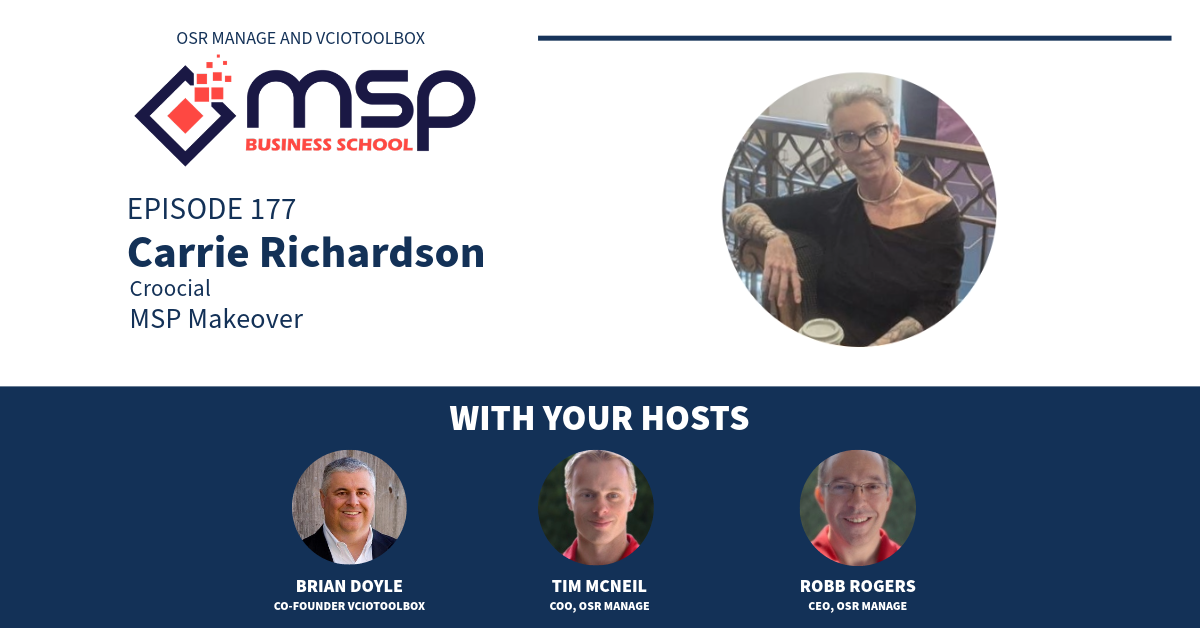
Ep 177Carrie Richardson - MSP Makeover
Show Website: https://mspbusinessschool.com/ Guest Name: Carrie Lyn Richardson https://www.linkedin.com/in/carrielynnrichardson/ Company: Croocial https://www.linkedin.com/company/croocial/ Hosts Brian Doyle: https://www.linkedin.com/in/briandoylemetathinq/ Robb Rogers: https://www.linkedin.com/in/robb-rogers-07415251/ Tim McNeil: https://www.linkedin.com/in/timmcneil3/ Sponsors vCIOToolbox: https://vciotoolbox.com OSR Manage: https://osrmanage.com 0:1:41 Carrie kicks off the podcast by talking about how she and Robb first met. She also talks about herself, her work experience, and how she started working in the MSP industry. 00:4:59 Carrie describes her company, Croocial. She tells the story of how the company began, talks about the tough times and the good times it had during the pandemic, and explains why she decided to start making podcasts. 00:13:35 Robb asks Carrie about the MSP makeover. Carrie explains in detail what it is, how it's making a difference in the community, and talks about its significant impact on vendors. 00:17:10 Carrie outlines the qualifications required for the MSP makeover. She gives a detailed overview, talks about what vendors will do, shares the topics they'll cover, and explains how to succeed in this new project. 00:20:00 Robb raises the question about the pre-preparations leading up to the podcast recording. Carrie shares insights into the meticulous groundwork essential for crafting engaging and impactful podcast episodes.

Ep 176Dan Adams Business Success is a Team Sport
Show Website: https://mspbusinessschool.com/ Guest Name: Dan Adams https://www.linkedin.com/in/danielericadams/ Company: Up-Skill.com Hosts Brian Doyle: https://www.linkedin.com/in/briandoylemetathinq/ Robb Rogers: https://www.linkedin.com/in/robb-rogers-07415251/ Tim McNeil: https://www.linkedin.com/in/timmcneil3/ Sponsors vCIOToolbox: https://vciotoolbox.com OSR Manage: https://osrmanage.com 00:1:25 Dan starts by talking about his work history in the industry. He shares about the different jobs he's had in well-known companies. He talks about the important changes he's seen happen in the tech industry during his time working. 00:3:30 Brian talks about Dan's book, "The Tech Nerds Guide to Career Success," explaining what it's mainly about and how it helps people with their jobs. He also talks about the forum Dan is running, where important people in the tech industry can talk about and solve difficult problems they face. 00:5:50 Dan looks really closely at the main problems that Managed Service Providers (MSPs) often face. He talks about the mistakes they might make that could hurt their businesses. Dan gives clear examples to explain these problems and then suggests practical ways to fix them. He says how important it is for MSPs to be professional, good at technical stuff, and have good people skills because these things really affect how successful they can be in the industry. 00:15:08 Tim starts talking about how important it is to have good ways of doing things and making plans to make a business successful. Dan says that the most important thing for making progress is people being ready to change and learn new things. He explains that it's really important for everyone in a company to think in a similar way and be open to new ideas, saying that being ready for change is key to doing well. 00:18:12 Dan talks about how being a good leader and taking responsibility are really important in a company. He says it's crucial to tell employees exactly what's expected of them. Dan explains the difference between just being the boss and taking real responsibility. He says it's really important for everyone to have the same goals and understand what's expected so that the work can go smoothly and the team can work well together. 00:21:28 Dan elaborates on a prevalent misconception within tech companies regarding hiring practices. He addresses the fallacy that solely assembling a proficient tech team guarantees a company's success. Dan goes further into this idea, explaining that there are many other important things a company needs to do to be successful besides having a skilled tech team. He talks about all the different parts that are needed for a company to do well, not just having good tech people.

Ep 175Its time for IT Nation and Brian's PitchIT Finals
Show Website: https://mspbusinessschool.com/ Hosts Brian Doyle: https://www.linkedin.com/in/briandoyl... Robb Rogers: https://www.linkedin.com/in/robb-roge... Tim McNeil: https://www.linkedin.com/in/timmcneil3/ Sponsors vCIOToolbox: https://vciotoolbox.com OSR Manage: https://osrmanage.com 1:09 Robb starts the podcast enthusiastically as he mentions that both companies, OSR and vCIOToolbox, are attendees for IT Nation. 4:40 Robb commends Brian for his improved 30-second pitch and expresses pride in his progress in delivering a concise message. Brian then discusses the challenges of crafting a 30-second pitch and how he improved through the PitchIT program. 6:11 Brian talks about his journey from avoiding self-promotion to becoming more comfortable with it. They discuss the benefits of receiving constructive criticism and the importance of embracing it to grow. 12:43 They discuss the impact of PitchIT and how it has helped them refine their pitches and brand messages. 15:02 The hosts encourage listeners to attend the PitchIT competition at IT Nation and witness vendors' well-crafted 30-second pitches. 19:44 Brian delivers a short and concise pitch for vCIOToolbox and asks for the audience's support in the competition.

Ep 174Ian Garrett - Do you know where your data is?
Show Website: https://mspbusinessschool.com/ Guest Name: Ian Y. Garrett https://www.linkedin.com/in/ianygarrett/ Company: https://www.phalanx.io/ Hosts Brian Doyle: https://www.linkedin.com/in/briandoylemetathinq/ Robb Rogers: https://www.linkedin.com/in/robb-rogers-07415251/ Tim McNeil: https://www.linkedin.com/in/timmcneil3/ Sponsors vCIOToolbox: https://vciotoolbox.com OSR Manage: https://osrmanage.com Ian Y. Garrett is the CEO and co-founder of Phalanx, and was formally a US Army Cyber officer as well as a data scientist in the defense sector. He combines his operational knowledge with his PhD research to bring unique insights to the intersection of artificial intelligence & cybersecurity. 1:49 Ian Garrett, our guest today, takes a moment to introduce himself and give us a peek into his journey into the industry. Ian also talks about data loss prevention solutions, offering us his professional insights and thoughts on these products. 9:24 Ian highlights the prevalence of AI automation tools in the data loss prevention landscape. He sheds light on the dual-edged sword these tools represent, as they empower both defenders and attackers. This discussion underscores the significance of incorporating automation into your defense and security strategies, emphasizing that relying solely on human efforts is akin to starting a losing battle. 13:00 Tim raises a pivotal question about integrating AI effectively. Ian advocates for a focus on automation over AI, pointing out that sometimes, it's the automation itself that holds the key, without the need for AI complexity. He strongly emphasizes the importance of reducing or eliminating human involvement within the system as a critical step to mitigate or prevent data loss. 18:00 BBrian discusses the nuances of risks and de-risking and turns to Ian to explore his approach model, particularly for those individuals who may not be well-versed or deeply invested in the nuances of AI.
Ep 173Bigger than Fire, AI and You!
Show Website: https://mspbusinessschool.com Hosts Brian Doyle: https://www.linkedin.com/in/briandoylemetathinq/ Robb Rogers: https://www.linkedin.com/in/robb-rogers-07415251/ Tim McNeil: https://www.linkedin.com/in/timmcneil3/ Sponsors vCIOToolbox: https://vciotoolbox.com OSR Manage: https://osrmanage.com 2:19 Robb kicks things off by discussing how you can really get into AI, and he suggests using Chat GPT. He goes on to explain how simple yet incredibly valuable AI can be, saving you a ton of time. However, he also highlights a common stumbling block - improper use of prompts that hinders many from harnessing AI's full potential. 8:05 Tim raises a valid question about the downsides of systems like ChatGPT, and Robb addresses some of the issues and limitations he's come across. Robb also mentions that many companies are working on developing their own private AI models to avoid some of these pitfalls. 14:52 Tim brings up the topic of AI regulation, expressing his concern about the lack of regulation in this field. He points out that this is indeed a complex issue. Robb offers an example of how AI, like ChatGPT, could potentially claim ownership of content you've worked hard on. Brian chimes in and talks about the challenges in regulating AI and its effects. 17:01 Brian shifts the conversation to deepfakes, noting their incredible yet somewhat unsettling potential. Robb agrees with Brian and mentions examples like Descript and D-ID AI, which he found to be impressive. 19:16 Brian then looks ahead to the future of AI. Robb shares his insights, anticipating significant AI developments in the next two years, such as AI making prospecting calls. Tim adds that he envisions a future where we can have meaningful conversations with AI, where they assist people, gather reactions, handle objections, and even train individuals.
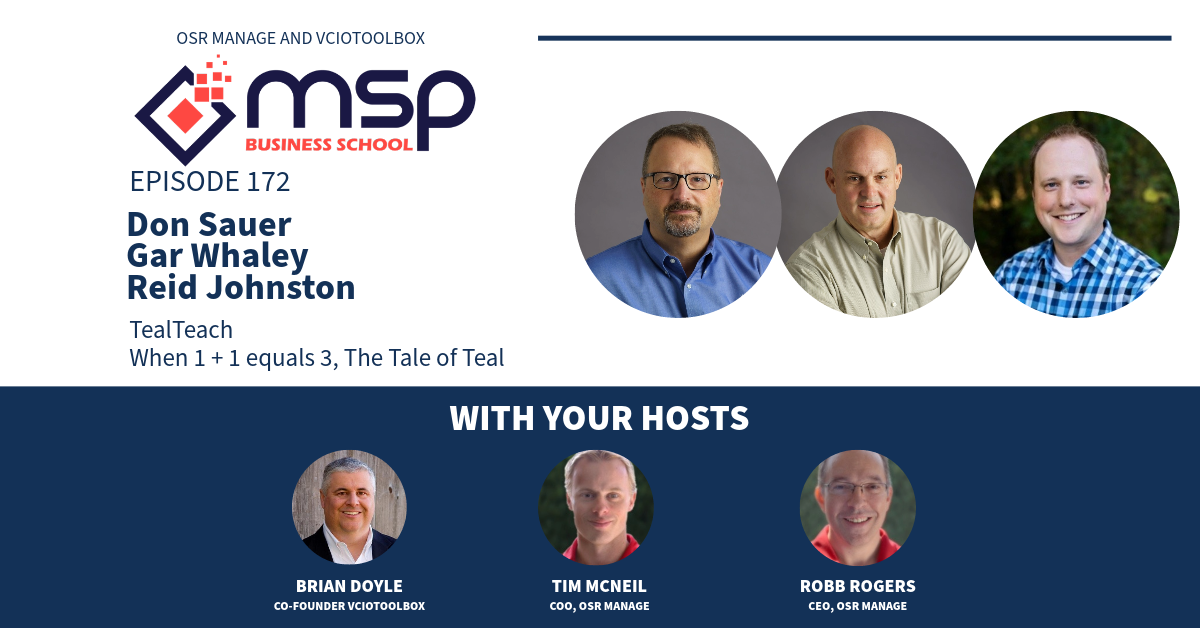
Ep 172When 1 + 1 equals 3 The Tale of Teal with Don Gar and Reid
Show Website: https://mspbusinessschool.com/ Guest Gar Whaley linkedin.com/in/garwhaley/ Don Sauer linkedin.com/in/donsauer Reid Johnston linkedin.com/in/reidjohnston/ Company: TealTech tealtech.com Hosts Brian Doyle: https://www.linkedin.com/in/briandoylemetathinq/ Robb Rogers: https://www.linkedin.com/in/robb-rogers-07415251/ Tim McNeil: https://www.linkedin.com/in/timmcneil3/ Sponsors vCIOToolbox: https://vciotoolbox.com OSR Manage: https://osrmanage.com Don Sauer Took a more direct path to acquiring nearly 35 years of IT expertise. It began in the US Navy, where he first worked on computer-controlled weapons systems. From there he amassed diverse IT experience in every kind of industry and organization, public-sector and private, startup to large-scale enterprise. Each presented unique challenges and allowed Don to develop a rare diversity of perspectives when it comes to designing and deploying IT solutions, and it never obscured Don's focus on learning what's best for a specific business, agency, or organization. Gar Whaley Gar Whaley, Aligned cofounder, always knew he wanted to run his own business. As technologically savvy as he is today, he honed his customer-centric business philosophy in the restaurant industry. Though he found satisfaction in owning a successful franchise, this experience introduced him to computer systems. Gar realized how beneficial appropriate IT solutions could be for other small businesses. This realization led him into the technology sector over 25 years ago, during the dot-com boom. Reid Johnston TechGen Consulting, Inc. was founded by Reid in 2000 as a sole proprietorship and later incorporated in 2002. Before starting TechGen, Reid worked as a web application developer, with a passion for problem-solving and working with people. A technology enthusiast from a very early age, Reid dismantled and rebuilt computers before finishing elementary school. He holds a Bachelor of Science degree in Entrepreneurial Management from the Carlson School of Management at the University of Minnesota. 1:33 Gar Whaley kicks things off by sharing how he, Don, and Reid started working together and what their current projects are. Then, Reid speaks on why choosing to merge was a game-changer, not just for him personally but for their company too. And Don chimes in, explaining how their teamwork is a win-win, allowing them to serve their clients even more effectively." 12:05 Tim throws a curveball, asking, "What caught you off guard during the merger?" Don doesn't hold back and spills the beans about a client bailing just four days before the settlement. It was a gut punch, but thanks to their strong bond, they saw it as a mere speed bump on their journey. 16:33 Reid chimes in with his response to Tim's query. He admits that navigating the varying communication styles and practices between their merging companies posed a real challenge. They knew it would be par for the course, but they're committed to smoothing out these wrinkles as they move forward. 18:10 Gar delves into why and how their merger hit the bullseye. The fact that they had remarkably similar tech stacks and product offerings was a major win. What's more, sharing nearly identical core values, makes the merger feel like a walk in the park. 23:29 Reid gives a bit of advice to those who are planning on doing a merger or acquisition to have partners you can trust. Gar says that having an entrepreneurial mindset is also one of the keys which Brian agrees.

Ep 171Frank Raimondi and Matt Koenig - Nodeware Great Compliance Starts with Identifying your Vulnerabilities
Show Website: https://mspbusinessschool.com/ Guest Frank Raimondi linkedin.com/in/frankraimondi Matthew Koenig linkedin.com/in/mkkoenig Company: Nodeware® https://nodeware.com/ Hosts Brian Doyle: https://www.linkedin.com/in/briandoyl... Robb Rogers: https://www.linkedin.com/in/robb-roge... Tim McNeil: https://www.linkedin.com/in/timmcneil3/ Sponsors vCIOToolbox: https://vciotoolbox.com OSR Manage: https://osrmanage.com 2:23 Matthew shares how he started his MSP journey. Interestingly, he was in a band before and even played for Disney! He shares that similar to a lot of people in the industry, he also started as a salesperson and he kind of drifted to specializing in MSP. Frank also shares his background and experiences with some notable companies such as Apple, Intel, and more. 13:30 Matt and Frank discuss their integration with vCIOToolbox. 17:31 Frank discusses the concept of Cyber hygiene and how it relates to compliance and GRC. He simplifies the idea of cyber hygiene, emphasizing its relevance to anyone navigating the digital landscape. He also talks about vulnerability management. 19:48 Brian addresses the impacts of the changes on the end user. He observes that in the current landscape, there's a noticeable shift in emphasis, with cyber liability taking center stage over the traditionally dominant concerns related to regulatory adherence and compliance. This shift reflects a growing recognition of the evolving digital risks and the increasing need to address them comprehensively. 22:12 To wrap up the podcast, Brian provides valuable insights into the functionality of vCIOToolbox and explains how its seamless integration with Nodeware can bring significant benefits to end users.

Ep 170Roundtable - Making the Shift from Owner-Led Sales
Show Website: https://mspbusinessschool.com/ Hosts Brian Doyle: https://www.linkedin.com/in/briandoylemetathinq/ Robb Rogers: https://www.linkedin.com/in/robb-rogers-07415251/ Tim McNeil: https://www.linkedin.com/in/timmcneil3/ Sponsors vCIOToolbox: https://vciotoolbox.com OSR Manage: https://osrmanage.com 2:11 Tim kicks things off by mentioning that there are various paths to making a transition. He then shares a story about how he and Robb got their transition journey underway, offering some friendly advice on how to go about hiring more folks and what initial steps you should take when thinking about making a switch. Afterward, Robb chimes in on Brian's question about the ideal timing for bringing in a sales rep, pondering whether it's best to do it before you commit to a transition or afterward. 8:57 When talking about sales reps, Tim points out that if someone's doing well within the MSP community, they really know their stuff. However, he also emphasizes that it's not a one-person show. Having a solid sales engineer and a good process working behind the scenes is just as important. 11:00 When Brian reflects on the most memorable onboarding experiences, he fondly recalls receiving gifts, but what stood out was that these gifts weren't just for the new sales reps themselves—they were actually thoughtful gestures for their spouses or partners. He also brings up some other awesome practices that he found really valuable during onboarding. 16:00 Robb jumps in and gives a full list of what to do and how to properly onboard a new sales rep. Brian and Tim add their two cents by sharing one of their memorable experiences. 20:00 Returning to the key question about shifting towards owner-led sales, Brian explains that having a great sales rep has a direct impact on your sales. It's crucial to consider how these reps communicate with the team, their people skills, and how they handle interactions with others, as this reflects how they treat your company's customers.

Ep 169Bobby Jacobs – Meet your customers where they live
Show Website: https://mspbusinessschool.com/ Guest Name: Bobby Jacobs https://www.linkedin.com/in/bobbyjacobs/ Company: Thread https://www.getthread.com/about-us Hosts Brian Doyle: https://www.linkedin.com/in/briandoyl... Robb Rogers: https://www.linkedin.com/in/robb-roge... Tim McNeil: https://www.linkedin.com/in/timmcneil3/ Sponsors vCIOToolbox: https://vciotoolbox.com OSR Manage: https://osrmanage.com Bobby Jacobs is the Head of Growth at Thread. It has previously sold refurbished HP products on AIM. Prior to Thread, Bobby was an early employee at Liongard where he helped MSPs increase their security, efficiencies, and profit. Bobby is also the 2nd Grade Biggest Smile Winner. 3:15 – Bobby tells us more about himself and how he ended himself in the strange world of MSP. He loves the MSP space. When he was first at Liongard, he introduced many of his friends to the MSP space. He is also an undergraduate entrepreneur. He was looking for his next opportunity, and a mentor of his knew a person who owned a company in Houston that resold and refurbished IT hardware. For around 30 years, this company has been reselling compact items. 7:48 – Brian claims that all of them have specialized knowledge and are mostly attempting to teach a person how to fish out here. He adds that he, Robb, and Tim were all from that area and that he sought to take what little of it they accomplished and figure out a way to share it with others. 8:45 – Tim emphasizes that there are a lot of vendors in the space that came specifically from the MSP world. He also states that they do not need to begin in the MSP community, but it does make the transfer into the vendor market much easier. 14:46 – Bobby states that he was been really cool about what happened a year ago now. They held a weekend hackathon to begin utilizing open AI, which generated discussion. As a result, they developed the first iteration of their automated time input application and gave their AI service the name co-pilot. 20:34 – Brian indicates that the applications are endless. Robb and Tim have discussed it from a sales perspective. He also says that they are investigating how they may help with investigations by understanding the responses that have been supplied globally. 21:25 – Robb places a bet with Bobby for the first time in years that there will be more AI firms with cybersecurity concepts out there, and that vendors with AI front and center will outnumber vendors with cybersecurity front and center.

Ep 168Karla Reffold (Orpheus Cyber) - Is your vendor ready to a Cyber Event
Show Website: https://mspbusinessschool.com/ Guest Name: Karla Reffold https://www.linkedin.com/in/karlareffold/ Company: Orpheus Cyber https://orpheus-cyber.com/ Hosts Brian Doyle: https://www.linkedin.com/in/briandoylemetathinq/ Robb Rogers: https://www.linkedin.com/in/robb-rogers-07415251/ Tim McNeil: https://www.linkedin.com/in/timmcneil3/ Sponsors vCIOToolbox: https://vciotoolbox.com OSR Manage: https://osrmanage.com Karla is the COO of Orpheus Cyber. Orpheus is a threat intelligence company with a SAAS platform that helps organizations manage their own risk, and that of their third parties, with an easy-to-understand cyber risk score. Prior to joining Orpheus, Karla founded the international recruitment business, BeecherMadden before overseeing their acquisition by Nicoll Curtin. As a Director for Nicoll Curtin, she expanded the company further before moving to the US to accelerate the growth of the American business. 2:55 – Karla shares her background and how she got involved with the MSP Marketplace. She made a shout-out to Mark of Appgate saying he is the person who opened the MSP door for her and introduced her to a variety of people, events, and other activities. 7:47 – Brian appreciates Karla's observation. Brian also emphasizes that the MSP market is starting to realize the importance of security. He also poses a question about Third-Party Risk and the matrix to be shared with the customer. 15:16 – Karla states that she was amazed to be able to watch teams go from one head of information security who couldn't obtain a budget to teams of 10 to 20 or more. 18:29 – Brian claims that even threats are constantly evolving, therefore they require the support of someone who can remain on top of it for them since MSP owners and teams already have too many responsibilities. He also asks Karla about MSPs collaborating with customers to help vendors better. 20:15 – Tim mentioned that he and Robb work more on the sales side, and he thinks that it'll be game-changing to find new ways to show vulnerabilities to prospects and ways that they can help.

Ep 167Nick Wolf Evo Security Access Required
Show Website: https://mspbusinessschool.com/ Guest Name: Nick Wolf https://www.linkedin.com/in/wolfnick/ Company: Evo Security https://www.evosecurity.com/ Hosts Brian Doyle: https://www.linkedin.com/in/briandoylemetathinq/ Robb Rogers: https://www.linkedin.com/in/robb-rogers-07415251/ Tim McNeil: https://www.linkedin.com/in/timmcneil3/ Sponsors vCIOToolbox: https://vciotoolbox.com OSR Manage: https://osrmanage.com Nick is the Director of Partner Acquisition at Evo Security, an Identity and access Management vendor for MSPs and MSSPs. Previously he worked at Datto for 9 years as one of their first employees and helped grow the company from being a startup to a successful exit of over $1 Billion. He also helped launch SKOUT Cybersecurity, an XDR vendor for MSSPs that was later acquired by Barracuda Networks in 2021. 3:31 Nick Wolf opens up about himself. He shares that he's been in the MSP industry for 13 years and he started way back in high school. He also talks about what he does and what his company offers. 7:41 Brian inquires about Nick's most memorable tales from the cyber world, prompting Nick to share some interesting and unforgettable experiences. In addition, Nick emphasizes the critical significance of identity protection in today's digital landscape. 12:06 Tim queries Nick about the company's aspirations for the next two to three years. Nick shares some of their future plans, collaborations, and partnerships. He also talks about how their products are revolutionizing the security industry. 18:49 Robb inquires about Nick's journey into Evo, to which Nick recounts how it all began through a LinkedIn connection with the CEO. Robb further expresses astonishment at the rapid growth of the company, noting that Evo has expanded its size by a remarkable factor in a relatively short span of time.

Ep 166Have you Mastered your Sales Pitch
Challenge: We'd love to hear your pitches! If you can, send us a video of you, and let's have a pitch dissection series here at MSP Business School! Show Website: https://mspbusinessschool.com/ Hosts Brian Doyle: https://www.linkedin.com/in/briandoyl... Robb Rogers: https://www.linkedin.com/in/robb-roge... Tim McNeil: https://www.linkedin.com/in/timmcneil3/ Sponsors vCIOToolbox: https://vciotoolbox.com OSR Manage: https://osrmanage.com 2:56 Brian introduces the topic of how to make elevated and effective pitches for MSP. Robb offers his perspective on the matter saying he has an advantage on this, given that their company offers a product that formulates concise 30-second pitches for clients. Nevertheless, he emphasizes that the dynamic changes when you're under the pressure of a ticking timer, underscoring the critical importance of preparedness and diligent practice. 4:30 Brian reflects on his past experiences in delivering sales pitches, pinpointing the challenge of condensing and selecting key elements within a timed presentation. Robb agrees with Brian saying that Tim and he even allotted 170 hours just to perfect the two decks they've meticulously crafted. Tim talks about how he did his 60-second pitch and shares some techniques. 12:49 Tim and Robb answer the question "What should an MSP think about when crafting a pitch?". Brian also added how important getting into the hook part fast when giving a pitch. 18:40 Robb probes Brian with a thought-provoking question: Which is the more intimidating challenge, the investor pitch or the MSP pitch? Brian responds candidly, and Robb, drawing from his own experiences, acknowledges the significant stress associated with these endeavors.
Ep 165Sales Trend Insights with Allison Trisko and Charlie Farris
EP 165 - Sales Trend & Insights with Allison Trisko and Charlie Farris 1:15 Robb introduces the two guests, Charlie and Allison. They are both from OSR Manage. 1:58 Charlie talks about how Managed Service Providers (MSPs) can contribute to the efficient operation of a business. He also gives an example of how club members get membership in exchange for "protecting Member data" which indicates the importance of maintaining the privacy and security of sensitive member information. Since club members invest a significant amount of money for their membership privileges, it's crucial to safeguard their data and ensure a secure environment. 4:35 Tim pitches in and says there is a potential role for MSPs in the business, e.g., golf course. Even though colleges or universities might not be the primary targets for MSPs, it's still valuable for MSPs to explore opportunities in such diverse industries. 9:23 Tim highlights the growing acceptance of co-management, drawing parallels between industries with diverse revenue streams, and emphasizing the strategy of entering through specialized aspects and then expanding within different industries. 12:22 Charlie emphasizes how the specialized approach of MSPs in the country club industry is bringing about positive changes in how these clubs operate. When the MSPs effectively demonstrate the value they can provide, it leads to improved business processes, and this shift is more likely to occur when the clubs recognize the need for improvement and solutions to their challenges. 14:28 Allison discusses how contracts with private golf courses and MSPs work similarly to other businesses. It also encourages the idea of reaching out to golf courses beyond your immediate area, as there might be broader opportunities through associated courses in different states, which could potentially be served remotely. The importance of identifying challenges and building relationships is emphasized.

Ep 164MSP Marketing Made Easy with Taher Hamid
Show Website: https://mspbusinessschool.com/ Guest Name: Taher Hamid https://www.linkedin.com/in/taherhishamhamid/ Company: MSP Camp https://msp-camp.com/ Hosts Brian Doyle: https://www.linkedin.com/in/briandoylemetathinq/ Robb Rogers: https://www.linkedin.com/in/robb-rogers-07415251/ Tim McNeil: https://www.linkedin.com/in/timmcneil3/ Sponsors vCIOToolbox: https://vciotoolbox.com OSR Manage: https://osrmanage.com 3:45 - Taher Hamid introduces himself. He talks about how they started with three people but now they have over 28 staff in a state-of-the-art building with amazing facilities. 6:53 - Robb asks about the number one mistake made during his first year. His biggest mistake, he says, was not learning enough. He also discusses how long it took him to land his first major client. Taher further explains how producing relevant content and attending various events may help with marketing. 10:18 - Taher discusses the MSP Camp and how helpful it would have been if he had known about it when he was just starting out. He also highlights how detailed and particular social media content should be in order to have a successful campaign. 16:33 When it comes to marketing, Brian agrees with Taher. Marketing should concentrate on "what do they care about?"". Robb adds that engaging in social media is also highly important. Tim expresses his observation that many MSPs do not have marketing staff or outsource marketing to a marketing business but do not devote enough effort to it. 19:37 Taher points out how important time is in marketing, "time is a strategy". 22:05 Taher talks about MSP Camp and what to do if you want to join in one.
Ep 163Jake Gregorich – Integrating Cultures in M&A
Show Website: https://mspbusinessschool.com/ Guest Name: Jake Gregorich https://www.linkedin.com/in/jake-greg... Company: Lyra Technology Group https://lyratechgroup.com/ Hosts Brian Doyle: https://www.linkedin.com/in/briandoyl... Robb Rogers: https://www.linkedin.com/in/robb-roge... Tim McNeil: https://www.linkedin.com/in/timmcneil3/ Sponsors vCIOToolbox: https://vciotoolbox.com OSR Manage: https://osrmanage.com Jake oversees revenue generation for one of the largest and fastest-growing IT service companies in the country, Lyra Technology Group, An Evergreen Services Group Company. In just five years, he went from an entry-level copier and IT salesperson to head of sales of an enterprise-size MSP which is on pace to double in size in 2023. He shares his experiences and learnings from that journey with his team and partner companies to help them achieve their growth goals. 02:13 – Jake, who is acquainted with someone at Pepsi Co, shares his journey through their management training program. Pepsi Co is a Fortune 50 company with a slow corporate ladder, with gross margins of 10%. Jake's entrepreneurial spirit and quick-moving nature make him a strong candidate for a job with Impact Networking, a large MSP based in Chicago. The company's sales training program has been experiencing significant growth, and Jake's entrepreneurial spirit has helped him succeed in his career. 04:43 – Robb inquires Jake as to where we are on the sales side of that company and at what level. How did it feel to be in that capacity, moving up into a much larger company? What was your sense of progress, and how did the transition go for you? 08:17 – Brian mentioned that when an acquisition occurs, those who dislike the corporate world may struggle to transition into the PE-backed arena due to the new reporting structure, reporting quality, and accountability changes. This is due to the new accountabilities and accountability requirements, which are essential for success in the PE-backed arena. 12:52 –Tim explained that being in charge of 20 different MSPs across the Northeast and Midwest keeps us updated on what they're doing, how the transition has gone, and how it's functioning. 17:15 – Brian suggested keeping ownership groups somewhat autonomous helps with the transition, as they don't relinquish power overnight. This approach model allows them to become part of the larger mission, which is interesting. 19:21 – Jake said that there are some things that they should know that suggests preparing for an event, especially for MSP owners who want the highest check. Knowing which companies to work with and ensuring the highest check is crucial for success in a large auction process. Companies that prioritize the highest check are more likely to be involved in the event.
Ep 162Brian Hoppe - Why your Business Needs a Coach
Show Website: https://mspbusinessschool.com/ Guest Name: Brian Hoppe https://www.linkedin.com/in/brianhoppe/ Hosts Brian Doyle: https://www.linkedin.com/in/briandoylemetathinq/ Robb Rogers: https://www.linkedin.com/in/robb-rogers-07415251/ Tim McNeil: https://www.linkedin.com/in/timmcneil3/ Sponsors vCIOToolbox: https://vciotoolbox.com OSR Manage: https://osrmanage.com Brian Hoppe has been part of the Managed Services industry since the early 2000s. He earned both his Bachelor's and MBA from Baylor University. For over 20 years, Brian has worked in multiple MSPs and has bought and sold multiple MSPs. He's been everything from a technician to Ops Manager to CFO to CEO. He has grown multiple MSPs to over $5 million in revenue and managed MSPs in excess of $15 million in revenue. Brian has a thorough understanding of all the ins and outs of running a highly successful MSP. But more importantly, he understands how to help MSP leaders get the most from their business. His expertise in leadership and coaching can help any MSP owner or CEO achieve the results they want in both business and life. 01:48 – Brian's journey from MSP to a full-service managed service provider began 20 years ago with a company he did not own. In 2007, the company transitioned from break-fix to completely managed services, growing from a couple of individuals over 45 to a fully managed service. Brian's career is marked by the transformation from a family office-owned company to an MSP company. 06:08 – Brian talks about the need for open communication during the due diligence process, as there are no secrets involved. This process can take a long time, especially if peas are engaged from introduction to deal closing. 10:12 – Brian discusses a business partner and a conversation outside his knowledge. He discussed the potential outcome of the deal and his willingness to exit for money or after the sale. 12:22 – Tim comments on what Brian Hoppe stated, and he's curious to see what they're seeking to accomplish now, what their next venture will be, how they'll do it, and what the different things will be like. 16:37 - Brian asks what advice they might give to a first-time MSP considering entering the coaching journey, what questions they should be asking themselves, and what they should be prepared to undertake as they enter into that arrangement. 19:22 – Tim appreciates his coachability and the number of people joining peer groups with business coaches. He believes those who aren't open to change may not even consider it.
Ep 161Meet your customers where they live with Chris Dix
Guest Name: Chris Dix https://www.linkedin.com/in/thoughtpost/ Company: ChatStyle.ai https://chatstyle.ai/ Hosts Brian Doyle: https://www.linkedin.com/in/briandoyl... Robb Rogers: https://www.linkedin.com/in/robb-roge... Tim McNeil: https://www.linkedin.com/in/timmcneil3/ Sponsors vCIOToolbox: https://vciotoolbox.com OSR Manage: https://osrmanage.com Chris Dix is the founder of ChatStyle, a software company based in Charlotte, NC, that provides chat and automation solutions for MSPs and their customers. Chris has over 20 years of experience developing software and is a former Microsoft MVP. He is also an author and has spoken at conferences for Microsoft, O'Reilly, ConnectWise, and MSPGeekCon. 3:10 Chris gives an overview of how he started doing MSP. He is a software developer and this gives him the skill set needed in working for MSP. He also discusses what truly is his drive for joining MSP and the challenges he wanted to overcome. 5:15 Brian mentions that there are a lot of tools available in the market with a variety of functions, Chris pitched that his starting point was the lack of consistent communication channels for customers and tech team. 12:01 Chris starts talking about the AI function of the tool. 15:12 Robb asks about PSA integrations with the program. Chris answers ConnectWise and AutoTask to name a few. He also says implementation with Halo and Freshdesk is also ongoing. He also shares some plans they have for this year as well as some improvements, especially on CRM. 18:45 Before closing Robb asked Chris which app has more people, Slack or Teams. Chris explains his answer and shares what struggles and challenges they face to make their program work since these two applications have different focuses.
Ep 160Summer Selling Strategies
1:35 – Tim claims that OSR has been similar, with pipeline participants participating but without necessarily being present. According to him, this trend started last year and has intensified this year. Although there are methods to get around this, he thinks that more people are taking vacations this year than last. The prolonging of the time until closing is more likely a sign of unwillingness to depart than a lack of engagement. 4:25 – Robb explains the cyclical nature of MSP deal closings, indicating that they can speak to fewer decision-makers during the summer months, but they do require to have more time for longer conversations. This shift in prospecting may result in a more favorable market for schools, municipalities, governments, and contracts in dates. The recent flush season of the CPA provides an opportunity for MSPs to target these areas. 9:52 – Brian advised remaining involved and monitoring output to make sure that sales and deals are successfully accomplished during the summer. Sales may be slower since some transactions might take longer. Businesses should step up their efforts and concentrate on the third and fourth week of August when students return to school in order to make the most of the little window between Labor Day and Thanksgiving. Businesses can maximize their potential and secure success in the future months by concentrating on these things. 14:57 – Brian noticed that marketing firms frequently set the rules for how to market, but he discovered that other vendors showed less interest. Only marketing companies have fully included the video in their processes, therefore the MSP community may benefit from including fragments of it in their procedures. This is a result of their efforts to market and sell their services. 17:56 – Tim stated that it simply goes back to them wanting to separate themselves in any way shape or form because there is so much white noise out there that you have to break through it and video. 18:20 – Brian stated that as salespeople, they all understand that the first step is to sell the meeting and the second step is to sell the product, so they have to use something to get to the meeting, and if that can be a way to get to a meeting and put some trust into the equation upfront, put some comfortability with the end user for when they do meet with them, and it's something they can start doing in their spare time.
Ep 159Greg Sharp and Trevor Thomas - Contract Chaos no More
Show Website: https://mspbusinessschool.com/ Guest Name: Greg Sharp https://www.linkedin.com/in/greg-sharp-2598713/ Trevor Thoams – https://www.linkedin.com/in/trevor-thomas-yyc/ Company: ZenContract https://www.zencontract.com/ Hosts Brian Doyle: https://www.linkedin.com/in/briandoyl... Robb Rogers: https://www.linkedin.com/in/robb-roge... Tim McNeil: https://www.linkedin.com/in/timmcneil3/ Sponsors vCIOToolbox: https://vciotoolbox.com OSR Manage: https://osrmanage.com Greg Sharp & Trevor Thomas – Contract Chaos No More Greg Sharp, a CISSP-qualified IT security engineer, is the Managing Director of ZenContract, a company with team members in New Zealand, Australia, the Philippines, the United Kingdom, and Canada. With 30 years of experience in the IT industry, he has served on advisory boards for Datto, Autotask, Dropbox, Microsoft, and Cisco in the APAC region. Greg is currently on three MSP advisory boards and has been a director of multiple businesses. He built and sold three MSP businesses, including the latest one sold to a division of the New Zealand government for a record-breaking multiplier. This process and systems led to the creation of ZenContract, which allows MSPs to fully own contract and agreement management. Greg leads a dream team of specialists, forming a culture that automates and enhances MSP contract management for all MSPs. 6:45 – Brian stated that contract management is a key difficulty in MSPs because many contracts become open-ended at the contract point. 9:51 – Tim's focused on assisting MSPs in growing their sales departments and dealing with the complexity that comes from big clients. They've been talking with a client about how to get the service manager to work and get an accurate picture of their client base. The discussion attempts to assist clients in improving their sales departments and streamlining their contracts. 11:03 – Greg offered a glimpse of AOR over 12, 24, and 36 months, noting that their MSPs will be evaluated using a multiplier of contracted revenue. As they have contracted revenue for one to three years, this technique creates a sense of stability and assurance. The formula may be a combination of these criteria, offering a reliable assessment of the worth of their MSPs. 15:41 – Greg said that ConnectWise and Auto Task are currently quite well integrated with the system. They are now working on Halo, which will be released soon. The system incorporates price, work kinds, inventory, and other data at the client level. Because the solution does not play in CPQ distribution streams, they must include recurring monthly contracts. The PSA believes it is critical to bring this up for discussion. Halo is another price quoting tool, however, it is not specifically designed for managing recurring monthly revenue. 20:26 – Tim noted the ease with which account managers and VCIOs may access QBR, adding that it eliminates concerns regarding signature difficulties. He recalls incidents in the MSP world where a single signature caused problems. 21:38 – Greg mentioned that MSPs are also employing templates for project variation sign-offs, which allows them to deliver scope variations for signatures in the middle of a project. These templates are immediately saved in the PSA against opportunities or contracts, capturing all components of the solution negotiation process. This tool assists MSPs in managing project variances and ensuring the project negotiation process runs smoothly. 24:22 – Trevor expressed interest in working on the channel because he is familiar with several of the characters. He is looking forward to the pitching program and IT Nation Connect, which will focus on webinar strategies.
Ep 158Abe Garver – The latest M&A
1:13 – Abe outlines his plans to discuss three topics in today's podcast. First is his lunch conversation with an IT Nation member, which he thinks would be very helpful for the listeners. Second, an update on the overall market (acquisition). Lastly, IT Nation on Denver this August 2023. 5:26 – Abe shared a slide of the lunch conversation. He explains that in just 3.5 years, there are already 73 parties now involved and it includes 11 platform investments. 7:46 – The guest talks about the Modes Theory™. Robb does a follow-up to what is the Modes Theory™ about and what it is for. He emphasizes that one best aspect of the Modes Theory is that, you can have your leadership team take the assessment which means you can see and understand where your people are coming from. 12:50 – "Organic growth is more valuable than M&A growth", Abe emphasizes. Although he himself is an m&a advisor, he advocates organic growth. The business should have and focus on its secret sauce and grow organically, then later venture into m&a. He urges that these three should be satisfied: the business core, the best customers, and use m&a to help complement the first two strategies. 17:01 – Brian raises the question about vertical shifting. Abe gives advice and expands on how important having deep expertise in whatever vertical you are in. 20:51– Robb clarifies Abe's early statement in which the latter says that having 20% growth than a good profit is better. Abe explains further and discusses his previous point. 25:16 – To increase valuation, Abe suggests attending peer groups such as IT Nation every year. Lastly, he emphasized MSPs making a strategy to grow organically. 26:40 – Tim talks about how Sales Maturity helps a lot of MSPs during their pre-peer group stage but in the organic growth phase to get up and make an organic sales model
Ep 157Jake Carroll – Marcus Chans Ideas for Elevating your Discovery Game
Ep 156Inside the FTC Safeguards Rule
1:00 – Brian initiated the discussion and provided a brief overview of the Safeguard Rules, highlighting their scope, functionality, and associated regulations. 3:50 – Tim clarified the specific sector to which the rules are applicable, while Brian proceeded to illustrate several prevalent industries that, based on his experience, often struggle with managing sensitive information, such as social security numbers and similar data. 8:10 – Robb inquired about the last industry mentioned in the list and expressed astonishment upon learning that it was a "non-federally insured credit union." Brian explained that certain credit unions are affiliated with specific companies and drew upon his past professional experience working in such an institution. 11:04 – Robb inquired about the implementation timeline for the new rules, to which Brian clarified that they were initially introduced in December 2022 and were granted an additional extension until June 9, 2023. Brian expressed his belief that there would not be any further extensions beyond this point. He proceeded to outline the essential tasks that needed to be undertaken, including the proper handling and encryption of sensitive data, the development of incident response plans, and various other requirements. Brian highlighted that there were a total of 17 items on the list that needed to be addressed. 15:13 – Brian discussed how this new rule will be beneficial for the MSP. Robb pitched in some of his ideas on how he could build a more successful campaign using the new safeguard rule.
Ep 155Roundtable - PitchIT
We are part of the PitchIT Program! 00:48 Brian provided a summary of the PitchIT program, explaining its nature and purpose. Robb supported Brian's statement and shared his own experience of the program's inaugural class. He expressed his excitement at witnessing the participation of prominent and reputable companies in the program. 03:22 Brian talks about the challenges of starting a new company. 4:30 Tim talks about how awesome it was to be part of the program and just being together with like-minded individuals really sets a different mood. 06:18 Robb expresses his enthusiasm about the business assessment and reveals his surprise at receiving a low score, despite believing that he maintained a reasonably healthy work-life balance. Adding to the conversation, Brian shares that his score was low on the "strategy" aspect. 11:17 Brian urges other vendors who are listening to the podcast to join or perhaps listen to others in the program. He also highlighted that this also a great opportunity to network as well. 12:59 Robb encourages everyone to tune in to the ConnectWise LinkedIn page to learn more about clever business and good ideas related to the program.
Ep 154Roundtable - Using AI tools for Sales
The subject of today's podcast centers on the utilization of ChatGPT as an essential component of one's sales process. 00:54 Robb enthusiastically discusses how AI has the potential to be the next step in the development of the world. He then mentions how ChatGPT has been a valuable resource for him in multiple ways, including coding and stock trading, and expresses his amazement at its helpfulness. 2:47 Tim shares Robb's viewpoint, as he has also noticed that an increasing number of his clients are using AI to develop and construct emails. They have found AI to be a useful resource for generating initial content and creating sustainable emails that can be incorporated into automation sequences. 5:50 Brian discussed his use of AI in conjunction with a virtual assistant (VA). He specifically mentioned using Jasper, an AI tool he believes is more focused on marketing. Brian provided an explanation of Jasper's functions and described how he guides his VA in using it to achieve desired results that align with the company's tone. 9:42 Robb discussed the comparison between ChatGPT and Jasper, and Brian agreed that while the two AI systems share similarities, they have different applications. Brian also touched on the features of machine learning and AI present in both systems. 15:21 Brian expressed concern about the extent to which AI engines can learn and improve upon existing processes, and at what point they become aware that they are not learning for their own benefit. Tim agreed and acknowledged that Brian's worry is valid, citing social media as an example. He mentioned the significant role AI plays in creating posts and generating feeds, which can be overwhelming 17:59 Tim explained his use of AI in marketing and sales, specifically in creating LinkedIn posts, email templates, and content. Robb added that he uses AI as a tool to change the tone of his writing and transform bullet points into readable paragraphs. Brian also chimed in, stating that he employs AI to enhance the quality of his writing and generate effective subject lines for email campaigns.
Ep 153Final Sales War Stories - Unfortunate tales from the frontline
Ep 152Jake Carroll – A Day in the Life of a Virtual Sales Manager
Show Website: https://mspbusinessschool.com/ Guest Name: Jake Carroll https://www.linkedin.com/in/jake-carr... Company: OSR Mange https://www.osrmanage.com/ Hosts Brian Doyle: https://www.linkedin.com/in/briandoyl... Robb Rogers: https://www.linkedin.com/in/robb-roge... Tim McNeil: https://www.linkedin.com/in/timmcneil3/ Sponsors vCIOToolbox: https://vciotoolbox.com OSR Manage: https://osrmanage.com 1:59 – Jake said that there have always been a lot of people who chose to work in sales or as a group of people who work in sales, whether they had a degree or not. Before you could start working, there was no salary and you couldn't just go knocking on doors. 7:19 – Brian asks Jake what is his role as a Virtual Sales Manager. 11:07 – Tim stated he won't even argue that you were recruited as an engineer to protect forever, no matter what it is or how high up the scale it is. The salesperson actually needs more supervision, more oversight, and more training. 15:24 – Robb asks Jake what would you say do you manage a lot of people? Do you manage others or do you manage in salespeople? What would you say is probably what you have to do most during your manager time? Are you coaching, reps up, or are you doing kind of ability, are you being the person in between? What would you say is the most time-consuming of your job? 23:14 – Jake claimed that we currently have some very strong indicators, none of which are more straightforward than the emails you exchange with one another. Email correspondence between the individual you are dealing with at the company and your company is a really excellent indicator. The disadvantage of maintaining the moment is that it has a table and asks if everyone is in agreement if the meeting doesn't start or if this is the agenda.

Ep 151Roundtable - Better your MSP with the Business Model Canvas
Show Website: https://mspbusinessschool.com/ Document Link: https://tinyurl.com/ywv26e28 Hosts Brian Doyle: https://www.linkedin.com/in/briandoylemetathinq/ Robb Rogers: https://www.linkedin.com/in/robb-rogers-07415251/ Tim McNeil: https://www.linkedin.com/in/timmcneil3/ Sponsors vCIOToolbox: https://vciotoolbox.com OSR Manage: https://osrmanage.com 0:28 Brian kicks off the podcast by talking about the business canvas model. He talks about its advantages and how it can open great opportunities in the IT industry. 3:04 Brian starts introducing today's agenda and gives a brief description of what to do to dive into today's topic effectively. He starts presenting the business canvas model and discusses the different columns. 6:52 Robb shares his understanding of the value proposition. He says that when the company has new products or services, they always make it a priority to ask clients what they are trying to solve or what services they need that you can offer. Robb points out that it starts with stories of successes and failures. 11:39 Tim suggests that revenue size should also be considered under Customer Segments. He mentions that the revenue size of clients you bring in is critical. He also noted that mid-size companies are large enough to understand how technology works for them. 19:22 Robb discusses Channels. He gives emphasis not only on understanding the channels but how it relates to your budget. 26:44 Brian gives voice to the question, "How do we use?" He explains how using a business model could help a company immensely. Robb adds his thoughts on the partnership side. He said that a few years back partnerships were all transactional, however, when covid hit many companies suffered losses yet were saved due to having a close partnership. He ends his discussion with an encouraging note - be a person that has a great relationship with the partners/vendors and not just transactional because there's gonna come a time when they'll give you a referral or they're gonna help you when you are having an issue.

Ep 150Doug Kreitzberg Seedpod Cyber Protecting those protecting networks
Show Website: https://mspbusinessschool.com/ Guest Name: Doug Kreitzberg https://www.linkedin.com/in/dougkreitzberg/ Company: SeedPod Cyber https://seedpodcyber.com/ Hosts Brian Doyle: https://www.linkedin.com/in/briandoylemetathinq/ Robb Rogers: https://www.linkedin.com/in/robb-rogers-07415251/ Tim McNeil: https://www.linkedin.com/in/timmcneil3/ Sponsors vCIOToolbox: https://vciotoolbox.com OSR Manage: https://osrmanage.com In 2018, Doug founded a cybersecurity and data privacy risk consulting firm. It was through his consulting practice that he learned the value that Managed Service Providers bring to small and medium-sized businesses. That insight formed the basis for SeedPod Cyber, a cyber insurance managing general agency Kreitzberg founded in 2021 which partners with Managed Service Providers to provide cyber insurance to their clients. 1:49 Doug gives a brief recap on how he started in technology and insurance, then ended up running an organization. He also shares some reasons why Seedpod got created, the company's goals in providing better insurance coverage with a competitive price, and businesses that use their services. 5:50 Brian asks how to define if a company is over-insuring or under-insuring, in which Doug answers that two areas come into play when figuring out which insurance is better suited 1. Liability and 2.Cost of System Restoration. He also expounded on each point and gives examples of real-life situations. 14:20 How do people best protect themselves against attacks and what does it look like in the insurance industry? Doug answers Brian's question by saying that when it comes to MSP, it's always related to aggregation risks. There are several aspects to dealing with these situations, technical standpoints and contractual aspects. He elaborates that the relationship that you have with your client, account management, and trust is very critical when an event occurs. 20:35 Robb expresses his opinion on how smart and how good of an idea Doug's company does. He explained that usually when there are problems or stressful situations, the first thing we ought to do is to just jump in and fix the problem but now he realized that it's equally/more important to step back and call the insurance provider to avoid further damage. 22:07 Brian poses his last question about the state regulations impacting the premiums. Doug answers that state regulations are actually favorable however the new privacy regulation is still under heat.
Ep 149Perfecting the Art of the Sales One on One
EP 149 - Roundtable - Perfecting the Art of the Sales One on One 2:21 Robb starts discussing his ideas about sales one on one. He says that one important aspect that owners missed is having a head check. He points out that it is essential to start the week by asking your sales persons how they were and if there were anything they would like to talk about. In this manner, you are understanding your sales reps before you are understood. 6:44 Robb continues saying that it should always be the reps that have to bring in the numbers and the report, and not the manager. Brian agrees with Robb's point as the reps are the ones responsible in bring in people to the business. Tim expands the discussion by specifying that when choosing reps, you want somebody who is money-driven and someone who knows exactly what they were doing. 10:30 As Brian talks about reps fluffing their reports and numbers, Robb provided two easy ways to recognize if the reps are fluffing – a) the 8-6-4-1 rule and b) if they keep talking about the one deal they are working on. He expounds that these two methods have been of great help in identifying red flags. 14:55 The third step in perfecting sales one-on-one according to Robb is having built-in steps for the next six weeks. He emphasized that if there are no steps shown, you are going to start from square one as it is already considered a lost deal. He also added that aside from weekly meetings, it is also necessary to meet monthly to talk about quarterly rocks – how to improve the reps long term and how to get them to the next position in the company. 17:04 Tim added that one-on-one meetings with sales reps are different from one-on-one meetings with engineers or tech people. Salespeople got different personality types, they may like to talk and banter, so you ought to be prepared for the difference in the conversation. Robb joins in the topic, sharing his idea that it is significant to talk about their wins or losses however it is as equally as important to talk about how did they get to that win or loss. This is to figure out which aspects you can coach and have them supported. 19:20 Brian gives a recap of all the key points talked about during the discussion.
Ep 148Roundtable – Huddle Up! Revitalizing the Daily Standup Meeting
00:54 – Brian mentioned that many companies like to do daily stand-ups and huddles, but they are often haphazardly run and not as effective as they could be. They have a standardized process for running sales huddles with all their sales reps cascading across the US that virtually manage, but they can give insight into how to structure the huddle and make sure it is effective for all users on a call. 5:03 – Robb suggested that the role play should be divided into two parts: prospecting and objection handling. The goal is to have the participants try to get past a gatekeeper and get shut down by the gatekeeper, and then role play until one good thing is achieved. 6:36 – Tim said that the MSP Sparks have stats and figures that are easy to grasp, making it easier for salespersons to find the next reason why they should reach out to a company again. This helps them to have something in the back of their head to pull from when they talk to the decision-maker. 11:28 – Tim believes that role play is an effective way to self-diagnose a rep. He suggests finding a 3-minute call that is not an everyday thing, once a week or at least every other week, and listening to it. This is a good time for the rep to self-diagnose. 14:00 – Brian believes that a good morning huddle should have a conversation about what they did today, what they did yesterday, and what they accomplished yesterday. They also like the concept of mixing up content to keep people engaged, such as role play, pulling a calling, and bringing in inspirational quotes or something else to celebrate a win or dissect a loss. This will help keep people engaged and keep them focused on the task at hand.
Ep 147Len DiCostanzo – Accelerate Partner integration in your stack and Sell More
Len DiCostanzo has been a mainstay of the global IT channel and is a sought-after consultant and speaker. For decades, he has been providing thought leadership and best practice guidance for senior leaders who want to understand the channel's roots and its future. DiCostanzo consults and collaborates with leading and emerging channel vendors, as well as managed service providers and business technology solution providers who want to accelerate growth and better serve clients. He has worked with thousands of partners helping them build their managed services practice with a focus on service catalog development, pricing and bundling, and go-to-market strategy development and execution. His recent work has focused on helping SaaS and cybersecurity vendors and specialty distributors to grow their MSP and VAR channels by building comprehensive partner programs. The programs are designed to drive internal awareness across the business while accelerating partner go-to-market motion and recurring revenue for the vendor and their partners. Len has consulted with and led the buildout and execution of Partner Programs for top channel vendors including ConnectWise, LogMeIn, and LastPass. 2:08 – Len has been in the business for a long time, having started a solution provider business in 1984. He was a solution writer for 20 years and sold his business to a publicly traded company in 2001. He then moved to consulting and helping them build out their global MSP partner community and eventually found a role at Auto Task. 5:51 – Tim believes Len just made an important point about the number of MSPs they've spoken with over the years who simply don't know how to wrap all of those into one service. Despite his belief that people are far more advanced than they have ever been, there is still a great need. 9:10 – Brian believes that products are becoming more specialized and that MSPs should form a partnership with their vendor partner to better support their needs. This includes educating the vendor on how to better meet the needs of the MSP. 9:50 – Len said that it depends on the vendor and how they intend to market. They are aware that they are an outsourced partner. The bottom line is that every vendor must become a more strategic partner for the MSP, which begins with having a comprehensive and robust partner program. 11:43 – Robb's message is that MSPs often go to vendors with great ideas and don't implement them, leading to a loss of the vendor 6 months later. It is a powerful message that can help both the sale and implementation sides. 16:07 – Len spent a year and a half with Cordo before COVID sold the business, building a product called Cloud Optimizer for offices of sixty-five. He now consults on the MSP side and talks about the vendor's offering. 21:25 – Brian believes that the only way to increase the amount per seat charge is by consolidating products, building them into the service offering, and providing services around it. The products are just enablers for him to get to that service offering.
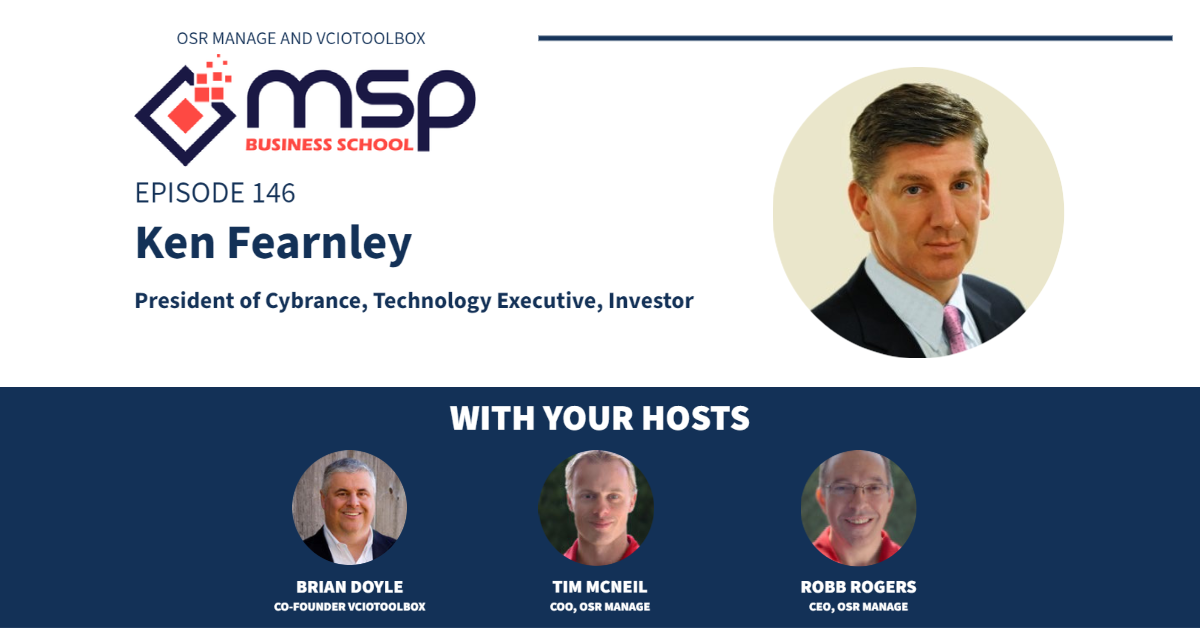
Ep 146Ken Fearnley – Risky Business
In this episode, they talked about Risky Business and Life in IT. 3:09 – Ken ended up in the crazy world of technology because he was a full-time firefighter for about twelve years and he started selling t-shirts and realized he needed a website. He taught himself how to code, and build a website, and decided that technology and business were what he wanted to do. He has been involved in a bunch of startups and taken a company public and has been involved with software for 25 years. 8:15 – Brian asks Ken "what drives kind of creativity for you today and what are your working on right now?" Ken is working on a project with Cybrance, a company that provides a platform for cyber compliance in risk management. The platform includes enterprise GRC, third-party risk management, cyber incidental response management, and more modules. Cybrance sees a need in the marketplace for software and the know-how to put something out there that has a real possibility of gaining significant market share. 11:06 – Brian said that the most important details in this text are that the human factor, insecurities, is the biggest challenge in delivering policy, following up on compliance, and reviewing status. There are a lot of moving pieces in infrastructure that are being recorded and measured, so it is important to ensure that they are being reviewed appropriately and not missing things that can get chaotic. 12:41 – Ken and his team are looking to reduce the number of tools used in the security landscape by offering different capabilities. They are also aware of how the three sixty partners and supplier and vendor ecosystem is expanding, with a thirty percent year of growth. They need to consider not only their suppliers, but also their partners, networks, and security posture. This can lead to an infinite loop of enrolling everything up without tools and things that make it easy to collect. 16:42 – Ken believes that when starting a business, you should be opportunistic and fluid in terms of who you take on as a client. You know the target demographic, twenty to hundred million in revenue, ten to twenty people on the IT staff, with one or two people focusing on security. 20:11 – Brian explains that when they think about their contacts, they think about the people they work with and law enforcement. They have to engage bodies like CIS to help with forensics, and the more data they can collect and organize, the easier it is to communicate those things to insurance companies. The more they can document, the more they can quickly give to them and share with them.
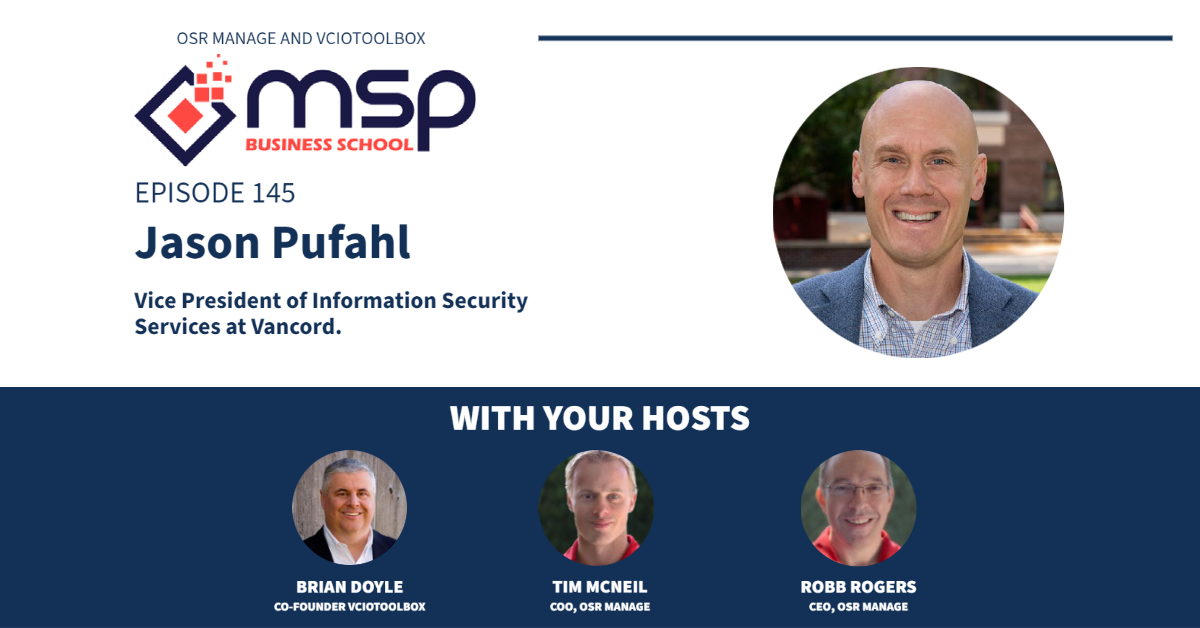
Ep 145Jason Pufahl – It's a Cyber Life: Sometimes the Path Chooses You
Show Website: https://mspbusinessschool.com/ Guest Name: Jason Pufahl https://www.linkedin.com/in/jasonpufahl/ Company: Vancord https://www.vancord.com/ Podcast: https://www.vancord.com/cybersound/ Hosts Brian Doyle: https://www.linkedin.com/in/briandoyl... Robb Rogers: https://www.linkedin.com/in/robb-roge... Tim McNeil: https://www.linkedin.com/in/timmcneil3/ Sponsors vCIOToolbox: https://vciotoolbox.com OSR Manage: https://osrmanage.com Jason Pufahl is the Vice President of Information Security Services at Vancord. 1:45 – Jason found himself in the world of MSP after applying for 30 national park ranger jobs and one IT role. He chose the IT gig and that is what brought him here with us today. 6:31 – Jason believes that his ability to communicate has been his strongest quality throughout his career. He said he had never been the most technical person in the room, but he had a good vision and the ability to communicate that vision to get buy-in and get projects moving. 9:38 – Tim's most important advice to salespeople is not to be pushy when selling and to have an honest conversation about what they are looking to achieve. If they can do this, they will be ahead of 50% of the reps out there. 13:21 – Jason emphasized the importance of security education, which is a non-technical discipline that doesn't get enough attention. It is important to explain to people what risk potentially remains and to train staff to recognize threats. 18:05 – Brian noted that there was an educational process that led to people becoming more aware of networks, computers, and security. This led to people taking on roles in their generation, similar to what is happening now with security. 20:15 – Brian said that we know we're able to work in and it does open up a lot of security holes when you got people geographically dispersed accessing the same information and see where the human factor comes into play.
Ep 144Battling Burnout
In this episode, the team discusses Battling Burnout here at MSP Business School. 1:37 – Robb stated that burnout is a combination of factors for him, both as a business owner and as an employee. He discussed how to address this on both an employee and a company culture level, which he enjoys discussing. 3:25 – Brian also claims that burnout is usually caused by some kind of stressor, but not all stressors are the same. He has had some of his most energizing times when he worked the most hours and some of his most stressful times when he can't figure out what to do. 7:32 – Brian suggests that when an individual is experiencing burnout, he tries to retain them by providing them with a win-win benefit such as a conference or personal training exercise. This can help them get out of the office for a couple of days. 14:06 – Brian suggests looking into yourself to identify what is causing stress and burnout in your job. It could be the people you're working with or the person there, and it can be better if you get an action plan together to change the team's turnover rate. This way, no word will get out and you'll be better off for it when it's over. 15:28 – Robb says that if you can see burnout in yourself, you can also see it in your staff. If you don't deal with it head-on and find solutions, it will just grow worse and you'll start having nightmares about it.

Ep 143The Game of Risk
In this episode, our team discusses The Game of Risk here at MSP Business School. 2:20 – Brian suggests that organizations engage with customers to understand risk and take the next step in risk management by introducing frameworks to them to manage their organization. Cyber liability insurance can be a challenge for some organizations, so it is important to engage with customers and understand risk during the sales process. 3:11 – Robb said that he'd like to define a little bit better about "What are we talking about when we're talking about risk? Are you talking about it as it relates to the insurance side? Are you talking about the hacking side? What exactly do you mean when you say the global word risk?" 7:21 – Brian explains that there is a challenge of not all risks needing to be solved right due to the cost justification versus the percentage opportunity of risk. For example, if a customer has 3 to 4 risks, it could be that they have a realistic budget and are looking to protect to the best of their capabilities. 12:12 – Robb inquires how to coordinate the sales process between the sales rep, the owner, and the sales LED. He is blown away by the variety of ideas discussed. 17:19 – Brian emphasized the importance of having a good cyber security posture for businesses. There are a lot of different frameworks and regulations that are industry-based, so it is important to focus on cyber frameworks. These frameworks are groups of controls that businesses can define and measure against over time. 21:12 – Brian explains that CIS is geared towards non-targeted companies that don't have security professionals on staff. It focuses on protecting and detecting the first 3 identities, then moving up to implementation where they usually have security professionals, and then dealing with vendors that are the companies that support us publicly. 24:53 – Robb stated that the ads of services are picking up for code management, and they are seeing a lot of interest and opportunity on the upper side as well. There is a lot of opportunity out there right now. 27:54 – Brian's most important idea is to understand the risk and not focus on fear or uncertainty in doubt. He emphasizes that not all risks are equal and not all risks need to be attended to immediately.
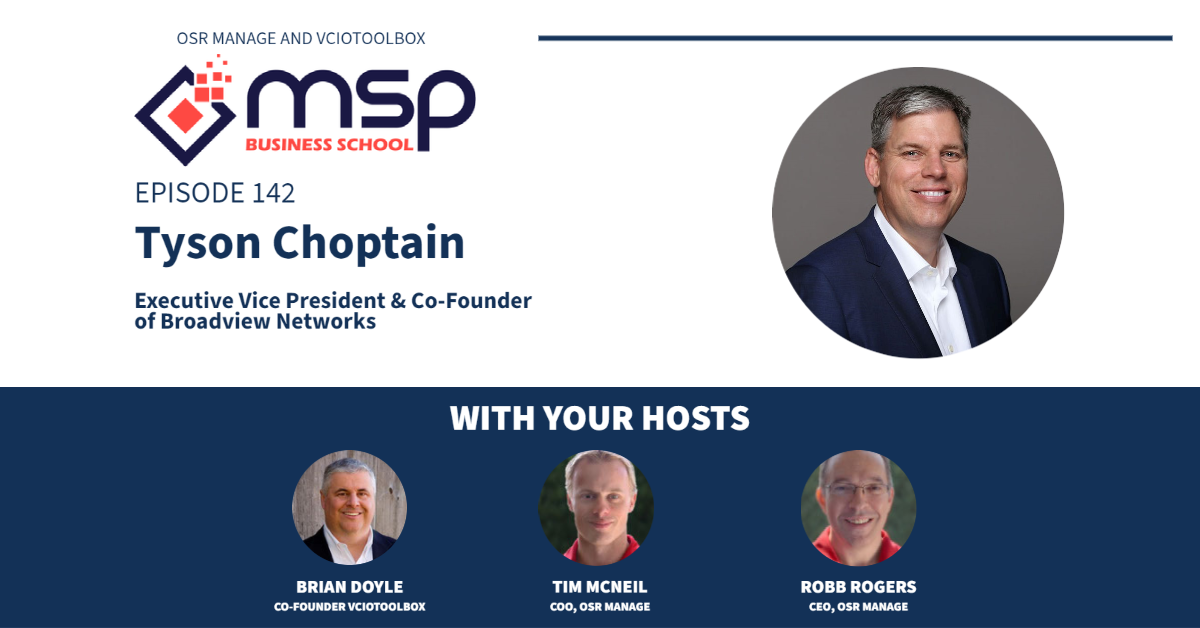
Ep 142Tyson Choptain – The Co-Managed Opportunity
Tyson Choptain is the Executive Vice President and co-founder of Broadview Networks, a leading Managed Services and Security Solutions provider based out of Winnipeg. With more than 30 years of consulting, sales engineering, and implementation has a track record of success with technology in the workplace and providing IT solutions meeting business needs. As an entrepreneur who helped build a successful IT consulting business, his focus on business solutions has helped grow the company to be recognized as one of Canada's fastest-growing businesses and one of Manitoba's fastest-growing companies. With a philosophy of teamwork and collaboration, Broadview attributes its success to its 30+ employees. In this episode, they talked about The Co-Managed Opportunity. 1:48 – Tyson shares how he got started in the MSP community and how he got to where he is now. After high school, he started a computer consulting company with his father that he ran for ten years. Broadview Networks was a project-based business for the first ten years, not knowing what managed services were. 5:24 – Tyson said that they've had a solid Microsoft relationship the entire time, so they've been able to keep a very big quantity of Microsoft 365 licensing for the size of the firm. Because of several major enterprise project-based customers, we are by far the largest local Microsoft 365 dealer in the products. 7:36 – Tyson claims that when they first started offering managed services to clients without an IT department, they actually offered more co-managed services than the more common fully managed situations they now offer. 8:56 – Brian said that in reality security never goes out of style so when you start looking at things that an MSP can do in a world that's constantly adapting and always changing over time. 12:58 – Tim stated that Tyson just made an extremely important point. Throughout the years, they have spoken with many security professionals, and attending conferences has become extremely important. It's just becoming more and more crucial to outsource that component of it, and not everyone has the patience for that given the amount of education, salary, and time required. 14:46 – Tyson stated that when selling to a co-managed customer, you are selling to a fully managed customer, thus not every MSP has experience in their sales staff or even how they market their services. 17:03 – Tyson goes on to say that security is an excellent door opener for businesses, as it allows them to gain customers who previously refused managed services. This changes the customer narrative.
Ep 141Jacob Cane – Maximizing your Centers of Influence
Jacob has 25 years of experience in managed IT and cybersecurity services and has participated in multiple startups, acquisitions, and successful exits with experience from company formation through exit and integration. Jacob was Co-Founder and CEO of Proactive Technologies, where he led revenue growth to over $10M per year with an owner-led sales model until Proactive's acquisition by Abacus Group. Jacob currently works with MSPs to help them optimize owner-led sales and lay the groundwork to make dedicated sales professionals successful. In this episode, they talked about Maximizing your Centers of Influence. 2:23 – Jacob tells how he stumbled into the managed services industry. He did not begin as an IT professional, and he recalls beginning to work in it shortly after graduating from college. 25 years later, he reflects on his generation's lack of IT degrees and notes that it is frequently the profession of the intelligent but unprepared. 11:04 – Tim believes that teaching customers that no one is perfect is one of the most crucial aspects of the sales cycle. You go and try to sell your product or service, whether you're an MSP or simply a little firm. People must be aware of the good, the bad, and the ugly. 12:06 – Robb's question is answered by Jacob. He noted that when they first started the business, their intention was not to be labeled as a financially minded MSP. We wanted to be all things to all people. 14:29 – Brian adds a comment in response to what Jacob stated. He stated that if you can cut through all the minutia and get to the subject the way people see it. 17:28 – Jacob explained that they had finally received their first lead, which he declined. They went through the sales procedure and were selected as finalists. It turned out to be quite difficult to turn down the lead, but what it did is that he always looked at his right leads can come and go. 21:50 – "Did you have a big sales department? Did you have a giant marketing department to get all these hedge funds? How did that work for you?" Robb asks Jacob. 26:26 – Brian said it's fantastic to have it so well set out and know and stay under control while he does that because obviously there's that part of us that just wants to keep hitting the accelerator when sales start flowing in, but they do get to look at it objectively from the other side. 27:23 – Tim claims that because you worked in a field where people tended to come and go quickly, spending time with them after they left was wonderful because they were either going to move on to something else, catch on, or advance in status wherever they went. 28:12 – Brian wraps up the show with a recap. When going through this, he really thought about developing your center of influence, getting those people on board, and really making sure you're treating the people that are closest to you.
Ep 140Aaron Boone – Peer Group opportunities for the Masses
Aaron spent the first years of his career in Sports & Hospitality working in Event Management and Operations and started in the MSP industry in 2011 while completing an MBA. Aaron's expertise is in Project Management, Finance, and Organizational Strategy & Business Development. In this episode, they talked about Peer Group opportunities for the Masses. 1:58 – Aaron explains how he became involved in the world of MSP. He studied at the University of Florida. He earned an undergraduate degree in business management and then took a year to two years off to figure out what he wanted to do before deciding on a career in hospitality, specifically with Outback Steakhouse. 5:33 – Brian states that his business changed when he got involved with a strategist and a peer group. 8:54 – Tim appreciates Aaron for his commitment to lifelong learning in a variety of fields, including sales operations and customer service. "All areas that don't matter what size MSP you are. You can always be better somewhere and be part of that." 10:55 – Tim was impressed by what Aaron had accomplished for the community. He asked "What would you say as an MSP who is not in a peer group right now? What would they be looking for or what would be different about it?" 12:17 – Brian said that one aspect of this industry is that it is a burnout-prone one. They observe many owners who become depressed over it. Everyone talks about finding a work-life balance, but nobody ever succeeds at it. 13:37 – Aaron admits that in order to solve this, they make a significant effort to assist some or all of the members in seeing the need to surround themselves with a leadership team and to empower their subordinates so that they may share some of the burdens. 18:09 – Brian believes that many MSPs are unaware of the importance of thinking about the exit virtually from day one since, without doing so, it is difficult to provide guidance and to be realistic about how you will arrive at your goal. 22:45 – Tim adds that they have discussed it in the past and that having strong leadership teams is how more mature organizations develop, expand, and set themselves apart from the competition. Building them up makes sense because if they have a team under them, everyone will benefit.
Ep 139George Bardissi & Sade Mendez – Breaking the Boundaries of MSP Growth
George Bardissi is the Founder and CEO of three companies: Bardissi Enterprises, an MSP based in Philadelphia, PA; bvoip, a channel-only firm that works with other MSPs around the world in the Cloud Communications Space; and MSP Initiative, which was founded in the middle of the 2020 pandemic, as a community and networking entity to help bridge the gap between IT Service Providers and MSPs to collaborate in new ways. In this episode, they talked about Breaking the Boundaries of MSP Growth 2:48 – George stated that he mastered many of the skills he possessed at an early age largely on his own and that he quickly became involved in them. He started an IT services business when he was still a high school student. He was really apprehended entering the school on a weekend when other activities, such as building an access point in the cafeteria, are taking place. 6:25 – Sade recalls her fortunate accident entry into the MSP world. Someone she had previously worked with in 2017 was in and out of the MSP sandbox. From that point on, George pretty much took her under his wing and just sort of showed her a little bit of everything, and from that point on, she actually began to gain a true understanding of what exactly the MSP land is like. 11:38 – Brian says it's nice to see the community now taking conferences and extending them out a little bit farther, as well as adding other choices for participants to come together and finish the day in a different way. 16:58 – George responds to Brian's question on how to delegate and scale up. He believes the most important thing he can tell people is to see Gary V. 20:36 – Tim says that one of the things that they do on a daily basis is hiring salespeople for MSPs all across the nation, and it's kind of amazing how, just a year ago, the mindset had changed so that candidates suddenly had more negotiating power than they had ever had in interviews. However, he will admit that he does feel like it's beginning to turn back a little bit—certainly not to the extent it once did, but it is unquestionably beginning to turn back. 22:37 – Sade stated that right now, all efforts are focused on the new type of structured events that MSP is holding, namely the MSP Community Mines.
Ep 138Chris Johnson - Gaining Trust with Security Trustmark
Chris Johnson is a cybersecurity compliance strategist at heart. He is currently CompTIA's senior director of cybersecurity programs and ex-officio chairperson of the CompTIA Security Community. In this role, he champions the abilities of MSPs looking to focus more on cybersecurity. 2:22 – Chris discusses his background in the IT industry. He believes that many of the people who were listening fell into it. He had a lot of nasty jobs early in my career because he was someone who said, "I didn't like working at U Haul anymore," but he also had the chance, during the dot-com era, to sort of get his cut by volunteering for a school system at the time. 7:58 – Brian stated that one of the most significant issues in this sector is that anyone can become an MSP tomorrow. 11:37 – Tim has a question for Chris, which he referred to briefly in the beginning, because not everyone is ready to delve deeply into all of this. There are so many shifting parts, such as he knew a new provider, a new company attempting to enter this area. "How do they engage with you?", "What are the first steps they take", "What does that look like?", "How can they achieve some of the things that you just talked about ?" 16:25 – Brian noted that if we look at CIS as a kind of stepping stone based on trust markets, it's a good area that people can get started today since he's always seen CIS as pretty common sense controls for practically every organization. 22:11 – Brian believes we have a good understanding of the measures an MSP can take to get organized. Maybe we can wrap up the conversation today by talking a little bit about what audit expectations would be for the end user. It's not necessarily about dollars and cents, but what that process feels like because many MSPs have never been a part of an audit for either their customers or themselves. 26:45 – Brian believes that if you want the program to be successful in the long run, you must approach it with the perspective that you are going in to improve your business and make your service delivery stronger and more secure. 29:19 – Chris advises getting involved with CompTIA and the membership because these are good places to find resources that can help you navigate this journey and you don't have to do this to yourself. CIS is a great place to start if you are even remotely considering addressing cybersecurity in your organization, especially with group one being somewhat—he doesn't say simple—but it's kind of linear control one step one.
Ep 137A-Jay Orr Building Opportunity for Veterans in Transition
A-Jay Orr, the founder, and CEO of Simple Plan IT. They specialize in helping businesses specifically those that have government contracts, protect digital assets, and be compliant with all the security regulations that the DOD pushes out. In this episode, they talked about Building Opportunities for Veterans in Transition. 02:13 – Brian asks A-Jay "How did you find your way into the lovely world of IT?" A-Jay stated that he got into the wonderful world of IT through the military. He was a communication specialist, so his role in the military was to set up communications, tap into satellites, and do other things of that type, which is where he really began his excursion into technology. 8:01 – A-Jay believes that his project management skills helped him transition into the ownership space by allowing him to swiftly evaluate and analyze situations. He wants to acquire military traits and talents so that he can go in and perform such things. 12:41 – Brian is happy to hear A-Jay talk about how he kind of changed and realized that he needs to scale up because he is on the right track and has a fantastic communicator who can be visionary and who really helps define it. . 16:13 – A-Jay says "Being in the military is a unique dynamic in the sense that we could hate each other but we knew that when it was time to go to work". He said that he could trust them to do their job and protect my life and you could trust me to do the same because the mission came first. 21:05 – A-Jay shares that in Ohio, they are starting this thing, and we are the 22nd state that has this thing going on, and so there are 20, and one of those states that already have them has a veteran chamber of commerce up and running, and so we all get together once a month as a coalition to kind of share best practices and just to inform each other "what's going on in our different states and our regions" so that we can kind of work together. 24:05 – Robb claims that when Tim and he are hiring, they recruit a lot of people. One of the ways they attempt to relate to people, especially when they are leaving the military, is to give them the impression that they may have been in communications in the military, but when they leave, they can rapidly transfer into sales. 27:48 – Robb asks A-Jay about his resume-writing services and other similar services.

Ep 1365 Things on CIOs minds in 2023
This week we deep dive into the minds of Enterprise CIO's and see how their concerns can map to the SMB. The impact of many of the concerns we will discuss will impact the SMB market faster and harder than the enterprise, and MSPs need to be prepared to be leaders and address these issues with their clients and demonstrate value with the solutions.
Ep 135Tips for using a VA on your team
Show Website: https://mspbusinessschool.com/ Octopus CRM - https://bit.ly/3GwgQkz Kennected - https://bit.ly/3WHCjOc Typify - https://bit.ly/3jOL4qX Hosts Brian Doyle: https://www.linkedin.com/in/briandoyl... Robb Rogers: https://www.linkedin.com/in/robb-roge... Tim McNeil: https://www.linkedin.com/in/timmcneil3/ Sponsors vCIOToolbox: https://vciotoolbox.com OSR Manage: https://osrmanage.com In this episode, we talked about the advantages of having a Virtual Assistant (VA) and how to start working with one. 00:30 – Brian extends a warm welcome to all who join him and his co-hosts, Robb Rogers and Tim McNeil, on their podcast. Also, he mentioned that they're going to talk about something that you should think about when you ask, "How do I scale if I don't yet have the available dollars to hire direct resources or don't want to hire direct resources for some of the administrative tasks in our life?" 01:56 – Brian stated that one of the things he decided to do, as he had done in the past with other organizations he has run, was to reach out to virtual assistants. He understands that many of us have been hearing about virtual assistants in the marketplace and may be confused as to what the true capabilities of a virtual assistant are and what one should expect from this because he believes that sometimes when people enter these relationships, they expect people to just show up at their doorstep and be able to do everything without any real guidance or training. 03:33 – Robb asks one of the biggest questions Brian "What is prospecting really mean to you? because he heard some good, bad, and ugly for prospecting overseas, so what do you mean by that?" 04:06 – Brian responds to a prospecting question. In order to warm up the customer and increase the likelihood that they would comply with whatever your call to action is, whether it be a meeting appointment, demo, or trial depending on what you're doing, there are various methods that go into the sales process. We are attempting to get used to those things. 07:05 – Brian began by discussing how to prepare VA. He also talks about where he got his VA. 13:08 – Tim asks Brian if there's anything he experienced anything that his VA has not been able to accomplish for him. 15:31 – Robb inquires once more about what you can recommend for an MSP owner who is using a VA to assist them with prospecting. What is the first step after watching videos and all that? What is the first action you want your MSP owners to take? 18:50 – Robb also mentions octopus and typify as two examples of coordinates campaigns that use sales navigator lists. 19:10 – Tim stated that there is another company called Kennected that begins with a K, and they have heard some really good things about it as well. It also allows you to schedule social media posts on top of prospecting. 26:53 – Tim concurs with Brian's statement about having his VA work outside US business hours. He also added that VAs are people as well, that they have lives to live, families, and struggles.
Ep 134Best of 2022
Show Website: https://mspbusinessschool.com/ Guests Name: Abe Garver https://www.linkedin.com/in/abegarver/ Company: FOCUS Investment Banking https://focusbankers.com/ Jim Lippie: https://www.linkedin.com/in/jim-lippie-52931/ SaaS Alerts: https://saasalerts.com/ Name: Kipp Stumpf https://www.linkedin.com/in/kipp-stum... Company: ConnectWise https://www.connectwise.com/ Jon Kotman: https://www.linkedin.com/in/jonkotman/ Luke Ross: https://www.linkedin.com/in/lucas-ross-238b07143/ Kotman Technology: https://www.kotman.com/ Rob Rae: https://www.linkedin.com/in/robtrae/ Datto: https://www.datto.com/ Derek Gabriel: https://www.linkedin.com/in/dereksgabriel/ Ignite Solutions Group: https://www.ignitetheday.com/ Name: Vince Tinnirello https://www.linkedin.com/in/vincetinn... Company: Anchor Network Solutions https://www.anchornetworksolutions.com/ Hosts Brian Doyle: https://www.linkedin.com/in/briandoyl... Robb Rogers: https://www.linkedin.com/in/robb-roge... Tim McNeil: https://www.linkedin.com/in/timmcneil3/ Sponsors vCIOToolbox: https://vciotoolbox.com OSR Manage: https://osrmanage.com In this episode, our hosts, Brian, Rob, and Tim, will share their favorite guests and clips from our 2022 podcast selection. 05:45 – Jim began by saying that the majority of MSPs don't realize when a bad actor is actually coming in with authentic credentials from somewhere they aren't supposed to unless they are monitoring. Therefore, it is crucial that we keep informed of what occurs. 12:01 – Kipp notes that while there are numerous distinct evolutionary programs, the owner's program's flagship is actually centered upon four planes. It is your strategy, as well as your life plan, and it is your personal and business legacy plan. Therefore, your life plan is "What are your one-year goals? What do you want, exactly, since it's only a one-year team goal?" 14:57 – Brian claims that Derek's clip is a fantastic episode since it will be the clip we share with you after you have listened to a journey. 15:40 – Derek shares his journey. He started looking for work but was turned down because of his lack of qualifications. He had applied to work as an installer, was using a headhunter, and had once been interviewed at Sprint for a position that sounded absolutely awful: database administrator for reporting, and creating reports for executives. But in the end, wanting a job with the least amount of responsibility. 19:24 – Robb claims that Vince's clip is his favorite episode because it was about how he felt about an anchor and how to deal with anchor network problems, and since Vince is a peer group facilitator and had so many smart things to say. 24:15 – Tim thinks that too many individuals do things well and likes the idea of not placing a lot of emphasis on the income standpoint. They place a lot of emphasis on the revenue generated by each client. You should be evaluated to determine if these are the proper people for you and if they are real. 24:36 – Brian said there are a lot of other variables you can consider besides just pure income and when you start growing to the level where you are at. He always looks at those plans to make sure they aren't overlooking those clients in the middle of the stack. That is also prepared for ascent. 27:27 – According to Rob Rae, it is simple to predict that, at some point, any organization, regardless of location or size, will find that having in-house IT personnel is no longer necessary. This may be the case in order to protect internal infrastructure, but as far as anything that is coming from the outside, things are moving too quickly. 34:50 – Robb's query is answered by John. It's always preferable to attempt and change a connection or get it moving in the proper manner when you're in that position. This is why we always give 110% effort to say when we're in that position. 40:30 – Abe states that there is so much competition that he has a merger of equal platforms that will be completed soon and he increasingly sees a competitive advantage to call potential clients and informing them that he has sixty-five nondisclosure agreements (NDAs) from all of these buyers for this assignment, which will encourage serious bids from prospective buyers. 45:56 – Brian thanks all of the listeners for their support as he wraps up the podcast.