
Macro Waves
Stories about money and markets : Weekly talks from the Economic Research department of BNP Paribas with William De Vijlder, Group Chief Economist.
BNP Paribas Economic Research
Show overview
Macro Waves has been publishing since 2018, and across the 8 years since has built a catalogue of 68 episodes. That works out to roughly 10 hours of audio in total. Releases follow a roughly quarterly cadence, with the show now in its 2nd season.
Episodes typically run under ten minutes — most land between 7 min and 12 min — though episode length varies meaningfully from one episode to the next. None of the episodes are flagged explicit by the publisher. It is catalogued as a EN-language News show.
The show is actively publishing — the most recent episode landed 1 months ago, with 6 episodes already out so far this year. The busiest year was 2019, with 25 episodes published. Published by BNP Paribas Economic Research.
From the publisher
Stories about money and markets : Monthly talks from the Economic Research department of BNP Paribas. Hosted on Ausha. See ausha.co/privacy-policy for more information.
Latest Episodes
View all 68 episodesThe energy crisis versus the rise of AI: why emerging economies are holding their own
Conflict in the Middle East: analysis of the consequences for advanced economie
How can Europe attain energy sovereignty?

AI, a new strategic driver for emerging economies
In this new episode of MacroWaves, we examine how artificial intelligence is reshaping growth in emerging economies. We hear from three economists at BNP Paribas Economic Research: Lucas Plé, Christine Peltier, and Hélène Drouot.While Asia dominates semiconductor production, other countries, such as those in Latin America and Africa, are either exploiting their mineral resources or falling behind.What challenges will they face? The answers lie in moving upmarket, securing energy supplies and avoiding increased geopolitical dependence in order to transform this opportunity into sustainable productivity gains.https://economic-research.bnpparibas.com/Home/en-USHosted on Ausha. See ausha.co/privacy-policy for more information.

Public finances in advanced economies: significant yet surmountable constraints?
Between rising interest rates, an ageing population and massive rearmament needs, the budgetary equation for advanced economies is becoming increasingly complex. Why is debt continuing to grow in the United States and France, while it is falling in Spain and Italy? How does Germany intend to finance its infrastructure and defence without jeopardising its budgetary stability?In this new episode of En Eco dans le texte, Stéphane Colliac, Marianne Mueller and Benjamin Puiseux explain the inner workings of public debt. They also explore reasons for optimism: from the impact of artificial intelligence on productivity to reforms in the employment rate of senior citizens.These are certainly significant constraints, but are they really insurmountable? Delve into the issues that will shape global economies between now and the end of the decade.https://economic-research.bnpparibas.com/Home/en-USHosted on Ausha. See ausha.co/privacy-policy for more information.

In 2026: Consumption to rebound in the Eurozone and to modaterate in the US?
Hello, everyone, and welcome to another episode of Macro Waves, the BNP Paribas Economic Research podcast. Today, we're looking at household consumption, which remains the main driver of growth in both the Eurozone and the United States. As we all know, household consumption suffered a major negative shock during the COVID-19 pandemic. Since then, growth has remained very moderate in the Eurozone, while it has accelerated sharply in the United States. After the pandemic, the inflationary crisis and contrasting economic policies of recent years, where do we stand on either side of the Atlantic?https://economic-research.bnpparibas.com/Home/en-USHosted on Ausha. See ausha.co/privacy-policy for more information.

Emerging economies — Solid growth, limited room for manoeuvre
In today’s discussion, we delve into the public finances of emerging economies in 2025, based on an exclusive analysis of our most recent EcoPerspectives issue focused on these economies. With robust but slowing growth, rising public debt and limited fiscal flexibility, what challenges and opportunities lie ahead for these countries?That's what we're going to explore with Hélène Drouot, an expert on Latin America and Lucas Plé, who specialises in sub-Saharan Africahttps://economic-research.bnpparibas.com/Home/en-USHosted on Ausha. See ausha.co/privacy-policy for more information.

International trade: after the US tariff offensive, an ever more multipolar world
https://economic-research.bnpparibas.com/Home/en-USSince Donald Trump's return to the White House in 2025, the United States has massively increased its tariffs. As a result, trade flows to the US have been disrupted, but has this affected the dynamics of global trade? And above all, are we heading towards a major restructuring of global trade?Fins out more here: EcoPerspectives — Advanced Economies | 3rd Quarter 2025– Economic Research – BNP ParibasHosted on Ausha. See ausha.co/privacy-policy for more information.

Global Economy: Issues to watch in the second half of 2025
As we enter the second half of the year, and after a first half marked in particular on the economic front by the tariff war initiated by the United States, we suggest that we pause and look back for a moment. This will allow us to understand the dynamics that have shaped our economies over the last six months. It will also help us to identify to what extent and in what way they will impact the economic outlook for the second half of the year. What scenario should we expect?Hosted on Ausha. See ausha.co/privacy-policy for more information.
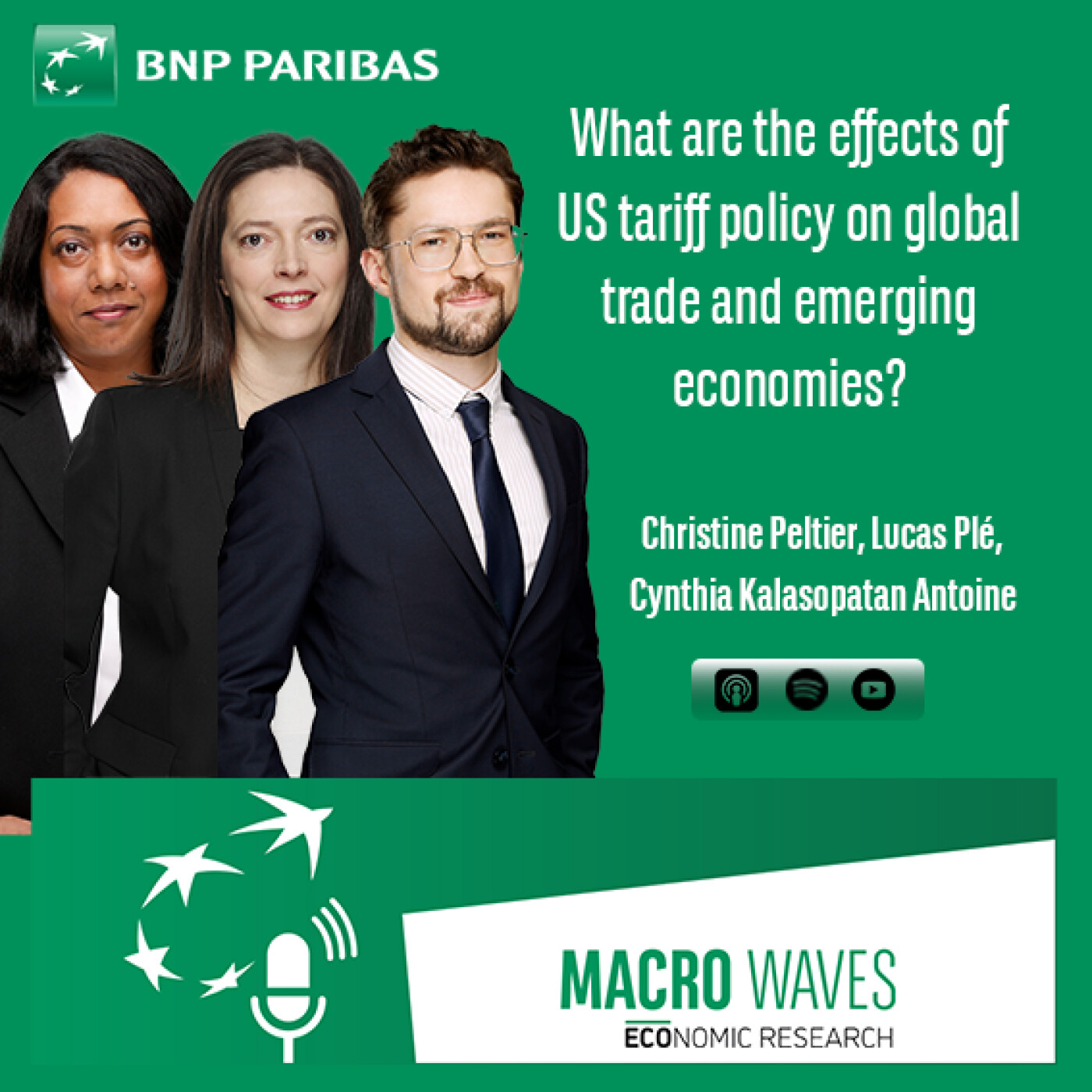
What are the effects of US tariff policy on global trade and emerging economies?
To highlight the publication of the second quarter issue of EcoPerspectives Emerging Economies, three members of the Emerging Economies team speak in ‘MacroWaves’: Christine Peltier, Cynthia Kalasopatan Antoine and Lucas Plé. This is an opportunity to take stock of the specific challenges facing countries.In this podcast, our economists review the consequences of US tariff increases on global growth, the dynamics of international trade reconfiguration, and the reorganisation of value chains. We will analyse the effects of these upheavals on emerging countries.Hosted on Ausha. See ausha.co/privacy-policy for more information.

In the turmoil of US tariffs: what effects on developed economies?
In this new Podcast, we take a look at the short- to medium-term economic outlook for the major advanced economies, analysing the impact of trade tensions, the room for manoeuvre available and the expected economic dynamics.#growth #inflation #monetarypolicy #us #eurozone #ukReading advice :Équipe Économies Avancées | EcoPerspectives — Économies Avancées | 2ème trimestre 2025 – Etudes Economiques – BNP ParibasSound credit :Extact from the speech of Pierre-Olivier Gourinchas, chief economist at the IMF, during the IMF World Economic Outlook' press briefing, April 2025.# Press Briefing: World Economic Outlook, April 2025 - YouTubeExtract from Jérome Powell's speech at the May 7, 2025 FOMC press conference.# FOMC Press Conference May 7, 2025Extact from the speech by Christine Lagarde, Président of the ECB, at the announcement of the ECB's latest monetary policy decisions, April 17, 2025.# President Lagarde presents the latest monetary policy decisions – 17 April 2025Hosted on Ausha. See ausha.co/privacy-policy for more information.

Audiobrief | Self-employment back to the future
In this Audiobrief, Stéphane Colliac discusses selfemployment in France. It has been growing again for almost 20 years, particularly in household services, but also in business services. In France, which has created nearly 420000 jobs a year over the last 5 years, self-employment has represented almost one job creation out of 5.Economic Research WebsiteHosted on Ausha. See ausha.co/privacy-policy for more information.

Audiobrief | The European Union's trade balance: back in surplus
In this Audiobrief, Guillaume Derrien discusses recent evolution of the European Union's trade balance. The latter moved back to a surplus in 2023. Despite China’s ramping up to higher value-added sectors, the EU trade surplus in traditionally buoyant industries (pharmaceuticals, automotive) remains at historically-high levels.Economic Research WebsiteHosted on Ausha. See ausha.co/privacy-policy for more information.

Audiobrief | French trade deficit: France is relatively deindustrialised but investing
In this audiobrief, Stéphane Colliac describes France’s trade deficit for 2023 main drivers. In addition to a deficit linked to imports of hydrocarbons and a structural deficit reflecting the country’s de-industrialisation, it is also driven by France’s investment in the needs arising from the ecological and digital transition and the electrification of the car industry. Economic Research WebsiteHosted on Ausha. See ausha.co/privacy-policy for more information.
#2 - Geopolitical uncertainty: economic consequences
In the second podcast on geopolitical uncertainty and its economic consequences, Daniel Morris and William De Vijlder look more closely at the impact of geopolitical uncertainty on firms, households and financial markets.Economic Research WebsiteHosted on Ausha. See ausha.co/privacy-policy for more information.
#1 - Geopolitical uncertainty: economic consequences
In two podcasts Daniel Morris, Chief Market Strategist of BNP Paribas Asset Management discusses with William De Vijlder, Group Chief Economist of BNP Paribas the impact of geopolitical uncertainty on the economy. In this first podcast, they look at economic and geopolitical uncertainty, why it matters and how it can be measured.Clic here to consult the graphicHosted on Ausha. See ausha.co/privacy-policy for more information.

#2 - Looking beyond the peak
In the second and last episode of the series on central banks and their fight against inflation, Andrew Craig and William de Vijlder are looking beyond the peak and discuss what will come next. Among the questions are: how long will central banks hold rates at these levels? How long will they plateau at these current levels? what come after that?Economic Research WebsiteHosted on Ausha. See ausha.co/privacy-policy for more information.
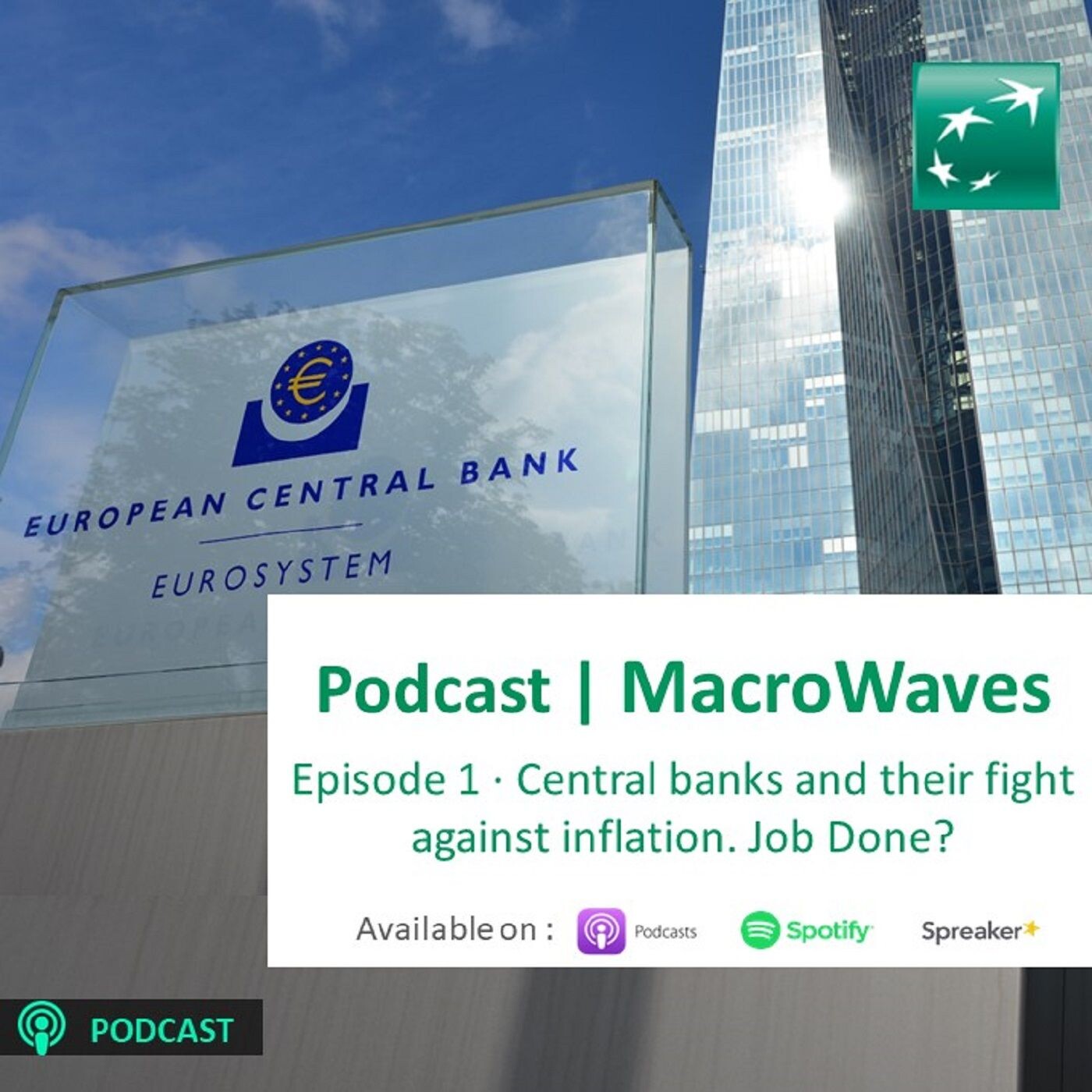
#1 - Central banks and their fight against inflation. Job done?
In this series of two podcasts Andrew Craig, co-head of the Investments Insight Center at BNP Paribas Asset Management, interviewed William de Vijlder, group chief economist of the Economic Research of BNP Paribas regarding the central banks policies to fight inflation. Among the questions answered in the first episode are:Are we at the peak or can we expect further rates hikes? Is the inflation going to declines? at which pace?Economic Research WebsiteHosted on Ausha. See ausha.co/privacy-policy for more information.
S1 Ep 3#3 - National recovery plan Espana 2050: Towards a productivity recovery?
In this third and final episode of the series dedicated to labour productivity in Spain, signs of encouragement for a recovery in Spanish productivity are presented, in particular thanks to a national recovery plan (2021-2026) that is in line with the España 2050 strategy, which consists of raising R&D investment.Economic Research WebsiteHosted on Ausha. See ausha.co/privacy-policy for more information.
S1 Ep 2#2 - Why Is Productivity Growth So Low?
In this second episode of the series on labour productivity in Spain, Hélène Baudchon and Guillaume Derrien discuss the three main factors that explain Spain's low productivity.Economic Research WebsiteHosted on Ausha. See ausha.co/privacy-policy for more information.