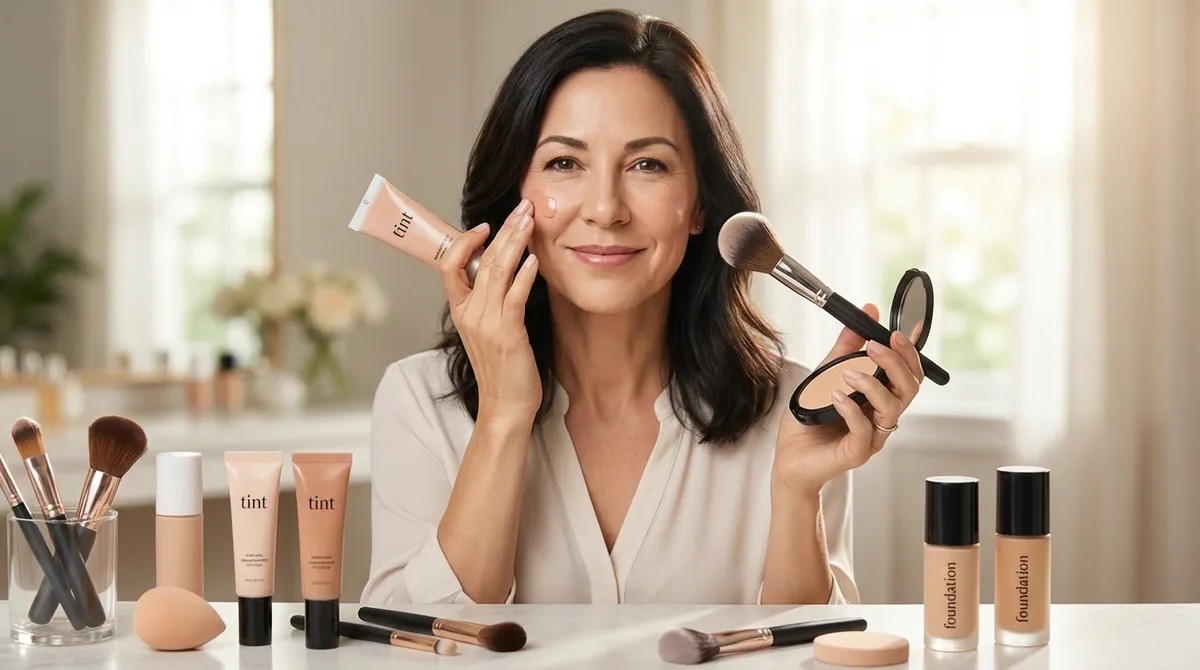
Skin-Responsive Tint vs Traditional Foundation: Which Is Better for Your Skin Type
Luxury Beauty on a Budget Podcast · Luxury Beauty on a Budget
Audio is streamed directly from the publisher (content.rss.com) as published in their RSS feed. Play Podcasts does not host this file. Rights-holders can request removal through the copyright & takedown page.
Show Notes
Ever wonder why your base makeup looks perfect one day and disastrous the next? The culprit might not be your skin—it could be a fundamental mismatch between your skin's chemistry and your foundation's formulation. In this episode, Dr. Elena Voss breaks down the science behind skin-responsive tints versus traditional foundations, examining everything from pH levels and particle sizes to comedogenic loads and oxidative stability. Whether you're battling midday shine, dealing with reactive skin, or trying to cover stubborn hyperpigmentation, this deep dive into cosmetic chemistry will help you make a smarter choice for your specific skin type.
- Skin-responsive tints are formulated at pH 5.5–6.0, matching your skin's natural pH and causing minimal barrier disruption, while traditional foundations typically sit at pH 6.5–8.0, which can compromise your skin barrier over time.
- The comedogenic load differs dramatically: tints contain roughly 0.5–2% silicones compared to foundations with 5–15% silicones and waxes, making tints significantly less likely to clog pores for oily and acne-prone skin.
- Traditional foundations still win for heavy coverage needs—if you're dealing with hyperpigmentation more than 3–4 shades darker than your base tone, melasma, or rosacea, the adaptive pigment release in tints simply can't generate enough correction.
- Particle size affects both coverage and skin penetration: tints use 20–50 nanometer encapsulated pigments that adapt on contact, while foundations use larger 100–300 nanometer particles for immediate uniform coverage.
- Budget skin-responsive tints use the same cosmetic-grade iron oxide encapsulation technology as prestige versions—you're often paying for brand positioning rather than better chemistry.
- The viscosity difference matters for oily skin: tints at 1,000–3,000 centipoise mix with your natural sebum rather than sitting on top like heavier foundations at 5,000–12,000 centipoise, reducing that greasy midday sheen.
Read the full article: https://luxurybeautyonabudget.com/skin-responsive-tint-vs-traditional-foundation