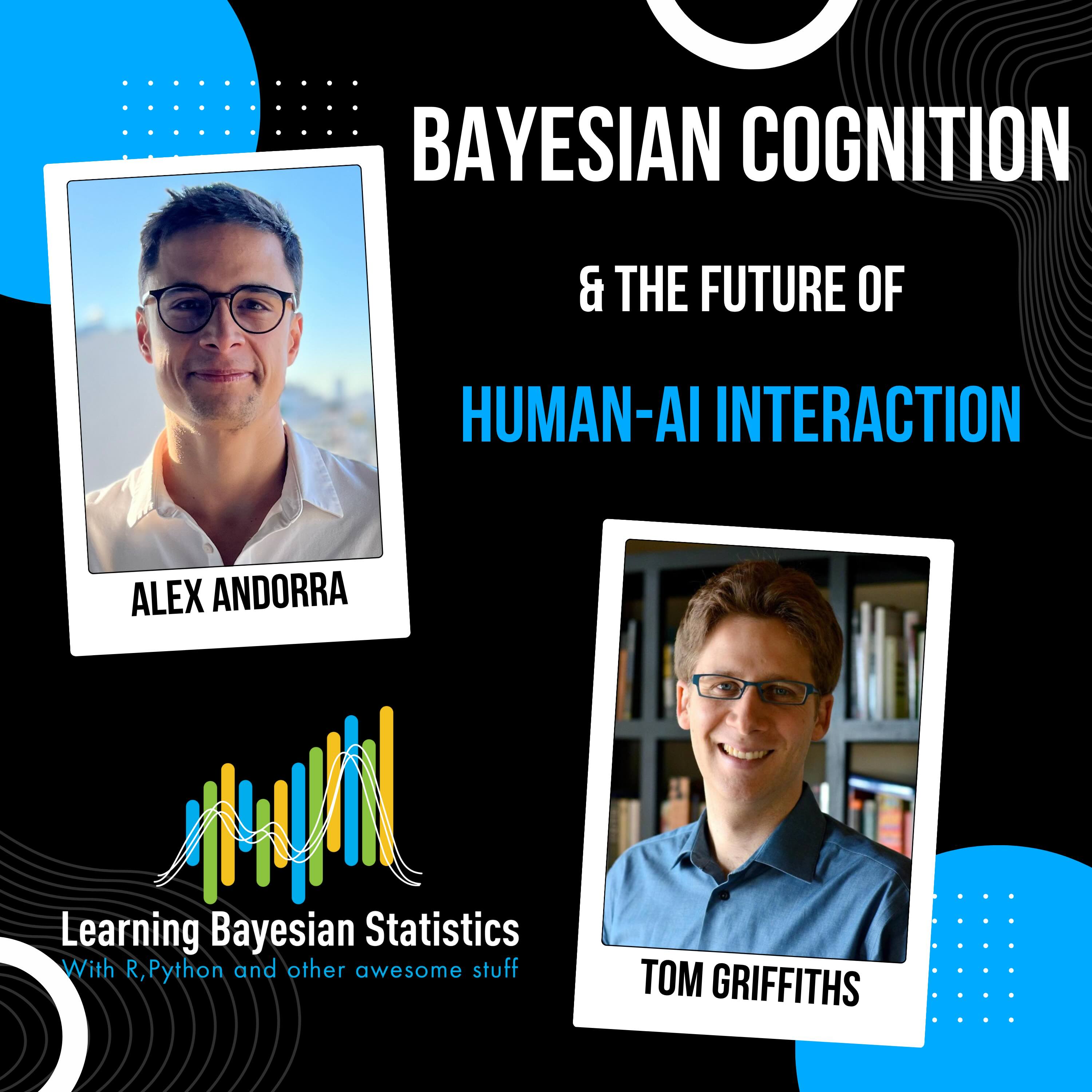
#132 Bayesian Cognition and the Future of Human-AI Interaction, with Tom Griffiths
Learning Bayesian Statistics · Alexandre Andorra
Audio is streamed directly from the publisher (api.riverside.fm) as published in their RSS feed. Play Podcasts does not host this file. Rights-holders can request removal through the copyright & takedown page.
Show Notes
Proudly sponsored by PyMC Labs, the Bayesian Consultancy. Book a call, or get in touch!
Check out Hugo’s latest episode with Fei-Fei Li, on How Human-Centered AI Actually Gets Built
- Intro to Bayes Course (first 2 lessons free)
- Advanced Regression Course (first 2 lessons free)
Our theme music is « Good Bayesian », by Baba Brinkman (feat MC Lars and Mega Ran). Check out his awesome work!
Visit our Patreon page to unlock exclusive Bayesian swag ;)
Takeaways:
- Computational cognitive science seeks to understand intelligence mathematically.
- Bayesian statistics is crucial for understanding human cognition.
- Inductive biases help explain how humans learn from limited data.
- Eliciting prior distributions can reveal implicit beliefs.
- The wisdom of individuals can provide richer insights than averaging group responses.
- Generative AI can mimic human cognitive processes.
- Human intelligence is shaped by constraints of data, computation, and communication.
- AI systems operate under different constraints than human cognition. Human intelligence differs fundamentally from machine intelligence.
- Generative AI can complement and enhance human learning.
- AI systems currently lack intrinsic human compatibility.
- Language training in AI helps align its understanding with human perspectives.
- Reinforcement learning from human feedback can lead to misalignment of AI goals.
- Representational alignment can improve AI's understanding of human concepts.
- AI can help humans make better decisions by providing relevant information.
- Research should focus on solving problems rather than just methods.
Chapters:
00:00 Understanding Computational Cognitive Science
13:52 Bayesian Models and Human Cognition
29:50 Eliciting Implicit Prior Distributions
38:07 The Relationship Between Human and AI Intelligence
45:15 Aligning Human and Machine Preferences
50:26 Innovations in AI and Human Interaction
55:35 Resource Rationality in Decision Making
01:00:07 Language Learning in AI Models