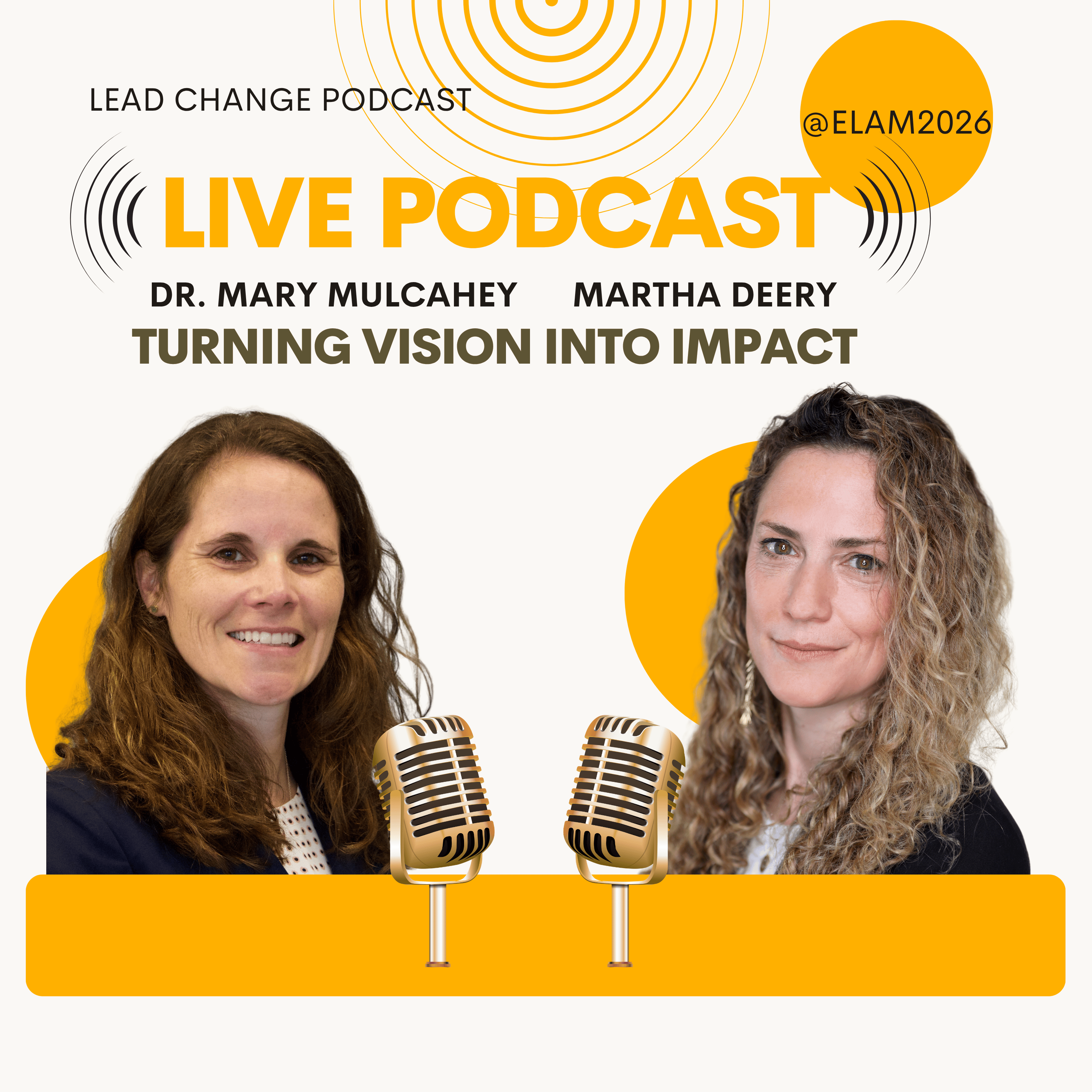
Live Podcast: Martha Deery - Turning vision into impact
Lead Change · Mary Mulcahey
Audio is streamed directly from the publisher (api.riverside.fm) as published in their RSS feed. Play Podcasts does not host this file. Rights-holders can request removal through the copyright & takedown page.
Show Notes
In this live episode of Lead Change, recorded at the ELAM program in Philadelphia, Dr. Mary Mulcahey interviews Martha Deery, a leader in organizational transformation and change strategy. Martha shares insights from her work with Kotter, emphasizing that successful change is not driven by process alone, but by leadership that inspires, empowers, and engages people at all levels.
Drawing from her experience in global social impact initiatives and large-scale organizational transformation, Martha highlights the importance of understanding stakeholders, framing change as an opportunity, and creating clarity amid competing priorities. She underscores that resistance to change is often deeply personal, rooted in identity and professional investment, and that effective leaders must recognize and address these concerns.
The conversation also explores the concept of distributed leadership, the importance of psychological safety, and the need for adaptability in an era of constant change. Ultimately, Martha defines “leading change” as having a vision and enabling others to take bold, sometimes uncomfortable steps in a supportive environment where they feel seen, valued, and empowered.
Key Take-Home Points
- Change Requires Leadership, Not Just Management
- Strategy, budgets, and plans are necessary—but insufficient.
- True transformation depends on vision, inspiration, and people engagement.
2. Frame Change as an Opportunity
- Clearly articulate:
Why now?
What is the opportunity?
Who benefits—and how? - Avoid jargon; communicate in simple, meaningful terms.
3. Prioritization Is Critical
- When everything is a priority, nothing is.
- Leaders must define:
What will change
What will stop
What matters most
4. Stakeholder Understanding Is Essential
- Identify:
Who is impacted—and how
What they might gain or lose
Recognize that resistance is often tied to identity and expertise, not just logistics.
5. Engage Both Formal and Informal Influencers
- Change is accelerated by those who can influence others, regardless of title.
- Build coalitions across levels of the organization.
6. Empower Leadership at All Levels
- Move beyond hierarchy to a network-based model of leadership.
- Everyone has the capacity to lead change when empowered.
7. Psychological Safety Drives Innovation
- Create environments where individuals feel safe to:
Try new things
Take risks
Fail productively
8. Adaptability Is a Core Leadership Skill
- Modern organizations must continuously:
Learn
Pivot
Evolve - Agility and mindset are as important as technical skills.
9. Human-Centered Design Enhances Impact
- Effective solutions require deep understanding of:
Culture
Context
End users - Co-creation leads to more meaningful and sustainable change.
10. Leadership Is About Empowering Others
- “Leading change” means:
Believing in a vision
Inspiring others
Enabling people to do hard, new, and sometimes uncomfortable things