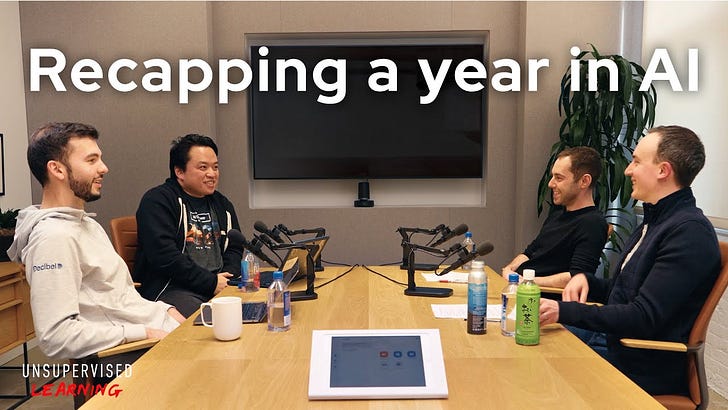
Unsupervised Learning x Latent Space Crossover Special
Latent Space: The AI Engineer Podcast
Audio is streamed directly from the publisher (api.substack.com) as published in their RSS feed. Play Podcasts does not host this file. Rights-holders can request removal through the copyright & takedown page.
Show Notes
If you’re in SF: Join us for the Claude Plays Pokemon hackathon this Sunday!
If you’re not: Fill out the 2025 State of AI Eng survey for $250 in Amazon cards!
Unsupervised Learning is a podcast that interviews the sharpest minds in AI about what’s real today, what will be real in the future and what it means for businesses and the world - helping builders, researchers and founders deconstruct and understand the biggest breakthroughs.
Top guests: Noam Shazeer, Bob McGrew, Noam Brown, Dylan Patel, Percy Liang, David Luan
Full Episode on Their YouTube
Timestamps
* 00:00 Introduction and Excitement for Collaboration
* 00:27 Reflecting on Surprises in AI Over the Past Year
* 01:44 Open Source Models and Their Adoption
* 06:01 The Rise of GPT Wrappers
* 06:55 AI Builders and Low-Code Platforms
* 09:35 Overhyped and Underhyped AI Trends
* 22:17 Product Market Fit in AI
* 28:23 Google's Current Momentum
* 28:33 Customer Support and AI
* 29:54 AI's Impact on Cost and Growth
* 31:05 Voice AI and Scheduling
* 32:59 Emerging AI Applications
* 34:12 Education and AI
* 36:34 Defensibility in AI Applications
* 40:10 Infrastructure and AI
* 47:08 Challenges and Future of AI
* 52:15 Quick Fire Round and Closing Remarks
Transcript
[00:00:00] Introduction and Podcast Overview
[00:00:00] Jacob: well, thanks so much for doing this, guys. I feel like we've we've been excited to do a collab for a while. I
[00:00:13] swyx: love crossovers. Yeah. Yeah. This, this is great. Like the ultimate meta about just podcasters talking to other podcasters. Yeah. It's a lot. Podcasts all the way up.
[00:00:21] Jacob: I figured we'd have a pretty free ranging conversation today but brought a few conversation starters to, to, to kick us off.
[00:00:27] Reflecting on AI Surprises and Trends
[00:00:27] Jacob: And so I figured one interesting place to start is you know, obviously it feels that this world is changing like every few months. Wondering as you guys reflect path on the past year, like what surprised you the most?
[00:00:36] Alessio: I think definitely recently models we kinda on the, on the right here. Like, oh, that, well, I, I I think there's, there's like the, what surprised us in a good way.
[00:00:44] May maybe in a, in a bad way. I would say in a good way. Recently models and I think the release of them right after the new reps scaling instead talked by Ilia. I think there was maybe like a, a little. It's so over and then we're so back. I'm like such a short, short period. It was really [00:01:00] fortuitous
[00:01:00] Jacob: timing though, like right.
[00:01:01] As pre-training died, I mean, obviously I'm sure within the labs they knew pre-training was dying and had to find something. But you know, from the outside it was it, it felt like one right into the other.
[00:01:09] Alessio: Yeah. Yeah, exactly. So that, that was a good surprise,
[00:01:12] swyx: I would say, if you wanna make that comment about timing, I think it's suspiciously neat that like, because we know that Strawberry was being worked on for like two years-ish.
[00:01:20] Like, and we know exactly when Nome joined OpenAI, and that was obviously a big strategic bet by OpenAI. So like, for it to transition, so transition so nicely when like, pre-training is kind of tapped out to, into like, oh, now inference time is, is the new scaling law is like conv very convenient. I, I, I like if there were an Illuminati, this would be what they planned.
[00:01:41] Or if we're living in a simulation or something. Yeah.
[00:01:44] Open Source Models and Their Impact
[00:01:44] swyx: Then you said open source
[00:01:45] Alessio: as well? Yeah. Well, no, I, I think like open source. Yeah. We're discussing this on the negative. I would say the relevance of open source. I would specifically open models. Yeah, I was surprised the lack, like the llamas of the world by the lack of adoption.
[00:01:56] And I mean, people use it obviously, but I would say nobody's [00:02:00] really like a huge fanboy, you know, I think the local llama community and some of the more obvious use cases really like it. But when we talk to like enterprise folks, it's like, it's cool, you know? And I think people love to argue about licenses and all of that, but the reality is that it doesn't really change the adoption path of, of ai.
[00:02:18] So
[00:02:19] swyx: yeah, the specific stat that I got from on anchor from Braintrust mm-hmm. In one of the episodes that we did was I think he estimated that open source model usage in work in enterprises is that like 5% and going down.
[00:02:31] Jacob: And it feels like you're basically all these enterprises are in like use case discovery mode, where it's like, let's just take what we think is the most powerful model and figure out if we can find anything that works.
[00:02:39] And, you know, so much of, of, of it feels like discovery of that. And then, right, as you've discovered something, a new generation of models are out and so you have to go do discovery with those. And you know, I think obviously we're probably optimistic that the that the open source models increase in uptake.
[00:02:50] It's funny, I was gonna say my biggest surprise in the last year was open source related, but it was just how Fast Open Source caught up on the reasoning models. It was kind of unclear to me, like over time whether there would be, you know, [00:03:00] a compounding advantage for some of the closed source models where in the, okay, in the early days of, of scaling you know, there was a, a tight time loop, but over time, you know, would would the gap increase?
[00:03:08] And if anything it feels like a trunk. You know, and I think deep seek specifically was just really surprising in how, you know, in many ways if the value of these model companies is like you have a model for a period of time and you're the only one that can build products on top of that model while you have it.
[00:03:21] Like, God, that time period is a lot shorter than a, than I thought it was gonna be a year ago.
[00:03:25] swyx: Yeah. I mean, again, I I, I don't like this label of how Fast Open Source caught up because it's really how Fast Deepsea caught up. Right. And now we have, like, I think some of it is that Deepsea is basically gonna stop open sourcing models.
[00:03:36] Yeah. So like there, there's no team open source, there's just different companies and they choose to open source or not. And we got lucky with deep seek releasing something and then everyone else is basically distilling from deep seek and those are distillations. Catching up is such an easier lower bar than like actually catching up, which is like you, you are like from scratch.
[00:03:56] You're training something that like is competitive on that front. I don't know if [00:04:00] that's happening. Like basically the only player right now is we're waiting for LA four.
[00:04:03] Jordan: I mean, it's always an order of magnitude cheaper to replicate what's already been done than to create something fundamentally new.
[00:04:09] And so that's why I think deep seek overall was overhyped. Right? I mean obviously it's a good open source, new entrant, but at the same time there's nothing new fundamentally there other than sort of doing it executing what's already been done really well.
[00:04:21] Alessio: Yeah,
[00:04:21] Jordan: right.
[00:04:21] Alessio: So Well, but I think the traces is like maybe the biggest thing, I think most previous open models is like the same model, just a little worse and cheaper.
[00:04:30] Yeah. Like R one is like the first model that had the full traces. So I think that's like a net unique thing in fair, open source. But yeah, I, I think like we talked about deep seek in the our n of year 2023 recap, and we're mostly focused on cheaper inference. Like we didn't really have deep, see, deep CV three
[00:04:47] swyx: was out then, and we were like, that was already like talking about fine green mixture of experts and all that.
[00:04:51] Like that's a great receipt to
[00:04:52] Jacob: have
[00:04:52] swyx: to be like, yeah.
[00:04:52] Jacob: End
[00:04:53] swyx: of year 20. Yeah. That's a,
[00:04:54] Jacob: that's a, that's, that's an
[00:04:55] swyx: impressive one. You follow the right whale believers in Twitter. It's, it's like [00:05:00] pretty obvious. I actually had like so, you know, I used to be in finance and, and a lot, a lot of my hedge fund and PE friends called me up.
[00:05:06] They were like, why didn't you tip us off on deep seek? And I'm like, well, I mean, it's been there. It's, it's actually like kind of surprising that like, Nvidia like fell like what, 15% in one day? Yeah. Because deep seek and I, I think it's just like whatever the market, public market narrative decides is a story, becomes the story, but really like the technical movements are usually.
[00:05:26] One to two years in the making. Before that,
[00:05:27] Jacob: basically these people were telling on themselves that they didn't listen to your podcast. They've been on the end of year 22, 3. No, no,
[00:05:32] swyx: no. Like yeah, we weren't, we weren't like banging the drum. So like it's also on us to be like, no, like this. This is an actual tipping point.
[00:05:38] And I think I like as people who are like, our function as podcasters and industry analysts is to raise the bar or focus attention on things that you think matter. And sometimes we're too passive about it. And I think I was too passive there. I'd be, I'd be happy to own up on that.
[00:05:52] Jacob: No, I feel like over time you guys have moved into this margin general role of like taking stances of things that are or aren't important and, you know I feel like you've done that with MCP of [00:06:00] late and a bunch of
[00:06:00] swyx: things.
[00:06:00] Yeah.
[00:06:01] Challenges and Opportunities in AI Engineering
[00:06:01] swyx: So like the, the general pushes is AI engineering, you know, like it's gotta, gotta wrap the shirt. And MCP is part of that, but like the, the general movement is what can engineers do above the model layer to augment model capabilities. And it turns out it's a lot. And turns out we went from like, making fun of GPT rappers to now I think the overwhelming consensus GPT wrappers is the only thing that's interesting.
[00:06:20] Yeah.
[00:06:21] Jacob: I remember like, Arvin from Perplexity came on our podcast and he was like, I'm proudly a rapper. Like, you know, it's like anyone that's like talking about like, you know, differentiation, like pre-product market fit is like a ridiculous thing to, to say, like, build something people want and then yeah.
[00:06:33] Over time you can kind of worry about that.
[00:06:35] swyx: Yeah. I, I interviewed him in 2023 and I think he may have been the first person on our podcast to like, probably be a GBT rapper. Yeah. And yeah, and obviously he's built a huge business on that. Totally. Now, now we now we all can't get enough of it. I have another one for, Oh, nice.
[00:06:47] That was Alessia's one and we, we perhaps individual answers just to be interesting in the same Uber on the way up. Yeah. You just like in the, in different Oh, I was driving too. Oh, you were driving. So I actually, I mean, it was a Tesla mostly drove mine was [00:07:00] actually, it is interesting that low-code builders did not capture the AI builder market.
[00:07:04] Right. AI builders being bought lovable, low-code builders being Zapier, Airtable, retool notion. Any of those, like you're not technical. You can build software.
[00:07:14] misc: Yeah.
[00:07:14] swyx: Somehow not all them missed it. Why? It's bizarre. Like they should have the DNA, I don't know. They should have. They already have the reach, they already have the, the distribution.
[00:07:25] Like why? I I have no idea. The ability to
[00:07:27] Jacob: fast follow too. Like I'm surprised there's Yeah. There's just
[00:07:29] swyx: nothing. Yeah. What do you make of that? I, it seems and you know, not to come back to the AI engineering future, like it takes a, a certain kind of. Founder mindset or AI engineer mindset to be like, we will build this from whole cloth and not be tied to existing paradigms.
[00:07:45] I think, 'cause I like, if I was, if I'm to, you know, you know, Wade or who's, who's, who's the Zapier person than, you know, Mike. Mike who has left the Zapier. Yeah. What's the, yeah. Like you know, Zapier, when they decided to do Zapier ai, they [00:08:00] were like, oh, you can use natural language to make Zap actions, right?
[00:08:03] When Notion decided to do Notion ai, they were like, oh, you can like, you know write documents or, you know, fill in tables with, with ai. Like, they didn't do the, the, the, the next step because they already had their base and they were like, let's improve our baseline. And the other people who actually tried for to, to create a phone cloth were like, we, we got no prior preconceptions.
[00:08:24] Like, let's see what we can, what kinda software people can build with like from scratch, basically. I don't know that, that's my explanation. I dunno if you guys have any retros on the AI builders?
[00:08:33] Jacob: Yeah. Or, or, or did they kind of get lucky getting, you know starting that product journey? Like right as the models were reaching the inflection point?
[00:08:39] There's the timing
[00:08:40] swyx: issue. Yeah. Yeah, yeah. Yeah. Yeah, I don't know. Like I, I, to some extent, I think the only reason you and I are talking about it is that they, both of them have reported like ridiculous numbers. Like zero to 20 million in three months, basically, both of them. Jordan, did you have a, a big surprise?
[00:08:55] Jordan: Yeah, I mean, some of what's already been discussed. I guess the only other thing would be on the Apple side in particular, I [00:09:00] think, I think you know, for the last text message summary, like, but they're
[00:09:04] Jacob: funny. They're funny at how bad they had, how off they're, they're viral. Yeah.
[00:09:08] Jordan: I mean, so like for the last couple years we've seen so many companies that are trying to do personal assistance, like all these various consumer things, and one of the things we've always asked is, well, apple is in prime position to do all this.
[00:09:18] And then with Apple Intelligence, they just. Totally messed up in so many different ways. And then the whole BBC thing saying that the guy shot himself when he didn't. And just like, there's just so many things at this point that I would've thought that they would've ironed up their, their AI products better, but just didn't really catch on,
[00:09:35] Jacob: you know, second on this list of, of generally overly broad opening questions would be anything that you guys think is kind of like overhyped or under hyped in the AI world right now?
[00:09:43] Alessio: Overhyped agents framework. Sorry. Not naming any particular ones. I'm sorry. Not, not not, yeah, exactly. It's not, I, I would say they're just overall a chase to try and be the framework when the workloads are like in such flux. Yeah. That I just think is like so [00:10:00] hard to reconcile the two. I think what Harrison and Link Chain has done so amazingly, it's like product velocity.
[00:10:05] Like, you know, the initial obstructions were maybe not the ending obstruction, but like they were just releasing stuff every day trying to be on top of it. But I think now we're like past that, like what people are looking for now. It's like something that they can actually build on mm-hmm. And stay on for the next couple of years.
[00:10:23] And we talked about this with Brett Taylor on our episode, and it feels like, it's like the jQuery era Yeah. Of like agents and lms. It's like, it's kinda like, you know, single file, big frameworks, kinda like a lot of players, but maybe we need React. And I think people are just trying to build still Jake Barry.
[00:10:39] Like, I don't really see a lot of people doing react like,
[00:10:43] swyx: yeah. Maybe the, the only modification I made about that is maybe it's too early even for frameworks at all. And the thing that, and do you think
[00:10:50] Jacob: there's enough stability in the underlying model layer and, and patterns to, to have this,
[00:10:54] swyx: the thing is the protocol and not the framework?
[00:10:56] Jacob: Yeah.
[00:10:56] swyx: Because frameworks inherently embed protocols, but if you just focus on a protocol, maybe that [00:11:00] works. And obviously MCP is. The current leading mm-hmm. Area. And you know, I think the comparison there would be, instead of just jQuery, it is XML HTB requests, which is like the, the thing that enabled Ajax.
[00:11:10] And that was the, the, the, the, the sort of inciting incident for JavaScripts being popular as a language.
[00:11:16] Jordan: I would largely agree with that. I mean, I think on the, the react side of things, I think we're starting to see more frameworks sort of go after more of that, I guess like master is sort of like on the TypeScript side and more of like a sort of master.
[00:11:28] Yeah, yeah, yeah, yeah. The traction is really impressive there. And so I think we're starting to see more surface there, but I think there's still a big opportunity. What do you have for for an over or under hyped on the under hype side? You know, I actually, I, I know I mentioned Apple already, but I think the private cloud compute side with PCC, I actually think that could be really big.
[00:11:45] It's under the radar right now. Mm-hmm. But in terms of basically bringing. The on device sort of security to the cloud. They've done a lot of architecturally interesting things there. Who's they? Apple. Oh, okay. On the PCC side. And so I actually think of that.
[00:11:58] swyx: So you're negative on Apple [00:12:00] Intelligence, but also on Apple Cloud,
[00:12:01] Jordan: on the more of the local device.
[00:12:04] Sort of, I think there'll be a lot of workloads still on device, but when you need to speak to the cloud for larger LLMs, I think that Apple has done really interesting thing on the privacy side.
[00:12:13] Alessio: Yeah. We did the seed of a company that does that, so Yeah. Especially as things become more co that you set 'em up on purpose.
[00:12:18] So that felt like a perfect Yeah, no, I was like, let's go Jordan, you guys concluding before this episode? Tell me about that company after. We'll chat after, but, but yes, I, I think that's like the unique the thing about LLM workflows is like you just cannot have everything be single tenant, right?
[00:12:35] Because you just cannot get enough GPUs. Like even like large enterprises are used to having VPCs and like everything runs privately. But now you just cannot get enough GPUs to run in a VPC. So I think you're gonna need to be in a multi-tenant architecture, and you need, like you said, like single tenant guarantees in multi-tenant environment.
[00:12:52] So yeah, it's a interesting space.
[00:12:55] swyx: Yeah. What about you, Swiss? Under hypes, I want to say [00:13:00] memory. Just like stateful ai. As part of my keynote on, on for just like every, every conference I do, I do a keynote and I try to do the task of like defining an agent, just, you know, always evergreen content, every content for a keynote.
[00:13:14] But I did it in a, in a way that it was like I think like a, what a researcher would do. Like you, you survey what people say and then you sort of categorize and, and go like, okay, this is the, the. What everyone calls agents and here are the groups of DEF definitions. Pick and choose. Right. And then it was very interesting that the week after that OpenAI launched their agents SDK and kind of formalized what they think agents are.
[00:13:34] CloudFlare also did the same with us and none of them had memory. Yeah, it's very strange. The, pretty much like the only big lab o obviously there, there's conversation memory, but there's not memory memory like in like a, like a let's store a large across fact about you and like, you know, exceed the, the context length.
[00:13:54] And here's the, if you, if you're look, if you look closely enough, there's a really good implementation of memory inside of [00:14:00] MCP when they launched with the initial set of servers. They had a memory server in there, which I, I would recommend as like, that's where you start with memory. But I think like if there was a better, I.
[00:14:10] Memory abstraction, then a lot of our agents would be smarter and could learn on, on the job, which is something that we all want. And for some reason we all just like ignored that because it's just convenient to, and, but do you feel like
[00:14:24] Jacob: it's being ignored or it's just a really hard problem and like lots of, I feel like lots of people are working on it.
[00:14:27] Just feels like it's, it's proven more challenging.
[00:14:29] swyx: Yeah. Yeah. Yeah. So, so Harrison has lang me, which I think now he's like, you know, relaunched again. And then we had letter come speak at our mm-hmm. Our conference I don't know, Zep, I think there's a bunch of other memory guys, but like, something like this I think should be normal in the stack.
[00:14:44] And basically I think anything stateful should be interesting to VCs 'cause it's databases and, you know, we know how those things make money.
[00:14:51] Jacob: I think on the over hype side, the only thing I'd add is like, I'm, I'm still surprised how many net new companies there are training models. I thought we were kind of like past that.
[00:14:58] And
[00:14:58] swyx: I would say they died end of last year. And now, [00:15:00] now they've resurfaced. Yeah. I mean they, that's one of the questions that you had down there of like, yeah. Sorry. Is there an opportunity for net new model players? I wouldn't say no. I don't know what you guys think.
[00:15:08] Alessio: I, I don't have a reason to say no, but I also don't have a reason to say, this is what is missing and you should have a new model company do it.
[00:15:15] But again, I'm an add here. Like, all these guys wanna
[00:15:17] swyx: pursue a GI, you know, all, they all want to be like, oh, we'll, we'll like hit, you know, soda on all the benchmarks and like, they can't all do it. Yeah.
[00:15:25] Jacob: I mean, look, I don't know if Ilia has the secret secret approach up his sleeve of of something beyond test time compute.
[00:15:29] Mm-hmm. But it was funny, I, we had Noam Shaer on the podcast last week. I was asking him like, you know, is, is there like some sort of other algorithmic breakthrough? Would he make a Ilia? And he's like, look, I think what he is implicitly said was test time compute gets to the point where these models are doing AI engineering for us.
[00:15:43] And so, you know, at that point they'll figure out the next algorithm breakthrough. Yeah. Which I thought was was pretty interesting.
[00:15:47] Jordan: I agree with you folks. I think that we're most interested, at least from our side and like, you know, foundation models for specific use cases and more specialized use cases.
[00:15:55] Mm-hmm. I guess the broader point is if there is something like that, that these companies can latch onto [00:16:00] and being there sort of. Known for being the best at. Maybe there's a case for that. Largely though I do agree with you that I don't think there should be, at this point, more model companies. I think it's like
[00:16:09] Jacob: these
[00:16:09] Jordan: unique data
[00:16:09] Jacob: sets, right?
[00:16:10] I mean, obviously robotics has been an area we've been really interested in. It's entirely different set of data that's required, you know, on top of like a, a good BLM and then, you know, biology, material sciences, more the specific use cases basically. Yeah. But also specific, like specific markets. A lot of these models are super generalizable, but like, you know finding opportunities to, you know, where, you know, for a lot of these bio companies, they have wet labs, like they're like running a ton of experiments or you know, same on the material sciences side.
[00:16:31] And so I still feel like there's some, some opportunities there, but the core kind of like LLM agent space is it's tough, tough to compete with the big ones.
[00:16:38] Alessio: Yeah. Agree. Yeah. But they're moving more into product. Yeah. So I think that's the question is like, if they could do better vertical models, why not do that instead of trying to do deep research and operator?
[00:16:50] And these different things. Mm-hmm. I think that's what I'm, in my mind, it's like the agents coming
[00:16:53] swyx: out too.
[00:16:54] Alessio: Well. Yeah. In my, in my mind it's like financial pressure. Like they need to monetize in a much shorter timeframe [00:17:00] because the costs are so high. But maybe it's like, it's not that easy to, do
[00:17:04] Jacob: you think they would be, that it would be a better business model to like, do a bunch of vertical?
[00:17:07] Well, it's more like
[00:17:07] Alessio: why wouldn't they, you know, like you make less enemies if you're like a model builder, right? Yeah. Like, like now with deep research and like search, now perplexity like an enemy and like a, you know, Gemini deep research is like more of an enemy. Versus if they were doing a finance model, you know?
[00:17:25] Mm-hmm. Or whatever, like they would just enable so many more companies and they always have, like they had as one of the customer case studies for GBT search, but they're not building a finance based model for them. So is it because it's super hard and somebody should do it? Or is it because the new models.
[00:17:41] Are gonna be so much better that like the vertical models are useless anyways. Like this is better lesson. Exactly.
[00:17:46] Jacob: It still seems to be a somewhat outstanding question. I, I'd say like, all the signs of the last few years seem to be like a general purpose model is like the way to go. And, you know, you know, like training a hyper-specific model in this, in, in a domain is like, you know, maybe it's cheaper and faster, but it's not gonna be like higher quality.
[00:17:59] But [00:18:00] also like, I think it's still an, I mean, we were talking to, to no and Jack Ray from Google last week, and they were like, yeah, this is still an outstanding, like, we, we check this every time we have a new model. Like whether there's you know, there that still seems to be holding. I remember like a few years ago, it felt like all the rage was like the, it was like the Bloomberg GPT model came out.
[00:18:14] Everyone was like, oh, you gotta like, you know, massive data. Yeah. I had
[00:18:17] swyx: a GPA, I had DP of AI of Bloomberg present on that. Yeah. That must be a really
[00:18:20] Jacob: interesting episode to go back on because I feel like, like very shortly thereafter, the next opening AI model came out and just like beat it on all sorts of
[00:18:25] swyx: No, it, it was a talk.
[00:18:26] We haven't released it yet, but yeah, I mean it's basically they concluded that the, the closed models were better so they just Yeah. Stopped. Interesting. Exactly. So I feel like that's been the but he's I, I would be. He's very insistent that the work that they did, the team he assembled, the data that he collected is actually useful for more than just the model.
[00:18:42] So like, basically everything but the model survived. What are the other things? The data pipeline. Okay. The team that they, they, they assembled for like fine tuning and implementing whatever models they, they ended up picking. Yeah, it seems like they are happy with that. And they're running with that.
[00:18:57] He runs like 12, 13 [00:19:00] teams at Bloomberg just working. Jenny, I across the company.
[00:19:03] Jacob: I mean, I guess we've, we've all kind of been alluding it to it right now, but I guess because it's a natural transition. You know, the other broad opening I have is just what we're paying most attention to right now. And I think back on this, like, you know, the model company's coming into the product area.
[00:19:13] I mean, I think that's gonna be like, I'm fascinated to see how that plays out over the next year and kind of these like frenemy dynamics and it feels like it's gonna first boil up on like cursor anthropic and like the way that plays out over the next six months I think will be. What, what is Cursor?
[00:19:26] swyx: Anthropic is, you mean Cursor versus anthropic or, yeah. And I
[00:19:29] Jacob: assume, you know, over time Anthropic wants to get more into the application side of coding Uhhuh. And you know, I assume over time Cursor will wanna diversify off of, you know, just using the Anthropic model.
[00:19:39] swyx: It's interesting that now Cursor is now worth like 10 billion, nine, nine, 10 billion.
[00:19:43] Yeah. And like they've made themselves hard to acquire, like I would've said, like, you should just get yourself to five, 6 billion and join OpenAI. And like all the training data goes through OpenAI and that's how they train their coding model. Now it's not as complicated. Now they need to be an independent company.
[00:19:57] Jacob: Increasingly, it's seems to the model companies want to get into the [00:20:00] product layer. And so seeing over the next six, 12 months does having the best model, you know let you kind of start from a cold start on the product side and, and get something in market. Or are the, you know, companies with the best products, even if they eventually have to switch to a somewhat worse, tiny bit worse model, does it not, you know, where do the developers ultimately choose to go?
[00:20:16] I think that'll be super interesting. Yeah.
[00:20:18] Alessio: Don't you think that Devon is more in trouble than cursor? I, I feel like on Tropic, if anything wants to move more towards, I don't think they wanna build the ID like if I think about coding, it's like kind of like, you know, you look at it like a cube, it's like the ID is like one way to get the code and then the agent is like the other side.
[00:20:33] Yeah. I feel like on Tropic wants more be on the agent side and then hand you off the cursor when you want to go in depth versus like trying to build the claw. IDEI think that's not, I would say, I don't know how you think the
[00:20:46] swyx: existence, a cloud code doesn't show, doesn't support what you say. Like maybe they would, but
[00:20:52] Jacob: assume, like I assume both just converge eventually where you want have where will you be able to do both?
[00:20:57] So,
[00:20:57] swyx: so in order to be so we're, we're talking [00:21:00] about coding agents, whether it's sort of what is it? Inner loop versus auto loop, right? Like inner loop is inside cursor, inside your ID between inside of a GI commit and auto loop is between GI commits on, on the cloud. And I think like to be an outer loop coding agent, you have to be more of a, like, we will integrate with your code base, we'll sign your whatever.
[00:21:17] You know, security thing that you need to sign. Yeah. That kinda schlep. I don't think the model ads wanna do that schlep, they just want to provide models. So that, that, that's, that would be my argument against like why cognition should still have, have, have some moat against anthropic just simply because they cognition would do the schlep and the biz dev and the infra that philanthropic doesn't really care about.
[00:21:39] Jacob: I know the schlep is pretty sticky though. Once you do it,
[00:21:41] swyx: it's very sticky. Yeah. Yeah. I mean it's, it's, it's interesting. Like, I, I think the natural winner of that should be sourcegraph. But there's another
[00:21:47] Jacob: unprompted point portfolio. Nice. We, I mean they, they're
[00:21:51] swyx: big supporters like very friendly with both Quinn and B and they've they've done a lot of work with Cody, but like, no, not much work on the outer [00:22:00] loop stuff yet.
[00:22:01] But like any company where like they have already had, like, we've been around for 10 years, we, we like have all the enterprise contracts that you already trust us with your code base. Why would you go trust like factory or cognition as like, you know, 2-year-old startups who like just came outta MIT Like, I don't know.
[00:22:17] Product Market Fit in AI
[00:22:17] Jacob: I guess switching gears to the to the application side I'm curious for both of you, like how do you kind of characterize what has genuine product market fit in AI today? And I guess less, you more and your side of the investing side, like more interesting to invest in that category of the stuff that works today or kind of where the capabilities are going long term.
[00:22:35] Alessio: That's hard. I was asking you to do my job for you, like, man, that's a easy, that's a layout. Tell us all your investing
[00:22:40] pieces. Yeah, yeah, yeah. I, I, I would say we, well we only really do mostly seed investing, so it's hard to invest in things that already work. Yeah. That fair. Are really late. So we try to, but, but we try to be at the cusp of like, you know, usually the investments we like to make, there's like really not that much market risk.
[00:22:57] It's like if this works. Obviously people are gonna [00:23:00] use it, but like it's unclear whether or not it's gonna work. So that's kind of more what we skew towards. We try not to chase as many trends and I don't know, I, you know, I was a founder myself and sometimes I feel like it's easy to just jump in and do the thing that is hot, but like becoming a founder to do something that is like underappreciated or like doesn't yet work shows some level of like dread and self, like you, you actually really believe in the thing.
[00:23:25] So that alone for me is like, kind of makes me skew more towards that. And you do a lot of angel investing too, so I'm curious how,
[00:23:31] swyx: Yeah, but I don't regard, I don't have, I don't use, put, put that in my mental framework of things like I come at this much more as a content creator or market analyst of like, yeah, it, it really does matter to me what has part of market fit because.
[00:23:45] People, I have to answer the question of what is working now When, when people ask me,
[00:23:50] Jacob: do you feel like relative to the, the obviously the hype and discourse out there, like, you know, do you feel like there's a lot of things that have product market fit or like a few things, like where a few things? Yeah.
[00:23:58] swyx: I was gonna say this, so I have a list [00:24:00] of like two years ago we, I wrote the Anatomy of autonomy posts where it was like the, the first, like what's going on in agents and, and and, and, and what is actually making money. Because I think there's a lot of gen I skeptics out there. They're all like, these, these things are toys.
[00:24:13] They're, they're not unreliable. And you know, why, why, why you dedicating your life to these things. And I think for me, the party market fit bar at the time was a hundred million dollars, right? Like what use cases can reasonably fit a hundred million dollars. And at the time it was like co-pilot it was Jasper.
[00:24:30] No longer, but mm-hmm. You know, in that category of like help you write. Yeah. Which I think, I think was, was helpful. And then and the cursor I think was on there as, as a, as, as, as like a coding agent. Plus plus. I think that list will just grow over time of like the form factors that we know to work, and then we can just adapt the form factors to a bunch of other things.
[00:24:47] So like the, the one that's the most recently added to this is deep research.
[00:24:52] misc: Yeah.
[00:24:52] swyx: Right. Where anything that looks like a deep research whether it's a grok version, Gemini version, perplexity version, whatever. He has an investment [00:25:00] that that he likes called Brightwave that is basically deep research for finance.
[00:25:02] Yeah. And anything where like all it is like long-term agent, agent reporting and it's starting to take more and more of the job away from you and, and just give you much more reason to report. I think it's going to work. And that has some PMFI think obviously has PMF like I, I would say. It's I, I went to this exercise of trying to handicap how much money open AI made from launching open ai deep research.
[00:25:25] I think it's billions. Like the, the, the mo the the she upgrade from like $20 to 200. It has to be billions in the R off. Maybe not all them will stick around, but like that is some amount of PMF that is didn't they have to immediately drop it down
[00:25:38] Jacob: to the $20 tier?
[00:25:39] swyx: They expanded access. I don't, I wouldn't say, which I thought was
[00:25:42] Jacob: really telling of the market.
[00:25:43] Right. It's like where you have a you know, I think it's gonna be so interesting to see what they're actually able to get in that 200 or $2,000 tier, which we all think is, is, you know, has a ton of potential. But I thought it was fascinating. I don't know whether it was just to get more people exposure to it or the fact that like Google had a similar product obviously, and, and other folks did too.
[00:25:59] But [00:26:00] it was really interesting how quickly they dropped it down.
[00:26:02] swyx: I don't, I think that's just a more general policy of no matter what they have at the top tier, they always want to have smaller versions of that in the, in the lower tiers. Yeah. And just get people exposure to it. Just, yeah, just get exposure.
[00:26:12] The brand of being first to market and, and like the default choice Yeah. Is paramount to open ai
[00:26:18] Jacob: though. I thought that whole thing was fascinating 'cause Google had the first product, right? Yeah. And no, like, you know, I, we
[00:26:24] swyx: interviewed them. I, I, I, straight up to their faces, I was like, opening, I mocked you.
[00:26:28] And they were like, yeah, well, actually curious, what's
[00:26:30] Jacob: it, this is totally off topic, but whatever. Like, what is it going to take for go? Google just released some great models like a, a few weeks ago. Like I feel like it's happening. The stuff they're shipping is really cool. It's happening. Yeah, but I, I, I also, I feel like at least in the, you know, broader discourse, it's still like a drop in the bucket relative to
[00:26:45] swyx: Yeah.
[00:26:45] I mean, I, I can riff on, on this. I, I, but I, I think it's happening. I think it takes some time, but I am, like my Gemini usage is up. Like, I, I use, I use it a lot more for anything from like summarizing YouTube videos to the [00:27:00] native image generation Yeah. That they just launched to like flash thinking.
[00:27:02] So yeah, multi-mobile stuff's great. Yeah. I run you know, and I run like a daily sort of news recap called AI news that is, 99% generated by models, and I do a bake off between all the frontier models every day. And it's every day. Like does it switch? I manual? Yes, it does switch. And I, man, I manually do it.
[00:27:18] And flash is, flash wins most days. So, so like, I think it's happening. I think I was thinking, I was thinking about tracking myself like number of opens of tragedy, g Bt versus Gemini. And at some point it will cross. I think that Gemini will be my main and, and it, it, I I like that will slowly happen for a bunch of people.
[00:27:37] And, and, and then that will, that'll shift. I, I think that's, that's a really interesting for developers, this is a different question. Yeah. It's Google getting over itself of having Google Cloud versus Vertex versus AI studio, all these like five different brands, slowly consolidating it. It'll happen just slowly, I guess.
[00:27:53] Alessio: Yeah.
[00:27:54] Yeah. I, I mean, another good example is like you cannot use the thinking models in cursor. Yeah. And I know [00:28:00] Logan killed Patrick's that they're working on it, but I, I think there's all these small things where like if I cannot easily use it, I'm really not gonna go out of my way to do it. But I do agree that when you do use them, their models are, are great.
[00:28:12] So yeah. They just need better, better bridges.
[00:28:15] swyx: You had one of the questions in the prep.
[00:28:16] Debating Public Companies: Google vs. Apple
[00:28:16] swyx: What public company are you long and short and minus Google versus, versus Apple, like, long, short. That was also my
[00:28:23] Jacob: combo. I, I feel like, yeah, I mean, it does feel like Google's really cooking right now.
[00:28:26] swyx: Yeah. So okay, coming back to what has product market fit
[00:28:29] Jacob: now,
[00:28:29] swyx: now that we come
[00:28:30] Jacob: back to my complete total sidetrack,
[00:28:33] Customer Support and AI's Role
[00:28:33] swyx: there's also customer support.
[00:28:35] We were talking on, on the car about Decagon and Sierra, obviously Brett, Brett Taylor is founder of Sierra. And yeah, it seems like there's just this, these layers of agents that'll like, I think you just look at like the income statement or like the, the org chart of any large scaled company and you start picking them off one by one.
[00:28:51] What like is interesting knowledge work? And they would just kind of eat. Things slowly from the outside in. Yeah, that makes sense.
[00:28:57] Alessio: I, I mean, the episode with the, [00:29:00] with Brett, he's so passionate about developer tools and Yeah. He did not do a developer tools. We spent like two hours talking about developer tools and like, all, all of that stuff.
[00:29:10] And it's like, I, they a customer support company, I'm like, man, that says something. You know what I mean? Yeah. It's like when you have somebody like him who can like, raise any amount of money from anybody to do anything. Yeah. To pick customer support as the market to go after while also being the chairman of OpenAI, like that shows you that like, these things have moats and have longstanding, like they're gonna stick around, you know?
[00:29:32] Otherwise he's smarter than that. So yeah, that's a, that's a space where maybe initially, you know, I would've said, I don't know, it's like the most exciting thing to, to jump into, but then if you really look at the shape of like, how the workforce are structured and like how the cost centers of like the business really end up, especially for more consumer facing businesses, like a lot of it goes into customer support.
[00:29:54] AI's Impact on Business Growth
[00:29:54] Alessio: All the AI story of the last two years has been cost cutting. Yeah. I think now we're gonna switch more towards growth revenue. [00:30:00] Totally. You know, like you've seen Jensen, like last year, GTC was saying the more you buy, the more you save this year is that the more you buy, the more you make. So we're hot off the
[00:30:08] Jacob: press.
[00:30:10] We were there. We were there. Yeah. I do think that's one of the most interesting things about the, this first wave of apps where it's like almost the easiest thing that you could you could get real traction with was stuff that, you know, for lack of a better way to frame it, like so that people had already been comfortable outsourcing the BPOs or something and kind of implicitly said like, Hey, this is a cost center.
[00:30:24] Like we are willing to take some performance cut for cost in the past. You know, the, the irony of that, or what I'm really curious to see how it plays out is, you know, you, you could imagine that is the area where price competition is going to be most fierce because it's already stuff that you know, that people have said, Hey, we don't need the like a hundred percent best version of that.
[00:30:42] And I wonder, you know, this next wave of apps. May prove actually even more defensible as you get these capabilities that actually are, you know, increased top line or whatnot where you're like, you take ai, go to market, for example. Like you're, you'd pay like twice as much for something that brought, like, 'cause there's just a kind of very clean ROI story to it.
[00:30:59] And so [00:31:00] I wonder ultimately whether the, like this next set of apps actually ends up being more interesting than the, than the first wave.
[00:31:05] Alessio: Yeah,
[00:31:05] Voice AI and Scheduling Solutions
[00:31:05] Jordan: I think a lot of the voice AI ones are interesting too, because you don't need a hundred percent precision recall to actually, you know, have a great product.
[00:31:12] And so for example, we looked into a bunch of you know, scheduling intake companies, for example, like home services, right? For electricians and stuff like that. Today they miss 50% of their calls. So even if the AI is only effective, say 75% of the time, yeah, it's crazy, right? So if it's effective 75% of the time, that's totally fine because that's still a ton of increased revenue for the customer, right?
[00:31:32] And so you don't need that a hundred percent accuracy. Yeah. And so as the models. And the reliability of these agents are getting better is totally fine, because you're still getting a ton of value in the meantime.
[00:31:41] swyx: Yeah. One, this is, I don't know how related this is, but I, one of my favorite meetings at it is related one of my favorite meetings at AI Engineer Summit, it is like, like I do these, this is our first one in New York, and I it is like met the different crew than, than you meet here.
[00:31:55] Like everyone here is loves developer tools, loves infra over there. They're actually more interested in [00:32:00] applications. It's kind of cool. I met this like bootstrap team that, like, they're only doing appointment scheduling for vets. They, they, yeah. And like, they're like, this is a, this is an anomaly. We don't usually come to engineering summits 'cause we usually go to vet summits and like talk to the, they're, they're like, you know, they, they're, they're literally, I'm sure it's a
[00:32:16] Jordan: massive pain point.
[00:32:17] They're willing to pay a lot of money.
[00:32:20] Alessio: Yeah. But, but, but this is like my point about saving versus making more, it's like if an electrician takes two x more calls, do they have the bandwidth? To actually do two X more in-house and they get