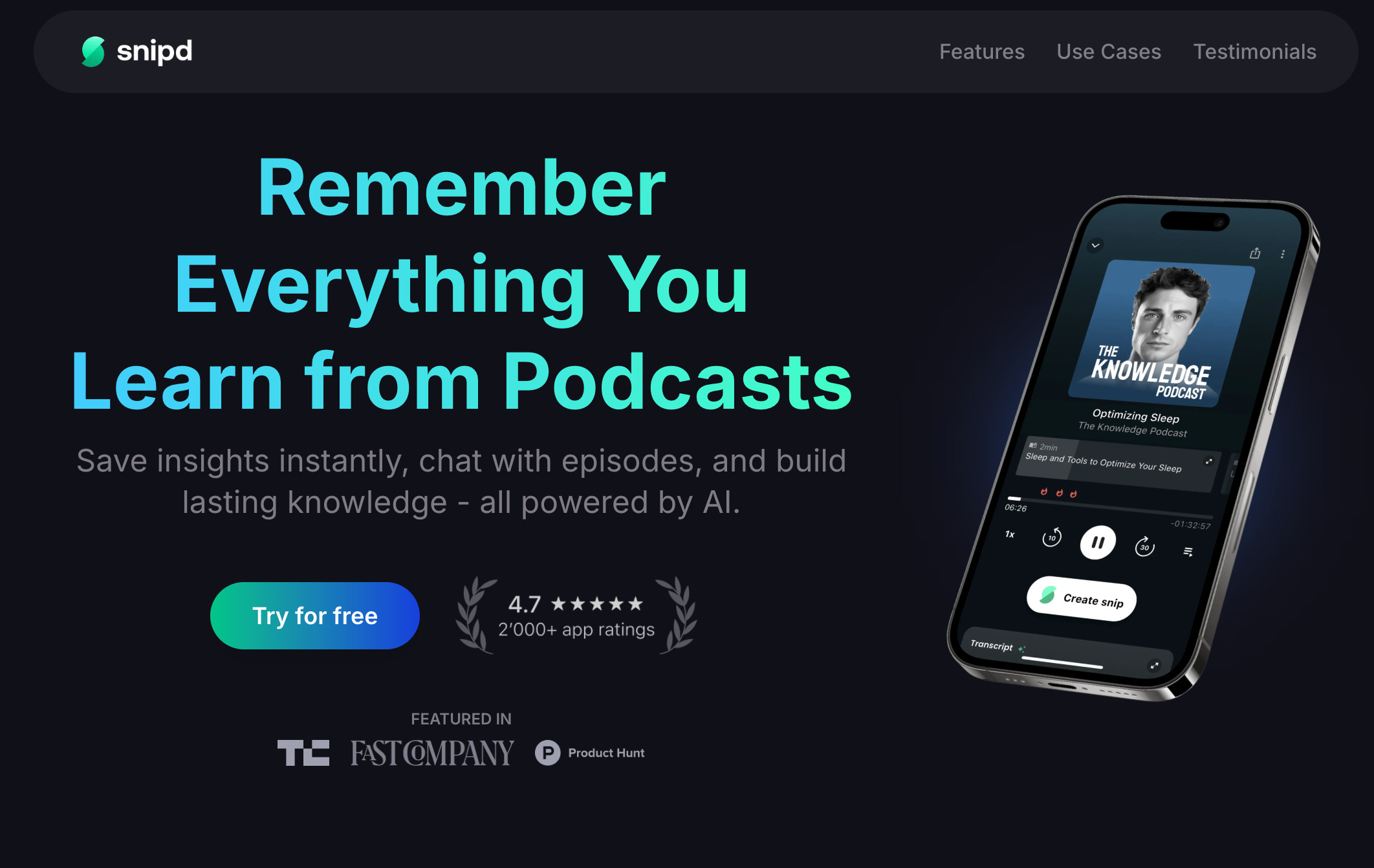
Building Snipd: The AI Podcast App for Learning
Latent Space: The AI Engineer Podcast
Audio is streamed directly from the publisher (api.substack.com) as published in their RSS feed. Play Podcasts does not host this file. Rights-holders can request removal through the copyright & takedown page.
Show Notes
We are working with Amplify on the 2025 State of AI Engineering Survey to be presented at the AIE World’s Fair in SF! Join the survey to shape the future of AI Eng!
We first met Snipd (affiliate link! we get a free month, you get a free month. but this is not a sponsored pod, we’ve never done one) over a year ago, and were immediately impressed by the design, but were doubtful about the behavior of snipping as the title behavior:
Podcast apps are enormously sticky - Spotify spent almost $1b in podcast acquisitions and exclusive content just to get an 8% bump in market share among normies.
However, after a disappointing Overcast 2.0 rewrite with no AI features in the last 3 years, I finally bit the bullet and switched to Snipd.
It’s 2025, your podcast app should be able to let you search transcripts of your podcasts. Snipd is the best implementation of this so far.
And yet they keep shipping:
What impressed us wasn’t just how this tiny team of 4 was able to bootstrap a consumer AI app against massive titans and do so well; but also how seriously they think about learning through podcasts and improving retention of knowledge over time, aka “Duolingo for podcasts”.
As an educational AI podcast, that’s a mission we can get behind.
Full Video Pod
Find us on YouTube! This was the first pod we’ve ever shot outdoors!
Show Notes
* Comparing Snipd transcription with our Bee episode
* Gustav Söderström - Background Audio
Timestamps
* [00:00:03] Takeaways from AI Engineer NYC
* [00:00:17] Weather in New York.
* [00:00:26] Swyx and Snipd.
* [00:01:01] Kevin's AI summit experience.
* [00:01:31] Zurich and AI.
* [00:03:25] SigLIP authors join OpenAI.
* [00:03:39] Zurich is very costly.
* [00:04:06] The Snipd origin story.
* [00:05:24] Introduction to machine learning.
* [00:09:28] Snipd and user knowledge extraction.
* [00:13:48] App's tech stack, Flutter, Python.
* [00:15:11] How speakers are identified.
* [00:18:29] The concept of "backgroundable" video.
* [00:29:05] Voice cloning technology.
* [00:31:03] Using AI agents.
* [00:34:32] Snipd's future is multi-modal AI.
* [00:36:37] Snipd and existing user behaviour.
* [00:42:10] The app, summary, and timestamps.
* [00:55:25] The future of AI and podcasting.
* [1:14:55] Voice AI
Transcript
swyx [00:00:03]: Hey, I'm here in New York with Kevin Ben-Smith of Snipd. Welcome.
Kevin [00:00:07]: Hi. Hi. Amazing to be here.
swyx [00:00:09]: Yeah. This is our first ever, I think, outdoors podcast recording.
Kevin [00:00:14]: It's quite a location for the first time, I have to say.
swyx [00:00:18]: I was actually unsure because, you know, it's cold. It's like, I checked the temperature. It's like kind of one degree Celsius, but it's not that bad with the sun. No, it's quite nice. Yeah. Especially with our beautiful tea. With the tea. Yeah. Perfect. We're going to talk about Snips. I'm a Snips user. I'm a Snips user. I had to basically, you know, apart from Twitter, it's like the number one use app on my phone. Nice. When I wake up in the morning, I open Snips and I, you know, see what's new. And I think in terms of time spent or usage on my phone, I think it's number one or number two. Nice. Nice. So I really had to talk about it also because I think people interested in AI want to think about like, how can we, we're an AI podcast, we have to talk about the AI podcast app. But before we get there, we just finished. We just finished the AI Engineer Summit and you came for the two days. How was it?
Kevin [00:01:07]: It was quite incredible. I mean, for me, the most valuable was just being in the same room with like-minded people who are building the future and who are seeing the future. You know, especially when it comes to AI agents, it's so often I have conversations with friends who are not in the AI world. And it's like so quickly it happens that you, it sounds like you're talking in science fiction. And it's just crazy talk. It was, you know, it's so refreshing to talk with so many other people who already see these things and yeah, be inspired then by them and not always feel like, like, okay, I think I'm just crazy. And like, this will never happen. It really is happening. And for me, it was very valuable. So day two, more relevant, more relevant for you than day one. Yeah. Day two. So day two was the engineering track. Yeah. That was definitely the most valuable for me. Like also as a producer. Practitioner myself, especially there were one or two talks that had to do with voice AI and AI agents with voice. Okay. So that was quite fascinating. Also spoke with the speakers afterwards. Yeah. And yeah, they were also very open and, and, you know, this, this sharing attitudes that's, I think in general, quite prevalent in the AI community. I also learned a lot, like really practical things that I can now take away with me. Yeah.
swyx [00:02:25]: I mean, on my side, I, I think I watched only like half of the talks. Cause I was running around and I think people saw me like towards the end, I was kind of collapsing. I was on the floor, like, uh, towards the end because I, I needed to get, to get a rest, but yeah, I'm excited to watch the voice AI talks myself.
Kevin [00:02:43]: Yeah. Yeah. Do that. And I mean, from my side, thanks a lot for organizing this conference for bringing everyone together. Do you have anything like this in Switzerland? The short answer is no. Um, I mean, I have to say the AI community in, especially Zurich, where. Yeah. Where we're, where we're based. Yeah. It is quite good. And it's growing, uh, especially driven by ETH, the, the technical university there and all of the big companies, they have AI teams there. Google, like Google has the biggest tech hub outside of the U S in Zurich. Yeah. Facebook is doing a lot in reality labs. Uh, Apple has a secret AI team, open AI and then SwapBit just announced that they're coming to Zurich. Yeah. Um, so there's a lot happening. Yeah.
swyx [00:03:23]: So, yeah, uh, I think the most recent notable move, I think the entire vision team from Google. Uh, Lucas buyer, um, and, and all the other authors of Siglip left Google to join open AI, which I thought was like, it's like a big move for a whole team to move all at once at the same time. So I've been to Zurich and it just feels expensive. Like it's a great city. Yeah. It's great university, but I don't see it as like a business hub. Is it a business hub? I guess it is. Right.
Kevin [00:03:51]: Like it's kind of, well, historically it's, uh, it's a finance hub, finance hub. Yeah. I mean, there are some, some large banks there, right? Especially UBS, uh, the, the largest wealth manager in the world, but it's really becoming more of a tech hub now with all of the big, uh, tech companies there.
swyx [00:04:08]: I guess. Yeah. Yeah. And, but we, and research wise, it's all ETH. Yeah. There's some other things. Yeah. Yeah. Yeah.
Kevin [00:04:13]: It's all driven by ETH. And then, uh, it's sister university EPFL, which is in Lausanne. Okay. Um, which they're also doing a lot, but, uh, it's, it's, it's really ETH. Uh, and otherwise, no, I mean, it's a beautiful, really beautiful city. I can recommend. To anyone. To come, uh, visit Zurich, uh, uh, let me know, happy to show you around and of course, you know, you, you have the nature so close, you have the mountains so close, you have so, so beautiful lakes. Yeah. Um, I think that's what makes it such a livable city. Yeah.
swyx [00:04:42]: Um, and the cost is not, it's not cheap, but I mean, we're in New York city right now and, uh, I don't know, I paid $8 for a coffee this morning, so, uh, the coffee is cheaper in Zurich than the New York city. Okay. Okay. Let's talk about Snipt. What is Snipt and, you know, then we'll talk about your origin story, but I just, let's, let's get a crisp, what is Snipt? Yeah.
Kevin [00:05:03]: I always see two definitions of Snipt, so I'll give you one really simple, straightforward one, and then a second more nuanced, um, which I think will be valuable for the rest of our conversation. So the most simple one is just to say, look, we're an AI powered podcast app. So if you listen to podcasts, we're now providing this AI enhanced experience. But if you look at the more nuanced, uh, podcast. Uh, perspective, it's actually, we, we've have a very big focus on people who like your audience who listened to podcasts to learn something new. Like your audience, you want, they want to learn about AI, what's happening, what's, what's, what's the latest research, what's going on. And we want to provide a, a spoken audio platform where you can do that most effectively. And AI is basically the way that we can achieve that. Yeah.
swyx [00:05:53]: Means to an end. Yeah, exactly. When you started. Was it always meant to be AI or is it, was it more about the social sharing?
Kevin [00:05:59]: So the first version that we ever released was like three and a half years ago. Okay. Yeah. So this was before ChatGPT. Before Whisper. Yeah. Before Whisper. Yeah. So I think a lot of the features that we now have in the app, they weren't really possible yet back then. But we already from the beginning, we always had the focus on knowledge. That's the reason why, you know, we in our team, why we listen to podcasts, but we did have a bit of a different approach. Like the idea in the very beginning was, so the name is Snips and you can create these, what we call Snips, which is basically a small snippet, like a clip from a, from a podcast. And we did envision sort of like a, like a social TikTok platform where some people would listen to full episodes and they would snip certain, like the best parts of it. And they would post that in a feed and other users would consume this feed of Snips. And use that as a discovery tool or just as a means to an end. And yeah, so you would have both people who create Snips and people who listen to Snips. So our big hypothesis in the beginning was, you know, it will be easy to get people to listen to these Snips, but super difficult to actually get them to create them. So we focused a lot of, a lot of our effort on making it as seamless and easy as possible to create a Snip. Yeah.
swyx [00:07:17]: It's similar to TikTok. You need CapCut for there to be videos on TikTok. Exactly.
Kevin [00:07:23]: And so for, for Snips, basically whenever you hear an amazing insight, a great moment, you can just triple tap your headphones. And our AI actually then saves the moment that you just listened to and summarizes it to create a note. And this is then basically a Snip. So yeah, we built, we built all of this, launched it. And what we found out was basically the exact opposite. So we saw that people use the Snips to discover podcasts, but they really, you know, they don't. You know, really love listening to long form podcasts, but they were creating Snips like crazy. And this was, this was definitely one of these aha moments when we realized like, hey, we should be really doubling down on the knowledge of learning of, yeah, helping you learn most effectively and helping you capture the knowledge that you listen to and actually do something with it. Because this is in general, you know, we, we live in this world where there's so much content and we consume and consume and consume. And it's so easy to just at the end of the podcast. You just start listening to the next podcast. And five minutes later, you've forgotten everything. 90%, 99% of what you've actually just learned. Yeah.
swyx [00:08:31]: You don't know this, but, and most people don't know this, but this is my fourth podcast. My third podcast was a personal mixtape podcast where I Snipped manually sections of podcasts that I liked and added my own commentary on top of them and published them as small episodes. Nice. So those would be maybe five to 10 minute Snips. Yeah. And then I added something that I thought was a good story or like a good insight. And then I added my own commentary and published it as a separate podcast. It's cool. Is that still live? It's still live, but it's not active, but you can go back and find it. If you're, if, if you're curious enough, you'll see it. Nice. Yeah. You have to show me later. It was so manual because basically what my process would be, I hear something interesting. I note down the timestamp and I note down the URL of the podcast. I used to use Overcast. So it would just link to the Overcast page. And then. Put in my note taking app, go home. Whenever I feel like publishing, I will take one of those things and then download the MP3, clip out the MP3 and record my intro, outro and then publish it as a, as a podcast. But now Snips, I mean, I can just kind of double click or triple tap.
Kevin [00:09:39]: I mean, those are very similar stories to what we hear from our users. You know, it's, it's normal that you're doing, you're doing something else while you're listening to a podcast. Yeah. A lot of our users, they're driving, they're working out, walking their dog. So in those moments when you hear something amazing, it's difficult to just write them down or, you know, you have to take out your phone. Some people take a screenshot, write down a timestamp, and then later on you have to go back and try to find it again. Of course you can't find it anymore because there's no search. There's no command F. And, um, these, these were all of the issues that, that, that we encountered also ourselves as users. And given that our background was in AI, we realized like, wait, hey, this is. This should not be the case. Like podcast apps today, they're still, they're basically repurposed music players, but we actually look at podcasts as one of the largest sources of knowledge in the world. And once you have that different angle of looking at it together with everything that AI is now enabling, you realize like, hey, this is not the way that we, that podcast apps should be. Yeah.
swyx [00:10:41]: Yeah. I agree. You mentioned something that you said your background is in AI. Well, first of all, who's the team and what do you mean your background is in AI?
Kevin [00:10:48]: Those are two very different things. I'm going to ask some questions. Yeah. Um, maybe starting with, with my backstory. Yeah. My backstory actually goes back, like, let's say 12 years ago or something like that. I moved to Zurich to study at ETH and actually I studied something completely different. I studied mathematics and economics basically with this specialization for quant finance. Same. Okay. Wow. All right. So yeah. And then as you know, all of these mathematical models for, um, asset pricing, derivative pricing, quantitative trading. And for me, the thing that, that fascinates me the most was the mathematical modeling behind it. Uh, mathematics, uh, statistics, but I was never really that passionate about the finance side of things.
swyx [00:11:32]: Oh really? Oh, okay. Yeah. I mean, we're different there.
Kevin [00:11:36]: I mean, one just, let's say symptom that I noticed now, like, like looking back during that time. Yeah. I think I never read an academic paper about the subject in my free time. And then it was towards the end of my studies. I was already working for a big bank. One of my best friends, he comes to me and says, Hey, I just took this course. You have to, you have to do this. You have to take this lecture. Okay. And I'm like, what, what, what is it about? It's called machine learning and I'm like, what, what, what kind of stupid name is that? Uh, so you sent me the slides and like over a weekend I went through all of the slides and I just, I just knew like freaking hell. Like this is it. I'm, I'm in love. Wow. Yeah. Okay. And that was then over the course of the next, I think like 12 months, I just really got into it. Started reading all about it, like reading blog posts, starting building my own models.
swyx [00:12:26]: Was this course by a famous person, famous university? Was it like the Andrew Wayne Coursera thing? No.
Kevin [00:12:31]: So this was a ETH course. So a professor at ETH. Did he teach in English by the way? Yeah. Okay.
swyx [00:12:37]: So these slides are somewhere available. Yeah. Definitely. I mean, now they're quite outdated. Yeah. Sure. Well, I think, you know, reflecting on the finance thing for a bit. So I, I was, used to be a trader, uh, sell side and buy side. I was options trader first and then I was more like a quantitative hedge fund analyst. We never really use machine learning. It was more like a little bit of statistical modeling, but really like you, you fit, you know, your regression.
Kevin [00:13:03]: No, I mean, that's, that's what it is. And, uh, or you, you solve partial differential equations and have then numerical methods to, to, to solve these. That's, that's for you. That's your degree. And that's, that's not really what you do at work. Right. Unless, well, I don't know what you do at work. In my job. No, no, we weren't solving the partial differential. Yeah.
swyx [00:13:18]: You learn all this in school and then you don't use it.
Kevin [00:13:20]: I mean, we, we, well, let's put it like that. Um, in some things, yeah, I mean, I did code algorithms that would do it, but it was basically like, it was the most basic algorithms and then you just like slightly improve them a little bit. Like you just tweak them here and there. Yeah. It wasn't like starting from scratch, like, Oh, here's this new partial differential equation. How do we know?
swyx [00:13:43]: Yeah. Yeah. I mean, that's, that's real life, right? Most, most of it's kind of boring or you're, you're using established things because they're established because, uh, they tackle the most important topics. Um, yeah. Portfolio management was more interesting for me. Um, and, uh, we, we were sort of the first to combine like social data with, with quantitative trading. And I think, uh, I think now it's very common, but, um, yeah. Anyway, then you, you went, you went deep on machine learning and then what? You quit your job? Yeah. Yeah. Wow.
Kevin [00:14:12]: I quit my job because, uh, um, I mean, I started using it at the bank as well. Like try, like, you know, I like desperately tried to find any kind of excuse to like use it here or there, but it just was clear to me, like, no, if I want to do this, um, like I just have to like make a real cut. So I quit my job and joined an early stage, uh, tech startup in Zurich where then built up the AI team over five years. Wow. Yeah. So yeah, we built various machine learning, uh, things for, for banks from like models for, for sales teams to identify which clients like which product to sell to them and with what reasons all the way to, we did a lot, a lot with bank transactions. One of the actually most fun projects for me was we had an, an NLP model that would take the booking text of a transaction, like a credit card transaction and pretty fired. Yeah. Because it had all of these, you know, like numbers in there and abbreviations and whatnot. And sometimes you look at it like, what, what is this? And it was just, you know, it would just change it to, I don't know, CVS. Yeah.
swyx [00:15:15]: Yeah. But I mean, would you have hallucinations?
Kevin [00:15:17]: No, no, no. The way that everything was set up, it wasn't like, it wasn't yet fully end to end generative, uh, neural network as what you would use today. Okay.
swyx [00:15:30]: Awesome. And then when did you go like full time on Snips? Yeah.
Kevin [00:15:33]: So basically that was, that was afterwards. I mean, how that started was the friend of mine who got me into machine learning, uh, him and I, uh, like he also got me interested into startups. He's had a big impact on my life. And the two of us were just a jam on, on like ideas for startups every now and then. And his background was also in AI data science. And we had a couple of ideas, but given that we were working full times, we were thinking about, uh, so we participated in Hack Zurich. That's, uh, Europe's biggest hackathon, um, or at least was at the time. And we said, Hey, this is just a weekend. Let's just try out an idea, like hack something together and see how it works. And the idea was that we'd be able to search through podcast episodes, like within a podcast. Yeah. So we did that. Long story short, uh, we managed to do it like to build something that we realized, Hey, this actually works. You can, you can find things again in podcasts. We had like a natural language search and we pitched it on stage. And we actually won the hackathon, which was cool. I mean, we, we also, I think we had a good, um, like a good, good pitch or a good example. So we, we used the famous Joe Rogan episode with Elon Musk where Elon Musk smokes a joint. Okay. Um, it's like a two and a half hour episode. So we were on stage and then we just searched for like smoking weed and it would find that exact moment. It will play it. And it just like, come on with Elon Musk, just like smoking. Oh, so it was video as well? No, it was actually completely based on audio. But we did have the video for the presentation. Yeah. Which had a, had of course an amazing effect. Yeah. Like this gave us a lot of activation energy, but it wasn't actually about winning the hackathon. Yeah. But the interesting thing that happened was after we pitched on stage, several of the other participants, like a lot of them came up to us and started saying like, Hey, can I use this? Like I have this issue. And like some also came up and told us about other problems that they have, like very adjacent to this with a podcast. Where's like, like this. Like, could, could I use this for that as well? And that was basically the, the moment where I realized, Hey, it's actually not just us who are having these issues with, with podcasts and getting to the, making the most out of this knowledge. Yeah. The other people. Yeah. That was now, I guess like four years ago or something like that. And then, yeah, we decided to quit our jobs and start, start this whole snip thing. Yeah. How big is the team now? We're just four people. Yeah. Just four people. Yeah. Like four. We're all technical. Yeah. Basically two on the, the backend side. So one of my co-founders is this person who got me into machine learning and startups. And we won the hackathon together. So we have two people for the backend side with the AI and all of the other backend things. And two for the front end side, building the app.
swyx [00:18:18]: Which is mostly Android and iOS. Yeah.
Kevin [00:18:21]: It's iOS and Android. We also have a watch app for, for Apple, but yeah, it's mostly iOS. Yeah.
swyx [00:18:27]: The watch thing, it was very funny because in the, in the Latent Space discord, you know, most of us have been slowly adopting snips. You came to me like a year ago and you introduced snip to me. I was like, I don't know. I'm, you know, I'm very sticky to overcast and then slowly we switch. Why watch?
Kevin [00:18:43]: So it goes back to a lot of our users, they do something else while, while listening to a podcast, right? Yeah. And one of the, us giving them the ability to then capture this knowledge, even though they're doing something else at the same time is one of the killer features. Yeah. Maybe I can actually, maybe at some point I should maybe give a bit more of an overview of what the, all of the features that we have. Sure. So this is one of the killer features and for one big use case that people use this for is for running. Yeah. So if you're a big runner, a big jogger or cycling, like really, really cycling competitively and a lot of the people, they don't want to take their phone with them when they go running. So you load everything onto the watch. So you can download episodes. I mean, if you, if you have an Apple watch that has internet access, like with a SIM card, you can also directly stream. That's also possible. Yeah. So of course it's a, it's basically very limited to just listening and snipping. And then you can see all of your snips later on your phone. Let me tell you this error I just got.
swyx [00:19:47]: Error playing episode. Substack, the host of this podcast, does not allow this podcast to be played on an Apple watch. Yeah.
Kevin [00:19:52]: That's a very beautiful thing. So we found out that all of the podcasts hosted on Substack, you cannot play them on an Apple watch. Why is this restriction? What? Like, don't ask me. We try to reach out to Substack. We try to reach out to some of the bigger podcasters who are hosting the podcast on Substack to also let them know. Substack doesn't seem to care. This is not specific to our app. You can also check out the Apple podcast app. Yeah. It's the same problem. It's just that we actually have identified it. And we tell the user what's going on.
swyx [00:20:25]: I would say we host our podcast on Substack, but they're not very serious about their podcasting tools. I've told them before, I've been very upfront with them. So I don't feel like I'm shitting on them in any way. And it's kind of sad because otherwise it's a perfect creative platform. But the way that they treat podcasting as an afterthought, I think it's really disappointing.
Kevin [00:20:45]: Maybe given that you mentioned all these features, maybe I can give a bit of a better overview of the features that we have. Let's do that. Let's do that. So I think we're mostly in our minds. Maybe for some of the listeners.
swyx [00:20:55]: I mean, I'll tell you my version. Yeah. They can correct me, right? So first of all, I think the main job is for it to be a podcast listening app. It should be basically a complete superset of what you normally get on Overcast or Apple Podcasts or anything like that. You pull your show list from ListenNotes. How do you find shows? You've got to type in anything and you find them, right?
Kevin [00:21:18]: Yeah. We have a search engine that is powered by ListenNotes. Yeah. But I mean, in the meantime, we have a huge database of like 99% of all podcasts out there ourselves. Yeah.
swyx [00:21:27]: What I noticed, the default experience is you do not auto-download shows. And that's one very big difference for you guys versus other apps, where like, you know, if I'm subscribed to a thing, it auto-downloads and I already have the MP3 downloaded overnight. For me, I have to actively put it onto my queue, then it auto-downloads. And actually, I initially didn't like that. I think I maybe told you that I was like, oh, it's like a feature that I don't like. Like, because it means that I have to choose to listen to it in order to download and not to... It's like opt-in. There's a difference between opt-in and opt-out. So I opt-in to every episode that I listen to. And then, like, you know, you open it and depends on whether or not you have the AI stuff enabled. But the default experience is no AI stuff enabled. You can listen to it. You can see the snips, the number of snips and where people snip during the episode, which roughly correlates to interest level. And obviously, you can snip there. I think that's the default experience. I think snipping is really cool. Like, I use it to share a lot on Discord. I think we have tons and tons of just people sharing snips and stuff. Tweeting stuff is also like a nice, pleasant experience. But like the real features come when you actually turn on the AI stuff. And so the reason I got snipped, because I got fed up with Overcast not implementing any AI features at all. Instead, they spent two years rewriting their app to be a little bit faster. And I'm like, like, it's 2025. I should have a podcast that has transcripts that I can search. Very, very basic thing. Overcast will basically never have it.
Kevin [00:22:49]: Yeah, I think that was a good, like, basic overview. Maybe I can add a bit to it with the AI features that we have. So one thing that we do every time a new podcast comes out, we transcribe the episode. We do speaker diarization. We identify the speaker names. Each guest, we extract a mini bio of the guest, try to find a picture of the guest online, add it. We break the podcast down into chapters, as in AI generated chapters. That one. That one's very handy. With a quick description per title and quick description per each chapter. We identify all books that get mentioned on a podcast. You can tell I don't use that one. It depends on the podcast. There are some podcasts where the guests often recommend like an amazing book. So later on, you can you can find that again.
swyx [00:23:42]: So you literally search for the word book or I just read blah, blah, blah.
Kevin [00:23:46]: No, I mean, it's all LLM based. Yeah. So basically, we have we have an LLM that goes through the entire transcript and identifies if a user mentions a book, then we use perplexity API together with various other LLM orchestration to go out there on the Internet, find everything that there is to know about the book, find the cover, find who or what the author is, get a quick description of it for the author. We then check on which other episodes the author appeared on.
swyx [00:24:15]: Yeah, that is killer.
Kevin [00:24:17]: Because that for me, if. If there's an interesting book, the first thing I do is I actually listen to a podcast episode with a with a writer because he usually gives a really great overview already on a podcast.
swyx [00:24:28]: Sometimes the podcast is with the person as a guest. Sometimes his podcast is about the person without him there. Do you pick up both?
Kevin [00:24:37]: So, yes, we pick up both in like our latest models. But actually what we show you in the app, the goal is to currently only show you the guest to separate that. In the future, we want to show the other things more.
swyx [00:24:47]: For what it's worth, I don't mind. Yeah, I don't think like if I like if I like somebody, I'll just learn about them regardless of whether they're there or not.
Kevin [00:24:55]: Yeah, I mean, yes and no. We we we have seen there are some personalities where this can break down. So, for example, the first version that we released with this feature, it picked up much more often a person, even if it was not a guest. Yeah. For example, the best examples for me is Sam Altman and Elon Musk. Like they're just mentioned on every second podcast and it has like they're not on there. And if you're interested in it, you can go to Elon Musk. And actually like learning from them. Yeah, I see. And yeah, we updated our our algorithms, improved that a lot. And now it's gotten much better to only pick it up if they're a guest. And yeah, so this this is maybe to come back to the features, two more important features like we have the ability to chat with an episode. Yes. Of course, you can do the old style of searching through a transcript with a keyword search. But I think for me, this is this is how you used to do search and extracting knowledge in the in the past. Old school. And the A.I. Web. Way is is basically an LLM. So you can ask the LLM, hey, when do they talk about topic X? If you're interested in only a certain part of the episode, you can ask them for four to give a quick overview of the episode. Key takeaways afterwards also to create a note for you. So this is really like very open, open ended. And yeah. And then finally, the snipping feature that we mentioned just to reiterate. Yeah. I mean, here the the feature is that whenever you hear an amazing idea, you can trip. It's up your headphones or click a button in the app and the A.I. summarizes the insight you just heard and saves that together with the original transcript and audio in your knowledge library. I also noticed that you you skip dynamic content. So dynamic content, we do not skip it automatically. Oh, sorry. You detect. But we detect it. Yeah. I mean, that's one of the thing that most people don't don't actually know that like the way that ads get inserted into podcasts or into most podcasts is actually that every time you listen. To a podcast, you actually get access to a different audio file and on the server, a different ad is inserted into the MP3 file automatically. Yeah. Based on IP. Exactly. And that's what that means is if we transcribe an episode and have a transcript with timestamps like words, word specific timestamps, if you suddenly get a different audio file, like the whole time says I messed up and that's like a huge issue. And for that, we actually had to build another algorithm that would dynamically on the floor. I re sync the audio that you're listening to the transcript that we have. Yeah. Which is a fascinating problem in and of itself.
swyx [00:27:24]: You sync by matching up the sound waves? Or like, or do you sync by matching up words like you basically do partial transcription?
Kevin [00:27:33]: We are not matching up words. It's happening on the basically a bytes level matching. Yeah. Okay.
swyx [00:27:40]: It relies on this. It relies on the exact match at some point.
Kevin [00:27:46]: So it's actually. We're actually not doing exact matches, but we're doing fuzzy matches to identify the moment. It's basically, we basically built Shazam for podcasts. Just as a little side project to solve this issue.
swyx [00:28:02]: Actually, fun fact, apparently the Shazam algorithm is open. They published the paper, it's talked about it. I haven't really dived into the paper. I thought it was kind of interesting that basically no one else has built Shazam.
Kevin [00:28:16]: Yeah, I mean, well, the one thing is the algorithm. If you now talk about Shazam, the other thing is also having the database behind it and having the user mindset that if they have this problem, they come to you, right?
swyx [00:28:29]: Yeah, I'm very interested in the tech stack. There's a big data pipeline. Could you share what is the tech stack?
Kevin [00:28:35]: What are the most interesting or challenging pieces of it? So the general tech stack is our entire backend is, or 90% of our backend is written in Python. Okay. Hosting everything on Google Cloud Platform. And our front end is written with, well, we're using the Flutter framework. So it's written in Dart and then compiled natively. So we have one code base that handles both Android and iOS. You think that was a good decision? It's something that a lot of people are exploring. So up until now, yes. Okay. Look, it has its pros and cons. Some of the, you know, for example, earlier, I mentioned we have a Apple Watch app. Yeah. I mean, there's no Flutter for that, right? So that you build native. And then of course you have to sort of like sync these things together. I mean, I'm not the front end engineer, so I'm not just relaying this information, but our front end engineers are very happy with it. It's enabled us to be quite fast and be on both platforms from the very beginning. And when I talk with people and they hear that we are using Flutter, usually they think like, ah, it's not performant. It's super junk, janky and everything. And then they use it. They use our app and they're always super surprised. Or if they've already used our app, I couldn't tell them. They're like, what? Yeah. Um, so there is actually a lot that you can do with it.
swyx [00:29:51]: The danger, the concern, there's a few concerns, right? One, it's Google. So when were they, when are they going to abandon it? Two, you know, they're optimized for Android first. So iOS is like a second, second thought, or like you can feel that it is not a native iOS app. Uh, but you guys put a lot of care into it. And then maybe three, from my point of view, JavaScript, as a JavaScript guy, React Native was supposed to be there. And I think that it hasn't really fulfilled that dream. Um, maybe Expo is trying to do that, but, um, again, it is not, does not feel as productive as Flutter. And I've, I spent a week on Flutter and dot, and I'm an investor in Flutter flow, which is the local, uh, Flutter, Flutter startup. That's doing very, very well. I think a lot of people are still Flutter skeptics. Yeah. Wait. So are you moving away from Flutter?
Kevin [00:30:41]: I don't know. We don't have plans to do that. Yeah.
swyx [00:30:43]: You're just saying about that. What? Yeah. Watch out. Okay. Let's go back to the stack.
Kevin [00:30:47]: You know, that was just to give you a bit of an overview. I think the more interesting things are, of course, on the AI side. So we, like, as I mentioned earlier, when we started out, it was before chat GPT for the chat GPT moment before there was the GPT 3.5 turbo, uh, API. So in the beginning, we actually were running everything ourselves, open source models, try to fine tune them. They worked. There was us, but let's, let's be honest. They weren't. What was the sort of? Before Whisper, the transcription. Yeah, we were using wave to work like, um, there was a Google one, right? No, it was a Facebook, Facebook one. That was actually one of the papers. Like when that came out for me, that was one of the reasons why I said we, we should try something to start a startup in the audio space. For me, it was a bit like before that I had been following the NLP space, uh, quite closely. And as, as I mentioned earlier, we, we did some stuff at the startup as well, that I was working up. But before, and wave to work was the first paper that I had at least seen where the whole transformer architecture moved over to audio and bit more general way of saying it is like, it was the first time that I saw the transformer architecture being applied to continuous data instead of discrete tokens. Okay. And it worked amazingly. Ah, and like the transformer architecture plus self-supervised learning, like these two things moved over. And then for me, it was like, Hey, this is now going to take off similarly. It's the text space has taken off. And with these two things in place, even if some features that we want to build are not possible yet, they will be possible in the near term, uh, with this, uh, trajectory. So that was a little side, side note. No, it's in the meantime. Yeah. We're using whisper. We're still hosting some of the models ourselves. So for example, the whole transcription speaker diarization pipeline, uh,
swyx [00:32:38]: You need it to be as cheap as possible.
Kevin [00:32:40]: Yeah, exactly. I mean, we're doing this at scale where we have a lot of audio.
swyx [00:32:44]: We're what numbers can you disclose? Like what, what are just to give people an idea because it's a lot. So we have more than a million podcasts that we've already processed when you say a million. So processing is basically, you have some kind of list of podcasts that you will auto process and others where a paying pay member can choose to press the button and transcribe it. Right. Is that the rough idea? Yeah, exactly.
Kevin [00:33:08]: Yeah. And if, when you press that button or we also transcribe it. Yeah. So first we do the, we do the transcription. We do the. The, the speaker diarization. So basically you identify speech blocks that belong to the same speaker. This is then all orchestrated within, within LLM to identify which speech speech block belongs to which speaker together with, you know, we identify, as I mentioned earlier, we identify the guest name and the bio. So all of that comes together with an LLM to actually then assign assigned speaker names to, to each block. Yeah. And then most of the rest of the, the pipeline we've now used, we've now migrated to LLM. So we use mainly open AI, Google models, so the Gemini models and the open AI models, and we use some perplexity basically for those things where we need, where we need web search. Yeah. That's something I'm still hoping, especially open AI will also provide us an API. Oh, why? Well, basically for us as a consumer, the more providers there are.
swyx [00:34:07]: The more downtime.
Kevin [00:34:08]: The more competition and it will lead to better, better results. And, um, lower costs over time. I don't, I don't see perplexity as expensive. If you use the web search, the price is like $5 per a thousand queries. Okay. Which is affordable. But, uh, if you compare that to just a normal LLM call, um, it's, it's, uh, much more expensive. Have you tried Exa? We've, uh, looked into it, but we haven't really tried it. Um, I mean, we, we started with perplexity and, uh, it works, it works well. And if I remember. Correctly, Exa is also a bit more expensive.
swyx [00:34:45]: I don't know. I don't know. They seem to focus on the search thing as a search API, whereas perplexity, maybe more consumer-y business that is higher, higher margin. Like I'll put it like perplexity is trying to be a product, Exa is trying to be infrastructure. Yeah. So that, that'll be my distinction there. And then the other thing I will mention is Google has a search grounding feature. Yeah. Which you, which you might want. Yeah.
Kevin [00:35:07]: Yeah. We've, uh, we've also tried that out. Um, not as good. So we, we didn't, we didn't go into. Too much detail in like really comparing it, like quality wise, because we actually already had the perplexity one and it, and it's, and it's working. Yeah. Um, I think also there, the price is actually higher than perplexity. Yeah. Really? Yeah.
swyx [00:35:26]: Google should cut their prices.
Kevin [00:35:29]: Maybe it was the same price. I don't want to say something incorrect, but it wasn't cheaper. It wasn't like compelling. And then, then there was no reason to switch. So, I mean, maybe like in general, like for us, given that we do work with a lot of content, price is actually something that we do look at. Like for us, it's not just about taking the best model for every task, but it's really getting the best, like identifying what kind of intelligence level you need and then getting the best price for that to be able to really scale this and, and provide us, um, yeah, let our users use these features with as many podcasts as possible. Yeah.
swyx [00:36:03]: I wanted to double, double click on diarization. Yeah. Uh, it's something that I don't think people do very well. So you know, I'm, I'm a, I'm a B user. I don't have it right now. And, and they were supposed to speak, but they dropped out last minute. Um, but, uh, we've had them on the podcast before and it's not great yet. Do you use just PI Anode, the default stuff, or do you find any tricks for diarization?
Kevin [00:36:27]: So we do use the, the open source packages, but we have tweaked it a bit here and there. For example, if you mentioned the BAI guys, I actually listened to the podcast episode was super nice. Thank you. And when you started talking about speaker diarization, and I just have to think about, uh, I don't know.
Kevin [00:36:49]: Is it possible? I don't know. I don't know. F**k this. Yeah, no, I don't know.
Kevin [00:36:55]: Yeah. We are the best. This is a.
swyx [00:37:07]: I don't know. This is the best. I don't know. This is the best. Yeah. Yeah. Yeah. You're doing good.
Kevin [00:37:12]: So, so yeah. This is great. This is good. Yeah. No, so that of course helps us. Another thing that helps us is that we know certain structural aspects of the podcast. For example, how often does someone speak? Like if someone, like let's say there's a one hour episode and someone speaks for 30 seconds, that person is most probably not the guest and not the host. It's probably some ad, like some speaker from an ad. So we have like certain of these heuristics that we can use and we leverage to improve things. And in the past, we've also changed the clustering algorithm. So basically how a lot of the speaker diarization works is you basically create an embedding for the speech that's happening. And then you try to somehow cluster these embeddings and then find out this is all one speaker. This is all another speaker. And there we've also tweaked a couple of things where we again used heuristics that we could apply from knowing how podcasts function. And that's also actually why I was feeling so much with the BAI guys, because like all of these heuristics, like for them, it's probably almost impossible to use any heuristics because it can just be any situation, anything.
Kevin [00:38:34]: So that's one thing that we do. Yeah, another thing is that we actually combine it with LLM. So the transcript, LLMs and the speaker diarization, like bringing all of these together to recalibrate some of the switching points. Like when does the speaker stop? When does the next one start?
swyx [00:38:51]: The LLMs can add errors as well. You know, I wouldn't feel safe using them to be so precise.
Kevin [00:38:58]: I mean, at the end of the day, like also just to not give a wrong impression, like the speaker diarization is also not perfect that we're doing, right? I basically don't really notice it.
swyx [00:39:08]: Like I use it for search.
Kevin [00:39:09]: Yeah, it's not perfect yet, but it's gotten quite good. Like, especially if you compare, if you look at some of the, like if you take a latest episode and you compare it to an episode that came out a year ago, we've improved it quite a bit.
swyx [00:39:23]: Well, it's beautifully presented. Oh, I love that I can click on the transcript and it goes to the timestamp. So simple, but you know, it should exist. Yeah, I agree. I agree. So this, I'm loading a two hour episode of Detect Me Right Home, where there's a lot of different guests calling in and you've identified the guest name. And yeah, so these are all LLM based. Yeah, it's really nice.
Kevin [00:39:49]: Yeah, like the speaker names.
swyx [00:39:50]: I would say that, you know, obviously I'm a power user of all these tools. You have done a better job than Descript. Okay, wow. Descript is so much funding. They had their open AI invested in them and they still suck. So I don't know, like, you know, keep going. You're doing great. Yeah, thanks. Thanks.
Kevin [00:40:12]: I mean, I would, I would say that, especially for anyone listening who's interes