
Konalani Yoga Ashram, Hawaii.
93 episodes — Page 2 of 2
S2 Ep 16The Witness of Emotion: Shiva Sutra 3.33
“sukhaduḥkhayorbahirmananam // “The Yogi experiences their joy and their sadness just like an object, with “this-consciousness” separate from their being.” There was an experiment done at the University of California at Los Angeles that asked four groups of people who are afraid of spiders to see how close they could let themselves get to a tarantula. The study postulated that normally the goal is to make people think differently about the spider so that it appears less threatening, so one group was instructed to say to itself, “The spider is in a cage and can’t hurt me, so I don’t need to be afraid.” Another group was instructed to say something that was irrelevant to the spider, the third group was simply exposed, not instructed to say anything at all, and the last group was told to say how they were feeling out loud to themselves as they approached the spider, such as “I’m scared of that huge, hairy tarantula.” The study concluded that the group that labeled their fear of the spider performed far better than the other groups. They got closer, were less emotionally aroused, and their hands were sweating significantly less, concluding that recognizing and naming of emotions seemed to defang the fearful emotions. I found the practice of this Sutra to be similar to the practice of naming emotions in this experiment, at least in the beginning stages. In this Sutra we see the teaching that instead of identifying directly with our pains and pleasures, such as feeling “I am Joyful” or “I am Sad”, we can learn to recognize our experience as “I am experiencing Joy or sadness”. “Such a yogī experiences the state of pleasure (sukha) and pain (duḥkha) with “this-consciousness,” not “I-consciousness.” For example, he does not experience joy thinking “I am joyous” and sadness thinking “I am sad.” Rather, he“experiences “this is sadness” and “this is joy,” just as an ordinary person experiences external objects in his daily life. He experiences “this-consciousness” not “I-consciousness,” thinking “this is a pot” or “this is a bottle.” So, this yogī experiences his joy and sadness just like an object, separate from his being.” Emotions are powerful because they arise from samskaras. This practice can help us release our attachment or aversion to the pleasure or pain in order that we are not lead around by them in the circle of samsara. As Patanjali says in his Yoga Sutras, “The seed of attachment is pleasure. The seed of aversion is pain…The enlightened practitioner realizes that the endless cycle of avoiding pain and seeking pleasure is a self-propagating result of our past impressions, and so both pain and pleasure must be subjected to the process of introspection and detachment.” (2.7,2.8,2.15). When we are hooked by pain or pleasure, our energy keeps leading us back to those pains and pleasures. Later in that article about the tarantula study, the author noted that research has shown that “When we are afraid or stressed, our brain can only respond based off of previously stored patterns of behavior. But that is rarely the best possible reaction, unless you really are reacting in a life or death situation.” Meaning that it’s good to react on previously stored patterns when an emergency strikes, you hear a tree limb breaking and you run away from the sound without interpreting the situation. Reacting to Samskaras only strengthens them. The problem arises, though, when we respond to our daily life in such a patterned way. This is the nature of samsara, when actions are not based on awareness, but are merely based on previous actions, creating a loop of eventual suffering. One simple example is when you hear your favorite song on your playlist, and you really enjoy it, but imagine if that song played a second time, and then a third time, and then a fourth time— it would eventually make you feel aggravated. Or, on the other hand, if there’s something you’re worried about, and you just keep running the worry through your mind endlessly, it wears you out deeply. So as yogis we can learn to observe our pains and pleasures with detachment and surrender in order to choose them, or not choose them, based on our growth. This is not a matter of stoicism, as this actual practice leads to immense joy. How can that be? I thought we were surrendering our joy? We are surrendering the temporary manifestations of joy as a means of accessing a deeper ‘supreme bliss’ which resides within us. As the Sutra reads, the yogi who uses their practice during the experience of pleasure and pain actually experiences Bliss. “although in their daily lives they experience pleasure and pain, these experiences do not affect them at all. There is no apprehension that pain and pleasure will rise in them because the cause of the rise of pain and pleasure is individuality and they have destroyed individuality. They are apart from that and so, in the experience of pleasure and pain, they experience the real state of supreme beatitude, supreme bliss (ānanda),

S2 Ep 153rd Eye of the Hurricane: Shiva Sutra 3.32
Every hurricane has a center, a point of absolute calm at its heart. So too do we have a ‘center’ amidst the storm of thoughts and sensations that swirl around us and within us everyday. In this Sutra we will learn how to naturally reside in this ‘third eye’ of the hurricane by using our practice, and releasing doership, within the multitude of weather patterns we call our lives. The Previous Sutra states that we can find Shiva in all of the different phases of reality— the creation phase, the maintenance phase and the dissolution phase, as well as the space between the phases. This motivates us to always use our practice— to keep reaching inside as we start a task, maintain it, as it is ending, and even during the space between. On our cushion, we watch the breath, for example, with equal attention on the inhale, the feeling of fullness, the exhale, and the space after the exhale. The yogic tradition is at its heart a scientific tradition, meaning that its ok to ask questions, and to use your practice in the laboratory of your life to prove its efficacy. At the end of the last Sutra the teacher, Ksemaraja, 1,000 years ago, asks his listeners— If we are saying that Shiva is to be found in all of these different stages of reality, then aren’t we also saying that Shiva is changeable? I thought Shiva was eternal, unchanging? How can this be? “If this yogī feels that the universe, in creation, in protection, and in destruction, is the expansion of his own nature, then would not his nature be changeable? It would definitely change. In creation it would be one way, in protection another way, and in destruction another way. Therefore, as his original state of being would occasionally change, the essential nature of the self would not remain unchangeable. The next sūtra answers this question.” The Answer to this is presented to us in the next Sutra, our work tonight, Shiva Sutra 3.32: Tatpra vṛitā vapya nirāsaḥ Saṁvet tṛibhāvāt : “Although the yogi is determined in creating, protecting, and destroying their universe, even then they are not separated from the real state of their subjectivity.” The word determined here shows us that our work as yogis is in this realm of the world— we have to learn how to operate within fluctuating circumstances of creation/maintanence/dissolution. But within this swirling hurricane of thought and sensation, we are never truly separated from the eternal stillness of Shiva which is our true nature. This true nature of Shiva is described here as “subjective” because it is not something that can be known from outside of itself, like an object can be. Our true nature is inherently subjective, when you discover it it will a revelation only for you. Only the path can be revealed, not the destination. For this reason it is inherently a subjective experience. The Sutra begins by telling us what we have already gone over together— that although it appears that the world is full of infinitely changing experiences, the experience of our true nature is never covered up, never separated from us. And that even when we forget our true nature, we are still Shiva. In a very scientific way, we then are taught that if we weren’t this eternal aspect, then the swirl of creation/maintanence/dissolution wouldn’t exist— we are the fulcrum around which it spins, we are not the spinning— we are the eye of the hurricane. This is taught in the following way: The Self can neither be created nor destroyed. The world of the mind and senses is constantly created and destroyed. So if the Self can never be created or destroyed, than it must be beyond the nature of the mind and senses. Another way we are taught this is through the analogy of “The Doer” and “the Done.” The doer is us, and the done is that which we are doing throughout our day. The Doer can never be created or destroyed, but the things we do are constantly being created and destroyed. When we over-associate with that which we do, instead of that which we are, we feel that we too are being destroyed, even though this is not the case. “This is written in Spanda: In the two states which are termed “doer” and “done,” the aspect known as done is destroyed while the aspect known as doer always remains and can never be destroyed. Only that force, which is the effort to create that which is to be done, is destroyed. But when that force is destroyed, ignorant people cry, saying, “we too are also destroyed.” (Spanda Kārikā 1.14–15)” When we over-associate with the mind and senses, we feel as though our world is ending when that world is ending. Our hearts beat fast for the protagonist of a movie when they are on the tipping point of their quest— we become what we see and do. In the movie of our lives this also happens, and when it does we honestly don’t know if there is a world beyond our senses. But as the text teaches, just because you aren’t aware of that reality doesn’t mean its not there. You might think your world is destroyed, but that doesn’t mean it reall
S2 Ep 15Beyond the Breath: Shiva Sutra 3.31, Part 3
In our final installment of Shiva Sutra 3.31 we are asked to pay attention to not only the breath, but the endless space after each breath. The perfectly gradual slide into stillness that we all experience at the end of each exhale. This space between our breaths is the same as the space between our thoughts, our days, the events of our lives. This ‘middle space’ is actually where the continuity of consciousness resides— known by many names: Turya, Shiva, Witness, God. This seemingly small space after each breath is a doorway to an infinitely large space, a crack in the boards if you will, light shining in to show us the way. But to fit our awareness through this crack we don’t get small, we get large, very large. We harmonize with the expansiveness that resides within us, the sky of the heart, and by doing so, we become that infinite space beyond the mind, the senses and even beyond the breath. Quotes used in this Sutra: “3.31. sthitilayau //This universe is the expansion of his energy in objective impressions and in the dissolution of those impressions." “If God consciousness were not existing throughout, then how would you be able to travel from one state to the next, from the dreaming state to the state of deep sleep, and from the state of deep sleep to the waking state? Between each of these states, there is a gap, a point where one state has ceased to exist and the next state has yet to begin. When you direct your consciousness from waking state to the dreaming state and from the dreaming state to the dreamless state, there is a point, a gap, when your consciousness, having left one world, has not yet entered the next world. How could you travel through that gap if God consciousness did not exist in that gap? So God consciousness must exist throughout. It is why the commentator Kṣemarāja says “there would be disconnection of your consciousness.” “It is said in the Śri Kālikākrama: That which exists, that which does not exist; this differentiation of existence and nonexistence and their connection [is only maintained by God consciousness]. This whole universe is absolutely pure, without any support, and one with the knowledge of the consciousness of self. If that consciousness of self is revealed and perceived, then at that very moment, he is without a doubt liberated in this very life. (Kālikākrama Śāstra)”
S2 Ep 14Beyond the Physical: Further Explorations of Shiva Sutra 3.31
Shiva Sutra 3.31 part 2 “3.31. sthitilayau //This universe is the expansion of his energy in objective impressions and in the dissolution of those impressions. Our goal in this Sutra is to discover our shiva nature in the more subtle layers of our practice and lives, specifically the layers that are beyond the physical. Layers of Surrender 1-In this sutra we see that our first understanding is defined by “action”, the Srishti phase. This is the physical level of understanding. From there, those actions accumulate into a knowledge that goes beyond the physical, the Sthiti stage. And then finally, the physical and even subtle dissolve into a third level of understanding that is based on the void, layah. “Initially, this universe is revealed to you by the energy of action. And after this universe shines before you, the knowledge of the universe remains for some time as an impression in your objective consciousness. That is what is meant by the word sthiti. Then the impression of this universe in your objective consciousness also melts away and all that is left is the void state where there is nothing. That is what is meant by the word layaḥ. And this state where there is nothing is also held in consciousness. For such an elevated soul, these two states are only the expansion of His energies and nothing else. For him, this objective world may be created in his sensual world, or it may be stored in his impressions, or it may be taken away from his impressions; but this threefold world is nothing more than the expansion of his God consciousness everywhere.” When learning any trade we see that first you learn the physical, then that experience accumulates into knowledge which gives you a subtler understanding, and eventually that knowledge accumulates into your very being which transcends both physical objects and knowledge itself, when you ‘become the profession’. Example: Cook 100 recipes you’re working with the physical ingredients. After a 1,000 recipes you are cooking with the recipe and your own accumulated knowledge. After 10,000 recipes you have become a chef, with or without a kitchen. 2. We see this same progression within our meditation practice. Do a hundred Malas and you’re working with the physical. Do a 1,000 Malas (100,000 mantras) and your practice starts to be informed by more than the just the words themselves. Do 10,000 Malas (1,000,000 mantras) and your mantra begin to do you, the mantra has become you. This is described as the three levels of mantra: Vaikhari, Madhyama and Pashyanti. As Muktananda teaches: “Everyone is aware of the speech of the tongue. It is called Vaikhari and corresponds to the gross body. With the subtle intellect, one can also know the second level of speech, which is in the throat. There, words have taken form but have not yet emerged. This level is called Madhyama and corresponds to the subtle body. At a deeper level, words exist in the heart. This is the third level of speech, Paśyanti, which corresponds to the causal body. Here, words are hidden, and what arises at this level is Matrika… The moment one understands the Matrika Shakti and its work, one is no longer a human being. When the Matrika Shakti expands within, in this very body one becomes Shiva.” (Nothing Exists Not Shiva, p. 7-9) 3. SO…knowing that this is the progression of understanding both and off the cushion means you can accelerate your growth. Can you connect to these deeper layers while you do your work and practice? Free Write: How do you reach for these deeper aspects of your practice on and off the cushion.
S2 Ep 13Training the Muscle of Surrender: Shiva Sutra 3.31
This Sutra teaches us how to recognize the many phases our ‘surrender muscles’ undergo during its inner work, just like a real muscle in our body. We can better tone this muscle of surrender by not just working with it at the onset of our practice, or when a tension arises, but also during the middle of our practice time, and even at the end of our practice, as we return to our regularly scheduled life. As you are able to recognize the 3 different phases of surrender, you can begin to work with more awareness during all of them. The result is a strong inner muscle that is capable of carrying you to new heights in your practice. [Full Text Below] 3.31: “śvaśaktipracayo’sya viśvam // For him, this universe is the embodiment of his collective energies” This whole universe is seen as Shiva, and you are Shiva, so this whole universe is an embodiment of your ‘collective’, meaning the totality of, your energies. So we are Shiva and the Universe is Shiva, but how can we realize that through our practice and experience? Sutra 3.30 teaches that we must learn to use our practice as we encounter the objects of our daily life. We can’t reject the objects of our life in order to find God, and we can’t quite directly pursue God without the objects of our life— even an enlightened practitioner has a personality, as Babaji has said of our own lineage teachers. So the path to realizing our own Shiva nature, and the Shiva nature of our universe, is to engage our practice as we engage with our life. This is how we walk from object awareness to God awareness. As we see in this quote: “If you think that in practicing yoga, God consciousness is to be possessed and that which is other than God consciousness is to be discarded, that is not the proper understanding. The correct understanding is that you must unite these two together. God consciousness must be united with objective consciousness and objective consciousness must be united with God consciousness…When you simultaneously possess this kind of knowledge, then knowledge and the known will be not separated.” When we stop accepting and rejecting our reality, and ourselves, and start engaging our practice as we engage in our life, we slowly but surely walk our awareness from object to Shiva. This isn’t a metaphor, but a very real part of our practice that any of us can do anytime we are willing to apply ourselves. This is the path we walk from mantra at the level of the mouth, to mantra at the level of the throat, to mantra at the level of the heart. Or the path we walk from pranayama to a natural breath meditation. And of course, this is the same work we do off our cushion as we engage our practice within the context of our lives. I received a question via email from a student after last week’s class that said “I can feel and connect with Shakti/awareness in meditation and often as I walk and look at things such as nature like the trees, sky, birds. However, the other day someone with a really loud souped up engine in a pickup truck drove by and they revved up their engine as they passed me and blew alot of exhaust into the air around me. I was wondering how one should ideally deal with staying connected with God consciousness and awareness when things are not so ideal and peaceful - and often in day to day life they are not as we well know (or have to deal with rudeness or disrespect) . Mostly I seem easily pulled back into judgement and reaction from the unpleasantness by people who are immersed into ego identity.” The practice is no different in this situation than it is on our cushion, we will walk the same path, but because of the variables in this situation we must walk the path of our practice slower and with more awareness. For example, magine this like walking on a nice clear path in the woods, and then suddenly, the path becomes overgrown and you can’t quite tell which way to go. You would naturally walk a little slower in this situation, or stop altogether, and you would pay more attention to your surroundings. In this case, we would react slower, breathe smoother, and try to make sure that each step we took was still towards a higher state of awareness, instead of just ‘downhill’ into our all too comfortable patterns of behavior. None of us are free from these challenges, although they look different in all of our lives. The path through them, though, is the same for all of us, and is the heart of this Sutra. How can we hold our practice and our life simultaneously? Maybe we have to slow down, or take very small steps— all of that should be expected. We might not reach the destination in one breath or ten, but we know afterwards, and sometime during, if we were pointing ourselves in the right direction. 3.31: sthitilayau // This universe is the expansion of his energy in objective impressions and in the dissolution of those impressions. This sutra can seem a little confusing at first, but when compiled with the previous sutra we see that it is merely an extension

S2 Ep 12The Path to God Awareness: Shiva Sutra 3.30 Part 2
Even though Shiva is all around us, and in us, there is still a path we must walk to that realization, and that is the reason we practice. This Path to God Awareness is the path we walk when we do mantra, pranayama, selfless service, hatha yoga— these are the ways that we can walk from our object based awareness to God awareness. As we will see in tonight’s Sutra, it is precisely from our limited object-awareness that we can '“walk” towards an expanded God Awareness, meaning that we can’t reject or accept the objects of our life to find God, but we in fact must learn to surrender them— to use our practice simultaneously with those objects of our awareness in order to illuminate the path to the higher Consciousness we seek. Full Text: Shiva Sutra 3.30 śvaśaktipracayo’sya viśvam // “For the yogi, this universe is the embodiment of their collective energies” To review in this Sutra we are taught that the practicing yogi sees this universe as the embodiment of their own energy. Just like our own body, there are infinite parts to it— you can zoom into to it infinitely, never ending. Muscles, bones, cells, atoms, etc. So the whole world is like your own body, there are infinite topics to learn about. But without inner awareness, that learning will never teach you about your self, who you are, and what this universe is really about. Its like trying to fit an ocean in a cup, instead throw your cup in the ocean. How do you do that? Cultivate a meditative state while you learn, work, play, and even relax, and then everything you do will teach you about your own true nature. As we will see in today’s teachings, cultivating this inner awareness is absolutely possible for anyone willing to try it, because everything you think, see and do is happening within this Universal Body of Shiva, which is also your body, as the Sutra tells us. There is nothing you can perceive that is not Shiva, as Swami Mutktananda’s own book tells us, and therefore this Shiva awareness is always available to us. But even though Shiva is all around us, and in us, there is still a path we must walk to that realization, and that is the reason we practice. This Path to God Awareness is the path we walk when we do mantra, pranayama, selfless service, hatha yoga— these are the ways that we can walk from our object based awareness to God awareness. As we will see in tonight’s text, it is precisely from our limited awareness of the object that we walk towards an expanded awareness of God Consciousness, meaning that we don’t need to reject the objects of our life to find God, but we in fact must learn to use our practice alongside those objects in order to illuminate the path to a higher level of awareness. We saw in the text last week that the word Knowledge can be confusing. Thanks to Usha, we saw the possibility to replace the word knowledge with awareness in order to simplify the work of the Sutra. Why are knowledge and awareness interchangeable? Because wherever awareness flows, knowledge naturally grows. My neighbor Billy is the best mango farmer on the island, when I asked him his secret he just said “I look at them everyday.” And the same could be said about our own hearts, our own true nature— if you take time to simply look inside everyday, you will grow! Just like a mango! Let’s take a look at a paragraph now and read it with that substitution. “This knowledge is found everywhere, inside and outside, because without knowledge, an object cannot exist. This entire universe is, therefore, filled with that knowledge. And that knowledge, which may be objective knowledge, is, in fact, knowledge of God consciousness. No one has ever perceived an object without that knowledge. That knowledge, which is the real knowledge of God consciousness, has taken the form of the object. Objective knowledge is not separate from that knowledge of God consciousness. It is by that knowledge of God consciousness that this knowledge of objects takes place.” Free Write: Where do you see this relationship of awareness and knowledge at play in your own life? We can take this investigation of knowledge and awareness further as we see the Sutra describing the relationship of Object awarensss, or knowledge, and God awareness, or knowledge. We are told that they are not opposite of each other, but are intimately related. As yogis, we use our practice to walk from Object to Awareness to God Awareness— We use the object to discover Shiva. This is a part of every practice we do-- every single thing we do. Mantra walks you from the mouth to the heart, pujas walk you from the Aarti try to devotion, seva walks you from chopping a carrot to a disciplined mind. Its endless— this path from object to God in Yoga. Let’s see how the Sutra teaches it: “If you think that in practicing yoga, God consciousness is to be possessed and that which is other than God consciousness is to be discarded, that is not the proper understanding. The correct understanding is that you must unite these two
S2 Ep 12Learn to Grow, Grow to Learn: Shiva Sutra 3.30, Part 1
"Great acts are made up of small deeds," Lao Tzu. If you want to understand cooking, you have to learn many small recipes. If you want to understand anatomy, you have to learn many small bones and muscles. If you want to understand the Universe, you have to learn how to use your practice during the many "small" moments of your life... Shiva Sutra 3.30 śvaśaktipracayo’sya viśvam // “For the yogi, this universe is the embodiment of their collective energies” In common terminology you could say, “For the yogi, everything is Shiva.” But as we remember from LMJ’s commentary on Sutra 3.14, “Some yogīs permeate their thinking with thoughts such as “I am independent” or “I am Śiva.” To possess unartificial independence, they must actually be independent, they must be Śiva, not just imagine they are.” So just saying, ‘everything is Shiva’ isn’t what we’re after in this Sutra. We are seeking the real understanding that everything is Shiva, which takes effort over time. So how do we get to that level of real understanding? The same way we get to real understanding in any topic, practice. If you want to really understand cooking, you have to learn recipes. If you want to really understand anatomy, you have to learn about how the body moves and the muscles, bones and tissue that encompass it. And by learning these individual parts we gradually learn about the whole. The same can be said of learning about our own true nature by learning how to meditate. When you apply your practice to your life, on and off the cushion, you learn about yourself and your Universe. In our everyday life we might learn about a topic through a podcast or masterclass, other times we might learn valuable skills ‘on the job’, by being a problem solver. My brother Ben was never fond of school, but boy is he a great problem solver at his job. Learning in any shape or form is a valuable and healthy pursuit, and completely natural,— By Saying “everything is Shiva,” this Sutra is not saying we don’t have to learn about our jobs, to become better at what we do. Rather, it is saying that we shouldn’t limit our experience of learning to the individual topic or subject we are learning about. Instead, we should use our practice while learning in order to use that experience to inspire our spiritual growth. And as always, this practice does not make you a slower learner, but rather, a more natural learner. And what’s more, when we are able to extract the spiritual growth from the learning process, we are able to learn and grow spiritually from anything and everything. This means you can learn from a podcast or masterclass while your driving to work, or you could just simply drive to work consciously and learn about the Universe and your place in it. “This Lord Śiva is filled with knowledge and that knowledge is the innumerable knowledge found in the universe. Real knowledge is universal knowledge. The knowledge that frees you from the limited knowledge of the universe is called netra. By holding and possessing only one class of this limitless universe of knowledge, and by not possessing universal knowledge, you are bound with limitation. When your master reveals the universal truth to you, then you emerge from limitation and the whole universe becomes your possession. To possess the whole universe as your own self is real knowledge and that is netra and that is liberation. (Netra Tantra 9.12) (1.5 minutes) innumerable knowledge versus universal knowledge, knowledge of the parts versus knowledge of the whole. Knowledge of a recipe versus knowledge of cooking You can hold onto one recipe and only learn that, or you can keep cooking and keep growing as a cook and eventually learn about the whole. Learning to cook is harder than learning a recipe, but when you really learn to cook the whole world of cooking opens up for you. Universal knowledge must be revealed to you by a teacher, its hard to do this alone. “This knowledge is found everywhere, inside and outside, because without knowledge, an object cannot exist. This entire universe is, therefore, filled with that knowledge. And that knowledge, which may be objective knowledge, is, in fact, knowledge of God consciousness. (20 seconds) God knowledge is found everywhere, inside and out. Because without God Knowledge, object knowledge cannot exist. The entire universe is, therefore, filled with God Knowledge. And that God knowledge, which may be perceived as object knowledge, is in fact still knowledge of God. No one has ever perceived an object without that knowledge. That knowledge, which is the real knowledge of God consciousness, has taken the form of the object. Objective knowledge is not separate from that knowledge of God consciousness. It is by that knowledge of God consciousness that this knowledge of objects takes place.” (20 seconds) Learning to cook a recipe makes you a better cook. You can’t cook a recipe without becoming a better cook. The art of cooking has taken the shape of this particular recip
S2 Ep 11[Energy] Wheels Keep On Turning: Shiva Sutra 3.29
What if the answer to the challenges of our life wasn’t actually an answer, but a question? Take a moment to ask yourself, “Is the wheel of my inner practice turning right now? Can I feel my heart, my breath, my seat?” According to the teachings of our current Sutra, you may find that your inner wheels of awareness are not the ones moving you through your life, but rather, your mental and physical patterns, your samskaras, are the actually the wheels turning you— in circles. And as we will see in the Sutra, mastering our “wheels of energy” isn’t a feat of strength or will, but rather, is accomplished through a light touch— a simple reflective turn that helps you engage this inner wheel over and over again, until it truly becomes that which your life revolves around. And in the end, we see this inner wheel as that which defines a teacher, as that which allows the ‘energy of knowledge’ to flow. Shiva Sutra 3.29: Yo’vipastho Jñāhe-tuśca: “The one who rules the wheel of energies becomes the cause of inserting knowledge in others.” Taking a moment for the Sutra itself, before getting into the commentary, we see two clear ideas. First, there are ‘wheels of energy’ that we use to navigate our life. These wheels can either work for us, or against us, depending on the ‘fullness of our awareness’, as previous sutras have taught. Second, the one who learns to rule these wheels of energy becomes ‘the cause of inserting knowledge in others,” which is another way of saying a teacher, a guide. So according to this sutra, a teacher is defined as someone who has learned to rule their inner energy. Now let’s dive into Ksemaraja’s explanation of the Sutra to explore deeper layers to the Sutra. We begin with the following quote: “The master who has established sovereignty over the wheel of energies (śakticakra) is not played by these energies but is instead the player. The wheel of energies is classified in two segments: the energies pertaining to cognition (jñānendriyas), and the energies pertaining to action (karmendriyas).” In this quote we see right away that the wheels of energy can be wheels that we use to move through our life, or wheels that run us in circles. These wheels of energy are known as Shakti (Energy) Chakras (Wheels). We are shown that there are two primary energy wheels, that of cognition and that of action. To help understand this, we can actually look at how our minds and body’s function— it’s actually a lot like a wheel! Our mind and body work to find efficient patterns and then run from those patterns on loop, just like a wheel. For example, when you find a path to work that gets you there fastest, you always take it. When you find an app you like, you click on it. Did you know that we operate according to these pattern like behaviors so much that certain social media apps can detect if your Login has been stolen simply based on the way the thief clicks around your screen— they aren’t you because they don’t click in the same patterned order you always do. Wild, right? Well, yogis have been talking about this for millennia. Our mind and body are built to work from patterns, and like a wheel they just keeps rolling with those patterns endlessly, like a computer program. We saw this described in the “Intro to Kashmir Shaivism”, when the text told us that the manas (the lower mind) is like a sensor that takes in information, but the Ahamkara (The Ego, the middle tier of the mind) is like a pattern recognizer that relates to that information as it stores it, like Google. And as we know of the ego, these ego patterns can become quite crystallized, which eventually leads to a more and more limited experience of reality. The Sutra calls these individuals “ignorant souls” because they have forgotten their true nature and are living in a cyclical world of patterns. As the Sutra teaches: “These śakti cakras protect these ignorant souls by providing them with taste, with form, with touch, with smell, and with whatever else they need. This so-called protection is not really protection because it provides them with these sensual pleasures.” So instead of being the player, and using our senses to grow, we become the played, and are led around by our mind and senses. We all know the feeling of a nagging thought that just keeps running on loop, devouring tremendous amounts of energy, leaving us frazzled. Or a physical pattern, like our posture at our desk, that keeps our neck permanently soar. So the Sutra goes on to say that a teacher should be someone who is no longer ruled by their patterns, someone who has risen above them, and until then keep working on yourself. As the Sutra teaches, “The person who is influenced by the wheel of energies, which means who is dependent on their senses, is not able to protect themself, so how could they possibly protect others? They are constrained to follow the demand of their senses, so how could they possibly elevate others? They can not. It is impossible.” This might feel like a
S2 Ep 10Living is Giving is Growing: Shiva Sutra 3.28
A yogi’s reason for living is giving, and as we learn in this Sutra, the true best gift one can give is an open heart and calm mind. So for the yogi, living is giving, and giving is growing! Shiva Sutra 3.28: dānamātmajñānam “The Yogi’s only purpose for remaining in his body is to impart their knowledge to others.” A yogi’s reason for living is giving knowledge of the Self. But how can you give this kind of knowledge— As we know from previous sutras, and the holiday season with family, talking about your practice is a slippery slope off center. Shiva Sutra 3.26: “Due to the impressions the yogi has of what others think of them or expect from them and of their wanting to help others, to satisfy them with boons, the yogi may lose their temper and become careless and uneven-minded, blocking their flow of God consciousness.” And what’s more, the lasting path inside can only be walked by the individual, and can’t ultimately be revealed by another. “Actually, this state of the Śaivaite yogī is the real state of Śiva. This state is not revealed to others; it is revealed only to the revealers. (Netra Tantra 8.41–45)” So what is the yogic approach to giving? We’ve got to look the other direction to find the answer. Giving is an internal act, an internal experience. We first have to feel inside ourselves, and then we can be effective in our service to others. Seva, for example, isn’t about how fast you are at weeding, but how well you use the weeding to calm your mind and open your heart. Of course, if you are doing this well, you will weed at a natural pace that will be extremely helpful, but the pace isn’t the focus, the inner experience is. For example, a very small but enjoyable part of my Seva is writing these presentations. When writing this presentation I could feel myself getting off center, and had to stop and re-center. I try to feel my heart as I type, my breath. I know that this is the essential first step, and perhaps only step, in the process of giving a presentation that would be helpful to my sangha. As the Sutra tells us, the word dana, to give, isn’t so much about what one gives, but how one gives. Giving is primarily about using an action to surrender inside, open and grow. The Sutra gives us a few ways to understand this yogic approach to giving: “Whatever this yogī, who has become one with God consciousness, experiences, which means whatever he sees in his own self, that is dāna for him…The word dāna can also mean that which gives the yogi fullness of consciousness… that which destroys the differentiated perception of the universe…that which remains when illusion ends” So when you take the time inside to get present, and ‘gain fullness of consciousness’, you are making a charitable donation to the world around you. When you use your practice to surrender the feeling of ‘difference’ you might feel with someone who isn’t wearing their mask correctly, you are making a donation to world’s heart opening organization. When you are shopping on amazon and stop to take a moment to feel gratitude for all you already have, ‘dissolving the illusion’ of external happiness, you have made yet another charitable donation. This isn’t to say that we shouldn’t continue to lend a physical helping hand, or donate actual dollars, it is simply showing us how to make those donations even more valuable. It also allows us to make donations everyday, in countless ways, as our actual state of being becomes our currency of charity. And Eventually, yes, the realized yogi can actually give someone an experience of their true nature, as the Sutra tells us. But of course, as Babaji and our lineage remind us, this requires that the student is also doing their own inner work, and the work to maintain that awakening. “Those yogic heroes who are established in the Kula system reveal the reality of God consciousness to others by merely looking (darśana) or touching. By this revelation, all of their disciples cross over to the other side of the bondage (saṁsāra) of repeated births and deaths and are liberated.” What is your favorite way to give as a yogi? When does giving open your heart and calm your mind?
S2 Ep 8Logs into Light: Shiva Sutra 3.26
How do you turn a log into light? With Practice. The Shiva Sutras describe our daily practice as a sacred fire— the logs are the tasks of our daily life and the fire is the extra inner awareness we bring to those tasks. Using the task to stay present creates a fire that transmutes the log into light, merging you with Shiva, the sky above. All while performing an otherwise ordinary task. The Secret teaching of this practice is that you don’t need a secret teaching— you just need to practice. In fact, it is often our need for “special circumstances” that keeps us from ever realizing our innate inner potential. As the Sutras teach: “What is virtuous behavior? For ordinary beings, virtuous behavior may involve special ways of acting and being… like fasting and performing special ceremonies during the eclipse of the moon.… But for such a yogī, behaving virtuously is just to remain in their body as it is… intent only on performing the supreme worship of Lord Śiva in each and every action of their life—while eating, while drinking, while talking, while taking tea, while eating lunch, and so forth. Although everyone around them experiences that they are acting just like an ordinary human being, they are not, they are somewhere else.” So on the one hand the yogi appears to be cleaning their room, which they are, but they are not only with the log, they are also above the log— using that task to keep themselves present, repeating mantra and feeling their body as they spiral down to pick up a pair of socks. Sounds so simple, but if you try it you’ll see how much your mind wants to wander, to day dream, and how much inner awareness it takes to keep pulling your awareness back again and again to the present. And each time you do, you create a spark, a bit of friction, that turns that log into light. So how do you turn a log into light? You pick a daily task today and apply yourself to the practice of staying present while doing it. You imagine every small part of the task as a little bit of kindling, and you allow this inner heat to naturally accumulate until it illuminates your life itself.
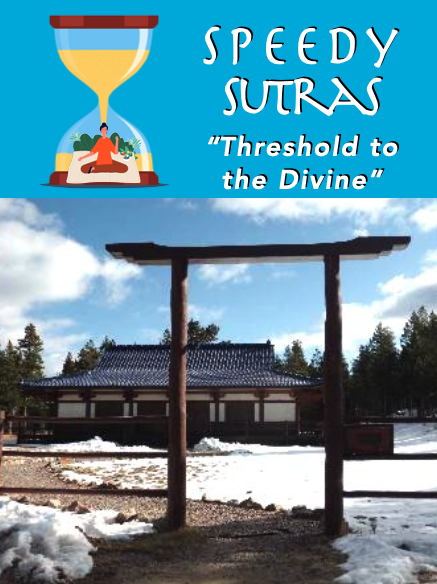
S2 Ep 7Threshold to the Divine: Speedy Sutra 3.25
Shoshoni has an incredible Torii outside of its main temple, a huge threshold you walk through marking a transition from the mundane to the celestial. We walk through many thresholds in our daily life, and even though they might not have a temple on the other side, we can still use these transition points to make the room we enter more sacred within ourselves. When we walk through a doorway, we are usually caught up in the anticipation of the joy we expect to find on the other side of it, finding little bits of fleeting satisfaction in the many rooms of our life, but rarely enough to fulfill us. Meditation is the practice of opening the door to our heart without losing ourself in any particular object. This practice allows us to expand our heart’s threshold in a very natural yet profound way, until the joy that we’re used to chasing after seems to comes to us. This is because the greatest joy in life is that of an open heart. As Sri Shambhavananda teaches, “Happiness is something that shouldn’t be dependent on external things. It should be an experience of your true nature…Having that realization you become free. Free to enjoy the world fully, free to be a part of many things, but never to lose yourself in any of them.” It is the search for inner joy that frees us from our outer suffering, which is why Shiva Sutra 3.25 also teaches that “Karma can only be overcome if it is enjoyed, it cannot be cast aside or abandoned,” meaning the real work of overcoming our karma isn’t in accepting or rejecting the objects of our life, but in keeping our hearts open as we encounter those objects. So the next time you are passing through a threshold towards your object of joy, be it a refrigerator door or an office door— try slowing down your gait, exhale to surrender the object your approaching and inhale to drink a little bit of the present you are walking within. Because this door of the present, which opens in your heart, is the only threshold we must pass through to find our joy. And if you’re lucky enough, you might look back and see someone you can hold that door of the present open for, allowing them the opportunity to open their heart as well.

S2 Ep 6Dish Karma: Speedy Sutra 3.25
To live you gotta eat, and to eat you gotta dirty a dish— so it’s only logical that living requires that we do some dishes. Dish Karma, as with all karma, is unavoidable. The very fact that you’re eating means there are dishes to do, just like the very fact that you are living means there is karma to clean up. This goes for all yogis, from the newcomer to the enlightened practitioner, as the Shiva Sutras teach: “For an embodied being, prārabdha karma is unavoidable. The yogi may be just like Śiva or they may be an ordinary person; prarabdha karma … cannot be cast aside or abandoned.” Sitting to meditate can sometimes feel daunting, like staring at a sink full of dishes. When faced with this reality we tend to just ‘look the other way’, and dirty another dish with some kind of distraction. But as we just saw in the Sutras, our karma, our ‘dishes’, cannot be cast aside or abandoned. As Sri Shambhavananda also teaches: “If you find yourself in a particular arena of life, in this or that situation, that is where your karma has taken you, and you have to work it out. If you just run away from it all the time and don’t deal with it, then you have to come back again. So you might as well confront your issues now. Then you can avoid wasting about twenty years to get focused enough to begin to meditate again.” That’s why the ashram is here— to not only provide you with the soap, the sponge, and the running water to help you do your dishes, but also the support and guidance to make the entire process ENJOYABLE! Yes, you read that right, MEDITATION and DISHES CAN BE ENJOYABLE! In fact, they must be enjoyed in order to be done at all, according to the remaining part of the earlier Shiva Sutra: “Prārabdha karma cannot be overcome unless it is enjoyed. For an embodied being, prārabdha karma is unavoidable. The Yogi may be just like Śiva or they may be an ordinary person; prarabdha karma must be overcome by being enjoyed. It cannot be cast aside or abandoned.” Two Minute Meditation: Sitting in your chair, keep your body still in a relaxed way— just like holding a dish still to clean it. Visualize your breath as the gentle running water of the faucet, let it run over you for a moment. As you feel the breath pouring over you, begin to scrub your dish clean with the sponge of mantra. The lineage mantra of Shambhavananda Yoga is “Om Namah Shivaya”, I bow with respect to the Inner Self. And when all of those elements are in play— we add the magic ingredient, JOY! Yes, joy. (Which literally happens to be a real type of dish soap, lol!) Now try to work for two minutes in this way and watch as your load starts to lighten, one breath, one mantra, one joyful moment at a time.

S2 Ep 5The Joy of Karma
An open heart is not only a more enjoyable way to live, it’s the only way to burn your karma, to become free. Shiva Sutra 3.25 teaches that “karma cannot be overcome unless it is enjoyed”— but does that mean if you’re not having fun you’re not burning karma? Yes and no. In the beginning, learning to enjoy our karma is a practice of simply staying present, not rejecting or attaching to the situation in front of you. And this kind of work is actually what eventually burns your karma, and when that loads starts to lighten, you actually begin to find more joy in the everyday tasks of your daily life. As Sri Shambhavananda teaches, “you know you are progressing in your practice when you are getting happier for no [external] reason.” We can open the door to this kind of joy with a slight smile, but the real opening we are seeking is inside our heart. This is a unique work that only you can do— all the Sutras and lineage teachers can merely point the way, but actually walking your awareness inside, actually breathing into your heart in a natural and sustainable way, is the journey. And it begins with this simple teaching— “karma cannot be overcome unless it is enjoyed”. The rest is up to us. Start now— what does it feel like to enjoy the moment you are in? Repeat the Om sound internally, like a humming, and hold onto the vibration of the present. Keep internally repeating your om sound as you begin to move into your next activity, and see if that slight shift doesn’t bring a little more joy to whatever you do next. “Through the intensity of meditating on turya…The Yogi becomes like Lord Śiva. Why is it said that the yogi becomes like Lord Śiva? Why not say that he becomes one with Śiva? It cannot be said they become one with Śiva because they have a body, a physical frame. As long as the physical frame is existing, the yogi is just like Śiva, they are not one with Śiva. Their having a physical frame will divert them toward inferior states…When he casts off this physical frame composed of the five elements, then he becomes one with Śiva.” This physical frame is more than just our body, it is the circumstances of our entire life— the arena, or physical frame, of our life. This arena or frame of our life is no coincidence, it is our karma. Specifically our Prarabdha Karma. Praradbhda Karma is like an arrow shot up in to the sky, it has to land somewhere sometime, but where and when it lands us unknown to us. As Babaji teaches, “If you find yourself in a particular arena of life, in this or that situation, that is where your karma has taken you, and you have to work it out. If you just run away from it all the time and don’t deal with it, then you have to come back again. So you might as well confront your issues now. Then you can avoid wasting about twenty years to get focused enough to begin to meditate again.) 42, SP. Our work in yoga is the practice of burning up our Karma. This can be done directly, by applying our practice while we encounter our karma, or indirectly, through a steady daily meditation practice on our cushion, and mantra practice in our daily life. In this Sutra, and in our lineage, we are given a very specific pathway through our karma— “Prārabdha karma cannot be overcome unless it is enjoyed. For an embodied being, prārabdha karma is unavoidable. He may be just like Śiva or he may be an ordinary person; prarabdha karma must be overcome by being enjoyed. It cannot be cast aside or abandoned.” What does ‘enjoyed’ mean? This is a powerful question— don’t answer it from your head, answer from your practice. How can you enjoy this moment of your karma? And how does that help you overcome or dissolve the karma of this moment. The simplicity of this approach is profound, and offers you the opportunity to actually feel our work in a real way right now, and whenever you are open to applying your practice. Paul Reps once taught, “Until it fun better left undone”— is this a real approach to our lives and our karma? The Sutra continues to unpack this ‘enjoyment of our karma’ in the following way: “So, for the remainder of their life, the yogi must continue to exist with this physical frame. They must welcome whatever comes to them, whether it be good or bad. Whatever they get to eat, they must eat. It is not worthwhile to cast their body aside. For such a yogī, this body is to be maintained until the time of death.” I would like to take a moment to reflect on the significance of leaving our body in this Sutra, as I recently had an opportunity to support yogi in their transition. In the beginning of the Sutra we are taught that the arena’s or ‘body’ of our life provides endless distractions which divert our awareness to inferior states. We work at dissolving these distractions through our spiritual practice, but it is mentioned at multiple times in this Sutra that only when we leave our body can we truly be free. In the weeks leading up to our sangha member RK’s passing, I felt this to be true. It is similar
S2 Ep 4Speedy Sutras 3.24: Unmasking the Masquerade
Shakespeare said the world is a stage, and the yogic tradition might add that it’s also a masquerade. Everything you see, feel, or even think about, is considered the mask of Shiva, called “Maya” or Illusion, a veil that conceals our True Nature. This mask is ornate, intricate, and perfect in every way, meaning we are perfectly fooled by it. Not only that, it has a power, a gravity, that pulls our energy out into it. The only way to get above it is to dissolve it, or as the yogic tradition teaches, to ‘burn it up’. To surrender our attachment to the outer mask of our reality, and allow the flame of consciousness in our heart to dissolve all illusion. And this mask of illusion is strong— as the Svacchanda Tantra writes, “Due to God’s energy of māyā, the minds of yogīs are diverted by force towards worldly pleasures and away from God consciousness.”(4.311–12). The distractions of our life are powerful, and have a real magnetism. They pull us away from center actively, so we have to pull ourselves back to center in order to regain it. Otherwise we are played by the drama of our life, as the Minivijaya Tantra teaches, “The Yogi played by this universe, played by hunger, played by thirst, played by every aspect of daily life. Therefore, the one who desires to achieve the highest being should not be attached to these outer impressions.” And no matter how strong the drama, we can lift ourselves out of this illusion with a simple redirection of awareness. We practice directing our awareness to the wearer of the mask, instead of the mask itself. This is a natural process, but takes incredible effort. You’re tired, I know. Its easier just to go to bed with your mask on so to speak— but take a moment to redirect your awareness and feel your true self behind the mask. Holding your focus there starts a fire in your heart that does the rest of the work for you. For guidance on this process, check out our recent “RESET” Class titled “Unmasking the Masquerade”, and learn how to use stillness, your breath, and mantra to reveal the Real You.

S2 Ep 3Shivas Masquerade: Shiva Sutra 3.24
Shiva’s Masquerade3.24. mātrāsvapratyayasaṁdhāne naṣṭasya punarūtthānam // When a yogī, in coming out from samādhi, also attempts to maintain awareness of God consciousness in the objective world, then, even though his real nature of self is destroyed by the inferior generation of self-consciousness, he again rises in that supreme nature of the self.”Maya is the mask of shiva, and is literally everywhere you look, or even think. This cloak is so thorough that we will never discover Shiva through it, no matter how hard we try. The only way to unmask Shiva is through our practice. What we find is that it’s our own attachments that keep Shiva veiled, and that these attachments are always within our power to dissolve. In this way, though everything appears to cloak Shiva from us, nothing can truly mask our true nature. “Due to the impressions he has of what others think of him or expect from him and of his wanting to help others, to satisfy them with boons, he may lose his temper and become careless and uneven-minded, blocking his flow of God consciousness from the center of the three states of waking, dreaming and deep sleep. So, although he is aware of God consciousness in the beginning and in the end, he is played by this universe in the center, played by hunger, played by thirst, played by every aspect of daily life. Therefore, the one who desires to achieve the highest being should not be attached to these outer impressions. (Mālinīvijaya Tantra)”Commentary: We get pulled into Maya’s masquerade in a variety of ways— by what others think of us, what we think of ourselves, or simply the demands of thirst or hunger. When we get pulled into the masquerade, we get lost in the drama and lose our center. It might seem fun at first, but eventually its draining. “Supreme God consciousness should be sought with great effort in whatever is seen by the eyes, whatever is felt by speech, whatever is thought by the mind, whatever is perceived by the intellect, whatever is owned by limited ego, whatever is existing in the objective world, and whatever is not existing in the objective world. (Svacchanda Tantra 12.163–64)”Commentary>> Finding your center is how you find Shiva under the mask. You can do it right now with a breath, as you find the present. Holding the present, as we know is another story. Nonetheless, we are taught to seek this experience of the present with great effort whenever we are encountering the mind, senses and external world. “Whenever the mind flows out, he centers his consciousness on that one God consciousness. Because he feels the oneness of Śiva existing everywhere, if his mind moves here and there, even then it does not move at all because it moves in his own nature. Wherever he feels and experiences the existence of the objective world, he feels and experiences that the objective world is actually nothing but Śiva. (Svacchanda Tantra 4.313–14)”Commentary: How do you get back to center? How do you find Shiva again? The Sutras say that we should practice thinking “This whole universe is one with myself,” in order to regain our center— but of course, such a valuable asset is not gained from external commands, but only through internal work over time. This is perhaps the most liberating moment of the Sutras, as it shows us that nothing can really keep us from our realization. And what’s more, it teaches that it is our own attachments that are the mask— not Shiva. Our true nature is Being, Consciousness and Bliss— not the drama of our mundane life. It is we who holds up the mask, and when we learn to let it go, we realize what lies beneath it. Of course, this takes practice, and its not easy— but it is possible. This is the Shambhava uppaya, to live in the world while still being immersed in your heart, that is our practice, our tradition.
S2 Ep 2Sphurana Discussion Class
Every activity of our day undergoes three stages— it begins, or is created, it sustains or maintains for a while, and then it ends, or dissolves. These are known as the Acts of Shiva in the Yogic Tradition. According to the Sutras, its easy to have focus at the beginning and end of a task, but its hard to maintain that focus during the middle of a task. You are usually present for the first minute of a meditation practice, and when the teacher says, ‘for these last few minutes’ you perk back up, but its those long pauses between cues, the middle of our practice, where our attention drifts the most. You’re not alone— this is the work at the heart of our practice, as Swami Lakshmanjoo teaches, “Losing awareness happens to all yogīs, it is the great crisis in the yogīc world. All yogīs generally experience this state of losing awareness.” But this maintenance phases is the longest of the three phases— a sunrise and sunset might only last an hour, but the day and night between them is much longer. You built a house in a year, can tear it down in a month, but maintain it for decades. Which is why the Sutras tell us to “Hold” that awareness— hold it at the beginning and end, when your attention is rich and full. Don’t take those spaces for granted, feel the energy that is available to you in those moments and invest it inside. Anticipate this middle space, see it coming, don’t be wary of it— work with it, work with it. To work with this middle space you have to surrender the need to make your meditation happen. You’ve got to relax while maintaining awareness, to ‘persevere without tension’ as Patanajli puts it in the Yoga Sutras.And this maintenance work pays off. The Yogi who is capable of maintaining their awareness through the center of their practice and life becomes filled with the nectar of awareness. This experience is called Sphurana, “the fragrance of the supreme glittering of God consciousness,” that’s what is directly deposited to your energetic bank account.Quote for Free Write: “Filled with the fragrance of the supreme glittering (sphuraṇa) of God consciousness, that yogī, slowly coming out from samādhi, feels their breath is filled with a supreme fragrance. And although their breath is moving out, they feel their breath is not moving out. They feel their breath is established in their Supreme Being. Then after exhaling very slowly, they experience that the three states of waking, dreaming and deep sleep are filled with the dense nectar of God consciousness and they come out in the waking state with this fragrance.”
S2 Ep 1The Glittering Fragrance of God Consciousness: Shiva Sutra 3.22 & 3.23
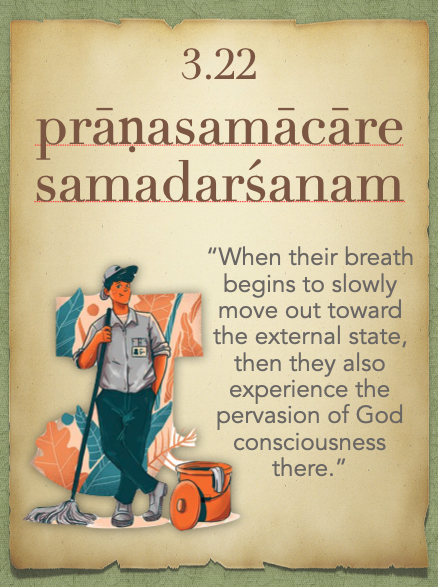
3.22. prāṇasamācāre samadarśanam //“When his breath begins to slowly move out toward the external state, then he also experiences the pervasion of God consciousness there.”3.23. madhye ‘varaprasavaḥ //“He does not experience the state of God consciousness in the center of these three states.”All of manifestation undergoes a three stage process. Creation, maintenance, and disillusion, known as the Acts of Shiva. This process is at work in the biggest cycles of reality, like our expanding universe, as well as smaller cycles, like the cycle of a day, or even smaller like the cycles of our cells. And in terms of time, most of our life is spent in the maintenance phase. Think about it, a sunrise and sunset are relatively short compared to the overall length of a day. The time it takes to build a house, or the time it takes to tear down a house, pale in comparison to the amount of time you spend living in, and maintaining, the house. And likewise during the activities of our day, we’re excited to start a project, received to end it, how do we feel in the middle of it? This middle space is where a majority of our lives and practice take place, and according to the Sutras, is also where we tend to lose our focus the most. As Lakshmanjoo teaches in Sutra 2.10, “Losing awareness happens to all yogīs, it is the great crisis in the yogīc world. All yogīs generally experience this state of losing awareness.” That’s why in this set of Sutras we are focusing on unlocking the energy in this maintenance phase of our practice.What pulls us away from center during the midst of our lives and practice? Everything! For thousands of years, yogis have been pulled away from center by absolutely everything that surrounds them— “About this, the Mālinīvijaya Tantra says:‘Due to the impressions he has of what others think of him or expect from him and of his wanting to help others, to satisfy them with boons, he may lose his temper and become careless and uneven-minded, blocking his flow of God consciousness from the center of the three states of waking, dreaming and deep sleep. So, although he is aware of God consciousness in the beginning and in the end, he is played by this universe in the center, played by this universe in the center, played by hunger, played by thirst, played by every aspect of daily life. Therefore, the one who desires to achieve the highest being should not be attached to these outer impressions. (Mālinīvijaya Tantra)” To rise to this challenge of the maintaining our awareness we need to pick up the mop bucket and start paying attention to the maintenance phase of our lives and practice. Imagine your on your own special episode of undercover boss, and your going to take a break from being the CEO of your life, and put on the Maintenance person’s uniform. We can begin to shift our energy from being the Director to being the maintainer. And what we find, according to our teachers and the Sutras, is that our lives get better when we take on this new job as maintenance yogis— As Babaji teaches, “The most surprising thing for me over the years was realizing that what I was clinging to and how I thought something should be were the biggest obstacles to having something better come along. We cling so desperately to our tensions. It is as if we have a strangle hold on an anchor, and we are sinking to the bottom of the ocean, and we won’t let go. It is not a fun way to be. But, if for a moment or two, you can reach that state where you are totally present, you are not in the past, you are not in the future, your heart is open, and you have a deep sense of gratitude, then everything releases. All you have to do is not grab it again. Grabbing it again is often our biggest problem.” (SP, 102)Our status as CEOs is our biggest limitation. Put down the business card, and pick up the screwdriver, because creating our reality usually just re-creates our patterns. Being a maintainer of reality may not appear to be changing anything on the surface, but under the surface it’s changing everything. Be aware, though, that being the maintenance person is not initially as glamorous or exciting as being the CEO. The Maintenance person looks around the environment they are in instead of looking at their phone. The maintanence person can take a breath into their heart and practice Santosha, contentment, when 'nothing is going wrong’, where others might look for something to go wrong. The maintenance person might move slower, speak slower, breathe slower, react slower— because they are in it for the long run. To maintain our awareness across this huge swath of our lives and practice requires a big shift in our daily approach to tasks. It’s like Babaji is always teaching us, “see what’s possible,” instead of always trying to make things the way you want them. Support your environment, work within it, not against it. In this way we begin to work with our distractions instead of being flattened by them. A maintenance person is alway
S1 Ep 26Merging with the Supreme: Shiva Sutra 3.21
Shiva Sutra 3.21: magnaḥ svacittena praviśet // “The yogī who is merged in his self must enter completely with his mind filled with great awareness.”Quick Review We learned from the last sutra that the three states of waking, dreaming and deep sleep are like a sword that we use to cut through and carve out our reality. In between our swash buckling, we place the sword in its sheath, and have the opportunity to experience a different state of being, described as the Turya State. This state, where the sword of the mind rests in the sheath of the heart, is like an oil made of nectar, that not only nourishes the sword within it, but our whole state of being. Close your eyes and allow the awareness you normally keep in your head to sink down into this ocean of nectar in the heart. Feel yourself being deeply nourished, every nook and cranny of your awareness is lubricated and refreshed in sheath of this experience. We were instructed in Sutra 3.20 to expand this nectar into the 3 states. Though this sheath naturally oil our awareness at the entries and exits of our reality— for example, your morning and evening sit nourish you, but is that nectar present in the middle of your day. Or, you might be excited to start or finish a project, but where is that excitement during the project? Our work as yogis is to find a way to hold and spread this nectar into the other three states: “The fourth state (turya), which is filled with pure knowledge, pure light and the ecstasy and joy of turya, must be sprinkled and expanded just as oil expands when it is poured on a smooth surface like a piece of cloth. For just as oil spreads on this surface, adhering to it, so in this way a yogī must expand the state of turya into the other three states.” As was said before, to spread this nectar we must “hold” the Turya state as we enter and exit the many sheathing and unsheathing moments of our day. To pull your focus inside as you are about to engage externally, and to follow your focus inside, and keep it there, when that event comes to an end. “The yogī must prolong turya in such a way that its nectar becomes established and pervades not only in the beginning and the end but also in the middle of these three states. And the means to accomplishing this in all three states is to “hold it.” Hold it at the time of entry and hold it at the time of exit. This nectar of turya (turyarasa) must be properly held with full awareness so that it is expanded in the center of these three states. ” Simply taking one conscious breath before talking can help you draw that nectar of the heart up, and then taking time to breathe while you talk can help you stay connected inside. When you’re finished talking, let your awareness actually turn within, and pay attention to what the next person is saying, or to a slight pause that naturally occurs. You can also try to pay attention to the spaces between events, such as when walking from one room to another, or driving from point A to Point B— let your awareness remain sheathed in these in between moments so that when you arrive it will draw that nectar into your reality. And finally, trying to bring more awareness to the space between the waking and dreaming state itself, both by doing practice as you fall asleep, and doing a little practice before you leave bed in the morning. Just tapping into that nectar, until it starts to permeate. Sutra 3.20 sets the stage for the work, and gives us practical approaches to expand the space of Turya in our lives, but Sutra 3.21 tells us more about ‘how’ we hold that nectar. “The yogī who is merged in his self must enter completely with his mind filled with great awareness.” Ie. We must ‘merge completely’ in order to allow this nectar to permeate our reality. On the Hero’s journey of enlightenment, we are ascending a mountain of Karma to ultimately gain the perspective of enlightenment. We use physical tools to navigate the initial aspects of the journey— like healthy living, asana practice, and seva. Those become a foundation in our practice, and guide us towards a higher elevation, where we learn to use subtler tools of awareness like pranayama, mantra and silent meditation. These tools are like a GPS system, keeping us climbing towards our enlightenment. And Just like following a real GPS system, you walk or drive through your life, then we check in with our GPS to make sure we are on track. We sit in the morning, then we live our waking state, and then sit in the evening, and live our dreaming state. We might get off track, but our GPS guides us back on the path. In a way, this also mirrors the transition that is occurring in our tradition right now. We all have the luxury of a having a living breathing GPS called Babaji. You could say, in fact, that GPS stands for Guru Positioning System, in that your Guru keeps you on track when you start to stray. We can check in with our Guru during practice sessions and energetically be lifted and placed back on the path. This a
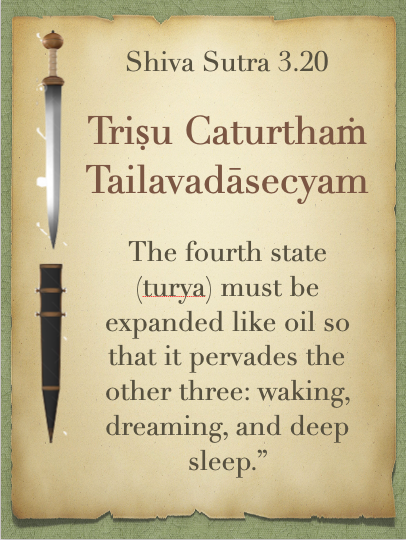
S1 Ep 25Sheathing the Sword of the Mind: Shiva Sutra 3.20
Triṣu Caturthaṁ Tailavadāsecyam // The fourth state (turya) must be expanded like oil so that it pervades the other three: waking, dreaming, and deep sleep.”“What are the three states? The three states are the waking state (jāgrat), the dreaming state (svapna), and the state of deep sleep (suṣupti). The fourth state (turya), which is filled with pure knowledge, pure light and the ecstasy and joy of turya, must be sprinkled and expanded just as oil expands when it is poured on a smooth surface like a piece of cloth. For just as oil spreads on this surface, adhering to it, so in this way a yogī must expand the state of turya into the other three states.” Jagrat- Waking state, awareness and navigation of your daily life and external world. Later referred to as the “Gross Body”, meaning the elements and senses. Patanjali called “Correct/Incorrect understanding” Tattvas 27-36, Elements Svapna- Dreaming state or thought state. The is is awareness of an unseen world, the world of the mind. Later referred to as “Prana”, which implies the organs of action and knowledge, your ability to work with the elements around you. Patanjali called “imagination and memory” Tattvas 16-26, powers of knowing and acting Susupti- Dreamless sleep state. Later referred to as Purastaka, which implies a subtler aspect of our mind, perhaps we underestimate what is meant by the mind if it is grouped with this state. Tattvas 13-15, the mindThe sword and the sheath “The three states—jagrat, svapna, and suṣupti, along with turya—are like a sword and its sheath. Here, the three states are said to be found in the sheath of turya. And although the three states are separated from turya, as a sword is separated from its sheath, they are united with each other. In the same manner, the yogī must be aware that jagrat, svapna and suṣupti are found as one with turya.” The text gives us a specific analogy to hep relate the 3 states to the turya state: “the three states—jagrat, svapna, and suṣupti, along with turya—are like a sword and its sheath. Here, the three states are said to be found in the sheath of turya. And although the three states are separated from turya, as a sword is separated from its sheath, they are united with each other. In the same manner, the yogī must be aware that jagrat, svapna and suṣupti are found as one with turya.” This analogy serves us on a few levels. Although the three states have different qualities, we can assume they all resemble each other in that they are states of differentiation, states of the mind, states of limitation. And that unlike these three, Turya is not a state of difference, is above the mind, and is unlimited. This is also obvious due to its description as pure knowledge, pure light and joy. THe analogy of a sword also shows us the role of the three states as well as the role of the turya state. Ie. We use the three states of mind as a sword to cut through life, to carve out our individual path and personality, to defend and pursue our likes and keep away our dislikes. And that we often do this from a place of separation, meaning, the sword is out of its sheath when we use it to carve our way through life. We generally only access this place of nectar, the Turya state, when the sword of our mind is in its sheath— that is, when we sit for meditation in a safe place and practice putting down our mind over and over again, surrendering the swashbuckling of our mind. Another time the Sutra tells us that we can find this Turya state is when we take the sword out of its sheath, and when we put it back in its sheath. “The state of turya is found in all these three at the moment of entry and at the moment of exit. So at the time of entering into the state of wakefulness, or the dreaming state, or the dreamless state, and at the time of coming out from any one of these three states, the yogī finds turya existing.” Transition 1, Falling Asleep: This brings to mind practices such as trying to go to sleep at night from a conscious place, such as doing mantra into your sleep, as Babaji has taught many times. Transition 2, Waking up: It also brings to mind the practice of doing gratitude practice, just one example, upon waking up as a way of accessing this turya state as we transition between dreaming and waking. In both cases we are told that we must learn to “hold” the transition point between states as a means of spreading the bliss of Turya into the 3 states. Transition 3, During your Day: Dreaming doesn’t just mean at night, dreaming also means thinking. Therefore, the end of a thought or experience is also a transition point. In previous sutras this was known as Nimesha, the ending of one thought, which brings you to the space between thoughts, Turya, before another one begins, Unmesha. This can be hard to contemplate, because thoughts are so subtle, but I often work with this practically by using my practice when walking from one room to the next— I find that this space is usually the space ‘between thoughts’
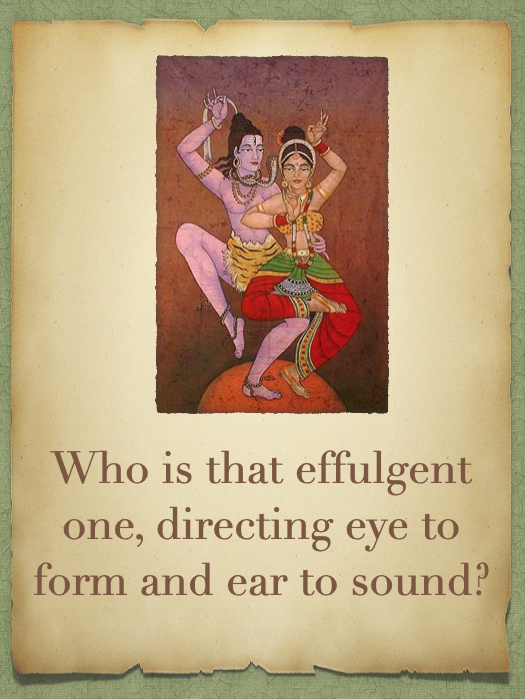
S1 Ep 24Conversing Consciously: Shiva Sutra 3.19
Shiva Sutra 3.19: “kavargādiṣu māheśvaryādyāḥ paśumātaraḥ // In the world of letters, words and sentences, the eight energies of the Lord, who are the mothers of beasts (take control and hold him).”Class Notes: The words of our mind and experiences of our senses are like lassos that are constantly ensnaring us. As Paul Reps once quoted of the Upanishads, “who is that effulgent one directing eye to form and ear to sound?” That effulgent one is us, but the world of words and senses have pulled our awareness away from that effulgence. Through our practice we find that we can rise above these lassos of the mind and senses by connecting to our heart— to use our practice to reconnect with our true nature as we speak, listen and live, and by doing so we find that not only do our words become clearer, but our hearts become open, and a new level of nourishment and growth is able to flow.Levels of Awareness Teaching from the heart is an expression common to our tradition. This implies the ability to put words together in a coherent way, listen to a teacher, or perform a task, while simultaneously keeping one’s awarensss in the heart. Initially this sound like our heart and our lives are in two separate places, and that we are trying to be in two places at once when we practice, but according to the science of yoga this is not the case. Our heart is the source of our reality, it’s where Shiva and Shakti begin to manifest as our reality. In the yogic chart of manifestation, we see this as Iccha Shakti, the first manifested tattva, which is described as an urge, not a thought or word yet. This urge is Shiva and Shakti, manifesting themself in the world, as the Sutra tells us: “When Lord Śiva desires to manifest themself in this world, then svātantrya śakti is transformed into the energy of will (icchā śakti). ” We experience this everyday, in literally every action or thought of our lives— there is always an urge which spurs the thought or action, an urge that we might say we ‘feel” before we think and act. In the Science of Mantra, and language, the heart is the source of our words power, the Paśyanti level of awareness. From the heart, this urge rises up in us to the throat, the Madhyama level of awareness, where we know what we will say, but have not yet formed the words to say it. In the tattvas, the next level of manifestation is knowledge, jnana shakti. When our words are in our throat, for example, we know what we will say but have not said it yet. Take a moment to swallow, and feel this area in yourself. Try to hold your awareness there, you’ll find that it requires focus and surrender, as our awareness is usually held in our head. And from the throat, words seem to escape our mouths instantaneously, like a slide. It’s as if there is an exponential factor at play, where the slope from the heart to the throat is very slight, but from the throat to the mouth becomes steeper, and from the mouth to the rest of differentiation it’s practically a cliff. This is the Vaikhari Level of awareness, and is the space from which we usually interact with our reality. From the perspective of the tattvas, this is the level of action, kriya shakti, and represents the moment before Shiva and Shakti are fully teased apart. When the words leave our mouth, all of manifestation begins to take form, and we can quickly lose our center and begin to suffer from it. We see in this sutra that words and senses are like lassos that are constantly ensnaring us, pulling us away from our center. “In the center of brahmarandhra is situated the supreme energy of Lord Śiva, the Divine Mother, surrounded by the eight divine mothers of beasts. In their hands, they hold the lassos (brahma pāśa) which entangle and bind one with limitation, keeping one from the unlimited state. These supreme terrible (mahāghorā) śaktis, create disturbance and ignorance again and again, and are very difficult to conquer.” We are told that as we interact with our daily life we are surrounded by 8 Deities: 3 dieties of the mind, the Manas, Ahamkara and Buddhi, and 5 more deities of the Senses. Whether we are simply looking out our window, eating a meal, talking with friends, or weed whacking, these lassos are constantly being tossed at us in the form of tag lines, colors, sounds, etc. Being caught by them means that our energy starts to flow out, instead of in, and when that occurs we are ‘played’ by our mind and senses, like a puppet on a string, and forget our effulgent nature: “words and sentences pierce their minds and make them weep, make than smile, make them laugh, make them joyous, make them happy and make them sad...By the penetration of the sounds of letters, words and sentences, they are oppressed with the delusion (moha) created by those who rule limited beings (paśus). This is the essence of this sūtra.”Working with it The Sutra describes two methods of working with this situation, one way that ensnares us and another that liberates us. The ensnaring method oc

S1 Ep 23The Current of Shiva: Shiva Sutra 3.18
Sailing Through our karma There is a current running through our lives, a current below and a breeze above, a reality unfolding not only around us, but right along with us— in our very being. In the Yogic Tradition this current is known as Svatantrya Shakti, the ever cresting wave of Shiva that unfolds infinitely to form our reality. Through our practice we can learn to feel this current as we navigate our lives, a small shift that holds the key to transcending your karma for good. Mapping the river: We often look at this flow in it’s diagrammatic form as the tattvic map, which shows this unfolding from one to many. In this form we can see the process of creation, which starts as an urge, becomes a thought, and manifests as an action, those actions takes infinite forms which you can see all around, and within you. Urge becomes thought, thought becomes action, action becomes manifestation “When Lord Śiva desires to manifest himself in this world, then svātantrya śakti is transformed into the energy of will (icchā śakti)…then that energy of will is transformed into the knowledge (jñānaśakti)…then that energy of knowledge becomes the energy of action (kriyā śakti)”“(Mālinī Vijaya Tantra 3.8)” Map is only half the picture: Seeing the map of the river, seeing it’s overall trajectory and shape, is knowledge that can help you navigate it. This is one half of what the Sutras call Pure Knowledge, Shuddha Vidya, knowledge of how to practice. But this knowledge is only one part instruction, and the rest of it is experiential. Imagine trying to learn how to sail from looking at a picture of a river— it misses the actual experience of the river, the un-predictable quality of navigation itself. Shiva is a moving target: This experiential knowledge takes into account the fact that, though we can map creation, we can never map Shiva themself. Shiva's Shakti, manifestation, is never the same twice— Shiva is a moving target, an ever cresting wave we must learn to surf, or sail, or paddle— depending on your metaphor. JDS went out of his way in the notes to this sutra to say that ‘Shiva is not an object”, meaning that we can’t let ourselves try to pin down the practice, it is a state of being. Or as 500 BC Heraclitus put it, “NO man ever steps n the same river twice, for it not the same man, and it is not the same river. “ This is why the Sutra begins with “When knowledge of being is established in continuation,” meaning that we must stay in touch with the ‘being’ of our practice continually in order to be in touch with it at all— there is no way to simply ‘connect’ once and for all. Lear Learning to navigate the River: So to navigate the river’s of our lives, to sail through our Karma, we have to learn how to stay in touch with Shiva, the current below and the wind above, while we move towards our goals. As Paul Reps put it, move with, not against, the harmony Our time on the cushion is a way for us to get in touch with this inner current, so that we can keep this connection as we begin to move through our lives. Of course, there are many many times during everyday that we can reconnect with this current, and by doing so, connect our actions with Pure Knowledge, and start to free ourselves from repeated mistakes. When we move against the current, what happens? For the most part, it’s just like swimming against a current— everything just seems to take longer, and when you get there you’re exhausted. Which is how one meditation teacher in our current training describes her students, she says they all talk about how tired they are, and of course they’re telling the truth, it takes tremendous energy to swim against the current. Of course, this doesn’t mean that our lives are peachy just because we are doing our practice— karma is karma. Just because you are feeling the current on a raft doesn’t mean you aren’t going to work hard, it just means that your work will be more efficient, more effective. So if we can feel the current while we steer our ship, we are staying focused on the reality of Shiva, and we find that our ship starts to come under our control. Which was the teaching of the Sutra, 3.13, “All elementary worlds, all individuals, all words and all sentences are absolutely dependent on and under the control of such a yogī, who is always intent on determining the reality of Śiva. Whatever he does and whatever he wills will do and undo. (Svacchanda Tantra 7.245)” The Rewards of Proper Navigation: When we do this, we burn our karma, when we don’t do this, we create more karma, more re-births as the Sutra puts it. “When this pure knowledge of consciousness is established in continuity, then birth (janma) is gone forever. For him, there is no more birth and there is also no more death. What is the cause of birth (janma)? Action attached with ignorance is the cause of birth. That action creates the organs, the body and all its limbs. Therefore, when that action which is the cause ends, then the effect, being created and being
S1 Ep 22Dissolving Difference: Shiva Sutra 3.17
Class Notes:3.17: svamātrānirmāṇamāpādayati // He can bring about forms in accordance with that measure or aspect of consciousness which is creative and in which he is established." svamātrā: The measure of consciousness which coagulatesnirmāṇamā : Produces/Creates pādayati: Effects“Svamatra means the measure pertaining to his consciousness, i.e. the aspect of the essence of consciousness that coagulates, that creates.” -Ksemaraja (JDS Translation) “By taking the deception of grossness, they become gross in this universe and by taking the deception of subtleness, they becomes subtle.” -Svacchanda Tantra 4.295 (LMJ Translation)“Because of the power of creative thought (vimarsa sakti), the foundational Self makes Itself as the object of knowledge. The object has no separate existence of its own. If the Self were to depend upon an object, something outside itself, for creation, the Self’s absolute freedom would be violated." -Isvara-pratyabhijna I, 5, 15 (JDS Translation)“O dear one, one who knows from the mouth of his spiritual director that water and ice are (essentially) the same (is liberated). He has no further obligation to discharge. He will have no further birth." -Agamas“This state, which is the real nature of Śiva, is not revealed; this state is the revealer…The revealed is not the point to be sought; it is the revealer that is to be striven for.”- Lakshmanjoo, Shiva Sutra 3.16 CommentaryRudi Quote: “We are locked in so many of these things because of our need to be in the mind— to refute, to fight and endlessly find the differences— whereas when we're strong enough to know it's all one, then we have the capacity to be above it. All of those so called differences lead to the same oneness. And you have to do this in your own life. You have to do this with the people you work with and the people you live with, and the people you bond with. You either eventually love with them, and you all go up together, or you endlessly try to find differences. The differences never made a man free, it was the lack of difference that always freed people. It is to find the lack of difference for which you are living, because this holds within it the content, this flow of higher consciousness and energy. Difference makes walls, lack of difference breaks down walls. You must really open to that and feel the lack of difference, and then we drink it in, and the nourishment comes into all of us.”-Swami Rudrananda
S1 Ep 21The "Real" Seat of Awareness: Shiva Sutra 3.16
1. We begin the sutra with a commentary that yoga practices alone are not enough to take you to the experience of your true nature. The example given is the Yogadarśana, the eight limbs of yoga. The 8 limbs of yoga begin with Yamas, or how to interact socially as a yogi through non-harm and non-greediness, for example, and then moving on to the Niyamas, how to work with yourself as yogi through cleanliness of mind and body, divine conduct, etc. And once those are established, the practitioner begins asana, the physical postures of yoga, pranayama, the breathing practices, pratyhara, concentration practice, and dhyana, meditation. These practices beneficial and essential aspects of our path to growth, but we are learning in this Sutra that these practices can’t get you to the goal unless you also learn how to surrender them. So we must learn how to use the tool, and then learn how to set it down while continuing to maintain our inner connection. This is how we sink completely into the nectar of Shiva, pure awareness. When this occurs, we see that any posture, any practice, any action, any life we may have, becomes the fullest expression of Shiva. “Actually, the postures (āsanas) explained in the yogadarśana are not really āsanas at all. Śivayoga is the only posture that must be understood when you are seeking to understand the real posture for such a yogī. This real posture is the supreme energy of awareness. You are seated in that posture when you hold and possess the supreme energy of awareness. Then in each and every act of your life you are aware, you are seated in that posture. This is the real āsana.”2. We see that we must learn to ‘leave aside’ the effort of our practice while ‘remaining in the posture’. This particular kind of effort is described as effortless. In our tradition, we may describe this kind of effort as ‘surrender’, that is, consciously letting something go while maintaining awareness. When the body, breath and mind are out of balance, we use a tool to work with it— when that balance begins to come into view, we can begin to release the tool while ‘remaining in our posture’, while staying centered. “leaving aside the effort of āsana (yogic exercises), prāṇāyāma (breathing exercises), dhyāna (contemplation), and dhāraṇā (meditation), simply remains in that posture with nothing left to do, aware of what he actually is. This is why the author has used the word sukham in the sūtra because “effortlessly” means that without exerting any effort in respect to breathing or yogic exercise, contemplation or meditation, they remain seated in that posture”3.This kind of effortless effort, the work of surrender, is how we ‘dive’ into the ocean of nectar that is our true nature. “Diving” here is redescribed as a type of ‘sinking’, which again is helpful in describing out concepts of ‘going inside’ and ‘surrender’. Our work is to consciously release our body, breath, mind and even the void, and by doing so we sink into our true nature.“And without any effort, the yogi finally immerses themself in the ocean from which the universe rises and expands. They dive and enter for good in that ocean, which is filled with real nectar. What does diving mean? In diving into the ocean of nectar, they let the impressions of the body (deha), of the breath (prāṇa), of the eight constituents (puryaṣṭaka) and of the void (śūnya) sink into that ocean and they become one with that nectar. This is the real way of diving.”4. The Sutra concludes by bringing it’s teaching to an even more subtle level— not only must we surrender the practices themselves, but we also must surrender the experience. There is no way for us to understand the experience of surrender until we have become it. This experience is only revealed to those who have attained it— it cannot be revealed in any other way. Your actual reality, the world that you live in and the experience you are having right now of that world— this is what changes. Perhaps this is why in our tradition we describe this process as ‘spiritual growth’— ‘growth’ meaning that what you will become doesn’t exist yet— like a tree growing a fruit. You can describe the fruit to the tree, you can show it other fruits, you can give it the nourishment it needs, but nothing can reveal this tree’s fruit except this tree’s growth. That is why Lakshmanjoo teaches that“ This state is subjective, not objective…this state of the revealer is not separate from subjective consciousness. It is only subjective consciousness.”“”Netra Tantra 8.44–45: this state of the Śaivaite yogī is the real state of Śiva. This state is not revealed to others; it is revealed only to the revealers.” This state, which is the real nature of Śiva, is not revealed; this state is the revealer”LMJ.
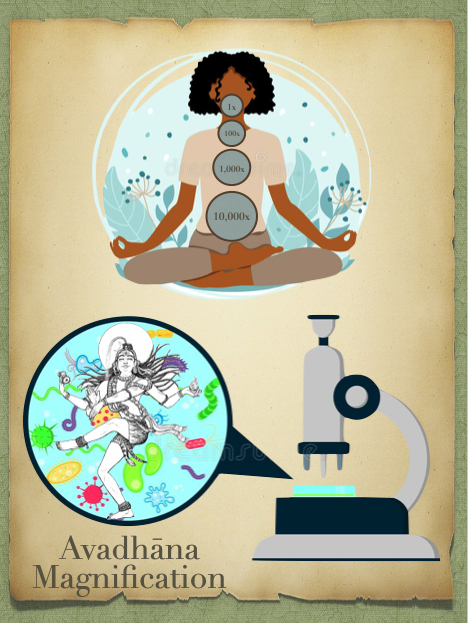
S1 Ep 20Magnifying Shiva: Shiva Sutra 3.15
In the natural world we all recognize that a seed contains the blue prints and the impulse for the organism it will become— in Yoga that seed is Shiva, in Sanskrit Bija. As meditators, we use the tools of our practice like a microscope to focus our attention on this seed of our true nature, but we can only zoom in, past the infinite distractions of the manifest universe, via the magnification power of breakless awareness, in Sanskrit Avadhana. Join the ShambhavAnanda Sangha as we pursue the seed of our awareness and independence in the heart through the practice of breakless awarenessin this interactive LIVE Yoga & Meditation Philosophy Class.

S1 Ep 19Let Good Fortune Jump on You! Shiva Sutra 3.14, Part 2
Lineage Teacher Swami Rudrananda taught that enlightenment is not a level, but learning how to raise your level. Because as this Sutra teaches, no matter what level of awareness we have attained, as yogis we must continue to raise that level, again and again, through all the different stages and settings of our life. This kind of pursuit goes beyond the mind, beyond the societal status quo, and into the realm of Grace. Ultimately, when we are able to maintain this kind of surrender both on and off the cushion, we arrive at the state of receptivity that allows us to receive Grace as it descends at any point in our day. That is the state of independence we seek. 3.14: “yathā tatra tathānyatra // This [absolute independence] is the same in the external world as it was in samādhi.”
S1 Ep 18Absolute Sincerity: Shiva Sutra 3.14
We all know the value of sincerity in our daily lives. When a friend sincerely thanks you, or someone sincerely enjoys your cooking, for example, you can feel it in your heart. This kind of sincerity is also a cornerstone of our practice, as it is required for our work to truly penetrate the obscurations that limit our experience of our true nature. When we practice with sincerity we can move mountains of tension, without sincerity those mountains don’t move anywhere. In Sanskrit the term is called “akrita”, unartificial, and is described as the combination of natural effort and intense desire, what a powerful force! In the practice of ShambhavAnanda Yoga, we interact with this notion as “the wish to grow”, and seek it in everything we do with an ‘open heart’. Let’s jump in and begin our exploration of sincere, unartificial practice from the heart, and find out why it’s so important, and how we can find more of it!

S1 Ep 17Absolute Surrender: Concluding Sutra 3.13
If you swim with the current, you become as powerful as the current. If you swim against the current, you struggle and tire. In our everyday life, we use our practice while we work with the circumstances of our lives— like swimming diagonally across a strong flowing river. We might not end up exactly where we planned, but this way we will always get to the other side. In this Sutra we discuss the Absolute Power and Independence we experience by swimming with the current of Our True Nature.
S1 Ep 16Absolute Freedom: Shiva Sutra 3.13
Explore the yogic practice of surrender, which leads us to the ultimate experience of Absolute Freedom. “3.13. siddhaḥ svatantrabhāvaḥ // The state of absolute independence is already achieved.” “From earth to Anāśrita Śiva all beings are dependent on the conscious being, Śiva…The singularly unique aspect of Lord Śiva is complete independence, svātantrya. This complete independence is not found anywhere except in the state of Lord Śiva.” We usually think of independence as ‘freedom from dependance on anything’, but according to the Sutras, only shiva can be free from dependance on anything. So how can we be free? From the perspective of our small self, we can’t—because that perspective is always separate from it’s true nature, and when we’re separate from our Shiva Nature, we’re bound. Through our practice, though, we unite with Shiva, and experience absolute Freedom. In this class we’ll explore a few distinct vantage points and practices to help us realize the vastness of this promise.

S1 Ep 15Spiritual Intuition: Shiva Sutra 3.12
We have a ‘spiritual intelligence’ within us. When we do mantra, for example, and notice that our mind is wandering into thoughts, or slipping into doership, what aspect of our awareness is able to recognize this? Perhaps this is the spiritual intelligence this sutra describes. Sutra 3.12: "Through the higher spiritual intelligence, there is the realization of the Light of the Self." The word proficient doesn’t mean perfect, it means progress derived from practice. So even thought this aspect of our awareness is proficient at finding the light of the self, that proficiency is the result of practice.This is a double edged sword. On the one hand it means we all have the capacity to become realized masters, because it is only a matter of practice. On the other hand, though, it means we must practice, and that we can’t just expect it to do it on it’s own.

S1 Ep 14Over-Acting the Ego: Shiva Sutra 3.10
Sutra 3.10 continues our metaphor of acting as a way of understanding the relationship between our essential and timeless true nature and the peripheral and temporal characters we play in our life. In this Sutra we see that as we learn to relax and allow Shiva to play our part, we become more skillful within our life and more enjoyable overall. We also see that the part we play, and the actions we make throughout our day, are not meant to be ends in themselves, but means of uncovering our true nature.

Camping-In Our True Nature
S1 Ep 13Shiva Sutra 3.11: Surrender the Sequels
Imagine a projector in a movie theater shining it’s light onto the screen in front of you. You don’t see the projector, or the light streaming through the air, you only see the shapes on the screen. We react to the actors, and the drama projected in front of us— and it seems like a miracle, but the actors we watch the most keep getting more and more lines in this movie of our life. Good, bad, or ugly— the roles we identify with on the screen keep getting bigger and bigger parts. The Shiva Sutras tell us that this is because the projector is not behind us, but within us. And these actors are reading the very lines that we are writing for them, in real time. In this way, we see that we are writing this movie of our lives, and if we want to breathe some fresh life into it, this Sutra teaches, we must step back from the re-acting process and let this movie start to develop more naturally. As we learn to step back from the screen of our mind and senses we can allow our lives to play out in a more natural way. This doesn’t mean the movie stops, far from it, in fact yogis tell us through the generations that this is the only way to finally let the movie of our life play out to it’s highest fruition. Welcome to Shiva Sutra 3.11, The Senses are the Spectators.
S1 Ep 11Maha Shivaratri: The Huntress & the Boon
If you had 3 wishes what would they be? Tonight, Maha Shivaratri, the greatest holiday of Shiva in the Hindu Tradition, gives practitioners just this opportunity. The opportunity to practice, and the opportunity to wish? The age old story of the genie in the lamp serves to teach us one simple thing— whatever ‘thing’ you wish for will eventually become your greatest obstacle. The Shiva Sutras, and the yogic tradition teach us that our greatest wish is not for a thing, or an experience, but for the tools to grow spiritually. Lineage teacher Swami Rudrananda said that when he went to India, the enlightenment he found was not a heaven realm where everyone sits around drinking tea, but rather his ‘enlightenment’ was the gift of learning how to work, how to practice— The greatest boon we can ask for is a practice, a teacher to guide us in that practice, and a community to practice alongside. These are three greatest wishes, the three jewels in the yogic and buddhist tradition, and here’s the astonishing part: If you are reading this, then you have already received this gift, you’re staring right at it now— Because the sole purpose of the ashram is to teach you how to use the gifts of the yogic tradition to propel your spiritual growth.
S1 Ep 10Shiva is the Actor: Shiva Sutra 3.9
Class starts with Intro & Intero-surfing.Sutra Discussion Begins at 10:07
S1 Ep 9The Practice of Pure Awareness: Shiva Sutra 3.8 Conclusion
Intro done at 4:10Interception finishes and Sutra begins, at 9:11Guided Meditiation begins at 49:33
S1 Ep 6Shiva Sutra 3.8.2: Raising Our Awareness
Intro done at: 00:03:15Embodied Movement finished at 00:11:14Guided Mediation starts at 00:51:46
S1 Ep 7Guided Mantra Meditation
In this guided meditation we utilize the teachings of the Shiva Sutras to fan our sparks of awareness into flames of recognition, bringing our mantra from the level of the mouth to the level of the heart while cultivating spiritual focus on our breath in between.
S1 Ep 6Guided Breath Meditation
In this guided breath meditation we cultivate the heat of awareness by counting down from 60 to zero with a few stops along the way, slowing down our counting, counting with our breath, and eventually arriving at the ability to watch our breath with a higher degree of focus and sensitivity.
S1 Ep 5New Year, New Level: The Yogic Power of Discipline
SPECIAL OFFER AT THE END OF THE PODCAST!
S1 Ep 4Practice First: Shiva Sutra 3.8
Intro done at 3:26Interoception Practice done at 10:11Sutra begins at 10:11Guided Meditation begins at 50:50

S1 Ep 3The Path: Shiva Sutra 3.7
Intro finished: 3:27Interoception Explanation and Practice Finished: 12:10Sutra Begins: 12:10
S1 Ep 2Shiva Sutra 3.7 Part Two: How to 'Quit' Suffering
How do you quit something you don’t know you’re doing? How do you quit suffering if you don’t know you’re suffering? There are indicators that can help you notice it, but ultimately we can only recognize our own suffering, and surrender it, through an empowered meditation practice. Of course it’s easier said than done, which is why we spend this hour not just studying, but meditating while we interpret the teachings of this Sutra about the topic. I hope you’ll take the time to work with us in this class and find some insight to your own inner process of quitting suffering.
S1 Ep 1Shiva Sutra 3.7- Conquering Illusion, Part One
In this class we continue to work with Shiva Sutra 3.7, and unpack the concepts of illusion, differentiation, pure knowledge and God Consciousness from within the context of a living meditation practice both on our cushion and in our life. Below are the quotes from the class, as well as the explanations and questions to inspire personal feeling and reflection. Enjoy!As always, if you would like to attend the class live, drop us an email and we’ll let you know how to join.