
Konalani Yoga Ashram, Hawaii.
Konalani Yoga Ashram, Hawaii. · Acharya Satyam Ehinger
Show overview
Konalani Yoga Ashram, Hawaii. has been publishing since 2020, and across the 4 years since has built a catalogue of 93 episodes. That works out to roughly 140 hours of audio in total. Releases follow a fortnightly cadence, with the show now in its 44th season.
Episodes typically run an hour to ninety minutes — most land between 57 min and 1h 2m — and the run-time is fairly consistent across the catalogue. None of the episodes are flagged explicit by the publisher. It is catalogued as a EN-language Religion & Spirituality show.
The catalogue appears to be on hiatus or wound down — the most recent episode landed 2.8 years ago, with no new episodes in over a year. The busiest year was 2022, with 29 episodes published. Published by Acharya Satyam Ehinger.
From the publisher
Welcome Konalani Yoga Ashram’s live-online Yoga Philosophy Podcast led by Yoga Acharya’s Satyam and Abhaya. We focus on helping students learn how to FEEL the practice of philosophy as an internal stretch that purifies the intellect, just like yoga purifies your body. It’s one part philosophy, one part meditation, and one part discussion, as the active and vibrant sangha members of ShambhavAnanda Yoga unpack ancient texts like the Shiva Sutras and Vijnana Bhairava through the lens of their personal practice. For anyone seeking inspiration and education in their ongoing meditation journey, this class is a must.
Latest Episodes
View all 93 episodes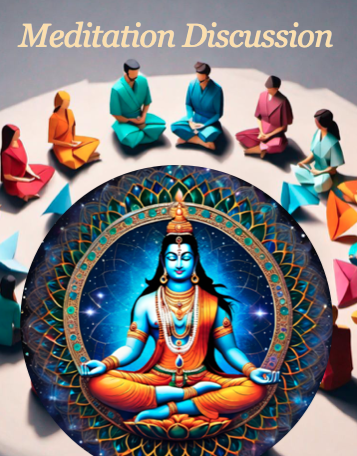
S4 Ep 34Dharana 9, Part 2: Meditation & Discussion
Beyond the Void and Union with Shiva:Swami Muktananda's teaching distinguishes our tradition by revealing that beyond the void is Shiva.Dharana emphasizes mindful separation from infinite manifestations, leading to union with true nature, Bhairava, synonymous with Shiva.Surrendering the Senses: Seeing them as 'Nothing':Mind and senses depicted as a five-fold mandala: smell, touch, taste, sight, and sound working together.Analogy of senses as peacock's feathers, creating a dizzying experience.Swami Lakshmanjoo's method: Concentrate on the void while seeing senses as 'nothing'.Reflection on the yogic tradition's viewpoint of 'the void' and the difference between rejecting senses and concentrating on the void.The Source of the Senses Mapped by the Tattvas:Teaching aligns with Tattvas, where Shiva and Shakti's dance creates all manifestation.Outward expansion involves the development of the power of physical senses (Jnana Indriyas), leading to sensations, subtle elements, and gross elements.Three capacities arise simultaneously, with objects often overshadowing the deeper mechanism within us.A Closer Look at The Moment of Sensation:The indriyas (senses) have no meaning without the objects they are correlated with.Importance of accessing a deeper space during sense perception, in line with the yogic concept of surrender.Surrendering to the Source:The void described in Dharana is devoid of object but not content.Interacting with objects is interacting with Shiva in a limited way; turning attention within enriches the experience.Letting go of the sense object is a gain to the heart, allowing the experience of Shiva beyond the void.Translation and Practice of Dharana 9:Swami Lakshmanjoo sees the senses as nothing; Paul Reps adds the approach of melting into the beauty of the senses.Achieving the goal of the heart, the real wish behind the senses, through different approaches.Jai Deva Singh's teaching on the Absolute void as Bhairava and Shiva being most full from the point of view of Reality.Imagery and Practice:Paul Reps' imagery of the peacock tail and melting its beauty within for finding the source in the heart.Traditional approach of perceiving a point in space until it becomes nothing.Both approaches lead to achieving the goal of the heart and fulfilling the real wish behind the senses.
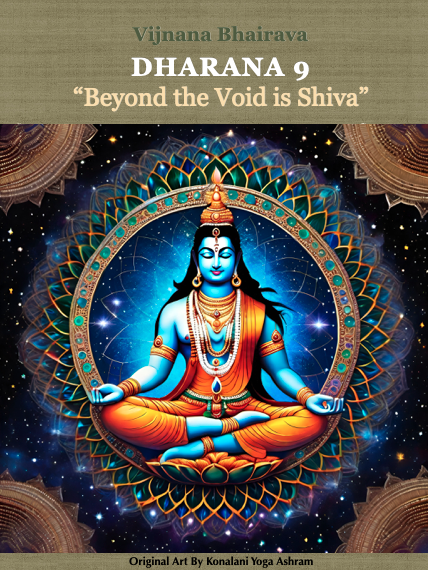
S4 Ep 33Dharana 9: Beyond the Void is Shiva
Full Essay with Quotes: Babaji often tells the story of his meeting with Swami Muktananda in which Muktananda told him that many meditation traditions teach that one meditates to experience the void, but that beyond the void is Shiva. In the current Dharana, we see the same teaching— when we use our practice to detach from the infinite manifestations of the mind and senses, we are able to attain mindful separation, which is like a void, and that sustaining that state brings us into union with our true nature, here named Bhairava, which is the same way of saying Shiva. Shiva exists beyond the void. In this Dharana our mind and senses are described as a type of five-fold mandala, smell, touch, taste, sight and sound working as one to inform us of our physical reality. These senses are likened to a peacocks feathers, which when fanned behind them create a dizzying experience much like the mind and senses can become. Our task as yogis is to witness the mind and senses, but not to multiply them with our energy. One method for this, given by Swami Lakshmanjoo, is to see the senses themselves as voids. “You must concentrate simultaneously on [the void while experiencing each of] these five, that it is nothing, it is only a void and nothing else. Then, you have to forcibly concentrate that these are nothing, [that] these objects are nothing–“What I see is nothing, what appears to me is nothing, what I hear is nothing, what I touch and what I get [as] the sensation of smell, it is nothing, it is only śūnya.” It is only seeing as energy–just seeing only, hearing only, not to analyze that…There it ends. And when I feel smelling, there ends that. At the time of that sensation of smelling, you must end it there. You must not go further, You must not go beyond that so that you will [avoid being] entangled in the world of the senses.”This is one of the many underlying teachings of the Tattvas, the yogic map of manifestation. In the tattvas we see that Shiva and Shakti’s dance creates all of manifestation. As we expand further from Shiva we are covered by maya, illusion, meaning as our awareness moves further from our own center we identify less and less with our true nature. This outward expansion from center takes a particular path that is helpful in understanding this Dharana. We see in tattvas 17-21, the power of the physical senses are developed— there are called the Jnana Idriyas, which is referred to in the text by Swami Lakshmanjoo as well. This is considered the source of the senses, described as the ‘power of seeing’ the ‘power of smelling’ and so on. This source gives rise to the sensations themselves, tattvas 27-31, called the subtle elements. This would be the capacity for sense itself, but not of any particular scent. The capacity for sight, but not necessarily a particular sight, etc. And eventually the power and capacity for the senses gives rise to the actual gross elements themselves, tattvas 32-36, the final and most externalized of manifestation. Interesting enough, all three of these capacity’s arise simultaneously, we see the object, but often miss the deeper mechanism happening within us. Intro to Kashmir Shaivism: “The moment the senses of perception are produced, the five tanmatras or subtle elements of perception also come into manifestation from the same Ahamkara, because the indriyas can have no meaning or existence whatsoever without the objects with which they are inseparably correlated. For instance, the indriya of hearing has no meaning without something to hear, that is, without sound. Similarly, the indriyas of feeling-by-touch, tasting, and smelling have no meaning without a simultaneous reference to something to feel, taste, and smell. Therefore, the moment Manas arises as desire, Ahamkara takes a triple form: I - (1) desire - (2) to see - (3) some color.” (Note: the ahamkara is the self that is doing or the personality associated with this individual body. It refers to the sense of being an individual separate from everything else.)This means that behind every color is a deeper understanding if we are willing to surrender it. This experience of surrender is something we have been given by Swami Rudrananda, but keep in mind that this word does not come up very often in the text as we have read it. Therefore the act of surrender is a way of describing a very paradoxical yet essential reality we must learn to participate within— if we can let go of the sense object in front of us, which appears to mean we are left with nothing, we are actually brought to a much vaster experience. Beyond the void is Shiva, this is an essentially another way of teaching us the nature of surrender. When we let go we begin to receive. Let go of the color, receive the source of the color. To the mind we have lost something, but to the heart we have gained. As Jai Deva Singh teaches at the end of his commentary on this Dharana: The Absolute void is Bhairava who is beyond the senses and the mind, beyond a

S4 Ep 32The Mouse of the Mind: Embracing Ganesh through the Story of Mushika
Immerse yourself in the transformative spirit of Ganesha as our Ashram resonates with the joyous celebrations that extend from personal realms to the universal. Delve into the symbolic journey through the story of Mushaka, Ganesha's mouse, illustrating the release of karmic obstacles and the surrender to Shakti's play, guiding us toward union with Shiva. Join us in expanding awareness beyond the five coverings, inspired by the wisdom of Ganesha and the transformative power of surrender. Om Gam Ganapataye Namah! The Mouse of the Mind: Embracing Ganesh through the Story of Mushaka It is that time of year - Ganesha pervades our Ashrams and pujas, our lives and is everywhere! The celebrations spread in a widening circle to envelop ourselves and our families, then our friends & relatives, next the people in our public lives, then the arts & artistes enriching our lives and finally, encompassing all beings in all Lokas. It feels like a wholesome practice expanding my awareness past five aspects of my karma - from the physical and personal to the subtle and Universal. These aspects are reminiscent of the five kanchukas in Kashmir Shaivism (or even the five koshas of Advaita) that limit the experience of Universal consciousness. The five heads of Ganesha seem to symbolize His help for the progress of my awareness through these five coverings. In our practices, we surrender to the play of Shakti (i.e., Parvati) which moves our ordinary awareness into union with Shiva (Universal consciousness). Ganesha’s energy helps the surrender by removing obstacles manifested in these karmic covers. The story of Ganesha’s vehicle, the mouse, illustrates the nature of these blocks. The story begins in Indra Loka where Krauncha was an accomplished celestial musician. His artistry however inflated his ego leading to pride and jealousy. He became miserly in praise of others, often absent when others performed or, preferred to sulk in the back or linger behind pillars in the hall. One day, Indra called on him to perform for the assembly of sages and Devas. As he sashayed to the dais, he thought he heard rapturous applause from sage Vamadeva on the way. In reality, however, he had stepped on the sage’s feet and the furious sage had cursed him “Enough of your false pretenses! May your outer form reflect your inner nature!” Krauncha was immediately transformed to a huge mountain-sized rodent to match the size of his pride! Why a rodent? It loves dark places and prefers corners and edges to open spaces which are seen as threatening or negative. Our pride is invisible to us and operates in the dark recesses of our mind, delighting in gossip and thriving on the failures of others. This negativity bias is a survival instinct that causes us to blame others when they reflect our limitations back to us. Back in the story, as the mouse-mountain moved, it trampled and destroyed the dwellings and all beings in its path. A desperate Indra ejected Krauncha from the heavens to the earth. Scurrying on earth, it destroyed forests, mountains, lakes, farms and families eventually reaching the Ashram of sage Parashara. Ganesha who was visiting the Ashram decided to end the rampage and collared the mouse with his lasso. This yanked the mouse off his feet and landed him, stunned, at Ganesha’s feet. The shock of the event flashed Krauncha’s behavior past his mind’s eye. He felt remorseful and begged Ganesha for forgiveness. Ganesha saw that Krauncha’s negative nature had dissolved. So he decided to employ Krauncha’s skills and talents and made him his vehicle. And, this is how Ganesha snagged a mouse for his ride. And like tiny mice, all kinds of thoughts scurry about the mind and pull it away from our practice. Unless we surrender them, we function from our mind and ego, much like Krauncha, the musician. This is the nature of the blocks manifest in our karmic coverings. As Babaji had said at a recent Satsang, ”… The Shakti will take you through every insecurity, every illusion, and every obstacle that exists in you, on the way to that state of perfection. You have to be willing to face it and move beyond all of it …” As we practice to expand our awareness past the five coverings, the Shakti will present our karma to us. Our heartfelt wish to grow draws Ganesha’s energy to all parts of our mind - through the smallest openings and darkest areas like riding a mouse! To help us surrender past the karmic blocks to union with Shiva. Om Gam Ganapataye Namah!

S4 Ep 31Dharana 7 • Cosmic Nectar: From Sound to Soul with Matrika Shakti

Dharana 6 • Slow is Smooth & Smooth is Surrender
Embarking on the path to spiritual growth is often framed as a solemn endeavor, demanding ceaseless, mindful effort. But it doesn't have to be a burdensome task—instead, it can be a playful and invigorating journey that engages us fully in every minute of our existence. In a recent exchange with Sri Shambhavananda, the anecdotes about Paul Reps, the contemporary Zen master and compiler of Zen Flesh Zen Bones, were illuminating. Reps illustrates that continuous mindfulness can be pursued not just through disciplined practice, but also with a touch of lightheartedness and curiosity. As we delve Dharana 6, we'll explore how the wisdom of "every minute Zen" aligns with the ancient teachings of Shiva Sutra 2.3, which states that "pauseless effort brings attainment." Our spiritual journey, as it turns out, can be a seamless blend of focus, surrender, and even a bit of playfulness—enabling us to embody mindfulness in every moment. Eventually this work paves the way for our work with Dharana 5 & 6 from the Vijnana Bhairava, which focuses on entering the natural and uplifting flow of Shakti that permeates our Heart, our Shushumna, and even our daily lives. The tale of “Every Minute Zen” from Zen Flesh Zen Bones highlights the importance of unbroken mindfulness….”Zen Students are with their masters at least ten years before they presume to teach others. Nan-in was visited by Tenno, who, having passed his apprenticeship, had become a teacher. The day happened to be rainy, so Tenno wore wooden clogs and carried an umbrella. After greeting him Nan-in remarked: “I suppose you left your wooden clogs in the vestibule. I want to know if your umbrella is on the right or left side of the clogs. Tenno, confused, had no instant answer. He realized that he was unable to carry his Zen every minute. He became Nan-in’s pupil, and he studied six more years to accomplish his every-minute Zen.” The story of every minute zen reminds us that we should be fully aware and present at all times. Paul Reps himself was known for his playful techniques to maintain mindfulness. For instance, a simple action like switching a bracelet you wear everyday from one wrist to the other could serve as a practice to be more present. The teaching here is, perhaps, that being fully present is equal parts discipline and creativity. It requires us to be committed but also to maintain a sense of playfulness. As Reps once described it, “serious play”— our everyday play of being present. I recently had the chance to ask Babaji about pauseless presence in Monday Night Satsang. His guidance was that one can't force themselves to be continuously present; one needs to be relaxed and in tune with the flow of the moment in order to really experience the present. This mirrors the commonly used motto in high-stakes professions: "Slow is smooth, and smooth is fast”— that is, we have to relax and slow down if we are ever going to rise up to the real heights of any discipline. Paul Reps emphasized the same idea in his poem, "Smooth Motion Cures Commotion," suggesting that when we move smooth we not only heal ourselves but even those around us, “If the world ship sinks will you save it,” Reps writes, “Yes you will, move smooth.” Shiva Sutra 2.3 also reflects this, teaching that “Pauseless effort brings attainment”, meaning that practicing with continuity is one of our greatest assets in our practice. How do we achieve continuity, and thus the rewards of it? Slow down and smooth out our effort, and let the rest come naturally. A metaphor that Babaji often uses is that of digging a well— if you are steady and stick with it, eventually the rewards will rush up to meet you in a natural and sustainable manner. About a year and a half ago, Babaji advised the sangha to ‘slow down’ in their daily practice. One example of this is that of ‘over-breathing' when meditating on the breath, leading to hyperventilation and nervous system imbalances. Babaji recommended gentler breathing patterns and a focus on heart-centered meditation. For much of the sangha this was a rejuvenating experience, much our current Dharana is describing—Slowing down and smoothing out their practice allowed them to feel the natural energy and power that is radiating from within them all the time. Which brings us to the heart of our current Dharana. Dharana 6 of the Vijnana Bhairava guides us to focus on the lightning-like upsurge of shakti in the spine. Reaching directly for this level of experience could be like trying to move fast without first moving slow and smooth— either it is ineffective, or could cause imbalance. For this reason, the commentary on the Dharana urges us to take our time to ground our awareness, and allow the upsurge to come slowly and naturally. The take away here is that our work isn’t to push or pull energy, but to calm our mind and body deeply, bring our attention low into our base and allow the exhale to be a natural expression of this upward flowing energy. If done consciou

S4 Ep 29Devic Stories & Songs: Vishnu
This class will deepen your connection to deity Vishnu through stories and new perspectives, kirtan, and meditation.

S44 Ep 28Vijnana Bhairava Reflections: Grace and Effort
This class reflects further on Vijnana Bhairava Dharana 5 through discussion, free writing, and meditation.

S4 Ep 27Vijnana Bhairava, Dharana 5
This pressure or density is not only natural, but good for us. When diving underwater in the physical world, our body recognizes the pressure and slows down our heart rate, shifting our nervous system down towards a more restful and rejuvenating state. The pressure is also good for our lungs. In our subtle bodies when meditating there is a very similar experience, when we go inside our heart rate slows down and our nervous system down shifts. And similar to the water, there is a natural tendency to bob like a buoy in our heads all day long, staying at the surface, and it takes a certain kind of work to actually go deep within ourselves. And like water, we do this in small sessions— we don’t need to live underwater, we just need to practice going there over and over again. In fact, it is teh repetition that is the source of our depth, “Inserting the spark of awareness and letting it fade” as Shiva Sutra —- teaches. It is Effort over time, as Rudi teaches, that yields real growth. The pressure of this dive within ourselves is unique, subtle. I hope that by discussing this pressure it does not lead to any expectations of pressure and thus doership. Instead I hope that by discussion this subtle pressure that we feel when we go inside it helps us actually feel our experience more clearly, and interact with it more personally. Because, as Babaji has been teaching steadfastly for quite a while, we so often get attached to the technique and artificial goals in our practice, such as “how deep we are diving”, or “how long we can hold our breath” to keep with the analogy, and we not only miss the point of our practice, but we miss the experience, and thus also miss the growth. Technique is here to guide us to the present, to our direct experience, to our state of being— that is what I hope this discussion does for you. Because it doesn’t matter how deep you dive within yourself— its the pressure itself that is beneficial, the actual experience of going inside and working with that experience— and when you can shift your awareness from the ‘depth’ to the ‘experience’, every depth becomes more beneficial, sustainable and interactive. We are diving into the heart to interact with the experience, not to be done with the experience. As teh Sutras say, it is a subjective experience, not objective— meaning it is meant to be happening to you in the state you are in today, within the context of your life right now. We are each meant to really experience the process of going inside every time we do it, not to simply go through the motions like watching a TV show while you walk 3 miles on a treadmill. This is why it is beneficial to pay attention to the experience rather than focus on the destination— the experience is where the growth is. The subtle pressure that exists within us, that we slowly but surely breathe through, is the source of the healing— it doesn’t matter the depth or the time spent underwater/inside, it matters how much you are absorbing and participating in the experience. It Which brings us to the second half of the Dharana, the rising up. Diving down is the work, rising up is the serenity. In the water, diving down is effort, you not only have to actively swim against the natural buoyancy of the ocean, you have to stop every few kicks to actively clear your ears, and this process continues every few feet. At a certain point you stop and allow yourself to rise up slowly. There is no need to kick here, or even clear your ears, you simply rise up and expand to the surface. In our practice it is the same. The work of going inside takes time and effort, we work with the experience directly and gradually, and let it work on us. And eventually there comes a time to allow ourselves to rise up and expand naturally. In the big picture one could say this is the moment of our Kundalini rising up the spine to the crown chakra. If we zoom out even further, this could be said to be the description of enlightenment itself, a gradual rising up that takes place over liftetimes of Sadhana. From a more zoomed in perspective, this could also be referring to the latter half of the circular breath, wherein our attention rises up the spine. Or in an even more localized way, and the way we have been instructed to work more and more these days by our teacher, this is referring to the subtle expansion that takes place in the heart on each exhale. For the past year or so, Babaji has been emphasizing the practice of bringing our attention to the heart with our inhale, and then allowing the heart to expand with the exhale. The expansion that takes place in the heart is subtle, and happens gradually. When letting one’s self rise up from a decent depth underwater, it can often feel slow, or even impreceptible, compared to the effort one expels to dive down. But again, if we pay attention to the experience itself as we did when we dove down into the heart, there will be plenty to feel. For me, I was expelling

S4 Ep 26Devic Stories & Songs: Parvati
This class will help you deepen your connection to goddess Parvati, followed by kirtan and meditation.

S4 Ep 25Teaching Moments: Place of Refuge
In this Teaching Moments episode, Sangha member Arati and Satyam discuss their experiences of finding refuge in the heart, our meditation practice, and the sangha.Arati: Talking about my practice is not something I’m very familiar with…I feel like I am still trying to learn, understand, and feel for what it means to have a spiritual practice. The talks that the sangha members gave at the intensive really resonated and inspired me to try and open up as I could relate to a lot of what they talked about and how they used their practice during rough times.The last couple of years have been very turbulent for me and I can’t say I’m totally on the other side so a lot of my experience is still current. A 10 year marriage ended and with it took a lot of people I considered family, I lost my house and most of my belongings, I left a job that I worked really hard to get to where I was and with all that change…so much else was shaken up and lost. It felt like my entire world and what I relied on for stability, security, safety, and comfort was all pulled out from underneath me in a blink of an eye. It felt so quick that I didn’t know who I was anymore. When people would ask me how I felt..it felt like I was jello, in the in-between…it was so scary and uncomfortable. Early on when these changes started happening, I went to Shoshoni for a weekend training with Satyam and Abhaya and when I returned to the east coast, I signed up for an online yoga teacher training with them. During that training, everything was falling apart and it was so hard for me to show up for those classes let alone meditate on my own each day. But ever since I connected to this practice, it’s been there for me when I didn't know what else to do.I had always dreamed of going to India and what better of a time than when you’ve lost everything? And because I have this practice and have been warned over and over throughout the years…I knew I wasn’t going to find anything out there to solve my problems or the key to my happiness but staying or going was equally tough. So I left my job and went on a big adventure with my new partner. I was traveling the world and in a newish relationship and although I’m so grateful for both of these experiences, after having my life dismantled, it definitely wasn’t a vacation.I won’t go too much into my traveling and it did strengthen my gratitude for these teachings and for Babaji but I also went through a lot more discomfort on so many different levels. Because of the state I was in internally, the chaos, uncertainty, and unfamiliarity all around me was so challenging physically, emotionally, and mentally. I kept making a (small) effort to do my practice but I have been exhausted by life and my mind felt like it was torturing me when I would sit to meditate. Still feeling pretty lost, I reluctantly reached out to Abhaya and asked about spending some time at Konalani.On the Big Island there is a place called the city of refuge where, in ancient Hawaiian times, if you committed a crime and you made it to this point, you would be absolved of your punishment, which was typically death. That sounds pretty extreme and I wasn’t running from a crime but even though I knew it wasn’t going to be easy, getting myself to the ashram felt like making it to my own place of refuge.I was right, it hasn’t been easy. Being at the ashram is not an escape from any of your problems and most days, they are highlighted for me. But I’ve been able to get some clarity and reconnect to my practice in a big way. I have a reason to wake up each morning and am committed to doing my practice each day no matter what. I’ve got a place to sleep, food to eat, work to do each day and the support of the sangha. When I have to face my stuff - feeling lost, confused, disoriented, sad, overwhelmed - I can be in the flow of the ashram and I can remember that I am here to do this work.My idea of a refuge has really deepened during my time here. I asked Babaji how I should work while I am here and he said to stay centered and when I feel myself getting drawn out to come back. He’s also pulled me aside during seva and told me to stop worrying and that I need to relax. I’ve always liked Babaji’s surfing references because I surf a little bit and I found this quote where he said: “It is a lot like surfing: there is a wave of energy causing the transformation in your life. Your job is to keep centered and to keep your balance. That means you don’t go to extremes mentally and emotionally. You don’t get overly excited or overly conservative. Try to stay centered and balanced.”It’s been hard for me to find this state of being centered and balanced because my mind really wants to analyze all the loss and feel all the emotions over and over. It hit me during a movie yoga night when there was a really intense scene happening and I could feel myself getting pulled into the drama, feeling the anxiety and anticipating what was coming. Babaji told us all to take a

S4 Ep 24Creative Consciousness: Writing from Within (Dharana 4)
Join us as we explore our practice through the art of writing from within. We will review Dharana 4 and spend time meditating, writing, and discussing, in addition to some light movement. You are welcome to bring previous writing to continue working on or use the prompts provided.

S4 Ep 23Slowing Down to Open Up: Vijnana Bhairava, Dharana 4
Dharana 4 concludes the breath and pause specific teachings in this portion of the Vijnana Bhairava, and is our focal point for tonight. In this Dharana we begin to lean into the pause skillfully, feeling for the moment when we are ‘all out’ or ‘all in’, and allowing ourselves to be absorbed in a space where our ‘small self vanishes’. Before we unpack it, we can sit for a minute with the dharana itself and let it speak to you directly:“When breath is all out (up) and stopped of itself, or all in (down) and stopped—in such universal pause, one’s small self vanishes. This is difficult only for the impure.”The breath itself is a ‘ceaseless pulsation’ of life force, a throb of Shakti described as Spanda. When the breath pauses, as we saw in the last Dharana, there is a moment of where the ceaseless pulsation of life fuses into stillness— this stillness is not separate from reality, but a unique experience within it— a moment when the surface of the water becomes absolutely still before the wave pool of the breath begins again. This moment comes and goes in a flash for most of us most of the time— yet it seems to be a Holy Grail of meditative experience. Holding the pause with the will misses the point— we only end up feeling our will, not the peace of the pause— so what other options are there? As Muktananda teaches in his text “I Am That”, if we want to expand the pause, we have to expand our experience of the breath itself: “The state of stillnesswhich occurs when the syllables merge inside and outsideis natural kumbhaka.You don't have to make a deliberate effort to hold your breath,because as you practice hamsa,the time of the suspension of breath begins to expand.The duration of the kumbhaka increases naturally.”To expand our experience of the breath overall, we can slow down our breath, this guarantees that we will stay connected to the flow, while also taking ourselves towards the subtle destination of the pause. Of course this must be within reason and not create tension, but once the breath is slower, your mind slows down too and you can begin to work through the impurities that the Dharana alludes to. Because who are the impure that have trouble feeling the pause and slowing down? All of us, most of the time. As study after study concludes, our overstimulated nervous systems are stuck in a subtle state of fight and flight. And as we know about the sympathetic nervous system, when we are ‘fighting and flighting’— which is to say thinking, planning and scheming— the maintenance aspects of our biology go on hold. Our digestion slows down, our cellular repair and maintenance slows down, everything goes on pause so we can get through this or that struggle. Its like being in a hurry all morning and leaving the toothbrush open on the counter, throwing a towel on an unmade bed and leaving breakfast dishes in the sink. It helps us get to work on time this time, but studies are showing us that these biological dishes are just piling up inside, as a 2018 article from the University of Colorado health and medical center describes it— “When you check your phone or hear an alert, you activate your sympathetic nervous system, the part of your body that’s always scanning the environment. It gives you a little shot of adrenaline for every interaction. That adrenaline, which is meant to trigger your body to pay attention, sets off a cascade of chemicals that increases heart rate, pulse and muscle tension, and shunts energy from the brain to the muscles. It will take five to 30 minutes for your body to get back to baseline after every one of these alarms…Which is a problem in a world where cell phones rarely stop. Essentially, people don’t ever come back down to baseline…We have one stress after another after another. All that stress wreaks havoc on the body and mind, causing or contributing to a range of diseases, from heart disease and depression, to sleep deprivation and chronic fatigue” (https://www.uchealth.org/today/the-hidden-stress-of-cell-phones/)These are the impurities to which the Dharana alludes— when we are in this neurological state, it is hard to meditate. The solution… s-l-o-w…d-o-w-n… Slow it all down, and start to feel again. When we can start to feel again, then we can start to relax and release, we can start cleaning up the debris, and eventually we can even begin to experience something beyond it.A Student once asked Babaji, “I have been very bothered lately by tightness in my heart. Can you suggest a way for me to release that tension?” To which he responded, “Try to breathe slowly and feel your navel. As you exhale relax deeply. Don’t focus on an area where the congestion is. Focus below it, or beyond it. You have to draw the energy down. Your type of experience usually has to do with the energy coming back up the chakras. You have to breathe very slowly and deeply below the tightness and into the navel, and then relax and release. It is helpful to inhale slowly to a cou

S4 Ep 22Devic Stories & Songs: Dancing with Shiva
In this class, we explore stories and new ways of relating to the Deities of our lineage, followed by kirtan and meditation. A deeper connection to our Deities - these powerful, loving spiritual forces - is always available, and our relationship to them is ever-changing. Today’s episode will open your heart to a greater and more expansive understanding of Shiva. Tonights Chants: Shiva Shiva Mahadeva Namah Shivaya Sada Shiva Refrain: Om Namah Shivaya Namah Shivaya Shiva Shiva Shankara Om Namah Shivaya Jaya Hara Hara Maha-dev Shiva Shiva Shankara Om Namah Shivaya

S4 Ep 21Creative Consciousness: Finding Inspiration in the Shambhavi Mudra
Let your creative juices flow as we recap and are inspired by previous class topics, especially the Shambhavi Mudra - the ability to keep your attention within as your senses are turned outward and you navigate the external world..

S4 Ep 20The Shambhavi Pause: Vijnana Bhairava, Dharana 3
“Whenever inbreath and out breath fuse, at this instant touch the energyless energy-filled center.”When considering the pause between the breath, it is almost automatic to approach it from the outside in— meaning, to watch your breath and feel for the pause to occur. This, we are told, was the practice given in Dharana 2, which taught us to watch the breath ‘turn, turn turn’. As Swami Lakshmanjoo begins his translation of Dharana 3, though, “now, [we are entering] a more subtle process”. The subtle teaching at the heart of this Dharana is that we can experience the pause between our breaths more fully through the internal gaze of the Shambhavi Mudra, described in the commentary as Bhairavi Mudra. The Shambhavi Mudra is the practice of keeping the senses open but bringing your awareness inside to the heart, as you continue to experience your life. This is an advanced practice because it asks you to hold your awareness inside with no external object per se, such as a mantra or pranayama. It is simply, and not so simply, the practice of keeping your attention “inside” while you live your life “outside”. This practice, we are taught in this Dharana, will naturally draw the pause between the breaths to us. In fact, the deeper inside we go inside, the bigger the experience of the pause between the breaths will become for us. The experience of this pause gives rise to spiritual energy described in the Dharana as “Nirvikalpakataya”, which refers specifically to the energy of the central vein, the Shushumna. The Dharana continues that when this practice is truly accomplished, “the energy of breath neither goes out nor enters in (na vrajet na viśet)”, meaning that the inbreath and out breath pause momentarily of their own accord. And here, in this space between the breaths, “one becomes one with Bhairava,” as Lakshmanjoo translates, “Bhairavarüpatà”.When the inbreath and out breath “fuse”, as Paul Reps teaches it, we have fused inner and outer realities, the essence of the Shambhavi Mudra. Which is perhaps why Reps describes the experience as an “energyless, energy-filled, center”— when inside and outside merge, empty and full become interchangeable terms— all that’s left is energy. Which brings us back to the illumination of the central channel at the heart of this Dharana, Nirvikalpakataya, which as Swami Lakshmanjoo comments, “is already illuminated”. So we aren’t filling ourselves with light, we are unveiling the light that’s already there. As we sit with this Dharana, we don’t start at the top, we work our way there. We can begin by focusing on establishing a natural breath flow, smoothing out the breath and using our mantra, like we did in Dharana 2. Once this is established, we can open the eyes softly, and start to use less and less effort to guide our breath, approaching Dharana 3. This opens the door to a deeper dive into the Shambhavi Mudra, as we start to witness our senses, and exert less and less effort towards them with each breath. We can explore the depths of this Dharana as we explore our capacity for the Shambhavi Mudra. As our attention truly does sink inside, while our awareness on the breath and senses remain open, what happens to the space between the breaths? Does it come to you? Does it expand? Is it easier to feel— how would you describe that ease?

S4 Ep 19Devic Stories and Songs: Ganesh
In this exciting new class rotation, we explore stories and new ways of relating to the Deities of our lineage, followed by kirtan and meditation. A deeper connection to our Deities - these powerful, loving spiritual forces - is always available, and our relationship to them is ever-changing. (Text continues below video). Today’s class is all about the jolly, elephant-headed remover of obstacles Deity, Ganesh. Sangha member Chaitanya offers insights into approaching Ganesh simultaneously as a sweet, innocent child as well as an unimaginably powerful force of the universe. Ganesh being the child of Shiva and Parvati/Shakti, Chaitanya explains how befriending a child and gaining their trust is a guaranteed way to win over the affections of the mother. In this way, reaching out to Ganesh sincerely and directly (as a child would reach out to their mother) is one way to connect to Shiva/Shakti, our Inner Self, Universal Consciousness. We can also think of Ganesh as representing the wish to grow, what lineage teacher Rudi called “the most powerful force in the universe.” Like Ganesh, the wish to grow sits right in our hearts, and is a pure, innocent and unwavering longing of the heart. When we reach out to Ganesh before starting any puja or practice, we can do so with our sincere desire to grow, asking for his guidance and support. Building this connection with Ganesh will strengthen us on our journey of spiritual growth, and ultimately has the power to take us directly to union with our Inner Self.

S4 Ep 18Teaching Moments: The Pause
The pause between the breath gives us an anchor of stillness amidst the constant fluctuations of mind and karma. Because the breath is as ceaseless as manifestation is infinite— and flowing with our breath, like flowing with our karma, takes practice and surrender. This is why the pause between the breath is such a resource helping us find and unite with this flow. The pause between the breath isn’t separate from the breath, but it is what unites the inhale and exhale into a fluid experience. The Shiva Sutras describe this as a type of “Triple Awareness”, awareness that goes beyond just the inhale and exhale, beyond duality, and encompasses the in-between space. “When you fix your awareness not only in two, but in three, you are carried to God consciousness and you become one with Svacchanda.32 (Svacchanda Tantra) What is the meaning of “triple awareness”? The verse tells us there must be triple awareness, not just awareness of two. Awareness of two is the awareness of two actions, such as inhaling and exhaling. Triple awareness includes the junction, the gap, between any two actions, between inhaling and exhaling and between exhaling and inhaling. It is the junction between one step and another step, between one thought and another thought, between one sensation and another sensation, etc. When you are aware of the three centers, then you are carried to Svacchanda, to God-consciousness.” Feeling the space between the breath is actually a means of feeling the breath itself— because triple awareness doens’t mean awareness of three, it means awareness of one. Duality is awareness of two, of inhale and exhale as separate, of like and dislike, accepting and rejecting. Non-duality posits a third option, that of surrender— this is what allows us to feel the breath as a flow, instead of just separate parts. The reason it is called ‘triple awareness’ is because this experience of surrender always exists within the realm of duality—duality is what we are surrendering in order to feel unity. So the pause between our breaths isn’t a separate practice, but a deeper practice, of breath awareness. The pause, though, is elusive. If you think of our breath as a swinging pendulum, inhaling as it swings one way, exhaling as it swings the other way— the still point is almost mathematically impossible to calculate. This is because as the pendulum swings to one side, its distance towards that end point keeps getting exponentially smaller— Like slicing a cake in half, then fourths, then eighths, then sixteenths, then thirty-seconds, and so on— when will the cake slices become so small they disappear? When does the inhale become the exhale? Math and the mind can’t tell us exactly, but of course with a little practice we can all experience it for ourself. Meditation lets us directly experience a reality that our mind simply can’t comprehend. To support our path to the pause between the breath, this triple awareness that yields an experience of one-ness and unity, we are taught to watch the breath turn, to watch it taper down and taper up around this infinitely small yet existent pause. In this way we allow the pause to arrive within us, which is the only way to fully experience it. On our meditation cushion this would look like watching the exhale dissolve into stillness, and then watching the inhale spring up from that same stillness. Then watching the inhale almost levitate into a pause, and then the exhale rains down like a fine mist. When we pay attention to the tapering edges of our breath, the pause comes to us vibrantly. In our daily life this is possible too, as each experience of our day has a creation, maintenance and dissolution phase. In Sanskrit the dissolving phase is called a Nimesha, and the arising phase is called an Unmesha. When we watch the tapering edges of a situation beginning or ending, we naturally become more present during the activity, and the space between the activities. We do this for kids all the time, telling them that we’ll be leaving the playground in 10 minutes, then five minutes, then another five minutes, then ‘this is the last thing’, then another ‘last thing’, then the playground is dissolved fully as we drive home. It’s not easy for kids and its not easy for us, but its not only possible, but essential for our health, consciousness and bliss. We unconsciously relate to the space between breaths and events in our life as a void, which makes it sound empty, but when that void is described by lineage texts and teachings it is anything but, which is why the Vijnana bhairava teaches that “This [liminal] state, which is absolutely pure and filled with universal consciousness, fills the whole universe with bliss. (Vijñānabhairava Tantra 15)”Further, when we can maintain our awareness on the two ‘voids’, there is an ‘upsurge’ of energy in our Shushumna, which then causes ’the formation of Bhairava [to be] revealed’, meaning that awareness of this liminal space cau

S4 Ep 17Creative Consciousness: Turns and Curves
This class revisits the Vijnana Bhairava's progressive training of awareness, particularly focusing on Dharana 2, which introduces the turns and curves of the breath. By following the turns and curves of the breath closely, we naturally arrive at the Shakti filled experience of the pause without doership. The is not only essential on our cushion, as well as in our lives by paying attention to the "turns" of our day and arriving more consciously in each experience. We will use this material as inspiration for a longer free write session on the topic, and then share it with each other, in our pursuit of cultivating our creative consciousness.

S4 Ep 16"To Everything, Turn, Turn Turn...": Noticing the Turn of the Breath, Vijnana Bhairava (Dharana 2, Part 1)
The Vijnana Bhairava is a ceaseless pulsation, and the first practices of the Vijnana Bhairava take us through a progressive training of awareness in order to use that pulsation to reveal our true nature. Dharana one teaches us to focus on the pulsation itself in the form of Ham and Sah, Dharana two introduces the turning point of our breath, a moment of pauseless presence. Dharana three dives deeper into that pause, and Dharana four leans into it. It should always be noted that the pause between the breath should feel as natural as breathing itself— anything less and we’re missing the point. Pranayama is no more about controlling our breath than Hatha yoga is about controlling our body. It is a means by which we enter the flow of the breath, just like Hatha yoga is how we start to move more harmoniously with our body. This means that our work with the pauses should always feel natural, and if it doesn’t, each of us has to be open to taking a step back in order to find a sustainable path forward. Dharana 2: Reps: “As breath turns from down to up, and again as breath curves from up to down—through both these turns, realize.”So as we see here, we begin to explore the pause not by seeking a pause, but by watching it turn. You can imagine a pendulum swinging in one direction, and if you watch it closely enough, it slows and turns and begins to swing in the other direction, did it stop? When did it stop? The math of this moment proves to be quite complex— as it approaches the end of the swing the speed gets slower and slower, the movement smaller and smaller, and the pause that takes place before it turns around is almost imperceptible, and mathematically almost impossible to predict. It would be like slicing a cake in Half, then quarter, then eighths, then sixteenths, then thirty-seconds, and sixty fourths, and so on, the slices of movement getting smaller and smaller as the pendulum approaches the end, almost infinitely. Which is why watching this turn can give us a glimpse of the infinite. Jai Deva Singh comments on the Sutra that at this point the inhale and exhale cease, and what occurs is an upsurge of energy in the Shushumna: “By the anusandhāna or one-pointed awareness of these two pauses, the mind becomes introverted, and the activity of both prâna and apâna ceases, and there is the upsurge of madhya dasa i.e. the path of the madhya nadi or shushumna becomes open.”But this is not a state we can grasp with our minds, or our bodies— as the math showed us. This is a state that arrives as we watch the turn with pauseless effort, or “Uninterrupted awareness”, as Swami Lakshmanjoo described it— meaning that we must be pauselessly present in order to actually feel this turn take place, and in that pauseless presence we perceive our True nature, “When you maintain uninterrupted awareness of these two voids, by this way of treading on this process the formation of Bhairava is revealed.”This is why the Dharana teaches us to focus on the turning, the slowing, the changing, as a way of cultivating pauseless presence. It can be very productive to approach this concept progressively, first in body, then in breath. To help us really notice the ‘turn’ we can incorporate Robin’s breath, and work physically to make the end of each movement come to an almost invisible end before turning in the opposite direction. After a few repetitions with the arms, we can continue with the same pranayama, using a little effort to keep our breath long and smooth, like it was with robins breath, allowing us to hone in on the imperceptible ‘turn’ of the breath. Homework: Taking this Dharana into your life means noticing the ‘turns’ of your day— all the in between moments when you are going in one direction with one activity, and then as that comes to an end, are going in a new direction with another activity. The spaces between the breaths are like the spaces between the activities of our life. In Sanskrit, these turns are described as Unmesha and Nimesha. It can be easiest to understand these by looking at the seasons. Summer and Winter represent the inhale and exhale, the two phases that we oscillate between. In between these two polar opposites are transitional turns we call fall and spring. Fall is the turn that takes summer into winter, and Spring is the turn that takes us from winter into summer. Paying attention to these turns can help us arrive more consciously in the experience that is either coming our way, or fading away. On a practical level, this means paying more attention to the turns of your day, between your activities. Such as the space after this class, and before whatever is next for you. The turn that is your morning commute, for example, how do you engage your awareness there so that you truly arrive when you arrive? Or the turn on your way back from work, so that when you get home you can be totally present? Waking up is a turn from sleeping to waking life, and going to bed is also another t

S4 Ep 15Play of Consciousness: Philosophy, Yoga & Meditation
“Think of the breath as a vehicle rather than a jackhammer. Often students use the breath too strongly... You will not be using the breath to cut the rock open. Instead, the breath is a vehicle that you are riding on, and you are consciously feeling it move through the chakras, or at least to experience where they are. For example, when you take a breath in, you can feel the heart chakra. You do not try to tear and rip it open with willfulness. The breath is like a massage, and as you exhale you surrender all the negativity that gets kicked up. When students are able to be open and simple with their breath, they realize that watching the breath is not the same as trying to control it. The pranayama within the breath is simply flowing with the breath.”We see at the beginning of the quote that there is a tendency in all of us to use the breath too strongly, like a jackhammer attempting to simply cut our resistance in half with a deep breath. Instead, we are taught to put our conscious energy and will into relaxing enough to feel the breath flowing within us— and when we do that our tension falls away, revealing a lighter state that is already within us. The practice of pranayama, or a breath based meditation, can sometimes be challenging to access when we are experiencing a strong tension, as Anju referred to last week in her presentation. Trying to go right from a tough day into your meditation practice can sometimes not feel productive—like trying to climb a ten foot wall— but should remember that the yogic tradition has given us a stair case to walk up whenever we need it. From the general arc of the Uppays themselves, to the Koshas, to Patanjali’s 8 limbs of yoga, and so on— everywhere we look we see a step by step approach to getting our mechanism moving from the physical to the subtle and beyond. Learning to surrender at the physical level through hatha yoga and Seva guide us to work with more surrender at the level of the breath, which also guides us to profound stillness of the mind and opening of the heart. Step by step is how we arrive at our destination in the yogic tradition, and the first step is learning how to work with surrender at the level of the physical body. Similar to the practice of pranayama, which begins by shaping the breath, Hatha yoga begins by shaping the body. But like pranayama, the shapes are not the goal— the shapes exist to generate inner sensation and awareness. As Shiva says in the introduction to the Vijnana bhairava, the flame is there to put the kettle on it, the techniques are there to heat and grow our inner awareness. This is crucial both for using our asana practice to grow, but also avoiding injury. Because without inner awareness, the postures are just exercise, or worse injurious— as injuries such as hamstring tendonitis and hip labral impingements in the overly physical yoga community have shown us. As the Shiva Sutras teach, the body, mind and senses can be the source of our growth— or they can be the very things that bind and limit us, depending on the fullness of our awareness. Hatha yoga helps us surrender tightness in our body in the same way a mantra helps us surrender tightness in our mind. Each posture is like a mantra, in that you put your awareness into it, feeling it effect you, and you keep coming back to it as the mind wanders. The tightness we feel in our bodies are what we work with— we don’t push the tightness away, or become obsessed with changing it, we simply apply our awareness to the posture and our breath and allow the contracted states to fall away. Just like Babaji said about the breath— controlling it is not the same as watching it and flowing with it. We aren’t here to control our body with hatha yoga, we are here to get in the flow of our body, to move more naturally, and this is accomplished with the tools of the asanas and the elixir of inner awareness. The experience of surrender we seek in our postures, as Patanjali taught it, is a feeling of effortless effort, of perseverance without tension. In this way, he wrote, the practitioner transcends the duality of physical existence, and experiences the infinite. This is how yoga guides us towards a more surrendered experience of our breath, mind and heart— one step at a time.