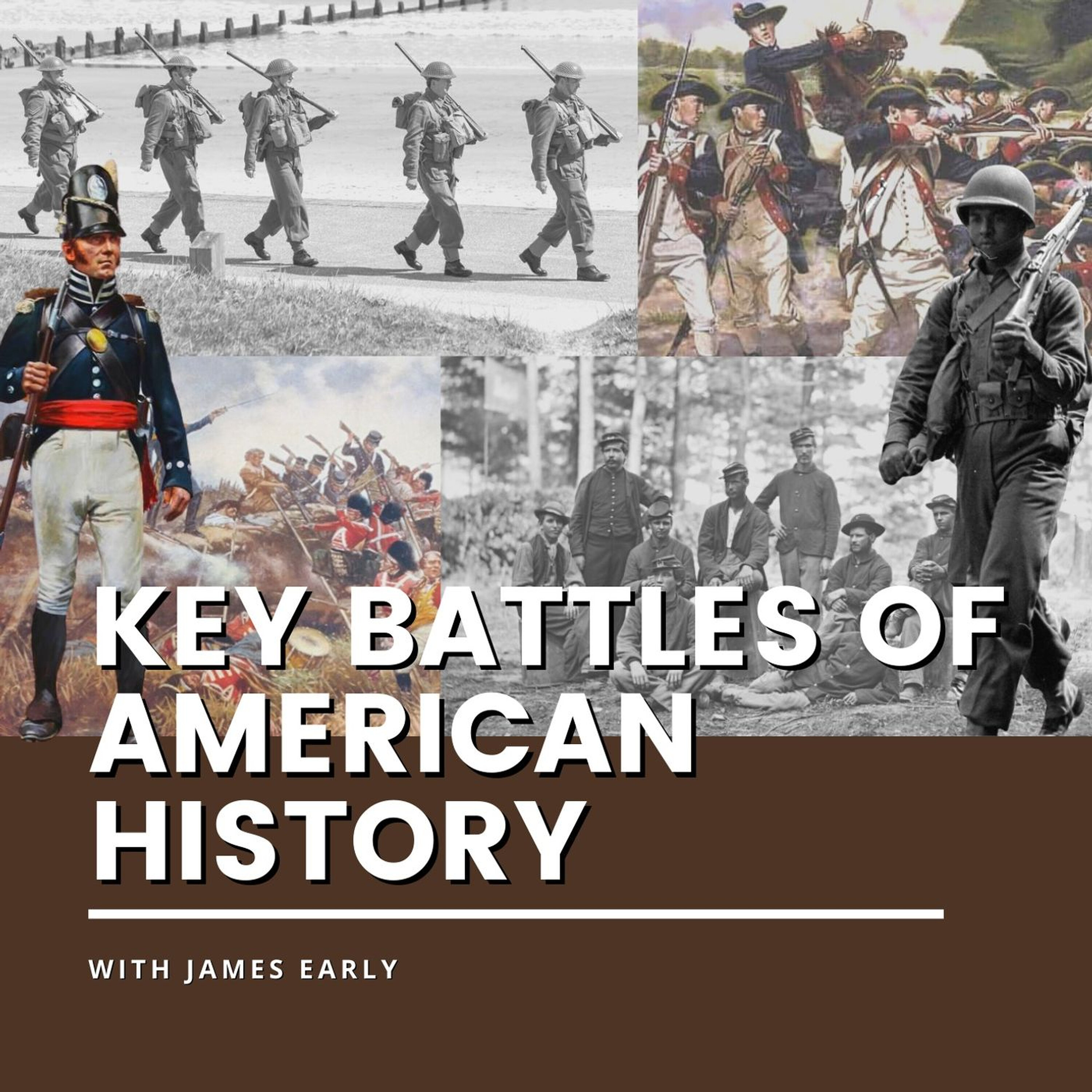
Key Battles of American History
449 episodes — Page 9 of 9
Hiroshima, Nagasaki and the End of the War
Between December 1942 and July 1945, a team of scientists, working in secret facilities in various parts of the U. S., researched, built, and tested the world’s first atomic bomb. Japan’s failure to surrender, together with the possibility of hundreds of thousands of casualties, motivated President Truman to drop an atomic bomb on the Japanese city of Hiroshima. Despite the bomb’s destruction of the city, including the immediate deaths of up to 80,000 people, Japan’s leaders still refused to surrender. Three days later, an American bomber dropped a second bomb on Nagasaki, leveling that city and killing nearly as many people as had perished at Hiroshima. Soon after, the Emperor led Japan to surrender. In this episode, James and Scott discuss the Manhattan Project, the dropping of the two atomic bombs, the Japanese surrender, and the end of the Second World War.See omnystudio.com/listener for privacy information.
Plug for This American President
This is an excerpt from an episode of This American President, a great history podcast that is the newest member of the Parthenon Podcast Network. You can find it at www.spreaker.com/show/this-american-president or wherever you listen to podcasts.George Washington: The First American Action HeroHe might look like an old man on the one-dollar bill, but George Washington was once a bona fide action hero. This episode explores our first president’s legendary exploits during the French and Indian War and the American Revolution.See omnystudio.com/listener for privacy information.
The Beginning of the End
By the summer of 1945, it was clear that Japan was defeated. Historian Craig Symonds writes that Japan was “stripped of her conquests, bombed incessantly from the air by American B-29s, her imports cut to a trickle by American submarines, her navy destroyed, and her industries idle for lack of raw materials and oil. Her allies were gone, too…Japan was alone, starving, all but defenseless, a passive target, absorbing punishment and unable to strike back.” In addition, Allied leaders issued the Potsdam Declaration, which warned Japan of “prompt and utter destruction” if they did not surrender. Despite all this, Japan’s leaders vowed to fight to the death. In this episode, James and Scott discuss Allied efforts to persuade Japan to surrender, along with Operation Downfall, the planned invasion of the Japanese home islands.See omnystudio.com/listener for privacy information.
Prisoners of War
During the Pacific War, the Japanese took over 130,000 Allied prisoners of war and held them in camps spread all over the Japanese Empire. Nearly all Allied prisoners were deprived of food and medical care, were regularly beaten, and were worked past the point of exhaustion. Nearly 40,000 died, representing about 27% (compared to only 4% in German camps). In this episode, James and Scott tell the tragic story of Allied prisoners of war in Japanese internment camps. They also briefly discuss the much happier story of Navajo Code Talkers, who helped win the war for the United States.See omnystudio.com/listener for privacy information.
Kamikazes
Once again, James and Scott are taking a break from the narrative of key battles to discuss two more important topics. In this episode, we will tell the story of kamikazes, including the origin of the tactic, its expansion into a full-fledged program, and its increasingly devastating effect, most notably at the Battle of Okinawa.See omnystudio.com/listener for privacy information.
Okinawa (KB 9), Part Two
As was the case with previous island battles, the American conquest of Okinawa was slow and bloody. In addition to their network of caves and tunnels, the Japanese possessed a strong fortress called Shuri Castle. But if the Americans could overcome the seemingly impregnable Japanese defenses, they could establish a powerful naval and air base from which to stage the seemingly inevitable invasion of the Japanese home islands. Would they succeed? Tune in and find out!See omnystudio.com/listener for privacy information.
Okinawa (KB 9), Part One
After the successful capture of Iwo Jima, the Americans’ next objective was Okinawa, which was only 330 miles from the Japanese home islands. Possessing Okinawa would cut Japan’s supply line from southeast Asia and would provide an excellent staging point for an eventual invasion. As in many previous battles, the Japanese were dug into an extensive network of caves and tunnels. To complicate things further, there were about 400,000 Okinawan civilians on the island. Capturing Okinawa would be the Americans’ greatest challenge to date. Join James and Scott as they discuss the lead up to the invasion and narrate its initial stage.See omnystudio.com/listener for privacy information.
Iwo Jima (KB 8), Part Two
On February 19, 1945, 40,000 Marines landed on Iwo Jima, and many more would follow. Within four days, they had taken the summit of Mt. Suribachi, a key position that commanded the entire island, and had raised an enormous flag (an event made famous in the iconic photo by Joe Rosenthal). But the battle was far from over. The Japanese defenders were determined to exact as heavy a toll as possible, while kamikazes wreaked havoc on the US Navy off the shore. Join James and Scott as they conclude their discussion of the key battle of Iwo Jima.See omnystudio.com/listener for privacy information.
Iwo Jima (KB 8), Part One
In order to make the strategic bombing runs over Japan more effective, General Curtis LeMay and other USAAF leaders wanted the B-29s to be escorted by fighters. In order for this to happen, the US needed a base much closer to Japan, because no fighter at the time could make it from Saipan or Guam to Japan and back. To meet this need, American military planners decided to launch an invasion of Iwo Jima, which is only 750 miles from Japan. Iwo Jima was only 8 square miles in size and was covered with black volcanic ash rather than sand. More significantly for the American invaders, the Japanese defenders had dug deep into a network of underground caves and tunnels that were impervious to American bombs and shells. The fight would be slow and bloody. Would the Americans be able to root out the Japanese and take the island? Join us and see!See omnystudio.com/listener for privacy information.
American Bombers in the Pacific Theater
In May 1944, the US unveiled a new weapon, the Boeing B-29 Superfortress bomber. It was bigger and faster than the B-17, it had a greater range, and it could carry a heavier bomb load (8-10 tons). Despite many early problems, by early 1945, B-29s were causing heavy damage on Japanese cities in the firebombing campaign led by General Curtis LeMay. In this episode, James and Scott discuss the controversial policy of firebombing, including its background, its execution, and its results.See omnystudio.com/listener for privacy information.
American Submarines in the Pacific
In this episode, James and Scott take a break from the narrative of battles to take a deep dive (pun intended!) into the topic of American submarines in the Pacific War. Due to technical problems, early submarine torpedoes seldom destroyed their targets. By mid-1944, however, these problems had largely been solved, with devastating results for Japanese merchant vessels. From then on, US submarines destroyed 200,000 tons of Japanese shipping per month and were threatening Japan’s war industries. According to historian Max Hastings, “No other combatant force as small as the U. S. Navy’s submarine flotillas and their 16,000 men achieved a comparable impact upon the war anywhere in the world.” Join James and Scott as they discuss the fascinating world of submarines.See omnystudio.com/listener for privacy information.
Leyte Gulf (Key Battle 7), Part Two
In the last episode, we saw that the Japanese fleet, despite suffering some initial setbacks at the hands of the Americans, were still pressing hard toward the American invasion fleet in Leyte Gulf. Due to a major communication breakdown, the US Navy had left the San Bernardino Strait unguarded, so the way to the American invasion fleet was wide open. Would the Japanese fleet be able to capitalize on the American mistake? In this episode, James and Scott discuss the final stages of the battle of Leyte Gulf, as well as the American effort to recapture Leyte, Luzon, and the other Philippine Islands.See omnystudio.com/listener for privacy information.
Leyte Gulf (Key Battle 7), Part One
After their overwhelming victories at the Philippine Sea and the Mariana Islands, American military leaders faced several options for their next target. Due in large part to lobbying by General MacArthur, they chose the Philippines. Japan’s leadership knew that losing the Philippines would mean the severing of the supply line from the Dutch East Indies to the home islands, so they were determined to stop the American invasion. Join James and Scott as they discuss the Japanese navy’s attempt to destroy the American invasion fleet in a “decisive battle.”See omnystudio.com/listener for privacy information.
Philippine Sea (Key Battle 6)
While the American attack on Saipan was still in progress, the Japanese Pacific fleet launched an attack on the American fleet, hoping to halt the invasion and to destroy the American fleet in a final, decisive battle. The Japanese fleet was powerful, but it was no match for Admiral Raymond Spruance’s Fifth Fleet, which destroyed so many Japanese planes and ships that the battle became known as the “Great Marianas Turkey Shoot.” In this episode, James and Scott discuss this dramatic and epic battle, along with the subsequent American capture of the islands of Guam and Tinian.See omnystudio.com/listener for privacy information.
Saipan (Key Battle 5)
In June 1944, the U. S. launched its Marianas campaign, beginning with an amphibious assault on the key island of Saipan. After more than three bloody weeks of fighting, culminating in a massive banzai charge and the horrific suicides of thousands of civilians, the Americans controlled the island. Join James and Scott as they discuss the bloodiest battle of the Pacific Theater up to that point, a battle which gave the U. S. an air base within bombing range of the Japanese home islands.See omnystudio.com/listener for privacy information.
America Moves Closer to Japan
In the fall of 1943, top Japanese leaders decided to pull Japan’s defensive perimeter back closer to Japan, in an effort to stop the American juggernaut. American and other Allied forces continued to press forward, taking Biak in the southwestern Pacific and the Caroline Islands (including the key Japanese air/naval base of Truk) in the central Pacific. After these victories, American planners set their sights on a key target even closer to Japan: The Mariana island chain. In this episode, James and Scott discuss Japan’s “New Operational Policy” and the allied conquests of Truk and the Caroline Islands. They conclude with a comparison of the main American and Japanese fleets that would be facing off in the next campaign.See omnystudio.com/listener for privacy information.
The Solomons, the Gilberts, and the Marshalls
In June 1943, American forces kicked off Operation Cartwheel, an attack on additional islands in the Solomons chain and parts of New Britain and New Guinea, under the command of General Douglas MacArthur. At the same time, Admiral Ernest King decided to launch a second major offensive under Admiral Nimitz’ command that would work its way across the Central Pacific. This new invasion force would be supported by the Third Fleet, the most powerful naval force ever assembled at the time. Join James and Scott as they discuss Operation Cartwheel, the invasion of the Gilbert Islands (most notably the bloody Battle of Tarawa), and the attack on the Marshall Islands.See omnystudio.com/listener for privacy information.
The Tide Turns: July 1942 - August 1943
Between August 1942 and June 1944, no “Key Battles” (at least in James’ reckoning!) occurred...but that of course does not mean that nothing happened! During the time between the Guadalcanal and Saipan campaigns, the U. S. and its allies launched a series of smaller campaigns to gradually push back the Japanese. In this episode, James and Scott discuss several key Allied efforts that occurred between July 1942 and August 1943, including the Kokoda Track Campaign, the Makin Raid, and the attack on the Aleutian islands of Attu and Kiska. Also discussed are the Battle of the Bismarck Sea and the American attempt to kill Admiral Yamamoto.See omnystudio.com/listener for privacy information.
Japanese and American Sailors
The Pacific War was dominated by the navy. Without the hundreds of thousands of sailors who manned the thousands of ships on both sides, there would have been no land battles. In this episode, written mostly by Sean McIver, James and Scott discuss the life of a common sailor on both the Japanese and the American side. Pacific Theater sailors endured cramped quarters, hot temperatures, and extended periods of mind-numbing boredom, punctuated by brief periods of terror. Climb aboard a ship with your James and Scott and enjoy the ride. Anchors aweigh!See omnystudio.com/listener for privacy information.
Soldiers, Marines and Aviators
In this and the next episode, James and Scott take a break from the military narrative to zoom in and take a look at the lives and experiences of common soldiers, marines, and pilots on both the Japanese and American sides. What backgrounds did they come from? What was their training like? What did they wear, carry, and eat? James and Scott discuss these and other questions to help you understand what it was like to be on the front lines and in the air over them.See omnystudio.com/listener for privacy information.
Guadalcanal (Key Battle 4), Part 4
After the failed October Japanese attack on Henderson Field and the American fleet’s repeated prevention of Japanese efforts to reinforce and resupply the island, the Japanese army on Guadalcanal became increasingly hungry, disease-ridden, and depleted in numbers. After successful American attacks on the eastern part of the island (the “Long Patrol”) and the key position of Mt. Austen in the center of the island, the Japanese commander faced two alternatives: evacuate, or be wiped out. What would he choose, and how would it work out? In this episode, James and Scott answer this question and many others as they wrap up the epic Guadalcanal campaign.See omnystudio.com/listener for privacy information.
Guadalcanal (Key Battle 4), Part 3
In October and November of 1942, the Japanese fleet near Guadalcanal kept trying to bring supplies and reinforcements to the island, while the American navy tried to stop this. As a result, no fewer than three naval engagements occurred in these two months: the Battle of Cape Esperance, the Battle of the Santa Cruz Islands, and the epic Naval Battle of Guadalcanal. Also, in late October, two Japanese forces launched another attack on Henderson Field, the American airfield. Would the attack succeed? Listen and find out!See omnystudio.com/listener for privacy information.
Guadalcanal (Key Battle 4), Part 2
In the first week after their landing, the Americans seized the Japanese airstrip and constructed a perimeter around it. But in the next month, the Japanese launched two attacks to try to regain it. The second one nearly succeeded. In this episode, James and Scott narrate these two attacks (known, respectively, as the Battle of the Tenaru and the Battle of Bloody Ridge (or Edson’s Ridge) as well as the continuing naval battle around the island, especially the Battle of the Eastern Solomons.See omnystudio.com/listener for privacy information.
Guadalcanal (Key Battle 4), Part 1
After overwhelmingly defeating the Japanese fleet at Midway, American military leaders decided to go on the offensive. The first major target would be a group of islands in the eastern part of the Solomon Islands, the most prominent of which was Guadalcanal. Japanese forces had begun constructing an airfield on Guadalcanal, and the Americans hoped to seize the airfield, convert it into an American one, and expel the Japanese from the island. The Japanese, however, refused to play along. In this episode, James and Scott discuss the planning and buildup toward the Guadalcanal campaign, the initial American landing, and the disastrous (for the Allies) naval Battle of Savo Island.See omnystudio.com/listener for privacy information.
SPECIAL ANNOUNCEMENT- Beyond the Big Screen
See omnystudio.com/listener for privacy information.
Midway (Key Battle 3)
Thanks to the American code breakers at “Station Hypo” on Oahu, led by the brilliant and quirky Joe Rochefort, American naval leaders knew of Yamamoto’s plan to attack Midway. This knowledge turned hunter into prey and prey into hunter. When Fleet Commander Chuichi Nagumo and the Japanese attack fleet arrived, they discovered they had sailed into an ambush. The result was the crucial Battle of Midway, in which it could be argued that the direction of the Pacific War changed in just five minutes. Join James and Scott as they narrate the exciting and decisive Battle of Midway.See omnystudio.com/listener for privacy information.
Yamamoto Rolls the Dice
The Japanese attack on Pearl Harbor on December 7, 1941 inflicted great damage on the American Pacific Fleet, but it left one group of American ships untouched: the aircraft carriers. In early 1942, Japanese Admiral Yamamoto decided to finish the job that his fleet had begun the previous December. Yamamoto authored a plan to send his fleet toward Midway Island. There, he hoped to lure the American carriers to their destruction and to capture Midway, establishing a powerful Japanese air and naval base only 1100 miles from Midway. This would force the Americans to the negotiating table...or would it? In this episode, James and Scott discuss the details of Yamamoto’s bold but risky plan to project Japanese power further westward. They also discuss the major types of ships and planes used by both navies in early 1942.See omnystudio.com/listener for privacy information.
The Coral Sea (Key Battle 2)
Following up on their stunning military successes of late 1941 and early 1942, Japan’s leaders decided to capture the key Allied port of Port Moresby on the southern coast of New Guinea. They also hoped to cut off the critical American supply line from Hawaii to Australia. Unbeknownst to the Japanese, however, American codebreakers had broken enough of the Japanese naval code to realize the Imperial Navy’s plans. As a result, when the Japanese fleet arrived at the Coral Sea, an American squadron was there to meet them. Listen as James and Scott discuss the key battle that resulted: The Battle of the Coral Sea.See omnystudio.com/listener for privacy information.
The Japanese Blitzkrieg
When Japan attacked Pearl Harbor on December 7, 1941, they were just getting started. Over the next 5 months, Japan rapidly and overwhelmingly conquered several European and colonial possessions in southeast Asia, including Guam, Malaya, Wake Island, Hong Kong, Burma, Singapore, the Dutch East Indies, and the Philippines. At the same time, they inflicted several defeats on Allied naval forces. They were then faced with several alternatives for their next move. In this episode, James and Scott narrate this period of rapid Japanese expansion, including the famous “Doolittle Raid” and the infamous “Bataan Death March.”See omnystudio.com/listener for privacy information.
SPECIAL ANNOUNCEMENT - The History of the Papacy
See omnystudio.com/listener for privacy information.
America Gears Up for War
Between 1939 and 1941, the United States began increasing the size of its military forces while it ramped up war production. After Pearl Harbor, these processes went into overdrive, with the result that several million Americans served in uniform in the war years, while America quickly became the world’s greatest industrial and military power. In the US, unemployment nearly disappeared, while African-Americans, Latinos, and women found unprecedented employment opportunities. At the same time, the US government interned thousands of Japanese-Americans for no reason other than their ancestry. In this episode, James and Scott describe how the US went from being a relatively isolationist power to the world’s “Arsenal of Democracy.” They also give an overview of life on the home front during the war.See omnystudio.com/listener for privacy information.
Pearl Harbor (Key Battle 1)
On December 7, 1941, Japanese air and naval forces launched a surprise attack on the American naval and air base at Pearl Harbor, Hawaii, killing 2400 Americans and heavily damaging the US Pacific Fleet. How did this happen? In this episode, James and Scott tell the gripping story of how Japan managed to keep the attack a secret, despite having to traverse several thousand miles of ocean. They also discuss the multiple American intelligence failures and the aftermath of the attack.See omnystudio.com/listener for privacy information.
The Road to Pearl Harbor
Japan’s complicated relationship with the United States stretches back much further than 1940. The relationship, which began nearly a century prior to World War II, was often fraught with tension. Things reached a breaking point in 1941, when the US began to push back against Japanese expansion. In this episode, James and Scott give a brief history of Japanese-American relations from 1853 to 1941, and they chronicle the Japanese decision to launch a surprise attack on the American naval and air base at Pearl Harbor, Hawaii.See omnystudio.com/listener for privacy information.
Japan’s Strategy; Relations with the US
In order to meet the needs of its expanding population and empire, Japan’s leaders began looking hungrily to the south and east. Three years after invading China, Japanese military forces occupied French Indochina. This, combined with American support for China, put Japan on a collision course with the US. Would the two powers be able to avoid war? In this episode, James and Scott tell the story of the dangerous “dance” between imperial Japan and the United States in 1940 and 1941.See omnystudio.com/listener for privacy information.
The Rise of Imperial Japan
As late as the 1860s, Japan was a semi-feudal nation, largely cut off from the rest of the world. But within a few decades, the nation had transformed itself into a major industrial power with one of the world’s most well-trained, well-equipped, and well-led militaries. Between 1905 and 1941, Japan defeated Russia, gained several former German colonies in the Pacific, seized Manchuria, and invaded and conquered much of coastal China. How did Japan accomplish all this? In this episode, James and Scott explain Japan’s meteoric rise to world power status.See omnystudio.com/listener for privacy information.
Intro to Key Battles of the Pacific War
In this episode, James introduces the second season of Key Battles of American History. The topic will be Key Battles of the Pacific Theater (WW2). Returning as James' co-host is Scott Rank. Enjoy!See omnystudio.com/listener for privacy information.
The Lost Battalion
James and Sean discuss the 2001 made-for-television movie The Lost Battalion, in which an American battalion becomes isolated and surrounded by German forces during the Meuse-Argonne Offensive of 1918.See omnystudio.com/listener for privacy information.
Lawrence of Arabia
James and Sean discuss the epic, multi award-winning 1962 film Lawrence of Arabia, based on British Colonel T. E. Lawrence’s autobiographical book The Seven Pillars of Wisdom. Lawrence assists a group of Arab tribesmen in their effort to break free of Ottoman rule.See omnystudio.com/listener for privacy information.
War Horse
James and Sean discuss the 2011 film War Horse, in which a young Englishman struggles to be reunited with his beloved horse, who has been sent to the Western Front and has experienced several trying experiences there.See omnystudio.com/listener for privacy information.
James Patreon Announcement
See omnystudio.com/listener for privacy information.
Sergeant York
James and Sean discuss the classic 1941 film Sergeant York, which tells the fascinating story of Alvin York, one of the most decorated American soldiers of the First World War.See omnystudio.com/listener for privacy information.

1917
James and Sean discuss the award-winning 2019 film 1917, in which two British soldiers are sent on a dangerous mission to save another unit from disaster.See omnystudio.com/listener for privacy information.
Beneath Hill 60
James and Sean discuss the 2010 Australian film Beneath Hill 60, which tells the fascinating story of an Australian tunneling company trying to undermine the German position at the Ypres Salient in the Western Front.See omnystudio.com/listener for privacy information.
They Shall Not Grow Old
James and Sean discuss the outstanding 2018 Peter Jackson documentary They Shall Not Grow Old, which combines interviews with British World War I veterans with colorized and slowed-down footage from the war.See omnystudio.com/listener for privacy information.

Paths of Glory
James and Sean discuss the classic 1957 anti-war film Paths of Glory, starring Kirk Douglas. In this film, a French colonel tries to save three of his men who are sentenced to be executed for cowardice.See omnystudio.com/listener for privacy information.
Gallipoli
James and Sean discuss the 1981 Australian film Gallipoli, which tells the story of a group of Australian young men who are introduced to the horrors of war at the 1915 Battle of Gallipoli.See omnystudio.com/listener for privacy information.
All Quiet on the Western Front
In this episode, James and special guest Sean McIver discuss the classic 1930 anti-war film All Quiet on the Western Front. Based on the novel of the same name, All Quiet on the Western Front set the standard for all future war movies, especially those which present war in a negative light.See omnystudio.com/listener for privacy information.
Season 1 Introduction
In Season 1 of "Key Battles of American History," James is joined with special guest Sean McIver to discuss their favorite WW1 films.See omnystudio.com/listener for privacy information.
Intro to Key Battles of American History
In this episode, host James Early introduces the series, discussing the format, the topics to be discussed in future episodes, and everything else you need to know.See omnystudio.com/listener for privacy information.