Episode 12
Ireland's Quantum Leap – Walton Institute at SETU and Q*Bird deploy Ireland's first QKD network
Waterford's Walton Institute at South East Technological University (SETU) and IrelandQCI project consortium partners have worked with Q*Bird, the Dutch leader in quantum secure communication, to successfully deploy Ireland's first multi-node, entangle...
Irish Tech News Audio Articles
March 27, 20267m 47s
Audio is streamed directly from the publisher (cdn.beyondwords.io) as published in their RSS feed. Play Podcasts does not host this file. Rights-holders can request removal through the copyright & takedown page.
Show Notes
Waterford's Walton Institute at South East Technological University (SETU) and IrelandQCI project consortium partners have worked with Q*Bird, the Dutch leader in quantum secure communication, to successfully deploy Ireland's first multi-node, entanglement-based Measurement-Device-Independent Quantum Key Distribution (MDI-QKD) network.
The deployment forms part of the IrelandQCI project, the country's national quantum communications initiative and a key contributor to EuroQCI, the EU-wide federated quantum communications infrastructure.
Operating over Ireland's existing fibre infrastructure, the telecom-grade network transitions quantum security from research environments into live national infrastructure. It safeguards research, education and critical systems while enabling interoperable quantum connectivity across Ireland and Europe.
Importantly, it has been designed from the start with an expandable architecture in mind, so that any additional Q*Bird QKD Node can connect to the network with a single fibre link and then gain full quantum connectivity around the network.
A major milestone for Ireland's national quantum infrastructure
''This multi-node deployment represents a major milestone for Ireland's national quantum infrastructure," said Dr Deirdre Kilbane, Director of Research at Walton Institute at SETU and Coordinator of the €10 M IrelandQCI project, which is co-funded by the European Commission and the Irish Government's Department of Communications, Culture and Sport.
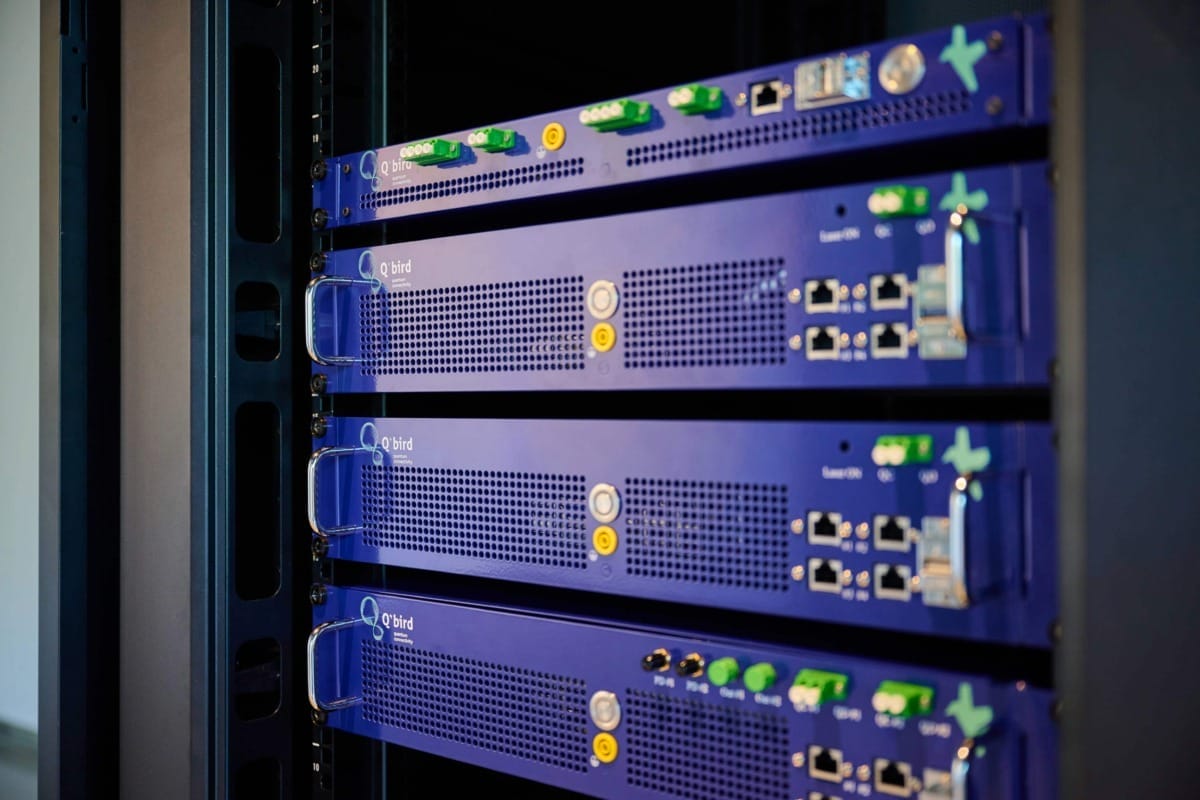
"By integrating Q*Bird's operational MDI-QKD Falqon® Series across research institutions, data centres and national networks, we are enabling secure, interoperable quantum communication while also creating a platform for other research institutions to join. It strengthens Ireland's sovereignty over critical communications and contributes directly to EuroQCI and Europe's federated quantum network vision."
The hub-and-spoke architectural network comprises of four End Nodes, one Center Hub and one Quantum Optical Switch for a scalable metropolitan deployment and uses ESB Telecoms dark fibre for the quantum communication channel. The End Nodes are located in two Dublin data centres, Dublin City University and Trinity College Dublin, while the Center Hub is hosted at Asiera (formerly HEAnet), Ireland's National Education and Research Network.
The collaborative expertise of Walton Institute at SETU, Asiera and Q*Bird were responsible for the successful deployment of the highly secure connection between the strategic Dublin city locations. The Q*Bird Quantum-Optimized Optical Switch enables dynamic, secure routing of qubits around the network, ensuring full multi-node connectivity of QKD keys, without relying on trusted intermediaries.
Industry-grade security for research, education and critical infrastructure
At the core of the network is Q*Bird's Falqon Series, enabling entanglement-based quantum key distribution over operational fibre networks. Detector-side exploits have been identified by security authorities, including Germany's Federal Office for Information Security (BSI), as the most critical attack vector in earlier QKD implementations. Q*Bird's devices completely remove the requirement to trust any measurement devices, thus establishing an architecture with a security model resilient against both present day cyber threats and future quantum-enabled attacks.
This ensures long-term cryptographic protection for sensitive research data, governmental communications and critical infrastructure systems, while addressing harvest-now-decrypt-later (HNDL) risk scenarios.
Interoperability by design, resilience by architecture
The network's hub-and-spoke architecture of Q*Bird devices, along with the Quantum Optical Switch, enables precise synchronisation, dynamic routing and multi-node quantum key distribution. Designed for interoperability and compatibility with existing fibre infrastructure, it provides an open foundation for future integration with eme...
The deployment forms part of the IrelandQCI project, the country's national quantum communications initiative and a key contributor to EuroQCI, the EU-wide federated quantum communications infrastructure.
Operating over Ireland's existing fibre infrastructure, the telecom-grade network transitions quantum security from research environments into live national infrastructure. It safeguards research, education and critical systems while enabling interoperable quantum connectivity across Ireland and Europe.
Importantly, it has been designed from the start with an expandable architecture in mind, so that any additional Q*Bird QKD Node can connect to the network with a single fibre link and then gain full quantum connectivity around the network.
A major milestone for Ireland's national quantum infrastructure
''This multi-node deployment represents a major milestone for Ireland's national quantum infrastructure," said Dr Deirdre Kilbane, Director of Research at Walton Institute at SETU and Coordinator of the €10 M IrelandQCI project, which is co-funded by the European Commission and the Irish Government's Department of Communications, Culture and Sport.
"By integrating Q*Bird's operational MDI-QKD Falqon® Series across research institutions, data centres and national networks, we are enabling secure, interoperable quantum communication while also creating a platform for other research institutions to join. It strengthens Ireland's sovereignty over critical communications and contributes directly to EuroQCI and Europe's federated quantum network vision."
The hub-and-spoke architectural network comprises of four End Nodes, one Center Hub and one Quantum Optical Switch for a scalable metropolitan deployment and uses ESB Telecoms dark fibre for the quantum communication channel. The End Nodes are located in two Dublin data centres, Dublin City University and Trinity College Dublin, while the Center Hub is hosted at Asiera (formerly HEAnet), Ireland's National Education and Research Network.
The collaborative expertise of Walton Institute at SETU, Asiera and Q*Bird were responsible for the successful deployment of the highly secure connection between the strategic Dublin city locations. The Q*Bird Quantum-Optimized Optical Switch enables dynamic, secure routing of qubits around the network, ensuring full multi-node connectivity of QKD keys, without relying on trusted intermediaries.
Industry-grade security for research, education and critical infrastructure
At the core of the network is Q*Bird's Falqon Series, enabling entanglement-based quantum key distribution over operational fibre networks. Detector-side exploits have been identified by security authorities, including Germany's Federal Office for Information Security (BSI), as the most critical attack vector in earlier QKD implementations. Q*Bird's devices completely remove the requirement to trust any measurement devices, thus establishing an architecture with a security model resilient against both present day cyber threats and future quantum-enabled attacks.
This ensures long-term cryptographic protection for sensitive research data, governmental communications and critical infrastructure systems, while addressing harvest-now-decrypt-later (HNDL) risk scenarios.
Interoperability by design, resilience by architecture
The network's hub-and-spoke architecture of Q*Bird devices, along with the Quantum Optical Switch, enables precise synchronisation, dynamic routing and multi-node quantum key distribution. Designed for interoperability and compatibility with existing fibre infrastructure, it provides an open foundation for future integration with eme...