
Iowa City Church Podcast
112 episodes — Page 3 of 3

6. The Cost of Following Jesus
In August of 2003, the Church of the Holy Cross in New York City was broken into twice. In the first break-in, thieves made away with a metal moneybox that had been resting next to a votive candle rack. Three weeks later, vandals escaped with something much more valuable: they unbolted a 4-foot long, 200-pound plaster Jesus from a meditation area, taking the statue of Christ, but leaving behind his wooden cross on the wall. The church caretaker, David St. James, confessed his bewilderment at this: "They just decided, 'We're going to leave the cross and take Jesus.' We don't know why they took just him. We figure if you want the crucifix, you take the whole crucifix." In other words, David St. James was saying, "If you want Jesus, you take his cross, too." It only makes sense if you want Jesus, the cross is a part of the deal; that's one of the many reasons why Jesus is so amazing! For the Christian, the cross of Christ represents love, grace and forgiveness. You take Jesus and his cross. But what about your cross? If you follow Jesus, you have a cross as well...at least that's what Jesus says. "Whoever wants to be my disciple must deny themselves and take up their cross and follow me." ~ Mark 8:34 There are a lot of people who are fans of Jesus; they agree with some of the things he says, they appreciate the love and forgiveness...they even wear a "Jesus Is My Homeboy" t-shirt! However being a disciple of Jesus isn't about agreement or fandom...it's about self denial, allegiance and loyalty. Here's why this matters according to Jesus: "For whoever wants to save their life will lose it, but whoever loses their life for me and for the gospel will save it." ~ Mark 8:35 Intuitively we think that by preserving our lives we save them, yet according to Jesus by surrendering our lives, our passions and even our desires over to the cross (our own cross) we will find life. So the question we all have to wrestle with is this: Will I take Jesus, his cross and my cross too? To better understand what this looks like in your life, make sure and listen to part six of Come, Follow, Me.

5. How Jesus Prepares You For Your Kingdom Mission
In part five of Come, Follow, Me we discover how Jesus intentionally coaches his disciples so that they can be prepared to carry on the Kingdom Mission.

4. The Dirt Matters
In a few months we will see tractors working the soil in the fields surrounding Iowa City. We will also observe countless people tilling the soil in their backyards, prepping the ground for the huge gardens they are about to plant. Here is what the farmer and the gardener both know well: the dirt matters. One doesn't just throw some seeds onto any type of soil. The ground needs to be a rich, dark, black...well aerated with enough moisture. Using rocky or weedy soil is not going to produce the crop anyone wants and if the ground is like concrete--well you can forget about it! Here's the thing, we all intuitively know this to be true however, we don't often realize that it applies to our lives as well. Our ability to follow and grow in Jesus is directly related to the kind of "soil" we are. This basic truth is the basis of Jesus' parable of the soils found in Mark 4:1-12. How does one prepare their "soil" to best grow the instructions Jesus wants to implant into our lives? Jesus actually gives us the key. It's found at the beginning of his parable of the soils. "He taught them many things by parables, and in his teaching said: "Listen!" ~ Mark 4:2-3 Our ability to grow as disciples of Jesus lies in our ability to listen to Jesus. A lot of people heard the words of Jesus, but very few people actually listened to Jesus. Here's the question, do you hear Jesus or do you listen to him? Why does any of this even matter? It matters because what you become in the Kingdom of God is directly related to your ability to listen to Jesus. Simply put, your life could potentially take a completely different trajectory if you learn how to listen to Jesus! To learn more, give a listen to part four of Come, Follow, Me.

3. Who Is Jesus?
Imagine the mystery and delight of not just hearing, but seeing the story of Jesus for the first time, almost as an eyewitness. That's what happened to a tribe in the jungles of East Asia when missionaries showed them the Jesus film. Not only had these people never heard of Jesus, they had never seen a motion picture. Then, on one unforgettable evening, they saw it all—the gospel in their own language, visible and real. Imagine again how it felt to see this good man, Jesus, who healed the sick and was adored by children, held without trial and beaten by jeering soldiers. As they watched this, the people came unglued. They stood up and began to shout at the cruel men on the screen, demanding that this outrage stop. When nothing happened, they attacked the missionary running the projector. Perhaps he was responsible for this injustice! He was forced to stop the film and explain that the story wasn't over yet; there was more. So they settled back onto the ground, holding their emotions in tenuous check. Then came the crucifixion. Again, the people could not hold back. They began to weep and wail with such loud grief that, once again, the film had to be stopped. The missionary again tried to calm them, explaining that the story still wasn't over; there was more. So they composed themselves and sat down to see what happened next. Then came the resurrection. Pandemonium broke out this time, but for a different reason. The gathering had spontaneously erupted into a party. The noise now was of jubilation, and it was deafening. The people were dancing and slapping each other on the back. Christ is risen, indeed! Again the missionary had to shut off the projector; this time he didn't tell them to calm down and wait for what was next. All that was supposed to happen—in the story and in their lives—was happening. (Source: Ben Patterson, "Resurrection and Pandemonium," Leadership Journal) Can you imagine experiencing Jesus for the very first time in such a unique and powerful way? This is Mark's goal as he writes his account of Jesus of Nazareth; he wants his readers to be introduced to Jesus in such a way that their lives are changed forever. This is one of the reasons Mark's Gospel is short, action-packed and focused on answering this one question: Who is Jesus? Mark knows that if his readers learn that Jesus is King, it will provide them with someone to lead them through life. Mark also know that if his readers understand that Jesus is God's Son, they will be able to find forgiveness and relationship with God. These are just two examples of how Mark strives to answer the question: Who is Jesus? Do you know Jesus? To see Jesus with fresh eyes, give a listen to part three of Come, Follow, Me.

2. The Kingdom Mission
In the late 1600s and early 1700s a half-literate Italian craftsman named Antonio Stradivari designed and made a series of beautiful musical instruments. Today, those violins, named after the Latinized form of his name, Stradivarius, are considered priceless. In 2010, a Stradivarius was purchased for $3.6 million. It is believed there are only around five hundred of them still in existence, some of which have been submitted to the most intense scientific examination in an attempt to reproduce their extraordinary sound quality. But no one has been able to replicate Stradivari's craftsmanship. Today we do know that Stradivari used spruce for the top, willow for the internal blocks and linings, and maple for the back, ribs, and neck. He also treated the wood with several types of minerals, including potassium borate, sodium and potassium silicate, as well as a handmade varnish that appears to have been composed of gum arabic, honey, and egg white. But the genius craftsman never once recorded his technique for posterity. Instead, he passed on his knowledge to a number of his apprentices through what one scholar called "elbow learning." The apprentices of the great Stradivari didn't learn their craft from books or manuals but by sitting at his elbow and feeling the wood as he felt it to assess its length, its balance, and its timbre right there in their fingertips. All the learning happened at his elbow, and all the knowledge was contained in his fingers. As Jesus begins his ministry of announcing the good news about the Kingdom of God, the very first thing that he does is find some apprentices, you would know them as disciples. Here is how he invites one third of his disciples into their apprenticeship. "Follow me, and I will make you become fishers of men." ~ Mark 1:17 We learn a lot from Jesus' strategy for growing the Kingdom; it's more then just announcing good news. The Kingdom strategy for expansion is about finding apprentices/disciples and inviting them to engage in some "elbow learning". Who showed you how to be a Christian? Was it a parent or family member? A friend? Or was it a book you read, a class you took or a video you watched? What is clearly missing when it comes to living as a follower of Jesus is good, old fashioned, Stradivarian, "elbow learning". To discover more about Jesus' strategy for making "elbow learning" disciples, check out the lastest sermon from, Come, Follow, Me.

1. Looking For Some Good News?
On June 23, 2018, 12 members of the Wild Boars youth soccer team and their coach entered caves in Northern Thailand. Things drastically changed when torrential rains caused flooding that trapped them all in the Than Luang Nang Non cave system. Hundreds of rescuers from around the world teamed up to save the boys and their coach. It took nine days for the divers to find the team and it took another eight days to rescue them all. In total, the boys and their coach were trapped for 17 days in a flooded cave with little food and water. There are a number of books, movies and television series depicting the dramatic events of the Tham Luang Cave Rescue. Now imagine you are one of those boys, trapped with your teammates for nine days, in a flooded dark cave, not sure anyone even knows where you are...not sure if you will ever be found! When suddenly a diver bursts through the water with a flash light to let you know that they are going to rescue you. Good news? Absolutely! However, it's only good news if you need to be rescued. If you were to say those same words to the person pumping gas across from you and the gas station, they would think you were weird! Sometimes good news may not appear to be good news, especially if we don't think it's relevant to our circumstances. In this sermon we begin a twelve week journey through the Gospel of Mark. Here's the opening line from Mark's book: "The beginning of the good news about Jesus the Messiah, the Son of God" ~ Mark 1:1 Good news? Well, I guess it depends. Do you need to be rescued? Do you need a King? Do you want God to personally intervene in your life through the person of Jesus? If the answer is "Yes" well, according to Mark you've come to the right place! However, if the answer is "No" you've still come to the right place. Mark is going to make a powerful case as to why Jesus is the King you have been looking for and the Savior your soul desperately needs. Maybe by taking an open minded look at who Jesus is, you will discover that he is the good news you have been looking for. To be a part of this journey, take a few minutes and listen to this sermon. Enjoy!

New Year. New You?
Kintsukuroi (golden repair) is the Japanese art of repairing damaged pottery with gold or silver lacquer. If you take a few minutes and search the internet you will find countless examples of kintsukuroi. In fact, if you want to give it a try, simply drop your favorite coffee cup and then order a kintsukuroi kit. In no time your coffee stained mug will be turned into a piece of coffee drinking art! However, kintsukuroi is more then just an art form, it's also a way of thinking about life. As a philosophy, kintsukuroi celebrates imperfection as an integral part of our story. The artists believe that when something has suffered damage and has a history, it becomes more beautiful. As we enter into a New Year, how are you feeling about a new you? We all have these broken pieces in our lives and every New Year just reminds us that nothing is really going to change. Others of you may currently be feeling like a shattered plate spread all across the dining room floor. The last thing on your mind is being made new, especially when you can't even pull yourself together? Does kintsukuroi even happen for people with broken lives? The apostle Paul writes to the church in Corinth, a collection of Christians feeling this sense of brokenness, and he states this fact: "Therefore, if anyone is in Christ, the new creation has come: The old has gone, the new is here!" ~ 2 Corinthians 5:17 Allegiance to Jesus puts us back together...makes us new! It's not our strength, discipline or hard work which puts us together, it's the power of God working in our lives. A few verses earlier the apostle writes: "But we have this treasure in jars of clay to show that this all-surpassing power is from God and not from us." ~ 2 Corinthians 4:7 It appears God has his own form of kintsukuroi, where He takes the broken pieces of our lives and uses the power of Jesus to make us new again. If you would like to learn more about how this can happen in your life, give a listen to New Year. New You?

New Year, New Soil, New Fruit
Give a listen to one of our elders, Jerry Anthony bring a close to 2023 and challenges us for how we can follow Jesus' instruction about bearing fruit in 2024.

2. Make Room for Peace
We all want to forget the year 2020, especially those spring months when the COVID virus and the fear of the unknown began to move around the globe. However, in the midst of that pandemic we learned where people go to find peace. The Bible. During the hardest moments of 2020, Bible searches soared online and a record number of people turned to Scripture for passages addressing fear, healing, and justice. The YouVersion Bible app saw searches increase by 80%, totaling nearly 600 million worldwide. YouVersion found Bobby Gruenewald said, "Through every hardship, people continue to seek God and turn to the Bible for strength, peace, and hope. While 2020 is a year so many say they'd like to forget, we see it as a year to remember how God used the Bible app to help so many people who were searching for answers." Overall, the app tracked 43.6 billion chapters of the Bible read in 2020, with half a billion verses shared, its highest on record. So for many people, reading Scripture is a way that they find peace in their moments of stress and anxiety. What do you do to find peace? Finding peace is something that a lot of people, maybe even you, are trying to find. The unfortunate reality is we end up pursuing a lot of unhealthy comforts which in the end don't bring peace, and instead hook us into habits that hurt. This is one of the reason why Scripture admonishes us to practice discipline, and self control in our pursuit of finding the peace that only Jesus can give. This is why this Christmas season we are practicing some of the disciplines of advent. Advent challenges us to make space for Jesus in our lives by preparing for his coming through worship, prayer, fasting, Scripture reading and acts of generosity. On Sunday we will continue with part two of our advent sermon series by discovering how we can find true peace in our lives when we make room for Jesus in our chaotic lives. To join us on the journey give a listen to part two of Make Room.
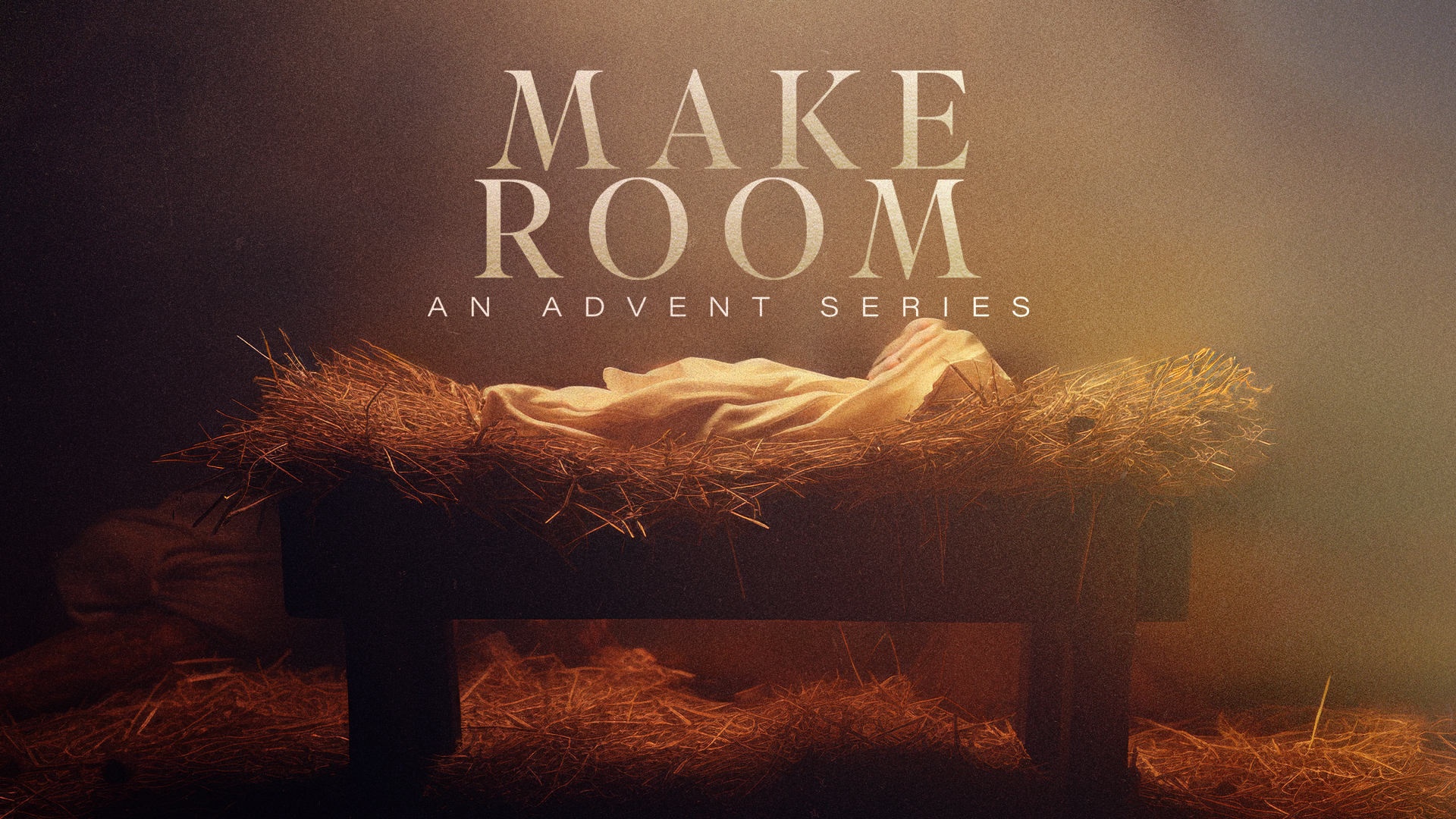
1. Make Room For Hope
During the month of December we all make room for Christmas. We make room for a tree and decorations. We make room in our schedules for buying and wrapping presents. We make room for parties and family get togethers. We make room for Christmas cards and delicious treats. However, this question does need to be asked: Is anyone, making room for Jesus? As much as we should enjoy all the extra events of Christmas, the truth is none of what we invest all of our time on ultimately gives us the hope our souls desperately crave. The Christmas trees die and shed their needles, food is eaten, gifts are broken or forgotten, decorations come down and the bills begin to arrive only to bring on the "blues" of January. That is unless you have made room for Jesus. With this sermon we are going to embark on an Advent Christmas series designed specifically to help you make room for Jesus. If we aren't intentional with how we use our time and resources, it doesn't take long for the important things in life to be quickly forgotten. So what's the plan? Advent. If you aren't familiar with the concept of Advent, the term comes from the Latin word, adventus---which means coming. It's been used by the church over the centuries as a discipline to prepare for the coming of King Jesus; both his first coming and his second coming (click here if you want to learn more) For the month of December we are going to practice some of the disciplines of Advent by worshiping together, working through a Bible reading plan together, practicing prayer and fasting...all with the expressed goal of making room for more of Jesus in our lives. To be a part of the journey, get started by listening to part one of Make Room.

3. From Gratitude to Generosity
In doing research for this sermon series I came across a fascinating article studying the connection between gratitude and altruism. It appears God actually wired people with a neural connection between being thankfulness and generosity. In Mind & Body magazine, Christina Karns writes in detail about the research being done in tracing the mental link between gratitude and altruism (Why a Grateful Brain Is a Giving One) Here's a summary of the article: "In a sense, gratitude seems to prepare the brain for generosity. Counting blessings is quite different than counting your cash, because gratitude, just as philosophers and psychologists predict, points us toward moral behaviors, reciprocity, and pay-it-forward motivations. Apparently, our brain literally makes us feel richer when others do well. Perhaps this is why researchers have observed that grateful people give more. Gratitude might be good for us—but it is good for others as well." As we stop and consider the implications of this research it doesn't take long to see this connection between gratitude and generosity popping up all over the Bible. Probably the one that immediately stood out to me was Jesus in the garden of Gethsemane, giving thanks to his Father in Heaven and then proceeding to give himself generously as a sacrifice on the cross. Why should any of this matter to us? It matters because Black Friday and Cyber Monday are often more important to us then being generous. Our culture focuses more on getting and hoarding then generosity. To break this cycle and become generous, all we have to do is look to God and science to see that it starts with developing a grateful heart. On Sunday we will wrap up this series by looking at a specific incident in the book of Exodus where Israel demonstrates this connection between gratitude and generosity. To be a part of the conversation give a listen to part three of Thanks & Giving.

2. Being Thankful Even When You Don't Feel Like It
I recently came across an article about Richard Stearns, the president of World Vision, as he reflected on his visit to a church in Port-au-Prince, Haiti a year after the devastating earthquake. The church's building consisted of a tent made from white tarps and duct tape, pitched in the midst of a sprawling camp for thousands of people still homeless from the earthquake. This is how he described the church and the lesson he learned in Haiti: In the front row sat six amputees ranging in age from 6 to 60. They were clapping and smiling as they sang song after song and lifted their prayers to God. The worship was full of hope … [and] with thanksgiving to the Lord. No one was singing louder or praying more fervently than Demosi Louphine, a 32-year-old unemployed single mother of two. During the earthquake, a collapsed building crushed her right arm and left leg. After four days both limbs had to be amputated. She was leading the choir, leading prayers, standing on her prosthesis and lifting her one hand high in praise to God .… Following the service, I met Demosi's two daughters, ages eight and ten. The three of them now live in a tent five feet tall and perhaps eight feet wide. Despite losing her job, her home, and two limbs, she is deeply grateful because God spared her life on January 12th last year … "He brought me back like Lazarus, giving me the gift of life," says Demosi … [who] believes she survived the devastating quake for two reasons: to raise her girls and to serve her Lord for a few more years. I find Demosi's response of gratitude to God remarkable! How can a woman who lives in those conditions not to mention the loss of her limbs find a reason to thank God? In my context, I find myself lacking gratitude because my WiFi isn't working and the coffee ran out. How pathetic in comparison! The truth is while most of us would think that we are in a better position then Demosi, it's actually Demosi who has something to teach all of us: How to be thankful no matter what the circumstances. In this episode, we will study a section of the apostle Paul's Thessalonian letter (1 Thessalonians 5:16-24), which teaches us how to develop a discipline of giving thanks in all circumstances.