Invested In Climate
138 episodes — Page 2 of 3
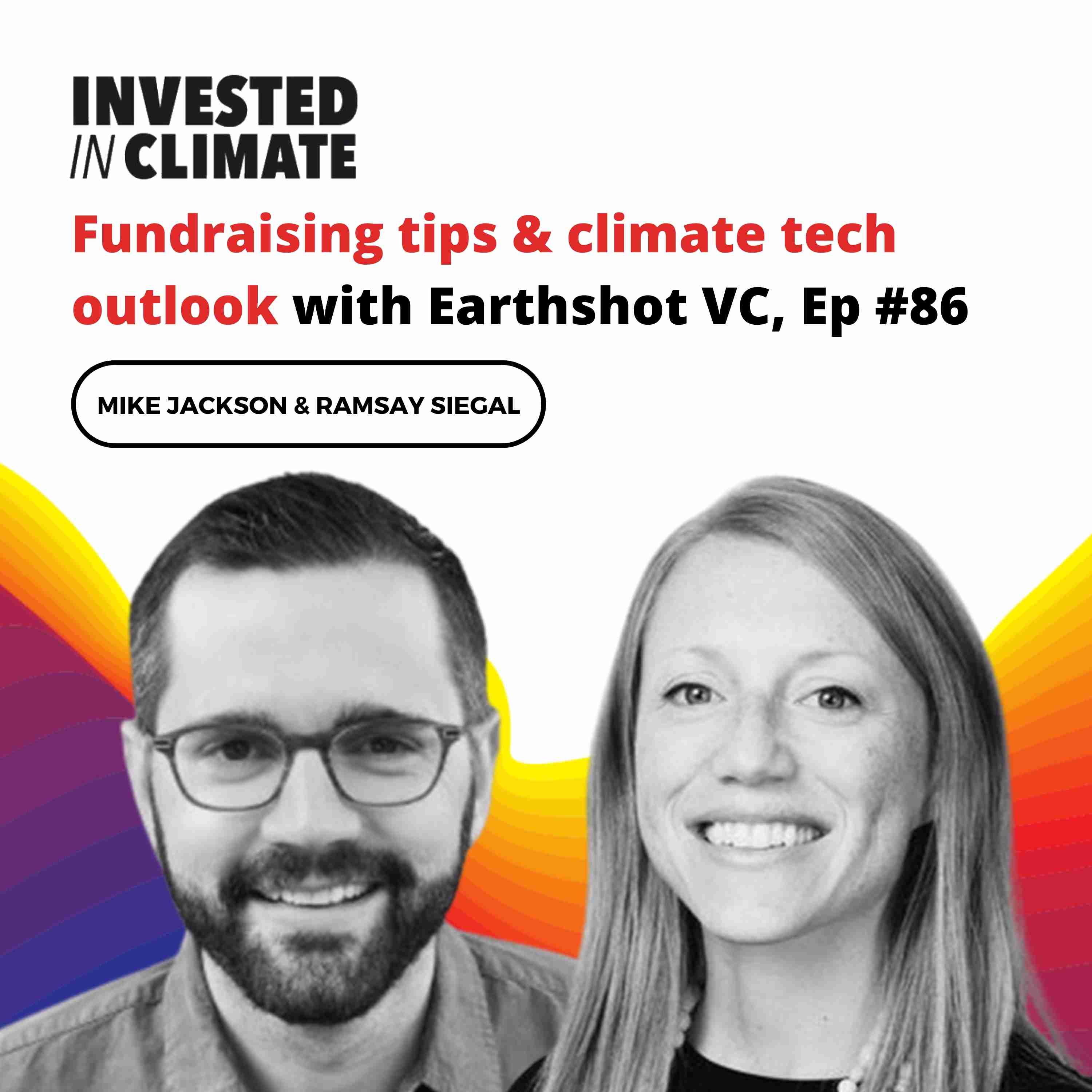
Ep 86Fundraising tips & climate tech outlook with Earthshot VC, Ep #86
Earthshot Ventures isn't just any climate tech venture firm. Having grown out of the Elemental Excelerator, one of the biggest and best-reputed accelerators in the industry, Earthshot is deeply rooted in the early-stage ecosystem. And it turns out there's something else that sets them apart. Managing Partner Mike Jackson has a knack for coaching founders on what he thinks of as the art and science of fundraising. We're joined today by Mike and Earthshot Partner Ramsay Siegal to hear about their firm, approach, portfolio, and outlook on the market. We dive deep into Mike's insights to helping founders raise money. We talked about non-dilutive project financing and hard-to-abate sectors, the opportunities AI is bringing to climate tech, several of their portfolio companies, and much more. If you're interested in early-stage climate investing, or startups, there's lots to learn in this one. Hope you enjoy. Here we go.In today’s episode, we cover:[02:47] Mike’s background & experience[04:52] Ramsey’s background & expertise[07:51] The relationship between Earthshot VC & Elemental Excelerator[09:39] Earthshot’s investment thesis, what they’re interested in & what sets them apart[12:22] Earthshot’s network[14:13] Mike’s approach to fundraising & coaching the portfolio[17:54] Fundraising tips and tricks for founders[22:17] Earthshot’s success stories[24:38] How is AI showing up[30:41] Investing in hard-to-abate sectors and Kanin Energy[33:06] Kanin Energy's business model and non-dilutive funding[38:15] Earthshot’s commitment, DEI & tips for achieving a diverse portfolio[42:38] Outlook & opportunities for climate tech investingResources MentionedEarthshot VenturesElemental ExceleratorMitra ChemKanin EnergyGenerate CapitalWestly GroupConnect with Mike Jackson & Ramsay SiegalConnect with Mike on LinkedInConnect with Ramsay on LinkedInConnect with Jason RissmanOn LinkedInOn TwitterKeep up with Invested In ClimateSign up for our NewsletterLinkedInInstagramTwitterHave feedback or ideas for future episodes, events, or partnerships?Get in touch!
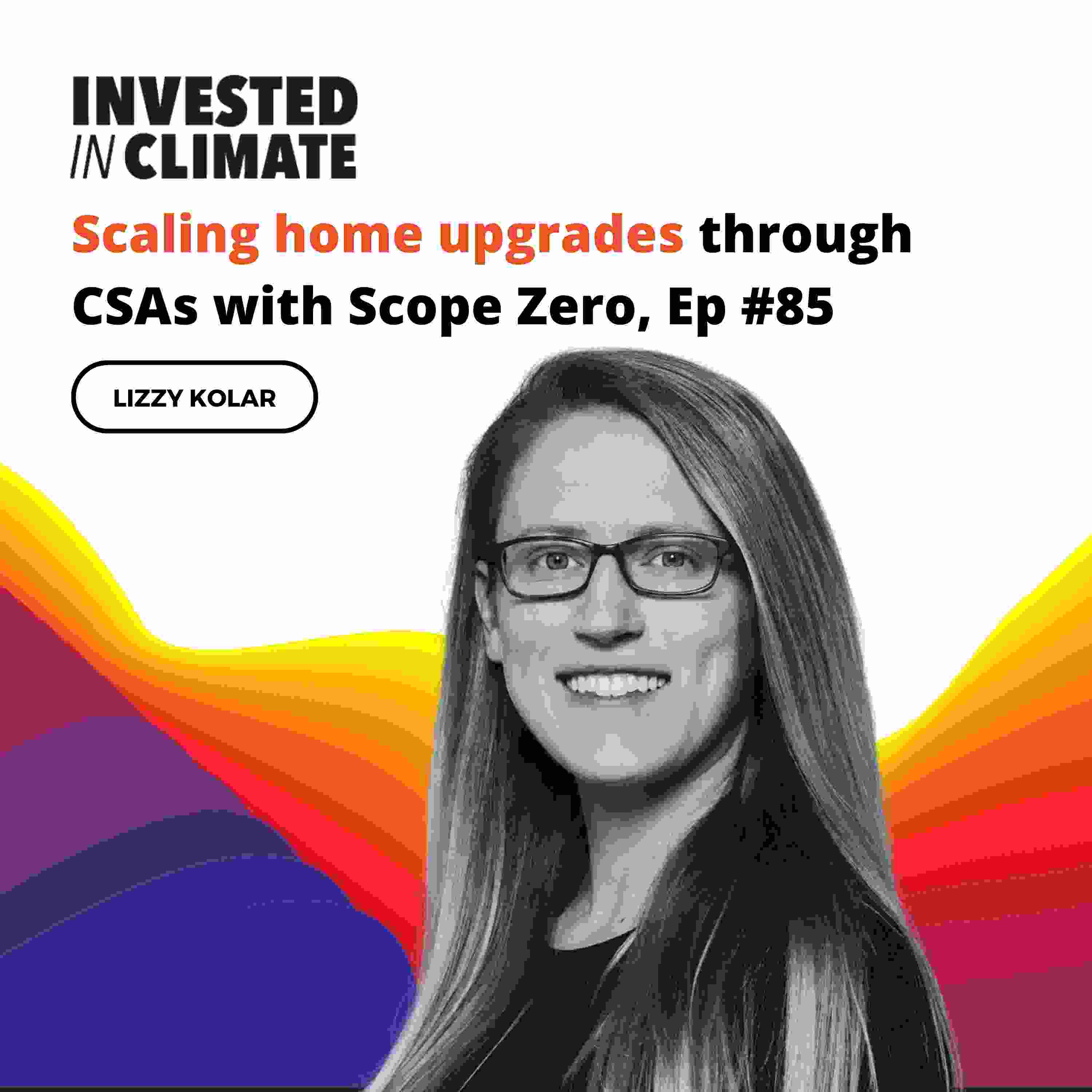
Ep 85Scaling home upgrades through CSAs with Scope Zero, Ep #85
We know that motivating homeowners to invest in energy efficiency retrofits and home upgrades is hard. Energy efficiency might not sound glamorous, but across the US, retrofits can actually cut our residential energy usage in half. That’s why when I met Scope Zero CEO Lizzy Kolar, I was excited to learn about her company’s novel way of motivating home upgrades. What Lizzy and her co-founder realized is that our homes are now workplaces. And, with employers having to account for emissions for remote workers, they now have an incentive to help homeowners invest in upgrades. Enter the Carbon Savings Account (CSA). Modeled after FSAs and HSAs, the CSA can scale quickly and help millions of homeowners across the US to begin investing in upgrades they’ve been putiing off. In this episode, we hear about Lizzy’s background, the founding story of Scope Zero, the problems they’re trying to solve, the best home upgrade investments, how the home upgrade ecosystem has been evolving, and much more. This is a fast and to-the-point episode. Hope you enjoy it.In today’s episode, we cover:[03:02] Lizzy’s background, what sparked her interest in climate & founding Scope Zero[05:50] Key needs that Scope Zero is addressing[07:17] The HSA model & how it works[08:24] How the HSA model translates to climate action[09:20] How someone might use the money they put in a Scope Zero account[10:15] What holds homeowners back from making investments[11:40] Evidence that consumers will invest in CSAs[12:23] The benefits of government incentives - Inflation Reduction Act[12:53] What home upgrades should be prioritized[14:43] The benefits of a Scope Zero CSA for employers[16:34] ROI for employers[17:53] CSAs in practice & the response[18:27] How far along is Scope Zero & the growth plan[19:44] Scope Zero’s total addressable market & opportunity[20:27] Quantifying impact in terms of emissions reduced & environmental benefits[21:06] Tracking the impact of CSAs using dashboards & data[21:44] Customers’ access to a partner vendor network[22:14] How the ecosystem surrounding home upgrades is evolving[23:08] How Scope Zero is financed & raising funding[23:47] Opportunities for aligning interests & motivating changeResources MentionedScope ZeroTomKat Center for Sustainable Energy - StanfordCaltech Rocket FundCollaborative FundConnect with Lizzy KolarConnect with Lizzy on LinkedInConnect with Jason RissmanOn LinkedInOn TwitterKeep up with Invested In ClimateSign up for our NewsletterLinkedInInstagramTwitterHave feedback or ideas for future episodes, events, or partnerships?Get in touch!
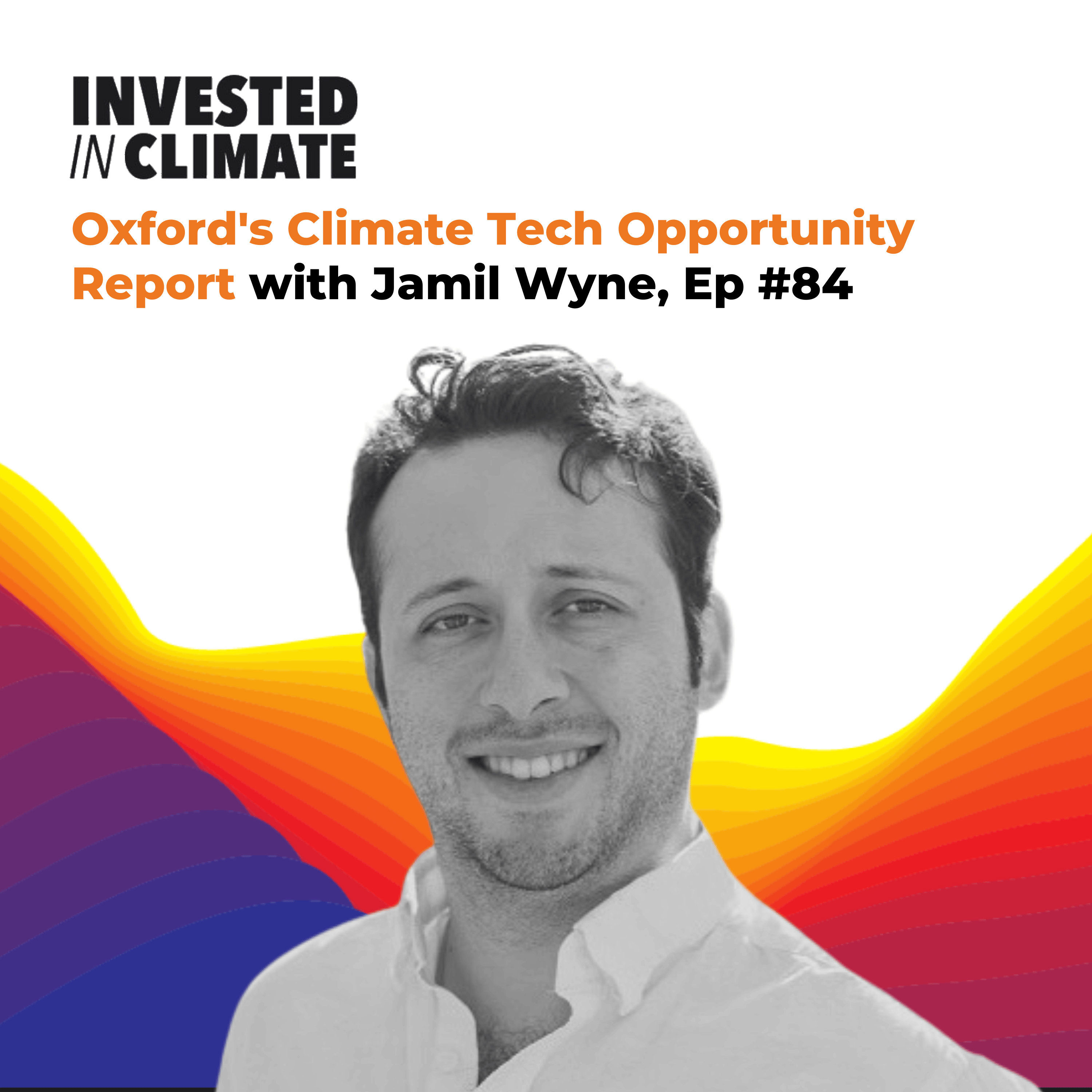
Ep 84Oxford's Climate Tech Opportunity Report with Jamil Wyne, Ep #84
We know that addressing climate change will take trillions of dollars of investment. According to the Climate Policy Institute, we’ll need to spend over $10 trillion annually for decades. and we only just exceeded $1 trillion for the first time in 2022. I’ll confess, I find these big numbers hard to conceptualize and I’m always glad for more nuanced ways to break them down. That’s why when I saw Oxford’s Climate Tech Initiative’s recent report, I reached out to one of its authors Jamil Wyne. The Oxford report builds on recent climate finance data by asking almost 150 climate investors, entrepreneurs, and policymakers what they're seeing. It's a snapshot from inside climate tech that identifies gaps, promising opportunities, and five recommended changes for climate finance. In this interview, Jamil and I cover all that and more. We go far beyond just talking about the numbers and I think you’ll appreciate the global perspective and ability to zoom in and out that Jamil and the Oxford report brings. Enjoy. On today's episode, we cover:[01:15] Introduction to the Oxford Climate Tech Initiative’s report & Jamil[02:31] Jamil’s portfolio & what's been energizing[04:19] How Climate Tech Initiative’s report got started[06:20] Growth & breakdown of climate finance investments[10:02] The mismatch in climate investing[12:43] Investor interest in transportation[15:20] Under investment in heavy industry, built environment & adaptation[17:41] The best investment opportunities within the energy sector[20:39] Overview of recommendations from the report [22:31] Growing climate funding recommendation[23:06] The role of governments & corporations[25:27] Building talent & workforce pools for climate[28:27] Focusing on solutions for vulnerable communities[30:30] Funding for adaptation[33:20] What is Riffle Ventures[36:08] Climate Tech Boot Camp, who it’s for & how it’s changed[41:27] Future projects & initiativesResources MentionedOxford’s Climate Tech InitiativeThe Climate Tech Opportunity ReportRiffle VenturesClimate Tech BootcampConnect with Jamil WyneConnect with Jamil on LinkedInConnect with Jason RissmanOn LinkedInOn TwitterKeep up with Invested In ClimateSign up for our NewsletterLinkedInInstagramTwitterHave feedback or ideas for future episodes, events, or partnerships?Get in touch!
Ep 83Unlocking the Potential of Scientists with Activate, Ep #83
At the center of climate progress are scientists. They’re developing new technologies with which we can build a new, more sustainable global economy. Moving inventions from a lab to startup companies to scaled products, however, takes more than science. Research scientists had long lacked a support structure to help them build successful businesses. That’s where Activate came in. Founded in 2015 at the Lawrence Berkeley National Laboratory, Activate is a fellowship program that has helped almost 200 science fellows create companies that have now collectively created about 2,000 jobs and have raised about $1.5 billion. To learn more about Activate’s important work, we’re joined today by Activate CEO Cyrus Wadia. Cyrus brings a unique background spanning time in the Obama Administration, academia, Nike, and Amazon. We talk about how Activate works, lessons they’re gathering across climate tech verticals, examples of companies emerging from their fellowship, opportunities, gaps, and much more. I’m a big fan of the work Activate is doing and I’d guess you’ll soon be too. Enjoy.In today’s episode, we cover:[3:13] Cyrus’ background & career journey[6:01] Activate & the problem that its aiming to solve[9:47] The ideal Activate Fellow[12:38] The support that Fellows get & how the Fellowship works[14:25] Activate’s achievements[16:41] Success stories & companies that have emerged from the Fellowship[20:02] What's coming & gaps[22:20] Examples of where friction is lower for climate tech to scale[26:35] Applications of AI [31:54] The involvement of corporate partners & how they can show up[34:36] How else do we need to change our approach to addressing climate changeResources MentionedActivateSublime SystemsCalWaveFervoProject RedNoon EnergySoneraLawrence Berkeley National LabCyclotron RoadConnect with Cyrus WadiaConnect with Cyrus on LinkedInConnect with Jason RissmanOn LinkedInOn TwitterKeep up with Invested In ClimateSign up for our NewsletterLinkedInInstagramTwitterHave feedback or ideas for future episodes, events, or partnerships?Get in touch!
Ep 82Sierra Club Foundation's Shifting Trillions Initiative to Transform Energy Finance, Ep #82
If you’re listening to this podcast you’ve probably heard of the Sierra Club. It’s one of the largest environmental organizations in the United States, with about 4 million members and a history of advocacy going back to 1892.But what do you know about the Sierra Club Foundation? It’s a $200m organization that, as you’d guess, supports the Sierra Club. It also takes on ambitious initiatives to leverage its resources to protect the environment, transform the energy system, and more. One of those initiatives focuses on shifting trillions of dollars out of the fossil fuel economy. It’s a good example of the level of ambition of these organizations.To learn more, I sat down with Dan Chu and Pedro Henriques Da Silva. Dan is the Executive Director of the Foundation. Pedro is the Director of the Shifting Trillions Program. We had a fascinating conversation about the history, role, and accomplishments of both organizations, the goals and strategy of the Shifting Trillions program, being a 21st-century fiduciary, the upcoming election, and much more. This episode will push your thinking about the role of the Sierra Club and environmental organizations more generally. Enjoy. In today’s episode, we cover:[02:54] Background on Sierra Club[05:15] Sierra Club’s history & how the Foundation and Club are different[06:56] Size & funding of the organizations[08:09] Focus issue areas, how they are decided & how they inform capital allocation[10:23] Sierra Club Foundation & its broader role[12:37] The Shifting Trillions program & what it’s aiming to solve[13:54] The Foundation’s three roles & what it’s doing[18:21] How the roles of the Club & Foundation are distinct[22:36] What progress has been achieved so far with Shifting Trillions[23:57] Exciting goals being pursued[25:29] Progress & achievements that Dan has seen during his tenure[29:58] The state of the U.S. environmental nonprofit field[32:32] Support for climate through philanthropy[36:02] The importance of this election from an environmental perspective[39:02] Harnessing climate for young voter turnoutResources MentionedSierra ClubSierra Club FoundationShifting TrillionsImpactAlpha Article by Pedro: Fiduciaries have a duty of care to their investors and to the worldConnect with Dan Chu & Pedro Henriques da SilvaConnect with Dan on LinkedInConnect with Pedro on LinkedInConnect with Jason RissmanOn LinkedInOn TwitterKeep up with Invested In ClimateSign up for our NewsletterLinkedInInstagramTwitterHave feedback or ideas for future episodes, events, or partnerships?Get in touch!
Ep 81Smart ACs and hot cities with Sensibo's Ran Roth and Prof. Matthias Roth, Ep #81
I know it’s wintertime for many of you, but that doesn’t mean we can ignore how cities around the world are heating up and how air conditioning is a growing contributor to climate change. Air conditioning is responsible for about 4% of global greenhouse gas emissions. Today, about 20% of electricity used in buildings and about 10% of global electricity use comes from operating air conditioners. With cities heating up and more people able to afford this technology, air conditioning emissions are expected to double by 2030 and triple by 2050.To understand this problem and some promising solutions, I sat down with Matthias Roth and Ran Roth. Matthias is a Professor of Geography and Urban Climatology at the University of Singapore. Ran is the Founder of Sensibo, a startup that’s using data and AI to improve the efficiency of air conditioners around the world. No family relation between the two Roths, but a shared interest in how cities are heating up and what we can do about it. We talk about urban heat islands, how cities are responding, the growth of air conditioning, Sensibo’s solution to making them smarter and more efficient, what else needs attention, and much more. Wherever you are, warm up and stay cool with this episode. Enjoy. In today’s episode, we cover:[03:25] Matthias’ background & focus[05:10] Ran’s background & insights into his work[07:13] The impact of a heating planet on cities[10:28] Why cities heat up more than their surroundings[12:36] How cities are tackling urban heat challenges[14:20] Unpacking air conditioners' impact on climate[17:48] Sensibo's solution to growing AC issues[20:42] Sensibo's customers & scale[21:52] Impact metrics - saving energy on a large scale[23:35] The global rise in demand for air conditioning[25:24] Sensibo's role in curbing AC's environmental impact[27:54] Sensibo’s unique features - geofencing and more[29:32] The crucial role of AI in Sensibo's vision[31:22] High-tech excitement & limitations[36:12] Identifying gaps in current climate discussionsResources MentionedUniversity of SingaporeSensibo Connect with Matthias Roth & Ran RothConnect with MatthiasConnect with Ran on LinkedInConnect with Jason RissmanOn LinkedInOn TwitterKeep up with Invested In ClimateSign up for our NewsletterLinkedInInstagramTwitterHave feedback or ideas for future episodes, events, or partnerships?Get in touch!
Ep 80Inside Atlassian's Sustainability Playbook, Ep #80
We all know that companies around the world are working to reduce their emissions and, hopefully, achieve net zero. But what does it take to set up a sustainability program? What are the steps in the process? What are the considerations along the way? And who are the partners one might work with? Most of this work happens behind closed doors, but sharing insights from corporate sustainability journeys can accelerate progress. That’s why Atlassian, a technology company with a real commitment to addressing climate change, decided to open up their own process and share what they learned in a really clear and straightforward playbook.To learn more, I sat down with Atlassian Chief Sustainability Officer, Jess Hyman. Full disclosure: Jess is a member of NationSwell, the executive membership network and advisory, where I get to support impact and sustainability leaders like Jess. In today’s conversation, we walk step-by-step through Atlassian’s sustainability journey – from getting started, building internal buy-in, finding the right vendors, partners, and reporting protocols for reducing Scope 1, 2, and 3 emissions, to reporting on progress as well as setbacks, and much more. Whether or not you’re a corporate sustainability leader, this episode will help you understand what companies around the world are actually doing to address climate change. Enjoy.In today’s episode, we cover:[3:03] Jess’ background & path to sustainability work[4:21] Jess’ work at Business for Social Responsibility (BSR) & what she learned[6:09] What is Atlassian & their core products[6:44] Why Atlassian decided to share their sustainability journey[8:34] The process of going to leadership to develop the report[9:57] What is a materiality assessment & learnings[11:57] Atlassian’s sustainability goals, what it took to develop & share them[13:55] Sustaining internal collaboration[16:15] Atlassian’s goal to reach net zero by 2040[18:15] Scope 1, 2, and 3 emissions & how they show up for Atlassian[19:30] The Science Based Targets initiative (SBTi) approval process[22:00] Learnings around decarbonizing buildings[23:40] What are Virtual Power Purchase Agreements (VPPAs) [25:51] Engaging suppliers to reduce emissions[28:37] Transparency, accountability & reporting[30:21] Addressing Work-From-Home (WFH) electricity[31:49] What is the Sustainable Aviation Buyers Alliance (SABA)[34:24] What are residual emissions & how is Atlassian dealing with them[36:00] The quality of offsets[37:06] Reporting protocols & learnings[38:56] Building executive buy-in for uncomfortable levels of ambitionResources MentionedAtlassianAtlassian Sustainability ReportAtlassian’s Climate Story & Guide: Don’t #@!% the PlanetAtlassian Team PlaybookRE100Science Based Targets initiativeSustainable Aviation Buyers AllianceSustainability Accounting Standards BoardBusiness for Social ResponsibilityConnect with Jess HymanConnect with Jess on LinkedInConnect with Jason RissmanOn LinkedInOn TwitterKeep up with Invested In ClimateSign up for our NewsletterLinkedInInstagramTwitterHave feedback or ideas for future episodes, events, or partnerships?Get in touch!
Ep 79How advertising can accelerate climate progress with Wieden+Kennedy, Ep #79
What do you think of when you think about advertising and its role in climate change? I’ll confess the first thing that comes to mind is the fossil fuel industry’s multi-billion dollar campaign to discredit climate science, deliberately confuse the public, and delay climate action. But, of course, like every industry, advertising has a role to play in accelerating climate progress. Advertising creatives have storytelling skills that can help distill complex information, shift attitudes, and accelerate the adoption of climate solutions. At a more basic level, the narratives that capture our attention and gain currency in our collecting thinking play a powerful role in influencing corporate agenda, policymaking, and voters. So don’t count advertising out. Today, I’m joined by Blake Harrop, President of Wieden+Kennedy Amsterdam. Whether or not you know it, you’re familiar with Wieden+Kennedy’s work. They’re a small creative firm with a big reputation, and they’ve been doing some genuinely interesting climate-related work. In our conversation, we talk big picture about the advertising industry and how it needs to evolve, and also what we can all learn from European countries’ effective climate communication. We also get specific and talk about some of Wieden+Kennedy’s recent projects and how they demonstrate advertising’s potential as a climate ally. Lot’s to learn about and ponder if you listen with an open mind. Here we go. In today’s episode, we cover:[3:19] Wieden+Kennedy history & what it's known for[4:32] Why does advertising matter?[7:22] Should we be lauding the ad industry?[8:55] How the ad industry rewards success & opportunity to change perception[10:28] Wieden+Kennedy as a B Corp & what it means for their commitment to climate[13:06] Would Wieden+Kennedy work with fossil fuel companies in the future?[15:10] Working with Fortescue Future Industries & Google in Germany[19:16] Working with Orsted (Fmr. DONG Energy) & Corona[25:31] The pros & cons of sustainability as a selling point[30:10] Lessons on communicating climate change[33:23] The importance & urgency of climate action[36:22] Nuclear energy as a dream campaign from a climate perspective[39:43] A role for all of us to be advertisers for climate engagementResources MentionedWieden+KennedyB LabClean Creatives PledgeW+K & Fortescue Future Industries: The Power of NowW+K & Google DE: Every Decision CountsW+K & Ørsted: The Power of WindW+K & Ørsted: Hello to a Better FutureW+K & Corona: Oceans WeekW+K & Corona: The FishAn Inconvenient TruthYale Program on Climate Change CommunicationConnect with Blake HarropConnect with Blake on LinkedInConnect with Jason RissmanOn LinkedInOn TwitterKeep up with Invested In ClimateSign up for our NewsletterLinkedInInstagramTwitterHave feedback or ideas for future episodes, events, or partnerships?Get in touch!
Ep 79Rockefeller Foundation's $1 billion catalytic climate commitment, Ep #78
It feels fitting to start 2024 talking about the big numbers, the big climate financing gaps we face and ways to fill them. We know that addressing the climate crisis requires trillions of dollars of investment. It’ll need to come from government, corporations, and big finance, but there’s another stakeholder with an important contribution. Private philanthropic foundations have important roles to play too, particularly in helping communities that might otherwise be left behind and in using philanthropic capital as a catalyst. By de-risking investments and taking concessionary returns, philanthropy can unlock hundreds of billions of dollars of needed investment. Today, we’re joined by Elizabeth Yee, who oversees Rockefeller Foundation’s global programs, including its recent $1 billion commitment to climate change. I’ve gotten to work with the Rockefeller Foundation in a variety of partnerships over the years, and I’ve been impressed by how they recognize their ability to take a lead and help accelerate fields. Of course, it’s interesting to remember the Foundation was initially funded by Standard Oil founder John D Rockefeller, something that Liz and I discuss in our conversation. In recent years, the Foundation has demonstrated real commitment to climate leadership. And even in the weeks following this interview, the Foundation announced that it will pursue a net-zero emissions target for its $6 billion endowment, making it the largest private US foundation to pursue a net-zero endowment to date. Liz and I talk about the Foundation’s history in climate philanthropy, two different programs with billion-dollar plus commitments, how it works to catalyze other funding, the intersections of energy, food, health and economic opportunity and much, much more. Lots to learn and think about in this one. Here we go.In today's episode, we cover:[3:43] Elizabeth's background and history working on climate, along with her current role[7:15] Key elements of the Rockefeller Foundation's Climate Commitment [9:23] The Foundation's divestment from fossil fuels in its endowment and details about the Global Energy Alliance for People and Planet[12:23] Reasons behind the significant commitment to climate and the timing of such a commitment[13:58] Overview of the billion-dollar commitment, including the main pillars and distribution across different climate priorities[16:35] The theory of change behind the Foundation's climate initiatives[19:36] The types of partners needed for the success of the initiatives[21:17] Influencing ideas and narratives[22:43] Selection process and priorities for initial grantees.[25:07] Grantees: Climate Mayors, C40, and the Urban Sustainability Directors Network[27:12] Insights into the Invest in Our Future Initiative and its significance[28:22] Grantees: Makerere University School of Public Health and University of the West Indies[30:32] Success for the foundation in committing significant resources to climate[32:00] The message for other investors or foundations considering a similar commitment[33:27] Elizabeth's outlook and hopefulness despite the existing financing gapsResources MentionedRockefeller FoundationPress Release: The Rockefeller Foundation Commits Over USD 1 Billion To Advance Climate SolutionsRockefeller Foundation: 100 Resilient CitiesGlobal Energy Alliance for People and PlanetIKEA FoundationBezos Earth FundPress Release: The Rockefeller Foundation Announces Over USD 11 Million Towards Climate SolutionsClimate Mayors C40Urban Sustainability Directors NetworkInvest in Our FutureConnect with Elizabeth YeeConnect with Elizabeth on LinkedInConnect with Jason RissmanOn LinkedInOn TwitterKeep up with Invested In ClimateSign up for our NewsletterLinkedInInstagramTwitterHave feedback or ideas for future episodes, events, or partnerships?Get in touch!
Ep 78Preview for the New Year
Happy New Year. It is the beginning of 2024 and I am excited to work along side you to achieve a greater future for our planet. On this preview episode I give you a glimpse into the upcoming topics of 2024.
Ep 77Replacing plastic using captured greenhouse gases with Newlight, Ep #77
There’s a lot we can learn from nature. Processes that happen in nature keep resources in flow, by-products are used and contribute to the health of the ecosystem and there is no waste. Fallen leaves enrich the soil, photosynthesis produces oxygen for animals to breathe, and microorganisms decompose methane and carbon dioxide and produce PHP. Oh, not so familiar with that last example? Well, it’s an important one to know about if you care about removing greenhouse gasses from the atmosphere or producing a sustainable replacement for plastics. Today we’re joined by an entrepreneur who for 20 years has been working to harness this natural process to combat climate change, Mark Herrema, founder of Newlight. We talk about how Mark got into this space, how NewLight’s technology works, its impact and business potential, insights to the broader carbon removal space, and much more. Lots to learn in this one. Enjoy!In today’s episode, we cover:[3:19] Mark's journey to founding Newlight[6:44] Newlight & the problem it’s aiming to solve [8:33] Overview of the air carbon production process[11:19] Characteristics & applications of air carbon[13:00] Newlight's business model & revenue sources[14:24] Products, partnerships, & insights into sales & growth[15:44] Utilizing protein byproducts of air carbon[17:00] Newlight's vision for reducing greenhouse gases[18:59] Thoughts on the emerging carbon market & its potential[21:00] Key challenges in the carbon reduction space[23:26] Regulatory environment, public investments & support programs[24:35] Newlight's future plans, challenges & scaling strategies[26:29] Aspirations for research in carbon capture & negative productsResources MentionedNewlightConnect with Mark HerremaConnect with Mark on LinkedInConnect with Jason RissmanOn LinkedInOn TwitterKeep up with Invested In ClimateSign up for our NewsletterLinkedInInstagramTwitterHave feedback or ideas for future episodes, events, or partnerships?Get in touch!
Ep 76Building global climate resilience with Global Resilience Partnership & Green Africa Youth Organization, Ep #76
As we all feel the impacts of climate change more and more each year, the need to invest in climate resilience becomes more and more clear. The World Bank estimates that by 2050, there’ll be more than 1 billion climate refugees.It’s not about choosing between solutions to dramatically cut emissions and investments that help communities prepare for and bounce back from climate events – we need them both to limit human suffering as well as geopolitical risks of destabilization caused by climate change. Today, we’re joined by two leaders working to advance climate resilience. Nate Matthews is the CEO of the Global Resilience Partnership, an organization that supports research, policy and innovation to advance the world’s resilience ecosystem. And Joshua Amponsem is the founder of the Green Africa Youth Organization and a Director of the Youth Climate Justice Fund. In this conversation, we talk about the state of the climate resilience field, inspiring examples of innovation, the case for investing in resilience, how young people, startups and big companies are all contributing, how resilience will be present at the upcoming COP28 conference and much more. Lots to learn and think about in this one. Here we go. In today’s episode, we cover:[3:23] Nate's background & role[4:27] Joshua's background & role[6:20] Understanding climate resilience & its significance[8:17] Exploring the distinctions between resilience & adaptation[9:29] Joshua's perspective on the need for more resilience[11:58] Resilience efforts in the community & success stories[16:29] Identifying challenges & gaps in building resilience[20:15] Introduction to GRP & its role in addressing community needs[22:10] The potential impact of insufficient investment on mitigation efforts[23:30] Advocacy for investing in resilience[26:09] The investment case for supporting resilience efforts[30:50] Overview of the Resilient Agriculture Innovations Challenge[33:22] AI's role in resilience & innovations showcased in the challenge[34:51] Exciting & encouraging innovations in the current moment[38:41] Results and outcomes from the open innovation challenge[40:30] Resilience's presence at COP & goals for the upcoming yearResources MentionedGlobal Resilience PartnershipGreen Africa Youth OrganizationYouth Climate Justice FundCGIARGlobal Center on AdaptationConnect with Nathanial Matthews & Joshua AmponsemConnect with Nathanial on LinkedInConnect with Joshua on LinkedInConnect with Jason RissmanOn LinkedInOn TwitterKeep up with Invested In ClimateSign up for our NewsletterLinkedInInstagramTwitterHave feedback or ideas for future episodes, events, or partnerships?Get in touch!
Ep 75Impact investing in climate with Impact Engine, Ep #75
This episode focuses on impact investing and the particular approach of an impact investing firm based in Chicago named Impact Engine. Now that I’ve said the word impact four times, I should probably unpack the jargon. This class of investing aims to create direct, measurable social and environmental impact alongside a financial return. It’s related to, but distinct from ESG investing, which doesn’t necessarily have specific impact goals so much as it aims to avoid harm or risk by considering environmental, social and governance factors. Global impact investing has surpassed $1 trillion annually, and a top focus area is climate. According to a recent report by the Global Impact Investing Network, 74% of impact investors invest in climate action. So I was thrilled to zoom into the approach of one firm and learn about their climate investing strategy. Today we’re joined by Impact Engine’s Partner & Chief Investment Officer Priya Parrish, as well as Chris Wu, a Vice President who leads their environmental sustainability investments. We talk about Impact Engine’s history, approach and investment thesis, it’s portfolio of investments in climate funds and private companies – from food tech to mobility to energy efficiency, how they see the climate investment space today and what they see coming next year. Lots of great insights in this peek into the impact investing world. Enjoy. In today’s episode, we cover:[4:06] Priya & Chris’ background, roles & how they came to do the work they're doing.[5:01] What is Impact Engine & what sets it apart[8:11] Impact Engine's client base[8:47] Partnership with Alliance Bernstein & its significance[10:58] Impact Engine’s investment thesis in climate explained[12:01] Assessing the current market for climate investors[13:43] Overview of invested funds & key criteria[18:16] Utilizing an impact side letter & impact metrics reporting[20:10] Relationships with larger venture & private equity funds[21:05] The motivations behind direct investments in companies[22:18] Spotlight on selected startups & their significance[23:27] Insights on the food waste startup space & future investment prospects[24:51] The goals & potential impact of Market Wagon[26:24] Circuit’s impact & business potential[29:19] Brightcore Energy's role in energy efficiency & its importance in climate transition[30:59] Unique qualities of Brightcore Energy's team[32:11] Updates on Brightcore Energy's progress[33:50] Economic rationale behind the investment in Brightcore Energy[34:34] Identifying major opportunity drivers for climate tech in the upcoming year[38:00] Addressing blind spots and gaps in climate impact areas in the year aheadResources MentionedImpact EngineAlliance BernsteinMarket WagonCircuitBrightcore EnergyAfreshFull HarvestMatsmartAcreBloom EquityConnect with Priya Parrish & Chris WuConnect with Priya on LinkedInConnect with Chris on LinkedInConnect with Jason RissmanOn LinkedInOn TwitterKeep up with Invested In ClimateSign up for our NewsletterLinkedInInstagramTwitterHave feedback or ideas for future episodes, events, or partnerships?Get in touch!
Ep 74Salesforce's climate investing playbook, Ep #74
When it comes to big companies’ sustainability commitments, I’ve long been impressed by Salesforce. They made sustainability a core company value and pledged to put the full power of their business behind protecting the planet. Hold your skepticism for a minute – this is more than just big promises. They achieved net zero residual emissions and transitioned to 100% renewable energy for their operations back in 2021. They’re part of an effort to plant one trillion trees, and they’ve integrated helping other companies accelerate their own sustainability efforts into their core business through their Net Zero Cloud product. There’s much more too and I won’t try to capture it all, but central to their approach has also been leveraging their financial capital to accelerate climate progress. And that’s what we’ll focus on in this episode. Today we’re joined by Salesforce’s SVP of Philanthropy Naomi Morenzoni and the Partner of Salesforce Venture Impact Fund Claudine Emeott. We talk about Salesforce’s history and strategy for using philanthropy and impact investing together to address climate change, some examples of recent investments and partnerships, how philanthropy can help derisk investments and bring more dollars to the table, how AI could be a game changer for climate and much more. Lots to learn and think about in this one. Here we go. In today's episode, we cover:[4:10] Naomi's role and objectives at Salesforce [4:50] Claudine's introduction and background [5:53] Launch and evolution of the Salesforce Venture Impact Fund [7:24] Evolution and approach to nonprofit support at Salesforce [9:33] Solving problems through philanthropy and impact investing [11:56] Example of Pano AI and its alignment with the fund [14:07] Investment in WeaveGrid [15:34] Leveraging Salesforce technology and market presence for portfolio companies [18:12] Philanthropic commitments and frameworks for impact evaluation [18:12] Contrasting focus areas between Naomi and Claudine [21:38] The state of climate philanthropy and the need for increased support [23:33] Introduction and purpose of the playbook [25:41] Financial instruments for climate initiatives and Salesforce's experience [26:38] Levers for climate finance[28:53] Five tips for readers to embark on their climate finance journey [30:37] $8.3 million in grants to climate justice and conservation organizations [33:45] Prospects for commitments to biodiversity and conservation [35:03] Partnerships and initiatives in climate justice [37:41] Supporting diverse teams in climate initiatives [40:26] Impact of AI on climate efforts [44:05] Current challenges in their work [45:50] Lessons from Salesforce's ambitious climate initiativesResources MentionedSalesforce: Environmental SustainabilitySalesforce Venture Impact FundSalesforce & Climate Policy Initiative: The Corporate Climate Finance PlaybookClimate Policy InitiativeElemental ExceleratorPano AIWeaveGridThe Nature ConservancyThe Ocean FoundationNew Energy NexusRE-volvGlobal Forest GenerationGreenWave Island ConservationRainforest ConnectionConnect with Naomi Morenzoni & Claudine EmeottConnect with Naomi on LinkedInConnect with Claudine on LinkedInConnect with Jason RissmanOn LinkedInOn TwitterKeep up with Invested In ClimateSign up for our NewsletterLinkedInInstagramTwitterHave feedback or ideas for future episodes, events, or partnerships?Get in touch!
Ep 73Fusion, carbon transformation, grid management and more with Braemar Energy Ventures, Ep #73
Today we’re joined by three team members of Braemar Energy Ventures, ESG Head Lori Collins, Partner Don Tappan, a Co-Founder and Managing Partner Bill Lese. I was excited to talk to the Braemar team because their firm has been investing in energy companies for over 20 years and have backed some early category-defining pioneers like ChargePoint and EnerNOC. Since they’re investing in a wide range of companies driving the energy transition, they bring broad insights to today’s climate tech opportunities as well historical lessons from the clean tech 1.0 years. We dive deep into three of their investments, offering insights to the carbon transformation market, applying AI to upgrade the grid and last but definitely not least, nuclear fusion. We talk about the trends in those spaces, why Braemar made the bets that they did, the ESG and impact considerations of their portfolio companies and much more. Enjoy.In today’s episode, we cover:[2:25] Lori’s role & work at Braemar[3:42] Don’s role & work at Braemar[4:20] Bill’s story & founding of Braemar[5:39] How is Braemar different today in talking about the energy transition[7:29] Learnings from the clean tech 1.0 years[9:00] Braemar’s investment thesis[11:13] Learnings over a decade of investing in the space [12:35] ESG & impact both internally & with a portfolio[13:30] Helping portfolio companies reduce emissions & remove carbon [15:03] Profit pools & what spaces are seen as offering the best investment opportunities[17:54] CarbonFree & why Braemar invested[19:55] The state of the carbon transformation market & its future[23:27] Utilidata & why Braemar invested[26:36] AI for the grid[30:45] General Fusion[35:54] The timeframe for fusion[38:47] Predictions for the climate tech space in 2024 & what needs more attentionResources MentionedBraemar Energy VenturesChargePointEnerNOCCarbonFreeUtilidataGeneral FusionConnect with Lori Collins, Don Tappan & Bill LeseConnect with Lori on LinkedInConnect with Don on LinkedInConnect with Bill on LinkedInConnect with Jason RissmanOn LinkedInOn TwitterKeep up with Invested In ClimateSign up for our NewsletterLinkedInInstagramTwitterHave feedback or ideas for future episodes, events, or partnerships?Get in touch!
Ep 72Massive infrastructure opportunity with Nexus PMG & GreenBacker, Ep #72
The climate transition we’re living through brings so many opportunities to rethink our infrastructure that it could easily be the entire focus of this podcast week after week. Today’s episode focuses on a handful of those opportunities: converting waste into valuable upcycled materials, renewable energy infrastructure, biomass, biofuels and more. We’re joined by Ben Hubbard, CEO of Nexus PMG, a company that advises and develops a wide range of infrastructure projects. They’re a fascinating company, and as you’ll hear, they’re engineering sustainable solutions for everything from wood pellets to solar farms to dog food. They just received a $50m investment to accelerate their growth, and leading that round was another fascinating company Greenbacker Capital Management. Greenbacker is not just an investor but also owns and operates a portfolio of solar plants, wind farms, and battery storage systems. Greenbacker Principal Quinn Pasloske joins us as well for a conversation that sheds a lot of light on the opportunity to invest in the infrastructure we need to reduce emissions, eliminate waste and more. Enjoy.In today’s episode, we cover:[3:26] Ben’s background & role at Nexus PMG[4:30] Quinn’s background & role at Greenbacker[6:35] Greenbacker’s origins & unique market approach[8:04] Moving from fossil fuel projects to sustainability projects[9:43] Examples of Nexus PMG’s projects[14:13] Nexus PMG’s clients, investors & other groups[16:02] Greenbacker’s investment in Nexus & the opportunity[19:07] Greenbacker as a strategic investor [20:33] What the $50M equity round will allow Nexus PMG to do[23:31] The opportunity around biomass for sustainable aviation fuel[27:08] The concerns around sequestration approaches[31:12] Other exciting investment spaces[36:26] The Bipartisan Infrastructure Law, IRA & what else needs to happen from a policy perspective[40:46] What else will it take to scale low-carbon infrastructure projects to meet emission reduction targetsResources MentionedNexus PMGGreenbacker Capital ManagementConnect with Ben Hubbard & Quinn PasloskeConnect with Ben on LinkedInConnect with Quinn on LinkedInConnect with Jason RissmanOn LinkedInOn TwitterKeep up with Invested In ClimateSign up for our NewsletterLinkedInInstagramTwitterHave feedback or ideas for future episodes, events, or partnerships?Get in touch!
Ep 71Geothermal heat pumps with Dandelion Energy, Ep #71
Heat pumps have gotten a lot of attention lately. They’re one of the technologies most critical to electrifying buildings and removing our dependency on fossil fuels for heating and cooling. And, they’re a technology that’s taking off. Sales of heat pumps have grown by double digits for two years running. According to the Sustainability Trends Report published recently by Al Gore’s investment firm Generation, heat pump sales In Europe grew by 50% and they’re now outselling gas furnaces in the United States. But did you know there’s more than one kind of heat pump? Today, we’re joined by Kathy Hannun, Founder of Dandelion Energy, a geothermal startup that grew out of Google X and is now growing quickly. Kathy explains how heat pumps work, the difference between air source and geothermal heat pumps, the economics and experience for heat pump buyers, and much more. Whether you’re a homeowner still relying on fossil fuels or simply interested in the future of buildings, this episode has a lot for you. Enjoy. In today's episode, we cover:[3:43] Kathy’s background & she came to found Dandelion [4:46] Developing Dandelion at Google X, the spinout & the complexities[8:11] What heat pumps are, how they work & why they're important from a climate perspective[12:32] The user experience, performance, maintenance & operating costs for homeowners[14:16] Geothermal heat pumps: the difference between air source vs. ground source[17:01] How customers are thinking about the economics of investing in a heat pump[20:06] The longevity of HVAC systems & replacing them[24:07] Dandelion’s focus on the US Northeast[26:08] Where geothermal heat pumps work from a technology perspective [27:09] How national incentives & policy changes have been helpful[28:07] The growth of the heat pump market[29:17] The biggest barriers for Dandelion & the market overall[32:23] The role of HVAC contractors[34:49] The next three to five years & what’s next for DandelionResources MentionedDandelion EnergyGeneration: Sustainability Trends Report 2023Google XConnect with Kathy HannunConnect with Kathy on LinkedInConnect with Jason RissmanOn LinkedInOn TwitterKeep up with Invested In ClimateSign up for our NewsletterLinkedInInstagramTwitterHave feedback or ideas for future episodes, events, or partnerships?Get in touch!
Ep 70Climate Week recap featuring Al Gore & many others, Ep #70
This week, we’re doing something a bit different outside of our typical interview format. This is a recap of New York Climate Week. I’ll share some of my impressions and you’ll hear from folks like Vice President Al Gore, California Senator Henry Stern, several friends, and fellow climate travelers. You’ll hear some segments from sessions I attended and sometimes it might sound like you’re actually there in a room full of people. If you hear an occasional cough or something, try to just think of it as getting closer to the experience of being there without any risk of coming home with COVID.Over 75,000 people kicked off the week by taking to the streets for the Climate March on September 17th. Over the ensuing week, thousands of people from around the world joined over 585 official Climate Week sessions and likely as many unofficial ones. I kicked off the week in a somewhat surreal way. I work for a company called NationSwell. We’re an executive membership network and advisory that helps sustainability and other leaders take on bigger bets and be more successful. We were invited to bring some NationSwell members like Michael Komori, Chief Sustainability Officer of Starbucks, and joined Al Gore and other climate leaders in ringing the NASDAQ bell on Monday morning – which felt like a fitting start, as a question on everyone’s minds is: “If capitalism is up for the challenge, will corporations lead the transformation needed to cut emissions?”In today's episode, we're hearing from:[1:34] Adam Lake, Climate Week NYC Lead of the Climate Group[2:34] Bonnie Gurry, Co-Founder of GreenPortfolio[5:15] Alex Wright Gladstein, Founder of Sphere[6:48] Nyla Mabro, New York Chapter of New Energy Nexus[7:18] Tom Chi, Founder of At One Ventures[8:54] Kirsten Snow Spalding, VP of the Investor Network at Ceres[10:45] Former US Vice President Al Gore[19:29] VP Al Gore on Climate TRACE[12:59] VP Al Gore on the state of climate progress[20:56] Katie Rae, CEO & Manager Partner of The Engine[22:51] Jeff Johnson, Managing Partner of Temasek[24:03] Clay Dumas, Founding Partner of Lowercarbon Capital[25:44] Clay Dumas on the unique opportunity for climate founders today[27:06] Ian Samuels, Founder & Managing Partner of New System Ventures[28:09] Colin le Duc, Founding Partner of Generation Investment Management[33:43] Dr. Vanessa Chan, Chief Commercialization Officer for the US Department of Energy and Director of the Office of Technology Transition[38:19] Dr. Chan on the role that corporations play & her plea[40:36] Mark Kroese, GM of Sustainability Solutions at Microsoft[42:00] Barbara Humpton, CEO of Siemens[44:47] Mark Kroese on how the IRA is making a difference[47:50] Rebecca Fay, CMO of Climate Impact Partners[49:11] California State Senator Henry Stern[52:02] Mary Creasman, CEO of California Environmental Voters[53:11] Chris Castro, Chief of Staff of the US Department of Energy[54:01] Miles Goodrich, Co-Founder of the Sunrise Movement[55:07] Yihanna von Ritter, Align Impact[58:14] Bodhi Patil, Co-Creator of Ocean Uprise & ocean advocate[1:00:14] Krystal Persaud, Founder & CEO of Wildgrid Solar[1:01:21] Jean-Louise Warnholz of Future[1:02:58] VP Al Gore on taking actionResources MentionedNasdaq: Climate Leaders Ring the Opening BellUS Department of Treasury: Principles for Net-Zero Financing & InvestmentCalifornia Senate Bill 261California Senate Bill 253Climate Policy Initiative & Salesforce: The Corporate Climate Finance PlaybookAmerican Climate Corps ProgramUS Department of State: Signing of the High Seas TreatyGlobal Biodiversity FundUN: Kunming-Montreal Global Biodiversity FrameworkClimate-first investing with GreenPortfolio & Earth Equity Advisors, Ep #66Moving billions through 401ks with Sphere, Ep #7Supporting 100,000 climate founders with New Energy Nexus & Third Derivative, Ep #40Supporting founders with Lowercarbon Capital and the Climate Tech Bootcamp, Ep #18Investing for a net positive civilization with Tom Chi, Ep #20Systems transformation through finance with Ceres, Ep #31Climate TRACE’s bold plan to map emissions with satellites, sensors & AI, Ep #64The power of State action with CA Senator Josh Becker and CA Envirovoters CEO Mary Creasman, Ep #16US Department of Energy’s...
Ep 69Tackling the plastics crisis via blended finance with Circulate Capital & the Circulate Initiative, Ep #69
When it comes to plastics, we’re in a real bind. We have yet to develop and scale attractive alternatives to the petroleum-based plastic products we all use every day, and the plastics industry drives well over a billion tons of greenhouse gasses, that’s roughly 4% of total global emissions and plastic-related emissions are on track to double by 2060. Meanwhile, a small fraction – we’re talking less than 10% – of plastics are recycled. Creating a circular economy for plastics is vital to eliminating the flow of plastic waste into our environment and to reducing the emissions generated from creating new plastic products. Today’s conversation focuses on an ambitious effort to catalyze and fund the systems change needed to get us there. Circulate Capital is working to unlock a billion dollars to invest in circular solutions, and its partner Circulate Initiative offers research and insights to track this space and help recruit more private and public investment in this space. We’re joined by Ellen Martin, Circulate Capital’s Chief Impact Officer, and Umesh Madhavan, Research Director for Circulate Initiative. We talk about the history and state of the plastics crisis, their current efforts, and the investment opportunities they see. Circulate has impressive momentum in building coalitions of different kinds of investors – from governments to Fortune 100 companies. This blended finance approach is surely a key to mobilizing the commitment we need, and I was grateful to learn so much about it through this conversation. Here we go. In today’s episode, we cover:[3:18] Circulate Capital, Ellen’s role & where they’re based geographically[4:24] Circulate Initiatives & Umesh’s role[5:24] How Circulate Capital & Circulate Initiatives are connected[6:56] The plastics problem & what’s causing it[8:57] The plastics problem timeline[11:01] Overlaps between plastic pollution, climate, ocean health & circular solutions[13:04] Why Circulate Capital was established & what they’re aiming to do [16:41] De-risking the investments using concessionary capital [19:08] Using a highly collaborative investment ecosystem to solve the plastic waste challenge[19:47] Circulate Capital’s role & how it’s focused[20:59] Working with LPs to scale circular solutions[23:24] What should we all know about the plastics economy & how it works[25:06] Asia & Latin America plastic markets[27:50] Breaking down $4B in investments in the circular economy for plastics[31:27] The greatest opportunities from an investment lens[34:15] What more needs to be done around the plastic waste problem[36:32] The Plastics Treaty, its state of play & what impact will it have[39:15] How plastic economies differ between Asia & Latin America[41:25] Investment opportunities in the US & Europe[43:25] Visions for the future of plasticResources MentionedCirculate CapitalCirculate InitiativeOECD: Plastic PollutionPew Charitable Trusts: Preventing Ocean PlasticsCirculate Capital Ocean FundPrevented Ocean Plastic Southeast AsiaDelterra & Circulate Initiative: Honing the Habit: Four Insights on Spreading Recycling Behavior ReportCirculate Initiative: Plastics Circularity Investment TrackerInternational Legally Binding Instrument on Plastic PollutionCircAcelon Chemicals and Fiber CorporationAceGreenConnect with Ellen Martin & Umesh MadhavanConnect with EllenConnected with UmeshConnect with Jason RissmanOn LinkedInOn TwitterKeep up with Invested In ClimateSign up for our NewsletterLinkedInInstagramTwitterHave feedback or ideas for future episodes, events, or partnerships?Get in touch!
Ep 68Sunrise Movement & young people's fight for bold climate action, Ep #68
No matter who I talk to – whether startup founders, investors, or corporate sustainability leaders – when I ask what is needed to really move the needle on climate change, everyone always comes back to the to importance of policy change, of making climate an electoral issue and holding political leaders accountable to take bold action. There’s no denying that in recent years one of the most important forces making bold climate action more of a priority, has been the voice of young people. Their cry for change and their committed activism has been impossible to ignore, and the policies they’ve fought for have gained real headway. In the United States, at the center of youth climate organizing is an organization named the Sunrise Movement. They’ve been around for less than a decade but have mobilized effectively and are credited for inspiring and advancing historic climate policies like the Inflation Reduction Act. Today we’re joined by two leaders of the Sunrise Movement, Matthew Miles Goodrich and Aru Shiney-Ajay. Miles was one of the founders of the movement and leads fundraising. Aru has been involved since she was 19 and now leads Sunrise’s strategy. They’re both inspiring representatives of the bold vision and commitment that’s made Sunrise so successful and that we all need to bring to climate work.In today’s episode, we cover:[3:35] Miles’ background, role with Sunrise & how he got involved[5:34] Aru’s background, role with Sunrise & how she got involved[8:31] The origin & history of the Sunrise Movement[11:45] The reach that Sunrise has achieved & how it's been successful at getting young people involved in climate action[13:54] Why has Sunrise gathered so much momentum[17:00] How many people have been involved in Sunrise & how are they able to manage their volunteer army[19:31] Sunrise’s wins & progress[21:55] Sunrise’s role surrounding the Inflation Reduction Act and the impact of the IRA & other recent climate policies[27:57] Sunrise’s current strategy & priorities[32:34] Why is declaring a climate emergency needed & what would it lead to[34:45] Sunrise’s theory of change[37:44] The lawsuit against the state of Montana & implications of the case[39:45] Pivotal moments for climate & the progress being sought[41:20] Hopes for Climate Week[42:01] What else needs to happen to adequately address climate changeResources MentionedSunrise MovementSunrise Movement: Green New DealSunrise Movement: Declare a Climate EmergencyConnect with Matthew Miles Goodrich & Aru Shiney-AjayConnect with MilesConnected with AruConnect with Jason RissmanOn LinkedInOn TwitterKeep up with Invested In ClimateSign up for our NewsletterLinkedInInstagramTwitterHave feedback or ideas for future episodes, events, or partnerships?Get in touch!
Ep 67AI-Powered Climate Tech Breakthroughs with Neotribe's Kittu Kolluri, Ep #67
When it comes to climate tech, there are a lot of new kids on the block, investors that have brought billions of dollars of new capital and have helped fund climate innovation we badly need. It’s rare that you find folks who have been investing in climate tech for over a decade, let alone two decades. So I was thrilled to sit down with Neotribe’s Swaroop Kolluri who goes by Kittu, a long-time climate investor who sees enormous opportunity in the intersection of different technologies. We talk about several of his investments – from solar to wave energy, to energy storage, to risk resilience – and more generally about the role of AI and other advanced technology in changing the game for climate tech. Lots to learn and think about in this one. Enjoy! In today’s episode, we cover:[2:24] Neotribe & the opportunity to invest in climate right now[4:16] How is climate investing different today & what’s exciting[7:50] Heliogen as an example of breakthrough climate tech[9:15] How is AI showing up in investment opportunities like CalWave[10:37] Opportunities beyond energy generation[12:24] Other opportunities for AI & climate tech[16:05] Other exciting technologies with transformative potential[20:31] Kittu’s thoughts around time to market & types of risks [21:47][21:47] Kittu’s leap to Neotribe from NEA[23:24] Gaps in the investment space & the type of capital needed[25:39] Recent federal investments & impacts on early-stage startups[27:04] What else needs to happen to support climate tech[29:10] Common barrier to startups[30:25] Advice for today’s climate tech leadersResources MentionedNeotribeBloom EnergyNEAHeliogenIdealabCalWaveEnergy VaultMetalenzConnect with Swaroop ‘Kittu’ KolluriConnect with Kittu on LinkedInConnect with Jason RissmanOn LinkedInOn TwitterKeep up with Invested In ClimateSign up for our NewsletterLinkedInInstagramTwitterHave feedback or ideas for future episodes, events, or partnerships?Get in touch!
Ep 66Climate-first investing with GreenPortfolio & Earth Equity Advisors, Ep #66
From the growing demand for climate-positive investing, new funds, new approaches for financial advisors, and entirely new platforms for managing one's investments are taking off. This is just the beginning. It's hard to imagine how different investing might be as tens of trillions of dollars transfer to younger sustainability-motivated generations.Today’s conversation is with two people working to change how people invest today to participate in and support the unique opportunity that is the climate transition. Pete Krull is a Partner & the Director of Sustainable Investments at Earth Equity Advisors, a firm he founded almost 20 years ago. Bonnie Gurry is Co-Founder and CEO of GreenPortfolio, a new startup aimed at creating an online financial management platform like Mint.com focused on climate-first investing. We talk about their backgrounds, their companies, the trends, opportunities and evolution they’re seeing in climate investing, and much more. Enjoy! In today’s episode, we cover:[3:09] Bonnie’s background & how she came to start GreenPortfolio[4:22] Pete's background, Earth Equity Advisors & the problem they’re helping solve[7:29] Advantages of working with a firm of Earth Equity Advisors’ size[8:22] What makes Earth Equity Advisors unique right now[8:59] GreenPortfolio, the problem they’re addressing and how the platform & product works [10:54] GreenPortfolio’s climate scorecard & what's involved in considering investment opportunity[12:37] How far along GreenPortfolio is[14:15] Earth Equity Advisors’ free impact x-ray of one’s investments[19:46] How does Earth Equity Advisors’ process differ & offer more sustainable options[21:20] Responses to investing in the traditional energy sector[25:18] Earth Equity Advisors’ benchmarking & how it works in practice[27:33] What is it that GreenPortfolio allows users to do after auditing their investments[30:15] What would make a credit card worth recommending[32:27] Investing in renewable energy[35:51] How the investment landscape has been changing & what’s coming next[40:07] The backlash to ESGResources MentionedEarth Equity AdvisorsGreenPortfolioConnect with Pete Krull & Bonnie GurryConnect with Pete on LinkedInConnect with Bonnie on LinkedInConnect with Jason RissmanOn LinkedInOn TwitterKeep up with Invested In ClimateSign up for our NewsletterLinkedInInstagramTwitterHave feedback or ideas for future episodes, events, or partnerships?Get in touch!
Ep 65Creating a circular economy of carbon with LanzaTech, Ep #65
Fossil carbon is not just burnt for energy. It’s also used as an ingredient for millions of everyday products. But what if, rather than extracting new fossil carbon from the ground, the carbon could be sourced from waste and kept in circulation. That’s exactly what a company called LanzaTech is doing. For almost two decades LanzaTech has been using a synthetic biology process to recycle carbon waste and create new products. They went public earlier this year and provide a fascinating example of a climate tech company with a bold vision for transforming how our material world is built. Perhaps that’s why they were recently recognized by the prestigious Earthshot Prize. In this episode, I’m joined by LanzaTech’s Chief Sustainability Officer Freya Burton and Chief Science Officer Zara Summers. We talk about the growth and evolution of LanzaTech, their effort to create a circular economy of carbon, their technology, partners, and much more. This episode will push your thinking in some interesting ways. Enjoy.In today’s episode, we cover:[3:36] Freya’s background & what she was doing before LanzaTech[4:52] Zara’s background & what she was doing before LanzaTech[6:23] LanzaTech & the problem that it’s aiming to solve[8:13] Finding stuff to do with emissions vs. eliminating them[11:13] The overall scale of environmental impact that LanzaTech is targeting[13:20] How LanzaTech’s technology works[16:47] Partnerships for removing carbon emissions [19:29] How has the technology evolved over the years[21:16] How AI is involved in the approach[23:11] Who are current customers & what kind of partners is LanzaTech seeking[26:25] The pulse of the marketplace[28:44] Who is it for & why is it critical[30:21] How LanzaJet is going[32:41] Benefits & expectations of climate policies [35:24] How EarthShot was helpful to LanzaTech[36:31] What has changed since LanzaTech went public[37:40] The industry in 5-10 years[41:43] Call to action for listenersResources MentionedLanzaTechConnect with Freya Burton & Zara SummersConnect with Freya on LinkedInConnect with Zara on LinkedInConnect with Jason RissmanOn LinkedInOn TwitterKeep up with Invested In ClimateSign up for our NewsletterLinkedInInstagramTwitterHave feedback or ideas for future episodes, events, or partnerships?Get in touch!
Ep 64Climate TRACE's bold plan to map emissions with satellites, sensors & AI, Ep #64
We all know that addressing climate change means eliminating greenhouse gas emissions, but have you ever stopped to wonder how we know how much we’re actually emitting? The truth is we haven’t really known, but instead rely on estimates. These estimates fail to provide very specific data about where exactly emissions are coming from, when, and what investment and policy choices might be most effective in turning them off.Today’s episode focused on an incredibly ambitious initiative called Climate TRACE, a collaboration of over 100 organizations that use a dizzying number of satellites and remote sensors to actually detect and track emissions at a global level. Vice President Al Gore is a Co-Founder of the initiative, along with Gavin McCormick who runs a nonprofit called WattTime. We’re joined today by Gavin who explains how Climate TRACE works, the Vice President’s role in the effort, their theories of change, surprises, progress, and hopes for the initiative, and much more. Climate TRACE is positioned to play a central role in improving transparency and planning at a global level, and I was thrilled to get to learn more about it through this interview. Enjoy.In today’s episode, we cover:[3:18] Gavin’s background & the climate work he’s leading today[3:49] WattTime & what it’s doing today[4:45] Climate TRACE & how it got started[6:28] Why is detailed emissions mapping so important?[10:59] Tracking theories of change[12:11] Surprises & leading theories of change for Climate TRACE[13:11] How this dataset can be helpful for Chief Sustainability Officers & those in sustainability roles[15:01] Climate-positive investment opportunities through Climate TRACE[15:44] Vice President Al Gore’s role in the initiative[16:10] How has AI been helpful to Climate TRACE & its pursued outcomes[19:02] What does it take to work with so many groups in practice & why different groups are needed?[21:47] Funding from Google.org & contributions from other companies[23:04] What has Climate TRACE achieved so far[25:21] The biggest learning from Climate TRACE yet[26:44] Surprises on the technical side around data collection & analysis at scale[28:34] What comes next for Climate TRACE[33:36] Replication of Climate TRACE’s model in other spaces[34:43] What’s next for WattTime[36:58] How policy can be accelerated through data[39:35] What can listeners do to helpResources MentionedClimate TRACEWattTimeUC BerkeleyTransitionZero Former Vice President Al GoreGoogle.orgConnect with Gavin McCormickConnect with Gavin on LinkedInConnect with Jason RissmanOn LinkedInOn TwitterKeep up with Invested In ClimateSign up for our NewsletterLinkedInInstagramTwitterHave feedback or ideas for future episodes, events, or partnerships?Get in touch!
Ep 63Electrifying fleets with Spring Free EV & Spring Lane Capital, Ep #63
The EV revolution is well underway, and we’re clearly in the midst of a massive transition away from gas-powered cars. Consumers are opting for EVs not only to end their costly dependency on fossil fuels, but also because EVs are often just better cars.For fleet managers, the calculus is different and more challenging. Switching to EVs requires not just an upfront investment, but also operational changes to deal with charging. This is an important problem to solve given the vast number of intensively-used, fleet-owned vehicles on the road. We’re joined today by Tenni Theuer, Co-Founder and Chief Product Officer of Spring Free EV, a startup that provides EVs as a service to fleet managers across the US, as well as one of her investors, Rob Day, Partner and Co-Founder at Spring Lane Capital. Don’t be confused by the names of Spring Free EV and Spring Lane – they’re two separate companies, but they are united by their shared excitement for the enormous opportunity to electrify vehicle fleets. We talk about the size of that opportunity, Spring Free’s product and traction, how EVs can transform fleets from depreciating assets into revenue opportunities, and much more. So buckle up – sorry had to go there – and enjoy. In today’s episode, we cover:[3:36] The market & need that Spring Free EV is filling[5:50] The size of the fleet market & why is it Spring Free EV’s focus[7:47] How many companies have fleets & how many cars are owned by fleets[8:06] How Rob sees the market as an investor[11:19] The holdback on CNI fleets[12:11] Cutting the cost of EV ownership in half for commercial fleet owners[15:38] EVs & the title as the better car[18:38] How Spring Free EV stands out[21:56] The most important milestones that Spring Free EV should be pursuing[23:31] Cars, customers & capital[25:44] What will it take to get to the gigaton goal[26:21] How Spring Free EV’s work will change[29:28] How & when Rob got involved in climate investing & how he sees the market evolving[32:50] Spring Free’s unique approach & why it's needed for climate companies today.[35:52] What else is Rob excited about right now[38:04] What else needs to happen to accelerate EV adoptionResources MentionedSpring Free EV Spring Lane CapitalConnect with Tenni Theuer & Rob DayConnect with Tenni on LinkedInConnect with Rob on LinkedInConnect with Jason RissmanOn LinkedInOn TwitterKeep up with Invested In ClimateSign up for our NewsletterLinkedInInstagramTwitterHave feedback or ideas for future episodes, events, or partnerships?Get in touch!
Ep 62Turning waste into energy onsite with Closed Loop Partners & HomeBiogas, Ep #62
I love talking about food waste. It’s one of the biggest contributors to emissions and something that we all contribute to every day. Reducing how much food goes uneaten is, of course, a big part of the solution, but there’ll always be organic waste. If it sits in a landfill, it’ll emit methane and miss the chance to be used as a resource.Today’s episode focuses on an Israeli startup that sees organic waste as a precious resource. HomeBiogas turns waste into fuel onsite to be used for heating and cooking. They’re off to the races selling their products for a range of applications – from backyards to hotels – and they’re just getting started. We’re joined today by HomeBiogas’ founder Oshik Efrati, and one of their key investors Ron Gonen from Closed Loop Partners. We talk about both guests' backgrounds, the challenges and opportunities to create a circular economy, anaerobic digestion, how HomeBiogas turns waste into energy, the opportunity they see, and much more. Here we go. In today’s episode, we cover:[3:03] Oshik’s background & what led him to launch HomeBiogas[4:51] Ron’s experience in recycling and waste & what led him to founding Closed Loop Partners[7:08] Closed Loop Partner & the ways it’s working to eliminate waste[9:06] The impact of waste on climate & why solutions are needed[10:32] How Oshik sees the problem & what his company is working to solve[11:43] How HomeBiogas is approaching the problem[13:44] Anaerobic digestion & what else makes HomeBiogas’ systems possible[16:09] The potential that Closed Loop Partners sees in HomeBiogas as an investor[17:43] Oshik’s view of the market opportunity[18:19] Measuring climate & environmental impacts[19:51] HomeBiogas’ traction, different applications & go-to-market[21:06] The process of converting waste to energy in buildings[22:25] The toilet market & what HomeBiogas is able to do with human waste[24:33] What’s most critical to HomeBiogas’ success[25:39] Partnerships that HomeBiogas has developed & is looking for now[28:06] The residential market in the US[31:19] The next few years from a business & impact perspective[33:03] How does this space compare to other circular economy verticals[34:22] What else is needed for realizing the circular economyResources MentionedHomeBiogas Closed Loop PartnersConnect with Oshik Efrati & Ron GonenConnect with Oshik on LinkedInConnect with Ron on LinkedInConnect with Jason RissmanOn LinkedInOn TwitterKeep up with Invested In ClimateSign up for our NewsletterLinkedInInstagramTwitterHave feedback or ideas for future episodes, events, or partnerships?Get in touch!
Ep 61Climate investing past, present & future with Jenn Kenning, Ep #61
Most of our episodes go deep into specific opportunities to address climate change through new technologies, investment opportunities, advocacy, and policy. This episode takes a step back to look at climate and impact investing, how they’ve evolved in recent years, and where they’re heading. Not only have climate and impact investing exploded in recent years, but they’ve also become more mature spaces with more opportunities, tools, nuances, and complexity. So I was thrilled to zoom out for this conversation and speak with a true pioneer and leader in this field, Jenn Kenning. Jenn is the Founder and CEO of Align Impact, an independent specialized impact and financial advisor to high-net-worth families, individuals, and foundations. Align is an Inc. 5000 company and Jenn is one of the most recognized voices in impact investing and wealth management. She was selected for Private Asset Management’s “50 Most Influential Women in Private Wealth,” and her firm recently earned global recognition as one of the top 200 impact companies of 2023 by Real Leaders. So sit back and enjoy a true expert’s take on climate investing past, present, and future. Here we go. In today’s episode, we cover:[2:46] Jenn’s background & work at Aligned Impact[4:00] How has mission-line investing changed over the years?[6:06] Examples of how intersectionality is creating opportunities for investors[9:16] How clients’ investments compare today vs. in the past[11:48] Opportunities Jenn is most excited about in the climate tech space[14:33] Strategies that investors should & shouldn’t consider[17:12] How is ESG playing out[21:48] The role of finance in accelerating our response to climate change: what's working & what needs to change[23:56] Systemic change & what it looks like when it's working [25:57] Gaps in finance AI[27:55] Why it’s hard for individual advisors to weave climates or social priorities into portfolios[29:19] How retail investors can support changes & what else needs to happen[31:13] The future of climate investingResources MentionedAlign ImpactConnect with Jenn KenningConnect with Jenn on LinkedInConnect with Jason RissmanOn LinkedInOn TwitterKeep up with Invested In ClimateSign up for our NewsletterLinkedInInstagramTwitterHave feedback or ideas for future episodes, events, or partnerships?Get in touch!
Ep 60Carbon-negative pigments with Nature Coatings and Regeneration.vc, Ep #60
Decarbonization requires not only eliminating fossil fuels as a main source of energy, but also replacing them as key ingredients in objects we use every day. If you want a crash course on just how much our material world depends on fossil fuels, check out the book How the World Really Works by Vaclav Smil. It’s a fascinating, though sobering read, and one of Bill Gates’ favorite books. Today’s episode focuses on pigments, a great example of fossil fuels hiding in plain sight. Take a look around you right now. See any objects that are black in color? Replacing the petroleum in the black pigment used in millions of objects with a carbon-negative material is the focus of an innovative startup called Nature Coatings. Today we’re joined by Nature Coatings founder and CEO Jane Palmer and one of her investors, Dan Fishman, a General Partner at Regeneration.vc. I loved this conversation as it really pushed my thinking about the work needed to truly transition from fossil fuels, and the enormous opportunities for innovators who can lead the charge. Enjoy. In today’s episode, we cover:[3:20] Regeneration.vc & how Dan came to work on climate[5:37] Jane’s background & how it led to Nature Coatings[7:39] Carbon black & why it’s a problem[9:08] How BioBlack is made & how it compares to carbon black[11:09] The scale of the carbon black problem[11:59] How is BioBlack a carbon-negative product[14:00] Dan’s perspective on why Nature Coatings is an attractive business[16:01] Nature Coatings’ biggest priorities right now[17:02] Nature Coatings’ traction, customers, companies they’re looking to reach & status[19:05] The future that Jane envisions for Nature Coatings[21:29] Rethinking ingredients in everyday products[24:11] Others in the petroleum-replacement space[25:06] Other exciting opportunities in the space from the investor perspectiveResources MentionedNature CoatingsRegeneration.vcConnect with Jane Palmer & Dan FishmanConnect with Jane on LinkedInConnect with Dan on LinkedInConnect with Jason RissmanOn LinkedInOn TwitterKeep up with Invested In ClimateSign up for our NewsletterLinkedInInstagramTwitterHave feedback or ideas for future episodes, events, or partnerships? Get in touch!
Ep 59Making sustainable investing easy with Carbon Collective & Powerhouse Ventures, Ep #59
If you’re listening to this podcast you clearly care about climate change and it might bother you that your 401k is likely investing in fossil fuels. Many employers have yet to offer sustainable 401k plans, and it sends billions of dollars of capital into fossil fuels every year. Even ESG funds often invest in fossil fuels.Today’s conversation is about making it easier for everyday investors to invest more sustainably. I’m joined by Zach Stein, Founder of Carbon Collective, a startup offering green 401ks and other sustainable financial products, and by Shaandiin Cedar, an investor at Powerhouse Ventures who invested in Carbon Collective. We talk about Zach and Shaandin’s backgrounds, ESG investing and the need for more sustainable investment options, Carbon Collective’s potential and traction, and what else is needed to finance the kind of climate progress we need. There’s lots in this one that’ll get you thinking. Enjoy.In today’s episode, we cover:[3:15] Zach’s background and how he came to start Carbon Collective[4:34] Shaandiin’s background and work at Powerhouse Ventures[5:34] Background on Powerhouse[7:31] Powerhouse’s investment thesis & companies they are looking for[8:37] Carbon Collective’s theory of change[12:59] Carbon Collective’s unique approach[16:00] Fossil fuel divestment[17:10] Carbon Collective’s business potential & why Powerhouse invested[21:29] Carbon Collective’s master plan & how it’s going[24:53] What’s critical for success[26:59] Status of Carbon Collective’s returns & customer base[30:43] What Carbon Collective is aiming to accomplish in 12-18 months[31:45] Sustainable 401ks & addressing market friction[36:53] What else needs to happen to accelerate climate action?Resources MentionedCarbon CollectivePowerhouse Ventures Connect with Zach Stein & Shaandiin CedarConnect with Zach on LinkedInConnect with Shaandiin on LinkedInConnect with Jason RissmanOn LinkedInOn TwitterKeep up with Invested In ClimateSign up for our NewsletterLinkedInInstagramTwitterHave feedback or ideas for future episodes, events, or partnerships?Get in touch!
Ep 58Decarbonization intelligence with SINAI & Energize Ventures, Ep #58
We often hear about public commitments to reach net zero, but not the nuance, choices, costs, and complexity big companies face when working to decarbonize their global operations. Behind the scenes, any company that is making climate commitments has teams of people focused on decarbonization strategy, carbon accounting, and reporting to figure out how to ween their companies off of fossil fuels and emission-heavy practices in the most effective and cost-effective ways. It’s a laborious task that requires a ton of data and analysis.This is where SINAI Technologies comes in, a start-up focused on helping companies understand and analyze their decarbonization choices. Today we’re joined by Maria Fujihara, founder and CEO of SINAI, and Lauren Densham, who leads ESG and impact initiatives at Energize Ventures, one of Sinai’s recent investors. We talk about SINAI’s concept of decarbonization intelligence, why their technology is needed, its impressive growth, its plans for the future, and what this all means for any company working to decarbonize. I learned a lot in this one and imagine you will too. Enjoy. Resources MentionedSINAI Technologies Energize VenturesConnect with Maria Fujihara & Lauren Densham Connect with Maria on LinkedInConnect with Lauren on LinkedInConnect with Jason RissmanOn LinkedInOn TwitterKeep up with Invested In ClimateSign up for our NewsletterLinkedInInstagramTwitterHave feedback or ideas for future episodes, events, or partnerships?Get in touch!
Ep 57Piloting through the valley of death with NREL, NineDot & Community Energy Lab, Ep #57
Perhaps you’ve heard of the Valley of Death? It’s the phase of development that often kills off startups before they can reach scale. One key challenge is needing to test and refine their technology and gain true validation. For a few lucky startups, this is where the Wells Fargo Innovation Incubator comes in to help them develop pilots that provide the insights and credible third-party endorsement needed to grow their technology. The incubator is part of the Department of Energy-backed National Renewable Energy Lab, an institution that’s central to the United State’s investment in renewable energy. Today, we’re joined by Trish Cozart, the Director of NREL's Innovation and Entrepreneurship Center, who oversees the Incubator. And, we’re also joined by the founders of two startups that recently participated in the lab: Adam Cohen from NineDot Energy and Tanya Barham from Community Energy Labs. We talk about what makes the incubator unique, how it’s helped these two companies, what they’re aiming to achieve and much more. Enjoy! In today’s episode, we cover:[3:15] National Renewable Energy Laboratory & the role it plays[5:01] Wells Fargo Innovation Incubator & the types of companies it supports[7:07] Tracking growth after participation in the Incubator[7:29] Advice for companies that need to get through the Valley of Death[9:01] Community Energy Labs, the problem it’s aiming to solve & what led Tanya to start the company[11:09] NineDot Energy, the problem it’s aiming to solve & Adam’s founding story[13:32] Tanya’s experience with the Incubator & differences in the NREL experience[17:39] Adam’s experience with the Incubator: focuses & outcomes[19:55] Trish on the support offered by the Incubator[22:07] Energy storage & why its important, especially in New York[24:03] How is NineDot different[25:45] NineDot’s partnerships & learnings[28:15] NineDot’s overall traction & current measurements[29:23] What are community buildings & why focus on them[34:56] Community Energy Lab’s technology & what makes it different[39:40] Community Energy Lab’s overall traction & achievements so far[42:04] New cohorts for the Incubator & what to expect for the future[43:04] NineDot’s role & what is needed to get there[43:58] What the future looks like for Community Energy LabsResources MentionedWells Fargo Innovation IncubatorNational Renewable Energy Lab, NREL's Innovation and Entrepreneurship CenterNineDot Energy Community Energy LabsConnect with Trish Cozart, Adam Cohen & Tanya BarhamConnect with Trish on LinkedInConnect with Adam on LinkedInConnect with Tanya on LinkedInConnect with Jason RissmanOn LinkedInOn TwitterKeep up with Invested In ClimateSign up for our NewsletterLinkedInInstagramTwitterHave feedback or ideas for future episodes, events, or partnerships?Get in touch!
Ep 56Sustainable shopping momentum with Future & Back Market, Ep #56
Today’s episode focuses on sustainable consumption. I know what you’re probably thinking – that the climate crisis requires systemic change and that shifting consumer behavior is slow, it's difficult and it simply won’t add up to enough in terms of the emissions reductions we need. And, I agree – sustainable shopping isn’t enough, but it’s still essential. Demand for climate-positive products helps accelerate new markets. And when consumers see that their choices matter, it influences what they work on, invest in and vote for.Over the years, there have been many attempts to get consumers to go green, but today’s guests have novel approaches that are gaining real traction. Jean-Louis Warnholz is the Co-Founder and CEO of Future, a recommendation and rewards engine driving sustainable purchasing. And Amandine Durr is the Head of Product at Back Market, an online marketplace serving the fast-growing interest in refurbished technology. We talk about both of their companies, how they got started, how they’re saving consumers money while protecting the environment, where they’re headed, how AI is helping, how refurbished goods have become a new category, the potential for everyday people to transform our economy and much more. Lots to learn and think about in this one. Enjoy. In today’s episode, we cover:[3:19] Future & the problem it’s aiming to solve[4:27] Jean-Louis’ journey & how he got involved in climate work[5:15] Back Market & the problem it’s aiming to solve[6:48] Amandine’s journey & how she got involved in climate work[8:01] Future’s products & what sets it apart [10:13] Future’s traction & consumer adoption[11:49] Future’s impact on climate & the environment[13:34] Future’s rewards system[14:39] Back Market’s products, its refurbishing process & how it stands out in the space[17:47] How the market for refurbished & secondhand goods has changed [20:17] Conveying Back Market’s refurbishment process to consumers[23:38] Handling the issue of planned obsolescence[25:55] The partnership between Back Market & Future[29:01] Future’s personalized recommendations feature[31:29] Spending areas where consumers could save money & improve their climate impacts[35:37] What’s next for Back Market[38:21] The B2B market[40:54] The future of shopping in 5-10 years & what needs to changeResources MentionedFutureBack MarketConnect with Jean-Louis Warnholz & Amandine DurrConnect with Jean-Louis on LinkedInConnect with Amandine Durr on LinkedInConnect with Jason RissmanOn LinkedInOn TwitterKeep up with Invested In ClimateSign up for our NewsletterLinkedInInstagramTwitterHave feedback or ideas for future episodes, events, or partnerships?Get in touch!
Ep 55Mushrooms that eat waste with Mycocycle & Gener8tor, Ep #55
Today, we’re going to talk about mushrooms. More than a delicious pizza topping, fungi can be useful in many different ways and it might even play a heroic role in addressing climate change. How might mushrooms help? Let's count some of the ways. They can be eaten and help reduce our dependence on animal protein. They can replace animal-based leather, sequester carbon, serve as a biofuel, improve soil health, and thereby reduce our need for fertilizers. They can accelerate reforestation, create an alternative to petroleum-based plastics and packaging, and finally, they can help break down and absorb pollutants. This last use case is called bioremediation and it’s the focus of the startup Mycocycle – a company that’s making impressive progress using mushrooms to clean up waste. We’re joined by Mycocycle Founder and CEO Joanne Rodriguez, as well as one of her investors Ryan Jeffrey, Senior Managing Director at the venture firm and accelerator, Gener8tor. We chatted about the opportunity to transform the waste management sector, how fungi can help, Mycocycle’s traction, Gener8tor’s investment thesis and how they’ve helped Joanne’s journey, and much more. Hope you enjoy this one, mushroom jokes and all. Here we go. In today’s episode, we cover:[3:25] Joanne’s background & how she got to where she is today[4:23] Ryan’s background & how he got to where he is today[5:52] What is Gener8tor?[7:11] Mycocycle, the problem it's aiming to solve & the company’s approach[9:37] The process of leveraging the power of fungi & nature to break down waste[13:47] Why did Gener8tor decide to invest in Mycocycle?[16:14] The role of fungi in battling climate change & the opportunity[18:06] The fungi-for-bioremediation business model[20:45] Surprises & lessons of working with fungi[21:19] The Department of Energy's Argonne National Labs & what it allowed Mycocycle to do[24:08] Mycocycle’s experience with Gener8tor’s accelerator[25:39] Mycocycle’s milestones[26:46] The types of companies that Mycocycle is looking to partner with right now[28:05] Mycocycle’s environmental impact & carbon measurement[29:34] John’s view of milestones & risks for Mycocycle to reach commercial success[30:57] How John sees the space in 3-5 years[33:15] How Joanne sees the space evolving & opportunities to improve waste management[36:34] What’s next for Mycocycle[37:36] A final mushroom jokeResources MentionedMycocycle Gener8torConnect with Joanne Rodriguez & Ryan JeffreyConnect with Joanne Rodriguez on LinkedInConnect with Ryan Jeffrey on LinkedInConnect with Jason RissmanOn LinkedInOn TwitterKeep up with Invested In ClimateSign up for our NewsletterLinkedInInstagramTwitterHave feedback or ideas for future episodes, events, or partnerships?Get in touch!
Ep 54City Councilmembers Nithya Raman of Los Angeles & Yassamin Ansari of Phoenix on local climate action, Ep #54
When it comes to climate policy we hear a whole lot about what’s happening or not at the federal level, and it's easy to miss the critical role of states and cities in responding to climate change. Whether you know it or not, your local government is shaping how your community is preparing for and responding to climate impacts. It’s also making choices driven by the climate transition that affect your daily life. Building codes, electric vehicle infrastructure, public transportation, waste management, green spaces – maybe these things don’t sound sexy, but they’re central to cutting emissions and creating more resilient, livable communities.Today’s episode focuses on cities, and we’re joined by two City Councilmembers who are leading the climate efforts of two major US cities. Yassamin Ansari is Vice Mayor and Councilmember of Phoenix, Arizona, and Nithya Raman is a Councilmember of Los Angeles. Both Councilmember Ansari and Raman care deeply about climate action, and in this conversation, we discussed how they’re setting their priorities, the progress they’ve made, their goals for the future, and much more. I learned a lot from this conversation and suspect you will as well. Here we go. In today’s episode, we cover:[3:28] Councilmember Ansari’s background, city & focus on climate[6:59] Councilmember Raman’s background, city & focus on climate[9:13] The role of cities & establishing priorities[14:43] Phoenix’s Office of Heat Response and Mitigation[17:39] Climate justice & equity in LA[20:43] Zero emission policy & decarbonizing the built environment in LA[25:43] New rules & incentives for climate in Phoenix[28:30] LA’s biggest priorities & opportunities[30:41] Phoenix’s biggest priorities & opportunities[32:17] The role of public-private partnerships & examples[37:11] How cities influence the broader climate fight[41:00] How listeners can make a difference at the local levelResources MentionedPhoenix: City Council District 7Los Angeles: City Council District 4Vice Mayor Ansari's Climate RecordCouncilmember Raman's Environment InitiativesPhoenix's Climate Action PlanPhoenix Office of Heat Response and MitigationLA Ordinance: Zero-Emission ConstructionPhoenix Awarded $25M RAISE Grant to Build Rio Salado Bike/Ped BridgeLA Region's South Coast Air Quality Management DistrictConnect with Councilmembers Yassamin Ansari & Nithya RamanConnect with Councilmember Ansari on LinkedInConnect with Councilmember Raman on D4 WebsiteConnect with Jason RissmanOn LinkedInOn TwitterKeep up with Invested In ClimateSign up for our NewsletterLinkedInInstagramTwitterHave feedback or ideas for future episodes, events, or partnerships? Get in touch!
Ep 53Innovation to restore our oceans with Sustainable Ocean Alliance and Oceans Uprise, Ep #53
Today, we're taking a deep dive into the ocean. Oceans are central to our planet’s climate system. They regulate temperatures, host a vast array of biodiversity, and here's a crucial point - they absorb about a quarter of all CO2 emissions, acting as a massive carbon sink.But this isn't without consequence. Ocean acidification is a direct result of climate change. It's a silent crisis happening beneath the waves, triggering a mass extinction of coral reefs and the diverse ecosystems that depend on them. And, then there’s the crisis of plastics – 10 million tons of plastic enter the ocean each year.These threats are real and immediate, but so is the potential for innovation. In this episode, we’re joined by two people working hard to restore ocean health. Brandon Levy is Chief Product Officer at the Sustainable Ocean Alliance, and Bodhi Patil is an activist and organizer who founded Ocean Uprise, a platform enabling thousands of young people to support ocean activism. Both Brandon and Bodhi have their fingers on the pulse of the global effort to restore our oceans’ health. Despite the daunting challenges facing our oceans, this conversation was truly inspiring and I’m sure you’ll enjoy it. Here we go. In today’s episode, we cover:[3:37] Brandon’s story & role at SOA[8:46] Bodhi’s story & role at Ocean Uprise[15:10] The state of ocean health & how it’s linked to climate change[20:28] The state of ocean investment & SOA’s diversified strategy[24:30] The role of young people & the importance of youth leadership in creating sustainable oceans[30:44] Insights on SOA’s Ocean Solutions Accelerator[34:44] Current initiatives that Bodhi is excited about[41:02] What we need to know about deep-sea mining[44:51] How can listeners support SOA’s work[46:41] Bodhi’s calls to action for people inspired to do more to protect our oceansResources MentionedSustainable Ocean AllianceOcean UpriseParley for the OceansSustainable Ocean Alliance: Ocean Solutions AcceleratorSeabird VenturesFinless FoodsAKUAOnDeck Fisheries AISymbrosiaInvested in Climate: Saving the planet with seaweed, Symbrosia & Sway, Ep #25Coral GardenersInternational Seabed AuthorityNo Deep Sea Mining: Business Statement Supporting a Moratorium on Deep Seabed MiningLook Down ActionInnerLightOne World BreathConnect with Brandon Levy & Bodhi PatilConnect with Brandon on LinkedInConnect with Bodhi on LinkedInConnect with Jason RissmanOn LinkedInOn TwitterKeep up with Invested In ClimateSign up for our NewsletterLinkedInInstagramTwitterHave feedback or ideas for future episodes, events, or partnerships? Get in touch!
Ep 52Pursuing a just transition with Climate Justice Alliance, Ep #52
Addressing climate change is not just about eliminating emissions and removing as much carbon from the atmosphere as possible. It's also about people – how their lives, livelihoods, and communities are disrupted by climate impacts as well as by investments in climate solutions. It’s an issue of equity. Pollution and climate-induced extreme weather are disproportionately felt by people of color and low-income communities. And, historically, large-scale investments in new industries have often disproportionately benefited wealthy people with privileged access. This is where the environmental and climate justice movement comes in. It's a movement that's grown in numbers, strength, and sophistication in recent years. It’s won hard-fought advocacy battles at all levels of government and has also influenced how stakeholders from all sectors think, talk about, and pursue climate action. At the center of this movement is the organization Climate Justice Alliance, a coalition of nearly 100 grassroots organizations, working to create what's called a Just Transition. In this interview, I’m joined by Marion Gee, Co-Executive Director of the Climate Justice Alliance, for a truly informative conversation on the state of the climate justice movement, the principles of a just transition, the role and strategies of the Climate Justice Alliance, and much more. Listen to this one with an open mind, give some thought to how equity issues show up in your work, and enjoy.In today’s episode, we cover:[3:53] The just transition movement, its history & the role Climate Justice Alliance is playing to support it[6:40] About Marion & how she got involved in this work[8:15] The core principle of equitably redistributing resources & power[10:53] What does a regenerative economy look like[12:47] Climate Justice Alliance’s member organizations & how they work together[14:21] How Climate Justice Alliance is creating more collaboration & why community-based organizations are important[16:35] Climate Justice Alliance’s six strategies[22:20] Move the Money: How it’s going & what should we expect to see in the future[24:37] The influx of interest & support for climate action in recent years[30:57] Unpacking the term technofix[33:07] The Inflation Reduction Act: Excitement, concerns & challenges[36:04] Exciting policy efforts & new programs[38:13] Things that must happen in the next few years to achieve a just transition[39:41] How can listeners helpResources MentionedClimate Justice AllianceJustice40 InitiativeWhite House Environmental Justice Advisory CouncilBezos Earth FundDetroit Black Food Security Network - Detroit Food CommonsThe Inflation Reduction ActCommunity to CommunityNuma’lo RefilleryConnect with Marion GeeConnect with Marion on LinkedInConnect with Jason RissmanOn LinkedInOn TwitterKeep up with Invested In ClimateSign up for our NewsletterLinkedInInstagramTwitterHave feedback or ideas for future episodes, events, or partnerships? Get in touch!
Ep 51Reshaping real estate with Pearl & Clean Energy Ventures, Ep #51
You probably know that buildings and the built environment account for 40% of our emissions and about 40% of our energy use. Many bright minds are working on this problem, but it remains a tricky one. In the residential market, homeowners are often reluctant to undertake renovations, and when they do, they usually lack the information and contractors they need to consider energy-efficient and climate-positive options.Now, imagine a world where all homes were rated based on their energy efficiency and environmental impact, and that rating influenced their financial value. Furthermore, imagine if the rating included a recommended retrofitting strategy. That would be a game-changer, right? This is the world that a start-up called Pearl Certification is attempting to create. I have to say, I really love this systems change approach that could shift incentives and behavior in real estate.In this episode, I'm joined by Pearl CEO and Founder Cynthia Adams, as well as one of her investors, Lou Schick from Clean Energy Ventures. We discuss Cynthia and Lou's extensive experience in the built environment and real estate markets, Pearl's growth and potential, how this space will evolve in the future, what we need to do to get there, and much more. Enjoy!In today’s episode, we cover:[3:29] Pearl, Cynthia’s role & why she got involved in climate work[6:37] Clean Energy Ventures, Lou’s role & why he got involved in climate work[7:43] CEV’s investment thesis, their approach to potential climate investments & what led to their investment in Pearl[9:26] The business opportunity with Pearl[11:00] Pearl’s climate impact through certifying buildings[12:38] Pearl’s demand, target market, reach & the evidence for demand [16:12] Consumer interest in retrofitting homes & investing in clean energy products[19:17] Partnerships to Pearl’s growth[22:10] How Pearl’s helping homeowners in the next phase[23:59] What Lou is excited about in these spaces [25:32] The gaps in electrification[31:15] The future outlook in 5-10 years[36:02] The most concerning problems within the built environment [41:01] The government’s role in building markets[43:10] How the Inflation Reduction Act benefits homeowners[47:09] Call to action for listeners who want to support the built environment transitionResources MentionedPearl CertificationClean Energy VenturesNational Association of RealtorsThe Appraisal InstituteFerguson VenturesGreen DoorConnect with Cynthia Adams & Lou SchickConnect with Cynthia on LinkedInConnect with Lou on LinkedInConnect with Jason RissmanOn LinkedInOn TwitterKeep up with Invested In ClimateSign up for our NewsletterLinkedInInstagramTwitterHave feedback or ideas for future episodes, events, or partnerships? Get in touch!
Ep 50US Department of Energy's Chris Castro on helping communities access the IRA and more, Ep #50
The US Department of Energy (DOE) plays a key role in the rollout of climate funding and policies, so I was thrilled to chat with Chris Castro. Chris is the Chief of Staff of the Office of State and Community Energy Programs at the DOE. Chris brings entrepreneurial instincts and experience, along with clear passion to his role. We talk about Chris’ journey, the implementation of policies you’ve heard of like the IRA, as well as dozens of lesser-known initiatives managed by the DOE that are helping communities across the country decarbonize. There’s lots to learn in this one – enjoy.In today’s episode, we cover:[2:57] Chris’ journey in environmental policy, how it started & the different roles he played before being appointed by President Biden[8:23] Chris’s current role & what he’s trying to accomplish at the DOE[15:42] The Chips and Science Act, the Bipartisan Infrastructure Law & the IRA[21:54] Realizing climate opportunities equitably for communities[24:34] The biggest barrier to these laws not creating their intended impact[26:51] Signs the IRA will spark other investments in decarbonization, electrification & energy efficiency retrofits[29:07] The path to decarbonizing building[33:37] The umbrella of grant programs available[38:08] What else needs to happen to address climate change[41:05] Advice for listeners & entrepreneurs/intrapreneurs looking to get startedResources MentionedUS Department of Energy Office of State and Community EnergyConnect with Chris CastroConnect with Chris on LinkedInConnect with Jason RissmanOn LinkedInOn TwitterKeep up with Invested In ClimateSign up for our NewsletterLinkedInInstagramTwitterHave feedback or ideas for future episodes, events, or partnerships? Get in touch!
Ep 49How shareholder activism accelerates climate action with ShareAction, Ep #49
Late in 2022, I noticed a BBC News article stating that HSBC – one of the world’s largest banks – had committed to end funding for all new oil and gas drilling. The commitment alone was noteworthy, but what really caught my eye, as I was looking to understand what drove such a powerful commitment, was the mention of a small nonprofit group based in the UK called ShareAction. I learned that their investigative work, pressure, and collaboration with financial service firms and other companies are accelerating the climate transition. The secret to their sauce is what’s known as shareholder activism, and here to explain it today is Simon Rawson, ShareAction’s Director of Corporate Engagement & Deputy CEO. A former British diplomat, Simon helped build the social responsibility practice at McKinsey & Company. He brings real sophistication to his advocacy work, understanding the need for quality data and balancing pressure and collaboration. I learned a lot from this conversation and if you’re interested in understanding how the financial system can help accelerate climate action, I think you’ll enjoy it. Here we go.In today’s episode, we cover:[3:14] ShareAction, how it got started & the problem it's aiming to solve[4:57] Simon’s career switch & why his work today is important[6:41] The power of shareholder activism[8:48] The transformation of the financial system[10:56] ShareAction’s Voting Matters Report[14:10] Divergence in the US & Europe in relation to ESG backlash[16:22] The importance of the Net Zero Asset Managers Initiative & Climate Action 100+[18:19] The hyperpolarization of ESG & next steps[19:57] The HSBC commitment & ShareAction’s role[21:43] The balance between pushing aggressively & being collaborative[23:33] What’s involved in creating a shareholder resolution[26:00] Coalition building & keeping the pressure on[27:25] Climate action & investor returns[30:02] Focusing on the petrochemical industry [32:54] Other focus areas for ShareAction[34:44] What everyday people can do when it comes to shareholder activism[37:05] What the future will look like in 10-15 yearsResources MentionedShareActionShareAction’s Voting Matters ReportThe Net Zero Asset Managers InitiativeClimate Action 100+BBC News: HSBC to end funding for new oil and gas fieldsConnect with Simon RawsonConnect with Simon on LinkedInConnect with Jason RissmanOn LinkedInOn TwitterKeep up with Invested In ClimateSign up for our NewsletterLinkedInInstagramTwitterHave feedback or ideas for future episodes, events, or partnerships? Get in touch!
Ep 48Marilyn Waite on the Climate Finance Fund and the $4T we need, Ep #48
Today’s episode is a deep dive into climate finance. I’m joined by Marilyn Waite, Managing Director of Climate Finance Fund. Marilyn is one of the world’s leading thinkers, writers and leaders working in several different ways to stimulate the kind and scale of investment needed to address climate change. She brings a deep commitment to climate justice and using finance to ensure the climate transition happens more equitably. As she works to make investments in the US, Europe and China, Marilyn brings a truly global lens. This is a really thoughtful conversation, reflecting on the role of philanthropy in climate finance, the banking sector’s role in addressing climate change, the implications of Silicon Valley Bank’s collapse, the likely impact of disclosure rules, innovative finance, systemic change in finance and much more. If you’re interested in the big picture of climate finance there’s a lot here for you.In today's episode, we cover:[3:21] Marilyn’s background & what drives her[4:57] Climate Finance Fund & Marilyn’s role[6:25] Why is philanthropic capital needed[8:45] How much climate financing is needed & the role of philanthropic capital [11:38] Capital accelerants that can help unlock more investment[13:41] Innovative finance & the systemic decarbonization of capital[15:16] The climate financing market in the US, Europe & China[19:36] The opportunity for collaboration across markets[21:32] The integration of equity into Marilyn’s work[22:59] Where does climate justice get challenged most often[25:34] The Bank for Good campaign & why it’s needed[27:16] The role of Silicon Valley Bank & the gap its collapse created[31:59] The short & longer-term influence of the SEC disclosure rules[33:37] The highly politicized backlash to ESG investing[36:32] Excitement & hopes over the next 3-5 years[39:02] Advice for listeners interested in climate financeResources mentionedClimate Finance FundPublications by Marilyn WaiteHewlett FoundationInside the Movement (ITM) NewsletterGreenbiz: 3 green economy insights from China’s quintessential conveningConnect with Marilyn WaiteConnect with Marilyn on LinkedInConnect with Jason RissmanOn LinkedInOn TwitterKeep up with Invested In ClimateSign up for our newsletterLinkedInInstagramTwitterHave feedback or ideas for future episodes, events, or partnerships? Get in touch!
Ep 47Transparent solar’s revolutionary potential with Andersen Windows & Ubiquitous Energy, Ep #47
Imagine if solar panels could be invisible and so thin that you could install them inside windows. Exciting, right? This isn’t a science fiction thought experiment, but it’s a real technology being developed by a company called Ubiquitous Energy. And it gets even better: they’re developing this technology in partnership with Andersen Windows, one of the largest and perhaps best-known residential window manufacturers in the US. We’re joined today by Ubiquitous Energy’s CEO Susan Stone and Andersen Corporation’s Director of Ventures Prabhakar Karri (who goes by KP), who led Andersen’s investment in Ubiquitous. We talk about the technology that makes transparent solar possible, how it was developed, the path to market, the transformative impact it could have on the built environment, and much more. For anyone interested in technology that could really change the world around us and the types of partnerships needed to reach scale, this episode is for you. Enjoy.In today’s episode, we cover:[3:40] Ubiquitous Energy & the technology it’s developing[7:30] The history of Ubiquitous Energy & key milestones[12:28] How Andersen Windows & Ubiquitous Energy found each other[14:56] Andersen’s transparent solar products & when they’ll go-to-market[16:04] How Andersen is gauging customer interest & what they're learning[19:13] The impact on price for customers & solar investment tax credits[23:12] How efficient is transparent solar technology[27:24] The physical placement of this technology[31:08] How much of a contribution could transparent solar make to our overall energy needs[33:09] The main barriers to widespread adoption[35:39] The investment potential & critical factors for achieving that potential[38:12] The transparent solar market [41:35] Andersen’s investment thesis, how Ubiquitous fits in & what else they’re looking at[43:55] Andersen's sustainability commitments & what they’re doing [45:38] What listeners considering becoming an early adopter of transparent solar can do[46:35] Final thoughtsResources MentionedUbiquitous EnergyAndersen WindowsConnect with Susan Stone & Prabhakar “KP” KarriConnect with Susan on LinkedInConnect with KP on LinkedInConnect with Jason RissmanOn LinkedInOn TwitterKeep up with Invested In ClimateSign up for our newsletterLinkedInInstagramTwitterHave feedback or ideas for future episodes, events, or partnerships? Get in touch!
Ep 46Democratizing climate investing with RaiseGreen & WeSolar, Ep #46
If you’re listening to this podcast you probably agree that climate solutions need to be deployed at scale, across industries, and ultimately influence the lives of everyone. And yet, it’s still hard for most people to invest in and access the solutions our future relies on. The episode features two companies that are working towards increasing access to climate tech for investors and consumers.RaiseGreen is an investment platform that enables non-accredited investors to invest in climate solutions such as climate tech startups, energy efficiency retrofitting programs, green bonds, and renewable energy projects. I’m a fan of RaiseGreen’s approach – helping people invest across a spectrum of climate solutions and helping more diverse entrepreneurs raise capital, and full disclosure, I’m a RaiseGreen investor. WeSolar is a community solar developer. It enables more people to access residential solar, and it successfully raised capital on RaiseGreen.We’re joined today by the CEOs and Founders of RaiseGreen and WeSolar: Franz Hochstrasser and Kristal Hansley. Both Franz and Kristal bring fascinating backgrounds and perspectives. We talk about the genesis and aspirations of each of their companies, where they are in their journeys, what it takes to educate people about investing in climate opportunities, and much more. Enjoy.In today’s episode, we cover:[3:04] Kristal’s background & how it led to WeSolar[5:24] Franz’s background & how it led to RaiseGreen[6:55] The need for a climate-focused online investing platform[9:34] Investment crowdfunding, how it emerged, how it's evolved & its importance today[11:01] Companies & projects that have raised money on RaiseGreen[12:03] The scale that RaiseGreen has reached so far[12:50] RaiseGreen’s track record working with underrepresented founders & improving access to capital[14:25] WeSolar & the problem that it’s aiming to solve[15:53] How the community solar market has developed and its role in the future[18:04] WeSolar's competitive advantage [20:22] How Kristal believes partnerships with solar developers will evolve over time[20:53] A walkthrough of WeSolar’s user experience[22:14] Getting people interested in solar, educating them about benefits & how it works[23:56] What’s working & what isn’t working for communicating with investors[28:02] Kristal’s experience raising capital with RaiseGreen [30:05] Wesolar’s current campaign on WeFunder & why listeners should check it out[31:21] RaiseGreen as a business: How big can it be & key metrics for success[34:46] WeSolar’s trajectory: Key metrics & milestones for success[35:55] Final thoughts from Kristal & FranzResources MentionedRaiseGreenWeSolarConnect with Franz Hochstrasser & Kristal HansleyConnect with Franz on LinkedInConnect with Kristal on LinkedInConnect with Jason RissmanOn LinkedInOn TwitterKeep up with Invested In ClimateSign up for our newsletterLinkedInInstagramTwitterHave feedback or ideas for future episodes, events, or partnerships? Get in touch!
Ep 45Sec. of Agriculture Karen Ross on California's Climate Leadership, Ep #45
Agriculture is a sector that needs to be transformed. We need to cut emissions, improve soil health, and sequester more carbon, all while feeding more people. This episode focuses on how California’s Department of Food and Agriculture is investing in this change. Why California? Well, agriculture in the Golden State is a big deal. It’s a $51 billion-a-year industry, that grows over a third of the vegetables and three-quarters of the fruits and nuts in the United States. California is a recognized leader when it comes to climate action, and there’s much to learn from its agriculture policy and practices. So I was delighted to sit down with California’s Secretary of Agriculture Karen Ross. Secretary Ross has decades of experience in agriculture and ag policy and is deeply committed to climate action. We talked about everything from dairy digesters and regenerative ag practices to the role California ag innovation plays nationally and globally, and much more. If you’re interested in how the food system is changing to address climate change, there’s a lot here for you. Here we go. In today’s episode, we cover:[2:25] Recent weather impacts on California farmers [4:20] Secretary Ross’ background, experience & current role[6:34] California’s agricultural agenda & its main priorities[8:57] The CA Department of Food & Agriculture’s top programs [11:23] The Dairy Digester R&D Program - goals & how it works[13:52] Reducing methane emissions from cow burps[15:41] The menu of items to reduce emissions[16:51] The Biden Administration’s Methane Emissions Reduction Plan[18:23] Other success stories or signs of progress [19:40] The biggest barrier to reaching “every farmer and at least one practice on every acre in California”[20:49] What is the state aiming to address through its Healthy Soils Program[22:49] The target of farms to be reached with 80,000 acres per year [24:58] Some ways that California & the federal government's climate initiatives influence one another[27:35] Other initiatives & states that Sec. Ross admires & is learning from[29:11] Opportunities within the ag tech space for innovators & investors to start dialing up their attention[32:44] Other highlights from Sec. Ross on global impact, International Womens Day & CA’s accolades[34:49] What else needs to happen in US agriculture to meet Paris Accord climate commitments & other climate goals[36:26] What can listeners do to address climate change through food & agricultureResources MentionedCalifornia Department of Food & Agriculture (CDFA)CDFA’s Dairy Digester R&D ProgramThe U.S. Methane Emissions Reduction PlanCDFA’s Healthy Soils ProgramInvested in Climate: Saving the planet with seaweed, Symbrosia & Sway, Ep #25Invested in Climate: Regenerative Ag with Biodel’s Ben Cloud and Dr. Paul Zorner, Ep #35Other Related & Notable ResourcesUC Agriculture & Natural Resources’ Verde Innovation Network for Entrepreneurship (Vine)The Almond Board of CaliforniaInvested in Climate: Danone & EDF’s partnership to transform agriculture, Ep #44Connect with Secretary Karen RossConnect with Secretary Ross via CDFAConnect with Jason RissmanOn LinkedInOn TwitterKeep up with Invested In ClimateSign up for our newsletterLinkedInInstagramTwitterHave feedback or ideas for future episodes, events, or partnerships? Get in touch!
Ep 44Danone & EDF's partnership to transform agriculture, Ep #44
While new innovations from climate tech startups are exciting, effectively addressing the climate crisis simply isn’t going to happen without big companies making big changes. To be honest, that’s part of why I recently started a new role at NationSwell where I get to help a growing community of chief sustainability officers and ESG leaders take bold action. But don’t worry this episode isn’t about me. It’s about Danone, a global dairy company that is taking significant steps to reduce emissions, and the Environmental Defense Fund (EDF), a nonprofit partnering with Danone and other companies to accelerate climate action. Recently, Danone became the first food and agriculture company to set a methane-specific climate target - a 30% reduction from its fresh milk sourcing by 2030 - through their partnership with EDF. We’re speaking with EDF Director Katie Anderson and Danone’s Vice President of Public Affairs and Regenerative Agriculture Policy Chris Adamo about how this collaboration is helping Danone reach its ambitious goal, what other companies are learning from their experience, the role of policy, and what the future holds. This episode offers valuable, frontline insights into the transformation of a large corporation and agriculture as a whole. Enjoy.In today’s episode, we cover:[3:53] Katie’s background, EDF & her role [5:13] Chris’s background, Danone’s sustainability commitment & his role[9:30] How Danone & EDF’s partnership came to be & what it involves[11:57] Why do environmental & climate issues matter to Danone & what's at stake [15:02] The scale that Danone operates at, its aim & biggest barriers in doing more[17:22] How EDF helps partners like Danone make progress on these issues[22:00] Collaboration for financing to support the agricultural transition[25:43] Thoughts on grants being viewed as corporate welfare[26:58] How methane became a priority & the impact that Danone is hoping to have[30:55] Why is Danone working on getting other companies to follow[33:09] The most effective strategies for getting companies engaged & committed[36:59] Investment areas that Chris thinks investors should look into[39:57] Thoughts on reducing animal agriculture & the diversity of the field[43:09] EDF & Danone’s policy priorities[47:09] What needs to happen in the next decade to transform agricultureResources MentionedDanoneEnvironmental Defense FundInvested in Climate: Saving the planet with seaweed, Symbrosia & SwaySymbrosiaDanone Manifesto VenturesZelpConnect with Katie Anderson & Chris Adamo Connect with Katie on LinkedInConnect with Chris on LinkedInConnect with Jason RissmanOn LinkedInOn TwitterSubscribe & Follow Invested In ClimateSign up for our newsletterLinkedInInstagramTwitterHave feedback or ideas for future episodes, events, or partnerships?Get in touch!
Ep 43The great school bus transition with Highland Electric & Tim Shannon, Ep #43
There’s a lot of talk about electric cars, but what about other vehicles like buses and trucks? Buses and trucks create 30% of emissions from the transportation sector, so they need to be a priority. This episode focuses on school buses. It turns out that diesel school buses not only pollute the environment, but they cause real health problems for the kids who ride them. Fortunately, the shift to electric school buses has begun, and we’re featuring two people working hard to make it happen. Today, you’ll hear from Duncan McIntyre and Tim Shannon. Duncan is CEO of Highland Electric Fleets, a startup that helps school districts electrify their buses. Tim meanwhile is the Transportation Director for Twin Rivers Unified School District. He’s known as the godfather of electric school buses. We talk about the importance of phasing out diesel buses, what it takes, where we’re at in the transition, and what’s coming.Alright, hop on the bus and let’s go. In today’s episode, we cover:[2:29] Highland Electric Fleets & Duncan’s journey into climate work[5:40] Tim’s role & journey into climate work[6:25] The US school bus landscape & what's wrong with it[8:53] The climate impacts of diesel buses & how electrifying them will help[10:41] The harmful effects of diesel buses on kids[11:50] The state of maturity of electric bus technology[14:20] What it takes for a school district to transition to electric buses[16:39] How Highland Electric is breaking down barriers to electric bus adoption[19:02] The economics: justifying investment & accessing funding[23:27] Where the adoption of electric buses is at [26:12] What else needs to happen to accelerate the transition[28:28] The potential for buses to provide resilient electricity & examples[30:18] What can listeners do to be involved in the electric bus transitionResources MentionedHighland Electric FleetsTwin Rivers Unified School DistrictWRI’s Electric School Bus Adoption DatasetEPA Clean School Bus ProgramInflation Reduction ActConnect with Duncan McIntyre & Tim ShannonConnect with Duncan on LinkedInConnect with Tim on LinkedInConnect with Jason RissmanOn LinkedInOn TwitterSubscribe & follow Invested In ClimateSign up for our NewsletterLinkedInInstagramTwitterHave feedback or ideas for future episodes, events, or partnerships? 👉 Get in touch!
Ep 42Climate jobs report with LinkedIn & Weinreb Group, Ep #42
The race to address climate change is creating a whole lot of opportunity and a whole lot of work. Just to offer a sense of the scale, the US Inflation Reduction Act is expected to create nine million jobs alone. This is on top of an already booming climate job market. And, climate isn’t just tackled through newly created jobs, but also through new climate responsibilities within existing jobs. To learn more about the world of climate work, I sat down with two experts: Peggy Brannigan and Ellen Weinreb. Peggy is the Director of Global Environmental Sustainability at LinkedIn, where she has access to perhaps the world’s best database of climate-related jobs. Ellen is the founder of Weinreb Group, a recruiting firm that has been focused on filling sustainability and ESG roles for over 10 years. Together, Peggy and Ellen provide a fascinating glimpse into the green job market, how it’s evolved in recent years, the skills that are most needed, and of course, advice for hiring teams and jobseekers. So whether you’re looking for a job, looking to hire people, or just trying to anticipate the skills you’ll need for the future, this episode should be helpful to you. Enjoy. In today’s episode, we cover:[3:20] Ellen’s role & journey into sustainability work[4:27] Peggy’s role & journey into sustainability work[5:26] LinkedIn’s economic graph - the data used & the value it brings[7:45] The climate job market - how has it changed & what does it look like today[9:01] The roles that companies are looking for[10:46] Geographies & drivers of climate job growth [12:48] What is ESG & how is it different from sustainability[14:26] The evolution of the job market for ESG & sustainability leaders over 15 years[16:45] Corporate commitments to hiring ESG professionals [19:33] The most sought-after skills for climate work today [21:57] The prediction that half of all jobs will be redefined by climate change[23:04] Advice for companies seeking to grow their ESG & sustainability teams[27:15] Peggy’s advice for climate jobseekers[30:32] Being a changemaker within both existing & new companies[32:48] Ellen’s advice for climate jobseekers[33:48] The future of the climate job marketResources MentionedLinkedInWeinreb GroupLinkedIn Economic Graph: Global Green Skills Report 2022Greenbiz x Weinreb: State of the Profession 2022 ReportReuters: PwC planning to hire 100,000 over five years in major ESG push LinkedIn: Green JobsConnect with Peggy Brannigan & Ellen WeinrebConnect with Peggy on LinkedInConnect with Ellen on LinkedInConnect with Jason RissmanInvested in ClimateOn LinkedInOn TwitterSubscribe to Invested In ClimateIf you have feedback or ideas for future episodes, events or partnerships, please get in touch!
Ep 41Off-grid power anywhere with YouSolar & Inergy, Ep #41
When you think of residential solar, you probably think of solar installations that are tied to the grid. These installations have many benefits. You can rely on the grid when you need to, you don’t need to store all the energy you generate in batteries, and you can sell energy back to utilities. But on-grid solar isn’t for everyone, and our future surely requires some mix of on- and off-grid technology. To learn about the use case and business opportunity of distributed off-grid solar, I sat down with the founders of two growing, off-grid solar companies. Arnold Leitner is the CEO of YouSolar, and Sean Luangrath is the CEO of Inergy Solar. Both Arnold and Sean have been in the industry for a long time and helped clarify why off-grid solar matters, who it's for, where the industry is, and where its likely to go. Their two companies offer really different products and understanding their differences really helped me comprehend some of the different applications for off-grid solar. And, as it happens, YouSolar is actually in the final stretch of an equity crowdfunding campaign on StartEngine, which you might want to check out if you really like what you hear. Ok, here we go!In today’s episode, we cover:[3:02] Arnold’s CEO journey[6:11] Sean’s CEO journey[9:11] Inergy’s product lineup & target customers[11:32] The power of a 26-pound electricity system[13:01] YouSolar’s progress toward commercialization[13:53] YouSolar’s current & future products[17:59] YouSolar’s history[18:53] The importance of off-grid solar[25:11] The difference between YouSolar, Inergy & big solar companies[29:36] The future of balancing on-grid & off-grid power[36:46] Key barriers to scaling[40:52] Experiences with crowdfunding[45:45] How listeners learn more about distributed off-grid solarResources MentionedYouSolarInergy SolarStartEngine: YouSolar Crowdfunding CampaignNREL: Fuel from the Sky StudyConnect with Arnold Leitner & Sean LuangrathConnect with Arnold on LinkedInConnect with Sean on LinkedInConnect with Jason RissmanOn LinkedInOn TwitterSubscribe to Invested In ClimateIf you have feedback or ideas for future episodes, events or partnerships, please get in touch!
Ep 40Supporting 100,000 climate founders with New Energy Nexus & Third Derivative, Ep #40
Given the enormity of climate change and the unprecedented opportunity for innovation that comes with decarbonization, I love learning about ambitious efforts that really take seriously the speed and scale at which we need to invest in change. I’ve long been a fan of New Energy Nexus – an organization that aims to make clean energy accessible to everyone by supporting 100,000 climate entrepreneurs. They take an ecosystem approach, recognizing that entrepreneurs need not just cash, but supportive networks to succeed, and they’ve been building up ecosystems all over the world to support diverse entrepreneurs.I was thrilled to learn more about New Energy Nexus and one of their best-known accelerators Third Derivative, which is a partnership with RMI. In this episode, you’ll hear from Nexus’ founder and CEO, Danny Kenedy, and Third Derivative co-founder and CMO, Elaine Hsieh. We talk about their backgrounds, the work that Nexus and Third Derivative are doing, their approach to ecosystem building, the importance of justice, equity, and inclusion in climate investing, underhyped and overhyped spaces in climate tech, and much more. Third Derivative is currently accepting applications through March 21 for its next two cohorts - so if you’re a startup founder, consider putting in an application. For everyone else, hope you enjoy. In today’s episode, we cover:[3:43] Third Derivative & Elaine’s role[4:31] New Energy Nexus & Danny’s role[5:07] Danny’s path to starting New Energy Nexus[8:15] Elaine’s path to starting Third Derivative[11:28] Nexus’ large-scale approach[14:48] Nexus’ country-level programs in practice[18:41] Challenges & learnings from setting up programs in other countries[20:41] What makes Third Derivative different & important[25:53] Underhyped & overhyped spaces in climate tech[31:54] The climate justice lens that informs Nexus’ & Third Derivative’s work[37:10] Recent growth & continued interest in climate investments[41:07] What needs to change to address today’s climate crisis[44:10] How listeners can get involved with New Energy Nexus & Third DerivativeResources MentionedNew Energy NexusThird Derivative’s (D3) startup accelerator applicationRocky Mountain Institute (RMI)BloombergNEF’s Energy Transition Investment Trends reportConnect with Danny Kennedy & Elaine HsiehConnect with Danny on LinkedInConnect with Elaine on LinkedInConnect with Jason RissmanOn LinkedInOn TwitterSubscribe to Invested In ClimateIf you have feedback or ideas for future episodes, events or partnerships, please get in touch!
Ep 39The carbon removal revolution with Collaborative Fund & AirMiners, Ep #39
Get ready. This episode is a really detailed conversation about what could be one of the most important new technologies for addressing climate change. Here’s some context: The world has started working to decarbonize virtually every sector of the economy. Yet, even if we had all the political and corporate will, investments and incentives one could imagine, this would still be an incredibly complex process that takes decades. And so, we’ll continue to emit carbon dioxide and other greenhouse gasses for longer than we want. Essentially, the faucet will stay on, and we need other ways to reduce the amount of carbon in our atmosphere to slow and eventually reverse climate change. That’s where carbon removal and today’s conversation comes in. We’re joined by Tomás Álvarez Belón and Tito Jankowski. Tomás is a climate investor at Collaborative Fund, focused on decarbonization. Tito Jankowski is CEO of AirMiners, a community of innovators focused on removing carbon dioxide from the air to reverse climate change. These two are true experts and pioneers that are helping to build the carbon removal industry from scratch. I learned a ton and think you’ll enjoy. Here we go.In today’s episode, we cover:[3:43] Collaborative Fund & Tomás’ role [5:17] AirMiners & Tito’s role[6:08] Why focus on carbon removal[10:11] The difference between carbon removal & carbon capture[11:51] The knee-jerk reaction behind carbon removal[17:59] The state of the carbon removal space today[22:13] More about AirMiners, who they work with & what they offer[25:24] The impact of AirMiners to-date[28:38] Tomás’ learnings from the growth of carbon removal startups[31:56] Carbon removal becoming a commodity[34:14] Tito’s learnings from the growth of carbon removal startups[38:05] Collaborative Funds’ investments & the range of possibilities around carbon removal[50:09] How large investments have helped the marketplace grow[58:46] Why companies should get involved & become purchasers to support the carbon removal marketplaceResources MentionedCollaborative FundAirMinersAirMiners Startup AcceleratorAirMiners Youtube ChannelXPRIZE for Carbon RemovalFrontier: Stripe ClimateShopify’s Sustainability FundSouth Pole: Carbon Removal SolutionsMicrosoft: Carbon Removal ProgramConnect with Tomás Álvarez Belón & Tito JankowskiConnect with Tomás on LinkedInConnect with Tito on LinkedInConnect with Jason RissmanInvestedinClimate.comOn LinkedInOn TwitterSubscribe to Invested In ClimateOn any podcast platformSign up for our newsletterIf you have feedback or ideas for future episodes, events or partnerships, get in touch!
Ep 38ESG investing insights with Baron Capital's James Stone, Ep #38
Today’s episode focuses on environmental, social, and governance (ESG) investing. What began as a fringe interest in socially responsible investing grew at an astonishing rate and is now completely mainstream, considering the ESG performance of companies. According to a PWC report from last November, ESG investing will grow over the next three years to reach over $30 trillion dollars. That’d be over 20% of all assets under management and a real force influencing how well companies act on climate change, amongst many other issues. But ESG can be messy and confusing. To learn more about what it actually is, how it's distinguished from impact investing, why it became politically controversial in the US last year, how it’s performed for investors, and how it's likely to change in the future, I sat down with James Stone, VP of ESG Research at Baron Capital. Jamie offered a really clear overview and I learned a ton. Hope you enjoy this one as much as I did. In today’s episode, we cover:[3:23] James' background & his experience with ESG investing[5:23] Baron Capital & what they specialize in[6:33] The ESG market today & trends[9:53] Overall interest in ESG investing & how it's been changing in recent years[11:03] Who is actually interested in ESG investing[14:44] Baron’s ESG commentary & the World Economic Forum study on top global risks[20:26] The positive feedback loop due to growing ESG investors & capital deployed[25:09] The impact of policy developments related to climate investing within ESG[27:49] The political backlash & controversy of ESG[31:22] The impacts of ESG investing on companies[33:46] The SEC climate disclosure rule change[35:17] Policy developments that Jamie is watching for this year[35:41] Thoughts on ESG investing opportunities this year & longer-term[36:45] Things for climate-focused investors to consider[38:40] How listeners can get involvedResources MentionedBaron CapitalConnect with James StoneConnect with James on LinkedInConnect with Jason RissmanOn LinkedInOn TwitterSubscribe to Invested In ClimateIf you have feedback or ideas for future episodes, events or partnerships, please get in touch!