
Into the Impossible With Brian Keating
634 episodes — Page 13 of 13

Eric Weinstein: Theories of Everything, Geometric Unity & Science’s Paths. Into the Impossible (#048)
Part 1 of Brian Keating’s fascinating interview with mathematician & economist Eric Weinstein on the INTO THE IMPOSSIBLE Podcast. Topics include Eric’s provocative new ideas on physics and science culture. Weinstein is a vocal critic of modern academic hierarchies and advocates for advances in scientific theory over an emphasis on experimental results. Keating’s own issues with what he calls the “academic Hunger Games” leads to a lively debate about funding, academic freedom, and theoretical vs experimental physics. Find show notes and resources are available here: https://briankeating.com/blog.php 00:11:09 Is there middle ground between cranks and peer review? 00:20:23 The value of Weinstein’s approach to communicating science. 00:30:50 The ethics of attribution. 00:41:26 Surviving the academic Hunger Games. 00:54:24 Theoretical physicists can save human life by getting us off Earth. 01:11:52 “Great science is whatever people have done to make major advances.” 01:22:00 Experiments are only the last step, theory is the bulk of science. 01:29:15 The logic behind questioning accepted theories on April Fool’s Day. Eric Weinstein has a Ph.D. from Harvard in mathematical physics. He is the managing director of Thiel Capital. Weinstein hosts the podcast The Portal Find Eric Weinstein on the web: https://ericweinstein.org and Twitter: https://twitter.com/EricRWeinstein Watch Weinstein’s “April Fool’s” episode of The Portal, where he explains his theory of Geometric Unity Watch Weinstein’s latest interview on The Joe Rogan Experience ️Please subscribe, rate, and review the INTO THE IMPOSSIBLE Podcast on iTunes ♂️ Find Brian Keating on Twitter at https://twitter.com/DrBrianKeating Learn more about your ad choices. Visit megaphone.fm/adchoices

Author, Filmmaker Tiffany Shlain discusses her films, book 24/6, and the human side of tech (#047)
#TechShabbat #character #neuroscience Filmmaker, and author Tiffany Shlain discusses her life, films and her book 24/6, about the neuroscience of how technology reshapes our brains and how the practice of turning off all screens 24 hours each week can make us healthier and more creative. http://tiffanyshlain.com https://twitter.com/tiffanyshlain Get the book This practice of turning off all screens for twenty-four hours each week, which she’s done for over a decade with her husband and kids (sixteen and ten), has completely changed their lives, giving them more time, productivity, connection, and presence. She and her family call it “Technology Shabbat”, which has become a worldwide movement. Learn more about it at https://www.24sixlife.com/ Drawn from the ancient ritual of Shabbat, living 24/6 can work for anyone from any background. With humor and wisdom, Shlain shares her story, offers lessons she has learned, and provides a blueprint for how to do it yourself. It has become even more important recently, in wake of the worldwide pandemic that has made so many of us reliant on screens for work, shopping, socializing, even exercise. COVID-19 has changed how we use the Web in some beneficial ways, but it has also made us even more dependent on screens for our every need. We are now spending almost all day online, and many of us are finding that it’s just too much. Turning off screens now feels like it provides double resilience for the soul. Having a much-needed boundary and separation — a day unlike the others, a day dedicated to being present, reflecting, resting, and connecting with those around me — helps us make sense of this unusual way we are living, where time seems to blur between days and between work and family and life. Because that’s what Shabbat is all about — carving out time to appreciate and find joy in what’s right in front of you, and focus on what truly matters. As Heschel calls it, it’s creating a “Palace in Time.” Watch Tiffany’s award-winning, provocative short films discussed in this interview: The Adaptable Mind https://urldefense.com/v3/__http://www.letitripple.org/adaptable_mind__;!!Mih3wA!WZVDrv6-nVu20ycjHqIolC9bGENbbVxnJmwlaU513fzuzNLlBUFhv4BFELjEqiFx$ The Science of Character Learn more about your ad choices. Visit megaphone.fm/adchoices

Sasha Sagan: Cosmic Rituals (#046)
Sasha Sagan’s stirring debut book, “For Small Creatures Such As We: Rituals for Finding Meaning in Our Unlikely World,” is the topic of this week’s episode of INTO THE IMPOSSIBLE. Sagan is the daughter of late astronomer/author Carl Sagan and writer/producer Ann Druyan. Show notes and resources are available here: https://briankeating.com/blog.php Highlights: 00:10:02 The power of secular rituals versus relying on habits and willpower. 00:23:48 Rituals span the distinction between belief through evidence, faith, and philosophy. 00:27:01 Poetry for Physicists: Brian Keating reads poems by Walt Whitman and Richard Feynman 00:34:42 Academic rituals and how to share wonder through education. 00:44:34 Generational learning and how we’re influenced by family. 00:56:45 Would Carl Sagan have given up the search for extraterrestrial life by now? 01:01:46 Questions INTO THE IMPOSSIBLE asks of all authors. On this Mother’s Day episode, Sagan discusses her own upbringing and how becoming a mother inspired her to research rituals from around the world and throughout history. Her interview with Dr. Brian Keating also touches on her secular upbringing and the intersection of science and religion. Sasha Sagan studied literature at NYU and has worked as a producer, filmmaker, and editor. Her essays, many about the lessons she learned from her parents, have been published in literary magazines. Buy Sasha Sagan’s book here Read Sagan’s essays, including one that inspired her book here Listen to Sagan’s interview on The Powerful Ladies podcast here Learn more about Moxie the robot here Find Sasha Sagan on the web: https://www.sashasagan.com and Twitter: https://twitter.com/SashaSagan Please subscribe, rate, and review the INTO THE IMPOSSIBLE Podcast on iTunes for a chance to win a copy of Sagan’s book. Find Brian Kea Learn more about your ad choices. Visit megaphone.fm/adchoices

Peter Diamandis, Founder of the XPrize Foundation and Singularity University (#045)
Peter Diamandis is a remarkable entrepreneur, and futurist, best known as the Founder & Executive Chairman of XPRIZE Foundation. His new book, written with Steven Kotler, is “The Future is Faster Than You Think: How Converging Technologies Are Transforming Business, Industries, and Our Lives.” Already a bestseller, it is both timely and important. In this discussion with Brian Keating, Diamandis shares his vision for technological and educational advances over the next decade and how COVID-19 has accelerated the timeline. Show notes and resources are available here. 04:49 How COVID-19 will change what the next ten years look like. 13:02 The Tricorder XPRIZE and how Star Trek inspired Diamandis. 18:19 Artificial intelligence and human intelligence need to work together. 27:03 “For the first time ever, the human race has a singular enemy.” 36:46 Should universities offer lifelong subscriptions? 45:28 Technology marches forward; make it a force for good. 50:30 Arthur C. Clarke supported Diamandis’ early pursuits. It may have taken a global pandemic for many people to understand exponential growth, but Diamandis has used it for years to explain technological advancement. Understanding Diamandis’ 6 D’s – digitization, deception, disruption, demonetization, dematerialization, and democratization – can help entrepreneurs make an impact. Diamandis is a graduate of MIT and Harvard Medical School. While still in school himself, he co-founded The International Space University which boasts multiple astronauts as alumni. He also co-founded the weightless flight company Zero G that provides training flights for NASA. He is an advisor and friend of the Arthur C. Clarke Center for Human Imagination at UC San Diego. Diamandis and Steven Kotler have written three bestselling books together. He co-hosts the podcast Exponential Wisdom with Dan Sullivan. Buy books by Peter Diamandis and Steven Kotler: The Future is Faster Than You Think BOLD: How to Go Big, Create Wealth and Impact the World Abundance: The Future Is Better Than You Think Learn more about the Tricorder XPRIZE Listen to Peter Diamandis on a previous episode of INTO THE IMPOSSIBLE Watch the documentary Learn more about your ad choices. Visit megaphone.fm/adchoices

Galileo & the Science Deniers with Mario Livio (#044)
Mario Livio is a renowned astrophysicist & best-selling author. His new book “Galileo and the Science Deniers” is the gripping first biography of Galileo Galilei written by an astronomer. Though Galileo’s quest to prove that Earth orbits the sun was correct, he eventually recanted his belief as punishment for heresy. Livio describes parallels to our modern world where, even 400 years later, some people assail science when it conflicts with their ideology. Show notes and resources are available here. An interview with Dr. Livio and Steve Mirsky on Scientific American’s “Science Talk’ podcast is available here. His research into whether Galileo actually said “And yet it moves!” is here. 00:05:37 Galileo’s quest for intellectual freedom wasn’t an attack on religion. 00:12:15 Telescopes are tools that allow augmented senses. 00:15:44 The importance of Galileo’s discoveries supporting Copernicanism. 00:20:48 Why ideological bias does a disservice to both science and religion. 00:25:51 Galileo was only human — some of his findings were wrong. 00:32:30 Denying science can be dangerous and even deadly. 00:39:15 Did an unconvincing preface lead to Galileo’s arrest? 00:44:12 Do authority figures have an obligation to keep the peace? 00:49:39 Why Galileo was sentenced to house arrest instead of prison. 00:54:43 What was Galileo like as a father? 01:01:12 Teaching ‘the controversy’ can liven up science lessons. 01:06:33 Lessons from Galileo for the COVID-19 pandemic. 01:10:44 5 questions INTO THE IMPOSSIBLE asks all authors. Livio is now retired from the Space Telescope Science Institute, which operates the Hubble Space Telescope. He is a Fellow at the American Association for the Advancement of Science (AAAS) and has published over 400 articles, both in peer-reviewed scientific journals and popular science magazines: www.mario-livio.com/articles Livio is also Science Advisor to the Baltimore Symphony Orchestra, collaborating on the world’s first VR music experience, The Hubble Cantata. In this discussion with Dr. Brian Keating, Livio recounts Galileo’s prolific Learn more about your ad choices. Visit megaphone.fm/adchoices

Sarah Scoles, Journalist and Author of “They Are Already Here: UFO Culture and Why We See Saucers” (#043)
Science journalist and author Sarah Scoles talks about her new book “They Are Already Here: UFO Culture and Why We See Saucers”, a study of UFO culture and its critics. What makes people believe intelligent alien life has visited the Earth? Fresh off this week’s news that the Pentagon has declassified and released three videos of UFOs (or UAPs Unidentified Aerial Phenomena as the government prefers to call them), Scoles talks about why some people are more prone to believe than others. And, for an alternate explanation, we refer you to Mick West, a popular skeptic, who analyzed the Nimitz #UFO / #UAP video last year. Show notes and resources are available here. And a worksheet for this episode can be found here. 03:20 How a New York Times article about UFOs led to inspiration. 06:00 Why don’t astronomers see UFOs? 10:30 Confirmation bias for fans of the X-Files. 14:10 Why people believe the government, and even astronomers, are hiding something. 18:10 Could UFO investigations benefit from the scientific peer-review process? 18:35 MUFON is crowdsourcing the search for extraterrestrial life [https://www.mufon.com] 20:30 Why are millionaires & billionaires like Tom DeLonge and Robert Bigelow willing to spend so much money on this pursuit? 29:40 Earth may already host alien life in a shadow biosphere. 31:30 5 questions INTO THE IMPOSSIBLE asks all authors. Sarah Scoles is a freelance science writer, a contributing author at WIRED, and a contributing editor at Popular Science. See her impressive list of bylines here: http://www.sarahscoles.com Sarah previously worked as an associate editor at Astronomy magazine and an educational tour guide at the National Radio Astronomy Observatory in Green Bank, West Virginia. In this discussion with Brian Keating, Scoles relates that she never planned to write a second book about space, but research and imagination demanded it. Her first book, 2017’s “Making Contact,” is a biography of Dr. Jill Tarter of the SETI Institute, who provided inspiration for Carl Sagan’s protagonist in his book “Contact.” Buy Sarah Scoles’ books here: They Are Already Here: https://amzn.to/3fcofXp Making Contact: https://amzn.to/3fc644o Find Brian Keating on Twitter: twitter.com/DrBrianKeating Find the Arthur C. Clarke Center for Human Imagination on Twitter: twitter.com/imagineUCS Learn more about your ad choices. Visit megaphone.fm/adchoices

Brian Keating & Dave Rubin — DON’T BURN THIS BOOK: using free speech to avoid a Sci Fi dystopia (#042)
Brian Keating interviews Dave Rubin (The Rubin Report) on the most interesting issues of the day: free speech and expression, classical liberalism, lessons from Jordan Peterson, and the imperative of tolerance. More about Dave Rubin: https://daverubin.com/ Find Dave on Youtube: https://www.youtube.com/user/RubinReport Get Dave’s book: Thinking for Yourself in an Age of Unreason: https://amzn.to/2KCurtT 00:01:00 The mellifluousness of the Long Island accent! 00:05:00 Coming out of the Closets: first as a gay man, and then as a classical liberal 00:12:07 The Exclusive story of how Dave named the book and designed the cover 00:21:00 Shadow Banning: the new normal? 00:23:11 Are we running out of time to defend liberalism? 00:26:46 Is there a danger in overblowing your message? 00:30:00 Similar messages like Michael Shermer’s https://youtu.be/5dGzMTdfsic 00:34:36 Digital Detox: why and how? 00:41:02 Jordan Peterson: what do you do when your mentor struggles? 00:47:43 Are you worried about getting too popular? 00:52:53 High-Performance Public Speaking 00:57:57 Would you rather have a 1,000 readers now or 1 reader in a 100 years? 00:59:10 Would you rather have fans or haters read your book? 00:59:51 What are you most pessimistic about? 01:01:09 What advice would you give your 20-year-old self? 01:03:16 Can creativity be taught? Dave’s journey from a left-leaning progressive to a free-thinking classical liberal has been quite an adventure. As a gay married man in America, Dave spent the majority of his adult life subscribing to a certain political belief system based primarily on his immutable characteristics. Fed up with the mainstream media narrative and click-bait news, Dave decided to open up about his awakening, for all to see. He came to realize that no person or idea should be expected to join a side, but rather they should embrace their status as an individual. He now feels that political correctness and groupthink are reaching dangerous levels, distracting us from the true American dream of the pursuit of life, liberty and happiness. Dave’s background as a stand-up comedian, degree in political science, and willingness to listen without fighting has uniquely positioned him to tackle big ideas and uncomfortable truths with thought leaders from both sides of the aisle. His show The Rubin Report aims to create civil discourse with people we both agree and disa Learn more about your ad choices. Visit megaphone.fm/adchoices

Stephen Wolfram, Founder & CEO of Wolfram Research, Computing the Cosmos (#041)
Stephen Wolfram, Founder & CEO of Wolfram Research, Creator of Mathematica, Wolfram Alpha, Author of A New Kind of Science, discusses computational science, his new Project to Find a Fundamental Theory of Physics, and more. Over the course of 4 decades, Stephen Wolfram has pioneered the development & application of computational thinking. He has been responsible for many discoveries, inventions & innovations in science, technology, and business. In this wide-ranging interview with Brian Keating @DrBrianKeating , Wolfram discusses his decades in-the-making Wolfram Physics Project, his career, his philosophy & approach to science, his hoped-for legacy, and questions from the audience including whether mathematical beauty matter at all, or is it just falsifiability? We also discuss his books A New Kind of Science (2002), Idea Makers (2016) and Adventures of a Computational Explorer (2019). Show notes and resources available here: Topics discussed in this in-depth interview: The Impact of Computers on his life 00:12:18 Prime Numbers 00:15:25 What he thinks he’s good at doing 00:20:49 #WolframAlpha 00:21:30 The work he and his son did on creating a language for #ArrivalMovie 00:32:38:26 The first alien intelligence is really AI! 00:38:58 thoughts on #2001ASpaceOdyssey from his blog post 00:44:50 Cellular Automata & Complexity (1994) 00:54:50 Doom for the “Simulation Hypothesis” Thanks to the Physics Project 1:00:00 A New Kind of Science 01:14:54 Adventures of a Computational Explorer 02:06:39 How Steve Jobs convinced him to use ‘Mathematica’ instead of Wolfram Omega 02:32:02 Wolfram was educated at Eton, Oxford, and Caltech. He published his first scientific paper at the age of 15, and received his PhD in theoretical physics from Caltech at the age of 20. Wolfram’s early scientific work was mainly in high-energy physics, quantum field theory & cosmology. Having started to use computers in 1973, Wolfram rapidly became a leader in the emerging field of scientific computing, and in 1979 he began the construction of SMP—the first modern computer algebra system—which he released commercially in 1981. In recogn Learn more about your ad choices. Visit megaphone.fm/adchoices

Greg Zuckerman, author of THE MAN WHO SOLVED THE MARKET: How Jim Simons Launched the Quant Revolution (#040)
Find show notes and other resources here Brian Keating, Director of the Simons Observatory, interviews Greg Zuckerman, author of the bestselling biography of Jim Simons, “The Man Who Solved The Market”. Portfolio/Penguin has published Greg Zuckerman’s latest book, THE MAN WHO SOLVED THE MARKET: How Jim Simons Launched The Quant Revolution. This book, the culmination of two challenging years of research, is the story of how Simons, a secretive mathematician and code breaker, set out to conquer financial markets, overcoming a series of imposing obstacles to become the greatest moneymaker in modern finance. Recruiting colorful and enigmatic mathematicians and scientists, Simons embraced algorithms and computer models while Mark Zuckerberg was still in grade school, launching a quantitative revolution that has shaken Wall Street. With their winnings, Simons, his colleague Robert Mercer, and others at Renaissance Technologies have upended the worlds of education, science and politics. THE MAN WHO SOLVED THE MARKET was shortlisted for the Financial Times/McKinsey Business Book of the Year award. The book competed against five of the year’s best nonfiction books for the award. It’s been reviewed in Bloomberg, and the Financial Times, and adapted in the Wall Street Journal. Get your copy here: or from our friends at Warwicks.com For more, including an excerpt of the book and its many endorsements and reviews, visit here. Learn more about your ad choices. Visit megaphone.fm/adchoices

A Conversation with Physicist and Science Fiction Author David Brin (#039)
http://davidbrin.blogspot.com/2020/04/more-repercussions-in-plague-year-and.html https://www.davidbrin.com http://www.davidbrin.com/fiction/givingplague.html A Conversation with Physicist and Science Fiction Author David Brin about his work and his recent post: More repercussions in a plague year… and some long term (excerpted here) : And yes, some foresee all this accelerating the exodus of the uber-rich, abandoning us to simmer in festering cities and suburbs. Connecticut, Wyoming and New Zealand have seen such influx. Certainly there is a “prepper” wing of oligarchy that’s bought up whole mountain ranges in Patagonia, Siberia and under the sea. I portrayed that mind set in The Postmanand in Earth and in Existence. Of course the smarter half of the zillionaire caste wants no part of such insanity. Nor will such preparations avail the selfishness-fetishists an iota, even if the fit truly hits the shan. There are five reasons why this masturbatory survivalist fantasy is utter proof of mental defectiveness. Finally Smart Sovereignty: – Whether this Minsky Moment triggers revitalization and waves of new-creative solutions by an empowered citizenry… or one of Marx’s purportedly “inevitable” stages of spiral into revolution… may depend on to what extent we revive civic goodwill and use new technologies to enhance logical, fact-centered. pragmatic civil discourse. Recall that earlier communication techs — e.g. the printing press, radio and loudspeakers — all led first to polemical horror shows that made things much worse… before folks sussed the new media and learned to parse truth from populist lies, making things much, much better. That natural progression took decades, though. Time we simply do not have. == The jury is still out == I left aside possible outcomes that seem more “science fictional”… …e.g. what-if there is more to this virus than meets the eye? We already know that corona viruses are not like the flu. Flu stays in business by mutating rapidly, every year, forcing new kinds of vaccines to be developed. (Again, see my predictive short story “The Giving Plague,” which dives into the many ways that viruses and parasites “negotiate” with their hosts.) Learn more about your ad choices. Visit megaphone.fm/adchoices
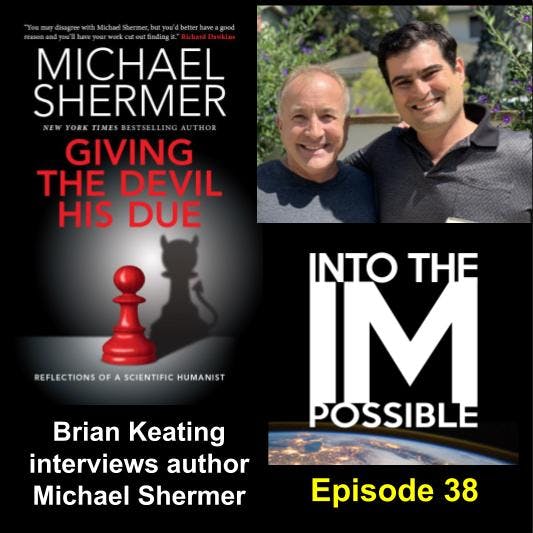
Giving the Devil His Due: a conversation with Michael Shermer & Brian Keating (#038)
Brian Keating Interviews Skeptic Magazine publisher and author of “Giving The Devil His Due” Michael Shermer. Get Michael Shermer’s Books here: GIVING THE DEVIL HIS DUE HEAVENS ON EARTH THE MORAL ARC: Find Show Notes and Links here Dr. Michael Shermer is the Founding Publisher of Skeptic magazine, the host of the Science Salon Podcast, and a Presidential Fellow at Chapman University where he teaches Skepticism 101. For 18 years he was a monthly columnist for Scientific American. He is the author of New York Times bestsellers Why People Believe Weird Things and The Believing Brain, Why Darwin Matters, The Science of Good and Evil, The Moral Arc, and Heavens on Earth. His new book is Giving the Devil His Due: Reflections of a Scientific Humanist. Follow Michael on Twitter: https://twitter.com/michaelshermer and Brian Keating here: https://twitter.com/drbriankeating Michael regularly contributes opinion editorials, essays, and reviews to: the Wall Street Journal, the Los Angeles Times, Science, Nature, and other publications. He wrote 214 consecutive monthly columns for Scientific American. He appeared on such shows as The Colbert Report, 20/20, Dateline, Charlie Rose, Oprah, and Larry King Live (but, proudly, never Jerry Springer!). He has been interviewed in countless documentaries aired on PBS, A&E, Discovery, The History Channel, The Science Channel, and The Learning Channel. Dr. Shermer was the co-host and co-producer of the 13-hour Family Channel television series, Exploring the Unknown. His two TED talks, seen by millions, were voted in the top 100. Dr. Shermer received his B.A. in psychology from Pepperdine University, M.A. in experimental psychology from California State University, Fullerton, and his Ph.D. in the history of science from Claremont Graduate University. He has been a college professor since 1979, also teaching at Occidental College, Glendale College, and Claremont Graduate University, where he taught a transdisciplinary course for Ph.D. students on Evolution, Economics, and the Brain. Watch Michael Shermer discuss Losing the Nobel Prize with Brian Keating on SCIENCE SALON # 70 Topics discussed in this extended interview include: M Learn more about your ad choices. Visit megaphone.fm/adchoices

The Physics of Krav Maga with author and physics Professor John Eric Goff (#037)
https://www.mmaacademy.com https://www.facebook.com/John.Eric.Goff.Sports.Physicist http://johnericgoff.blogspot.com https://www.lynchburg.edu Krav Maga (“contact combat” in Hebrew) is a hard-hitting and efficient form of self-defense that was popularized by Israeli soldiers. Stressing practical, real-world fighting and a philosophy of self-defense, its popularity has grown worldwide over the past few decades. In The Physics of Krav Maga, John Eric Goff, a physicist, best-selling author, and martial arts practitioner, explains the science behind dozens of Krav Maga moves, from headlocks to hammer fists. Focusing on Warrior Krav Maga, a fighting style that combines the key elements of Krav Maga with kickboxing, wrestling, karate, and other fighting specialties, this equation-free, conceptual introduction is aimed at martial arts practitioners interested in refining their fighting technique and all fans of the fascinating moment when sports meet science. With step-by-step descriptions and detailed photos of each critical motion, Goff takes a scientific look at everything from punch speed to power output and reaction time. Armed with this book, readers will understand the physics behind each move. They will also learn how to enhance their level of physical fitness disrupt an opponent’s balance―while keeping theirs make use of leverage to defeat a larger, stronger attacker become faster and more powerful inflict pain up close • use weapons―and “weapons of opportunity” and much more! Anyone interested in martial arts, in how physics applies to sports and combat, and in how a physicist wins a fight will love The Physics of Krav Maga. John Eric Goff is a professor of physics and the chair of the physics department at the University of Lynchburg. The author of Gold Medal Physics: The Science of Sports, he holds a black belt in Karate and a purple belt in Krav Maga. If you enjoyed this episode of INTO THE IMPOSSIBLE, please subscribe, comment, share and review. For a chance to win a free copy of our most recent guest’s newest book, send a screenshot of your review to [email protected] Learn more about your ad choices. Visit megaphone.fm/adchoices

Brian Keating interviews Professor Elena Aprile about the search for dark matter and her life in science (#036)
https://chasingeinsteinfilm.com http://www.xenon1t.org Elena Aprile is UCSD’s Margaret Burbidge Visiting Professor at UC San Diego and Professor of Physics at Columbia University. She is the founder and spokesperson of the XENON Dark Matter Experiment. Aprile is well known for her work with noble liquid detectors and for her contributions to particle astrophysics in the search for dark matter. Professor Aprile appears in the documentary CHASING EINSTEIN about the search for dark matter. Could Einstein have been wrong about the true nature of gravity? Does his general theory of relativity and the Standard Model need an update? Unprecedented advances in experimental particle physics, astronomy and cosmology are uncovering mysteries of cosmic consequence. Among the most challenging is the realization that 80% of the universe consists of something unknown that exerts galactic forces pulling the universe apart. The search for Dark Matter extends from the worlds most powerful particle accelerators to the most sensitive telescopes, to deep under the earth. Nobel worthy discoveries await. Scientists at UC San Diego are at the epicenter of the search for Dark Matter leading efforts to build the next generation of instruments and experiments to uncover its secrets. Learn more about your ad choices. Visit megaphone.fm/adchoices

SETI and Beyond: A discussion with Brian Keating, Paul Davies, Jim Benford and Mat Kaplan (#035)
Books mentioned in this episode: The Eerie Silence: Renewing Our Search for Alien Intelligence by Paul Davies The Demon in the Machine: How Hidden Webs of Information Are Solving the Mystery of Life by Paul Davies Starship Century, Edited by Greggory & James Benford A technologically advanced extraterrestrial civilization could likely detect life on Earth, if such beings exist. Life on Earth could be detectable in our planet’s atmospheric spectral lines for over a billion years. Most of our atmospheric oxygen is due to life, and can be observed over interstellar distances — across thousands of light-years. Over this long time, many stars have swept near our solar system and Earth. If extraterrestrial intelligence (ETI) on such “nearby” planets did send probes to remotely observe our planet, where in the Solar System should we look to find evidence of their past visitation? The Moon is the obvious, closest place. Another option would be a newly discovered class of co-orbital objects, an equally logical place to locate for observing Earth. These objects approach Earth very closely every year at distances much closer than any large body besides our Moon. They are an ideal way for ET’s to watch our world from a secure natural object that provides resources an ET life form might need: materials, a firm anchor, and concealment. They might likely be robotic probes, like our own Voyager and New Horizons probes, remaining on site after exhausting their energy supply. Studying the Moon and co-orbitals could be termed “extraterrestrial archeology”. For the Moon, we can use the photographic mapping of the Moon’s surface by the Lunar Reconnaissance Orbiter. Co-orbitals have been little studied by astronomy and not at all by SETI or planetary radar observations. This discussion describes a str Learn more about your ad choices. Visit megaphone.fm/adchoices

Brian Keating interviews Sir Roger Penrose: The Emperor’s New Mind — Consciousness & Computers (#034)
Books mentioned in this episode: The Emperor’s New Mind: Concerning Computers, Minds, and the Laws of Physics Shadows of the Mind: A Search for the Missing Science of Consciousness Sir Roger Penrose OM FRS (born 8 August 1931) is an English mathematical physicist, mathematician and philosopher of science. He is Emeritus Rouse Ball Professor of Mathematics in the University of Oxford, an emeritus fellow of Wadham College, Oxford and an honorary fellow of St John’s College, Cambridge. Penrose has made contributions to the mathematical physics of general relativity and cosmology. He has received several prizes and awards, including the 1988 Wolf Prize for physics, which he shared with Stephen Hawking for the Penrose–Hawking singularity theorems. Penrose sat down with Professor Brian Keating to discuss artificial intelligence, consciousness, cosmology, and the many fascinating developments in physics since the publication of The Emperor’s New Mind in 1989. Previous talks at UC San Diego: Conformal Cyclic Cosmology: https://www.youtube.com/watch?v=zt1WH_SkazQ&t=2284s New Theory of Dark Matter: https://www.youtube.com/watch?v=xlSMME-Cl5g Physics and Fantasy: https://www.youtube.com/watch?v=aaIdJMxP6bA Hawking Points in the CMB: https://youtu.be/gfYBfjVt08k Learn more about your ad choices. Visit megaphone.fm/adchoices

UC San Diego Alumni discuss their careers & Quantum Design Inc. with Brian Keating (#033)
Dr. Stefano Spagna, PhD. and Ivy Lum Fipps, MS are both alumni of UC San Diego Physics. Dr. Spagna is Chief Technology Officer and Mrs. Fipps is Final Test Engineer specializing in dilution refrigerators. Since its inception in 1982, Quantum Design International (a privately held corporation) has developed and manufactured automated temperature and magnetic field testing platforms for materials characterization. These systems offer a variety of measurement capabilities and are in widespread use in the fields of physics, chemistry, biotechnology, materials science, nanotechnology, and quantum information research. Building on its expertise in the global marketing and distribution of its own scientific instruments, Quantum Design International (QDI) eventually broadened its scope to distribute quality scientific instruments from other manufacturers through an international network of wholly-owned subsidiaries in every major technological center around the world. Learn more about your ad choices. Visit megaphone.fm/adchoices
Brian Keating Interviews Richard Panek about The Trouble With Gravity (#032)
Books mentioned: The Trouble with Gravity: Solving the Mystery Beneath Our Feet Empiricism, heavens and earth, gravity in history, god, religion, and politics, a thrilling tour guide from ancient concepts to the very present. The Autistic Brain: Thinking Across the Spectrum The 4 Percent Universe: Dark Matter, Dark Energy, and the Race to Discover the Rest of Reality Richard Panek is most recently the author of The Trouble with Gravity: Solving the Mystery Beneath Our Feet, published in July 2019 by Houghton Mifflin Harcourt. His previous book, The 4% Universe: Dark Matter, Dark Energy, and the Race to Discover the Rest of Reality, received the Science Communication Award from the American Institute of Physics. He is also the recipient of a Guggenheim Fellowship, an Antarctic Artists & Writers grant from the National Science Foundation, and a Fellowship in Nonfiction Literature from the New York Foundation for the Arts. His own books have been translated into sixteen languages, while his collaboration with Temple Grandin, The Autistic Brain: Thinking Across the Spectrum, was a New York Times best-seller and the recipient of the Goodreads Choice Award for Best Nonfiction Book of 2013. He also co-wrote the giant-format 3D museum movie ROBOTS [[CUT: 3D]], a National Geographic production. He has been a monthly columnist for Natural History magazine and a regular contributor to The New York Times. Two of his previous books also cover the history of science for non-specialist readers, Seeing and Believing: How the Telescope Opened Our Eyes and Minds to the Heavens (Viking, 1998), and The Invisible Century: Einstein, Freud and the Search for Hidden Universes (Viking, 2004). Education MFA in Fiction, University of Iowa BS in Journalism, Northwestern University Learn more about your ad choices. Visit megaphone.fm/adchoices

UC San Diego Alumnus, Nanome.ai Co-Founder & CEO Steve McCloskey interviewed by Stuart Volkow (#031)
https://nanome.ai/ @StevenMcCloskey Steve McCloskey is an Alumni from the first class of Nanoengineering at the University of California, San Diego. Steve’s work is focused on emerging technologies applied to Science, Technology, Engineering, and Mathematics (STEM). During his time at UC San Diego Steve worked directly with the founding Chair of the Nanoengineering Department, Ken Vecchio helping set the foundation for the Nanoengineering Materials Research Center and developing thermodynamic processing methods for Iron-based Superelastic alloys. After graduating from UCSD he founded Nanome Inc to build Virtual Reality solutions for Scientists and Engineers working at the nanoscale, specifically protein engineering and small molecule drug development. Steve is also a founder of the Matryx blockchain platform which provides a secure framework for collaborative design and development for STEM. Nanome is transforming how we interact with and understand science, creating a virtual world where users can experiment, design and learn at the nanoscale. We’re building an open platform to solve age-old problems of collaboration, incentivization and siloed information – creating a world with open access to science & technology. Learn more about your ad choices. Visit megaphone.fm/adchoices
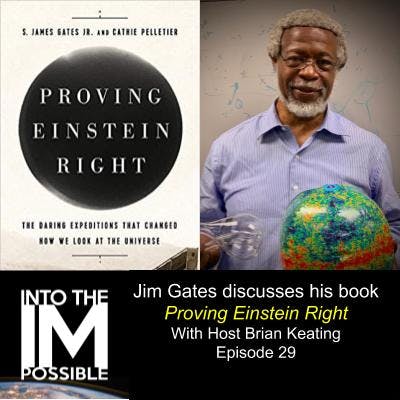
Brian Keating Interviews Jim Gates about Proving Einstein Right, supersymmetry and other mysteries (#030)
Proving Einstein Right on Amazon Jim Gates is the Ford Foundation Professor of Physics, and the Director of The Brown University Theoretical Physics Center. He is a 2013 recipient of the National Medal of Science He was a Distinguished University Professor, University System of Maryland Regents Professor, John S. Toll Professor of Physics, and Director of the Center for String and Particle Theory. Gates is well known for his pioneering work in supersymmetry and supergravity, and his 1977 doctoral dissertation on supersymmetry earned him a prominent place in the early development of the field, as did the 1984 book he co-authored, Superspace, or One thousand and one lessons in supersymmetry, which is widely considered the first comprehensive book on the subject. His study of string theory and supersymmetry has recently led Gates to develop an interest in what are called adinkras. Adinkra symbols are graphical representations of supersymmetric algebras named after symbols created by the Asante people. Adinkras may help us understand the structure of the universe, although Gates cautions, “most of the time when we make up ideas, they’re wrong. However, when we get it right, it’s amazing.” Gates is also a pioneer in another respect, having been the first African American to hold an endowed chair in physics at a major U.S. research university. He comes to Brown with a mission to increase the participation of historically underrepresented groups in the sciences. Gates is a former scientific advisor to President Barack Obama, Gates is also a member of the National Academy of Sciences, as well as the board of trustees of Society for Science & the Public, and one of the USA Science and Engineering Festival’s “Nifty Fifty.” More information on Professor Jim Gates https://sites.brown.edu/sjgates/ Other books by Cathy Pelletier @Dr_JimGates Learn more about your ad choices. Visit megaphone.fm/adchoices

Brian Keating interviews Sean Carroll about his book Something Deeply Hidden & Many Worlds (#029)
Buy Sean’s books on Amazon Find Sean Carrol online and listen to his Mindscape podcast Sean Carroll on Joe Rogan Sean M. Carroll is a Research Professor of Physics at CalTech. He is a theorist who thinks about the fundamental laws of nature, especially as they connect to cosmology. His research involves theoretical physics and astrophysics, especially cosmology, field theory, and gravitation. He has worked on questions involving dark matter and dark energy, modified gravity, violations of Lorentz invariance, extra dimensions, topological defects, cosmic microwave background anisotropies, causality violation, black holes, and the cosmological constant problem. Currently, most of his attention is focused on the origin of the universe and the arrow of time, including the roles of inflation, baby universes, and quantum gravity. Quantum mechanics is the most important idea in physics, and physicists themselves readily admit that they don’t understand it. But rather than treating this situation as an urgent call to action, they have traditionally pretended that the problem isn’t there. In Something Deeply Hidden, Sean Carroll argues that this situation is embarrassing and unnecessary, as we do have a very promising way of understanding quantum reality: the Many-Worlds theory, pioneered by Hugh Everett. This book demystifies the paradoxes of quantum mechanics, explains the Many-Worlds approach at a level never previously attempted in a popular work, and argues that an improved understanding of the foundations of quantum mechanics is crucial to making progress on quantum gravity and the emergence of spacetime. Learn more about your ad choices. Visit megaphone.fm/adchoices

Dan Hooper discusses his book At The Edge of Time (#028)
At The Edge of Time Dan Hooper is a senior scientist and the head of the Theoretical Astrophysics Group at the Fermi National Accelerator Laboratory (Fermilab). He is also Associate Professor of Astronomy and Astrophysics at the University of Chicago. Dr. Hooper received his Ph.D. in Physics from the University of Wisconsin–Madison. He was later a postdoctoral researcher at the University of Oxford and the David Schramm Fellow at Fermilab. Dr. Hooper’s research focuses on the interface between particle physics and cosmology, covering topics such as dark matter, dark energy, supersymmetry, neutrinos, extra dimensions, and ultra-high-energy cosmic rays. He has authored more than 200 articles in peer-reviewed scientific journals, and he has given an even larger number of technical talks at scientific conferences and university seminars and colloquia. Dr. Hooper is the author of three books written for nonscientists: Dark Cosmos: In Search of Our Universe’s Missing Mass and Energy, Nature’s Blueprint: Supersymmetry and the Search for a Unified Theory of Matter and Force, and At the Edge of Time: Exploring the Mysteries of Our Universe’s First Seconds. He has also written for popular magazines such as Astronomy, Sky & Telescope, and New Scientist. He gives many public lectures and is frequently called on by the media to comment on science news. Dr. Hooper’s television appearances include Through the Wormhole with Morgan Freeman and Space’s Deepest Secrets, and he has been interviewed on NPR’s Science Friday. Professor Hooper also teaches through The Great Courses As the new field of astro-particle physics rapidly develops, we are witnessing an exciting time in the history of science. In addition to the progress being made in the traditional areas of experimental particle physics (accelerator experiments), exciting developments are also taking place in the use of astrophysical experiments to study elementary particles. The most striking example of this success is the measurement of the neutrino masses and mixing angles that have been made over the last decade. Many of the questions asked by particle physicists are difficult to address with collider experiments and are being explored ever increasingly by astrophysicists. These efforts include the development of particle dark matter searches, ultra-high energy cosmic rays detectors, gamma-ray telescopes and high-energy neutrino telescopes. Professor Hooper’s research is focused primarily, although not entirely, on studying and exploring particle physics beyond the Standard Model using astrophysics. Other books mentioned in this program: Losing The Nobel Prize by Brian Keating Something Deeply Hidden by Sean Carol Black Hole Blues by Janna Levin The First Three Minutes by Steven Weinberg Learn more about your ad choices. Visit megaphone.fm/adchoices

Innovator Series – Additive Rocket Corporation (#027)
Links: The Additive Rocket CorporationReiley Weekes, CSO Kyle Adriany, CTO The Arthur C. Clarke Center for Human Imagination on Facebook and Twitter Email us at [email protected]. Learn more about your ad choices. Visit megaphone.fm/adchoices

The Origins of Life and the Work of Primo Levi (#026)
Links: Dr. Luca Legnani, Ph.D., The Blackmond Lab, Scripps Research Institute Primo Levi The Arthur C. Clarke Center for Human Imagination on Facebook and Twitter Email us at [email protected]. Learn more about your ad choices. Visit megaphone.fm/adchoices

A Discussion of Quantum Theory and the book “What Is Real?” by Adam Becker (#025)
This podcast is about the book, "What Is Real? The Unfinished Quest for the Meaning of Quantum Physics". The conversation was part of the "Into the Impossible" podcast at the UC San Diego Arthur C. Clarke Center for Human Imagination, featuring a discussion between Professor Chip Sebens (UCSD Philosophy), Dr. Andrew Friedman (UCSD Physics), and the book's author, Adam Becker. Learn more about your ad choices. Visit megaphone.fm/adchoices

Julian Guthrie Discusses Alpha Girls (#024)
Co-Director of the Clarke Center Professor Brian Keating interviews bestselling author Julian Gurthrie about her latest book Alpha Girls. The stories of 4 women who achieved prominence in the male-dominated world of Silicon Valley venture capital. How did these women do it? What makes them so successful? Julian also reveals how she's written and published 4 successful non-fiction books over the past 8 years. Learn more about your ad choices. Visit megaphone.fm/adchoices
Matthew Stanley & Einstein’s War (#023)
How history can shape science, and how science can change the tide of history? NYU Professor Matthew Stanley is our guest, here to discuss about his latest book: Einstein's War: How Relativity Triumphed Amid the Vicious Nationalism of World War I . Brian Keating, associate director of the Clarke Center and professor of physics at UC San Diego, talked to Professor Stanley about his interest in the history of science and the relationship between science and society. We learn about Einstein's first failed attempt at proving his theories with a disastrous expedition at the outbreak of WW I in 1914, and Arthur Eddington's 1919 solar eclipse experiment that made Einstein famous around the world. Learn more about your ad choices. Visit megaphone.fm/adchoices

Journalist & Author Annalee Newitz (#022)
Meet Annalee Newitz, nonfiction and fiction author, science-journalist, and co-host of the podcast series Our Opinions are Correct. Winner of the Lambda Literary Award and nominee for the Nebula and Locus awards, her ability to use her scientific knowledge in both her fiction and nonfiction works is something that makes Newitz unstoppable. Dr. Brian Keating begins to unravel the creative process behind her newest novel Autonomous, as well as The Future of Another Timeline, and more. Annalee Newitz's novel Autonomous Newitz’s podcast Our Opinions are Correct Newitz’s website Learn more about your ad choices. Visit megaphone.fm/adchoices

Beyond 10,000 Hours (#021)
On this episode, we explore physics, education, and what it takes to train imaginative scientists with Carl Wieman, Nobel Prize winning physicist with joint appointments as Professor of Physics and Professor in the Graduate School of Education at Stanford University. Dr. Wieman is interviewed by Brian Keating, UC San Diego Professor of Physics, Director of the Simons Observatory, and Associate Director of the Clarke Center. Learn more about your ad choices. Visit megaphone.fm/adchoices

The Second Kind of Impossible (#020)
THE SECOND KIND OF IMPOSSIBLE: The Extraordinary Quest for a New Form of Matter is the exciting, first-hand story of how Paul Steinhardt, the award-winning physicist and Albert Einstein Professor in Science at Princeton University, predicted a new type of matter – the quasicrystal – shattering centuries-old laws of physics. Steinhardt’s quest to prove the natural existence of quasicrystals takes him on a globe-hopping scientific journey from Princeton to Italy to the remote mountains of Russia’s Kamchatka Peninsula. In a “suspenseful true-life thriller of science investigation and discovery” (Publishers Weekly), readers are taken along for the ride as Steinhardt challenges commonly held assumptions about settled science, refuting skeptics and disproving their notions of impossibility along the way. Steinhardt’s search to prove the existence of this rare crystal structure began in the early 1980s, when he first proposed the existence of “quasicrystals.” While studying abstract tile patterns, Steinhardt and his graduate student discovered a scientific loophole in one of the most well-established laws of science and, exploiting that, realized it was possible to create new forms of matter. In this podcast, co-associate director of the Arthur C. Clarke Center for Human Imagination, Professor Brian Keating, and Professor Paul Steinhardt explore a wide range of ideas from the discovery of new forms of matter to string theory and the sociology of science. Enjoy! Learn more about your ad choices. Visit megaphone.fm/adchoices

Nature Has More Imagination (#019)
In a ranging conversation, associate director Brian Keating interviews the preeminent scientist and thinker Freeman Dyson, discussing his career in science and letters, the role of creativity and subversiveness, the perils of prizes, and how nature always shows more imagination than we do. Learn more about your ad choices. Visit megaphone.fm/adchoices

Ep 18Internet of All Kinds of Things (#018)
How is the internet changing our humanity, and what can we do about it? We explore these questions and more with Antonio Garcia Martinez (author of Chaos Monkeys: Obscene Fortune and Random Failure in Silicon Valley) and Douglas Rushkoff (author most recently of Throwing Rocks at the Google Bus and host of the fantastic podcast Team Human). Learn more about your ad choices. Visit megaphone.fm/adchoices

Graphic Science (#017)
On May 8th, the Clarke Center will host an evening of Graphic Science: Comics Engage the Cosmos. In advance of that, associate director Brian Keating chatted with Jorge Cham, creator of PHD Comics, and Daniel Whiteson, physicist at UC Irvine, about their new book We Have No Idea: A Guide to the Unknown Universe, a witty, creative look at the biggest open questions in cosmology. Learn more about your ad choices. Visit megaphone.fm/adchoices

Alien Contact: Part 2 (#016)
We’re continuing our conversation from episode 14 about alien contact by focusing on language barriers: barriers betweens humans and aliens, humans and animals, and, in what some consider the most alien encounter of all, between scientists and artists. With acclaimed science fiction writer Ted Chiang, dolphin researcher Christine Johnson, and visual artist Lisa Korpos. Learn more about your ad choices. Visit megaphone.fm/adchoices

Bonus Episode: Remembering Stephen Hawking (#15b)
In 2007, Erik Viirre, Associate Director of the Clarke Center, was fortunate to share a unique experience with the great Stephen Hawking: taking him into zero gravity. He shares his remembrance of the intellectual giant with Brian Keating here, in honor of Hawking's passing on March 14, 2018. Learn more about your ad choices. Visit megaphone.fm/adchoices