Illuminated
113 episodes — Page 2 of 3
The Cat Killer Detectives
When decapitated cats start appearing in South London, animal rescue duo Boudicca Rising and Tony Jenkins spring into action. They’ll do whatever it takes to get to the bottom of this mystery.It’s 2015 and the two volunteers running the South Norwood Animal Rescue and Liberty (SNARL) Facebook page, stumble upon a vet’s poster telling locals to keep their pets safe as there have been a series of “mutilations” in the area. When Boudicca and Tony share the vet’s warning, they’re flooded with messages from pet owners saying something similar has happened to their cats.Boudicca and Tony convince the police to launch Operation Takahe, an investigation into the “Croydon Cat Killer.” Far from stepping back, Boudicca and Tony find themselves at the centre of the operation; investigating “crime scenes,” breaking bad news to pet owners and being interviewed by press. The case takes over their lives.Presented and produced by Natasha Fernandes Editor: Matt Willis Sound design: James Beard
The Watch Case
Watchmaker Rebecca Struthers has been invited to come and examine a watch which its owners claim is the world's oldest - but is it?Until now, Rebecca had only heard rumours of this watch - about the reputation of its famous maker, about the extraordinary circumstances in which it was found, about its unbelievable valuation. It is famous, or infamous, in antiquarian horology circles. But until Rebecca wrote her book 'Hands of Time' (a Radio 4 Book of the Week), few outside that small world had heard much about it. Now, thanks to her book, a mysterious lawyer has emailed to ask if she'd like to examine the watch. So she's on her way to Switzerland with a lot of questions. Not least - is it the real deal or, as so many of the watch's detractors claim, nothing more than a forgery.Producer: Giles Edwards
Into the West
The red-billed chough is the most dashing crow in the world. These rare, flamboyant, scarlet-legged, scarlet-billed denizens of Britain’s Celtic coasts are communal and comic, intelligent and daring. They’re also sublime aeronauts, riding the breeze as though they’re made of it. For writer Horatio Clare, the chough is his totem. He’s loved the bird since he first encountered it in the 1980s during childhood holidays to Pembrokeshire. And more than forty years on from that joyous first encounter he still seeks them out. It’s his annual pilgrimage. In this episode of Illuminated, we join Horatio on that pilgrimage as he tells the story of a bird with a beak and legs the colour of a saint’s blood… or perhaps a king’s blood; whose cry says its name and whose presence symbolises a nation’s identity. It’s the story of a bird which embodies myths… and creates new ones; a bird which fled into the West over two centuries ago and which is finally returning to a wider world. Horatio begins his journey on Pen Llŷn, the westernmost spur of North Wales and one of the red-billed chough’s strongholds. His guide as he walks the sea cliffs is naturalist and folklorist Twm Elias. Twm lived alongside chough as he grew up on Llŷn and remembers a childhood visit to Caernarfon Castle, where his friend Dic John made a grab for the Castle’s ‘tame’ chough – and got a painful pecking in return. Twm sees chough as a symbol of the wild coastal areas of north Wales. But it’s also wrapped up in ideas of Cornish identity too. Dr. Loveday Jenkin grew up on stories of King Arthur becoming a chough when he died. Yet, just as she heard those stories, the very last choughs were dying out in Cornwall. But then, in 2001, thirty years after the last chough disappeared, three birds from Ireland made landfall in the far west of Cornwall. The following year two of them built a nest and the population grew from there. Hilary Mitchell from Cornwall Birds tells the story of how the avian symbol and spirit of the county returned. The chough is associated now with the western Celtic coasts. But once upon a time it ranged right across the British Isles. And maybe it will again. Horatio heads in the opposite direction… east… to a place which hasn’t seen chough for at least two centuries, despite the bird being embedded in its iconography.In Dover he meets Paul Hadaway from Kent Wildlife Trust to discover how a bird which was a symbol of the martyr and saint Thomas a Becket is once again flying in Kentish skies. And Jenny Luddington from the Trust explains how she’s drawn on an old tradition of hooden creatures – carved wooden animal heads on poles – to create a hooden chough and tell the story of the bird’s return to Kent. Horatio Clare discovers that the chough’s story has come full circle as old myths rehatch and new ones take wing.Presenter: Horatio Clare Producer: Jeremy Grange Editor: Chris Ledgard A BBC Audio Wales production for BBC Radio 4
A Taste of Home
Care packages are a universal love language and a way for families to stay connected across distances. We unbox four from China, India, Ireland and the Philippines, each filled with the tastes, textures and memories of home. In Newton-le-Willows, content creator Aurora unwraps a parcel from her mother in China revealing fragrant spices, dried mushrooms and handmade gifts as a reminder of her native traditions. In Cardiff, dancer Ishika shares a tightly sealed batch of homemade bori, sun-dried lentil dumplings prepared and packed by her cousins in India. Over in Liverpool, full-time mum Sarah introduces us to a selection of snacks pulled from her Nanny's cabinet in Ireland for a mix of nostalgia, sweetness and comfort that bridges generations. In Norwich, multidisciplinary artist Sha opens a package from her mum in the Philippines filled with dried mangoes and polvoron, a crumbly, sugary treat that melts in your mouth and warms the heart. Each of them shares how these packages, sent with care and packed with love, offer more than just food. They’re a connection to family, culture, belonging and the best remedy for homesickness.Presented and produced by Jay Behrouzi Executive Producer Richard McIlroy A BBC Audio North production for BBC Radio 4
Don't Lose Your Head!
When the Reverend Andrew Doarks took on the church of St Gregory's in Sudbury three years ago - he received no warning of what he would discover in the vestry.There - behind a perspex screen and a wooden flap in the wall - is the severed head of the fourteenth century Archbishop of Canterbury Simon of Sudbury. Simon who was decapitated during the Peasant's Revolt in 1381 shares the same space as the church's playgroup and receives visitors by appointment only. It is an unusual arrangement for the former Archbishop who met his demise after attempting to introduce a hated poll tax. So how did Simon's head end up in Sudbury when his body is buried in Canterbury Cathedral? And should both head and body be reunited?Andrew takes a trip to Canterbury to see Simon's tomb with the Cathedral's Head of Estates Joel Hopkinson. Inside the tomb - Simon's head has been replaced by a cannonball. He then visits the Cathedral library with Cressida Williams who discovers a document in the archive that relays Simon's will, dictated immediately before his death and he discusses Simon's future with the Canon Treasurer Andrew Dodd. Dr Helen Lacey from the University of Oxford and the People of 1381 project provides the historical context from the days of the Revolt.It's a journey of discovery that sheds light on Simon's past and gives Andrew ideas for his future. After all - as he reflects - managing severed heads just wasn't part of his training at theological college.Produced and presented by Robin Markwell for BBC Audio in Bristol "Vice Or Virtue" is composed and performed by singer-songwriter Jonny Day
Target Girls
“There are so many things you can’t see coming. You can’t see death. You can’t see Mount Vesuvius erupting. The carpet could be pulled out from under you at any second. But I’ll see a knife coming if it’s going to hit me.”Target Girls are the female performers in “impalement arts'', where knives, arrows and even bullets are propelled at humans. Prepare for a full body immersion in this extreme profession, as we pull back the curtain on the hidden world behind the target girl’s silent, singular image.Your ringleader for this event is world-famous target Ula The Painproof Rubbergirl! Also starring!! Yana Hanson, Annabelle Holland and Amanda Jane ... With a special guest appearance from The Great Throwdini!Producer: Jude Shapiro Executive Producer: Jack Howson Sound Designer: Louis BlatherwickA Peanut & Crumb production for BBC Radio 4
All Under One Magnetosphere
Electromagnetic waves fill the universe, radiating from solar storms and bursts of lightning, but also from our electronic devices and infrastructures. Using simple, DIY tools, a community of audio enthusiasts translates these waves into sound, uncovering hidden sonic worlds.Five dedicated ‘natural radio’ enthusiasts venture beyond the electromagnetic pollution of the city, tuning into the Earth’s natural static to reveal a rich, textured soundscape, rarely heard.Stephen McGreevy, a cult figure within this practice, shares stories of his recordings during the geomagnetic storm of 1989. Hannah Kemp-Welch travels to northern Norway in search of the electromagnetic waves of the aurora borealis, struggling to escape the omnipresent hum of the mains power grid. Alyssa Moxley captures the crackles of shooting stars in southern France. Matt Parker ventures into the National Radio Quiet Zone in Virginia, USA. And Anonea experiments with antennas from a remote location in northern Spain.This audio feature encourages listeners to contemplate the vast, often invisible role electromagnetism plays in our daily lives. It invites us to look up at the sky and imagine radio waves bouncing off layers of the atmosphere, connecting us all under one magnetosphere. Produced by Hannah Kemp-Welch and Oliver Sanders Research & Development: Hannah Kemp-Welch Editing & Sound Design: Oliver Sanders Executive Producer: Lucia Scazzocchio Special thanks to Anonea, Alyssa Moxley, Dan Tapper, Francesca Thakorlal, Matt Parker, Rob Stammes, Rebekah Breding, Ruth Stewart, Sébastien Robert and Stephen P. McGreevy. A Social Broadcasts production for BBC Radio 4
Still Me
Tracey Okines is witty, stylish, sharp, and fiercely independent. She loves seaside strolls, spontaneous shopping trips, pub outings, and her cat, Meow. She’s a writer, a dreamer, a lover of music, and someone who refuses to be boxed in by anyone’s expectations.At 27, Tracey’s life changed overnight when a misjudged cartwheel caused a massive bleed, leading to a brainstem stroke. She was left with locked-in syndrome, unable to move or speak but fully conscious. Sixteen years on, she communicates using eye-tracking and a letter board, lives independently with 24-hour care, and remains, as ever, totally herself.In Still Me, producer Jess Gunasekara visits Tracey in Eastbourne, joining her in everyday moments and quiet reflections. Through Tracey’s personal musings, dream diaries, text messages, and actor-read excerpts from her memoir, this intimate portrait reveals a woman living boldly, navigating the world with humour, honesty, and imagination.A story of agency, adaptation, and the richness of inner life, from someone who’s still here, still vibrant, still herself.Produced and presented by Jess Gunasekara Sound design and mix by Meic Parry Actor: Lizzie Stables Executive Producer: Olivia Humphreys With thanks to Tracey Okines and John OkinesAn Overcoat Media production for BBC Radio 4
Sea Like a Mirror
An atmospheric gathering storm of a documentary exploring the extraordinary history of the Beaufort Scale - a system designed to help find language for the wind.Sea like a mirror Whistling heard in telegraph wires Umbrellas used with difficulty...In this programme we climb to the top of a lighthouse in the Outer Hebrides, labelled the windiest point in Britain by the Guinness Book of Records, and travel deep into the Met Office archives. With contributions from the writer Scott Huler, author of Defining the Wind; Ruairidh Macrae, the retained lighthouse keeper for the Butt of Lewis and Eilean Glas lighthouses in the Outer Hebrides; Catherine Ross, the library and archive manager at the Met Office; and John Morales, a hurricane specialist and meteorologist with 40 years experience in the field.The Beaufort scale is read by Charlotte Green Original music composed by Jeremy Warmsley, with additional music by Eleanor McDowall Mix by Mike WoolleyProduced by Eleanor McDowall A Falling Tree production for BBC Radio 4
The Frozen Light
Once a year, residents of Longyearbyen gather where the steps of the old hospital used to be to witness the return of something they have not seen in months – sunlight. The Arctic archipelago of Svalbard, part of Norway, is as far north as humans can live. This dramatic polar world experiences 24-hour daylight in summer and total darkness in winter.But on March 8th, locals and visitors of its largest settlement, Longyearbyen, wait with baited breath until a single ray of sunshine appears upon the old hospital steps, warming their cheeks for a few minutes before disappearing once more behind the vast mountains that surround the town. Journalist and producer Lara Bullens takes us with her to witness this miraculous moment, but also to understand why people have decided to make a home in a place not meant for humans. Svalbard is a barren frozen land, devoid of trees or crops. The risk of avalanches is always lurking around the corner. Polar bears outnumber humans. Powerful winds and sub-zero temperatures engulf the landscape most of the year. Deprived of sunlight for months at a time, many residents battle depression. The remote landscape is also experiencing vast transitions. The Arctic is warming twice as fast as any other part of the planet, banishing sea ice and opening its waters to the exploitation of natural resources. Coal mining, the industry on which Svalbard’s economy was built, is coming to an end. And non-Norwegians living in Longyearbyen are increasingly feeling less stable here. Yet humans decide to stay, bound together by the eternal cycle of light. Written and Presented by Lara Bullens Produced by Lara Bullens and Steven Rajam Executive Producer: Leonie Thomas Mix and Sound Design: Mike Woolley An Overcoat Media production for BBC Radio 4
Lost and Found
When a dog goes missing it can be devastating. It’s every dog owners worst nightmare. Social media is awash with posts about lost dogs, some of them scams, but many are genuine cries for help from distressed people who have lost an animal they love. Between January 2023 and June 2024 almost 5000 dogs were reported missing in the UK.In March 2025, Roger put a lead on his Jack Russell terrier Betty, as he attended to his boat at Buckden Marina in St Neots, Cambridgeshire. With his back turned for a few minutes, she disappeared. In this episode of Illuminated, we join a group of volunteers with St Neots Animal Search and Rescue as they seek to reunite Betty and Roger using all the experience, teamwork and technology available. Colin Butcher is a pet detective based in West Sussex who has been recovering missing and stolen pets for over 20 years. As Colin shares his expert tips for dog-owners, through field recordings from a tiny microphone attached to a dog-collar, listeners are invited to enter the world of our missing puppy.Producer: Peter ShevlinA Pod60 production for BBC Radio 4
You've Got Worms
Worms are everywhere - in our soils, our seas, and our selves. Dive down a worm burrow on this sound-rich odyssey to meet our most numerous and intimate animal companion.Science writer Jack Monaghan will guide you through gardens and farms, factories and laboratories to look afresh at our wriggling, wonderful world.Producer and narrator: Jack Monaghan Sound design and original music: Robert Moutrey Executive producer: Bridget Harney A Pronk production for BBC Radio 4
A Walk in Time
Where do we begin to think about time without humans to count it? Chris Gasson spends every spare moment on his local beach, Seatown on the Jurassic coast of Dorset, looking out for fossils and stones that speak of a past and future too vast for us to easily imagine. On his walks, Chris has found countless time capsules - including a mammoth tooth, plesiosaur vertebrae and the remains of an ichthyosaur 190 million years old, now under research by Craig Chivers. 'It's a fantastic find,' says Craig. 'Fossils are a snapshot in time a bit like paintings and writings. Trace fossils that show where a dinosaur once stepped and left a footprint behind, or an ammonite has rolled along the sea floor and left an impression in the sediment, really stir the imagination.' Our walk along Seatown beach is accompanied by readings by geologist and writer, Marcia Bjornerud, Walter Schober Professor of Environmental Studies and Professor of Geosciences at Lawrence University, Wisconsin. Her essay Wrinked Time imagines humans as wandering in a vast, labyrinthine library of time. 'We are like squatters living amid the remains of earlier empires, worlds defined by different geographies,' she writes in a work that first appeared in Emergence Magazine. Marcia shows us how fragments from that library still exist in the most synthetic, human-made products like phones and computers if only we have eyes to see them. Produced by Jon Nicholls and Monica Whitlock Sound design and music by Jon Nicholls Photograph by Monica WhitlockA Storyscape production for BBC Radio 4For many more creative and surprising one-off documentaries like this, just search for Illuminated on BBC Sounds.
Doctor Dolittle and the Exploding Trout
It's the glorious summer of 1966 and Hollywood has taken over England’s prettiest village. The residents of Castle Combe have made way for the cast and crew of the biggest budget musical of the decade- Doctor Dolittle.Where sheep once grazed there are two-headed llamas, talking macaws, singing chimps and enormous catering trucks. Propping up the bar at the local pub are hot actors Anthony Newley, Richard Attenborough and one of the biggest stars of the day- the man who talks to the animals- Rex Harrison.Locals are divided about the pros and cons of the Hollywood invasion but one thing they’re all annoyed about is the destruction of the local trout stream, dammed to create a lake for filming. Native fish and plants are gone, replaced by movie props and trained ducks.Four young chaps decide to make their feelings clear. For three of them that means fireworks and noisy protests but ring leader, Ranulph Fiennes, intends to take things a little further. He’s just joined the SAS, the crack Army regiment that gives him access to high explosives- more than enough to blow the dam sky high.Environmental historian and broadcaster, Eleanor Barraclough gathers together the protagonists to publicly share their stories of the Dolittle affair for the first time.Producers: Alasdair Cross of BBC Audio Wales and West and Matt Dyas for Good Productions
A Map of the Moon
When you look at the moon, what do you see? Producer and artist Siddharth Khajuria encounters competing human imaginations for the moon. Starting with some of the earliest lunar maps, he works with moonlight to illuminate thornier questions about our own behaviour on earth. What motivates the desire to etch a name into the landscape? The humanity woven through our modern map of the moon – Seas of Tranquility and Crises, Lakes of Death and Dreams, an Ocean of Storms – is the work of a 17th century Italian priest, Giovanni Battista Riccioli. Siddharth meets Riccioli’s poetic mapmaking in the context of a heated European race to name the moon’s many craters, mountains, valleys and maria. From these celestial cartographers etching names into the first detailed lunar maps, to the Cold War era Apollo missions and commercially-fuelled landings that lie ahead of us, the story of humanity’s relationship with the moon is one of a growing intimacy. Featuring astronomer and lunar biographer David Whitehouse, librarian at the Edinburgh Royal Observatory Karen Moran, space lawyer Frans von der Dunk, and a late night, torch-lit conversation between Siddharth and his eldest son.Photograph: Siddharth KhajuriaMusic composed and performed by Phil Smith Produced by Eleanor McDowall and Siddharth Khajuria A Falling Tree production for BBC Radio 4
The Organ Symphony
An extraordinary one-off symphony brings to life the stories of five people and their relationship with one of their vital organs.Like a symphony orchestra, our organs work in harmony to execute the movement that is human life. We don’t often think about our relationship to these internal cogs that keep us alive. For most people, the connection remains distant. For others, it is ever present. In The Organ Symphony, we encounter our five vital organs – the heart, lungs, brain, kidneys and liver – through the eyes of five people, each with a special relationship to one of the five organs. Our brain is an Emeritus Professor in Computer Science, Steve Furbar, whose work is focused on understanding the human brain via computing. Our kidney is writer Alison Moore, who donated one of her kidneys to her husband and simultaneously wrote a horror novella, based on the experience. Our liver is Dr Zhong Jiao, a Chinese Medical Doctor who focused on treating her postnatal depression by caring for her liver. Our heart is a men's group facilitator and agony uncle Kenny Mammarella-D'Cruz, who draws on his traumatic experiences of leaving his homeland and subsequent journey of self-discovery to help others foster positive relationships with their heart and emotions. Liz, our representative of the lungs, unexpectedly experienced both her lungs collapsing in the space of two yearsEach representative worked with the producer, Maia Miller-Lewis to illustrate their relationship to their organ through music, creating musical sketches that capture how they imagine their organ sounds.These sketches were then taken by composer, David Owen Norris, who turned them into individual classical scores. In this way the five organs have become five sections of an orchestra. The heart, the vocals. The lungs, the brass. The kidneys the woodwind. The brain, the percussion. The liver, the strings. David ultimately brought the five pieces together, working them into harmony to form the completely unique Organ Symphony. With the wonderful assistance of Simon Webb, Carolyn Hendry, Jonathan Manner and Matthew Swann at the BBC, the individual pieces and the combined symphony was played out by the BBC Concert Orchestra and the BBC Singers at Maida Vale Studios in March 2025.You can hear the full Organ Symphony piece here: https://loftusmedia.co.uk/project/the-organ-symphony/Producer: Maia Miller-Lewis Executive producers: Jo Rowntree and Kirsten Lass Composer and conductor: David Owen Norris With thanks to the BBC Concert Orchestra and the BBC Singers A Loftus Media production for BBC Radio 4
Mum in a Box
As their 30th birthday approaches, Saba Husain (they/them) receives an unexpected and life changing box. It contains ‘the life’ of their mum; never before seen diaries, love letters, poems, photos of a person who died when Saba was born, 29 years earlier.With no note or message, it must have been sent by Saba’s father - but why now? Why not before? And what should Saba do with these incredibly intimate pieces of their mother? Saba starts to investigate, asking; how do you get to know your mum - from scratch - through a box of her things?Mum in a Box follows Saba on the twists and turns of the often unacknowledged experience of a motherless child, piecing together a person through the things they’ve left behind and the revelations that unfold. We join Saba as they work through this totally uncurated box of both overwhelming and underwhelming surprises, travelling through space and time as they try to reach a mother that they never got to meet.Producer: Christina Hardinge Co-creator: Saba Husain Sound Design & Music composition: Noémie Ducimetière A Falling Tree production for BBC Radio Four
Robben Island’s Hallelujah
In his memoir of surviving the brutal apartheid prison Robben Island, South African activist Sedick Isaacs recalls an extraordinary event about which little has been recorded - "the creation and training of the eighty-member choir [of political prisoners] for the production of Handel’s ‘Hallelujah Chorus'. The incongruous beauty of the choir’s performance – and the rich history of the Messiah in South Africa – is brought to life by former political prisoners, by musicians and academics who reveal the power of music as it was experienced on the Island – music as escape, protest, refuge and salvation.Original compositions, mixing and production by Charl-Johan Lingenfelder Hallelujah Chorus – reconstruction arranged and conducted by Leon Starker with singers from Fezeka Secondary School in Gugulethu under the leadership of Monde Mdingi, with additional singers from across Cape Town Also featuring: The South African Messiah, a translation of Handel’s Messiah by Michael Masote Archival tape courtesy of UWC-Robben Island Museum Mayibuye Archives, Villon Films and the SABC With special thanks to Marcus Solomon, Neo Lekgotla laga Ramoupi, Kutlwano Masote, Christopher Cockburn, Maraldea Isaacs and Lebohang SekholomiProduced by Catherine Boulle A Falling Tree production for BBC Radio 4
The Big Ask
How many questions have you asked today? How many were rhetorical, “boomer-asking”, passive/aggressive or just boringly functional?Did you know that our appetites for question-asking peak at the age of five, then steadily diminish? That kids ask an average of 40,000 questions between the ages of 2 and 5, while adults ask fewer than ten questions a day? Why are we asking fewer, meaningful questions? In an age where antisocial behaviour has become normal — where it’s entirely acceptable to spend most of the time looking down at our phones, or ranting on social media — shouldn’t we be asking what we’re losing in the process?Can journalist Ian Wylie, who uses the five Ws daily, reignite our curiosity and appetite for asking questions? And can he discover better questions that unlock bigger stories and deeper conversations? What will he learn from professional question-askers, including barrister Melanie Simpson, detective Steve Hibbit, philosopher Lani Watson and priest Leanne Roberts? Is artificial intelligence likely to discourage us from asking deep, open-ended questions? Or could it force us to ask clearer, sharper, more precise questions?Can Ian create his documentary entirely from questions? Or will he slip up?A Sparklab production for BBC Radio 4
Nobody to Call
If a person dies without friends or relatives, the authorities can instigate a 'public health funeral'. Once called pauper's funerals - the services are referred to on the administrative form with a poignant phrase: "Nobody to Call."These funerals often see online appeals for mourners to attend. And when the BBC's Kevin Core spots a particularly moving appeal on behalf of a 102 year old woman, he's intrigued. “Funeral notice for Miss Margaret Robertson. 11 O’Clock, Thursday. Sefton Road United Reformed Church in Morecambe. Margaret Robertson has no family. If anyone could attend, that would be lovely.”This documentary charts his visit to that funeral. He talks to celebrant Hayley Cartwright about the hidden world of "public health funerals". Hayley's commitment to "do right by people" who die alone, compels her to seek out details about their lives, inviting mourners and ensuring these departures are more than cold, legal necessities. Kevin wants to know more about the life of the 102-year-old Margaret Robertson, and finds a story of grit and dedication - and the surprising, moving reality behind the original online appeal. Produced and presented by Kevin Core
A Georgian Polyphonic Feast
Welcome to the feast! We’re invited to a traditional Georgian ‘Supra’ to immerse ourselves in the magic of Georgian polyphonic singing. The table groans with food, the wine flows, and the singing fills the heart. Led by toastmaster Levan Bitarovi, diners are guided through a narrative, weaving together their personal and collective experiences, through song.At home in the mountains, in Georgia's "singing village" Lakhushdi, people sing like they breathe. A lullaby, a grieving song, a song when the belly is full, a song for milking the cow. It’s a part of everyday life and forms the connective tissue of the community.For Paris-based singer Luna Silva, these songs bring her the comfort and sense of togetherness of her childhood circus home. Since first hearing the music as an ethno-musicology student in London, she has made several trips to the Georgian mountains to immerse herself in the musical tradition, and now teaches polyphonic singing to her French choir. She even took them with her to Lakhushdi. Now, the French choir has invited their Georgian hosts to attend their first Supra in Montreuil, Paris.In the pauses during the Supra, as people talk and eat, we hear from singers and diners what makes the Supra so important in Georgia. Luna and Levan also dissect the polyphonic singing style, as voices are added and removed to demonstrate how individual pitches and harmonies are brought together. They are layered over each other, surrounding the listener in a bath of sound which touches the soul. As the Supra draws to a close, everyone joins together to sing a song to life.You can hear more from the musicians at https://adilei.ge/en/about-us/ You can also find Lakhushdi, the Singing Village on various music streaming websites. Search for ‘The Singing Village Lakhushdi’.Presented by singer and ethno-musciologist Luna Silva Featuring singers Levan Bitarovi, Madona and Ana Chamgeliani, Avto Turkia and Lasha Bedenashvili Produced by Amanda Hargreaves Executive producer: Carys Wall Sound recordist: Léonard Ibañez Sound designer: Joel Cox With thanks to the Choeur d'Aronde in MontreuilA Bespoken Media production for BBC Radio 4
The Story of Solent City
Author Owen Hatherley goes in search of the lost future of Solent City – the extraordinary plan, devised in the mid-1960s at the height of the post-war modernisation of Britain, to join the historic city-ports of Southampton and Portsmouth with a vast, Los-Angeles style grid. The plan was finally rejected, but why? - and what were the consequences of its defeat, not only for the region but for the future of urban planning in Britain? Travelling across south Hampshire from Fareham to Portsmouth, Chandler’s Ford to his native Southampton, Owen meets architects, planners and historians to tell the story of one of the boldest visions in the history of British urban design, discovering that some of its most important ideas might still be ahead of us.With contributions from Nicholas Phelps, Chair of Urban Planning at the university of Melbourne; architecture historian and author Gillian Darley; Kate Macintosh, former senior architect at Hampshire County Architects; urban historian Otto Saumarez Smith; writer and software engineer Naomi Christie; city planner and architecture blogger Adrian Jones; Southampton Hackney Carriage taxi driver Perry McMillan; Charlotte Gerada, councillor for Central Southsea and social historian of modern place, John Grindrod.Produced by Simon HollisA Brook Lapping production for BBC Radio 4
Night Bus
Ian Burke was not someone who grew up riding buses. His school was in walking distance, his parents had a car.But one night in his 20s, he had a dream which began a love affair with bus travel.Any spare moment is now spent exploring undiscovered routes or revisiting old favourites.“It’s about the journey, the out-of-the-way, the overheard snippets of conversation, the weird and unfamiliar place names, the people you’re with, the unexpected,” says Ian.He’s someone who can find beauty in an industrial estate or a gossip between pensioners. But it’s time for a new adventure. In a bid to boost the local economy and provide safer travel for revellers and shift workers, Manchester is trialling new bus routes at night.Alongside the drunken students dissecting their evening exploits and the night-time workers struggling to stay awake, we join Ian as he hops aboard the night bus to experience, for the first time, the darker side of both his home city and bus travel.
The Endemic Truth
Estimates from NSPCC suggest around 1 in 20 children in the UK have been sexually abused. This documentary brings together survivors whose experiences span different backgrounds, relationships and generations - challenging misconceptions that abuse only happens in certain communities. Through intimate conversations with Laura, Bryony, Joe, and Chris, we witness how institutional silence has allowed abuse to become endemic. At a time when child sexual abuse is making headlines, these survivors offer crucial insight into what real justice looks like, and how society must act to protect children while supporting those whose lives have been irrevocably changed by abuse.Voices: Laura, Bryony, Joe and Chris from IICSA Changemakers Consultant: Natalie Dormer, Ambassador for NSPCC Sound design and music by Phoebe McIndoe Production Support: Clare Kelly & Denise Pringle Produced by Phoebe McIndoe assisted by Tess Davidson A Falling Tree production for BBC Radio 4
Thirty Eulogies
The story of how a heterosexual, Indian immigrant to England, ignorant of the gay scene, ended up delivering heartfelt eulogies to 30 homosexual men at the height of the AIDS crisis. The experiences of Suresh Vaghela take us behind the headlines of the infected blood scandal and into a transformative relationship between a hemophiliac and the people who he came to regard as his new family.(Including extracts from the BBC Sound Archive and from the 1975 World In Action documentary Blood Money, Granada TV) Music by Jeremy Warmsley Produced by Nicolo Majnoni Executive Producer: Alan Hall A Falling Tree production for BBC Radio 4
Bellboy
The 2001 Foot and Mouth crisis forced North Devon farmers into a traumatic 6 month lockdown, cut off from their neighbours and living with the death and destruction of their animals. When restrictions were finally eased, the ringing of church bells signalled the end of the lockdown, bringing communities back together. For artist and farmer Marcus Vergette it was a sound that would change his life.Marcus was struck by the ancient power of bells to unite and resurrect a community and he embarked on a project that would span the length and breadth of the UK. His Time and Tide Bells project is a monumental work of both sculpture and social enterprise, 13 massive bells mounted along the British shoreline, each one ringing out twice a day with the tide and telling a unique story about its surrounding community. In Harwich a teacher uses the bell as a catalyst for marine biology lessons. In Aberdyfi, a town on the verge of collapse, their bell might just pull a disintegrated community back together. And in Par, their bell is facilitating conversations between generations that were once impossible.But closer to home, Marcus faces an urgent challenge. The church bells in the village of Highampton - the ones whose sound signalled the end of the Foot and Mouth outbreak - are under threat. In a story that is common across the country, the church has seen a steep decline in use and has become redundant. The tower is crumbling, and if the tower goes, the bells go too. Aside from their personal connection to Marcus, these bells have historic significance, dating as they do from between 1200 and 1500 AD. Marcus is determined to save them, but the forces of bureaucracy are against him.We follow Marcus on his quest to save the Highampton Bells and learn about the lives he has touched through the bells he created.A Sound & Bones production for BBC Radio 4
Scattering
Over 80% of people in Britain choose to be cremated rather than buried after death and the scattering of a loved one's ashes is a ritual that's increasingly familiar to many of us.In a lyrical and bittersweet meditation on grief and memory, writer and producer Tim Dee reflects on a West Country road trip to scatter his father’s mortal remains in places of significance to both of them. Each stop has a unique story and forms part of a revealing and poignant commemoration. In the car, the cardboard tube of John Dee's cremated remains travels in the passenger seat, safely buckled up. Then at each place, some of the contents are decanted into an recycle Indian Takeaway container for the act itself.They are cast into the wind from the top of Dunkery Beacon on Exmoor, from a bridge over the River Horner nearby. A pot of ashes is put into a paper boat as an attempt to sail John out to sea from Madbrain Sands in Minehead.Then to Bristol. To the family home on Sion Hill to remember domestic rancour between father and mother. And below the bridge over the Avon Gorge, a place of profound early trauma for son Tim.All this is set to a soundtrack of remembrance on the car stereo with songs from The Beach Boys, Julie Andrews, Taylor Swift and the recorded memories of Tim's father from a conversation they had 20 years before his death. Presenter: Tim Dee Producer: Alastair Laurence Executive Producer: David Prest A Whistledown production for BBC Radio 4
The Memory Catcher
Memory is fragile. We are driven to capture it. But is this possible when the memories of the person we love have fragmented?Julian’s mother has no memory. Both her long and short term memory were destroyed by different viruses. His mother still has an emotional memory of Julian. She recognises him - his personality, his manner. But she doesn’t know how old he is, what he does for a living, or that he has a partner. And she doesn’t realise that she can’t remember. So their relationship is stuck in a loop, consisting of repeated conversations and activities. But Julian’s found a way to connect with his mother. He is a photographer and he is constantly trying to capture his mother’s image. His sister thinks he’s trying to catch glimpses of their mum as she would have been had she not got ill. Julian isn’t so sure. For him, taking photographs of his mum is simply a way for them to pass time together - to connect. Chatting in her care home, going to the café for tea and cake, listening to music in the car, celebrating a birthday - the lens of Julian’s camera brings us into the relationship between a mother and a son, divided by a loss but bound together by love. The Memory Catcher takes us on a journey into their relationship but also our relationship with memory. Who are we when we cannot make memories, even as simple as who has just said hello? When memory is faulty, fading, or lost altogether, what can be captured by another? Recorded by artist and writer Julian Lass Produced by Maia Miller-Lewis and Jo Rowntree Composer Maia Miller-Lewis With thanks to Kirsten and Monika and the wonderful staff at Monika’s care home.A Loftus Media production for BBC Radio 4
Anger and Us
Siblings Sam and Bon Stone are angry. Sam directs her anger inwards while Bon’s anger can be explosive. Through sharing parts of their lives with each other for the first time, they explore how we process anger and whether we can change it.With contributions from Noel Oganyan of Forrest Flowers (recorded at the New Cross Inn, London in November 2024) and Ronnie Turner, founder of The Anger Clinic. Original music by Jennifer Walton Produced by Sam Stone A Falling Tree production for BBC Radio 4
In Pieces
For some, burnout feels like an unravelling - a slow, creeping dissolution where the threads of your life and identity loosen and fray until you are completely undone. For others, it’s a breaking point - a sharp, sudden, collapse where everything shatters all at once. It doesn’t just kill physical vitality it also guts the entire internal mechanism of us. Like lifting the hood off a car and finding no engine. There’s nothing, a void, which feels very shameful and fragile to those who have defined themselves by performance and always had the ability to bounce back. Driven by extensive rumination both burnout and shame thrive in silence. Stories are often how we create shape from the mess, they turn shame into something softer; something shared. They are how we make sense of the world, and often how we survive it. Giving us the power to hold what feels unholdable and ultimately creating a space where someone else can say, “me too”. And sometimes what is required isn’t the courage to keep it all together, but to surrender and come apart.Recovery is messy, non-linear but also deeply creative. This is where the feature maker Hana Walker-Brown finds herself in this tender and intimate programme, sifting through the fragments, the scattered pieces of a life upended, considering how to start putting it back together. With contributions from Luca and Theo Walker-Brown, Hana’s swimming companions Zoë and Gabby, Dr Sophie Mort, Dr Aaron Balick, Andrew Tobert and Services Director for Calm Wendy Robinson.With thanks to Kenwood Ladies Pond and Campaign Against Living Miserably (CALM) Featuring the use of "Prayer" by PJ HarveyProduced and presented by Hana Walker-Brown Sound design and original music by Hana Walker-Brown Executive Producer: Anishka Sharma Mix and Mastering: Peregrine AndrewsA Reduced Listening production for BBC Radio 4
One Hundred Ways of Listening
Distracted, privatised, enchanted - do you ever think about how you listen? For the last 20 years, sound anthropologist Dr Tom Rice has been collecting different ways of listening from the world’s leading sound experts. He’s gathered more than 100 – some of these may be quite familiar, others will definitely surprise you. We are at a critical moment when it comes to listening. The world is increasingly busy with sound, and it’s placing more and more demands on our ears. There’s an awareness that our culture and economic circumstances influence our perception, concern about growing pressures on our attention, and anxiety about our relationship to the environment. With the pace at which technology is developing, can we even be sure of what it is we’re listening to? We need to be skilful and agile listeners. By recognising the vast scope and extraordinary complexity of listening, we can develop our awareness and sharpen our perception, helping us to survive and even thrive in the complex sound world of the 21st century. Contributors: Bernd Brabec, University of Innsbruck; Ruth Herbert, University of Kent and City University; Dylan Robinson, University of British Columbia.Special thanks to: Michel Chion – semantic listening; Martin Daughtry – palimpsestic listening; Michael Gallagher, Jonathan Prior, Martin Needham and Rachel Holmes – embodied listening, expanded listening; Stefan Helmreich – soundstate; David Huron – ecstatic listening; James M. Kopf – anal listening; Pierre Schaeffer – acousmatic listening; Murray Schafer, David Toop – clairaudience; Kai Tuuri – critical listening. Written by Tom Rice and Ben Lewis Produced by Eve Streeter and Tom Rice Sound design by David Thomas Music by Max Walter A Raconteur Studios production for BBC Radio 4
My Night With Tracy - How the Darwin Cyclone Made a Man of Mike Thomson
What drives us? What makes us who we are? For one of the BBC’s most experienced foreign correspondents, the multi-award-winning Mike Thomson, it was a near-death experience in Australia’s worst natural disaster this century. Having been kicked out of school at 17 for refusing to cut his hair, Mike opts to go travelling. With an older family friend, Mick Kendall, he journeys overland from Ivybridge in Devon to Australia’s 'top end' via Turkey, Afghanistan, India, Burma and Indonesia. Mike arrives in Darwin in December 1974. However, the search for fun and adventure with Mick and their new friend, Daryl Johnson, turns to terror when an “evil wind” known as Cyclone Tracy strikes on Christmas Eve and flattens the city in one night. For days Mike’s parents think their youngest child is "presumed dead" His name is on a list of causalities when in fact Mike was being well looked after as a refugee and evacuated to a farm in Western Australia. Why the confusion? Who is this ‘other’ Thomson? Now, 50 years on, Mike returns to Darwin to answer these questions and search for the two friends who helped him through the ordeal that shaped him. For more stories like this, search for Illuminated on BBC Sounds. It was produced by Ed Prendeville for BBC Audio Wales and Jane Ray for Cat Flap Media. Sound design is by John Wakefield, original music by Ben Goodman. This edition of ILLUMINATED was written and presented by Mike Thomson.With thanks to Rod Louey-Gung on behalf of the Northern Territories Museum for use of their archive.
The Shipping Forecast: A Haven
It's the most intimate moment of the Radio 4 schedule: The late-night Shipping Forecast, a prelude to the close-down of the station, read every night at 00:48. But who is really listening along, and why? Guided by Radio 4 Announcer Al Ryan, we'll cross the world to meet the people who find comfort in this unique broadcast for a variety of reasons.Produced by Luke Doran
Ceefax Strikes Back... with Count Binface
Ceefax has just reached its 50th birthday, and to celebrate this unique golden anniversary, the BBC's once-mighty teletext news service is receiving the greatest gift of all - the gift of life, courtesy of the greatest novelty politician in the omniverse, Count Binface. For eight years, Binface has pledged in his election manifestos to bring back Ceefax and now, at last, the BBC is granting his wish. With just one small hitch - it's on the radio. Still, you've got to start somewhere. Featuring the stellar talents of Rory Bremner, Emma Clarke and Jon Harvey, get ready for an aural event like no other, with the unlikely return to the airwaves of the much-missed Ceefax. Or should that be Hearfax?Starring: Rory Bremner, Emma Clarke, Leah Marks and Jon Harvey And introducing Ceefax, 4-Tel and The OracleScript Writers: Jon Harvey and Matthew Crosby Sound Design: Tony Churnside Producer: Jon Harvey Illustration: Dan Farrimond Executive Producer: Eloise WhitmoreA Naked production for BBC Radio 4
The Horse at the Door
Every year's end, as the days shorten and the nights grow darker, you might be fortunate enough to hear a distinctive knock at your door. Upon opening it, you'll be met with a group of Guisers - men in disguise - here to perform their mystery play, part of the ancient Mumming tradition. There's the Enterer In, Saint George, The Prince of Paradise, The King, The Old Woman, The Quack Doctor, Beelzebub, Little Johnny Jack with his wife on his back, Little Devilly Doubt, The Groom, and The Horse.And it's the vision of The Horse At The Door that has stayed with Isy since childhood.Isy hasn’t seen the Guisers for over 30 years, but that horse and the clack of its jaw frightened her so much, she thinks of it often. In The Horse At The Door, Isy will see if she can come face to face with her fears and see whether that black painted skull still holds the same magic and power. She will speak to local pub owners and residents about The Guisers habit of bursting in, to the folklorist Richard Bradley about the Derbyshire traditions of mumming and guising, to the psychotherapist Jane Watson about why we enjoy being scared, and to The Winster Guisers themselves about the traditions they are keeping alive – and the children they are scaring.Can Isy finally look that horse in its red bulging eyes? The Horse At The Door is written and presented by Isy Suttie The Music is by Jane Watkins and Isy Suttie The Sound Design is by Jane Watkins It is produced by Laura Grimshaw It’s a Mighty Bunny production for BBC Radio 4.With thanks to The Winster Guisers, Richard Bradley, Jane Watson, Colette Dewhurst at The Barley Mow, The Miners Standard and - especially - The Old Horse.
Stockport: Britain's Karaoke Town
The best stories have a certain WTF factor.. a weird little fact that draws you in…something you can’t ignore because it’s so contrary to what you previously thought. So it was for Geoff Lloyd when he heard that the story that Karaoke was invented in Stockport, by a charismatic shopkeeper called Roy Brooke who claimed the Japanese adopted his discovery and marketed it around the world.Geoff’s a massive Karaoke fan and remembers his halcyon days in the 90s, judging karaoke competitions in the town with his friend Caroline Aherne, so he sets off on a quest to get to the bottom of this tale; a quest that sees him chat to Stockport hitmakers Blossoms, comedy writing legend Craig Cash and a Japanese academic said to have backed up Roy's crazy claim.On the way he discovers a town so in love with Karaoke that it's home to the country's only dedicated league, a secretive world jampacked with big voices and human drama. 12 pub teams meet every Monday for chance to be champions of the New Stockport Fun Karaoke League. But have some of the teams starting taking it too seriously and forgotten about the fun?Will Geoff track down Roy Brooke and hear his side of the story and find out why Karaoke has taken root so strongly in Stockport?Presenter: Geoff Lloyd Producer: Catherine Murray Additional recording by George Herd Production Co-ordination: Mica Nepomuceno Studio mix: Nat Stokes Executive Producer: Richard McIlroyFeaturing Blossoms, Craig Cash, Professor Hiroshi Ogawa, and Matt Alt, author of Pure Invention: How Japanese Culture Conquered the World.Special thanks to the Blossoms Bees and The Barnhouse teams and all the members of the New Stockport Karaoke Fun League
Voices from the Bog
For 2000 years beneath layer upon layer of peat, the remains of two bodies - a man and a woman - lay buried in the earth. Within 12 months of each other, they were discovered on Lindow Moss, the cut-over peat bog in Cheshire. It's now more than 40 years since the remains of Lindow Man were found, the best-preserved bog body ever discovered in the UK. A year before that, the skull of Lindow Woman was found, with major ramifications for a modern-day mystery. We still don’t know who these people were or in the case of Lindow Man, why he met his violent death. Was it ritual sacrifice to the gods, private scores settled or a public execution? Their spirits remain in the place of their burial - a small corner of Cheshire filled with myth, mystery and history. Together with one of the original peat cutters at that time, the first journalist on the site, a professor of pre-history, a conservator and material from archive, we tell the story of this remarkable archaeological discovery. And a slight twist - listening in on proceedings are Lindow Man and Lindow Woman. What might they make of the celebrations around the discovery of the bodies in the bog? Contributors: Melanie Giles Professor in European Prehistory, University of Manchester; Stephen Dooley, former peat cutter; Rachel Pugh, writer and journalist; Velson Horie, conservation consultant and the late Rick Turner (archive) former County Archaeologist, Cheshire. Lindow Man is played by Fisayo Akinawe and Lindow Woman by Eve Shotton. Produced and written by Geoff Bird Executive Producer: Mel Harris Sound Engineer: Eloise Whitmore Music composed & performed by Laetitia Stott & mixed and mastered by Geoff Southall A Sparklab production for BBC Radio 4
Dark Crossing
EMike is a carpenter, a boat builder, and a keen amateur sailor. Now, in his 60s he feels the time has come for a big adventure, so he signs on as crew for a transatlantic sailing voyage. But when the skipper turns to tyranny and his only ally on board loses touch with reality, Mike is faced with his own demons. There's no storm, no shipwreck, no sea monster - only three men trapped together, each battling for their own sanity. With only the endless sea surrounding them, Mike soon realises he is the only one who can pull the crew and himself out of a very dangerous place. Will he surrender to the dark line that runs through all of us?Produced by Guy Natanel Executive Producers: Shannon Delwiche and Chris Jones Original Music by Pat MoranA Sound and Bones production for BBC Radio 4
The Last of the Blind Piano Tuners
Composer Aidan Tulloch is fascinated by the physical process of making music – but fears he knows very little. He gains a unique insight from some of the most precise and gifted technicians in the country – members of the Association of Blind Piano Tuners. Aidan traces their journey into this field, goes along to their annual curry lunch, and finds out why the highly skilled craft of piano tuning was once a popular career for blind and partially sighted people: now their numbers are dwindling. They also reflect on how we listen to and perceive sound and music, and the joy it brings.Presenter: Aidan Tulloch Producers: Maryam Maruf and Emily Webb Editor: John Goudie Mix: Giles Aspen(Photo: Piano tuner Martin Locke tuning a piano. Credit: Maryam Maruf)
The Sun Does Shine
The story of Anthony Ray Hinton who spent years on death row for crimes he didn't commit, with a soundtrack composed by Harvey Brough and performed by Vox Holloway Community Choir.In June 1988, Mr Hinton was convicted of two murders, in one of the most shockingly cynical miscarriages of justice in US history. He spent the next 28 years on death row, before all charges were dropped and he was finally released in April 2015. The Sun Does Shine is the title of his memoir, in which he tells how he found life and freedom on death row. His story reflects the compassion, faith and heroic courage of a remarkable man. In prison he befriended Henry Hays, a member of the Ku Klux Klan, who was convicted and eventually executed for a racist murder. The unlikely friendship of Hinton and Hays lies at the heart of this story. The Sun Does Shine features an extended interview with Hinton, in which he talks about how he survived years of imprisonment, facing the constant threat of execution, and how the multiple appeals launched by his lawyer Bryan Stevenson ultimately led to his release. His words are accompanied by an oratorio composed by Harvey Brough, based on Hinton's memoir and performed by the Vox Holloway Community Choir. Vox Holloway’s work on The Sun Does Shine was supported by Arts Council EnglandSince leaving prison, Anthony Ray Hinton has worked tirelessly, alongside Bryan Stevenson, campaigning for the abolition of the death penalty and for reforms to the criminal justice and prison systems in America PRESENTER: Christina Gill PRODUCERS: Abigail Morris and Sam Liebmann with Osman Teezo Kargbo COMPOSER: Harvey Brough EXECUTIVE PRODUCERS: Andrew Wilkie and Tricia Zipfel A Vox Holloway / Prison Radio Association production for BBC Radio 4
Reclusion
Are we ever really alone nowadays, what with the extraordinary velocity of contemporary social circulation, whether this be the madness of the crowds, or the relentless churn of social media? Does anyone really experience reclusion? A conscious choice to withdraw from the social realm. What would it be like? For decades, Will Self lived his life as a very public figure. An acerbic satirist and giant man of letters he was constantly on the move, driven by his insatiable curiosity about the world. “I once flew to Scotland, climbed Ben Lomond, and flew back to London the same day”. In a series of powerful soliloquies, Self reveals how he’s gradually withdrawn from the social realm. He began by abandoning acquaintances and remoter colleagues, then started cutting off friends, close colleagues, and eventually family. “It’s been over a year since I’ve read a newspaper report, looked at a news website, or heard more than a three-minute news bulletin. Most days I see only my wife and youngest child who I live with.” In this powerful piece of radio, Will Self reaches down to the very bottom of how the self is socially constructed – and then dismantles that scaffolding from around it, to see what’s still standing. A half-hour that will leave the listener feeling as if they’ve been staring at their reflection for so long in a mirror, that this image appears totally uncanny to them.Presenter: Will Self Producer: Emily WilliamsA Whistledown production for BBC Radio 4
Rebirth
When Clive Hammond was 31, he had a cardiac arrest. His heart stopped for eight minutes. But he can't remember any of it.What happens when the heart stops - and then what happens next?Clive sets out to piece together what happened to him. He speaks to his wife Victoria about what went on while he was unconscious, and the impact it had on their lives. He compares notes with fellow cardiac arrest survivor Meg Fozzard about what it's like to have a cardiac arrest as a young person. Former head of first responders at London Ambulance Chris Hartley-Sharpe tells him what goes on in the body during a cardiac arrest, and how they can affect medical professionals afterwards. And he hears the incredible story of Steve Morris, who started carrying a defibrillator in his car after having a cardiac arrest - and then used it to help save someone else's life.Presenter: Clive Hammond Producer: Lucy Burns Editor: Clare Fordham Technical production: Richard Hannaford
We Are Not Alone
In 1980, Prestonwood Mall in Dallas contacted the Center for UFO Studies (CUFOS) with a unique request. It was the opening weekend of The Empire Strikes Back, and the mall’s marketing team wanted an additional attraction. Sensing an opportunity, John P Timmerman, the owner of a family air-conditioning business in Ohio and a dedicated volunteer at CUFOS, packed his car with an eye-catching collection of UFO photographs and embarked on a cross-country journey for the weekend.What began as a simple photography exhibit turned into a 12year research expedition across the malls of America. In front of plexiglass panels, between the skylights and shiny floors, Timmerman interviewed curious shoppers with stories to tell. What he captured on his small tape recorder was the “raw material of ufology” - candid, first-hand accounts of strange lights, silver discs, and close encounters. Between 1980 and 1992, Timmerman recorded 1,179 witness reports across 120 tapes that cover every aspect of the UFO phenomena. The collection is considered one of the largest ever put together by a single investigator.John P Timmerman spent years travelling far from his quiet family life in the Midwest searching for insights into our place in the universe. What he found, among the hum of escalators and muzak, was connection - or ‘contact’ - with thousands of ordinary people, all searching for the same thing.Produced, Edited & Sound Designed by Oliver Sanders Archive Digitisation & Co-Production by James Timmerman Executive Producer: Lucia Scazzocchio Special thanks to Dr Mark Rodeghier, Dr Michael Swords, Dr Michael West, The Center For UFO Studies, The Timmerman Family, Dominic De Vere, Francesca Thakorlal, Ben Plumb, Hannah Kemp-Welch.A Social Broadcasts production for BBCRadio 4
The Suitcase
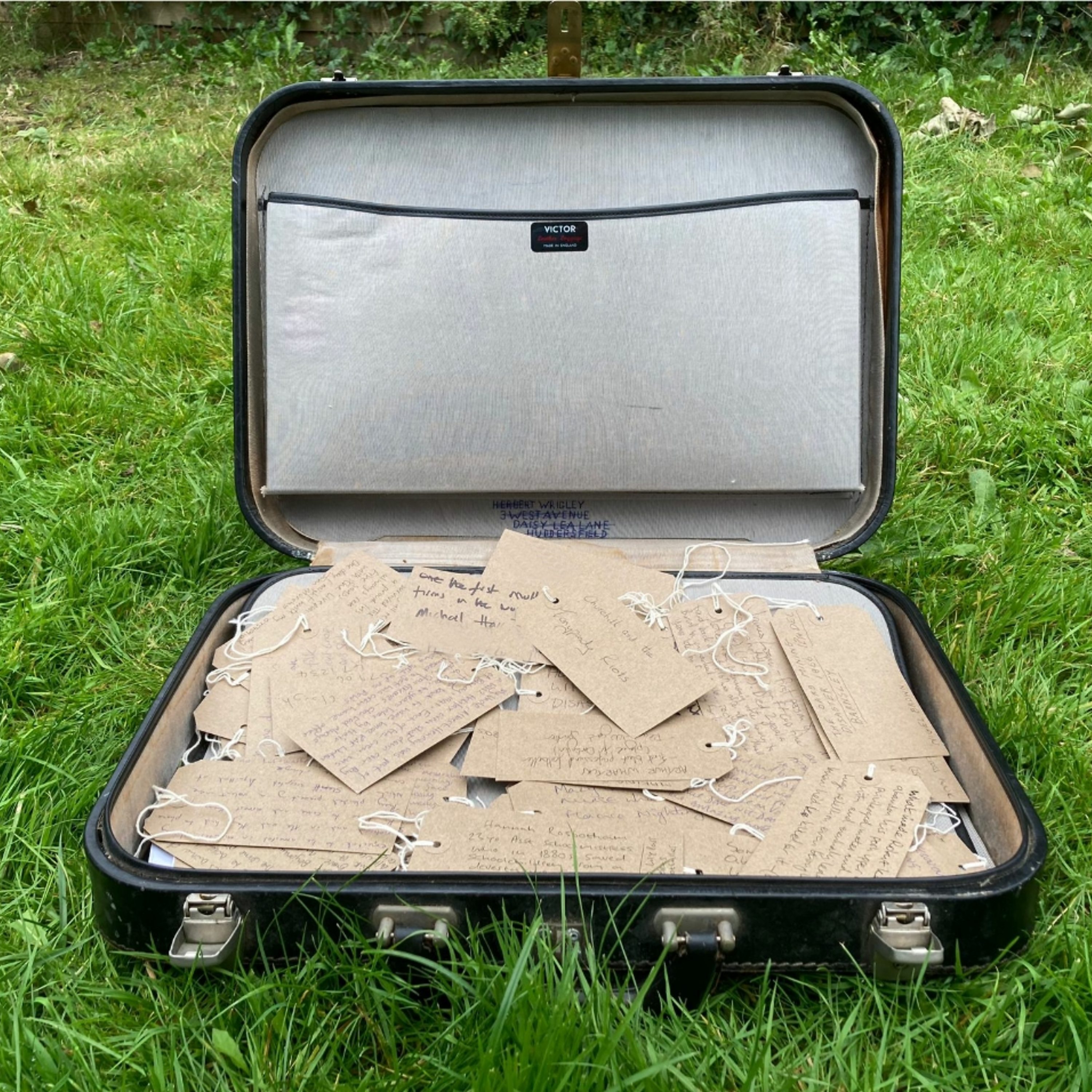
On their last tour, the award-winning folk band The Young'uns took with them an old suitcase, some blank luggage tags and marker pens, and asked audience members to fill the case with ideas for songs. Hundreds poured in with stories of hope, remembrance, love, grief and joy. In this programme, singer-songwriter Sean Cooney opens the case to find a myriad of voices all waiting...wanting to be heard. He follows three stories of love... from a couple who found each other in their 70s through their shared passion of Middlesbrough Football Club, to a story of love, loss and renewal on the banks of the Thames. He meets up with Angela to hear a tale of how some borrowed boots outside a disco led to several dates, a marriage and three children. Inspired by this wonderful story, Sean writes a song to surprise the man with the borrowed boots - Angela's now-husband.Presenter: Sean Cooney Producer: Elizabeth Foster
Lasting Lessons
Alongside their A-levels, five 17 year-olds volunteer for six months at a hospice in Surrey. These are young people who hope to work in healthcare one day and, for one reason or another, feel drawn to helping others. Their hopes and fears are similar to most people who've never been to a hospice, which includes their parents, and they have have no idea what they'll encounter. Above all, there are worries that it will be very sad, and too much for people of their age to handle.Pretty quickly, they get to know the nurses at the hospice, who have a great sense of humour and are not in the least bit despairing. The volunteers feel awkward at first, and scared of getting things wrong, but with the nurses' encouragement, they begin talking with patients, feeding them, moving them, brushing their teeth, and helping them to the toilet. Little by little, they get to know patients, gain confidence and maturity and start to form a new understanding of dying and death.With many thanks to the staff of the Princess Alice Hospice and to Lizzie Leigh in particular. Presented by Farida Abdelhamid Produced by Tim Moorhouse A Just Radio production for BBC Radio 4
A Man Without Bees
Why are all the bees dying? Simon Mitambo, an expert from Kenya's so-called 'Land of Bees', travels from his own affected community to huge industrial farms in search of answers. It is a journey both planetary and personal: without bees, can Simon's world survive?Presenter: Simon Mitambo Producer: Lucy Taylor Field producer: Mel Myendo Researcher: Georgie Styles Exec Producer: Dan Ashby Sound design and mixing: Jarek ZabaA Smoke Trail Production for BBC Radio 4.
Hervé's Way: The Story of a One-legged Pilgrim
Hervé lost a leg in a motorbike accident. On the eve of the operation, he made a deal with God: “If I walk again, I'll go to Santiago.” He did walk again, but not on pilgrimage. Instead, he got caught up in his business affairs, had a burn out, tried to kill himself and spent several months in a psychiatric hospital before he decided to keep his side of the bargain. He set out, with crutches and a prosthetic leg, for Santiago de Compostela, a journey of 1,920 kilometres from his home in Brittany in north west France to the cathedral that contains the relics of Saint James at the tip of north west Spain. The experience utterly changed him. It was, he says, a resurrection. He is now embarking on a second pilgrimage which will cover almost twice the distance; from Rome to Santiago de Compostela. John Laurenson walks with him for a couple of days to hear his story and talk about life, God, pilgrimage, about Luther's criticism – that they are a waste of time - and the sacrifice they can represent for his family of a wife and four children. John also talks to him about how, in a part of the world where religious observance has become the affair of a small minority, going on pilgrimages in Europe has never been more popular with new routes opening all the time.This episode was first broadcast on BBC World Service on 24 May, 2024.Producer / Presenter: John Laurenson
John Meagher: The Divil's Own
Did you ever have a recurring dream that you think might just be a memory? Or a nightmare so vivid that it could almost be real? John Meagher has. He’s been dreaming about a group of devil worshippers who may or may not have terrorised his home town of Newry, Northern Ireland since the early 90s. John takes us on a funny, fearful and surprising journey of discovery across Northern Ireland to uncover the truth behind the story of "The Whitehoods" of Newry and discovers that the "Satanic Panic" wasn't exclusive to his home town. But what was really going on? And why do so many towns in the North have a similar story?Can John find out the truth and lay these memories to rest? Is there any truth to be found at all in this land of saints, scholars and spoofers? For the sake of his sleeping patterns and his marriage, John is determined to find out.A Fabel production for BBC Radio 4
Reaching for Rossini
In an engaging programme full of beautiful music, Joanna Robertson eavesdrops on a cast of talented young opera singers from around the world, as they work on favourite arias to perfect the style of "bel canto" ("beautiful singing"). They have come to the bel canto summer school of the Georg Solti Accademia, in the small Italian seaside town of Castiglione della Pescaia in Tuscany. The academy was founded in memory of the legendary conductor who had his summer residence here. We listen in on the world-class students as they hone their bel canto technique with leading vocal coaches, opera singers and conductors. "Bel canto" is now on UNESCO's list of Intangible Cultural Heritage. It is both a style of singing and a repertoire. It requires vocal artists to produce a penetrating yet luxuriantly smooth, and very expressive sound - often with virtuosic and dazzling runs of notes. Bel canto singing can be heard above an orchestra, without the help of amplification. It sounds effortless, but takes years to learn. It can be used for any style of music, but the repertoire most closely associated with it are operas by the nineteenth century Italian composers Rossini, Bellini and Donizetti. Joanna joins the young singers and their teachers to find out more about bel canto and to hear how this sound is produced. Producers: Arlene Gregorius and Joanna Robertson Editor: Penny Murphy Production Coordinator: Maria Ogundele Sound mix: Andy Fell Photo of Rebecca Gulinello by Jennifer LorenziniWith special thanks to Jonathan Papp, Artistic Director, and all at the Solti Accademia 2024 Young artists heard in this programme: Eva Rae Martinez - Soprano Rebecca Gulinello - Soprano Aebh Kelly - Soprano Clover Kayne - Mezzo Soprano Xavier Hetherington - Tenor Oliver Heuzenroeder - Baritone
Brood X
Every seventeen years in the eastern United States, a roaring mass of millions of black-bodied, red-eyed, thumb-length insects erupt from the ground. For a few glorious weeks the periodical cicadas cover the trees and the air vibrates with their chorus of come-hither calls. Then they leave a billion eggs to hatch and burrow into the dirt, beginning the seventeen year cycle all over again. Sing. Fly. Mate. Die. This is Brood X or the Great Eastern Brood. It’s an event which, for the residents of a dozen or so US states, is the abiding memory of four, maybe five, summers of their lives. In a programme that’s both a natural and a cultural history of the Great Eastern Brood we re-visit four Brood X years....1970, 1987, 2004 and 2021…. to capture the stories of the summers when the cicadas came to town. Princeton University's Class of 1970 remember the cicadas’ appearance at their graduation ceremony, during a time of student unrest and protest against the Vietnam War; a bride looks back to the uninvited - but welcome - cicada guests attending her wedding; a musician recalls making al fresco music with Brood X; and an entomologist considers the extraordinary life cycle of an insect which is seems to possess both great patience and the ability to count to seventeen. Brood X cicadas spend 17 years underground, each insect alone, waiting and listening. In 2021, as Brood X stirred and the air began to thicken with the cicadas’ love songs, we all shared with them that sense of emerging from the isolation of lockdown and making a new beginning.Featuring: Elias Bonaros, Liz Dugan, Anisa George, Ray Gibbons, Peter Kuper, Gene Kritsky, Gregg Lange, David Rothenberg, Gil Schrage and Gaye WilliamsProducer: Jeremy GrangeCicada audio recorded by Cicada Mania and David RothenbergProgramme Image: Prof. Gene Kritsky