
How to Lower Your Tax Bill
30 episodes

S1 Ep 30How To Lower Your Tax Bill Episode 30
How Much Profit Should You Keep in Your Business?For business owners wondering how to manage profits wisely, this episode is essential listening. Host Terrance Hutchins and co-host T’mia explore the strategic decision-making process behind retaining money in your business, explaining how much to keep, why it matters, and how it all ties into taxes.Building on previous episodes about where profit goes—like taxes, debt, and reinvestment—this conversation centers on the crucial (and often overlooked) topic of retained earnings. Whether you're a seasoned entrepreneur or a new S-corp owner, you’ll walk away with a clearer understanding of financial planning inside your business.What You’ll Learn in This Episode:Why retaining profit is essential for long-term business stability and growthThe difference between C-corporations and pass-through entities when it comes to taxesHow to calculate and set up a proper rainy day fund for your businessStrategic reasons to retain money beyond emergency savings—like hiring or equipment replacementA breakdown of how to allocate business profits (taxes, reinvestment, savings, distributions)Why understanding distributions is key—and what most people get wrongFeatured Tax Tip:Retaining profit doesn’t change your tax liability in an S Corp—the IRS still taxes you on what your business earns, not what you take out. Just like your kids ordering dinner doesn’t mean they’re paying the bill, your S Corp passes the check to you. Plan accordingly.If you’re building a business, don’t just focus on making money—focus on allocating it wisely. Learn how to prepare for surprises, fund your future, and structure your finances with tax-smart strategy.Subscribe to How to Lower Your Tax Bill on Spotify or Apple Podcasts. Keep More of What You Earn.

S1 Ep 29 How To Lower Your Tax Bill Episode 29
In this episode of How to Lower Your Tax Bill, host Terrance Hutchins and co-host T’mia continue their series on managing profits for small business owners. This time, the spotlight is on reinvesting profits back into your business—and how to do it in a way that actually builds long-term value.Whether you're new to entrepreneurship or scaling an established business, this conversation will help you rethink what profit really is, why some owners are unknowingly devaluing their businesses, and how reinvesting strategically can save you thousands in taxes while setting up future growth.Key Discussion Points:Why your business profits aren’t really profit if you’re underpaying yourselfThe four areas where reinvestment makes the biggest impact: people, systems, processes, and marketingHow to set a baseline return on investment before reinvesting a dollarWhat “return on invested capital” is—and how it tells you if your business is healthyWhy a big tax write-off now can mean lower taxes today and lower capital gains laterFeatured Tax Tip:Reinvesting in your business reduces taxable profit today—and if that increases your business’s value, you’ll pay a lower capital gains tax rate (capped at 20%) when you sell, instead of ordinary income tax rates (which can be over 30%). That's a strategic win.If you’ve ever wondered where your profit goes—or how to turn it into more revenue instead of just expenses—this episode is your roadmap.Subscribe to How to Lower Your Tax Bill on Spotify or Apple Podcasts — and as always, Keep More of What You Earn.

S1 Ep 28How To Lower Your Tax Bill Episode 28
Is Business Debt Worth It? Tax Truths You Need to KnowIn this episode of How to Lower Your Tax Bill, host Terrance Hutchins and co-host T’mia continue their series on what to do with your business profits—this time diving into the realities of using debt as a business strategy. Whether you're thinking of financing a new vehicle, bidding on a big project, or taking out a loan to expand, this episode unpacks what debt really costs you from a tax and cash flow perspective.Ideal for business owners navigating decisions about loans, reinvestment, and capital expenses, this conversation helps you think critically about whether the “tax write-off” is actually worth the debt you’re taking on.Key Discussion Points:Why debt feels like a tax win—but can drain your cash in year twoThe danger of spending $1 to save 40 cents: why tax write-offs aren't always smartHow to evaluate if a project is worth financing and what poor forecasting can cost youUnderstanding “cash trapped in the balance sheet” and how delayed payments can trigger tax troubleWhat good debt looks like: using loans to buy assets that pay for themselves—and then someFeatured Tax Tip:Buying a vehicle to reduce your tax bill can backfire—fast. Only the interest on your loan is deductible after year one, not the principal. If your new asset isn’t generating profit, your debt may cost you more than the taxes you saved.Whether you're a cautious entrepreneur or an ambitious growth-seeker, this episode gives you practical tools to forecast smartly, avoid unnecessary debt, and keep your profits working for you—not your lender.Subscribe to How to Lower Your Tax Bill on Spotify or Apple Podcasts — and as always, Keep More of What You Earn.

How To Lower Your Tax Bill Episode 27
One Big Beautiful Bill, Part 2: Advanced Opportunities & Loopholes for Savvy TaxpayersHost Terrence Hutchins and returning guest David Stevens shift from “what changed” to “how to exploit it.” This follow-on conversation mines the fine print of the “One Big Beautiful Bill,” surfacing planning angles that tipped employees, high-income coastal professionals, and growth-minded business owners can act on right now.Key takeawaysSALT cap relief—finally a workaround Deduct up to $40 k of state & local taxes (phasing out above $500 k AGI) through 2030; pair it with strategic charitable giving to stack deductions.Tip & overtime exclusions First $25 k in combined tips/overtime ($12.5 k single) is off-limits to the IRS for earners under $300 k AGI—only 2025-2028, so document every dollar.New “personal perks” bucket Car-loan interest on U.S.-assembled vehicles (max $10 k), “Trump Accounts” for newborns, and supersized 529 uses for tutoring & therapy up to $20 k—each with sunset dates readers should diary.Charitable & family credits rebooted A resurrected $2 k above-the-line charity deduction, refundable $5 k adoption credit, plus HSA compatibility for bronze plans—great news for gig-economy families.Business-owner bonanza 100 % bonus depreciation on manufacturing/refining buildings (four-year window), immediate R&D expensing, tighter but more lucrative corporate-giving thresholds, and beefed-up Qualified Opportunity Zone and QSBS incentives.Farmer-friendly gain spreading Capital gains from farm sales can be recognized over four years when property stays in long-term agricultural use—easing cash-flow hits and succession plans.Featured Tax Tip Waiting tables or bartending in 2025? Track tips daily with a simple phone spreadsheet—the first $25 k you record could be 100 % tax-free under the new exclusion.Stay tuned! Subscribe to How to Lower Your Tax Bill on Spotify or Apple Podcasts — and as always, Keep More of What You Earn.

S1 Ep 26How To Lower Your Tax Bill Episode 26
Episode 26 – “Decoding the ‘One Big Beautiful Bill’: How the New Tax Law Impacts Families & Businesses (Part 1)”In this webinar-style episode, host Terrence Hutchins teams up with tax partner David Stevens to unpack the sweeping “One Big Beautiful Bill.” If you’re an individual taxpayer, parent, real-estate investor, or small-business owner wondering what stays, what changes, and where new savings may hide, this conversation is for you.Key Takeaways2018 rate brackets made permanent – the top rate holds at 37 %, averting a scheduled jump back to 39.6 % and sparing most filers an automatic tax hikeHigher, inflation-indexed child tax credit – boosted from $2,000 to $2,200 per qualifying child and set to rise with the CPIStandard deduction locked in – roughly the first $31,500 of married-filing-joint income remains tax-free, keeping itemizing optional for ~70 % of householdsEstate & gift exemption climbs to $15 million per person, giving high-net-worth families fresh breathing room for legacy planningBusiness-friendly perks – 100 % bonus depreciation and an expanded $2.5 million §179 expensing limit become permanent, super-charging upfront deductions on equipment and cost-seg studiesPaperwork relief – 1099-MISC/K reporting kicks in at $2,000 (up from $600), reducing the form flood for contractors and platformsFeatured Tax TipConsidering a major equipment purchase or a cost-segregation study? Lock it in while 100 % bonus depreciation and the beefed-up §179 limits are available—front-loading those deductions can offset other active or passive income this year.Subscribe to How to Lower Your Tax Bill on Spotify or Apple Podcasts and, as always, Keep More of What You Earn.

S1 Ep 25How To Lower Your Tax Bill Episode 25
Episode 25: What To Do With Business Profits — And How They Affect Your TaxesIf you’re a small business owner or aspiring entrepreneur wondering what happens after you make a profit, this episode is for you. Host Terrance Hutchins and guest Tamia break down how to think about your business income strategically, plan for taxes, and avoid common mistakes that lead to IRS trouble. Learn how to shift your mindset from just “owning a job” to building a profitable, sustainable company that pays you and funds future growth.Key Discussion Points:Why paying yourself a fair market salary is crucial to measuring true profitThe “two hats” every owner wears: employee and shareholder — and how each is taxedFive smart ways to use profits: paying taxes, paying off debt, retaining as reserves, reinvesting in the business, and taking owner distributionsHow to plan ahead for quarterly tax payments to avoid penalties and stressPractical examples of overlooked deductions like the Augusta Rule, home office, mileage, and kids on payrollFeatured Tax Tip: Always treat taxes as a business expense — factor them in like rent or payroll. Look at your prior tax returns (line 24 divided by line 11) to estimate your tax percentage, then set aside that portion of every dollar you make to stay ahead of the IRS.Planning for taxes is just as important as planning your next client pitch or hiring decision. Build tax savings into your cash flow now so you don’t get stuck paying penalties later. Subscribe to How to Lower Your Tax Bill on Spotify or Apple Podcasts — and Keep More of What You Earn.

How to Lower Your Tax Bill Episode 24
From Laid Off to Launched — A Real Talk on Starting Your Business and Managing Taxes.Thinking about starting your own business? In this episode, host Terrence Hutchins sits down with co-host Tamia Kelly for an honest, behind-the-scenes conversation about her journey from corporate layoff to launching her own insurance agency. If you’ve wondered what really goes into starting a business — and how to handle the tax side — this episode is for you.Key Highlights:Why Tamia decided to start her insurance agency after being laid off — and how she knew it couldn’t just be a side hustle.The unexpected costs and overlooked expenses every new business owner should plan for.How the IRS treats start-up and operational expenses — and why forecasting matters.The pitfalls of self-funding vs. taking a business loan — and how each affects your taxes.A practical breakdown of sweat equity, capital investment, and how to plan for ROI.Featured Tax Tip: Did you know the IRS lets you deduct up to $5,000 of qualifying start-up expenses — but only if you plan and track them correctly? Good forecasting and clear separation of business vs. personal funds can help you maximize this deduction and avoid surprises at tax time.If you’re dreaming of starting your own business — or already in the middle of it — Tamia’s lessons learned will help you do it wisely, stay tax-smart, and avoid rookie mistakes.Subscribe to How to Lower Your Tax Bill on Spotify or Apple Podcasts. Keep More of What You Earn.

S1 Ep 23How to Lower Your Tax Bill Episode 22
Is Starting a Business Worth It? A Financial Reality CheckThinking of launching a business to save on taxes? In this episode, Terrence Hutchins and co-host T’mia break down what many aspiring entrepreneurs overlook: the true financial costs of starting a business—and whether it's worth your time. This is the first of a three-part series unpacking the mindset, math, and tax implications behind the decision to become a business owner.Perfect for side hustlers, freelancers, or anyone evaluating whether entrepreneurship is the right path, this episode walks through a practical framework to help you decide with clarity and confidence.Key Takeaways:Profit vs. Passion: Why business should be about making money, not just saving on taxes or chasing passion alone.Know Your Worth: How to calculate your hourly rate and determine if your business idea can exceed that value.Startup vs. Operating Costs: Learn the difference between upfront and ongoing expenses—and why many new business owners underestimate both.Minimum Revenue Math: Use this formula to reverse-engineer how much income you need to make entrepreneurship viable.Value-Based Pricing: Six reasons people will pay you—and how to communicate that value without underselling yourself.Featured Tax Tip:Startup Write-Offs: The IRS allows up to $5,000 in organizational expenses and $5,000 in startup expenses to be deducted in your first year of business—if you have a genuine profit motive. Don't mistake a hobby for a company, or you'll lose this powerful benefit.Leaping into entrepreneurship can offer freedom, but it’s not free. Listen in to learn how to value your time, price your services, and plan for taxes before you dive in.Subscribe to How to Lower Your Tax Bill on Spotify or Apple Podcasts. Keep More of What You Earn.

S1 Ep 22How To Lower Your Tax Bill Episode 23
Before You Form an LLC: What Every New Business Owner Needs to KnowThinking about starting a business? This episode is for entrepreneurs and aspiring business owners ready to take their first step—but unsure what comes first: pricing, systems, or an LLC. Host Terrance Hutchins and co-host T’mia Kelly dive into the practical and financial considerations that can make or break a new venture. From setting up the right structure to avoiding common (and costly) tax mistakes, this conversation is a must-listen for anyone wanting to start smart.Key Topics Covered:Pricing and Profitability: Why competing on price is usually a losing game—and how to define a value proposition that actually pays.Core Business Systems: The four essential systems every startup needs: attracting, converting, servicing, and retaining customers.Business Expenses vs. Business Value: A powerful mindset shift for evaluating every dollar spent through a lens of long-term business value.The Truth About LLCs and S Corps: Clarifying what LLCs do (and don’t do) for taxes—and when an S corporation makes sense (hint: not at the beginning).Good Habits From Day One: How monthly “board meetings,” separate bank accounts, and record-keeping can set the foundation for compliance and future deductions.Featured Tax Tip:Use the Augusta Rule to pay yourself tax-free. If you hold legitimate board meetings (even solo) at your home, your corporation can rent the space—allowing you to move money from your business to yourself with no tax hit, up to 14 times per year.Subscribe to How to Lower Your Tax Bill on Spotify or Apple Podcasts. Keep More of What You Earn.Let me know when you're ready for Episode 24 or if you'd like me to add this one to the catalog next.

S1 Ep 21How To Lower Your Tax Bill Episode 21
Why Small Business Owners Owe the IRS—and How to Avoid ItIn this episode of How to Lower Your Tax Bill, host Terrance Hutchins is joined by co-host T’Mia Kelly to explore the top five tax mistakes small business owners make—and how to avoid them. If tax season caught you off guard this year, this episode is packed with real-world insights and practical strategies to help you stay ahead of the IRS, avoid penalties, and better plan your business finances.Whether you're new to entrepreneurship or a seasoned business owner, understanding these pitfalls can save you thousands.Key Topics Covered:Why underpaying estimated taxes can trigger costly IRS penaltiesThe “Safe Harbor” and “Pay-As-You-Go” methods for managing estimated paymentsWhy paying in cash doesn't exempt you from reporting incomeThe dangers of commingling business and personal expensesThe true cost of buying things "just to save on taxes"Why taking advice from TikTok or social media can get you in trouble with the IRSFeatured Tax Case: In Trinidad v. United States (1977), the court denied a nightclub owner’s attempt to deduct the living expenses of his live-in girlfriend, even though he claimed her presence helped him stay “relaxed and happy” for work. The IRS ruled that personal relationships—even morale-boosting ones—aren’t legitimate business deductions.Pro Tip: Avoid tax trouble by setting up proper systems early on—like separating your business and personal finances, issuing 1099s to contractors, and seeking professional advice before making big purchases or financial moves.For more strategies to reduce your tax bill, subscribe to How to Lower Your Tax Bill on Spotify, Apple Podcasts, or your favorite platform.And remember: Keep More of What You Earn.

S1 Ep 20How To Lower Your Tax Bill Episode 20
Phantom Income: Why You Might Owe Taxes on Money You Didn't Actually ReceiveIn this episode of How to Lower Your Tax Bill, host Terrence Hutchins explains one of the trickiest pitfalls in tax planning—phantom income. Terrence breaks down the critical IRS doctrines of constructive receipt and economic benefit, helping you understand why you might owe taxes even when you don’t have cash in hand.Whether you’re a business owner, investor, or receive stock-based compensation, this episode will help you spot hidden tax traps and plan ahead more effectively.Key Topics Covered:How tax law defines income—even when you haven’t been paidReal-world examples where taxes can hit harder than expectedWhat to know about depreciation, business vehicles, and partnership incomeWhy proper planning can prevent costly surprisesFeatured Tax Case: In Sproul v. Commissioner (1945), the court ruled that even though a trust payout was scheduled for future years, the taxpayer owed tax immediately due to guaranteed access. A key reminder that tax law doesn't always follow the cash.For more smart tax strategies, subscribe to How to Lower Your Tax Bill on Spotify or Apple Podcasts.And remember: Keep More of What You Earn.

S1 Ep 19How To Lower Your Tax Bill Podcast Episode 19
Write It Off? Not So Fast — Common Tax Deduction Myths DebunkedIn this lively and eye-opening episode of How to Lower Your Tax Bill, host Terrence Hutchins is joined again by now co-host T’mia Kelly to break down one of the most misused phrases in personal finance—"Just write it off!" From W-2 employees trying to claim home office deductions to well-meaning givers misunderstanding charitable write-offs, this episode tackles the biggest misconceptions around tax deductions.Terrence and T’mia explain why context matters, what’s actually deductible, and how blindly chasing write-offs can cost you more than it saves. This episode is a must-listen as we approach tax deadlines and gear up for smarter tax planning in the year ahead.Key Topics Covered:The origin of the “just write it off” mindset—and why it’s flawedCommon tax deduction mistakes W-2 employees make (hint: your home desk setup may not qualify)Why charitable giving (including GoFundMe and goodwill donations) often doesn’t deliver the tax benefits people expectWhen home improvements and vehicle purchases are not tax-smartWhy filing separately when married can cost you more in taxesMissed opportunities with 401(k) and HSA contributionsKey advice: don’t confuse tax planning with tax filingFeatured Tax Reminder: You can't "write off" what you don’t understand. Documentation, timing, and proper classification are key to maximizing real deductions—and avoiding disappointment at tax time.For more clarity on how to separate fact from fiction in your tax planning, subscribe to How to Lower Your Tax Bill on Spotify or Apple Podcasts.And as always: Keep More of What You Earn.#KeepMoreOfWhatYouEarn

S1 Ep 18How To Lower Your Tax Bill Episode 18
Rental Property Deductions: What Landlords Need to KnowIn this episode of How to Lower Your Tax Bill, host Terrence Hutchins dives into one of the most potent tax tools for real estate investors—rental property deductions. Whether you’re managing a single unit or a growing portfolio, Terrence breaks down what qualifies as rental income, what deductions landlords often miss, and how to avoid trouble when renting to family or below market.Key Topics Covered:What qualifies as rental income (including security deposits, lease break fees, and payments in kind)How rental income is taxed and when net investment income tax appliesWhat landlords can deduct:How to fix missed depreciation deductions from past years using Form 3115The Qualified Business Income (QBI) deduction and when to use the Safe Harbor electionWhy renting to family or charging below-market rent makes your property a not-for-profit rental, disqualifying you from valuable deductionsA key court case (Barte v. Commissioner, 1998) that shows why renting to relatives at a discount can cost you at tax timeFeatured Tax Tip: Renting out a property for 14 days or less? That income can be tax-free—but if you rent long-term to family below market, expect limited deductions and potential gift tax concerns.If you’re in the rental game, make sure you’re getting every tax break available—and avoiding traps that can cost you thousands. Subscribe to How to Lower Your Tax Bill on Spotify or Apple Podcasts.And as always: Keep More of What You Earn.
How to Lower Your Tax Bill Episode 17
Are You a Real Estate Dealer or Investor? Why It Matters More Than You ThinkEpisode Description: In this episode of How to Lower Your Tax Bill, Terrence Hutchins explores a key distinction that could dramatically affect how much tax you owe on your real estate income: are you a dealer or an investor? If you’re flipping houses or building a rental portfolio—or doing both—how the IRS classifies your activity can mean the difference between capital gains taxes or ordinary income plus self-employment tax.Terrence walks through how the IRS makes this classification, what the tax consequences are, and what you can do to protect your profits. He also shares a powerful seven-point filter for analyzing real estate investments and wraps up with a fascinating tax court case that could help you if the IRS challenges your classification.Key Topics Covered:The seven-part filter to assess real estate deals: risk, upside, tax treatment, control, effort, time, and feesDealer vs. investor classification and how the IRS determines your statusWhy your intent and documentation matter more than your titlesThe tax impact:Dealers pay ordinary income tax and self-employment taxInvestors pay long-term capital gains tax (if held more than a year)Dealers can’t use depreciation or 1031 exchanges—but investors canHow to avoid accidentally being classified as a dealerTips for structuring your real estate activity: use of LLCs, separate accounts, tracking time, and keeping recordsWhen using an S corporation might help flippers reduce self-employment taxFeatured Tax Case: In Byron v. Commissioner, John Byron sold 22 real estate properties over three years, netting $3.4 million. The IRS classified him as a dealer—but the court disagreed, citing his lack of active marketing, minimal involvement, and intent to hold for investment. The result? Byron paid capital gains tax instead of a much higher ordinary income tax rate.This case highlights why documentation and strategy can make or break your tax outcome.For more real estate tax tips, subscribe to How to Lower Your Tax Bill on Spotify or Apple Podcasts. And as always: Keep More of What You Earn.#KeepMoreOfWhatYouEarn

S1 Ep 16How To Lower Your tax Bill Episode 16
Tax Deductions & Credits: What You Don’t Know Could Cost YouIn this episode of How to Lower Your Tax Bill, host Terrence Hutchins is joined by T’mia Kelly to break down the difference between tax deductions and credits—and how understanding them can save you thousands. They dive into carry-forward tax benefits, the importance of reviewing last year’s tax return, and how historical tax changes (like the introduction of the standard deduction in 1944) continue to impact taxpayers today.Key Topics CoveredThe difference between tax credits (dollar-for-dollar reductions) vs. tax deductions (which lower taxable income).Common carry-forward deductions that can lower your tax bill in future years, including:Net Operating Losses (NOLs) for business owners.Capital losses from stocks and investments.Passive activity losses from rental properties.Charitable contribution carry-forwards for those who donate large sums.Business tax credits like the Work Opportunity Tax Credit (WOTC) and R&D credit—and how to leverage them.How solar panels and energy-efficient home upgrades qualify for tax credits (but don’t believe every salesperson’s pitch).The importance of reviewing last year’s tax return to avoid missing out on deductions and credits you’re entitled to.Featured Tax FactDid you know that before 1944, tax brackets were so complex that President Franklin D. Roosevelt would submit his tax return half-completed with a $15,000 check, telling the IRS to "send him an invoice" for the balance? The complexity of tax deductions at the time led to the creation of the standard deduction to simplify the process for Americans.For more expert tax strategies, subscribe to How to Lower Your Tax Bill on Spotify or Apple Podcasts. And as always: Keep More of What You Earn!#KeepMoreOfWhatYouEarn

S1 Ep 15How To Lower Your Tax Bill Episode 15
Smart Tax Refund StrategiesIn this episode of How to Lower Your Tax Bill, host Terrence Hutchins and guest T’mia Kelly debunk tax refund myths and explain why a big refund isn’t always a win. Learn how to adjust your withholdings and keep more of your money year-round.Key Takeaways:Why Tax Refunds Feel Good: The psychology behind refunds.How Refunds Work: Withholdings, deductions, and credits explained.Optimizing Your W-4: Adjust withholdings to avoid overpaying taxes.Side Hustle Tax Planning: Track income and expenses to prevent surprises.The Time Value of Money: Why keeping your money upfront is smarter.Featured Tax Insight:The Time Value of Money: Why a dollar today is worth more than a dollar in the future and how it applies to your tax refund.For more tax-saving insights, subscribe to How to Lower Your Tax Bill on Spotify or Apple Podcasts. Have questions? Email [email protected], and we’ll answer them in a future episode. Keep more of what you earn!
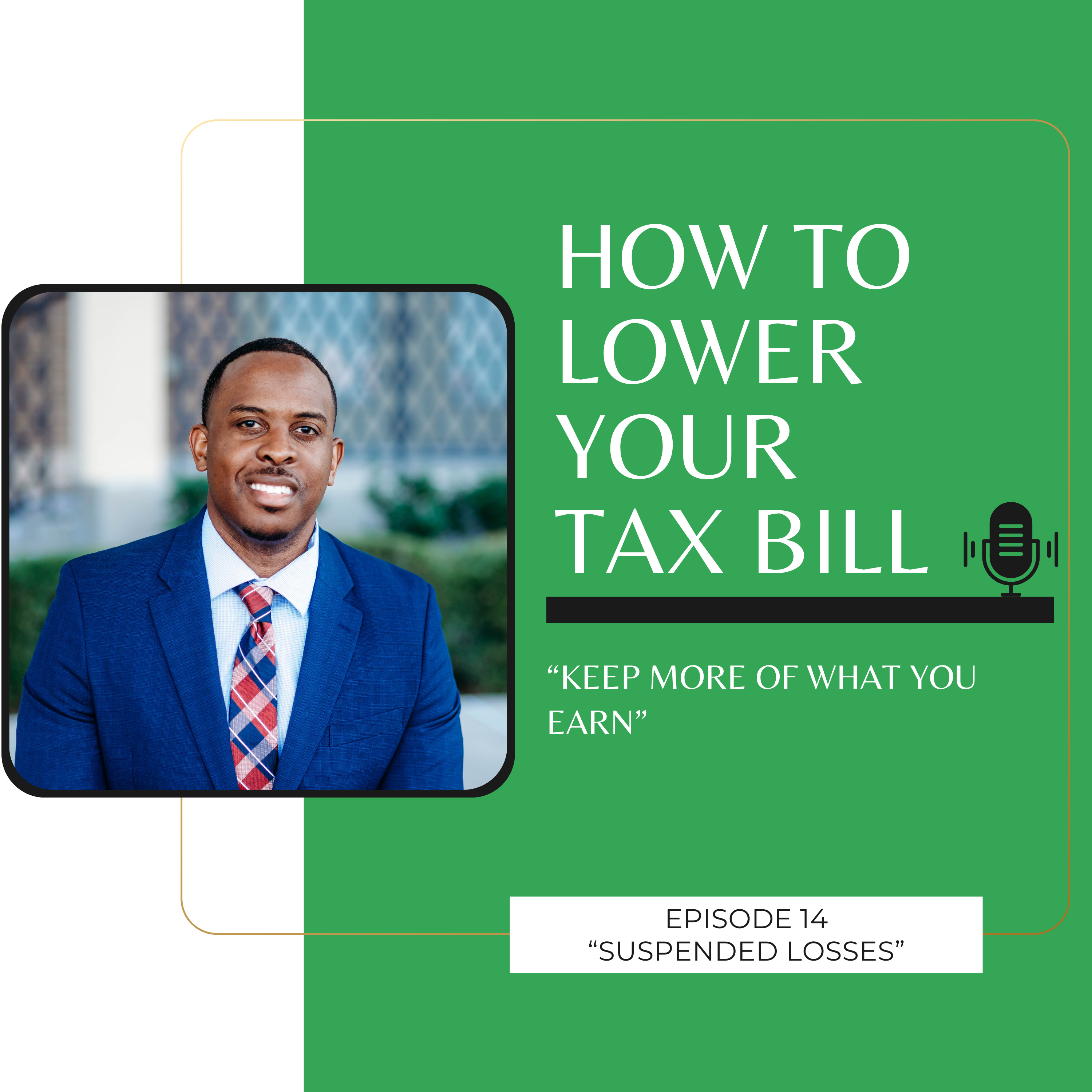
S1 Ep 14How To Lower Your Tax Bill Episode 14
Understanding Suspended Losses: Real Estate Tax StrategiesIn this episode of How to Lower Your Tax Bill, host Terrence Hutchins dives into suspended real estate losses—what they are, why they happen, and how to unlock them for tax savings.What You’ll Learn:What Are Suspended Losses? How the 1986 tax law introduced passive activity loss rules and how they impact real estate investors.Income Thresholds for Deductions:If income is below $100,000, up to $25,000 of losses can be deducted.Between $100,000 - $150,000, the deduction phases out.Above $150,000, losses are suspended and carried forward.Strategies to Unlock Suspended Losses:Lowering Taxable Income: 401(k) contributions and other deductions to stay below $150,000.Generating Passive Income: Offset gains from real estate partnerships or short-term rentals.Becoming a Real Estate Professional: Meeting the 750-hour rule to deduct losses in the current year.Selling a Property: Unlocking losses upon the sale of an individual property.Grouping Election Strategy: Combining multiple properties to meet material participation rules.Featured Tax Case: May vs. Commissioner (2005) – A real estate investor lost deductions due to failing to elect property grouping. This case highlights the importance of properly documenting participation and making necessary tax elections.For more tax-saving strategies, subscribe to How to Lower Your Tax Bill on Spotify or Apple Podcasts. Have questions? Email [email protected] and we’ll address them in a future episode. The key to tax planning is not just reducing your bill—it’s keeping more of what you earn.

S1 Ep 13How To Lower Your Tax Bill Episode 13
Repairs vs. Improvements: Maximizing Your Rental Property DeductionsIn this episode of How to Lower Your Tax Bill, host Terrence Hutchins explains the critical differences between repairs and improvements for real estate investors and W-2 filers with rental properties. Understanding how the IRS classifies these expenses can have a significant impact on your tax deductions and long-term financial strategy.What You’ll Learn:Repairs vs. Improvements: Repairs (e.g., patching drywall, fixing leaks) are deductible immediately, while improvements (e.g., new roof, HVAC) must be depreciated over 27.5 years.IRS Safe Harbors:Small Taxpayer Safe Harbor – Deduct up to $10,000 or 2% of property value.Routine Maintenance Safe Harbor – Deduct recurring maintenance costs.De Minimis Safe Harbor – Deduct expenses under $2,500 per item.Partial Disposition Election: Deduct the remaining cost of replaced property components.LaPointe vs. Commissioner (1990) – A real-world case where a taxpayer incorrectly classified renovations as repairs instead of improvements, leading to disallowed deductions and increased tax liability.For more tax-saving strategies, subscribe to How to Lower Your Tax Bill on Spotify or Apple Podcasts. If you have questions, email [email protected], and we’ll address them in a future episode. The key to tax planning is not just reducing your bill—it’s keeping more of what you earn.

S1 Ep 12How To Lower Your Tax Bill Episode 12
Installment Sales: Tax Strategy for Deferring Capital GainsIn this episode of How to Lower Your Tax Bill, host Terrence Hutchins explores how installment sales can help defer capital gains taxes and provide flexible income streams for property owners and business sellers. Terrence, a financial and tax advisor in the Dallas-Fort Worth area, breaks down the rules, benefits, and potential pitfalls of this strategy.What You’ll Learn:Installment Sale Basics: What qualifies as an installment sale and why you might choose this strategy.Tax Benefits: How deferring capital gains taxes can help reduce your overall tax burden.Interest Requirements: When and why you must charge interest on deferred payments.Depreciation Recapture: Why depreciation must be reported as ordinary income in the first year of sale.Income Splitting Strategy: How married couples can split property sales to avoid IRS interest charges.Special Considerations:Transaction Limits: No interest required for sales under $150,000, but interest payments to the IRS apply to sales over $5 million.Related Party Rule: Sales to family members who sell the property within two years trigger immediate taxation.Restricted Use: House flippers and stock sales do not qualify for installment sales.Business Sales: How contingent payments tied to business performance impact taxable income.Tax Court Case Spotlight:Police vs. Commissioner: A restaurant sale case that highlights the IRS’s requirement to report depreciation recapture as ordinary income in the first year.Tax Forms to Know:Form 6252: Required for reporting installment sales.Form 4797: For rental property sales.Form 8594: For business asset sales.Pro Tip: Combining a 1031 exchange with an installment sale can help defer taxes on both replacement properties and cash proceeds.For more tax-saving strategies, subscribe to How to Lower Your Tax Bill on Spotify or Apple Podcasts. Have questions? Email [email protected] and get your answers in future episodes.

S1 Ep 11How To Lower Your Tax Bill Episode 11
1031 Exchange Tax Strategy for W-2 Filers and Real Estate InvestorsIn this episode of How to Lower Your Tax Bill, host Terrence Hutchins breaks down the 1031 exchange process for W-2 earners and real estate investors. As a financial and tax advisor in the Dallas-Fort Worth area, Terrence explains how this strategy helps defer capital gains taxes and maximize tax savings.What You’ll Learn:1031 Exchange Basics: What it is, how it started, and why the IRS incentivizes real estate reinvestment.Key Rules for Success: Same taxpayer requirement, qualifying property types, and investment holding periods.Timelines to Remember: 45 days to identify new properties and 180 days to close the transaction.Qualified Intermediary Requirement: Why you need a neutral third party to handle funds.Key Tax Considerations:Boot and Gain Recognition: Understanding when you might owe taxes during the exchange process.Depreciation and Basis Tracking: How to keep accurate records across multiple property exchanges.Advanced Techniques: Reverse exchanges, split basis elections, and combining Section 1031 with Section 121 for mixed-use properties.Featured Tax Story:Declean vs. Commissioner (2000) – A real-life example of a taxpayer who lost a tax court case for improperly handling a 1031 exchange.For more tax-saving tips, subscribe to How to Lower Your Tax Bill on Spotify or Apple Podcasts. Smart tax planning means keeping more of what you earn. Have questions? Email [email protected] and we’ll answer them in future episodes.

S1 Ep 10How To Lower Your Tax Bill Episode 10
Real Estate Tax Strategies for W-2 EarnersIn this episode of How to Lower Your Tax Bill, host Terrence Hutchins explains how W-2 earners can use real estate to reduce their tax burden. As a financial and tax advisor in the Dallas-Fort Worth area, Terrence breaks down three key strategies that allow employees to offset income with real estate losses and maximize tax savings.What You’ll Learn:Real Estate Loss Deductions: How W-2 earners making less than $150,000 can deduct up to $25,000 in rental losses.Short-Term Rental Strategy: How properties rented for an average of seven days or less can bypass passive loss limitations and offset W-2 income.Real Estate Professional Status (REPS): How you or your spouse can qualify as a real estate professional to unlock additional tax-saving opportunities.Key Tax Considerations:Material Participation Rules: Understanding how to meet the IRS's participation thresholds to deduct real estate losses.Grouping Elections: How combining multiple rental properties for tax purposes can impact deductions and future tax liability.Audit Risks and Compliance: Lessons from tax court cases where taxpayers failed to properly document their real estate hours and losses.Featured Tax Story:A look at past IRS cases where taxpayers attempted to claim real estate professional status or passive losses without meeting the necessary requirements—and what you should do differently to stay compliant.For more actionable tax tips, subscribe to How to Lower Your Tax Bill on Spotify or Apple Podcasts. The key to effective tax planning isn’t just reducing your bill—it’s keeping more of what you earn.

S1 Ep 9How to Lower Your Tax Bill Episode 9
Real Estate & Taxes: How Short-Term Rentals Can Offset Your W-2 IncomeIn this episode of How to Lower Your Tax Bill, host Terrence Hutchins, a financial and tax advisor in the Dallas-Fort Worth area, explains how W-2 employees can leverage short-term rentals (STRs) to reduce their taxable income. Many new real estate investors expect immediate tax benefits—only to be caught by the passive activity loss rules. But by structuring rentals strategically, you can unlock deductible losses to offset your W-2 earnings.Terrence covers:The three exceptions that allow real estate losses to offset W-2 income.The 7-day rule that distinguishes short-term rentals from passive real estate.Material participation tests and why tracking your hours is critical.The cost segregation study strategy to accelerate depreciation and maximize tax savings.The QBI deduction and how rental profits can qualify for an extra 20% tax deduction.Featured Tax Fact: In the 1985 case Moss v. Commissioner, a group of attorneys tried to deduct their daily lunch meetings as a business expense. The IRS ruled against them, emphasizing that meals must be directly related to business—so no, your daily lunch with colleagues doesn’t qualify!For more real estate tax strategies, subscribe to How to Lower Your Tax Bill on Spotify or Apple Podcasts. And remember: Keep More of What You Earn!

S1 Ep 8How to Lower Your Tax Bill Episode 8
How Real Estate Can Lower Your Tax Bill as a W-2 FilerIn this episode of How to Lower Your Tax Bill, host Terrence Hutchins dives into tax strategies tailored for W-2 filers who are real estate investors. As a financial and tax advisor in the Dallas-Fort Worth area, Terrence shares actionable tips to help you leverage real estate to grow your wealth while reducing your tax burden.What You’ll Learn:The BRRRR Strategy: How the "Buy, Rehab, Rent, Refinance, Repeat" method accelerates real estate portfolio growth and provides tax advantages.Return on Equity: Why targeting a 5% return on equity is key to achieving financial independence through real estate.Short-Term Rentals: How IRS rules on rentals averaging fewer than seven days can allow you to offset W-2 income with real estate losses.Cost Segregation Studies: Breaking down your property into depreciable components to maximize tax deductions, including accelerated depreciation benefits available in 2025.Financing Strategies: Creative ways to fund your real estate investments, including leveraging life insurance policies and stock portfolios tax-efficiently.Featured Tax Story: Terrence highlights a 2004 tax court case, Robert P. Sweet vs. Commissioner, where the IRS incorrectly classified a rental property. The couple’s victory underscores the importance of proper record-keeping, understanding the tax code, and working with knowledgeable professionals to protect your earnings.For more actionable tax tips, subscribe to How to Lower Your Tax Bill on Spotify or Apple Podcasts. Remember: it’s not just about lowering your taxes—it’s about keeping more of what you earn!

S1 Ep 7How to Lower Your Tax Bill Episode 7
How Your Home Can Lower Your Tax BillIn this episode of How to Lower Your Tax Bill, host Terrence Hutchins explains how your primary residence can help you save on taxes and even increase your income. As a financial and tax advisor in the Dallas-Fort Worth area, Terrence breaks down practical strategies to make your homework for you.What You’ll Learn:Itemized Deductions: How property taxes, mortgage interest, and prepaid points can maximize your tax savings.House Hacking: Renting out part of your home to generate income and create tax advantages through depreciation.Capital Gains Exclusions: Sell your home tax-free by meeting the IRS’s 2-out-of-5-year rule, and strategies to reduce taxable gains further.Rental Conversions: Special considerations for depreciation recapture and options like the 1031 exchange.Featured Tax Story: A couple's missteps in claiming land as a business expense and the lessons learned about proper tax classifications.For more actionable tax tips, subscribe to How to Lower Your Tax Bill on Spotify or Apple Podcasts. Remember: it’s not just about lowering your taxes—it’s about keeping more of what you earn!
S1 Ep 6How to Lower Your Tax Bill Episode 6
"Real Estate Investing for High-Income Earners: Strategies to Maximize Tax Benefits"In this episode of How to Lower Your Tax Bill, host Terrence Hutchins explores how real estate investing can offer significant tax advantages for high-income earners. With his experience as a financial and tax advisor in the Dallas-Fort Worth area, Terrence shares actionable insights to help listeners navigate the complexities of real estate taxation.Terrence covers:The Three Buckets of Income: Active, passive, and portfolio income—and how understanding these categories impacts your tax strategy.Real Estate as Passive Income: Why rental properties are typically considered passive activities and how this classification affects your ability to deduct losses.Depreciation Deductions: Key benefits of deducting property value over time, including residential and commercial property lifespans.Offsetting Income with Real Estate Losses: Strategies for utilizing passive losses to reduce tax liability, including income thresholds and real estate professional status.Tax Planning Year by Year: The importance of tracking losses and adapting strategies to maximize deductions in future tax years.Featured Tax Story: A 1981 tax court case where Dr. Arthur Pervsner attempted to deduct his entire Beverly Hills mansion as a business expense. The court ruled he could only deduct spaces used exclusively for business, underscoring the need to justify your claims.For more tips on reducing your tax bill, subscribe to How to Lower Your Tax Bill on Spotify or Apple Podcasts. Remember, it's not just about lowering your taxes—it's about keeping more of what you earn!
S1 Ep 5How to Lower Your Tax Bill Episode 5
"Depreciation and Business Credits: Tax Strategies to Lower Your Bill"In this episode of How to Lower Your Tax Bill, host Terrence Hutchins breaks down two powerful tools for business owners: depreciation and business credits. He explains how these tax strategies can significantly reduce your taxable income and help you keep more of your hard-earned money.Terrence covers:Depreciation: What it is, how it works, and how to decide between Section 179, bonus depreciation, and MAKERS.Business Credits: Key credits like retirement plan startup credits, research and development credits, energy investment credits, and more.Strategic tips on when to depreciate assets upfront versus spreading deductions over time.Plus, hear the surprising story of how a bodybuilder successfully deducted baby oil as a business expense—proving that justifying your deductions can make all the difference.Featured Tax Fact: In the 1980s, a professional bodybuilder successfully claimed baby oil as a deductible business expense because it enhanced his competition performance.For more self-employment tax tips, subscribe to How to Lower Your Tax Bill on Spotify or Apple Podcasts.
S1 Ep 4How to Lower Your Tax Bill Episode 4
"Maximize Your Tax Savings with QBI and PTET Strategies"In this episode of How to Lower Your Tax Bill, host Terrence Hutchins, a financial and tax advisor in the Dallas-Fort Worth area, unpacks two critical tax-saving strategies for business owners: the Qualified Business Income (QBI) Deduction and the Pass-Through Entity Tax (PTET). Whether you’re a small business owner, freelancer, or entrepreneur, these strategies can make a significant difference in how much of your hard-earned income you get to keep.Terrence breaks down:What qualifies for the 20% QBI deduction and how to determine if your business is considered a Specified Service Trade or Business (SSTB).Income thresholds that may phase out your eligibility for QBI, and the unique tests for high earners.How aggregating multiple businesses can maximize your tax benefits.The PTET election as a workaround for the $10,000 SALT deduction limit and how it can save business owners thousands.Featured Tax Fact: Did you know England once taxed windows? Starting in 1696, homeowners paid taxes based on the number of windows in their homes, leading many to brick them up. This quirky tax lasted over 150 years before being repealed in 1851.For more tips to keep more of what you earn, subscribe to How to Lower Your Tax Bill on Spotify or Apple Podcasts.

S1 Ep 3How to Lower Your Tax Bill Episode 3
"The IRS says a business must have a profit motive, but that doesn’t mean you can’t enjoy tax deductions along the way."In this episode of How to Lower Your Tax Bill, Terrence dives into tax-saving strategies for self-employed individuals. He explains how freelancers, small business owners, and side hustlers can take advantage of tax deductions for business travel, meals, and vehicles.Terrence covers key topics like ordinary and necessary expenses, documenting business travel, and maximizing deductions on vehicles. He also offers strategies for planning corporate retreats and how to properly track your mileage.Featured Tax Fact: In a 1981 case, Elvis Presley's estate lost a tax battle trying to deduct bodyguard expenses.For more self-employment tax tips, subscribe to How to Lower Your Tax Bill on Spotify or Apple Podcasts.
S1 Ep 2How to Lower Your Tax Bill Episode 2
"Even if you're an employee, there are still tax strategies you can use to save money."Terrence Hutchins, a financial and tax advisor, returns to How to Lower Your Tax Bill to discuss essential tax strategies for employees. He highlights common deductions, tax credits, and tips for employees with limited options, such as teachers, students with loans, and those with medical expenses.Terrence explains how to leverage tax credits, such as the Earned Income Credit and Child Tax Credit, and offers actionable advice, like using HSAs for future savings and medical expense deductions.Featured Tax Fact: Did you know you can deduct cat-related expenses for fostering cats? A 2011 case made it possible.For more self-employment tax tips, subscribe to How to Lower Your Tax Bill on Spotify or Apple Podcasts.

S1 Ep 1How to Lower Your Tax Bill Episode 1
"How you make your money determines how much you can save on taxes."Terrance Hutchins, a financial and tax advisor in the Dallas-Fort Worth area, kicks off the How to Lower Your Tax Bill podcast. In this episode, Terrence introduces listeners to key strategies for reducing their tax burden based on Robert Kiyosaki’s Cashflow Quadrant.Terrance explains how your tax options vary based on whether you’re an employee, self-employed, a business owner, or an investor. He shares actionable tips on how to transition between these quadrants to maximize deductions and lower your tax bill, no matter your income.Featured Tax Fact: Madison Square Garden has saved $946 million in property taxes since 1982 due to a loophole in tax law.For more self-employment tax tips, subscribe to How to Lower Your Tax Bill on Spotify or Apple Podcasts.