
Hempsons health and social care law podcast
Leading health and social care law firm Hempsons' podcast discussing all the latest developments for the health and social care sector
Hempsons
Show overview
Hempsons health and social care law podcast has been publishing since 2020, and across the 6 years since has built a catalogue of 74 episodes. That works out to roughly 25 hours of audio in total. Releases follow a monthly cadence.
Episodes typically run ten to twenty minutes — most land between 13 min and 24 min — though episode length varies meaningfully from one episode to the next. None of the episodes are flagged explicit by the publisher. It is catalogued as a EN-language Business show.
There hasn’t been a new episode in the last ninety days; the most recent episode landed 6 months ago. The busiest year was 2020, with 24 episodes published. Published by Hempsons.
From the publisher
Hempsons is the UK's leading law firm dedicated to the health and social care sector. In the NHS alone, Hempsons’ clients include over 180 organisations, trusts and foundation trusts, commissioning bodies and NHS England’s Area Teams. We also act for private healthcare providers and hundreds of individual GPs, dentists and other healthcare-related professionals and practitioners at any one time. The firm’s ‘top 10′ charities practice has in excess of 160 clients, comprising charity and not-for-profit organisations of all sizes and our charity solicitors have extensive experience in this area. Our new podcast series begins life in the COVID-19 era, and will initially focus on the impact of the coronavirus outbreak on the health and social care system, but will move on to more "business as usual" topics.
Latest Episodes
View all 74 episodesEp 75Managing patient disputes: practical guidance for clinicians
In this episode, Anita Rao and Flora Jago explore the complex and sensitive issue of managing disputes in patient care. Drawing on their extensive experience advising clinicians and NHS organisations, they break down why disagreements arise, how to identify the root of the issue, and the practical steps clinicians can take to resolve disputes early and safely.The discussion covers the key legal frameworks for decision‑making across different patient groups, and highlights the common themes seen in paediatrics, end‑of‑life care, cases involving adults who lack capacity, and situations where patients with capacity make decisions that clinicians may find difficult or unexpected.In this episode, Anita and Flora discuss: • The two‑stage decision‑making process in England and Wales: clinical judgment and patient choice • How consent works in practice, and why it must be a meaningful process rather than a signature • Why disputes often arise: divergent expectations, clinical uncertainty, communication gaps, cultural and emotional factors • The unique challenges in paediatric decision‑making, including parental responsibility and Gillick competence • How best‑interest decisions are made for adults who lack capacity, and the role of LPAs and deputies • The rights of adults with capacity to make decisions clinicians may consider unwise • When and why the Court of Protection or High Court may become involved • Practical steps to avoid escalation and support better communicationFor more guidance, resources and updates on healthcare law, visit our website at https://www.hempsons.co.uk/
Ep 74Hempsons podcast: Consent and Capacity for children and young people
Episode OverviewIn this episode of The Hempsons Podcast, Anita Rao and Flora Jago take listeners through a concise but comprehensive tour of the legal framework surrounding consent and capacity for children and young people in healthcare settings. They explore how decision‑making differs between under‑16s, 16–17 year olds, and adults, and why understanding these distinctions is essential for clinicians and providers.Key Topics DiscussedWhy children and young people aren’t “small adults” How decision-making in healthcare differs fundamentally and why providers must take a tailored approach.Gillick competence explained Its origins in the landmark Gillick case, how emotional and intellectual maturity factor into decisions, and why autonomy for under‑16s is treatment-specific.The shift at age 16: the Mental Capacity Act Why 16 and 17 year olds are presumed to have capacity unless assessed otherwise, and how this differs from the pre‑16 competence model.Understanding parental responsibility (PR) What PR really means, why not all parents have it, and why checking PR is crucial when seeking consent.Common complexities and risk areas Surrogacy arrangements, uncertainty over PR, involvement of local authorities, and serious medical treatment requiring careful navigation.Managing disagreements What happens when parents, clinicians, or the young person disagree about treatment, and why early escalation and specialist advice can prevent disputes from reaching court.Takeaway MessageConsent and capacity in children’s healthcare is a nuanced, evolving area of law. Being aware of age thresholds, legal frameworks, PR boundaries, and potential disagreements enables clinicians to support safe, lawful decision‑making and avoid unnecessary conflict.Additional ResourcesFor a deeper dive into this topic, Anita and Flora’s full webinar is available on the Hempsons YouTube channel.
Ep 73Statement writing: tops tips and common pitfalls
In this episode, Mesha from Hempsons’ Healthcare Advisory Team and Abidah from the Inquest Team share expert advice on writing effective witness statements. They explain why statements are so important, what to include, and how to make them clear and professional. From complaint responses to inquests and clinical negligence claims, this episode provides practical tips to help healthcare professionals navigate the process with confidence.What You’ll Learn:Why witness statements are critical in healthcare legal processesKey elements every statement should include (context, factual account, supporting documents, statement of truth)Writing style tips: clarity, numbering, explaining medical terms, and toneHow to handle apologies and condolences appropriatelyDifferences in approach for complaints, inquests, clinical negligence, and criminal mattersPractical advice to make the process less stressfulResources & Contact:For more guidance or legal support, get in touch with us here: Contact us - Hempsons - Hempsons. Our team is here to help.
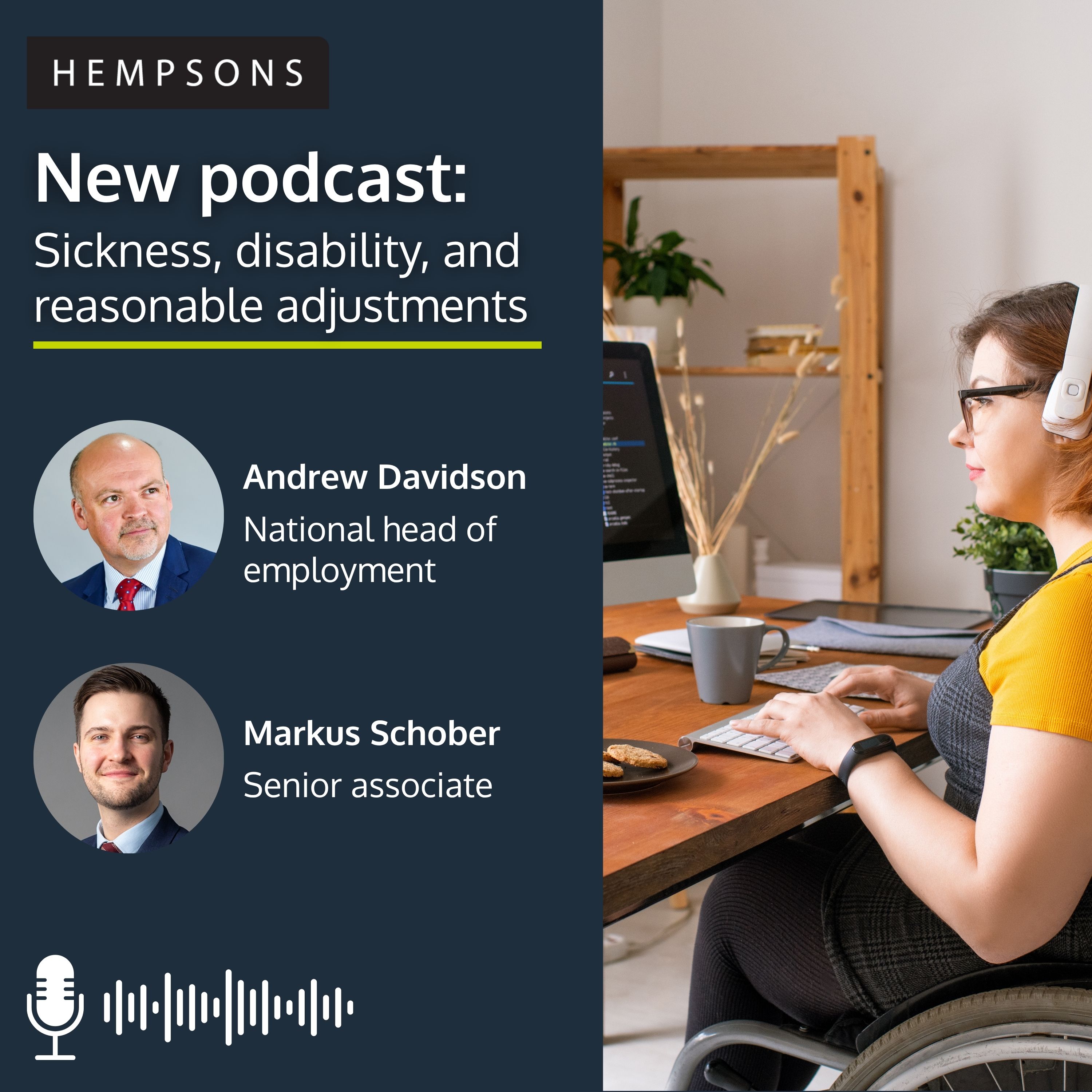
Ep 72Sickness, Disability and Reasonable Adjustments
In this episode, employment law specialises Andrew Davidson and Markus Schober share practical guidance for employers on managing sickness absence and understanding the legal duties around disability and reasonable adjustments under the Equality Act 2010. Drawing on real cases and best practice, they highlight key steps to reduce risk and ensure compliance.This episode is essential for HR professionals, managers, and employers navigating complex issues around sickness absence and disability. It offers actionable advice to help you stay compliant, avoid costly claims, and support your workforce effectively.Resources & Links:Hempsons employment services: https://www.hempsons.co.uk/services/employment-law/Full webinar on YouTube: https://youtu.be/YAvzOYF4OJU?si=IW9PYObb2PKeNjVGACAS guidance on sickness absence: https://www.acas.org.ukNHS Employers guidance: https://www.nhsemployers.org
Ep 70Complex Hospital Discharges
In this episode, healthcare advisory partner Sophie Bowes provides a guide to managing complex hospital discharges. Key topics covered:The discharge to assess model and its practical application in NHS trustsWhy clear, consistent internal discharge policies are essentialHow to plan for and escalate delayed discharges, including when to seek legal adviceLessons from recent case law, including guidance on capacity, patient rights, and the role of the courtsPractical takeaways for healthcare leaders and discharge teamsFor a deeper dive, check out Sophie’s recent webinar on complex discharges, available on the Hempsons YouTube channel.
Ep 69Real Estate Podcast: Securing Value for Money for NHS Providers
In this episode, Ann Cojeen, commercial real estate partner at Hempsons, discusses how NHS providers can secure value for money in property transactions and disputes. Ann delves into the estate code, particularly HBN00-08, and its references to value for money. She explores the roles of agents, surveyors, and solicitors in achieving value for money, the importance of commercial terms, and the benefits of appointing an agent. Ann also covers the significance of fit-out works, the necessity of having a detailed specification, and the role of a dilapidations surveyor. Tune in for valuable insights and top tips on making informed decisions and achieving value for money in property transactions.To find out more about our real estate services and to contact the team, visit https://hpsns.co/ytrealestate
Ep 68The meaning of biological sex under The Equality Act
Employment law partner Saira Ramadan examines the recent UK Supreme Court ruling in For Women Scotland v The Scottish Ministers. This episode explores the Court’s interpretation of 'biological sex' under the Equality Act 2010, reaffirming that the terms 'man', 'woman', and 'sex' refer to biological sex. Saira provides an overview of the case background, unpacks the implications of the judgment, and offers practical guidance for employers. Her advice includes answers to frequently asked questions around workplace facilities such as toilets, changing rooms, and other gendered spaces, helping organisations navigate this evolving legal landscape with confidence. To find out more about our employment law services and to contact the team, visit https://hpsns.co/ytemployment
Ep 67GP Practice Mergers explained
Primary care experts, Justin Cumberlege and Robert McCartney, discuss the intricacies of merging GP practices. They begin by clarifying what a merger typically involves - two or more practices coming together to operate as a single entity.The conversation explores the strategic motivations for merging, such as financial sustainability, improved service delivery, and increased influence within Primary Care Networks (PCNs). They highlight the benefits of scaling up, including shared responsibilities, enhanced workforce capabilities, and greater resilience in a rapidly evolving NHS landscape.The episode also examines different structural models, including incorporation as limited companies, and how regulatory changes have made such models more viable. The importance of thorough preparation is emphasised - particularly in establishing a shared vision, conducting due diligence, and understanding each practice’s assets, liabilities, and staffing structures.Key legal and operational considerations are discussed, including staff restructuring, premises management, regulatory compliance (such as CQC registration), and the novation of GMS contracts. The hosts stress the value of early legal input, confidentiality agreements, and well-drafted heads of terms to guide the merger process effectively.
Ep 66Regulated below threshold contracts under the Procurement Act 2023
In this episode, Helen Redfern, a senior solicitor in the procurement team at Hempsons, outlines the key obligations and requirements for English contracting authorities regarding regulated below threshold contracts under the Procurement Act 2023. Helen addresses common queries, including the definition of below threshold contracts, direct awards without competition, running formal competitions, and the prompt payment provisions. She provides practical guidance on the various notices required and the flexibility contracting authorities have in awarding and managing these contracts.Episode summary00:00 Introduction to the Procurement Act 202301:03 Understanding regulated below threshold contracts01:40 Key considerations for English Contracting Authorities02:34 Options for awarding below threshold contracts03:50 Direct award without competition05:27 Running a competition for below threshold contracts08:59 Managing regulated below threshold contracts10:06 ConclusionTo find out more and to contact our procurement team, visit our website.
Ep 65How will The Procurement Act 2023 impact the Provider Selection Regime?
With The Procurement Act 2023 coming into force on Monday 24 February 2025, we have received a number of queries about how this will impact the Provider Selection Regime. Hempsons' head of procurement, Andrew Daly, explains what people can expect when the Act comes into force. Visit our PSR hub: https://www.hempsons.co.uk/services/the-provider-selection-regime/
Ep 64The Procurement Act 2023: What does it mean in practice?
Hempsons' head of procurement, Andrew Daly, gives an update on the introduction of the Procurement Act 2023 and what it will mean for businesses in practice. Register for our free Procurement Act webinar on Thursday 13 February.Find out more about our specialist procurement team
Ep 63NHS Resolution indemnity scheme for GPs: what you need to know
Healthcare litigation expert Patricia Roe and primary care expert Justin Cumberlege explain the NHS Resolution indemnity scheme for GPs. Find out more about our primary care law services and contact the team: https://hpsns.co/practitionerspodcasts
Ep 62Walking the tightrope - patient capacity, best interests, and disclosure
Healthcare law specialists Stephen Maratos and Stephen Evans host this episode discussing patient capacity, acting in their best interests, and the importance of thorough disclosure in the coronial and civil court process.
Ep 61What does the PSR mean for primary care providers?
Primary healthcare law experts Justin Cumberlege and Robert McCartney host our first podcast of the year, discussing what the new Provider Selection Regime means for primary healthcare providers. In this episode, they discuss what the Provider Selection Regime is, and look at three different scenarios where it would apply. For more information about our primary healthcare legal services and how we can help your business, visit our website.
Ep 60Social media uses and abuses in primary care
What are the rules around social media for doctors and other primary care health professionals? Join Robert McCartney and Rachel Levine for the latest episode of our primary care podcast, where they navigate the complex and ever-evolving issue of social media uses and abuses in employment law. In this episode they discuss:00:16 - Introduction01:00 - The evolving nature of social media02:06 - Which social media platforms cause the biggest issues?03:44 - Social media and the law04:54 - Tribunal scenarios and outcomes06:54 - Cyber bullying and the law08:02 - Personal opinion or work issue?11:13 - Different standards for different professions13:12 - Data protection and company monitoring15:35 - Processes for practice managers19:10 - Freedom of expression
Ep 59Complaints handling - an introduction to negligence claims for dentists
Following his recent webinar, healthcare litigation associate, Nigel Wood, gives an introduction to clinical negligence claims that dentists face and discusses how they can handle these complaints.
Ep 58Primary care contracts - don't get trapped!
Robert McCartney and Kirsty Odell, associates in Hempsons' primary care team, host this episode, focusing on common traps in primary care contracts. In this episode, they discuss:00:18 - Introduction: the purpose of contracts01:45 - The pros and cons of NHS contracts03:00 - Trap one: entering into a contract inadvertently 05:13 - Trap two: the role of customer practice07:36 - Trap three: conflicts10:12 - Trap four: gaps in subcontracting13:00 - Trap five: unfair provisions in commercial contracts16:39 - Trap six: unclear termination provisions19:19 - Trap seven: insufficient payment provisions
Ep 57An introduction to inquests for the primary care sector
Primary care partner Justin Cumberlege talks to Sam Wright, a senior solicitor in our healthcare advisory team specialising in inquests, about the role of primary care practitioners in the latest episode of our podcast for GPs.00:16 - Introduction01:36 - What is an inquest?02:49 - What should/shouldn't you say in an inquest?05:00 - Can inquest evidence be cited in a subsequent clinical negligence case?05:54 - Quality of evidence07:47 - Do GPs need to attend inquests in person?11:36 - Who can support GPs throughout the inquest process?12:53 - Potential adverse outcomes of inquests
Ep 56Court of Protection episode 6 - Liberty Protection Safeguards
In the sixth and final episode of our Court of Protection series, Hempsons' healthcare advisory associates Rachael Hawkin and Liz Stokes give an overview of the Liberty Protection Safeguards (LPS).00:16 - Introduction01:23 - April 5 2023 announcement02:25 - Recap: what are the Liberty Protection Safeguards?04:53 - LPS objectives06:01 - What is the definition of deprivation of liberty?07:41 - How will the deprivation of liberty be authorised?09:07 - Who can be a 'responsible body'?10:44 - The impact of LPS on care planning11:42 - The LPS process14:39 - What is the expected timeline for LPS implementation?16:28 - What now?
Ep 55Court of Protection Episode 5: Section 21A of the Mental Capacity Act
In the penultimate episode of our Court of Protection series, Hempsons' healthcare advisory associates Rachael Hawkin and Liz Stokes discuss Section 21A of the Mental Capacity Act.00:16 - Introduction01:23 - What is Section 21A of the Mental Capacity Act 2005?02:26 - Objections to a patient's deprivation of liberty03:55 - Who can bring a challenge on behalf of a patient?06:55 - Who can be party to a Section 21A challenge hearing?07:38 - How are Section 21A challenges progressed in the Court of Protection?09:41 - Best interests and capacity11:10 - The role of the social care provider in a Section 21A challenge