A Forrest Gump Career: Chance, Gifts, Support, and Privilege
Audio is streamed directly from the publisher (media.blubrry.com) as published in their RSS feed. Play Podcasts does not host this file. Rights-holders can request removal through the copyright & takedown page.
Show Notes
Turn-around: Grandson interviews Health Hats about his Zelig-like career path and choices: unpredictable, privileged, mentored, supported, and spiritually healthy.
Summary
Health Hats is interviewed by his editor, grandson Leon, delving into a discussion about his diverse and impactful career. The episode starts with Leon interviewing Health Hats about the origins and motivations behind the podcast, tracing back to a serendipitous naming and a road trip that solidified the podcast’s visual identity.
Health Hats shares his journey from opting out of a higher-paying job that required him to cut his long hair to embracing a path in healthcare as a psychiatric aide, which led him to nursing school. The story also touches on being a male nurse in the 70s, transitioning from direct care to significant hospital and quality management roles.
Leon and Health Hats discuss the significant impact of personal decisions on career paths, the unpredictability of life, and the profound influence of one’s birth and circumstances. Health Hats reflects on his efforts to improve healthcare systems, advocating for better staff and patient conditions and participatory health. The episode explores Health Hats’ professional life, his philosophy on work-life balance, his role as a change agent, and his commitment to continuous learning and improvement.
Click here to view the printable newsletter with images. More readable than a transcript, which can also be found below.
Contents
Please comment and ask questions:
- at the comment section at the bottom of the show notes
- on LinkedIn
- via email
- YouTube channel
- DM on Instagram, Twitter, TikTok to @healthhats
Production Team
- Kayla Nelson: Web and Social Media Coach, Dissemination, Help Desk
- Leon van Leeuwen: article-grade transcript editing
- Oscar van Leeuwen: video editing
- Julia Higgins: Digit marketing therapy
- Steve Heatherington: Help Desk and podcast production counseling
- Joey van Leeuwen, Drummer, Composer, and Arranger, provided the music for the intro, outro, proem, and reflection, including Moe’s Blues for Proem and Reflection and Bill Evan’s Time Remembered for on-mic clips.
Five-minute episodes on YouTube.
Inspired by and Grateful to
Jim Bulger and Bob Doherty (deceased), Eric Pinaud, Jane Sarasohn-Kahn, Luc Pelletier, John Marks, Ann Boland, Lynn Hubbard
Links and references
Are medication error rates useful as a comparative measures of organizational performance? was published in The Joint Commission Journal on Quality Improvements in 1994 receiving the David K Stumpf Award for Excellence in Publication from the National Association for Healthcare Quality. The article was referenced in the book, Error Reduction in Healthcare by Patrice L. Spath in 2000.
1977 article about Danny van Leeuwen, the first male public health nurse in W Mass
It sounds like a Zelig effect (if you know Woody Allen) or a Forrest Gump effect (if you know Tom Hanks)
Jane Sarasohn Kahn, a blogging health economist
The University of Minnesota ISP Program
Episode
Proem
As you may know, my production team includes Grandson Leon, who edits my audio transcript for readability for the 275 Health Hats, the Podcast, followers who prefer reading to audio or video. I call it an article-grade transcript. Leon and I speak often, when I drive or pick him up for school or he drops in for a visit. He critiques warmly and confidently. He often comments on stories and experiences in the episodes. Recently, Leon suggested that he interview me for an episode about my career. You’ve probably heard some of these stories before. In the last episode, I told you about being the first male public health nurse in Western Massachusetts. But you haven’t heard them all by a long shot. Expect more career stories over time.
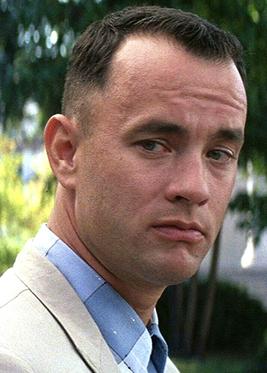
Image from the movie Forrest Gump
Perhaps a theme for this episode is the unpredictability of life served by the gifts of spiritual health, the ability to find support, and the incredible privilege of birth and circumstances, setting me up to make choices that accrue to my benefit. Sounds like a Zelig effect (if you know Woody Allen) or a Forrest Gump effect (if you know Tom Hanks)
For listeners, please excuse all the times I seem to be running over Leon – talking over him. It’s a function of technical challenges I couldn’t correct. I assure you that I was more respectful than it sounds.
Podcast intro
Welcome to Health Hats, the Podcast. I’m Danny van Leeuwen, a two-legged cisgender old white man of privilege who knows a little bit about a lot of healthcare and a lot about very little. We will listen and learn about what it takes to adjust to life’s realities in the awesome circus of healthcare. Let’s make some sense of all of this.
Birthing Health Hats
Health Hats: Hi Leon. Thanks for joining us.
Leon van Leeuwen: Great to be here. What got you to start Health Hats, the podcast?

First Health Hats logo by Danny McGinnis
Health Hats: I started blogging twelve years ago. I met Jane Sarasohn Kahn, a blogging health economist, in 2012. When I told her my story, she said, oh, you’re Health Hats. You should start a blog. I did this with help from Uncle Eric and others. Soon after, I drove on a several hundred-mile road trip to the Cumberland Gap in Maryland. I rode in the front, while Danny McGinnis, an artist, sat in the back. He drew an image of my hat on his iPad. I loved it as a logo! How much can I pay you for this? $75.
Leon van Leeuwen: Wow.
Health Hats: I set up a website and began blogging weekly. Seven years later, in 2018, I received an email notice for a podcasting course from Seth Godin, whom I have followed for a long time. He’s a marketing/inspirational guy sending a daily post, saying the next day was the last day to register for an eight-week podcasting course at the low price of $300. Early in the course, the 350 attendees broke into groups of about 12 or 15. My group became close and supportive of each other. We still meet weekly every Sunday afternoon. We’ve been doing that for perhaps 45 weeks out of the year since 2018. That got me started and motivated to keep podcasting.
Nursing school – what’s hair got to do with it?
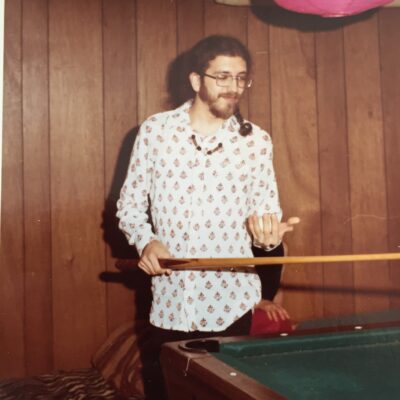
Danny/Health Hats circa 1973
Leon van Leeuwen: How did you get into healthcare? That’s what you talk about in your podcast.
Health Hats: I attended Wayne State University for two years and dropped out to travel extensively – hitchhiking in Europe,
Columbia, Mexico, British Columbia, and across the States. When I came back looking for work, I had a choice between a job reading water meters or working as an aide at the Detroit Psychiatric Institute. The meter reading paid more, but I had to cut my hair, and I didn’t want to cut my hair. So, I took the aide position.
Leon van Leeuwen: How were those your only two options?
Health Hats: I was in the mode of looking, and those were two jobs I applied for. I can’t remember how many jobs I applied for, but those are the two I could get. I must have had interviews because how else would I know I had to cut my hair? They would’ve had to see me. The nurses at the Detroit Psychiatric Institute encouraged me to attend nursing school.
Leon van Leeuwen: Wow.
Health Hats: When I interviewed for the nursing student position, they asked about my hair. I said I can put it in a bun. They said okay.

Detroit Psychiatric Institute abandoned
Leon van Leeuwen: Checking the water meters paid you more than working as an aide in a hospital?
Health Hats: Yes. I made $3.00 an hour as an aide. I could have earned $3.50 an hour as a meter reader.
Wanted a life
Leon van Leeuwen: From there, did you go to medical school?
Health Hats: No, I went to nursing school. A few people asked why I wasn’t going to medical school. Why nursing? I wanted to have a life. I felt that medical school was, all in all, too much education and too expensive. The nursing school I attended was a two-year program that cost only $11 a credit.
Leon van Leeuwen: Wow.
Health Hats: Yeah. Even then, it was cheap. Wayne County Community College.
First male public health nurse in Western Mass
Leon van Leeuwen: You mentioned you were the first male nurse in Western Mass.
Health Hats: I was the first male public health nurse in Western Massachusetts in 1976.
Leon van Leeuwen: What was it like to be the first male nurse in that area?
Health Hats: Home care was a great place and way to start. I was excited because I didn’t want to work in a hospital. I had been working in a nursing home before that. So, I liked the idea of home care. But being a guy was different. My bosses and other staff were very concerned. How would female patients take to having a guy care for them? I told them I never had any issues when I was one of two male nursing students in my class attending nursing school. Patients want a kind word and a warm hand. Gender doesn’t usually matter.
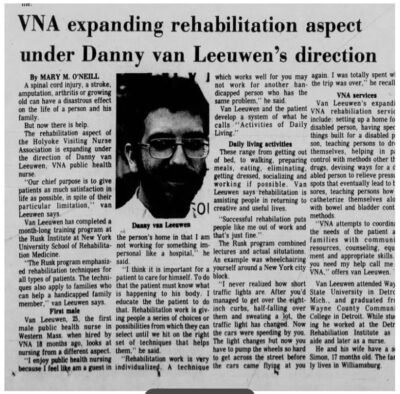
Article from the Holyoke Transcript-Telegram Aug 19,1977
Leon van Leeuwen: Yeah. When you’re sick or not feeling well, you are not only thinking about that. It seems a little weird to ask if you’ve had any hardships for being a man, but did you get treated weirdly?
Health Hats: I never did; I never was in that situation. Sometimes, people in certain religions might not want a guy taking care of a woman. But I never had that happen to me. I didn’t have to deal with it. On the other hand, I may have benefited from being a guy.
Leon van Leeuwen: Yeah, you benefit from being a guy often, but was home care your first job out of nursing school?
Health Hats: I worked in a nursing home for several months. It mainly was passing pills, medication management, and supervising aides. I wouldn’t say I liked it.
Leon van Leeuwen: How long did you do home care?
Health Hats: Four and a half years.
We don’t hire men in nursing here
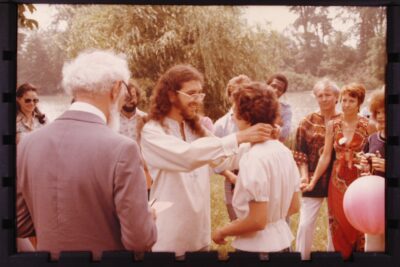
Image of Danny and Ann’s wedding in 1975 by Rich Rieger
Leon van Leeuwen: Where did you go after home care?
Health Hats: Grandma and I married in Detroit in 1975, a week after I graduated from nursing. Within weeks, we were trying to decide where to move, and we had several choices: Northern California, West Virginia, or Western Massachusetts. We decided against Northern California because it was too far from the family in Buffalo and Detroit. So we went down to West Virginia, and I went to the local hospital to find a job. They were not interested in hiring a guy, so we ended up in Western Massachusetts.
Retiring in our thirties as back-to-the-land hippies
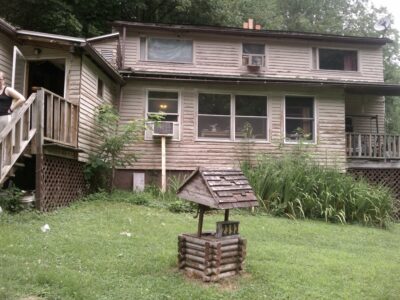
House built by Ann and Danny in WV circa 2000
Health Hats: In 1979, when I was 27 and Grandma 28, we retired to be back-to-the-land hippies in West Virginia. We built a house and had your Uncle Ruben at home. I worked with my friend, Rich Rieger, as Sunnyside Construction. Then, one day, the Director of Nursing at the local hospital, Stonewall Jackson Hospital, the successor to the Director who wouldn’t hire a guy, heard that there was a new nurse in town. She wanted me to come and work for them part-time, which I didn’t do for a while. But eventually, I did because we needed the money.
Leon van Leeuwen: Yeah, it is astonishing that initially you tried to apply, but they didn’t let you, and then they asked you to work there.
Health Hats: It was much better to be wanted.
Leon van Leeuwen: How long did you take off from nursing?
Health Hats: Three to four years.
Couldn’t manage an emergency at home
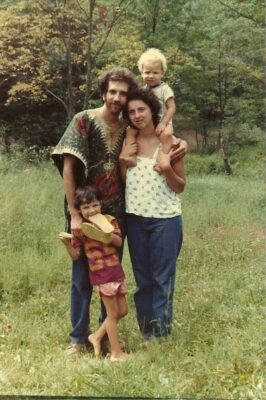
Boland van Leeuwen’s in West Virginia 1982
Health Hats: The reason I got back into nursing was that I was very concerned that even though I’d gone to nursing school and had four and a half years of experience as a professional nurse, I felt like I didn’t know how to handle an emergency that might happen in our community, Jupiter Hollow, the name of the intentional community we lived in. So, I trained as a paramedic.
Leon van Leeuwen: Nice.
Health Hats: Your grandmother and I started working at the volunteer emergency squad. I also started working per diem in the
medical-surgical unit at the local hospital, Stonewall Jackson Hospital.
Twelve-bed hospital
Then, I got a job in an emergency room at a 12-bed hospital about 30 miles away in Braxton County.
Leon van Leeuwen: Was that the emergency room or the whole hospital?
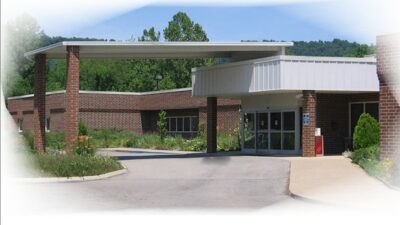
Braxton County Memorial Hospital circa 1990
Health Hats: The whole hospital had 12 beds. They had an emergency department staffed by one nurse. I worked the midnight shift. We would call in a doctor when a patient arrived. If somebody came in via the emergency squad, the squad would have to stay and help because only one other nurse was working with the 12 inpatients. Pretty wild, to say the least. But then I returned to Stonewall Jackson Hospital to work in the emergency department. That became a regular full-time job.
Leon van Leeuwen: Was the 12-bed hospital busy at all? I can’t imagine. It would be ridiculous if it were just one nurse.
Health Hats: A trickle of patients would come in, but if there was a heart attack and a car accident simultaneously, that was a disaster. We would have to call people in literally. It was an excellent job. I learned so much. I had to be prepared, manage, anticipate, have the equipment, and get help.
West Virginia, a Third World state
Health Hats: It was insane. On the other hand, West Virginia is a third-world state, meaning it is poor.
Leon van Leeuwen: Is that an actual term for a third-world state?
Health Hats: It’s what I say. I mean, it’s poor. The money is in the resources of coal, gas, and lumber. It was sparsely populated, with three main cities: Morgantown, Charleston, and Huntington. Remoteness and size made adapting necessary. The state emergency services system was well-integrated and managed. I could radio the Charleston Emergency Department if I were alone without a doctor, yet they would be available via the radio’s speaker. I could talk to an emergency physician while caring for patients by myself. They would ask me questions about the patient’s condition and advise me while calling an ambulance or sending a helicopter. So, although I was alone, I wasn’t without medical support.
Leon van Leeuwen: Was this at the 12-bed hospital? Was it different once you got to Stonewall Jackson Hospital?
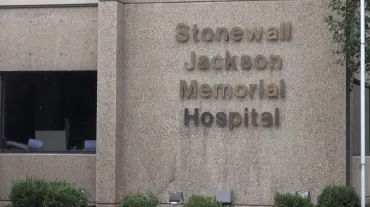
Stonewall Jackson Memorial Hospital sign circ 1985
Health Hats: Yes. Stonewall Jackson was a 70-bed hospital. At night, there would be two nurses in the Emergency Department, an aide, and a doctor, who was usually a resident, sleeping until patients arrived. So, there was somebody. In Braxton County, the 12-bed hospital, doctors were at home, and it would take them 20 minutes or more to get in.
Advanced Cardiac Life Support
Leon van Leeuwen: Did the experience of working by yourself help you later?
Health Hats: First, I had to be confident – have hutzpah – because otherwise I couldn’t manage it. While becoming a paramedic, the people I met in Morgantown and Charleston taught me Advanced Cardiac Life Support, ACLS. Unfortunately, Neither Braxton County nor Stonewall Jackson Hospitals used ACLS then. So, I started an ACLS training program in the region. From my training and work in Emergency Departments, the people I knew around the state came to help teach. They were a gift! The skills of the people I worked with improved. Much better for me.
I’ll tell you a funny story: when your Uncle Ruben was eight, he and your dad would come to where we worked at the emergency squad, me as a paramedic and grandma as a driver. Our boys would come and bunk while we went on emergency squad runs. Ruben got interested in ACLS, and I would take him to some classes. Then, I took him to the state meetings where we trained people to teach it. He studied along with the doctors, nurses, and paramedics. He eventually took the test and almost passed. He could read the EKG strips, know the algorithms and medications, and intubate. He just forgot to auscultate (listen) to the lungs after intubation.
There was a cardiologist at Stonewall Jackson Hospital who turned his nose up at Advanced Cardiac Life Support.
Leon van Leeuwen: What do you mean by that?
Health Hats: He didn’t think he needed it because he was the cardiologist.
Leon van Leeuwen: He thought he already knew everything?
Health Hats: Eight-year-old Uncle Ruben took the ACLS course, which put the cardiologist to shame. The doctor didn’t know the algorithms, so he couldn’t use other ACLS-certified doctors, nurses, and paramedics well. The cardiologist ended up taking the ACLS course, too, because Ruben was taking it.
Leon van Leeuwen: Do you think that’s how Uncle Ruben got into teaching?
Health Hats: I have no idea.
Call to action
I now have one URL for all things Health Hats. https://linktr.ee/healthhats to subscribe for free or with a contribution through Patreon. You can access show notes, search the 600-plus episode archive, and link to my social media channels. Your engagement by listening, sharing, and commenting makes quite an impact. Thank you.
Volunteering for the Emergency Squad
Leon van Leeuwen: What was working in the ambulance with your wife like working in the ambulance? Did you see her often if she was the driver and you were a nurse?
Health Hats: Did we get many runs (calls)?
Leon van Leeuwen: Yeah. Or how much did you work together?
Health Hats: It was great. Grandma was my driver. She drove, and sometimes we would have somebody else with us; it was all volunteer. When I worked with other drivers, they were hot dogs and wanted to go fast, like flashing lights, sirens, and so on. I’m not a go-fast guy, but I felt safer since Grandma drove much more sensibly.
Leon van Leeuwen: Yeah. I like using ‘hot dog’ to describe them as hotheaded.
Health Hats: Have you ever heard that term?
Leon van Leeuwen: That’s a good term. I might start using it.
Health Hats: It’s a macho thing.
Leon van Leeuwen: Yeah. I know some people that drive like hot dogs. Did you work in the Emergency Department the whole time you were in West Virginia?
From direct care to management
Health Hats: No, because I led this ACLS Program, I knew all the nurses in the ICU. When the ICU manager left, the nurses in the ICU came to me and said that I should apply to be their manager. I said, you’re crazy; I’ve never worked in the ICU or been a manager. And they said, you’ll be a fine manager, and we’ll teach you to work in the ICU.
Leon van Leeuwen: Okay, so your staff that since you taught, you knew how to manage?
Health Hats: I guess. So, I went to my boss and told her what they were saying. What do you think? She said to apply. I applied, and she hired me. I was an ICU manager for a year or so.
Leon van Leeuwen: Wow. How different was it? Did you still do any nursing work?
Health Hats: Yes, it was a small four-bed ICU. I had a dual work-and-manage job.
Leon van Leeuwen: So, you managed only four beds. How much staff was that, then?
Change agent: staffing and visiting hours
Health Hats: I think we might have had a staff of twelve. We needed at least two for every shift. Management was interesting. I had to deal with things like having enough staff, and a pool of staff experienced enough to deal with the ebbs and flow of the census, meaning how many patients there are, vacations, pregnancies, or family caregiving.
The hospital was not really into having too many part-time or per diem people because that was the management theory at the time. I thought it was stupid. I argued for more flexibility and was successful with that. It was also the first time I had to deal with a budget, and the ICU was considered a loss leader, meaning that it expected to lose money. I said I’m not leading something that’s losing money. My goal was to break even.
The most significant expense was supplies, and every doctor wanted their own supplies, so you had to stock all this stuff that stayed on the shelf. I was very fortunate that the ICU Medical Director, Alan Hirsch, was an internist from Cleveland.
Leon van Leeuwen: What’s an internist?
Health Hats: An internist is an internal medicine doctor, a physician who takes care of adults, something like a generalist for adults, as opposed to a family practice, which is adults and children. He was working off his med school loans by working in West Virginia. Again, it’s a third-world state that needs clinicians. He was open-minded. We were able to do quite a bit together.
Another thing that we did that drove me crazy was the limited visiting hours. If I was in the ICU as a patient, that meant that Grandma could only visit me from one to two in the afternoon and six to seven in the evening or something like that, two one-hour blocks. The staff thought more visiting hours would interfere with patient care. I thought that was ridiculous. These are the people who are going to have to take care of their loved ones when they go home. If they don’t have any experience dealing with whatever they’re dealing with, and they’re not learning what’s going on with their heart attack or their GI bleed or whatever, they’ll be readmitted. I wanted open visiting hours, meaning we were busy or needed space. We should ask them to step out. But my staff was not happy with me at all. Thankfully, Dr. Hirsch, the Medical Director, was supportive. So, we opened visiting hours.
Leon van Leeuwen: If I had a family member in the ICU, I’d want to see them, so it’s essential. It is intensive care. They would want to see their family and loved ones to ensure safety.
Health Hats: It is a safety concern. Somebody else is keeping their eyes open.
Leon van Leeuwen: You managed the ICU for a while. Where did you go from there?
Remote Learning for a Master’s Degree
Health Hats: While a nurse manager at Stonewall Jackson Hospital, the Nursing Director, CEO, and Chief Operating officer encouraged me to get my Master’s. They had gone to the University of Minnesota in the ISP program, a remote learning master’s program. They sponsored me to follow.
Leon van Leeuwen: What year was this?
Health Hats: I graduated in 1993.
Leon van Leeuwen: What was the learning like? When I picture remote learning, I think of Zoom.
Health Hats: No Zoom, then. For the three-year program, students went to the University of Minnesota for two weeks during the summer and stayed in the dorm. During those two weeks, we had half-day sessions, two a day for two weeks, introducing each curriculum chapter to occur over the year. As it was a worldwide program, students in proximity would get together monthly with the CEO of some hospital near them. So, a guy in Kentucky who was a CFO Chief Financial Officer and I went to the University of Charleston Hospital to meet with the CEO, our mentor, for a day once a month. Then, there were regional meetings once a year with several of the monthly groups. Since our monthly group was remote, the Kentucky CFO and I met with the international groups in the regional meeting.
Leon van Leeuwen: Minnesota and West Virginia aren’t close.
Health Hats: The Puerto Rican contingent of the international groups hosted us at the University of Puerto Rico. We traveled a few days around Puerto Rico with our spouses or partners. We took one day for schoolwork. In the second year, we went on a cruise together.
Leon van Leeuwen: Wow. So, for the remote learning, what did you do in West Virginia?
Health Hats: The ISP remote learning program required you to be a working manager because your job was your laboratory. So, if the study unit was about staffing, it was about staffing in my ICU. If the study unit was about budgeting, then courses or modules had to be about the budget of your department, which helped me with the whole goal of trying to break even. I had a lot of help figuring that out because I had this idea that I wanted to break even, but I had no idea how. I was ignorant.
Leon van Leeuwen: Did you accomplish it? Did it break even? What did you do?
Health Hats: Staffing made the difference. Most expenses are in people and materials. So, with help from fellow ISP students, I figured out how to have efficient s