Audio is streamed directly from the publisher (api.substack.com) as published in their RSS feed. Play Podcasts does not host this file. Rights-holders can request removal through the copyright & takedown page.
Show Notes
The Three Dialogues, written in 1713 by George Berkeley lays out his philosophy of “indeterminism” via a series of dialogues between two characters: Hylas (representing common sense) and Philonous (representing Berkeley as the philosopher). This writing style may have been an inspiration for the approach Douglas Harding takes in parts of the Hierarchy of Heaven and Earth as a device to argue against conventional ways of thinking.
Berkeley argues that there are nothing but “sensible” objects perceived in a mind and that the notion of “matter” which is somehow outside of mind does not make any sense (literally and figuratively). In fact, says Berkeley, the “things” which we sense are actually the redness, sweetness, and roundness which, in language, we commonly refer to as an “apple”. Ultimately, Berkeley (who was a bishop in the Anglican Church of Ireland) uses this chain of logic as a proof that God exists — for how else could there be things outside of our individual human minds, if they were not in the mind of God.
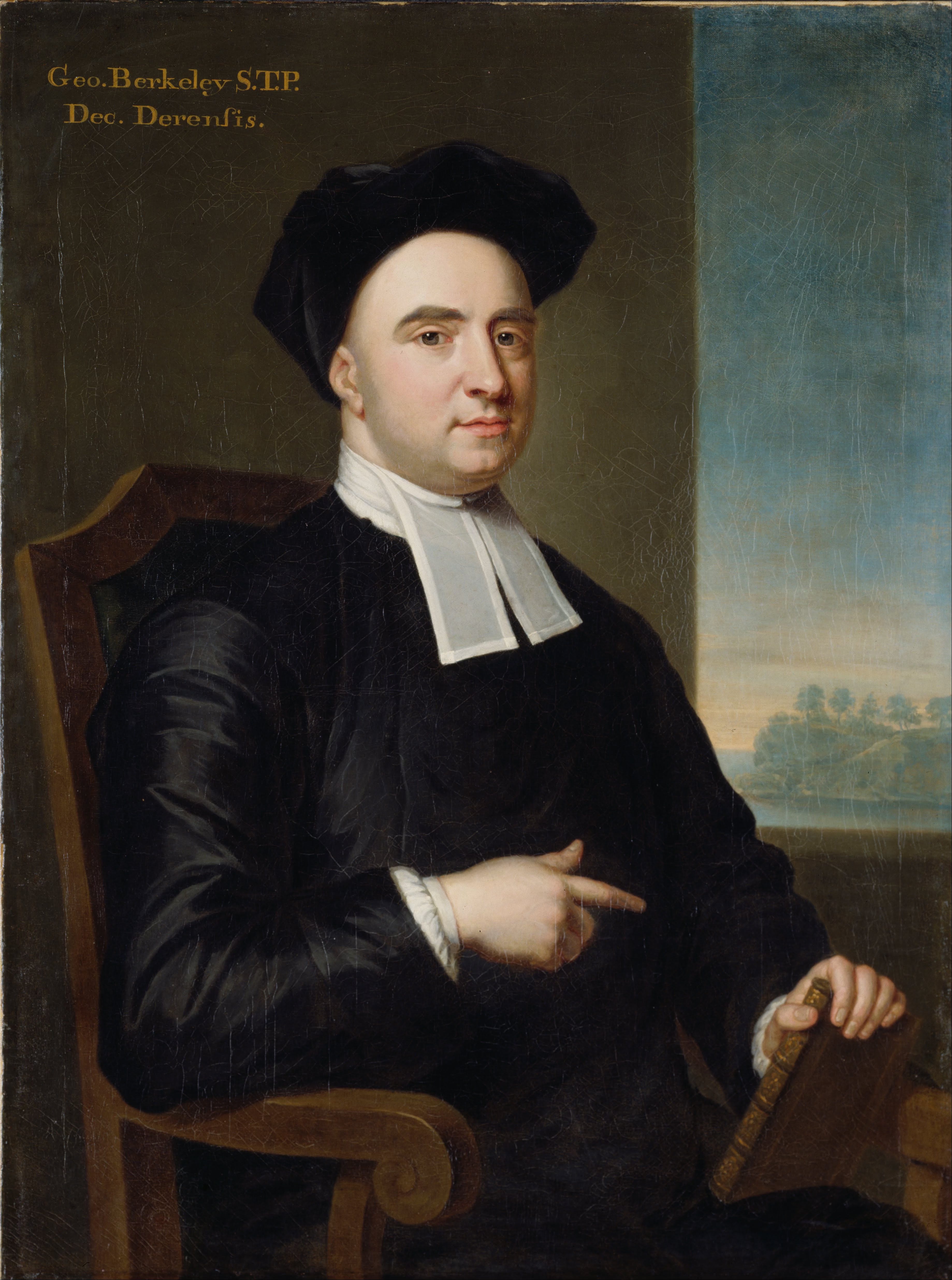
p.s. I get a kick out of how this painting of Berkeley looks like he is doing one of Harding’s pointing experiments.
This is a public episode. If you would like to discuss this with other subscribers or get access to bonus episodes, visit headlessdeepdive.substack.com