
Happy English Podcast
1,088 episodes — Page 4 of 22
Ep 962962 - Start Off On The Right Foot - English Tips in a Minute | Happy English
Hey there! It’s Michael here - and welcome back to English Tips in a Minute from Happy English. I’m here every Saturday with a short, simple tip to help you speak English more naturally and confidently. And if you want to watch this lesson, just look for Happy English Podcast on YouTube.Today, let’s look at a really natural expression you’ll hear a lot at the beginning of the year - “start off on the right foot.” We use the idiom, start off on the right foot to mean begin something in a good, positive, or successful way.Like, when it’s the first day back at work this year, your coworker might say: “I want to start the year off on the right foot.”Or when you decide to remodel the kitchen, you can say: “Let’s start off on the right foot and keep everything organized from the beginning.”We also use this phrase to talk about relationships: Like, Jack started off on the right foot with his new neighbors.It’s positive, it’s friendly, and it’s perfect for January when everyone is thinking about goals, routines, and fresh starts. Start off on the right foot is a natural way to say you want to begin something well - whether it’s a new year, a new job, or even a new habit.Lemme know in the comments how you’re planning to start your year off on the right foot, and remember to follow or subscribe so you don’t miss the next Happy English Podcast and next Saturday’s English Tips in a Minute. Hey, thanks for listening - and until next time, keep learning and keep it cool.To help you stick to your English learning goals in the new year, I created a brand-new 8-week phrasal verb course to help you speak more naturally. It starts on January 8th (this Thursday):https://www.myhappyenglish.com/snpvWatch video versions of the Happy English Podcast on YouTube: https://www.youtube.com/@HappyEnglishNY/podcastsBuild Vocabulary With My Free Vocabulary Workshop: https://learn.myhappyenglish.com/vocabulary-workshop-signupThe Happy English PodcastHelping people speak English better since 2014Over 1,000 episodes • 8 million downloads📘 Build your vocabulary with my free Vocabulary Workshophttps://learn.myhappyenglish.com/vocabulary-workshop-signup🎥 Watch video versions of the Happy English Podcast on YouTubehttps://www.youtube.com/@HappyEnglishNY/podcasts🌐 Learn more about my English lessons and courseshttps://www.myhappyenglish.com

Ep 961961 - Kick Off - Phrasal Verbs in a Minute | Happy English
Hey there! It’s Michael here, and welcome back to Phrasal Verbs in a Minute from Happy English. I’m here every Friday with a quick one-point lesson to help you learn a new phrasal verb and sound more natural when you speak. By the way, if you want to see the video version of this lesson, just look for Happy English Podcast on YouTube.Today’s phrasal verb is perfect for the new year - kick off. When you kick off something, it means you start it in an energetic or official way. We use kick of for events, projects, meetings, and even new habits or goals.Like, my friend Emma kicked of2026 by joining a new gym.A lot of companies kick off events with a big team meeting.And me? I’m kicking off the new year with a fresh batch of podcast English lessons like this one.And here’s a pronunciation tip: kick off sounds like kik-koff. The K at the end of kick links with off. That makes the sound smooth.So how about you? How are you kicking off the new year? Maybe with a new hobby, a new routine, or a new goal for learning English?Let me know in the comments, and remember to follow or subscribe so you don’t miss the next Happy English Podcast and next week’s Phrasal Verbs in a Minute. Hey, thanks for listening - and until next time, keep learning and keep it cool.I’m starting a small live English group next week focused on speaking with phrasal verbs.Keeping it small so everyone can talk. Join us here: https://www.myhappyenglish.com/snpvThe Happy English PodcastHelping people speak English better since 2014Over 1,000 episodes • 8 million downloads📘 Build your vocabulary with my free Vocabulary Workshophttps://learn.myhappyenglish.com/vocabulary-workshop-signup🎥 Watch video versions of the Happy English Podcast on YouTubehttps://www.youtube.com/@HappyEnglishNY/podcasts🌐 Learn more about my English lessons and courseshttps://www.myhappyenglish.com
Ep 960960 - Talking About Opinions - I Think, I Guess, I Suppose, I’d Say
Have you ever found yourself using “I think” a little too much when giving your opinion? Like, “I think that’s a good idea,” “I think we should try it,” “I think he’s right.” It’s a good expression - clear and direct - but maybe… a little too common? Well, the good news is, in English we’ve got a few more natural and interesting ways to share your thoughts.Today, we’re gonna look at how native speakers casually express their opinions - not just with “I think,” but with a few other really natural, common phrases. And I’ll show you how we use each of them in daily conversation. Sound good? I’d say it does. Watch video versions of the Happy English Podcast on YouTube: https://www.youtube.com/@HappyEnglishNY/podcastsBuild Vocabulary With My Free Vocabulary Workshop: https://learn.myhappyenglish.com/vocabulary-workshop-signupThe Happy English PodcastHelping people speak English better since 2014Over 1,000 episodes • 8 million downloads📘 Build your vocabulary with my free Vocabulary Workshophttps://learn.myhappyenglish.com/vocabulary-workshop-signup🎥 Watch video versions of the Happy English Podcast on YouTubehttps://www.youtube.com/@HappyEnglishNY/podcasts🌐 Learn more about my English lessons and courseshttps://www.myhappyenglish.com
Ep 959959 - The Tiny Y - Speak Naturally in a Minute | Happy English
Hey there! It’s Michael here - and welcome back to Speak Naturally in a Minute from Happy English. I’m here every Sunday with a quick one-point lesson to help you improve your pronunciation, rhythm, and intonation. And if you want to watch this lesson, just look for Happy English Podcast on YouTube.Now, in everyday spoken American English, when a word ends with an “ee” sound and the next word starts with a vowel sound, we often connect those sounds with a very small, quick Y sound.I call this the tiny Y.Like, see it. We don’t stop the sound, and in one breath we say, see-yit. It’s not see. it. It’s see-yit. Like, That movie? I’m gonna see-yit tomorrow. Did you hear the tiny y? I’m gonna see-yit tomorrow. Here are some other examples: She is sounds like she-yiz. She-yiz the boss.We are sounds like we-yar. We-yar happy to see you!Many apples sounds like meni-yapples. There are meni-yapples on the table.This tiny Y keeps the flow smooth and natural. Be sure to practice these phrases yourself this week and they will become part of your English.And remember to follow and subscribe so you won’t miss the next Happy English Podcast and next Sunday’s Speak Naturally in a Minute. Hey, thanks for listening! Until next time, keep learning and keep it cool.Watch video versions of the Happy English Podcast on YouTube: https://www.youtube.com/@HappyEnglishNY/podcastsBuild Vocabulary With My Free Vocabulary Workshop: https://learn.myhappyenglish.com/vocabulary-workshop-signupThe Happy English PodcastHelping people speak English better since 2014Over 1,000 episodes • 8 million downloads📘 Build your vocabulary with my free Vocabulary Workshophttps://learn.myhappyenglish.com/vocabulary-workshop-signup🎥 Watch video versions of the Happy English Podcast on YouTubehttps://www.youtube.com/@HappyEnglishNY/podcasts🌐 Learn more about my English lessons and courseshttps://www.myhappyenglish.com
Ep 958958 - To This Day - English Tips in a Minute | Happy English
Hey there! It’s Michael here - and welcome back to English Tips in a Minute from Happy English. I’m here every Saturday with a short, simple tip to help you speak English more naturally and confidently. And if you want to watch this lesson, just look for Happy English Podcast on YouTube.Today, let’s look at a really natural phrase you’ll hear in everyday English - “to this day.” We use to this day to mean until now, usually when something began in the past and is still true today. To this day often shows strong feelings - surprise, wonder, and even admiration.Like, I first saw Casablanca when I was in my twenties, and to this day, it’s still my favorite movie.”Our relationship ended over 25 years ago, but to this day, I don’t know why she broke up with me.You’ll hear the phrase to this day a lot in stories, interviews, and even documentaries, because it connects the past and present in a simple, powerful way. So try using to this day in your English conversations this week. Lemme know in the comments how it goes, and remember to follow or subscribe so you don’t miss the next Happy English Podcast and next Saturday’s English Tips in a Minute. Hey, thanks for listening - and until next time, keep learning and keep it cool.Watch video versions of the Happy English Podcast on YouTube: https://www.youtube.com/@HappyEnglishNY/podcastsBuild Vocabulary With My Free Vocabulary Workshop: https://learn.myhappyenglish.com/vocabulary-workshop-signupThe Happy English PodcastHelping people speak English better since 2014Over 1,000 episodes • 8 million downloads📘 Build your vocabulary with my free Vocabulary Workshophttps://learn.myhappyenglish.com/vocabulary-workshop-signup🎥 Watch video versions of the Happy English Podcast on YouTubehttps://www.youtube.com/@HappyEnglishNY/podcasts🌐 Learn more about my English lessons and courseshttps://www.myhappyenglish.com
Ep 957957 - Luck Out - Phrasal Verbs in a Minute | Happy English
Today’s phrasal verb is luck out. When you luck out, it means you have really good luck - usually by chance. Something goes much better than you expected, and you didn’t have to do anything special. It just happened.For example, this morning I lucked out and found a parking spot right in front of the station.And my friend Jake lucked out last week - he got the last two tickets to a concert that had been sold out for days.And yesterday, I lucked out at the supermarket… strawberries were half price!Here’s a pronunciation tip: luck out sounds like luk-kout. The K at the end of luck connects with out.So how about you? When was the last time you lucked out?Let me know in the comments, and remember to follow or subscribe so you don’t miss the next Happy English Podcast and next week’s Phrasal Verbs in a Minute. Hey, thanks for listening. And until next time, keep learning and keep it cool.Watch video versions of the Happy English Podcast on YouTube: https://www.youtube.com/@HappyEnglishNY/podcastsBuild Vocabulary With My Free Vocabulary Workshop: https://learn.myhappyenglish.com/vocabulary-workshop-signupThe Happy English PodcastHelping people speak English better since 2014Over 1,000 episodes • 8 million downloads📘 Build your vocabulary with my free Vocabulary Workshophttps://learn.myhappyenglish.com/vocabulary-workshop-signup🎥 Watch video versions of the Happy English Podcast on YouTubehttps://www.youtube.com/@HappyEnglishNY/podcasts🌐 Learn more about my English lessons and courseshttps://www.myhappyenglish.com
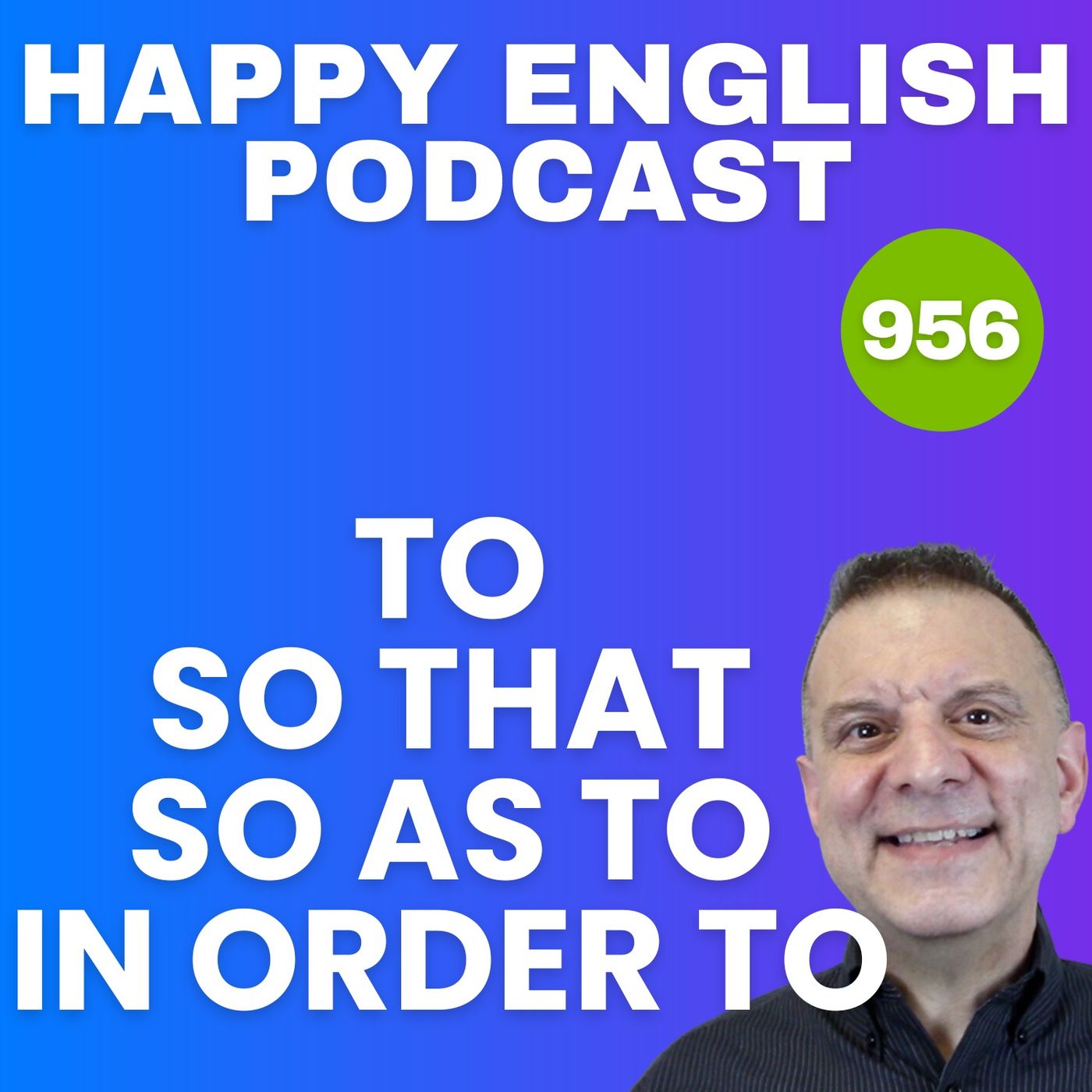
Ep 956956 - “So That,” “So as to” “In Order To,” and “To” - Talking About Purpose in English
Thanks for tuning in! So… why are you listening to this podcast? Maybe it’s so that you can improve your English? Or in order to sound more natural? Or just to have fun learning something today? Well, whether you said so that, in order to, or to, you were talking about the purpose of doing something.And that’s what these expressions are all about - showing the reason or goal behind an action.Watch video versions of the Happy English Podcast on YouTube: https://www.youtube.com/@HappyEnglishNY/podcastsBuild Vocabulary With My Free Vocabulary Workshop: https://learn.myhappyenglish.com/vocabulary-workshop-signupThe Happy English PodcastHelping people speak English better since 2014Over 1,000 episodes • 8 million downloads📘 Build your vocabulary with my free Vocabulary Workshophttps://learn.myhappyenglish.com/vocabulary-workshop-signup🎥 Watch video versions of the Happy English Podcast on YouTubehttps://www.youtube.com/@HappyEnglishNY/podcasts🌐 Learn more about my English lessons and courseshttps://www.myhappyenglish.com
Ep 955955 - Went, Gone, or Been - What’s the Real Difference?
Have you ever gone somewhere… and then realized you should’ve been somewhere else? Or maybe you went somewhere, and now you’re trying to explain that… but the grammar just won’t come out right. Don’t worry - this happens to a lot of English learners. So today, we’re going to clear it all up.Went, Been, Gone. Yeah - I know. These words all seem similar, and sometimes even native speakers mix them up. But there is a pattern. There is a logic behind when we use went, gone, and been. So today, I’m gonna break it down for you in a clear, simple way - with a bunch of examples to make it all stick.Watch video versions of the Happy English Podcast on YouTube: https://www.youtube.com/@HappyEnglishNY/podcastsBuild Vocabulary With My Free Vocabulary Workshop: https://learn.myhappyenglish.com/vocabulary-workshop-signupThe Happy English PodcastHelping people speak English better since 2014Over 1,000 episodes • 8 million downloads📘 Build your vocabulary with my free Vocabulary Workshophttps://learn.myhappyenglish.com/vocabulary-workshop-signup🎥 Watch video versions of the Happy English Podcast on YouTubehttps://www.youtube.com/@HappyEnglishNY/podcasts🌐 Learn more about my English lessons and courseshttps://www.myhappyenglish.com
Ep 954954 - The Tiny W - Speak Naturally in a Minute | Happy English
Hey there! It’s Michael here - and welcome back to Speak Naturally in a Minute from Happy English. I’m here every Sunday with a quick one-point lesson to help you improve your pronunciation, rhythm, and intonation. And if you want to watch this lesson, just look for Happy English Podcast on YouTube.Now, in everyday spoken American English, we often connect vowel sounds with a very small, quick W sound. I call this the tiny W. The tiny W happens when when one word ends with an “oo” sound and the next word begins with a vowel sound. Like, do it. We don’t stop the sound, and in one breath we say, doo-wit. It’s not do it, it’s doo-wit. I’m gonna doo-wit tomorrow. Did you hear the tiny w? I’m gonna doo-wit tomorrow. Here are some other examples: You are sounds like yoo-wahr. Yoo-wahr a nice person. Who else sounds like hoo-welse. Hoo-welse is coming to the party?To ask sounds like too-wask. You need too-wask the boss.Be sure to practice these phrases yourself this week and they will become part of your English. And remember to follow and subscribe so you won’t miss the next Happy English Podcast and next Sunday’s Speak Naturally in a Minute. Hey, thanks for listening! Until next time, keep learning and keep it cool.Watch video versions of the Happy English Podcast on YouTube: https://www.youtube.com/@HappyEnglishNY/podcastsBuild Vocabulary With My Free Vocabulary Workshop: https://learn.myhappyenglish.com/vocabulary-workshop-signupThe Happy English PodcastHelping people speak English better since 2014Over 1,000 episodes • 8 million downloads📘 Build your vocabulary with my free Vocabulary Workshophttps://learn.myhappyenglish.com/vocabulary-workshop-signup🎥 Watch video versions of the Happy English Podcast on YouTubehttps://www.youtube.com/@HappyEnglishNY/podcasts🌐 Learn more about my English lessons and courseshttps://www.myhappyenglish.com
Ep 953953 - The Next Thing I Knew - English Tips in a Minute | Happy English
Hey there! It’s Michael here - and welcome back to English Tips in a Minute from Happy English. I’m here every Saturday with a short, simple tip to help you speak English more naturally and confidently. And if you want to watch this lesson, just look for Happy English Podcast on YouTube.Today, let’s look at a really useful expression for telling stories - “the next thing I knew.” We use the next thing I knew when something happens quickly or unexpectedly, especially in a story. It’s another way to say “and then suddenly…” or “after that…”Like, “I sat down on the sofa to rest, and the next thing I knew, I fell asleep.”Or: “I was looking at instagram on my phone, and the next thing I knew, it was after midnight.”We use this expression to show a jump in time - like your story skips ahead to the next big moment.So remember, if you want to make your storytelling more natural and dramatic, try using “the next thing I knew.” It brings your story to life.Lemme know in the comments how it goes, and remember to follow or subscribe so you don’t miss the next Happy English Podcast and next Saturday’s English Tips in a Minute. Hey, thanks for listening - and until next time, keep learning and keep it cool. Watch video versions of the Happy English Podcast on YouTube: https://www.youtube.com/@HappyEnglishNY/podcastsBuild Vocabulary With My Free Vocabulary Workshop: https://learn.myhappyenglish.com/vocabulary-workshop-signupThe Happy English PodcastHelping people speak English better since 2014Over 1,000 episodes • 8 million downloads📘 Build your vocabulary with my free Vocabulary Workshophttps://learn.myhappyenglish.com/vocabulary-workshop-signup🎥 Watch video versions of the Happy English Podcast on YouTubehttps://www.youtube.com/@HappyEnglishNY/podcasts🌐 Learn more about my English lessons and courseshttps://www.myhappyenglish.com
Ep 952952 - Chew Out - Phrasal Verbs in a Minute | Happy English
Hey there! It’s Michael here, and welcome back to Phrasal Verbs in a Minute from Happy English.I’m here every Friday with a quick one-point lesson to help you learn a new phrasal verb and sound more natural when you speak. By the way, if you want to see the video version of this lesson, just look for Happy English Podcast on YouTube.Today’s phrasal verb is chew out. When you chew someone out, it means you scold them strongly - usually because they did something wrong or made a big mistake. It’s a very informal, very American way to say “tell someone off.”Like yesterday in the office, my manager chewed out the team because the report wasn’t finished on time.And my friend Olivia got chewed out by her mom for coming home too late.Even I got chewed out once - I forgot to reply to an important email, and the client was not happy.Here’s a pronunciation tip: chew out sounds like choo-wout. The W sound in chew links with out.So how about you? Has anyone ever chewed you out - or maybe you had to chew someone out?Let me know in the comments, and remember to follow or subscribe so you don’t miss the next Happy English Podcast and next week’s Phrasal Verbs in a Minute. Watch video versions of the Happy English Podcast on YouTube: https://www.youtube.com/@HappyEnglishNY/podcastsBuild Vocabulary With My Free Vocabulary Workshop: https://learn.myhappyenglish.com/vocabulary-workshop-signupThe Happy English PodcastHelping people speak English better since 2014Over 1,000 episodes • 8 million downloads📘 Build your vocabulary with my free Vocabulary Workshophttps://learn.myhappyenglish.com/vocabulary-workshop-signup🎥 Watch video versions of the Happy English Podcast on YouTubehttps://www.youtube.com/@HappyEnglishNY/podcasts🌐 Learn more about my English lessons and courseshttps://www.myhappyenglish.com
Ep 951951 - Does "I hear you" mean "I can hear you?"
Have you ever been in this situation? You’re venting to a friend about having a long and tough day, and your friend’s response is something like, Yeah, I hear you.” That little phrase - "I hear you"- has nothing to do with your friend's ears. So - let’s talk about those moments when someone is telling you about a bad day, a tough situation, or something that’s just not going well. You want to respond in a way that shows you care, right? That you’re listening. That you understand. There are actually a bunch of phrases like that in everyday English that help you sound more natural when someone is complaining, venting, or just needs to feel heard. That’s what we’re going to look at today!Watch video versions of the Happy English Podcast on YouTube: https://www.youtube.com/@HappyEnglishNY/podcastsBuild Vocabulary With My Free Vocabulary Workshop: https://learn.myhappyenglish.com/vocabulary-workshop-signupThe Happy English PodcastHelping people speak English better since 2014Over 1,000 episodes • 8 million downloads📘 Build your vocabulary with my free Vocabulary Workshophttps://learn.myhappyenglish.com/vocabulary-workshop-signup🎥 Watch video versions of the Happy English Podcast on YouTubehttps://www.youtube.com/@HappyEnglishNY/podcasts🌐 Learn more about my English lessons and courseshttps://www.myhappyenglish.com
Ep 950950 - Stress Shift With Do and Did - Speak Naturally in a Minute | Happy English
Hey there! It’s Michael here - and welcome back to Speak Naturally in a Minute from Happy English. I’m here every Sunday with a quick one-point lesson to help you improve your pronunciation, rhythm, and intonation. And if you want to watch this lesson, just look for Happy English Podcast on YouTube.Sometimes, in everyday spoken American English, we use stress, to show meaning. That means saying certain words louder or stronger to give emphasis in a sentence. A great example of this is when we use do or did for emphasis. When we really want to strongly confirm something, we put the stress on do or did. Like if someone says, how come you didn’t finish that report? You can say “I did finish the report.” And I sent it to you.Or if you got a bad grade on an exam, and someone accuses you of not studying. You can tell them, “I did study. That was just a really tough exam”Or maybe someone has the wrong idea about you. Like if your friend says, “we can’t go to that new sushi place, because Michael doesn’t like sushi. You can say, “I do like sushi.”When you use do or did this way, the meaning becomes stronger and clearer. That’s how native speakers show emphasis. So next time you want to correct someone or strongly confirm something, try saying things like, “I did do it.” OR “I do wanna do it.” That’s the music of natural American English.Hey, thanks for listening! And remember to follow and subscribe so you won’t miss the next Happy English Podcast and next Sunday’s Speak Naturally in a Minute. Until next time, keep learning and keep it cool.Watch video versions of the Happy English Podcast on YouTube: https://www.youtube.com/@HappyEnglishNY/podcastsBuild Vocabulary With My Free Vocabulary Workshop: https://learn.myhappyenglish.com/vocabulary-workshop-signupThe Happy English PodcastHelping people speak English better since 2014Over 1,000 episodes • 8 million downloads📘 Build your vocabulary with my free Vocabulary Workshophttps://learn.myhappyenglish.com/vocabulary-workshop-signup🎥 Watch video versions of the Happy English Podcast on YouTubehttps://www.youtube.com/@HappyEnglishNY/podcasts🌐 Learn more about my English lessons and courseshttps://www.myhappyenglish.com
Ep 949949 - Sure Enough - English Tips in a Minute | Happy English
Hey there! It’s Michael here - and welcome back to English Tips in a Minute from Happy English. I’m here every Saturday with a short, simple tip to help you speak English more naturally and confidently. And by the way, if you want to watch this lesson, just look for Happy English Podcast on YouTube.Today, let’s look at a really natural conversational expression - “sure enough.” Sure enough means, “as expected.” We use sure enough to talk about something that happened exactly the way we thought it would.Like, “I was wondering if Jack would come late to the meeting - and sure enough, he did.”And yesterday, on the way to the bakery, I was wondering if they would still have sesame bagels left, and when I got there, sure enough, they were sold out. Here’s one more. The weather looked iffy all morning and sure enough, it started pouring during lunch.Again, sure enough is not negative or positive. It just means, “Yep… that’s exactly what I thought would happen.”Try using this phrase in one of your English conversations this week. And hey - sure enough, I think you’re gonna sound even more natural when you do. Lemme know in the comments how it goes, and remember to follow or subscribe so you don’t miss the next Happy English Podcast and next Saturday’s English Tips in a Minute. Hey, thanks for listening - and until next time, keep learning and keep it cool. Watch video versions of the Happy English Podcast on YouTube: https://www.youtube.com/@HappyEnglishNY/podcastsBuild Vocabulary With My Free Vocabulary Workshop: https://learn.myhappyenglish.com/vocabulary-workshop-signupThe Happy English PodcastHelping people speak English better since 2014Over 1,000 episodes • 8 million downloads📘 Build your vocabulary with my free Vocabulary Workshophttps://learn.myhappyenglish.com/vocabulary-workshop-signup🎥 Watch video versions of the Happy English Podcast on YouTubehttps://www.youtube.com/@HappyEnglishNY/podcasts🌐 Learn more about my English lessons and courseshttps://www.myhappyenglish.com

Ep 948948 - Bang Out - Phrasal Verbs in a Minute | Happy English
Hey there! It’s Michael here, and welcome back to Phrasal Verbs in a Minute from Happy English. I’m here every Friday with a quick one-point lesson to help you learn a new phrasal verb and sound more natural when you speak. By the way, if you want to see the video version of this lesson, just look for Happy English Podcast on YouTube.Today’s phrasal verb is bang out. When you bang something out, it means you produce it quickly - often a lot of it - without spending too much time on perfect details. It’s all about speed and getting things done fast.Like, the other day, I had so many emails to answer that I just banged them out one after another.And in my neighborhood, my friend Atsuko bangs out a lot of bagels at her bakery Cocon.Yesterday, I banged out a quick pasta dish using whatever I had in the fridge.And here’s a pronunciation tip: The G at the end of bang links with out. So it sounds like ban-goutSo how about you? What’s something you can bang out quickly - homework, ideas, or maybe dinner?Let me know in the comments, and remember to follow or subscribe so you don’t miss the next Happy English Podcast and next week’s Phrasal Verbs in a Minute. Hey, thanks for listening. And until next time, keep learning and keep it cool.Watch video versions of the Happy English Podcast on YouTube: https://www.youtube.com/@HappyEnglishNY/podcastsBuild Vocabulary With My Free Vocabulary Workshop: https://learn.myhappyenglish.com/vocabulary-workshop-signupThe Happy English PodcastHelping people speak English better since 2014Over 1,000 episodes • 8 million downloads📘 Build your vocabulary with my free Vocabulary Workshophttps://learn.myhappyenglish.com/vocabulary-workshop-signup🎥 Watch video versions of the Happy English Podcast on YouTubehttps://www.youtube.com/@HappyEnglishNY/podcasts🌐 Learn more about my English lessons and courseshttps://www.myhappyenglish.com
Ep 947947 - Verb + To Do Patterns With Special Meanings
You know, English is funny sometimes. We’ve got a ton of verbs that go with “to + verb” - like want to do, like to do, plan to do - and most of them just talk about an action, right? I want to go. I like to cook. I plan to travel. That’s easy. But! There are some verb + to do combinations that have a special meaning - a nuance - a deeper idea behind them. And that’s what we’re going to look at today.Watch video versions of the Happy English Podcast on YouTube: https://www.youtube.com/@HappyEnglishNY/podcastsBuild Vocabulary With My Free Vocabulary Workshop: https://learn.myhappyenglish.com/vocabulary-workshop-signupThe Happy English PodcastHelping people speak English better since 2014Over 1,000 episodes • 8 million downloads📘 Build your vocabulary with my free Vocabulary Workshophttps://learn.myhappyenglish.com/vocabulary-workshop-signup🎥 Watch video versions of the Happy English Podcast on YouTubehttps://www.youtube.com/@HappyEnglishNY/podcasts🌐 Learn more about my English lessons and courseshttps://www.myhappyenglish.com
Ep 946946 - Phrases With “It’s Time” In English
So, the other day, I was on the phone with my friend Ed. We had plans to meet at 1pm, and it was already 1:15. I said, "It’s time to go." And he goes, "It’s about time!" Ha! You ever hear that phrase? "It’s about time"? What does that even mean? Well, today, we’re going to talk about how to use a bunch of conversational phrases with “It’s time” in English. Watch video versions of the Happy English Podcast on YouTube: learnenglish,englishpodcast,englishconversation,phrasalverbs,americanenglish,englishgrammar,englishpronunciation,eslpodcast,speakenglishnaturally,englishlessons,englishforbeginners,englishlistening,englishspeaking,improveyourenglish,studyenglishonline,learnenglishusa,learnenglishcanada,learnenglishgermany,learnenglishbrazil,happyenglishpodcastBuild Vocabulary With My Free Vocabulary Workshop: https://learn.myhappyenglish.com/vocabulary-workshop-signupThe Happy English PodcastHelping people speak English better since 2014Over 1,000 episodes • 8 million downloads📘 Build your vocabulary with my free Vocabulary Workshophttps://learn.myhappyenglish.com/vocabulary-workshop-signup🎥 Watch video versions of the Happy English Podcast on YouTubehttps://www.youtube.com/@HappyEnglishNY/podcasts🌐 Learn more about my English lessons and courseshttps://www.myhappyenglish.com
Ep 945945 - Speak Naturally in a Minute | Happy English
Hey there! It’s Michael here - and welcome back to Speak Naturally in a Minute from Happy English. I’m here every Sunday with a quick one-point lesson to help you improve your pronunciation, rhythm, and intonation. And if you want to watch this lesson, just look for Happy English Podcast on YouTube.Today, let’s continue our discussion of reduction in American English, you know, when we shorten or soften sounds when we speak. Can’t you, Aren’t you, and ain;t you are usually pronounced as can’cha, aren’cha, and ain’chaWhen we say can’t you, the T of can’t blends with the Y of you. Can’t you becomes can’cha. “Can’cha see that?,” “Can’cha hear me?,” “Can’cha stay a little longer?”And when we say aren’t you, the T in aren’t also blends with the Y of you. Aren’t you becomes aren’cha. “Aren’cha coming to the party?,” “Aren’cha ready?” “Aren’cha going home soon?”And finally, It’s the same with ain’t you. The T in ain’t also blends with the Y of you. Ain’t you becomes ain’cha. “Ain’cha coming to the party?,” “Ain’cha ready?” “Ain’cha gonna tell me?”Can’cha, aren’cha and ain’cha. This is how it goes in spoken American English. They help the rhythm stay smooth and make the whole sentence easier to say.And if you want to sound more natural yourself, try using them in casual conversation. Hey, thanks for listening! And remember to follow and subscribe so you won’t miss the next Happy English Podcast and next Sunday’s Speak Naturally in a Minute. Until next time, keep learning and keep it cool.Watch video versions of the Happy English Podcast on YouTube: https://www.youtube.com/@HappyEnglishNY/podcastsBuild Vocabulary With My Free Vocabulary Workshop: https://learn.myhappyenglish.com/vocabulary-workshop-signupThe Happy English PodcastHelping people speak English better since 2014Over 1,000 episodes • 8 million downloads📘 Build your vocabulary with my free Vocabulary Workshophttps://learn.myhappyenglish.com/vocabulary-workshop-signup🎥 Watch video versions of the Happy English Podcast on YouTubehttps://www.youtube.com/@HappyEnglishNY/podcasts🌐 Learn more about my English lessons and courseshttps://www.myhappyenglish.com
Ep 944944 - All + Adjective - English Tips in a Minute | Happy English
Hey there! It’s Michael here - and welcome back to English Tips in a Minute from Happy English. I’m here every Saturday with a short, simple tip to help you speak English more naturally and confidently. And by the way, if you want to watch this lesson, just look for Happy English Podcast on YouTube.Today, let’s look at a really casual, really conversational pattern you’ll hear in everyday American English - all + adjective. We use all before an adjective to mean very or totally, and it adds emotion to what we’re saying. You’ll hear this especially when people are talking about feelings, reactions, or moodsLike, Maybe last night, you came home after a long day. You can say: “I was all hungry and tired when I got home last night.” all hungry and tired means very hungry, and very tired.Or maybe your boss saw last month’s sales numbers and wasn’t happy. You could say: “The boss was all grumpy when he saw last month’s sales data.” Here's another example. “Jen was all excited about her vacation.” It’s casual, it’s expressive, and it sounds very natural in everyday American English. Just remember - this is spoken English, not something you’d use in formal writing.Try using this pattern the next time you want to describe a strong feeling - like “I was all surprised!” It really brings your English to life. Lemme know in the comments how it goes, and remember to follow or subscribe so you don’t miss the next Happy English Podcast and next Saturday’s English Tips in a Minute. Hey, thanks for listening - and until next time, keep learning and keep it cool.Watch video versions of the Happy English Podcast on YouTube: https://www.youtube.com/@HappyEnglishNY/podcastsBuild Vocabulary With My Free Vocabulary Workshop: https://learn.myhappyenglish.com/vocabulary-workshop-signupThe Happy English PodcastHelping people speak English better since 2014Over 1,000 episodes • 8 million downloads📘 Build your vocabulary with my free Vocabulary Workshophttps://learn.myhappyenglish.com/vocabulary-workshop-signup🎥 Watch video versions of the Happy English Podcast on YouTubehttps://www.youtube.com/@HappyEnglishNY/podcasts🌐 Learn more about my English lessons and courseshttps://www.myhappyenglish.com

Ep 943943 - Weigh In (On) - Phrasal Verbs in a Minute | Happy English
Hey there! It’s Michael here, and welcome back to Phrasal Verbs in a Minute from Happy English. I’m here every Friday with a quick one-point lesson to help you learn a new phrasal verb and sound more natural when you speak.By the way, if you want to see the video version of this lesson, just look for Happy English Podcast on YouTube.Today’s phrasal verb is weigh in on. When you weigh in on something, it means you offer your opinion in a discussion — especially when people want your thoughts or input.Like in the office, the boss weighed in on Jack’s new marketing idea.And yesterday, my friend Justin weighed in on which laptop I should buy.And whenever I post a lesson like this online, you guys weigh in with awesome comments!And here’s a pronunciation tip: The A sound of weigh links with in, and the N of in links with on. Altogether, it sounds like way-yih-non. Way-yih-non: very smooth and connected.So how about you? What’s something you weighed in on recently - maybe a decision at work, a family plan, or even a friend’s problem? Let me know in the comments, and remember to follow or subscribe so you don’t miss the next Happy English Podcast and next week’s Phrasal Verbs in a Minute. Hey, thanks for listening. And until next time, keep learning and keep it cool.Watch video versions of the Happy English Podcast on YouTube: https://www.youtube.com/@HappyEnglishNY/podcastsBuild Vocabulary With My Free Vocabulary Workshop: https://learn.myhappyenglish.com/vocabulary-workshop-signupThe Happy English PodcastHelping people speak English better since 2014Over 1,000 episodes • 8 million downloads📘 Build your vocabulary with my free Vocabulary Workshophttps://learn.myhappyenglish.com/vocabulary-workshop-signup🎥 Watch video versions of the Happy English Podcast on YouTubehttps://www.youtube.com/@HappyEnglishNY/podcasts🌐 Learn more about my English lessons and courseshttps://www.myhappyenglish.com
Ep 942942 - Come vs. Go in English - How to Use Them Correctly
So I got invited to another one of Jack’s parties. If I go by myself, there’s a good chance I won’t know anyone, which is ok, unless a lot of people come. But if Jenny comes with me, then there’s a better chance of having fun. I wonder if she’ll go... or come with me. Come and go. That’s the magic - and the confusion - of the verbs come and go in English. They seem simple… but they can be really tricky. Today we’re going to clear up one of the biggest confusions that even intermediate and advanced learners struggle with: the difference between come and go.Watch video versions of the Happy English Podcast on YouTube: https://www.youtube.com/@HappyEnglishNY/podcastsBuild Vocabulary With My Free Vocabulary Workshop: https://learn.myhappyenglish.com/vocabulary-workshop-signupThe Happy English PodcastHelping people speak English better since 2014Over 1,000 episodes • 8 million downloads📘 Build your vocabulary with my free Vocabulary Workshophttps://learn.myhappyenglish.com/vocabulary-workshop-signup🎥 Watch video versions of the Happy English Podcast on YouTubehttps://www.youtube.com/@HappyEnglishNY/podcasts🌐 Learn more about my English lessons and courseshttps://www.myhappyenglish.com
Ep 941941 - Though, Even Though, & Although - What’s The Difference?
The other day, I was thinking about the difference between though, even though, and although. Even though they all mean but, there’s a difference, though. And although you may not have learned it before… you’ll learn it today.Though, Even Though, & Although all - express contrast, like you say one thing, but then mention something opposite. But how we use them depends on the situation, how formal or casual we want to sound, and the rhythm of the sentence. So today, I’ll walk you through the differences between though, even though, and although... with clear, natural examples to help you speak more fluently and confidently.Watch video versions of the Happy English Podcast on YouTube: https://www.youtube.com/@HappyEnglishNY/podcastsBuild Vocabulary With My Free Vocabulary Workshop: https://learn.myhappyenglish.com/vocabulary-workshop-signupThe Happy English PodcastHelping people speak English better since 2014Over 1,000 episodes • 8 million downloads📘 Build your vocabulary with my free Vocabulary Workshophttps://learn.myhappyenglish.com/vocabulary-workshop-signup🎥 Watch video versions of the Happy English Podcast on YouTubehttps://www.youtube.com/@HappyEnglishNY/podcasts🌐 Learn more about my English lessons and courseshttps://www.myhappyenglish.com
Ep 940940 - Doncha & Woncha - Speak Naturally in a Minute | Happy English
Hey there! It’s Michael here - and welcome back to Speak Naturally in a Minute from Happy English. I’m here every Sunday with a quick one-point lesson to help you improve your pronunciation, rhythm, and intonation.And if you want to watch this lesson, just look for Happy English Podcast on YouTube.As we’ve said before, in everyday spoken American English, we often use reduction - that means we shorten or soften sounds when we speak.Today, let’s look at two really common question reductions that you hear all the time in natural spoken English: don’t you and won’t you. These are pronounced like, doncha and wonchaWhen we say don’t you, the T of don’t blends with the Y of you. Don’t you becomes doncha. Like “Doncha wanna go?” “Doncha know him?” “Doncha like it” DonchaAnd when we say won’t you, the T of won’t blends with the Y of you. Won’t you becomes woncha. “Woncha join us for lunch?” “Woncha come inside?” “Woncha tell me?” WonchaSo remember. Doncha and Woncha. These natural ways to say don’t you and won’t you in American English. They help the rhythm stay smooth and make the whole sentence easier to say.And if you want to sound more natural yourself, try using them in casual conversation. Hey, thanks for listening! And remember to follow and subscribe so you won’t miss the next Happy English Podcast and next Sunday’s Speak Naturally in a Minute. Until next time, keep learning and keep it cool.Watch video versions of the Happy English Podcast on YouTube: https://www.youtube.com/@HappyEnglishNY/podcastsBuild Vocabulary With My Free Vocabulary Workshop: https://learn.myhappyenglish.com/vocabulary-workshop-signupThe Happy English PodcastHelping people speak English better since 2014Over 1,000 episodes • 8 million downloads📘 Build your vocabulary with my free Vocabulary Workshophttps://learn.myhappyenglish.com/vocabulary-workshop-signup🎥 Watch video versions of the Happy English Podcast on YouTubehttps://www.youtube.com/@HappyEnglishNY/podcasts🌐 Learn more about my English lessons and courseshttps://www.myhappyenglish.com
Ep 939939 - What’s Up With? - English Tips in a Minute | Happy English
Hey there! It’s Michael here - and welcome back to English Tips in a Minute from Happy English. I’m here every Saturday with a short, simple tip to help you speak English more naturally and confidently. And by the way, if you want to watch this lesson, just look for Happy English Podcast on YouTube.Today, let’s look at a really useful conversational phrase - “What’s up with…?”We use what’s up with…? to ask about something we don’t understand. It’s another way to say“What’s the situation with…?” And you can use it for people, for events, or even for weird situations.Like, Maybe your coworker is acting strange. You can say: “What’s up with John today?”Or if you’re confused about a rule at work, you might say: “What’s up with casual Fridays? Can we wear jeans or not?”We also use it to talk about trends or new behaviors we don’t get. Like: “I don’t know what’s up with kids these days and that 6-7 thing.”One thing to keep in mind is tone. With a neutral tone, it sounds curious. With a strong tone, it can sound annoyed or frustrated: “Oh man, what’s up with all this traffic today?”What’s up with waiting? Go try this phrase in your next conversation! Lemme know in the comments how it goes, and remember to follow or subscribe so you don’t miss the next Happy English Podcast and next Saturday’s English Tips in a Minute. Hey, thanks for listening. And until next time, keep learning and keep it cool.Watch video versions of the Happy English Podcast on YouTube: https://www.youtube.com/@HappyEnglishNY/podcastsBuild Vocabulary With My Free Vocabulary Workshop: https://learn.myhappyenglish.com/vocabulary-workshop-signupThe Happy English PodcastHelping people speak English better since 2014Over 1,000 episodes • 8 million downloads📘 Build your vocabulary with my free Vocabulary Workshophttps://learn.myhappyenglish.com/vocabulary-workshop-signup🎥 Watch video versions of the Happy English Podcast on YouTubehttps://www.youtube.com/@HappyEnglishNY/podcasts🌐 Learn more about my English lessons and courseshttps://www.myhappyenglish.com
Ep 938938 - Brush Up On - Phrasal Verbs in a Minute | Happy English
Hey there! It’s Michael here, and welcome back to Phrasal Verbs in a Minute from Happy English.I’m here every Friday with a quick one-point lesson to help you learn a new phrasal verb and sound more natural when you speak. By the way, if you want to see the video version of this lesson, just look for Happy English Podcast on YouTube.Today’s phrasal verb is brush up on. When you brush up on something, it means you review it or practice it again so you can improve. We usually use brush up on for skills, subjects, and knowledge.For example, before my trip to Paris, I brushed up on my French a little.And yesterday, my friend Emma brushed up on her Excel skills before her job interview.If you want to brush up on your English, why not take a lesson with me!And here’s a pronunciation tip: brush up on sounds like bruh-shuh-pon. The SH of brush links with UP, and the P of UP links with ON bruh-shuh-pon That makes it smooth and quick.So how about you? What’s something you want to brush up on? Maybe English, a hobby, or a skill you haven’t used in a while? Let me know in the comments, and remember to follow or subscribe so you don’t miss the next Happy English Podcast and next week’s Phrasal Verbs in a Minute. Hey, thanks for listening. And until next time, keep learning and keep it cool.Watch video versions of the Happy English Podcast on YouTube: https://www.youtube.com/@HappyEnglishNY/podcastsBuild Vocabulary With My Free Vocabulary Workshop: https://learn.myhappyenglish.com/vocabulary-workshop-signupThe Happy English PodcastHelping people speak English better since 2014Over 1,000 episodes • 8 million downloads📘 Build your vocabulary with my free Vocabulary Workshophttps://learn.myhappyenglish.com/vocabulary-workshop-signup🎥 Watch video versions of the Happy English Podcast on YouTubehttps://www.youtube.com/@HappyEnglishNY/podcasts🌐 Learn more about my English lessons and courseshttps://www.myhappyenglish.com
Ep 937937 - Phrasal Nouns For Daily English Conversation
Do you need a pick-me-up? I’m not being a show-off when I say that our little online get-togethers like this podcast are probably good for your English. Thanks for tuning in! Let me start with a quick question. Have you ever heard someone say, “We’re having a little get-together this weekend”? Or maybe, “I could really use a pick-me-up”? You might think, wait a second – isn’t get a verb? Isn’t get together a phrasal verb? Yep - but when we add a hyphen and use it as a noun, it becomes something totally different. Today, we’re going to look at these kinds of phrases that native speakers use all the time, but they don’t always show up in grammar books. These are called phrasal nouns and for today’s lesson, we’re going to see how those verbs become nouns, and how we use them in conversation. Watch video versions of the Happy English Podcast on YouTube: https://www.youtube.com/@HappyEnglishNY/podcastsBuild Vocabulary With My Free Vocabulary Workshop: https://learn.myhappyenglish.com/vocabulary-workshop-signupThe Happy English PodcastHelping people speak English better since 2014Over 1,000 episodes • 8 million downloads📘 Build your vocabulary with my free Vocabulary Workshophttps://learn.myhappyenglish.com/vocabulary-workshop-signup🎥 Watch video versions of the Happy English Podcast on YouTubehttps://www.youtube.com/@HappyEnglishNY/podcasts🌐 Learn more about my English lessons and courseshttps://www.myhappyenglish.com
Ep 936936 - Get Outta Here! Casual English Phrases That Show Surprise
Let me ask you something… have you ever been surprised - like, really surprised - and you just didn’t know what to say in English? Imagine, you’re talking to a friend, and they say something totally unexpected. Like, “Hey, did you hear? Lisa is moving to Australia!” And you want to respond like a native speaker - with something more natural than just “Wow” OR “Really?”That’s what we’re going to look at today - casual, real-life phrases that native English speakers use to show surprise. And hey - this isn’t just fun stuff. These phrases help you sound more natural and more confident when you speak. So let’s jump in!Watch video versions of the Happy English Podcast on YouTube: https://www.youtube.com/@HappyEnglishNY/podcastsBuild Vocabulary With My Free Vocabulary Workshop: https://learn.myhappyenglish.com/vocabulary-workshop-signupThe Happy English PodcastHelping people speak English better since 2014Over 1,000 episodes • 8 million downloads📘 Build your vocabulary with my free Vocabulary Workshophttps://learn.myhappyenglish.com/vocabulary-workshop-signup🎥 Watch video versions of the Happy English Podcast on YouTubehttps://www.youtube.com/@HappyEnglishNY/podcasts🌐 Learn more about my English lessons and courseshttps://www.myhappyenglish.com
Ep 935935 - Didn’t → Dih-n’t → Dih-n’ - Speak Naturally in a Minute | Happy English
Hey there! It’s Michael here - and welcome back to Speak Naturally in a Minute from Happy English. I’m here every Sunday with a quick one-point lesson to help you improve your pronunciation, rhythm, and intonation.And if you want to watch this lesson, just look for Happy English Podcast on YouTube.Now, in everyday spoken American English, we often use reduction - that means we shorten or soften sounds when we speak. Today’s example is the word “didn’t.” First, most native speakers drop the D in the middle. So instead of “didn’t,” we say “dih-n’t.” “dih-n’t.” The reason is if you pronounce the final D of did, and the next sound is N, D followed by N makes the sound stop. Did-n’t. Dropping the D makes the sound smoother: “dih-n’t.” Like, “I didn’t see your message.” becomes “I din’t see your message.” OR “She didn’t call me back.” becomes “She dih-n’t call me back.” “dih-n’t.”And there’s one more thing. The final T in this word also tends to get very soft… or disappears. So “dih-n’t ” becomes “dih-n.” That’s right - both the D and the T get reduced. I’m sure you hear this all the time, like, “I didn’t hear you.” becomes “I dih-n hear you.” “She didn’t call me back.” becomes “She dih-n call me back.” and “They didn’t do it.” becomes “They dih-n do it.”This is not slang and it’s not lazy. It’s just how real American English flows. So next time you say didn’t, try relaxing your tongue a bit: “I dih-n know.” “I dih-n get it.” That’s the rhythm of natural American speech.Hey, thanks for listening! And remember to follow and subscribe so you won’t miss the next Happy English Podcast and next Sunday's Speak Naturally in a Minute. Until next time, keep learning and keep it cool.Watch video versions of the Happy English Podcast on YouTube: https://www.youtube.com/@HappyEnglishNY/podcastsBuild Vocabulary With My Free Vocabulary Workshop: https://learn.myhappyenglish.com/vocabulary-workshop-signupThe Happy English PodcastHelping people speak English better since 2014Over 1,000 episodes • 8 million downloads📘 Build your vocabulary with my free Vocabulary Workshophttps://learn.myhappyenglish.com/vocabulary-workshop-signup🎥 Watch video versions of the Happy English Podcast on YouTubehttps://www.youtube.com/@HappyEnglishNY/podcasts🌐 Learn more about my English lessons and courseshttps://www.myhappyenglish.com
Ep 934934 - Do Me a Favor - English Tips in a Minute | Happy English
Hey there! It’s Michael here - and welcome back to English Tips in a Minute from Happy English. I’m here every Saturday with a short, simple tip to help you speak English more naturally and confidently. And by the way, if you want to watch this lesson, just look for Happy English Podcast on YouTube.Today, let’s look at a really common phrase you’ll hear in everyday English - “Do me a favor.”We use do me a favor when we want to ask someone to do something for us. It’s usually for a small, everyday request, and it sounds more friendly than directly asking someone to do something. One common pattern is: Do me a favor and, plus a verb. You can say things like, “Do me a favor and close the window.” OR “Do me a favor and turn down the TV a little.”We also use Do me a favor followed by a sentence. Like, “Do me a favor. Hand me that dictionary over there.” OR “Do me a favor, don’t tell anyone what we just talked about.You can also use Do me a favor when you’re annoyed with someone. Like, Do me a favor and talk more quietly. OR Do me a favor. Stop smoking in this restaurant. Using “do me a favor” is a common, indirect way to soften your request. Even when you’re annoyed. So do me a favor and try using this phrase in one of your English conversations this week, ok?Lemme know in the comments how it goes, and remember to follow or subscribe so you don’t miss the next Happy English Podcast and next Saturday’s English Tips in a Minute. Hey, thanks for listening - and until next time, keep learning and keep it cool.Watch video versions of the Happy English Podcast on YouTube: https://www.youtube.com/@HappyEnglishNY/podcastsBuild Vocabulary With My Free Vocabulary Workshop: https://learn.myhappyenglish.com/vocabulary-workshop-signupThe Happy English PodcastHelping people speak English better since 2014Over 1,000 episodes • 8 million downloads📘 Build your vocabulary with my free Vocabulary Workshophttps://learn.myhappyenglish.com/vocabulary-workshop-signup🎥 Watch video versions of the Happy English Podcast on YouTubehttps://www.youtube.com/@HappyEnglishNY/podcasts🌐 Learn more about my English lessons and courseshttps://www.myhappyenglish.com

Ep 933933 - Chip In - Phrasal Verbs in a Minute | Happy English
Today’s phrasal verb is chip in. When you chip in, it means you contribute money, effort, or help toward something - especially when everyone gives a little to make something happen.For example, at the office, we all chipped in to buy a birthday gift for our manager.And last weekend, my friends chipped in to rent a cabin in the mountains.And at home, my neighbors and I chipped in to help our elderly neighbor clean up his yeard. It was a nice way to do something together.And gere’s a pronunciation tip: Chip in sounds like chi-pin. The P at the end of chip links with in, so it sounds like chi-pin.So how about you? When was the last time you chipped in for something - maybe a gift, a party, or a project? Lemme know in the comments, and remember to follow or subscribe so you don’t miss the next Happy English Podcast and next week’s Phrasal Verbs in a Minute. Hey, thanks for listening - and until next time, keep learning and keep it cool.Watch video versions of the Happy English Podcast on YouTube: https://www.youtube.com/@HappyEnglishNY/podcastsBuild Vocabulary With My Free Vocabulary Workshop: https://learn.myhappyenglish.com/vocabulary-workshop-signupThe Happy English PodcastHelping people speak English better since 2014Over 1,000 episodes • 8 million downloads📘 Build your vocabulary with my free Vocabulary Workshophttps://learn.myhappyenglish.com/vocabulary-workshop-signup🎥 Watch video versions of the Happy English Podcast on YouTubehttps://www.youtube.com/@HappyEnglishNY/podcasts🌐 Learn more about my English lessons and courseshttps://www.myhappyenglish.com
Ep 932932 - How To Politely Refuse an Invitation in English
Has this ever happened to you? Someone invites you to do something - maybe go out for dinner, or join a party - but you can’t go. Maybe you’re too busy. Maybe you don’t want to go. But you feel a little nervous about saying no? Yeah... totally understandable. Saying no in English isn’t always easy, so today let’s learn how to do it.In this lesson, we’re going to look at how we invite people in English, and more importantly, how to politely say no when you can’t accept that invitation. This is super helpful for conversations at work, school, or even with friends.Build Vocabulary With My Free Vocabulary Workshop: https://learn.myhappyenglish.com/vocabulary-workshop-signupWatch video versions of the Happy English Podcast on YouTube: https://www.youtube.com/@HappyEnglishNY/podcastsThe Happy English PodcastHelping people speak English better since 2014Over 1,000 episodes • 8 million downloads📘 Build your vocabulary with my free Vocabulary Workshophttps://learn.myhappyenglish.com/vocabulary-workshop-signup🎥 Watch video versions of the Happy English Podcast on YouTubehttps://www.youtube.com/@HappyEnglishNY/podcasts🌐 Learn more about my English lessons and courseshttps://www.myhappyenglish.com
Ep 931931 - Questions and Negatives with Still, Yet, Already, & Anymore
Thanks for joining me today! If you’ve ever wondered what the difference is between “Have you eaten yet?” and “Are you still eating?”... or if you’re not sure when to use anymore - then this episode is for you. These four little words - still, yet, already, and anymore - seem simple, but when it comes to questions and negative sentences, things can get a little tricky. So today, we’ll take a deep dive into how they work, with plenty of real, everyday examples.Build Vocabulary With My Free Vocabulary Workshop: https://learn.myhappyenglish.com/vocabulary-workshop-signupWatch video versions of the Happy English Podcast on YouTube: https://www.youtube.com/@HappyEnglishNY/podcastsThe Happy English PodcastHelping people speak English better since 2014Over 1,000 episodes • 8 million downloads📘 Build your vocabulary with my free Vocabulary Workshophttps://learn.myhappyenglish.com/vocabulary-workshop-signup🎥 Watch video versions of the Happy English Podcast on YouTubehttps://www.youtube.com/@HappyEnglishNY/podcasts🌐 Learn more about my English lessons and courseshttps://www.myhappyenglish.com
Ep 930930 - I’m Tryin’ To → Ahm Tryin’ Uh - Speak Naturally in a Minute | Happy English
Hey there! It’s Michael here - and welcome back to Speak Naturally in a Minute from Happy English. I’m here every Sunday with a quick one-point lesson to help you improve your pronunciation, rhythm, and intonation.And if you want to watch this lesson, just look for Happy English Michael on YouTube.In fact, the idea for today’s lesson came from a listener’s question on YouTube. It’s all about reductions. In language learning, reduction means shortening or softening sounds when we speak quickly - it’s what makes English sound smooth and natural. One really common example is when we say the phrase “I’m trying to.” It usually sounds like, “I’m tryin’ uh.” “I’m tryin’ uh.” There are three things happening here. First, I’m is pronounced as Ahm. Then, we drop the g of trying, so it sounds like try-in, and third we drop the T in the word TO and pronounce it as uh. Ahm try-in-uh. Here are some examples in context: “I’m tryin’ uh finish this report.”“I’m tryin’ uh get up earlier.”And these days, “I’m tryin’ uh learn Japanese.”It’s quick, relaxed, and totally natural - especially in everyday conversation and songs. You’ll hear this kind of reduction all the time in American English, like what we studied last Sunday: Lemme, gimme, and gemme. So next time you say I’m trying to, relax your mouth and let it flow: “I’m tryin’ uh.” That’s the rhythm of real American English.Hey, thanks for listening! And remember to follow and subscribe so you won’t miss the next Happy English Podcast and next week’s Sunday Speak. Until next time, keep learning and keep it cool.Watch the video version of this Podcast on YouTube: https://www.youtube.com/@HappyEnglishNY/podcastsBuild Vocabulary With My Free Vocabulary Workshop: https://learn.myhappyenglish.com/vocabulary-workshop-signupThe Happy English PodcastHelping people speak English better since 2014Over 1,000 episodes • 8 million downloads📘 Build your vocabulary with my free Vocabulary Workshophttps://learn.myhappyenglish.com/vocabulary-workshop-signup🎥 Watch video versions of the Happy English Podcast on YouTubehttps://www.youtube.com/@HappyEnglishNY/podcasts🌐 Learn more about my English lessons and courseshttps://www.myhappyenglish.com
Ep 929929 - Does That Make Sense? - English Tips in a Minute | Happy English
Hey there! It’s Michael here - and welcome back to English Tips in a Minute from Happy English. I’m here every Saturday with a short, simple tip to help you speak English more naturally and confidently.And if you want to watch this lesson, just look for Happy English Michael on YouTube.Today, let’s look at a really common phrase you’ll hear in everyday English - “Does that make sense?”We use does that make sense? to check if the other person understands what we just explained. It’s a more natural and friendly way to say “Do you understand?” - which can sometimes sound a little too direct.For example, if you’re giving directions, you could say: “Go straight two blocks, turn right at the light, and the café’s on the left. Does that make sense?”Or, if you’re helping a coworker with a report, you might say: “So, we’ll send this out by Friday, and then follow up next week. Does that make sense?”It’s polite, warm, and shows you care that the other person understood you. So next time you’re explaining something, try ending with a friendly “Does that make sense?” - just to make sure!And hey, does that make sense to join me again next time for another podcast English lesson? Lemme know in the comments, and remember to follow or subscribe so you don’t miss the next Happy English Podcast and next Saturday’s English tips in a minute. Hey, thanks for listening - and until next time, keep learning and keep it cool.Watch the video version of this Podcast on YouTube: https://www.youtube.com/@HappyEnglishNY/podcastsBuild Vocabulary With My Free Vocabulary Workshop: https://learn.myhappyenglish.com/vocabulary-workshop-signupThe Happy English PodcastHelping people speak English better since 2014Over 1,000 episodes • 8 million downloads📘 Build your vocabulary with my free Vocabulary Workshophttps://learn.myhappyenglish.com/vocabulary-workshop-signup🎥 Watch video versions of the Happy English Podcast on YouTubehttps://www.youtube.com/@HappyEnglishNY/podcasts🌐 Learn more about my English lessons and courseshttps://www.myhappyenglish.com
Ep 928928 - Rattle Off - Phrasal Verbs in a Minute | Happy English
Hey there! It’s Michael here - and welcome back to Phrasal Verbs in a Minute from Happy English.I’m here every Friday with a quick one-point lesson to help you learn a new phrasal verb and sound more natural when you speak. And if you want to watch this lesson just look for Happy English Michael on YouTube.Today’s phrasal verb is rattle off. When you rattle something off, it means you say or list things quickly and easily - usually without stopping to think much. It’s like when someone just fires off information from memory.Like, my friend Lisa is amazing with dates. You can ask her about any historical event, and she’ll rattle off the exact year it happened.And my coworker Tom can rattle off ten phrasal verbs in thirty seconds - no problem at all.Here’s a pronunciation tip: rattle off - ra-dl-off. The T sound of rattle is a flap T sound, and the L sound of links with off, so it sounds like ra-dloff.So how about you? Is there something you can rattle off - maybe song lyrics, movie quotes, or English phrasal verbs?Lemme know in the comments, and remember to follow or subscribe so you don’t miss the next Happy English Podcast and next week’s Phrasal Verb Friday. Hey, thanks for listening - and until next time, keep learning and keep it cool.Watch the video version of this Podcast on YouTube: https://www.youtube.com/user/happyenglishnyBuild Vocabulary With My Free Vocabulary Workshop: https://learn.myhappyenglish.com/vocabulary-workshop-signupThe Happy English PodcastHelping people speak English better since 2014Over 1,000 episodes • 8 million downloads📘 Build your vocabulary with my free Vocabulary Workshophttps://learn.myhappyenglish.com/vocabulary-workshop-signup🎥 Watch video versions of the Happy English Podcast on YouTubehttps://www.youtube.com/@HappyEnglishNY/podcasts🌐 Learn more about my English lessons and courseshttps://www.myhappyenglish.com
Ep 927927 - How to Use ‘Make’ and ‘Do’ in English - What’s the Difference?”
I get it - make and do can be super confusing. You’ve probably learned that both verbs mean "to take action" in some way. But for example, how do you know when to say make a mistake or do your homework? That’s what we’re going to clear up.Today we’re going to talk about two small but mighty verbs in English: make and do. These verbs show up everywhere - but the tricky part is knowing when to use which one. So today, we’ll go over the core difference between make and do, and I’ll give you lots of real-life examples along the way. Let’s get started!Build Vocabulary With My Free Vocabulary Workshop: https://learn.myhappyenglish.com/vocabulary-workshop-signupThe Happy English PodcastHelping people speak English better since 2014Over 1,000 episodes • 8 million downloads📘 Build your vocabulary with my free Vocabulary Workshophttps://learn.myhappyenglish.com/vocabulary-workshop-signup🎥 Watch video versions of the Happy English Podcast on YouTubehttps://www.youtube.com/@HappyEnglishNY/podcasts🌐 Learn more about my English lessons and courseshttps://www.myhappyenglish.com
Ep 926926 - How to Agree and Disagree Politely in English
I guess you're here because you think podcasts are a good way to learn English. Yeah, absolutely — I was thinking the same thing. You might even think they are the best way to learn. Well, I see your point, but I’m not sure everyone would think so. Maybe we can agree to disagree. That’s the language we’ll look at today. In this podcast English lesson, we’re going to talk about something that happens all the time in conversations — agreeing and disagreeing. But not just saying “yes” or “no.” We’re going to look at how to do this politely — whether you’re in a meeting, having a group chat, or just talking with a friend.Build Vocabulary With My Free Vocabulary Workshop: https://learn.myhappyenglish.com/vocabulary-workshop-signupThe Happy English PodcastHelping people speak English better since 2014Over 1,000 episodes • 8 million downloads📘 Build your vocabulary with my free Vocabulary Workshophttps://learn.myhappyenglish.com/vocabulary-workshop-signup🎥 Watch video versions of the Happy English Podcast on YouTubehttps://www.youtube.com/@HappyEnglishNY/podcasts🌐 Learn more about my English lessons and courseshttps://www.myhappyenglish.com

Ep 925925 - Sunday Speak - Lemme, Gimme, Gemme - Reductions in American English
In everyday spoken American English, we often use reduction. Here, reduction means we shorten or soften sounds when we speak. It’s when certain words or syllables lose their full sound to make speech smoother and faster. Today, let’s look at three really common reductions: lemme, gimme, and gemme.Like, instead of saying let me, we reduce it to lemme. The T sound at the end of let, is dropped. Lemme. You can say things like, “Lemme see that.” “Lemme know when you’re ready.” or “Lemme know what time the meeting starts.” Lemme. And instead of saying give me, we reduce it to gimme comes from give me.The V sound at the end of give, is dropped. Gimme. You can say things like, “Gimme a second.” “Gimme that pen.” Or “Can you gimme a hand moving this desk?. GimmeFinally for today, instead of saying get me, we reduce it to gemme. The T sound at the end of get is dropped. Gemme. You can say things like, “Gemme a coffee, please.” “Can you gemme a towel?” Or, “You’re going for donuts? Can you gemme one?”These reductions happen naturally in everyday casual conversation. And reductions aren’t a lazy way of speaking. They’re just how people really talk smoothly. So next time you hear lemme, gimme, or gemme, you’ll know the meaning. And when you use them yourself, your English will sound smoother and more natural.Build Vocabulary With My Free Vocabulary Workshop: https://learn.myhappyenglish.com/vocabulary-workshop-signupThe Happy English PodcastHelping people speak English better since 2014Over 1,000 episodes • 8 million downloads📘 Build your vocabulary with my free Vocabulary Workshophttps://learn.myhappyenglish.com/vocabulary-workshop-signup🎥 Watch video versions of the Happy English Podcast on YouTubehttps://www.youtube.com/@HappyEnglishNY/podcasts🌐 Learn more about my English lessons and courseshttps://www.myhappyenglish.com

Ep 924924 - Saturday Short - Sounds Like a Plan
Today, let’s look at a really natural and friendly phrase you’ll hear all the time in everyday English - “Sounds like a plan.” We use sounds like a plan when we agree to someone’s suggestion or idea. It’s a casual, upbeat way to say “That’s a good idea” or “Let’s do that.”For example, your friend says: “Let’s meet at 6 for dinner.” You can reply: “Sounds like a plan!”Or maybe your coworker says: “How about we finish this project on Monday?” You can say: “Yeah, sounds like a plan.”It’s short, friendly, and works perfectly in everyday conversation - at work, with friends, even with your family.So remember, the next time someone suggests something you agree with, skip the formal “That is a good idea.” and just say “Sounds like a plan!” It’s a natural way to reply!Build Vocabulary With My Free Vocabulary Workshop: https://learn.myhappyenglish.com/vocabulary-workshop-signupThe Happy English PodcastHelping people speak English better since 2014Over 1,000 episodes • 8 million downloads📘 Build your vocabulary with my free Vocabulary Workshophttps://learn.myhappyenglish.com/vocabulary-workshop-signup🎥 Watch video versions of the Happy English Podcast on YouTubehttps://www.youtube.com/@HappyEnglishNY/podcasts🌐 Learn more about my English lessons and courseshttps://www.myhappyenglish.com

Ep 923923 - Phrasal Verb Friday - Whip Up
Today’s phrasal verb is whip up. When you whip something up, it means you make or create something quickly - usually food, but it can also be ideas, energy, or excitement.Like, yesterday morning I was in a rush, so I whipped up some scrambled eggs before heading out the door.And the other day, my neighbor whipped up a batch of cookies and brought them over. Best surprise ever!Or my friend Amy is so creative - she can whip up a great PowerPoint presentation in no time.So how about you? What’s something you can whip up quickly - maybe a meal, a project, or even a good idea? Leave a comment, and remember to follow or subscribe!Build Vocabulary With My Free Vocabulary Workshop: https://learn.myhappyenglish.com/vocabulary-workshop-signupThe Happy English PodcastHelping people speak English better since 2014Over 1,000 episodes • 8 million downloads📘 Build your vocabulary with my free Vocabulary Workshophttps://learn.myhappyenglish.com/vocabulary-workshop-signup🎥 Watch video versions of the Happy English Podcast on YouTubehttps://www.youtube.com/@HappyEnglishNY/podcasts🌐 Learn more about my English lessons and courseshttps://www.myhappyenglish.com

Ep 922922 - Office Speak- What Do These Phrases Really Mean?
Let’s table this. That’s what the boss said. And then someone else said, we need to pivot. So then I suggested we take it off line, but the boss said, Let’s not reinvent the wheel. Ah, the language of business.have you ever been in a meeting or on a Zoom call and someone says something like, “Let’s circle back on that” or “We need to pivot”… and you’re just sitting there thinking, “Wait, what did that mean?” Today, let’s take a closer look at what these buzzwords really mean in plain English - and how native speakers use them in everyday business conversations. Visit my website for over 3,000 free English lessons: https://www.myhappyenglish.com/The Happy English PodcastHelping people speak English better since 2014Over 1,000 episodes • 8 million downloads📘 Build your vocabulary with my free Vocabulary Workshophttps://learn.myhappyenglish.com/vocabulary-workshop-signup🎥 Watch video versions of the Happy English Podcast on YouTubehttps://www.youtube.com/@HappyEnglishNY/podcasts🌐 Learn more about my English lessons and courseshttps://www.myhappyenglish.com

Ep 921921 - Business English Idioms for Everyday Work Life
I know that I promised to keep you in the loop, so I’m touching base with you in this podcast English lesson to let you know I’ve been thinking outside the box and everything you need to improve your English is here in the pipeline. Today, we're going to look at six of the most common idioms you’ll hear in American offices, and help you sound more natural and confident at work - or at least understand what your coworkers are saying.Visit my website for over 3,000 free English lessons: https://www.myhappyenglish.com/The Happy English PodcastHelping people speak English better since 2014Over 1,000 episodes • 8 million downloads📘 Build your vocabulary with my free Vocabulary Workshophttps://learn.myhappyenglish.com/vocabulary-workshop-signup🎥 Watch video versions of the Happy English Podcast on YouTubehttps://www.youtube.com/@HappyEnglishNY/podcasts🌐 Learn more about my English lessons and courseshttps://www.myhappyenglish.com
Ep 920920 - Sunday Speak - The Schwa Sound- The Secret to Natural Speech
One of the biggest secrets to sounding natural in English is something called the schwa sound. It’s the most common sound in American English, and it’s a huge reason why native speakers sound so smooth and relaxed when they talk.The schwa sounds like uh - not strong or clear, just soft and lazy: uh. We use it in many unstressed syllables and small words: Like the vowel sounds in umbrella, the a in what [whut], the i in anima [AN-uh-muhl] and the a in Sofa [SO-fuh]. Visit my website for over 3,000 free English lessons: https://www.myhappyenglish.com/The Happy English PodcastHelping people speak English better since 2014Over 1,000 episodes • 8 million downloads📘 Build your vocabulary with my free Vocabulary Workshophttps://learn.myhappyenglish.com/vocabulary-workshop-signup🎥 Watch video versions of the Happy English Podcast on YouTubehttps://www.youtube.com/@HappyEnglishNY/podcasts🌐 Learn more about my English lessons and courseshttps://www.myhappyenglish.com
Ep 919919 - 6-7 Is The Hottest Slang From GEN-Z
In today’s Saturday Short, Michael talks about one of the newest slang expressions to hit the English language — “6-7.”You’ll learn where this Gen Z phrase came from, how people use it online, and why it’s more about vibe than grammar.It’s short, fun, and a perfect look at how English keeps evolving.So, what does “6-7” really mean? Let’s find out together!Visit my website for over 3,000 free English lessons: https://www.myhappyenglish.com/The Happy English PodcastHelping people speak English better since 2014Over 1,000 episodes • 8 million downloads📘 Build your vocabulary with my free Vocabulary Workshophttps://learn.myhappyenglish.com/vocabulary-workshop-signup🎥 Watch video versions of the Happy English Podcast on YouTubehttps://www.youtube.com/@HappyEnglishNY/podcasts🌐 Learn more about my English lessons and courseshttps://www.myhappyenglish.com

Ep 918918 - Phrasal Verb Friday - Zone Out
Hey there! It’s Michael here - and welcome back to another Happy English, Phrasal Verb Friday. I’m here every Friday with a quick, one-point English lesson to help you learn a new phrasal verb and sound more natural when you speak.Today’s phrasal verb is zone out. When you zone out, it means your mind starts to wander and you stop paying attention - especially when you’re tired, bored, or distracted. Basically, your body’s there, but your brain takes a little break.Like the other day, I was in a long meeting, and about halfway through, I totally zoned out.Or my friend Olivia said she was watching a movie, but she zoned out and missed the ending.And when I ride the train home at night, sometimes I just zone out and stare out the window. It’s kind of relaxing, actually.Here’s a pronunciation tip: zone out - zohn-out. The N connects smoothly with out, like zoh-nout.So how about you? When do you usually zone out - at work, in class, or maybe when someone’s talking too long? Leave a comment, and don’t forget to follow or subscribe so you don’t miss the next Happy English Podcast and next week’s Phrasal Verb Friday.Thanks for listening - and until next time, keep learning and keep it cool.Join my Podcast Learner's Study Group here: https://www.myhappyenglish.com/plsgVisit my website for over 3,000 free English lessons: https://www.myhappyenglish.com/My AI English Tutor is HERE The Happy English PodcastHelping people speak English better since 2014Over 1,000 episodes • 8 million downloads📘 Build your vocabulary with my free Vocabulary Workshophttps://learn.myhappyenglish.com/vocabulary-workshop-signup🎥 Watch video versions of the Happy English Podcast on YouTubehttps://www.youtube.com/@HappyEnglishNY/podcasts🌐 Learn more about my English lessons and courseshttps://www.myhappyenglish.com
Ep 917917 - How Halloween is Really Celebrated in the USA
Boo! Did I scare you? I hope not. Halloween is literally right around the corner, and depending on where you live that may or may not have any particular meaning for you. But in the USA? Well, let’s go trick or treating...Thanks for tuning in. And hey, Happy Halloween! 🎃👻 If you’re listening to this on October 31st - or even a day or two later - I hope you’re feeling the spooky season vibes. Two weeks ago, we kicked off our Halloween series with some scary vocabulary. And today, we’re keeping the Halloween spirit alive with something a little different - a look at how Halloween is really celebrated here in the USA.Join my Podcast Learner's Study Group here: https://www.myhappyenglish.com/plsgVisit my website for over 3,000 free English lessons: https://www.myhappyenglish.com/My AI English Tutor is HERE The Happy English PodcastHelping people speak English better since 2014Over 1,000 episodes • 8 million downloads📘 Build your vocabulary with my free Vocabulary Workshophttps://learn.myhappyenglish.com/vocabulary-workshop-signup🎥 Watch video versions of the Happy English Podcast on YouTubehttps://www.youtube.com/@HappyEnglishNY/podcasts🌐 Learn more about my English lessons and courseshttps://www.myhappyenglish.com
Ep 916916 - How to Use “Yet” in Conversations
“Are we there yet?” That’s a question you’ve probably heard - or maybe even asked - especially if you’ve ever taken a road trip with kids: “Are we there yet?” “Not just yet!” Yet is just a three-letter word, but it’s packed with meaning. It helps you talk about time, expectations, contrast, and even emphasis. And once you learn how to use yet naturally, your English is going to sound a whole lot more fluent. So today, let’s look at four of the most common ways we use yet - and I’ll show you how this tiny word makes a big impact in everyday conversation. Join my Podcast Learner's Study Group here: https://www.myhappyenglish.com/plsgVisit my website for over 3,000 free English lessons: https://www.myhappyenglish.com/My AI English Tutor is HERE The Happy English PodcastHelping people speak English better since 2014Over 1,000 episodes • 8 million downloads📘 Build your vocabulary with my free Vocabulary Workshophttps://learn.myhappyenglish.com/vocabulary-workshop-signup🎥 Watch video versions of the Happy English Podcast on YouTubehttps://www.youtube.com/@HappyEnglishNY/podcasts🌐 Learn more about my English lessons and courseshttps://www.myhappyenglish.com
Ep 915915 - How to Use “Get” in 5 Different Ways In English
Let me ask you something - have you ever noticed how often people say get in English? I mean seriously - we get tired, we get pizza, we get better, we get going, we get caught in the rain, and we get used to the cold. Well, some of us. Get is one of the most flexible and common verbs in English - and native speakers use it all the time in conversation. So today, let’s get into it… and take a look at five of the most useful ways we use get in natural, everyday English.Join my Podcast Learner's Study Group here: https://www.myhappyenglish.com/plsgVisit my website for over 3,000 free English lessons: https://www.myhappyenglish.com/My AI English Tutor is HERE The Happy English PodcastHelping people speak English better since 2014Over 1,000 episodes • 8 million downloads📘 Build your vocabulary with my free Vocabulary Workshophttps://learn.myhappyenglish.com/vocabulary-workshop-signup🎥 Watch video versions of the Happy English Podcast on YouTubehttps://www.youtube.com/@HappyEnglishNY/podcasts🌐 Learn more about my English lessons and courseshttps://www.myhappyenglish.com
Ep 914914 - Sunday Speak - Ya Didja Whaddaya - Connected Speech In American English
Hey there! It’s Michael here — and welcome back to another Happy English Sunday Speak. I’m here every Sunday with a quick one-point tip to help you speak English more naturally. Now, In spoken American English, we often connect words together, and when we do, the sounds change. That’s called connected speech. You’ll hear it all the time in words and phrases like ya, didja, and whaddaya.So instead of saying “Do you”, Americans usually say “d’ya” or just “ya.” “Do you like sushi?” → “D’ya like sushi?” or “Ya like sushi?”Instead of “Did you”, we say “didja.” “Did you see that movie?” → “Didja see that movie?”And instead of “What do you,” we say “whaddaya.” “What do you think?” → “Whaddaya think?” “What do you mean?” → “Whaddaya mean?”This kind of connected speech makes English sound smoother and faster — the way people really talk. So next time you listen to native speakers, try to catch those little sound changes. Ya hear ’em? That’s connected speech!Thanks for listening. And remember to like, follow, and subscribe so you won’t miss the next Happy English Podcast and next week’s Sunday Speak. Until next time, keep learning and keep it cool.Join my Podcast Learner's Study Group here: https://www.myhappyenglish.com/plsgVisit my website for over 3,000 free English lessons: https://www.myhappyenglish.com/My AI English Tutor is HERE The Happy English PodcastHelping people speak English better since 2014Over 1,000 episodes • 8 million downloads📘 Build your vocabulary with my free Vocabulary Workshophttps://learn.myhappyenglish.com/vocabulary-workshop-signup🎥 Watch video versions of the Happy English Podcast on YouTubehttps://www.youtube.com/@HappyEnglishNY/podcasts🌐 Learn more about my English lessons and courseshttps://www.myhappyenglish.com
Ep 913913 - Saturday Short - You Know What? Guess What?
Hey there! It’s Michael here, and welcome back to another Happy English Saturday Short, your quick tip for speaking English better.Today, let’s look at two really common and super natural phrases you’ll hear in everyday English: “You know what?” and “Guess what?” We use both of these when we want to grab someone’s attention - usually before we share some news, an idea, or an opinion. They make your speech sound lively and conversational and they’re kind of like how we say, “Hey, listen to this!”Like: “You know what? I think I’m finally getting used to this cool weather.” Or: “You know what? I’ve decided to start going to the gym again.”And guess what? is even more playful. We use it when we’re excited to share news or something surprising. Like: “Guess what? I passed my driving test!” Or: “Guess what? My favorite band is coming to Japan!”When you use you know what or guess what, your tone matters. Both phrases sound best with energy and a rising intonation - it builds a little excitement before you say your news. So remember...you know what and guess what, are great for starting a story, sharing good news, or giving an opinion in a fun, natural way. And you know what? I think you’re gonna sound even more fluent when you start using these in your conversations!Oh, and don’t forget to follow or subscribe so you don’t miss the next Happy English Podcast and next week’s Saturday Short. Thanks for listening - and until next time, keep learning and keep it cool.Join my Podcast Learner's Study Group here: https://www.myhappyenglish.com/plsgVisit my website for over 3,000 free English lessons: https://www.myhappyenglish.com/My AI English Tutor is HERE The Happy English PodcastHelping people speak English better since 2014Over 1,000 episodes • 8 million downloads📘 Build your vocabulary with my free Vocabulary Workshophttps://learn.myhappyenglish.com/vocabulary-workshop-signup🎥 Watch video versions of the Happy English Podcast on YouTubehttps://www.youtube.com/@HappyEnglishNY/podcasts🌐 Learn more about my English lessons and courseshttps://www.myhappyenglish.com