Show overview
Grounded and Aligned™ has been publishing since 2024, and across the 2 years since has built a catalogue of 72 episodes, alongside 1 trailer or bonus episode. That works out to roughly 25 hours of audio in total. Releases follow a weekly cadence.
Episodes typically run ten to twenty minutes — most land between 15 min and 19 min — and the run-time is fairly consistent across the catalogue. None of the episodes are flagged explicit by the publisher. It is catalogued as a EN-language Business show.
There hasn’t been a new episode in the last ninety days; the most recent episode landed 4 months ago. The busiest year was 2025, with 47 episodes published. Published by Karen Gombault.
From the publisher
Grounded and Aligned™ is a podcast for people in senior roles who carry real responsibility - budgets, teams, visibility, and pressure that doesn’t switch off at the end of the day. If your role has grown faster than your comfort zone… If you’re managing up, setting boundaries, delegating, and absorbing more than you used to… If you care about being effective and human (without being inauthentic or pushing yourself past your limits), this show is for you. I’m Karen Gombault. I’ve spent decades working internationally in complex corporate environments, and today I work as an executive coach with senior professionals navigating expanded scope and expectations. Each week, I take one real situation and slow it down... not to analyze it, but to bring perspective, language, and judgment back into the picture. No hype. No generic advice. Just grounded conversations for navigating complex roles with composure and self-trust. 🎧 Subscribe and tune in weekly. Let's connect: https://www.linkedin.com/in/karengombault/ https://www.instagram.com/karengombaultcoaching/ Email: [email protected] For coaching inquiries or to learn more, visit: https://www.karengombault.com/workwithme
Latest Episodes
View all 72 episodes71. New Job? Spend Time on What Matters
70. Integrating Intuition into Strategy and Leadership [2026 Leadership Series]
69. Leadership Bottlenecks That Disrupt Revenue Growth [2026 Leadership Series]
68. Authentic Visibility
Ep 6767. You Don't Have to Choose Between Integrity and Influence
Most senior leaders who avoid the informal conversations — the individual check-ins, the quiet conversations before a decision needs to be made— aren't doing it because they're lazy or disorganised.They're doing it because it doesn't feel right.It feels like politics. Like pre-managing the outcome. Like their work should be strong enough to stand on its own.And that instinct, as understandable as it is, is quietly costing them.In this episode, Karen looks at what happens when strong work meets an audience that wasn't brought along and why the leaders who build the most genuine influence are also the most deliberate about their relationships.In this episode:Why a concern raised in private stays manageable — and the same concern raised in public becomes a positionHow your peers are forming a read on you, whether you're actively shaping it or notThe difference between being politically aware and compromising your integrityOne reframe and two practical things to do before your next significant askIf you've ever walked out of a meeting wondering what happened — this episode is worth your time.Next steps:Follow Karen on Substack where she writes about power, politics and influence: https://karengombault.substack.com/Connect with Karen on Linkedin: Karen Gombault | LinkedIn
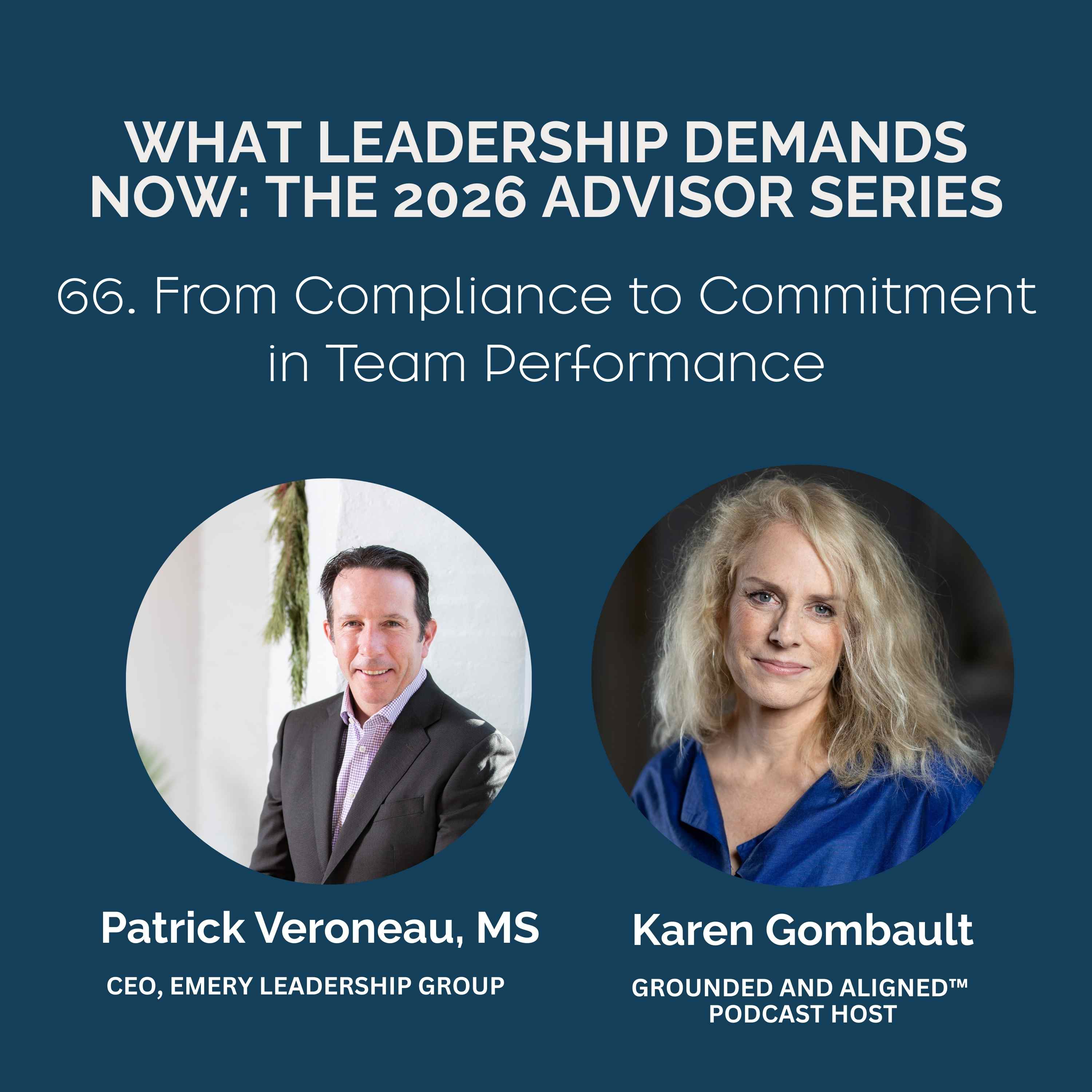
Ep 6666. From Compliance to Commitment in Team Performance [2026 Leadership Series]
Organizations often respond to performance challenges by adding more accountability: additional metrics, more reporting, and closer monitoring. Yet in many cases, these efforts do not solve the underlying problem.In this episode of Grounded and Aligned™, Karen speaks with leadership researcher and author Patrick Veroneau about the difference between accountability and ownership in high-performing teams. Drawing on two decades of work with leaders and teams across industries, Patrick explains why many organizations struggle with engagement even while emphasizing accountability.The conversation explores a structural pattern Patrick has observed repeatedly. Teams that struggle, teams that perform at an average level, and teams that consistently excel all engage in three behaviors: they support each other, celebrate each other, and challenge each other. The difference lies in the sequence.Great teams begin with support. When people trust that others have their backs, challenge becomes constructive rather than defensive, and accountability shifts from external pressure to internal ownership.For leaders, the implication is significant. Engagement, ownership, and performance are not created through tighter oversight. They emerge when leaders create the conditions where people choose to take responsibility for the shared mission.Key discussion points:Why organizations that focus primarily on accountability often miss the deeper issue of ownershipThe three behaviors all teams demonstrate — support, celebrate, challenge — and why the sequence mattersHow the CABLES model builds trust and credibility through consistent leadership behaviorsThe five levels of the Accountability Staircase and how language signals where a team is operatingWhy compliance creates average teams, while commitment creates high-performing onesHow small improvements and declines compound over time through the “1% principle”High-performing teams rarely emerge from pressure alone. They form when individuals feel supported, valued, and connected to the mission. At that point accountability no longer needs to be imposed from the outside. People begin to take ownership for the success of the team itself.Connect with Patrick here:Patrick Veroneau website: www.emeryleadershipgroup.comFree leadership resources and downloads (CABLES model, team assessments, etc.): Resources - Emery Leadership Group - Portland, MECABLES model: CABLES Leadership ModelBook: The Missing Piece: What Great Teams Do That Others OverlookBook: The Leadership BridgeLinkedin: Patrick Veroneau, MS | LinkedIn
Ep 6565. Say The Actual Thing
In this episode of Grounded and Aligned™, Karen examines something most senior leaders do but rarely admit: assuming the people around them already know what they need.Not because they're conflict-averse. Not because they're passive. But because at senior levels, asking can feel like a signal that something has gone wrong.The result is a pattern that quietly damages relationships in both directions — with the boss who doesn't know what support you need, and with the team working hard on the wrong version of what you wanted.Karen looks at:Why senior leaders avoid being direct about what they need and the specific belief driving itWhat the silence actually costs, with your boss, with your team, and in the relationships that matter mostThe difference between being direct and being blunt and why that distinction matters at this levelWhat it actually sounds like to ask clearly: the language, the framing, and the two things that make it workWhy most relationship friction at senior levels isn't conflict — it's accumulated assumptionAt senior levels, the people around you are busy, under pressure, and managing their own complexity. They are not going to guess correctly. Clarity is not a sign of weakness. Ambiguity is.Next steps:If you are postponing a conversation — with your boss, with a key stakeholder, or with someone on your team — and you want to think it through before you have it, book a Focus-15.In 15 minutes, you will clarify what you actually need to say, how to frame it, and what outcome you're working toward. You will leave with a clear direction and the confidence to move forward.https://www.karengombault.com/scheduleFollow Karen's writing on Substack, where she examines the structural importance of relationships and alignment at senior levels. https://karengombault.substack.com🤝 Connect on LinkedIn https://www.linkedin.com/in/karengombault/
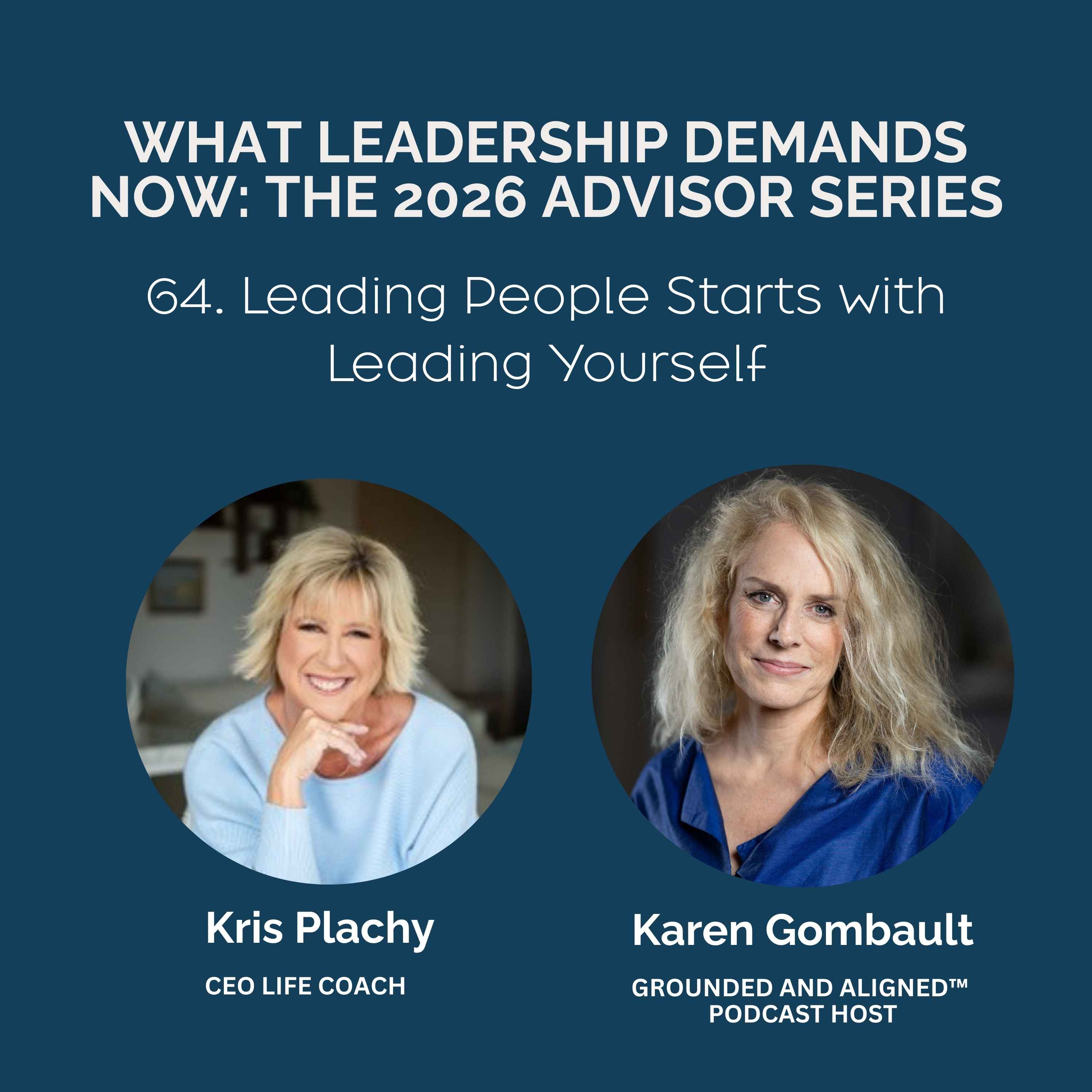
Ep 6464. Leading People Starts With Leading Yourself [2026 Leadership Series]
Leadership conversations often focus on strategy, growth, and organizational change. Yet the daily reality of leadership still comes down to something more fundamental: how effectively leaders manage people and themselves.In this episode of Grounded and Aligned™, Karen speaks with leadership coach Kris Plachy about what has — and has not — changed in leadership as we move into 2026. Drawing on three decades of work with female founders and CEOs, Kris argues that the fundamentals remain the same: leaders set direction, clarify expectations, and hold people accountable for results.What has changed is the environment in which those fundamentals now operate. Leaders are managing teams with shorter attention spans, greater emotional volatility, and increasing distraction. At the same time, many leaders struggle with the very conversations required to maintain accountability.The discussion explores why emotional regulation is not a “soft skill,” but a core leadership requirement. When leaders cannot manage their own emotional responses, they lose authority in difficult conversations and allow behavior patterns that ultimately undermine results.For senior leaders, the implication is direct: leadership effectiveness is less about new frameworks and more about mastering the internal mechanics that determine how you respond in pressure moments.Key takeawaysWhy the fundamentals of leadership have not changed, even as the external environment has become more complexThe growing challenge leaders face managing teams in a culture of distraction and shortened attentionWhy many leaders avoid accountability conversations, even when performance expectations are clearHow emotional regulation determines whether leaders maintain authority in difficult momentsThe connection between self-leadership, organizational performance, and business outcomesHow changing the way leaders interpret situations can transform both business results and personal freedomLeadership ultimately reveals how well someone can lead themselves. When leaders learn to regulate their emotional responses, they regain the ability to address problems directly, set clear expectations, and make decisions that serve the organization rather than their discomfort. That shift often changes both the trajectory of the business and the life of the leader.Connect with Kris:Kris Plachy website: https://thevisionary.ceoBook, The One Hour Leader: https://thevisionary.ceo/onehourleader Kris Plachy books :How to Coach a Difficult Person in Six StepsFive Truths for Thinking About Difficult PeopleLinkedIn: Kris Plachy | LinkedIn
Ep 6363. Positioning Yourself for Promotion at Senior Levels
In this episode of Grounded and Aligned™, Karen examines a recurring situation at senior levels: leaders who consistently deliver, operate at the next level, and still do not get promoted.The issue is not capability or performance. It is how promotion decisions are actually formed inside large organizations.If you are operating at Director, VP, or SVP level and relying on execution to carry you forward, this episode focuses on what sits outside your direct output: how decisions are shaped, who influences them, and how your positioning is interpreted when you are not in the room.Karen looks atThe structural gap between strong execution and weak positioning in promotion discussionsHow promotion decisions are formed collectively, and why individual performance is insufficient at senior levelsThe difference between being known and being relevant to decision-makers’ prioritiesThe role of advocacy, sponsorship, and silence in shaping promotion outcomesHow early relationship-building influences credibility long before opportunities are formally discussedWhat happens when leaders opt out of political dynamics and how that affects their visibility in decision processesAt senior levels, progression is determined less by what you deliver and more by how your work is carried into decision-making forums by others. If your scope is already expanding but your positioning is not, the gap will become visible when promotion decisions are made.Next steps:If your scope has recently expanded and you are operating with greater visibility and stakeholder complexity, a short, structured reset can materially improve how you deploy your time and authority. Book a Focus-15. In 15 minutes, you will clarify what requires your attention now, what no longer does, where to focus to reinforce authority, and one concrete adjustment to implement immediately. You will leave with a clear direction for the next 30 days.https://www.karengombault.com/scheduleFollow Karen’s writing on Substack, where she examines the structural importance of relationships and alignment at senior levels.https://karengombault.substack.com🤝 Connect on LinkedInhttps://www.linkedin.com/in/karengombault/
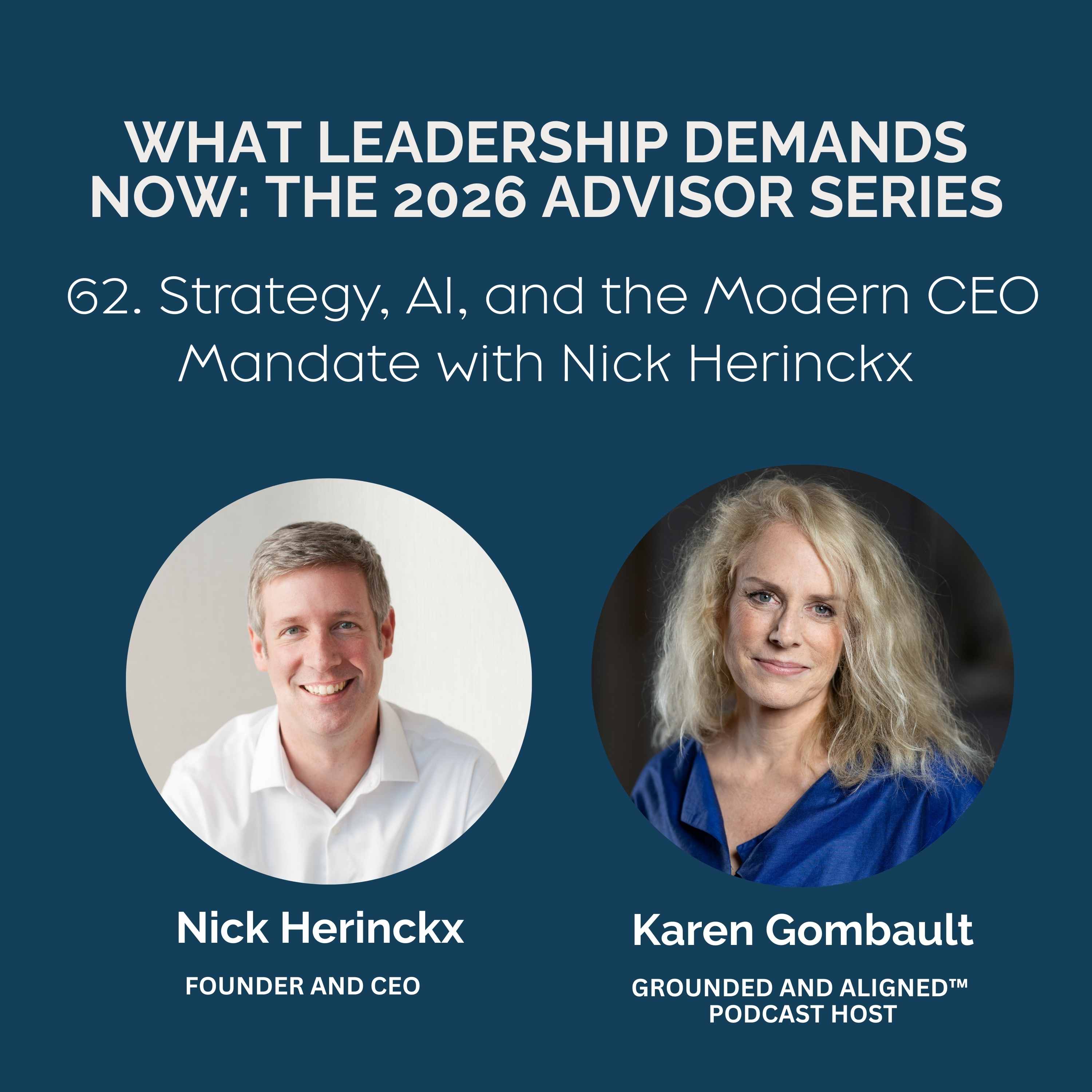
Ep 6262. Strategy, AI, and the Modern CEO Mandate [2026 Leadership Series]
The operating environment for CEOs and senior leaders has shifted materially over the past five years. Artificial intelligence is accelerating, funding cycles are volatile, remote work is embedded, and expectations around leadership have changed.In this episode of Grounded and Aligned™, Karen speaks with Nick Herinckx, founder and CEO of Oxygen, about what is structurally different for CEOs in 2026. Drawing on his work coaching more than 100 CEOs, Nick outlines two persistent tensions: staying focused on strategy while technology evolves rapidly, and building toward a future that current tools cannot yet fully support.The discussion also addresses a dynamic many senior leaders are now experiencing directly: AI adoption moving bottom-up, with employees experimenting faster than executives. For VPs and SVPs operating between executive decision-making and frontline execution, this creates both risk and opportunity.Beyond AI, the conversation examines management capability, remote leadership strain, and the cumulative impact of social media and constant comparison on executive mental health.Key takeawaysWhy CEOs are repeatedly revisiting strategy in response to AI pressure, and how this can stall executionThe shift from top-down change to bottom-up AI adoption, with employees often outpacing senior leadersWhere silo breakdown is occurring as cross-functional teams collaborate around new toolsWhy first-time manager development remains a structural weakness in many organizationsHow remote environments increase the difficulty of culture transmission and emotional reinforcement for senior leadersThe underestimated impact of social media and constant comparison on executive mental health and decision-makingSenior leaders hold disproportionate influence over how uncertainty is interpreted inside their organizations. In periods of acceleration, your framing of technology, strategy, and risk directly affects focus, morale, and retention. Clarity and steadiness are no longer secondary qualities. They are operational requirements.Connect with Nick here: https://www.linkedin.com/in/nickherinckx/ https://www.leadwithoxygen.com/
Ep 6161. Powerful Work Relationships
At senior levels, execution alone rarely determines results. Most decisions, promotions, and initiatives depend on how effectively you work with other people.In this episode of Grounded and Aligned™, Karen Gombault looks at a pattern that appears consistently in her work with senior leaders: when progress slows, a relationship dynamic is usually involved. It may be a new boss reshaping the organization, a promotion discussion influenced by several decision-makers, tension between senior peers, or the challenge of aligning large teams.Many experienced leaders still approach their role primarily through execution. Yet as scope increases, outcomes depend increasingly on influence, alignment, and how work moves through other people.Karen introduces a practical way to think about workplace relationships so that they are not treated as informal networking or personality chemistry. Instead, they become part of how leaders deliver on their responsibilities.Karen looks at:Why relationships become more decisive as roles expand and decisions involve multiple stakeholders.The difference between relationships that shape long-term opportunities and those that determine whether work actually happens.The informal individuals inside organizations who influence how actions and decisions are interpreted.Why most senior leaders need one or two trusted relationships that provide direct, honest perspective.How clarity about your objectives changes which relationships matter.Relationships at work are not primarily social connections. For leaders with significant scope, they are part of how decisions move, how initiatives progress, and how judgment develops over time.Next stepsIf your scope has recently expanded and you are operating with greater visibility and stakeholder complexity, a short, structured reset can materially improve how you deploy your time and authority....Book a Focus-15. In 15 minutes, you will clarify what requires your attention now, what no longer does, where to focus to reinforce authority, and one concrete adjustment to implement immediately. You will leave with a clear direction for the next 30 days.https://www.karengombault.com/schedule Follow Karen’s writing on Substack, where she examines the structural importance of relationships and alignment at senior levels.https://karengombault.substack.com 🤝 Connect on LinkedInhttps://www.linkedin.com/in/karengombault/
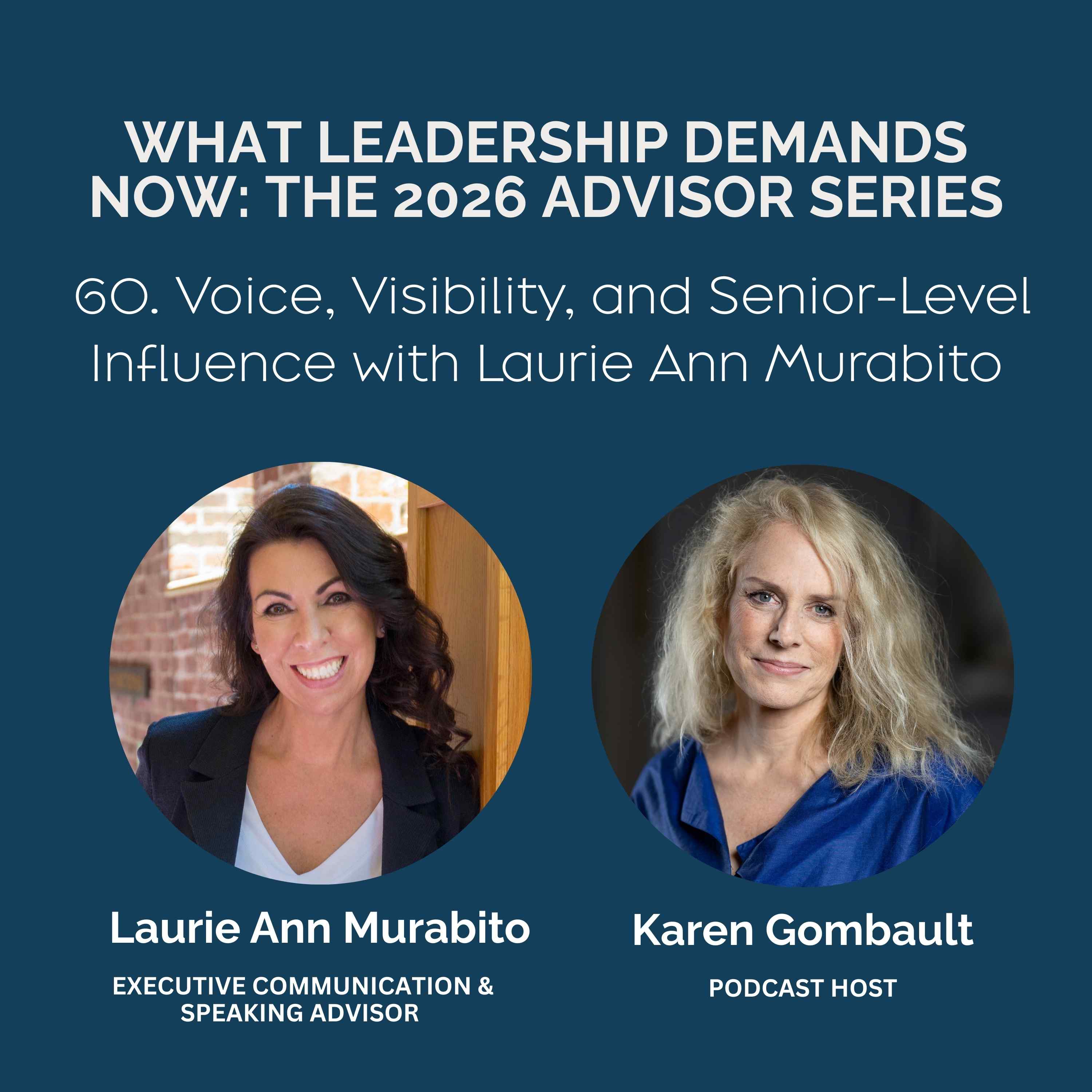
Ep 6060. Voice, Visibility, and Senior-Level Influence [2026 Leadership Series]
In many organizations, performance is necessary but no longer sufficient for advancement. Senior roles now require visible authority, clarity under pressure, and the ability to influence across stakeholders who may not sit in your reporting line.In this episode of Grounded and Aligned™, Karen speaks with executive communication advisor Laurie-Ann Murabito about what she is hearing from corporate leaders following year-end reviews: feedback around conciseness, executive presence, and memorability.The pattern is consistent. Leaders with strong track records are being passed over for promotion because their communication does not signal readiness for broader scope.If you are operating in a matrix environment, presenting to boards, or preparing for expanded accountability, this conversation examines why speaking skill is no longer optional. It is a structural component of leadership credibility.Key topics addressed:Why executive presence is increasingly cited in promotion decisions, even when technical performance is strongHow virtual environments have raised the bar on clarity, vocal control, and attention managementThe link between nervous system regulation and consistent authority in high-stakes forumsWhy speaking opportunities function as internal strategic networking, particularly in large organizationsHow personal brand resilience matters in periods of restructuring, acquisition, and leadership turnoverA practical starting point for increasing visibility without overexposing yourselfAs scope increases, so does scrutiny. The leaders who advance are not only delivering results but doing so in a way that is visible, structured, and credible across forums. Communication is not an add-on to the role. It is part of how readiness is assessed.Connect with Laurie-Ann here:LinkedInInstagramYouTubeWebsite: Speak and Stand Out | Executive Communication and Speaking Advisor and CoachPodcast
Ep 5959. On Being Right
In senior roles, you are expected to have a point of view. You are promoted for judgment and decisiveness. But there is a structural risk that emerges at VP and SVP levels: the instinct to defend your position can reduce your ability to move work forward.In this episode of Grounded and Aligned™, Karen Gombault examines what happens when relational alignment at the top is not deliberately built. If you are operating with a broad scope and cross-functional accountability, execution depends less on being correct and more on whether your boss, peers, and team are positioned to support your decisions.The episode looks at:How the need to be right can narrow influence with your boss and affect when and how you are consultedWhat misalignment with peers does to cooperation, information flow, and execution speedWhy teams comply but disengage when leaders over-index on certaintyHow political capital is built or reduced through everyday interactionsThe difference between individual correctness and coordinated progressAt senior levels, momentum is built on relationships. You are accountable for outcomes that require other people’s cooperation. The question is not whether you are right. It is whether you can move forward decisions and initiatives - THAT is your job.Next stepsIf your scope has recently expanded and you are operating with greater visibility and stakeholder complexity, a short, structured reset can materially improve how you deploy your time and authority.Book a Focus-15 with former C-Suite executive Karen Gombault. In 15 minutes, you will clarify what requires your attention now, what no longer does, where to focus to reinforce authority, and one concrete adjustment to implement immediately. You will leave with a clear direction for the next 30 days.🧭 Book a Focus-15https://www.karengombault.com/scheduleYou can also follow Karen’s writing on Substack, where she examines the structural importance of relationships and alignment at senior level.https://karengombault.substack.com🤝 Connect on LinkedIn https://www.linkedin.com/in/karengombault/
Ep 5858. Leadership Superpower #3: Leading with Focus Amid Uncertainty and Noise
In this episode of Grounded and Aligned™, Karen Gombault addresses a pressure most senior leaders recognize immediately: how to stay focused when the organization feels unsettled. A new CEO, a reorganization, acquisitions, limited communication, and leadership turnover can quickly create uncertainty. At the same time messages, meetings, and internal speculation compete for your attention. If you are operating with significant scope, your ability to decide what deserves your focus becomes central to your effectiveness. This episode looks at how senior leaders can direct their attention deliberately and avoid being pulled into noise that adds no value.Karen looks atHow leadership changes and reorganizations increase distraction and dilute executive attentionThe discipline of focusing on what you can control, including decisions, time allocation, and prioritiesThe expectation that senior leaders provide steadiness when teams feel unsettledThe impact of gossip and speculation on anxiety, productivity, and decision qualityThe cumulative effect of constant digital interruption on focus and performanceHow dissatisfaction or stagnation in a role can make distraction more likelyAt VP and SVP level, focus is not a personal productivity preference. It directly affects your credibility and impact. In uncertain conditions, your attention determines what moves forward and what stalls. Choosing where you invest it is part of the role.Next steps🧭 Book an Focus-15 an we'll fine 2 concrete solutions to keep you focused https://calendly.com/kareng-coaching/executive-pulse🤝 Connect on LinkedIn https://www.linkedin.com/in/karengombault/
Ep 5757. Leadership Superpower #2: Emotional Regulation
In senior roles, pressure is constant. Decisions are visible. Stakeholders bring urgency, frustration, and competing priorities into the room. You cannot control those inputs but you can control your response. In this episode of Grounded and Aligned™, Karen Gombault examines emotional regulation as a core leadership skill. Emotional regulation is the ability to notice your reaction, pause, and choose how to respond rather than act on impulse. It is not suppression of emotion, but disciplined composure. When leaders react in the moment — through sharp emails, raised tone, or visible frustration — judgment and discernment are difficult and conversations tend to escalate. When emotions remain steady, discussions stay productive. Karen looks at: How emotional reactivity reduces decision quality Why visible composure increases trust and authority The link between a leader’s emotional state and team stabilityThe role of regulation in high-stakes discussions and negotiations A practical method to reset your nervous system in real time As responsibility increases, emotional regulation becomes part of the role. Your tone influences the room and your reaction sets the standard. Next steps Schedule a free Focus 15 session where she walks you through a practical exercise to regulate your nervous system in real time. If you want to experience the method directly, you can sign up below. 🧭 Book a Focus 15 https://www.karengombault.com/schedule 🤝 Connect on LinkedIn. https://www.linkedin.com/in/karengombault/
Ep 5656. Leadership Superpower #1: Not Taking Things Personally
At senior levels, challenge is constant, questions are direct, assumptions are tested in real time, and comments are brief and often ambiguous.In this episode of Grounded and Aligned™, Karen Gombault begins a series on leadership skills that materially affect effectiveness in expanded roles.The first: the ability to avoid turning routine business scrutiny into a "personal verdict", a.k.a. taking things personally.Many experienced leaders know they “shouldn’t” take things personally. Yet in high-visibility settings, a short comment can trigger over-explanation, a neutral question can alter tone and composure, focus moves from the issue at hand to protecting credibility.Karen examines why this happens, what it costs at VP and executive level, and why the habit intensifies during role transitions. She draws on client situations and her own experience managing sustained external pressure while carrying full executive accountability.Karen looks at:How interpretation changes behavior in the momentWhy visible defensiveness weakens authorityThe relationship between internal self-assessment and external scrutinyWhat destabilization does to judgment when scope expandsWhy neutrality is a strategic discipline, not an emotional exerciseIf you are operating with broader mandate and exposure, your ability to separate fact from fiction and story directly affects decision quality and perceived steadiness.This episode focuses on that separation — and why it becomes non-negotiable as responsibility increases.Next steps:Book Focus-15 Callhttps://www.karengombault.com/scheduleFree Resource, The Identity Laghttps://www.karengombault.com/identityConnect on LinkedInhttps://www.linkedin.com/in/karengombault/
Ep 5555. Improving Daily Effectiveness in Senior Roles
If you’re operating with sustained responsibility, constant decision flow, and expanding scope, overwhelm often shows up not because of poor time management, but because of how decisions, expectations, and work are structured. In this episode of Grounded and Aligned™, Karen Gombault addresses why senior leaders remain cognitively overloaded even when they are experienced, disciplined, and committed. She outlines three pragmatic strategies drawn from her personal experience as CEO and her work with executives who have limited recovery time, and who need effectiveness that holds under pressure, not theoretical productivity models.Karen looks atHow delayed decisions consume disproportionate cognitive capacity and keep senior leaders stuck in analysis rather than executionWhere unclear decision rights between leaders and their teams create rework, escalation, and unnecessary involvementThe cost of vague task-based scheduling versus explicitly defining outcomes within fixed time constraintsWhy senior roles require deliberate boundary-setting rather than reactive availabilityHow structuring decisions and expectations reduces ongoing mental load without reducing accountabilityOverwhelm at senior level is rarely a volume problem. It is a structural one. When decisions linger, roles are ambiguous, and work is framed as activity rather than outcome, leaders absorb unnecessary load that compounds over time. Effectiveness comes from how judgment, authority, and attention are designed into the role, not from working longer or trying harder.Schedule a Focus-15 here: Schedule Leadership Impact Call
Ep 5454. Identity Shifts Required for Expanded Leadership Scope
If you are stepping into a new role with broader scope, higher visibility, or C-suite level accountability, the pressure to perform often shows up as more effort, more involvement, and faster execution.This episode of Grounded and Aligned™, looks at why that approach breaks down at senior levels. Karen examines how success in expanded roles depends less on activity and more on how leaders see themselves, how they make decisions, and how that internal reference point shapes authority, boundaries, and impact.Karen looks atWhy strategies and behaviors alone are insufficient when role scope increasesHow self-concept directly influences decision speed, priorities, and boundariesThe cost of remaining positioned as the reliable problem solver in senior rolesHow authority is undermined when effort replaces judgmentWhy teams and stakeholders respond to hesitation, over-involvement, and avoidance as signals of role definition“Performance and impact, efficacy, it's not about what you output. It's about how you make decisions, how quickly you make decisions, how you frame those decisions and how you implement those decisions.” - Karen GombaultAs scope expands, leadership effectiveness accumulates through judgment, role design, and disciplined decision-making. Without an explicit shift in how leaders see their role and responsibility, effort increases while authority weakens, creating unsustainable patterns that limit impact over time.Next stepsDownload the associated guide, The Identity Lag: https://www.karengombault.com/identity🧭 Book an Executive Pulse Callhttps://calendly.com/kareng-coaching/executive-pulse🤝 Connect on LinkedInFollow Karen’s writing on senior leadership roles, authority, and sustainable scope.https://www.linkedin.com/in/karengombault/
Ep 5353. Decision Speed, Authority and Organizational Impact
In this episode of Grounded and Aligned™, Karen addresses a pattern that consistently undermines senior leaders taking on new roles: delaying decisions in the name of certainty.When you step into expanded scope with incomplete information, hesitation carries real organizational consequences. Drawing on client work and direct experience, she examines why waiting for clarity rarely produces better outcomes and how early decisions affect authority, momentum, and cognitive load.If you are operating with accountability from day one and feel the pressure to “get it right,” this conversation reframes what effective judgment actually looks like at senior levels.Karen looks atHow delayed decisions create vacuums that others will fill, often in ways misaligned with your intent or prioritiesWhy hesitation signals uncertainty rather than thoughtfulness, and how that signal slows organizations more than imperfect decisions doThe cumulative emotional and cognitive load created by unresolved decisions, particularly in hiring, budgeting, and investment contextsThe role of early decisions in establishing credibility and authority within the first months of a new roleHow decision speed reduces over-coordination and excessive alignment cycles that drain senior capacityAt senior levels, the cost of indecision compounds quickly. Early decisions are less about being right and more about setting direction, preserving energy, and reinforcing judgment under uncertainty. Momentum, authority, and self-trust are built through action, not prolonged analysis.Next steps🧭 If you are experiencing decision indecision, book an Executive Pulse Call, and we'll work through the decision that needs to be made:https://calendly.com/kareng-coaching/executive-pulse🤝 Connect on LinkedInhttps://www.linkedin.com/in/karengombault/
Ep 5252. Stepping Into a Larger Mandate: Boundaries, Scope, and Delegation
Taking on a broader mandate at VP or SVP level is rarely accompanied by clear operational boundaries. The remit expands, visibility increases, and expectations accumulate often faster than they are explicitly discussed.In the early phase, scope is shaped less by formal agreement and more by behavior.Leaders make themselves available.They absorb unresolved issues.They step into gaps to keep momentum and avoid disruption.Over time, those choices define the role as much as the job description does.In this episode of Grounded and Aligned™, Karen Gombault examines what needs to be decided early when responsibility increases — before workload, availability, and accountability become assumed rather than intentional.Karen looks atHow expanded scope is often established through early responsiveness rather than explicit mandateWhy boundaries at VP–SVP level are rarely clarified unless the leader clarifies themThe effect of sustained availability on judgment and decision quality as volume increasesWhy effectiveness at senior level depends on maintaining capacity outside the roleHow postponing delegation keeps senior leaders in execution longer than the role requiresFrom the episode: “No one is going to set a boundary for you. If you say yes, people will take advantage of your time.” - Karen GombaultSenior roles usually become difficult through accumulation, not crisis.Small, reasonable decisions made early tend to define the long-term operating model of the role.At this level, leadership is demonstrated less by responsiveness and more by discernment, particularly around scope, ownership, and what no longer is of your responsibility.Use this link to book your 2026 Atelier call before Jan. 31, 2026: https://calendly.com/kareng-coaching/introductionNext stepsIf you are stepping into a larger remit, or recognising that your current role has expanded beyond what was originally agreed, a short Executive Pulse Call can help you take stock of where expectations need to be clarified.Fifteen minutes.One current situation.Clear perspective on scope, boundaries, and delegation.🧭 Book an Executive Pulse Callhttps://calendly.com/kareng-coaching/executive-pulse☕ Grounded and Aligned™ Daily Coffee ChatConcise weekday reflections on senior leadership, expanded mandates, and executive decision-making.https://www.karengombault.com/offers/wuqAChoZ/checkout🤝 Connect on LinkedInFollow Karen’s writing on senior leadership roles, authority, and sustainable scope.https://www.linkedin.com/in/karengombault/