PLAY PODCASTS
Grating the Nutmeg

Grating the Nutmeg

Connecticut Explored Magazine

237 episodesEN

Show overview

Grating the Nutmeg has been publishing since 2015, and across the 11 years since has built a catalogue of 237 episodes. That works out to roughly 160 hours of audio in total. Releases follow a fortnightly cadence, with the show now in its 217th season.

Episodes typically run thirty-five to sixty minutes — most land between 32 min and 46 min — though episode length varies meaningfully from one episode to the next. None of the episodes are flagged explicit by the publisher. It is catalogued as a EN-language History show.

The show is actively publishing — the most recent episode landed 2 weeks ago, with 7 episodes already out so far this year. Published by Connecticut Explored Magazine.

Episodes
237
Running
2015–2026 · 11y
Median length
38 min
Cadence
Fortnightly

From the publisher

Connecticut is a small state with big stories. GTN episodes include top-flight historians, compelling first-person stories and new voices in Connecticut history. Executive Producers Mary Donohue, Walt Woodward, and Natalie Belanger look at the people and places that have made a difference in CT history. New episodes every two weeks. A joint production of Connecticut Explored magazine and the CT State Historian Emeritus.

Latest Episodes

View all 237 episodes

229. Irish Immigration in Art from the Fairfield Great Hunger Museum at the Lockwood-Mathews Mansion Museum

May 1, 202632 min

228. Sports Heaven: The Birth of ESPN in Bristol, Connecticut

Apr 15, 202629 min

S4 Ep 227227. Pioneering Woman Sculptor Evelyn Beatrice Longman

I've got a story about an artist that I've been obsessed with for years. In this episode, Patricia Hoerth Batchelder talks about her new biography of Evelyn Beatrice Longman, The Woman Who Sculpted Golden Boy, Thomas Edison, and Other Monuments. Poor, motherless at five, and uneducated after elementary school, Longman made the highly ambitious claim at nineteen that she could create monumental sculpture. The book tells the story of how she created beauty, moved into upper class society, and succeeded in a field of art that was overwhelmingly dominated by men. Ms. Batchelder has worked for The Washington Star and written for The Tulsa Tribune before co-writing her father's memoir. She is married to Nathaniel Horton Batchelder III, the grandson of sculptor Evelyn Beatrice Longman Batchelder. Look for Evelyn Beatrice Longman, The Woman Who Sculpted Golden Boy, Thomas Edison, and Other Monuments by Patricia Batchelder and published in 2025 on Amazon or at your favorite bookstore. It's also available at the publisher's website, Bloomsbury.com. There are two places I'd encourage you to visit when the weather warms up. The first is the Spanish-American War Memorial in Hartford's Bushnell Park. It's on the south side on Elm Street-if you go at lunch time, there might be food trucks. The second is Chesterwood, sculptor Daniel Chester French's summer estate in Stockbridge, Massachusetts. It's only a smidge over the Connecticut border in the Berkshires and is run as a museum property by the National Trust for Historic Preservation. Here's the website: chesterwood.org/ -------------------------------------------- Don't forget to subscribe to Connecticut Explored magazine today-our summer issue is full of fun ideas for daytrips and staycations! Remember, you can help us celebrate our 10th anniversary and keep the podcast alive by pledging $10 dollars a month. It's easy to set up a monthly donation on our website at ctexplored.org/ Connecticut history matters - be part of it! This episode of Grating the Nutmeg was produced by Mary Donohue and engineered by Patrick O'Sullivan at highwattagemedia.com/ Follow GTN on our socials-Facebook, Instagram, Threads, and BlueSky. Follow executive producer Mary Donohue on Facebook and Instagram at West Hartford Town Historian. Join us in two weeks for our next episode of Grating the Nutmeg, the podcast of Connecticut history. Thank you for listening!

Apr 1, 202635 min

S4 Ep 226226. Abby (and Julia) Smith and Their Cows

Last year, in Episode 217, listeners were introduced to Hannah Smith. Born in 1767, Hannah was the matriarch of the non-conformist Smith Family of Glastonbury. In the 2020s, her diaries inspired Leonard Raybon, a music professor at Tulane, to compose an original mini-musical based on her writings. You can view the debut performance of "Hannah and Her Daughters" here. This episode focuses on the next generation of the Smith family. Hannah Hickock married Zephaniah Smith of Glastonbury in 1786, and their marriage produced five daughters. Two of the daughters became nationally famous in the 1870s, around the time of the Bicentennial, for their stance in favor of women's suffrage. Natalie Belanger is joined by Diane Hoover, Education Director of the Glastonbury Historical Society, who told her about the Smith sisters' upbringing, their many talents, and how the two youngest became involved in the suffrage fight – in a protest that centered around their pet cows. You'll also hear about Julia Smith's achievements as a Biblical scholar, and how a romantic entanglement at the age of 87 provides a rather sad end to her remarkable life. Image: Portrait of Abby and Julia Smith, c. 1877, Library of Congress -------------------------------- Like Grating the Nutmeg? Want to support it? Make a donation! 100% of the funds from your donation go directly to the production and promotion of the show. Go to ctexplored.org to send your donation now. This episode of Grating the Nutmeg was produced by Natalie Belanger and engineered by Patrick O'Sullivan at highwattagemedia.com/ Follow GTN on our socials-Facebook, Instagram, Threads, and BlueSky. Follow executive producer Mary Donohue on Facebook and Instagram at West Hartford Town Historian. Join us in two weeks for our next episode of Grating the Nutmeg, the podcast of Connecticut history. Thank you for listening!

Mar 15, 202623 min

S4 Ep 225225. On Trial: Alfred Marder and Catherine Roraback - A Communist's Arrest in 1950's McCarthy-era New Haven (10th Anniversary Encore Release)

Grating the Nutmeg is 10 years old! In celebration of our 10th anniversary, we are bringing you a remastered and re-edited edition of an episode we recorded in 2016 at the New Haven Museum with Alfred Marder, Judge Andrew Roraback and his father Charles Roraback. This compelling first-person interview with Alfred Marder shares his experiences as a defendant in New Haven's Smith trial. Mr. Marder died in 2023 at the age of 101. He was defended by civil rights attorney Catherine Roraback, an inductee in the Connecticut Women's Hall of Fame. In 1954, 32-year-old Alfred Marder was arrested in New Haven along with several others under the Smith Act for allegedly working to overthrow the US government. After a lengthy trial, during which he was defended by the celebrated civil rights lawyer Catherine Roraback, he was acquitted. Hear Mr. Marder tell in his own words what he was fighting for and what it feels like when the full power of the state, federal, and local government is aimed at you. This episode of Grating the Nutmeg was produced by Mary Donohue and engineered by Patrick O'Sullivan at highwattagemedia.com/ Follow GTN on our socials-Facebook, Instagram, Threads, and BlueSky. Follow executive producer Mary Donohue on Facebook and Instagram at West Hartford Town Historian. Join us in two weeks for our next episode of Grating the Nutmeg, the podcast of Connecticut history. Thank you for listening!

Feb 15, 202656 min

S4 Ep 224224. Scholar, Activist, Trailblazer: The Enduring Legacy of Dr. Lorenzo Greene

Connecticut is a small state that has had a huge national impact. In this episode, we celebrate someone that we are proud to say was born in Connecticut and went on to be a pioneering historian in Black history. Dr. Lorenzo Johnston Greene received his BA in from Howard University in 1924, his MA from Columbia University in 1926 and his Ph.D. in 1942. He was born in Ansonia, Connecticut. We can learn more about his family from the 1900 federal census record. His father Willie was born in 1858 in Virginia before the end of slavery, and his mother was born in West Virginia in 1870. Both came to Connecticut and by the time Lorenzo was born in 1899, he had five older brothers and sisters. The census states that both of his parents can read and write and their children are in school. By the time of the 1920 census, Lorenz has two older brothers who work in a brass mill. What made Lorenzo want to go to college and become a historian? When did he work with Dr. Carter Woodson, the "Father of Black History" and what were Greene's own lasting contributions to the study of Black history? Our guest is Dr. Stacey Close, Associate Vice Provost and Vice President of Equity and Diversity at Eastern Connecticut State University. Dr. Close is a co-author of African American Connecticut Explored, published by Wesleyan University Press, and a noted authority on Hartford and the Great Migration. You can learn more about that in GTN episode: #181. Hartford and the Great Migration, 1914-1950. One last thing about Dr. Greene. In the 1930 federal census, he is 31 years old and working for Dr. Woodson as a field representative and research assistant. Greene lists his job as "Historical Investigating Officer" - he had such a strong sense of his mission even as a young man during the depths of the Great Depression. Thank you to Dr. Close. And thank you for listening! We'll be back in two weeks with another episode of Grating the Nutmeg. History matters - be part of it. --------------------------------------- This episode of Grating the Nutmeg was produced by Mary Donohue and engineered by Patrick O'Sullivan at highwattagemedia.com/ Follow GTN on our socials - Facebook, Instagram, Threads, and BlueSky. Follow executive producer Mary Donohue on Facebook and Instagram at West Hartford Town Historian. Join us in two weeks for our next episode of Grating the Nutmeg, the podcast of Connecticut history. Thank you for listening!

Jan 30, 202627 min

S4 Ep 223223. The 'Great Temperance Times' in Nineteenth-Century Black Connecticut

At first glance, alcohol and racial equality might seem unrelated—but for Black activists, the temperance movement was a powerful vehicle for social change. In this episode of Grating the Nutmeg, Natalie Belanger of the Connecticut Museum chats with Mackenzie Tor about her research into Black temperance activism in 1830s and 1840s Connecticut. Mackenzie talks about how people like Maria Stewart, James Pennington, and the Beman family used temperance as a strategy for civic inclusion. Through their words and organizing efforts, from newspaper columns to church halls, abstaining from the bottle became a radical tool for political belonging in the hands of Connecticut's Black communities. She also discusses the flip side of this – how accusations of intemperance could be wielded to bring down successful Black men, like New Haven's William Lanson, when their business and civic ventures threatened the power of white elites. Mackenzie, a PhD Candidate in History at the University of Missouri, did research for this project at the Connecticut Museum as part of the New England Regional Fellowship Consortium. Learn more about the Consortium and the support it provides for scholars here: masshist.org/fellowships/nerfc To find out how William Lanson changed the face of New Haven, see this CT Explored article by Stacey Close: ctexplored.org/william-lanson-an-artisan-who-built-beyond-structures/ You can read more about Stewart, Pennington, and the Bemans here: ctexplored.org/site-lines-black-abolitionists-speak/ Finally, here's a link to watch Mackenzie Tor give a more detailed look at the research she did at the Connecticut Museum of Culture and History's Waterman Research Center on this topic: youtube.com/watch?v=bYi9JAqouTE&t=2510s Caption image #1: The Colored American newspaper, 1841. Caption Image #2: The Tree of Temperance, Currier and Ives, 1872, Library of Congress. ---------------------------------------- Like Grating the Nutmeg? Want to support it? Make a donation! 100% of the funds from your donation go directly to the production and promotion of the show. Go to ctexplored.org to send your donation now. This episode of Grating the Nutmeg was produced by Natalie Belanger and engineered by Patrick O'Sullivan at highwattagemedia.com/ Follow GTN on our socials-Facebook, Instagram, Threads, and BlueSky. Follow executive producer Mary Donohue on Facebook and Instagram at West Hartford Town Historian. Join us in two weeks for our next episode of Grating the Nutmeg, the podcast of Connecticut history. Thank you for listening!

Jan 14, 202641 min

S4 Ep 222222. Cabbage Patch Kids and West Hartford's Toymaker Coleco

During this holiday season, it seems like the perfect time to bring you the story of one of the bestselling toys ever - Cabbage Patch Kids! Inducted into the Toy Hall of Fame in 2023, Cabbage Patch Kids set every toy industry sales record for three years running from 1983-86, and has become one of the longest-running doll franchises in the United States. How did a Connecticut company produce the hottest toy of the 1980s - and then go broke? The license to produce Cabbage Patch Kids has gone through a record 7 toy companies. This episode is on the Coleco years - the toymaker with their headquarters in West Hartford. Host Mary Donohue will share her experience buying the dolls and Natalie Belanger, Grating the Nutmeg producer from the Connecticut Museum of Culture & History, her own childhood experience playing with the Cabbage Patch Kids. It's hard to believe after such a successful toy, but Coleco Industries were bankrupt by 1989. The Hartford Courant published numerous full-page stories about what had gone wrong. The Courant reported that "With its revenues dropping and its debt mounting, Coleco faced some critical decisions. Toy industry analysts said the company should have slowed its spending, cut expenses and waited for sales to improve. Instead, Coleco chose to borrow more and spend more, trying to develop a product to rival Cabbage Patch Kids. But the new toys it introduced-Rambo action figures, Furskins stuffed bears, a talking Cabbage Patch doll and Starcom space toys for boys sold only moderately well." Find out more in this episode! ------------------------------------------ To subscribe to Connecticut Explored, the magazine of Connecticut history, visit simplecirc.com/subscribe/connecticut-explored To watch Connecticut's Hidden Gems on YouTube, visit ctpublic.org/watch/local-programming/connecticut-hidden-gems We did it! Thanks to our listeners, Grating the Nutmeg is celebrating our 10th anniversary. With over 200,000 streams, over 200 episodes and heard in over 50 countries, Grating the Nutmeg brings CT's big stories to listeners around the world! We're planning our 2026 calendar now and need your support. Help us celebrate our 10th anniversary milestone by pledging $10 a month or making a $100 donation now on our website at ctexplored.org. History matters-be part of it! This episode of Grating the Nutmeg was produced by Mary Donohue and engineered by Patrick O'Sullivan at https://www.highwattagemedia.com/ Follow GTN on our socials-Facebook, Instagram, Threads, and BlueSky. Follow executive producer Mary Donohue on Facebook and Instagram at West Hartford Town Historian. Join us in two weeks for our next episode of Grating the Nutmeg, the podcast of Connecticut history. Thank you for listening!

Dec 1, 202522 min

S4 Ep 221221. New Haven's Lt. Augusto Rodríguez, First Civil War Soldier from Puerto Rico

More than twenty thousand Hispanic Americans served in the Civil War. When Cuban-born Loreta Velázquez's husband would not allow her to join him on the battlefield, she assumed the role of First Lieutenant Harry T. Buford to be near him. Philip Bazaar, born in Chile, was awarded the Medal of Honor for his courageous exploits during the assault of Fort Fisher. The spying efforts of Floridian Maria Dolores Sánchez and her two sisters led to a Union defeat at the Battle of Horse Landing. Delving into the lives of these individuals, historian A.J. Schenkman, author of Hispanic Americans of the Civil War, published by the History Press in 2025, uncovers this often-overlooked aspect of Civil War history. Hispanic soldiers came from different countries. Mexico had declared its independence from Spain in 1821 and later abolished slavery in 1837. Some soldiers and sailors traced their families to Cuba and Puerto Rico, which were still part of Spain. Or from Spain itself or its other colonies. In this episode, Schenkman uncovers a bombshell story about New Haven's Augusto Rodríguez, the first known Civil War soldier from Puerto Rico. When this story was published in the Summer 2025 issue of Connecticut Explored magazine, the phone started to ring off the hook. Television news channels and newspapers quickly picked up this remarkable story. Grating the Nutmeg has covered the courageous Puerto Rican men of the 65th regiment founded in 1899 when Puerto Rico became a United States territory in episode #184 but not someone this early in our military history. A. J. Schenkman is a New York-based writer. He is a social studies teacher in Ulster County, New York, and a former municipal historian. Schenkman is also author of several books about local, regional, and national history. He currently writes for Litchfield and Dutchess Magazines, as well as the Shawangunk Journal. To contact A.J. Schenkman, visit his website at https://www.ajschenkman.com/ To subscribe to Connecticut Explored, the magazine of Connecticut history, visit https://simplecirc.com/subscribe/connecticut-explored To watch Connecticut's Hidden Gems on YouTube, visit https://www.ctpublic.org/watch/local-programming/connecticut-hidden-gems ------------------------------------- This episode of Grating the Nutmeg was produced by Mary Donohue and engineered by Patrick O'Sullivan at highwattagemedia.com/ Follow GTN on our socials-Facebook, Instagram, Threads, and BlueSky. Follow executive producer Mary Donohue on Facebook and Instagram at West Hartford Town Historian. Join us in two weeks for our next episode of Grating the Nutmeg, the podcast of Connecticut history. Thank you for listening!
Nov 14, 202525 min

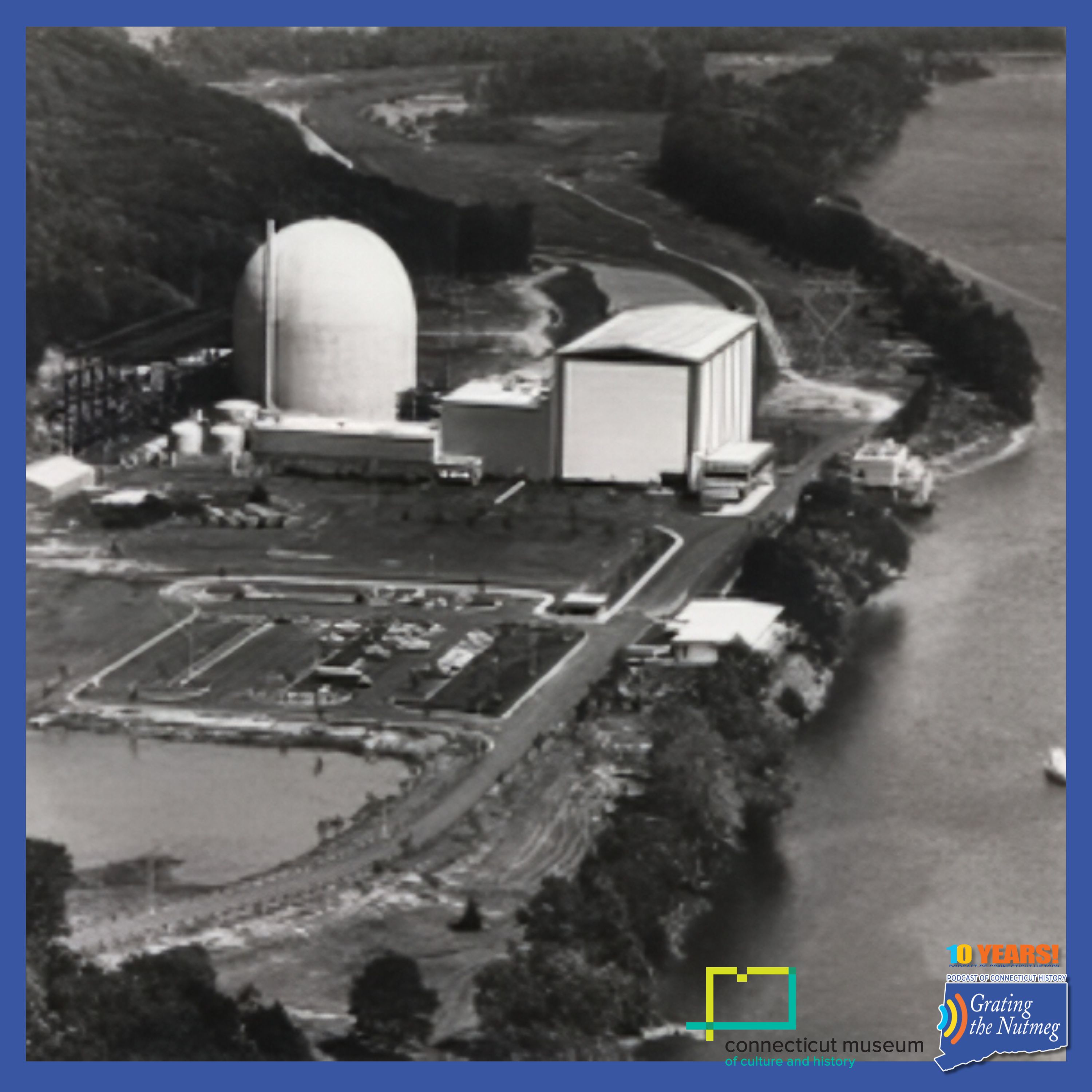
S4 Ep 220220. Connecticut Yankee Atomic Power Plant: The Promise and Peril of Nuclear Energy

The Connecticut Yankee atomic power plant was one of the earliest commercial nuclear reactors in New England. Though it was dismantled at the turn of the 21st century, its legacy remains, both for the landscape of the Connecticut River Valley where it once stood, and for contemporary debates about energy today. This episode explores the plant's life and afterlife, the activists who opposed it, and the promises and perils of nuclear power in the 1960s and today, through the reminiscences of Paul Gionfriddo, a former state legislator and longtime president of People's Action for Clean Energy, a group that has advocated for conservation and renewable energy in Connecticut since the early 1970s. This episode is presented by Dr. Amrys Williams and Jon Kozak. Williams is a historian of science, technology,and the environment who serves as the Executive Director of the Connecticut League of Museums. Her recent research projects have focused on anti-nuclear activism, radioecology, and the public interpretation of nuclear places. Kozak is a graduate student in Public History at Central Connecticut State University and the Communications Manager for the Connecticut League of Museums. His recent research has focused on energy landscapes and the Connecticut Yankee plant. Their guest is Paul Gionfriddo is a former state representative and mayor of Middletown, a graduate of Wesleyan University, and a retired nonprofit professional. He has advocated for mental health and renewable energy, and served as President of People's Action for Clean Energy from 1975 until 1999. For more information, visit these sites: -Connecticut Yankee website: connyankee.com/ -People's Action for Clean Energy website: pacecleanenergy.org/ -1960s film of the construction of the Connecticut Yankee Nuclear Power Plant: youtube.com/watch?v=AiCYVMboju8 -The Atom and Eve, 1960s film promoting CT Yankee plant and atomic power in New England: footagefarm.com/reel-details/communications/telephone/1966---colour-atomic-energy-usa--atom-and-eve ; https://catalog.archives.gov/id/88095 -US Department of Energy Flickr Photo Stream, with many images of the Haddam Neck Plant before and during its operating lifetime: flickr.com/photos/departmentofenergy/10822396434/in/photostream/ -Connecticut Yankee Atomic Power Company, Haddam Neck Plant Records at the University of Connecticut Archives and Special Collections: archivessearch.lib.uconn.edu/repositories/2/resources/335 -Wesleyan Anti-Nuclear Protests Collection, Wesleyan University Archives and Special Collections: archives.wesleyan.edu/repositories/ua/resources/wesleyan_university_anti-nuclear_protests_collecti -Connecticut Collections: ctcollections.org/ Production notes -Projector sound effect: cine-projector SFX.wav by Rollo145 -- https://freesound.org/s/220348/ -- License: Attribution NonCommercial 3.0 -Archival audio from: -Gene Starbecker, The Atom and Eve (Bay State Film Production Inc., 1966). -Construction of Connecticut Yankee Atomic Power Plant, produced for Connecticut Yankee by Kevin Donovan Films, Glastonbury, CT, ca. 1968. Photo Credit Photo of CY when it was in operation from the Department of Energy. Connecticut League of Museums: ctleague.org/ This episode of Grating the Nutmeg was produced by Amyrs Williams and Jon Kozak. GTN podcast engineer is Patrick O'Sullivan at highwattagemedia.com/ Follow GTN on our socials-Facebook, Instagram, Threads, and BlueSky. Follow executive producer Mary Donohue on Facebook and Instagram at West Hartford Town Historian. Join us in two weeks for our next episode of Grating the Nutmeg, the podcast of Connecticut history.

Oct 31, 202529 min

S4 Ep 219219. Transgender History and Connecticut Transgender Pioneer Dr. Alan L. Hart

The transgender community has struggled to receive recognition and equality. In this episode, we explore the history of the transgender community over the last 100 years with Dr. Susan Stryker and the life of Dr. Alan L. Hart, a transgender medical doctor working on the forefront of an urgent public health crisis, tuberculosis, in Connecticut. Hart, Director of Connecticut's Office of TB Rehabilitation, is credited with saving countless lives. My guest is Dr. Susan Stryker, author of Transgender History, the Root of Today's Revolution, published in 2017. Transgender History, Third Edition: A Resource for Today's Struggle-and Tomorrow's will be published in Febuary, 2026. Dr. Susan Stryker holds a distinguished visiting appointment at Stanford's Michelle R. Clayman Institute for Gender Research at Stanford University, and is Professor Emerita of Gender, Women's and Sexuality Studies at the University of Arizona, where she directed the Institute for LGBT Studies for many years. She is the author or editor of numerous articles, books and anthologies. A collection of previously published short works, When Monsters Speak: A Susan Stryker Reader, was published by Duke University Press in 2024. She is also an Emmy-winning documentary filmmaker for Screaming Queens: The Riot at Compton's Cafeteria. In the documentary, you'll meet Dr. Stryker and some of the transgender women and drag queens who fought police harassment at Compton's Cafeteria in San Francisco's Tenderloin in 1966 three years before the famous riot at Stonewall Inn bar in New York City. You'll find the documentary on Amazon Prime. To contact Dr. Stryker, visit her website at www.susanstryker.net/about For more information on Dr. Alan L. Hart, go to these resources: https://www.scientificamerican.com/article/trailblazing-transgender-doctor-saved-countless-lives/ https://pmc.ncbi.nlm.nih.gov/articles/PMC12328259/ https://www.researchgate.net/publication/272831386_Manifesting_Manhood_Dr_Alan_Hart's_Transformation_and_the_Embodiment_of_Sex_in_Early_Twentieth-Century_Sexology https://college.lclark.edu/live/news/43320-from-the-archives-dr-alan-hart West Hartford Pride West Hartford Pride supports, celebrates, and uplifts the LGBTQAI+ Community by providing resources, events, education, and social justice initiatives. Find out more about visiting their website at westhartfordpride.org Preservatlon Connecticut LGBTQ+ Historic Sites Survey Preservation Connecticut, in partnership with scholars and activists, has embarked on documenting Connecticut's LGBTQ+ sites. Interwoven through these places are stories of resilience, innovation, and the pursuit of equality that transcend the traditional boundaries of class, race, ethnicity, and religion. If you're interested in learning more or contributing to this survey project, please visit www.preservationct.org/lgbtq. Grating the Nutmeg Three-part LGBTQ+ Series 2025 Connecticut Explored magazine and our podcast, Grating the Nutmeg, have featured many of the heritage trails that mark the important histories and sites of Connecticut's people. Preservation Connecticut has undertaken a survey of LGBTQ+ heritage sites across the state. Now, Grating the Nutmeg and Preservation Connecticut have teamed up to bring you a three-episode podcast series that pairs new research on LGBTQ+ identity and activism with accounts of the Connecticut places where history was made. The episodes include a thriving vegetarian cafe-bookstore run by lesbian feminists in a working-class former factory town, Episode 212, a transgender medical researcher working on an urgent public health issue in the center of Connecticut politics, Episode 219, and a gay, Jewish, best-selling children's book author in affluent Fairfield County, Episode 215. Connecticut Humanites The 2025 LGBTQ+ Three-part series received grant support from CT Humanities, connecting people to the humanities through grants, partnerships, and public programs. Visit our website to learn about our funding opportunities and capacity building grants. https://cthumanities.org/ ------------------------------------------ Like Grating the Nutmeg? Want to support it? Make a donation! 100% of the funds from your donation go directly to the production and promotion of the show. Go to ctexplored.org to send your donation now. secure.qgiv.com/for/gratingthenutmeg This episode of Grating the Nutmeg was produced by Mary Donohue and engineered by Patrick O'Sullivan at www.highwattagemedia.com/ Follow GTN on our socials-Facebook, Instagram, Threads, and BlueSky. Follow executive producer Mary Donohue on Facebook and Instagram at West Hartford Town Historian. Join us in two weeks for our next episode of Grating the Nutmeg, the podcast of Connecticut history. Thank you for listening!

Oct 15, 202555 min

S4 Ep 218218. Connecticut in the Industrial Revolution: Making Buttons in Cheshire

A button sounds like a very ordinary thing. But button production in Cheshire was part of Connecticut's pioneering role in the precision manufacturing revolution of the nineteenth century. According to connecticuthistory.org, button production began with pewter buttons in the mid-eighteenth century but quickly turned to brass in the early nineteenth century. By 1860s, machines in the Scovill Brass factory in Waterbury produced 216,000 buttons per day. This type of industrial production volume for an everyday necessity such as buttons propelled investors and entrepreneurs to establish companies such as the Ball & Socket Manufacturing Company. But what were the benefits and costs of Cheshire's industrial development during Connecticut's Industrial Revolution? Cheshire's Ball & Socket factory has been transformed into a community arts center as we discovered in Grating the Nutmeg episode 167. New Lives for Old Factories. But its industrial past has not been forgotten-new research by noted historian Elizabeth Fox has been shared with the public in outdoor signage and a feature story in the Fall 2024 issue of Connecticut Explored. Fellow historian Agnes Wnuk has been researching the history of the factory and its effect on Cheshire. My guests Elizabeth Fox and Agnes Wnuk today will share what they've uncovered so far! Elizabeth "Betsy" Fox is a retired museum consultant. She lives in Cheshire and has been involved with Ball & Socket Arts as a volunteer for over ten years. She has also written some great articles for Connecticut Explored magazine. Historian Agnes Wnuk has been involved in preservation work at museums and libraries. Ball & Socket Arts will present a public program on the oral history project and button production at 6:30pm on Nov. 13th, 2025 at the Cheshire Public Library. Get more information here: ballandsocket.org/events/2025/11/13/pushing-buttons-collecting-oral-histories-about-ball-socket-manufacturing Did you know Waterbury, CT has been a hub of button-making for over 200 years? Buttons aren't just functional; they're miniature works of art! Opening October 12, Beau McCall: Buttons On! is the first-ever retrospective of the renowned textile artist known as "The Button Man," showcasing his striking wearable and visual art created entirely with buttons. The exhibition is complemented by the Mattatuck Museum's impressive Button Gallery, home to over 20,000 buttons, offering a unique blend of creativity and history through January 4. Get more information here: https://www.mattmuseum.org/exhibition/beau-mccall-buttons-on/ ------------------------------------------ If you love Connecticut history, be sure to support Grating the Nutmeg by bidding on some fabulous one-of-a-kind experiences in our online benefit auction! History matters! Get more information here: www.ctexplored.org/2nd-grating-the-nutmeg-auction/ To listen to our episode on Ball & Socket Art's transformation, stream free here: https://gratingthenutmeg.libsyn.com/167-new-lives-for-old-factories-cheshires-ball-socket-arts This episode of Grating the Nutmeg was produced by Mary Donohue and engineered by Patrick O'Sullivan at https://www.highwattagemedia.com/ Follow GTN on our socials-Facebook, Instagram, Threads, and BlueSky. Follow executive producer Mary Donohue on Facebook and Instagram at West Hartford Town Historian. Join us in two weeks for our next episode of Grating the Nutmeg, the podcast of Connecticut history. Thank you for listening!

Oct 1, 202542 min

S217 Ep 4217. The Smith Family of Glastonbury: Hannah and Her Daughters

In this episode of Grating the Nutmeg, Natalie Belanger tells us about how two journals kept by a Revolutionary War-era girl in the Connecticut Museum of Culture and History's collection have inspired an original work of music. Several years ago, Leonard Raybon (Associate Professor of Music at Tulane University) encountered two journals and other writings by Hannah Hadassah Hickok, held at the Connecticut Museum. Hannah was the matriarch of the non-conformist Smith Family of Glastonbury. Her daughters would go on to became nationally famous for protesting their lack of voting rights in the 1870s by refusing to pay their taxes — an act that resulted in the town of Glastonbury confiscating their property, including their beloved cows. Inspired by the young Hannah's unique voice, Leonard composed an original mini-musical based on her writings. You'll hear Natalie and Leonard's conversation about what moved him to compose the piece and how it fits into his larger project of producing "Ameri-musicals" that use song to get us to think about the past. Professor Raybon, the Connecticut Museum, and the Glastonbury Historical Society are partnering to present this work to the public in a one-time performance on November 8th, 2025 at 7:30 pm at First Church of Glastonbury at 2183 Main Street, Glastonbury. First Church was the Smith family's congregation, so it's a fitting place to host this unique musical experience! You can visit the CT Museum's website to learn more about the concert. For more information on the Smith family, visit the CT Women's Hall of Fame, or read this excellent blog from the Library of Congress. -------------------------------------- Like Grating the Nutmeg? Want to support it? Make a donation! 100% of the funds from your donation go directly to the production and promotion of the show. Go to ctexplored.org to send your donation now. This episode of Grating the Nutmeg was produced by Natalie Belanger and engineered by Patrick O'Sullivan at www.highwattagemedia.com/ Follow GTN on our socials-Facebook, Instagram, Threads, and BlueSky. Follow executive producer Mary Donohue on Facebook and Instagram at West Hartford Town Historian. Join us in two weeks for our next episode of Grating the Nutmeg, the podcast of Connecticut history. Thank you for listening!

Sep 14, 202533 min

S4 Ep 216216. Brewing Community: Labor, Alcohol, and Unrest in Industrial New Britain

Immigrants from Lithuania who made their way to New Britain, Connecticut at the beginning of the twentieth century found work in the city's factories turning out tools and hardware. Their weekly routine included work, church and socializing at neighborhood saloons. But major upheavals in American society were happening at the time that affected their lives including the rise of organized labor, the temperance movement, anti-immigrant sentiment, and labor strikes. In this episode, we have two new voices in public history, Central Connecticut State University students Jon Kozak and Nathaniel Smith. They produced the episode as a class project under Dr. Leah Glazier at Central Connecticut State University. This episode reminds us that some of the most interesting history can be found all around you in your own community. A big thanks to Jon Kosak and Nathaniel Smith for their hard work in producing this episode. I also want to thank Dr. Glazier, professor of public history for her help. Contact Jon Kosak at: [email protected] Contact Dr. Leah Glazier at: [email protected] Jon and Nathaniel used a wide variety of local history materials including oral histories and the New Britain Herald newspaper. Museum Collections: The New Britain Public Library Local History Room, The New Britain Industrial Museum, Connecticut State Library, and the Elihu Burritt Library at Central Connecticut State University, specifically their special collections and archive of the New Britain Herald newspaper. Oral Histories: John Skritulsky, had been interviewed by the Federal Writers Project in 1938, by a writer in the FWP's New Britain office by the name of Albert Kayeski. Being Lithuanian himself, Kayeski understood the importance of this ethnic community in telling the story of an industrialized New Britain. Several of his other profiles bear mention of taverns, be it Skritulsky's or others as places to gather. Use of New Britain directories from the turn of the twentieth century reinforced the prevalence and importance of these institutions. It must be noted that for the clarity of our story, the character of Jonas, whose story was found in a FWP profile by Kayeski, History of a Lithuanian Immigrant, was originally listed with the name John, and was given no last name. We changed his name to Jonas, the Lithuanian translation of John, to avoid confusion with John Skritulsky in the narrative. No other names were altered from the original source material. Manuscript reference: Portrait of Occupations, Investments, and Businesses of Lithuanian Immigrants in New Britain Connecticut by the Reverend William Wolkovich-Valkavicius from 1979, Local History Room, New Britain Public Library. Song Credit: This version, by the musical group Ugniavijas, recorded in 2014 is a centuries-old Lithuanian folk song whose title roughly translates to "Sweet Beer of the Oats. The original lyrics with an English translation can be found here. It is a song that remains important to the people of Lithuania and is still sung today, often by schoolchildren. ----------------------------------------------------- Connecticut Landmarks Event Join Connecticut Landmarks at East Haddam's Palmer-Warner House for our second annual Summer Pipes & Cider! Sip barrel-aged cider and whiskey from Yankee Cider Company. Enjoy a bagpipe performance by the Portland & District Pipers, accompanied by a scenic trail walk. Plus, bring your friends for a round of pub trivia with prizes for the top two teams. Are you a fan of the TV series, Outlander? Come wearing your best Outlander attire and test your knowledge during trivia! Extend your experience with a tour of the Palmer-Warner House, which previous owner Frederic Palmer called Dunstaffnage as a nod to his Scottish heritage. Raise a glass, embrace the music, and celebrate the magic of Scotland! Event and tour tickets are available at ctlandmarks.org/pipesandcider. We hope to see you at 1 pm on Saturday, September 13 for Summer Pipes & Cider! Support GTN! We need your financial support now more than ever. Grating the Nutmeg talks to historians, researchers, and community members to bring you compelling stories about your state that you haven't heard before. Make a donation! 100% of the funds from your donation go directly to the production and promotion of the show. Go to ctexplored.org to send your donation now. And don't forget that our Second Annual Online Benefit Auction is coming up in September. This episode of Grating the Nutmeg was produced by Mary Donohue and engineered by Patrick O'Sullivan at https://www.highwattagemedia.com/ Follow GTN on our socials-Facebook, Instagram, Threads, and BlueSky. Follow executive producer Mary Donohue on Facebook and Instagram at West Hartford Town Historian. Join us in two weeks for our next episode of Grating the Nutmeg, the podcast of Connecticut history. Thank you for listening!

Sep 1, 202528 min

S4 Ep 215215. Connecticut's Wild Visionary: Children's Author Maurice Sendak

Artist and author Maurice Sendak was able to achieve significant and enduring success in art and children's literature during his lifetime. But what secrets did he had to keep from his family, publishers, parents, librarians, and readers as a gay, Jewish man negotiating the field of children's literature? Sendak wrote and illustrated books that nurtured children and adults alike. Winner of the 1964 Caldecott Medal for Where the Wild Things Are, in 1970 Sendak became the first American illustrator to receive the international Hans Christian Anderson Award, given in recognition of his entire body of work. Sendak's work has been the subject of several extensive retrospective art shows at prestigious museums across the country. Sendak lived in Ridgefield, Connecticut with his partner Dr. Eugene Glynn for over 50 years. In this episode, my guest is Dr. Golan Moskowitz, author of Wild Visionary, Maurice Sendak in Queer Jewish Context, published by Stanford University Press in 2021. Dr. Moskowitz is an Assistant Professor of Jewish Studies and a faculty member of the Grant Center for the American Jewish Experience at Tulane University. He serves as Book Review Editor for Holocaust and Genocide Studies and as director of the Jewish American and Holocaust Literature Symposium. Golan is currently working on a cultural history of Jewish American involvement in the art of drag. To contact Dr. Mostowitz, please see below: His faculty page: americanjewishexperience.org/gc-scholar/golan-moskowitz/ For speaking inquiries, please contact Tulane University's Jewish Studies Department: [email protected] The Maurice Sendak Foundation: https://www.sendakfoundation.org/ Connecticut Landmarks LGBTQ+ Archives The archival collections of East Haddam's Palmer-Warner House include the diaries and letters of previous residents Frederic Palmer and his partner Howard Metzger. On view during the museum's open hours through August 23,2025, "Letters of Unity" explores the evolution of LGBTQ+ communication over more than a century through the stories of Frederic, Howard, and other members of LGBTQ+ communities. From love letters to social media and personal diaries to protest flyers, this display showcases how love, resistance, and solidarity have been expressed through various mediums. Purchase tickets at ctlandmarks.org/properties/palmer-warner-house/ Preservatlon Connecticut LGBTQ+ Historic Sites Survey Preservation Connecticut, in partnership with scholars and activists, has embarked on documenting Connecticut's LGBTQ+ sites. Interwoven through these places are stories of resilience, innovation, and the pursuit of equality that transcend the traditional boundaries of class, race, ethnicity, and religion. If you're interested in learning more or contributing to this survey project, please visit www.preservationct.org/lgbtq. Ridgefield Pride Ridgefield Connecticut Pride fosters belonging, provides support, and celebrates the LGBTQ+ community in Ridgefield and beyond. Fostering a sense of belonging for LGBTQ+ individuals, their families, and friends and celebrating the richness and diversity of the community. Check out their website for more information at https://ridgefieldctpride.com Grating the Nutmeg Three-part LGBTQ+ Series 2025 Connecticut Explored magazine and our podcast, Grating the Nutmeg, have featured many of the heritage trails that mark the important histories and sites of Connecticut's people. Preservation Connecticut has undertaken a survey of LGBTQ+ heritage sites across the state. Now, Grating the Nutmeg and Preservation Connecticut have teamed up to bring you a three-episode podcast series that pairs new research on LGBTQ+ identity and activism with accounts of the Connecticut places where history was made. The episodes include a thriving vegetarian cafe-bookstore run by lesbian feminists in a working-class former factory town, a transgender medical researcher working on an urgent public health issue in the center of Connecticut politics, and a gay, Jewish, best-selling children's book author in affluent Fairfield County. Our first LGBTQ+ episode, #212, available to listen to now, told the story of feminist and lesbian restaurants from across the country with Dr. Alex Ketchum. We visited Bloodroots, a lesbian-run vegan restaurant in Bridgeport that is celebrating 48 years in business. Connecticut Humanites The 2025 LGBTQ+ Three-part series received grant support from CT Humanities, connecting people to the humanities through grants, partnerships, and public programs. Visit our website to learn about our funding opportunities and capacity building grants. https://cthumanities.org/ -------------------------------------- Like Grating the Nutmeg? Want to support it? Make a donation! 100% of the funds from your donation go directly to the production and promotion of the show. Go to ctexplored.org to send your donation now. And don't forget that our Second Annual Online Auction is coming up in September. This episode of

Aug 15, 202552 min

S4 Ep 214214. Monstrous: The Business of Whaling

Whaling was big business. Connecticut and her sister New England states built ships, forged cast iron tools, produced wooden storage casks and outfitted sailors. Stonington, Mystic, New London, and New Haven were part of New England's predominance in successful whaling. We're going to get into the nitty gritty of the trade in this episode and hear about some of the striking artifacts from Mystic Seaport's whaling collection - tools, ship logs, harpoons, blubber hooks and scrimshaw - that are on view. They speak to the staggering risks and rewards of the whaling industry that lit America's lamps and greased its machines for over a century. We're also going to talk about the largest whaling artifact of all - the Charles W. Morgan, the last American whaling ship in existence. It was considered "ancient" in the 1920s but has been faithfully restored. This summer we are featuring two episodes on whaling. To get the big picture on whaling, we talked to one of our favorite guests, Eric Jay Dolin, in episode 211, about his book Leviathan, the History of Whaling in America. And in today's episode, we'll visit Mystic Seaport Museum's new exhibition "Monstrous: Whaling and Its Colossal Impact" with curator Mike Dyer. The exhibit explores the sheer scale-physical, economic, and human-of the nation's whaling industry and its legacy. Dyer is the Curator of Maritime History and an Instructor in the Frank C. Munson Institute of American Maritime History at Mystic Seaport Museum. Visitors can tour the new exhibit and visit the Charles W. Morgan for an unforgettable immersive experience. *Warning: Listeners may find the content of this episode disturbing. Whaling was a brutal trade. We are describing the industry in its historic context.* Listen to the whaling episode with Eric J. Dolan at gratingthenutmeg.libsyn.com/211-leviathan-new-englanders-and-the-history-of-whaling Contact Michael P. Dyer at [email protected] Find out more about the new exhibit here: mysticseaport.org/exhibit/monstrous/ Find out more about the Charles W. Morgan here: mysticseaport.org/explore/morgan/ Find out more about American whaling here: whalinghistory.org/ You'll find the link to the New Bedford Whaling National Historical Park here: www.nps.gov/nebe/index.htm -------------------------------------------- Like Grating the Nutmeg? Want to support it? Make a donation! 100% of the funds from your donation go directly to the production and promotion of the show. Go to ctexplored.org to send your donation now. This episode of Grating the Nutmeg was produced by Mary Donohue and engineered by Patrick O'Sullivan at www.highwattagemedia.com/ Follow GTN on our socials - Facebook, Instagram, Threads, and BlueSky. Follow executive producer Mary Donohue on Facebook and Instagram at West Hartford Town Historian. Join us in two weeks for our next episode of Grating the Nutmeg, the podcast of Connecticut history. Thank you for listening!

Aug 1, 202541 min

S4 Ep 213213. When the Continental Army Camped in Connecticut

The Redding Encampment, Connecticut's first State Archaeological Preserve, is located in Putnam Memorial State Park. Understanding of the Revolutionary War has emphasized the battles, maneuvers, and war meetings; but far more time was expended during the long periods of winter encampment. The winter months were a brutal test of individual fortitude, unifying command, and local support. In the journal Joseph Plumb Martin kept at the time, he wrote, "We arrived at Redding about Christmas or a little before and prepared to build huts for our winter quarters. And now came on the time again between grass and hay, that is, the winter campaign of starving." Compared to Valley Forge or Morristown, the archaeological evidence supports the poor conditions described by Martin. The site remains intact and is a relatively unknown archaeological gem, administered by Connecticut Department of Energy and Environmental Protection. Our publisher Dr. Kathy Hermes chats with Ellery Leary, the official park historian of Putnam Memorial State Park and a member of the Friends & Neighbors of Putnam Memorial State Park in Redding, Connecticut. They studied history and art history, and they hold an MA in archaeology. They also served as a consultant on a National Park Service Battlefield Interpretation Grant obtained by Cris Radio to create an app with a downloadable audio tour for Putnam Park and a website that tells the stories of people of color at the Redding Encampment. We discuss the importance of Putnam Park as a historical site, the experiences of the soldiers and camp followers, and the efforts at historic preservation of the site. Visit the websites, Dr. Kathy Hermes, et al, Forgotten Voices of the Revolutionary War: People of Color and the Redding Encampment, 1778-1779 at https://forgottenvoicesrevwar.org/ and Cris Radio, Forgotten Voices of the Revolutionary War, which offers audio recordings of narratives and documents. https://crisradio.org/voice/forgotten-voices-of-the-revolutionary-war/ For more about Abimelech Uncus, see: www.battlefields.org/learn/biographies/abimeleck-uncus ---------------------------------------------- Like Grating the Nutmeg? Want to support it? Make a donation! 100% of the funds from your donation go directly to the production and promotion of the show. Go to ctexplored.org to send your donation now. This episode of Grating the Nutmeg was produced by Kathy Hermes and engineered by Patrick O'Sullivan at highwattagemedia.com. Follow GTN on our socials-Facebook, Instagram, Threads, and BlueSky. Join us in two weeks for our next episode of Grating the Nutmeg, the podcast of Connecticut history. Thank you for listening!

Jul 15, 202534 min

S4 Ep 212212. Ingredients for Revolution: Feminist Restaurants featuring Bloodroot Restaurant

Connecticut Explored and our podcast, Grating the Nutmeg, have featured many of the heritage trails that mark the important histories and sites of Connecticut's people. Preservation Connecticut has undertaken a survey of LGBTQ+ heritage sites across the state. Now, Grating the Nutmeg and Preservation Connecticut have teamed up to bring you a three-episode podcast series that pairs new research on LGBTQ+ identity and activism with accounts of the Connecticut places where history was made. The episodes include a thriving vegetarian cafe-bookstore run by lesbian feminists in a working-class former factory town, a transgender medical researcher working on an urgent public health issue in the center of Connecticut politics, and a gay, Jewish, best-selling children's book author in affluent Fairfield County. In this episode, Dr. Alex Ketchum, author of Ingredients for Revolution: A History of American Feminist Restaurants, Cafes, and Coffeehouses, published by Concordia University Press in 2022, reveals the history of women-owned restaurants in the 1970s and 1980s that had a feminist mission. In a first-ever overview of feminist cafe subculture, Ketchum's book details the role eateries played in social justice movements, including women's and LGBTQ+ liberation, and food justice. And we will highlight Bloodroot, the almost 50-year-old lesbian-feminist bookstore, collective, and vegetarian restaurant in Bridgeport. Dr. Ketchum is Assistant Professor at McGill University's Institute for Gender, Sexuality, Feminist Studies, and the Director of the Just Feminist Tech and Scholarship Lab, co-editor of Queers at the Table: An Illustrated Guide to Queer Food (Arsenal Pulp Press, 2022), and creator of The Feminist Restaurant Project: thefeministrestaurantproject.com Follow Dr. Ketchum on her social media pages- bluesky: https://bsky.app/profile/aketchum22.bsky.social @aketchum22.bsky.social instagram: https://www.instagram.com/dr.alexketchum/ @dr.alexketchum To find out more information on Bloodroot Restaurant, check out these sources: Restaurant Website https://www.bloodroot.com/ Public Broadcasting Interview with the founders https://www.youtube.com/watch?v=qtxLyIqYhxQ Documentary Trailer "A Culinary Uprising: The Story of Bloodroot" https://www.youtube.com/watch?v=nh2K7RAeBf4 This episode of Grating the Nutmeg was supported by Preservation Connecticut, preserving the state's heritage for 50 years and a Quick Grant from CT Humanities. CTH connects people to the humanities through grants, programs, and collaboration with other organizations. CTH is supported by state and federal matching funds, community foundations, and gifts from private sources. Connecticut Landmarks LGBTQ+ Archives The archival collections of East Haddam's Palmer-Warner House include the diaries and letters of previous residents Frederic Palmer and his partner Howard Metzger. On view during the museum's open hours through August 23,2025, "Letters of Unity" explores the evolution of LGBTQ+ communication over more than a century through the stories of Frederic, Howard, and other members of LGBTQ+ communities. From love letters to social media and personal diaries to protest flyers, this display showcases how love, resistance, and solidarity have been expressed through various mediums. Purchase tickets at https://ctlandmarks.org/properties/palmer-warner-house/ The Palmer-Warner House will host a thought-provoking free community panel discussion on queer independence on Saturday, July 12 from 1 pm-4 pm. This panel will offer the opportunity to connect with diverse voices from across generations as they reflect on past, present, and future LGBTQ+ resilience, self-determination, and community support. Don't miss this opportunity to connect, learn, and celebrate the strength of queer identities. Register at https://114536.blackbaudhosting.com/114536/Queer-Independence-Discussion-Panel ---------------------------------------------------- Like Grating the Nutmeg? Want to support it? Make a donation! 100% of the funds from your donation go directly to the production and promotion of the show. Go to ctexplored.org to send your donation now. This episode of Grating the Nutmeg was produced by Mary Donohue and engineered by Patrick O'Sullivan at https://www.highwattagemedia.com/ Follow GTN on our socials: Facebook,Instagram, Threads, and BlueSky. Follow executive producer Mary Donohue on Facebook and Instagram at West Hartford Town Historian. Join us in two weeks for our next episode of Grating the Nutmeg, the podcast of Connecticut history. Thank you for listening!

Jul 1, 202542 min

S4 Ep 211211. Leviathan: New Englanders and the History of Whaling

American whale oil lit the world. The Industrial Revolution couldn't have happened without it. Connecticut was part of the whaling industry of the nineteenth century that sent thousands of American ships manned by tens of thousands of men to hunt whales across the world's oceans. Stonington, Mystic, New London, and New Haven were part of New England's predominance in successful whaling. In fact, New London, Connecticut is known today as the "Whaling City". My guest Eric Jay Dolan is the author of sixteen award-winning books on maritime history. In this episode, we will be talking about the history of American whaling taken from his work in Leviathan The History of Whaling in America published in 2007 byW.W. Norton Press. His latest book, is Left for Dead: Shipwreck, Treachery, and Survival at the Edge of the World. Dolin lives in Marblehead, Massachusetts. Note: Listeners may find this episode disturbing. Whaling was a brutal trade - we are describing the industry in its historic context. To find out more about the other books that Eric has written, go to his website: www.ericjaydolin.com/ His website also has information on upcoming events he's doing and contact information. He is available for book talks and lectures both in person and remotely. You'll find the link to the New Bedford Whaling National Historical Park here: www.nps.gov/nebe/index.htm Don't forget that our August 1st episode will feature Mystic Seaport's new whaling exhibit. ----------------------------------------------------- Like Grating the Nutmeg? Want to support it? Make a donation! 100% of the funds from your donation go directly to the production and promotion of the show. Go to ctexplored.org to send your donation now. This episode of Grating the Nutmeg was produced by Mary Donohue and engineered by Patrick O'Sullivan at highwattagemedia.com/ Follow GTN on our socials-Facebook, Instagram, Threads, and BlueSky. Follow executive producer Mary Donohue on Facebook and Instagram at WeHa Sidewalk Historian. Join us in two weeks for our next episode of Grating the Nutmeg, the podcast of Connecticut history. Thank you for listening!

Jun 15, 202550 min

S4 Ep 210210. The Mattatuck Museum: Waterbury and Summer Leisure

In this episode, host Mary Donohue visits the Mattatuck Museum in Waterbury, a place that includes stellar architecture, art by some of the most renowned artists of the nineteenth and twentieth centuries, and an exhibition that tells the story of Waterbury's rise as a manufacturing powerhouse. The Mattatuck Museum is an art and regional history museum on the Green in downtown Waterbury, that started out as a historical society in 1877. Our guest is Rebecca Lo Presti, Assistant Curator. She served as the curator for " The Art of Leisure" an exhibit that is up now until June 15, 2025. From pencil sketches of working-class families picnicking to paintings done by Americans on the European Grand Tour, the exhibit shows how artists depicted recreation, relaxation, and travel in their work. They also talk about what else you'll see at museum when you visit including the artwork of American masters associated with Connecticut such as Anni Albers, Alexander Calder and Frederic Church. And, on the quirkier side, the museum is also home to a button gallery displaying 10,000 buttons -miniature works of art collected from around the globe. A big thanks to Becca Lo Presti, Asst. Curator and Tanya Labeck, Marketing & Media Coordinator at the Mattatuck Museum. Visit the museum before June 15th to see the Art of Leisure, but remember that any time is a good time to go! You'll always find something interesting, beautiful or inspiring on display. Find out more at their website at mattmuseum.org/ To learn more about Waterbury's industrial history, go to the Connecticut Explored website at ctexplored.org/ ---------------------------------------------------------- Like Grating the Nutmeg? Want to support it? Make a donation! 100% of the funds from your donation go directly to the production and promotion of the show. Go to ctexplored.org to send your donation now. This episode of Grating the Nutmeg was produced by Mary Donohue and engineered by Patrick O'Sullivan at highwattagemedia.com/ Follow GTN on our socials-Facebook, Instagram, Threads, and BlueSky. Follow executive producer Mary Donohue on Facebook and Instagram at WeHa Sidewalk Historian. Join us in two weeks for our next episode of Grating the Nutmeg, the podcast of Connecticut history. Thank you for listening!

Jun 1, 202539 min