Gradient Dissent: Conversations on AI
141 episodes — Page 2 of 3

Providing Greater Access to LLMs with Brandon Duderstadt, Co-Founder and CEO of Nomic AI
On this episode, we’re joined by Brandon Duderstadt, Co-Founder and CEO of Nomic AI. Both of Nomic AI’s products, Atlas and GPT4All, aim to improve the explainability and accessibility of AI.We discuss:- (0:55) What GPT4All is and its value proposition.- (6:56) The advantages of using smaller LLMs for specific tasks. - (9:42) Brandon’s thoughts on the cost of training LLMs. - (10:50) Details about the current state of fine-tuning LLMs. - (12:20) What quantization is and what it does. - (21:16) What Atlas is and what it allows you to do.- (27:30) Training code models versus language models.- (32:19) Details around evaluating different models.- (38:34) The opportunity for smaller companies to build open-source models. - (42:00) Prompt chaining versus fine-tuning models.Resources mentioned:Brandon Duderstadt - https://www.linkedin.com/in/brandon-duderstadt-a3269112a/Nomic AI - https://www.linkedin.com/company/nomic-ai/Nomic AI Website - https://home.nomic.ai/Thanks for listening to the Gradient Dissent podcast, brought to you by Weights & Biases. If you enjoyed this episode, please leave a review to help get the word out about the show. And be sure to subscribe so you never miss another insightful conversation.#OCR #DeepLearning #AI #Modeling #ML

Exploring PyTorch and Open-Source Communities with Soumith Chintala, VP/Fellow of Meta, Co-Creator of PyTorch
On this episode, we’re joined by Soumith Chintala, VP/Fellow of Meta and Co-Creator of PyTorch. Soumith and his colleagues’ open-source framework impacted both the development process and the end-user experience of what would become PyTorch.We discuss:- The history of PyTorch’s development and TensorFlow’s impact on development decisions.- How a symbolic execution model affects the implementation speed of an ML compiler.- The strengths of different programming languages in various development stages.- The importance of customer engagement as a measure of success instead of hard metrics.- Why community-guided innovation offers an effective development roadmap.- How PyTorch’s open-source nature cultivates an efficient development ecosystem.- The role of community building in consolidating assets for more creative innovation.- How to protect community values in an open-source development environment.- The value of an intrinsic organizational motivation structure.- The ongoing debate between open-source and closed-source products, especially as it relates to AI and machine learning.Resources:- Soumith Chintalahttps://www.linkedin.com/in/soumith/- Meta | LinkedInhttps://www.linkedin.com/company/meta/- Meta | Websitehttps://about.meta.com/- Pytorchhttps://pytorch.org/Thanks for listening to the Gradient Dissent podcast, brought to you by Weights & Biases. If you enjoyed this episode, please leave a review to help get the word out about the show. And be sure to subscribe so you never miss another insightful conversation.#OCR #DeepLearning #AI #Modeling #ML

Advanced AI Accelerators and Processors with Andrew Feldman of Cerebras Systems
On this episode, we’re joined by Andrew Feldman, Founder and CEO of Cerebras Systems. Andrew and the Cerebras team are responsible for building the largest-ever computer chip and the fastest AI-specific processor in the industry.We discuss:- The advantages of using large chips for AI work.- Cerebras Systems’ process for building chips optimized for AI.- Why traditional GPUs aren’t the optimal machines for AI work.- Why efficiently distributing computing resources is a significant challenge for AI work.- How much faster Cerebras Systems’ machines are than other processors on the market.- Reasons why some ML-specific chip companies fail and what Cerebras does differently.- Unique challenges for chip makers and hardware companies.- Cooling and heat-transfer techniques for Cerebras machines.- How Cerebras approaches building chips that will fit the needs of customers for years to come.- Why the strategic vision for what data to collect for ML needs more discussion.Resources:Andrew Feldman - https://www.linkedin.com/in/andrewdfeldman/Cerebras Systems - https://www.linkedin.com/company/cerebras-systems/Cerebras Systems | Website - https://www.cerebras.net/Thanks for listening to the Gradient Dissent podcast, brought to you by Weights & Biases. If you enjoyed this episode, please leave a review to help get the word out about the show. And be sure to subscribe so you never miss another insightful conversation.#OCR #DeepLearning #AI #Modeling #ML
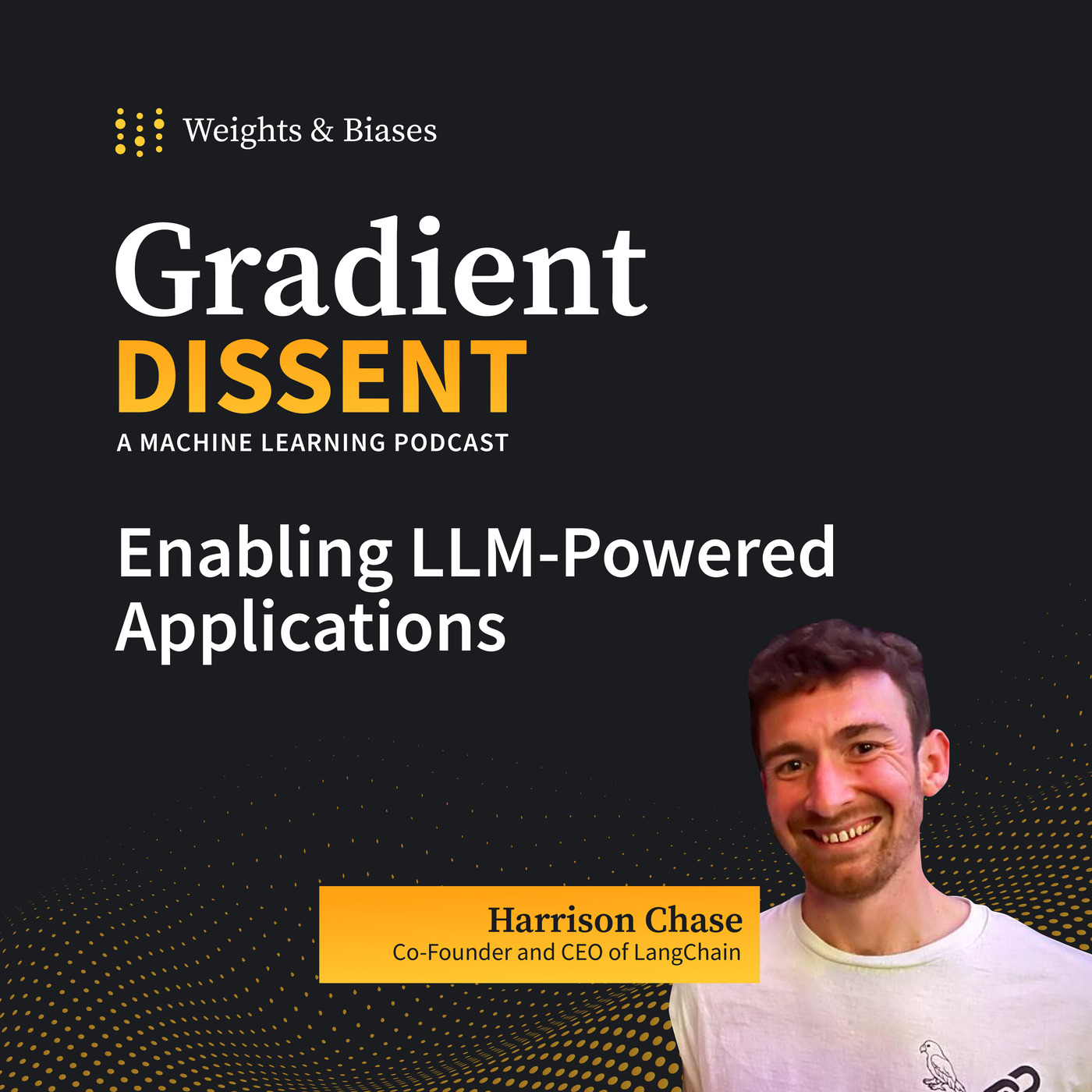
Enabling LLM-Powered Applications with Harrison Chase of LangChain
On this episode, we’re joined by Harrison Chase, Co-Founder and CEO of LangChain. Harrison and his team at LangChain are on a mission to make the process of creating applications powered by LLMs as easy as possible.We discuss:- What LangChain is and examples of how it works. - Why LangChain has gained so much attention. - When LangChain started and what sparked its growth. - Harrison’s approach to community-building around LangChain. - Real-world use cases for LangChain.- What parts of LangChain Harrison is proud of and which parts can be improved.- Details around evaluating effectiveness in the ML space.- Harrison's opinion on fine-tuning LLMs.- The importance of detailed prompt engineering.- Predictions for the future of LLM providers.Resources:Harrison Chase - https://www.linkedin.com/in/harrison-chase-961287118/LangChain | LinkedIn - https://www.linkedin.com/company/langchain/LangChain | Website - https://docs.langchain.com/docs/Thanks for listening to the Gradient Dissent podcast, brought to you by Weights & Biases. If you enjoyed this episode, please leave a review to help get the word out about the show. And be sure to subscribe so you never miss another insightful conversation.#OCR #DeepLearning #AI #Modeling #ML

Deploying Autonomous Mobile Robots with Jean Marc Alkazzi at idealworks
On this episode, we’re joined by Jean Marc Alkazzi, Applied AI at idealworks. Jean focuses his attention on applied AI, leveraging the use of autonomous mobile robots (AMRs) to improve efficiency within factories and more.We discuss:- Use cases for autonomous mobile robots (AMRs) and how to manage a fleet of them. - How AMRs interact with humans working in warehouses.- The challenges of building and deploying autonomous robots.- Computer vision vs. other types of localization technology for robots.- The purpose and types of simulation environments for robotic testing.- The importance of aligning a robotic fleet’s workflow with concrete business objectives.- What the update process looks like for robots.- The importance of avoiding your own biases when developing and testing AMRs.- The challenges associated with troubleshooting ML systems.Resources: Jean Marc Alkazzi - https://www.linkedin.com/in/jeanmarcjeanazzi/idealworks |LinkedIn - https://www.linkedin.com/company/idealworks-gmbh/idealworks | Website - https://idealworks.com/Thanks for listening to the Gradient Dissent podcast, brought to you by Weights & Biases. If you enjoyed this episode, please leave a review to help get the word out about the show. And be sure to subscribe so you never miss another insightful conversation.#OCR #DeepLearning #AI #Modeling #ML

How EleutherAI Trains and Releases LLMs: Interview with Stella Biderman
On this episode, we’re joined by Stella Biderman, Executive Director at EleutherAI and Lead Scientist - Mathematician at Booz Allen Hamilton.EleutherAI is a grassroots collective that enables open-source AI research and focuses on the development and interpretability of large language models (LLMs).We discuss:- How EleutherAI got its start and where it's headed.- The similarities and differences between various LLMs.- How to decide which model to use for your desired outcome.- The benefits and challenges of reinforcement learning from human feedback.- Details around pre-training and fine-tuning LLMs.- Which types of GPUs are best when training LLMs.- What separates EleutherAI from other companies training LLMs.- Details around mechanistic interpretability.- Why understanding what and how LLMs memorize is important.- The importance of giving researchers and the public access to LLMs.Stella Biderman - https://www.linkedin.com/in/stellabiderman/EleutherAI - https://www.linkedin.com/company/eleutherai/ Resources:- https://www.eleuther.ai/Thanks for listening to the Gradient Dissent podcast, brought to you by Weights & Biases. If you enjoyed this episode, please leave a review to help get the word out about the show. And be sure to subscribe so you never miss another insightful conversation.#OCR #DeepLearning #AI #Modeling #ML
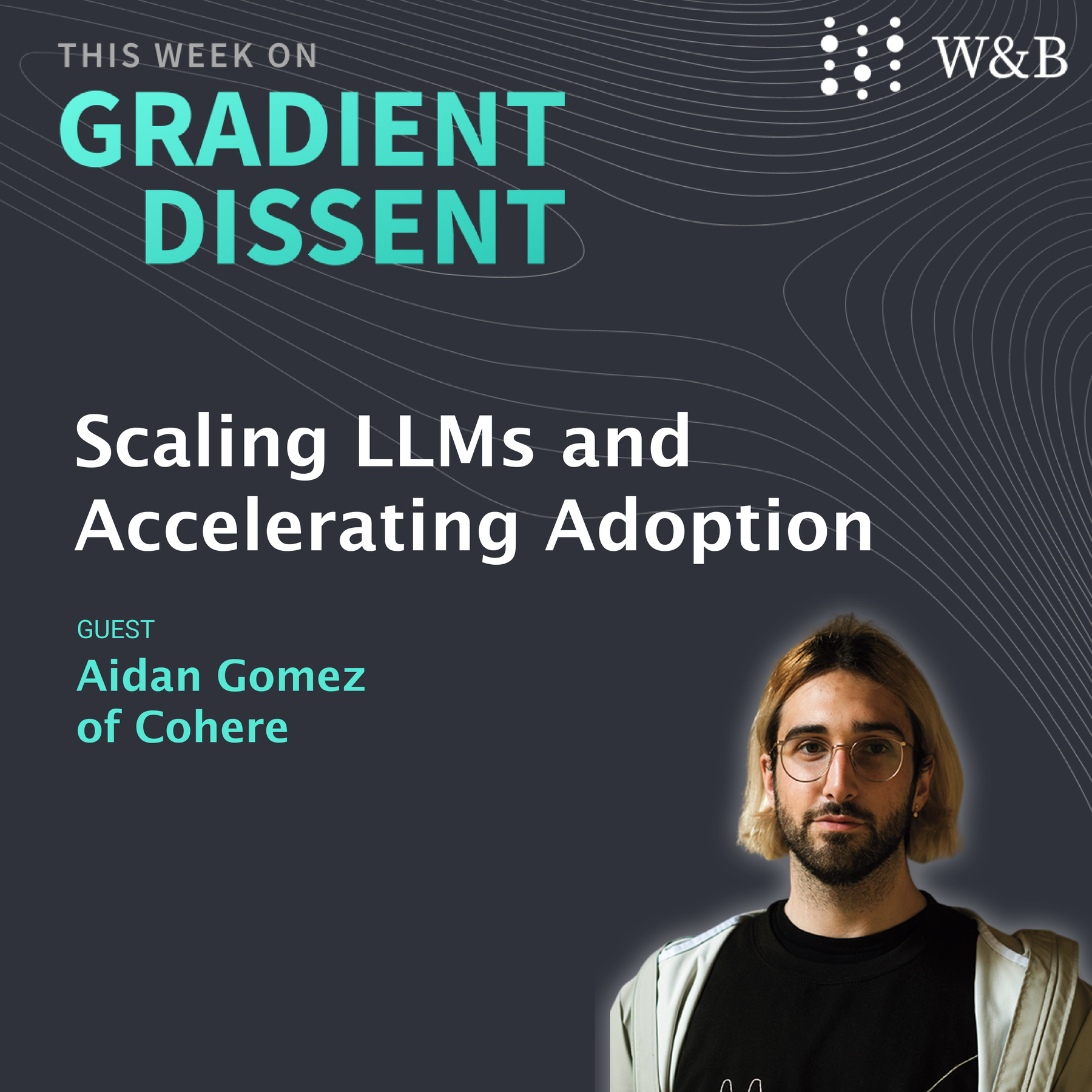
Scaling LLMs and Accelerating Adoption with Aidan Gomez at Cohere
On this episode, we’re joined by Aidan Gomez, Co-Founder and CEO at Cohere. Cohere develops and releases a range of innovative AI-powered tools and solutions for a variety of NLP use cases.We discuss:- What “attention” means in the context of ML.- Aidan’s role in the “Attention Is All You Need” paper.- What state-space models (SSMs) are, and how they could be an alternative to transformers. - What it means for an ML architecture to saturate compute.- Details around data constraints for when LLMs scale.- Challenges of measuring LLM performance.- How Cohere is positioned within the LLM development space.- Insights around scaling down an LLM into a more domain-specific one.- Concerns around synthetic content and AI changing public discourse.- The importance of raising money at healthy milestones for AI development.Aidan Gomez - https://www.linkedin.com/in/aidangomez/Cohere - https://www.linkedin.com/company/cohere-ai/Thanks for listening to the Gradient Dissent podcast, brought to you by Weights & Biases. If you enjoyed this episode, please leave a review to help get the word out about the show. And be sure to subscribe so you never miss another insightful conversation.Resources:- https://cohere.ai/- “Attention Is All You Need”#OCR #DeepLearning #AI #Modeling #ML

Neural Network Pruning and Training with Jonathan Frankle at MosaicML
Jonathan Frankle, Chief Scientist at MosaicML and Assistant Professor of Computer Science at Harvard University, joins us on this episode. With comprehensive infrastructure and software tools, MosaicML aims to help businesses train complex machine-learning models using their own proprietary data.We discuss:- Details of Jonathan’s Ph.D. dissertation which explores his “Lottery Ticket Hypothesis.”- The role of neural network pruning and how it impacts the performance of ML models.- Why transformers will be the go-to way to train NLP models for the foreseeable future.- Why the process of speeding up neural net learning is both scientific and artisanal. - What MosaicML does, and how it approaches working with clients.- The challenges for developing AGI.- Details around ML training policy and ethics.- Why data brings the magic to customized ML models.- The many use cases for companies looking to build customized AI models.Jonathan Frankle - https://www.linkedin.com/in/jfrankle/Resources:- https://mosaicml.com/- The Lottery Ticket Hypothesis: Finding Sparse, Trainable Neural NetworksThanks for listening to the Gradient Dissent podcast, brought to you by Weights & Biases. If you enjoyed this episode, please leave a review to help get the word out about the show. And be sure to subscribe so you never miss another insightful conversation.#OCR #DeepLearning #AI #Modeling #ML
Jasper AI's Dave Rogenmoser & Saad Ansari on Growing & Maintaining an LLM-Based Company
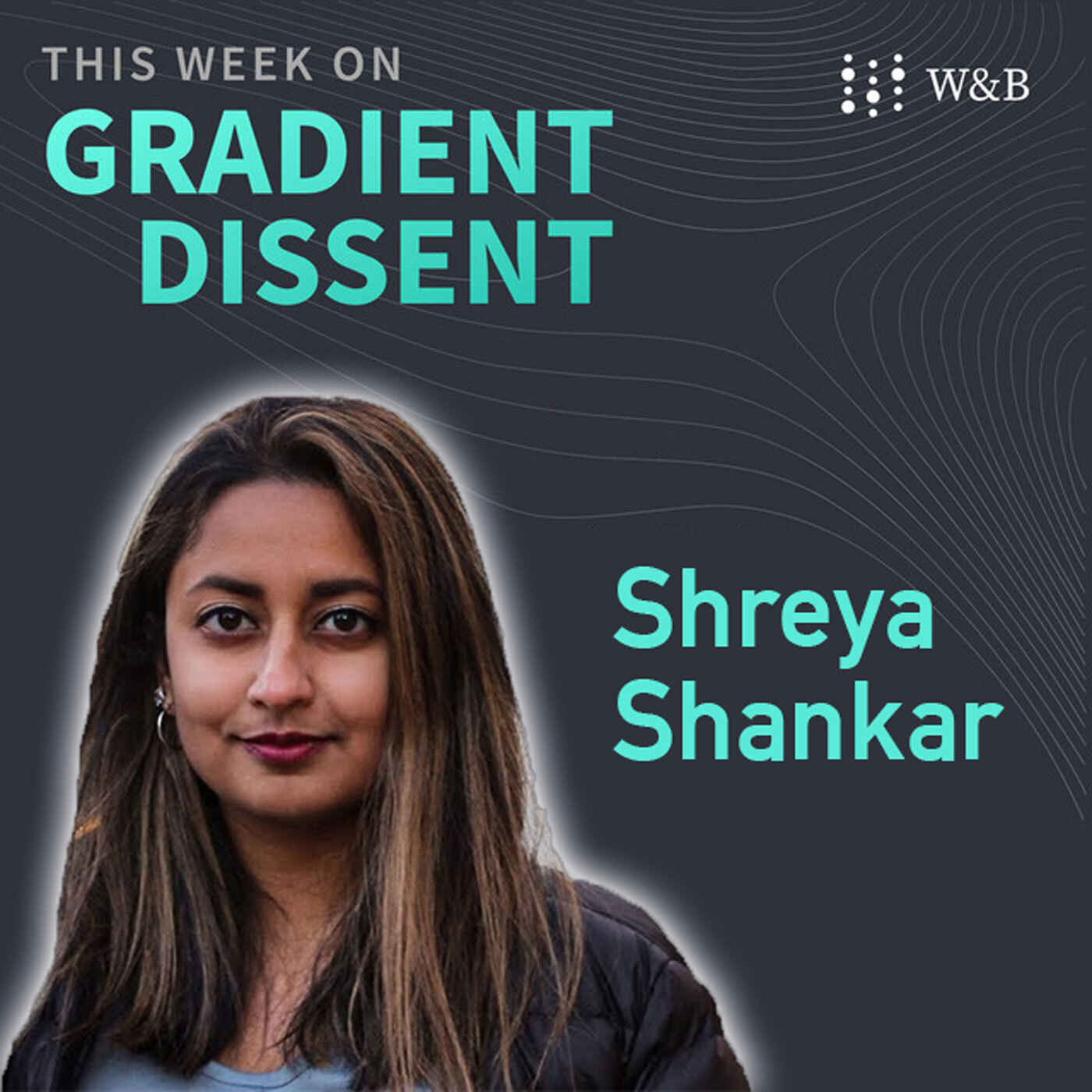
Shreya Shankar — Operationalizing Machine Learning
About This EpisodeShreya Shankar is a computer scientist, PhD student in databases at UC Berkeley, and co-author of "Operationalizing Machine Learning: An Interview Study", an ethnographic interview study with 18 machine learning engineers across a variety of industries on their experience deploying and maintaining ML pipelines in production.Shreya explains the high-level findings of "Operationalizing Machine Learning"; variables that indicate a successful deployment (velocity, validation, and versioning), common pain points, and a grouping of the MLOps tool stack into four layers. Shreya and Lukas also discuss examples of data challenges in production, Jupyter Notebooks, and reproducibility.Show notes (transcript and links): http://wandb.me/gd-shreya---💬 *Host:* Lukas Biewald---*Subscribe and listen to Gradient Dissent today!*👉 Apple Podcasts: http://wandb.me/apple-podcasts👉 Google Podcasts: http://wandb.me/google-podcasts👉 Spotify: http://wandb.me/spotify

Sarah Catanzaro — Remembering the Lessons of the Last AI Renaissance
Sarah Catanzaro is a General Partner at Amplify Partners, and one of the leading investors in AI and ML. Her investments include RunwayML, OctoML, and Gantry.Sarah and Lukas discuss lessons learned from the "AI renaissance" of the mid 2010s and compare the general perception of ML back then to now. Sarah also provides insights from her perspective as an investor, from selling into tech-forward companies vs. traditional enterprises, to the current state of MLOps/developer tools, to large language models and hype bubbles.Show notes (transcript and links): http://wandb.me/gd-sarah-catanzaro---⏳ Timestamps: 0:00 Intro1:10 Lessons learned from previous AI hype cycles11:46 Maintaining technical knowledge as an investor19:05 Selling into tech-forward companies vs. traditional enterprises25:09 Building point solutions vs. end-to-end platforms36:27 LLMS, new tooling, and commoditization44:39 Failing fast and how startups can compete with large cloud vendors52:31 The gap between research and industry, and vice versa1:00:01 Advice for ML practitioners during hype bubbles1:03:17 Sarah's thoughts on Rust and bottlenecks in deployment1:11:23 The importance of aligning technology with people1:15:58 Outro---📝 Links📍 "Operationalizing Machine Learning: An Interview Study" (Shankar et al., 2022), an interview study on deploying and maintaining ML production pipelines: https://arxiv.org/abs/2209.09125---Connect with Sarah:📍 Sarah on Twitter: https://twitter.com/sarahcat21📍 Sarah's Amplify Partners profile: https://www.amplifypartners.com/investment-team/sarah-catanzaro---💬 Host: Lukas Biewald📹 Producers: Riley Fields, Angelica Pan---Subscribe and listen to Gradient Dissent today!👉 Apple Podcasts: http://wandb.me/apple-podcasts👉 Google Podcasts: http://wandb.me/google-podcasts👉 Spotify: http://wandb.me/spotify

Cristóbal Valenzuela — The Next Generation of Content Creation and AI
Cristóbal Valenzuela is co-founder and CEO of Runway ML, a startup that's building the future of AI-powered content creation tools. Runway's research areas include diffusion systems for image generation.Cris gives a demo of Runway's video editing platform. Then, he shares how his interest in combining technology with creativity led to Runway, and where he thinks the world of computation and content might be headed to next. Cris and Lukas also discuss Runway's tech stack and research.Show notes (transcript and links): http://wandb.me/gd-cristobal-valenzuela---⏳ Timestamps: 0:00 Intro1:06 How Runway uses ML to improve video editing6:04 A demo of Runway’s video editing capabilities13:36 How Cris entered the machine learning space18:55 Cris’ thoughts on the future of ML for creative use cases28:46 Runway’s tech stack32:38 Creativity, and keeping humans in the loop36:15 The potential of audio generation and new mental models40:01 Outro---🎥 Runway's AI Film Festival is accepting submissions through January 23! 🎥They are looking for art and artists that are at the forefront of AI filmmaking. Submissions should be between 1-10 minutes long, and a core component of the film should include generative content📍 https://aiff.runwayml.com/--📝 Links📍 "High-Resolution Image Synthesis with Latent Diffusion Models" (Rombach et al., 2022)", the research paper behind Stable Diffusion: https://research.runwayml.com/publications/high-resolution-image-synthesis-with-latent-diffusion-models📍 Lexman Artificial, a 100% AI-generated podcast: https://twitter.com/lexman_ai---Connect with Cris and Runway:📍 Cris on Twitter: https://twitter.com/c_valenzuelab📍 Runway on Twitter: https://twitter.com/runwayml📍 Careers at Runway: https://runwayml.com/careers/---💬 Host: Lukas Biewald📹 Producers: Riley Fields, Angelica Pan---Subscribe and listen to Gradient Dissent today!👉 Apple Podcasts: http://wandb.me/apple-podcasts👉 Google Podcasts: http://wandb.me/google-podcasts👉 Spotify: http://wandb.me/spotify

Jeremy Howard — The Simple but Profound Insight Behind Diffusion
Jeremy Howard is a co-founder of fast.ai, the non-profit research group behind the popular massive open online course "Practical Deep Learning for Coders", and the open source deep learning library "fastai".Jeremy is also a co-founder of #Masks4All, a global volunteer organization founded in March 2020 that advocated for the public adoption of homemade face masks in order to help slow the spread of COVID-19. His Washington Post article "Simple DIY masks could help flatten the curve." went viral in late March/early April 2020, and is associated with the U.S CDC's change in guidance a few days later to recommend wearing masks in public.In this episode, Jeremy explains how diffusion works and how individuals with limited compute budgets can engage meaningfully with large, state-of-the-art models. Then, as our first-ever repeat guest on Gradient Dissent, Jeremy revisits a previous conversation with Lukas on Python vs. Julia for machine learning.Finally, Jeremy shares his perspective on the early days of COVID-19, and what his experience as one of the earliest and most high-profile advocates for widespread mask-wearing was like.Show notes (transcript and links): http://wandb.me/gd-jeremy-howard-2---⏳ Timestamps:0:00 Intro1:06 Diffusion and generative models14:40 Engaging with large models meaningfully20:30 Jeremy's thoughts on Stable Diffusion and OpenAI26:38 Prompt engineering and large language models32:00 Revisiting Julia vs. Python40:22 Jeremy's science advocacy during early COVID days1:01:03 Researching how to improve children's education1:07:43 The importance of executive buy-in1:11:34 Outro1:12:02 Bonus: Weights & Biases---📝 Links📍 Jeremy's previous Gradient Dissent episode (8/25/2022): http://wandb.me/gd-jeremy-howard📍 "Simple DIY masks could help flatten the curve. We should all wear them in public.", Jeremy's viral Washington Post article: https://www.washingtonpost.com/outlook/2020/03/28/masks-all-coronavirus/📍 "An evidence review of face masks against COVID-19" (Howard et al., 2021), one of the first peer-reviewed papers on the effectiveness of wearing masks: https://www.pnas.org/doi/10.1073/pnas.2014564118📍 Jeremy's Twitter thread summary of "An evidence review of face masks against COVID-19": https://twitter.com/jeremyphoward/status/1348771993949151232📍 Read more about Jeremy's mask-wearing advocacy: https://www.smh.com.au/world/north-america/australian-expat-s-push-for-universal-mask-wearing-catches-fire-in-the-us-20200401-p54fu2.html---Connect with Jeremy and fast.ai:📍 Jeremy on Twitter: https://twitter.com/jeremyphoward📍 fast.ai on Twitter: https://twitter.com/FastDotAI📍 Jeremy on LinkedIn: https://www.linkedin.com/in/howardjeremy/---💬 Host: Lukas Biewald📹 Producers: Riley Fields, Angelica Pan

Jerome Pesenti — Large Language Models, PyTorch, and Meta
Jerome Pesenti is the former VP of AI at Meta, a tech conglomerate that includes Facebook, WhatsApp, and Instagram, and one of the most exciting places where AI research is happening today.Jerome shares his thoughts on Transformers-based large language models, and why he's excited by the progress but skeptical of the term "AGI". Then, he discusses some of the practical applications of ML at Meta (recommender systems and moderation!) and dives into the story behind Meta's development of PyTorch. Jerome and Lukas also chat about Jerome's time at IBM Watson and in drug discovery.Show notes (transcript and links): http://wandb.me/gd-jerome-pesenti---⏳ Timestamps: 0:00 Intro0:28 Jerome's thought on large language models12:53 AI applications and challenges at Meta18:41 The story behind developing PyTorch26:40 Jerome's experience at IBM Watson28:53 Drug discovery, AI, and changing the game36:10 The potential of education and AI40:10 Meta and AR/VR interfaces43:43 Why NVIDIA is such a powerhouse47:08 Jerome's advice to people starting their careers48:50 Going back to coding, the challenges of scaling52:11 Outro---Connect with Jerome:📍 Jerome on Twitter: https://twitter.com/an_open_mind📍 Jerome on LinkedIn: https://www.linkedin.com/in/jpesenti/---💬 Host: Lukas Biewald📹 Producers: Riley Fields, Angelica Pan, Lavanya Shukla---Subscribe and listen to our podcast today!👉 Apple Podcasts: http://wandb.me/apple-podcasts👉 Google Podcasts: http://wandb.me/google-podcasts👉 Spotify: http://wandb.me/spotify

D. Sculley — Technical Debt, Trade-offs, and Kaggle
D. Sculley is CEO of Kaggle, the beloved and well-known data science and machine learning community.D. discusses his influential 2015 paper "Machine Learning: The High Interest Credit Card of Technical Debt" and what the current challenges of deploying models in the real world are now, in 2022. Then, D. and Lukas chat about why Kaggle is like a rain forest, and about Kaggle's historic, current, and potential future roles in the broader machine learning community.Show notes (transcript and links): http://wandb.me/gd-d-sculley---⏳ Timestamps: 0:00 Intro1:02 Machine learning and technical debt11:18 MLOps, increased stakes, and realistic expectations19:12 Evaluating models methodically25:32 Kaggle's role in the ML world33:34 Kaggle competitions, datasets, and notebooks38:49 Why Kaggle is like a rain forest44:25 Possible future directions for Kaggle46:50 Healthy competitions and self-growth48:44 Kaggle's relevance in a compute-heavy future53:49 AutoML vs. human judgment56:06 After a model goes into production1:00:00 Outro---Connect with D. and Kaggle:📍 D. on LinkedIn: https://www.linkedin.com/in/d-sculley-90467310/📍 Kaggle on Twitter: https://twitter.com/kaggle---Links:📍 "Machine Learning: The High Interest Credit Card of Technical Debt" (Sculley et al. 2014): https://research.google/pubs/pub43146/---💬 Host: Lukas Biewald📹 Producers: Riley Fields, Angelica Pan, Anish Shah, Lavanya Shukla---Subscribe and listen to our podcast today!👉 Apple Podcasts: http://wandb.me/apple-podcasts👉 Google Podcasts: http://wandb.me/google-podcasts👉 Spotify: http://wandb.me/spotify
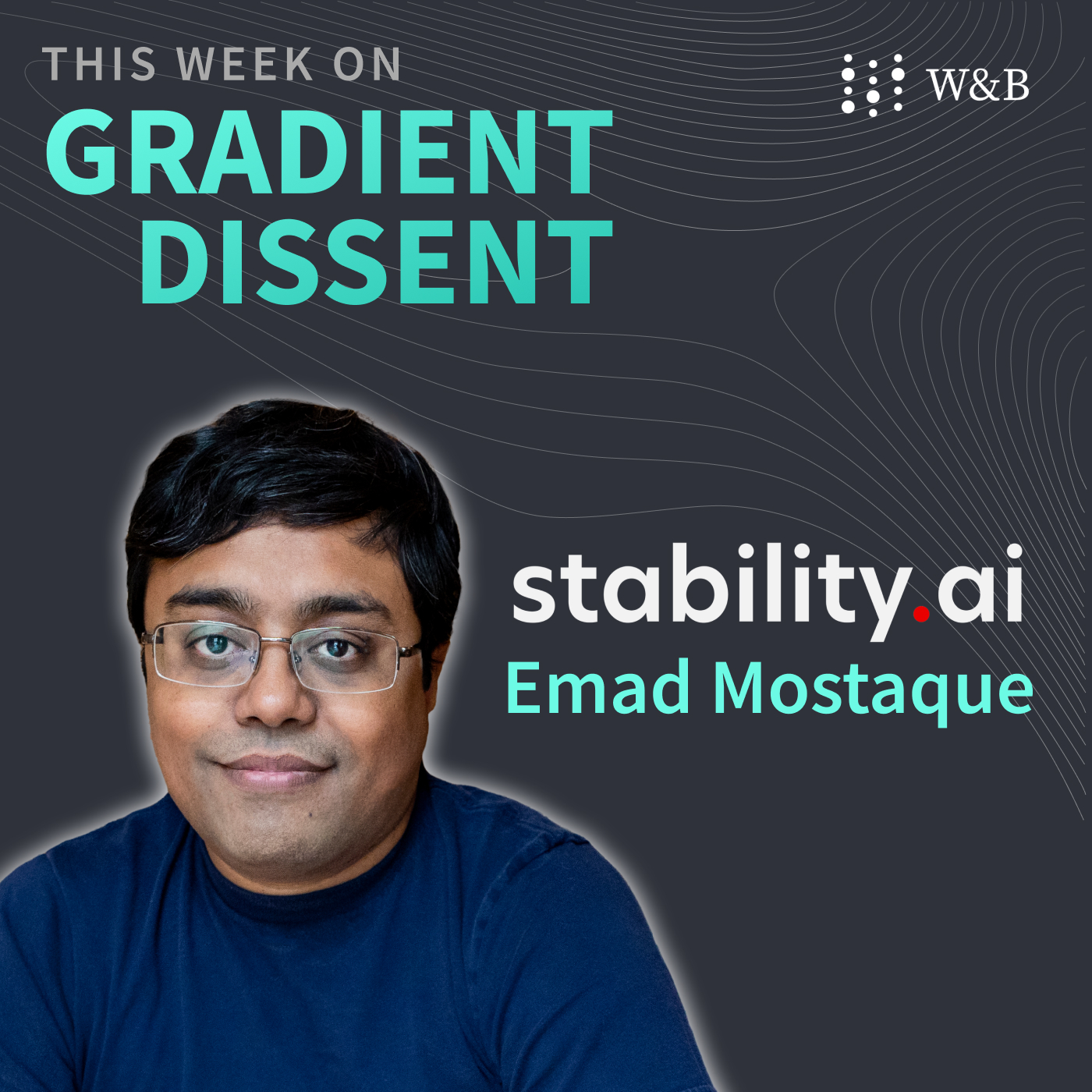
Emad Mostaque — Stable Diffusion, Stability AI, and What’s Next
Emad Mostaque is CEO and co-founder of Stability AI, a startup and network of decentralized developer communities building open AI tools. Stability AI is the company behind Stable Diffusion, the well-known, open source, text-to-image generation model.Emad shares the story and mission behind Stability AI (unlocking humanity's potential with open AI technology), and explains how Stability's role as a community catalyst and compute provider might evolve as the company grows. Then, Emad and Lukas discuss what the future might hold in store: big models vs "optimal" models, better datasets, and more decentralization.-🎶 Special note: This week’s theme music was composed by Weights & Biases’ own Justin Tenuto with help from Harmonai’s Dance Diffusion.-Show notes (transcript and links): http://wandb.me/gd-emad-mostaque-⏳ Timestamps:00:00 Intro00:42 How AI fits into the safety/security industry09:33 Event matching and object detection14:47 Running models on the right hardware17:46 Scaling model evaluation23:58 Monitoring and evaluation challenges26:30 Identifying and sorting issues30:27 Bridging vision and language domains39:25 Challenges and promises of natural language technology41:35 Production environment43:15 Using synthetic data49:59 Working with startups53:55 Multi-task learning, meta-learning, and user experience56:44 Optimization and testing across multiple platforms59:36 Outro-Connect with Jehan and Motorola Solutions:📍 Jehan on LinkedIn: https://www.linkedin.com/in/jehanw/📍 Jehan on Twitter: https://twitter.com/jehan/📍 Motorola Solutions on Twitter: https://twitter.com/MotoSolutions/📍 Careers at Motorola Solutions: https://www.motorolasolutions.com/en_us/about/careers.html-💬 Host: Lukas Biewald📹 Producers: Riley Fields, Angelica Pan, Lavanya Shukla, Anish Shah-Subscribe and listen to our podcast today!👉 Apple Podcasts: http://wandb.me/apple-podcasts👉 Google Podcasts: http://wandb.me/google-podcasts👉 Spotify: http://wandb.me/spotify

Jehan Wickramasuriya — AI in High-Stress Scenarios
Jehan Wickramasuriya is the Vice President of AI, Platform & Data Services at Motorola Solutions, a global leader in public safety and enterprise security.In this episode, Jehan discusses how Motorola Solutions uses AI to simplify data streams to help maximize human potential in high-stress situations. He also shares his thoughts on augmenting synthetic data with real data and the challenges posed in partnering with startups.Show notes (transcript and links): http://wandb.me/gd-jehan-wickramasuriya-⏳ Timestamps: 00:00 Intro00:42 How AI fits into the safety/security industry 09:33 Event matching and object detection14:47 Running models on the right hardware17:46 Scaling model evaluation23:58 Monitoring and evaluation challenges26:30 Identifying and sorting issues30:27 Bridging vision and language domains39:25 Challenges and promises of natural language technology41:35 Production environment43:15 Using synthetic data49:59 Working with startups53:55 Multi-task learning, meta-learning, and user experience56:44 Optimization and testing across multiple platforms59:36 Outro-Connect with Jehan and Motorola Solutions:📍 Jehan on LinkedIn: https://www.linkedin.com/in/jehanw/📍 Jehan on Twitter: https://twitter.com/jehan/📍 Motorola Solutions on Twitter: https://twitter.com/MotoSolutions/📍 Careers at Motorola Solutions: https://www.motorolasolutions.com/en_us/about/careers.html-💬 Host: Lukas Biewald📹 Producers: Riley Fields, Cayla Sharp, Angelica Pan, Lavanya Shukla-Subscribe and listen to our podcast today!👉 Apple Podcasts: http://wandb.me/apple-podcasts👉 Google Podcasts: http://wandb.me/google-podcasts👉 Spotify: http://wandb.me/spotify

Will Falcon — Making Lightning the Apple of ML
Will Falcon is the CEO and co-founder of Lightning AI, a platform that enables users to quickly build and publish ML models.In this episode, Will explains how Lightning addresses the challenges of a fragmented AI ecosystem and reveals which framework PyTorch Lightning was originally built upon (hint: not PyTorch!) He also shares lessons he took from his experience serving in the military and offers a recommendation to veterans who want to work in tech.Show notes (transcript and links): http://wandb.me/gd-will-falcon---⏳ Timestamps: 00:00 Intro01:00 From SEAL training to FAIR04:17 Stress-testing Lightning07:55 Choosing PyTorch over TensorFlow and other frameworks13:16 Components of the Lightning platform17:01 Launching Lightning from Facebook19:09 Similarities between leadership and research22:08 Lessons from the military26:56 Scaling PyTorch Lightning to Lightning AI33:21 Hiring the right people35:21 The future of Lightning39:53 Reducing algorithm complexity in self-supervised learning42:19 A fragmented ML landscape44:35 Outro---Connect with Lightning📍 Website: https://lightning.ai📍 Twitter: https://twitter.com/LightningAI📍 LinkedIn: https://www.linkedin.com/company/pytorch-lightning/📍 Careers: https://boards.greenhouse.io/lightningai---💬 Host: Lukas Biewald📹 Producers: Riley Fields, Anish Shah, Cayla Sharp, Angelica Pan, Lavanya Shukla---Subscribe and listen to our podcast today!👉 Apple Podcasts: http://wandb.me/apple-podcasts👉 Google Podcasts: http://wandb.me/google-podcasts👉 Spotify: http://wandb.me/spotify

Aaron Colak — ML and NLP in Experience Management
Aaron Colak is the Leader of Core Machine Learning at Qualtrics, an experiment management company that takes large language models and applies them to real-world, B2B use cases.In this episode, Aaron describes mixing classical linguistic analysis with deep learning models and how Qualtrics organized their machine learning organizations and model to leverage the best of these techniques. He also explains how advances in NLP have invited new opportunities in low-resource languages.Show notes (transcript and links): http://wandb.me/gd-aaron-colak---⏳ Timestamps: 00:00 Intro00:57 Evolving from surveys to experience management04:56 Detecting sentiment with ML10:57 Working with large language models and rule-based systems14:50 Zero-shot learning, NLP, and low-resource languages20:11 Letting customers control data25:13 Deep learning and tabular data28:40 Hyperscalers and performance monitoring34:54 Combining deep learning with linguistics40:03 A sense of accomplishment42:52 Causality and observational data in healthcare45:09 Challenges of interdisciplinary collaboration49:27 Outro---Connect with Aaron and Qualtrics📍 Aaron on LinkedIn: https://www.linkedin.com/in/aaron-r-colak-3522308/📍 Qualtrics on Twitter: https://twitter.com/qualtrics/📍 Careers at Qualtrics: https://www.qualtrics.com/careers/---💬 Host: Lukas Biewald📹 Producers: Riley Fields, Cayla Sharp, Angelica Pan, Lavanya Shukla---Subscribe and listen to our podcast today!👉 Apple Podcasts: http://wandb.me/apple-podcasts👉 Google Podcasts: http://wandb.me/google-podcasts👉 Spotify: http://wandb.me/spotify

Jordan Fisher — Skipping the Line with Autonomous Checkout
Jordan Fisher is the CEO and co-founder of Standard AI, an autonomous checkout company that’s pushing the boundaries of computer vision.In this episode, Jordan discusses “the Wild West” of the MLOps stack and tells Lukas why Rust beats Python. He also explains why AutoML shouldn't be overlooked and uses a bag of chips to help explain the Manifold Hypothesis.Show notes (transcript and links): http://wandb.me/gd-jordan-fisher---⏳ Timestamps: 00:00 Intro00:40 The origins of Standard AI08:30 Getting Standard into stores18:00 Supervised learning, the advent of synthetic data, and the manifold hypothesis24:23 What's important in a MLOps stack27:32 The merits of AutoML30:00 Deep learning frameworks33:02 Python versus Rust39:32 Raw camera data versus video42:47 The future of autonomous checkout48:02 Sharing the StandardSim data set52:30 Picking the right tools54:30 Overcoming dynamic data set challenges57:35 Outro---Connect with Jordan and Standard AI📍 Jordan on LinkedIn: https://www.linkedin.com/in/jordan-fisher-81145025/📍 Standard AI on Twitter: https://twitter.com/StandardAi📍 Careers at Standard AI: https://careers.standard.ai/---💬 Host: Lukas Biewald📹 Producers: Riley Fields, Cayla Sharp, Angelica Pan, Lavanya Shukla---Subscribe and listen to our podcast today!👉 Apple Podcasts: http://wandb.me/apple-podcasts👉 Google Podcasts: http://wandb.me/google-podcasts👉 Spotify: http://wandb.me/spotify

Drago Anguelov — Robustness, Safety, and Scalability at Waymo
Drago Anguelov is a Distinguished Scientist and Head of Research at Waymo, an autonomous driving technology company and subsidiary of Alphabet Inc.We begin by discussing Drago's work on the original Inception architecture, winner of the 2014 ImageNet challenge and introduction of the inception module. Then, we explore milestones and current trends in autonomous driving, from Waymo's release of the Open Dataset to the trade-offs between modular and end-to-end systems.Drago also shares his thoughts on finding rare examples, and the challenges of creating scalable and robust systems.Show notes (transcript and links): http://wandb.me/gd-drago-anguelov---⏳ Timestamps: 0:00 Intro0:45 The story behind the Inception architecture13:51 Trends and milestones in autonomous vehicles23:52 The challenges of scalability and simulation30:19 Why LiDar and mapping are useful35:31 Waymo Via and autonomous trucking37:31 Robustness and unsupervised domain adaptation40:44 Why Waymo released the Waymo Open Dataset49:02 The domain gap between simulation and the real world56:40 Finding rare examples1:04:34 The challenges of production requirements1:08:36 Outro---Connect with Drago & Waymo📍 Drago on LinkedIn: https://www.linkedin.com/in/dragomiranguelov/📍 Waymo on Twitter: https://twitter.com/waymo/📍 Careers at Waymo: https://waymo.com/careers/---Links:📍 Inception v1: https://arxiv.org/abs/1409.4842📍 "SPG: Unsupervised Domain Adaptation for 3D Object Detection via Semantic Point Generation", Qiangeng Xu et al. (2021), https://arxiv.org/abs/2108.06709📍 "GradTail: Learning Long-Tailed Data Using Gradient-based Sample Weighting", Zhao Chen et al. (2022), https://arxiv.org/abs/2201.05938---💬 Host: Lukas Biewald📹 Producers: Cayla Sharp, Angelica Pan, Lavanya Shukla---Subscribe and listen to our podcast today!👉 Apple Podcasts: http://wandb.me/apple-podcasts👉 Google Podcasts: http://wandb.me/google-podcasts👉 Spotify: http://wandb.me/spotify

James Cham — Investing in the Intersection of Business and Technology
James Cham is a co-founder and partner at Bloomberg Beta, an early-stage venture firm that invests in machine learning and the future of work, the intersection between business and technology.James explains how his approach to investing in AI has developed over the last decade, which signals of success he looks for in the ever-adapting world of venture startups (tip: look for the "gradient of admiration"), and why it's so important to demystify ML for executives and decision-makers.Lukas and James also discuss how new technologies create new business models, and what the ethical considerations of a world where machine learning is accepted to be possibly fallible would be like.Show notes (transcript and links): http://wandb.me/gd-james-cham---⏳ Timestamps: 0:00 Intro0:46 How investment in AI has changed and developed7:08 Creating the first MI landscape infographics10:30 The impact of ML on organizations and management17:40 Demystifying ML for executives21:40 Why signals of successful startups change over time27:07 ML and the emergence of new business models37:58 New technology vs new consumer goods39:50 What James considers when investing44:19 Ethical considerations of accepting that ML models are fallible50:30 Reflecting on past investment decisions52:56 Thoughts on consciousness and Theseus' paradox59:08 Why it's important to increase general ML literacy1:03:09 Outro1:03:30 Bonus: How James' faith informs his thoughts on ML---Connect with James:📍 Twitter: https://twitter.com/jamescham📍 Bloomberg Beta: https://github.com/Bloomberg-Beta/Manual---Links:📍 "Street-Level Algorithms: A Theory at the Gaps Between Policy and Decisions" by Ali Alkhatib and Michael Bernstein (2019): https://doi.org/10.1145/3290605.3300760---💬 Host: Lukas Biewald📹 Producers: Cayla Sharp, Angelica Pan, Lavanya Shukla---Subscribe and listen to our podcast today!👉 Apple Podcasts: http://wandb.me/apple-podcasts👉 Google Podcasts: http://wandb.me/google-podcasts👉 Spotify: http://wandb.me/spotify

Boris Dayma — The Story Behind DALL·E mini, the Viral Phenomenon
Check out this report by Boris about DALL-E mini:https://wandb.ai/dalle-mini/dalle-mini/reports/DALL-E-mini-Generate-images-from-any-text-prompt--VmlldzoyMDE4NDAyhttps://wandb.ai/_scott/wandb_example/reports/Collaboration-in-ML-made-easy-with-W-B-Teams--VmlldzoxMjcwMDU5https://twitter.com/weirddalleConnect with Boris:📍 Twitter: https://twitter.com/borisdayma---💬 Host: Lukas Biewald📹 Producers: Cayla Sharp, Angelica Pan, Sanyam Bhutani, Lavanya Shukla---Subscribe and listen to our podcast today!👉 Apple Podcasts: http://wandb.me/apple-podcasts👉 Google Podcasts: http://wandb.me/google-podcasts👉 Spotify: http://wandb.me/spotify

Tristan Handy — The Work Behind the Data Work
Tristan Handy is CEO and founder of dbt Labs. dbt (data build tool) simplifies the data transformation workflow and helps organizations make better decisions.Lukas and Tristan dive into the history of the modern data stack and the subsequent challenges that dbt was created to address; communities of identity and product-led growth; and thoughts on why SQL has survived and thrived for so long. Tristan also shares his hopes for the future of BI tools and the data stack.Show notes (transcript and links): http://wandb.me/gd-tristan-handy---⏳ Timestamps: 0:00 Intro0:40 How dbt makes data transformation easier4:52 dbt and avoiding bad data habits14:23 Agreeing on organizational ground truths19:04 Staying current while running a company22:15 The origin story of dbt26:08 Why dbt is conceptually simple but hard to execute 34:47 The dbt community and the bottom-up mindset41:50 The future of data and operations47:41 dbt and machine learning49:17 Why SQL is so ubiquitous55:20 Bridging the gap between the ML and data worlds1:00:22 Outro---Connect with Tristan:📍 Twitter: https://twitter.com/jthandy📍 The Analytics Engineering Roundup: https://roundup.getdbt.com/---💬 Host: Lukas Biewald📹 Producers: Cayla Sharp, Angelica Pan, Sanyam Bhutani, Lavanya Shukla---Subscribe and listen to our podcast today!👉 Apple Podcasts: http://wandb.me/apple-podcasts👉 Google Podcasts: http://wandb.me/google-podcasts👉 Spotify: http://wandb.me/spotify

Johannes Otterbach — Unlocking ML for Traditional Companies
Johannes Otterbach is VP of Machine Learning Research at Merantix Momentum, an ML consulting studio that helps their clients build AI solutions.Johannes and Lukas talk about Johannes' background in physics and applications of ML to quantum computing, why Merantix is investing in creating a cloud-agnostic tech stack, and the unique challenges of developing and deploying models for different customers. They also discuss some of Johannes' articles on the impact of NLP models and the future of AI regulations.Show notes (transcript and links): http://wandb.me/gd-johannes-otterbach---⏳ Timestamps: 0:00 Intro1:04 Quantum computing and ML applications9:21 Merantix, Ventures, and ML consulting19:09 Building a cloud-agnostic tech stack24:40 The open source tooling ecosystem 30:28 Handing off models to customers31:42 The impact of NLP models on the real world35:40 Thoughts on AI and regulation40:10 Statistical physics and optimization problems42:50 The challenges of getting high-quality data44:30 Outro---Connect with Johannes:📍 LinkedIn: https://twitter.com/jsotterbach📍 Personal website: http://jotterbach.github.io/📍 Careers at Merantix Momentum: https://merantix-momentum.com/about#jobs---💬 Host: Lukas Biewald📹 Producers: Cayla Sharp, Angelica Pan, Sanyam Bhutani, Lavanya Shukla---Subscribe and listen to our podcast today!👉 Apple Podcasts: http://wandb.me/apple-podcasts👉 Google Podcasts: http://wandb.me/google-podcasts👉 Spotify: http://wandb.me/spotify

Mircea Neagovici — Robotic Process Automation (RPA) and ML
Mircea Neagovici is VP, AI and Research at UiPath, where his team works on task mining and other ways of combining robotic process automation (RPA) with machine learning for their B2B products.Mircea and Lukas talk about the challenges of allowing customers to fine-tune their models, the trade-offs between traditional ML and more complex deep learning models, and how Mircea transitioned from a more traditional software engineering role to running a machine learning organization.Show notes (transcript and links): http://wandb.me/gd-mircea-neagovici---⏳ Timestamps: 0:00 Intro 1:05 Robotic Process Automation (RPA) 4:20 RPA and machine learning at UiPath 8:20 Fine-tuning & PyTorch vs TensorFlow 14:50 Monitoring models in production 16:33 Task mining 22:37 Trade-offs in ML models 29:45 Transitioning from software engineering to ML 34:02 ML teams vs engineering teams 40:41 Spending more time on data 43:55 The organizational machinery behind ML models 45:57 Outro---Connect with Mircea:📍 LinkedIn: https://www.linkedin.com/in/mirceaneagovici/📍 Careers at UiPath: https://www.uipath.com/company/careers---💬 Host: Lukas Biewald📹 Producers: Cayla Sharp, Angelica Pan, Sanyam Bhutani, Lavanya Shukla

Jensen Huang — NVIDIA’s CEO on the Next Generation of AI and MLOps
Jensen Huang is founder and CEO of NVIDIA, whose GPUs sit at the heart of the majority of machine learning models today.Jensen shares the story behind NVIDIA's expansion from gaming to deep learning acceleration, leadership lessons that he's learned over the last few decades, and why we need a virtual world that obeys the laws of physics (aka the Omniverse) in order to take AI to the next era. Jensen and Lukas also talk about the singularity, the slow-but-steady approach to building a new market, and the importance of MLOps.The complete show notes (transcript and links) can be found here: http://wandb.me/gd-jensen-huang---⏳ Timestamps:0:00 Intro0:50 Why NVIDIA moved into the deep learning space7:33 Balancing the compute needs of different audiences10:40 Quantum computing, Huang's Law, and the singularity15:53 Democratizing scientific computing20:59 How Jensen stays current with technology trends25:10 The global chip shortage27:00 Leadership lessons that Jensen has learned32:32 Keeping a steady vision for NVIDIA35:48 Omniverse and the next era of AI42:00 ML topics that Jensen's excited about45:05 Why MLOps is vital48:38 Outro---Subscribe and listen to our podcast today!👉 Apple Podcasts: http://wandb.me/apple-podcasts👉 Google Podcasts: http://wandb.me/google-podcasts👉 Spotify: http://wandb.me/spotify

Peter & Boris — Fine-tuning OpenAI's GPT-3
Peter Welinder is VP of Product & Partnerships at OpenAI, where he runs product and commercialization efforts of GPT-3, Codex, GitHub Copilot, and more. Boris Dayma is Machine Learning Engineer at Weights & Biases, and works on integrations and large model training.Peter, Boris, and Lukas dive into the world of GPT-3:- How people are applying GPT-3 to translation, copywriting, and other commercial tasks- The performance benefits of fine-tuning GPT-3- - Developing an API on top of GPT-3 that works out of the box, but is also flexible and customizableThey also discuss the new OpenAI and Weights & Biases collaboration, which enables a user to log their GPT-3 fine-tuning projects to W&B with a single line of code.The complete show notes (transcript and links) can be found here: http://wandb.me/gd-peter-and-boris---Connect with Peter & Boris:📍 Peter's Twitter: https://twitter.com/npew📍 Boris' Twitter: https://twitter.com/borisdayma---⏳ Timestamps: 0:00 Intro1:01 Solving real-world problems with GPT-36:57 Applying GPT-3 to translation tasks14:58 Copywriting and other commercial GPT-3 applications20:22 The OpenAI API and fine-tuning GPT-328:22 Logging GPT-3 fine-tuning projects to W&B38:25 Engineering challenges behind OpenAI's API43:15 Outro---Subscribe and listen to our podcast today!👉 Apple Podcasts: http://wandb.me/apple-podcasts👉 Google Podcasts: http://wandb.me/google-podcasts👉 Spotify: http://wandb.me/spotify

Ion Stoica — Spark, Ray, and Enterprise Open Source
Ion Stoica is co-creator of the distributed computing frameworks Spark and Ray, and co-founder and Executive Chairman of Databricks and Anyscale. He is also a Professor of computer science at UC Berkeley and Principal Investigator of RISELab, a five-year research lab that develops technology for low-latency, intelligent decisions.Ion and Lukas chat about the challenges of making a simple (but good!) distributed framework, the similarities and differences between developing Spark and Ray, and how Spark and Ray led to the formation of Databricks and Anyscale. Ion also reflects on the early startup days, from deciding to commercialize to picking co-founders, and shares advice on building a successful company.The complete show notes (transcript and links) can be found here: http://wandb.me/gd-ion-stoica---Timestamps: 0:00 Intro0:56 Ray, Anyscale, and making a distributed framework11:39 How Spark informed the development of Ray18:53 The story behind Spark and Databricks33:00 Why TensorFlow and PyTorch haven't monetized35:35 Picking co-founders and other startup advice46:04 The early signs of sky computing49:24 Breaking problems down and prioritizing53:17 Outro---Subscribe and listen to our podcast today!👉 Apple Podcasts: http://wandb.me/apple-podcasts👉 Google Podcasts: http://wandb.me/google-podcasts👉 Spotify: http://wandb.me/spotify

Stephan Fabel — Efficient Supercomputing with NVIDIA's Base Command Platform
Stephan Fabel is Senior Director of Infrastructure Systems & Software at NVIDIA, where he works on Base Command, a software platform to coordinate access to NVIDIA's DGX SuperPOD infrastructure.Lukas and Stephan talk about why having a supercomputer is one thing but using it effectively is another, why a deeper understanding of hardware on the practitioner level is becoming more advantageous, and which areas of the ML tech stack NVIDIA is looking to expand into.The complete show notes (transcript and links) can be found here: http://wandb.me/gd-stephan-fabel---Timestamps: 0:00 Intro1:09 NVIDIA Base Command and DGX SuperPOD10:33 The challenges of multi-node processing at scale18:35 Why it's hard to use a supercomputer effectively25:14 The advantages of de-abstracting hardware29:09 Understanding Base Command's product-market fit36:59 Data center infrastructure as a value center42:13 Base Command's role in tech stacks47:16 Why crowdsourcing is underrated49:24 The challenges of scaling beyond a POC51:39 Outro---Subscribe and listen to our podcast today!👉 Apple Podcasts: http://wandb.me/apple-podcasts👉 Google Podcasts: http://wandb.me/google-podcasts👉 Spotify: http://wandb.me/spotify

Chris Padwick — Smart Machines for More Sustainable Farming
Chris Padwick is Director of Computer Vision Machine Learning at Blue River Technology, a subsidiary of John Deere. Their core product, See & Spray, is a weeding robot that identifies crops and weeds in order to spray only the weeds with herbicide.Chris and Lukas dive into the challenges of bringing See & Spray to life, from the hard computer vision problem of classifying weeds from crops, to the engineering feat of building and updating embedded systems that can survive on a farming machine in the field. Chris also explains why user feedback is crucial, and shares some of the surprising product insights he's gained from working with farmers.The complete show notes (transcript and links) can be found here: http://wandb.me/gd-chris-padwick---Connect with Chris:📍 LinkedIn: https://www.linkedin.com/in/chris-padwick-75b5761/📍 Blue River on Twitter: https://twitter.com/BlueRiverTech---Timestamps: 0:00 Intro1:09 How does See & Spray reduce herbicide usage?9:15 Classifying weeds and crops in real time17:45 Insights from deployment and user feedback29:08 Why weed and crop classification is surprisingly hard37:33 Improving and updating models in the field40:55 Blue River's ML stack44:55 Autonomous tractors and upcoming directions48:05 Why data pipelines are underrated52:10 The challenges of scaling software & hardware54:44 Outro55:55 Bonus: Transporters and the singularity---Subscribe and listen to our podcast today!👉 Apple Podcasts: http://wandb.me/apple-podcasts👉 Google Podcasts: http://wandb.me/google-podcasts👉 Spotify: http://wandb.me/spotify

Kathryn Hume — Financial Models, ML, and 17th-Century Philosophy
Kathryn Hume is Vice President Digital Investments Technology at the Royal Bank of Canada (RBC). At the time of recording, she was Interim Head of Borealis AI, RBC's research institute for machine learning.Kathryn and Lukas talk about ML applications in finance, from building a personal finance forecasting model to applying reinforcement learning to trade execution, and take a philosophical detour into the 17th century as they speculate on what Newton and Descartes would have thought about machine learning.The complete show notes (transcript and links) can be found here: http://wandb.me/gd-kathryn-hume---Connect with Kathryn:📍 Twitter: https://twitter.com/humekathryn📍 Website: https://quamproxime.com/---Timestamps: 0:00 Intro0:54 Building a personal finance forecasting model10:54 Applying RL to trade execution18:55 Transparent financial models and fairness26:20 Semantic parsing and building a text-to-SQL interface29:20 From comparative literature and math to product37:33 What would Newton and Descartes think about ML?44:15 On sentient AI and transporters47:33 Why casual inference is under-appreciated49:25 The challenges of integrating models into the business51:45 Outro---Subscribe and listen to our podcast today!👉 Apple Podcasts: http://wandb.me/apple-podcasts👉 Google Podcasts: http://wandb.me/google-podcasts👉 Spotify: http://wandb.me/spotify

Sean & Greg — Biology and ML for Drug Discovery
Sean McClain is the founder and CEO, and Gregory Hannum is the VP of AI Research at Absci, a biotech company that's using deep learning to expedite drug discovery and development.Lukas, Sean, and Greg talk about why Absci started investing so heavily in ML research (it all comes back to the data), what it'll take to build the GPT-3 of DNA, and where the future of pharma is headed. Sean and Greg also share some of the challenges of building cross-functional teams and combining two highly specialized fields like biology and ML.The complete show notes (transcript and links) can be found here: http://wandb.me/gd-sean-and-greg---Connect with Sean and Greg:📍 Sean's Twitter: https://twitter.com/seanrmcclain📍 Greg's Twitter: https://twitter.com/gregory_hannum📍 Absci's Twitter: https://twitter.com/abscibio---Timestamps: 0:00 Intro0:53 How Absci merges biology and AI11:24 Why Absci started investing in ML19:00 Creating the GPT-3 of DNA25:34 Investing in data collection and in ML teams33:14 Clinical trials and Absci's revenue structure38:17 Combining knowledge from different domains45:22 The potential of multitask learning50:43 Why biological data is tricky to work with55:00 Outro---Subscribe and listen to our podcast today!👉 Apple Podcasts: http://wandb.me/apple-podcasts👉 Google Podcasts: http://wandb.me/google-podcasts👉 Spotify: http://wandb.me/spotify

Chris, Shawn, and Lukas — The Weights & Biases Journey
You might know him as the host of Gradient Dissent, but Lukas is also the CEO of Weights & Biases, a developer-first ML tools platform!In this special episode, the three W&B co-founders — Chris (CVP), Shawn (CTO), and Lukas (CEO) — sit down to tell the company's origin stories, reflect on the highs and lows, and give advice to engineers looking to start their own business.Chris reveals the W&B server architecture (tl;dr - React + GraphQL), Shawn shares his favorite product feature (it's a hidden frontend layer), and Lukas explains why it's so important to work with customers that inspire you.The complete show notes (transcript and links) can be found here: http://wandb.me/gd-wandb-cofounders---Connect with us:📍 Chris' Twitter: https://twitter.com/vanpelt📍 Shawn's Twitter: https://twitter.com/shawnup📍 Lukas' Twitter: https://twitter.com/l2k📍 W&B's Twitter: https://twitter.com/weights_biases---Timestamps: 0:00 Intro1:29 The stories behind Weights & Biases7:45 The W&B tech stack9:28 Looking back at the beginning11:42 Hallmark moments14:49 Favorite product features16:49 Rewriting the W&B backend18:21 The importance of customer feedback21:18 How Chris and Shawn have changed22:35 How the ML space has changed28:24 Staying positive when things look bleak32:19 Lukas' advice to new entrepreneurs35:29 Hopes for the next five years38:09 Making a paintbot & model understanding41:30 Biggest bottlenecks in deployment44:08 Outro44:38 Bonus: Under- vs overrated technologies---Subscribe and listen to our podcast today!👉 Apple Podcasts: http://wandb.me/apple-podcasts👉 Google Podcasts: http://wandb.me/google-podcasts👉 Spotify: http://wandb.me/spotify

Pete Warden — Practical Applications of TinyML
Pete is the Technical Lead of the TensorFlow Micro team, which works on deep learning for mobile and embedded devices.Lukas and Pete talk about hacking a Raspberry Pi to run AlexNet, the power and size constraints of embedded devices, and techniques to reduce model size. Pete also explains real world applications of TensorFlow Lite Micro and shares what it's been like to work on TensorFlow from the beginning.The complete show notes (transcript and links) can be found here: http://wandb.me/gd-pete-warden---Connect with Pete:📍 Twitter: https://twitter.com/petewarden📍 Website: https://petewarden.com/---Timestamps: 0:00 Intro1:23 Hacking a Raspberry Pi to run neural nets13:50 Model and hardware architectures18:56 Training a magic wand21:47 Raspberry Pi vs Arduino27:51 Reducing model size33:29 Training on the edge39:47 What it's like to work on TensorFlow47:45 Improving datasets and model deployment53:05 Outro---Subscribe and listen to our podcast today!👉 Apple Podcasts: http://wandb.me/apple-podcasts👉 Google Podcasts: http://wandb.me/google-podcasts👉 Spotify: http://wandb.me/spotify

Pieter Abbeel — Robotics, Startups, and Robotics Startups
Pieter is the Chief Scientist and Co-founder at Covariant, where his team is building universal AI for robotic manipulation. Pieter also hosts The Robot Brains Podcast, in which he explores how far humanity has come in its mission to create conscious computers, mindful machines, and rational robots.Lukas and Pieter explore the state of affairs of robotics in 2021, the challenges of achieving consistency and reliability, and what it'll take to make robotics more ubiquitous. Pieter also shares some perspective on entrepreneurship, from how he knew it was time to commercialize Gradescope to what he looks for in co-founders to why he started Covariant.Show notes: http://wandb.me/gd-pieter-abbeel---Connect with Pieter:📍 Twitter: https://twitter.com/pabbeel📍 Website: https://people.eecs.berkeley.edu/~pabbeel/📍 The Robot Brains Podcast: https://www.therobotbrains.ai/---Timestamps: 0:00 Intro1:15 The challenges of robotics8:10 Progress in robotics13:34 Imitation learning and reinforcement learning21:37 Simulated data, real data, and reliability27:53 The increasing capabilities of robotics36:23 Entrepreneurship and co-founding Gradescope44:35 The story behind Covariant47:50 Pieter's communication tips52:13 What Pieter's currently excited about55:08 Focusing on good UI and high reliability57:01 Outro

Chris Albon — ML Models and Infrastructure at Wikimedia
In this episode we're joined by Chris Albon, Director of Machine Learning at the Wikimedia Foundation.Lukas and Chris talk about Wikimedia's approach to content moderation, what it's like to work in a place so transparent that even internal chats are public, how Wikimedia uses machine learning (spoiler: they do a lot of models to help editors), and why they're switching to Kubeflow and Docker. Chris also shares how his focus on outcomes has shaped his career and his approach to technical interviews.Show notes: http://wandb.me/gd-chris-albon---Connect with Chris:- Twitter: https://twitter.com/chrisalbon- Website: https://chrisalbon.com/---Timestamps: 0:00 Intro1:08 How Wikimedia approaches moderation9:55 Working in the open and embracing humility16:08 Going down Wikipedia rabbit holes20:03 How Wikimedia uses machine learning27:38 Wikimedia's ML infrastructure42:56 How Chris got into machine learning46:43 Machine Learning Flashcards and technical interviews52:10 Low-power models and MLOps55:58 Outro

Emily M. Bender — Language Models and Linguistics
In this episode, Emily and Lukas dive into the problems with bigger and bigger language models, the difference between form and meaning, the limits of benchmarks, and why it's important to name the languages we study.Show notes (links to papers and transcript): http://wandb.me/gd-emily-m-bender---Emily M. Bender is a Professor of Linguistics at and Faculty Director of the Master's Program in Computational Linguistics at University of Washington. Her research areas include multilingual grammar engineering, variation (within and across languages), the relationship between linguistics and computational linguistics, and societal issues in NLP.---Timestamps:0:00 Sneak peek, intro1:03 Stochastic Parrots9:57 The societal impact of big language models16:49 How language models can be harmful26:00 The important difference between linguistic form and meaning34:40 The octopus thought experiment42:11 Language acquisition and the future of language models49:47 Why benchmarks are limited54:38 Ways of complementing benchmarks1:01:20 The #BenderRule1:03:50 Language diversity and linguistics1:12:49 Outro

Jeff Hammerbacher — From data science to biomedicine
Jeff talks about building Facebook's early data team, founding Cloudera, and transitioning into biomedicine with Hammer Lab and Related Sciences.(Read more: http://wandb.me/gd-jeff-hammerbacher)---Jeff Hammerbacher is a scientist, software developer, entrepreneur, and investor. Jeff's current work focuses on drug discovery at Related Sciences, a biotech venture creation firm that he co-founded in 2020.Prior to his work at Related Sciences, Jeff was the Principal Investigator of Hammer Lab, a founder and the Chief Scientist of Cloudera, an Entrepreneur-in-Residence at Accel, and the manager of the Data team at Facebook.---Follow Gradient Dissent on Twitter: https://twitter.com/weights_biases---0:00 Sneak peek, intro1:13 The start of Facebook's data science team6:53 Facebook's early tech stack14:20 Early growth strategies at Facebook17:37 The origin story of Cloudera24:51 Cloudera's success, in retrospect31:05 Jeff's transition into biomedicine38:38 Immune checkpoint blockade in cancer therapy48:55 Data and techniques for biomedicine53:00 Why Jeff created Related Sciences56:32 Outro

Josh Bloom — The Link Between Astronomy and ML
Josh explains how astronomy and machine learning have informed each other, their current limitations, and where their intersection goes from here. (Read more: http://wandb.me/gd-josh-bloom)---Josh is a Professor of Astronomy and Chair of the Astronomy Department at UC Berkeley. His research interests include the intersection of machine learning and physics, time-domain transients events, artificial intelligence, and optical/infared instrumentation.---Follow Gradient Dissent on Twitter: https://twitter.com/weights_biases---0:00 Intro, sneak peek1:15 How astronomy has informed ML4:20 The big questions in astronomy today10:15 On dark matter and dark energy16:37 Finding life on other planets19:55 Driving advancements in astronomy27:05 Putting telescopes in space31:05 Why Josh started using ML in his research33:54 Crowdsourcing in astronomy36:20 How ML has (and hasn't) informed astronomy47:22 The next generation of cross-functional grad students50:50 How Josh started coding56:11 Incentives and maintaining research codebases1:00:01 ML4Science's tech stack1:02:11 Uncertainty quantification in a sensor-based world1:04:28 Why it's not good to always get an answer1:07:47 Outro

Xavier Amatriain — Building AI-powered Primary Care
Xavier shares his experience deploying healthcare models, augmenting primary care with AI, the challenges of "ground truth" in medicine, and robustness in ML. --- Xavier Amatriain is co-founder and CTO of Curai, an ML-based primary care chat system. Previously, he was VP of Engineering at Quora, and Research/Engineering Director at Neflix, where he started and led the Algorithms team responsible for Netflix's recommendation systems. --- ⏳ Timestamps: 0:00 Sneak peak, intro 0:49 What is Curai? 5:48 The role of AI within Curai 8:44 Why Curai keeps humans in the loop 15:00 Measuring diagnostic accuracy 18:53 Patient safety 22:39 Different types of models at Curai 25:42 Using GPT-3 to generate training data 32:13 How Curai monitors and debugs models 35:19 Model explainability 39:27 Robustness in ML 45:52 Connecting metrics to impact 49:32 Outro 🌟 Show notes: - http://wandb.me/gd-xavier-amatriain - Transcription of the episode - Links to papers, projects, and people --- Follow us on Twitter! 📍 https://twitter.com/wandb_gd Get our podcast on these platforms: 👉 Apple Podcasts: http://wandb.me/apple-podcasts 👉 Spotify: http://wandb.me/spotify 👉 Google Podcasts: http://wandb.me/google-podcasts 👉 YouTube: http://wandb.me/youtube 👉 Soundcloud: http://wandb.me/soundcloud

Spence Green — Enterprise-scale Machine Translation
Spence shares his experience creating a product around human-in-the-loop machine translation, and explains how machine translation has evolved over the years. --- Spence Green is co-founder and CEO of Lilt, an AI-powered language translation platform. Lilt combines human translators and machine translation in order to produce high-quality translations more efficiently. --- 🌟 Show notes: - http://wandb.me/gd-spence-green - Transcription of the episode - Links to papers, projects, and people ⏳ Timestamps: 0:00 Sneak peak, intro 0:45 The story behind Lilt 3:08 Statistical MT vs neural MT 6:30 Domain adaptation and personalized models 8:00 The emergence of neural MT and development of Lilt 13:09 What success looks like for Lilt 18:20 Models that self-correct for gender bias 19:39 How Lilt runs its models in production 26:33 How far can MT go? 29:55 Why Lilt cares about human-computer interaction 35:04 Bilingual grammatical error correction 37:18 Human parity in MT 39:41 The unexpected challenges of prototype to production --- Get our podcast on these platforms: 👉 Apple Podcasts: http://wandb.me/apple-podcasts 👉 Spotify: http://wandb.me/spotify 👉 Google Podcasts: http://wandb.me/google-podcasts 👉 YouTube: http://wandb.me/youtube 👉 Soundcloud: http://wandb.me/soundcloud Join our community of ML practitioners where we host AMAs, share interesting projects and meet other people working in Deep Learning: http://wandb.me/slack Check out Fully Connected, which features curated machine learning reports by researchers exploring deep learning techniques, Kagglers showcasing winning models, industry leaders sharing best practices, and more: https://wandb.ai/fully-connected

Roger & DJ — The Rise of Big Data and CA's COVID-19 Response
Roger and DJ share some of the history behind data science as we know it today, and reflect on their experiences working on California's COVID-19 response. --- Roger Magoulas is Senior Director of Data Strategy at Astronomer, where he works on data infrastructure, analytics, and community development. Previously, he was VP of Research at O'Reilly and co-chair of O'Reilly's Strata Data and AI Conference. DJ Patil is a board member and former CTO of Devoted Health, a healthcare company for seniors. He was also Chief Data Scientist under the Obama administration and the Head of Data Science at LinkedIn. Roger and DJ recently volunteered for the California COVID-19 response, and worked with data to understand case counts, bed capacities and the impact of intervention. Connect with Roger and DJ: 📍 Roger's Twitter: https://twitter.com/rogerm 📍 DJ's Twitter: https://twitter.com/dpatil --- 🌟 Transcript: http://wandb.me/gd-roger-and-dj 🌟 ⏳ Timestamps: 0:00 Sneak peek, intro 1:03 Coining the terms "big data" and "data scientist" 7:12 The rise of data science teams 15:28 Big Data, Hadoop, and Spark 23:10 The importance of using the right tools 29:20 BLUF: Bottom Line Up Front 34:44 California's COVID response 41:21 The human aspects of responding to COVID 48:33 Reflecting on the impact of COVID interventions 57:06 Advice on doing meaningful data science work 1:04:18 Outro 🍀 Links: 1. "MapReduce: Simplified Data Processing on Large Clusters" (Dean and Ghemawat, 2004): https://research.google/pubs/pub62/ 2. "Big Data: Technologies and Techniques for Large-Scale Data" (Magoulas and Lorica, 2009): https://academics.uccs.edu/~ooluwada/courses/datamining/ExtraReading/BigData 3. The O'RLY book covers: https://www.businessinsider.com/these-hilarious-memes-perfectly-capture-what-its-like-to-work-in-tech-2016-4 4. "The Premonition" (Lewis, 2021): https://www.npr.org/2021/05/03/991570372/michael-lewis-the-premonition-is-a-sweeping-indictment-of-the-cdc 5. Why California's beaches are glowing with bioluminescence: https://www.youtube.com/watch?v=AVYSr19ReOs 6. 7. Sturgis Motorcyle Rally: https://en.wikipedia.org/wiki/Sturgis_Motorcycle_Rally --- Get our podcast on these platforms: 👉 Apple Podcasts: http://wandb.me/apple-podcasts 👉 Spotify: http://wandb.me/spotify 👉 Google Podcasts: http://wandb.me/google-podcasts 👉 YouTube: http://wandb.me/youtube 👉 Soundcloud: http://wandb.me/soundcloud Join our community of ML practitioners where we host AMAs, share interesting projects and meet other people working in Deep Learning: http://wandb.me/slack Check out Fully Connected, which features curated machine learning reports by researchers exploring deep learning techniques, Kagglers showcasing winning models, industry leaders sharing best practices, and more: https://wandb.ai/fully-connected

Amelia & Filip — How Pandora Deploys ML Models into Production
Amelia and Filip give insights into the recommender systems powering Pandora, from developing models to balancing effectiveness and efficiency in production. --- Amelia Nybakke is a Software Engineer at Pandora. Her team is responsible for the production system that serves models to listeners. Filip Korzeniowski is a Senior Scientist at Pandora working on recommender systems. Before that, he was a PhD student working on deep neural networks for acoustic and language modeling applied to musical audio recordings. Connect with Amelia and Filip: 📍 Amelia's LinkedIn: https://www.linkedin.com/in/amelia-nybakke-60bba5107/ 📍 Filip's LinkedIn: https://www.linkedin.com/in/filip-korzeniowski-28b33815a/ --- ⏳ Timestamps: 0:00 Sneak peek, intro 0:42 What type of ML models are at Pandora? 3:39 What makes two songs similar or not similar? 7:33 Improving models and A/B testing 8:52 Chaining, retraining, versioning, and tracking models 13:29 Useful development tools 15:10 Debugging models 18:28 Communicating progress 20:33 Tuning and improving models 23:08 How Pandora puts models into production 29:45 Bias in ML models 36:01 Repetition vs novelty in recommended songs 38:01 The bottlenecks of deployment 🌟 Transcript: http://wandb.me/gd-amelia-and-filip 🌟 Links: 📍 Amelia's "Women's History Month" playlist: https://www.pandora.com/playlist/PL:1407374934299927:100514833 --- Get our podcast on these platforms: 👉 Apple Podcasts: http://wandb.me/apple-podcasts 👉 Spotify: http://wandb.me/spotify 👉 Google Podcasts: http://wandb.me/google-podcasts 👉 YouTube: http://wandb.me/youtube 👉 Soundcloud: http://wandb.me/soundcloud Join our community of ML practitioners where we host AMAs, share interesting projects and meet other people working in Deep Learning: http://wandb.me/slack Check out Fully Connected, which features curated machine learning reports by researchers exploring deep learning techniques, Kagglers showcasing winning models, industry leaders sharing best practices, and more: https://wandb.ai/fully-connected

Luis Ceze — Accelerating Machine Learning Systems
From Apache TVM to OctoML, Luis gives direct insight into the world of ML hardware optimization, and where systems optimization is heading. --- Luis Ceze is co-founder and CEO of OctoML, co-author of the Apache TVM Project, and Professor of Computer Science and Engineering at the University of Washington. His research focuses on the intersection of computer architecture, programming languages, machine learning, and molecular biology. Connect with Luis: 📍 Twitter: https://twitter.com/luisceze 📍 University of Washington profile: https://homes.cs.washington.edu/~luisceze/ --- ⏳ Timestamps: 0:00 Intro and sneak peek 0:59 What is TVM? 8:57 Freedom of choice in software and hardware stacks 15:53 How new libraries can improve system performance 20:10 Trade-offs between efficiency and complexity 24:35 Specialized instructions 26:34 The future of hardware design and research 30:03 Where does architecture and research go from here? 30:56 The environmental impact of efficiency 32:49 Optimizing and trade-offs 37:54 What is OctoML and the Octomizer? 42:31 Automating systems design with and for ML 44:18 ML and molecular biology 46:09 The challenges of deployment and post-deployment 🌟 Transcript: http://wandb.me/gd-luis-ceze 🌟 Links: 1. OctoML: https://octoml.ai/ 2. Apache TVM: https://tvm.apache.org/ 3. "Scalable and Intelligent Learning Systems" (Chen, 2019): https://digital.lib.washington.edu/researchworks/handle/1773/44766 4. "Principled Optimization Of Dynamic Neural Networks" (Roesch, 2020): https://digital.lib.washington.edu/researchworks/handle/1773/46765 5. "Cross-Stack Co-Design for Efficient and Adaptable Hardware Acceleration" (Moreau, 2018): https://digital.lib.washington.edu/researchworks/handle/1773/43349 6. "TVM: An Automated End-to-End Optimizing Compiler for Deep Learning" (Chen et al., 2018): https://www.usenix.org/system/files/osdi18-chen.pdf 7. Porcupine is a molecular tagging system introduced in "Rapid and robust assembly and decoding of molecular tags with DNA-based nanopore signatures" (Doroschak et al., 2020): https://www.nature.com/articles/s41467-020-19151-8 --- Get our podcast on these platforms: 👉 Apple Podcasts: http://wandb.me/apple-podcasts 👉 Spotify: http://wandb.me/spotify 👉 Google Podcasts: http://wandb.me/google-podcasts 👉 YouTube: http://wandb.me/youtube 👉 Soundcloud: http://wandb.me/soundcloud Join our community of ML practitioners where we host AMAs, share interesting projects and meet other people working in Deep Learning: http://wandb.me/slack Check out Fully Connected, which features curated machine learning reports by researchers exploring deep learning techniques, Kagglers showcasing winning models, industry leaders sharing best practices, and more: https://wandb.ai/fully-connected

Matthew Davis — Bringing Genetic Insights to Everyone
Matthew explains how combining machine learning and computational biology can provide mainstream medicine with better diagnostics and insights. --- Matthew Davis is Head of AI at Invitae, the largest and fastest growing genetic testing company in the world. His research includes bioinformatics, computational biology, NLP, reinforcement learning, and information retrieval. Matthew was previously at IBM Research AI, where he led a research team focused on improving AI systems. Connect with Matthew: 📍 Personal website: https://www.linkedin.com/in/matthew-davis-51233386/ 📍 Twitter: https://twitter.com/deadsmiths --- ⏳ Timestamps: 0:00 Sneak peek, intro 1:02 What is Invitae? 2:58 Why genetic testing can help everyone 7:51 How Invitae uses ML techniques 14:02 Modeling molecules and deciding which genes to look at 22:22 NLP applications in bioinformatics 27:10 Team structure at Invitae 36:50 Why reasoning is an underrated topic in ML 40:25 Why having a clear buy-in is important 🌟 Transcript: http://wandb.me/gd-matthew-davis 🌟 Links: 📍 Invitae: https://www.invitae.com/en 📍 Careers at Invitae: https://www.invitae.com/en/careers/ --- Get our podcast on these platforms: 👉 Apple Podcasts: http://wandb.me/apple-podcasts 👉 Spotify: http://wandb.me/spotify 👉 Google Podcasts: http://wandb.me/google-podcasts 👉 YouTube: http://wandb.me/youtube 👉 Soundcloud: http://wandb.me/soundcloud Join our community of ML practitioners where we host AMAs, share interesting projects and meet other people working in Deep Learning: http://wandb.me/slack Check out Fully Connected, which features curated machine learning reports by researchers exploring deep learning techniques, Kagglers showcasing winning models, industry leaders sharing best practices, and more: https://wandb.ai/fully-connected

Clément Delangue — The Power of the Open Source Community
Clem explains the virtuous cycles behind the creation and success of Hugging Face, and shares his thoughts on where NLP is heading. --- Clément Delangue is co-founder and CEO of Hugging Face, the AI community building the future. Hugging Face started as an open source NLP library and has quickly grown into a commercial product used by over 5,000 companies. Connect with Clem: 📍 Twitter: https://twitter.com/ClementDelangue 📍 LinkedIn: https://www.linkedin.com/in/clementdelangue/ --- 🌟 Transcript: http://wandb.me/gd-clement-delangue 🌟 ⏳ Timestamps: 0:00 Sneak peek and intro 0:56 What is Hugging Face? 4:15 The success of Hugging Face Transformers 7:53 Open source and virtuous cycles 10:37 Working with both TensorFlow and PyTorch 13:20 The "Write With Transformer" project 14:36 Transfer learning in NLP 16:43 BERT and DistilBERT 22:33 GPT 26:32 The power of the open source community 29:40 Current applications of NLP 35:15 The Turing Test and conversational AI 41:19 Why speech is an upcoming field within NLP 43:44 The human challenges of machine learning Links Discussed: 📍 Write With Transformer, Hugging Face Transformer's text generation demo: https://transformer.huggingface.co/ 📍 "Attention Is All You Need" (Vaswani et al., 2017): https://arxiv.org/abs/1706.03762 📍 EleutherAI and GPT-Neo: https://github.com/EleutherAI/gpt-neo] 📍 Rasa, open source conversational AI: https://rasa.com/ 📍 Roblox article on BERT: https://blog.roblox.com/2020/05/scaled-bert-serve-1-billion-daily-requests-cpus/ --- Get our podcast on these platforms: 👉 Apple Podcasts: http://wandb.me/apple-podcasts 👉 Spotify: http://wandb.me/spotify 👉 Google Podcasts: http://wandb.me/google-podcasts 👉 YouTube: http://wandb.me/youtube 👉 Soundcloud: http://wandb.me/soundcloud Join our community of ML practitioners where we host AMAs, share interesting projects and meet other people working in Deep Learning: http://wandb.me/slack Check out Fully Connected, which features curated machine learning reports by researchers exploring deep learning techniques, Kagglers showcasing winning models, industry leaders sharing best practices, and more: https://wandb.ai/fully-connected

Wojciech Zaremba — What Could Make AI Conscious?
Wojciech joins us to talk the principles behind OpenAI, the Fermi Paradox, and the future stages of developments in AGI. --- Wojciech Zaremba is a co-founder of OpenAI, a research company dedicated to discovering and enacting the path to safe artificial general intelligence. He was also Head of Robotics, where his team developed general-purpose robots through new approaches to transfer learning, and taught robots complex behaviors. Connect with Wojciech: Personal website: https://wojzaremba.com// Twitter: https://twitter.com/woj_zaremba --- Topics Discussed: 0:00 Sneak peek and intro 1:03 The people and principles behind OpenAI 6:31 The stages of future AI developments 13:42 The Fermi paradox 16:18 What drives Wojciech? 19:17 Thoughts on robotics 24:58 Dota and other projects at OpenAI 33:42 What would make an AI conscious? 41:31 How to be succeed in robotics Transcript: http://wandb.me/gd-wojciech-zaremba Links: Fermi paradox: https://en.wikipedia.org/wiki/Fermi_paradox OpenAI and Dota: https://openai.com/projects/five/ --- Get our podcast on these platforms: Apple Podcasts: http://wandb.me/apple-podcasts Spotify: http://wandb.me/spotify Google Podcasts: http://wandb.me/google-podcasts YouTube: http://wandb.me/youtube Soundcloud: http://wandb.me/soundcloud Join our community of ML practitioners where we host AMAs, share interesting projects and meet other people working in Deep Learning: http://wandb.me/slack Check out Fully Connected, which features curated machine learning reports by researchers exploring deep learning techniques, Kagglers showcasing winning models, industry leaders sharing best practices, and more: https://wandb.ai/fully-connected

Phil Brown — How IPUs are Advancing Machine Intelligence
Phil shares some of the approaches, like sparsity and low precision, behind the breakthrough performance of Graphcore's Intelligence Processing Units (IPUs). --- Phil Brown leads the Applications team at Graphcore, where they're building high-performance machine learning applications for their Intelligence Processing Units (IPUs), new processors specifically designed for AI compute. Connect with Phil: LinkedIn: https://www.linkedin.com/in/philipsbrown/ Twitter: https://twitter.com/phil_s_brown --- 0:00 Sneak peek, intro 1:44 From computational chemistry to Graphcore 5:16 The simulations behind weather prediction 10:54 Measuring improvement in weather prediction systems 15:35 How high performance computing and ML have different needs 19:00 The potential of sparse training 31:08 IPUs and computer architecture for machine learning 39:10 On performance improvements 44:43 The impacts of increasing computing capability 50:24 The ML chicken and egg problem 52:00 The challenges of converging at scale and bringing hardware to market Links Discussed: Rigging the Lottery: Making All Tickets Winners (Evci et al., 2019): https://arxiv.org/abs/1911.11134 Graphcore MK2 Benchmarks : https://www.graphcore.ai/mk2-benchmarks Check out the transcription and discover more awesome ML projects: http://wandb.me/gd-phil-brown --- Get our podcast on these platforms: Apple Podcasts: http://wandb.me/apple-podcasts Spotify: http://wandb.me/spotify Google Podcasts: http://wandb.me/google-podcasts YouTube: http://wandb.me/youtube Soundcloud: http://wandb.me/soundcloud Join our community of ML practitioners where we host AMAs, share interesting projects and meet other people working in Deep Learning: http://wandb.me/slack Check out our Gallery, which features curated machine learning reports by researchers exploring deep learning techniques, Kagglers showcasing winning models, industry leaders sharing best practices, and more: https://wandb.ai/gallery

Alyssa Simpson Rochwerger — Responsible ML in the Real World
From working on COVID-19 vaccine rollout to writing a book on responsible ML, Alyssa shares her thoughts on meaningful projects and the importance of teamwork. --- Alyssa Simpson Rochwerger is as a Director of Product at Blue Shield of California, pursuing her dream of using technology to improve healthcare. She has over a decade of experience in building technical data-driven products and has held numerous leadership roles for machine learning organizations, including VP of AI and Data at Appen and Director of Product at IBM Watson. Connect with Sean: Personal website: https://seanjtaylor.com/ Twitter: https://twitter.com/seanjtaylor LinkedIn: https://www.linkedin.com/in/seanjtaylor/ --- Topics Discussed: 0:00 Sneak peak, intro 1:17 Working on COVID-19 vaccine rollout in California 6:50 Real World AI 12:26 Diagnosing bias in models 17:43 Common challenges in ML 21:56 Finding meaningful projects 24:28 ML applications in health insurance 31:21 Longitudinal health records and data cleaning 38:24 Following your interests 40:21 Why teamwork is crucial Transcript: http://wandb.me/gd-alyssa-s-rochwerger Links Discussed: My Turn: https://myturn.ca.gov/ "Turn the Ship Around!": https://www.penguinrandomhouse.com/books/314163/turn-the-ship-around-by-l-david-marquet/ --- Get our podcast on these platforms: Apple Podcasts: http://wandb.me/apple-podcasts Spotify: http://wandb.me/spotify Google Podcasts: http://wandb.me/google-podcasts YouTube: http://wandb.me/youtube Soundcloud: http://wandb.me/soundcloud Join our community of ML practitioners where we host AMAs, share interesting projects and meet other people working in Deep Learning: http://wandb.me/slack Check out Fully Connected, which features curated machine learning reports by researchers exploring deep learning techniques, Kagglers showcasing winning models, industry leaders sharing best practices, and more: https://wandb.ai/fully-connected