Foreseeable: A Podcast Series by Global-is-Asian
59 episodes — Page 1 of 2
Policy Unpacked: Nuclear in Southeast Asia - Power, Politics and Public Trust
Policy Unpacked: ASEAN at the Crossroads - Rethinking Economic Security
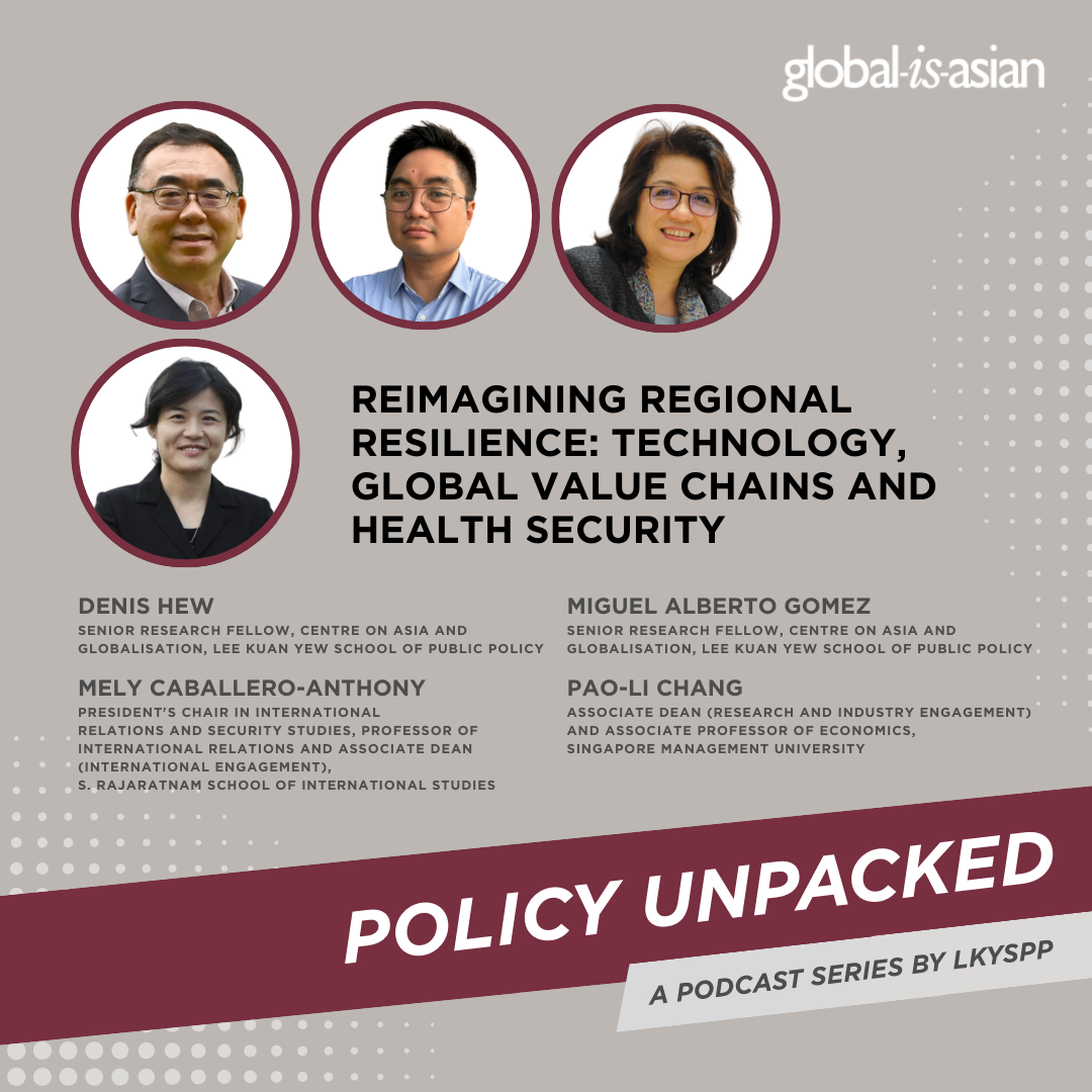
S3 Ep 5Policy Unpacked: Reimagining Regional Resilience - Technology, Global Value Chains & Health Security
Resilience has become a familiar term in recent years, especially after COVID-19, supply chain disruptions, rising geopolitical tensions and rapid technological change. But today, resilience is no longer just about recovery. It is about how countries and regions adapt and rethink how they operate in a more uncertain and fragmented world. For ASEAN, this challenge is particularly complex. Resilience looks different across emerging technologies, global value chains and health and other non-traditional security issues. And policy choices in one area can create vulnerabilities in another. In this episode's of Policy Unpacked, join our expert panel, LKYSPP's Dr. Denis Hew and Dr Miguel Gomez, Senior Research Fellows at the Centre on Asia and Globalisation, SMU's Associate Professor Chang Pao Li and RSIS' Professor Mely Anthony, as they explore what resilience really means for ASEAN and what it will take for the region to remain competitive, resilient and secure. Register for their Ideas Festival here: https://lkyspp.sg/reimagining-regional-resilience Or find out more here: https://lkyspp.sg/ideasfestival2026See omnystudio.com/listener for privacy information.
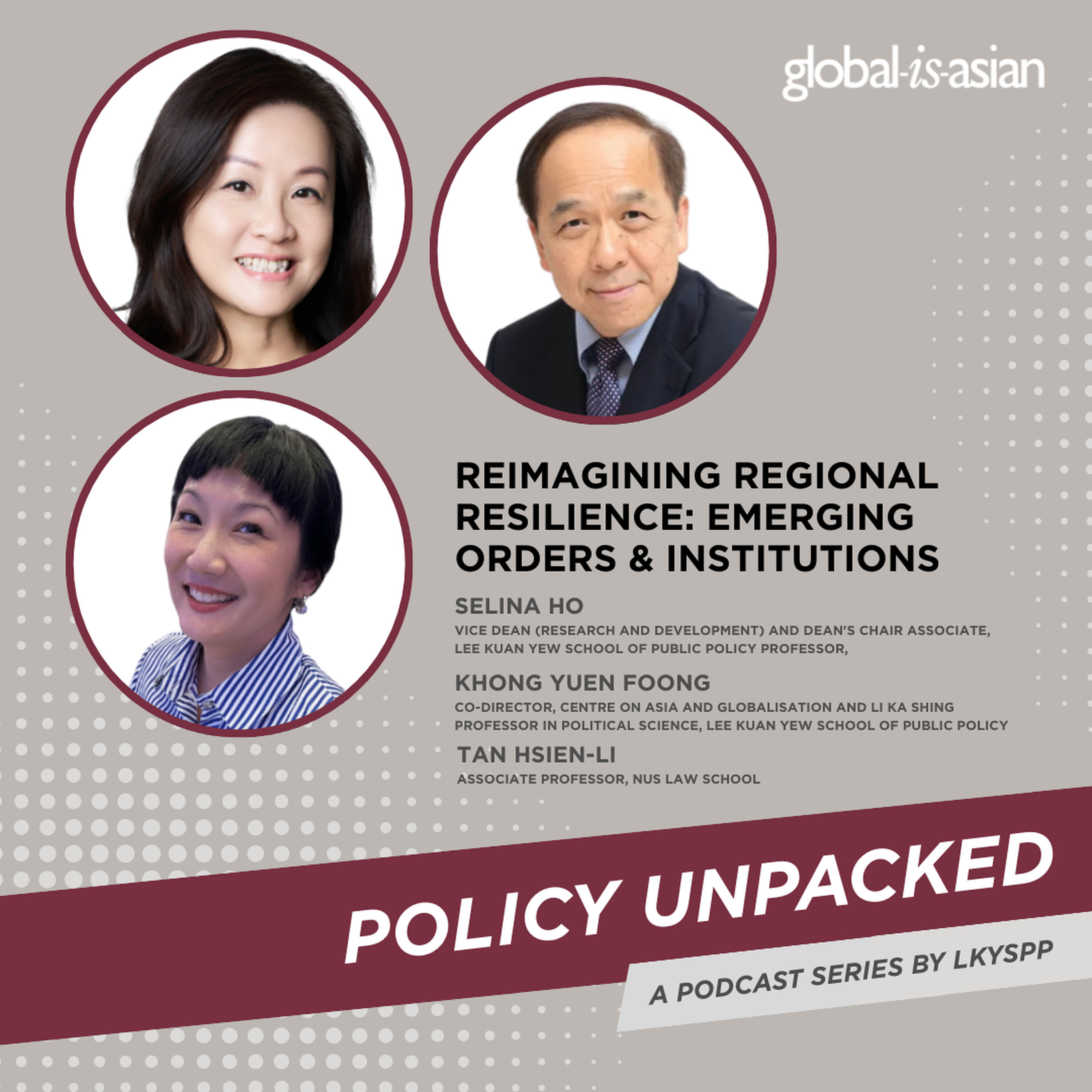
S3 Ep 4Policy Unpacked: Reimagining Regional Resilience - Emerging Orders & Institutions
Southeast Asia is navigating a far more contested and uncertain strategic environment. Military tensions, major power rivalry and territorial disputes are growing, while transboundary challenges from economic shocks to cyber risks, are testing the region's resilience. For ASEAN, this raises a critical question: How can the region remain stable, resilient and relevant as global power structures shift? Tune in to this episode of Policy Unpacked with LKYSPP's Prof Selina Ho, Prof Khong Yuen Foong as well as, NUS' Law School's Prof Tan Hsien-Li, as they examine how changing global dynamics are reshaping the Asian regional order and what this means for ASEAN's role going forward. Excited to hear more about this? Register for their Ideas Festival here: https://lkyspp.sg/reimagining-regional-resilience Or find out more here: https://lkyspp.sg/ideasfestival2026See omnystudio.com/listener for privacy information.
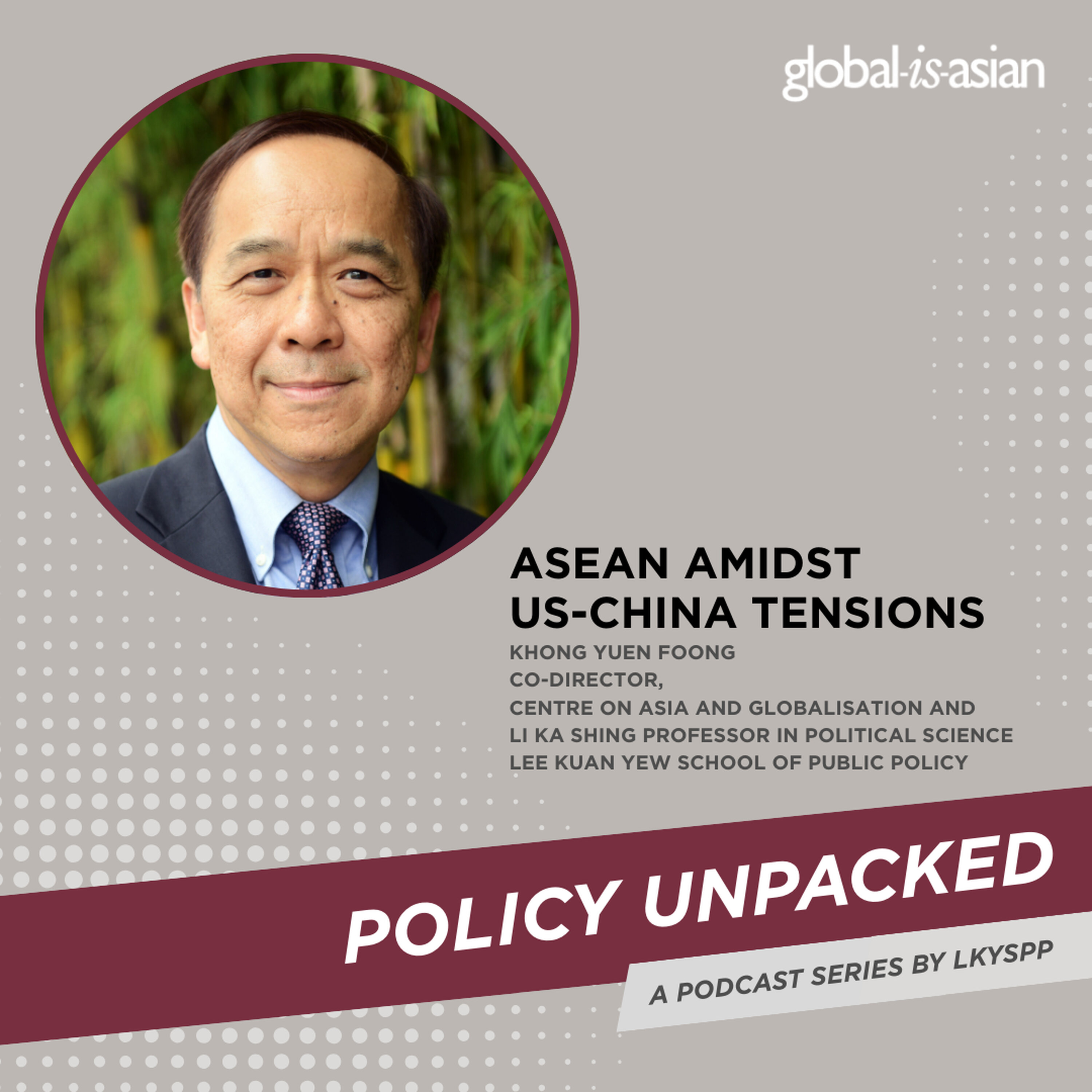
S3 Ep 3ASEAN Amidst US-China Tensions
Southeast Asia now finds itself at the heart of a growing storm. As the geopolitical rivalry between the United States and China intensifies, ASEAN nations are navigating a delicate balance between two competing powers. Today, we speak with LKYSPP Professor Khong Yuen Fong, Li Ka Shing Professor in Political Science and Co-Director of Centre on Asia and Globalisation, about his work, examining how ASEAN is managing this rivalry and what the shifting global order means for the region's future.See omnystudio.com/listener for privacy information.
S3 Ep 2Policy Unpacked: Work, AI, and the Role of Public Policy
Is your job safe from AI? Or is the real question, is your country ready? As artificial intelligence reshapes, Singapore faces a critical challenge. How do we equip citizens to thrive? And how must public policy evolve to redefine the social contract between government, businesses and workers? We're joined by Dr. Reuben Ng, assistant professor at Lee Kuan Yew School of Public Policy. His work focuses on trust, social resilience, and the narratives shaping technology. This podcast will unpack the future of work in the age of AI and what Singapore must do to stay ahead.See omnystudio.com/listener for privacy information.
S3 Ep 1Policy Unpacked: Rethinking the Social Contract
In the first episode of our newly launched podcast series, “Policy Unpacked”, we explore Singapore’s “small nation, big journey,” featuring Terence Ho, Adjunct Associate Professor in Practice at the Lee Kuan Yew School of Public Policy and author of “How Singapore Beat the Odds.” The conversation explores why Singapore’s survival was uncertain at independence - small population, high unemployment, reliance on British bases - and how it built success through ideas and institutions rather than luck. Ho highlights the pivotal role of first-generation leaders like Lee Kuan Yew and Goh Keng Swee, long-term planning, strong inter-agency coordination, and empowering capable people - principals, commanders, and civil servants - through mechanisms like block budgeting. A core theme is Singapore’s pragmatic synthesis: drawing from both left and right (compassion and self-reliance), combining market forces with judicious state intervention, and adapting global best practices to local context. Policy evolution, such as shifting from streaming to subject-based banding, illustrates continuous recalibration to reduce stigma while keeping standards. The civil service complements political leadership as “intellectual equals,” increasingly communicating policies publicly, while tripartism builds trust and buy-in, countering the misconception of a purely top-down technocracy. Associate Prof Ho outlines enduring tensions Singapore must balance: growth and equity, global openness and local identity, development and heritage. Looking ahead, he sees new “odds” in a fractured global trading system and disruptive AI, arguing for an updated success formula that layers resilience (domestic capabilities, local core) atop openness and investment in human capital. He is cautiously optimistic, citing strong institutions, societal trust, adaptability shown in COVID-19, and purposeful youth. His overarching takeaway: values - service, integrity, and evolving meritocracy - anchor Singapore’s policy playbook and continue to guide its inclusive, pragmatic path.See omnystudio.com/listener for privacy information.
S2 Ep 27Foreseeable Podcast: The United Nations at 80: Power, Peace and a Changing World Order
Today we put the spotlight on the United Nations as it turns 80 years old in 2025. Current global crises, such as geopolitical conflicts, climate change, and humanitarian disasters are profoundly testing the UN's existing mechanisms and its capacity to respond effectively. We sit down with Professor Francesco Mancini to discuss the UN's ability to adapt, reform and successfully address these crises, which will ultimately define its relevance and determine its path forward in global governance.See omnystudio.com/listener for privacy information.
S2 Ep 26Foreseeable Podcast: The choice to be honest: Behavioural nudges in policy design
In this episode of the Foreseeable podcast series, Associate Professor Leong Ching unpacks a behavioural experiment that explores how opt-in monitoring affects honesty across nine countries. With insights drawn from behavioural economics and public policy, she discusses how low-cost, non-intrusive interventions can promote pro-social behaviour and strengthen public trust.See omnystudio.com/listener for privacy information.
S2 Ep 25Foreseeable Podcast: South Korean politics: Impeachment, elections, and international impact
In this episode of the Foreseeable podcast series, Assistant Professor Yongwook Ryu offers an in-depth analysis of South Korea's political upheaval marked by the impeachment of President Yoon Suk Yeol. Explore the causes and effects of this dramatic political saga and understand its domestic politics and its impact on South Korea's foreign policy, particularly in relation to the US-China trade tensions, as the nation is poised for significant change amid a leadership vacuum that is expected to end after the presidential election on 3rd June.See omnystudio.com/listener for privacy information.
S2 Ep 24Foreseeable Podcast: Future-Ready Governance
Terence Ho, Adjunct Associate Professor in Practice at the Lee Kuan Yew School of Public Policy, is a former policymaker and now academic. Terence's latest book, ‘Future-Ready Governance: Perspectives on Singapore and the World’, is a collection of essays exploring how Singapore is addressing critical issues like tech disruptions, climate change, social stresses, leadership transitions, and fiscal sustainability. Drawing on Singapore's experience, the book illuminates broader governance and leadership principles and aims to provide insights for those interested in Singapore's approach to navigating a complex future.See omnystudio.com/listener for privacy information.
S2 Ep 23Singapore Budget 2025: A New Social Compact?
Singapore Budget 2025 is a landmark one, coinciding with the year Singapore turns 60, and arriving ahead of the General Elections. This is also the first Budget under Prime Minister Lawrence Wong. But beyond the headline-grabbing incentives, does Budget 2025 truly create opportunities for all? The team at the Social Inclusion Project (SIP) host this podcast special. Moderated by SIP’s Nessa Swinn Yap, and led by SIP’s lead, Dr Ng Kok Hoe (Senior Research Fellow, NUS Lee Kuan Yew School of Public Policy), they speak to guests Dr Stephanie Chok (Executive Director, Humanitarian Organization for Migration Economics (HOME)), and Lim Jingzhou (Community Worker, Cassia Resettlement Team) to explore the Budget’s implications for lower-income groups, migrant workers, and caregivers.See omnystudio.com/listener for privacy information.
S2 Ep 22Foreseeable Podcast: The Longevity Revolution: How Art, AI & Agency are Reframing Ageing
As lifespans increase, it's projected that 2.1 billion people will be aged 65 and above by 2050. That's one reason why it's so important to address the negativity surrounding ageing, as positive perceptions of ageing can lead to longer and healthier lives. Dr Reuben Ng is an Assistant Professor at the Lee Kuan Yew School of Public Policy, and a behavioural scientist who also spent 16 years in government consulting and research. He's an expert in ageism, social gerontology, and quantitative social science. It's in that context that we spoke to him about the ongoing longevity revolution and how our AI and agency are helping to reframe ageing in a positive light. See omnystudio.com/listener for privacy information.
S2 Ep 21Foreseeable Podcast: Navigating Trump 2.0: Challenges and Opportunities for Southeast Asia
Dr Denis Hew is Senior Research Fellow at the National University of Singapore's Lee Kuan Yew School of Public Policy. Prior to taking up his current appointment, he was director of the APEC Policy Support Unit, PSU, from 2011 to 2022. Dr Hew also spent two years in the Asian Development Bank, ADB in its Southeast Asia department, where he managed technical assistance programmes on regional cooperation and integration. Dr Denis Hew is Senior Research Fellow at the National University of Singapore's Lee Kuan Yew School of Public Policy. Prior to taking up his current appointment, he was director of the APEC Policy Support Unit, PSU, from 2011 to 2022. Dr Hew also spent two years in the Asian Development Bank, ADB in its Southeast Asia department, where he managed technical assistance programmes on regional cooperation and integration. See omnystudio.com/listener for privacy information.
S2 Ep 20Indonesia's New Era: Challenges and Opportunities under a Prabowo Presidency
Professor Eduardo Araral, is a distinguished academic and practitioner with over 30 years of experience in academia and government. His research primarily focuses on institutions for collective action. As a prominent figure in the field, Professor Araral has contributed to significant projects with various governments and international organisations, including the Asian Development Bank and the World Bank. He has engaged in over 250 executive education programmes, sharing his insights with thousands of government officials, business leaders, and NGOs across more than 50 countries.See omnystudio.com/listener for privacy information.
S2 Ep 19From Cars to Tofu: Uncovering what drives Eco-Friendly Choices
Assistant Professor Tan Soo Jie Sheng primarily uses micro econometrics techniques combined with economic modelling to conduct empirical research in the areas of environment, health, and development. Recently, he and his co-authors published an article titled, “Using Cost–Benefit Analyses to Identify Key Opportunities in Demand-Side Mitigation.”See omnystudio.com/listener for privacy information.
S2 Ep 18Foreseeable Podcast: The largest democracy votes: What's next for India?
The world’s largest democracy, India, has recently concluded its six-week long election, counting 640 million votes. India’s incumbent Prime Minister Narendra Modi was re-elected but his Bharatiya Janata Party (BJP) lost their majority and are now in a coalition with the National Democratic Alliance (NDA). What does this mean for India, Asia and the world?See omnystudio.com/listener for privacy information.
S2 Ep 17Foreseeable Podcast: Building urban resilience to tackle unknown unknowns
A new book, Building Urban Resilience: Singapore's Policy Response to Covid-19 is one of the first few books to discuss the Covid-19 crisis as an urban phenomenon. Written by our guests—J.J. Woo who is a Senior Lecturer at the Lee Kuan Yew School of Public Policy and Debbie R. Loo, who is an architect by training with a background in professional practice, urban studies research, and teaching—the book takes a look at how pandemics have shaped urban planning for centuries, and how we can learn from the experience to improve our population centres in many different ways.See omnystudio.com/listener for privacy information.
S2 Ep 16A new era in Indonesia: Outcome and significance of its 2024 presidential elections
Indonesian voters in Southeast Asia’s largest democracy elected the ticket of former military general Prabowo Subianto and Gibran Rakabuming Raka in February 2024, but not without controversy. Gibran is the son of outgoing President Joko "Jokowi" Widodo, who is accused of manipulating the courts to allow Gibran to run despite being below the constitutional minimum age. There are even charges of vote rigging that are being handled by Indonesia’s Election Supervisory Agency or Bawaslu and The General Elections Commission known as KPU. Associate Professor Suzaina Kadir is Vice Dean of Academic Affairs at the Lee Kuan Yew School of Public Policy and an expert on politics in Southeast Asia. As an avid Indonesia watcher, we wanted to get her take on what the upcoming administration means for Indonesia domestically, regionally and globally. See omnystudio.com/listener for privacy information.
S2 Ep 15Foreseeable Podcast: Macroeconomic and financial management in emerging Asian economies
From booming GDP growth and low interest rates to raging inflation and a shrinking economy, most of us have a sense of how the macroeconomic ups and downs can affect our lives. But have you ever considered what it takes to keep an economy healthy? Our guest certainly has. Ramkishen S. Rajan is Yong Pung How Professor at the Lee Kuan Yew School of Public Policy. He has been a Visiting Fellow at various regional research institutes, including the Asia Competitiveness Institute, the Institute of Policy Studies as well as the Asian Development Bank Institute. See omnystudio.com/listener for privacy information.
S2 Ep 14Foreseeable Podcast: The rationale behind irrational environmental behaviour
The last time we spoke to Leong Ching, Vice Provost for Student Life, NUS, and Associate Professor at the Lee Kuan Yew School of Public Policy, we discussed the "yuck factor" which describes people's visceral aversion to drinking recycled water. Today, we'll be expanding on that topic to look at the rationale behind irrational environmental behaviour in general. As an institutional economist, Professor Leong uses narratives, perceptions and stories to understand collective public behaviour as well as environmental identities. See omnystudio.com/listener for privacy information.
S2 Ep 13Foreseeable Podcast: Creating healthier societies through urban planning
Urban environments, from infrastructure to green spaces, play a crucial role in shaping lifestyle choices, social dynamics, and overall quality of health. Tan Shin Bin is an Assistant Professor at the Lee Kuan Yew School of Public Policy (LKYSPP). She previously worked as an urban planner at Singapore’s Urban Redevelopment Authority, the government body tasked with guiding the physical development of Singapore in a sustainable manner. She joins us to discuss how urban environments impact health, as well as the opportunities and challenges faced when developing policies to promote healthier lifestyles within urban spaces.See omnystudio.com/listener for privacy information.
S2 Ep 12Foreseeable Podcast: Maritime heritage and the power of narrative
Dr Marina Kaneti is an Assistant Professor at the Lee Kuan Yew School of Public Policy. Her area of research centres on global governance and questions of migration, climate and geopolitical developments. She has explored the influence of China around the world, including the Belt and Road initiative. Recently, she produced a two-part documentary series titled “The Seas That Bind Us and Define Us”, exploring maritime heritage and its significance in Asia. She joins us to talk about maritime heritage, exploring the shaping and impact of narratives, and implications for the present and beyond. Get our monthly updates to stay ahead on Asian policy issues here.See omnystudio.com/listener for privacy information.
S2 Ep 11Foreseeable Podcast: The socio-economic impact of mobile banking on developing economies
In an increasingly interconnected world, the advent of mobile banking has ushered in a transformative era. Access to mobile banking can have a profound impact on people in developing economies. The impact of mobile banking extends beyond individual lives – it ripples through entire communities, affecting aspects such as migration and inequality. Dr Saravana Ravindran, Assistant Professor at the Lee Kuan Yew School of Public Policy, studies challenges and potential policy solutions relating to migration, including mobile banking and digital financial services. He has conducted research into whether mobile technology can reduce inequality by modernising traditional ways to transfer money. He joins us to explore the socio-economic impact of mobile banking on communities. See omnystudio.com/listener for privacy information.
S2 Ep 10Foreseeable Podcast: Challenges on the path to achieving the ASEAN Economic Community by 2025
The Association of Southeast Asian Nations (ASEAN) aims to create a highly integrated regional economy by 2025. Known as the ASEAN Economic Community (AEC), the initiative faces many obstacles that may hinder the achieving of its goal. To understand the obstacles and opportunities, we speak to Dr Denis Hew. Currently Senior Research Fellow at the Centre on Asia and Globalisation, Lee Kuan Yew School of Public Policy, Dr Hew has served as Director of the Asia-Pacific Economic Cooperation Policy Support Unit. He also spent time managing technical assistance programmes on regional cooperation and integration at the Asian Development Bank. Dr Hew has published extensively on policy issues related to economic integration in ASEAN and the Asia-Pacific region.See omnystudio.com/listener for privacy information.
S2 Ep 9Foreseeable Podcast: Urban policy and planning in Singapore: the shift towards sustainability
Singapore is world-renowned for its urban planning. While it is enjoying the success of the good planning of the past, it finds itself in the middle of an important shift to be prepared for the environment of the future. To understand the challenges and opportunities, we speak with Dr Woo Jun Jie. Dr Woo is a Senior Research Fellow at the Institute of Policy Studies, Lee Kuan Yew School of Public Policy, where he heads the Governance and Economy department. His work focuses on urban policy, economic development, and crisis management in Asia. See omnystudio.com/listener for privacy information.
S2 Ep 8Foreseeable Podcast: Microdata and its potential in policy planning and decisions
Visiting Professor Emmanuel Skoufias served as a Lead Economist in the Poverty and Equity Global Practice of the World Bank Group, from 2004 until his retirement in 2022. His area of expertise includes the use of microdata to analyse the determinants of poverty and household welfare, the impacts of risk and risk management strategies, and the targeting of social protection programs. He joined us for a deep dive into how microdata informs policy planning and decisions. Subscribe to the Global-is-Asian newsletter.See omnystudio.com/listener for privacy information.
S2 Ep 7Foreseeable Podcast: Forging stewards of biodiversity, conservation and marine ecosystems with local communities
What are the most effective methods of protecting, and hopefully restoring, the planet's biodiversity? This is a key question underlying the work of Tanya O'Garra, Senior Research Fellow at the Institute for Environment and Sustainability, Lee Kuan Yew School of Public Policy. Tanya is an environmental economist with over 15 years’ experience conducting research on the valuation of ecosystem services and the collective management of shared natural resources. She has recently published a study on the effectiveness of community-based approaches to conservation and natural resource management. Subscribe to the Global-is-Asian newsletter.See omnystudio.com/listener for privacy information.
S2 Ep 6Foreseeable Podcast: Policy design capacity building for Southeast Asia's most pressing climate and sustainability challenges
Benjamin Cashore is Li Ka Shing Professor in Public Management and Director of the Institute for Environment and Sustainability (IES) at the Lee Kuan Yew School of Public Policy. He specialises in global and multi-level environmental governance, comparative public policy and administration, and transnational business regulation and corporate social responsibility. In his role as the Director of IES, he focuses on helping governments and private sectors close the gap between policy commitments and actual outcomes through "fit-for-purpose" policy analysis. He joins us to help explain just how that works in the real world. Subscribe to the Global-is-Asian newsletter.See omnystudio.com/listener for privacy information.
S2 Ep 5[Forseeable Podcast] Homelessness in Singapore during the COVID-19 pandemic
Dr Ng Kok Hoe is a Senior Research Fellow and Head of the Social Inclusion Project and Case Study Unit at the Lee Kuan Yew School of Public Policy, National University of Singapore (NUS). His research interests are public housing policy, homelessness, income security and minimum income standards. In August this year, Dr Ng Kok Hoe from the Social Inclusion Project at the Lee Kuan Yew School of Public Policy published findings from a nationwide count of the number of homeless people sleeping on the streets and in temporary homeless shelters during the COVID-19 pandemic. This is the second nationwide street count of homelessness in Singapore. The first, conducted by the same researcher, was in 2019. Before this research, homelessness was generally a hidden issue. Most people were not familiar with the issue. Since 2019, public concern, media interest and policy attention have all grown. In this podcast, we will discuss with Dr Ng on how the research came about, what we have learnt and what we need to do next.See omnystudio.com/listener for privacy information.
S2 Ep 4Foreseeable Podcast: China's Rise and US-China Rivalry
Selina Ho is Assistant Professor in International Affairs and Co-Director of the Centre on Asia and Globalisation at the Lee Kuan Yew School of Public Policy. She is an expert on Chinese politics and foreign policy. She is especially interested in how China wields power and influence via infrastructure and water disputes in Southeast Asia and South Asia. She is co-author of Rivers of Iron: Railroads and Chinese Power in Southeast Asia. She joins us to discuss China's domestic politics and foreign policy, as China approaches key meetings, the 20th Party Congress, the National People's Congress and the Chinese People’s Political Consultative Congress. Subscribe to the Global-is-Asian newsletter.See omnystudio.com/listener for privacy information.
S2 Ep 3Foreseeable Podcast: Singapore's economic outlook: inflation, social stresses and more
Terrence Ho is an Associate Professor in Practice at Lee Kuan Yew School of Public Policy. Over the past decade, Professor Ho has held various policy research and leadership positions in the Singapore public service, including as an economist in the Ministry of Trade and Industry and Divisional Director of Manpower Planning and Policy at the Ministry of Manpower. A frequent commentator for publications such as the Straits Times and Channel News Asia, Professor Ho specialises in economic and manpower policy, fiscal policy, public sector management, and organisation, social security, inequality, and social mobility. He joins us to discuss Singapore's economy in this time of volatility and uncertainty. Subscribe to the Global-is-Asian newsletter.See omnystudio.com/listener for privacy information.
S2 Ep 2Foreseeable Podcast: Renewable Energy – how real is this for Asia?
Vinod Thomas is Visiting Professor at the Lee Kuan Yew School of Public Policy. Previously he served as Director General of Independent Evaluation at Asian Development Bank, where he worked to institute change. In his role, he assessed ADB’s development effectiveness while providing lessons to help inform ADB’s actions. This was instrumental in making green growth and action on climate change more integral to ADB’s strategy. This is just one example of Professor Thomas' deep understanding of issues affecting climate change and the environment. So he's in a perfect position to help us answer this question “Renewable Energy – how real is this for Asia?” Subscribe to the Global-is-Asian newsletter.See omnystudio.com/listener for privacy information.
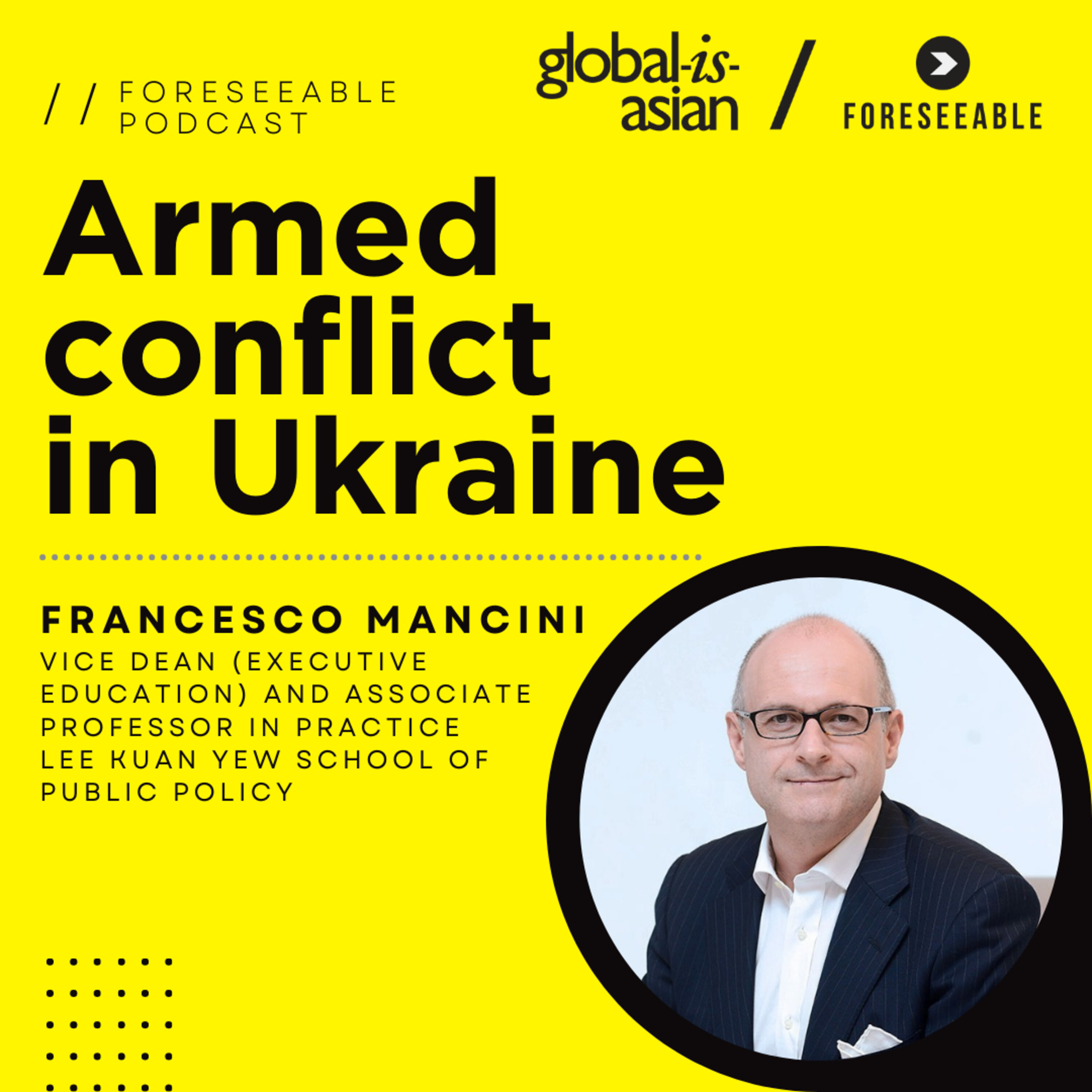
S2 Ep 1Foreseeable Podcast: Armed conflict in Ukraine
Francesco Mancini, Vice Dean (Executive Education) and Associate Professor in Practice at the Lee Kuan Yew School of Public Policy has an extensive background in the prevention and settlement of armed conflict. He was a senior director at the International Peace Institute in New York, a think tank that works very closely with the United Nations and its member states. He has been working in and around conflict, peacekeeping, conflict resolution and negotiation for close to 20 years. In that light, we've asked him to share his views on the current military conflict in Ukraine. Subscribe to the Global-is-Asian newsletter.See omnystudio.com/listener for privacy information.
S1 Ep 25What is Public Policy?
“What is public policy?” It has often been broadly defined as a set of actions the government decides to take when approaching a problem that affects society as a group. When Global-is-Asian decided to explore the question of public policy and its impact on Singapore, one faculty member stood out as the perfect person to speak with to get their input: Lim Siong Guan is Professor in Practice at the Lee Kuan Yew School of Public Policy, instructing on leadership and change management, and his depth of experience is impressive He was the Head of the Singapore Civil Service from 1999 to 2005. He has been the Permanent Secretary of the Ministry of Defence, the Prime Minister’s Office, the Ministry of Education and the Ministry of Finance. He has also served as Chairman of the Singapore Economic Development Board, the Inland Revenue Authority of Singapore, the Accounting and Corporate Regulatory Authority and the Central Provident Fund Board. And these are just a few of his accomplishments. We were very lucky to have a few minutes to discuss, “What is Public Policy?”See omnystudio.com/listener for privacy information.
S1 Ep 24Foreseeable Podcast: Optimism no help to migrants
Dr. Marina Kaneti specialises in questions of global development, including the Chinese Belt and Road initiative, environmental governance, human rights, the sustainable development goals and for the purpose of this discussion – migration. I started by asking her what made her interested in migration in the first place.See omnystudio.com/listener for privacy information.
S1 Ep 23Foreseeable Podcast: Racism and fear of the other in Singapore
We have Dr. Mathew Mathews, Principal Research Fellow and Head of the Social Lab at the Institute of Policy Studies at NUS and Shamil Zainuddin, Research Associate at the Institute of Policy Studies at NUS. And we're following up on a recent commentary they wrote that was published in Channel NewsAsia, about the worries over rising COVID-19 cases, that they're fuelling racially charged comments, and we wanted to follow up and talk a little bit more about that.See omnystudio.com/listener for privacy information.
S1 Ep 22Foreseeable Podcast: How does Leadership matter in Public Service?
Leadership is always a popular topic of discussion. As our guest Taha Hameduddin, Assistant Professor at the Lee Kuan Yew School of Public Policy says, “if you want to sell a talk or a speaker or a class, you have to put the word leadership in it.” But the fact is, leadership matters. And that’s exactly what Professor Hamedduddin and his co-author Professor Trent Engbers found in their recent study, “Leadership and public service motivation: a systematic synthesis”.See omnystudio.com/listener for privacy information.
S1 Ep 21Foreseeable Podcast: Time for ASEAN to act in Myanmar
“It’s time for ASEAN to act and lead the de-escalation and mediation process in Myanmar.” That’s the main message of a paper published by The Institute of Southeast Asian Studies, co-authored by our guest, Yongwook Ryu, Assistant Professor at the Lee Kuan Yew School of Public Policy, together with Bernard Minn and Myat Myat Mon, who are both Master in Public Policy candidates at LKYSPP.See omnystudio.com/listener for privacy information.
S1 Ep 20Foreseeable Podcast: The different shapes of terrorism
In the 21st century, terrorism continues to be a phenomenon that plagues countries all around the world. In this Foreseeable Podcast, Associate Professor in Practice Francesco Mancini gives us insights on terrorism and how it could change in the future. Subscribe to the Global-is-Asian podcastSee omnystudio.com/listener for privacy information.
S1 Ep 19Foreseeable Podcast: The view from China: Is the US viewed favourably?
There was a lot of media attention when a Pew Research Center study came out in late 2020 saying that 61 percent of citizens in 14 major economies hold unfavourable views of China. And especially that public opinion of China in the United States was historically negative. But what about public opinion inside China? How did Chinese citizens view these same 14 countries? That’s exactly what our guests found out. Their survey revealed that the negative feelings are largely mutual, particularly Chinese views of the US, which 77 percent responded was “very unfavourable" or "somewhat unfavourable" The survey was authored by Songying Fang, Associate Professor of Political Science at Rice University, Adam Liu, Assistant Professor at the Lee Kuan Yew School of Public Policy who are with us now, and Xiaojun Li, Associate Professor of Political Science at the University of British Columbia, who was unfortunately unable to join us.See omnystudio.com/listener for privacy information.
S1 Ep 18Foreseeable podcast: Assistant Professor Yongwook Ryu on a post-Trump Asia
After a tense and controversial election period, Joe Biden is now set to become the next president of the United States. We asked Assistant Professor Yongwook Ryu to give us his perspective on the past four years under the Trump administration, as well as on what the Biden administration has in store for China and the rest of Asia.See omnystudio.com/listener for privacy information.
S1 Ep 17Forseeable podcast: What does new US leadership mean for Asia?
Prior to the US elections, the Lee Kuan Yew School of Public Policy held an instalment of their Asia Thinker Series titled “Asia’s Takeaways from the US Elections” featuring Visiting Senior Research Fellow Drew Thompson. Now the elections have come and gone and Joe Biden is set to become the 46th President. So we asked Drew to give us a more detailed look at what's in store for a Biden administration. Subscribe to our newsletterSee omnystudio.com/listener for privacy information.
S1 Ep 16Reimagining Education with Associate Professors Suzaina Kadir and Francesco Mancini
The COVID-19 pandemic has changed the nature of education in ways that few other events could. Adopting technology to work, live and learn from home while staying distant from others has affected millions. A recent instalment of the Asia Thinker Series (After the Pandemic) moderated by Associate Professor Suzaina Kadir, Vice Dean of Academic Affairs at the Lee Kuan Yew School of Public Policy, discussed what is in store for education in the post-COVID-19 era. After the session, Global-is-Asian caught up with Associate Professor Suzaina Kadir as well as Associate Professor in Practice Francesco Mancini, Associate Dean of Executive Education programmes at the school. Subscribe to our newsletterSee omnystudio.com/listener for privacy information.
S1 Ep 15Explaining the Asian Economic Miracle
Razeen Sally is Associate Professor at the Lee Kuan Yew School of Public Policy and Chairman of the Institute of Policy Studies, the main economic-policy think tank in his native Sri Lanka. His research and teaching focuses on global trade policy and Asia in the world economy. He has also written on the history of economic ideas, especially the theory of commercial policy. Subscribe to our newsletter See omnystudio.com/listener for privacy information.
S1 Ep 14Touring India’s New Gilded Age with James Crabtree
James Crabtree has been the Mumbai bureau chief for the Financial Times, a senior policy advisor in the UK Prime Minister’s Strategy Unit and was a Fulbright Scholar at Harvard’s Kennedy School of Government.Today, the journalist and author is an Associate Professor in Practice at the Lee Kuan Yew School of Public Policy.His latest book, The Billionaire Raj: A Journey Through India's New Gilded Age takes an in-depth look at the “…billionaire class in a radically unequal society” where the country’s top 1% now own nearly 60% of its wealth.See omnystudio.com/listener for privacy information.
S1 Ep 13Thirsty Cities: Social Contracts and Public Goods Provision in China and India
Thirsty Cities: Social Contracts and Public Goods Provision in China and India is a book written with one overarching, broad question in mind: Why does authoritarian China produce more public goods than democratic India? The book’s author is Selina Ho, Assistant Professor at the Lee Kuan Yew School of Public Policy. She specialises in Chinese politics and foreign policy, with a focus on the politics of water and infrastructure. I asked her why she decided to write this book. Subscribe to the Global-is-Asian newsletter. See omnystudio.com/listener for privacy information.
S1 Ep 12Governments, non-profits and pandemics: A conversation with Assistant Professor Anubhav Gupta
The third instalment of Asia Thinker Series: Talkback discussed state capacity, trust, and privacy in the post-COVID-19 era. The episode featured Singapore’s Senior Minister Tharman Shanmugaratnam, John Micklethwait of Bloomberg and Ms Rana Foroohar from the Financial Times and was moderated by Associate Professor in Practice James Crabtree from the Lee Kuan Yew School of Public Policy. To follow up with some of the topics raised during the episode, we caught up with Anubhav Gupta, Assistant Professor at the Lee Kuan Yew School of Public Policy. Having joined the school in January this year, Professor Gupta is one of the school’s newer faculty. He says “it's been quite a start”. His research focuses on the charitable or nonprofit sector of the economy and the governance issues surrounding them.He was able to add an interesting perspective to the conversation of governments and their response to COVID-19.See omnystudio.com/listener for privacy information.
S1 Ep 11How has COVID19 changed the way we work? A Conversation with Assistant Professor Taha Hameduddin
The second episode of the Asia Thinker Series Talkback was titled: After the Pandemic "A Test of Resilience: Workplace Innovation and Strategies" It featured Jane Lim of Singapore’s Infocomm Media Development Authority, Shirin Hamid of the Asian Development Bank and was moderated by Assistant Professor Taha Hameduddin from the Lee Kuan Yew School of Public Policy and can be viewed on the school’s Facebook page. After the panel, there were still some unanswered questions from several viewers, so we caught up with Professor Hameduddin to give him a chance to respond. I started by asking him what were his key takeaways from the panel?See omnystudio.com/listener for privacy information.
S1 Ep 10Climate change: The knowledge - action gap
In his recent book, Climate Change and Natural Disasters:, Vinod Thomas, Visiting Professor at the Lee Kuan Yew School of Public Policy writes about “The knowledge - action gap,” when it comes to solving the climate crisis. And he should know. In his career, Professor Thomas has been at the forefront of evaluating and making policy recommendations for green growth and action on climate change at institutions like the Asian Development Bank and the World Bank Group. What does he mean by the knowledge - action gap, and what are some of the causes?See omnystudio.com/listener for privacy information.