
Focus and Chill - productivity tactics for AuDHDers and other neurodivergent folks
142 episodes — Page 2 of 3
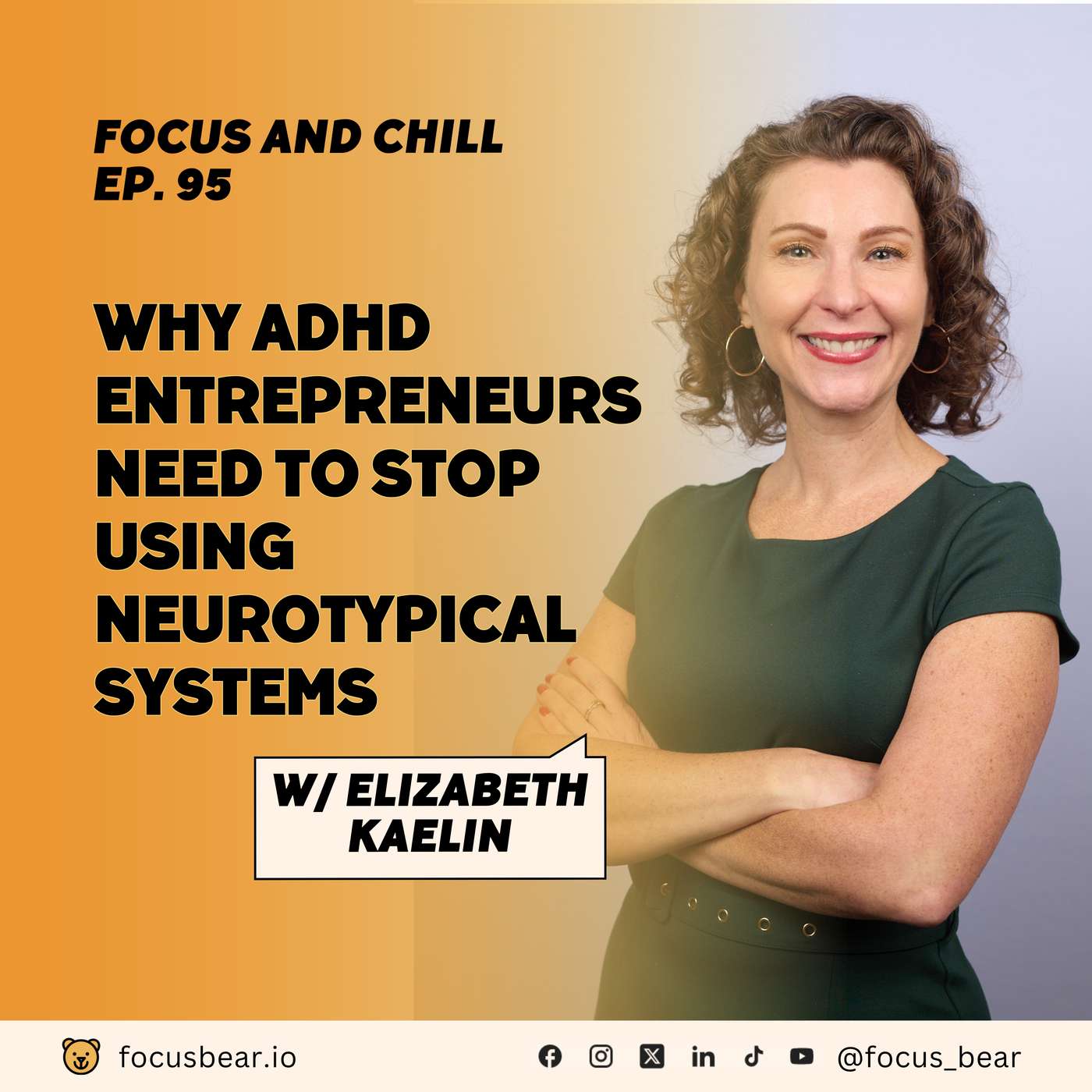
Ep 95Episode 95: Elizabeth Kaelin
Welcome to episode #95! We’re thrilled to be joined by Elizabeth Kaelin today.Elizabeth Kaelin is a tech founder, award-winning commercialization mentor, and intersectionality business advocate. Her career spans healthcare, tech, venture capital, and corporate leadership, where she helps businesses scale while challenging traditional business norms.Diagnosed with ADHD later in life, Elizabeth shares how she overcame burnout, adapted her leadership style, and built sustainable success. She is passionate about rethinking productivity, advocating for neurodivergent-friendly workplaces, and showing how ADHD can be a leadership strength.In this episode, we discuss navigating ADHD as an entrepreneur, energy-based productivity, and how to build a business that actually works for your brain.Welcome to the show, Liz!QuestionsJN: When did you first realize you had ADHD?Diagnosed three separate times before fully accepting itInitially dismissed the diagnosis due to career success & maskingADHD symptoms became more obvious during burnout & career transitionsJN: How did ADHD impact your early career?Worked in dietetics, tech, venture capital & consulting before founding her startupStruggled with executive dysfunction & burnout in structured corporate settingsThrived in entrepreneurship but faced challenges in long-term project managementJC: How did your ADHD diagnosis change how you approached work?Stopped trying to "fix weaknesses" & started optimizing strengthsFocused on energy-based productivity instead of rigid time managementLearned to work with her brain, not against itJN: What was the biggest challenge in building your business as a neurodivergent entrepreneur?Struggled with traditional productivity systems that don’t work for ADHDHad to develop her own strategies for prioritization & decision-makingLearned to lean into her strengths rather than force neurotypical approachesJC: What is your approach to productivity now?Uses energy management instead of strict schedulesPrioritizes flexibility & intuition over rigid planningExplores non-traditional frameworks like numerology & cyclical planningJN: What productivity strategies DON’T work for you?“Eat the Frog” method (doing the hardest task first)—completely drains motivationRigid time-blocking & consistency-based productivity hacksTrying to force structure instead of embracing fluidityJC: How do you prevent burnout while managing multiple projects?Learned to listen to her body & mental energy levelsSimplifies decision-making using intuition & structured randomnessBalances structure with novelty to maintain engagementJN: What is your morning routine like?Uses randomized prompts to keep routines engaging & prevent decision fatigueFocuses on three key things daily (movement, mindfulness, connection)Simulates a commute even when working from home to set mental boundariesJN: How do you wind down at night?Struggles with sleep & phone distractions—uses grayscale & separate phonesListens to music or ambient sounds to shift into relaxation modeTidies up before bed to avoid waking up in a chaotic environmentJN: Where can people connect with you?Instagram: @LizKaelinOfficial: https://www.instagram.com/lizkaelinofficial/LinkedIn: Elizabeth Kaelin: linkedin.com/in/elizabethkaelinJC: Final words for the audience?“I’d love recommendations for ADHD-friendly digital systems or consultants who help with automation and accountability.”“Managing inattentive ADHD without a second brain system is tough—any tips for setting one up?”More from Focus Bear:Website: https://focusbear.ioLinkedIn: https://www.linkedin.com/company/focus-bear/Youtube: https://www.youtube.com/@focusbearappTwitter: https://twitter.com/focusbear1Instagram: https://www.instagram.com/focus_bear/Facebook: https://www.facebook.com/focusbearapp/Podcast: https://podcast.focusbear.ioTiktok: https://www.tiktok.com/@focusbearConnect with Jeremy:LinkedIn: https://linkedin.com/in/nageljeremyEmail: [email protected] with Joey:LinkedIn: https://www.linkedin.com/in/joeycorea/Newsletter: https://thepluckyjester.com/newsletter/
Ep 94Episode 94: Claire Thomas
Welcome to episode #94! We’re thrilled to be joined by Claire Thomas today.Claire Thomas is the CEO and founder of Impact Group, a fast-scaling consulting firm that went from a solo startup to a 50-person, $12 million company in just two years. A 2024 Australian Women’s Small Business Champion and finalist for CEO of the Year, Claire brings deep expertise in business transformation, leadership, and public sector consulting.Diagnosed with ADHD in her late 30s, Claire’s leadership now prioritizes energy management, neurodivergent-friendly workplaces, and gamified productivity strategies. With over 45% of her team identifying as neurodivergent, she is redefining what it means to build an inclusive, thriving business.In this episode, we explore how ADHD fuels innovation, why energy management matters more than time, and how neurodivergent leadership is shaping the future of work.Welcome to the show, Claire!QuestionsJN: What led to your ADHD diagnosis in your late 30s?Realized she ticked more ADHD boxes than her child during their assessmentGrew up with the stereotypical image of ADHD as hyperactive boysDiagnosis changed how she viewed her past struggles with anxiety & executive functionJN: How did ADHD impact your early career?Struggled with traditional work structures & long-term planningExcelled in high-stimulation environments with constant problem-solvingAlways sought fast-moving, complex challenges that kept her engagedJC: What strengths do you lean into as a neurodivergent CEO?Pattern recognition & intuitive problem-solvingRapid decision-making & adaptability in uncertain marketsAbility to connect A to D without needing B & C in betweenJN: What is your "energy credits" system, and how does it help?Created a daily energy credit system (max 100 credits) to prevent burnoutActivities like sleep, movement & hydration "add credits"Overuse of focus or stress "spends credits" and requires recoveryJC: How do you balance high performance with sustainable work habits?Encourages her team to manage energy instead of just pushing productivityUses gamification strategies to make work more engagingHelps employees avoid burnout by tracking “energy debt” over multiple daysJN: What challenges do you still face as a neurodivergent leader?Managing macro time (long-term planning) is still difficultEnsuring that fast-paced decisions don’t leave her team behindBalancing innovation with structured executionJN: What role does AI & automation play in your workflow?Uses AI-generated "ClaireBot" to draft applications & communicationsAutomates decision-making processes to reduce cognitive loadLeverages AI for business insights & streamlining client solutionsJC: What productivity strategies work for you?Uses Jira as a personal Kanban board to track ideas & tasksPrefers momentum-building tasks before tackling hard projectsSchedules clearance blocks for deep focus & reducing backlogJC: What productivity strategies DON’T work for you?“Eat the frog” method (doing the hardest task first)—kills motivationStrict time-blocking—prefers adaptive schedules based on energy levelsForcing linear thinking—thrives on intuitive problem-solving & connectionsJN: What does your morning routine look like?Starts the day by guiding her neurodivergent children through their morning routinesRuns with a work colleague for accountability (3-4 days a week)Externalizes plans visually to offset ADHD-related time blindnessJN: How do you wind down at night?Drinks herbal tea & avoids social media before bedPrioritizes consistency over perfection—acknowledges that routines aren’t always easyManages "galaxy brain" thoughts by externalizing ideas before sleepJN: Where can people connect with you?LinkedIn: https://www.linkedin.com/in/claire-m-thomas/JC: Final words for the audience?“Manage energy, not time. You can’t borrow from tomorrow forever.”“Success isn’t about doing everything—it’s about doing what works for you.”More from Focus Bear:Website: https://focusbear.ioLinkedIn: https://www.linkedin.com/company/focus-bear/Youtube: https://www.youtube.com/@focusbearappTwitter: https://twitter.com/focusbear1Instagram: https://www.instagram.com/focus_bear/Facebook: https://www.facebook.com/focusbearapp/Podcast: https://podcast.focusbear.ioTiktok: https://www.tiktok.com/@focusbearConnect with Jeremy:LinkedIn: https://linkedin.com/in/nageljeremyEmail: [email protected] with Joey:LinkedIn: https://www.linkedin.com/in/joeycorea/Newsletter: https://thepluckyjester.com/newsletter/
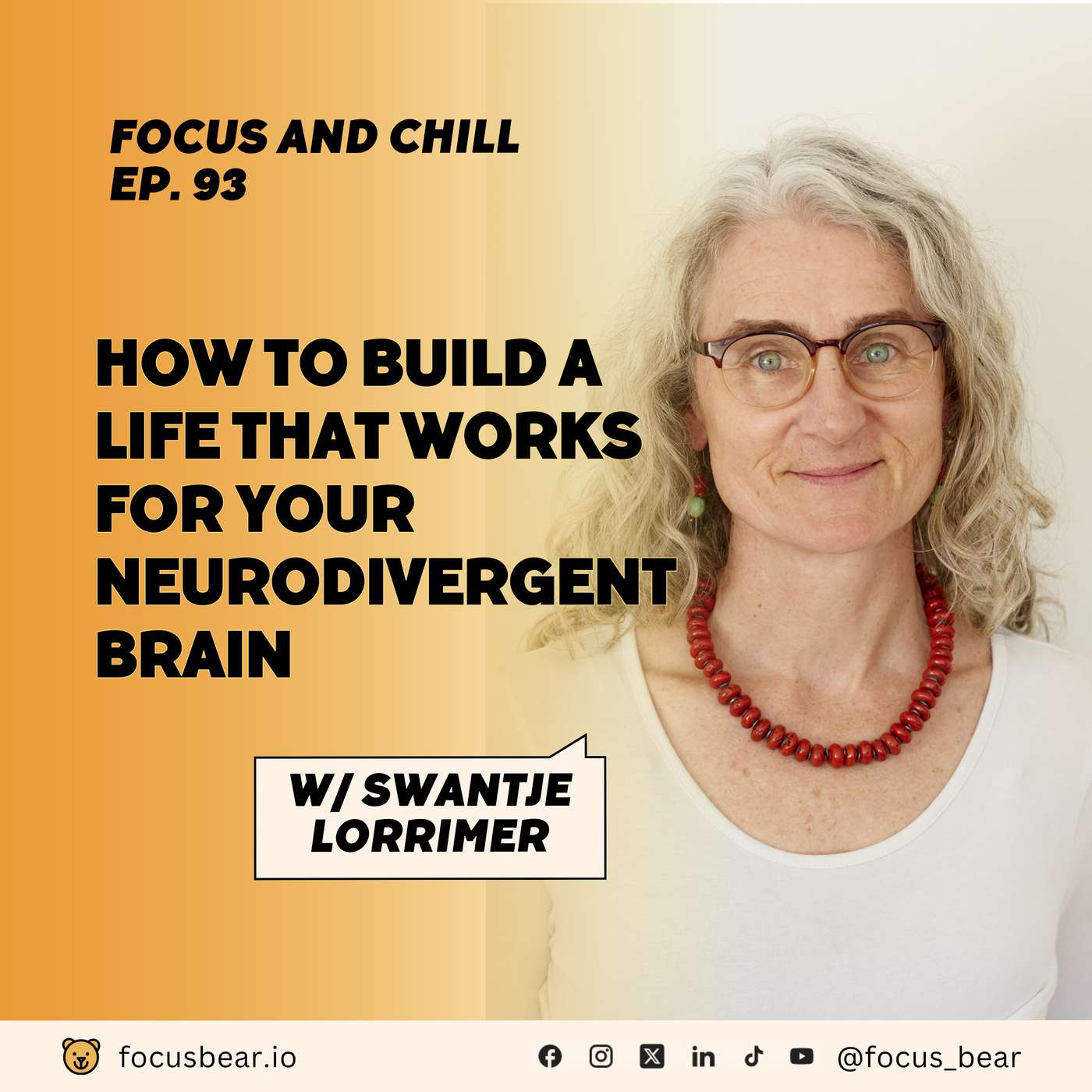
Ep 93Episode 93: Swantje Lorrimer
Welcome to episode #93! We’re thrilled to be joined by Swantje Lorrimer today.Swantje Lorrimer has built a career spanning multiple industries, including academic research, film productions (Star Wars, The Fall Guy), and ADHD coaching. After struggling to fit into traditional job structures, she embraced freelancing, creativity, and adventure as the key to thriving with ADHD.In this episode, we explore dopamine-seeking behavior, unconventional careers, ADHD-friendly productivity strategies, and why neurodivergent people often struggle with traditional routines.Welcome to the show, Swantje!QuestionsJN: When did you first realize you were neurodivergent?Realized later in life after seeking ADHD coaching for her childrenInitially dismissed the ADHD coach’s comments—until she recognized her own patternsDiagnosis made everything in her life make senseJN: What was it like growing up undiagnosed with ADHD?Left home at 16 to move to Finland with no prior knowledge of FinnishSought big, high-stimulation experiences—milking goats in a hippie commune, working in hospitals, etc.Always chased dopamine hits—leading to an adventurous but unpredictable careerJC: What was your career path before becoming an ADHD coach?Worked as a costume designer on major film productions like Star WarsFreelanced in theater, opera, and academic research in philosophyStruggled with structured, repetitive jobs, always seeking new challengesJN: How did getting diagnosed with ADHD change things for you?Stopped feeling like a failure—realized her brain just worked differentlyUnderstood that she needed flexibility, novelty, and control over her workLearned to embrace her ADHD instead of fighting against itJC: What led you to ADHD coaching?Saw her own children struggle with neurodivergence and wanted to support othersRealized her background in academia and creativity gave her a unique coaching perspectiveStudied ADHD coaching in New York and now runs Doing, Doing, DoneJN: What productivity strategies work for you?Avoids SMART goals—prefers a fluid, adaptable approach to projectsUses dopamine as a guide—choosing tasks that naturally engage her brainOutsources and delegates when possible instead of trying to do everything aloneJC: What productivity strategies DON’T work for you?Strict routines & time-blocking—every day is different, so flexibility is keyRigid linear task completion—she works best by jumping between ideasOvercommitting to projects without energy management—learned to say no strategicallyJN: What does your morning routine look like?No fixed routine—every day is differentLoves starting the day with deep focus work when possibleGoes to the gym when energy allows, without rigid expectationsJN: How do you wind down at night?Drinks hot cocoa and reads a book before bedEngages in creative activities like bookbinding and illustrationPrioritizes listening to her energy levels rather than forcing structureJN: Where can people connect with you?Website: https://www.doingdoingdone.com.au/LinkedIn: https://www.linkedin.com/in/swantje-lorrimer-14172558/Facebook: https://www.facebook.com/profile.php?id=61567285666137JC: Final words for the audience?“Your brain isn’t broken—stop trying to make it fit neurotypical standards.”“The world needs neurodivergent thinkers—find your own way to thrive.”More from Focus Bear:Website: https://focusbear.ioLinkedIn: https://www.linkedin.com/company/focus-bear/Youtube: https://www.youtube.com/@focusbearappTwitter: https://twitter.com/focusbear1Instagram: https://www.instagram.com/focus_bear/Facebook: https://www.facebook.com/focusbearapp/Podcast: https://podcast.focusbear.ioTiktok: https://www.tiktok.com/@focusbearConnect with Jeremy:LinkedIn: https://linkedin.com/in/nageljeremyEmail: [email protected] with Joey:LinkedIn: https://www.linkedin.com/in/joeycorea/Newsletter: https://thepluckyjester.com/newsletter/
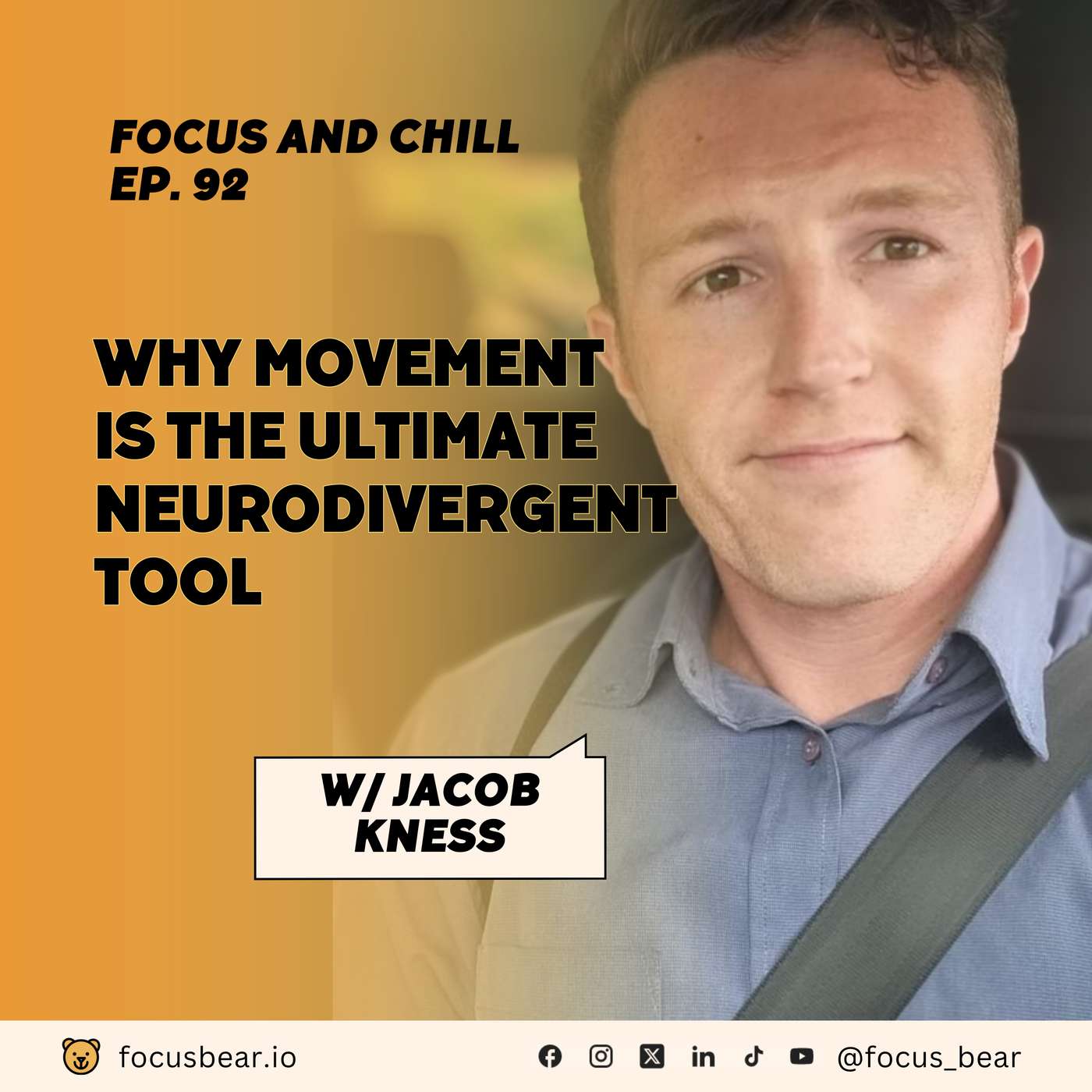
Ep 92Episode 92: Jacob Kness
Welcome to episode #92! We’re thrilled to be joined by Jacob Kness today.Jacob Kness is a social entrepreneur and neurodivergent advocate, helping autistic job seekers find meaningful work. Diagnosed with autism, ADHD, and Tourette’s, Jacob has spent years exploring fitness, biomechanics, and biohacking as tools for mental and physical well-being.In this episode, we dive into how exercise, cold shock therapy, and breathwork can help neurodivergent individuals build resilience, focus, and confidence.Welcome back to the show, Jacob!QuestionsJN: How has your approach to fitness evolved over time?Started with bodybuilding-style training, then shifted to functional movementExplored martial arts, breath control & biomechanics to improve movement patternsUses fitness as a daily practice for managing Tourette’s & ADHD symptomsJN: What role does exercise play in managing neurodivergent traits?Helps with mind-body connection & proprioceptionStrengthens fast-twitch muscle fibers for better motor controlActs as a tool for emotional regulation & energy managementJC: How did cold shock therapy become part of your routine?Discovered its benefits through Wim Hof breathing & resilience trainingHelps with stress regulation, focus & nervous system balanceUses cold showers & ice baths to reset after workoutsJN: What biomechanical challenges do neurodivergent individuals often face?Poor posture & joint alignment due to sensory processing differencesFoot placement, hip alignment & movement efficiency can impact trainingMany personal trainers overlook neurodivergence in exercise programmingJC: What advice would you give neurodivergent individuals starting their fitness journey?Listen to your body rather than following rigid workout plansFind movement styles that feel natural—martial arts, yoga, weightlifting, etc.Focus on form, breath, and body awareness before increasing intensityJN: How does fitness improve social confidence & resilience?Gyms provide structured social exposure without forced interactionBuilds discipline, self-trust & confidence in everyday lifeMartial arts, team sports & group training offer supportive communitiesJC: What productivity strategies work best for you?Uses exercise as an anchor to set the tone for the dayBreaks tasks into physical & mental blocks to maintain focusUses breathwork & cold exposure for quick resets during high-energy tasksJN: What does your morning routine look like?Starts with movement (stretching, light training, or breathwork)Uses cold exposure as a mental reset before workEats high-protein meals to fuel brain functionJN: How do you wind down at night?Rolls out muscles & stretches to relax the nervous systemAvoids high-stimulation activities before bedJournals & reflects on the day's progressJN: Where can people connect with you?LinkedIn: https://www.linkedin.com/in/jacob-alan-kness/Email: [email protected]’s Victoria Website: https://aspergersvic.org.au/employmentDoughnuts Business: Visit at Acuna Park MarketJC: Final words for the audience?“Find what movement works for you—fitness isn’t one-size-fits-all.”“The body and mind are deeply connected—train both to thrive.”More from Focus Bear:Website: https://focusbear.ioLinkedIn: https://www.linkedin.com/company/focus-bear/Youtube: https://www.youtube.com/@focusbearappTwitter: https://twitter.com/focusbear1Instagram: https://www.instagram.com/focus_bear/Facebook: https://www.facebook.com/focusbearapp/Podcast: https://podcast.focusbear.ioTiktok: https://www.tiktok.com/@focusbearConnect with Jeremy:LinkedIn: https://linkedin.com/in/nageljeremyEmail: [email protected] with Joey:LinkedIn: https://www.linkedin.com/in/joeycorea/Newsletter: https://thepluckyjester.com/newsletter/
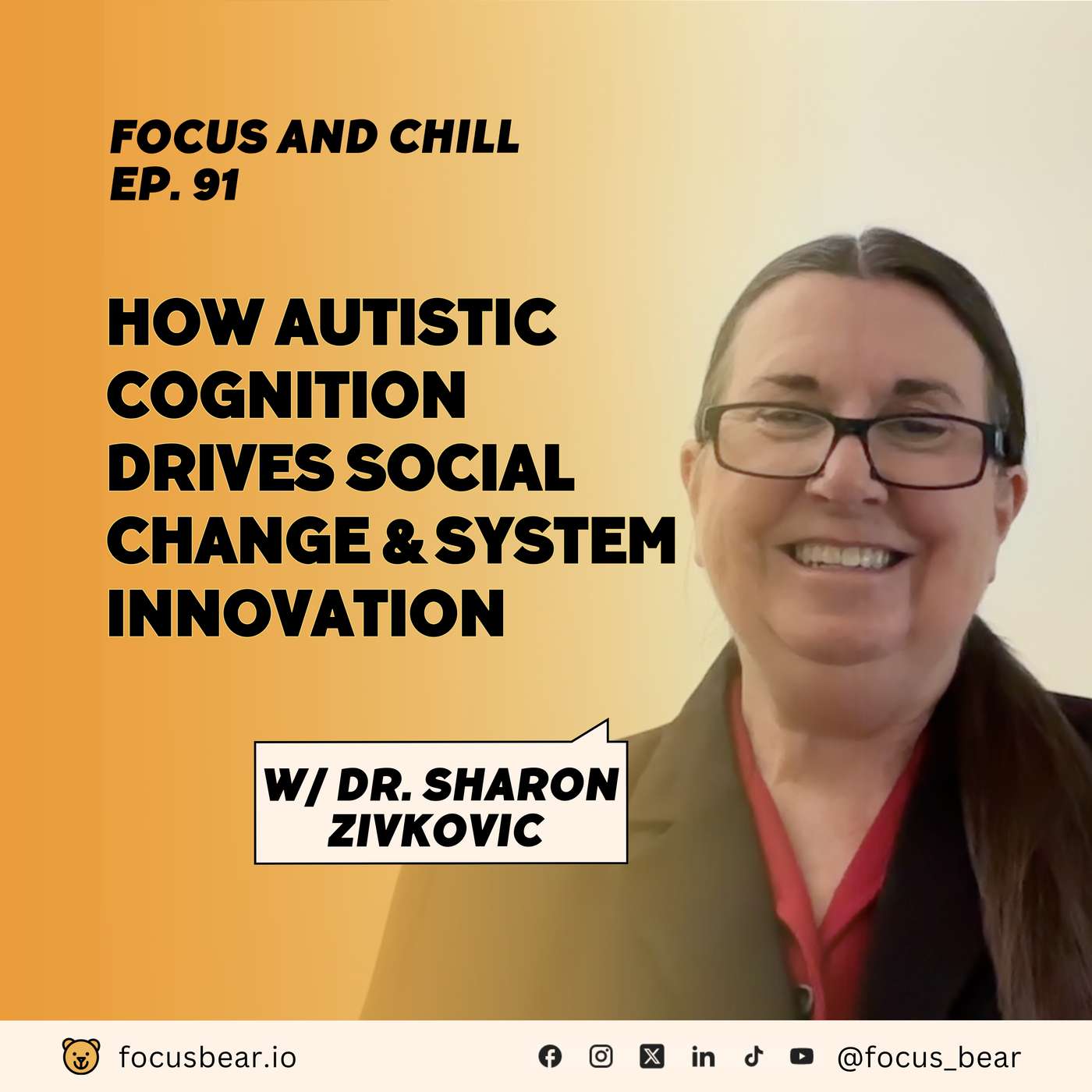
Ep 91Episode 91: Dr. Sharon Zivkovic
Welcome to episode #91! We’re thrilled to be joined by Dr. Sharon Zivkovic today.Dr. Sharon Zivkovic is an autistic social entrepreneur, systems thinker, and complexity scientist. As the CEO of Community Capacity Builders, she has used autistic cognition and systemizing strengths to develop and commercialize innovative solutions for wicked problems.Sharon has been recognized with a Fresh Scientist Award and her work is featured on the Complexity Sciences Map for Applied Complexity. Most recently, she founded the Centre for Autistic Social Entrepreneurship, which aims to create a neurodiversity-affirming entrepreneurial ecosystem.In this episode, we discuss how autistic cognition can be a superpower in systems thinking, innovation, and entrepreneurship.Welcome to the show, Sharon!QuestionsJN: When did you first realize you were neurodivergent?Knew she was different as a child but autism wasn’t associated with girls at the timeStruggled in school due to difficulty processing informationWas eventually signed out of school at 14 and spent 16 years on welfareJN: What led you back to education later in life?Wanted to be financially independent when her daughter turned 16Went back to high school as the only mature-age student, then pursued university degreesDeveloped self-learning strategies, including recording lectures and transcribing them at homeJN: What was your career path before entrepreneurship?Worked in accounting and economic development, but struggled with traditional employmentWas successful in jobs but found she was “uncontrollable” as an employeeEventually started Community Capacity Builders to work on her own termsJC: What inspired you to become a social entrepreneur?Developed social innovation programs focused on community capacity buildingWon the Enterprising Woman of the Year Award for her work in social enterpriseStarted seeing autistic cognition as an advantage in problem-solving and system innovationJC: What is a "wicked problem" and how does complexity science help solve them?Wicked problems are complex issues like climate change & poverty with no simple solutionsComplexity science helps map out the interconnected causes and effectsUses system transitions and structured problem-solving to drive changeJN: How did receiving an autism diagnosis at 61 impact you?Helped her understand why traditional employment never workedRealized she had built the perfect life for an autistic person—self-employed, off-grid, full control over workFrustrated by the deficit-based approach of disability servicesJN: What challenges do autistic entrepreneurs face?Rigid business structures don’t work for many autistic thinkersStruggle with delegation, executive function, and bureaucracyNeed support systems tailored to their cognitive strengthsJC: What productivity strategies work best for you?Works in long focus blocks, starting immediately after waking upMonotropic focus—prefers to work on one major project at a timeTakes structured movement breaks throughout the dayJC: What strategies do NOT work for you?Multitasking or switching between different projects—prefers to finish one before starting anotherTraditional productivity hacks designed for neurotypicalsRigid, unnecessary social obligations—prioritizes meaningful work over networkingJN: What does your morning routine look like?Straight to work after waking up—no coffee, no distractionsWorks for several hours before breakfastHighly structured and optimized for deep workJN: How do you wind down at night?Watches movies while doing physiotherapy exercisesBatch cooks meals to minimize time spent on daily food prepLoves her off-grid lifestyle and avoids unnecessary social interactionsJN: Where can people connect with you?LinkedIn: linkedin.com/in/dr-sharon-zivkovic-2587888Website: https://www.communitycapacity.com.au/JC: Final words for the audience?“Neurodiversity is a movement. We need to take control of our own narrative.”“Autistic cognition is an asset—let’s build systems that recognize and support it.”More from Focus Bear:Website: https://focusbear.ioLinkedIn: https://www.linkedin.com/company/focus-bear/Youtube: https://www.youtube.com/@focusbearappTwitter: https://twitter.com/focusbear1Instagram: https://www.instagram.com/focus_bear/Facebook: https://www.facebook.com/focusbearapp/Podcast: https://podcast.focusbear.ioTiktok: https://www.tiktok.com/@focusbearConnect with Jeremy:LinkedIn: https://linkedin.com/in/nageljeremyEmail: [email protected] with Joey:LinkedIn: https://www.linkedin.com/in/joeycorea/Newsletter: https://thepluckyjester.com/newsletter/
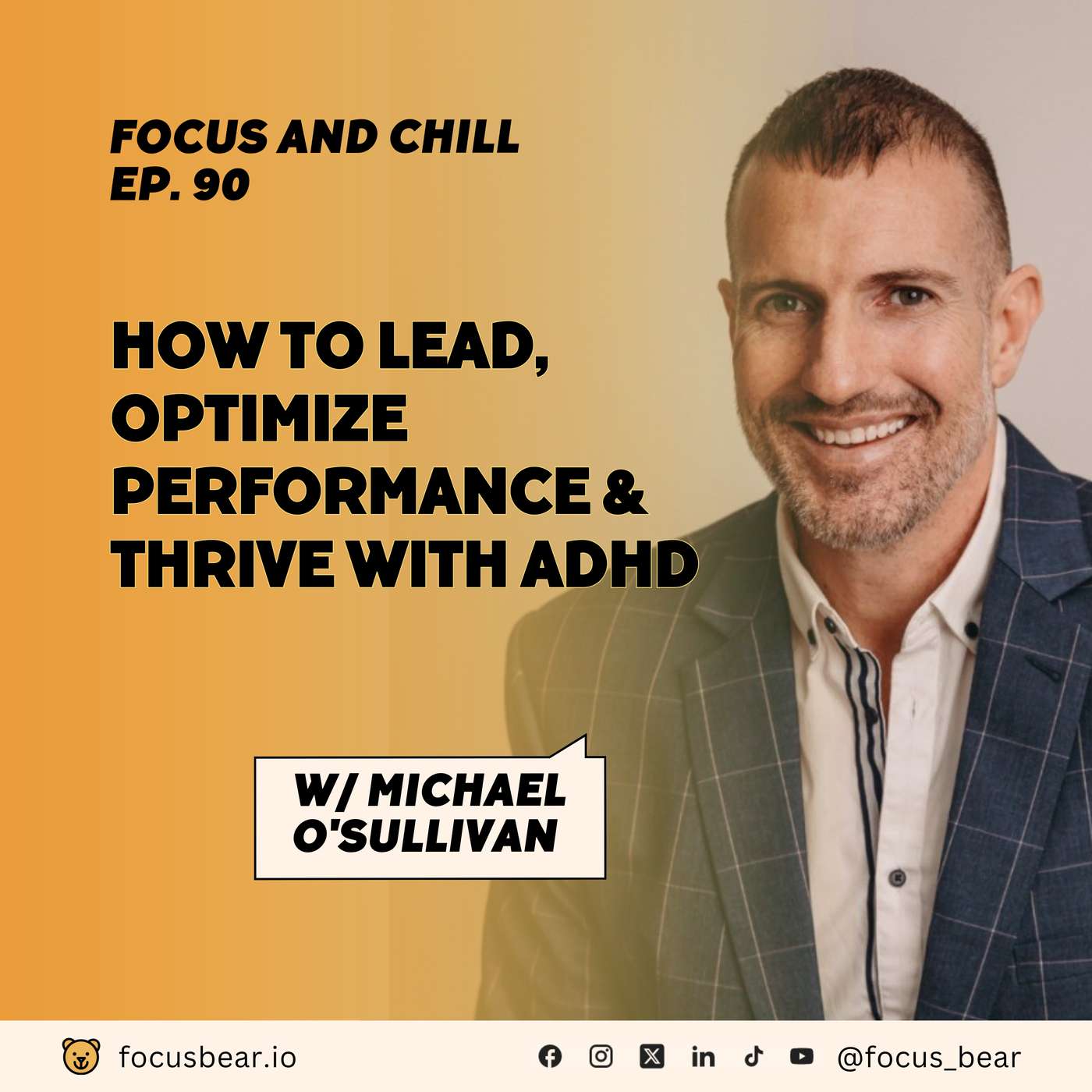
Ep 90Episode 90: Michael O’Sullivan
Welcome to episode #90! We’re thrilled to be joined by Michael O’Sullivan today.Michael O’Sullivan is a mind and body performance coach specializing in executive health, leadership, and peak performance. With over 25 years of experience in health and well-being, he helps CEOs, entrepreneurs, and professionals optimize their energy, focus, and productivity.As the founder of Body Beyond Limits and Elite Power Moves, Michael works with functional genomic testing, blood work, and high-performance strategies to create personalized health and leadership plans. Diagnosed with ADHD later in life, he has turned it into a superpower, designing science-backed methods to manage stress, master time, and maintain momentum.In this episode, we discuss ADHD, leadership, energy management, and how to structure your life for long-term success.Welcome to the show, Michael!QuestionsJN: When did you first realize you were neurodivergent?Always struggled with focus, impulsivity, and delegationFriends with ADHD pointed out he had all the traitsGot diagnosed at age 40 and turned ADHD into a strengthJN: How did ADHD affect your leadership style?Used to be a transactional leader, constantly checking on tasksTransitioned to transformational leadership using the 10-80-10 approachLearned to delegate, trust his team, and focus on high-impact workJN: What changes did you make in managing your business and team?Uses Loom videos, SOPs, and AI to streamline workGives his team more ownership and accountabilityFocuses on high-leverage tasks rather than micromanagingJC: What are some of your best productivity strategies for ADHD?Time-blocking energy levels – Grouping similar tasks togetherRecording Loom videos & delegating – Saves time on repetitive tasksUsing binaural beats & movement breaks – Boosts focus & creativityJC: What are some productivity strategies that DON’T work for you?Pomodoro technique – Finds longer deep-work sessions more effectiveStrict to-do lists – Prefers prioritizing tasks based on impact & energyForcing structure – Works better with flexible routines & flow statesJN: What does your morning routine look like?Wakes up at 3 AM – Starts the day with lemon water & breathworkGratitude journaling & movement – Sets the tone for peak performanceDeep work first – Tackles the most important tasks before distractionsJN: How do you wind down at night?Stops eating 2 hours before bed – Optimizes digestion & sleep qualityBlue light blockers & meditation – Reduces mental overstimulationAsks subconscious questions before sleep – Enhances problem-solving overnightJN: How does diet impact ADHD & performance?Avoids high-starch meals that spike insulin – Keeps blood sugar stableFocuses on high-protein, nutrient-dense meals for sustained energyUses scheduled meal reminders to avoid forgetting to eatJN: How do movement and recovery affect productivity?6 minutes of movement every hour boosts productivity by 60%Uses cryotherapy, hot yoga & gym sessions to regulate stressSchedules recovery days after high-energy work periodsJN: Where can people connect with you?LinkedIn: https://www.linkedin.com/in/elitepowermoves/Instagram: https://www.instagram.com/michaelosullivanexecutivecoach/Website: https://www.michaelosullivanfitness.com/official-pageJC: Final words for the audience?"Success isn’t about working harder—it’s about managing energy smarter.""Optimize your calendar, focus on high-impact work, and make recovery a priority."More from Focus Bear:Website: https://focusbear.ioLinkedIn: https://www.linkedin.com/company/focus-bear/Youtube: https://www.youtube.com/@focusbearappTwitter: https://twitter.com/focusbear1Instagram: https://www.instagram.com/focus_bear/Facebook: https://www.facebook.com/focusbearapp/Podcast: https://podcast.focusbear.ioTiktok: https://www.tiktok.com/@focusbearConnect with Jeremy:LinkedIn: https://linkedin.com/in/nageljeremyEmail: [email protected] with Joey:LinkedIn: https://www.linkedin.com/in/joeycorea/Newsletter: https://thepluckyjester.com/newsletter/
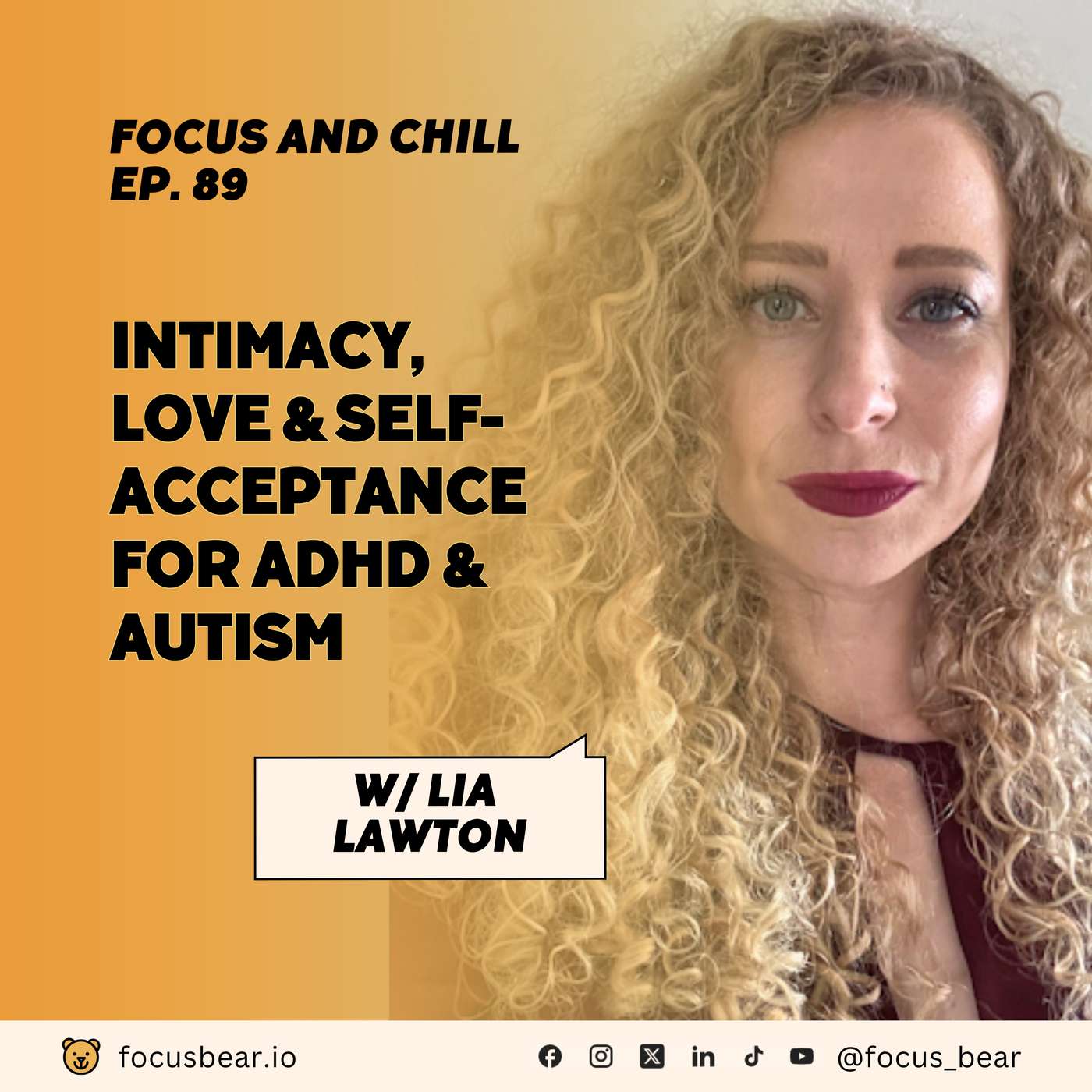
Ep 89Episode 89: Lia Lawton
Welcome to episode #89! We’re thrilled to be joined by Lia Lawton today.Lia Lawton is a neurodivergent psychologist and psychosexual therapist, passionate about helping clients explore intimacy, communication, and relationships in ways that are authentic to their unique neurotypes. She runs Fine Sanctuary, a private practice that provides therapy for ADHD, autism, and sexual health concerns.Diagnosed with ADHD in her late 20s, Lia understands firsthand the challenges of masking, late diagnosis, and navigating relationships as a neurodivergent adult. She is also working on developing neurodivergent-friendly tech tools to support better communication and connection.In this episode, we dive into how ADHD and autism affect relationships, intimacy, emotional regulation, and self-acceptance.Welcome to the show, Lia!QuestionsJN: When did you first realize you were neurodivergent?Late 20s—her dad was diagnosed first and encouraged her to get assessedHad struggled with dyscalculia (number dyslexia) in school but wasn’t identified as neurodivergentADHD traits were dismissed in school as “lazy” or “talking too much”JN: What was school like for you growing up?Thrived in primary school but struggled after transitioning to a larger, all-girls schoolWas misunderstood and labeled as lazy, leading to complete withdrawalA teacher once wrote in a report: "Lia handed in no work this year. Good luck for year 11."JN: What was your career path before psychology?Worked in event management, nightclubs, and the strip club industryLoved fast-paced, high-stimulation environments that suited her ADHD brainA bad therapy experience led her to return to university to study psychologyJC: How did getting diagnosed with ADHD change things for you?Medication was life-changing, but not a complete fixHelped level the playing field but still required additional strategiesFound alternative supports like binaural beats and heavy metal music for focusJC: How do ADHD and autism impact relationships and intimacy?Emotional regulation issues can cause communication breakdownsMasking in relationships leads to burnout and resentmentMany neurodivergent people struggle with sensory sensitivities & intimacy disconnectJC: What are some common intimacy struggles for neurodivergent clients?Porn addiction, anxiety around sex, erectile dysfunction, painful sex, and mismatched libidosRelationship challenges when one partner is neurodivergent and the other isn’tCommunication breakdowns due to different processing stylesJN: How do you help couples navigate neurodivergence in relationships?Explains the brain differences to both partners to build understandingHelps clients develop clearer communication strategiesEncourages acceptance of different intimacy needs rather than forcing a "norm"JN: What new projects are you working on?Exploring AI and app development to create neurodivergent-friendly communication toolsWriting a book on ADHD, sex, and relationships (currently in the idea-collection phase)JC: What productivity strategies work for you?Standing desk for movement while workingBinaural beats & heavy metal music to help with focusBreaking tasks into structured steps to avoid feeling overwhelmedJC: What productivity advice does NOT work for you?Journaling in pre-dated diaries—leads to guilt when she forgets to use it"Just remember to do it" strategies—doesn’t work for ADHD brainsOut of sight, out of mind—has to leave things visible to remember themJN: What does your morning routine look like?Not a morning person—needs time to wake up and resetStarts with a shower & reviewing client notes before first sessionUses movement & structured quiet time before diving into workJN: How do you wind down at night?Reads before bed to slow down thoughtsAvoids work-related conversations in the bedroomFinds her Golden Retriever comforting & part of her nightly routineJN: Where can people connect with you?Website: https://findsanctuary.com.au/Instagram: https://www.instagram.com/masterofsex_ology/JC: Final words for the audience?"Know your own brain. The more you understand it, the easier life becomes.""You’re already playing life on hard mode—find what makes things easier."More from Focus Bear:Website: https://focusbear.ioLinkedIn: https://www.linkedin.com/company/focus-bear/Youtube: https://www.youtube.com/@focusbearappTwitter: https://twitter.com/focusbear1Instagram: https://www.instagram.com/focus_bear/Facebook: https://www.facebook.com/focusbearapp/Podcast: https://podcast.focusbear.ioTiktok: https://www.tiktok.com/@focusbearConnect with Jeremy:LinkedIn: https://linkedin.com/in/nageljeremyEmail: [email protected] with Joey:LinkedIn: https://www.linkedin.com/in/joeycorea/Newsletter: https://thepluckyjester.com/newsletter/

Ep 88Episode 88: Ewa Nowińska
Welcome to episode #88! We’re thrilled to be joined by Ewa Nowińska today.Ewa Nowińska is a psychologist specializing in ADHD, trauma, and eating disorders, with a unique perspective shaped by her lived experience in a neurodivergent family. Originally from Poland, she has lived and worked across four different countries and now practices in Sydney.Ewa's work focuses on helping adults with ADHD navigate emotional regulation, trauma healing, and eating disorders, using evidence-based methods like EMDR therapy. She also provides therapy in Spanish and Polish, making her practice accessible to diverse communities.In this episode, we explore the link between ADHD and trauma, masking, self-acceptance, and how to build emotional resilience.Welcome to the show, Ewa!QuestionsJN: When did you first realize you were neurodivergent?Grew up in a neurodivergent family but didn’t recognize her own ADHDHyperactivity and impulsivity were seen as personality traits rather than ADHD signsBegan working with ADHD assessments and recognized traits in herselfJN: What was it like growing up with undiagnosed ADHD?Encouraged to be creative at home, but criticized for being too loud & direct outsideCultural expectations in Poland added to the challenge of maskingRealized her traits stood out even among other Polish peopleJN: How did your ADHD diagnosis change things for you?Provided relief and clarity about why certain challenges existedExperienced the grief of late diagnosis, wondering how life might have been differentFaced dismissiveness from colleagues who viewed ADHD through a trauma-only lensJN: What’s the connection between ADHD and eating disorders?ADHDers often struggle with impulsivity, emotional eating & interoception (body signals)Hyperfixation on food or lack of structure can lead to disordered eating patternsEMDR therapy is useful for addressing past experiences tied to body image and food habitsJC: What are some of the biggest challenges your ADHD clients face?Rejection Sensitivity & Childhood Messages – internalizing being "too much"Masking & Burnout – trying to appear neurotypical leads to exhaustionBalancing Structure & Flexibility – learning how to create systems that workJC: What strategies help with emotional regulation?Body-based regulation – exercise, movement, and grounding techniquesExternalizing thoughts – writing down intrusive thoughts before bedCreating safe environments – surrounding yourself with people who accept you without maskingJN: How does EMDR therapy help neurodivergent individuals?Helps process past experiences of rejection, shame & traumaReduces emotional distress tied to past experiences of being misunderstoodProvides a non-verbal approach to processing trauma, which is useful for alexithymic (emotionally disconnected) individualsJN: What does your morning routine look like?6 AM wake-up – Prepares kids' lunches before heading to the gymGym session – Exercises in the morning as a non-negotiable self-care habitStarts work after breakfast with a structured but flexible approachJN: How do you wind down at night?Aiming for a 9 PM bedtime – Reads or watches something light before sleepingUses meditation & writing down thoughts if her mind is racingReminds herself that perfection isn’t necessary before going to sleepJN: Where can people connect with you?Website: https://enpsych.com.au/Instagram: https://www.instagram.com/enpsych.com.au/Ebook & Resources: Available on her websiteJC: Final words for the audience?"You don’t need to fit into neurotypical expectations—find what works for you.""Healing is possible when you allow yourself to be seen and understood.”More from Focus Bear:Website: https://focusbear.ioLinkedIn: https://www.linkedin.com/company/focus-bear/Youtube: https://www.youtube.com/@focusbearappTwitter: https://twitter.com/focusbear1Instagram: https://www.instagram.com/focus_bear/Facebook: https://www.facebook.com/focusbearapp/Podcast: https://podcast.focusbear.ioTiktok: https://www.tiktok.com/@focusbearConnect with Jeremy:LinkedIn: https://linkedin.com/in/nageljeremyEmail: [email protected] with Joey:LinkedIn: https://www.linkedin.com/in/joeycorea/Newsletter: https://thepluckyjester.com/newsletter/
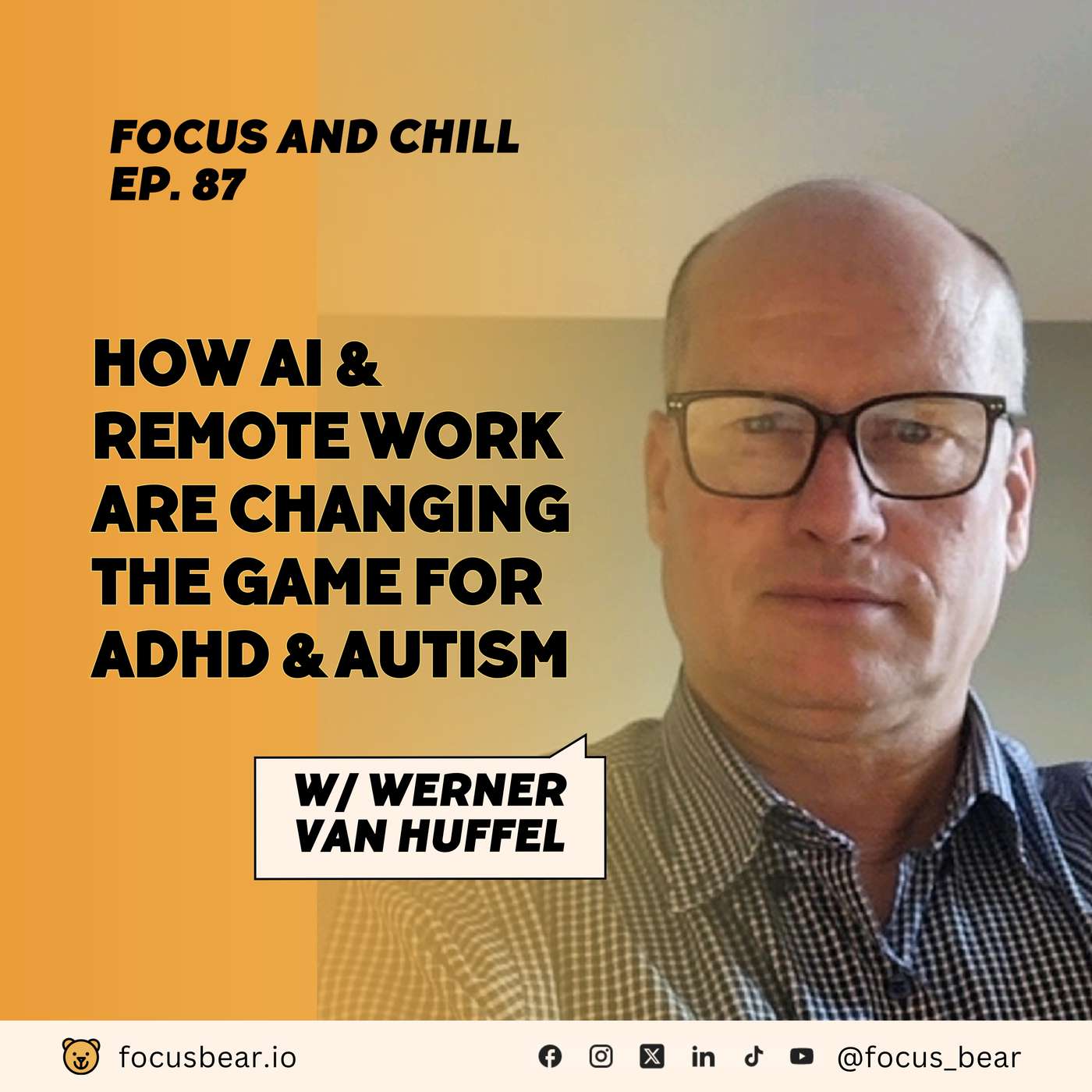
Ep 87Episode 87: Werner Van Huffel
Welcome to episode #87! We’re thrilled to be joined by Werner Van Huffel today.Werner Van Huffel is the co-founder of Kavn, a career support organization that helps neurodivergent professionals find meaningful remote work. With a background in enterprise architecture, AI, and business consulting, Werner has spent years advocating for career remoter professionals, ensuring they thrive in workspaces that align with their strengths.Diagnosed later in life, Werner discovered his neurodivergence through supporting his children. This realization led him to study psychology, homeschool his kids, and ultimately launch Kaven—a company that matches neurodivergent professionals with remote work environments that foster success.In this episode, we explore the intersection of neurodivergence, remote work, AI, and productivity.Welcome to the show, Werner!QuestionsJN: How did you first discover you were neurodivergent?Never thought of himself as different until seeing his children struggleStarted noticing similar traits in himself while homeschooling and studying psychologyRealized society has become less accepting of differences, which led to launching KavenJN: What inspired you to start Kaven?Started as a recruitment agency but quickly shifted focus to supporting neurodivergent professionalsNoticed a pattern: traditional career paths weren’t working for many neurodivergent peopleCoined the term “career remoter” to describe professionals who don’t follow linear career pathsJN: What is a "career remoter"?Someone who follows their own path rather than climbing a corporate ladderOften works independently, values flexibility, autonomy, and meaningful workMany neurodivergent professionals thrive in non-traditional career setupsJN: How does Kaven support remote professionals?Matches neurodivergent professionals with remote-friendly organizationsHelps businesses create truly inclusive remote work environmentsProvides psychological first aid & career coaching for professionals navigating career changesJN: What are the biggest advantages of remote work for neurodivergent individuals?Reduced social demands – Less energy spent on office politics and sensory overwhelmMore control over workspace – Can customize environment for focus and comfortFlexible schedules – Work when productivity is highest, not just 9 to 5JN: What are the challenges some neurodivergent professionals face with remote work?Some ADHD professionals struggle with lack of body doubling and external structureOthers miss spontaneous idea-sharing that happens in physical workspacesKaven helps find solutions tailored to individual needs, whether fully remote or hybridJC: How do you use AI as a productivity tool?Uses AI for speech-to-text to capture ideas faster than typingRuns AI-powered summarization tools to process large amounts of information quicklyBelieves AI is a game-changer for neurodivergent professionals who struggle with traditional workflowsJN: What productivity strategies work best for you?Focuses on outcomes rather than rigid to-do listsUses mind maps to organize thoughts and break down complex projectsRecords ideas verbally and transcribes them for structured reviewJN: What productivity advice doesn’t work for you?Strict time-blocking – Prefers a flexible workflow that allows for deep dives into tasks“Eat the frog” method – Finds it more effective to start with exciting tasks to build momentumTraditional task lists – Instead, prioritizes tasks based on impact & urgencyJN: What does your morning routine look like?Starts at 5 AM with a morning walk or exercise to get energy levels upPrepares mentally for the day by identifying key prioritiesWorks from home but visits client sites when needed for collaborationJN: How do you wind down at night?Gaming (Diablo, Project Zomboid, Elite Dangerous) helps transition from work to relaxationReads tech & psychology research to stay engaged with evolving ideasSometimes gets bursts of inspiration late at night and captures ideas before sleepingJN: Where can people connect with you?Website: https://www.kavn.au/Email: [email protected]: Final words for the audience?"Accept who you are. You’re not different—you’re you, and that’s enough.""Find the career setup that works for your brain, not the one society tells you to follow."More from Focus Bear:Website: https://focusbear.ioLinkedIn: https://www.linkedin.com/company/focus-bear/Youtube: https://www.youtube.com/@focusbearappTwitter: https://twitter.com/focusbear1Instagram: https://www.instagram.com/focus_bear/Facebook: https://www.facebook.com/focusbearapp/Podcast: https://podcast.focusbear.ioTiktok: https://www.tiktok.com/@focusbearConnect with Jeremy:LinkedIn: https://linkedin.com/in/nageljeremyEmail: [email protected] with Joey:LinkedIn: https://www.linkedin.com/in/joeycorea/Newsletter: https://thepluckyjester.com/newsletter/
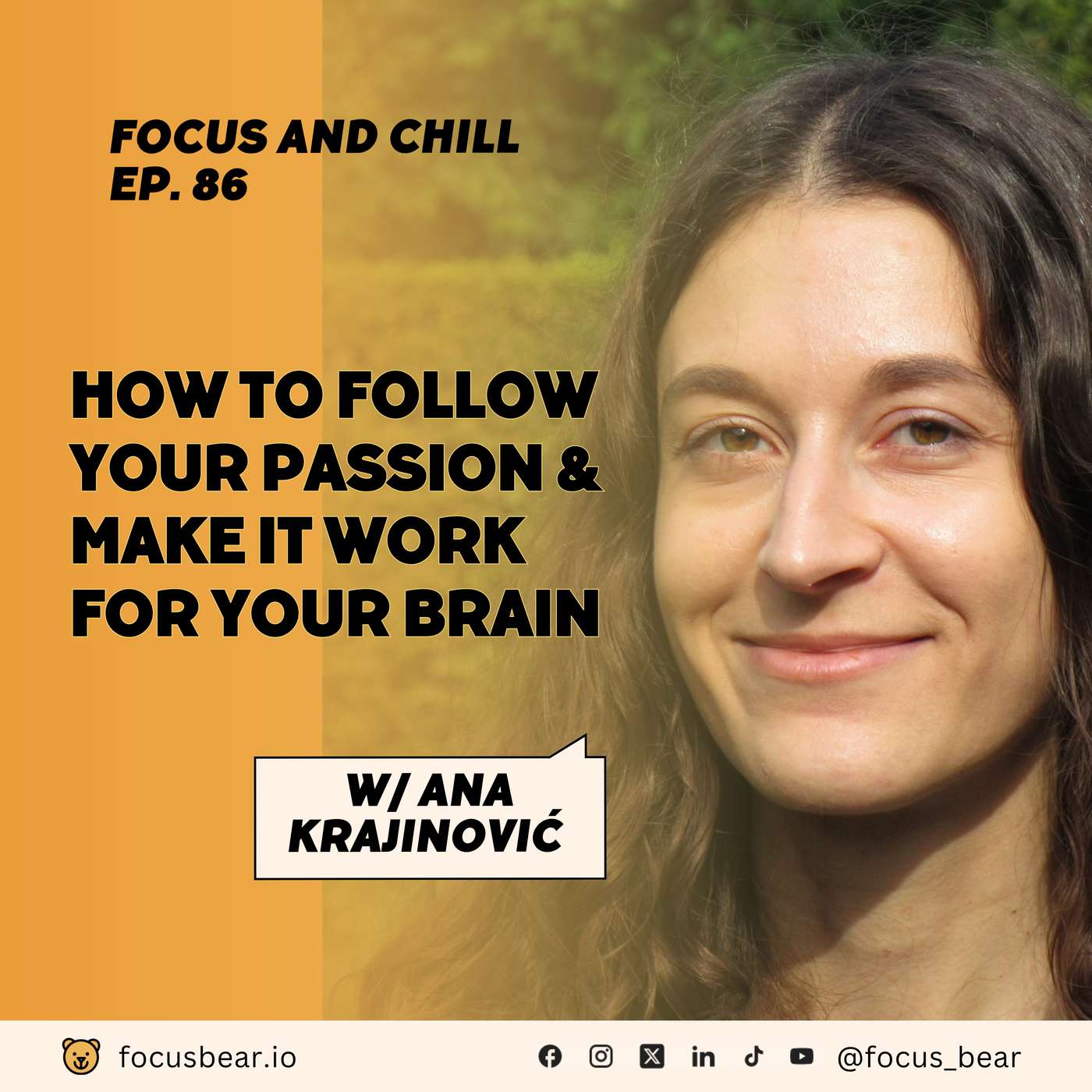
Ep 86Episode 86: Ana Krajinović
Welcome to episode #86! We’re thrilled to be joined by Ana Krajinović today.Ana Krajinović is a linguist, writer, and comic artist whose work explores the intersection of language, cognition, and visual storytelling. As an academic researcher at Tilburg University, she studies how comics use symbolic structures to convey meaning.Diagnosed with ADHD in adulthood, Ana has navigated challenges with task paralysis, executive dysfunction, and emotional regulation—but she’s also learned to harness her neurodivergence as a strength. Through her comics and writing, she shares insights on productivity, motivation, and embracing creative chaos.In this episode, we discuss ADHD, autism, creativity, productivity struggles, and how to work with your brain, not against it.Welcome to the show, Ana!QuestionsJN: When did you first realize you were neurodivergent?Started noticing ADHD traits about three years agoInitially misdiagnosed with depression and social anxietyDiscovered ADHD through HowToADHD YouTube videosDiagnosis process in Germany was smooth, but long-term care was challengingJN: What challenges did you face growing up with undiagnosed ADHD?Was an excellent student because school was a special interestSocial difficulties—never fully understood trends, popularity, or social normsStruggled with spatial awareness—difficulty with sports, movement, and even using appliancesNoticed task paralysis in adulthood when responsibilities increasedJN: How did your ADHD impact your PhD journey?Passion for linguistics kept her engaged, but executive function challenges made consistent work difficultStruggled with bureaucracy and non-research tasksMotivation fluctuated—hyperfocused on interesting topics but shut down on tedious tasksJN: How did you manage emotional regulation and overwhelm?Experienced meltdowns and shutdowns over small tasksLearned to recognize disproportionate emotional reactions to certain demandsFound self-acceptance through embracing chaos instead of forcing structureJC: What changed for you after receiving your ADHD diagnosis?Biggest shift was self-acceptance—realizing her brain works differently but isn’t "less"Stopped feeling guilty for needing more time on tasksMedication helped initially, but her biggest breakthrough came from Chasteberry supplementsFound a balance between structure and flexibility to optimize creativityJC: What are some productivity strategies that work for you?Start with tasks you enjoy to build momentumTrick yourself into hyperfocus by doing something exciting firstUse body doubling & external accountability to stay on trackFlexible scheduling—writes down tasks but doesn’t guilt-trip herself for postponing themJC: What productivity advice does NOT work for you?"Eat the frog" (doing the hardest task first)—kills motivation for the entire dayStrict time-blocking—leads to frustration when tasks take longer than expectedForcing inspiration—instead, she reads comics or listens to creators to spark ideasJN: How do you approach creativity and motivation?Embraces chaos—lets ideas flow rather than forcing a rigid scheduleUses deadlines as external motivators to push through creative blocksAllows herself to switch between projects instead of forcing consistencyJN: What does your morning routine look like?Slow start with breakfast & conversation—important for waking up mentallyGradual movement (yoga, stretching, light work) before diving into deep tasksAvoids immediate productivity pressure to prevent shutdownsJN: How do you wind down at night?Watches Netflix or does low-effort activities to relaxUses earplugs and a sleep mask to eliminate sensory disruptionsPrioritizes a quiet, distraction-free sleep environmentJN: Where can people connect with you?Website: annakrajinovic.comMedium: https://medium.com/@anakrajinovicSubstack: https://anakrajinovic.substack.com/Instagram: https://www.instagram.com/anacomics/JC: Final words for the audience?"Follow what excites you. If something doesn’t spark joy, explore a different path.""Don’t judge your productivity by neurotypical standards—find what works for your brain."More from Focus Bear:Website: https://focusbear.ioLinkedIn: https://www.linkedin.com/company/focus-bear/Youtube: https://www.youtube.com/@focusbearappTwitter: https://twitter.com/focusbear1Instagram: https://www.instagram.com/focus_bear/Facebook: https://www.facebook.com/focusbearapp/Podcast: https://podcast.focusbear.ioTiktok: https://www.tiktok.com/@focusbearConnect with Jeremy:LinkedIn: https://linkedin.com/in/nageljeremyEmail: [email protected] with Joey:LinkedIn: https://www.linkedin.com/in/joeycorea/Newsletter: https://thepluckyjester.com/newsletter/
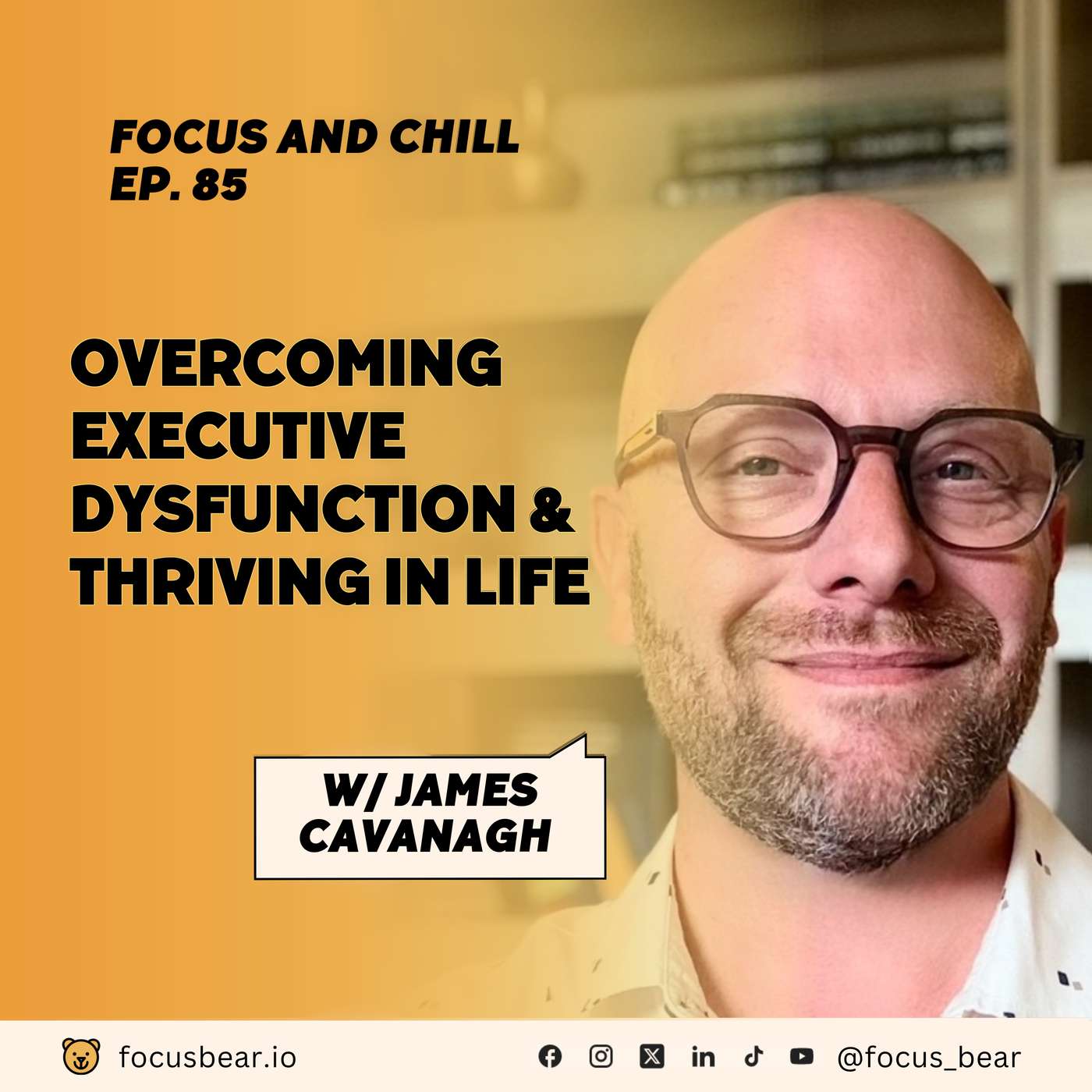
Ep 85Episode 85: James Cavanagh
Welcome to episode #85! We’re thrilled to be joined by James Cavanagh today.James Cavanagh is a neurodiversity consultant and the founder of Raw Life Health, a practice dedicated to helping neurodivergent individuals thrive. With over 25 years of experience in mental health, education, and disability support, James combines evidence-based therapy with lived experience to create neuroaffirming strategies.He is the creator of the Rawsome Framework, a strength-based approach to emotional regulation, productivity, and resilience. Passionate about transforming workplaces, healthcare, and education for neurodivergent individuals, James brings a holistic and person-centered approach to his work.In this episode, we discuss ADHD, emotional regulation, executive functioning, and how to create personalized routines that actually work.Welcome to the show, James!QuestionsJN: Can you share your journey with neurodivergence?Showed signs of ADHD in childhood but wasn’t diagnosed until later in lifeExperienced anxiety and misdiagnoses in the 90s before identifying as neurodivergentDiagnosis brought relief and a structured guide for self-understandingJN: What challenges did you face growing up with ADHD?Struggled with emotional regulation, leading to difficulties in social and work settingsFelt frustrated by the executive function demands of traditional education and workplacesRealized later in life that ADHD was impacting finances, relationships, and daily routinesJN: How has ADHD shaped your career path?Worked in various fields—education, mental health, disability support—before founding Raw Life HealthUsed his curiosity and adaptability as strengths rather than seeing them as failuresBuilt a strengths-based approach to help others find their personal work-life balanceJN: Can you explain the Rawsome Framework?A strengths-based system for resilience, emotional regulation, and productivityConsists of seven pillars: Relationships, Adaptability, Wellness, Sensory Processing, Organization, Mindfulness, and EmpowermentDesigned to help individuals create structured, flexible environments that work for their neurotypeJN: What are some key productivity strategies that work for ADHD?Uses the Mandatory, Mundane, Meaningful (3M) Method to structure daily tasksGamifies tasks to make boring activities more engagingUses stress as a currency—ensuring high-stress tasks provide meaningful outcomesJN: What are some common productivity tips that don’t work for you?"Just focus harder" – ADHD is not a lack of effort but a challenge of directing effortStrict time-blocking methods – prefers a flexible, adaptive approach insteadUnhelpful advice from neurotypicals – often dismisses the real struggles of executive dysfunctionJN: What does your morning routine look like?Wakes up gradually over 15 minutes to avoid shock to the systemStarts the day with a shower, coffee, and a 30-minute walk to clear his mindArrives at work an hour early to ease into the day without stressJN: How do you optimize sleep and wind down at night?Keeps phones out of the bedroom and uses an old-school alarm clockCreates a sensory-friendly environment to reduce overstimulationUses mental visualization techniques to prepare for sleepJN: Where can people connect with you?LinkedIn: https://www.linkedin.com/in/james-cavanagh-rawlife/Raw Life Health Website (Coming Soon): https://www.rawlifehealth.com/JN: Final words for the audience?"Keep things real—embrace who you are and work with your brain, not against it.""You deserve to take up space. Find the strategies that help you thrive."More from Focus Bear:Website: https://focusbear.ioLinkedIn: https://www.linkedin.com/company/focus-bear/Youtube: https://www.youtube.com/@focusbearappTwitter: https://twitter.com/focusbear1Instagram: https://www.instagram.com/focus_bear/Facebook: https://www.facebook.com/focusbearapp/Podcast: https://podcast.focusbear.ioTiktok: https://www.tiktok.com/@focusbearConnect with Jeremy:LinkedIn: https://linkedin.com/in/nageljeremyEmail: [email protected] with Joey:LinkedIn: https://www.linkedin.com/in/joeycorea/Newsletter: https://thepluckyjester.com/newsletter/
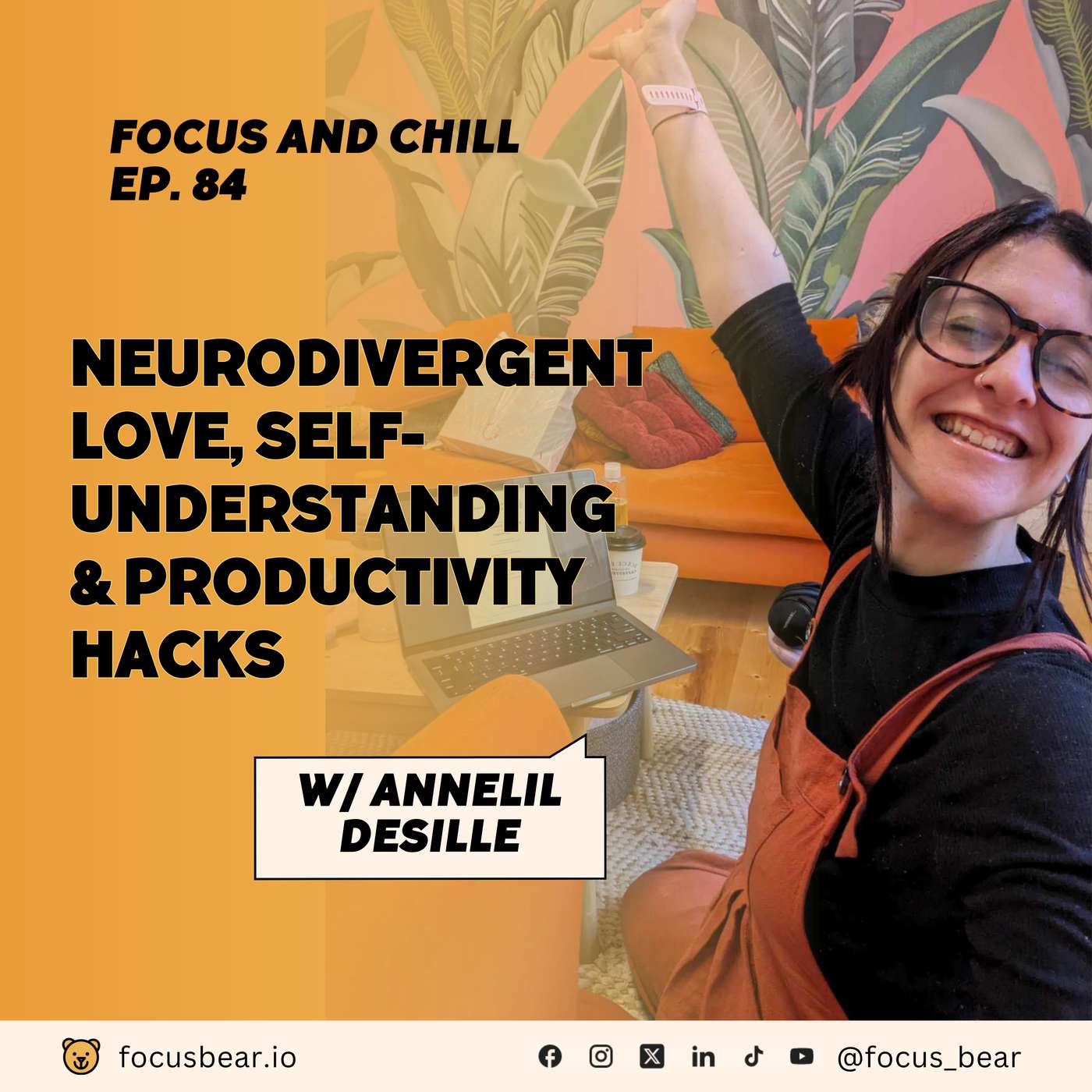
Ep 84Episode 84: Annelil Desille
Welcome to episode #84! We’re thrilled to be joined by Annelil Desille today.Annelil Desille is an ADHD-registered clinical psychologist who blends lived experience with evidence-based practice to support neurodivergent individuals. Her special interests include neurodivergence, the mind-body connection, sexual health, intimacy, attachment, and spirituality.Through her work, she helps neurodivergent individuals and couples navigate the unique challenges of relationships, task paralysis, self-acceptance, and personal growth. She also runs couples retreats focused on rebuilding intimacy and improving communication for neurodivergent partners.In this episode, we discuss ADHD, PDA (Pathological Demand Avoidance), neurodivergent relationships, and practical strategies for overcoming daily challenges.Welcome to the show, Annelil!QuestionsJN: When did you first realize you were neurodivergent?Identified with ADHD in 2018 during a binge-eating trial studyDiagnosed formally with autism in 2021 after a colleague recognized traits in herStruggled with self-doubt but eventually embraced her neurodivergenceJN: What were some of the biggest challenges you faced in school?Struggled with stats (had to take six years of it in her psych degree)Severe task initiation issues, leading to all-nighters and procrastinationExcelled in subjects she loved but found others nearly impossible to engage withJN: How did your diagnosis change your life?Medication was life-changing—marks jumped from 60s to 90sAllowed her to develop self-compassion for struggles she previously blamed herself forCreated affirmation decks to help herself and others embrace neurodivergenceJN: What challenges do you still experience now?Task paralysis due to PDA—struggles to start even things she enjoysUses the INCU acronym (Interest, Novelty, Competition, Urgency) to overcome task avoidanceFinds creativity and gamification essential for motivationJC: What are you currently working on?Couples Retreats – Helping neurodivergent couples rebuild intimacy and improve communicationTask Initiation App – Developing an app that provides customizable voice prompts to match energy levelsJC: What strategies work best for productivity?Water bottles & snack stations to avoid breaking hyperfocusBody doubling and external accountability to stay on trackGamification – Making boring tasks fun by turning them into challengesJC: What productivity strategies don’t work for you?Time blocking & Pomodoro method – Feels too rigid and disrupts deep focusStrict consistency – Prefers a continuity approach (changing up habits every two weeks to maintain novelty)JN: What does your morning routine look like?Low-spoon, medium-spoon, and high-spoon versions based on energy levelsJournaling, gratitude, and affirmations as key daily habitsPrefers buffer time before work (arrives an hour early for flexibility)JN: How do you manage sleep with ADHD?Struggles with sleep regulation and frequent vivid dreamsAntihistamines unexpectedly helped with sleep due to histamine-related sleep disturbancesWorks with her body’s natural rhythms rather than forcing early wake-upsJN: Where can people connect with you?Therapy Practice: https://www.neurokinnection.com.au/Retreats & Resources: https://www.nk-intimacy-alchemy.com.au/Instagram: https://www.instagram.com/neurokinnection/JC: Final words for the audience?"Figure out what you need before seeking external solutions.""You know yourself best—trust your instincts and adapt strategies to fit your brain."More from Focus Bear:Website: https://focusbear.ioLinkedIn: https://www.linkedin.com/company/focus-bear/Youtube: https://www.youtube.com/@focusbearappTwitter: https://twitter.com/focusbear1Instagram: https://www.instagram.com/focus_bear/Facebook: https://www.facebook.com/focusbearapp/Podcast: https://podcast.focusbear.ioTiktok: https://www.tiktok.com/@focusbearConnect with Jeremy:LinkedIn: https://linkedin.com/in/nageljeremyEmail: [email protected] with Joey:LinkedIn: https://www.linkedin.com/in/joeycorea/Newsletter: https://thepluckyjester.com/newsletter/
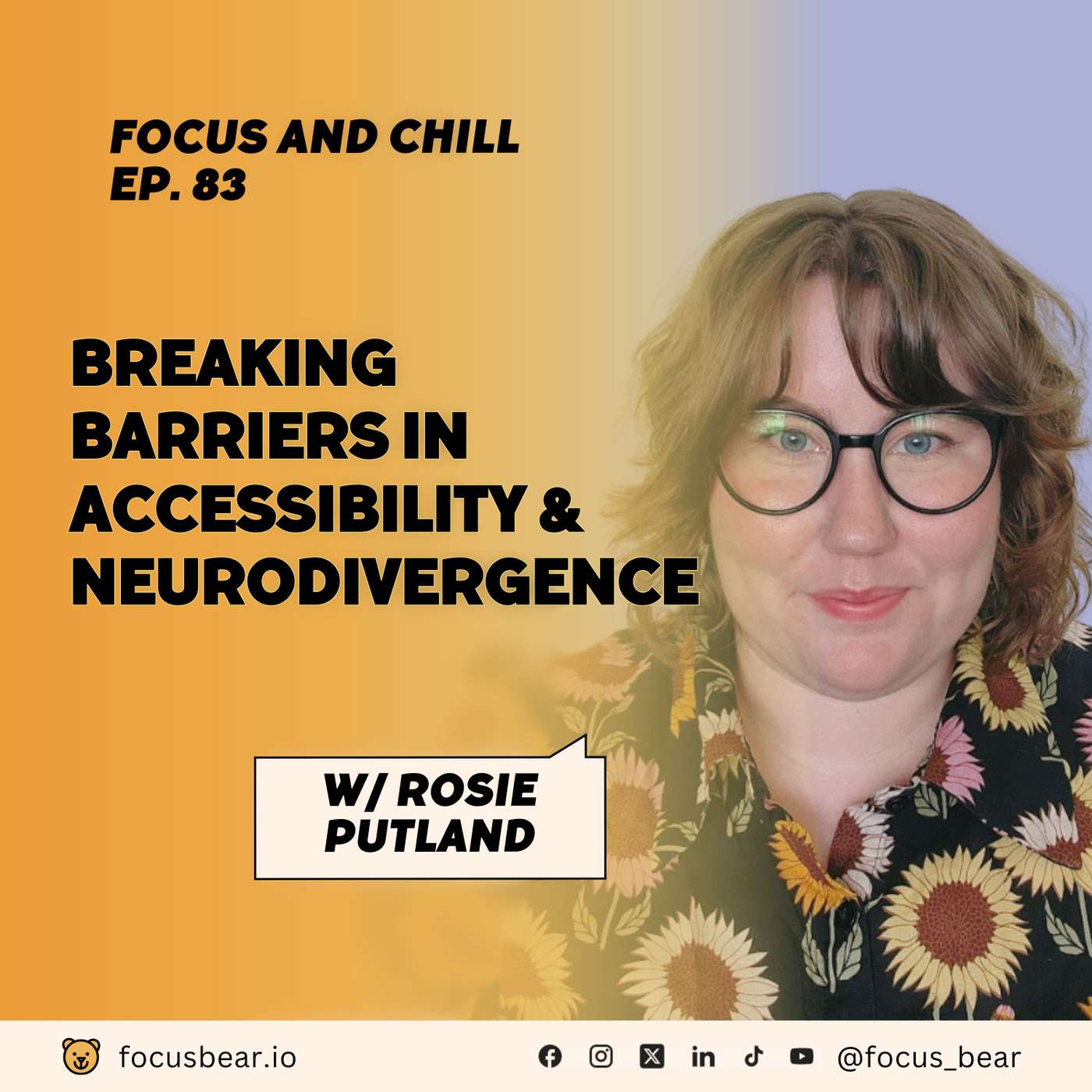
Ep 83Episode 83: Rosie Putland
Welcome to episode #83! We’re thrilled to be joined by Rosie Putland today.Rosie Putland is a proudly disabled and autistic public speaker, creative consultant, and co-founder of Modality Co, a digital accessibility consultancy focused on creating connection through accessibility. She is passionate about working with teams and leaders to develop sustainable, holistic digital accessibility practices.Rosie is known for her ability to create engaging presentations that change perspectives, her unwavering commitment to the accessibility and disability community, and her special interest in ducks.In this episode, we discuss Rosie’s journey of discovering she was autistic, her experience with autistic burnout, the importance of digital accessibility, and how organizations can create more inclusive online experiences.Welcome to the show, Rosie!QuestionsJN: When did you first realize you were neurodivergent?Always felt different growing up but attributed it to other factors (poverty, family violence, being queer)Noticed similarities with other neurodivergent people before having the language for itAt 16, found an online document on autistic traits and highlighted everything that appliedSelf-identified before formal diagnosis at 20 due to severe autistic burnoutJN: What was your experience with autistic burnout?Felt deep apathy toward everything, including special interestsStruggled with severe insomnia and inability to care for herselfHad difficulty navigating support systems like CentrelinkTook six to eight months to recover from burnout and start rebuildingJN: How did formal diagnosis change things for you?Brought relief and validation after years of feeling misunderstoodRequired recontextualizing her entire life through an autistic lensHelped her shift from internalized shame to self-acceptanceAllowed her to create accommodations that support her well-beingJN: What challenges do you still face today?Neurodivergence intersects with other health conditions (e.g., rheumatoid arthritis, cancer treatment)Lack of resources on navigating major health challenges as an autistic personDifficulty finding information or medical professionals who understand both autism and chronic illnessJN: How do you approach disclosure of neurodivergence?Faces discrimination whether she discloses or not, but prefers to control her own narrativeChooses to disclose because it helps others understand rather than make incorrect assumptionsAdvocates for meeting people where they are in their neurodivergence journeyJC: What strengths are you leaning into now in your work at Modality Co?Intuition & Pattern Recognition – Quickly identifies problems and potential risksStrong Sense of Justice – Drives her advocacy and push for meaningful changeAbility to Learn Quickly – Picks up new skills and adapts to different challenges, which helps in entrepreneurshipJC: Can you tell us about your work at Modality Co and the Tasmanian Digital Accessibility Community?Modality Co: Helps businesses create accessible digital products and servicesWorks with companies to meet Web Content Accessibility Guidelines (WCAG)Runs training and consulting programs to improve digital accessibilityTasmanian Digital Accessibility Community: Monthly meetups fostering the accessibility and disability communityJC: What do you enjoy doing in your free time?Loves spending time near reserves to watch ducks (but doesn’t have pet ducks yet!)Reads nonfiction and sci-fi, especially books by disabled authorsEnjoys knitting, sewing, gardening, and interior designJC: How do you optimize productivity during your working hours?Finds co-working/body doubling extremely effective for staying focusedUses Twitch co-working streams when working aloneUses five-minute timers to trick her brain into getting startedJC: What productivity advice doesn’t work for you?"Eat the frog" (doing the hardest task first) creates anxiety and resistanceShort work bursts & frequent breaks disrupt flow; prefers long focus sessionsJN: What does your morning routine look like?Prefers to be the first one awake for quiet timeEnjoys breakfast and coffee alone while listening to an audiobook or podcastStarts work before business hours to get deep work done without distractionsJN: How do you wind down at night?Follows a strict sleep routine to prevent insomniaHas mandatory low sensory hours from 8-10 PM for relaxationUses a Manta sleep mask with Bluetooth for audiobooks or meditationJN: Where can people connect with you?LinkedIn: https://www.linkedin.com/in/rosie-putland/Website: https://modalityco.com/Meetup: https://www.meetup.com/en-AU/tasmanian-accessibility-community/JC: Final words for the audience?"Meet people where they are in their neurodivergence journey.""Community is the most powerful tool you can have."More from Focus Bear:Website: https://focusbear.ioLinkedIn: https://www.linkedin.com/company/focus-bear/Youtube: https://www.youtube.com/@focusbearappTwitter: https://twitter.com/focusbear1Instagram: https
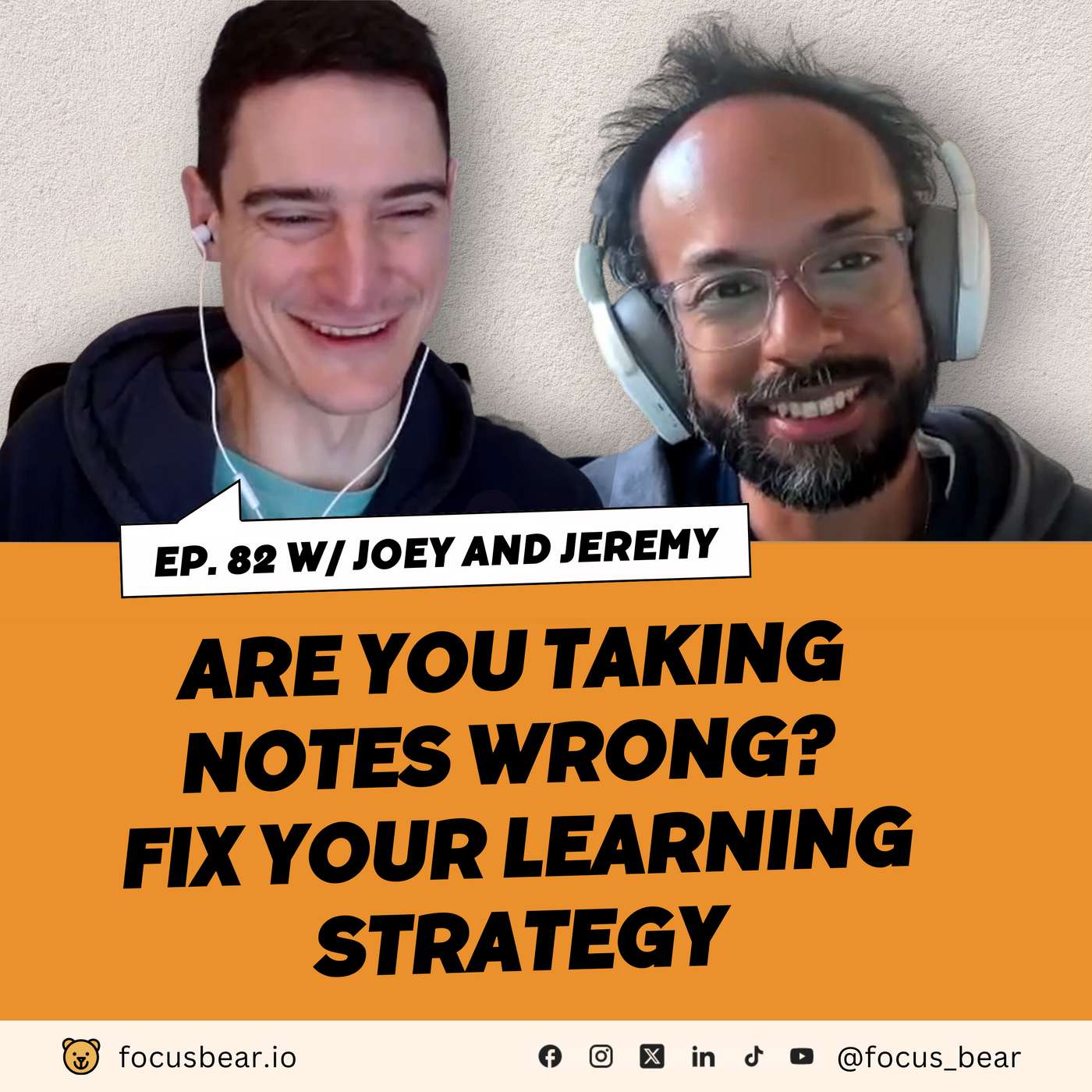
Ep 82Episode 82: Joey and Jeremy
Welcome to episode #82! Today, it’s just Joey and Jeremy discussing how to manage learning and memory.With so much information available, how do you decide what’s worth remembering? Joey and Jeremy dive into note-taking strategies, the balance between deep learning and quick recall, and whether it’s worth building personal knowledge systems when AI tools like ChatGPT exist.They explore different ways to process new information, from mind maps and Anki flashcards to slipboxes and structured review systems. Should you write everything down, or does the best knowledge naturally stick?Join them for a deep dive into learning, retention, and making information work for you.Topics Covered in This Episode:How to decide what’s worth rememberingThe pros and cons of note-takingAnki vs. slipbox: Which system works best?The role of AI in learning and memoryHow to balance structure with natural recallThe importance of interleaving different subjectsHow humor and personal connections improve memoryMore from Focus Bear:Website: https://focusbear.ioLinkedIn: https://www.linkedin.com/company/focus-bear/Youtube: https://www.youtube.com/@focusbearappTwitter: https://twitter.com/focusbear1Instagram: https://www.instagram.com/focus_bear/Facebook: https://www.facebook.com/focusbearapp/Podcast: https://podcast.focusbear.ioTiktok: https://www.tiktok.com/@focusbearConnect with Jeremy:LinkedIn: https://linkedin.com/in/nageljeremyEmail: [email protected] with Joey:LinkedIn: https://www.linkedin.com/in/joeycorea/Newsletter: https://thepluckyjester.com/newsletter/
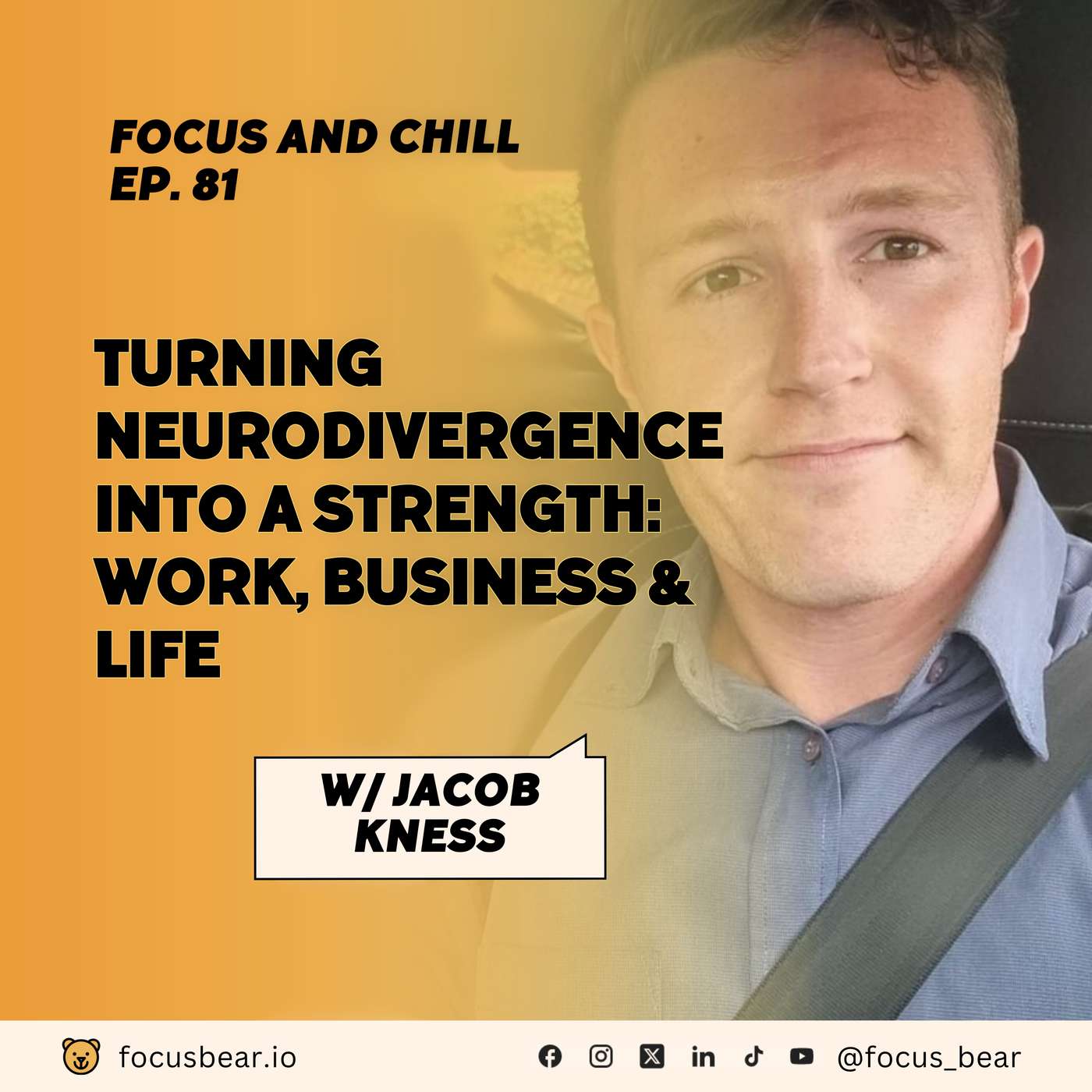
Ep 81Episode 81: Jacob Kness
Welcome to episode #81! We’re thrilled to be joined by Jacob Kness today.Jacob Kness is a social entrepreneur and project manager dedicated to improving autism employment opportunities. Diagnosed with autism, ADHD, and Tourette’s after experiencing a childhood stroke, Jacob has spent years navigating the intersection of neurodiversity and the workplace.Through his work at Asperger’s Victoria, he supports autistic job seekers by equipping them with skills, confidence, and opportunities for sustainable employment. In addition, his social enterprise Doughnuts provides hands-on employment experience, helping autistic individuals build real-world work skills.In this episode, we discuss autism and ADHD in the workplace, balancing structure with flexibility, and how to create sustainable career opportunities for neurodivergent professionals.Welcome to the show, Jacob!QuestionsJN: You were diagnosed quite early—what was that journey like?Had a stroke at five, which led to multiple diagnoses (autism, ADHD, epilepsy, Tourette’s)Struggled with acceptance, fought against diagnosis in early yearsLearned to reframe ADHD as a strength rather than a limitationJN: How did autism and ADHD impact your school experience?Faced behavioral challenges, moved through multiple schoolsADHD-driven impulsivity made structure difficult, but autism provided a counterbalanceA teacher with personal experience in neurodiversity made a huge impactJN: What led you to entrepreneurship?Left school at year 9, became a baker, then transitioned into social entrepreneurshipWanted to create the support system he wished he had growing upBuilt Doughnuts as a way to provide structured employment for autistic individualsJN: What do you do at Asperger’s Victoria?Manages employment support programs for autistic job seekersTeaches skills like resume writing, interview prep, and workplace adaptationWorks with major employers (e.g., ANZ Bank) to create neurodivergent-friendly hiring pipelinesJN: How do you balance structure and flexibility in work?Uses structured routines but allows flexibility for hyperfocus burstsAdapts productivity strategies depending on whether autism or ADHD traits are more dominant that dayBelieves in structured work environments but rejects the idea of rigid work-life balanceJN: How do you prevent burnout while managing multiple projects?Focuses on projects of significance—work that aligns with personal valuesUses exercise and self-discipline to maintain mental and physical resilienceFinds fulfillment in building businesses that create lasting changeJN: What productivity strategies work best for you?Uses CliftonStrengths to understand and lean into natural talentsLimits distractions and builds work environments that encourage focusSchedules gaming and downtime intentionally to avoid getting sucked into hyperfixationsJN: What does your morning routine look like?Wakes up early, goes to the gym (a non-negotiable part of his routine)Uses mornings for deep work or creative writing before distractions kick inPrioritizes movement and proactive tasks to start the day strongJN: How do you wind down at night?Limits entertainment time to two hours to avoid excessive screen timeUses deep breathing, journaling, and relaxation techniques when possibleFocuses on structured relaxation rather than mindless scrollingJN: Where can people connect with you?LinkedIn: https://www.linkedin.com/in/jacob-alan-kness/Email: [email protected]’s Victoria Website: https://aspergersvic.org.au/employmentDoughnuts Business: Visit at Acuna Park MarketJN: Final words for the audience?"Stop fighting change. Embrace discomfort and lean into self-acceptance.""Small steps lead to transformation. My first step was the gym—it changed everything."More from Focus Bear:Website: https://focusbear.ioLinkedIn: https://www.linkedin.com/company/focus-bear/Youtube: https://www.youtube.com/@focusbearappTwitter: https://twitter.com/focusbear1Instagram: https://www.instagram.com/focus_bear/Facebook: https://www.facebook.com/focusbearapp/Podcast: https://podcast.focusbear.ioTiktok: https://www.tiktok.com/@focusbearConnect with Jeremy:LinkedIn: https://linkedin.com/in/nageljeremyEmail: [email protected] with Joey:LinkedIn: https://www.linkedin.com/in/joeycorea/Newsletter: https://thepluckyjester.com/newsletter/
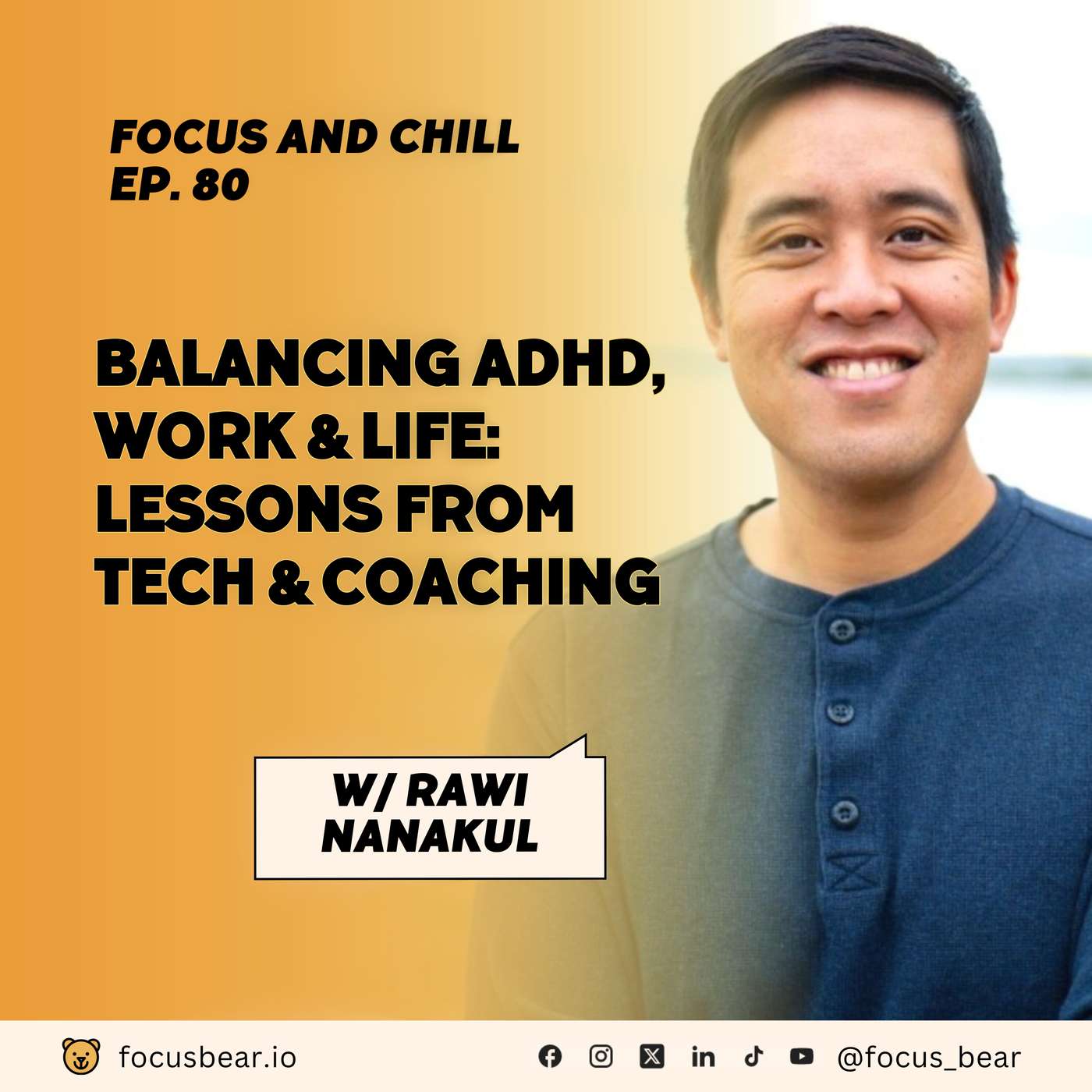
Ep 80Episode 80: Rawi Nanakul
Welcome to episode #80! We’re thrilled to be joined by Rawi Nanakul today.Rawi Nanakul is the founder of Tech Atypically, a newsletter and coaching service dedicated to helping neurodivergent professionals in the tech industry. With a background in ADHD research, product management, and kickboxing, Rawi’s career spans multiple industries, reflecting his deep curiosity and adaptability.Diagnosed with ADHD as an adult, Rawi has navigated the challenges of career shifts, emotional regulation, and balancing multiple roles. He now helps tech professionals thrive by integrating ADHD-friendly strategies into their work and personal lives.In this episode, we discuss ADHD in relationships, workplace challenges, emotional regulation, and how to build a sustainable career while embracing neurodivergence.Welcome to the show, Rawi!QuestionsJN: When did you first realize you were neurodivergent?Discovered ADHD during marriage therapy—therapist noticed common ADHD strugglesInitially skeptical due to his research background but sought an assessmentDiagnosis changed his perspective on past struggles and relationshipsJN: How did ADHD impact your personal relationships?Struggled with forgetfulness and follow-through, leading to resentment in his marriageBiggest improvement came from learning to communicate emotions and needsRecognized the fear of being vulnerable and how it affected relationshipsJN: How did ADHD affect your career path?Quit things when they got hard, leading to feelings of shameHad at least nine different careers, constantly shifting interestsRealized that his curiosity and adaptability were strengths, not failuresJN: How did you reframe your career journey?Identified his core values: curiosity and inclusionRecognized that each career move was intentional and aligned with his valuesShifted perspective from “falling behind” to “climbing multiple mountains”JN: What are the three career paths you're currently balancing?Tech Industry: Works as a project manager in a large fintech company, specializing in operationsADHD Coaching: Helps neurodivergent professionals succeed at work and in lifeWhiskey Business: Co-founder of Common Ritual, a whiskey company supporting underrepresented distilleriesJN: How do you manage emotional regulation in high-stakes work environments?Recognizes that emotional regulation is key to focus and decision-makingUses self-awareness to understand why he reacts a certain wayFinds that naming emotions helps create distance and reduce impulsive responsesJN: What productivity strategies work best for you?Breaks work into structured sprints with clear prioritiesUses coaching techniques to make difficult tasks emotionally "cheaper"Implements meeting strategies to avoid burnout (e.g., scheduling buffer time)JN: What does your morning routine look like?Reads first thing in the morning to avoid screen distractionsGoes for a run, using the time to process thoughts and plan the dayUses daily affirmations to set a positive mindsetJN: How do you wind down at night?Follows a sleep strategy: no caffeine (10 hrs before), no alcohol (3 hrs before), no screens (1 hr before)Uses medication and a CPAP machine to improve sleep qualityAims to minimize screen time but admits it’s a work in progressJN: Where can people connect with you?Coaching website: https://www.techatypically.com/LinkedIn: https://www.linkedin.com/in/rawi-nanakul/Instagram: https://www.instagram.com/tech.atypically/Newsletter: https://adhdpm.substack.com/JN: Final words for the audience?ADHD is both a gift and a disability—both realities should be acknowledgedAvoid the “superpower” narrative that dismisses those who struggle moreEmbrace your strengths, but don’t ignore the challenges neurodivergence bringsMore from Focus Bear:Website: https://focusbear.ioLinkedIn: https://www.linkedin.com/company/focus-bear/Youtube: https://www.youtube.com/@focusbearappTwitter: https://twitter.com/focusbear1Instagram: https://www.instagram.com/focus_bear/Facebook: https://www.facebook.com/focusbearapp/Podcast: https://podcast.focusbear.ioTiktok: https://www.tiktok.com/@focusbearConnect with Jeremy:LinkedIn: https://linkedin.com/in/nageljeremyEmail: [email protected] with Joey:LinkedIn: https://www.linkedin.com/in/joeycorea/Newsletter: https://thepluckyjester.com/newsletter/
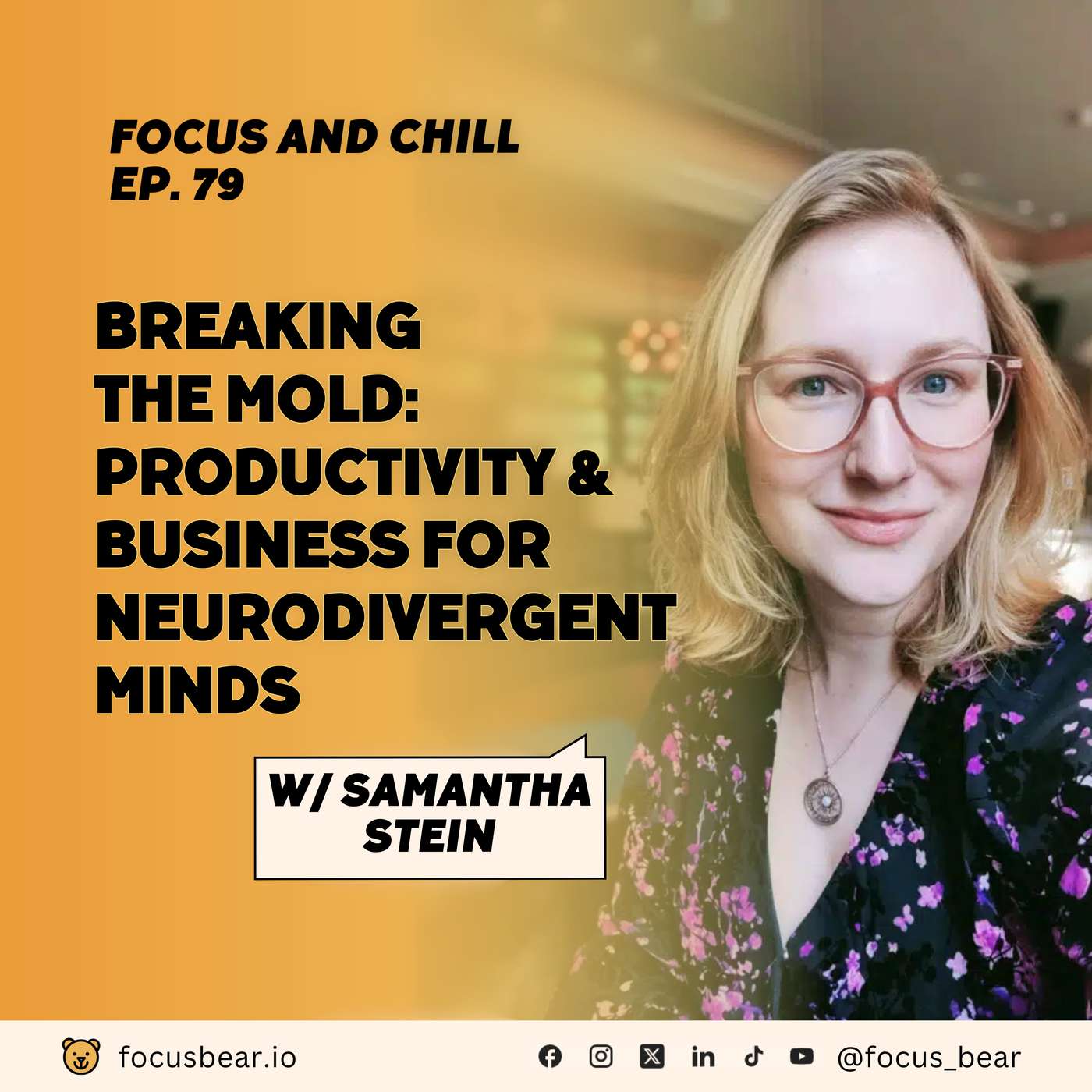
Ep 79Episode 79: Samantha Stein
Welcome to episode #79! We’re thrilled to be joined by Samantha Stein today.Samantha Stein, known online as YoSandySam, is a YouTube creator, author, and business strategist for neurodivergent entrepreneurs. Diagnosed with autism at 33 and ADHD shortly after, she began making YouTube videos to process her diagnosis and educate neurotypicals about what autism really looks like. Her content resonated widely, amassing over 14 million views.In addition to YouTube, Samantha is the author of So You Think You’re Autistic, a workbook that helps newly diagnosed individuals navigate their neurodivergence. She’s currently working on a new book about neurodivergence and trauma, set to release in 2026. She also works with neurodivergent business owners, helping them build sustainable strategies for success, and recently hosted the first-ever Wild Brains Retreat in the Netherlands.Today, she joins us to discuss her journey, content creation, business coaching, and productivity strategies for neurodivergent minds.Welcome to the show, Samantha!QuestionsJN: When did you first suspect you were neurodivergent?Always felt different but internalized it as a personal flawPsychology degree exposed her to outdated autism theories (e.g., “extreme male brain”), which didn’t fit her experienceStruggled with mental health throughout her 20s (depression, anxiety) but never linked it to autismPostpartum period triggered a breakdown in masking, making her realize something deeper was going onJN: What was your diagnosis process like?Struggled with imposter syndrome, worried she was “too good at masking” to be diagnosedWent to her assessment with a seven-page Google Doc listing symptomsDiagnostician confirmed autism easily, but the diagnosis felt anticlimactic—left wondering, “Now what?”JN: How did receiving an official diagnosis change things for you?Initially overwhelming, but led to self-acceptance over timeInspired her to start making YouTube videos as a way to process and educate othersHelped her understand her past struggles and navigate life more effectivelyJN: What are some of the biggest myths about autism that you address in your content?Stereotypes (e.g., only young boys like trains)Misconception that autism only presents in certain waysThe need for diverse representation in autism content, including cultural and racial perspectivesJN: What has been the impact of your YouTube channel?Over 14 million views and a growing neurodivergent communityLed to opportunities like publishing books and working with neurodivergent business ownersHelped push for more diverse and accurate representation of autism onlineJN: Can you tell us about your work with neurodivergent business owners?Helps them create sustainable business strategies that align with their neurodivergent strengthsFocuses on accountability, structure, and breaking tasks into manageable stepsAdvocates for working smarter, not harder—rejecting hustle culture in favor of efficiencyJN: What’s your approach to productivity as a neurodivergent person?Rejects the idea of “doing a little bit every day” in favor of deep work and hyperfocus sprintsUses external accountability and structured planning to stay on trackCreates work schedules that prevent burnout rather than chasing traditional productivity modelsJN: What does your morning routine look like?Survival mode—starts the day managing kids’ needsTries to fit in a workout or walk if possibleTidies up the house and prepares for the day aheadNo elaborate self-care rituals—just getting through the morning efficientlyJN: How do you wind down at night?Watches TV while using a second screen (phone)Occasionally plays piano with headphones as a calming activityPrioritizes sleep and avoids working in the evenings to maintain boundariesJN: Where can people connect with you?YouTube: YoSamdySamWebsite: yosamdysam.comPodcast: Awkward ConversationsInstagram: @YoSandySam Book: So You Think You’re Autistic (Available on Amazon)JN: Final words for the audience?Self-understanding and acceptance are the keys to sustainable successBe mindful of burnout and create work habits that actually fit your brainIt’s okay to need support—humans are meant to work together, not struggle aloneMore from Focus Bear:Website: https://focusbear.ioLinkedIn: https://www.linkedin.com/company/focus-bear/Youtube: https://www.youtube.com/@focusbearappTwitter: https://twitter.com/focusbear1Instagram: https://www.instagram.com/focus_bear/Facebook: https://www.facebook.com/focusbearapp/Podcast: https://podcast.focusbear.ioTiktok: https://www.tiktok.com/@focusbearConnect with Jeremy:LinkedIn: https://linkedin.com/in/nageljeremyEmail: [email protected] with Joey:LinkedIn: https://www.linkedin.com/in/joeycorea/Newsletter: https://thepluckyjester.com/newsletter/

Ep 78Episode 78: Elan Marko
Welcome to episode #78! We’re thrilled to be joined by Elan Marko today.Elan Marko is the founder of Deep Work Sprints, a coaching company dedicated to helping ADHD entrepreneurs accomplish their goals faster. His work focuses on overcoming procrastination, perfectionism, and stress by harnessing ADHD strengths to create more fun, flow, and financial success.After being diagnosed with ADHD during the pandemic, Elan dove deep into research and conducted studies on ADHD entrepreneurs to uncover what truly drives success. Now, he helps entrepreneurs stay consistent, remove distractions, and build the right environment to thrive.Welcome to the show, Elan!QuestionsJN: What was your journey to discovering your ADHD?Always suspected ADHD but never pursued a diagnosisDuring COVID, a business coach suggested getting testedRead an ADHD story online and immediately related to itDiagnosis explained past struggles but came with little guidanceJN: How did ADHD impact your education and early career?Struggled to focus on studying in university, couldn’t sit stillTried to get diagnosed in college but was discouraged by high costs and lack of treatment optionsRealized he needed structure and external accountability to thriveJN: How did your diagnosis change your approach to work?Went into hyperfocus mode, researching everything about ADHDNoticed that many of his coaching clients also had ADHDShifted his business to focus entirely on ADHD entrepreneursJN: Can you tell us about your ADHD entrepreneur studies?Interviewed 35 ADHD entrepreneurs, later expanded to multimillionaire ADHD entrepreneursFound that consistency—not talent—was the biggest predictor of successSuccessful entrepreneurs set up "bumper rails" to avoid distractions and failureMost entrepreneurs knew what they needed to do but struggled to follow throughJN: What were the biggest struggles ADHD entrepreneurs faced?Feeling like they weren’t meeting their full potentialLost revenue and opportunities due to unfinished projectsDifficulty maintaining business and personal relationshipsJN: What does Deep Work Sprints focus on?Helps ADHD entrepreneurs achieve their goals by creating structured, focused work sessionsUses body doubling and accountability to keep clients on trackFocuses on consistency and creating the right work environmentJN: What are some key productivity strategies that work for ADHD?Weekly "sprint" planning: setting three critical tasks each weekBreaking down tasks into ultra-clear stepsFinding unique ways to optimize performance (e.g., sales road trips)Creating the right environment by eliminating distractionsJN: Is consistency possible for ADHD brains?Daily consistency is difficult, but weekly consistency is achievableBuilding the right systems allows for sustainable performanceExercise, structured work environments, and clear goals make a big differenceJN: What does your morning routine look like?Starts the day with meditation using a visual timerRuns Deep Work Sprints with entrepreneurs in coworking sessionsBikes his daughter to school as part of his daily exerciseUses cold exposure (cold showers) to build resilienceJN: How do you wind down at night?Creates a plan for the next day before bedAvoids Netflix and social media to improve sleepListens to audiobooks at a slower speed to relax before sleepingJN: Where can people connect with you?Website: Deep Work SprintsInstagram: @adhdcoachelanJN: Final words for the audience?"Your neurodivergence is your superpower. Learn your strengths, minimize your weaknesses, and create an environment where you can thrive."More from Focus Bear:Website: https://focusbear.ioLinkedIn: https://www.linkedin.com/company/focus-bear/Youtube: https://www.youtube.com/@focusbearappTwitter: https://twitter.com/focusbear1Instagram: https://www.instagram.com/focus_bear/Facebook: https://www.facebook.com/focusbearapp/Podcast: https://podcast.focusbear.ioTiktok: https://www.tiktok.com/@focusbearConnect with Jeremy:LinkedIn: https://linkedin.com/in/nageljeremyEmail: [email protected] with Joey:LinkedIn: https://www.linkedin.com/in/joeycorea/Newsletter: https://thepluckyjester.com/newsletter/
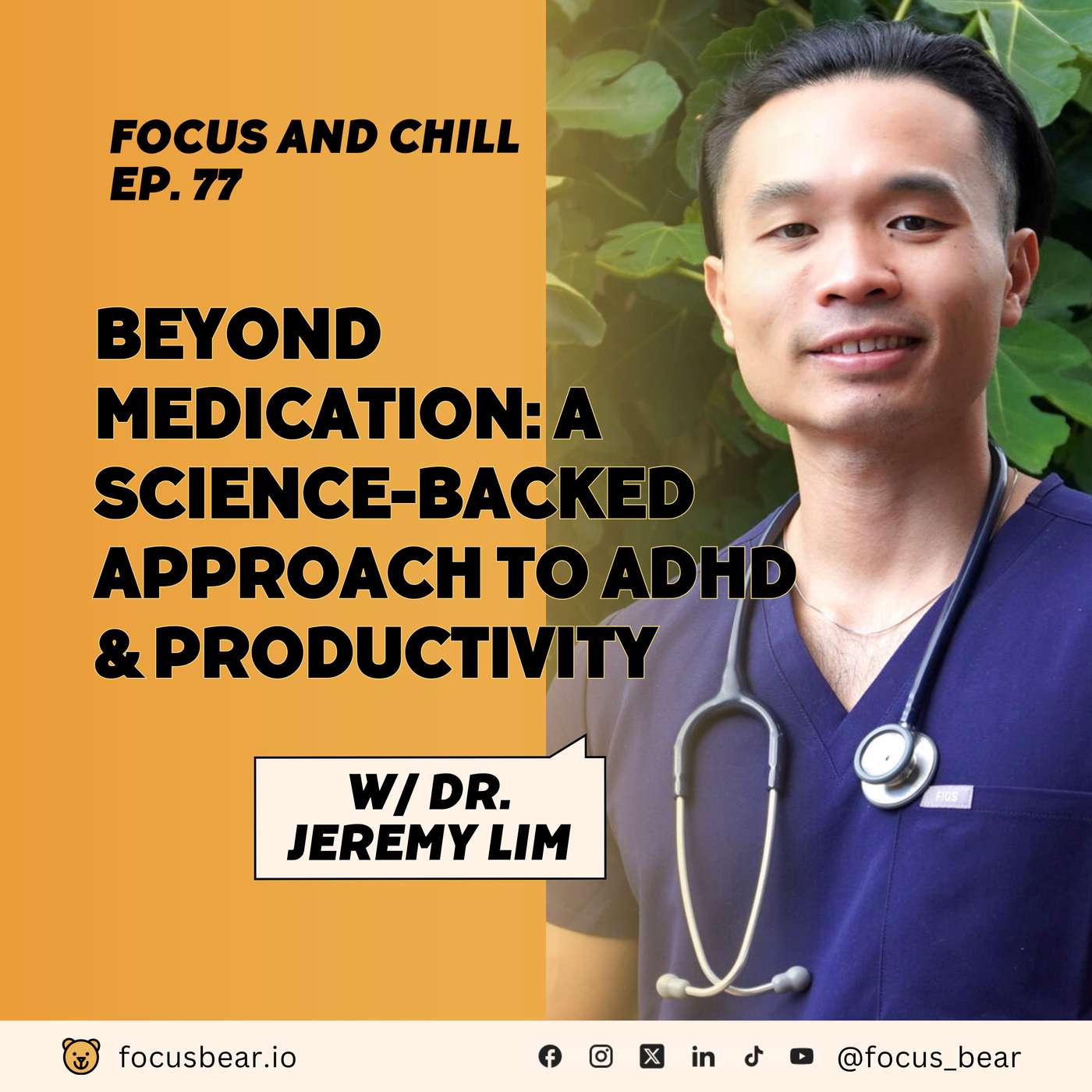
Ep 77Episode 77: Dr. Jeremy Lim
Welcome to episode #77! We’re thrilled to be joined by Dr. Jeremy Lim today.Dr. Jeremy Lim is a board-certified lifestyle medicine physician and experienced medical doctor. He runs Whole Being Medical, an online practice that takes a multifaceted approach to treating chronic pain and neurodivergence. With a deep understanding of ADHD, he is dedicated to harm reduction and empowering his patients with holistic strategies for well-being.In this episode, Dr. Lim shares his personal ADHD journey, insights into lifestyle medicine, and practical strategies for optimizing productivity, sleep, and mental health.Welcome to the show, Dr. Lim!QuestionsJN: When did you first realize you weren’t neurotypical?Labeled as disruptive from a young age in schoolParents didn’t have knowledge of ADHD, but father helped with learningDiagnosed with ADHD at 19 during university strugglesJN: How did your diagnosis impact your perspective?Provided clarity and understanding of personal strugglesTrialed stimulant medication for six months, had mixed experiencesInspired him to become a doctor to help others with ADHDJN: What was your experience with social interactions growing up?Faced social exclusion due to ADHD traits and rejection sensitivityNeurodivergence made relationship-building more difficultWants to help others feel seen and understoodJN: What strengths have you discovered through ADHD?ADHD traits, like thinking outside the box, can be strengths in the right environmentCompares ADHD to a sports car—powerful, but needs the right tools to function wellBelieves neurodivergence has contributed to human evolution and innovationJN: Can you tell us about your medical practice and approach?Runs Whole Being Medical, an online lifestyle medicine practiceUses a six-pillar approach: nutrition, sleep, exercise, relationships, stress management, and mindsetFocuses on holistic well-being rather than just medicationJN: How do you optimize productivity as someone with ADHD?Uses the "Eat That Frog" method—tackles the hardest task firstCreates a detailed outline of tasks to break down big projectsPrioritizes movement, hydration, and preparation in the morningJN: What productivity advice doesn’t work for you?Rejects hustle culture and constant comparison on social mediaBelieves in consistency over chasing hyperfocus highsEncourages realistic expectations and self-compassionJN: What does your morning routine look like?Keeps it simple to avoid resistanceFour key elements: hygiene, hydration, movement, and proteinPrepares warm clothes the night before to make waking up easierJN: How do you wind down at night and improve sleep?Follows the 3-2-1 rule: no big meals three hours before bed, no fluids two hours before bed, no screens one hour beforeAvoids caffeine, alcohol, and cannabis close to bedtimeUses magnesium supplements and mindfulness to aid relaxationJN: Where can people connect with you?Website: https://www.wholebeingmedical.com.au/JN: Final words for the audience?“Don’t get lost in the sauce. Just do the next right thing.”Focus on small, meaningful steps rather than feeling overwhelmedMore from Focus Bear:Website: https://focusbear.ioLinkedIn: https://www.linkedin.com/company/focus-bear/Youtube: https://www.youtube.com/@focusbearappTwitter: https://twitter.com/focusbear1Instagram: https://www.instagram.com/focus_bear/Facebook: https://www.facebook.com/focusbearapp/Podcast: https://podcast.focusbear.ioTiktok: https://www.tiktok.com/@focusbearConnect with Jeremy:LinkedIn: https://linkedin.com/in/nageljeremyEmail: [email protected] with Joey:LinkedIn: https://www.linkedin.com/in/joeycorea/Newsletter: https://thepluckyjester.com/newsletter/
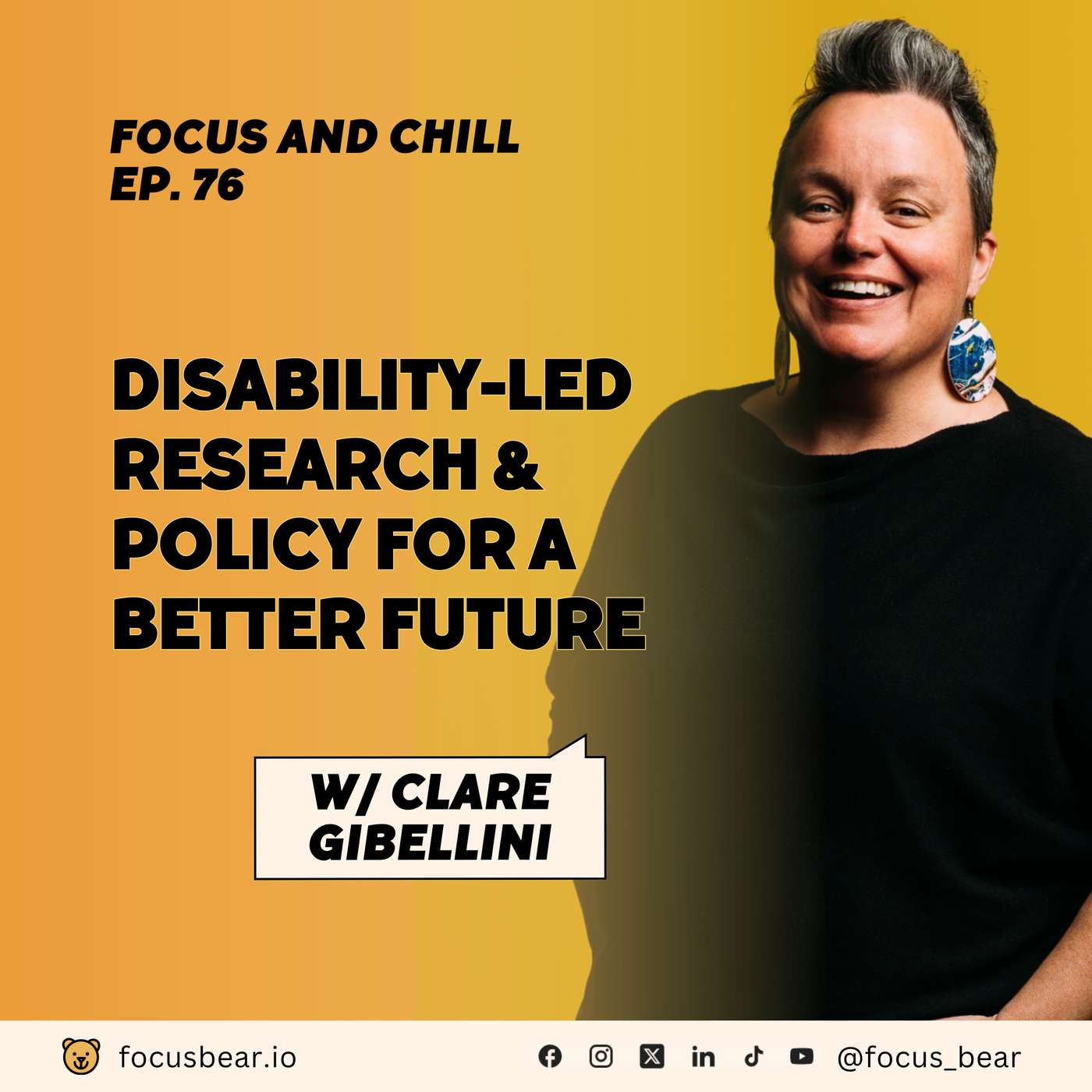
Ep 76Episode 76: Clare Gibellini
Welcome to episode #76! We’re thrilled to be joined by Clare Gibellini today.Clare Gibellini is a passionate advocate for disability inclusion in Australia and internationally. She is the co-chair of the Oversight Council for the First National Autism Strategy and the deputy chair of WA’s Ministerial Advisory Council on Disability. Clare also works as a policy officer for Women with Disabilities Australia and has been newly appointed as the chair for the National Disability Research Partnership.With a background in advocacy, research, and policy reform, Clare is committed to creating a more inclusive world. In this episode, she shares her journey of discovering her neurodivergence, the challenges of navigating multiple roles, and her strategies for balancing advocacy, productivity, and self-care.Welcome to the show, Clare!QuestionsJN: What was your journey to discovering your neurodivergence?Grew up as a military kid, constantly moving, which made it difficult to understand differencesRealized similarities with her son after his autism diagnosisReceived her own autism diagnosis from the same clinician who diagnosed her sonDiagnosis helped her understand herself, parent differently, and practice self-compassionJN: How did the diagnosis change your self-perception?Stopped internalizing negative self-talkDeveloped strategies to manage social situations and advocate for herselfShifted perspective from “something’s wrong with me” to “society isn’t built inclusively”JN: What are your current work roles?Policy officer at Women with Disabilities AustraliaCo-chair of the National Autism StrategyChair of the National Disability Research Partnership (NDRP)Advocates for more disability-led research and inclusive policy developmentJC: How do you manage multiple high-responsibility roles?ADHD helps her balance tasks by switching between projectsStrong support network keeps her accountable and reminds her to take breaksFinds fulfillment in advocacy work, which fuels her motivationJC: How do you prevent burnout in advocacy and policy work?Limits social media engagement to avoid negativity and toxicityHas hobbies unrelated to disability work, including volunteering for emergency servicesEngages in creative activities like crocheting, gardening, and bakingWorks out regularly to manage chronic pain and mental well-beingJN: What does your work in disability research aim to achieve?Advocates for disability-led, purpose-driven research to inform better policiesAims to include lived experience in research rather than extractive studiesPushes for research that improves real-life outcomes rather than abstract academiaJC: How do you optimize productivity during the day?Works from home to manage sensory needsUses a yoga ball chair for movement while workingSchedules movement breaks and weight training to stay regulatedUses live transcription instead of note-taking to stay fully engaged in meetingsJC: What productivity advice doesn’t work for you?Finds back-to-back meetings overwhelming and non-productiveRejects corporate jargon and vague email requests—prefers direct communicationPushes back against the expectation to have cameras on in every virtual meetingJN: What does your morning routine look like?Not a morning person, keeps routine simplePrepares everything the night before to reduce stressGets her son ready for school, grabs coffee, and starts work with a structured planRelies on checklists and habit-tracking apps to stay organizedJN: How do you manage sleep with ADHD and frequent travel?Struggles with sleep due to travel, ADHD, and hormonal cyclesCreates a familiar sleep environment by mimicking hotel room settings at homeUses earplugs and occasional sleep medication when necessaryJN: Where can people connect with you?LinkedIn: linkedin.com/in/clare-gibellini-653b98142JC: Final words for the audience?The disability advocacy space is tough right now, but don’t give upSurround yourself with good people and protect your energyKeep pushing for change—we will get thereMore from Focus Bear:Website: https://focusbear.ioLinkedIn: https://www.linkedin.com/company/focus-bear/Youtube: https://www.youtube.com/@focusbearappTwitter: https://twitter.com/focusbear1Instagram: https://www.instagram.com/focus_bear/Facebook: https://www.facebook.com/focusbearapp/Podcast: https://podcast.focusbear.ioTiktok: https://www.tiktok.com/@focusbearConnect with Jeremy:LinkedIn: https://linkedin.com/in/nageljeremyEmail: [email protected] with Joey:LinkedIn: https://www.linkedin.com/in/joeycorea/Newsletter: https://thepluckyjester.com/newsletter/

Ep 75Episode 75: Rebecca McCash
Welcome to episode #75! We’re thrilled to be joined by Rebecca McCash today.Rebecca McCash is the founder and CEO of FutureTech Australia, a neurodivergent-led social enterprise focused on inspiring the next generation of neurodivergent minds. FutureTech provides STEAM-based (Science, Technology, Engineering, Arts, and Math) social and learning opportunities designed and delivered by neurodivergent individuals.Rebecca is also an inclusion consultant for ASPEC’s Autism Friendly team, a member of Catalyst 2030, CECNA, and the Australian National Autism Strategy Economic Inclusion Working Group. With nearly a decade of experience in the disability sector, Rebecca is passionate about genuine co-design, neurodivergent well-being, and creating inclusive learning environments.Welcome to the show, Rebecca!QuestionsJN: When did you realize you weren’t neurotypical?Early exposure to neurodiversity through her younger brother’s autism and ADHD diagnosisStruggled with chronic depression, anxiety, and eating disorders before being diagnosed at 26Diagnosis provided a framework for understanding and supporting herselfJN: How has your diagnosis changed your life?Allowed for self-advocacy and better life choicesStopped forcing socialization and instead focused on deeper, meaningful relationshipsEmbraced special interests, especially learning and neurodivergence researchJN: What are your thoughts on the term "special interests"?Doesn’t mind it but acknowledges some prefer "obsessions" or "passions"Finds joy in deep-diving into interests like penguins, research, and STEAM topicsJN: How does your work align with your passions?FutureTech focuses on neurodivergent-led STEAM education and community capacity buildingAdvocates for shifting the focus from making autistic people fit into neurotypical expectations to celebrating neurodivergent strengthsJN: What is the neurodivergent well-being framework you’re working on?Traditional well-being metrics (e.g., academic achievement) don’t fully apply to neurodivergent peopleDeveloped an alternative model emphasizing curiosity, self-advocacy, and interest-driven learningAims to help educators, parents, and workplaces better support neurodivergent individualsJN: What productivity strategies work for you?Uses extensive safety nets like calendar blocking, structured environments, and automation tools (e.g., Calendly)Finds body doubling unhelpful but thrives with task chunking and completing work in one sittingOffloads cognitive tasks to external systems to avoid overwhelmJN: What does your morning routine look like?Wakes up early and starts the day with herbal tea, tidying up, and checking emailsUses structured routines to maximize productivity and mental clarityFinds early mornings the best time for deep workJN: How does narcolepsy impact your sleep, and what helps?Struggles with disrupted sleep cycles due to constantly shifting between sleep stagesUses sleep music, hypnosis tracks, and a weighted blanket for better restTakes a mid-day nap to compensate for limited nighttime sleepJN: What do you enjoy doing outside of work?Loves learning, reading, and researching a variety of topics, from neuroscience to economicsEnjoys dancing, especially pole dancing, as a way to stay active and express herselfJN: Where can people connect with you?LinkedIn: linkedin.com/in/rebecca-mccash-589b43195FutureTech Website: https://www.futuretechaustralia.org/Facebook: https://www.facebook.com/futuretechaustraliaInstagram: https://www.instagram.com/futuretechaustralia/JN: Final words for the audience?Find what works for you instead of forcing conventional productivity and relaxation methodsAdvocate for neurodivergent-friendly well-being frameworksLean into your strengths and embrace what makes you uniqueMore from Focus Bear:Website: https://focusbear.ioLinkedIn: https://www.linkedin.com/company/focus-bear/Youtube: https://www.youtube.com/@focusbearappTwitter: https://twitter.com/focusbear1Instagram: https://www.instagram.com/focus_bear/Facebook: https://www.facebook.com/focusbearapp/Podcast: https://podcast.focusbear.ioTiktok: https://www.tiktok.com/@focusbearConnect with Jeremy:LinkedIn: https://linkedin.com/in/nageljeremyEmail: [email protected] with Joey:LinkedIn: https://www.linkedin.com/in/joeycorea/Newsletter: https://thepluckyjester.com/newsletter/
Ep 74Episode 74: Tessa Amina
Welcome to episode #74! We’re thrilled to be joined by Tessa Amina today.Tessa Amina is the founder of Intuitive Expression and is a neurodivergent therapist, coach, and Reiki practitioner. They offer international coaching for professionals, drawing on lived experience with depression, anxiety, PTSD, religious trauma, grief, neurodiversity, and addiction.Tessa provides compassionate support for mental health challenges, spiritual growth, and creative blocks. They’re here today to share insights on living as a neurodivergent person and offer productivity tips.Welcome to the show, Tessa!QuestionsJN: When did you realize you weren’t neurotypical?Diagnosed with ADHD at 31 while working in an acute care psychiatric hospitalStruggled with details and a fast-paced environment, leading to diagnosisLooking back, childhood and school difficulties made sense after diagnosisJN: How did that realization impact your self-perception?Brought self-compassion and understanding of past strugglesLong-standing difficulties with organization, testing, and classroom behaviorJN: What strategies have helped you manage ADHD post-diagnosis?Shifted to a less intense work environment and started a private practiceSupplements (influenced by Dr. Daniel Amen) instead of stimulantsUses isochronic tones and sound therapy for focusJN: Can you explain isochronic tones?Similar to binaural beats but don’t require earbudsUsed in a cubicle setting to help maintain focusJN: How did changing your work environment help you lean into your strengths?Focuses on therapy, coaching, and Reiki—things they naturally excel atUses mornings for administrative tasks when their brain is freshestJN: What role does Mind-Body Bridging play in your daily routine?Foundation of their work, helping with self-awareness and emotional regulationUses mapping techniques for processing thoughts before big conversationsJN: Do you prefer working with individuals or groups?Currently works one-on-one but is considering starting group workshopsJN: What are your hobbies outside of work?Loves movies, especially Pixar, cerebral films, and documentariesPassion for poetry, nature, and trying diverse cuisinesRecently traveled to France and enjoyed exploring food cultureJN: How do you optimize productivity during the day?Uses whiteboards and physical lists instead of apps for task managementKeeps workspaces clear and uses music to stay in the zoneJN: What productivity advice doesn’t work for you?The concept of “grit” isn’t helpful—forcing tasks through pressure backfiresInstead, they set false deadlines to create urgency without anxietyJN: What does your morning routine look like?Coffee, reading, meditation, and Mind-Body Bridging before workUses mapping to prepare for big meetings or conversationsJN: How do you wind down at night?Uses silence, meditation, and supplements like lemon balm, CBD, and magnesiumEngages in Mind-Body Bridging and sensory grounding to relax before sleepJN: Where can people connect with you?Email: [email protected] NetworkJN: Final words for the audience?Don’t be afraid to ask for helpHonor your body—it will guide you if you listenLean into your strengths and celebrate themConnect with Tessa:LinkedIn: linkedin.com/in/tessa-amina-thulien-ma-lpc-a22aaa10Email: [email protected]: psychologytoday.com/us/therapists/intuitive-expression-westminster-co/1309665 Instagram: https://www.instagram.com/intuitiveexpressionllc/Connect with Jeremy:LinkedIn: https://linkedin.com/in/nageljeremyEmail: [email protected] with Joey:LinkedIn: https://www.linkedin.com/in/joeycorea/Newsletter: https://thepluckyjester.com/newsletter/More from Focus Bear:Website: https://focusbear.ioLinkedIn: https://www.linkedin.com/company/focus-bear/Youtube: https://www.youtube.com/@focusbearappTwitter: https://twitter.com/focusbear1Instagram: https://www.instagram.com/focus_bear/Facebook: https://www.facebook.com/focusbearapp/Podcast: https://podcast.focusbear.ioTiktok: https://www.tiktok.com/@focusbear
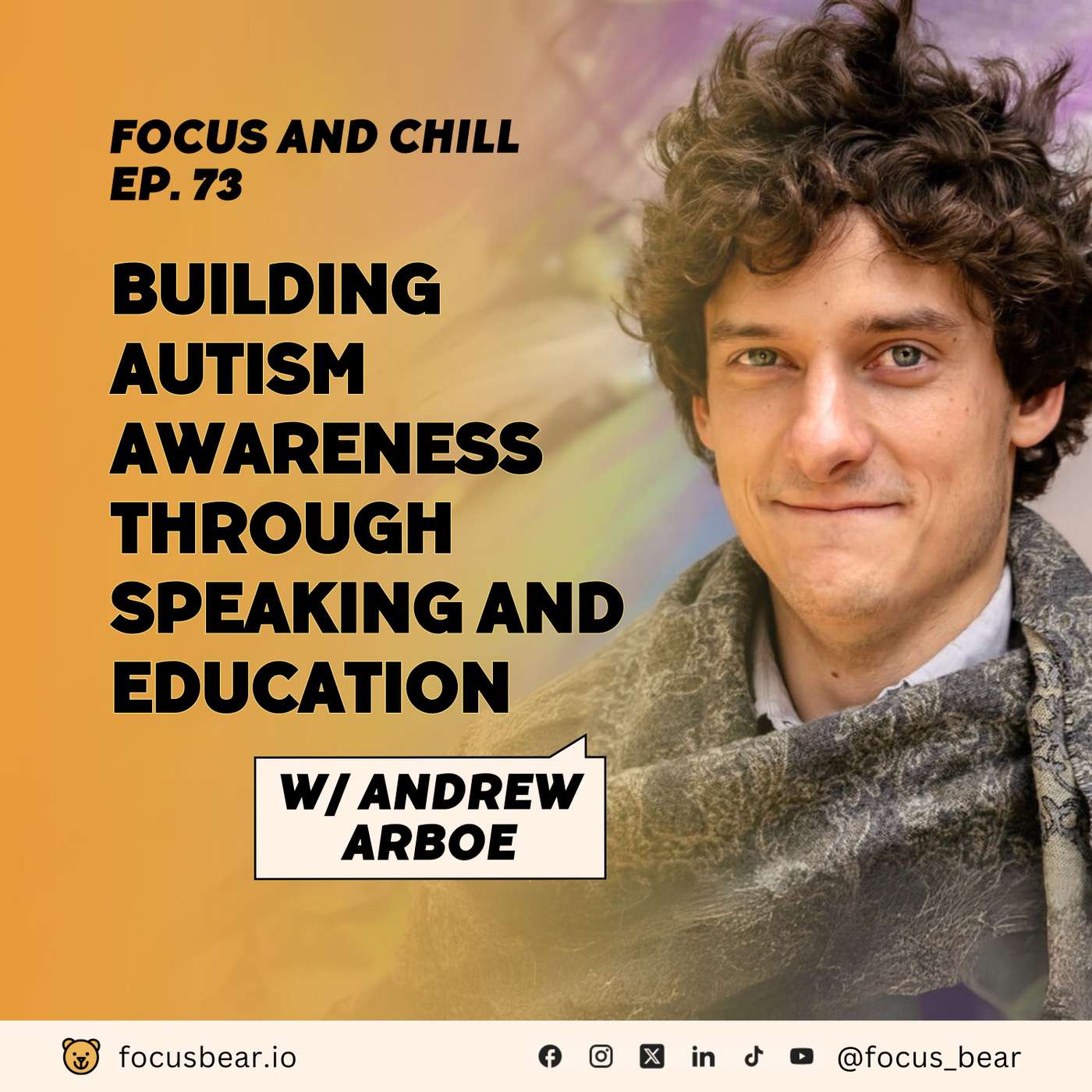
Ep 73Episode 73: Andrew Arboe
Welcome to episode #73 We’re thrilled to be joined by Andrew Arboe today. Andrew Arboe is a self-advocate with a professional work background consisting of public school, private school, nonprofits, and online programs. Andrew is also a public speaker known for talking throughout New England about autism and his personal experiences.Welcome to the show Andrew!QuestionsJN: Can you tell us about your experience with neurodiversity? When did you realise that you weren’t neurotypical? 5-6 y.o.Temple Grandin on the sceneInto video games/pokemonUpper elementary school started getting challengingWhat challenges did you face? Processing emotions when the environment is chaotic (raised voices)Unsure what to do after school - didn’t want to do tech/ITWhat strengths are you leaning into now?Explorer personality - play archetypeJC: What "work" projects are you concentrating on? 1 to 1 work in special education:Public schoolPrivate schoolHelping with social skillsE.g. helping with cooking - organising recipes etc.Letting go of expectations about NT work/driving abilitiesWriting/Public speaking/advocacy in different states - personal experience“Red mage”Studying psychologyJN: How about the rest of the time? What do you enjoy doing in your off time? Niche games Exploring different cities/coffee shopsClassic movies: The Red Shoes, It happened one nightAnime movies on big screenPuppy (9 month old German shepherd)JC: Productivity tips What do you do to optimise productivity during your working hours? CoffeeBreaksMeditation app - breaksDrivingGet ahead of work (e.g. reading history of psychology)Study music - anime movie music (peak fire)What is some unhelpful productivity advice that doesn’t work for you?Be careful about substance usage (even caffeine)Policing people about incorrect language usageBREAK JC: What does your morning routine look like and how has it evolved over time? Get up at 6 - take dog outEat bagelHave coffee at workJC: How is your sleep? How do you switch off at night? Video games to wind downRead book (Stuart Brown - Play book)Midnight sleepJN: Where can people connect with you or find your work? LinkedIn: https://www.linkedin.com/in/andrew-arboe/Website: https://andrewarboe.weebly.com/Instagram: https://www.instagram.com/andrewarboespeaker5/JC: Do you have any final words or asks for our audience? Don’t police people unnecessarily - be kindStart with small stepsThink of like leveling up like GokuDon’t give upMore from Focus Bear:Website: https://focusbear.ioLinkedIn: https://www.linkedin.com/company/focus-bear/Youtube: https://www.youtube.com/@focusbearappTwitter: https://twitter.com/focusbear1Instagram: https://www.instagram.com/focus_bear/Facebook: https://www.facebook.com/focusbearapp/Podcast: https://podcast.focusbear.ioTiktok: https://www.tiktok.com/@focusbearConnect with Jeremy:LinkedIn: https://linkedin.com/in/nageljeremyEmail: [email protected] with Joey:LinkedIn: https://www.linkedin.com/in/joeycorea/Newsletter: https://thepluckyjester.com/newsletter/
Ep 72Episode 72: Will Soward
Welcome to episode #72 We’re thrilled to be joined by Will Soward today. Will works creatively in a diverse field of digital media. He's invested in making online education more accessible for neurodiverse learners and the Web a better place to learn. Will talks about UX and accessible UI design with communities in the design and education space. He has 7 years as a UX designer under his belt, 12 years as an adult educator, and 20 years designing and coding front-end. Will is currently the Lead UX/LX Designer for Tait Communications in Aotearoa, New Zealand.Welcome to the show Will!QuestionsJN: Can you tell us about your experience with neurodiversity? When did you realise that you weren’t neurotypical? Dyslexia 11ADHD adultWhat challenges did you face? Masking - asking questionsAcademic - Rote learningSit still and listenSpeakingWhat changes have come post diagnosis?Context: why does it matter?More acceptance - stoicism - out of my controlEnvironmental changes - clutter, to do listsWhat challenges do you still face now?Rabbitholes during meetingInterruptingsolutionisingWhat neuroexceptional strengths are you leaning into now?Jump ahead to solve problems quicklyCreativityHyperfocusJC: What "work" projects are you concentrating on? Tait - accessibility designOnline learning - development + designMake it better for ND adultsJN: How about the rest of the time? What do you enjoy doing in your off time? Renovating house (last 8 yrs)Martial arts - forced calm and focus - karate -> taekwando -> BJJ -> muay thaiJC: Productivity tips What do you do to optimise productivity during your working hours? Philosophy: stoicismBreathing: calmingFlywheel to build up motivationListsKey priorities for the weekReprioritiseAlarm 30 minutes before need to leaveWhat is some unhelpful productivity advice that doesn’t work for you?Eat that frogBREAK JC: What does your morning routine look like and how has it evolved over time?Reprioritise listJC: How is your sleep? How do you switch off at night? Finish in evening at 5pm to make space for relationship - shut laptopJN: Where can people connect with you or find your work?Linkedin: https://www.linkedin.com/in/willsoward/Website: https://willsoward.com/JC: Do you have any final words or asks for our audience? Learn more about neurodiversityMore from Focus Bear:Website: https://focusbear.ioLinkedIn: https://www.linkedin.com/company/focus-bear/Youtube: https://www.youtube.com/@focusbearappTwitter: https://twitter.com/focusbear1Instagram: https://www.instagram.com/focus_bear/Facebook: https://www.facebook.com/focusbearapp/Podcast: https://podcast.focusbear.ioTiktok: https://www.tiktok.com/@focusbearConnect with Jeremy:LinkedIn: https://linkedin.com/in/nageljeremyEmail: [email protected] with Joey:LinkedIn: https://www.linkedin.com/in/joeycorea/Newsletter: https://thepluckyjester.com/newsletter/
Ep 71Episode 71: Michelle Ridsdale
Welcome to episode #71 We’re thrilled to be joined by Michelle Ridsdale today. Michelle is the visionary force behind Kaboose, an innovative app designed to foster a sense of community for autistic individuals and those embracing neurodiversity. Drawing from her own personal journey and lived experiences, Michelle is a dedicated advocate and volunteer within the autistic community. Witnessing her own son grapple with isolation and disconnection, she was inspired to create a platform that addresses these challenges head-on.Welcome to the show Michelle!QuestionsJN: Can you tell us about your experience with neurodiversity? When did you realise that you weren’t neurotypical? Son diagnosedI'm very socialDaughter: ADHD and AutismSignsRoutinesMaskAutistic meltdownWhat challenges did you face? Not many friendsSon gravitated to adults no kidsWhat changes have come post-diagnosis?Self acceptanceLess verbalWhat challenges do you still face now?ADHD - too many internal convosGetting upset over small thingsWhat neuro-exceptional strengths are you leaning into now?HyperfocusLearning more about routines and quiet workJC: What "work" projects are you concentrating on? Friends, mentors, jobsTribesSongs on repeat TikTokLimit the number of people in groupJN: How about the rest of the time? What do you enjoy doing in your off time?Work = special interestReading = mystery/nonfiction Let It Go by Dame Stephanie - autistic feelsJC: Productivity tips What do you do to optimize productivity during your working hours? Calendar - colour codedKaboose = purplekids = different colorssocialLists (notebook, phone)Tasks in calendarWhat is some unhelpful productivity advice that doesn’t work for you?Mindfulness leads to more stress BREAK JC: What does your morning routine look like and how has it evolved over time? Dog follows routine tooWalk at 6 amShowerCoffeeStart the night beforeClothes and food organizedJC: How is your sleep? How do you switch off at night? Ready yourself the night beforeMenu planJN: Where can people connect with you or find your work? LinkedIn: https://www.linkedin.com/in/michelleridsdale/Kaboose on app storeskaboose.app - https://www.kaboose.app/kaboose_app - social mediaJC: Do you have any final words or asks for our audience? More from Focus Bear:Website: https://focusbear.ioLinkedIn: https://www.linkedin.com/company/focus-bear/Youtube: https://www.youtube.com/@focusbearappTwitter: https://twitter.com/focusbear1Instagram: https://www.instagram.com/focus_bear/Facebook: https://www.facebook.com/focusbearapp/Podcast: https://podcast.focusbear.ioTiktok: https://www.tiktok.com/@focusbearConnect with Jeremy:LinkedIn: https://linkedin.com/in/nageljeremyEmail: [email protected] with Joey:LinkedIn: https://www.linkedin.com/in/joeycorea/Newsletter: https://thepluckyjester.com/newsletter/
Ep 70Episode 70: Kristian Mikhel
Welcome to episode #70 We’re thrilled to be joined by Kristian Mikhel today. Kristian is a co-founder of Paper and Pain, a creative collective for good, a PhD candidate at the University of Tasmania, and an accessibility designer. He's been sharing his experience living and working with ADHD, advocating for equal digital rights and inclusive experiences, and helping products that benefit humans and communities.Welcome to the show Kristian!QuestionsJN: Can you tell us about your experience with neurodiversity?When did you realize that you weren’t neurotypical? Diagnosed in 2023, but has struggled with concentration, focused work, and motivation since junior school.Initially, he wasn’t aware of the condition.His level of acceptance was a lot lower when he was growing upIt was thought to be a kids-only condition.What challenges did you face? Trying to calm myself down, feeling agitated and nervous constantly for no good reason, leaving tasks incomplete, and getting bored.Family wouldn’t understandSitting in one place for an hour was really difficultWould want to split a task up.Initially, he thought his inability to complete tasks was depression.A feeling of rolling in the fog before diagnosis.Defense mechanismAgainst feeling ofNot being “motivated enough.”What changes have come post-diagnosis?Just knowing that you’ve got ADHD and having a diagnosis that explains that it’s not you, it’s your disability, helps a lotIt’s like putting on glasses and now your vision is better.When you know what your dealing with, it’s sometimes as good as half the solution.Feeling well supported.What challenges do you still face now?The feeling of guilt for not being productive enough, constantly trying to find new things to keep me excited, access to medication (hello, Australian healthcare)The rushing mentioned below can be tough to manage.It’s like driving really fast and then braking hard over and over again.What neuro-exceptional strengths are you leaning into now?I don’t think I would call them “strengths”, but I’ve learned to complete things very fast to avoid getting bored, so sometimes, I would finish a massive project in a few hours and have the rest of the time to myself (well, I end up filling it with other projects, so that’s barely a win).Self-awareness of attention spanNeed to get a task done in 20 minutes otherwise, he’s going to get bored.The analogy of a match being lit needs to get stuff done before the match burns out.JC: What "work" projects are you concentrating on? PhDFocus on improving communication about air qualitybuilding a design agencyHelp out non-profits and well-being orgs with designwriting articlesPublish where?host a podcast (Paper and Pain)write a newsletter (The Accessibility Apprentice)Questions:How do you balance PhD with the other commitments?Understanding that there is life beyond work and commitmentsLogistically:Still trying to work it outTrying not to stick too rigidly to a routine.LooselyA few hours of fun in the morningCoffeeMake breakfastWatch TVWhile in a cheerful moodSolving the biggest problemsLiterature reviewsLater onFocus timersWhere did the name Paper & Pain come from?Why air quality comms - particular interest in that problem?JN: How about the rest of the time? What do you enjoy doing in your off time? Is there such a thing as an off-time? Wants to prioritise these things that make life beautifulWorking outGetting out of the houseReading Usually has 5-6 books simultaneous1-2 are research pieces.Light fiction: 100-year Swedish man who jumped out the windowClassicsHemmingway, TolstoyFukow? Foucault? (spelling?)HobbiesTrying new things - ask him about the most exciting thing he has tried.I recently moved to Tassie, a lot of nature and walking I read a lot (and sometimes, I even finish the books I pick up), watch good movies, cookI’m an incredibly social creature if I don’t get to spend time with other people, my condition gets worse very fastJC: Productivity tips What do you do to optimize productivity during your working hours? Paradoxical strategy: try not to focus on productivity because otherwise, it ends up being a checkbox mentalityInstead, focus on areas of interest (e.g. enjoys literature review)Ignore tasks that don’t add value - ruthlessly removeThe best I could come up with, I minimize distractions by spending some time setting up my workstation, muting all notifications, and setting timersWorkouts and a good diet help, but maybe don’t work out during work hours?What is some unhelpful productivity advice that doesn’t work for you?I don’t like making plans in advance, especially when they’re too detailed: breaking big tasks into subtasks causes you to lose track of the work. Too much meta work. You end up chasing the to-do list instead of enjoying itUsing AI to optimize calendar/to-do list: removesCounting hours: results matter more than time spentI can’t meditate (too boring), although deep breathing exercises help a lotI don’t build my life around a productivity app
Ep 69Episode 69: Christa Seals
Welcome to episode #69. We’re thrilled to be joined by Christa Seals today. Christa is a serial entrepreneur from her teen years and has extensive military experience, Christa has always positioned herself as a leader and mentor, consulting high-caliber executives, managing special agent HQs, and scaling her businesses. With her specialized understanding of human nature, team performance, and how high-producing talent operates, Christa is in the unique position to provide team building, performance enhancement, and skill development for high achievers within a demanding industry.Welcome to the show Christa!QuestionsCan you tell us about your experience with neurodiversity?When did you realize that you weren’t neurotypical? Her deep interest in her curiosityBringing biology books on camping.Deep focus while playing violin (so immersed in it that she’d end up with a bruise on her chin)When I was younger I felt like it was there but it didn’t manifest until I had multiple traumatic brain injuries (TBI).The last one really triggered it the worst and caused me to go through a multi-month clinical treatment.Shifting between periods of hyperfocus and then having a lot of trouble focusing.What challenges did you face? Speech, memory, and dealing with common situations, I was easily overwhelmed, and easily triggered.Some days able to concentrate well at work, other times unable to get anything done for days straightDidn’t tell anyone about the TBI or health issues.Didn’t want them to be an identifier.A leader with similar issues opened up which helped Christa feel less alone.The identity of being a small female in the militaryFeeling the need to prove herself.What changes have come post-diagnosis? AcceptanceI have slowed down immensely in comparison to when I was at the peak of my military career. I have started self-examining myself before most if not all situations so I can best prepare. What challenges do you still face now? Impulsivity, I naturally get easily excited about new things but that causes me to be impulsive (i.e. TEDx). I also have a lot of hobbies that I find hard to balance.How can you give yourself grace while being in a disciplined environment like the military?Military is pretty standardized, and not compatible with neurodivergence.Some leaders like the creative leadership of a neurodivergent individual.What neuro-exceptional strengths are you leaning into now? My creative lens. It took me a while to realize that I see the world differently and that’s truly a gift to share with the world. I have helped clients, friends, and family look at things completely different than what they approach problems with and that helps them overcome and find solutions.What "work" projects are you concentrating on?Writing book Business CoachingDentists, Professors, AI developersProvide structure, help set goalsSOPsPaper => Digitalworking on my TEDx talk. Being audacious: have balls of steelNecessary to create changeHow about the rest of the time? What do you enjoy doing in your off time?Depends on how much off timeI have. I love squeezing in coffee dates, or a quick trip to a beautiful view. If I have a bit more time then I love travelling, taking my family to find hidden gems in new places. Exploring: finding the views that no one really knows the locationProductivity tips What do you do to optimize productivity during your working hours? Listen to ASMR: helpful for productivity at work and household choresWhat does ASMR stand for again? - autonomous sensory meridian responseNot sure, but it’s often used as an ambient soundtrack to relaxReminds her of grandmother humming the rosary.NowPainting sounds of the brushRummaging through bags: makeup bags, craft bags.Location cued productivity:Working from home doesn’t helpThinks about housework/home improvement projects at homeSelf study/reflectionExamines consciencePrayer/meditationBrain dumping ideasDon’t work through lunch - useful recharge time.What is some unhelpful productivity advice that doesn’t work for you?Chronodiscrimination: not everyone wakes up at 5 am and jumps out of bedShe does much better if she wakes up without an alarm - peak productivityBREAKWhat does your morning routine look like and how has it evolved over time?It has evolved several times after testing my own productiveness in different scenarios. Has had to adjust with parenthood.I used to start by making coffee and sitting on my balcony while I read for 20 minutes, and then it transitioned to going to the gym first thing in the morning. But that changed after I had my son. Now that my son is 3, I take him to school so I am most productive by taking a shower, getting dressed, getting ready down to my shoes, and then waking up my son to get ready so I’m not overwhelmed trying to get both of us ready at the same timeWakes up with the sunI also allow my body to sleep in if I need to, but then I kick off the same way. Shower to get productiveGets into the outfit for the energy levelSweatpants ar
Ep 68Episode 68: Steve Grace
Welcome to episode #68. We’re thrilled to be joined by Steve Grace today. Steve Grace is the CEO & Founder of The Nudge Group, empowering high-growth companies to thrive on a global stage with a unique fusion of recruitment expertise and powerful storytelling designed to expand your reach and impact worldwide. He is also the Founder of Nudge Productions creating high-quality content to tell stories through every medium from creating & managing podcasts in both video & audio, newsletters production & management, photography, and documentary/filmmaking.And lastly, he is the publisher of both Balance the Grind & Startup Life: Unscripted and host of both the Give it a Nudge and Daily Grind podcasts.Welcome to the show Steve!QuestionsCan you tell us about your experience with neurodiversity? I could talk for hours about this, how it affected me mentally, etc and how it affects my work, why I do what I do, etcWhen did you realize that you weren’t neurotypical? About 13-14 years oldStarted with a diagnosis of an extreme form of dyslexia.What challenges did you face?Ridicule, stress, being differentAccomplished siblingsWhat is it like now?Love it, I will tell you whyStill finds it difficult to read. Took a while to readHad to learn the shape of every word.Finds it difficult to read handwriting.Found recruitment because it was all speaking (a lot easier than writing).What neuro-exceptional strengths are you leaning into now?every single one I canDifficult to separate the neurotypical strengths from the idiosyncraticShort and sweet communicationWhat "work" projects are you concentrating on? Recruitment businessProduction CompanyPodcasts: Give It A Nudge: features startupsDaily Grind: hacks to improve diet, exercise, career, sustainabilityWebsiteBalance the grind: work-life balanceFilm makingFilming war games for military startupsThe Pillars: private clubFounders and family offices get together and build stuffThe goal is to build 20 Canvas and 5 AtlassiansCasual club: can wear a t-shirt; avoiding being stuffy. BYO kilt.How about the rest of the time? What do you enjoy doing in your off time?With my business Balance the Grind balance, is important to meWork-life balance looks different to different people.Teenagers occasionally want to spend time with him (at the ATM)Sport/exercise:Exercise 6 days per weekKeystone habitI did a half ironman last yearI love the ocean, live at Tamarama, learning to surf very late in lifeMediaTravel (going away on a boat) What do you do to optimise productivity during your working hours? Get up early (how early - callback on sleep question) - sleep makes a difference to clarityRead for 30 minutes (though sometimes gets lured in by phone)High performance coffee - “before you speak”Green juice (reviewing them for Balance the Grind)Breaks up the day with movement (e.g. walk to next meeting for 1hr and make phone calls)Don’t spend more than 45 minutes on one taskDrinking water - gives him a lot of energyPlanning which I hate,Some standard old-school ones like doing what I hate firstLo-Fi Beats I am tryingBreathworkTurn email off + keep phone awayEmail yourself notesUse Siri to email 4 different notebooksCandidate interview notesClient requirementsThe Daily Grind: research guests beforehandIdeas bookAccountability MeetingMonday morning check-in with teamNot in trouble but feel embarrassed/fulfilled if you do it Measurement:Woop bandCGMWhat is some unhelpful productivity advice that doesn’t work for you?Focusing on one thing - everything is connected“Don’t make lists”COMMERCIAL BREAKWhat does your morning routine look like and how has it evolved over time?Get up at 5.30 am (earlier in Summer than Winter)Solar-powered human (moved from UK to AU for the sun)Drink half a bottle of waterJuiceCoffeeWake up teenagers (x2)Read for 15-30 mins (print them out in A4)Shower, shave, contactsGym (3x weights, 1x run, 1x swim)Protein shakeWork - no meetings before 11 amHow is your sleep? How do you switch off at night? Goes home around 6 pmCheck emailsWork until 7ishDinnerWork until 9 pmScrolling/bad TV/moviesGo to bed at 11 pmFalls asleep quicklyCan’t sleep past 7 hoursWhere can people connect with you or find your work?Website: https://thenudgegroup.com/Linkedin: https://www.linkedin.com/in/stevegrace/Instagram: https://www.instagram.com/stevegraceg/Do you have any final words or asks for our audience?Lofi musicReframe any limiting beliefsMore from Focus Bear:Website: https://focusbear.ioLinkedIn: https://www.linkedin.com/company/focus-bear/Youtube: https://www.youtube.com/@focusbearappTwitter: https://twitter.com/focusbear1Instagram: https://www.instagram.com/focus_bear/Facebook: https://www.facebook.com/focusbearapp/Podcast: https://podcast.focusbear.ioTiktok: https://www.tiktok.com/@focusbearConnect with Jeremy:LinkedIn: https://linkedin.com/in/nageljeremyEmail: [email protected] with Joey:LinkedIn: https://www.linkedin.com/in/joeycorea/Newsletter: https://thepluckyjester.com/
Ep 66Episode 66: Rebecca Arnold
Welcome to episode #66 We’re thrilled to be joined by Rebecca Arnold today. REBECCA ARNOLD, JD, CPCC, PCC, is a professional, certified coach and the founder of Root Coaching & Consulting, LLC, a holistic leadership coaching firm for ambitious professionals. She has worked with 100+ leaders in the fields of education, medicine, law, academia, and social-impact organizations. She is an attorney by training and has collaborated with organizations from Google and Harvard to Top 100 law firms and K-12 school districts. She’s known as a “straight-talkin’, big-hearted” coach. Her book, The Rooted Renegade: Transform Within, Disrupt the Status Quo & Unleash Your Legacy, shares the path to holistic success for mission-driven leaders. It’s a #1 Amazon bestseller and Kirkus Reviews called it, “A wide-ranging and impressively holistic approach to achieving personal and professional success.” Welcome to the show, Rebecca!QuestionsCan you tell us about your experience with neurodiversity?When did you realize that you weren’t neurotypical? About age 42- which I’m finding is more and more common among my peers (women with ADHD). I have been treated for anxiety and depression for most of my life, but it wasn’t until I had a child with ADHD that I recognized the symptoms in myself and was able to get a diagnosis. This seems like a common experience for parents of children with ADHD because there’s so much more awareness now than when we were children.What challenges did you face? Getting started and focused has always been difficult for me, but I did very well in school because of what I now realize were maladaptive coping mechanisms. I procrastinated and stayed up all night finishing assignments in high school, college, and law school.This led to me getting to the point of hallucinating in the middle of the night working on finals in law school because I’d stayed up for multiple nights in a row.When I had kids and started work again, the tasks built up more and more and I could no longer rely on procrastination. I ended up burning out because of massive anxiety overload and sleep deprivation.I’ve since learned that the effects of anxiety mimic ADHD medications, so of course many of us who are undertreated for ADHD use anxiety to self-medicate. Many of us also have anxiety as a separate diagnosis, so I do want to make that clear. In a world that doesn’t understand or value neurodiversity as it should, anxiety seems to be an obvious byproduct.The anxiety-fueled productivity masked what was going on underneath.It was tough to sleep. Combined with adrenal disease, it was really challenging - led to burnout of 8 months.Writing the book, especially editing required support from othersCan edit things forever.Hard to cut through the pressure of doing things aloneWhat is it like now?I have medication that works- yay!And I’ve learned so many hacks that help me work with my ADHDHacks wax and wane over timeAccountability buddiesI’m really choosy about the type of work I do because I know that if it plays to my strengths and talents, I’m fire and if not, it’s torture. I’m also very intentional about ways to generate motivation (connecting a task to my purpose, considering who the work is for and its impact, allowing myself to get excited and follow my energy- instead of treating my to-do list like my boss).What neuro-exceptional strengths are you leaning into now?I’m great at coming up with new ideas for my coaching business Many people post-pandemic have ADHD-like challenges with focus, procrastination, and productivity, so I’m able to share with my neurotypical clients strategies that support me (and they work for them too)I can get a lot done when I’m motivated, so I capitalize on that. Deep empathyCan be a distraction as well as a superpower.Tangentiality means she can join dots and see patterns easily.Creating own rules (came from being socialized as a woman, pressure to be perfect). Rebelled against perfection.What "work" projects are you concentrating on?I’m focused on spreading the word about my book, The Rooted Renegade because it’s packed with practical tools and strategies that I know will support people.The impetus for the book was videos that Rebecca was releasing during pandemicMessages for videos translated to bookFramework for holistic successCalming emotionsExistential peace - align work with purpose, habits with goalsRelational peace: positive relationships with self and others (instead of sucking us dry)50+ toolsTalk to the book while writing itDoing deep work with my executive and leadership clients.Running my business in ways that fulfill me like being aligned with my purpose, hiring people who are values-aligned, and building time and space into my schedule for deeper work, connection, rest, family, and play. JN: How about the rest of the time? What do you enjoy doing in your off time? (5 minutes - T+25)Productivity tips What do you do to optimize productivity during your working hours? Examples: creating
Ep 65Episode 65: Joey and Jeremy - niching down for work, clear to neutral
Welcome to the Focus and Chill podcast, episode 65. Today, Jeremy Nagel and Joey Corea talked about niching down for work, and clear to neutral.QuestionsNiching down - freeplane/ZohoWriting a book for specific people (Tim Ferris approach)If those people don’t like it, it’s a failureUser stories and personas - make them real not Be an apprentice/journeyman firstClear to neutralClosing tabs at end of dayTab limit: 5 tabsSave in Pocket instead?How do you order them?Setting an internal proposition?Low information dietHow do you consume content?Fractal reading?Read content around the author (interviews with author)“Leave future self breadcrumbs”Write plan for the next day the night beforeClearing deskResetting donations/subscriptions (pause credit cards)Hemingway starting in middle of sentenceZone 2 cardioADHD meds/stimulantscaffeineMore from Focus Bear:Website: https://focusbear.ioLinkedIn: https://www.linkedin.com/company/focus-bear/Youtube: https://www.youtube.com/@focusbearappTwitter: https://twitter.com/focusbear1Instagram: https://www.instagram.com/focus_bear/Facebook: https://www.facebook.com/focusbearapp/Podcast: https://podcast.focusbear.ioTiktok: https://www.tiktok.com/@focusbear10 News First: Melbourne Inventions Helping Those With DisabilitiesConnect with Jeremy:Jeremy’s LinkedIn: https://linkedin.com/in/nageljeremyEmail: [email protected] with Joey:https://thepluckyjester.com/newsletter/
Ep 64Episode 64: Damien Dicke
Welcome to episode #64. We’re thrilled to be joined by Damien Diecke today. Damien is the founder of the School of Attraction and The Dangerous Man. He is the author of the award-winning book Sincere Seduction. He's been a coach and professional speaker in over 25 countries. He was diagnosed with ADHD at the age of 10 and struggled until he started his company at the age of 25, which he’s still running today 15 years on. Damien has developed unique working styles to enable him to be productive. Many of his clients have ADD and he’s here today to share these working styles and how his work can help those with ADHD and ADD. Welcome to the show Damien!QuestionsCan you tell us about your experience with neurodiversity? When did you realise that you weren’t neurotypical?Other people realised long before I did - as a kid you don’t thnk about these things as much - except I never had friends in primary school which hurt a lot. I never ‘felt’ neurodivergent until I was an adult - even though I had been medicated as a kidDiagnosed at 10What challenges did you face? Couldn’t keep focussed on university, dropped out of a double degreeCouldn’t complete anything that I started - DJ work, courses, study, business ideas etc. When people knew I had ADHD they told me certain things I couldn’t do - I learned to be obsessed with finding a way to turn the ADHD into a strength, a way to use it to my advantage - this obsession has served me well I think.Feeling misunderstoodOften had only one friendStruggled with homeworkWondered what trouble he was going to get intoWhich knocked the love of learning out of himUniversity was tough because the pressure to achieve was no longer there.What is it like now?I suppose it’s a part of who I am - I live a life where it’s completely integrated and accounted for - I just live a little differently but don’t feel it’s a negative in any wayI had to learn to adapt because most useful drugs are off the table for me - hormone disregulation issues. I default to logic when things get emotionally hardLoves learning againStill loses interest in things that are repetitive (e.g. some board games).Schoolofattraction was the only thing that he was able to see throughThe difference was that he was able to get a lot of praise (because everyone wants to get better at dating).Consistent progress: 5 minutes per day.What neuroexceptional strengths are you leaning into now?Definitely hyper-focus… I can get amazing amounts of work done in short periods of time when I get into hyper-focus area. Knowing strengths:Great at designing and building websites. Not great at writing sales emailsNow delegates work that he finds hard to hyperfocus onI also hyper focus on electronic toys (drones) - Why is this useful? I buy and sell toys on a profit - so it’s a side-hustle I can only pursue because I’m hyper focussed on the toys and the marketplace they live in - I see the trends and take advantage of playing with new electronic toys for a while. Because I had to learn to be hyper-structured - it’s useful in a business context - at least a lot of the time.What "work" projects are you concentrating on? Two parts:School of AttractionDating coachingGoal is to be confident but not manipulative (not pickup artist style)Men’s retreatsPersonal development work separate from dating coachingHard to sell spirituality/self development - easier to sell dating coaching (but actually dating goes better if you do self development)Helps to dissolve illusion that a partner will solve self esteem issuesDealing with inner demonsAdvertising and PR mostly - I have spent too long focussing on what I’m good at and not other parts of the business that need attention. So my hyperfocus righ tnow is on designing ads, landing pages, and writing copy - thank god for AI it helps a lot with ideas. How about the rest of the time? What do you enjoy doing in your off time? I fly FPV racing drones, watching movies, photographyFPV (first person view)Exercise (helps with hormone dysregulation).Goes to a gymGoes with his partner but only because they’re partneredDoes weights (but doesn’t do much for mental health)Lot’s of readingAvoiding alcohol (since 21)Bars / clubsSpending time with partnerNoveltyCars / buggiesRecommends that people find hobbies that force you to be part of a communityProductivity tips What do you do to optimise productivity during your working hours? I’m hyper-structuredStart work at the same timeMy whole day is the same every dayOn Sundays plans out entire week down to 30 minute levelLong term goalsI have to block entire days dedicated to hyper-focus tasks otherwise I can’t even consider starting them. I have to bounce my thoughts off other people to really process themVerbally processing - doesn’t need feedbackWhat is some unhelpful productivity advice that doesn’t work for you?Pomodoro technique - better to stay in hyperfocusBut needs breaks during creativity crashesTaking walks every hour or twoBREAK What does your morning routine look l
Ep 63Episode 63: Errin Anderson
Welcome to episode #63. We’re thrilled to be joined by Errin Anderson today. Errin Anderson is a dedicated ADHD Clarity Coach, empowering professionals with ADHD through his 90-day program. Offering personalized strategies and motivational support, he helps individuals overcome challenges, focusing on their strengths. His empathetic, focused approach aims to transform personal and professional lives, understanding the unique hurdles faced by those with ADHD. Welcome to the show Errin!QuestionsCan you tell us about your experience with neurodiversity? When did you realise that you weren’t neurotypical? I always thought I was different, but it was not till I was going through a rough patch that I started to think about ADHD since other family members got diagnosed, Officially diagnosed when I was 32.Relatively late diagnosisDiagnosis gave a reason to the things going on with himWhat challenges did you face? Always mind a friend and work colleague who always said Errin you're like a Duracell Bunny on Drugs, running at 100 mph, I could not focus a lot of the time, unless I had a deadline to meet; mind from Uni, I was writing my essay at midnight when it was due to be handed in at lunchtimeNoise is always in my head, thoughts going 1000mphBrain is always busyWhat is it like now?Learned just to be me Mediation has really given me the quiet mindThrough coaching developed lots of tools and techniques that work for me to maintain focus and not lose EVERYTHING (mobile, wallet, keys) I am happy, not that I've never been happy but the longest I've felt in the happy emotional state.More emotional granularity (understanding the nuances between emotions)Having visual reminders like calendar reminders to help him manage time.What neuroexceptional strengths are you leaning into now?Being creativeGetting lost in CanvaBeing my true self and getting that mask drop Thinking outside the box, is there a way i can get around, over or under this challengeBeing able to listen to others and understand what really going onActive listeningNot filling in the spaceInstead allow thinking time.Was able to build it with small habitsAllows fidgets and sensory toysFidget ringWalking can help What "work" projects are you concentrating on?Busy (always busy!)Background is working in non profit spaceReally focusing the now on setting up my coaching business working with professionals ND, providing them with the safe and time to reflect and develop actions, within a safe nonjudgemental place, oh and love the random moments we have in coaching when our brain takes us down that rabbit hole and allowing people to explore the space. Without feeling pressured into focus on what was the first thing we spoke aboutCharitiesUntangling some admin messes (e.g. financials)How about the rest of the time? What do you enjoy doing in your off time?When not working with Charities across Scotland or working on my coaching, i spend time with the family. 2 children (9 and 13), and the wife (who just gets it)Getting awayYoungest has ADHD traitsTime out in the garden - well when it’s actually sunny in Scotland and not rainingWhat do you do to optimise productivity during your working hours? To Do list - but small GOALS,One product split into 5/10 steps to reach the goal, use online software to help me plan, has been a life saver. Used to write to-do list which was huge, and i would lose it so spent most the time trying to mind what was on the last one and redoing the listUseMotion.comRemarkable notepadWhat is some unhelpful productivity advice that doesn’t work for you?FOCUS and have QUIET, sounds like hell to me, i need noise to keep my brain busy on two things at one. Trying to just focus with nothing else going on it, make my brain feel like we need to run a marathon - Well that will never happen physically. MusicWhat he listens to dependsWhen hyperfocused, doesn’t matter what the music isWhen he’s trying to get into something, lyrics get distractingSubtitles makes him feel like he’s multi-taskingReading and listening at the same timeCOMMERCIAL BREAKHow do you manage communication with neurotypical folk?Before i would just close down and disengage, now its all about the relationship ive developed with them. Of course at the start i will apologies all the time, as my brain switches off or im listen but doing something else at the same timeWhy should i conform to neurotypical, they need to take me as i am, maybe they should change or we can meet half way? What does your morning routine look like and how has it evolved over time?Morning routine what's that!Initial i would wake up get ready and get to work no matter the time, can mind being in the office at 6am as i was up which just burned me outNow - always up around 1.5/2 hours before i need to leave, give myself time to have everything ready, and spent some time on stuff i need to do, if going into the office, jump on the bus and listen to a podcast whilst reading the news to see whats happening in the world. How is
Ep 62Episode 62: Ellen Busch
Welcome to episode #62 We’re thrilled to be joined by Ellen Busch today. Ellen Busch, diagnosed with dyslexia in childhood, defied expectations. Her parents nurtured her beyond academic confines, teaching her to navigate the ocean, excel in team sports, and embrace adventure. Despite self-esteem struggles, she became a skilled skier and earned bachelor’s and master’s degrees. Battling low self-esteem and trauma, Ellen persevered, escaping abuse and seeking healing. Through coaching, therapy, and training, she reclaimed her power, now thriving and fearlessly pursuing her dreams. Welcome to the show Ellen!QuestionsCan you tell us about your experience with neurodiversity? When did you realise that you weren’t neurotypical?Initially diagnosed as ambidextrous.What challenges did you face? Dyslexia associated with an intellectual disability.People had low expectations of her - teacher told her parents that she would only ever be able to be a wife/motherHer parents didn’t accept the administrator’s diagnosis. Her dad’s mantra was “Prove em wrong Ellen!”Took successes outside of the classroom and brought them into the classroom.Physical challenges like abseiling, scuba diving, boatingWas able to apply the adventures to assignmentsGoing to college / uni was betterAcademic staff were supportiveProbably because she was so open and transparentManaged to get through tough subjectsWhat is it like now?Agrees that the struggle gave her the gritShe could outwork everyone elseAt an early ageE.g. Reading nautical charts with her Dad.What neuroexceptional strengths are you leaning into now?Understanding visual learningThinks in picturesUsing visual aids whenever possibleE.g. Anatomy colouring book - associating the colour with the name.Long-term memory is goodGood pattern recognitionWhat projects are you concentrating on?Book: disEmpoweredShares her story about getting through hostile education system and leaning into her strengthsLots of podcastTraining to become a coach (to help other dyslexic people and parents of dyslexic children)Heroes’ journey approachRefuse the challengeTake on the challengeSucceedTake the lessons back to your tribeHow about the rest of the time? What do you enjoy doing in your off time?Come back to the idea of outworking people. Does she find it difficult to switch offWhen younger, it was roughBecause don’t have the emotional development on how to cope.Would have frustrated outbursts.Do athletic, physical things and then would fall asleep.Foundational practicesMeditationJournallingBreathworkVisualisationReboot practice - 45 mins to turn off the brainYogaWhat do you do to optimise productivity during your working hours? What is some unhelpful productivity advice that doesn’t work for you?Optimising productivityTake breaks - not a robot!“Spot drills”Micro-workouts (10 minutes): 50 air squats/burpees/push-presses/WODDoes 3 of those per day. Aiming for 4“Sitting is the new smoking”Break up tasks - write for 15 minutes and then empty the dishwasherSetting boundaries: this is what I need to do for myselfUnhelpful adviceMultitasking: doing 3-5 things at a time doesn’t work. Do one thing at a time.COMMERCIAL BREAKHow do you manage communication with neurotypical folk?Setting expectations (like she did with the professors at college)Active listeningUnderstanding different perspectivesAsking for clarificationReflecting back5 mountain planFrom Commander Mark Devine (retired Navy Seal)What does your morning routine look like and how has it evolved over time?Set alarm clock 30 mins early - give herself time to wake up (not New York style wake up, gulp coffee and leap out the door anymore!)Large glass of waterBox breathingGratitude journalling - typically 3 minutes Yoga and stretchingMicro goals approach: start small with the habits - 3 things I’m grateful for and then build out from hereHow is your sleep? How do you switch off at night?PM ritual:Journaling (what went well/what didn’t go well - what did I learn? In a non judgemental way)Breathwork (box breathing)Meditation (insight timer)Sleep!Where can people connect with you or find your work?Book: Amazonellenbusch.comFacebookLinkedInInstagramDo you have any final words or asks for our audience?If you are dyslexic/ND, please know that you are not brokenYou have amazing abilities - focus on what you’re good at - explore thatMore from Focus Bear:Website: https://focusbear.ioLinkedIn: https://www.linkedin.com/company/focus-bear/Youtube: https://www.youtube.com/@focusbearappTwitter: https://twitter.com/focusbear1Instagram: https://www.instagram.com/focus_bear/Facebook: https://www.facebook.com/focusbearapp/ Podcast: https://podcast.focusbear.ioTiktok: https://www.tiktok.com/@focusbear10 News First: Melbourne Inventions Helping Those With DisabilitiesConnect with Jeremy:Jeremy’s LinkedIn: https://linkedin.com/in/nageljeremyEmail: [email protected] with Joey:https://thepluckyjester.com/newsletter/
Ep 61Episode 61: Katriona Lee
Welcome to episode #61 We’re thrilled to be joined by Katriona Lee today. Kat is the Co-Founder of Kaya, Australia's first strategy-as-a-service platform built for entrepreneurs. Kat forged a successful career in corporate as a neurodivergent professional, leaning heavily into fitness and habit stacking as key tools for emotional regulation.Welcome to the show Kat!QuestionsCan you tell us about your experience with neurodiversity? When did you realize that you weren’t neurotypical? What challenges did you face? What is it like now?What neuro-exceptional strengths are you leaning into now?Early Signs and Challenges:Early childhood observations by parents indicated unusual developmental patterns, such as speaking and swimming before walking. This hinted at a different learning and communication style.During the teenage years, emotional regulation and social comprehension were significant struggles, leading to disproportionate reactions to routine disruptions or misunderstandings in communication.Professional life highlighted these challenges, particularly in understanding and managing social interactions and conversations.Diagnosis and Personal Struggles:Following difficulties in emotional control and understanding social cues, a diagnosis was made, including depression and being on the autism spectrum (previously referred to as Asperger's).The diagnosis brought mixed feelings about intelligence and self-worth, leading to extensive personal research and a reluctance to share this information with social circles for fear of judgment and loss of opportunities.Current Situation and Embracing Neurodiversity:Transitioning from a corporate environment to running a personal business has allowed greater freedom to be authentic and redefine leadership and business practices.Recognizes and values neurodiverse strengths such as exceptional memory and pattern recognition, which enhance capabilities in strategy consulting and anticipating risks.Uses unique cognitive abilities to develop innovative solutions and technologies, addressing pain points effectively.2. What "work" projects are you concentrating on?Kat Developed a one-stop "anti-consulting" platform to provide integrated, accessible business solutions for underserved entrepreneurs, fostering growth and authenticity without traditionalbarriers.Kat addresses the challenges of managing diverse business functions like IT, marketing, and sales through two main strategies:Partnerships: She partners with experts who respect her unique approach, enabling effective collaboration.Technology and Automation: Kat automates repetitive tasks to enhance efficiency and minimize errors, supporting her business's growth.3. How about the rest of the time? What do you enjoy doing in your off time?Kat enjoys outdoor sports like hiking, running, and tennis.She takes regular breaks in nature to manage hyper-focus and safeguard her health.Social and leisure activities, such as discussing movies with friends, help balance her life.4. What do you do to optimize productivity during your working hours? What is some unhelpful productivity advice that doesn’t work for you?Productivity Through Fitness: Kat uses her cardio sessions to brainstorm solutions to business challenges, assigning specific tasks to intervals in her running sets.Idea Generation During Exercise: She finds physical activity away from the computer leads to actionable business ideas by the end of her gym sessions.Reflective Processing: Kat reflects on conversations and business issues during non-work times, which aids in deeper processing and future planning.5. COMMERCIAL BREAK6. How do you manage communication with neurotypical folk?Positive Self-Talk: Utilizes self-encouragement to tackle natural negative thoughts.Preparation and Visualization: Plan mental exercises to visualize interactions, assessing likely conversations and challenging personalities.Daily Mental Rehearsals: Incorporates daily mental walkthroughs of her schedule to anticipate professional interactions and enhance communication skills.Empathetic Connections: Builds relationships with neurodivergent partners and team members, leveraging shared understanding.Communicating Needs: Proactively informs colleagues of her needs during remote conversations to manage expectations and maintain focus.Requesting Breaks: Transparently requests short breaks during conversations to manage energy and focus, which is well-received by colleagues.7. What does your morning routine look like and how has it evolved over time?Consistent Wake-Up: Uses alarms set at 15-minute increments to ensure she doesn't oversleep, providing a safety net for starting the day right.Hydration and Supplements: Begins with a big drink of water and takes daily supplements.Mandatory Exercise: Engages in a structured workout (minimum 40 minutes) which includes a warm-up, high-intensity or weight training, and cool-down. Requires coffee before exercising.Cold Water Exposure: Incorporates cold showers t
Ep 60Episode 60: Aleasha Bahr
Welcome to episode #60 We’re thrilled to be joined by Aleasha Bahr today. Aleasha Bahr is a sales strategist, speaker, best-selling author, and founder of the Black Sheep Sales Method™️. She has 15 years of experience customizing sales strategies for businesses. Aleasha is an ADHDer and uses it to her advantage in her career.Welcome to the show Aleasha!QUESTIONSCan you tell us about your experience with neurodiversity? When did you realize that you weren’t neurotypical? Didn’t know that habits were neurodivergent until a few years agoGetting frustrated when she can’t open certain things.Can’t conform to deadlinesFidgetDoodlingEmpathyWhat challenges did you face? Humans are drainingSo concerned with another person’s experience that they are constantly trying to accommodate.Stimulants can make her tiredTrying to figure out what works for her brainGetting diagnosed as a womanIt felt normalized because she was in the entrepreneurial space.SpiralingCatastrophisingNot acting on the spiraling thoughtsFiguring out how to get stuff doneWhat is it like now?Learning to communicate the experienceIs it a shared experience?What neuro-exceptional strengths are you leaning into now?Empathy - salesAsk more questionsListen (including to what they don’t say)Pattern interruptWhat "work" projects are you concentrating on?Sales training (Black Sheep)Clients = service providers who provide their own servicesNot just solopreneursAvoid working with corporates - people are engagedEthos:don’t manipulate buyers or use shameBe transparentMeet their needsMake lots of moneyGroup sales trainingA different approach - previously did 1 on 1 coaching/training so that she fully understood the client’s offerHow about the rest of the time? What do you enjoy doing in your off time?Boundaries:“That doesn’t make sense for my family” - if people ask for something beyond what she can offerTries not to identify completely as “Mom”Boundaries aroundPersonal timeColouringAdult coloring booksAbsent-mindedly coloringWrite music/singingWriting a bookPartner timeFriend time What do you do to optimize productivity during your working hours? Day blockingMonday and Friday are 0 meetings.Tuesday - Thursday are just meetings.Doodling/colouring/going for a walk to unlock creativityDelegation - detailed work to someone elseCalendar managementPodcast editing + distributionSocial media management (Aleasha creates the content, EA uploads/schedules it)Lots of lists - bullet pointsWhat is some unhelpful productivity advice that doesn’t work for you?Time blockingPutting stuff into spreadsheetsLikes having a bit of freedom/disorganizationA lot of productivity advice is around rigidity and isn’t flexible.COMMERCIAL BREAKHow do you manage communication with neurotypical folk?Remember that dealing with difficult people is optionalTransparencyWhat does your morning routine look like and how has it evolved over time?Mon, Wed, Fri - work out virtually with someoneAt 5:30 AM?Otherwise, getting kids dressed and out the door.Generally, talking to someone gets her out of that stressAnd being able to offer value.How is your sleep? How do you switch off at night?Brain dump before bed to prevent loopingPersonifying your mindInstead of trying to switch off the thoughts, thank the mind for the thoughtsWhere can people connect with you or find your work?PodcastSales is not a dirty wordWebsitealeashabahr.comDo you have any final words or asks for our audience?“There is no good or bad - there is effective and ineffective” - avoid judgment, focus on being effectiveMore from Focus Bear:Website: https://focusbear.ioLinkedIn: https://www.linkedin.com/company/focus-bear/Youtube: https://www.youtube.com/@focusbearappTwitter: https://twitter.com/focusbear1Instagram: https://www.instagram.com/focus_bear/Facebook: https://www.facebook.com/focusbearapp/ Podcast: https://podcast.focusbear.ioTiktok: https://www.tiktok.com/@focusbear10 News First: Melbourne Inventions Helping Those With DisabilitiesConnect with Jeremy:Jeremy’s LinkedIn: https://linkedin.com/in/nageljeremyEmail: [email protected] with Joey:Joey’s creativity course
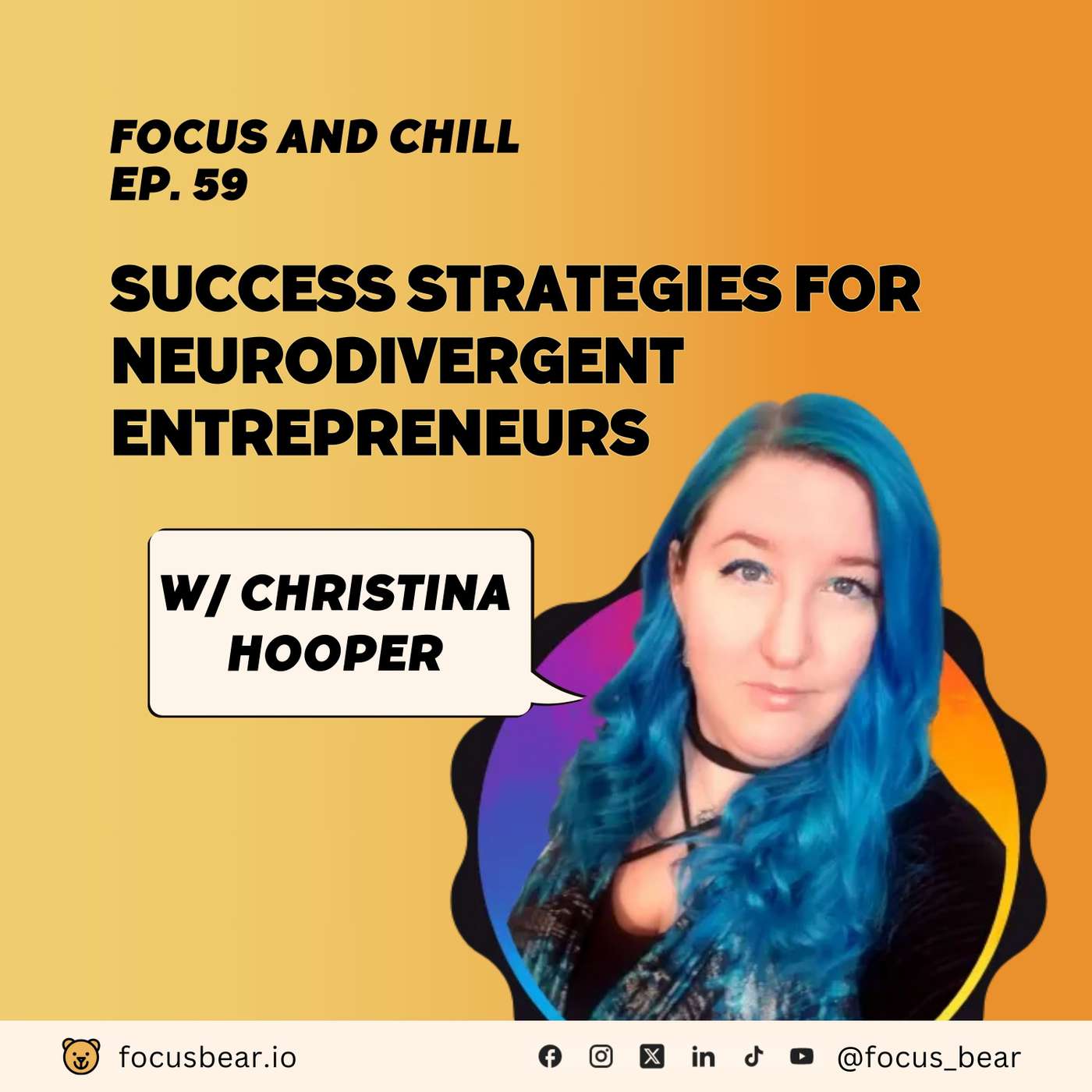
Ep 58Episode 59: Christina Hooper
Welcome to episode #58 We’re thrilled to be joined by Christina Hooper today. Christina is revolutionizing the journey for neurodivergent entrepreneurs. As one of the world's only AuDHD Business Designers, she puts a focus on understanding deeply, unlocking potential, and designing businesses that aren't just successful, but also fulfilling and sustainable.Christina and her business partners are creating a space where differences are strengths, where every challenge is a chance to innovate, and where everyone gets to live their best life through the journey of entrepreneurship.Welcome to the show Christina!QuestionsJN: Can you tell us about your experience with neurodiversity? When did you realize that you weren’t neurotypical? Age? I missed itSelf-diagnosed through TiktokFelt like the first time other folks understood how her brain worked.Other people experiencingBrain bouncing aroundNot being able to sit stillDrawing connections other people can’tWhat challenges did you face?Couldn’t create the course that should have been easy.Hired Melanie? The mindset coach?Business cultureAttireLoud venues (e.g. Vegas)What is it like now?Sensory toysFidgit toysBackground musicWithout wordsMedieval tavern (Bardcore?)Classical dubstepFollows the music of brain DJDopamine cheat sheetSensory-friendly clothesBeverage goblin armySupplementsMTHFR gene mutationDiabolical B12 deficiencyTurns B12 into cyanideWhat neuro-exceptional strengths are you leaning into now?Business design skillsetLeaning into autismThe possibilities / lateral thinkingJC: What "work" projects are you concentrating on?Academy18 years in businessOfferingDelivery methods:Metaverse style via gather.townBody doublingOffice hours with coachesEmail/slackRoadmap for ND entrepreneurs Strategies, appsMindset coachFractional COO Help with delegating and communicationHas 3 other businessesConsultancy - personal brandSaaS built on high-levelProject management agencyStarted doing graphic design initiallyAlso website programming on the side (before WYSIWYG builders)JN: How about the rest of the time? What do you enjoy doing in your off time?Hanging with husband and kidsLoofy/one-pieceBusiness lessonsJC: What do you do to optimize productivity during your working hours? What is some unhelpful productivity advice that doesn’t work for you?Optimizing productivityYou have to prepare the day before if you want to be productive todayRest and recover wellPay attention to energyMonday = content creation dayThursday/Friday = get interviewed/adminDaily/monthly cyclesSeasonal changes - winter = not a good time for launching productsBody doublingHighest level = physical human next to youLower level = focus mate/gather townOptimizing stimulation level4x speed if she wants to watch something and learnCan read a book, watch a video, and listen to a podcast at the same time.One of the things should be familiar - e.g. a re-run. Without cliffhangers.Needs to have two things happening at once.?Things don’t work foreverWhy - perhaps the context has changed, e.g. body doubling doesn’t work if you’ve been Unhelpful productivity advicePlayDHDCOMMERCIAL BREAKJN: How do you manage communication with neurotypical folk?She stopped tryingTries to get people to assume positive intentTraining the neurotypicals to assume positive intentJC: What does your morning routine look like and how has it evolved over time?Go easy first thing - sloth energy - avoid anxiety first thingExperience morning colors for the rest of the dayAnd colors the energy JC: How is your sleep? How do you switch off at night?Closing duties:Washing dishesClothesLock doorTiming: do the duties before dinnerTactile goal settingStir to left for more of what you want ofStir to the right for lessJN: Where can people connect with you or find your work?christinahooper.comJC: Do you have any final words or asks for our audience?Slow down and prioritise your joyLife is a journey
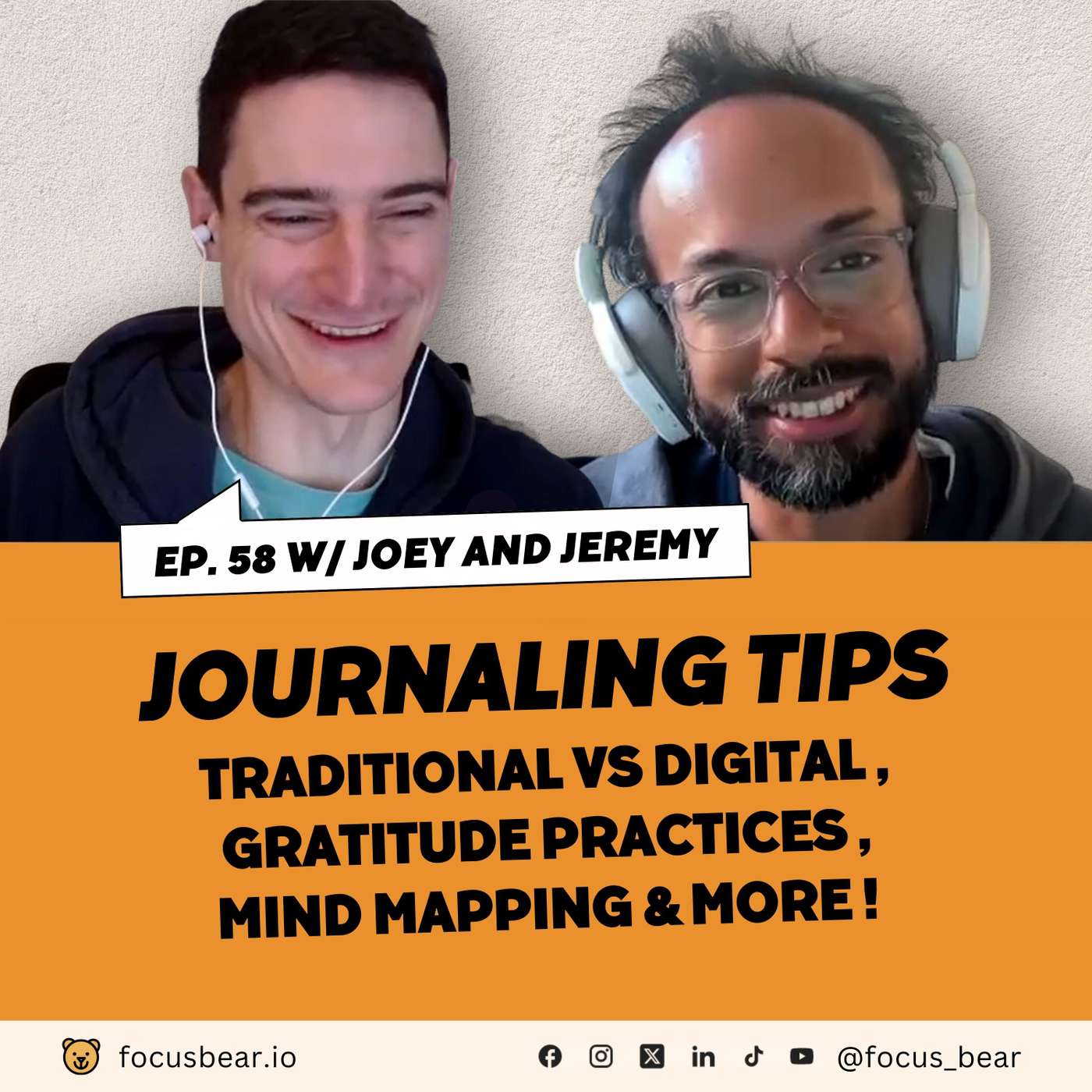
Ep 57Episode 58: Joey and Jeremy discuss journaling
Welcome to the Focus and Chill Podcast, episode 58! Today we'll share Journaling Tips: Traditional vs Digital Journaling, Gratitude Practices, Mind Mapping & more!TOPICSJournaling strategiesTraditional vs digitalBenefits of DigitalSecurityOrganizationSearchabilityBenefits of TraditionalFeels niceFreeformCan throw bits of paper awaySmart journaling appsNot really journaling, more like e-therapistConcerns around having intimate thoughts sent to the cloud (even if they don’t store your journals in the cloud)Advancements in local GPTs running on your smartphoneGratitude practicesWriting a single line vs a storyGetting into the feeling of it makes a difference according to HubermanPrompts vs no promptsDifferent prompts for different times of day/emotional statesMorning - Jeremy prefers tactical: what are the challenges of the day likely to be? How can I make today funDuring the day: emotional processing - why is this person annoying me so much?Muttering can help?Evening/scheduled weekly/monthly/seasonal reflection: strategic/divergent thinking - what did I learn? How am I living up to my values?Writing a day log vs a simple story of the dayLifelog helpful for historical reflection - what was life like in 2021?Weekly/monthly reflectionReflect on insights from last weekWhat have I learned?How did I go with last week’s experiments?How am I Iiving up to my values?What concerns do I have?lite tasks (can get done in less than 2 minutes)tasks to add to the to-do listNon-actionable but useful reference info to integrate into the second brain.Experiments to try for the week aheadMind mappingImplementing journaling in mindmaps (Freeplane); possible future episodes.Connect with Jeremy:LinkedIn: https://linkedin.com/in/nageljeremyEmail: [email protected] with Joey:LinkedIn: https://www.linkedin.com/in/joeycorea/Creativity Course: https://thepluckyjester.com/habitling-habit-building-courseMore from Focus Bear: Website: https://focusbear.ioLinkedIn: https://www.linkedin.com/company/focus-bear/Youtube: https://www.youtube.com/@focusbearappTwitter: https://twitter.com/focusbear1Instagram: https://www.instagram.com/focus_bear/Facebook: https://www.facebook.com/focusbearapp/ Podcast: https://podcast.focusbear.ioTiktok: https://www.tiktok.com/@focusbear
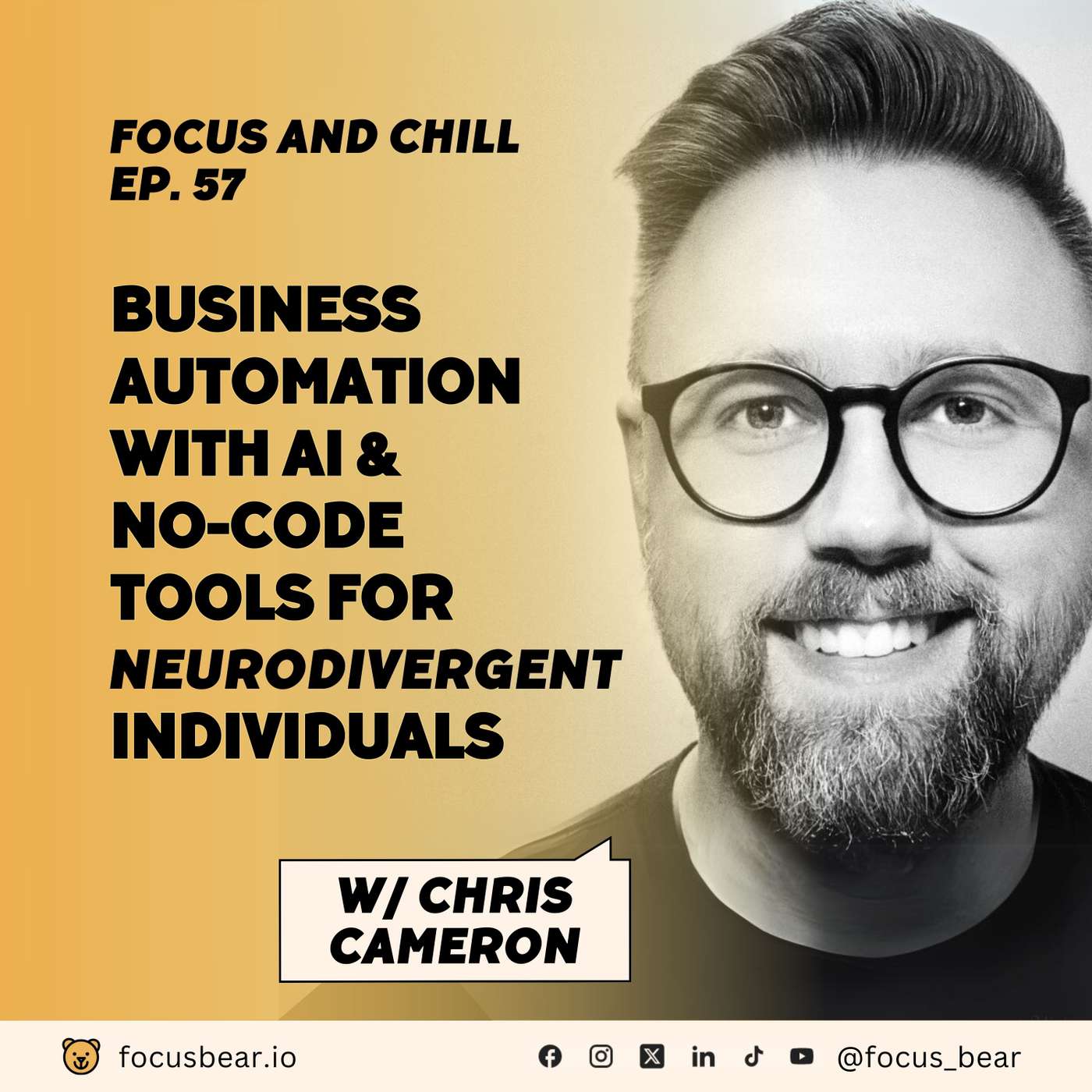
Ep 56Episode 57: Chris Cameron
Welcome to episode #57 We’re thrilled to be joined by Chris Cameron today.Chris Cameron is a Workflow Engineering and Process Automation Expert with over a decade of experience. He founded Satellite, a company dedicated to helping small businesses optimize their operations. He also teaches people with executive function barriers how to overcome them using AI, no-code automation tools, and productivity strategies. His work is driven by efficiency, innovation, and empathy, ensuring technology serves people.QUESTIONSCan you tell us about your experience with neurodiversity? When did you realize that you weren’t neurotypical?During pandemicFelt more on top of thingsOther people were strugglingRealized laterHe was responding well to chaos.Having a childThe above two things prompted him to investigate furtherIn school was the kid thatDidn’tDo homeworkStudyBut always performed wellWhat challenges did you face?Late to start thingsBut learning new things about it all the timeDifferent ways to approach things.Time blindnessIf something isn’t on the calendar, then it doesn’t get done.UnderestimatingTries to journal and self-analysis and reflect on what is working and what isn’tWhat is it like now?Wanted to talk about it so that other kids wouldn’t fall through the cracksNot simply be dismissed as the hyperactive boy stereotype.See through the coping strategies and masking.What neuro-exceptional strengths are you leaning into now?Tolerance for frustrationDepending on the causeLower than usualE.g. repetitive tasksFilling out tasksHigher than usualE.g. Solving aggravating problemCoding a solutionWhat "work" projects are you concentrating on?Consultancy doing business process automation (Satellite)Educational workshops (https://learnwith.cc) for ND people to learn how to automate processesBuilding out course materialTutoring (e.g. how to set up automation)Workflow optimization tool (free tool to figure out how to improve your processes)How about the rest of the time? What do you enjoy doing in your off time?Investigating new tools (physical and computers)Spending time with family2.5 year oldWhat do you do to optimize productivity during your working hours? What is some unhelpful productivity advice that doesn’t work for you?Calendaring + notes (so don’t forget)Timeboxing (worked for a while but then hated it)Time tracking Started for client billing as a freelancerTracking how much time spent on personal projects tooHelpful to calibrate estimates (e.g. grocery shopping seems like it should onlyAdapt tools to how people work rather than bending people to make the tools workVeljaE.g. default zoom calls to a specific browserE.g. always open Trello in the Trello appWhat works for a few months, can’t expect it to work foreverTheories about cyclingNovelty is attractiveAdaptation / habituationCOMMERCIAL BREAKHow do you manage communication with neurotypical folk?Variable NT toleranceHaving different personasWork ChrisReal ChrisIs he consolidating these?Establishing good rapportWhat does your morning routine look like and how has it evolved over time?For a while, he had a tightly planned morning routinePreviously, 2-hour time block in the morningExerciseMeditateAdaptability helped in transitioning to parenthood.Being a father led to a need for flexibility in the morning (e.g. kid wakes up early and needs you right away)Self-care for selfGet son ready (change, feed him, take him to daycare)Do maintenance tasks (meditation, exercise, writing)How is your sleep? How do you switch off at night?ParentingTerrible sleep doesn’t last forever.It’s tough when the kid doesn’t sleep at all.Energy management (more productivity stuff)Know when you have peak energyBeing mindful of when being sleep deprived.Where can people connect with you or find your work?https://learnwith.ccX: learnwithccLinkedInDo you have any final words or asks for our audience?WebinarsGet people to attend.Connect with Chris:LinkedIn: https://www.linkedin.com/in/learnwithcc/Website: https://learnwith.cc/Connect with Jeremy:LinkedIn: https://linkedin.com/in/nageljeremyEmail: [email protected]’s creativity course: https://thepluckyjester.com/habitling-habit-building-courseMore from Focus Bear: Website: https://focusbear.ioLinkedIn: https://www.linkedin.com/company/focus-bear/Youtube: https://www.youtube.com/@focusbearappTwitter: https://twitter.com/focusbear1Instagram: https://www.instagram.com/focus_bear/Facebook: https://www.facebook.com/focusbearapp/ Podcast: https://podcast.focusbear.ioTiktok: https://www.tiktok.com/@focusbear
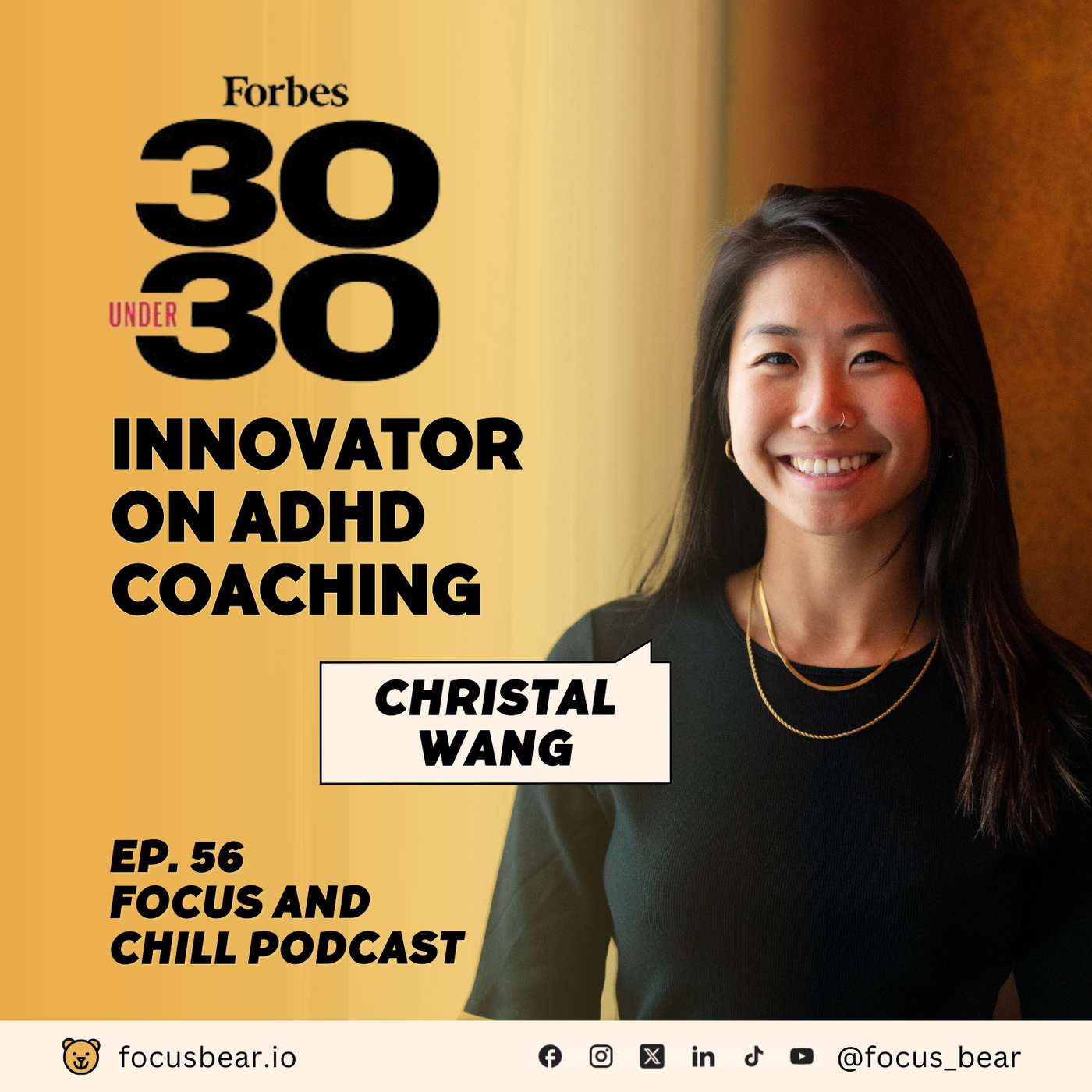
Ep 55Episode 56: Christal Wang
Welcome to episode #56. We’re thrilled to be joined by Christal Wang today. Christal (Forbes 30 under 30) is a startup founder, expert ADHD advocate & speaker, angel investor, and forever tinkerer. She is the Co-Founder & CEO of Shimmer (YC S21, Google for Startups, StartX): the first-ever comprehensive behavioral tech platform for adults with ADHD. She is an avid snowboarder, amateur surfer, world traveler, and coach-in-training for founders with ADHD. She is a part of and cares the most about: LGBTQ+, AAPI, women/non-binary, and neurodiverse.Welcome to the show Chris!QuestionsCan you tell us about your experience with neurodiversity? When did you realize that you weren’t neurotypical? Used to be different: only Asian in her primary schoolThe difference was apparent early on in schoolShe was great at coming up with fun scenarios for her friends - they’d follow alongWhat challenges did you face? She was called nosy and loudShe’d often get kicked out of class by teachers who didn’t understandSchool seemed overly focused on memorizingChallenges at work with managers who expected linear progressWhat is it like now?Much better thanks to being able to delegate weaknesses, ADHD meds, and coachingWhat neuro-exceptional strengths are you leaning into now?As a startup CEO, she naturally shares an inspiring vision and mission that excites her team“Nosiness” translates into curiosityWhat "work" projects are you concentrating on?Shimmer ADHD coaching platform (Jeremy uses it 🙂)Affordable ADHD coachingShe started it because it was what she needed and she couldn’t find anything that was accessibleHow about the rest of the time? What do you enjoy doing in your off time?Sabbaticals: 6-12 month cultural immersions/work awaysAdrenaline activities: snowboarding, skiing, surfingWhat do you do to optimize productivity during your working hours? What is some unhelpful productivity advice that doesn’t work for you?Body doubling (does it in person with a friend)Time blocking in the calendar (blocks out 2hr deep work blocks)PlanningTaking breaks (15-minute coffee break instead of trying to stuff in admin tasks every minute of the day)COMMERCIAL BREAKHow do you manage communication with neurotypical folk?Overcommunicate: explain your process and what you need to be successfulSoften feedback:SmileUse I statements (I observed)Receive feedback yourselfWhat does your morning routine look like and how has it evolved over time?Set the alarm for the latest possible time!Currently, it’s just drinking coffeeShe has gone through phases of hitting the gym first thing but not right nowHow is your sleep? How do you switch off at night?Challenging - her circadian rhythm doesn’t match her NT boyfriend’s. Creates friction sometimesWhere can people connect with you or find your work?Instagram: shimmer.careWebsite: shimmer.careDo you have any final words or asks for our audience?Try new strategies but don’t feel bad if they don’t work - there are always more strategiesConnect with Christal:Instagram: https://www.instagram.com/shimmer.careWebsite: https://www.shimmer.care/LinkedIn: https://www.linkedin.com/in/wangchristal/Connect with Jeremy:Email: [email protected]: https://linkedin.com/in/nageljeremyJoey's Creativity course:https://thepluckyjester.com/habitling-habit-building-courseMore from Focus Bear: Website: https://focusbear.ioLinkedIn: https://www.linkedin.com/company/focus-bear/Youtube: https://www.youtube.com/@focusbearappTwitter: https://twitter.com/focusbear1Tiktok: https://www.tiktok.com/@focusbearInstagram: https://www.instagram.com/focus_bear/Facebook: https://www.facebook.com/focusbearapp/ Podcast: https://podcast.focusbear.io
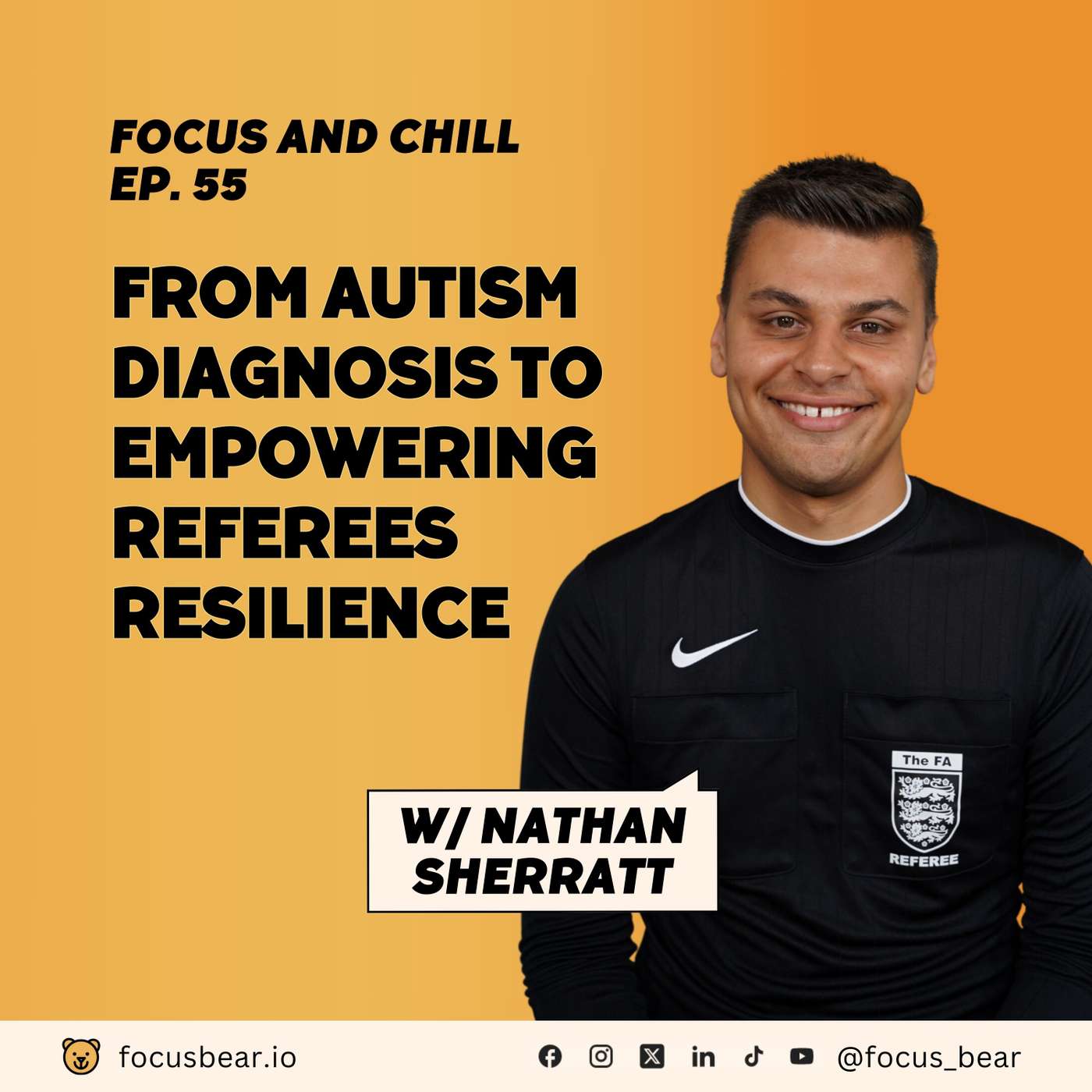
Ep 54Episode 55: Nathan Sherratt
Welcome to episode #55 We’re thrilled to be joined by Nathan Sherratt today. Nathan Sherratt is the Managing Director of The Third Team, a company that provides resilience training for referees. He is an active football referee and an educator passionate about supporting officials and improving their mental well-being. Nathan also works as a mental health ambassador and a speaker, using his off-the-field story to inspire and improve the lives of others. His work focuses on helping referees deal with challenges and pressures better, to enable them to stay in their roles longer, enjoy refereeing more, and enhance their performance. Additionally, he is involved in communicating similar messages through the vehicle of refereeing in schools, colleges, universities, and in the industry.Welcome to the show Nathan!QuestionsCan you tell us about your experience with neurodiversity? When did you realize that you weren’t neurotypical? What challenges did you face? What is it like now?Was diagnosed with autism at age 14/15Struggled with situations where things didn’t go to plan (traffic jams, the bus didn’t come on time)Illegible handwritingSome accommodations, e.g. extra time in examsLearned a lot more about ASD in my 20sGave him a lot of self-compassion for the struggles he experienced as a teenagerWhat "work" projects are you concentrating on?Helping sports officials all over the world manage the mental game Trustee of ND charityCoaches ND individuals - helps them deal with work challengesWhat do you do to optimize productivity during your working hours? Outsource things that aren’t in your sweet spotWhat is some unhelpful productivity advice that doesn’t work for you?How do you manage communication with neurotypical folk?Masking: eye contact, etc. learned skillExhaustingPeople appreciate directnessCOMMERCIAL BREAKHow is your sleep? How do you switch off at night?Midnight to 7 amTech sometimes gets in the wayHow do you fit exercise into your life?As a sports official himself, he does a lot of running for work and for recreationAims to get out into the sun in the morningHow about the rest of the time? What do you enjoy doing in your off time?GolfLong charity walksWhat does your morning routine look like and how has it evolved over time?Alarm 15 mins before need to get upShowerHairShaveBrush teethWhere can people connect with you or find your work?The Third Team websiteLinkedInDo you have any final words or asks for our audience?Don’t feel limited by your neurotype - be prepared to push yourself out of your comfort zone at timesConnect with Nathan ⚽️LinkedIn: https://www.linkedin.com/in/nathan-sherratt-508634137/Website: https://thethirdteam.co.uk/Connect with Jeremy 🐻LinkedIn: https://linkedin.com/in/nageljeremyEmail: [email protected]'s Creativity Course ✍️Click here: https://thepluckyjester.com/habitling-habit-building-courseMore from Focus BearWebsite: https://focusbear.ioLinkedIn: https://www.linkedin.com/company/focus-bear/Youtube: https://www.youtube.com/@focusbearappTwitter: https://twitter.com/focusbear1Tiktok: https://www.tiktok.com/@focusbearInstagram: https://www.instagram.com/focus_bear/Facebook: https://www.facebook.com/focusbearapp/ Podcast: https://podcast.focusbear.io
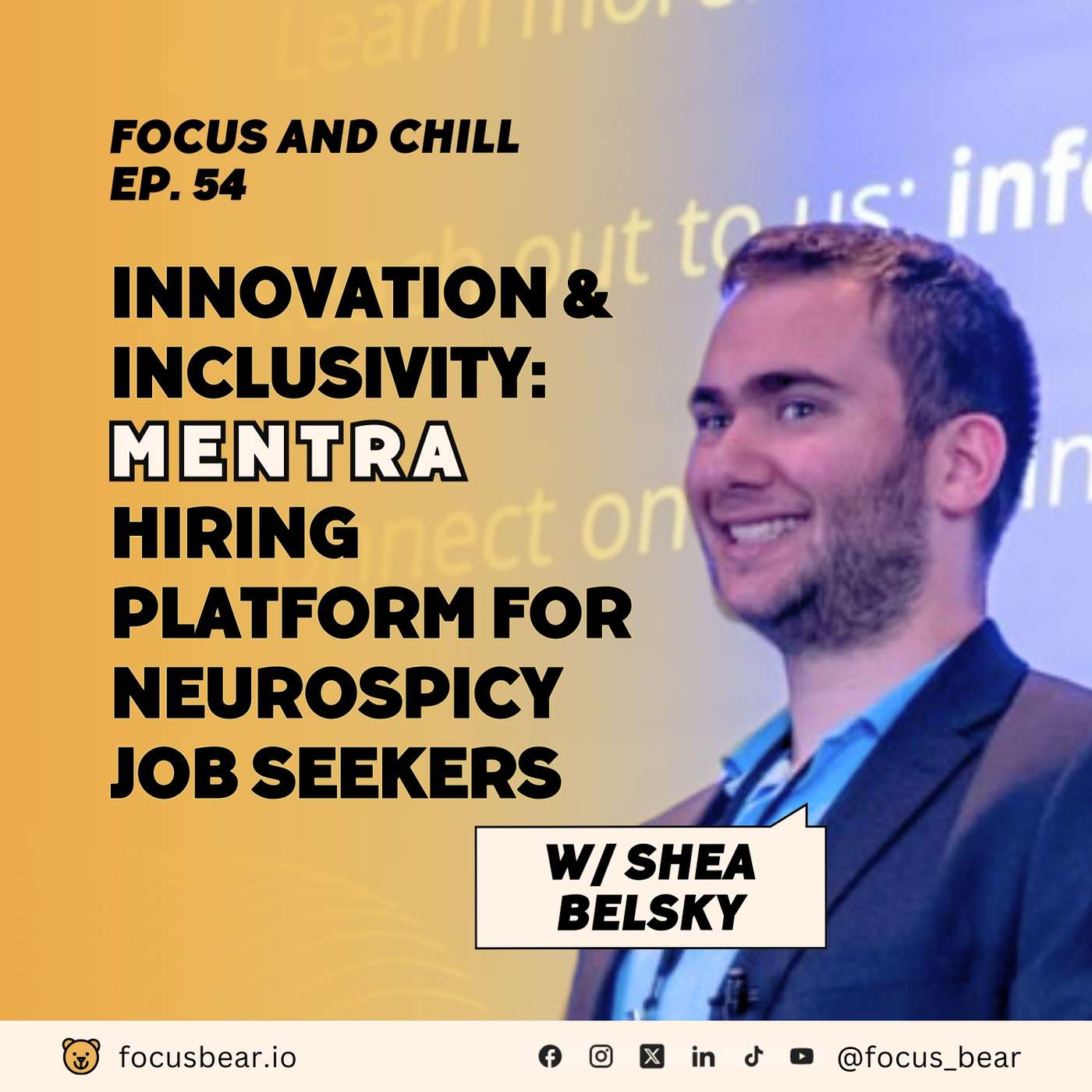
Ep 53Episode 54: Shea Belsky
Welcome to episode #54 - We’re thrilled to be joined by Shea Belsky today. Shea Belsky is an autistic self-advocate. He is the Chief Technology Officer of Mentra, a hiring platform for neurodivergent job seekers. Shea brings several unique perspectives to supporting neurodivergent colleagues: He has been the manager of neurodivergent & neurotypical employees, has reported to neurodivergent & neurotypical managers, and has advocated for the needs and well-being of his peers. Shea is excited to share these experiences with others to create a more neuro-inclusive workplace for everyone.QuestionsCan you tell us about your experience with neurodiversity? When did you realize that you weren’t neurotypical? What challenges did you face? What is it like now?Diagnosed at a young age (2 y.o.).Had a lot of support throughout school (physical therapists, speech therapists, individualized education plan, etc.). Did well at school and got into Cornell University where further development opportunities as a TA helped him grow his communication skillsLucky to be able to pay it forward now as part of my work with MentraHow is your sleep? How do you switch off at night?Sleeps well (apart from cats sometimes waking him up!)Mental exercise to shut off thoughts when he gets to bed so he can sleep quicklyHow do you fit exercise into your life?A big part of his life. He and his wife both enjoy hiking, running, cycling and skiingWhat "work" projects are you concentrating on?CTO of Mentra a careers site for ND people. Connects NDers with companies looking to hire ND talent. What do you do to optimize productivity during your working hours? What is some unhelpful productivity advice that doesn’t work for you?Walking meetingsBlocking out time for deep workCareers coach to help deal with communication challengesCOMMERCIAL BREAKWhat do you enjoy doing in your off time?Outdoor activities (see fitness)Dungeons and DragonsWhat does your morning routine look like and how has it evolved over time?Feed cats, shower, and head to workWhere can people connect with you or find your work?https://www.linkedin.com/in/sheabelsky/Do you have any final words or asks for our audience?Check out Mentra if you’re looking for work or looking to hire someoneConnect with Shea:LinkedIn: https://www.linkedin.com/in/sheabelsky/Mentra: https://mentra.com/Connect with Jeremy:LinkedIn: https://linkedin.com/in/nageljeremyEmail: [email protected]'s Creativity Course: https://thepluckyjester.com/habitling-habit-building-courseMore from Focus Bear: Website: https://focusbear.ioLinkedIn: https://www.linkedin.com/company/focus-bear/Youtube: https://www.youtube.com/@focusbearappTwitter: https://twitter.com/focusbear1Instagram: https://www.instagram.com/focus_bear/Facebook: https://www.facebook.com/focusbearapp/ Podcast: https://podcast.focusbear.ioTiktok: https://www.tiktok.com/@focusbear

Ep 52Episode 53: ST Rappaport
Welcome to episode #53 We’re thrilled to be joined by ST Rappaport today. ST Rappaport is a brain engineer who works with ADHD entrepreneurs to unleash their potential via Peak Brain Performance. ST assists them in optimizing their ADHD so they can remove overwhelm, get more done in less time, and enjoy growing their business again. Welcome to the show ST!QuestionsCan you tell us about your experience with neurodiversity? When did you realize that you weren’t neurotypical? What challenges did you face? What is it like now?From young ageFelt like she didn’t fit in.Didn’t like constraintsDidn’t like school1st day of 1st gradeThinking in a boxCollege in England was much betterLeft two years agoKey challenges after schoolPersonal developmentSelf-awarenessNever had a bossAlways run her own shipPhotography business.Creative journal expressive artsCreating with non-dominant handInternal locus of controlCreating her own environmentHow is your sleep? How do you switch off at night?Making the rules for herself is fine (just when other people tell her what to do)Does believe in the power of sleep (but struggles sometimes to get enough sleep)Goes in seasonsSometimes sleep is less of a priority when working on something else.Deadlines.Wind down routine:Think about three wins from today + anticipate 3 good things that will happen tomorrowVisualisation of calmJournalHow do you fit exercise into your life?A priority even higher than sleepFirst thing in the morningGo running - part of habit.45-60 zen time, thinking time.> 60 minutes, listen to something to avoid Novelty key - different types of exerciseStrength and cardioSwimmingWhat "work" projects are you concentrating on?Coaching ADHD entrepreneurs (loves it)Meaningful transformation not just hacks28 thinking skillsCoachees come to the conclusions themselvesTry to solve the root issueWhy do you want to procrastinate while working?It’s ok if you’re conscious that you’re putting on a band-aid until you can find the root cause.Podcasts + YouTube vidsWhat do you do to optimize productivity during your working hours?Band-aidsWork with your brain, not against it.Get to the sweet spot of challenge/flow:Make easy tasks harder (do it really fast/add fun)Break hard tasks into smaller ones.Pomodoro with a twistHas a list of tasksAfter 10 minutes, change tasks. Doesn’t matter where she is atGets her to work fasterTaking breaksSurgeryInterpret the procrastination as a signal.Which sub-task is challenging?Is itBoring?Repetitive?Which part does my brain not like? In the seemingly smallest tasks, there are big sub-tasksBy pinpointing the part it doesn’t like, you understand the why.Same thing with jobs/roles/gigsIdentify what you don’t like.COMMERCIAL BREAKHow about the rest of the time? What do you enjoy doing in your off time?Travel + research beforehand (do things that the locals would do - authentic experiences)Dancing/paintingDeep conversationsFinding time to talk with strangers:Appropriate event (networking event, podcast)Prioritize it if it’s important (time scarcity)Strategies for escalating small talkQuestions:What’s been the highlight of your week? What does your morning routine look like and how has it evolved over time?Brain sharpest in the morningWorkoutShowerInto the most important taskPrepared the night beforeMake it as easy as possibleWorkout clothesAny documents openWhere can people connect with you or find your work?Lifepixuniversity 28 thinking skillsDo you have any final words or asks for our audience?Stop caring what other people think.Joey’s creativity course
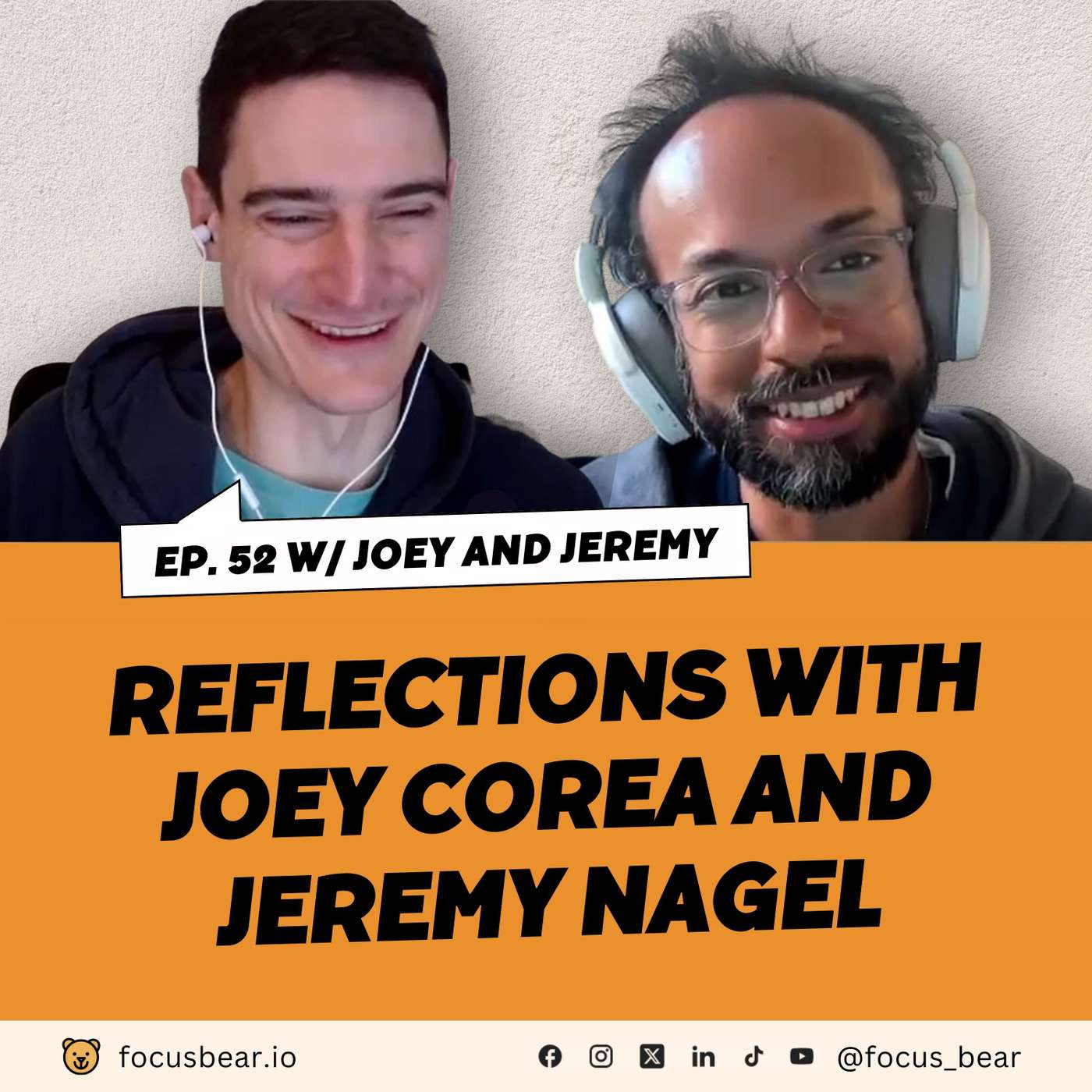
Ep 51Episode 52: Reflections with Joey Corea and Jeremy Nagel
Welcome to episode #52 We’re your hosts, Jeremy Nagel and Joey Corea, and we're thrilled to share our 2023 reflections with you today!Key points:Structured reflectionNew Years resolutionsWhy wait? If it’s important, do it nowAccountability GroupSharing vs doing it on your ownTiming:BirthdayStructured reviewsFormatWins: what worked wellJoey:Released book: Dilemmas to DecisionsIncreased workouts from 4 to 5 per week - plus 12 reps per set Started Plucky Jester business and got first $ inGot back into social media for business purposesInsights: learningsMost satisfaction from gaming if take breaks (e.g. play for an hour, take 10 minute walking break, and then play for another hour)“Life is happening for you, not to you” - Obstacle is the wayTrying to do everything on his own is not always the best wayPivots: what will I do differently?Cultivating self-healing - time for meditation/time in natureAnxiety management - “Cognitive Dominance” Diminish victim mindsetReview Frequencyweekly/monthly/annualMonthly reviewsUnstructured reflection: Remembering to be mindfulRe-entry meditation (shoes -> breaths)Walking through doorsPosturePeeing
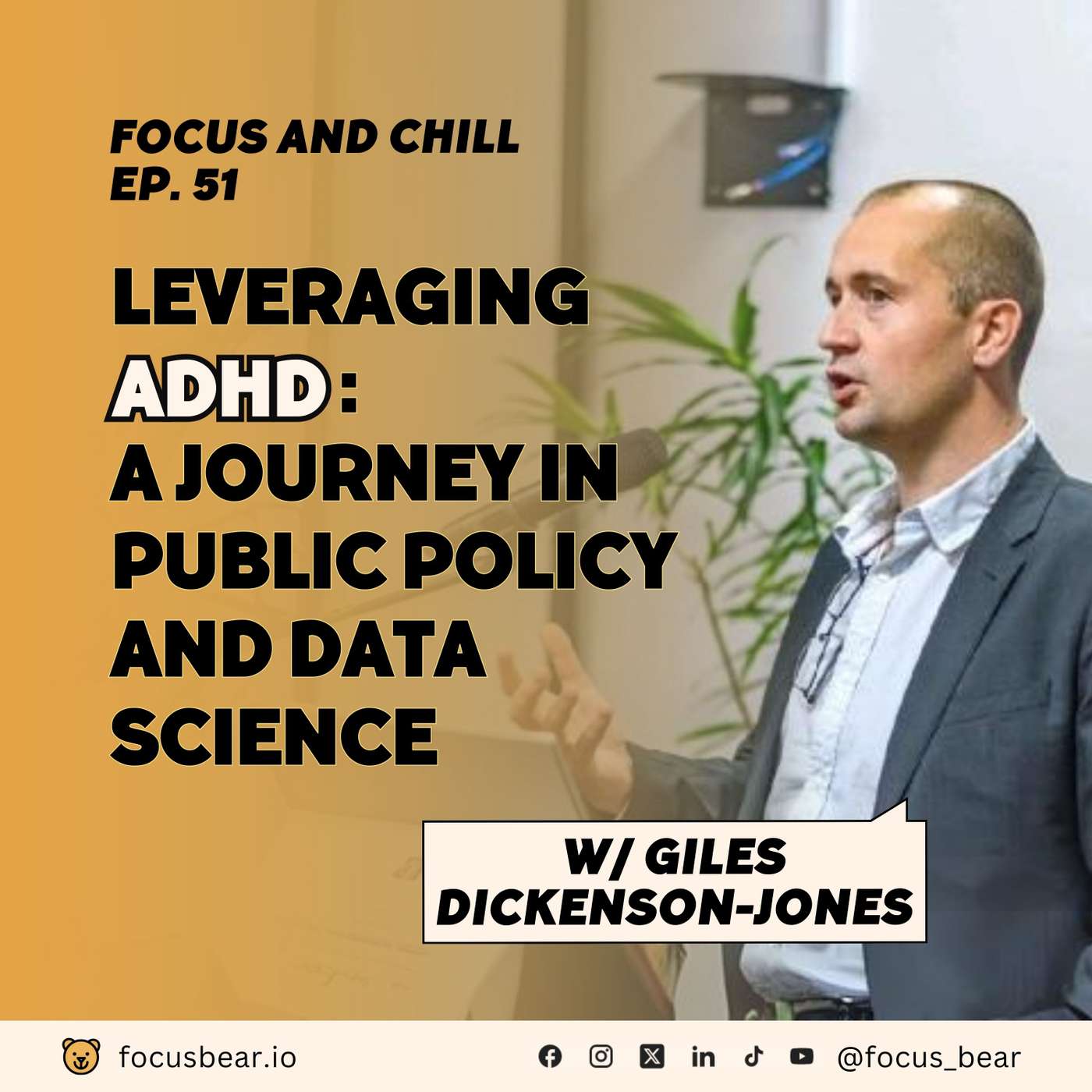
Ep 50Episode 51: Giles Dickenson-Jones
Welcome to episode #51 We’re thrilled to be joined by Giles Dickenson-Jones today. Giles is an independent consultant specializing in public policy (economics), international development, and data science. Giles was diagnosed with ADHD in his early teens and was shuttled off to one of the few schools he hadn't already been kicked out of: a boarding school in rural NSW. Giles leverages his ADHD by combining his interdisciplinary range, creativity, and expertise in data analytics to help clients tackle tough public policy problems.Welcome to the show Giles!QuestionsCan you tell us about your experience with neurodiversity? When did you realize that you weren’t neurotypical? What challenges did you face? What is it like now?Grew up in rural NSWDiagnosed with ADHD amidst being shuffled across schools.Initially confusedInitially thought it meant he wasn’t getting enough attention.Coping strategies didn’t stickInterpreted it as lacking in something as an explanation of why he was different.How he sees it now:Knows he was differentWas working ahead to fit inStrong sense of justice, hyperfocused on thatActing outGetting approval from othersSo eager to fit inSomehow not be theCool kidDorky kidAlmost got into a Montessori-style schoolBut mother wanted tougher disciplineHow neuro divergence led to the current line of workAnalytical framework hooked himEconomics sticks its nose into everythingRange, EpsteinHow has your neurodivergence affected your financial life?Special interest in finance including personal finances - complicated Excel model + savings modelHow has it affected your relationships?Enjoys socialising but won’t organise itWork often gets in the way.Blind to the need of tending to relationships.Interested in peopleLikes the diversity and variety of Lunchclub What "work" projects are you concentrating on?Independent economic consultantProgram evaluation of social policies, e.g. how to help more students graduateHow can we make the policy stronger (without incurring additional costs)?Board member of local NFPPolicy Analysis Lab Online course teaching policy analysts how to use data scienceHow to work with messy dataHow to clean it upHow about the rest of the time? What do you enjoy doing in your off time?Quit drinking in 2015Found it difficult to continueReplaced it with art classesCOMMERCIAL BREAKWhat does your morning routine look like and how has it evolved over time?Set up day similar to 9 to 5 jobGet up at 6 amGo to the gym (do boxing)Review to-do listWhat do you do to optimize productivity during your working hours?Normally external deadlines push him to hyperfocusSofter deadlines are harder (e.g. finishing the online course)Go to the library for focusTurn on hyperfocusKeep desk distraction-freeSimple structures/routinesMomentum method - get started with easy tasksMake tasks really small (break down responding to an email into - read email, write email, hit send).Reduce friction for good habitsHiring freelancers - keeps him accountableSimilar to body doubling.What is one habit you'd like to remove from your life (either a bad habit or one that takes up too much time)?Watching videos while having meals (lowers boredom threshold)How do you switch off at night?In theoryGet to sleep by ten.Loose during the holidaysPracticallyKeeps the 6 AM boxing classFunFitnessDiscipline, consequences for staying up lateWhat resources (books, philosophies, apps, sensory toys) do you find most helpful for dealing with your brain?Apps:OneNote for organizing notesExcel for To Do listsChat GPTFocus Coach: ADHD Coach GPTAskly Pocket for reading later (on Kobo)Read aloud (proofreading own work, reading websites)EtsyBooks:“Deep Work” Cal NewportRange by David Epstein“How to have a good day”Where can people connect with you or find your work?Etsy store - Turkey cardsLinkedInWebsite - gilesdj.com?Do you have any final words or asks for our audience?The emperor has no clothes: the person you are putting on the pedestal has foibles and got where they are through a combination of hard work and good luck. You can get there too.Joey’s creativity course
Ep 49Episode 50: Brent Huras
Welcome to episode #50 We’re thrilled to be joined by Brent Huras today. Brent Huras is a Productivity & Flow State Coach whose practice evolved from the single purpose of answering the question: "How can I get myself to do my work?" To this end, he has spent the last two decades reading, studying, philosophizing - and eventually - coaching on the answer to this mysterious question. His studies have taken him along multiple paths including psychological and spiritual ones which have culminated in his body of work that he calls Sustainable, High-Level Productivity which he describes in his work on YouTube, TikTok, and blog. He currently operates out of Stratford Ontario where he serves 1-1 clients and small groups.Welcome to the show Brent!QuestionsCan you tell us about your brain? When did you realize that your brain was different? What challenges did you face? What is it like now?Suspected undiagnosed ADHDBulk of clients are people with ADHDWhen they describe their experience, he felt it resonated.Brought it up with his parentsSaw challenges in himself that wasn’t evident in his peersFocusing at micro and macro levelAble to start but losing focus in the hour.Or not being able to see project through to the end of the week.How he learned the strategiesEverything leads to mastery (wanting to be really good at something)Give himself to something so he is free to focus and go deep on something.Reframe that he’s not missing out on something.Developing skills/mastery opens up other opportunities further down the road.What’s the realization like?It was a slow realizationIt’s not what you choose, it’s that you do choose.How has your neurodivergence affected your financial life?Family very disciplined around moneyHe inherited that mindset - frugal Enthusiastic about investment opportunitiesSometimes good: early investor in BTCSometimes bad: bought PSYK and it didn’t go wellHow has it affected your relationships?Quick to love peopleNot necessarily a bad thing - assumes positive intent.Sees the becoming/potential.What "work" projects are you concentrating on?Raising toddler 1 on 1 coachingGroup CoachingHow about the rest of the time? What do you enjoy doing in your off time?Raising toddlerWatching become a person.Not quite like raising a cat.There’s frequently a “new person”Serve the evolution of humanitySignaling to other people that it’s ok to step into purpose.CoachingWisdom traditionsPractices of enlightenment and awakening.Deeper and more grounded layers of peace.Playing piano.What forms of exercise do you do?Gym 3x a weekGet a run in per weekKen Wilbur’s stuffMeditation and working out complement each other.What does your morning routine look like and how has it evolved over time?Try and wake up before daughterDo meditationCatching up later in the dayFind a time to meditate ideally before the morningIdeal routine (past routine)Get upMeditateExerciseShowerJournalingPrioritizes mindfulness throughout the dayMindfulness is not just on the meditation cushion - be mindful when leaving a room, getting into the car etc.What do you do to optimize productivity during your working hours?Getting self to do the thing:Flow stateRemove the judgment that some tasks are flowy and others are tedious (e.g. doing tax return can be fun)“Compressed ease” - expectation that it should be going fasterIt will take as long as it will takeSlow down - let it take as much time as neededCOMMERCIAL BREAKWhat is one bad habit you have removed from your life (either a bad habit or one that takes up too much time)?Smoking cigarettes + DrinkingWhat’s your sleep like?No sleep issues, sleep well.Toddler wakes them up sometimes.How do you switch off at night?Trust that there is nothing to think about right now.What resources (books, philosophies, apps, sensory toys) do you find most helpful for dealing with your brain?Books:Falling into Grace - A.. Shanti QQQThe power of nowThe universe always has a plan Matt KahnWhere can people connect with you or find your [email protected]: spiritual awakening/flow/high levelYouTube channel: qqqDo you have any final words or asks for our audience?Radical self-trust: notice when the brain tells you that you’re missing something/doing something wrong. Suggest to yourself that you know what you’re doing.Joey’s creativity course
Ep 48Episode 49: Denise Lim
Welcome to episode #49 We’re thrilled to be joined by Denise Lim today. Denise is a PhD student at Griffith University, where she is currently investigating factors that contribute to academic motivation amongst intellectually gifted students with ADHD in secondary schools, a population she is extremely passionate about given her lived experience and challenges during that time. Denise has completed a Bachelor of Science with a psychology major, her psychology honors, followed by a graduate certificate in educational research, which provided her with the foundation for her PhD. In 2022, she worked with a team at The Matilda Centre at the University of Sydney to conduct the world’s biggest umbrella review of COVID-19 and mental health outcomes, which was published in March 2023. She enjoys spending time with her two Guinea pigs Squashi and Squishi, has won multiple state and national titles for chess and table tennis, and recently ranked in the top 10 for speed jigsaw puzzling in Australia.Welcome to the show Denise!QuestionsCan you tell us about your experience with neurodiversity? When did you realize that you weren’t neurotypical? What challenges did you face? What is it like now?During school, grades were very inconsistent, particularly with compulsory subjects. B+ average but never got B+ - always had really good days where she smashed it (particularly oral assignments) and other days where she got low marks even though she was trying really hard the whole timeTeachers said things like “I can see you’re really smart. You’re so good at Chess. How come you can’t…?”Grade divergence got worse as demands escalated during high school and uniAt the end of her first degree, a friend shared that she had been diagnosed with ADHD and that inspired Denise to seek a diagnosisPost diagnosis and treatment (meds), her performance in honors + subsequent tertiary study has been consistently high distinctions. She’s learned to work with her brain instead of against it.What "work" projects are you concentrating on?PhD research looking into motivational theory for twice exceptional (intellectually gifted + neurodivergent) studentsThe goal is to come up with a personalized motivational framework for each student so they can perform at their bestHow about the rest of the time? What do you enjoy doing in your off time?Speed puzzling (started during COVID to ward off depression and is now something she loves doing)Table tennis + Chess coachingWhat does your start of work routine look like and how has it evolved over time?Jigsaw puzzling - a form of mindfulnessListens to textbooks via Voice Dream. Currently listening to “Handbook of self-determination theory”Both activities get her in the zone for deep workWhat do you do to optimize productivity during your working hours?Multimodal input/output: uses whiteboard/iPad/iPhone/laptop depending on the type of work and how she’s feelingWobble chair to give her movement during meetingsWorking on trains: go from one end of the train line to another - being in motion helps her focus (planes are also good but expensive)Rewards: get bubble tea after a deep work sessionBody doubling: shut up and write sessions where several students get together and write (no talking)COMMERCIAL BREAKHow do you switch off at night?Feed Squishi and Squashi (guinea pigs)What resources (books/audiobooks, philosophies, apps, sensory toys) do you find most helpful for productivity and habit formation?Apps:Voice Dream (text-to-speech app)BooksAtlas of the Heart by Brenee BrownSensory toys:A multitude of spinners mostly from KaikoWhere can people connect with you or find your work?Griffith Uni pageDo you have any final words or asks for our audience?Talk to other people about your neurodivergence. If her friend hadn’t shared with Denise, it would’ve taken Denise much longer to realize why everything was so hard. Pass on that gift to others.Joey’s creativity course
Ep 47Episode 48: Yvonne Heimann
Welcome to episode #48 We’re thrilled to be joined by Yvonne Heimann today. Yvi was born and raised in Germany where she caught the entrepreneurial bug early on, working in her parents’ business and owning her own pub by the tender age of 22.Yvonne left the safety net and security she had in Germany to pursue her own dreams. Since moving to the US in 2007, Yvonne’s goal has been to help empower entrepreneurs so they can successfully run a sustainable business while also enjoying life.Her own life-changing challenge came in 2014 when she lost her husband to cancer. Yvonne was determined to resume her passion for building “bulletproof businesses” that can withstand anything.Welcome to the show Yvi!QUESTIONSCan you tell us about your experience with neurodiversity? When did you realise that you weren’t neurotypical? What challenges did you face? What is it like now?Struggled with by-the-book teaching style in schoolAfter moving to the US, became aware of ADHD and found it explained the trials and joys of her brainDivergent thinking is a big asset for her work with clients - sees things from a different perspectiveMicrodosing 2 times per week helps with cognitive overload (too many tabs) and anxietyHow has your neurodivergence affected your financial life?In business, she’s great at starting things but polishing/last mile is hardLearning is to delegate the integration workAdvice to only focus on one thing has been unhelpful. She’s been able to form a cohesive niche from doing many different thingsHow has it affected your relationships?Got told in the past: “You’re too intense/loud”Moving to the US has made it easier to find people on the same wavelength She now warns new clients “This is how I am” and puts out authentic content so she attracts people who like the way she is What "work" projects are you concentrating on?Coaching for digital entrepreneurs who are open to change and want help systematising their businessRecently published a book “Mastering the Basics of ClickUp: Get Up and Running in No Time: Easy project management using repeatable processes”YouTube channel + Boss Your Business podcastHow about the rest of the time? What do you enjoy doing in your off time?Fitness: 1-mile circuit around her neighborhoodGoing to the beach: amazing sunsets in San DiegoExperiencing food: tamale cooking classWhat does your morning routine look like and how has it evolved over time?Coffee on the patio - sitting and thinkingReadingJournalingGymWhat do you do to optimize productivity during your working hours?No client meetings before 10 amWork mode on the phoneEliminate decision fatigue: plan the night before (in the future, she’ll hire a business manager to help prioritise)COMMERCIAL BREAKWhat is one habit you'd like to remove from your life (either a bad habit or one that takes up too much time)?Using phone too much (uses parental controls to help)How do you switch off at night?Sleep:Avoid hot baths late at nightAvoid alcoholCold roomWeighted blanketBrain dump ideas (voice notes)Luna app for sleep: bedtime stories + painting a sceneAura ring to track dataWhat resources (books, philosophies, apps, sensory toys) do you find most helpful for productivity and habit formation?Books:Her book: “Mastering the Basics of ClickUp: Get Up and Running in No Time: Easy project management using repeatable processes”The One ThingAtomic HabitsApps:Luna sleep appWhere can people connect with you or find your work?askyvi.comDo you have any final words or asks for our audience?Be kind to yourselfJoey’s creativity course
Ep 46Episode 47: Siobhan Lamb
Welcome to episode #47 We’re thrilled to be joined by Dr. Siobhan Lamb today.Dr Lamb has worn many hats during her life. Neurodivergent herself, with a neurodiverse family, she spent twenty years as a teacher in STEM and Diverse Learning and is now principal of Embrace Difference, a business supporting neurodivergent children in the education system, including the provision of professional development in educational settings and advocacy services. Dr. Lamb is all the Head of Neurodiversity at a mainstream school in Sydney.Welcome to the show Siobhan!QuestionsCan you tell us about your experience with neurodiversity? When did you realize that you weren’t neurotypical? What challenges did you face? What is it like now?Diagnosed with ADHD, dyslexia, and selective mutism at age 7Was well supported and was able to thriveParents encouraged her to be herself at home but also explained societal expectations to help her around othersWhat "work" projects are you concentrating on?Embrace Difference: advocacy for children kindergarten to year ⅘Helps kids who get suspended due to dysregulationWorks with teachers + parents to identify patterns in behavior that precede a meltdown so that it can be addressed proactively (e.g. go for a walk outside/go to a quiet space)Head of neurodiversity at mainstream schoolWorks with ND students at her school in a similar way to plan how to make the environment suitableThe goal is for ND students to be able to say “I feel like I belong here”Runs workshops on executive functioning and organizational skillsHow about the rest of the time? What do you enjoy doing in your off time?Loves board games (could start a shop!)Azul, Patchwork, Dungeon Mayhem, Everdell (longer), Kindomino (good for young kids), a little wordy, splendor, sequenceBias towards short (sub 20 minute) games due to time constraintsWalks, moviesWhat does your morning routine look like and how has it evolved over time?Organise lunch etc. the night beforeShower to wake body upMedsUse clocks to remind you when to make a habitSome clients use the box of habits (e.g. put a toothbrush in the box and transfer it to another box when you’re done)What do you do to optimize productivity during your working hours?Go with the flow - on days that she’s on, smash the admin. On other days, she works with children as it gives her energyTry to maximize chances of being on by:Getting plenty of sleepGoing for a long walk before starting workAvoiding emotional conversationsCOMMERCIAL BREAKWhat is one habit you'd like to remove from your life (either a bad habit or one that takes up too much time)?Losing items. Solution: big notebooks that are easier to see. Use dropzones.How do you switch off at night?Walk and showerKeep a notepad next to bed and write thoughts down to combat ruminationWhat resources (books, philosophies, apps, sensory toys) do you find most helpful for productivity and habit formation?“Power of Habit” by Charles du HiggBouncy ballsVisualisation and verbalisation courseUpward diary/plannerWhere can people connect with you or find your work?embrace-difference.com.auDo you have any final words or asks for our audience?Make as much of your life habitual so you can spare your working memory for creativity.Use visualisation techniques to boost the capacity of working memoryJoey’s creativity course
Ep 45Episode 46: Eric Tivers
Welcome to episode #46 We’re thrilled to be joined by Eric Tivers today. Eric Tivers is a trained Licensed Clinical Social Worker turned coach and is the Founder and CEO of ADHD reWired. Since 2014, Eric has produced over 500 episodes of his Podcast, ADHD reWired. He's a leader in providing online group coaching and community-based growth programs for adults with ADHD. His coaching and accountability groups were recognized at the 2019 International Conference on ADHD as an innovative program of the year. Eric also runs a virtual coworking community for adults with ADHD called Adult Study Hall. You can learn more about ADHD reWired at www.adhdrewired.comWelcome to the show Eric!QuestionsCan you tell us about your experience with neurodiversity? When did you realize that you weren’t neurotypical? What challenges did you face? What is it like now?Got diagnosed in college: struggled with study (divergent thinking during reading made it difficult to absorb content)Saw psychiatrist after two semesters of struggling: off the charts inattentive ADHDPrescribed Adderal and it made a huge difference: doubled his GPAPerfectionism reared its head, especially during grad schoolObservations about ADHD over the last 20 years:It was stigmatized in the past (e.g. not safe to disclose at work)Language: used to be person-first language (person with ADHD) - now it’s “ADHDers” or “I have ADHD”Superpowers? Important to work on challenges as well as lean into strengthsWhat "work" projects are you concentrating on?Intensive accountability groups (12 people support each other)Structured content + peer-to-peer supportLong term planningSelf compassionFocus on resilience instead of consistencyConsistency is a lagging indicatorHow about the rest of the time? What do you enjoy doing in your off time?Used to be a mountain bikerPickleball - ADHD friendly because you can just show upMusicWhat does your morning routine look like and how has it evolved over time?Depends on whether have son or not6.30 am wake up (every day because oth)High protein breakfast (same each day)Workout most mornings (exercise for the brain)ShowerSimilar lunch each day (make it the night before)What do you do to optimize productivity during your working hours?Saying No to a lot of projects: “The less I do, the more productive I am”Identifying peak hours for productivityLeadershipCOMMERCIAL BREAKWhat is one habit you'd like to remove from your life (either a bad habit or one that takes up too much time)?Working non-stop - helped by having a son and knowing about the power of breaksHow do you switch off at night?Don’t start any creative project after 5 pm/6 pm (will ignore cues of hunger/bathroom)Make lunch before making dinner (hunger is a motivator to do it fast)Get son ready for bedGo for a motorbike rideWhat resources (books, philosophies, apps, sensory toys) do you find most helpful for productivity and habit formation?Community (adult study hall)Podcast (ADHD ReWired)YouTube: Justine McCabe (lots of due diligence to make sure it’s evidence-based)AudiobooksWhere can people connect with you or find your work?adhdrewired.comDo you have any final words or asks for our audience?Be kind to yourselfJoey’s creativity course
Ep 44Episode 45: Richard Wray
Welcome to episode #45 We’re thrilled to be joined by Richard Wray today. A genuine pioneer in new media, Richard has over 25 years of experience in sales, market analysis, project management, and customer relations. He helps organizations and individuals achieve success in multiple areas. His passion is exploring the intersection of innovation and intelligence, and how artificial intelligence can transform businesses and livesWelcome to the show Richard!QuestionsJN: Can you tell us about your experience with neurodiversity? When did you realize that you weren’t neurotypical? What challenges did you face? What is it like now?ADHD leads to unpredictability: at times killing it - amazing creativity - at other times struggling with basic skillsCareer has facilitated novelty - jumped into the deep end with a lot of jobsE.g. interactive TV football project for Sky TV - but didn’t know much about football. Learned quickly!Creating artificial pressurePomodoro techniqueExternal accountability - tell other people about the goal especially people who might give negative feedbackGet dogs to motivate you to get outsideJC: What "work" projects are you concentrating on?Producing AI/entrepreneurship podcastsJN: How about the rest of the time? What do you enjoy doing in your off time?Running (but not ultras)DogsMoviesJC: What does your morning routine look like and how has it evolved over time?Prepare for interviews with US guests at 7 amBreakfastMedsGroomingWrite scriptDays when don’t have interviewsA bit different each day Morning routine: only do things that must be done in the morning (e.g. shave)ExerciseJN: What do you do to optimize productivity during your working hours?Using AI:Pixel Rich: AI version of Richard. E.g. episode “Chat GPT for work-life balance”Ask ChatGPT for a schedule for your weekPomodoro techniqueWrite a to-do list for that day (only what is achievable in one day) and make it visibleMarkerboard next to coffee machine: wife can put chores on that listTime blockingCOMMERCIAL BREAKJC: What is one habit you'd like to remove from your life (either a bad habit or one that takes up too much time)?Alcohol (work-related socialising + pain from injuries)JN: How do you switch off at night?Be with people - have funWhite noise/pink noise drown out external noisesJC: What resources (books, philosophies, apps, sensory toys) do you find most helpful for productivity and habit formation?Sleep headbands with speakers for white noiseSensory toys (but don’t annoy other people)CoachingJoin local support groupsJN: Where can people connect with you or find your work?https://aiadvantage.show/https://evolvepreneur.app/JC: Do you have any final words or asks for our audience?Be prepared for mourning “What if I’d been diagnosed earlier?”Joey’s creativity course