
First Principles
First Principles is a weekly interview podcast comprising authentic, candid, and insightful conversations between some of India’s most accomplished founders and business leaders, and Rohin Dharmakumar, The Ken’s CEO & co-founder.
The Ken
Show overview
First Principles has been publishing since 2023, and across the 3 years since has built a catalogue of 71 episodes. That works out to roughly 75 hours of audio in total. Releases follow a monthly cadence, with the show now in its 3rd season.
Episodes typically run an hour to ninety minutes — most land between 57 min and 1h 14m — and the run-time is fairly consistent across the catalogue. None of the episodes are flagged explicit by the publisher. It is catalogued as a EN-language Business show.
The show is actively publishing — the most recent episode landed 2 weeks ago, with 19 episodes already out so far this year. The busiest year was 2024, with 26 episodes published. Published by The Ken.
From the publisher
First Principles is a weekly interview podcast comprising authentic, candid, and insightful conversations between some of India’s most accomplished founders and business leaders, and Rohin Dharmakumar, The Ken’s CEO & co-founder. From personal philosophies, mental models and decision making frameworks, to reading habits, parenting styles or personal interests, each episode will delve into what makes each of these leaders unique.
Latest Episodes
View all 71 episodesSeason 3
Part 2: Mukesh Bansal on hiring for loyalty to a mission, "no means not now", writing three books, and compounding sideways
Part 1: Mukesh Bansal on founder mode in the AI age, the three kinds of professionals in the AI age, and the Haridwar boy who found entrepreneurship in a library
Fireside Ventures' Kanwaljit Singh on the decade at Hindustan Lever that gave him consumer, raising half the fund he could have, and keeping a coach in his sixties
Fireside Ventures' Kanwal Singh on the consumer-brands bet nobody believed in, why "for a 5x, nobody will call you legendary," and on refusing the one-100x-outlier game
Part 2: Saahil Goel of Shiprocket on wanting a paisa of every Indian transaction outside the marketplaces, who doesn't survive at Shiprocket, and still playing Pink Floyd on a Fender
Part 1: Saahil Goel of Shiprocket on rebuilding the same company three times, the $4 million he was told to take or leave and why in India you sell outcomes, not software
Part 2: Impresario's Riyaaz Amlani on digital landlords, doers & divas, and why delivery will never eat dine-in
Part 1: Impresario's Riyaaz Amlani on Mocha, "Handmade," four near-deaths and 25 years of building places to be
Part 2: Kuku’s Lal Chand Bisu on the Bathoth-to-Bandra arc, learning from iterations not books, and why nos beat yeses
Part 1: Kuku's Lal Chand Bisu on killing three products, ditching the free tier and charging Bharat ₹399 a year
S3 Ep 12Part 2: Curefoods' Ankit Nagori on why Indians only eat healthy Monday to Thursday, focusing on brand over scale, and what drives him now
Welcome back to First Principles. This is Part 2 of our full conversation with Ankit Nagori, founder and CEO of Curefoods. If you have not listened to Part 1, go back and start there.In this half, the conversation slows down a little and gets even more interesting. Ankit has strong opinions about why healthy food will always lose to biryani on a Friday night, what building a brand people actually love looks like, and what a Unilever of foods means to him. He is also candid about how he hires, how he spends his Sundays with his son, and what drives him beyond the business._________This episode was produced by Uddantika Kashyap and mixed and mastered by Rajiv CN.Write to us at [email protected] with your feedback, suggestions, and guests you would want to see on First Principles.If you enjoyed this episode, please help us spread the word by sharing and gifting it to your friends and family.
S3 Ep 12Part 1: Curefoods' Ankit Nagori on cold emailing his way into Flipkart, designing for talent density, and surviving a pandemic on 2 crores a month
Welcome to First Principles. This is Part 1 of our full conversation with Ankit Nagori, founder and CEO of Curefoods.Ankit joined Flipkart as the 22nd employee after cold emailing its founders at a book fair with almost no relevant experience and within six years he was Chief Business Officer. He then co-founded Cult with Mukesh Bansal, built it into one of India's most recognised fitness brands, and spun out Curefoods in the middle of a pandemic when the business was down to 2 crores a month.In this half, Rohin and Ankit get into what those Flipkart years really felt like, what talent density means and whether you can actually design for it, and how Curefoods found its footing when everything was falling apart.________This episode was produced by Uddantika Kashyap and mixed and mastered by Rajiv CN.Write to us at [email protected] with your feedback, suggestions, and guests you would want to see on First Principles.If you enjoyed this episode, please help us spread the word by sharing and gifting it to your friends and family.
S3 Ep 11Part 2: Captain Fresh's Utham Gowda on seafood as the world's last unorganised trillion-dollar industry, why undervaluation is a founder's superpower and his “reverse career path”
Welcome to First Principles! This is part 2 of episode 52, the full conversation.Rohin met Utham Gowda at Spacebot Studio in Indiranagar on a Tuesday afternoon. Utham was compact, measured, and precise in the way he spoke, like someone who has spent years learning when to talk and when to listen. What's striking was how quickly he opened up. Within the first half hour of the conversation, you got the sense that this is someone who has thought very deeply about his own life, his choices, and what drives him. It makes for one of the best examples on this podcast of a guest easing into a conversation and then, almost without noticing, going places you didn't expect.The story itself is hard to believe. A kid from landlocked Mysore, with no connection to the sea, no family background in business, builds a billion-dollar global seafood company. He took salary cuts at every job change, even after getting married. He has never owned a car and the highest tax he paid was in 2015. And his eight-year-old son, unable to get his father's attention any other way, started a fake company called Blackfish and would set up a little boardroom at home, just to have something to talk to his dad about.This episode covers what seafood as an industry actually looks like, why the last 1000 years haven't changed it, what it really means to build a global company from India, and what happens when a founder finally stops chasing money and has to sit with the question of what he actually wants from all of it.**********This episode was produced by Uddantika Kashyap and mixed and mastered by Rajiv CN.Write to us at [email protected] with your feedback, suggestions, and guests you would want to see on First Principles.If you enjoyed this episode, please help us spread the word by sharing and gifting it to your friends and family.
S3 Ep 11Part 1: Captain Fresh's Utham Gowda on seafood as the world's last unorganised trillion-dollar industry, why undervaluation is a founder's superpower and his “reverse career path”
Welcome to First Principles! This is part 1 of episode 52, the full conversation.Rohin met Utham Gowda at Spacebot Studio in Indiranagar on a Tuesday afternoon. Utham was compact, measured, and precise in the way he spoke, like someone who has spent years learning when to talk and when to listen. What's striking was how quickly he opened up. Within the first half hour of the conversation, you got the sense that this is someone who has thought very deeply about his own life, his choices, and what drives him. It makes for one of the best examples on this podcast of a guest easing into a conversation and then, almost without noticing, going places you didn't expect.The story itself is hard to believe. A kid from landlocked Mysore, with no connection to the sea, no family background in business, builds a billion-dollar global seafood company. He took salary cuts at every job change, even after getting married. He has never owned a car and the highest tax he paid was in 2015. And his eight-year-old son, unable to get his father's attention any other way, started a fake company called Blackfish and would set up a little boardroom at home, just to have something to talk to his dad about.This episode covers what seafood as an industry actually looks like, why the last 1000 years haven't changed it, what it really means to build a global company from India, and what happens when a founder finally stops chasing money and has to sit with the question of what he actually wants from all of it.**********This episode was produced by Uddantika Kashyap and mixed and mastered by Rajiv CN.Write to us at [email protected] with your feedback, suggestions, and guests you would want to see on First Principles.If you enjoyed this episode, please help us spread the word by sharing and gifting it to your friends and family.
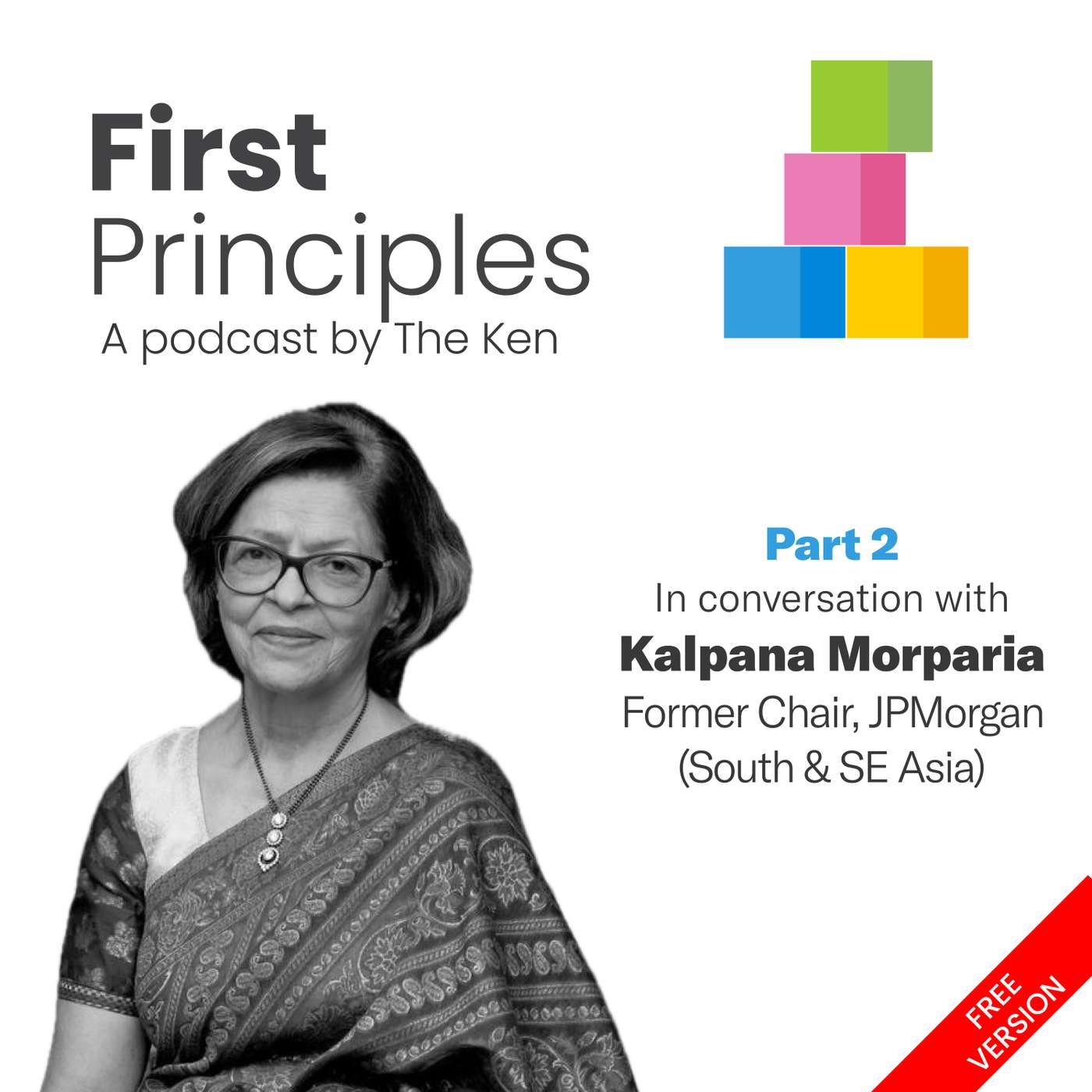
S3 Ep 10Part 2: Kalpana Morparia on the culture of dissent, the 90-day NYSE race, and why ambition requires self-redundancy
Hello, listeners, and welcome back to part 2 of the 51st episode of First Principles.Ms. Kalpana Morparia reached out to us via email after the bro-ification episode. It was the most pleasant surprise and we immediately knew we had to get her on the podcast.Here's someone who joined ICICI in 1975 as a lawyer, had absolutely no background in finance, and was then asked to run Treasury. She was terrified but her colleagues told her: "You do not say no to Mr. Kamath and live to have a great career in ICICI."So she said yes and built one of the most remarkable careers in Indian banking.She talks about the ICICI culture where contradicting the chairman wasn't just allowed, it was encouraged. A senior JPMorgan executive once said the most impressive thing about ICICI was that "the junior-most person could contradict the chairman and get away with it."She also gets candid about things most leaders don't talk about. Like why she wishes she had done an MBA. Why she has strong opinions about people's physical appearance at work and knows it's a flaw. Why her spiritual guru completely changed her relationship with the one thing she considered her biggest regret in life.She went to a Ferrari racetrack and hit 304 kmph. She believes work-life balance is nonsense and wishes every youngster would realize that life is work and work is life.Listen in for all this and more, including why she thinks India's next 30 years belong to banking, healthcare, and infrastructure. Why retirement at 60 is an outdated concept. And why on a scale of 1 to 10, she rates her happiness at 9 plus.**********This episode was produced by Uddantika Kashyap and mixed and mastered by Rajiv CN.Write to us at [email protected] with your feedback, suggestions, and guests you would want to see on First Principles.If you enjoyed this episode, please help us spread the word by sharing and gifting it to your friends and family.v
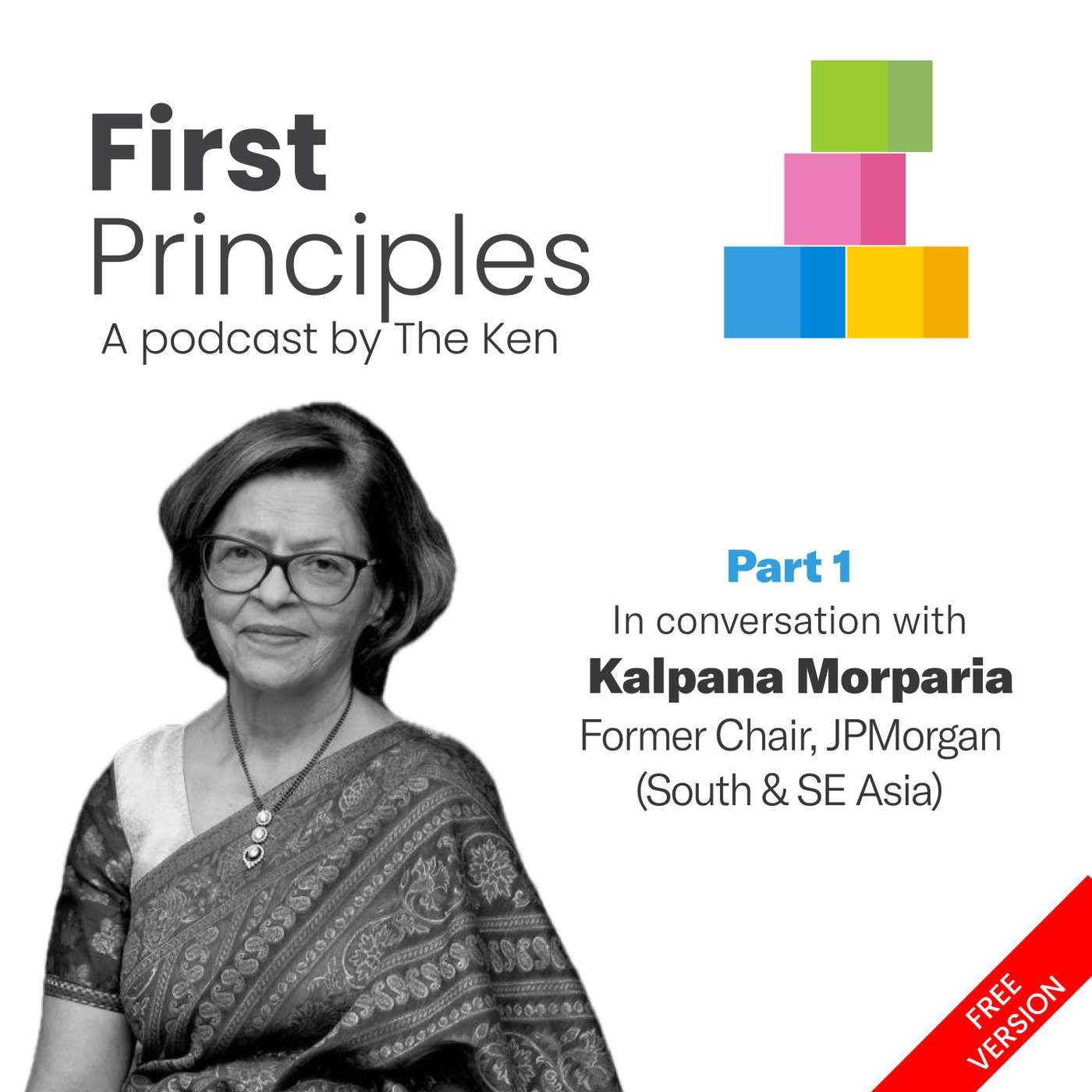
S3 Ep 10Part 1: Kalpana Morparia on the culture of dissent, the 90-day NYSE race, and why ambition requires self-redundancy
Hello, listeners, and welcome back to part 1 of the 51st episode of First Principles.Ms. Kalpana Morparia reached out to us via email after the bro-ification episode. It was the most pleasant surprise and we immediately knew we had to get her on the podcast.Here's someone who joined ICICI in 1975 as a lawyer, had absolutely no background in finance, and was then asked to run Treasury. She was terrified but her colleagues told her: "You do not say no to Mr. Kamath and live to have a great career in ICICI."So she said yes and built one of the most remarkable careers in Indian banking.She talks about the ICICI culture where contradicting the chairman wasn't just allowed, it was encouraged. A senior JPMorgan executive once said the most impressive thing about ICICI was that "the junior-most person could contradict the chairman and get away with it."She also gets candid about things most leaders don't talk about. Like why she wishes she had done an MBA. Why she has strong opinions about people's physical appearance at work and knows it's a flaw. Why her spiritual guru completely changed her relationship with the one thing she considered her biggest regret in life.She went to a Ferrari racetrack and hit 304 kmph. She believes work-life balance is nonsense and wishes every youngster would realize that life is work and work is life.Listen in for all this and more, including why she thinks India's next 30 years belong to banking, healthcare, and infrastructure. Why retirement at 60 is an outdated concept. And why on a scale of 1 to 10, she rates her happiness at 9 plus.**********This episode was produced by Uddantika Kashyap and mixed and mastered by Rajiv CN.Write to us at [email protected] with your feedback, suggestions, and guests you would want to see on First Principles.If you enjoyed this episode, please help us spread the word by sharing and gifting it to your friends and family.
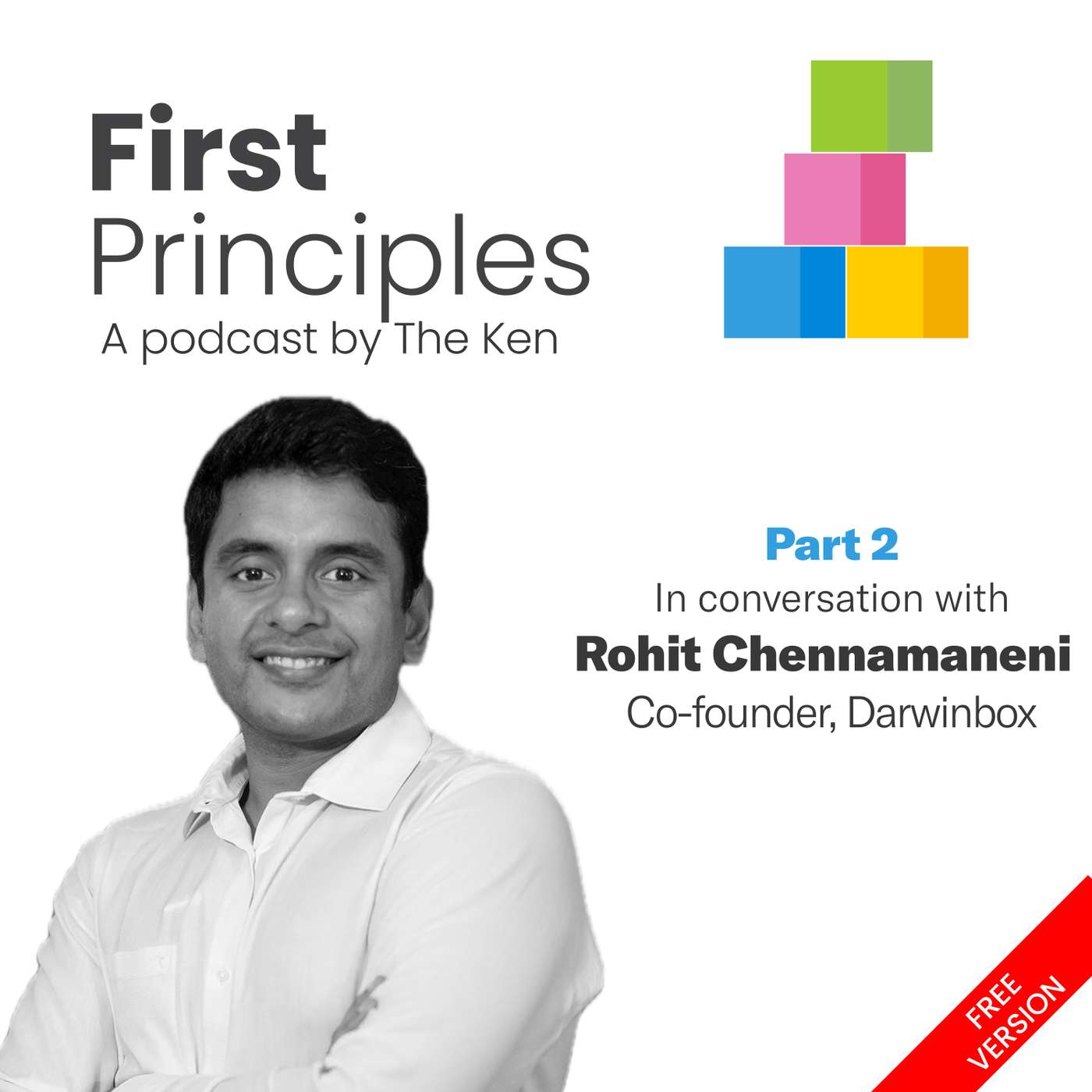
S3 Ep 9Part 2: Darwinbox’s Rohit Chennamaneni on leading without a CEO, the ‘show don’t tell’ product mindset, and why resilience beats intelligence
In the 2nd part of the 50th episode of First Principles, Rohit Chennamaneni, co-founder of Darwinbox, joins the show to talk about what changes after the early chaos of a startup fades.He explains how Darwinbox has operated without a CEO for years, how the 3 founders divide ownership of decisions instead of debating everything together, and why this structure helped them move faster as the company grew.Rohit also gets specific about product building. He talks about designing HR software that does not need training sessions or long explanations, why adoption matters more than feature depth, and how small product decisions can end up shaping behaviour across entire organisations.The conversation also turns inward. Rohit reflects on moments where intelligence stopped being the advantage he thought it was, why staying with uncomfortable problems mattered more, and how his understanding of leadership changed as Darwinbox scaled.This episode looks at company building through real decisions, and what it takes to keep going long after the excitement wears off.********This episode was produced by Uddantika Kashyap and mixed and mastered by Rajiv CN.Write to us at [email protected] with your feedback, suggestions, and guests you would want to see on First Principles.If you enjoyed this episode, please help us spread the word by sharing and gifting it to your friends and family.

S3 Ep 9Part 1: Darwinbox’s Rohit Chennamaneni on leading without a CEO, the ‘show don’t tell’ product mindset, and why resilience beats intelligence
In part 1 of the 50th episode of First Principles, Rohit Chennamaneni, co-founder of Darwinbox, joins the show to talk about what changes after the early chaos of a startup fades.He explains how Darwinbox has operated without a CEO for years, how the 3 founders divide ownership of decisions instead of debating everything together, and why this structure helped them move faster as the company grew.Rohit also gets specific about product building. He talks about designing HR software that does not need training sessions or long explanations, why adoption matters more than feature depth, and how small product decisions can end up shaping behaviour across entire organisations.The conversation also turns inward. Rohit reflects on moments where intelligence stopped being the advantage he thought it was, why staying with uncomfortable problems mattered more, and how his understanding of leadership changed as Darwinbox scaled.This episode looks at company building through real decisions, and what it takes to keep going long after the excitement wears off.********This episode was produced by Uddantika Kashyap and mixed and mastered by Rajiv CN.Write to us at [email protected] with your feedback, suggestions, and guests you would want to see on First Principles.If you enjoyed this episode, please help us spread the word by sharing and gifting it to your friends and family.
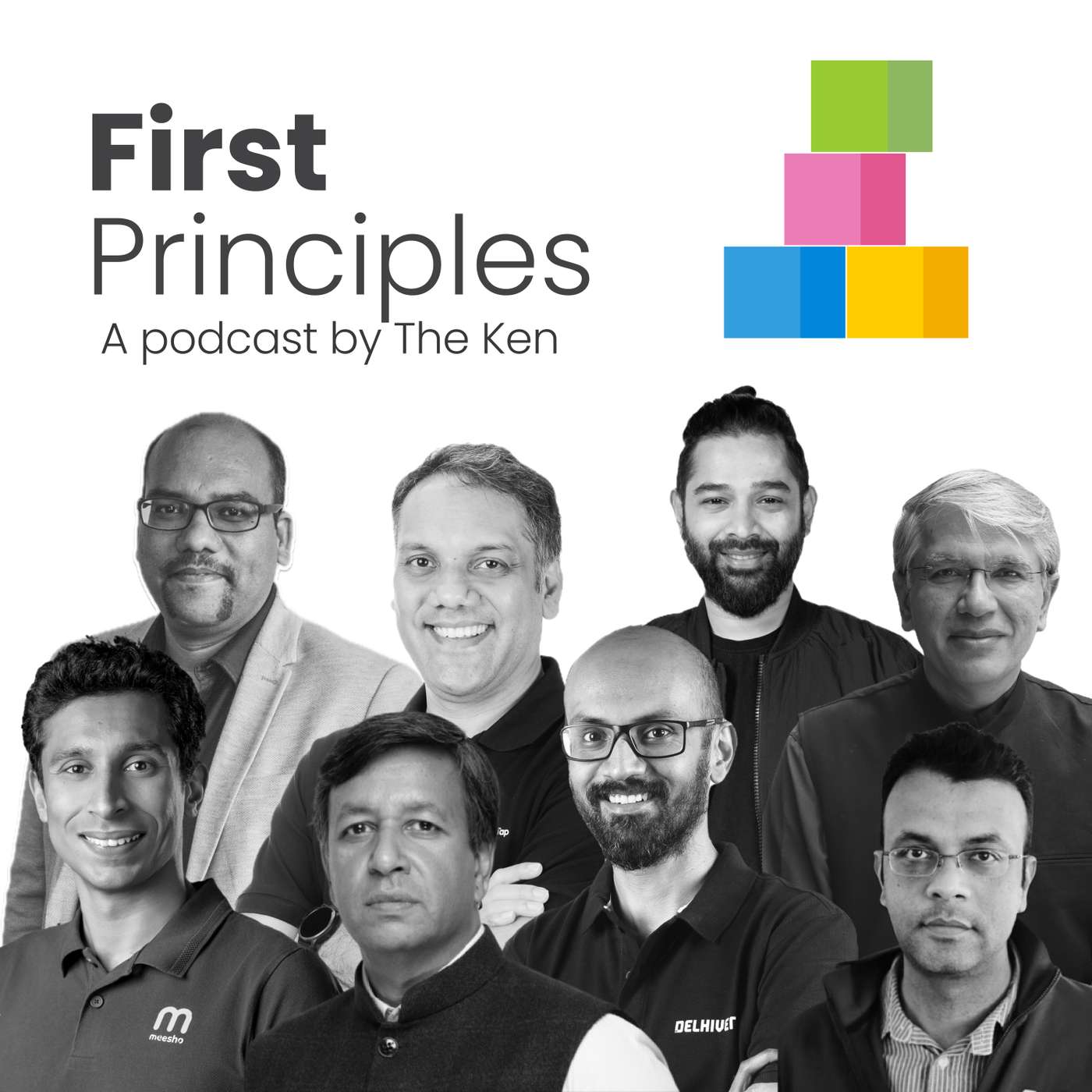
First Principles, second look: The 2025 wrap
What a year it's been.After a long hiatus and when we thought we'd closed the curtains for good, First Principles came back in April 2025 for Season 3. And what made this comeback so special? Simple: Rohin was genuinely excited to be back in the interviewing chair.That excitement is infectious. It showed up in every conversation and every question. This year, he sat down with eight incredible CEOs and founders who opened up about their journeys, their philosophies, their wins, and their struggles. These were deep, candid conversations about what it really takes to build something meaningful.In this special wrap episode, Rohin looks back at all eight conversations from 2025. He gives you the context about what it was really like sitting across from each guest, the moments that surprised him, the insights that stuck with him and then we play you the clips that mattered most. Think of it as a guided tour through the year's best moments.And here's the thing we're most proud of: First Principles has been named one of Apple's Best Shows of 2025. It's testament to you, our listeners, who make this more than just a podcast. You make it a community.And next year? It's going to be even better. More intriguing guests. More candid discussions. More first principles thinking applied.Here are all eight episodes from 2025: Episode 42: Vidit Aatrey on building a problem-first mindset into Meesho’s cultureEpisode 43: Sahil Barua on why Delhivery is the antithesis of moving fast and breaking thingsEpisode 44: Manish Sabharwal of Teamlease on creating great ancestors, India’s development journey and ‘regulatory cholesterol’Episode 45: Ultraviolette Automotive’s Narayan Subramaniam on tinkering, designing and learning by discardingEpisode 46: Anand Jain of Clevertap on starting with nothing and learning, building and leading as you go alongEpisode 47: Trilegal’s Rahul Matthan on the firm, the partnership, and the principlesEpisode 48: Indiagold’s Deepak Abbot on turning a nation’s ‘dead asset’ into credit scores and working capitalEpisode 49: Ixigo’s Aloke Bajpai on using empathy, customer experience, and resilience to both survive and thrive______Once again, thank you for listening to First Principles. Check out our newsletter and discover more at here. You can email us at [email protected] to share your thoughts, suggestions or anything else.This episode was produced by Uddantika Kashyap and mixed and mastered by Rajiv CN, our in-house audio engineer.See you next year,Team First Principles