Fieldnotes - The Anthropology Podcast
Anthropology Department - University of Sussex
Show overview
Fieldnotes - The Anthropology Podcast launched in 2025 and has put out 9 episodes in the time since. That works out to roughly 5 hours of audio in total. Releases follow a monthly cadence.
Episodes typically run twenty to thirty-five minutes — most land between 29 min and 41 min — though episode length varies meaningfully from one episode to the next. It is catalogued as a EN-language Education show.
There hasn’t been a new episode in the last ninety days; the most recent episode landed 3 months ago. Published by Anthropology Department - University of Sussex.
From the publisher
Fieldnotes is a new initiative from the Department of Anthropology at the University of Sussex. Each episode opens a window into the worlds our faculty move through – social, visual and cultural anthropology in all their messy, thoughtful, field-based forms.We sit with anthropologists as they reflect on their journeys, the moments that shaped them, the ideas that keep them awake at night and the questions they continue to carry into their research. From sensory encounters in the field to the politics of representation, memory and everyday life, Fieldnotes brings you conversations that are intimate, grounded and curious.This is a space for students, researchers and anyone who wants to understand how anthropology actually happens – through lived experience, careful listening and the slow work of paying attention.Join us as we follow the threads of stories, archives, images and relationships that make anthropology at Sussex what it is: open, critical, creative and deeply human.
Latest Episodes
Engaged Anthropology, Development and the Meanings of Violence with Dr Lyndsay McLean
Visual Storytelling, Memory and Afghanistan with Moska Najib
Labour, Inequality and the Human Lives Behind Global Fashion with Dr Rebecca Prentice
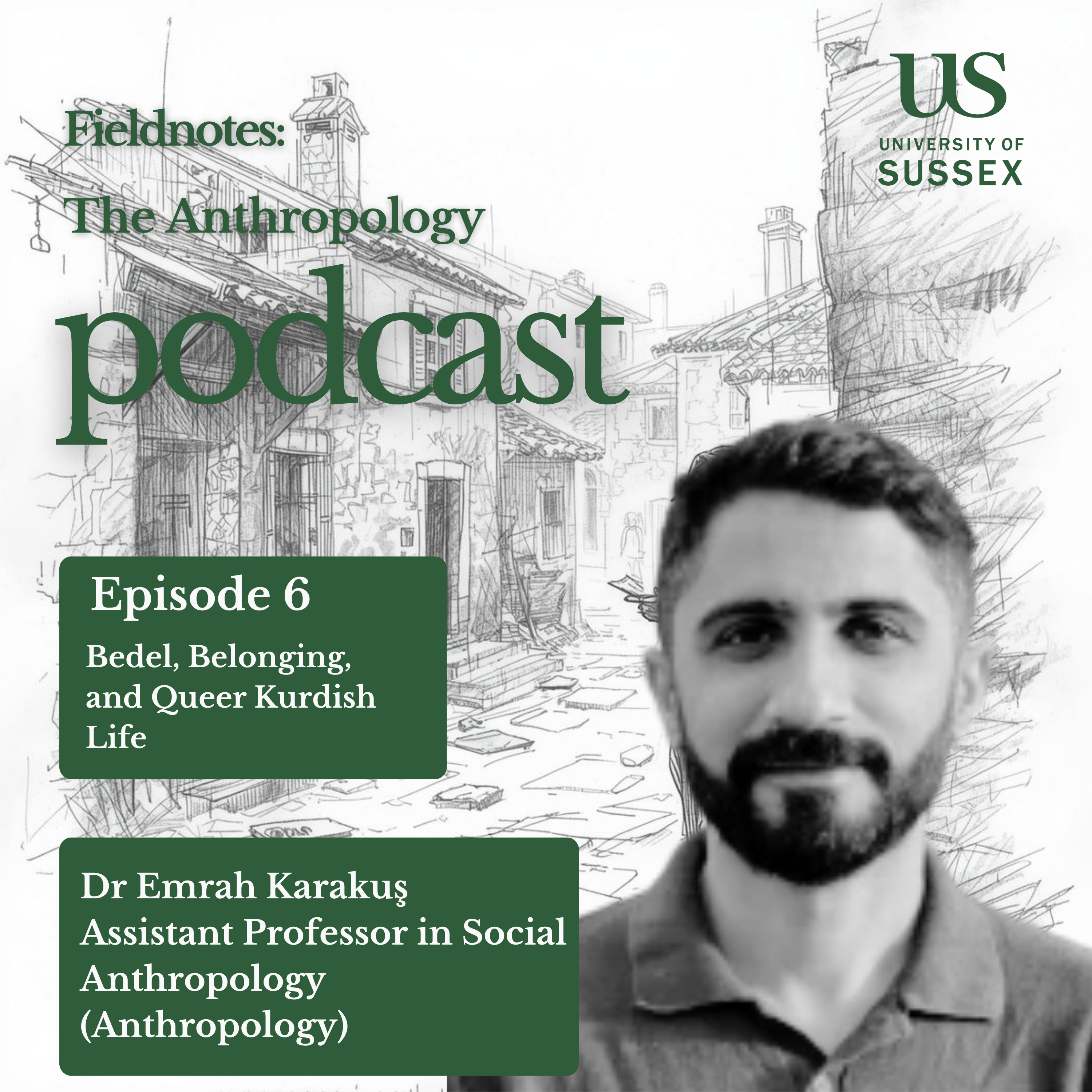
S1 Ep 6Field Notes: Bedel, Belonging, and Queer Kurdish Life with Dr Emrah Karakuş
In this episode of Field Notes, host Sam speaks with Dr Emrah Karakuş about queer and trans Kurdish life, intimacy and affect as political terrains, and the ethical stakes of ethnographic research. From a working-class Kurdish background to an interdisciplinary anthropological journey, Dr Karakuş reflects on how care, struggle, obligation, and belonging shape both scholarship and lived experience.The conversation explores the Kurdish concept of bedel—the cost, sacrifice, and responsibility carried in collective struggle—and asks what it reveals about queer and trans lives, political community, and the meaning of freedom. The episode also touches on fugitive ethnography, visibility and danger, and what it means to treat Kurdish histories and concepts not just as subjects of study, but as theory.Read more about his work here: https://profiles.sussex.ac.uk/p666622-emrah-karakus
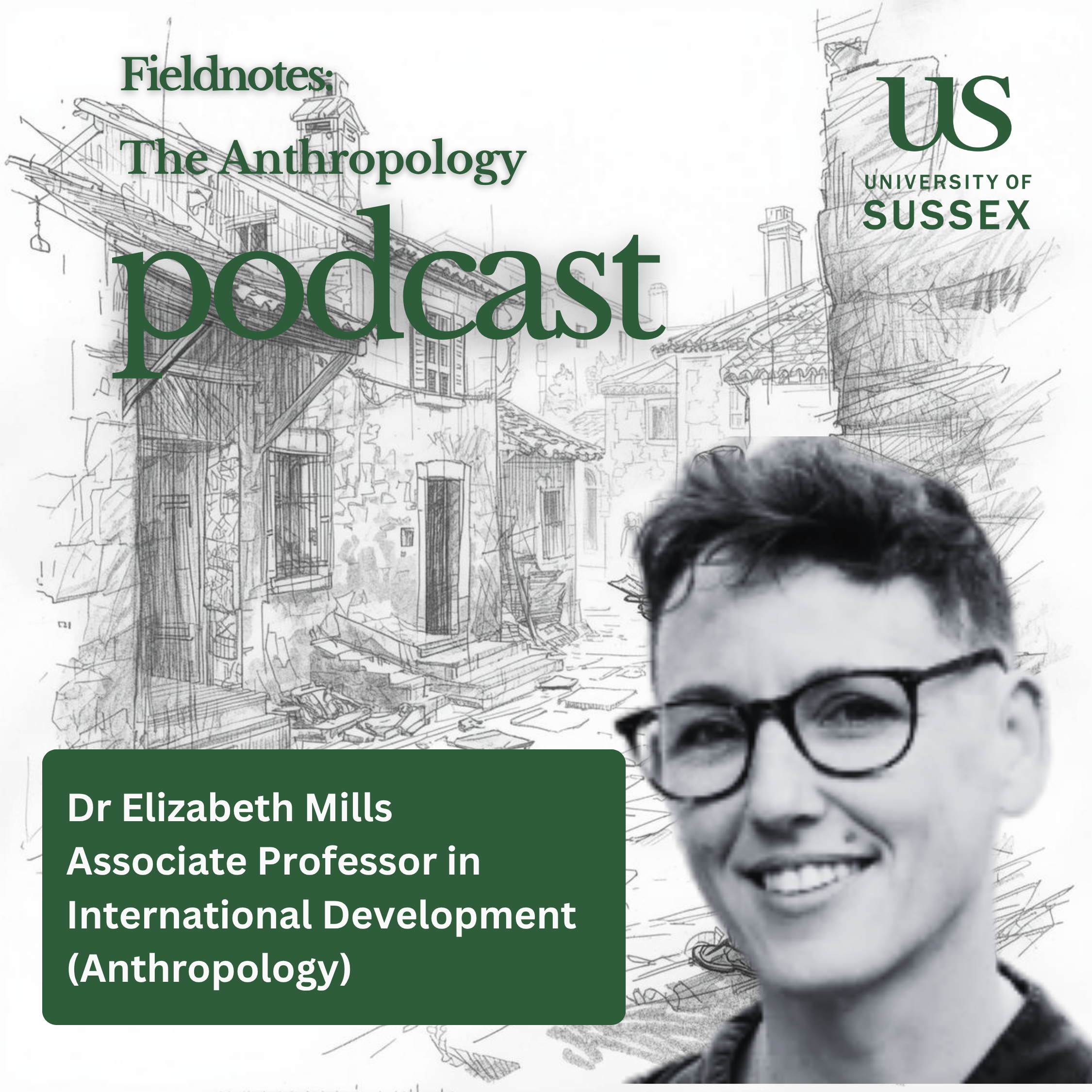
S1 Ep 5Listening to the Body: Health, Inequality and Anthropology with Dr Elizabeth Mills
In this episode of Field Notes: The Sussex Anthropology Podcast, Sana Batool speaks with Elizabeth Mills, Associate Professor in Anthropology and International Development at the University of Sussex. Beth reflects on how she first found anthropology in South Africa during a time of HIV activism and political urgency, and how that experience shaped her lifelong commitment to understanding health, gender, precarity and policy.The conversation explores Beth’s research across South Africa, the UK, the US and Yemen, looking at how policies and institutions shape everyday embodied experiences of inequality. She discusses why anthropology and international development belong in conversation with one another, and how methods such as participatory photography, film and body mapping can reveal what words alone often cannot.From HIV activism and state neglect to reproductive justice, queer family-making and the politics of care, this episode offers a powerful reflection on what it means to hold systems accountable while staying close to lived experience. It is also a hopeful conversation about students, teaching, and why anthropology still matters in making sense of urgent social worlds.Contact Dr Elizabeth Mills here: https://profiles.sussex.ac.uk/p226593-elizabeth-mills
S1 Ep 4Anthropology, Fieldwork & Global Challenges – A Conversation with Prof. Geert De Neve
In this episode, Dr Syeda Sana Batool spoke with Professor Geert De Neve, Head of the School of Global Studies at the University of Sussex. Trained initially in economics before turning to anthropology, Prof. De Neve shares what drew him to the discipline and how it continues to shape his understanding of the world. Drawing on decades of fieldwork in South India, he reflects on the complex realities of work, inequality, and everyday life, and how these local experiences connect to global issues like climate change, migration, and digital labour.We also explore the role of fieldwork in anthropology, what makes studying the subject at Sussex unique, and how students can approach communities with care and ethics. From leadership insights to student advice, this conversation offers valuable perspectives for anyone interested in anthropology, social justice, and global change.
S1 Ep 3Faith, Feeling, and the Future: Exploring Spiritual Worlds with Dr Gareth Breen
In this episode of Fieldnotes: The Sussex Anthropology Podcast, host Dr Syeda Sana Batool speaks with Dr Gareth Breen, Assistant Professor of Anthropology at the University of Sussex. Gareth’s work moves fluidly between transnational religious networks, emerging spiritual academies in China, psychotherapy, and the speculative horizons of AI.They begin with Gareth’s long-term research on the global Christian movement led by Witness Li, then move through China’s grassroots “shuyuan” (spiritual academies), where people seek to rediscover the essence of Chinese civilisation. The conversation also explores how anthropological inquiry can extend into therapy, how psychotherapy and ethnography inform one another, and why AI is now entering spiritual and ethical imaginaries.This episode offers a wide-ranging, deeply thoughtful exploration of belief, healing, and human connection across cultures — and what anthropology can bring to rapidly changing times.
S1 Ep 2Moving Worlds: Time, Trade, and Medical Travel with Dr Diana Ibáñez-Tirado
In this episode of Fieldnotes: The Sussex Anthropology Podcast, host Dr Syeda Sana Batool sits down with Dr Diana Ibáñez-Tirado, Lecturer in Anthropology at the University of Sussex and a beloved figure in the department. With research spanning Tajikistan, Russia, Turkey, and beyond, Diana shares the story behind her non-linear academic journey — from studying International Relations and Russian to becoming an anthropologist of time, trade, and medical mobility.Together, they discuss what connects her seemingly diverse projects, the ethical and practical dimensions of fieldwork across regions, and how gender and care subtly shape her work. Diana also offers a glimpse into her forthcoming book From the Heart of Kulob, and reflects on what excites her about the future of anthropology.Whether you're planning your own fieldwork, thinking about cross-cultural research, or just curious about how anthropologists make sense of global movement and everyday life — this episode offers a thoughtful and inspiring listen.
S1 Ep 1Travelling Through Frontiers: Global Lives, Local Worlds — with Professor Magnus Marsden
In the very first episode of Fieldnotes: The Sussex Anthropology Podcast, host Dr. Sana Batool, Assistant Prof. of Visual Anthropology speaks with Professor Magnus Marsden, Head of Anthropology at the University of Sussex, about his decades-long work tracing how people, goods, and ideas travel across borders.From the dusty roads of northern Pakistan to the global fur markets of Central Asia, Magnus shares insights from his upcoming book The Sheep Roads of Central Asia and reflects on what Karakul traders can teach us about cosmopolitanism, mistrust, and everyday life in borderlands.We also explore his collaborative work with artists, and his latest research into the lives of Afghan Hindu, Sikh, and Jewish communities across Europe and Asia. This conversation is a rich introduction to what anthropology can uncover when it listens to lives lived in motion.Themes: transnational trade, borderlands, fieldwork, cosmopolitanism, minority communities, anthropology and artGuest: Professor Magnus Marsden Host: Dr. Syeda Sana Batool. Explore More of Magnus Marsden’s Work: Magnus's work:The Karakul Project (Sheep Roads of Central Asia):https://www.hurstpublishers.com/book/the-sheep-roads-of-central-asia/Academic profile – University of Sussex:https://profiles.sussex.ac.uk/p318109-magnus-marsdenAfghan Traders and Central Asia (Beyond the Silk Roads Project):https://www.amazon.co.uk/Beyond-Silk-Roads-Geopolitics-Connections/dp/1108838316Selected publications via ResearchGate:https://www.researchgate.net/profile/Magnus-MarsdenExhibition Collaboration – Musafari at HKW, Berlin:https://www.hkw.de/en/programm/projekte/veranstaltung/p_215254.php