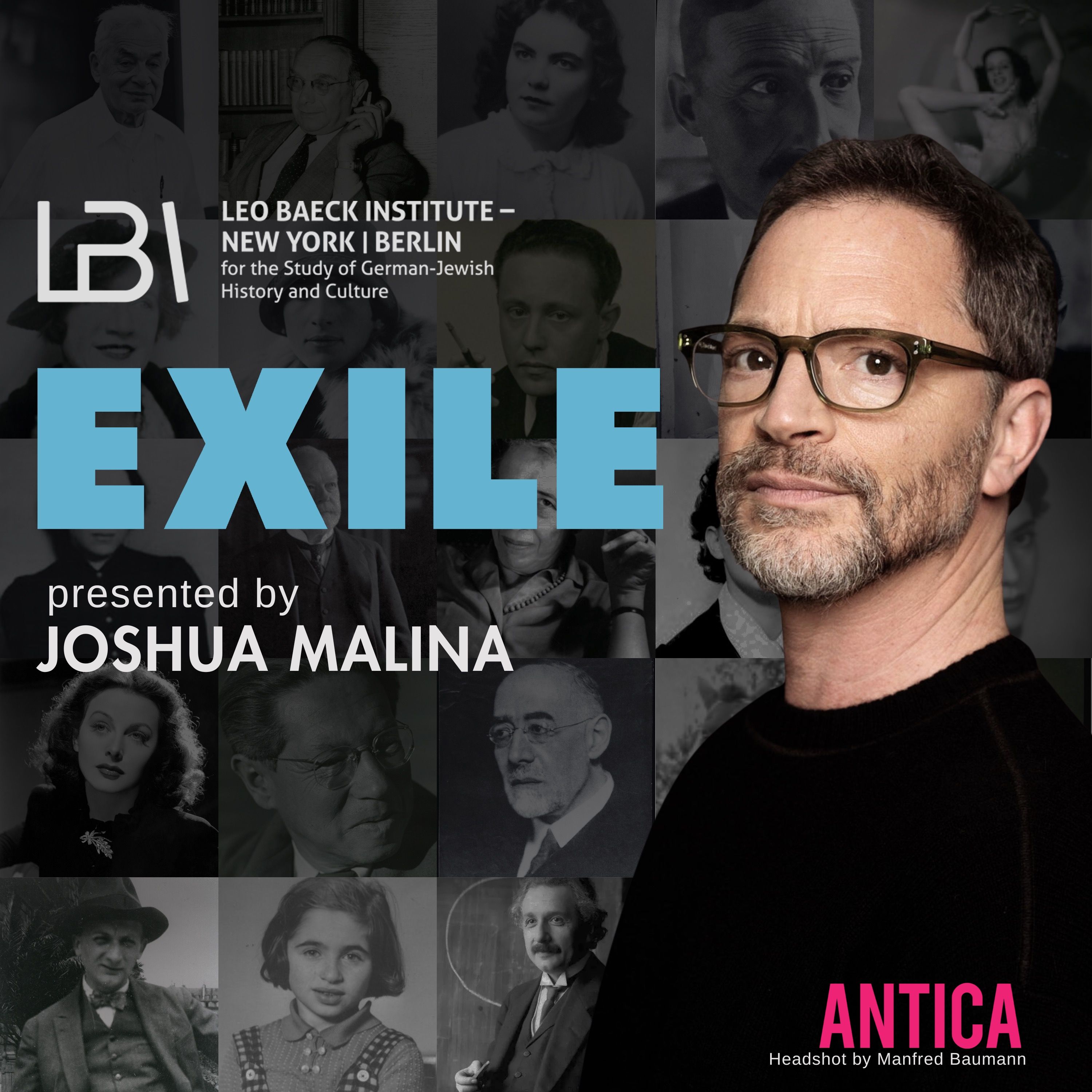
Exile
Leo Baeck Institute – New York | Berlin and Antica Productions · Antica Productions
Show overview
Exile has been publishing since 2022, and across the 4 years since has built a catalogue of 55 episodes, alongside 11 trailers or bonus episodes. That works out to roughly 30 hours of audio in total. Releases follow a monthly cadence, with the show now in its 5th season.
Episodes typically run twenty to thirty-five minutes — most land between 29 min and 40 min — and the run-time is fairly consistent across the catalogue. None of the episodes are flagged explicit by the publisher. It is catalogued as a EN-language History show.
There hasn’t been a new episode in the last ninety days; the most recent episode landed 4 months ago. Published by Antica Productions.
From the publisher
Welcome to Exile, a podcast about Jewish lives under the shadow of fascism. Narrated by award-winning screen and stage actor, Joshua Malina. Untold stories and firsthand accounts drawn from intimate letters, diaries and interviews found in the Leo Baeck Institute’s vast archive. Each episode, a story of beauty and danger that brings history to life. Because the past is always present. Starting February 24, episodes are released weekly every Tuesday. The Leo Baeck Institute, New York | Berlin is a research library and archive focused on the history of German-speaking Jews. Antica Productions produces award-winning non-fiction podcasts, films and series which inform and inspire audiences around the world.
Latest Episodes
View all 55 episodesBehind the scenes of “Exile”
Leo Baeck Part 2: The Teacher of Theresienstadt
S5 Ep 7Leo Baeck Part 1: The Soft-Spoken Sage
Rabbi Leo Baeck looms large in German-Jewish history, but he began his career as a smalltown rabbi in present-day Poland. Baeck quickly earned a reputation for moral clarity and quiet resolve, even in the face of a powerful opposition. As World War I gave way to the rise of the Nazis, the pressures on German Jewry intensified, and Baeck was thrust into an impossible role: guiding a community through its most dangerous and devastating hour. This is the first chapter of a two-part story.
S5 Ep 6Lion Feuchtwanger: From Moscow to Hollywood
In 1933, German author Lion Feuchtwanger wrote the first ever novel about the experience of Jews under Hitler. The book became a global sensation. When he finally received an offer in 1938 to adapt his most popular book for the screen in Stalin’s Russia, he jumped at the chance. The film was a success, but the decision would come to haunt him when he lived in California during the Red Scare. The Lion Feuchtwanger Collection in the LBI Archives contains a small amount of original correspondence, manuscripts for a translation of Lysistrata, and an essay on the historical consciousness of the Jews. Lion Feuchtwanger also appears in the extensive papers of his brother Ludwig, which are held by the LBI Archives. Learn more at lbi.org/feuchtwanger
S5 Ep 5Growing Up at the Berlin Zoo
In the late 1930s, one of the few places in Berlin that still allowed Jewish visitors was the Zoological Garden, which was established with the support of many Jewish donors. As antisemitic laws took over elsewhere, the Zoo remained a space for community and childhood joy. Eventually, however, even the Zoo would betray the Jews. Sixty years later, one man with fond memories of the zoo realized that an injustice had occurred against his family, and did everything he could to right the wrongs of the past. The James Cohn Collection in the LBI archives documents his father Dr. Werner Cohn’s battle for restitution of his family’s share in the Berlin Zoo, including correspondence with Zoo officials in 2000. The Papers of Gerald M. Friedman, a former Trustee of the LBI, also document his family’s efforts dating back to the 1960s to recover Zoo shares. They include copies of the entire family’s photographic Zoo membership cards. Learn more at lbi.org/zoo
S5 Ep 4Hannah Arendt: Origins of a Controversy
Hannah Arendt’s life was shaped by exile. The German-Jewish thinker was forced to flee Nazi Germany as a young woman, and her experience of statelessness impacted her academic and political pursuits for the rest of her life. Independent and single-minded from an early age, Hannah’s intense commitment to her own moral responsibility carried her through anti-Nazi activism, years of exile, and a controversy that shook up the German-Jewish intellectual world. Hannah Arendt was deeply involved in the early activities of LBI New York after it was founded in 1955. However, her papers are at the Library of Congress and her personal library is at Bard College. One significant collection in the LBI Archives that does bear her name is the “Hannah Arendt Eichmann in Jerusalem Collection”, which holds clippings documenting the furious response to her 1963 book in papers ranging from Aufbau to the Congregation Habonim Bulletin to the New Republic. Another collection of correspondence documents the response of the LBI and other German-Jewish organizations to Eichmann before the book’s publication in German. Learn more at lbi.org/arendt
S5 Ep 3Manfred George’s Aufbau: Reconstructing the News
In 1930s New York, there was only one publication that fully covered the worsening situation for Jews in Europe: the Aufbau. With a daring approach to journalism, editor Manfred George transformed the tiny newsletter of a German-Jewish social club into a lifeline for a worldwide community of refugees. His paper also reported on the atrocities unfolding in Hitler’s Germany long before the mainstream press. The Aufbau held together a community strained past the breaking point, and helped its local readers integrate as Americans. It was a project so successful that it could not last. In addition to the complete run of Aufbau from 1934–2004, which the LBI has digitized and made freely accessible online, our collections include the papers of Norbert and Lilo Goldenberg, the publishers of Aufbau. Learn more at lbi.org/aufbau
S5 Ep 2Hedy Lamarr: Beauty and Brains
In 1937, a young Austrian-Jewish actor named Hedwig Kiesler left Europe to pursue her dream in America. Within months, she became one of the biggest stars of the Golden Age of Hollywood: Hedy Lamarr. Known as “the most beautiful woman in the world,” Hedy’s unforgettable face and mysterious allure would take her far in the film industry – but that wasn’t her only success story. In fact, her greatest achievement was an invention that transformed the technology that powers our world. LBI Collections include rich materials on German-speaking Jewish immigrants and refugees in the Hollywood film industry, from Universal Pictures founder Carl Laemmle to director Ernst Lubitsch to film composer Erich Wolfgang Korngold to actors like Peter Lorre and Hedy Lamarr. Learn more at lbi.org/hollywood
S5 Ep 1Vera Haymann’s "Theater in Chains"
This episode is dedicated to the memory of Winnie Meyer-Ricard, the eldest daughter of Vera Haymann and Herbert Meyer-Ricard. After nightfall in German-occupied Amsterdam, a small group of friends risked their lives to engage in a unique form of resistance: puppet theater. Behind the darkened windows of a safe-house, marionettes built by graphic designers Vera Haymann and Herbert Meyer-Ricard acted out biting satires of the bitter circumstances unfolding outside. This “fettered theater” gave the audience a glimmer of hope and solidarity in a time of darkness. The Hermann Haymann Collection in the LBI Archives includes two vivid, hand-illustrated booklets which document Vera Haymann and Herbert Mayer-Ricard’s life in hiding in Amsterdam. See them online at lbi.org/haymann
Exile: Season 5 is coming soon
trailerJoin us for Exile Season 5 – another collection of compelling stories of Jewish lives under the shadow of fascism, drawn from the Leo Baeck Institute’s vast archive. Narrated by critically-acclaimed actor Joshua Malina. Starting February 24, episodes are released every Tuesday. The Leo Baeck Institute is a research library and archive focused on the history of German-speaking Jews. Antica Productions is an award-winning production company based in Toronto that believes in the power of purpose-driven storytelling to change the world.
Best of Exile: The Artist Who Made Beauty Out of Destruction
bonusFor more information about the exhibit, please visit: https://www.lbi.org/exhibitions/schames-exhibit/
Best of Exile: “Hopefully It’s Not Too Late By Then"
bonusAs we prepare our fifth season of Exile, we’re looking back at our favorite episodes from seasons 1-4. Each re-release brings back a unique, fascinating, and often heart-wrenching story from the Leo Baeck Institute Archives. Robert Bachrach is a buttoned-up doctor and dedicated researcher. Leo Hochner is a bon-vivant and art connoisseur who breeds small dogs. Both bachelors, they are part of a close network of friends from Vienna who are scattered across the globe after the Nazis take power in Austria. When Robert takes his life in New York after a humiliating arrest under New York’s anti-gay laws, he directs his final words to Leo, who was still trapped in Nazi-occupied Budapest. We follow the traces they left in the LBI archives to uncover an incredible story of heartbreak and heroism. For Robert, escaping the Nazis didn’t mean an end to discrimination, persecution, or fear. Learn more www.lbi.org/bachrach-hochner. Exile is a production of the Leo Baeck Institute, New York and Antica Productions. It’s narrated by Mandy Patinkin. This episode was produced by Nadia Medhi. Our executive Producers are Laura Regehr, Rami Tzabar, Stuart Coxe, and Bernie Blum. Our associate producer is Emily Morantz. Research and translation by Isabella Kempf. Voice acting by Isabella Kempf, Cyrus Lane, and Manuel Mairhofer. Sound design and audio mix by Philip Wilson. Theme music by Oliver Wickham. Special thanks to Anna Lvovsky, Brian Ferree, Hannes Sulzenbacher, Clarissa Hochner, and Diana Bulman. Thanks also to Victor Sattler, who wrote about Robert and LAY-oh as part of the LBI’s literary project, “Stolpertexte”, and whose essay lent our episode its title and opening scene. This episode of Exile is made possible in part by a grant from the Conference on Jewish Material Claims Against Germany, which is supported by the German Federal Ministry of Finance and the Foundation Remembrance, Responsibility and Future.
Best of Exile: Jackie Gerlich - The Road From Vienna to Oz
bonusAs we prepare our fifth season of Exile, we’re looking back at our favorite episodes from seasons 1-4. Each re-release brings back a unique, fascinating, and often heart-wrenching story from the Leo Baeck Institute Archives. Leo Fuks is a born performer. So when, in 1936, a vaudeville impresario shows up to recruit him, 10-year-old Leo is more than happy to join his troupe, and his parents reluctantly agree. As Leo, now known as Jackie Gerlich, travels the world and dips his toes into Hollywood, his family is left behind to grapple with the terror of rising antisemitism in Vienna. After years without contact, Leo’s mother is shocked to see her son dancing on screen in The Wizard of Oz—and she resolves to do everything she can to get her son back. Learn more at www.lbi.org/gerlich. Exile is a production of the Leo Baeck Institute, New York and Antica Productions. It’s narrated by Mandy Patinkin. This episode was produced by Emily Morantz. Our executive Producers are Laura Regehr, Rami Tzabar, Stuart Coxe, and Bernie Blum. Our associate producer is Emily Morantz. Research and translation by Isabella Kempf. Voice acting by Cyrus Lane. Sound design and audio mix by Philip Wilson. Theme music by Oliver Wickham. Special thanks to the Bentley Historical Library and the Syracuse University Special Collections Research Centre. This episode of Exile is made possible in part by a grant from the Conference on Jewish Material Claims Against Germany, which is supported by the German Federal Ministry of Finance and the Foundation Remembrance, Responsibility and Future.
Best of Exile: Before Dr. Ruth
bonusAs we prepare our fifth season of Exile, we’re looking back at our favorite episodes from seasons 1-4. Each re-release brings back a unique, fascinating, and often heart-wrenching story from the Leo Baeck Institute Archives. Known for her candid talk and blunt advice about sex, Dr. Ruth Westheimer is the world’s most renowned psychosexual therapist. But beneath her joyful demeanor is a chaotic story about her youth—a girl named Karola Ruth Siegel left orphaned and stateless. How does she harness all of this uncertainty - and the sexual awakenings of adolescence - to make it in the world? Dr. Ruth shared her diary for the first time with the Leo Baeck Institute – and with all of you – for this episode of Exile. We are grateful for her generosity with her time and her story – and for the decades of sound advice. Learn more at www.lbi.org/westheimer. Exile is a production of the Leo Baeck Institute, New York | Berlin and Antica Productions. It’s narrated by Mandy Patinkin. Executive Producers include Katrina Onstad, Stuart Coxe, and Bernie Blum. Senior Producer is Debbie Pacheco. Produced by Brian Rice. Associate Producers are Hailey Choi and Emily Morantz. Research and translation by Isabella Kempf. Sound design and audio mix by Philip Wilson, with help from Cameron McIver. Additional sound by Violet Lucca. Theme music by Oliver Wickham. Voice acting by Lucy Hill. Special thanks to Cliff Rubin, Barbara Schmutzler for translating Dr. Ruth’s diaries, Dr. Ruth and Ben Yagoda for All in a Lifetime, and Soundtrack New York.
Best of Exile: Love in the Time of Fascism
bonusAs we prepare our fifth season of Exile, we’re looking back at our favorite episodes from seasons 1-4. Each re-release brings back a unique, fascinating, and often heart-wrenching story from the Leo Baeck Institute Archives. In Nazi-occupied Austria, a young man named Kurt Kleinmann comes up with a plan to escape: write to Americans - strangers - who share his last name and ask for help to get a visa. Just as he begins to lose hope, he gets a response from New Yorker Helen Kleinman. Little does he know, Helen will save his life…and capture his heart. The Kurt and Helen Kleinmann Collection in the Leo Baeck Institute Archives includes Helen and Kurt’s entire correspondence - hundreds of letters - from 1938 and 1939, plus telegrams and other material documenting Kurt’s emigration. Learn more at www.lbi.org/kleinmann. Exile is a production of the Leo Baeck Institute, New York | Berlin and Antica Productions. It’s narrated by Mandy Patinkin. Executive Producers include Katrina Onstad, Stuart Coxe, and Bernie Blum. Senior Producer is Debbie Pacheco. Produced by Emily Morantz. Associate Producer is Hailey Choi. Research and translation by Isabella Kempf. Sound design and audio mix by Philip Wilson, with help from Cameron McIver. Theme music by Oliver Wickham. Voice acting by Heather Hedley and David Walpole. Special thanks to Len and Joanne Deutchman and the whole Kleinman(n) family, and to Soundtrack New York.
Best of Exile: Summer in Caputh
bonusAs we prepare our fifth season of Exile, we’re looking back at our favorite episodes from seasons 1-4. Each re-release brings back a unique, fascinating, and often heart-wrenching story from the Leo Baeck Institute Archives. At the height of his fame, a shirtless, barefooted Albert Einstein escapes the bustle of Berlin for a simpler life. The best thinkers of the time gather at his beloved summer house in Caputh to laze by the water, swap ideas, and gossip. There, he can escape the pressures of global fame, but his summer haven can’t keep him safe from the growing Nazi movement bubbling in Germany. The Albert Einstein Collections in the Archives of the Leo Baeck Institute in New York include hundreds of Einstein’s personal photographs, many from Caputh, as well as the Guestbook from his summer home. After a few pages bearing the signatures of the friends and international luminaries who visited the Einsteins those short summers before 1933, most of the pages remain blank. You can see the Collections at www.lbi.org/caputh. Exile is a production of the Leo Baeck Institute, New York | Berlin and Antica Productions. It’s narrated by Mandy Patinkin. Executive Producers include Katrina Onstad, Stuart Coxe, and Bernie Blum. Senior Producer is Debbie Pacheco. Produced by Emily Morantz. Associate Producer is Hailey Choi. Research and translation by Isabella Kempf. Sound design and audio mix by Philip Wilson with help from Cameron McIver. Additional sound by Kevin Caners. Theme music by Oliver Wickham. Voice acting by Jillian Rees-Brown. Thank you to Outloud Audio; Erika Britzke of the Einstein Forum in Potsdam; Michael Grüning’s, “A House for Albert Einstein”; Friedrich Hernick’s “Einstein at Home” translated by Josef Eisinger; The Albert Einstein Archives at the Hebrew University of Jerusalem; The New York Times; and the Max Planck Society.
Best of Exile: Librarian Turned Spy
bonusAs we prepare our fifth season of Exile, we’re looking back at our favorite episodes from seasons 1-4. Each re-release brings back a unique, fascinating, and often heart-wrenching story from the Leo Baeck Institute Archives. A young, Jewish librarian in New York named Florence Mendheim risks her life to spy on the growing Nazi movement in America. She passes herself off as a Nazi sympathizer, documenting the movement’s nefarious activities. Everything is on the line—her family, her work and her life—to try to halt hate in its tracks. As Nazism becomes a gathering storm, will she get out of the spy game before she’s caught? The Florence Mendheim Collection in the Archives of the Leo Baeck Institute in New York contains: her reports and correspondence with the Stephen Wise Free Synagogue and the American Jewish Congress, American pro-Nazi and white supremacist propaganda she collected during her spy work, her personal letters, and some of Florence’s unpublished novels. Go to www.lbi.org/mendheim. Exile is a production of the Leo Baeck Institute, New York | Berlin and Antica Productions. It’s narrated by Mandy Patinkin. Executive Producers include Katrina Onstad, Stuart Coxe, and Bernie Blum. Senior Producer is Debbie Pacheco. Produced by Lisa Gabriele. Associate Producers are Hailey Choi, Jacob Lewis, and Emily Morantz. Research and translation by Isabella Kempf. Sound design and audio mix by Philip Wilson. Theme music by Oliver Wickham. Voice acting by Isabel Kanaan. Thank you to Outloud Audio, WNYC Archives, the Jacob Rader Marcus Center of the American Jewish Archives at Hebrew Union College, UCLA Film & Television Archive, the New York Times, and eFootage.
S4 Ep 6Episode 24: Breaking Atoms, Breaking Barriers
At the dawn of the 1930s, Germany is a physics powerhouse, where great minds like Albert Einstein and Max Planck have revolutionized the scientific landscape. But a talented young physicist named Trude Goldhaber struggles to make her voice heard in a male-dominated field. Trude perseveres, despite the pressures of antisemitism and misogyny all around her. Forced to work in the shadow of her scientist husband, she contributes to research and discoveries that help create the most dangerous weapon known to mankind. Later, when Trude finally makes a name for herself, she does everything in her power to lift up the young women following in her footsteps. Thanks to a grant from the American Institute of Physics and funds from the German Foreign Office, LBI processed and digitized the approximately 19 linear feet of Trude’s papers, which consist of notes, graphs and diagrams, original data, and correspondence related to her research between 1930 and 2000. Maurice Goldhaber’s papers are awaiting processing. Learn more at lbi.org/goldhaber. Exile is a production of the Leo Baeck Institute, New York and Antica Productions. It’s narrated by Mandy Patinkin. This episode was written by Clem Hitchcock and Rami Tzabar. Our executive producers are Laura Regehr, Rami Tzabar and Stuart Coxe, and Bernie Blum. Our producer is Emily Morantz. Research and translation by Isabella Kempf. Voice acting by Hannah Gelman. Sound design and audio mix by Philip Wilson. Theme music by Oliver Wickham. Special thanks to the Physics World Weekly podcast, and to David Olson from the Oral History Archives at Columbia University. Please consider supporting the work of the Leo Baeck Institute with a tax-deductible contribution by visiting lbi.org/exile2025. This episode of Exile is made possible in part by a grant from the Conference on Jewish Material Claims Against Germany, which is supported by the German Federal Ministry of Finance and the Foundation Remembrance, Responsibility and Future.
S4 Ep 5Episode 23: Song of Resistance
For Karl Adler, there is nothing more powerful than music. While recovering from an injury sustained as a soldier in World War I, Karl pursues his goal of changing the way music is taught in Germany. And for a while, he’s successful – until a former student (and member of Hitler’s Brownshirts) falsely reports him for sexual harassment. Forced to start over, Karl devotes himself to creating a new cultural association for German Jews. As antisemitic laws take hold and Jews begin to flee Germany en masse, Karl continues to connect people through music – even as the world falls apart around him. The Karl Adler collection at LBI documents his entire career, including his engagement at the Royal Court Opera of Wurttemberg, his WWI service, and his work with the Conservatory and the Jewish Culture League in Stuttgart. Records of the Jüdische Mittelstelle show Adler intervening with the Gestapo on behalf of Jewish families seeking news of their husbands and fathers who had disappeared or been arrested. A folder of materials he collected about the Jewish history of Buttenhausen includes a photograph of Adler, his voice raised in song, at the dedication of his native town’s Holocaust memorial in 1961. Learn more at lbi.org/adler. Exile is a production of the Leo Baeck Institute, New York and Antica Productions. It’s narrated by Mandy Patinkin. This episode was written by Nadia Mehdi. Our executive producers are Laura Regehr, Rami Tzabar, Stuart Coxe, and Bernie Blum. Our producer is Emily Morantz. Research and translation by Isabella Kempf. Voice acting by Cyrus Lane and David Walpole. Sound design and audio mix by Philip Wilson. Theme music by Oliver Wickham. Please consider supporting the work of the Leo Baeck Institute with a tax-deductible contribution by visiting lbi.org/exile2025. This episode of Exile is made possible in part by a grant from the Conference on Jewish Material Claims Against Germany, which is supported by the German Federal Ministry of Finance and the Foundation Remembrance, Responsibility and Future.
S4 Ep 4Episode 22: Simson & Co: A Family Forged in Steel
The Simson family business has been manufacturing everything from firearms to vehicles for decades. But when the Nazis take over, they’re not happy to learn that a Jewish family is supplying weapons to the German army. After a new law forces the Simsons to relinquish their company to the Nazis, the family flees to the United States. Fifty years later, a Simson descendent makes his way back to Germany – and finds out what became of the business empire his family once led. The LBI Archives hold much of the extensive documentation Ulrike Schulz used to create her history of the Simson company, which was published in German in 2013. Among the records available digitally at LBI are Arthur Simson’s statement to the Zurich police after fleeing there in 1936 and a folder of clippings about the expropriation of the company. Learn more at lbi.org/simson. Exile is a production of the Leo Baeck Institute, New York and Antica Productions. It’s narrated by Mandy Patinkin. This episode was written by Hana Walker-Brown. Our executive producers are Laura Regehr, Rami Tzabar, Stuart Coxe, and Bernie Blum. Our producer is Emily Morantz. Research and translation by Isabella Kempf and David Brown. Voice acting by Manuel Mairhofer. Sound design and audio mix by Philip Wilson. Theme music by Oliver Wickham. Special thanks to Jens Arndt for the use of the film The Simson Suhl Vehicle Works. Please consider supporting the work of the Leo Baeck Institute with a tax-deductible contribution by visiting lbi.org/exile2025. This episode of Exile is made possible in part by a grant from the Conference on Jewish Material Claims Against Germany, which is supported by the German Federal Ministry of Finance and the Foundation Remembrance, Responsibility and Future.