Emerging Infectious Diseases
49 episodes
Liquid Bread and Invisible Worlds-Beer, Fungi, and the Origins of Microbial Control
Pediatric Meningoencephalitis Cluster Caused by Snowshoe Hare Virus, Whistler, British Columbia, Canada, 2024
Genetically Similar High-Risk Strains of Carbapenemase-Producing Enterobacterales in Humans and Companion Animals, United States
Campylobacteriosis Outbreak Linked to Municipal Water, Nebraska, USA, 2021
Dr. Lauren Jansen, an assistant professor in the Department of Family Medicine at the University of Massachusetts Chan Medical School, and Brianna Loeck, and epidemiologist with the state of Nebraska, discuss an outbreak of campylobacteriosis that occurred in Nebraska in 2021.
National Surveillance of Human Ehrlichiosis Caused by Ehrlichia ewingii, United States, 2013-2021
Sydney Adams, a CDC ORISE fellow, and Dr. Johanna Salzer, a veterinary medical officer and epidemiology team lead in CDC's Division of Vector-Borne Diseases, discuss national surveillance of human ehrlichiosis caused by Ehrlichia ewingii in the United States.
Homelessness and Bartonella quintana Infections
Dr. Grace Marx, an infectious disease physician and medical epidemiologist with CDC's Division of Vector-Borne Diseases, and Dr. Emily Mosites, an epidemiologist at the Multnomah County Health Department in Portland, Oregon, discuss Bartonella quintana infections among people experiencing homelessness.

Loop-Mediated Isothermal Amplification Assay to Detect Invasive Malaria Vector Anopheles stephensi Mosquitoes
Cristina Rafferty, a molecular biologist with the US President's Malaria Initiative at CDC, and former Public Health Entomology for All program interns Gloria Raise and JeNiyah Scaife discuss a new loop-mediated isothermal amplification assay to detect invasive malaria vector Anopheles stephensi mosquitoes.
Thelazia callipaeda Eyeworms in American Black Bear, Pennsylvania, USA, 2023
Dr. Carol Sobotyk, an assistant professor of clinical parasitology and director of the Clinical Parasitology Laboratory at the University of Pennsylvania, and Candice Hoffmann discuss Thelazia callipaeda eyeworms in an American black bear.

Carbapenem-Resistant and Extended-Spectrum β-Lactamase-Producing Enterobacterales in Children, United States, 2016-2020
Dr. Heather Grome, a medical epidemiologist in CDC's National Center for Emerging and Zoonotic Infectious Diseases, and Candice Hoffmann discuss antimicrobial-resistant infections in children.

Infectious Diseases and Clinical Xenotransplantation
Dr. Jay Fishman, a professor of medicine at Harvard Medical School and director of the Transplantation Infectious Disease Program at Massachusetts General Hospital, and Candice Hoffmann discuss xenotransplantation.
Newly Recognized Spotted Fever Group Rickettsia as Cause of Severe Rocky Mountain Spotted Fever-Like Illness, Northern California, USA
Doctors Anne Kjemtrup and Kerry Padgett from the California Department of Health and Candice Hoffmann discuss a newly recognized spotted fever group Rickettsia as the cause of severe Rocky Mountain spotted fever-like illness in California.
Decolonization and Pathogen Reduction Approaches to Prevent Antimicrobial Resistance and Healthcare-Associated Infections
Dr. Mihnea "Mike" Mangalea, a microbial ecologist and bioinformatician in CDC's National Center for Emerging and Zoonotic Infectious Diseases, and Candice Hoffmann discuss decolonization and pathogen reduction approaches to prevent antimicrobial resistance and healthcare-associated infections.

Crimean-Congo Hemorrhagic Fever Virus for Clinicians-An Overview
Dr. Gaby Frank, a hospitalist and medical director of Denver Health Hospital Authority's Biocontainment Unit and a professor of medicine at the University of Colorado School of Medicine, and Candice Hoffmann discuss Crimean-Congo hemorrhagic fever virus.
Norovirus Genogroup IX Outbreaks in Long-Term Care Facilities in Utah, USA [Original Post 11/30/2022]
BreAnne Osborn, an epidemiologist at the Utah Department of Health in Salt Lake City, and Sarah Gregory discuss outbreaks of norovirus genotype IX in long-term care facilities in Utah.
C. difficile in Pigs and People, Europe
Dr. Geraldine Moloney, an infectious diseases physician at Cork University Hospital in Ireland, and Sarah Gregory discuss the transmission of C. difficile in pigs and in people across Europe. [Original Post 10/14/2021]
Human Melioidosis Caused by Novel Transmission of Pathogen from Freshwater Home Aquarium, United States [Original Post 12/16/2021]
Dr. Patrick Dawson, an epidemiologist at CDC in Atlanta, and Sarah Gregory discuss a case of melioidosis from a freshwater home aquarium in the United States.
Human Salmonellosis Outbreak Linked to Salmonella Typhimurium Epidemic in Wild Songbirds, United States, 2020-2021
Dr. Megin Nichols, a veterinary epidemiologist at CDC in Atlanta, and Sarah Gregory discuss Salmonella in songbirds and its effect on people.
Angiostrongylus cantonensis Infection in Brown Rats (Rattus norvegicus), Atlanta, Georgia, USA, 2019-2022
Dr. Guilherme Verocai, a clinical assistant professor at Texas A&M University, and Sarah Gregory discuss rat lungworm infection in brown rats in Atlanta, Georgia.
Micro‒Global Positioning Systems for Identifying Nightly Opportunities for Marburg Virus Spillover to Humans by Egyptian Rousette Bats
Dr. Brian Amman, a disease ecologist at CDC in Atlanta, and Sarah Gregory discuss the risk of Marburg virus spillover from Egyptian rousette bats.
Salmonella in Thanksgiving Turkey, 1998-2018 [Original Post 1/26/2022]
Dr. Farrell Tobolowsky, a CDC FLIGHT fellow in Atlanta, and Sarah Gregory discuss Salmonella serotypes associated with illness after the Thanksgiving holiday.
Reoccurring Escherichia coli O157:H7 Strain Linked to Leafy Greens-Associated Outbreaks, 2016-2019
Dr. Jessica Chen, a bioinformatician at CDC in Atlanta, and Sarah Gregory discuss E. coli O157:H7 strain linked to leafy greens-associated outbreaks.
Ancestral Origin and Dissemination Dynamics of Reemerging Toxigenic Vibrio cholerae, Haiti
Dr. J. Glenn Morris, the director of the Emerging Pathogens Institute at the University of Florida, and Sarah Gregory discuss the origin and spread of cholera in Haiti.
Highly Pathogenic Avian Influenza A(H5N1) Virus Clade 2.3.4.4b Infections in Wild Terrestrial Mammals, United States, 2022
Dr. Betsy Elsmo, an assistant professor of clinical diagnostic veterinary pathology at the Wisconsin Veterinary Diagnostic Laboratory and the University of Wisconsin School of Veterinary Medicine, and Sarah Gregory discuss infections of H5N1 bird flu in wild mammals in the United States.
Increased Incidence of Invasive Pneumococcal Disease among Children after COVID-19 Pandemic, England [Original Post 8/25/2022]
Dr. Shamez Ladhani, a pediatric infectious disease consultant at the UK Health Security Agency in London, and Sarah Gregory discuss an increase of invasive pneumococcal disease in children after the COVID-19 pandemic in England.
Global Veterinary Diagnostic Laboratory Equipment Management and Sustainability and Implications for Pandemic Preparedness Priorities [Original Post 7/19/2023]
Jennifer Lasley, a senior program manager at the World Organisation for Animal Health in Paris, France, and Sarah Gregory discuss global veterinary diagnostic laboratory equipment and their implications for pandemic preparedness.
Rat Hepatitis E Virus in Norway Rats, Ontario, Canada, 2018-2021
Dr. Sarah Robinson, a postdoctoral researcher at the University of Guelph, and Sarah Gregory discuss hepatitis E virus in Norway rats in Ontario, Canada.
Highly Pathogenic Avian Influenza A(H5N1) Virus Outbreak in New England Seals, United States [Original Post 5/17/2023]
Dr. Wendy Puryear, a virologist at The Cummings School of Veterinary Medicine at Tufts University, and Sarah Gregory discuss the spillover of highly pathogenic avian influenza A(H5N1) into New England seals in the northeastern United States.
Human Neural Larva Migrans Caused by Ophidascaris robertsi Ascarid
Dr. Mehrab Hossain, an infectious disease physician in Australia, and Sarah Gregory discuss a case of human neural larva migrans caused by the ascarid Ophidascaris robertsi.
Prospecting for Zoonotic Pathogens by Using Targeted DNA Enrichment
Dr. Elisha Enabulele, a postdoctoral research associate at the Texas Biomedical Research Institute in San Antonio, Texas, and Sarah Gregory discuss using targeted DNA enrichment to look for zoonotic pathogens in museum samples.
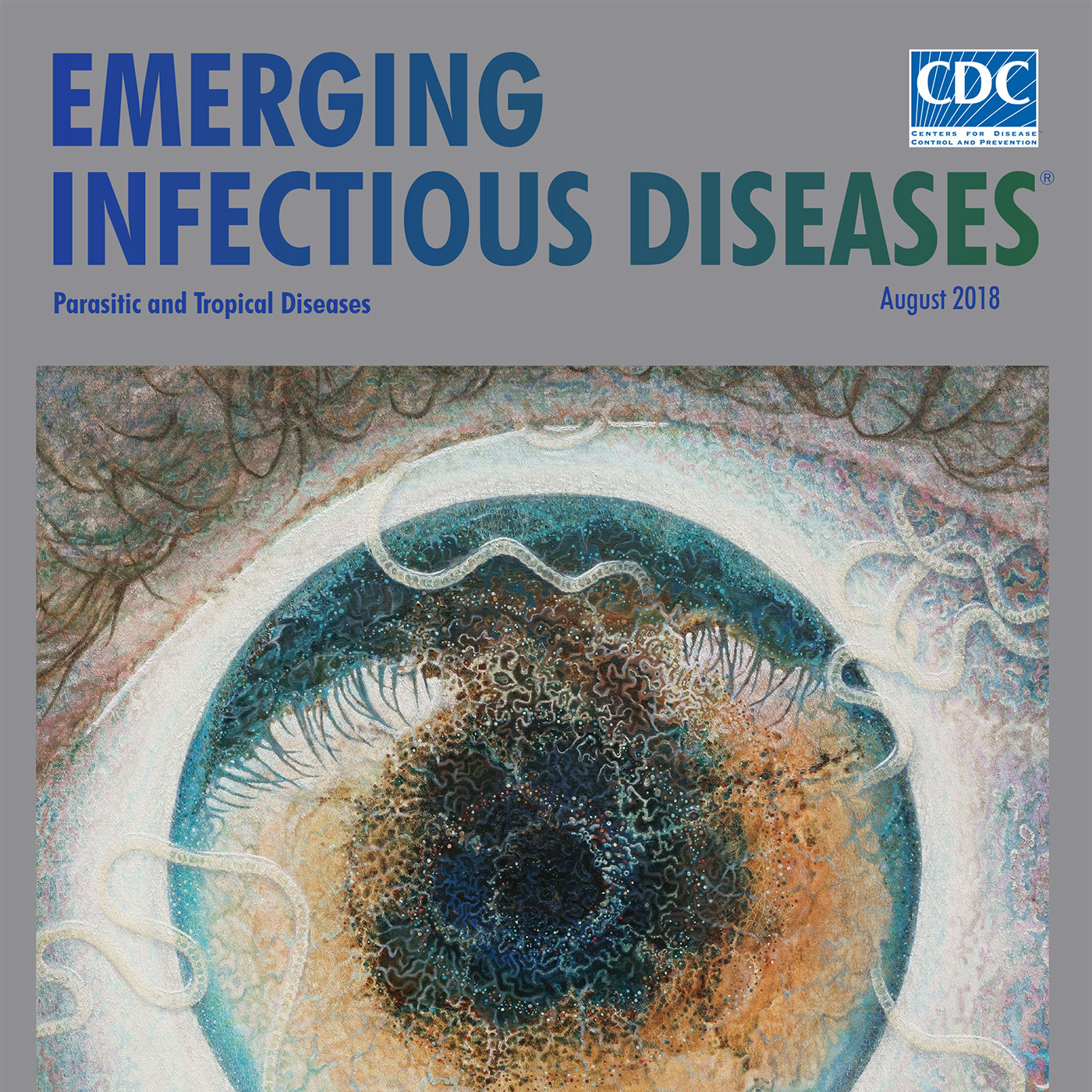
A Worm's Eye View [Original Post 10/25/2018]
Ben Taylor, cover artist for the August 2018 issue of EID, discusses how his personal experience with the Loa loa parasite influenced this painting.
Detection of Hantavirus during the COVID-19 Pandemic, Arizona, USA, 2020
Dr. Ariella Dale, a public health scientist at the Maricopa County Department of Public Health, and Sarah Gregory discuss two cases of people infected with hantavirus in Arizona.
Detection of Orientia spp. Bacteria in Field-Collected Free-Living Eutrombicula Chigger Mites, United States
Dr. Loganathan Ponnusamy, a principal research scholar at North Carolina State University, and Sarah Gregory discuss detection of Orientia species bacteria in chiggers in North Carolina.
Effects of Tick-Control Interventions on Ticks, Tickborne Diseases in New York Neighborhoods [Original Post 4/27/2022]
Dr. Felicia Keesing, a David & Rosalie Rose Distinguished Professor of the Sciences, Mathematics, and Computing at Bard College in New York, and Sarah Gregory discuss the effects of tick control interventions in New York.
Spatial Epidemiologic Analysis and Risk Factors for Nontuberculous Mycobacteria Infections, Missouri, USA, 2008-2019
Dr. Carlos Mejia-Chew, an assistant professor in the Division of Infectious Disease at Washington University in St. Louis, and Sarah Gregory discuss spatial distribution of nontuberculous mycobacteria infections and risk factors in Missouri.
Fatal Invasive Mold Infections after Transplantation of Organs Recovered from Drowned Donors, United States, 2011-2021
Dr. Karen Wu, an epidemiologist at CDC in Atlanta, and Sarah Gregory discuss fatal mold infections after organ transplants from drowned donors.
Waterborne Infectious Diseases Associated with Exposure to Tropical Cyclonic Storms, United States, 1996-2018
Dr. Victoria Lynch, a postdoctoral researcher at Columbia University Mailman School of Public Health in New York, and Sarah Gregory discuss waterborne diseases associated with tropical storms in the United States.
Pathogenesis and Transmissibility of North American Highly Pathogenic A(H5N1) Influenza A Virus in the Ferret Model [Original Post 10/19/2022]
Dr. Joanna Pulit-Penaloza, a biologist at the Centers for Disease Control and Prevention in Atlanta, and Sarah Gregory discuss avian influenza A(H5N1) in a ferret model.
Geographic Origin and Vertical Transmission of Leishmania infantum Parasites in Hunting Hounds, United States [Original Post 7/15/2022]
Dr. Susanne Franssen, an assistant professor of evolutionary biology at the Ludwig-Maximilians-Universität in Munich, Germany, and Sarah Gregory discuss vertical transmission of Leishmania infantum parasites in hunting dogs in the United States.
Epidemiology of Pathogens Listed as Potential Bioterrorism Agents, the Netherlands, 2009‒2019
Dr. Jorrit Broertjes, a physician and resident in clinical microbiology at the Amsterdam University Medical Centers, and Sarah Gregory discuss pathogens listed as potential bioterrorism agents in the Netherlands.
Baylisascaris procyonis Roundworm Infection in Child with Autism Spectrum Disorder, Washington, USA, 2022
Dr. Beth Lipton, a public health veterinarian for the Washington State Department of Health, and Sarah Gregory discuss a case of Baylisascaris procyonis roundworm infection in a child in Washington.
Culling Norway Rats not associated with Bartonella Species [Original Post 9/1/2022]
Dr. Kaylee Byers, the deputy director of the British Columbia Node of the Canadian Wildlife Health Cooperative and a university research associate at Simon Fraser University, and Sarah Gregory discuss the effects of culling on Bartonella bacteria in urban rats in Canada.
Mycobacterium marinum Infection after Iguana Bite in Costa Rica
Dr. Niaz Banaei, a professor of pathology and medicine at Stanford University in California, and Sarah Gregory discuss Mycobacterium marinum infection after an iguana bite in Costa Rica.
Ranid Herpesvirus 3 Infection in Common Frog Rana temporaria Tadpoles
Dr. Francesco Origgi, a veterinary microbiologist and pathologist at the University of Messina and University of Bern, and Sarah Gregory discuss the detection of ranid herpesvirus 3 in frogs.
Haematospirillum jordaniae Etymologia
Dr. John McQuiston, a lead in the Special Bacteriology Reference Laboratory at CDC in Atlanta, and Sarah Gregory discuss the etymology of the bacterium Haematospirillum jordaniae.
Novel Prion Strain as Cause of Chronic Wasting Disease in a Moose, Finland
Dr. Glenn Telling, the director of the Prion Research Center at Colorado State University, and Sarah Gregory discuss a new prion strain as a cause of chronic wasting disease in a Finland moose.
Mapping Global Bushmeat Activities to Improve Zoonotic Spillover Surveillance by Using Geospatial Modeling
Dr. Soushieta Jagadesh, a postdoctoral researcher in Zurich, Switzerland, and Sarah Gregory discuss mapping global bushmeat activities to improve zoonotic spillover surveillance.
Challenges in Forecasting Antimicrobial Resistance
Dr. Sen Pei, an assistant professor at the Mailman School of Public Health at Columbia University, and Sarah Gregory discuss challenges in forecasting antimicrobial resistance.
Mycobacterium leprae in Armadillo Tissues from Museum Collections, United States
Dr. Daniel Romero-Alvarez, an MD and PhD candidate at the University of Kansas, and Sarah Gregory discuss Mycobacterium leprae found in armadillo tissues in museum collections across the United States.
Burkholderia thailandensis Isolated from the Environment, United States
Dr. David Wagner, a professor at the Pathogen and Microbiome Institute at Northern Arizona University, and Sarah Gregory discuss the detection of Burkholderia thailandensis in the environment in the United States.