Show overview
Emergency Medicine Cases has been publishing since 2010, and across the 16 years since has built a catalogue of 404 episodes. That works out to roughly 380 hours of audio in total. Releases follow a fortnightly cadence.
Episodes typically run thirty-five to sixty minutes — most land between 37 min and 1h 18m — though episode length varies meaningfully from one episode to the next. None of the episodes are flagged explicit by the publisher. It is catalogued as a EN-CA-language Health & Fitness show.
The show is actively publishing — the most recent episode landed 1 weeks ago, with 17 episodes already out so far this year. The busiest year was 2020, with 34 episodes published. Published by Dr. Anton Helman.
From the publisher
Emergency Medicine Cases – Where the Experts Keep You in the Know. For show notes, quizzes, videos and more learning tools please visit emergencymedicinecases.com
Latest Episodes
View all 404 episodesEp 223 Epistaxis Management: A Step-Wise Approach
EM Quick Hits 73 MedMal Case Peds Headache, Phenobarb in Alcohol Withdrawal, Peer Support Programs, Asymptomatic Bacteriuria, Mechanical Ventilation, Coaching the EM Mind Part 3
Ep 222 Imaging Decisions in Emergency Medicine
Ep 221 EM-Primary Care Health Systems Strategies, Myths, Misperceptions and Solutions
EM Quick Hits 72 EMC²: Peds Neurocritical Care, Pulmonary Hypertension, Cytokine Release Syndrome, Peds Wrist Fracture, Bradycardia ECG Interpretation, Coaching the EM Mind Part 2
Ep 220 Facial Injuries: Assessment, Management and Disposition
Ep 219 Hip Emergencies: Recognition and Management
Journal Jam 24 Antibiotics for Strep Throat: Evidence, Myths and Misperceptions
Ep 218 Substance Use Disorder in the ED – Stigma, Compassion and System Change
Ep 217 Pediatric Agitation: Assessment and Management
Ep 216 Cardiac Arrest Update: Beyond the 2025 ACLS Guidelines Part 2 – Medications, Airway, Termination and Post-ROSC Care
Ep 215 Cardiac Arrest Update: Beyond the 2025 Guidelines Part 1: CPR, Defibrillation and Ventilation
In this EM Cases update on cardiac arrest management, Dr. Sheldon Cheskes and Dr. Rob Simard join Anton to walk us through the evolving science and bedside practicalities of cardiac arrest management in the wake of the 2025 ACLS Guidelines. They answer questions such as: What are the most common failures in CPR quality, and how can we recognize and correct them in real time? Should we employ head up CPR, and if so how? How should we interpret ETCO₂ during cardiac arrest, and why shouldn’t we chase a single number? How can we minimize peri-shock pauses and optimize defibrillation success at the bedside? Is the traditional two-minute CPR cycle too rigid, and should we be shocking earlier in cases of refibrillation? What is the evidence behind dual sequential external defibrillation (DSED), and when should we use it? After 3 shocks or earlier? How does hyperventilation during cardiac arrest harm patients, and what strategies can reliably prevent it? What is compression-adjusted ventilation (CAV), and how can it improve ventilation consistency during resuscitation? What is the optimal dose of epinephrine in patient with Ventricular Fibrillation? and many more... Please donate to EM Cases to ensure ongoing Free Open Access Medical Education here: https://emergencymedicinecases.com/donation/ This is a deep dive into the critical inflection points in resuscitation where small changes in technique and decision-making may have the greatest impact on outcomes.
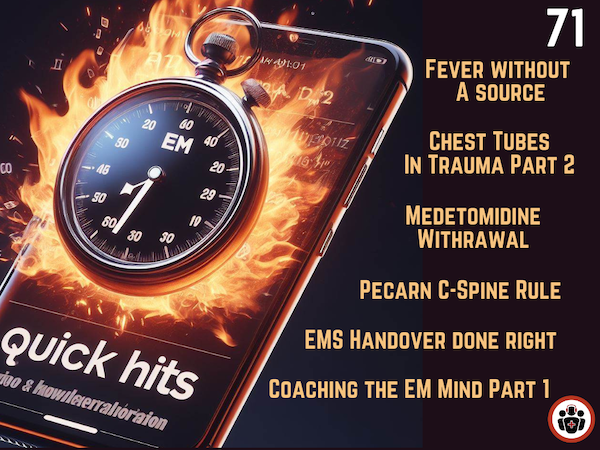
EM Quick Hits 71 EMC²: Fever Without a Source, Coaching the EM Mind Part 1, Traumatic Pneumothorax Part 2, PECARN C-spine Rule, Medetomidine Withdrawal, EMS Handover
In this month's EM Quick Hits Podcast we introduce not one, but two new series! First, "EMC²" - EM Cases Cases (we know, horrible name ;) where Anton or Katie discuss a knowledge building case with a special guest. And second, "Coaching the EM Mind" with Dr. Sara Gray a professional coach for EM providers, where Katie discusses with her the science and best expert advice on how to perform your best in the ED. Plus, a withdrawal syndrome that is new EDs, life-threatening and requires specific treatment - metetomadine withdrawal, EMS handover done right, why community ED docs should not use the PECARN C-spine Rule and Part 2 of Petro's tips on management of traumatic pneumothorax... Please consider a donation to ensure EM Cases continues to be Free Open Access here: https://emergencymedicinecases.com/donation/

Ep 214 Bridging the Gap in Endometriosis Care: Recognition, Risk Stratification, and ED-Initiated Management
We walk you through what Emergency Physicians need to know to recognize, risk stratify, and manage endometriosis safely and pragmatically. We answer question such as: When should endometriosis rise to the top of the differential for pelvic pain? How do we distinguish an endometriosis flare from a dangerous endometriosis complication? from Pelvic Inflammatory Disease? Why hemorrhagic cyst the most common misdiagnosis for endometriosis and how can we tell the difference between hemorrhagic cyst and endometrioma? Which hormonal therapy is safe, reasonable and effective to start in the ED? What are the most common life-threatening complications of endometriosis we should be on the lookout for in the ED? How do we discharge patients with suspected endometriosis safely and reduce repeat visits? and many more... Please consider a donation to EM Cases to ensure continued free open access medical education here: https://emergencymedicinecases.com/donation/
Ep 213 Update in Management of Status Epilepticus
Convulsive status epilepticus is one of the most morbid neurologic emergencies we manage in the ED, and outcomes depend far more on speed than drug selection. Like ventricular fibrillation, each minute of ongoing convulsions worsens hypoxia, acidosis, cardiovascular instability, and neuronal injury, while making seizures progressively harder to terminate. Modern definitions are intentionally time-compressed to force early, parallel, clock-anchored action. Any patient still convulsing when you reach the bedside should be treated as evolving status epilepticus. In this EM Cases podcast with Dr. Sara Gray, we take a practical, time-based approach to convulsive status epilepticus, focusing on early, adequately dosed benzodiazepines, avoiding common escalation and dosing pitfalls, anticipating post-ictal cardiovascular collapse, and knowing when to escalate to second-line agents, airway control, and anesthetic-dose therapy. We also address the transition to non-convulsive status epilepticus and how to recognize ongoing seizures when EEG is not immediately available. We answer questions such as: Why does time to first benzodiazepine matter more than the drug or route? What critical actions should occur in parallel with the first dose? What are 3 key actions to do in parallel with the first benzodiazepine? Why is underdosing second-line antiseizure medications—especially levetiracetam—a common and dangerous pitfall? When should persistent seizures trigger intubation and anesthetic-dose therapy? How can we identify non-convulsive status epilepticus once tonic-clonic activity stops? And many more (we also include a high yield status epilepticus management algorithm in the show notes!)... If you find EM Cases helpful in your clinical practice, please consider supporting our work so we can continue producing free, high-quality emergency medicine education for clinicians around the world. Make a donation here: https://emergencymedicinecases.com/donation/

Ep 212 PECARN Febrile Young Infant Prediction Tool: When To Safely Forgo LP and Empiric Antibiotics
If you’ve been practicing EM for more than a decade, your approach to the febrile young infant has (appropriately) evolved. For years, the default was LP + empiric antibiotics + admission for almost everyone. That approach prevented missing meningitis, but at the cost of a lot of harm: invasive testing, unnecessary antibiotics, and hospitalization-related complications. The modern approach is a paradigm shift toward risk stratification, biomarkers, and shared decision-making, while still respecting one immutable truth: Missing neonatal bacterial meningitis can be catastrophic. This episode revisits the framework from a prior EM Cases episode and updates it with a landmark study that directly informs how far we can safely go—especially in the 0–28 day group, with the father of multiple well-known PECARN rules Dr. Nathan Kuppermann and lead author Dr. Brett Burstein...
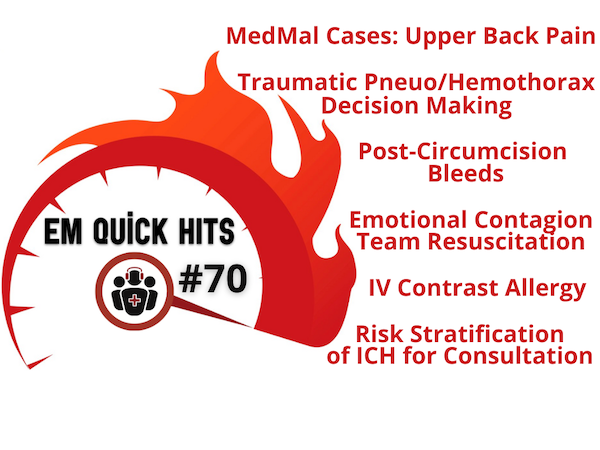
EM Quick Hits 70 MedMal Cases Upper Back Pain, Traumatic Pneumothorax/Hemothorax Decision Making, Risk Stratification of ICH for Consultation, Post-Circumcision Bleeds, IV Contrast Allergy, Emotional Contagion
In this month's EM Quick Hits podcast: Mike Weinstock discusses with Anton a case of upper back pain in this month's Medmal Cases, Andrew Petrosoniak on traumatic pneumothorax and hemothorax decision making: risk stratification, imaging cutoffs and chest tube choices, Justin Morgenstern on brain injury guidelines risk stratification for neurosurgical consult, repeat imaging and admission, Andrew Tagg on management of post-circumcision bleeding and when to escalate care, Hans Rosenberg & Ariel Hendin on evaluation and management of CT contrast allergy and why steroids are out, Shawn Seregren on emotional contagion in resuscitation teams: how tone, pace and volume of your voice and body language effect team rescucitation dynamics and outcomes...
Ep 211 Thyrotoxicosis and Thyroid Storm: Recognition and Management
In this Part 2 of our 2-part podcast series on thyroid emergencies Anton, Dr. George Willis and Dr. Alyssa Louis answer questions such as: When a patient presents with “sepsis without a source,” what bedside features should trigger you to prioritize thyrotoxicosis? How can PoCUS help you decide whether tachycardia is dangerous — or lifesaving — before starting β-blockade? Why can TSH and free T4 be falsely reassuring in a crashing patient, and what labs actually matter early? In which patients does propranolol increase the risk of cardiovascular collapse — and why is esmolol the safer first line medication? Why does the order β-blocker → thionamide → steroid → iodine matter, and what happens if you get it wrong? When is not giving a β-blocker the safest decision in thyroid storm, even in a profoundly tachycardic patient? In an agitated, hyperthermic patient with thyrotoxicosis, why might intubation be more dangerous than helpful in the first hour? How does amiodarone-induced thyrotoxicosis fundamentally change your management — and why can iodine make it worse? and many more...
Ep 210 Decompensated Hypothyroidism Recognition and Management
In the ED, we regularly care for sick patients presenting acutely with abnormal vital signs, altered mental status, and end organ dysfunction. Oftentimes, the culprit ends up being sepsis, or overdose, or organ failure. But it is important that we consider rarer endocrine presentations like decompensated hypothyroidism. In this Part 1 of this two-part podcast with Dr George Willis and Dr Alyssa Louis, we answer questions like: Why is the term myxedema coma a misnomer and should be abandoned? How can we differentiate between sepsis or environmental hypothermia or toxidrome from decompensated hypothyroidism at the bedside? When is it appropriate to order a TSH, a T4 and T3? What are the most important life-threatening triggers that need to be addressed in patients with decompensated hypothyroidism? Why is it important to test for cortisol levels and consider stress-dose steroids in all patients with decompensated hypothyroidism? Why is endotracheal intubation particularly dangerous in decompensated hypothyroidsm? What is the best way to manage hypothermia? Why is the order of medications for treatment of decompensated hypothyroidism so important? and many more... Please consider a donation to EM Cases to ensure continuing Free Open Access Medical Education: https://emergencymedicinecases.com/donation/
EM Quick Hits 69 Pediatric Urinary Retention & Acute Transverse Myelitis, Post-Dural Puncture Headache, Med Mal Cases: Clenched Fist Injury, IV Thrombolysis for Minor Stroke, EM Leadership Spotlight #4
On this month's EM Quick Hits podcast: Deborah Schonfeld on the differential diagnosis and work up of pediatric urinary retention & acute transverse myelitis, Jesse McLaren on his Tryptic Approach to Occlusion MI Diagnosis, Matthew McArthur on recognition and management of post-dural puncture headache, Joseph Yasmeh on Med Mal Cases: Clenched fist injury, Brit Long on IV thrombolysis for minor strokes and Victoria Myers & Lauren Westafer on mentorship and what it means to be a physician leader... Please consider a donation to EM Cases to support high quality Free Open Access Medical Education here: https://emergencymedicinecases.com/donation/