
Emancipations Podcast
135 episodes — Page 1 of 3
A Marxist History of Slavery and Capitalism (feat. David McNally)
Marxian Totality: Inverting Hegel to Expound Worldly Matters (feat. Kaveh Boveiri)
The Concept of the Drive in Psychoanalysis (feat. Andrew Flores)
The Kojève We Never Read (feat. Igor Shoikhedbrod)
The History of Materialism from Lange to Plekhanov (feat. C. Derick Varn & Daniel Tutt)
Confronting Hyperpolitics and Its Limits (feat. Anton Jäger)
Ernesto Laclau and the Making of Post-Marxism (feat. Oliver Marchart)
The Rise, Fall and Return of Lacan (feat. Judith Gurewich)
The Concept of Worldview Marxism (feat. Mathilde Chevallier)
Ideology and Class After Althusser: An Introduction to Göran Therborn (feat. Mike McCarthy)
Mary Wild on the Art of Podcasting & Psychoanalyzing Horror Movies
How Should We Read Nietzsche’s Politics? A Critical Dialogue
Vulgar Marxism and the Dilemmas of Worker Education (feat. Edward Baring)
A Lacanian Theory of Cinema (feat. Helen Rollins)
How to Understand the Chaos of Donald Trump (feat. Paul Heideman)

Ep 147Critical Theory After Habermas (feat. Philipp Felsch)
Joining me for his second appearance, Philipp Felsch explores the life and thought of Jürgen Habermas, one of the most influential philosophers of the modern era and Germany’s foremost living public intellectual. We trace Habermas's roots in the Marxist tradition, his role in the Frankfurt School, relationship to Adorno and Horkheimer, to his influential presence during the May 68 period across West Germany. We discuss why Habermas’s theory of the public sphere has been so influential, and why he came to be so widely revered as a philosopher, especially within American academia. We then examine how Habermas abandoned Marxism in his turn to develop a comprehensive theory of communication. Habermas is known as an admonishing voice of reason, as the moral conscience of post-Holocaust German society but in the wake of October 7th and his uncritical position on the genocide in Gaza, Habermas's intellectual supremacy seems to be coming to an end today. Learn more about Philipp's new book, The Philosopher: Habermas and Us (translated by Tony Crawford) https://bit.ly/4qjpFTC

Ep 146Pierre Bourdieu's Critique of the Intellectual
We discuss Pierre Bourdieu's legacy and its implications for understanding intellectuals. You can find C. Derick Varn at VarnVlog. In addition to going through some of Bourdieu's key categories, these are the primary readings we discuss: Pascalian Meditations by Pierre Bourdieu Homo Academicus by Pierre Bourdieu The Political Ontology of Martin Heidegger by Pierre Bourdieu "The Role of the Intellectual in the Modern World" by Pierre Bourdieu Distinction by Pierre Bourdieu

Ep 145Gaza and Revolutionary Philosophy (feat. Yanis Iqbal)
My guest Yanis Iqbal is the author of The Sword and the Neck, a militant work of philosophy that insists Gaza must be approached not as a humanitarian "exception," but as a primary terrain of proletarian and anti-colonial struggle. Iqbal develops an incisive critique of contemporary leftwing philosophers Slavoj Žižek, Ètienne Balibar and the wider tradition of post-colonial thought in the wake of October 7th and the subsequent genocide in Gaza. In this interview we discuss Iqbal's core ideas, the limits of post-colonial thought and the role of Marxist practice in the Palestinian liberation struggle. I encourage everyone to purchase Yanis Iqba's book The Sword and the Neck, published in 2025 with Iskra Books. If you download the PDF for free, please make a contribution to Iskra as gratitude for their work. I wrote the Preface to this very fine work where I address a number of important questions that the book raises. Yanis Iqbal is studying political science at Aligarh Muslim University, India. He is the author of the book 'Education in the Age of Neoliberal Dystopia' and 'The Sword and the Neck.' -- If you find my work valuable, please become a Patron to gain early access to all of my interviews and videos: www.patreon.com/emancipations

Ep 144Anti-Intellectualism in America (feat. C. Derick Varn)
We discuss the roots of anti-intellectualism in American life for the first episode in a four-part series co-created and presented with C. Derick Varn, "The Problem of Intellectuals." Learn more about C. Derick Varn by checking out his show "VarnVlog" https://www.patreon.com/c/varnvlog/posts These are the primary readings we discuss: Anti-Intellectualism in American Life by Richard Hofstadter The American Intellectual Elite by Charles Kadushin The New Radicalism in America: The Intellectual as Social Type by Christopher Lasch The Future of Intellectuals and the Rise of the New Class by Alvin Gouldner "The Missing Generation: Academics and the Communist Party from the Depression to the Cold War" by Ellen Schrecker

Ep 143Chinese Marxism (feat. Josef Gregory Mahoney)
I am joined by Dr. Josef Gregory Mahoney, Professor of Politics and International Relations at East China Normal University and Concurrent Professor of Marxism with Jiangsu’s top thinktank—the Institute for the Development of Socialism with Chinese Characteristics for a critical discussion and analysis of Marxism in China and the tradition of Chinese Marxism. We examine the ideological differences within the Chinese Communist Party from the time of Mao to the present, the main differences between Soviet and Chinese forms of Marxism, the core of Xi Jinping's thought, the impact of the "reform and opening up" period since Deng Xiaoping, to the status of class struggle in contemporary China. Dr. Josef Gregory Mahoney is Professor of Politics and International Relations and Doctoral Supervisor (政治与国际关系教授、博士生导师) at East China Normal University (ECNU/华东师范大学); Founder and Director of the Center for Ecological Civilization (主任, 政治与国际关系学院生态文明研究中心); Vice Dean for the Institute of Singularity Politics (奇点政治研究院副院长); Associate Editor, US-based Journal of Chinese Political Science (SSCI and ranked first in the field according to JCR); and Co-Editor, ECNU Review. He also serves as a Concurrent Professor of Marxism (马克思主义兼职教授) and Senior Research Fellow (资深研究员) with Jiangsu’s top thinktank—the Institute for the Development of Socialism with Chinese Characteristics (中国特色社会主义发展研究院)—based at Southeast University (东南大学) in Nanjing. He’s consulted regularly on matters related to governance and international affairs by the China’s central government, the Beijing, Shanghai and Jiangsu governments, and foreign diplomats. One of China’s most-recognized international key opinion leaders, Dr. Mahoney has more 200 publications and appears frequently on global broadcasts (1000+), including Xinhua, CGTN, CCTV, BBC, RT International and TRT World, and is a regular contributor to China Radio International’s The Beijing Hour and The World Today and RTHK’s Backchat (Hong Kong). He writes, produces and performs high-level documentaries for BRTV, one winning First Prize (一等奖 in the category of International Communication (等奖, 国际传播) per the 第35届中国新闻奖 (2025). He frequently publishes in the South China Morning Post, China Daily, Beijing Review, and writes for the CPC Central Committee’s foreign policy platform, China Diplomacy, among others. Previously he was a member of the Chinese team that translated Jiang Zemin’s Selected Works into English and subsequently a Senior Researcher with Beijing’s leading think-tank, the Central Compilation and Translation Bureau (中共中央编译局), under the CPC Central Committee. -- Please consider becoming a Patron to gain early access to all of my interviews and videos: www.patreon.com/emancipations

Ep 142Proletarian Accelerationism (feat. Mikey Downs, Nance and Grady Page)
My guests Mikey Downs, Nance and Grady Page are all accelerationists. We discuss the curious return of accelerationism in today's political moment and what it signals. We debate the politics in the philosophy of Nick Land and Curtis Yarvin. My guests find Land's thought to be generative and important, and they insist that Land is not a fascist thinker. We debate that precise point and dive into the core of what my guests find so incisive in the wider accelerationist movement. -- If you benefit from my work please consider a donation: paypal.me/danieltutt1 You can also become a Patron to gain early access to all of my interviews and videos: www.patreon.com/emancipations

Ep 141Reviving Anti-Imperialist Marxism (feat. Ali Kadri)
With guest co-host Benji Schoendorff, I sit down with Dr. Ali Kadri, a leading Marxist political economist and scholar of the Arab world to discuss his important new book The Accumulation of Waste: A Political Economy of Systemic Destruction (2023). In this interview we discuss Kadri's critique of Western Marxism, the question of revolutionary consciousness today, class issues, imperialism and its status and dynamics, the role of the anti-imperialist struggle and Dr. Kadri discusses his influences in contemporary Marxism. In his book The Accumulation of Waste, Kadri traces how capitalism, especially in the Global South, increasingly accumulates waste not only in discarded commodities, but in wasted lives, labor, and entire nations rendered disposable by imperial extraction. Through his incisive critique of “Western Marxism” and its retreat from anti-imperialist struggle, Kadri argues that Marxism today must re-anchor itself in the lived realities of colonial domination, military intervention, and financial subjugation. This conversation explores why imperialism remains central to capitalist reproduction and why any Marxism that cannot think anti-imperialism is destined to fail politically and theoretically. Co-host Benji Schoendorff is a clinical psychologist and podcast host of "Resistance is Fertile" (https://bit.ly/3KIRiGH).
Ep 140Accelerationism and Political Violence (feat. Grady Page)
Grady Page joins me for a philosophy salon on how accelerationist ideas influence contemporary struggles over technology, capitalism & the left. Read this Substack about the event: https://revolpress.substack.com/cp/180530252 If you benefit from my work please consider a donation: paypal.me/danieltutt1 You can also become a Patron to gain early access to all of my interviews and videos: www.patreon.com/emancipations

Ep 139Socialism Against Liberalism: The Political Philosophy of Jean-Claude Michéa (feat. Tony of 1Dime)
I'm joined by Tony Chamas, aka "Tony of @1Dimee" for a discussion on the philosopher Jean-Claude Michéa's theory of liberalism. Liberalism requires a unity between its economic and its cultural imperatives in order to remain intact as a ruling political ideology. What role does the left play in keeping this unity intact? We will argue that when the left becomes the stewards of cultural liberalism they participate in the pacification of class struggle politics and this prevents the left from remaining true to a socialist vision of politics. We discuss and debate how to best address this fundamental double bind, how it might be overcome and what the prospects are for socialist politics once this hostage situation is undone. Tony Chamas is a political theorist and author of the forthcoming book "Freedom to Change Nothing: The Spectrum of Managed Democracy and What Makes the US Different." Chamas is also a video essayist known for his YouTube channel, 1Dime and his podcast, 1Dime Radio. His most notable videos include "The Deficit Myth" and "China's Cultural Revolution: The Full Story" (Documentary).

Ep 138The Concept of Extimacy in the Work of Jacques Lacan (feat. Nadia Bou Ali & Surti Singh)
I am joined by Lacanian philosophers Nadia Bou Ali and Surti Singh to discuss the concept of "Extimacy" in the work of Jacques Lacan. In 1960, Lacan coined the neologism extimité (extimacy) to denote a structure of subjectivity in which the most intimate, internal core is already external, thus complicating the traditional philosophical dualisms and binaries that have informed traditional notions of subjectivity. We discuss what this idea helps us to think in terms of philosophy, culture and politics. This conversation is based on a new collection of essays co-edited by Nadia and Surti entitled Extimacy, a book that is the first sustained interrogation of the concept. Nadia Bou Ali is an associate professor and director of the Critical Humanities Program for the Liberal Arts at the American University of Beirut. She is the coeditor of Lacan contra Foucault: Subjectivity, Sex, and Politics and the author of Hall of Mirrors: Psychoanalysis and the Love of Arabic. Bou Ali is a candidate analyst at the Lacanian School of Psychoanalysis in the Bay Area. Surti Singh is an associate professor of philosophy at Villanova University.
Ep 137Q & A Session
I've have hosted a number of interviews, symposiums, lectures and study groups this year. This is a Q & A session where I answer questions from patrons, listeners and supporters. If you benefit from my work please consider a donation to help defray the costs of organizing all of these events: paypal.me/danieltutt1 You can also become a Patron to gain early access to all of my interviews and videos: https://www.patreon.com/c/emancipations

Ep 136A Whole New World (The Archimedean Point, Episode 4)
In our latest episode of The Archimedean Point, we turn to Edward Said's theory of Orientalism and address its shortcomings from a Marxist perspective. We focus on Disney's Aladdin from the early 1990s as an example of pop-Orientalism, and we argue that Aladdin offers an allegory for the remaking of Middle Eastern society by capitalism. -- If you benefit from my work please consider a donation: paypal.me/danieltutt1 You can also become a Patron to gain early access to all of my interviews and videos: www.patreon.com/emancipations

Ep 135Žižek and the Left (feat. Cadell Last)
We are joined by philosopher Cadell Last, the host of Philosophy Portal to discuss his new article "No Marxism Without Žižek", (https://bit.ly/46c4gnj) a review of Flowers for Marx.

Ep 134Deleuze for Marxism? A Discussion with Alex Taek-Gwang Lee
I am joined by philosopher Alex Taek-Gwang Lee for a critical analysis and discussion on the legacy of Gilles Deleuze's thought, its influence on the existing left and the ways that the concepts Deleuze developed have interacted with the wider Marxist tradition. This conversation will consider Dr. Lee's recent book Communism After Deleuze, published with Bloomsbury https://www.bloomsbury.com/us/communism-after-deleuze-9781350474048. Please support me on Patreon https://www.patreon.com/c/emancipations

Ep 133The Marxism of Domenico Losurdo - A Critical Discussion (feat. Ross Wolfe)
My guest is Ross Wolfe, a socialist historian and writer. In a recently published three-part essay entitled, "Against Losurdo" (https://newintermag.com/against-losurdo) Wolfe argues that Losurdo's work represents the re-introduction of Stalinism in contemporary Marxism. We discuss and debate Losurdo's work, with a focus on his book Western Marxism and his works on Hegel and Nietzsche. To watch the study sessions we hosted on Losurdo's Western Marxism, please go here: https://youtube.com/playlist?list=PLE03jn2k3GYCRd7dnBOAKBN-H-F-wGzYa&si=zkRb8GeYoi_Nc2Gv Support my work on Patreon by becoming a paid member: https://www.patreon.com/c/emancipations

Ep 132How to Confront Political Despair (feat. Benjamin Studebaker)
I am joined by political theorist Benjamin Studebaker to discuss the retreat of the political and the concomitant rise in despair. How do we theorize this despair, and how does it differ from spiritual despair? Please read Studebaker's article which is the focus of this discussion: "Political Despair and Moral Injunctions" https://bit.ly/469EqkQ

Ep 131Michel Clouscard's Critique of Liberal-Libertarian Ideology (feat. Michael C. Behrent)
My guest is Michael C. Behrent, a historian of French intellectual history and a leading scholar of Michel Foucault. Behrent has been at the forefront of an important debate about the legacy of Foucault's thought, and specifically his political influence on the contemporary left and the rise of neoliberalism. Behrent is also working on the thought of Michel Clouscard, the most important French Marxist from the 20th century you have likely never heard about. The second half of this conversation is a discussion on Clouscard's work, his critique of the wider ecosystem of French philosophy from the 60s and 70s and specifically his analysis of the ideology of "liberal libertarianism." Michael C. Behrent is a professor of History at Appalachian State University. His scholarship has sought to historicize the work of the French philosopher Michel Foucault. This work evaluates the political significance of Foucault's reflections on free-market economics by situating his work in the shifting ideological landscape of France in the 1970s. And his current project seeks to show how Foucault’s thought was (to a significant degree) rooted in his upbringing in Poitiers, France from the 1920s to the 1940s. Behrent is also developing a project that seeks to reconstruct the thought of the “young Foucault” (spanning 1949 through to the mid-1960s). Behrent also writes about American politics and culture for several French publications, notably Esprit as well as Dissent, Foreign Policy, and Oxford University Press blog. Read his article on Michel Clouscard here, "Michel Clouscard vs. the Hipster Left" https://bit.ly/3Kn6jO0

Ep 130Can Ressentiment Be Revolutionary? (feat. Zahi Zalloua)
I am joined by philosopher and scholar Zahi Zalloua to discuss the politics of resentment, and how to theorize the problematic concept of "ressentiment" and whether this concept can be applied to emancipatory ends. Is ressentiment a political affect that can be harnessed for revolutionary action? We discuss Zalloua's recent works: Fanon, Žižek, and Violence of Resistance and The Politics of the Wretched: Race, Reason, and Ressentiment. Zahi Zalloua is Cushing Eells Professor of Philosophy and Literature and a professor of Indigeneity, Race, and Ethnicity Studies at Whitman College and Editor of The Comparatist. His most recent work includes Fanon, Žižek, and Violence of Resistance (2025), The Politics of the Wretched: Race, Reason, and Ressentiment (2024), Solidarity and the Palestinian Cause: Indigeneity, Blackness, and the Promise of Universality (2023), Being Posthuman: Ontologies of the Future (2021), Žižek on Race: Toward an Anti-Racist Future (2020), Theory’s Autoimmunity: Skepticism, Literature, and Philosophy (2018), and Continental Philosophy and the Palestinian Question: Beyond the Jew and the Greek (2017).

Ep 129Palestine and the Political Economy of the Middle East (feat. Adam Hanieh)
My guest is the political economist Adam Hanieh, a foremost expert on the political economy of the Middle East, fossil capitalism and imperialism. We discuss the war on Gaza, the prospects of Palestinian statehood, the dominance of Gulf oil and how it shapes the ruling classes in the region and the status of labor struggles across the wider Middle East. Professor Adam Hanieh is the author of six books including the most recent Resisting Erasure: Capital, Imperialism and Race in Palestine with co-authors Robert Knox and Rafeef Ziadah as well as Crude Capitalism: Oil, Corporate Power, and the Making of the World Market and Money, Markets, and Monarchies: The Gulf Cooperation Council and thePolitical Economy of the Contemporary Middle East which was awarded the 2019 British International Studies Association International Political Economy Group Book Prize. Please support us on Patreon https://www.patreon.com/c/emancipations

Ep 128Marxism and the Literary Left in America (feat. Alan Wald)
I am joined by Alan M. Wald to discuss his extensive work on the literary left and the history of intellectuals and the communist movement in America. We discuss Wald's new book of essays called "Bohemian Bolsheviks: Dispatches from the Culture and History of the Left" which features a number of Wald's more recent essays and interventions on the history of US communism, including essays that touch on Richard Wright, James T. Farrell, Mike Gold, Agnes Smedley, John Steinbeck, Lorraine Hansberry and many other writers who incorporated a commitment to the class struggle in their writing, and who were influential propagating socialist and communist ideals. In this interview, we discuss the meaning of "realism" and why it is important to socialist writers, the founding of the communist party of America, the role of Trotskyism on US left intellectuals, the role of Browderism on the cultural development of the communist party in America, the legacy of The Romance of American Communism by Vivian Gornick, Wald's methodology as a researcher and writer, African American literature, the New Left and various individual authors. Alan Maynard Wald is an American professor emeritus of English Literature and American Culture at the University of Michigan, Ann Arbor, and writer of 20th-century American literature who focuses on Communist writers; he is an expert on the American 20th-Century "Literary Left." Wald's subjects have included: 20th Century United States Literature; Realism, Naturalism, Modernism in Mid-20th Century U.S. Literature; Literary Radicalism in the United States; Marxism and U.S. Cultural Studies; African American Writers on the Left; Modernist Poetry and the Left; the 1930s (Literature); New York Jewish Writers and Intellectuals; 20th-Century History of Socialist, Communist, Trotskyist and New Left Movements in the U.S.; the 1960s Politics and Culture; Cold War Culture and Resistance; Old Left/New Left in U.S. Politics and Culture; and Film Noir and the Left. Please join our Patreon to get early access to all interviews and to participate in our study groups https://www.patreon.com/c/emancipations

Ep 127Socialist Realism and the Communist Ideal: On Mikhail Lifshits (feat. Angela Harutyunyan)
My guest is art historian and Marxist thinker Angela Harutyunyan, who has joined us to discus the work of the Marxist philosopher Mikhail Lifshits. Lifshits was an important Soviet Marxist thinker who developed a theory of aesthetics that remained committed to the proposition that communism entails the overcoming of alienation. Lifshits offers a critique of modernism and theories on classicism and socialist realism that are deeply relevant to today's time. We discuss Lifshits's major works, key concepts and his wider philosophy of art and aesthetics. We also discuss an important debate on the concept of the ideal that occurred between Lifshits and Soviet Marxist Evald Ilyenkov. Dr. Angela Harutyunyan is a founding editor of ARTMargins published by MIT Press and has published extensively on post-Soviet art, Marxist aesthetics, and curatorial theory. She is the author of "The Political Aesthetics of the Armenian Avant-garde: The Journey of the \'Painterly Real\'" and co-author of "After Revolution: Historical Presentism and the Political Eclipse of Postmodernity". Harutyunyan has taught at the American University of Beirut and the American University in Cairo. She is currently based at the Universität der Künste Berlin. Please join our Patreon to support our efforts https://www.patreon.com/c/emancipations

Ep 126The History of Riots and the Left (feat. C. Derick Varn)
C. Derick Varn, host of the Varn Vlog is a Marxist theorist, poet and political commentator. Varn joins our show to discuss the protests and riots against ICE in Los Angeles and across the country that popped off in late spring and early summer 2025. We examine the history of riots in the US, the role of the left in the context of a second Trump presidency, how Marxists have theorized the return of riots and uprisings in our time (with a focus on communization theory) and what we might expect moving forward. Please support our work by becoming a Patreon member https://www.patreon.com/c/emancipations

Ep 125A Social History of Analytic Philosophy (feat. Christoph Schuringa)
Analytic philosophy is the leading form of philosophy in the English-speaking world and most academic philosophy departments are analytic. But what explains this power and what is the history of analytic philosophy. Where did it begin and how did it rise to such prominence? I am joined by philosopher Christoph Schuringa to explore the social history of analytic philosophy. Analytic philosophy tends to think of itself as concerned with eternal questions, transcending the changing scenes of history. It thinks of itself as apolitical. This book, however, convincingly shows that the opposite is true. To this day, analytic philosophy is the ideology of the status quo. It may seem arcane and largely removed from the real world, but it is a crucial component in upholding liberalism, through its central role in elite educational institutions. Learn more about this book and acquire a copy here: https://bit.ly/4lhoHF5 SHOWNOTES: We discuss why Christoph wrote the book, the origin of the analytic/continental divide, the meaning of logical positivism, Wittgenstein's influence and the various schools in Cambridge and Vienna that formed analytic philosophy. The contradictions of the "linguistic turn" and the ways it failed to address social concerns. Whether there are exceptions within analytic philosophy, or philosophers whose methods might offer a more robust engagement with the social and with radical philosophy. The theory of the "colonization" of analytic philosophy in other disciplines, from ethics, to politics, to continental thinkers. Can analytic philosophy shake off liberalism and if not why. If so, how? #EmancipationsPodcast

Ep 124Gramsci's Theory of Bonapartism (feat. Francesca Antonini)
My guest is Dr. Francesca Antonini, a historian and scholar of Antonio Gramsci. Dr. Antonini teaches at the Ca' Foscari University in Venice Italy. Her latest book is an exhaustive study of Gramsci's theory of Bonapartism, and it is entitled, Caesarism and Bonapartism in Gramsci: Hegemony and the Crisis of Modernity. In this discussion, we examine the Marxist view of Bonapartism and how it differs from liberal theories, the different periods of Gramsci's thinking on the concept, how Bonapartism relates to fascism in Gramsci's thought and why Gramsci retains the idea of Caesarism even though Marx rejected it. Please support us on Patreon at https://www.patreon.com/c/emancipations

Ep 123Analytic Marxism and the Future of Scientific Socialism (feat. Ben Burgis)
Ben Burgis joins us for a discussion on the analytic Marxism of G.A. Cohen and the implications of his reading of Marx for 21st century socialism. We discuss Burgis's essay in the new book Flowers for Marx available now with with Revol Press. Support us at https://www.patreon.com/c/emancipations

Ep 122The Roots of Austerity and 20th Century Fascism (feat. Clara Mattei)
My guest Clara Mattei has written about austerity’s dark intellectual origins in her important new book The Capital Order: How Economists Invented Austerity and Paved the Way for Fascism. We discuss the main ideas of this book and how the historical roots of austerity emerge as a response by the ruling class to the social democratic gains of the working class following the First World War in Europe. At the core of Dr. Mattei's book is a powerful lesson for the left, namely that conditions of economic austerity have the tendency to sap the political resolve of the working class. Austerity depoliticizes the working class and this is why liberal economists implement it. We discuss the history of how economists and technocratic policymakers invented austerity and how we can challenge it. Clara E. Mattei is a Professor of Economics and Director of the CHE, Center for Heterodox Economics, of The University of Tulsa Oklahoma, recently inaugurated in February 2025 (https://sites.utulsa.edu/chetu). Please support my efforts by becoming a Patreon member https://www.patreon.com/c/emancipations

Ep 121Organizing the Working Class (feat. Sudip Bhattacharya)
My guest Sudip Bhattacharya studies and organizes the working class in New Jersey and he joins me to discuss the findings of his work. We explore some practical strategies for organizing the working class, the future of socialist politics and ways to overcome some of the main limitations to class politics in our time. This conversation is inspired by a new essay Sudip wrote for The Hampton Reader. Check out the book published with Iskra Press Sudip Bhattacharya is a doctoral candidate in Political Science at Rutgers University. You can find his work at outlets like Protean magazine, Jacobin, Current Affairs, Black Agenda Report, among others.

Ep 120Restoring the Revolutionary Thought of Karl Kautsky (feat. Ian Szabo)
I am joined by Marxist historian Ian Szabo to discuss the revival of Karl Kautsky's revolutionary thought among contemporary Marxists. We discuss a recent article on Kautsky's theory of the dictatorship of the proletariat, and we address the predominant misreadings and misinterpretations that exist about Kautsky, and how his thought speaks to our present. Read Ian Szabo's article "The Adolescence of a Concept: Dictatorship of the Proletariat in Karl Kautsky’s Revolutionary Writings (https://bit.ly/4hHoOaW). Please support our efforts on Patreon https://www.patreon.com/c/emancipations

Ep 119The Social Formation of the Far Right (The Archimedean Point)
Welcome to The Archimedean Point, a new series on the current political situation from a Marxist perspective. In our second episode, Daniel Tutt and Conrad Hamilton discuss the inadequacies of left-liberal accounts of racism and bigotry and why only a Marxist analysis can address the ideology of the far right. We also discuss new work by Daniel on Michel Clouscard and his book Neo-Fascism and the Ideology of Desire and Conrad's new essay in the book After Speculative Realism. Episode One of The Archimedean Point can be found here (https://youtu.be/kTjaIm0XmZU?si=5cHD0k4gjnMsMGPT) The Archimedean Point is a reference to a concept from Lukács's History and Class Consciousness that refers to "the point from which the whole of reality can be overthrown." SHOWNOTES: The Social Formation of the Far Right https://bit.ly/3XSpR0B Neo-Fascism and the Ideology of Desire https://bit.ly/41jfkfL After Speculative Realism https://bit.ly/4ckRup4
Ep 118The Politics of Work and Class in Michael Mann's Thief (feat. Mtume Gant)
Welcome to a special crossover podcast discussion on Michael Mann's first major feature film Thief (1981). While Michael Mann is best known for films like HEAT and Last of the Mohicans, Thief is by far his most political film. The film explores themes of labor, exploitation, class and the inner lives of criminals and convicts. We discuss the Marxist and Freudian undertones in this great masterpiece of cinema. This conversation is hosted by Mtume Gant, filmmaker, professor and host of Within Our Gates podcast and Daniel Tutt, philosopher and host of the Emancipations podcast. Please support us at https://www.patreon.com/c/emancipations Please support Within Our Gates at https://www.patreon.com/c/Tumes/home

Ep 117Genius After Psychoanalysis (feat. Daniel Cho)
I am joined by K. Daniel Cho to discuss his provocative new book Genius After Psychoanalysis: Freud and Lacan which argues that genius is not exceptional talent or intelligence but is related to and illuminated by the psychological concept of sublimation. Beginning with a close examination of Freud's work on Leonardo da Vinci, Cho analyzes film, art, our relationship to nature, politics, group psychology, love, and philosophy to demonstrate that genius, far from an elitist notion, is universally available through a different approach to ideas of imperfection, disappointment, and failure. Learn more about the book. K. Daniel Cho is Professor of Education at Otterbein University in Columbus, USA. He works on psychoanalysis in a variety of disciplinary contexts. He is the author of Psychopedagogy: Freud, Lacan, and the Psychoanalytic Theory of Education and coeditor of Marcuse’s Challenge to Education.

Ep 117Economic Imperialism and Global Working Class Struggle (feat. Immanuel Ness)
My guest is Dr. Immanuel Ness, one of the foremost scholars of contemporary imperialism, workers’ social organization, Global South political economy, socialism and migration. We discuss the concept of economic imperialism in today's time and how the theory of imperialism has changed since the time of Lenin. We also discuss the theory of the labor aristocracy in Marxist thought, whether China is truly a socialist country and the status of working class struggles in China compared to America. Immanuel Ness is an American academic, and Professor of Political Science at the City University of New York, Brooklyn, School of Humanities and Social Sciences. His academic focus is on workers' organization, migration, mobilization and politics. His latest book is entitled Migration as Economic Imperialism: How International Labour Mobility Undermines Economic Development in Poor Countries and is published with Polity Press. Learn more about our work and join our community at https://www.patreon.com/c/torsiongroups
Ep 116Rumors and Philosophy (feat. Mladen Dolar)
I am joined by the philosopher Mladen Dolar, one of the most important Lacanian philosophers working today. A founder of the Ljubljana school of psychoanalysis, Mladen Dolar has written important works on Hegel, Marx and numerous works on Lacanian thought. In this podcast, we discuss his experience studying with Lacan in Paris and the legacy of the 1960s on today's politics. We then turn to a discussion of Dolar's new book Rumors, a philosophical essay on the persistent problem of rumors from the time of Socrates to the present. We examine how Socrates, Rousseau, Kafka and Kierkegaard each faced the problem of rumors and sought to overcome the stain of rumors on philosophy. Dolar writes that “rumors present another face of the big other, not the face of knowledge and truth but something that nobody quite believes to be true yet it unfailingly works and is given a questionable credence and general currency.” Learn more about Mladen Dolar's new book https://amzn.to/4b7WlJJ
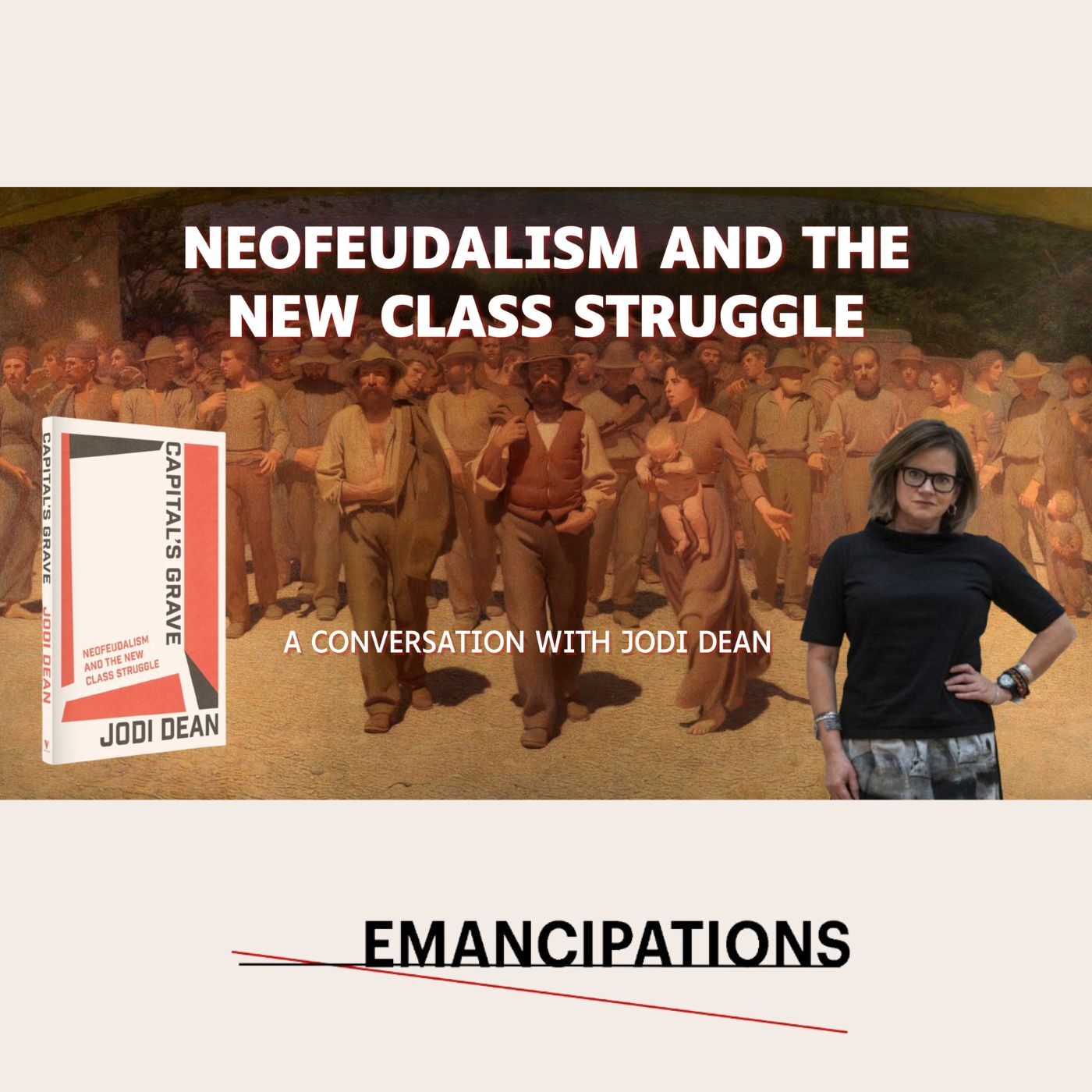
Ep 115The Working Class vs. Neofeudalism (feat. Jodi Dean)
I am joined by political theorist Jodi Dean to discuss her provocative new book Capital's Grave: Neofeudalism and the New Class Struggle. Jodi Dean is one of the most vocal proponents of the "neofeudal thesis", the idea that capitalism has regressed to a neofeudal arrangement characterized by the delinking of capitalist accumulation from production, the end of competition, rent-seeking, predation and plunder. No longer can Marxists rely on a developmentalist theory of capitalism and a proletariat tied to productive labor as the means to abolishing capitalism. Dean argues that we must completely re-think the proletariat and that the global service sector points the way to a renewal of working class agitaiton and revolutionary activity. Jodi Dean is a political theorist and professor in the Political Science department at Hobart and William Smith Colleges in New York state. Her books include The Communist Horizon, Crowds and Party, Comrade: An Essay on Political Belonging , Blog Theory and several others. Please check out Capital's Grave and order a copy here. Join our Patreon to gain access to our interviews before they go live to the public and become a member of our study group collective where we read important books in Marxist thought and philosophy https://www.patreon.com/c/torsiongroups
Ep 114Why Marxists Should Be Public Intellectuals (feat. Russell Jacoby)
My guest Russell Jacoby is credited with coining the concept "public intellectual." He has written extensively on socialism in America, western Marxism and Freudian Marxism. We begin with a discussion of his criticism of Domenico Losurdo's recently translated work Western Marxism, we then discuss his recent Jacobin article "American Marxism Got Lost on Campus", the work of Christopher Lasch (Jacoby's Ph.D. advisor) and how Marxism can become "plain" again. Jacoby offers advice for Marxist scholars and writer to better reach the public and transcend academic specialization. Russell Jacoby is the author of seven books including The Last Intellectuals: American Culture in the Age of Academe, Dogmatic Wisdom: How the Culture Wars Divert Education and Distract America and Dialectic of Defeat: Contours of Western Marxism. He is Emeritus professor of History at UCLA.