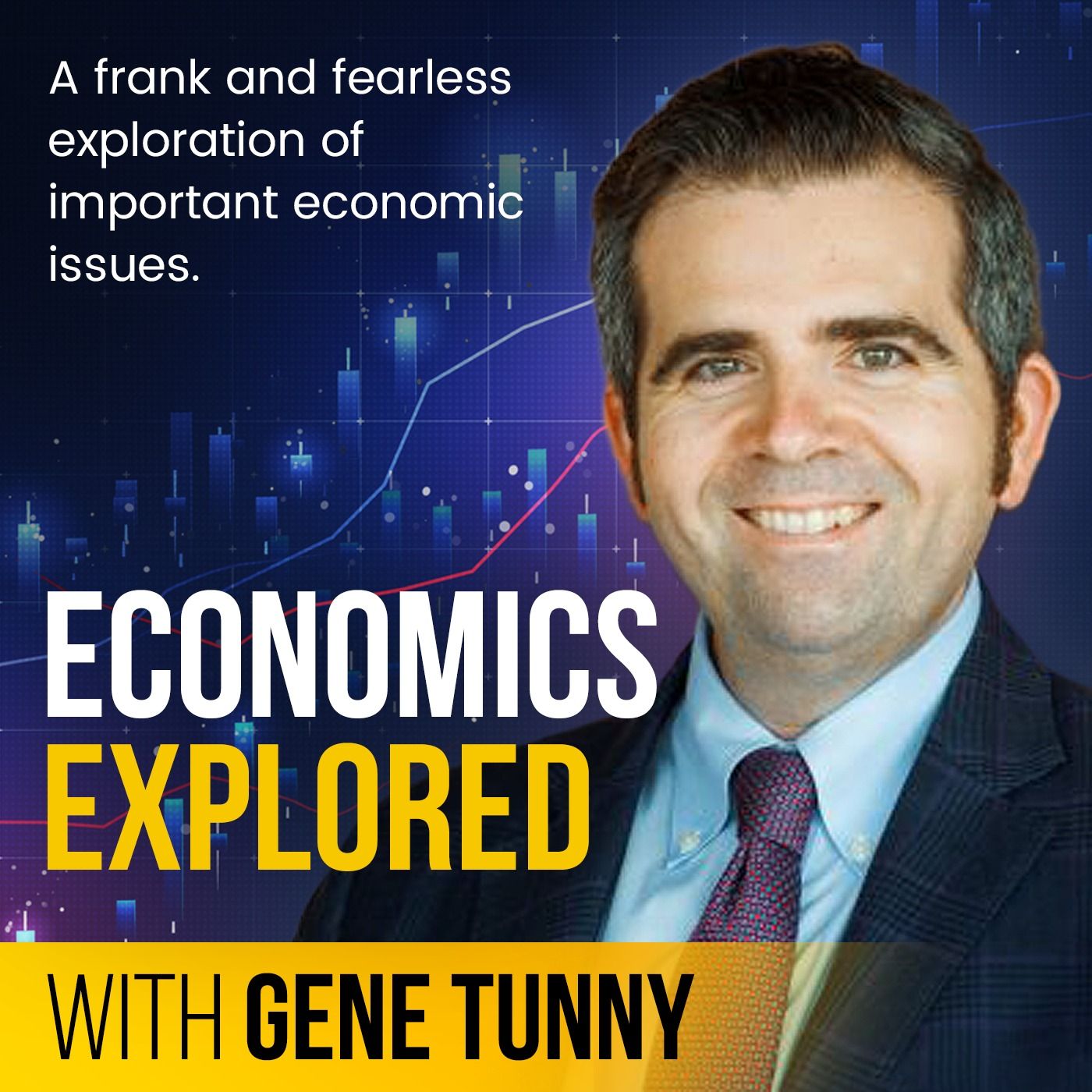
Economics Explored
323 episodes — Page 7 of 7
Ep 23Entrepreneurship with Professor Peter G. Klein
Many universities now offer courses in entrepreneurship, as students have been inspired by tech entrepreneurs such as Elon Musk and Mark Zuckerberg. But what exactly is entrepreneurship and who qualifies as an entrepreneur? Is entrepreneurship essential for economic growth? To help answer these questions, Economics Explained host Gene Tunny invited Professor Peter G. Klein on to the program. Peter is W. W. Caruth Chair and Professor of Entrepreneurship at Baylor University in Texas. He is also Carl Menger Research Fellow at the Mises Institute. TimestampsUse these timestamps to jump right to the highlights:2:25 – what is entrepreneurship? Entrepreneurship as a mindset 6:50 – Was Donald Trump an entrepreneur?15:50 – Schumpeter’s theory of creative destruction19:20 – Peter’s Entrepreneurial Judgment model (check out Peter’s book co-authored with Nikolai J. Foss Organizing Entrepreneurial Judgment and Peter’s Murray N. Rothbard lecture The Present State of Entrepreneurship Research on YouTube)26:15 – Gene mentions Cal Newport’s point that Steve Jobs thought the big value add of the iPhone was you could have your phone and iPod in the one device and didn’t foresee just how important all the apps would be (check out Newport’s great book Digital Minimalism) 35:15 – discussion of best places to be an entrepreneur, in which Peter tells Gene that Australia may not be as bad as he thinks, and Austin, Texas is attracting people who are leaving Silicon Valley39:05 – Peter says entrepreneurs are “absolutely front and centre in the process of economic growth” 44:15 – Peter refers to "the allure of fine tuning the economy" regarding frequent tweaks to R&D tax incentives The episode was recorded via Zoom video conferencing on the 12th of February 2020.
Ep 22Antitrust with Danielle Wood from the Grattan Institute
The massive market power of the big tech companies, such as Google, Facebook, and Amazon, has prompted a renewed interest in antitrust laws. To help us understand antitrust, we’ve invited Danielle Wood from the Grattan Institute on to Economics Explained. The Grattan Institute is a leading Australian public policy think tank based in Melbourne. Danielle is Budget Policy and Institutional Reform Program Director at Grattan. Later this year, she will take up the CEO position at the Institute. Danielle is well qualified to talk about antitrust, having once worked as Principal Economist and Mergers Director at the ACCC, the Australian Competition and Consumer Commission.Check out Danielle’s 2019 Inside Story article The hipster trustbusters.TimestampsUse these timestamps to jump right to the highlights:1:45 – what is antitrust? 5:40 – the hipster trustbusters8:58 – the problem with Amazon12:20 – the Chicago school view on antitrust17:28 – the data the tech companies have on us and network effects as barriers to entry19:45 – Grattan’s analysis of market concentration in Australia25:05 – problem isn’t market power per se, but the abuse of it26:15 – discussion of US Department of Justice-Microsoft case31:10 – should we break up big tech companies?33:29 – ACCC has been good at pushing for new powers, but it hasn’t been successful in mergers cases in the courts in the last 20 yearsThe episode was recorded via Zoom video conferencing on the 10th of February 2020.
Ep 21Surveillance Capitalism with Darren Brady Nelson
So-called surveillance capitalism was one of the big issues for the 2020s identified in the first Economics Explained episode this year. Google, Facebook, and other tech giants have massive amounts of data on us and they are using it for commercial gain. In this episode, Economics Explained host Gene Tunny discusses various perspectives on surveillance capitalism with his good friend Darren Brady Nelson, Chief Economist of LibertyWorks, an Australian libertarian think tank.Darren’s recently had an article published on the Mises Institute website with the title Surveillance Capitalism: A summary of critics. This is Darren’s second appearance on Economics Explained, and we spoke via Zoom video conferencing on the 18th of January 2020.Use these timestamps to jump right to the highlights:4:45 – Darren argues some criticism of surveillance capitalism is simply the latest manifestation of opposition to capitalism in general11:40 – Darren mentions work by Austrian economist George Gilder who thinks current tech giants are “going over the hill” (according to this Forbes article) and companies to watch will be in blockchain and quantum computing25:55 – Darren mentions section 230 of the US Communications Decency Act, often referred to as “The Twenty-Six Words That Created the Internet”27:30 – discussion of how it’s monarchs or governments which have traditionally created monopolies – e.g. British East India Company42.30 – mention of recent laws affecting tech companies – EU GDPR (e.g. see this Wired article) and California Consumer Privacy Act (for info, check out this Guardian article)
Ep 20Innovation + Equality with Dr Andrew Leigh MP
Australian economist and federal Member of Parliament Dr Andrew Leigh is interviewed about his new book with co-author Professor Joshua Gans Innovation + Equality: How to Create a Future that is More Star Trek than Terminator, published by MIT Press in 2019. This wide-ranging conversation covers a range of issues, including labour market impacts of digital disruption, universal basic income, and how to improve teacher effectiveness, among other issues.Use these timestamps to jump right to the highlights:4:20 – impact of AI and automation on jobs9:50 – criticisms of Universal Basic Income – fiscal critique and the fact work brings meaning – in which Andrew mentions Blanchflower and Oswald study Wellbeing over time in Britain and the USA11:05 – Andrew advises young people not to over-specialise15:20 – innovation is generally good for the economy and society, so Andrew rejects Bill Gates’s robot tax idea (see this Business Insider article)19.05 – Gene asks Andrew about Nicholas Gruen’s idea about public private partnerships for digital public goods (e.g. listen to Economics Explained episode 7)24:00 – Andrew tells us how we can connect with him, including by listening to his Good Life podcast24:40 – discussion of how to improve teach effectiveness, in which Gene asks about teachers’ unions and performance-based/teacher merit pay; check out Andrew’s 2012 paper The economics and politics of teacher merit pay (NB Gene mangled the end of his question, but Andrew got the gist of it, thankfully)28:45 – Andrew proposes assessing teacher quality policy measures via Randomised Controlled Trials (RCTs) This episode was recorded on 20 January 2020 via Skype.
Ep 19Cannabis with Dr Stephen Thornton
Several jurisdictions around the world, such as the US states of California and Colorado, have legalised cannabis, also known as marijuana. In Australia, the Australian Capital Territory will become the first Australian jurisdiction to legalise recreational cannabis use on the last day of January 2020. What are the pros and cons of cannabis legalisation? To help us answer this question, we’re joined this episode by Dr Stephen Thornton of BG Economics, a Brisbane-based economic consulting firm specialising in the economics of social issues.Use these timestamps to jump right to the highlights:1:15 – overview of cannabis laws in US, Canada, and Australia8:30 – why cannabis was banned in the first place – the Reefer Madness moral panic 12:00 – Stephen notes ex-Queensland Premier Campbell Newman has declared the war on drugs has failed13:00 – economic consequences of prohibiting cannabis19:30 – Stephen mentions cannabis price data are available via http://www.priceofweed.com/; Stephen has noted that, based on Price of Weed data, the black market price of cannabis in the non-legalised countries of Australia and UK is higher than the average price in Canada/California (approx. $200.00/ounce), with Australia approx. 40% higher and the UK approx. 25% higher32:50 – discussion of Stephen’s preliminary cost-benefit analysis of legalising Cannabis in Queensland, The Economic and Social Benefits and Costs of Legalising Recreational Cannabis in Queensland, which received a couple of media mentions (e.g. this Brisbane Times article)40:20 – discussion of US House of Representatives Judiciary Committee’s view on cannabis (e.g. see House panel approves of marijuana decriminalization, but it faces a long, hard road)43:40 – Stephen mentions Australian Senate inquiry on Current barriers to patient access to medicinal cannabis in Australia44:30- reference to share price surge of CannPal, which is developing medicinal cannabis-based products for pets This episode was recorded on 6 January at the Adept Economics office, Spring Hill, Brisbane. Australia.
Ep 18Government spending and economic growth with Dr Dan Mitchell
Here’s a link to Dr Dan Mitchell’s International Liberty blog. Use these timestamps to jump right to the highlights:1:40 – Gene mentions the Optimal size of government in Australia paper co-authored by Griffith University Professor Tony Makin and Economic Society of Australia (QLD) President Julian Pearce3:00 – Dan notes empirical literature suggests optimal size of government around 20% of GDP10:20 – discussion of OECD research on government spending and growth (see this OECD working paper and Dan’s blog plot)17:10 – Dan notes the 1930s and 1960s were the two periods where the size of government really stepped up20:05 – how a value-added tax (VAT) promotes growth of government30:55 – discussion of Adam Smith’s dictum “Little else is requisite to carry a state to the highest degree of opulence from the lowest barbarism but peace, easy taxes, and tolerable administration of justice…” (see this Online Library of Liberty post)32:45 – using foreign judges to import the rule of law
Ep 17Global population growth
There are currently around 7.7 billion people in the world. The UN is projecting global population will increase to 9.7 billion by 2050 and to nearly 11 billion by 2100. Obviously, this projected growth raises a range of economic, social, and environmental challenges. In this episode, Economics Explained host Gene Tunny discusses global population growth with his good friend Tim Hughes from Urban Ergo.The UN’s World Population Prospects 2019 projections get mentioned a lot in this episode.Use these timestamps to jump right to the highlights:0:14 – intro to global population trends – e.g. declining global population growth with growth concentrated in developing economies, a projected decline in population in the most developed economies over the century, and India to overtake China as the most populous country this decade5:18 – declining fertility rates in richer countries10:18 – Reverend Malthus’s dire prediction11:58 – why global population growth is declining and global population may eventually peak and start falling by 210015:53 – huge projected population growth in sub-Saharan Africa – e.g. in Nigeria20:30 – why is a fertility rate greater than 2 necessary to replace the population? And more on declining fertility rates – e.g. birth control pill, increasing opportunity cost of having children28:35 – sources of Australia’s population growth (NB more recent ABS demographic data than what Gene recalled off the top of his head suggest three-fifths of the growth is due to immigration, and two-fifths is due to natural increase (births minus deaths)This episode was recorded on Thursday 19 December 2019 at the Adept Economics office in the Johnson Hotel, Spring Hill Brisbane.
Ep 16Big economic issues for the 2020s
Use these timestamps to jump right into the episode:2:15 – Larry Summers’s secular stagnation hypothesis (see his Peterson Institute talk);4:10 – discussion of Tyler Cowen’s and Robert Gordon’s views (see Cowen’s lecture on Inequality, productivity stagnation and Moore’s Law and check out Robert Gordon’s book The Rise and Fall of American Growth);5:45 – On Stiglitz’s attack on Summers and secular stagnation (see Stiglitz’s article The myth of secular stagnation);7:30 – reference to “Dr Doom” Nouriel Roubini’s “perfect storm in 2020” interview from 2018;9:00 – discussion of Joshua Gans and Andrew Leigh’s new book Innovation + Equality; 11:10 – reference to the book The Age of Surveillance Capitalism;13:30 – Financial Times editorial on GDPR;14:08 – Verge article on new California data privacy law; and15:27 – IMF blog post on climate change.
Ep 15Highlights of Economics Explained in 2019
Use these timestamps to jump right to the highlights:3:55 – Quiggin on the relevance of the two lessons in economics for responding to climate change; 8:55 – Craig Lawrence on cost-benefit analysis;12:20 – Di Johnson on personal finance, particularly buying a house or unit;15:05 – Brendan Markey-Towler on behavioural economics;17:50 – Nicholas Gruen on digital public goods illustrated with 23andMe example; 21:45 – Andreas Chai on Randomized Controlled Trials in poverty alleviation;25:23 – Rebecca Archer on the media in this age of digital disruption; 26:54 – Darren Brady Nelson on the gig economy; 28:44 – Pascalis Raimondos on multinational tax avoidance; and31:02 – Leonora Risse on the gender pay gap.
Ep 14Randomised controlled trials & economic development
This episode’s guest Associate Professor Andreas Chai is Discipline Head of Economics and Business Statistics in the Griffith University Business School. He has previously worked at the Australian Productivity Commission and the Australia Treasury. Andreas is well-placed to speak about economic development, as he has consulted to international organisations such as the United Nations Industrial Development Organisation on economic development issues.Use these timestamps to jump right into Gene and Andreas’s conversation:1:40 – is the Nobel Prize in Economics a real Nobel Prize? (NB at the current exchange rate, the 9 million Swedish Krona prize is work around 960,000 USD, which is shared equally among the winners)5:40 – why did Esther Duflo, Abhijit Banerjee and Michael Kremer win the 2019 Nobel Prize?9:00 – Limitations of traditional approach to economic development, with Andreas mentioning Jeffrey Sachs and Bono and critics such as William Easterly 16:00 – Bill and Melinda Gates Foundation and Abdul Latif Jameel Poverty Action Lab17:50 – what is a randomised controlled trial? How one helped find the cure for scurvy. 22:40 – RCTs in poverty alleviation31:25 – Dr Andrew Leigh MP as proponent of RCTs in policy analysis and development in Australia (e.g. see Andrew’s 2018 interview on RN Breakfast)31:50 – ethical issues with RCTs?33:20 – future Nobel Prize winners? Neuroeconomics as an emerging field36:35 – Andreas’s own work on economic development issues; e.g. this UNIDO report on Household Consumption Patterns and the Sectoral Composition of Growing Economies
Ep 13The Gender Pay Gap with Dr Leonora Risse
This episode’s guest Dr Leonora Risse is currently a fellow in the Women and Public Policy program at the Harvard Kennedy School. Prior to taking up her Kennedy School fellowship this year, Leonora was a Vice-Chancellor's Postdoctoral Research Fellow at RMIT University in Melbourne, Australia. As we discuss toward the end of the episode, Leonora has been a very active board member of the Australian Women in Economics Network, which is affiliated with the Economic Society of Australia. Leonora is well qualified to talk about the gender pay gap, having co-authored an article on the gender pay gap which was published in Oxford Economic Papers in 2018.Use these timestamps to jump right into Gene and Leonora’s conversation:1:53 – size of the gender pay gap4:41 – gender pay gap partly due to women and men being concentrated in different industries, but partly to do with women not progressing up the career ladder as quickly as men do8:47 – how some policy settings (e.g. means-testing of child care benefits) can create high effective marginal tax rates for women and discourage them from returning to the workforce or working more hours12:26 – men get rewarded for being confident and ambitious, but women don’t – what does this mean regarding all those self-help books by Sheryl Sandberg, Marie Forleo, etc.?17:57 – women won’t go for a new job unless they feel they meet 100% of the criteria while men will if they think they meet 60% 26:58 – impact of big 5 personality traits (e.g. agreeableness, conscientiousness, etc.) on gender pay gap41:07 – barriers to women moving into male-dominated industries (e.g. mining, economics & finance)43:07 – Gene asks Leonora whether gender pay gap will naturally close over time due to higher tertiary enrolments among women than men and Leonora responds “…even though a higher share of women compared to men to achieve these educational qualifications, they still tend to be concentrated in fields of study that are associated with lower pay.”48:42 – what the Australian Women in Economics Network (WEN) has been up to, and why we should try to avoid “manels”, all male panels of speakersLeonora has kindly provided the following supplementary information on her gender pay gap research to help listeners understand her findings:Supplementary analysis of gender pay gapEarlier this year, Leonora recorded a podcast interview on the gender pay gap for the Economic Society of Australia (Victoria):Does confidence advance women’s careers?Also, you may be interested in Leonora’s Mandarin article:Rewarding competence not confidence offers a step toward equalityAnd if you’re interested in what the Australian Women in Economics Network has been doing to promote a career in economics to women, check out this video:https://www.youtube.com/watch?v=AtOU-DAVch0
Ep 12Multinational and Personal Tax Avoidance and Evasion
This episode’s guest is Professor Pascalis Raimondos, head of the School of Economics and Finance at the Queensland University of Technology (QUT), and an expert on international taxation and trade issues.Use these timestamps to jump right into Gene and Pascalis’s conversation:1:45 – are tax avoidance and tax evasion a major concern?3:40 – thin capitalisation as a way multinationals can minimise tax5:00 – transfer pricing as another way10:25 - having a lot of intangible capital (e.g. Apple, Starbucks) can assist in tax minimisation14:20 - need for international cooperation e.g. formula(ry) apportionment21:35 – Panama papers, shell companies, The Laundromat on Netflix 27:40 – following Piketty, do we need inheritance/wealth taxes?31:25 – economic benefits of Trump corporate tax cut in US34:40 – Pascalis recommends a cash flow tax, which Gene notes was suggested by the tax review led by Australian Treasury Secretary Ken Henry (see the 2010 Final Report)Gene and Pascalis’s conversation was recorded on 28 November 2019 in Pascalis’s office at QUT, Gardens Point Campus, Brisbane, using a Zoom H4n Pro digital recorder and Shure SM58 microphones.
Ep 11The Media and Digital Disruption with Rebecca Archer
This episode’s guest is Rebecca Archer, Director of Connect Media Training. Australian listeners may know Rebecca as Rebecca Hyam, former ABC finance reporter. Rebecca still works on a casual basis at ABC Brisbane in addition to running her media training company. Of course, views expressed in this podcast are Rebecca’s personal views, and should not necessarily be attributed to the ABC. As well as working for Australia’s national broadcaster, Rebecca has worked for the original public broadcaster, the BBC. Use these timestamps to jump right into Gene and Rebecca’s conversation:2:15 – how the media industry has changed over the last 20 years4:45 – entry of NYT and the Guardian into the Australian market, as well as the rise of citizen journalists and bloggers6:20 – while only twenty years ago Rebecca was lugging around a Marantz tape recorder, she can now use an iPhone to record interviews9:50 – how the internet and social media have undermined the traditional business models of media organisations, and how Twitter is where breaking news now occurs (e.g. important updates from emergency services)12:25 – Nine-Fairfax merger as response to how difficult it is to make money in traditional media these days, followed by observation people are able to bypass traditional media and get news directly from sources via Twitter or Facebook15:05 – Gene refers to Centre for Media Transition report for the ACCC which discusses news as a public good20:00 – how newspapers have lost the “rivers of gold” which were classifieds advertising revenues, and how some media organisations have taken strong ideological positions to attract an audience23:00 – how media organisations can thrive: create content people can relate to, don’t be highbrow, and use social media to add value (e.g. Facebook Live discussion regarding a 60 Minutes story)29:00 – whether quality journalism has been compromised by digital disruption32:10 – polarisation and filter bubbles38:20 – whether journalism remains a good career41.30 – journalists as story tellers (Gene mentions Cal Fussman’s outstanding podcast Big Questions)45:10 – the role of public broadcasters such as the ABC and BBC in this age of digital disruptionGene and Rebecca’s conversation was recorded on 26 November 2019 in the Adept Economics office at the Johnson, Spring Hill, Brisbane, using a Zoom H4n Pro digital recorder and Shure SM58 microphones.
Ep 10Economics in Two Lessons with John Quiggin
This episode features Professor John Quiggin, author of Economics in Two Lessons: Why Markets Work so Well, and Why they Can Fail So Badly. The book was published earlier this year by Princeton University Press. Economics Explained host Gene Tunny has reviewed the book on his blog (see Quiggin's Economics in Two Lessons should be on ECON101 reading lists for decades to come) and he was very happy to speak with Professor Quiggin about his book on the podcast. In addition to his own review, Gene recommends listeners check out Nicholas Gruen's remarks at the Melbourne book launch of Quiggin's book:There's no such thing as a free launch: Launching John Quiggin's Economics in Two LessonsProfessor Quiggin is the Vice-Chancellor’s Senior Fellow in Economics at the University of Queensland and is the author of, among other books, Zombie Economics: How Dead Ideas Still Walk Among Us.
Ep 9Job platforms and recruitment agencies
This episode’s guest is Chris Poole, a Senior Consultant at Frontline Health Recruitment, an Australian recruitment agency specialising in the health sector. Frontline Health Recruitment is on the same floor as Economics Explained host Gene Tunny’s business Adept Economics in the Johnson Hotel in Spring Hill, Brisbane. Highlights of this episode include:excellent tips from Chris on how job seekers can maximise their chances of getting a job (from 5:05);the importance of LinkedIn in the contemporary jobs market (from 17:10); why humans are still needed in the recruitment process (from 23:27); andhow Facebook and Google are getting into the recruitment business (from 30:40). Gene and Chris’s conversation was recorded on 31 October 2019 in the Adept Economics office in Spring Hill, Brisbane, using a Zoom H4n Pro digital recorder and Shure SM58 microphones.
Ep 8Behavioural Economics with Dr Brendan Markey-Towler
Dr Brendan Markey-Towler is a Senior Consultant at Behaviour Innovation, a Brisbane-based consultancy firm specialising in behavioural change which has undertaken a range of interesting projects include Project Cane Changer. Prior to joining Behavioural Innovation, Brendan researched and taught economics at the University of Queensland and University College London. He is the author of An Architecture of the Mind: A Psychological Foundation for the Science of Everyday Life, published by Routledge in 2018.Questions posed by Gene to Brendan included:How have economists traditionally thought about how people behave and make decisions? Why was it problematic?How has behavioural economics modified the way economists think?What does our new understanding of behavioural economics mean for policy (e.g. nudges, importance of overcoming biases, etc.)?What don't we know still that we really need to know?Books mentioned during the discussion included:Nudge, by Richard Thaler and Cass SunsteinThinking, Fast and Slow by Daniel KahnemanThe interview was recorded on 30 October 2019 at the Precinct innovation hub in Fortitude Valley, Brisbane.
Ep 7Innovation & digital public goods with Nicholas Gruen
In this episode, Economics Explained host Gene Tunny discusses innovation and digital public goods with his colleague Dr Nicholas Gruen, CEO of Lateral Economics. Nicholas is a well-known Australian economist, entrepreneur, and angel investor. Australia’s former Finance Minister Lindsay Tanner once described Nicholas as “Australia’s foremost public intellectual.”Many listeners will know of Nicholas’s work, through his published articles, reports and blog posts at Club Troppo and the Mandarin. He’s frequently quoted in national and international media, including the Financial Times. It’s challenging to summarise Nicholas’s wide-ranging career. He’s worked as a ministerial adviser and as a member of the Productivity Commission, and he has chaired several boards, including those of the Australian Centre for Social Innovation, Innovation Australia, and, in its early days, the data science start up Kaggle, which was later acquired by Google. Nicholas certainly has the track record to be a credible authority on innovation.Gene's wide ranging conversation with Nicholas includes discussion of:innovationknowledge as a public gooddigital public goodsgovernment as impresarioNicholas's upcoming book on the public goods of the 21st centuryclimate change policycitizens' juriesIf you're interested in Nicholas's Government as Impresario report mentioned in the podcast, you can find it on the Nesta website:Government as Impresario
Ep 6Personal Finance
Many people struggle with managing money. For example, last month, Australian ABC News reported “1.9 million Australians are struggling with credit card debts” and that the average Australian credit card debt is more than $3,000.To discuss personal finance, Economics Explained host Gene Tunny invited Griffith University lecturer Dr Di Johnson onto the program. Issues for discussion included:Credit cards – friend or foe?Is it ok to borrow money to buy a car?Is rent money dead money? Alternatively, should you do everything you can to get into the property market as soon as you can?How do you encourage good financial habits in young people?Di’s research interests include personal and household finance, behavioural economics and financial planning. She is a member of the Australian Securities and Investments Commission’s Financial Capability Research Network. In addition to teaching and researching, Di is a regular commentator on financial issues on ABC radio and TV here in Brisbane. During the conversation, Di noted that, in Australia, free financial counselling is available for people in financial trouble:Financial Counselling page on ASIC Moneysmart websiteNote this podcast episode contains information of a general nature only and does not constitute financial advice, which always needs to consider people's individual circumstances.
Ep 5Money on the Screen - Film Industry Economics
Economics Explained host Gene Tunny discusses the economics of the film industry with his good friend Tim Hughes, who spent ten years working in the film industry in the UK and Australia. Tim worked as a crew member on TV shows such as Peak Practice, The Bill, and Coronation Street, and on film productions including Tomb Raider, Scooby-Doo, and Swimming Upstream.Currently, Tim’s a Brisbane-based businessman who’s had a range of ventures over the years. His latest business is Urban Ergo, a distributor of Humanscale ergonomic products which improve health and comfort at work. Despite his change of career, which he talks about in the interview, Tim has never lost his passion for the film industry.As noted in the conversation, host Gene Tunny is a long-time critic of government subsidies for the film industry. For instance, see his Policy magazine article:Special rates for special mates: The case against film industry subsidiesRegarding the issue of local Australian content on streaming services such as Netflix, an issue Tim and Gene discuss in the episode, the latest news is:Change is coming: Netflix, Amazon, Apple get the jump on regulation
Ep 4The Gig Economy with Darren Brady Nelson
The gig economy benefits consumers through lower prices and greater choice. Check out how many local restaurants are participating in Uber Eats for example. And obviously the gig economy benefits the platform businesses which have multi-billion-dollar valuations. But does the gig economy benefit the workers, the people working gig-by-gig? This question and others were considered in a conversation I had on 12 October with my good friend Darren Brady Nelson, a professional economist who has worked for many years as a freelancer and contractor. Darren’s professional career began in the NSW Treasury in the 1990s. In addition to his economic consulting work, Darren has contributed regularly to a variety of publications, including the Cayman Financial Review. He has also served as an adviser to politicians. For instance, in 2017, Darren was economic adviser to Queensland Senator Malcolm Roberts. Darren joined us via Skype from co-working space Work Lofts in Milwaukee, Wisconsin, which has a range of features designed to make freelancers and entrepreneurs comfortable, including beer and sparkling water on tap and coffee.The following articles were mentioned in the interview:OECD Working Paper – Gig Economy Platforms: Boon or Bane?Mises Institute article – Is the Sharing Economy Exploitative?In the episode, I alluded to the regulators taking a dim view of Uber in London. The latest news is that Uber is effectively on probation in London:Uber gets two-month operating license in London. It wanted five years
Ep 3Economics of Infrastructure - Part 2
Craig Lawrence has three decades of experience as a professional economist and has advised on a wide range of infrastructure projects in Australia, the Pacific, and the Middle East. Part 2 of our conversation covers, among other things:public private partnerships or PPPs, their pros and their cons;challenges in infrastructure provision in emerging economies; andthe geopolitics of infrastructure (e.g. Chinese takeover of Sri Lankan port).
Ep 2Economics of apartment living
Issues discussed include:drivers of rising incidence of apartment livingthe nature of strata titleissues for apartment owners - body corporate fees, management rightsapartment defects crisis in AustraliaAirbnbeconomic benefits of pets in apartmentsArticles relevant to the conversation include:Will 2018 be the year for Airbnb certainty in strata?Pets are good for your health, the budget, and the economyPets, Airbnb, and management rights
Ep 1Economics of Infrastructure - Part 1
Information about our guest Craig Lawrence, Managing Director of Lytton Advisory:https://lyttonadvisory.com.au/craig-lawrence/