Dysregulated Kids: Science-Backed Parenting Help for Behavior, Anxiety, ADHD and More
440 episodes — Page 2 of 9
Ep 388What’s Really Driving Your Dysregulated Child’s Meltdowns, Anxiety, and Focus Struggles l Regulation First Parenting™ l E388
Struggling to understand your child’s ups and downs? This episode uncovers what’s really driving your dysregulated child’s meltdowns, anxiety, and focus struggles, giving parents clear insight and tools from Dr. Roseann Capanna-Hodge, expert in Regulation First Parenting™ and childhood emotional dysregulation.Many parents ask, what’s really driving your dysregulated child's meltdowns anxiety and focus struggles? The answer isn’t bad behavior. It’s a stressed nervous system stuck in survival mode.I unveil The Dysregulated Kid, my parenting playbook rooted in nervous system regulation. After three decades as a mental health professional, I want to emphasize: we must stop chasing separate labels and start calming the child’s nervous system first.Why does my child have meltdowns, anxiety, and focus problems all at once?Parents are often told these are separate issues—ADHD, oppositional defiant disorder, anxiety, mood swings. But what if your child’s meltdowns, emotional dysregulation, and focus struggles are signals from the same activated child’s brain?When stress hormones stay elevated, the nervous system shifts into fight or flight mode. The amygdala goes on high alert, and the prefrontal cortex—the part responsible for impulse control, problem solving, and emotional regulation skills—goes offline.That’s when you see:Emotional meltdowns over small requestsSensory overload and strong feelingsPoor impulse controlDifficulty starting tasksPublic meltdowns that feel confusing and exhaustingIt’s not defiance. It’s a child whose nervous system is overwhelmed.What's happening in my child’s brain during intense meltdowns?During childhood meltdowns, stress hormones like cortisol surge. In sympathetic overdrive, your child cannot access coping skills or manage emotions effectively.Meltdowns happen when the nervous system loses flexibility. The brain gets stuck in survival mode. Over time, ongoing stress creates patterns of chronic stress that won’t resolve without intervention.Signs your child may be overstimulated:Intense reactions and emotional outburstsTrouble settling at nightRigidity and control battlesAnxiety loops and worrySigns of an understimulated pattern:Shutdown or avoidanceSchool refusalMood stabilizers not improving focusProcrastination or appearing “lazy”Both patterns are nervous system issues—not character flaws.If you’re not sure whether your child is stuck in an over- or under-stimulated pattern, Quick CALM can help you figure it out fast. Why doesn’t discipline or medication fix emotional dysregulation?Many children are treated with pressure, punishment, or medication when behavior escalates. But treating overstimulation with discipline increases stress. Treating underactivation with pressure deepens withdrawal.Stress worsens emotional regulation and emotional resilience. It impacts learning, self regulation, and even long-term mental health.I want to remind parents:This is a capacity issue, not a compliance issue.You must lower stress before layering skills.Nervous system regulation comes before behavior change.You can’t teach regulation skills to a child whose brain is in fight or flight mode.If you’re tired of walking on eggshells or feeling like nothing works…Get the FREE Regulation Rescue Kit and finally learn what to say and do in the heat of the moment.Become a Dysregulation Insider VIP at www.drroseann.com/newsletter and take the first step to a calmer home.How can I help my dysregulated child calm down?Let’s calm the brain first.Practical proactive strategies include:Deep breathing and breathing exercises togetherGentle pressure and deep pressure hugsRhythmic movement or physical activityCreating a quiet space during challenging momentsConsistent routines and clear expectationsModeling remaining calm with a calm voiceWhen a meltdown occurs:Take a deep breath yourselfLower demands temporarilyOffer sensory integration toolsFocus on connection before correctionYour regulated presence helps your child calm. When you regulate your own nervous system, you help children develop emotional regulation skills.🗣️ “My child isn’t choosing chaos. Their nervous system is showing me what it needs.” — Dr. Roseann.Why Early Nervous System Support Changes EverythingChronic stress doesn’t fix itself. Without early intervention, patterns deepen. Children may later struggle with anxiety, self harm, mood disorders, or ongoing emotional dysregulation.But here’s the hope: every child’s nervous system can shift toward regulation.When you understand your child’s behavior through the lens of the nervous system:You stop personalizing behaviorPower struggles decreasePositive behaviors increaseThe whole family experiences more calmTakeaway & What’s NextWhen we stop chasing labels and start regulating the nervous system, everything changes. Emotional regulation becomes possible. Children learn coping skills. Families reconnect.The Dysregulated Kid is a step-by-step playbook to help parents shift from co-dysregulation
Ep 387Before Another Diagnosis or Pill: See What’s Really Happening in Your Dysregulated Child’s Brain l Emotional Dysregulation in Children l E387
Before another diagnosis or pill, pause and see what’s really happening in your dysregulated child’s brain. Meltdowns, anxiety, and focus struggles are signals—not flaws. Dr. Roseann Capanna-Hodge, founder of Regulation First Parenting™, guides parents to calm the brain first and create lasting change.Parenting a dysregulated child can feel like living in survival mode. You try consequences. You try therapy. Maybe even medication. And still… nothing sticks.Here’s the truth: behavior is communication. When we understand what’s really happening in your dysregulated child’s brain, everything changes.Let’s decode it together. In this episode, you’ll learn how brain patterns drive emotional dysregulation—and why we must calm the brain first.Why does my child have frequent meltdowns even when I set clear boundaries?When a child’s nervous system is stuck in fight or flight mode, logic doesn’t land. Their autonomic nervous system is in sympathetic dominance, flooded with stress hormones.An overstimulated child’s brain may show:Chronic stress activationExcessive high-frequency brain activityDifficulty shifting into the parasympathetic nervous systemPoor impulse control and intense emotional responsesSo those temper tantrums? That aggression? The explosive emotional reactions?It’s not oppositional defiant disorder by default. It’s a dysregulated nervous system.🗣️ “The brain isn’t choosing chaos—it’s overwhelmed and it can’t power down.” — Dr. RoseannReal Life ExampleOne mom I worked with thought her son had mood disorders. His brain map showed overactivation. Once we focused on nervous system regulation, his emotional regulation improved—and the “defiance” softened.Let’s calm the brain first. Everything follows.Why does my child seem lazy, unmotivated, or zoned out?Sometimes it’s the opposite pattern: understimulation.These children often get labeled with attention deficit hyperactivity disorder, anxiety, or even borderline personality disorder traits later in adolescence. But what’s really happening?An under-activated child’s brain may show:Excess slow-wave activityLow frontal lobe activationPoor brain body communicationTrouble initiating tasksThey aren’t refusing. They don’t lack willpower.Their child’s nervous system doesn’t have enough “gas.”Pressure creates shutdown—not effort. This is why consequences alone don’t build self regulation skills.Regulation skills grow when we support optimal nervous system function first.When your child is dysregulated, it’s easy to feel helpless.The Regulation Rescue Kit gives you the scripts and strategies you need to stay grounded and in control.Become a Dysregulation Insider VIP at www.drroseann.com/newsletter and get your free kit today.How do brain maps help with emotional dysregulation?Brain maps measure surface electrical activity in your child’s brain. They show:Areas of overactivation (sympathetic dominance)Areas of underactivationBrain communication patternsStress response and recovery speedThis removes the guessing cycle that many parents—and even mental health professionals—get stuck in.Instead of chasing mental health conditions or stacking labels like autism spectrum disorder, mood disorders, or oppositional defiant disorder, we focus on nervous system health.And when we regulate first:Therapy starts to stickEmotional resilience improvesEmotional development acceleratesEmotional regulation becomes possibleYou can learn more in The Dysregulated Kid at https://drroseann.com/dysregulatedkid.Can severe behaviors like self harm or school refusal improve without immediately fixing it with medication?Yes—but we must understand the brain state.Extreme behaviors like self harm, school refusal, or severe OCD often reflect:A dysregulated nervous system stuck in fight or flightOr total shutdown from depletionOngoing stress or childhood trauma triggersMedication isn’t always the first line. A comprehensive approach may include:NeurofeedbackBreathworkPhysical activityNutrition to support the gut brain connectionPredictable routinesCo regulationAddressing poor diet, maternal stress, birth trauma, or chronic stressYou’re not alone. And it’s gonna be OK.Every regulated moment adds “money in the bank” for your child’s well being. Consistency—not perfection—builds change.Takeaway & What’s NextParenting is hard. When we understand what’s really happening in your dysregulated child’s brain, we stop personalizing behavior and start addressing the root cause.Regulate first—and watch your child thrive. Quick CALM can help you regulate your own emotions first—because supporting children begins with your nervous system connection.FAQsWhat causes nervous system dysregulation in children?Chronic stress, childhood trauma, poor diet, infection (like PANS/PANDAS), birth trauma, ongoing stress, or genetic vulnerability can disrupt optimal nervous system function.Can a dysregulated nervous system look like ADHD?Yes. Underactivation often mimics attention deficit hyperactivity disorder symptoms,
Ep 3865 Secret Micro Habits That Build Self Control in Kids | Nervous System Strategies | E386
Struggling with impulsive behaviors and meltdowns? Discover the 5 secret micro habits that build self control in kids and how small daily shifts strengthen executive functioning and emotional regulation. With expertise in Regulation First Parenting™, Dr. Roseann Capanna-Hodge helps families decode dysregulation and build lasting calm. Self control isn’t about stronger discipline or more motivation. It’s a developmental brain skill built through regulated moments—not punishment. When the nervous system and executive functioning system work together, kids develop the ability to pause, delay gratification, and respond instead of react.It’s not bad parenting—it’s a dysregulated brain. In this episode, we unpack the 5 secret micro habits that build self control in kids and how small, daily shifts help children develop real self control—without power struggles.Why does my child lack self control even with consequences?If discipline alone worked, your child would already have self discipline.When parents describe a lack of self control, they’re seeing:Impulsive behaviorsExplosive emotionsTrouble waiting or delaying gratificationAvoiding tasks that require focusSelf control depends on a regulated nervous system and strong executive functioning (including working memory, self talk, and emotional control). If either system is offline, your child simply cannot access the skill—yet.Pressure doesn’t build capacity. It exposes the gap.🗣️ “Self control is not willpower. It’s a developmental brain skill.” — Dr. RoseannThat shift in understanding changes everything.How can I help my child develop self control without constant discipline?Here’s what actually works: micro habits.These are tiny, repeatable actions that build the brain’s ability to pause, tolerate discomfort, and recover from stress.Build the pause before the behavior. Self control begins with the ability to pause.Practice one slow deep breathCount to threeUse a physical stop signalDo this during calm moments—not during meltdowns. The brain learns when regulated.For instance, before screen time ends at night, practice a breath and pause routine. Over time, your child learns to wait patiently before reacting.If you want a deeper step-by-step roadmap, The Dysregulated Kid is your parenting playbook for helping your child find calm in a chaotic world.And for fast nervous system resets, try Quick CALM—a simple, science-backed way to regulate in real time.Why does my child explode when asked to do simple tasks?It makes sense when you understand cognitive load. Self control collapses when tasks feel overwhelming.Instead of: “Clean your room.”Try: “Pick up the clothes on the floor.”Clarity isn’t lowering expectations. It’s scaffolding executive functioning. When kids develop working memory and planning skills, they can handle bigger responsibilities.Young children, preschoolers, and even teens benefit from breaking tasks into manageable steps. That small difference builds success.Want to stay calm when your child pushes every button?Become a Dysregulation Insider VIP and get the FREE Regulation Rescue Kit—your step-by-step guide to stop oppositional behaviors without yelling or giving in.Go to www.drroseann.com/newsletter and grab your kit today.How do I teach kids to delay gratification and wait?Delay gratification isn’t about forcing patience. It’s about strengthening nervous system regulation and executive functioning.Try:Grounding exercises (feet planted, slow exhale)Timers to make time visibleVisual steps for routinesThis is especially powerful for toddlers and time-blind kids. Making the internal process external helps children develop awareness.And when you catch them practicing patience—even for five seconds—reinforce it: “You stopped and took a breath before reacting. That’s progress.”That reinforcement wires the brain toward success.What builds self control long-term?Number five might be the most powerful: Catch regulation and reinforce it.Instead of focusing on mistakes:Highlight recoveryName the skillCelebrate effortAfter a hard moment, say: “You reset and tried again. That shows control.”Reinforcement builds neural pathways. Over time you’ll notice:Longer pausesShorter meltdownsBetter problem-solvingIncreased frustration toleranceNot because your child is trying harder—but because the skill exists.TakeawaySelf control isn’t taught in discipline moments. It’s built in regulated ones. Choose one micro habit. Practice it daily for a week. Don’t stack. Don’t rotate. Consistency builds capacity.You’re not alone. It’s gonna be OK. Every child can develop self control when we build the brain from the bottom up.FAQsHow early can children develop self control?Self control starts developing in toddlers and preschoolers through play, modeling, and co-regulation. Early age experiences matter because they shape executive functioning and emotional regulation.Why doesn’t punishment teach self control?Punishment may stop behavior temporarily, but it doesn’t build nervou
Ep 385Could a Gene Be Amplifying ADHD, Anxiety, and Dysregulation? | Emotional Dysregulation | E385
Wondering why your child struggles with focus, mood, or emotional outbursts? Could a gene be amplifying ADHD, anxiety, and dysregulation, increasing stress sensitivity? Dr. Roseann Capanna-Hodge, creator of Regulation First Parenting™, shows parents how to decode behavior and calm the brain effectively.If you’ve tried everything and your child still melts down, struggles to focus, or seems stuck in fight-or-flight, you’re not failing. You’re not alone. In this episode, I dive into how a gene could be amplifying ADHD, anxiety, and dysregulation and, most importantly, what you can do to calm the brain and create real change.Why does my child seem more reactive than other kids, even with good parenting?When a child’s nervous system is already under pressure, genetic factors can lower their stress tolerance. Genes like MTHFR don’t cause attention deficit hyperactivity disorder (ADHD), anxiety disorders, or emotional dysregulation—but they can amplify vulnerability when combined with chronic stress, genetic and environmental influences, and other risk factors.This matters because research shows ADHD and related psychiatric disorders have a complex genetic architecture involving multiple genes, gene–environment interactions, and socioeconomic factors.Key takeaways:Genes involved can affect detoxification, inflammation, and neurotransmitters like dopamine and serotoninStress exposure fills the “stress cup” fasterBehavior is communication—not a character flawReal-Life Example: Two kids have the same school day. One recovers quickly. The other melts down for hours. Same environment—different genetic susceptibility, highlighting how genetic and environmental influences shape responses to everyday stress.Could MTHFR really impact ADHD symptoms, anxiety, or emotional regulation?Yes—but not in the scary way social media makes it sound. MTHFR is one of many genetic variations affecting methylation, the process that helps the body clear stress hormones and inflammatory byproducts. When methylation is sluggish, the sympathetic nervous system stays activated longer, making recovery from stress more difficult.Findings suggest kids with ADHD symptom dimensions, obsessive compulsive disorder, anxiety disorders, or major depressive disorder may struggle more with recovery after stress—especially when genetic and socioeconomic interplay, genetic and environmental influences, and other environmental risk factors pile up.What parents often notice:Heightened anxiety & emotional volatilitySlower recovery after meltdownsSensitivity to medications or supplementsThis doesn’t change the ADHD diagnosis—but it helps explain why regulation takes more effort in some children, even with supportive parenting and structured routines.If you’re tired of walking on eggshells or feeling like nothing works…Get the FREE Regulation Rescue Kit and finally learn what to say and do in the heat of the moment.Become a Dysregulation Insider VIP at www.drroseann.com/newsletter and take the first step to a calmer home.Is ADHD genetic, environmental, or both?It’s both. Genome-wide association studies show a strong genetic link for deficit hyperactivity disorder (ADHD), including rare genetic variants, associated genes, and gene expression tied to brain structure and cognitive functions. Statistical significance, functional annotation analysis, and future research continue to clarify genetic risk.But genes are just risk factors—parenting, stress, sleep, and environmental exposures shape how they actually express.Bottom line:ADHD is highly hereditary, but not destinyEnvironment can buffer or worsen symptomsLet’s calm the brain first—always🗣️ “Genes may increase sensitivity, but regulation decides how the brain responds.”— Dr. RoseannWhat should parents actually do if genetics are part of the puzzle?First—breathe. This isn’t about extreme protocols or supplement stacking. Further research shows that while certain genes have significant association with stress sensitivity and ADHD traits, regulation and nervous system support remain the most important steps.Here are Regulation-First steps:Calm the nervous system first—no supplement fixes survival modeGo low and slow with any genetic supportReduce the stress load: predictable routines, better sleep, fewer power strugglesThink systems, not magic wands—sleep, nutrition, emotional regulation still matter mostIf your child’s stress cup is overflowing, Quick CALM can help gently downshift the nervous system and support recovery without overstimulation. It’s a simple, regulation-first tool parents love.Takeaway & What’s NextWhen progress stalls despite good support, deeper genetic insights can bring clarity—not labels. Understanding genetic predispositions helps parents stop blaming behavior and start changing outcomes.It’s not bad parenting—it’s a dysregulated brain. And it’s gonna be OK.Discover practical strategies to calm your child’s brain and reduce meltdowns at the Regulated Child Summit. Join now for ac
Ep 3845 Hidden Ways Your Child's Meltdowns and Mood Swings Connect to Mental Health Struggles | Emotional Dysregulation | E384
Meltdowns and mood swings aren’t random—they’re signals from a stressed nervous system. This episode reveals 5 hidden ways your child’s meltdowns and mood swings connect to mental health struggles, often long before a diagnosis. Dr. Roseann Capanna-Hodge, creator of Regulation First Parenting™, brings decades of expertise in childhood emotional dysregulation to guide parents with clarity and hope.Parenting a child with intense reactions can feel exhausting and isolating. You’re not alone. Many parents see frequent meltdowns, sudden mood swings, or resistance to change and worry, “Am I missing something?” These behaviors aren’t just “bad days”—they’re signals your child’s brain is struggling to regulate.In this episode, I share five predictive nervous system signals I’ve identified over decades of working with thousands of children. You’ll learn how to recognize early warning signs of mental health challenges, support regulation, and change your child’s trajectory—long before labels or diagnoses appear.Why does my child have frequent meltdowns after small frustrations?Low frustration tolerance is one of the clearest early indicators of mental health concerns and challenges in a child’s mental health. Children who overreact to minor setbacks often struggle to pause, reflect, and problem solve under stress.Key takeaways:Explosive reactions aren’t misbehavior—they indicate a dysregulated nervous system.Recovery matters: kids who struggle to calm down are at risk for anxiety, impulsivity, and emotional volatility.Parent example: A 7-year-old melts down every time homework is hard. After co-regulation exercises and consistent scaffolding, these outbursts gradually lessen.How do restrictive eating habits signal mental health struggles?Children who resist textures, smells, or new foods may have a nervous system stuck in stress mode, experiencing the world as unsafe. This can affect a child's sleep patterns, emotional regulation, and even academic performance.Tips for parents:Observe patterns in eating—they can reflect underlying distress, not just picky behavior.Work with occupational therapists for sensory support.Ensure nutritional balance to support emotional health and overall well being.🗣️ “Behavior is communication. When we calm the nervous system, we change the trajectory of mental health.” — Dr. RoseannWhy is difficulty transitioning such a red flag?Struggling with transitions—from play to homework or screen time to bedtime—is linked to weaker executive functioning and cognitive flexibility. This affects school performance, social relationships, and the ability to manage stress.Parent strategies:Set clear expectations and give gentle reminders.Scaffold transitions with small steps.Celebrate micro-successes to build confidence and resilience.When your child is dysregulated, it’s easy to feel helpless.The Regulation Rescue Kit gives you the scripts and strategies you need to stay grounded and in control.Become a Dysregulation Insider VIP at www.drroseann.com/newsletter and get your free kit today.What does poor recovery from upset reveal about my child’s emotional health?Children who remain upset long after a trigger show that their parasympathetic nervous system isn’t engaging. Slow recovery predicts persistent sadness, excessive worry, and anxiety later.Actionable steps:Focus on co-regulation before trying to fix behavior.Use calming tools like Quick CALM for immediate support.Track intensity, frequency, and duration of emotional outbursts to notice progress.How do problem-solving difficulties under stress connect to mental health?Children who shut down or act oppositional when challenged often experience learned helplessness, low self-esteem, and difficulty with academic performance. Executive functioning skills only work when the brain is regulated and feels safe.Tips for support:Practice problem-solving in low-stress moments.Build confidence with achievable challenges.Focus on regulating first—skills stick when the nervous system is calm.Takeaway & What’s NextEarly dysregulation isn’t misbehavior—it’s a signal your child needs support. By recognizing subtle signs, supporting regulation, and fostering executive functioning, parents can prevent long-term mental health issues and improve emotional resilience.Join the Regulated Child Summit to learn practical, science-backed tools from top experts to calm the brain, reduce meltdowns, and support your child’s emotional well-being. Learn more and register here: https://drroseann.com/regulatedchildsummit/FAQsWhat are early warning signs my child might have mental health struggles?Look for frequent tantrums, difficulty transitioning, low frustration tolerance, restrictive eating, and slow recovery from upset.Can screen time worsen my child’s emotional health?Yes. Excessive screen use can over-stimulate the nervous system, affecting sleep patterns, social well-being, and overall emotional regulation.How can I support my child’s emotional resilience?Focus on
Ep 383How to Help Siblings Get Along (When One Is Dysregulated) | Co-Regulation | E383
Struggling with constant sibling fights? Learn how to help siblings get along when one is dysregulated as Dr. Roseann Capanna-Hodge, expert in Regulation First Parenting™, shares practical strategies to calm nervous systems, restore connection, and support every child’s emotional growth.Feeling stuck in constant sibling fights? You’re not alone. When one child is dysregulated, it can feel like refereeing a never-ending WWE match in your own home. But the good news? This isn’t about bad behavior—it’s about nervous system regulation.In this episode, I break down why sibling conflict happens, how emotional dysregulation impacts neurotypical siblings, and practical strategies for supporting siblings so the whole family can feel safer, calmer, and more connected.Why does my child fight more with their sibling than others?Sibling conflict isn’t just about personality clashes—it’s often a nervous system issue. When one child’s brain is dysregulated, impulse control drops and neutral interactions can feel threatening. This stress spreads across the family, impacting other children and family dynamics.Key takeaways:Regulate first: Calm the dysregulated child before problem-solving.Name it: Explain, “Your sibling’s brain is having a hard time—it’s not because of you.”Protect siblings: Give safe spaces, predictable attention, and permission to step away.Parent example: One mom noticed her neurotypical child withdrawing during board games while her dysregulated younger child exploded. Simply creating a calm, structured activity time reduced tension and restored connection.How can I support my child while still giving attention to their sibling?It’s tempting to split attention equally, but equity doesn’t mean identical. A struggling child may need tailored support, while other kids still need recognition to avoid resentment.Tips for practice:Schedule one-on-one time with each child, even 10–15 minutes daily.Use family routines and predictable activities to lower stress for the entire family.Normalize dysregulation: “We all have hard moments—brains get overwhelmed.”🗣️ “Sibling conflict isn’t about fairness. It’s about felt safety. When one child's nervous system is on fire, everyone else really can be struggling too.” — Dr. RoseannQuick CALM is a powerful tool for families. It helps kids take deep breaths, regulate emotions, and reset their nervous system before tension escalates.What strategies actually reduce sibling tension in daily life?Focusing on regulation rather than punishment changes the game. Instead of forcing apologies or correcting behavior in the moment, lead with calm.Practical strategies:Regulate first, teach later: One calm response can shift the whole family’s nervous system.Don’t play the judge: Stop refereeing; start co-regulating.Name patterns aloud: Help other family members understand triggers and responses.Real-life scenario: During a PANS episode, explaining, “His brain’s having a hard time” helped a younger neurotypical sibling stay compassionate without absorbing stress.You don’t have to figure this out alone.Become a Dysregulation Insider VIP and get your FREE Regulation Rescue Kit: How to Stay Calm When Your Child Pushes Your Buttons and Stop Oppositional Behaviors.Head to www.drroseann.com/newsletter and start your calm parenting journey today.When is sibling conflict normal—and when is it a sign of dysregulation?Normal sibling disagreements happen occasionally, often during transitions or competition for attention. Red flags include:Daily escalationSlow or incomplete recoveryAnxiety, anger, or withdrawal in other kidsResearch shows that emotional regulation capacity—not manners—is what determines whether conflicts persist. Parents co-dysregulating only reinforces stress.How do I help my neurotypical child cope with a dysregulated sibling?Provide predictable routines and consistent attention.Allow safe breaks from chaos; other kids don’t have to tolerate it alone.Teach empathy with emotional support: explain the dysregulated child’s behavior without blame.Bottom line: Supporting one child’s nervous system helps all siblings regulate, improving sibling relationships and family activities.Takeaway & What’s NextSibling conflict isn’t about bad behavior—it’s about nervous system regulation. When one child is dysregulated, the whole family absorbs the stress.By regulating the most dysregulated child first, protecting other siblings’ emotional safety, and using predictable routines and one-on-one time, parents can reduce tension, restore connection, and help every child thrive.For more expert strategies and support, check out the Regulated Child Summit, where parents learn practical tools to help dysregulated kids and neurotypical siblings navigate sibling conflict and family life with more calm and connection: https://drroseann.com/regulatedchildsummit/ FAQsHow do I stop sibling fights from taking over the house?Regulate the dysregulated child first, create predictable routines, and provide
Ep 382Device Dysregulation™: The Surprising Way Screens Rewire Your Child's Brain | Emotional Dysregulation | E382
Device Dysregulation™ can leave children overstimulated, anxious, and struggling to calm their brains after screen use. In this episode, Dr. Roseann Capanna-Hodge, expert in Regulation First Parenting™, explains how screens impact emotional regulation and shares strategies to help kids reset and thrive.Parenting with constant screens can feel overwhelming. You’re not alone. Post-pandemic, many kids became overstimulated from online learning and social media, leaving parents unsure how to help.Device dysregulation isn’t just screen time—it’s a brain stuck in high alert, craving dopamine, and losing tolerance for calm.In this episode, you’ll learn why kids get stuck in device dysregulation, how to prevent emotional dysregulation, and concrete strategies for transitions, boundaries, and sensory resets that make real change possible.Why does my child meltdown when I ask them to put the device down?Meltdowns aren’t defiance—they’re the nervous system signaling overwhelm. Rapid-fire entertainment, dopamine spikes, and addictive social media can keep the brain in a constant high alert, often leading to emotion regulation difficultiesand maladaptive emotion regulation strategies.These challenges affect children’s emotional responses, increase negative emotions, and in some cases can mimic symptoms seen in mental disorders or contribute to problematic internet use.Tips for parents:Co-regulate first: Model calm so your child can borrow your regulation and practice healthier emotion regulation strategies.Avoid personalization: Their reactions aren’t about you—they’re dysregulated.Predictable boundaries: Set device limits before the screen is on to reduce conflict and support consistent, regulated emotional responses.Real-Life Example: Eli, a 12-year-old, became irritable and anxious post-pandemic. Consistent screen limits and calm parental cues helped him power down without daily battles.How can I help my child regulate after excessive screen time?Transitions from screens are tricky because the brain is overstimulated. Without grounding, kids and young adults can struggle with emotional awareness, executive functioning, and attention, increasing the risk of temper tantrums, negative emotional states, and experiencing negative emotions.Practical strategies:Sensory transitions: Jumping jacks, cold water, a sensory snack, or barefoot walks reset the nervous system.Model coping: Show how you unplug and shift focus calmly.Gradual transitions: Use timers and warnings for device cutoff to reduce experiencing negative emotions and prevent meltdowns.If you’re tired of walking on eggshells or feeling like nothing works…Get the FREE Regulation Rescue Kit and finally learn what to say and do in the heat of the moment.Become a Dysregulation Insider VIP at www.drroseann.com/newsletter and take the first step to a calmer home.What is device dysregulation and how does it affect my child’s brain?Device dysregulation is more than screen time—it’s emotion dysregulation fueled by dopamine, blue light, and constant novelty. Kids may appear lazy, flat, or bored, but their nervous system is overloaded.Social media addiction and internet gaming disorder can worsen negative affective states, impacting mental health and leading to negative consequences in daily functioning. Emotion regulation scale highlight these challenges, and future research continues to explore how digital stimulation shapes emotional regulation over time.Key points:Rapid scrolling = mini dopamine hits, long-term depletionDisrupted sleep = suppressed melatoninHeightened impulsivity, difficulty planning, emotional distress🗣️ “It’s not bad parenting—it’s a dysregulated brain. The more we stay calm, the more our kids can step into calm too.”— Dr. RoseannGet instant tools to calm your child’s nervous system with Quick CALM—helping meltdowns stop before they take over your day.How do I set healthy device boundaries without constant battles?Predictable, consistent limits reduce conflict and support emotion regulation strategies.Try this:30-minute device windows: Set a timer together, enforce gently.Transition warnings: 10 minutes, 5 minutes, then cutoff.Collaborative problem-solving: Allow negotiation within boundaries; it builds emotional intelligence.Takeaway & What’s NextDevice dysregulation isn’t a moral failing—it’s a nervous system needing guidance. By modeling calm, setting predictable boundaries, and using sensory transitions, parents can help children manage intense emotions, reduce tantrums, and improve focus.Small, consistent steps now strengthen your child’s emotional resilience and cognitive emotion regulation strategies for life.Help your child find calm with The Dysregulated Kid—a science-backed guide to regulating the nervous system and managing intense emotions.FAQsWhat are the signs of device dysregulation in children?Irritability, emotional flatness, sensory overload, focus problems, and difficulty transitioning from screens.How can sensory transitions h
Ep 381Meltdowns, Mood Swings, and the Nervous System No One Is Talking About | Regulation First Parenting | E381
Meltdowns and mood swings can leave parents feeling stuck and overwhelmed. This episode unpacks meltdowns, mood swings, and the nervous system no one is talking about, showing why behavior escalates. Dr. Roseann Capanna-Hodge, Regulation First Parenting™ expert, explains how calming the brain creates real change.If you’re exhausted by constant meltdowns, mood swings, and reactions that make no sense, you’re not failing—your child’s nervous system is overwhelmed.This episode unpacks meltdowns, mood swings, and the nervous system no one is talking about and shows where real change begins.Why does my child melt down even when nothing “big” happened?Many parents are shocked by emotional outbursts that seem to come out of nowhere—especially after school or during simple transitions. What’s often happening isn’t defiance, but nervous system dysregulation.When a child’s nervous system is stuck in survival mode—also called fight or flight or sympathetic overdrive—their brain can’t process logic, rules, or consequences.Key takeaways:Behavior is communication, not manipulationA dysregulated brain repeats patterns—healthy or unhealthyCalm isn’t the goal—flexibility isExample: Your child explodes over homework. Their prefrontal cortex is offline, not their motivation.Why doesn’t traditional discipline work during emotional dysregulation?Most parenting advice starts after the nervous system is already on fire. Charts, rewards, and consequences fail because a dysregulated autonomic nervous system can’t learn.Discipline without regulation feels like a threat, while discipline after regulation becomes guidance.Remember:A stressed brain can’t self-regulateDiscipline before regulation escalates power strugglesRegulation first restores access to impulse controlIt’s not bad parenting—it’s a dysregulated brain.Want to stay calm when your child pushes every button?Become a Dysregulation Insider VIP and get the FREE Regulation Rescue Kit—your step-by-step guide to stop oppositional behaviors without yelling or giving in.Go to www.drroseann.com/newsletter and grab your kit today.What’s actually happening in my child’s brain during mood swings?When stress hormones flood the brain and nervous system, the amygdala hijacks behavior and shuts down executive function. This affects emotional regulation, mood swings, sleep, immune function, and learning.Over time, chronic stress leads to:Shorter fuses and bigger reactionsTrouble with impulse controlIncreased anxiety and mood disorders🗣️ “You can’t change behavior while the nervous system is stuck in survival mode.” — Dr. RoseannHow does regulating my nervous system help my child?Your child borrows your regulation. Stress transfers faster than words, which means maternal stress, muscle tension, tone, and body language all affect your child’s nervous system health.When parents regulate first:Emotional contagion stopsReactions softenChildren recover fasterYour calm becomes their safety. Tools like Quick CALM help reset the parasympathetic nervous system, bringing the body out of high alert and restoring balance. Can regulation first help kids with autism or severe symptoms?Yes. Many children—including those on the autism spectrum disorder—experience autistic meltdowns due to sensory overload, bright lights, noise, or a dysregulated nervous system.Regulation-first strategies support:Sensory input needs (weighted blankets, noise cancelling headphones)Nervous system care and balanceFewer meltdowns and improved emotional responsesThis isn’t permissive—it’s biological support.TakeawayYou’re not alone. When we calm the brain first, behavior changes naturally—not through force, but through safety.Regulation first isn’t working harder. It’s working smarter. It’s gonna be OK.FAQsWhy is my child always in stress mode?A dysregulated nervous system keeps the body on high alert, making calm impossible without regulation support.Can a dysregulated nervous system affect sleep?Yes. Chronic stress disrupts sleep, mood, and emotional regulation.Is emotional dysregulation a diagnosis?No. It’s a nervous system state—not a character flaw.Do tantrums mean my child lacks discipline?No. Tantrums signal nervous system overload, not poor parenting.How long does nervous system regulation take?Small, consistent steps create lasting change over time.Every child’s journey is different. That’s why cookie-cutter solutions don’t work.Take the free Solution Matcher Quiz and get a customized path to support your child’s emotional and behavioral needs—no guessing, no fluff.Start today at www.drroseann.com/help
Ep 380What If Your Child Isn't Lazy at All? Why Smart Kids Struggle | Emotional Dysregulation | E380
If your bright child avoids tasks or seems unmotivated, it’s not laziness. Why smart kids struggle often comes down to a dysregulated nervous system and executive functioning challenges. Dr. Roseann Capanna-Hodge, expert in Regulation First Parenting™, shows how understanding regulation transforms behavior.Parenting a gifted child can feel like walking a tightrope. You know your child is capable of great things, yet the constant battles over homework, chores, or tasks leave you questioning yourself. Why are smart kids struggling so much, even when they have all the abilities to succeed? Understanding why smart kids struggle can transform your parenting approach and help your child thrive without shame, pressure, or frustration. By the end, you’ll have actionable steps to support regulation, executive functioning, and motivation—so the “lazy” label finally makes sense.Why does my gifted child avoid starting tasks?Many parents of gifted children notice that their kids stall before beginning tasks. It’s tempting to think they’re unmotivated, but the truth is rooted in brain regulation.Underactive prefrontal cortex: Your child’s brain may lack the “go” signal for planning and initiating.Overactive emotional center: They feel failure deeply, so avoidance feels safer.Low mental energy: Bright brains burn through energy quickly, leaving little for sustained effort.🗣️ “Laziness isn’t a personality trait—it’s a dysregulated brain avoiding overwhelm.” — Dr. RoseannParent Example: Leo, a straight-A thinker, could explain concepts perfectly but avoided writing assignments. Once his nervous system was regulated and tasks were broken down using backward planning, he became more cognitively available—and finally started completing work without pressure.How can I help my smart child overcome perfectionism?Perfectionism is a common hidden struggle for gifted kids. When every mistake feels catastrophic, children freeze instead of acting.Encourage effort over outcome: Celebrate trying, not just finishing perfectly.Model imperfection: Show kids it’s okay to make mistakes.Small, achievable steps: Reduce overwhelm and make starting easier.If you’re tired of walking on eggshells or feeling like nothing works…Get the FREE Regulation Rescue Kit and finally learn what to say and do in the heat of the moment.Become a Dysregulation Insider VIP at www.drroseann.com/newsletter and take the first step to a calmer home.What practical strategies support smart kids struggling with motivation?Helping smart kids succeed is less about pushing harder and more about supporting regulation and executive functioning skills.Regulate the nervous system first: A dysregulated brain can’t start or sustain effort.Backward planning: Start with the end goal, then map steps visually or kinesthetically.Lower the first step: Begin with an easy entry point, not the entire “mountain.”Reinforce effort, not just completion: Skill development matters more than outcomes.Parent Scenario: A child who avoids multi-step math can start by completing just the first step on a visual mind map. Gradually, confidence builds and motivation grows.Why do gifted kids struggle even when school feels easy?Bright kids often experience cognitive fatigue, emotional intensity, and shame, even in “easy” environments:Exhaustion from masking: High-ability students often expend extra mental energy to keep up with peers.Shame and pressure: Falling short of expectations shuts down effort faster than anything.Misaligned tasks: When work isn’t stimulating, bright children disengage.By creating a supportive environment, encouraging open dialogue, and breaking tasks into manageable steps, parents can help their child navigate these hidden struggles.TakeawayYour child isn’t lazy—they’re navigating a complex intersection of gifted abilities, nervous system regulation, and executive functioning skills. By focusing on regulation first, modeling imperfection, and scaffolding tasks, you can help them thrive academically and emotionally.FAQsWhy do smart kids struggle with task initiation?A dysregulated nervous system and underdeveloped executive functioning often block bright kids from starting tasks.Can gifted children overcome perfectionism?Yes—by reinforcing effort, modeling mistakes, and breaking tasks into manageable steps.Why does my child seem unmotivated despite high ability?Cognitive fatigue, emotional intensity, and fear of failure often mask their true abilities.How can I encourage open dialogue with gifted kids?Validate feelings, ask reflective questions, and create safe spaces for expressing frustration or shame.When your child is struggling, time matters.Don’t wait and wonder—use the Solution Matcher to get clear next steps, based on what’s actually going on with your child’s brain and behavior.Take the quiz at www.drroseann.com/help
Ep 379Why "No!" Becomes Your Child's Default Response | Regulation-First Parenting | E379
Ever wonder why no becomes your child's default response? It’s rarely defiance—often, it’s their nervous system seeking safety. In this episode, Dr. Roseann Capanna-Hodge, expert in Regulation First Parenting™, explains how to understand and respond to these stress signals with calm, confidence, and clarity. Feeling like every request to your child is met with an automatic “No”? You’re not alone. Many parents feel like they’re raising a defiant child, but often, what you’re seeing is a nervous system protecting itself—not a power struggle.In this episode, I break down why “No” becomes your child’s default response and how you can respond with calm, strategy, and empathy.Why does my child say no to everything, even the things they like?For many kids, “No” is a self-protective shield, not rebellion. When a child’s brain senses pressure, unpredictability, or tasks that feel overwhelming, it reacts with an automatic refusal. Many default parents—often the parent who is primarily responsible for daily child-related tasks—feel the weight of this automatically, sometimes experiencing default parent resentment toward the other parent, especially if one is a stay-at-home parent and the other parent works full-time.Cultural gender norms can also shape who ends up carrying more of the emotional labor, adding to stress and fatigue.Demand sensitivity triggers immediate “No” responses, especially in children with anxiety, ADHD, or trauma histories.Low autonomy makes children feel powerless, so saying “No” restores a sense of control.Cognitive overload and unclear tasks lead to avoidance, not defiance.Parent example: Matthew shared that his daughter refused brushing teeth, getting dressed, and even dessert. By slowing down commands and giving small choices—like “Do you want socks first or shoes first?”—her nervous system felt safe, and the automatic “No” faded.How can I stop taking “No” personally as a parent?It’s easy for default parents or primary caregivers to feel attacked. Remember: it’s not disrespect—it’s the brain signaling stress. Many parents, especially many moms, notice they carry the bulk of the daily emotional labor and often need more support from their co-parent or family network.Regulate first: Your calm tone, posture, and pacing invite cooperation.Reduce pressure: Less rushing, fewer demands, smaller instructions.Offer mini control: Simple choices like “Do homework before or after snack?” help buffer the “No.”When your child is dysregulated, it’s easy to feel helpless.The Regulation Rescue Kit gives you scripts and strategies to stay grounded and in control.Become a Dysregulation Insider VIP at www.drroseann.com/newsletter and get your free kit today.What does “No” look like at different ages?Preschoolers: Floor drops, yelling, tantrums.Elementary kids: Arguing, negotiating endlessly, school refusal.Tweens/teens: Eye rolling, sarcasm, door slamming, withdrawal.All ages show the same nervous system message: “This is too much for me.”🗣️ “A persistent ‘No’ isn't about control. It's about self-protection. The brain is asking, ‘Am I safe?’ and if the answer feels no—even if it’s not real—the nervous system reacts.” — Dr. RoseannHow can parents reshape the automatic “No”?Four steps to counter the default response:Regulate before requesting: Calm energy invites cooperation.Offer mini choices: Give control in small, safe doses.Work backward: Anchor tasks to the end goal to reduce fear and uncertainty.Slow the pace: Fewer words, slower delivery, space between demands.Parent example: One mother noticed her teen’s automatic “No” melted away when she previewed tasks and gave one clear choice at a time. Over a few weeks, cooperation increased without forcing compliance. She also found that consulting a family therapist helped her understand the underlying stress triggers and fine-tune strategies for smoother interactions.For more practical tips, parents can join the FREE Regulated Child Summit—perfect for reducing automatic “No” responses and calming your child’s nervous system.How does default parenting amplify stress?Parents who take on the primary responsibility or default parent role often carry heavy mental loads, including child-related tasks, homework, school logistics, birthday parties, and more. Feeling like “one parent” handles everything can cause resentment or emotional burnout.Recognize the non-default parent or co-parent role to create a healthy partnership.Share responsibilities to reduce mental load and improve children’s emotional outcomes.Celebrate small wins and set boundaries to preserve self-care and relationship health.Tip: Tools like Quick CALM can support your nervous system while navigating these high-stress moments.TakeawayWhen “No” becomes your child’s default, it’s not defiance—it’s a nervous system asking for safety and predictability. By slowing down, offering choices, and regulating your own responses, you can transform the family dynamic. It’s gonna be OK. Safety first, cooperation fo
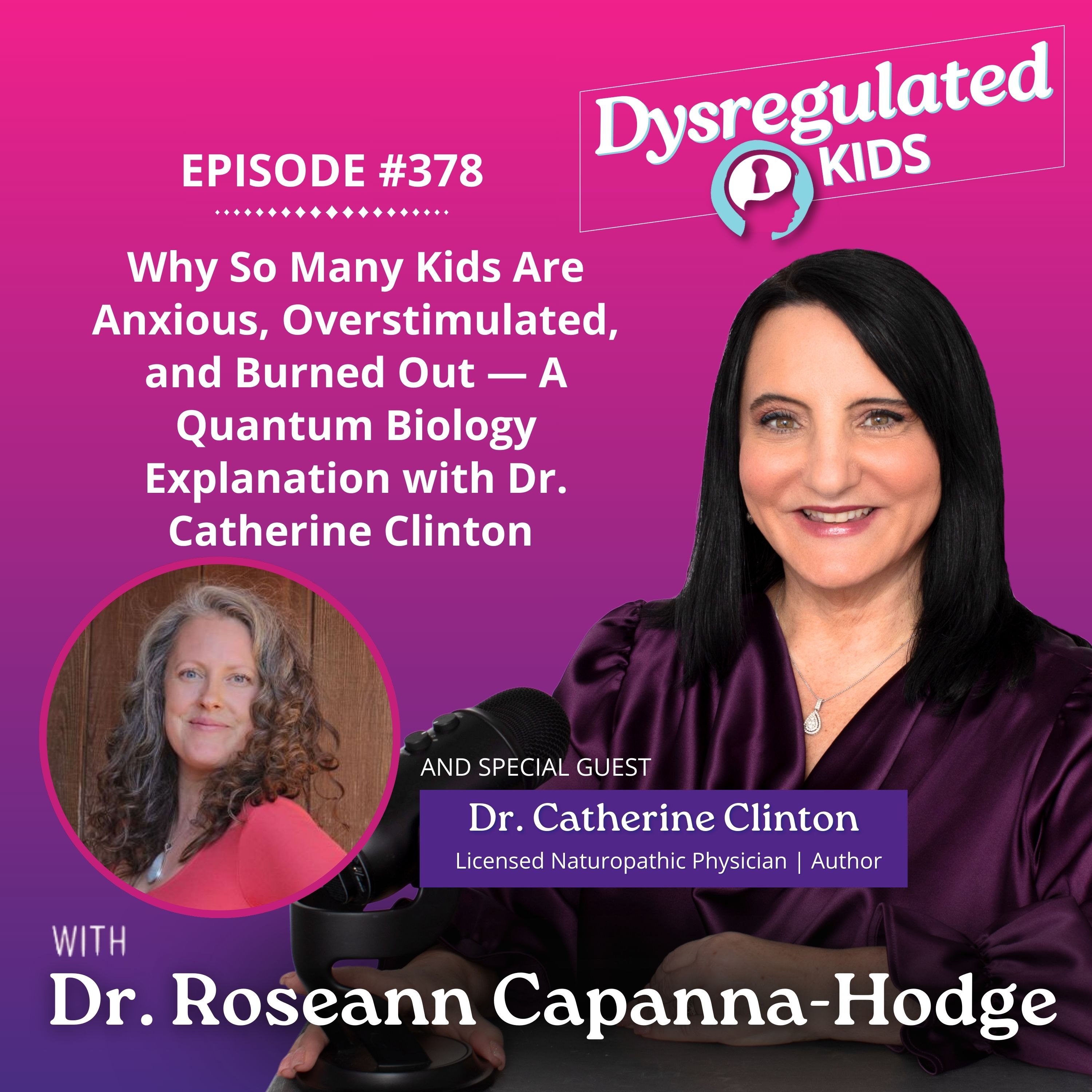
Ep 378Why So Many Kids Are Anxious, Overstimulated, and Burned Out — A Quantum Biology Explanation with Dr. Catherine Clinton | Emotional Dysregulation | E378
Discover why so many kids are anxious, overstimulated, and burned out through a quantum biology lens with Dr. Catherine Clinton. Learn practical insights to support emotional regulation, guided by Dr. Roseann Capanna-Hodge, expert in Regulation First Parenting™ and childhood dysregulation.So many parents feel exhausted watching their children struggle with racing thoughts, sensory overload, and anxious feelings. You’re not alone—kids today are navigating a world far more overstimulating than when we were growing up, and parental burnout is real.In this episode, I discuss with Dr. Katherine Clinton about small, actionable steps parents can take to improve emotional regulation, sleep, and overall mental health for their children and themselves.Why do so many kids feel burnt out and overwhelmed today?The modern world is relentless. Screens, schedules, and constant stimulation leave young people with 30 “tabs” open in their heads. Dr. Clinton explains that quantum biology—how energy from light, sound, and electromagnetic fields impacts our bodies—helps us understand why children are more anxious and struggling with mood, focus, and sleep.Takeaways:Children practice self-regulation naturally when they experience stillness and boredom—a step many mental health professionals say helps prevent racing thoughts and panic attacks.Daily physical activity outdoors supports neurotransmitters like serotonin and dopamine, helping kids focus and feel calm. This also gives parents the chance to tend to their own needs, which is essential if you want to be a better parent.Feeling burnt out isn’t a moral failing—it’s a normal reaction to overstimulation.Parent example: A fifth grade student who played outside daily felt calmer and less irritable compared to peers who spent all their free time on screens.How can sleep and light affect children’s emotional health?Sleep and circadian rhythm are foundational for regulating mood, immune function, and inflammation.When children get enough restorative sleep, it creates a sense of stability that supports their life at home, at school, and in relationships. Poor sleep can lead to depression or other challenges that are more than just a phase—they are not a normal part of healthy development.Morning sunlight exposure cues dopamine and serotonin, while evening red or infrared light supports mitochondrial function and restorative sleep. Overexposure to blue light at night can decrease melatonin by 90%, disrupting bedtime routines and creating racing thoughts at night.Tips:Go outside in natural light within 30 minutes of waking.Reduce overhead lights and screens before bed; consider blue light blocking glasses.Use warm, red-toned lights in the evening to cue relaxation.Parent example: Parents who swapped overhead lights for salt lamps and dimmed screens noticed children sleeping deeper and waking more alert.Want to stay calm when your child pushes every button? Become a Dysregulation Insider VIP and get the FREE Regulation Rescue Kit—your step-by-step guide to stop oppositional behaviors without yelling or giving in. Go to www.drroseann.com/newsletter and grab your kit today.What role does hydration and nutrition play in mental health?Hydration is the “antenna” for cellular function and nervous system regulation. Dehydration increases inflammation and anxious feelings, impacting children with ADHD, anxiety, or other medical conditions. Nutrition matters, but it’s one piece of a bigger puzzle.Tips:Encourage water and electrolyte intake daily.Include lean proteins for stable energy and focus.Make hydration a shared family habit rather than a chore.How does nature and grounding support regulation?Our bodies are electrical beings. Barefoot contact with the earth, time in green spaces, and listening to nature’s sounds reduces stress and sensory overload. Nature exposure also supports the microbiome, immune function, and emotional health.Takeaways:Even a short daily walk in the yard or park helps lower cortisol.Encourage kids to notice sensations: wind, sun, textures.Modeling self-care and deep breath exercises with your children teaches them regulation skills.Parent example: A teen who learned to take short outdoor breaks after screen time became more mindful and calmer during homework and family meals.🗣️ “These aren’t chores—they’re invitations to explore vitality with your children. When you tend to your own health alongside theirs, it ripples through the family.” — Dr. RoseannRemember, behavior is communication. By creating small, consistent routines, you can help your children regulate emotions, feel more grounded, and improve overall mental health—without magic wands, guilt, or overwhelm.FAQsHow can I tell if my child’s sleep is affecting their mood?Notice if they wake groggy, have racing thoughts, or struggle to focus—quality sleep affects behavior, focus, and mood.How long should outdoor time be for regulation?Even 5–10 minutes of natural light and movement cues neurotransmitters that i

Ep 377How to Get Your Child to Cooperate WITHOUT a Fight | Co-Regulation | E377
If every simple request turns into a power struggle, you’re not alone. How to Get Your Child to Cooperate WITHOUT a Fight reveals why cooperation starts in the nervous system—not willpower. Guided by Dr. Roseann Capanna-Hodge, founder of Regulation First Parenting™ and expert in childhood dysregulation, you’ll learn calmer, brain-based solutions that work.If every simple request feels like a negotiation, meltdown, or power struggle, you’re not alone. This isn’t bad parenting—it’s a nervous system under pressure. When kids can’t regulate, cooperation goes offline. And once you understand that, everything changes.In this episode, I break down the real neurological reason kids resist, why “just listen” doesn’t work, and the exact strategies that help kids of all ages—toddlers, school-age kids, and even older kids—cooperate without fights.Why does my child say “no” to everything—even simple things like brushing teeth?Because a dysregulated brain chooses avoidance over cooperation—every time. When your child’s nervous system is overloaded, they lose working memory, impulse control, and the ability to start tasks. Even brushing teeth or putting on socks can feel like too much, even for our own children.This isn’t disrespect or control—it’s overwhelm. When parents shift from correcting behavior to encouraging kids through regulation, everything changes.Key takeaways:Behavior is communication, not defianceA “no” often means “I can’t do this right now”Skills don’t disappear—access to them doesChild’s cooperation grows when adults regulate first and stay on the same teamReal-Life ExampleA mom I worked with felt like brushing teeth was a daily fight. Once she learned to regulate, connect, and then direct, the battles dropped—without teaching new skills. Her child finally accessed what he already knew.How do I stop power struggles before they start?Cooperation is a state, not a skill. You can’t demand it—you create it through co-regulation by calming the brain first.The 3-step Regulation First approach:Regulate first: deep pressure, a hug, walking together, slowing your voiceConnect before you direct: get close, not loud; calm presence mattersGive brain-friendly directions: short, concrete, one stepInstead of: “Get ready—we’re late!”Try: “Shoes on.”Connection flips the brain from threat to safety.🗣️ “Kids don’t resist doing the thing—they resist the internal overwhelm caused by the thing.” — Dr. RoseannYou don’t have to figure this out alone.Become a Dysregulation Insider VIP and get your FREE Regulation Rescue Kit:How to Stay Calm When Your Child Pushes Your Buttons and Stop Oppositional Behaviors.Head to www.drroseann.com/newsletter and start your calm parenting journey today.Why do transitions (mornings, after school, bedtime) cause meltdowns?Transitions are scary feelings for a sensitive nervous system. Predictability equals safety—and safety equals cooperation.Helpful strategies:Lower demands during high-stress timesCreate predictable routines (especially for neurodivergent kids)Prepare for transitions with warnings and visualsReal-Life ScenarioAfter school, kids’ cups are already full. Expecting instant compliance often leads to a meltdown and power struggles—lowering demands helps prevent them.💡 Want support calming the nervous system fast? Quick CALM helps reset dysregulation so kids feel safe and ready to cooperate. Learn more at https://drroseann.com/quickcalm/What exact words help kids follow directions without arguing?Less language = more cooperation. Short, clear words land better when kids are overwhelmed.Try this:Reduce language by 70%Offer one micro-stepLet kids choose the first stepInstead of: “Clean your room right now.” Say: “Let’s put clothes in the basket first.”Choice increases buy-in. Buy-in reduces battles.TakeawayIf your home feels like a battlefield, it’s not because your child won’t cooperate—it’s because their nervous system can’t yet. Regulate first. Connect next. Then direct. You’re not failing. It’s gonna be OK—and there is a way forward.FAQsWhy won’t my child follow directions?Because their nervous system is overwhelmed. Regulation must come before cooperation.Does this work for older kids?Yes. Older kids still need nervous system safety to cooperate.Am I giving in if I connect first?No. You’re creating the brain state needed to listen.How do I stop arguing fast?Lower language, calm your body, and give one clear step.Is this normal behavior?Yes. Most kids struggle when demands exceed regulation.Every child’s journey is different. That’s why cookie-cutter solutions don’t work.Take the free Solution Matcher Quiz and get a customized path to support your child’s emotional and behavioral needs—no guessing, no fluff.Start today at www.drroseann.com/help
Ep 376What I See Inside Every “Defiant” Kid’s Brain Map | Emotional Dysregulation | E376
Discover what I see inside every “defiant” kid’s brain map—revealing that oppositional behavior isn’t defiance but a dysregulated brain signaling stress. Dr. Roseann Capanna-Hodge, expert in Regulation First Parenting™, guides parents to understand, support, and calmly regulate their children’s emotions.Parenting a defiant child can feel exhausting, confusing, and even isolating. You might wonder if their arguing, refusals, or meltdowns mean you’re failing—but you’re not alone, and it’s not bad parenting.In this episode, I reveal what I see inside every defiant kid's brain map and explain how oppositional and defiant behavior is actually a signal of a dysregulated brain. You’ll learn how brain patterns drive defiance, why regulation must come before discipline, and practical strategies to help your child calm, focus, and thrive.Why does my child act defiant all the time?When parents hear “defiant,” it often triggers guilt or frustration—but defiance is never the first problem. Even behaviors that look like oppositional defiant disorder are often a sign of underlying dysregulation, not a personality flaw.Defiant behavior is a symptom, not a personality flaw.Children react to stress, overwhelm, or sensory input, and their behavior is simply a visible signal that their brain is struggling to cope.Brain maps show chronic overactivation in the limbic system—the emotional center of the brain. Kids are in constant fight, flight, or freeze mode.Example: A child who refuses homework may not be stubborn—they’re simply overwhelmed by information, sensory input, or stress.🗣️ “Defiance really isn’t a choice, it’s a way of communicating.” — Dr. RoseannHow can brain maps help me understand my child’s behavior?Brain mapping, or QEEG, measures electrical activity across the brain and compares it to age-appropriate norms.Identifies overactive and underactive regions, highlighting where regulation is breaking down.Reveals patterns behind oppositional and defiant behavior, attention deficit hyperactivity disorder, and executive functioning struggles.Real-life scenario: Riley, a 10-year-old with extreme defiance, had hyperactive connectivity across his brain. Once his nervous system was regulated through neurofeedback and sensory support, his behavior shifted dramatically.Tip: You don’t always need a brain map—look for the behavioral breadcrumbs. They’re screaming, “I need regulation first.”Why can’t I just discipline or reward my defiant child?Behavioral strategies alone often fail because they bypass the brain’s underlying dysregulation.First step: Calm the nervous system. When the brain is regulated, skills like listening, planning, and impulse control become accessible.Key Takeaways:Regulation precedes consequences or teaching.Meltdowns, shutdowns, and refusals are signs of overwhelm, not willful misbehavior.Adults modeling calm help children restore emotional balance.When your child is dysregulated, it’s easy to feel helpless.The Regulation Rescue Kit gives you the scripts and strategies you need to stay grounded and in control.Become a Dysregulation Insider VIP at www.drroseann.com/newsletter and get your free kit today.What patterns do I see inside every defiant kid’s brain map?I want to emphasize common neurological patterns in defiant children:Overactive limbic system: Constant emotional activation, hyper-vigilance, and fear responses.Underactive prefrontal cortex: Low executive functioning—difficulty with impulse control, planning, and decision-making.Poor left-right hemisphere communication: Challenges with transitions, processing information, and regulating emotions.Excessive fast wave activity: Drives irritability, impatience, and rapid emotional outbursts.Weak or overactive posterior regions: Impacts comfort-seeking, sensory regulation, and emotional grounding.Tip: Recognize these patterns in your child to better understand their reactions, emotions, and stress signals.For immediate support, try Quick CALM to help your child regulate in the moment.TakeawayDefiance isn’t a choice—it’s communication. Understanding what I see inside every defiant kid’s brain map empowers parents to see behavior as a signal of dysregulation, not defiance.Start with regulation, provide support, and watch executive functioning and emotional balance improve. It’s gonna be OK—your child can learn, grow, and thrive.FAQsWhat is the first step in helping a defiant child?Focus on calming the nervous system. Regulation must come before teaching skills or enforcing consequences.How does ADHD affect a child’s defiant behavior?ADHD impacts attention, executive functioning, and impulse control, often making children appear oppositional when their brain is simply overwhelmed.Can brain maps predict a child’s behavior?Yes. Brain maps reveal overactive and underactive regions, helping parents and practitioners identify triggers for oppositional and defiant behavior.How can parents support a dysregulated child at home?Model calm, provide sensory break
Ep 375The Disrespect Epidemic: Why Kids Are Ruder Than Ever and What to Do | Regulation-First Parenting | E375
Kids today seem sharper, quicker to snap, and harder to parent—and it’s leaving many families exhausted. In this episode, we explore The Disrespect Epidemic: Why Kids Are Ruder Than Ever and What to Do with Dr. Roseann Capanna-Hodge, founder of Regulation First Parenting™, who reveals how emotional dysregulation—not bad parenting—drives today’s behaviors and how calming the brain restores respect. If you feel like your child’s eye rolling, snapping, or sharp tone has gotten worse, you’re not imagining it—and you’re not failing. Many parents are quietly wondering why parenting feels harder than ever, even when they’re doing all the “right” things.In this episode, we unpack why kids are ruder than ever and what to do, revealing why disrespectful behavior has skyrocketed and why it’s really a sign of nervous system overload—not bad manners. You’ll learn what’s driving today’s explosive reactions and how calming the brain first can restore connection, respect, and peace at home.Why does my child seem so rude and disrespectful lately?Many parents worry their child’s disrespectful behavior means bad manners or poor values. But it’s not disrespect—it’s dysregulation. Children today are overstimulated, under-rested, and under constant pressure. When the nervous system is overwhelmed, skills like empathy, patience, and respectful tone go offline.What looks like rude behavior is really a stress response. Kids don’t wake up wanting to talk back or roll their eyes—their brains are stuck in survival mode.Takeaways:Behavior is communication, not defianceOverloaded brains lose access to self-controlYour child isn’t bad—their nervous system is strugglingExample: A 12-year-old snaps “Leave me alone!” when asked about homework. It’s not attitude—it’s emotional overload.Are kids today really ruder than past generations?Children today aren’t worse—they’re more dysregulated. Screens, constant noise, fast schedules, and emotional burnout leave little recovery time. Many young people hold it together at school, then explode at home where they feel safest.This is why disrespectful kids often save their worst behavior for parents and family members.Takeaways:Kids crash at home after holding it together all dayHyper-stimulation shortens frustration toleranceLosing problem-solving skills makes everything feel like a threat🗣️ “Kids don’t want to be disrespectful. It becomes the only thing their brain can do when they’re overloaded.” — Dr. RoseannWhy doesn’t my child listen or respond respectfully in the moment?When a child’s nervous system is in fight, flight, or freeze, the prefrontal cortex—the brain’s job manager—goes offline. You can’t reason, lecture, or punish your way through dysregulation.Matching their intensity only fuels a power struggle.What helps instead:Soft tone + calm body lowers arousalName the feeling without approving the behaviorPause before correcting tone or wordsExample: Instead of “Don’t talk to me like that,” try, “You sound overwhelmed. Let’s pause.”Yelling less and staying calm isn’t about being perfect—it’s about having the right tools.Join the Dysregulation Insider VIP list and get your FREE Regulation Rescue Kit, designed to help you handle oppositional behaviors without losing it.Download it now at www.drroseann.com/newsletterHow can I teach respect without yelling or harsh consequences?You can’t demand regulation—you have to practice it. Teaching respect starts when kids are calm, not mid-meltdown. Scripts, cues, and predictable routines build safety and better behavior over time.Steps forward:Teach respectful words after the stormBuild daily regulation breaks (movement, water, quiet time)Prioritize sleep—an exhausted brain is more likely to be rudeIt’s not bad parenting—it’s a dysregulated brain. Let’s calm the brain first.If you need fast support during heated moments, tools like Quick CALM help reset the nervous system in minutes so kids can respond instead of react. TakeawayYou’re not alone—and it’s gonna be OK. Disrespectful behavior doesn’t mean you’ve lost your child or your authority. When you focus on regulation first, connection and respectful behavior follow. There’s always a way forward.FAQsWhy is my child so rude to me but not others?Kids often unload where they feel safest. Home is where dysregulation spills out after holding it together all day.Should there be consequences for disrespectful behavior?Yes—but only after regulation. Calm brains learn; dysregulated brains resist.Is eye rolling and name calling normal?It’s common today, but it’s a sign of overload, not character flaws.How do I stop power struggles with my child?Step out of the moment, lower your tone, and co-regulate before correcting.Can kids really learn respect if they’re dysregulated?Absolutely. Regulation builds the foundation for respect.Not sure where to start?Take the guesswork out of helping your child.Use our free Solution Matcher to get a personalized plan based on your child’s unique needs—whether it’s ADHD, anxie
Ep 374Is Over-Scheduling Hurting Your Child’s Nervous System? | Emotional Dysregulation | E374
Is your child melting down despite a full schedule? Is over-scheduling hurting your child's nervous system? This episode reveals how too much activity dysregulates kids—and how less can bring calm. Dr. Roseann Capanna-Hodge, founder of Regulation First Parenting™, shows why calming the brain restores balance.If you’ve ever wondered why your child melts down after activities you thought were helping—or why home feels like the emotional fallout zone—you’re not alone.In this episode, I unpack how over scheduling can quietly overwhelm a child’s nervous system, why even “good” activities can backfire, and what actually helps kids find calm, focus, and emotional balance again.Is over scheduling hurting your child's nervous system—even with activities they love?Many parents sign kids up with good intentions: sports, music lessons, enrichment activities. But more isn’t always better. When children go from school to after school activities to homework to bed, their nervous system never gets a break.Key takeaways:Transitions drain neurological energyEven fun can be overstimulatingA constantly “on” brain can’t resetReal-life example: A child thrives at elementary school and extracurricular activities—but explodes over socks at home. That’s not bad behavior. It’s cumulative stress.Why does my child behave at school but fall apart at home?This is one of the biggest clues of a child overscheduled. Home is the safe place where the nervous system finally crashes. When kids hold it together all day, the stress has to come out somewhere.Watch for signs like:Tears, irritability, shutdownsResistance to simple tasksPhysical symptoms like headaches or stomach aches🗣️ “When kids fall apart at home but are phenomenal at school, it’s a classic sign of nervous system overload.” — Dr. RoseannIt’s not bad parenting—it’s a dysregulated brain.Can structured activities and enrichment harm mental health?Yes—when there’s no balance. Research shows chronic stress elevates cortisol, overloads the prefrontal cortex, and negatively impacts emotional well being, sleep, and a child’s cognitive ability.Too many scheduled activities can lead to:Higher anxiety and stress levelsTrouble sleeping or sacrificing sleepMood swings and emotional fragilityThis is especially true for kids with ADHD, anxiety, OCD, PANS/PANDAS, or other mental health challenges—but all children need downtime.If your child’s nervous system runs “hot,” tools like Quick CALM can help bring fast regulation support into daily life. Learn more at https://drroseann.com/quickcalm/.How do I know if my child is overscheduled?One activity alone isn’t the problem—it’s the pattern. When these signs stack up, your child is telling you they’re maxed out.Red flags include:Mood shifts before or after activitiesTrouble falling or staying asleepResistance to leaving the houseConstant somatic complaintsExample: A parent removed just one organized activity from their child’s week. Within days, meltdowns dropped dramatically—without adding anything new back in.If you’re tired of walking on eggshells or feeling like nothing works…Get the FREE Regulation Rescue Kit and finally learn what to say and do in the heat of the moment.Become a Dysregulation Insider VIP at www.drroseann.com/newsletter and take the first step to a calmer home.What actually helps kids regulate and thrive?Kids don’t need to be constantly busy to develop skills. They need predictability, recovery, and unstructured time.What supports regulation:Limit to one activity per dayBuild in 10–20 minutes of daily recoveryReduce unnecessary transitionsProtect family meals and family timeLet boredom happen—it builds creativity and problem-solving skillsChildren heal in quiet, not chaos. They can’t self-regulate if every minute is filled.How do parents set limits without guilt or pressure?Many parents feel pressure—from schools, friends, and society—to keep children occupied. But your child’s behavior should guide the calendar, not the other way around.Try this mindset shift:You’re not depriving your child—you’re protecting their well beingDoing less supports emotional stabilityOpen communication beats comparisonKids don’t need more activities. They need a regulated childhood. It’s gonna be OK.TakeawayIf your child is overwhelmed, reactive, or emotionally fragile, pause before adding more. This isn’t about quitting everything—it’s about finding balance so your child can truly thrive.FAQsIs over scheduling bad for kids?Yes. Too many activities can increase stress, disrupt sleep, and negatively impact mental health and behavior.How many extracurricular activities are too many?If your child shows meltdowns, sleep issues, or physical complaints, it may already be too many.Can boredom really help kids?Yes. Unstructured play supports creativity, self-regulation, and emotional resilience.Why does my child complain of headaches after school?Stress often shows up as physical symptoms in children when their nervous system is overloaded.Should kids qu
Ep 373The #1 Reason Your Kid Doesn’t Listen (It’s Not What You Think) | Emotional Dysregulation | E373
The #1 reason your kid doesn’t listen isn’t defiance or attitude—it’s brain state. This episode reveals why listening shuts down during dysregulation and how calming the nervous system restores connection, guided by Dr. Roseann Capanna-Hodge, founder of Regulation First Parenting™ and expert in childhood emotional dysregulation.When parents understand the reason your kid doesn’t listen, everything shifts. This episode breaks down how nervous system dysregulation—not attitude—impacts how kids listen, especially during transitions, and shows parents how calming the brain first restores connection and cooperation.Why does my child ignore me when I know they understand?This is such a big deal for many parents. Your child may be perfectly capable of understanding your words—and still not process them because their child's actual developmental reality doesn’t always match what we’re expecting in that moment.Listening isn’t a skill; it’s a brain state. When kids are dysregulated, the brain deprioritizes language, which can deeply strain the parent child relationship if we don’t understand what’s really happening.It’s not “they won’t,” it’s “they can’t—right now.” That’s why my work is about helping teach parents to stop personalizing behavior and start responding to the nervous system instead.Behavior is communication, and a child who ignores you is often overwhelmed or under-stimulated—which is why regulation always comes before cooperation. This is where practical tips rooted in brain science make all the difference.Takeaways:Dysregulation shuts down auditory processingOverstimulated brains feel noisy and reactiveUnderstimulated brains feel flat and checked outReal life Scenario: A parent asks a child to wear shoes, stop playing, grab their school bag—nothing. The child isn’t defiant. Their nervous system is louder than your voice.Is my child being disrespectful or oppositional?Many parents worry about oppositional defiant disorder or long-term disrespect. But compliance connotes coercion, and real listening comes from connection—not control, especially when we understand how children emotionally experience stress and authority.When children feel emotionally safe, their willingness to cooperate rises, and children follow rules more naturally. That’s how civil society operates—through regulation and relationships that children facilitate autonomy, not fear.What helps:Stop assuming attitudeAvoid yelling (voice carrying escalates stress)Offer gentle guidance instead of pathetic commands carried by frustrationIt’s not bad parenting—it’s a dysregulated brain.Want to stay calm when your child pushes every button?Become a Dysregulation Insider VIP and get the FREE Regulation Rescue Kit—your step-by-step guide to stop oppositional behaviors without yelling or giving in.Go to www.drroseann.com/newsletter and grab your kit today.Why do kids struggle most during transitions?Transitions are hard because expecting children to shift instantly ignores their developmental capability. The brain needs time to shift states.Practical strategies:Use fewer words (“Shoes on now” vs. long lectures)Give a “just a minute” warningAdd a sensory cue: light touch, visual gesture, quietly remindReal-Life Example: Instead of yelling to stop throwing knives (or toys), move closer, make eye contact if tolerated, and calmly cue the next step.Want a quick and easy shot of calm? Try Quick CALM to help regulate your child’s brain before giving directions.What does listening look like when the brain is ready?Listening doesn’t always mean eye contact. Don’t force it. Kids pay attention in different ways.Signs the brain is online:Body turns toward youBreath slowsLess delay in responseChildren physically show readiness before they follow rules. That’s your cue to speak.How do I help my child listen without yelling?Connection promotes competence. Spend time building relationships and create shared moments outside of conflict. This builds intrinsic motivation and long-term regulation—something many parenting advice books overlook when they focus on compliance over connection.Advanced strategies parents forget:Match tone—slow and steadyLower language loadInvite collaboration: “Are you ready?”🗣️ “Your child isn’t trying to make your life harder—their nervous system is just louder than your voice.” — Dr. RoseannTakeawayYou’re not alone. Your child’s behavior isn’t personal—it’s neurological. When you calm the brain first, listening follows. It’s gonna be OK. You have more power than you think.FAQsWhy does my child only listen when I yell?Because yelling spikes alertness. Calm regulation teaches sustainable listening.Should I get a hearing test?If you suspect physiological hearing issues, yes—but most listening problems are neurological, not hearing-related.Is eye contact required for listening?No. Many kids listen without direct eye contact.Do screens affect listening?Yes. Screens involved can overstimulate the nervous system and reduce auditory processing.
Ep 372The Executive Function Trap: When Smart Kids Can’t Start | Emotional Dysregulation | E372
Why can smart kids explain everything yet can’t get started? The Executive Function Trap reveals how dysregulated brains block task initiation. Dr. Roseann Capanna-Hodge, creator of Regulation First Parenting™, helps parents calm the brain and restore executive skills.Ever watched your smart child know everything about black holes—but freeze at putting on their shoes or starting homework? It’s frustrating, confusing, and can feel impossible to fix. You’re not imagining it—and it’s not laziness. There’s a real reason bright kids struggle with starting and finishing tasks: executive function challenges.In this episode, we unpack why executive function deficits often masquerade as disobedience, defiance, or lack of motivation. You’ll learn what these core executive function skills are, why task initiation often fails in dysregulated brains, and practical, science-backed strategies to support your child’s success in school and everyday life.Why does my child freeze even when they’re so smart?Smart kids often know the content—they just can’t see the path from start to finish. Their prefrontal cortex struggles with task initiation and planning ahead, creating what I call the executive function trap.Visualize the end goal: Help your child picture the completed task.Break tasks into small, concrete steps: 3–5 micro-steps instead of overwhelming lists.Use movement and gestures: Activate visual and motor pathways to strengthen memory and planning.Real-Life ExampleMilo could explain black holes in depth but couldn’t start homework. Once we taught him to see the finished project and work backward, he could initiate tasks without panic.How can I teach executive function skills at home?Executive function isn’t fixed—these key skills can be developed over time with consistent practice. Think of it like learning to cook a new recipe: you visualize the final dish, then reverse engineer the steps.Scaffold the first steps without creating dependence.Encourage cognitive flexibility and impulse control by offering choices within structured limits.Use visual schedules, sticky notes, or body doubling to support working memory.Parent Tip: Cue the nervous system to regulate first—if your child is dysregulated, no executive function strategy will stick.Try Quick CALM for a quick regulation reset before tackling tasks.What’s the first executive function skill to address?The single most impactful skill is task initiation. Without the ability to start, even the most intelligent child can feel paralyzed. By teaching children to:Imagine the end resultWork backward through the stepsTake the first doable action…you create a roadmap that reduces overwhelm and builds confidence.Use visual aids and gestures to strengthen memory and attention.Keep instructions short and concrete—avoid long, abstract multi-step directions at first.Celebrate small wins to reinforce self-monitoring and self-control.Real-Life ScenarioJC, a teen struggling with homework, finally completed his study session when we added gestures, acronyms, and movement—amplifying learning and reinforcing daily life executive skills.🗣️ “It’s not bad parenting—it’s a dysregulated brain. When we start with the end in mind and teach step-by-step, kids can actually start, stay on task, and finish.”— Dr. RoseannYou don’t have to figure this out alone.Become a Dysregulation Insider VIP and get your FREE Regulation Rescue Kit: How to Stay Calm When Your Child Pushes Your Buttons and Stop Oppositional Behaviors.Head to www.drroseann.com/newsletter and start your calm parenting journey today.How do executive function challenges affect daily life?Trouble planning: Difficulty organizing tasks, managing time, or sequencing complex tasks.Emotional dysregulation: Overwhelm leads to shutdown, avoidance, or risky behaviors.Social impact: Challenges with inhibition control and self-monitoring can affect social skills and teamwork.Can executive dysfunction be treated?Yes! By teaching children core skills like working memory, flexible thinking, problem solving, and inhibition control, we can support life skills, task completion, and self-advocacy.Consistency, scaffolding, and visual aids make it stick.TakeawayThe executive function trap isn’t about laziness or defiance—it’s about skills the brain hasn’t yet developed. By starting with the end in mind, breaking down tasks, and scaffolding appropriately, parents can teach specific strategies that make planning, task initiation, and completion achievable.It’s gonna be OK—your child can learn to manage emotions, finish tasks, and thrive.FAQsWhat is the executive function trap?It’s when a child knows the content but can’t start, plan, or finish tasks due to executive function deficits.How do I support executive functioning in my child?Use visual schedules, micro-steps, and scaffolding while regulating their nervous system first.Can executive dysfunction improve over time?Yes, executive function skills can be taught with practice, consistency, and guided s
Ep 371You’ve Tried Everything… Here’s Why Your Child Still Struggles | Emotional Dysregulation | E371
If you’re exhausted and wondering Why Your Child Still Struggles despite trying everything, this episode explains what’s really going on. Dr. Roseann Capanna-Hodge, founder of Regulation First Parenting™, reveals how nervous system dysregulation—not parenting failure—blocks real change.If you’re exhausted from trying therapy, medication, behavior charts, or every tip the internet throws at you, you’re not alone. So many parents reach out after years of effort, still confused about their child’s behavior and why change never seems to stick.Today, I’m breaking down what’s actually happening inside a dysregulated brain—because this isn’t about willpower, effort, or “trying harder.” It’s about calming the nervous system first so kids can learn, grow, and handle difficult emotions in healthier ways.Why does my child still struggle even after therapy, meds, and behavior charts?If you feel like you’ve done “all the things” and nothing sticks, you’re not alone.Most parents are given strategies that target symptoms instead of calming the nervous system first. And when a child’s brain is stuck in survival mode, problem solving skills, self regulation, cooperation, frustration tolerance, and even basic listening become neurologically impossible.Megan’s story says it all. After years of OT, speech, CBT, and multiple meds, her son Jack still couldn’t transition, follow directions, manage anxiety, or regulate emotions. She felt defeated — but the real problem wasn’t effort… it was sequence.Key Takeaways:Behavior is communication, not defiance.A dysregulated nervous system pulls the prefrontal cortex offline.You can’t teach children skills during dysregulation.It’s not bad parenting — it’s a dysregulated brain.Many kids struggle not because they’re unmotivated, but because their brain is overwhelmed.At school, with friends, or during transitions, your child may be struggling to manage frustration, think clearly, or solve problems—so lectures and consequences often bounce right off.🗣️ “You haven’t tried everything — you’ve just been shown what to try first in the wrong order.” — Dr. RoseannWhy does my child fall apart even though they’re smart and capable?Smart kids can still get stuck in fight, flight, or freeze. When the limbic system takes over, language, frustration tolerance, and cooperation shut down—this is why children struggle, even when a child who “knows better” suddenly can’t listen, transition, or self-regulate.Look for clues:Sudden irritabilityAvoidance“I won’t” moments that are truly “I can’t”Micro-signs of dysregulation before the meltdownParent tip: Start observing your child like a detective — the little signals matter.If you’re tired of walking on eggshells or feeling like nothing works…Get the FREE Regulation Rescue Kit and finally learn what to say and do in the heat of the moment.Become a Dysregulation Insider VIP at www.drroseann.com/newsletter and take the first step to a calmer home.Why won’t behavior charts, consequences, or reminders work?Because compliance tools don’t work on an overwhelmed brain. Charts, lectures, and reasoning bounce right off a nervous system in distress.What actually works:Regulation first, direction secondCo-regulation—your own behavior sets the toneRemoving demands when the brain is friedSimple resets like movement or deep breathsThese strategies help kids return to baseline so they can access their thinking brain again.Practical skills:BreathworkSomatic exercisesTwo 5-minute daily regulation resetsConsistency over perfectionIf you want an easy way to help your child shift out of overwhelm, try Quick CALM — a proven brain-calming kit for stressed kids and parents.What simple steps can I take today to help my child regulate?You don’t need 12 new strategies. Start with one nervous-system intervention and make it consistent. Then layer in more.Beginner-friendly options:Breathwork before transitionsMovement breaksLowering demands during dysregulationPredictable routinesParent co-regulation first (oxygen-mask moment!)Opportunities for fun, family connection, and positive thingsWhen kids feel safe, their self esteem grows. They develop a growth mindset. They handle challenges more easily. And they begin to show the same emotional resilience you see in other kids who seem to “bounce back.”TakeawayYour child isn’t struggling because you’ve failed or they can’t learn—they’re struggling because their brain is overwhelmed and no one showed you where to start.Every child can regulate. Calm the brain first, and kids can figure out emotions, talk, solve problems, and navigate the world confidently.You’re not behind. You were just given the wrong idea of where to start—until now.FAQsWhy doesn’t my child respond to therapy?Therapy only works when the brain is regulated. A stressed nervous system blocks learning and coping skills.How do I know if my child is dysregulated?Look for micro-signs: tension, avoidance, irritability, or quick frustration.What should I do during a meltdown?Pause
Ep 370370: Which Therapeutic Diet Really Helps Neurodivergent Kids? GFCF, Keto, Paleo & More Explained with Julie Matthews
Confused about diets for neurodivergent kids? In this episode, we answer Which Therapeutic Diet Helps Neurodivergent Kids, breaking down GFCF, keto, paleo, and more with Julie Matthews—guided by Dr. Roseann Capanna-Hodge’s Regulation First Parenting™ approach to calming emotional dysregulation.Which therapeutic diet really helps neurodivergent kids? Here’s what you need to know. Kids with ADHD, autism, anxiety, and emotional dysregulation can struggle so much, and you’re not imagining it—food truly can make or break their mood, focus, and behavior.In this episode, I talk with nutrition expert Julie Matthews about which therapeutic diet really helps neurodivergent kids, how diet affects the brain, and simple ways to start even if your child is picky.Why does food affect my child’s mood, behavior, and attention so much?Food is powerful because it either nourishes the brain or bogs the nervous system down with inflammation. Julie breaks it into two parts:Add nutrient-dense foods that support brain function, address nutritional deficiencies, and promote brain health in children with autism and other autistic patients.A healthy and balanced diet or targeted dietary interventions can make a big difference.Remove problematic foods that affect gut health, trigger immune system dysregulation, and impact cognitive function.Options may include a gluten free diet or ketogenic diets, tailored to genetic and environmental factors.Even brief swaps from processed foods and high sugar intake to whole foods often improve GI symptoms, autistic symptoms, mood, and attention.Key takeaways:Inflammation = dysregulationNourishing foods calm the brain faster than most parents expectEven one small change—like reducing dyes or food additives—can shift behavior fastParent StoryOne mom shared that removing red dye led to fewer after-school meltdowns within 48 hours—proof that eliminating unhealthy foods and additives can dramatically shift autism severity and mood disorders.Which therapeutic diet really helps neurodivergent kids?There’s no one-size-fits-all diet, but Julie’s clinical experience is clear: most neurodivergent children improve when they reduce sugar intake, remove gluten free casein (GFCF) triggers, and focus on healthy foods that improve gut bacteria, immune response, and brain development.Her book outlines a 12-step plan for implementing therapeutic diets, starting with removing dyes, flavors, preservatives, and then tailoring the diet to a child’s unique nutritional needs, GI disorders, and food sensitivities.Helpful starting points:Avoid artificial colors and additivesReduce sugarRemove gluten and dairy (high-impact inflammation triggers)Add protein, healthy fat, and whole foodsWhy this matters: 70% of American kids rely heavily on processed foods—foods that overstimulate the nervous system and deplete nutrients needed for attention and regulation.Want to stay calm when your child pushes every button?Become a Dysregulation Insider VIP and get the FREE Regulation Rescue Kit—your step-by-step guide to stop oppositional behaviors without yelling or giving in.Go to www.drroseann.com/newsletter and grab your kit today.How do I start improving nutrition when my child is picky?You’re not alone—every parent worries about this. Julie reminds us that picky eaters can still make progress because the first steps don’t require major sacrifice.Instead of taking away everything at once, begin with easy swaps your child will accept.Try these:Swap their usual cookie for a clean ingredient versionReplace sugary snacks with fruit + nuts (instant mood difference!)Start introducing new foods alongside favoritesKeep flavors simple—kids often prefer it that wayReal-Life ScenarioA child who only ate beige foods tolerated a preservative-free version of their favorite snack—and that small win opened the door for new foods.What’s the best first step if I feel overwhelmed?Nutrition doesn’t have to be complicated, and you don’t have to overhaul everything today.Start with ONE of these:Remove artificial dyesAdd protein at breakfastSwap processed snacks for cleaner alternativesRemove gluten or dairy for 2 weeksAdd healthy fats to stabilize moodWhen kids feel better—less anxiety, fewer headaches, calmer afternoons—they’re naturally more open to continuing the diet.🗣️ “Once kids feel dramatically better, it becomes easy to follow the diet because the brain and body start working the way they should.” — Dr. Roseann.Quick CALM helps your child’s nervous system stay regulated while you slowly shift nutrition, so diet changes feel easier and meltdowns decrease.Takeaway & What’s NextNutrition has a powerful, often immediate impact on mood, behavior, and regulation. When you calm inflammation and feed the brain well, kids feel better—and that means fewer meltdowns, clearer focus, and more calm in your home.Need guidance? Julie’s book The Personalized Autism Nutrition Plan gives you clear, practical steps to support kids with autism and neurodevelopmen
Ep 369369: The Real Reason You’re Stuck in Power Struggles (No One Talks About This)
Discover the real reason you’re stuck in power struggles with your child and why discipline often fails. I’ll show you how understanding your child’s nervous system transforms conflict into calm, using my Regulation First Parenting™ strategies. Parenting can feel overwhelming, especially when every morning feels like a standoff or every request turns into conflict. You’re not alone. Many parents find themselves exhausted trying discipline systems, charts, or punishments—only to watch the same struggles repeat.In this episode, I share practical Regulation First Parenting™ strategies to break free from daily power struggles and help your child—and yourself—find calm and connection.Why am I always stuck in power struggles with my child?The truth is, power struggles aren’t about willfulness—they’re a direct result of a dysregulated nervous system. When a child’s brain is overstimulated, their emotional brain takes over, and logic and reasoning go offline.This can affect personal relationships at home and even influence how children interact in their work environment or with peers, making it harder to maintain a fulfilling life for the whole family.Without understanding these cues, parents can lose sight of their child’s deeper emotional needs, and behaviors may appear as a defense mechanism rather than purposeful disobedience.Tips to break the cycle:Pause before reacting: Your own nervous system sets the tone, helping you stay present instead of getting stuck in the same place of repeated conflict.Co-regulate first: Match your child’s emotional state before attempting correction.Focus on connection: Eye contact, soft tone, and proximity help your child feel safe.Real-Life ExampleAlex, a 9-year-old, transformed mornings from 45 minutes of chaos to 10 minutes of calm by teaching both him and his mom how to regulate before acting.How can I teach my child to regulate emotions instead of punishing them?Discipline systems only work when the frontal lobes are online. If a child is stressed, fearful, or dysregulated, punishment will often escalate conflict instead of teaching self-control.Takeaways:Regulate first, connect second, teach third.Use quick rituals like deep breaths, tapping, or short mindfulness exercises.Name what’s happening in the body, not who the child is: “Your body is tense—let’s calm it together” instead of “Stop being lazy.”When your child is dysregulated, it’s easy to feel helpless.The Regulation Rescue Kit gives you the scripts and strategies you need to stay grounded and in control.Become a Dysregulation Insider VIP at www.drroseann.com/newsletter and get your free kit today.What role does my own self-awareness play in power struggles?Your own feelings and nervous system deeply influence your child’s behavior. Dysregulation spreads—when you’re stressed, your child often mirrors that state.Strategies:Take a moment to pause and breathe before engaging.Recognize your painful feelings and use them as clues rather than triggers.Show your child that making mistakes is human, fostering self-esteem and personal growth.🗣️ “You can’t teach coping skills until the brain is safe. Calm is the control system your child borrows until they can learn to self-regulate.” — Dr. RoseannHow can I create a more harmonious home and prevent daily conflicts?Start by building a routine that supports regulation:Begin mornings with a connection ritual: 5 deep breaths, gentle hugs, or quiet check-ins.Offer choices to give your child a sense of control.Practice team problem-solving and finding common ground instead of escalating punishments.Over time, these small, consistent actions build a foundation for confidence, emotional resilience, and better relationships at home and beyond.TakeawayPower struggles aren’t about your child being difficult—they’re about a nervous system in overdrive. By pausing, co-regulating, and teaching skills once your child is calm, you create real, lasting change. With patience and practice, mornings, homework, and transitions can become smoother—and your family’s well-being and connection stronger than ever.For quick, practical strategies to calm both you and your child in minutes, check out Quick CALM and start transforming your daily routines today.FAQsWhy do power struggles happen daily?They occur when a child’s nervous system is dysregulated, making it hard to follow rules or manage emotions.Can punishment solve power struggles?Not when a child is dysregulated. Regulation and connection must come first.How do I calm myself during conflicts?Pause, breathe, and use a brief regulation ritual before engaging with your child.What’s the best way to teach emotional regulation?Model calm, co-regulate, and teach coping skills in safe, low-stress moments.How long does it take to see improvement?Small changes often show results in days, but consistent practice builds long-term self-regulation.When your child is struggling, time matters.Don’t wait and wonder—use the Solution Matcher to get clear next ste
Ep 368368: You Can’t Regulate a Child With an Unregulated Nervous System: Are you Stuck in Co-Dysregulation?
Are you stuck in co-dysregulation? When your child’s nervous system spikes, yours can too—creating a cycle of stress and overwhelm. In this episode, I share Regulation First Parenting™ strategies to calm both you and your child.When your child’s emotions spike, it can feel like a wildfire—and sometimes, it spreads to you too. You’re not alone.This episode dives into the real science behind co-dysregulation and how your own nervous system directly affects your child’s emotional regulation. Learn practical, step-by-step strategies to stay calm, reset your nervous system, and help your child self-regulate.Why Do I Catch My Child’s Emotions?Ever notice how your stress seems to mirror your child’s? That’s your mirror neurons in action, and it’s a core part of co regulation.Research suggests that your child’s brain literally mirrors yours, sensing tension through your tone, posture, and facial expressions, shaping their emotional responses and stress response.Key takeaway: If your body signals threat, your child’s nervous system picks it up instantly, increasing emotional dysregulation and potentially impacting their mental health.Emotional emphasis: It’s not bad parenting—it’s biology.Parent StoryOne mom realized her lecturing only escalated her son’s meltdown. Pausing and softening her voice changed the dynamic entirely.What Is Co-Dysregulation and Why Does It Happen?Co-dysregulation happens when both parent and child’s nervous systems spike at the same time. It’s a reactivity loop: the child dysregulates, the parent gets triggered, stress amplifies, and both spiral.Tip: Pause before responding. Ask yourself, “Am I calm enough to help?”You cannot calm a dysregulated child from a dysregulated state. Your own nervous system must lead the way.Parent StoryA parent learned to step back, breathe deeply, and approach calmly—creating a de-escalated environment where learning and problem-solving became possible.You don’t have to figure this out alone.Become a Dysregulation Insider VIP and get your FREE Regulation Rescue Kit: How to Stay Calm When Your Child Pushes Your Buttons and Stop Oppositional Behaviors.Head to www.drroseann.com/newsletter and start your calm parenting journey today.How Can I Co-Regulate Instead of Escalate?Co-regulation isn’t about fixing your child—it’s about anchoring both of your nervous systems in safety. The polyvagal theory shows that a regulated adult cues a child’s body to stand down from threat.Practical steps:Take a deep breath, stretch, or move to calm yourself first.Lead with safety, not control—lower your voice, soften your face, slow your movements.Remember: kids learn by catching your calm, just as they catch chaos.Parent StoryOne mom stopped lecturing mid-meltdown, observed the pattern, and used one simple calming phrase to guide her child back to emotional regulation.🗣️ “When your child’s meltdown triggers yours, you’re not failing—you’re catching their emotional fire, and the one who comes first wins for both.”— Dr. RoseannWhat Do I Do After a Meltdown?Repairing after the storm is just as crucial as preventing it. Acknowledge your own emotions and model healthy regulation.Tips:Avoid guilt or harsh reactions—repair builds trust faster than perfection.Admit your missteps: “I got overwhelmed too. I’m learning to stay calm just like you.”Reinforce emotional resilience through repeated safe, calm experiences.Quick CALM Tip: Use tools like PEMF, magnesium, or a brief stretch to reset your own system—your calm is contagious.TakeawayCo-dysregulation is real, but it’s not permanent.By pausing, observing, and regulating your own emotions, you can shift your child’s nervous system, break reactive loops, and restore calm. Remember: behavior is communication, not defiance. With consistent calm, big emotions lose their power and children learn self-regulation. FAQsWhat is co-dysregulation in parenting?Co dysregulation occurs when both parent and child’s nervous systems escalate simultaneously, creating a reactivity loop.How do I calm my child when I’m stressed?Pause, breathe deeply, and approach with soft tone and safe body language. You must regulate first.Can my child learn emotional regulation?Yes. Kids learn by catching calm from adults and practicing coping skills in safe, supportive moments.Why does my child mirror my stress?Mirror neurons cause children to read and match your emotional states, responding to tone, posture, and energy before words.What’s the first step to break co-dysregulation?Recognize your own stress, pause, and lead with calm before trying to influence your child’s behavior.Every child’s journey is different. That’s why cookie-cutter solutions don’t work.Take the free Solution Matcher Quiz and get a customized path to support your child’s emotional and behavioral needs—no guessing, no fluff.Start today at www.drroseann.com/help
Ep 367367: The 4 Calming Phrases Parents Say Changed Everything
When your child melts down, every parent feels that moment of panic—What do I say? How do I help them calm? In this episode, I break down the 4 Calming Phrases Parents Say Changed Everything and how these simple, rhythmic statements help a dysregulated brain return to safety and connection.Parenting a child whose emotions shift from zero to one hundred can feel overwhelming, but understanding what the brain needs in those tense moments changes everything. These phrases aren’t fluffy scripts. They’re co-regulation tools that speak directly to a child’s nervous system, reduce overwhelm, and open the door to emotional learning.This episode offers practical guidance on why these phrases work, how to use them during real-life meltdowns, and how parents can stay grounded even when their child is losing control.Why do calming phrases work better than lectures during meltdowns?When a child is in fight, flight, or freeze, they literally can’t hear you. Logical thinking and critical thinking skills shut down as survival mode takes over. That’s why telling a child to “calm down,” “stop crying,” or “use your words” never works in the red zone—no matter your parenting style.Calming phrases act as safety cues. They help create a shift because they:Support emotional regulation in both parent and childPrevent you from barking orders when you’re stressedSignal safety so a child can feel connected rather than overwhelmedMake space for real boundary setting and the ability to set limitsReduce the urge for people pleasing or power strugglesCreate the conditions where kids learn instead of shut downStrengthen the entire family dynamic through calm communicationThese cues slow the moment and tell your child’s brain, “You’re not in danger. You’re not alone.”And that’s when real connection—and real teaching—can finally happen.If you’re tired of walking on eggshells or feeling like nothing works…Get the FREE Regulation Rescue Kit and finally learn what to say and do in the heat of the moment.Become a Dysregulation Insider VIP at www.drroseann.com/newsletter and take the first step to a calmer home.What are the 4 calming phrases parents say changed everything?1. “I’m with you.”This phrase instantly grounds a child who feels scared, overwhelmed, or ashamed.It tells their nervous system they aren’t alone, which is essential for emotional regulation.A parent shared that after years of nightly homework battles, whispering “I’m with you” softened her child’s panic—and changed the emotional tone of their entire household.2. “Let’s slow down.”Kids borrow our rhythm. When you slow your voice, breath, and movements, their brain naturally syncs to your calm.Saying “Let’s slow down” teaches emotional pacing and helps them step out of survival mode and back into connection.3. “We’ll get through this.”Dysregulated kids often think the moment is catastrophic. This phrase restores perspective and safety.It teaches resilience—not avoidance—and shows your child that problems are temporary and manageable with support.4. “It’s okay to feel upset.”Validation lowers cortisol and reduces overwhelm.Instead of shutting emotions down, this phrase teaches kids that feelings are safe and manageable—an essential skill for emotional intelligence.🗣️ "These phrases don’t reinforce negative behavior; they reinforce emotional safety, the foundation of all behavior change." — Dr. RoseannHow do I use these phrases during real-life meltdowns?Start in the yellow zone—before your child hits full red. Lead with regulation, not correction.Practical steps:Match the moment: Use a soft voice, slow movement, and few wordsChoose one phrase to practice consistentlyStay close but calm, offering co-regulationValidate first, teach laterWhen you use these phrases with consistency, your child begins to internalize them. Over time, they’ll use them with themselves—a huge win for self-regulation.Need instant tools before words even land? Try Quick CALM — a science-backed mini-course that helps settle your child’s nervous system fast.FAQsWhy do these phrases calm kids so quickly?They cue safety and connection, which downshift the nervous system faster than logic or discipline.Should I use these phrases with teens too?Absolutely. Older kids may resist comfort, but they still rely on safety cues to regulate.Are calming phrases the same as giving in?No—validation is not permissiveness. You regulate first, set boundaries second.What if my child ignores me when I use these phrases?They may be too dysregulated. Stay close, stay calm, and try again when they shift toward yellow.Not sure which strategy your child needs most?Take the guesswork out of parenting a dysregulated child.Use the free Solution Matcher to get a personalized brain-based plan for your child—whether it’s ADHD, anxiety, OCD, or emotional dysregulation.Start here: www.drroseann.com/help
Ep 366366: When the Sun Goes Down, the Meltdowns Begin—Here’s Why
Ever wonder why your child seems calm all day but melts down at night? I explain why child's meltdowns begin when the nervous system finally exhales, and share Regulation First Parenting™ strategies to help kids self-regulate. Parenting a child whose emotions swing from calm to chaos can feel overwhelming, especially at night. Understanding why child's meltdowns begin and how to respond with compassion can transform bedtime from a battle into a moment of connection.This episode dives into the triggers behind evening meltdowns and how to use proactive strategies to support emotional regulation.Why does my child meltdown as soon as bedtime arrives?Evening meltdowns aren’t about defiance—they’re about decompression.After a full day of school, activities, and sensory input, your child’s nervous system is depleted. Their brain finally “exhales,” which can lead to:Cortisol spikes that make relaxation difficultRestlessness and avoidance as the body struggles to calmReassurance-seeking behaviors fueled by anxiety or OCDReal-Life ExampleYour child who seemed perfectly calm all day suddenly refuses to get into bed, insisting on checking locks repeatedly. These challenging behaviors are their brain’s way of saying, “I’m overwhelmed and need safety.”How can I help my child self-regulate before bedtime?Leading with calm is key. You can’t lecture a dysregulated brain—co-regulation comes first.Start 30 minutes early: Dim lights, lower voices, and turn off screens.Introduce a wind-down ritual: Stretching, quiet music, or gentle yoga can cue the brain for sleep.Use humor and gentle touch: A hug or light hand pressure can reinforce safety and connection.🗣️ “When the sun goes down, your child's brain isn't trying to ruin things. It's trying to release from the day.”— Dr. RoseannWant to stay calm when your child pushes every button?Become a Dysregulation Insider VIP and get the FREE Regulation Rescue Kit—your step-by-step guide to stop oppositional behaviors without yelling or giving in.Go to www.drroseann.com/newsletter and grab your kit today.What are common triggers for toddler temper tantrums and meltdowns in young children?Evening meltdowns are often unlike tantrums seen earlier in the day. Common triggers include:Sensory overload from lights, sounds, or devicesUnexpected changes in routineEmotional distress or anxiety around school, tests, or social interactionsParent fatigue—co-dysregulation can escalate meltdownsProactive strategies:Teach coping skills like deep breathing, short stretches, or grounding exercises.Reinforce positive behaviors and model calm responses to help your child learn self-regulation over time.Struggling to help your child calm down quickly?Try Quick CALM, a science-backed mini course reset designed to settle your child’s nervous system and reduce meltdowns fast.How can I reinforce positive behaviors and manage future tantrums?Creating a predictable, calming bedtime routine is crucial.Regulate before routine: Lead with calm to help your child’s nervous system resetValidate feelings, not behavior: Address worries gently before instructing actionsSupport self-regulation skills: Encourage deep breathing, rhythmic movement, or guided relaxationReward and reinforce: Notice when your child follows the routine or calms independentlyReal-Life ExampleAfter a night of practicing breathing exercises together, your child successfully gets into bed with less arguing, giving both of you a sense of accomplishment.What long-term strategies help kids manage evening meltdowns?For ongoing support:Use tailored strategies based on your child’s triggers and ageIncorporate coping mechanisms like white noise, weighted blankets, or PEMF therapyMonitor routines and adjust over time as your child growsSeek professional guidance if meltdowns become severe or tied to OCD or anxietyRemember: Behavior is communication. Meltdowns signal a dysregulated brain, not bad parenting.By staying calm, modeling coping skills, and reinforcing positive behaviors, you can help your child manage emotions, reduce stress, and sleep more peacefully.FAQsWhy does my child meltdown every evening?Evening meltdowns often occur because a child’s nervous system is exhausted from daily stress. Leading with calm and consistent routines helps prevent overload.How can I teach my child coping skills for bedtime?Introduce deep breathing, grounding exercises, and gentle movement. Co-regulate first, then guide your child through the routine.Are evening tantrums a sign of ADHD or anxiety?They can be linked to anxiety, sensory overload, or neurodivergence. Observe triggers, validate feelings, and use tailored strategies.How do I manage a child’s behavior during bedtime arguments?Focus on calm co-regulation, predictable routines, and reinforcing positive behaviors rather than punishment or lectures.Can routines reduce severe irritability in kids?Yes! Structured, calming bedtime routines signal safety, support emotional regulation, and reduce nighttime
Ep 365365: The Real Reason Your Child Is Struggling in School (and How to Fix It at Every Age)
Many bright kids struggle daily in school, and it’s not because of laziness or lack of effort. The real reason your child is struggling in school is often a dysregulated nervous system. I’ll show you how Regulation First Parenting™ strategies help kids calm, focus, and thrive.Every parent knows the sinking feeling when homework, tests, or transitions turn your child’s school day into a battle. It’s tempting to think the problem is effort, attitude, or ability—but the truth is, learning, focus, and motivation depend on regulation. When a child’s nervous system is overstimulated or under stimulated, even the brightest students can struggle academically.In this episode, I break down why kids across all ages—from preschoolers to college students—face learning challenges, and how parents can partner with schools and use evidence-based strategies to unlock their child’s full potential.Why does my child melt down over schoolwork or transitions?Many children experience sensory or emotional overload, leading to meltdowns, avoidance, or shutdowns. Younger kids often face developmentally inappropriate expectations or tasks that feel too big, which triggers fight, flight, or freeze responses.Recognizing that every child has different learning styles is key, because what feels overwhelming to one child may feel manageable to another. Understanding your child’s learning process helps you tailor support and maintain progress in their child’s education, whether during the regular school year or even summer school.Tips for parents:Break tasks into manageable steps and offer sensory breaks.Validate your child’s feelings: “I see this is overwhelming, let’s take a minute.”Incorporate short nervous system resets, like deep breathing, gentle movement, or butterfly tapping.Real-Life ScenarioA preschooler refuses to start writing. Using a 3-minute reset and offering a small, achievable writing goal helps her calm and complete the activity.How can I help my middle or high schooler stay motivated?Middle and high school kids face growing demands on executive functioning—planning, organizing, and emotional regulation—all while managing increased homework, quizzes, and tests.Chronic stress can lead to procrastination, anxiety, or perfectionism, even in academically strong students.Tips for parents:Request a team meeting with teachers, guidance counselors, or case managers.Identify simple classroom supports, like sensory breaks or visual schedules.Encourage small, consistent self-regulation practices daily.🗣️ “You can’t pour knowledge into a brain that’s on fire—calm the brain first, and learning will follow.” — Dr. RoseannWhat can I do for my child’s learning in college?College is a test of independence and executive functioning.Without prior support, students may experience burnout, missed deadlines, anxiety, or withdrawal, regardless of intelligence. Nutrition, sleep, and coping strategies directly impact their academic performance and self-esteem.Tips for parents:Encourage self-advocacy and identify the school’s learning center resources.Know critical deadlines for dropping or adjusting classes to protect grades and scholarships.Support mental health with counseling, family therapy, or tools like Quick CALM for nervous system regulation.When your child is dysregulated, it’s easy to feel helpless.The Regulation Rescue Kit gives you the scripts and strategies you need to stay grounded and in control.Become a Dysregulation Insider VIP at www.drroseann.com/newsletter and get your free kit today.Takeaway & What’s NextOnly a calm brain can learn. Whether your child struggles with focus, motivation, anxiety, or executive functioning, Regulation First Parenting™ strategies can help.Preschool & elementary: Partner with teachers, advocate for sensory breaks, and support home routines.Middle & high school: Schedule team meetings, discuss triggers, and ask about extra support.College: Guide self-advocacy, monitor nutrition, sleep, and stress, and encourage mental health breaks.FAQsHow do I know if my child has a learning disorder or just struggles academically?Look for patterns in attention, focus, and emotional regulation. Dysregulation often underlies learning challenges rather than laziness.How can I support my child’s learning style at home?Identify your child’s strengths, use multisensory activities, and create a safe space for practice and focus.What should I do if my child resists homework daily?Try short, consistent nervous system resets and break assignments into small, achievable tasks.Can extracurricular activities improve focus?Yes. Activities that stimulate or regulate the nervous system can boost attention, confidence, and motivation.How do I communicate with teachers without conflict?Open communication works best. Share observations, ask about supports, and co-create solutions based on your child’s needs.Tired of not knowing what’s really going on with your child?The Solution Matcher gives you a personalized recommen
Ep 364364: Why Your Kid’s Brain Shuts Down When Plans Change
Child meltdowns spike when plans change because your child’s brain feels unsafe and the nervous system goes into survival mode. I’ll guide you through Regulation First Parenting™ strategies to calm, support, and help your child adapt with confidence.Every parent knows the moment when plans change and your child suddenly spirals into tears, anger, or shutdown. It feels overwhelming, frustrating, and sometimes even personal—but you’re not alone.In today’s episode, we explore why these meltdowns happen and practical ways to help your child stay regulated and resilient.Why does my child shut down when plans change?It’s not defiance—it’s anxiety in disguise. Many children struggle with flexibility because their nervous system craves predictability.When plans change, the amygdala—the brain’s fear center—takes over, and the prefrontal cortex responsible for logic goes offline.Small changes feel like danger to a dysregulated brain.Stress accumulates silently throughout the day (think schoolwork, transitions, friendships), filling your child’s “stress cup.”Meltdowns are the overflow, signaling their brain is overwhelmed.Parent StoryMaria’s daughter, Molly, would explode every weekend when plans shifted. By previewing the day and co-regulating, Maria helped Molly feel safe—and those meltdowns stopped.How can I help my child cope with unexpected changes?The key is regulation first, flexibility second. You can’t force a child to adapt if their nervous system is in survival mode. Instead:Preview changes in advance—give gentle warnings or visual schedules.Co-regulate through transitions—model calm, name emotions, and breathe together.Practice flexibility in small doses—switch dinner seating or minor routines while your child is calm.Tip: Every time your child navigates a small change successfully, their brain rewires for resilience. Predictability isn’t coddling—it’s scaffolding their emotional growth.Why do some kids struggle more than others?Nervous system sensitivity plays a big role.Children with neurodivergence, trauma histories, or heightened sensory experiences often feel emotions and changes more intensely. Their brains are wired to survive, not to negotiate logic in the moment.Over- or under-stimulation can trigger emotional dysregulation.Daily stress adds up, making even minor changes feel impossible.Developmental expectations vary by age, from toddlers needing reassurance to teens pushing back verbally.A tween might say, “You ruined everything!” while a teen might retreat with, “I don’t care.” Same nervous system reaction—different expression.Get instant tools to soothe your child’s stress and prevent meltdowns—grab your Quick CALM now at https://drroseann.com/quickcalm/What mistakes do parents make during meltdowns?It’s natural to want to lecture, explain, or impose consequences—but when the brain is in red-zone survival mode, logic doesn’t land.Talk less, regulate more—be the calm anchor your child needs.Avoid rescuing—overcorrecting adds stress to the cup.Model coping strategies—deep breaths, pausing, and gentle guidance teach resilience more than words.🗣️ “Change isn’t the enemy for your kid, it’s the dysregulation of their nervous system that’s causing them to freak out. When we regulate first, we build resilience for life.”— Dr. RoseannYelling less and staying calm isn’t about being perfect—it’s about having the right tools.Join the Dysregulation Insider VIP list and get your FREE Regulation Rescue Kit, designed to help you handle oppositional behaviors without losing it.Download it now at www.drroseann.com/newsletterHow do I create a safe space for my child to learn flexibility?Anchor with routine—consistent rituals lower baseline stress.Rehearse calm transitions—practice small changes when your child is regulated.Build cognitive flexibility gradually—regulation strengthens the brain pathways that support adapting to change.Tip: Think of it like insulin for a diabetic—the brain needs predictability and regulation to thrive.Takeaway Helping a child navigate changes is not about control—it’s about connection. By calming the brain first, providing predictability, and practicing small doses of flexibility, parents can reduce meltdowns, strengthen emotional regulation, and support brain development.With patience, consistency, and empathy, your child can learn to manage stress and thrive.FAQsWhy does my child throw tantrums when plans change?It’s their nervous system signaling overload. Stress, sensory sensitivity, and anxiety combine, making even minor changes feel threatening.How can I help my child regulate emotions during a school day?Preview transitions, co-regulate, and practice calm coping strategies to prevent the stress cup from overflowing.What is the role of the prefrontal cortex in emotional regulation?It manages logic and problem solving, but when the amygdala triggers fear, the prefrontal cortex temporarily shuts down.Can kids learn flexibility if they are neurodivergent?Yes! With regulati
Ep 363363: Is Everyday Stress Quietly Rewiring Your Child’s Brain?
Is everyday stress quietly rewiring your child's brain? Learn how chronic stress reshapes the nervous system, affects emotional regulation, and how small, practical lifestyle changes can protect your child’s brain health.Parenting a child whose emotions swing from calm to chaos can feel overwhelming. Everyday pressures—school demands, social tension, family stress—can quietly rewire your child’s brain, pushing it into a constant state of survival mode. But the good news? You can change these patterns.In today’s episode, we break down how chronic stress affects brain development, why your child may seem "overly reactive" or withdrawn, and practical tools you can use to build emotional resilience and calm.Why does my child overreact to small stressors?Your child's brain is highly responsive to repeated stress, especially those with trauma, neurodivergence, or sensory sensitivities. Chronic stress strengthens fear circuits in the amygdala while weakening prefrontal cortex control, making your child more prone to anxiety, meltdowns, or overreaction.Takeaways:Frequent stress rewires the brain: the more your child experiences stress, the stronger the fear pathways become.Behavior reflects the brain: meltdowns aren’t misbehavior—they’re signs of an overactive stress response.Small moments add up: transitions, noise, or school pressures can overflow your child’s stress cup.Real-Life ExampleJess noticed her son melting down every afternoon. By adding a quiet snack and a two-minute decompression before homework, she saw his meltdowns reduce within a month.How can I tell if my child’s nervous system is overstimulated or under-stimulated?Overstimulation looks like constant movement, big emotions, defiance, sleep troubles, and hyper-reactivity. Under-stimulation shows as daydreaming, zoning out, sluggishness, or excessive caffeine use in teens. Both reflect dysregulated stress response patterns.Tips for parents:Observe daily patterns in behavior and energy.Offer micro resets: 1–2 minute stretches, humming, tapping, or deep breathing.Track stressors to notice triggers and early warning signs.Quick CALM™ gives your child fast, simple tools to reset their nervous system and regain emotional control in moments of stress. With easy, science-backed techniques, it helps kids stay grounded, focused, and calm—so you can reduce meltdowns and boost everyday resilience.What can parents do to protect the brain during stressful moments?Regulate first, teach second. Your calm acts as the anchor for your child’s nervous system. Predictable routines and lifestyle changes—hydration, sleep, magnesium-rich foods—help balance stress hormones and protect brain structure.Action Steps:Incorporate short, frequent nervous system breaks.Prioritize predictable schedules and safe environments.Co-regulate for connection before correction—behavioral learning happens when your child feels safe.🗣️ “Every meltdown isn’t a tantrum—it’s your child’s nervous system overflowing. You can teach their brain to recover, not just react.”— Dr. RoseannYou don’t have to figure this out alone.Become a Dysregulation Insider VIP and get your FREE Regulation Rescue Kit:How to Stay Calm When Your Child Pushes Your Buttons and Stop Oppositional Behaviors.Head to www.drroseann.com/newsletter and start your calm parenting journey today.How do small daily habits influence emotional resilience?Micro resets lower cortisol and calm stress response.Consistent sleep, hydration, and nutrition protect brain development.Mindful connection and predictability teach the brain to expect safety, not danger.Even minor interventions build long-term emotional regulation and help children manage stress without harming the prefrontal cortex.What’s the real impact of chronic stress on kids?Repeated stress exposure can:Weaken focus, memory, and learningTrigger anxiety, depression, or aggressionPush the nervous system into constant survival modeThese effects are reversible. With intentional lifestyle changes, predictability, and mindful parenting, you can quietly rewire your child’s brain for calm.TakeawayStress builds brains—for better or worse.Today, we explored how everyday stress quietly rewires your child's brain, the signs of over- and under-stimulation, and the practical steps parents can take to protect emotional regulation, resilience, and overall brain health. It’s not bad parenting—it’s a dysregulated brain.Remember: You’re not alone. With consistent, small interventions, your child can learn calm, focus, and resilience—skills that last a lifetime.FAQsCan stress permanently change my child’s brain?Chronic stress shapes brain circuits, but intentional regulation, routines, and micro resets can reverse harmful wiring over time.How do I know if my child is dysregulated?Signs include meltdowns, defiance, zoning out, sleep issues, or overreaction to small triggers.What lifestyle changes support emotional resilience?Sleep, hydration, protein-rich foods, magnesium, predictable routine
Ep 362362: Why Therapy Isn’t Working: The Hidden Power of Neurofeedback for Dysregulation
If you’ve spent months—or years—in therapy and your child is still melting down, avoiding schoolwork, or unable to calm their body, you are not alone. And it’s not because the therapy is “bad” or you’re doing anything wrong. The real issue is that their brain can’t use the strategies yet.That’s where neurofeedback comes in. Today’s episode dives deep into the science of why so many kids stay stuck and why regulation must come first before any traditional therapy can work.Why isn’t therapy working for my child’s chronic meltdowns?It’s not your parenting, and it’s not that therapy “failed.”Often, traditional talk therapy assumes the prefrontal cortex—our thinking brain—is online. When your child is stuck in fight, flight, or freeze, that part of the brain shuts down, affecting how your brain functions, cognitive function, and overall brain health.Key takeaways:Dysregulation is biological, not behavioral. Kids know what to do but can’t act when their nervous system is stressed, affecting mental health disorders, anxiety symptoms, and overall brain function.Frontal lobe offline = skills don’t stick. Strategies learned in therapy may not transfer at home because brain waves aren’t balanced.Red flags: prolonged emotional resets, sleep or eating issues, constant overwhelm, and hypervigilance—common in mental health conditions and sometimes linked to chronic pain.Real-Life ExampleEthan struggled for two years in therapy. He could talk about his feelings but couldn’t apply any strategies at home, showing that knowledge alone doesn’t fix brain dysregulation or improve cognitive function.Once neurofeedback training targeted his brain’s communication centers through QEEG brain mapping, he began to pause, self-regulate, and thrive.This shows how brain science and precise interventions can create better mental health, strengthen overall brain function, and help children manage mental health disorders more effectively.How does neurofeedback therapy actually help the brain self-regulate?Neurofeedback uses real-time feedback to train the brain to recognize and correct its own brainwave patterns. Using QEEG brain mapping, practitioners identify areas of brain dysregulation and guide the nervous system back to balance.Tips for parents:Sessions are short: 20–30 minutes, 2–3 times per week.Neurofeedback strengthens emotional regulation, focus, and impulse control over time.It complements, rather than replaces, therapies like talk therapy, occupational therapy, or cognitive behavioral therapy.A child resistant to therapy often refuses to engage. With neurofeedback, even small, gentle “micro-workouts” of brain training can create lasting changes in nervous system regulation.Feeling stuck in constant meltdowns or anxious moments at home?Take control of meltdowns with Quick CALM™, a science-backed mini-course with the essential tools to calm your child’s brain—and yours too—so peace can finally return to your home.When should I consider neurofeedback for my child?Look for these red flags:Therapy progress is stalled or inconsistentEmotional resets take hours instead of minutesSleep, eating, or sensory issues persistConstant anxiety, hypervigilance, or dysregulated behaviorRemember: It’s not about motivation—it’s about biology. Neurofeedback therapy gives the brain a way to self-regulate, making all other interventions more effective.🗣️ “When the nervous system learns to calm itself, kids don’t just behave better—they think differently, communicate differently, and feel different. That’s the power of regulating the brain first.” —Dr. RoseannIf you’re tired of walking on eggshells or feeling like nothing works…Get the FREE Regulation Rescue Kit and finally learn what to say and do in the heat of the moment.Become a Dysregulation Insider VIP at www.drroseann.com/newsletter and take the first step to a calmer home.How does neurofeedback support other mental health challenges?ADHD and autism spectrum disorder: improves focus and cognitive performancePost-traumatic stress disorder (PTSD) or traumatic brain injury: reduces hyperarousal and supports emotional balanceAnxiety, severe depression, or chronic stress: helps calm the autonomic nervous system and improve sleep qualityBy targeting brainwave patterns like high beta (stress and anxiety) or theta (distractibility), neurofeedback retrains the brain’s ability to self-regulate, improving overall mental health and well-being.In short: Neurofeedback doesn’t just teach skills—it changes how the brain learns, thinks, and responds to life’s challenges.FAQsCan neurofeedback help kids who refuse therapy?Yes. Resistance often signals the brain isn’t regulated. Neurofeedback offers a gentle, effective pathway.How long until results appear?Many families see changes within weeks, though lasting benefits come with consistent sessions.Is neurofeedback safe for all ages?Generally yes, but sessions should be tailored by a certified provider for children with complex needs.Can neurofeedback improve
Ep 361361: Inside the Dysregulated and Distracted Brain: What a QEEG Map Reveals That Teachers and Doctors Miss
If you’ve ever wished you could peek inside your child’s brain during a meltdown or when they completely shut down, today’s episode is for you. We’re diving into QEEG brain maps—one of the most powerful, yet most underused tools for understanding what’s really driving big emotions, focus issues, and chronic dysregulation.For three decades, I’ve watched families bounce from diagnosis to diagnosis… ADHD, anxiety, “behavioral issues.” And while those labels can be helpful, they’re often surface-level.A QEEG lets us look under the hood so we can finally stop guessing. Because when we calm the brain first, everything else follows.Why So Many Kids Get the Wrong DiagnosisParents are often told their child has ADHD simply because they’re unfocused or overwhelmed. But ADHD criteria are broad—so broad that almost any dysregulated kid can fit the checklist. That’s why so many families show up after trying meds, OT, tutoring, and therapy with little or no progress.A QEEG changes that.This quantitative brain map shows where the brain is overactive, underactive, or disconnected, and those patterns tell us far more than a checklist ever could. I’ve done over 10,000 brain maps, and they consistently reveal what teachers, therapists, and even doctors miss.A Real Story: When ADHD Wasn’t ADHDOne mom, Sarah, came to me after years of trying to help her son Jack. He had an ADHD diagnosis, but nothing worked—not medication, not OT, not therapy.His brain map showed focus issues, yes… but more importantly, it pointed to learning and executive functioning patterns that suggested dyslexia. After a deeper history and a follow-up evaluation at school, dyslexia was confirmed.Suddenly everything made sense. Jack didn’t need a stronger stimulant—he needed a reading intervention. Once we supported his brain through neurofeedback and the right academic supports, the whole picture changed.This kind of story is far too common.Want to stay calm when your child pushes every button?Become a Dysregulation Insider VIP and get the FREE Regulation Rescue Kit—your step-by-step guide to stop oppositional behaviors without yelling or giving in.Go to www.drroseann.com/newsletter and grab your kit today.QEEG vs EEG: What’s the Difference?An EEG is a medical tool used to detect seizures. A QEEG—or quantitative EEG—measures the brain’s electrical activity and compares it to normative data.It’s:PainlessNoninvasiveDone with a soft cap and sensorsDesigned to map overactivity, underactivity, and connectivityThink of it like getting a satellite image of your child’s brain weather patterns—where storms are brewing, where things have gone quiet, and where communication lines are overloaded.What Dysregulation Looks Like on a Brain MapA dysregulated brain can’t shift smoothly between states—calm, alert, focused. On a QEEG, that shows up as:Underactivity → brain fog, low motivation, slow processingOveractivity → big emotions, anxiety, OCD-like reactionsChaotic connectivity → trouble transitioning, rigid thinking, meltdownsMany kids show a mix of all three. And when we understand those patterns, we stop blaming behavior and start seeing the biology behind it.Give your child instant relief with Quick CALM™—simple, science-backed tools that calm the brain fast, shrink meltdowns, boost focus, and make daily life feel so much easier.Why This Data Matters for ParentsOnce parents see their child’s brain map, everything shifts. Instead of saying, “He’s not motivated” or “She’s just not listening,” they begin to understand.🗣️ “Behavior is communication. Dysregulation is a nervous system saying, ‘I need help.’” – Dr. RoseannWith a brain map, we can finally:Prioritize the right interventionsStop wasting years on guessworkTrack progress with repeated QEEGsBuild a step-by-step plan based on what the brain actually needsIn my BrainBehaviorReset™ Program, this data allows us to calm the brain first—because nothing else works until we do.The Bottom LineA QEEG doesn’t just tell you what’s wrong. It shows you why your child is struggling and how to help.It takes the mystery out of behavior, replaces guesswork with data, and gives your family a clear path forward—one that honors your child’s biology, not just their symptoms.Because when we regulate the brain, everything begins to change.Not sure where to start?Take the guesswork out of helping your child.Use our free Solution Matcher to get a personalized plan based on your child’s unique needs—whether it’s ADHD, anxiety, mood issues, or emotional dysregulation.In just a few minutes, you'll know exactly what support is right for your family.Start here: www.drroseann.com/helpFAQsIs a QEEG the same as a medical EEG?No. An EEG looks for seizures. A QEEG measures brain activity patterns tied to mood, attention, learning, and regulation. It’s painless, non-invasive, and gives the functional information parents actually need.Can a QEEG help if treatments haven’t worked?Absolutely. Many kids struggle because the root issue wasn’t iden

Ep 360360: Minerals, Mitochondria, and Meltdowns: The Overlooked Link with Dr. Aaron Hartman
Parenting a child who goes from calm to chaos in seconds can feel exhausting. You try everything—deep breaths, gentle words, even walking away—and still, the meltdowns come. You’re not alone.When kids struggle with big emotions, there’s often a hidden root cause inside the body—and minerals play a much bigger role than most parents realize.In this episode, I sit down with Dr. Aaron Hartman to unpack the powerful connection between minerals, mitochondria, and meltdowns—and how nutrition, lifestyle, and nervous system regulation can help your child regain balance and calm.Why does my child melt down when they’re “just tired or hungry”?When your child seems to unravel at the smallest thing, it’s not bad behavior—it’s biology. Mineral imbalances directly affect how their nervous system fires.Low magnesium or zinc deficiency can make the brain more reactive to stress.When blood sugar drops from skipping meals or eating too many processed foods, the body burns through nutrients fast—leading to irritability, anxiety, or panic attacks.A deficient diet full of additives and low in whole foods affects serotonin, dopamine, and other key neurotransmitters.When we calm the brain first and nourish the body, meltdowns start to fade.Takeaway: A balanced diet rich in real food, protein, and calming minerals helps stabilize your child’s emotions and energy.Need quick relief while you work on those root causes? Try Quick Calm—my proven method to calm the brain fast so you and your child can reset and start fresh.Could my child’s mood swings be linked to mineral deficiencies?Absolutely. Research continues to show how essential minerals affect mental well-being and brain function.Here’s what parents need to know:Zinc deficiency is linked with attention deficit disorder (ADD/ADHD), depression, and poor immune function.Magnesium supports relaxation and sleep by calming overactive neurons.B vitamins and vitamin D play a critical role in serotonin production—affecting mood and focus.Too much copper or exposure to heavy metals can worsen anxiety, aggression, and brain fog.HTMA testing (Hair Tissue Mineral Analysis) can reveal these hidden imbalances, helping you target the root cause instead of chasing symptoms.🗣️“When your child’s body is missing key nutrients, their brain can’t regulate emotions—no matter how many coping tools you teach.” –Dr. RoseannWhat are simple ways to boost my child’s mineral intake naturally?You don’t need to overhaul your entire pantry overnight. Start small—consistency is what matters most.Choose whole foods over processed snacks. Think nuts, seeds, eggs, leafy greens, and clean proteins.Add trace minerals or electrolyte drops to water for gentle, steady support.Use zinc supplements or a high-quality multivitamin only when guided by a practitioner.Cook with healthy fats (omega-3-rich oils, avocado, grass-fed butter) to enhance absorption of fat-soluble vitamins.Involve your kids—make it fun with family “squat-offs” or walks after dinner to get their body and brain moving.Dr. Aaron’s reminder: “We used food like a drug.” Real food builds the foundation for healthy development and emotional balance.You don’t have to figure this out alone.Become a Dysregulation Insider VIP and get your FREE Regulation Rescue Kit: How to Stay Calm When Your Child Pushes Your Buttons and Stop Oppositional Behaviors.Head to www.drroseann.com/newsletter and start your calm parenting journey today.What if my child still struggles even with a healthy diet?If you’ve cleaned up your child’s diet and meltdowns persist, don’t lose hope. There are often deeper root causes at play—like mitochondrial dysfunction, gut imbalance, or unresolved body stress patterns.You can support healing by:Ensuring all the nutrients (especially amino acids and fatty acids) are coveredChecking for hidden inflammation or heavy metal exposurePrioritizing restorative sleep and movement—the mitochondria recharge when the body moves and rests rhythmicallyWorking with an integrative provider who looks at the whole child, not just their symptomsIt makes sense that when the body’s energy factories (mitochondria) are struggling, your child’s mood and focus will too.Bottom line: Nutrition and nervous system regulation work hand in hand. When one improves, the other follows.How can I help my child feel calmer while we work on the root cause?While you rebuild from the inside out, you can still help your child calm in the moment.Teach deep breathing and movement breaks.Use the Quick Calm method to regulate their nervous system fast.Model regulation yourself—kids co-regulate through your energy and responses.Celebrate progress, not perfection.Remember: It’s not bad parenting—it’s a dysregulated brain. Healing takes time, but small steps add up.Every child’s journey is different. That’s why cookie-cutter solutions don’t work.Take the free Solution Matcher Quiz and get a customized path to support your child’s emotional and behavioral needs—no guessing, no fluff.Start to
Ep 359359: Before the Emotional Blow-Up: Hidden Clues Your Kid's Nervous System Is in Trouble
Parenting a child, tween or teen who swings from calm to chaos in seconds can leave you walking on eggshells. One minute they’re fine, and the next—doors slam, voices rise, and you’re wondering what just happened. You’re not alone. Those big mood swings aren’t “attitude.” They’re signals that your child’s nervous system is in distress.Let’s dive into the hidden clues your child's, tween’s or teen’s nervous system is in trouble, how to decode them before they explode, and practical steps to bring calm back to your home.Why does my kid overreact to small things?When your child melts down over a lost pencil or a simple “no,” it’s not defiance—it’s a sign of an overwhelmed nervous system. Their brain is already running on empty, and even a tiny trigger can send them over the edge.What this means:Overreactions = stress overload. Their stress cup is full, and every little thing spills over.Persistent irritability or mood whiplash can signal emotional dysregulation, not disrespect.Physical signs like chest tightness, rapid heartbeat, or stomach pain often accompany these reactions.🗣️ “Behavior is communication. Once you learn to read these cues, you stop reacting to the behavior and start guiding your child back to calm.” –Dr. RoseannWhy can’t my kid calm down after getting upset?If your teen stays upset long after the conflict ends, that’s a clue their body’s stress response hasn’t shut off. Their stress hormones keep them on high alert, making it hard to return to balance.Try this:Regulate first. Take one deep breath before engaging. When you calm your brain, it helps theirs settle too.Name the shift. Say, “I can see this feels really big for you.” Validation lowers the nervous system threat.Use micro-resets. Short breaks, snacks, or movement stop the spiral.Remember: the more calm happens, the more calm happens.Is shutting down or saying “I don’t care” a warning sign?When teens go silent, refuse to talk, or withdraw, it’s often freeze mode, not attitude. This happens when their nervous system feels unsafe or overwhelmed—a common sign of emotional strain or unresolved trauma.Look for:Sudden withdrawal from friends or activitiesChanges in eating or sleep habits—like skipping meals, difficulty falling asleep, or frequent nightmaresPhysical complaints such as headaches, stomach pain, or fatigueA trauma-informed approach helps teens feel seen, not shamed. It’s not bad parenting—it’s a dysregulated brain.If you’re tired of walking on eggshells or feeling like nothing works…Get the FREE Regulation Rescue Kit and finally learn what to say and do in the heat of the moment.Become a Dysregulation Insider VIP at www.drroseann.com/newsletter and take the first step to a calmer home.Why does my child struggle with focus or schoolwork?Stress doesn’t just affect mood—it hijacks the executive function part of the brain. When your teen’s nervous system is dysregulated, focus, motivation, and even memory take a hit.What’s really going on:Stress hormones block concentration, leading to poor academic performance.Many kids are labeled with ADHD when the real issue is nervous system overload, not attention deficit.Medication isn’t always the answer. For some kids, it can worsen anxiety or mood issues.The solution? Regulate the nervous system first—then learning and focus improve naturally.How can I help my anxious kid express their feelings?Many teens don’t know how to talk about what’s happening inside. They may say, “I’m fine,” while their body screams otherwise. Helping them name emotions safely is the first step to emotional regulation.What to say:“I can see you’re having a rough moment. I’m here for you.”“Do you want space or support right now?”“Let’s take a reset together, then figure it out.”Connection cues—a gentle tone, soft eyes, or a calm touch—signal safety and help bring their nervous system back online.Decode the Behavior, Regulate the BrainYour tween or teen’s mood swings, shutdowns, or poor focus aren’t character flaws—they’re hidden clues that their nervous system needs support. Once you recognize these signs and calm your own brain first, you can help your child return to balance.If your home feels stuck in a cycle of tension and blow-ups, you can start shifting it today. Try my Quick Calm to learn how to reset your child’s stress response in minutes.When your child is struggling, time matters.Don’t wait and wonder—use the Solution Matcher to get clear next steps, based on what’s actually going on with your child’s brain and behavior.Take the quiz at www.drroseann.com/helpFAQsWhy does my teen have sudden mood swings for no reason?Those “random” mood swings aren’t attitude—they’re nervous system distress signals. When stress hormones build up, your teen’s brain struggles to stay calm. Help them regulate by staying grounded yourself and giving small breaks before reacting.Is my child's shutdown or “I don’t care” phase normal?Sometimes—but constant shutdowns mean your child’s nervous system is overwhelmed, not de
Ep 358358: The Surprising Fix for Oppositional Behavior (3 Steps Parents Can Use Today)
When every request turns into a power struggle, it can leave you exhausted, frustrated, and questioning everything you’re doing as a parent. But here’s the truth: your child isn’t trying to make your life harder—their brain is stuck in survival mode.Let me break down what’s really happening when kids seem defiant and how parents can shift from chaos to calm using three powerful regulation steps. You’ll learn how to decode oppositional behavior, why it’s not about disrespect, and what you can do today to help your child feel safe and cooperative again.Why Does My Child Say “No” to Everything?When your child refuses to listen or melts down over simple requests, it’s not bad behavior—it’s a dysregulated nervous system.Here’s what’s really happening:Their brain has gone into survival mode, shutting down logic and reasoning.That “no” is often a stress response, not manipulation.Many kids labeled with Oppositional Defiant Disorder (ODD) or other mental health conditions like ADHD, anxiety disorders, or mood disorders are really struggling with nervous system overload.Think of it like a smoke detector that’s too sensitive—it goes off even when nothing’s really burning. When your child’s stress cup is overflowing, every small demand feels like too much.Behavior is communication. Your child’s defiance is their brain’s way of saying, “I can’t handle this right now.”Is My Child’s Oppositional Behavior Really About Anxiety or Control?For many kids, saying “no” is an unconscious coping mechanism. It helps them avoid anxiety triggers or regain a sense of control when life feels unpredictable.Here’s what’s going on beneath that resistance:Anxious avoidance: Kids learn that saying “no” helps them keep anxiety lower.Loss of control: When kids feel powerless, they fight to regain safety.Sensory overload: Every transition, sound, or demand adds another drop to their stress cup.🗣️ “The more dysregulated they are, the more oppositional they become. And when parents respond from stress too, it amplifies the cycle.” –Dr. RoseannKey takeaway: Opposition isn’t disrespect—it’s the nervous system’s cry for safety and connection.You don’t have to figure this out alone.Become a Dysregulation Insider VIP and get your FREE Regulation Rescue Kit: How to Stay Calm When Your Child Pushes Your Buttons and Stop Oppositional Behaviors.Head to www.drroseann.com/newsletter and start your calm parenting journey today.What Can I Do When My Child Refuses to Cooperate?Here is a simple, science-backed three-step plan parents can use right away:Regulate first.You can’t calm your child if you’re dysregulated yourself.Take deep breaths, move your body, or pause before reacting.Your calm signals safety and helps your child’s brain shift out of fight-or-flight.Offer two choices.Keep it simple: “Do you want the red shirt or the blue shirt?”This restores healthy control without giving up structure.Choices defuse power struggles and build cooperation.Reframe your request.“Do it now” sounds like a threat to a dysregulated brain.Try, “Let’s start with this,” or use “first this, then that” language.It shrinks overwhelm and helps kids focus on one step at a time.These strategies reflect what’s taught in parent management training, parent-child interaction therapy, and social skills training—approaches proven to help kids with defiant behavior, conduct disorders, and anxiety disorders.Need help regulating in the moment? Download Quick Calm — it’s packed with simple, proven techniques to help you and your child calm the brain fast.How Can I Stay Consistent Without Losing My Cool?Consistency doesn’t mean rigidity—it means staying regulated, empathetic, and clear.To reinforce positive behavior and prevent problem behaviors:Model regulation. Your nervous system sets the tone for your child’s.Use positive reinforcement. Praise cooperation and effort, not perfection.Stick to routines. Predictability helps anxious and oppositional kids feel safe.Spend time connecting. Connection builds trust and reduces oppositional cycles.When parents lead with calm and connection, oppositional behavior softens—because the brain finally feels safe enough to cooperate.You Can Turn “No” into “Okay”Your child’s oppositional behavior isn’t a reflection of bad parenting—it’s a sign their brain needs help finding calm. When you regulate first, offer choices, and reframe your approach, you’ll start to see the resistance fade.Remember: Calm the brain first, and everything follows.Feel like you’ve tried everything and still don’t have answers?The Solution Matcher helps you find the best starting point based on your child’s symptoms, behaviors, and history.It’s fast, free, and based on decades of clinical expertise.Get your personalized plan now at www.drroseann.com/helpFAQsHow do I get my oppositional child to listen without yelling?Start by calming your own nervous system first. Kids mirror your energy—when you’re calm, their brain feels safe enough to listen. Then give short, clear direction
Ep 357357: Your Child's Meltdown Triggered Your Meltdown—Now What?
Parenting a child who’s melting down while you’re barely holding it together yourself can feel impossible.One minute you’re calm, and the next—you’re yelling too. You didn’t mean to, but their meltdown triggered yours. You’re not alone, and it doesn’t mean you’re a bad parent. It means both of your nervous systems are overwhelmed.Let me share why this happens and exactly how to stop the cycle of dysregulation before it spirals out of control. You’ll learn how your calm can anchor your child, what to do in the heat of the moment, and how small shifts can lead to lasting change in your family.Why Do I Lose My Cool When My Child Has a Meltdown?When your child screams, your nervous system feels it. That’s because of mirror neurons—the part of the brain that syncs emotions and energy between people. Your child’s chaos can trigger yours, just like your stress can trigger theirs.Here’s what’s happening:Your stress cup overflows just like your child’s. Every demand, noise, or unexpected change adds a drop until you spill over.Your survival brain takes over. Logic goes offline, patience disappears, and you react instead of respond.You move into fight, flight, or freeze, which makes emotional regulation nearly impossible.🗣️ “When meltdowns meet meltdowns, everyone’s brain goes offline. That’s why we calm the brain first—because no one can think when they’re in survival mode.” –Dr. RoseannWhat Should I Do When My Child’s Behavior Triggers Me?When that meltdown starts brewing, it’s not about perfection—it’s about presence.Try these calming techniques in the moment:Pause and breathe. Slow, deep breathing resets your nervous system and helps you stay grounded.Notice your body. Are your shoulders tight? Is your breathing shallow? These are early signs you’re dysregulated.Step away if needed. It’s OK to say, “I love you, but I need a minute to calm my body.”Anchor with calm body language. Kneel down, soften your voice, and lower your tone. Your calm presence helps your child’s brain feel safe again.Remember: Behavior is communication. Your child isn’t trying to make you lose it—they’re showing you that their nervous system needs help to regulate emotions.Yelling less and staying calm isn’t about being perfect—it’s about having the right tools.Join the Dysregulation Insider VIP list and get your FREE Regulation Rescue Kit, designed to help you handle oppositional behaviors without losing it.Download it now at www.drroseann.com/newsletterHow Can I Break the Cycle of Reactivity in My Family?I once worked with a dad named Michael who constantly clashed with his son, Jordan. Every argument ended in shouting matches—until Michael realized something powerful: he was getting pulled into the same dysregulated state as his child.When he learned to pause, breathe, and step back before reacting, everything changed. His calm energy helped Jordan settle faster—and the daily battles stopped.Key takeaways for parents:You set the tone. Your calm becomes your child’s calm.Repair matters. If you yelled, own it. Say, “I got upset too—let’s try again.” Repair builds trust and models emotional regulation.Consistency over perfection. Calm parenting isn’t about never losing it—it’s about repairing and reconnecting when you do.Feeling your stress cup start to spill over? You don’t have to power through it alone.Quick Calm gives you simple, science-backed tools to help you calm your body and mind fast—so you can respond, not react, when your child’s emotions run high.How Can I Teach My Child to Regulate Emotions?You can’t teach what you don’t model. Helping kids manage meltdowns starts with your own regulation.Proactive strategies that help:Create a calm space at home for when emotions run high.Use visual schedules to reduce anxiety from unexpected changes.Teach coping mechanisms like deep breathing, movement breaks, or quiet time.Use positive reinforcement when your child uses healthy coping skills.Whether your child struggles with sensory overload, poor impulse control, or communication challenges, the solution always begins with connection—not correction.When Should I Seek Extra Support?If intense meltdowns, severe irritability, or emotional distress are common, specialized support can help.A clinical psychologist, occupational therapy, or behavioral therapy can provide tailored strategies for children with undiagnosed learning disorders, autism spectrum challenges, or other regulation issues.Reaching out for help isn’t failure—it’s a proactive step toward healing. It’s not bad parenting—it’s a dysregulated brain.You can’t stop your child’s meltdown if you’re having one too. Regulation has to start with you, not perfectly—but most of the time.Next time your child’s emotions rise, pause, breathe, and remember: you have the power to stop the chain reaction. When you calm your brain first, you create the safety your child needs to calm theirs.Not sure where to start?Take the guesswork out of helping your child.Use our free Solution Matcher to get
Ep 356356: Why Your Child Freaks Out Over the Smallest Things
Parenting a child who melts down over socks that “feel weird” or a sandwich cut the “wrong” way can leave you wondering what’s really going on. You try to stay calm, but inside you’re thinking, Seriously? This can’t be about the sandwich.You’re not alone—and you’re not a bad parent. The truth is, those small moments aren’t small at all when your child’s stress cup is overflowing.Let me break down why your child freaks out over the smallest things and how to calm the brain first so everyone can find peace again. You’ll learn how to spot the warning signs of a full stress cup, what’s happening in your child’s brain during a meltdown, and simple ways to help them regulate—without power struggles or guilt.Why Does My Child Melt Down After School?Ever notice how your child holds it together all day at school—only to fall apart the second they walk in the door? That’s the stress cup effect. Every challenge, noise, and demand throughout the day adds a “drop” to your child’s nervous system. By the time they get home, that cup is full, and even seemingly small things push them over the edge.Here’s what fills your child’s stress cup:Classroom stress and transitionsSensory overload (sounds, textures, smells)Hunger and fatigueSocial struggles with other kidsHigh expectations or perfectionismWhen the brain is overstressed, logic and problem-solving shut down, and big emotions take over. That’s why reasoning in the heat of the moment rarely works—you’re talking to a brain that’s gone offline.Try this:Pause before reacting. Your calm becomes their calm.Offer a short regulation break (quiet time, water, movement) before talking.Create predictability. Use gentle countdowns and routines to lower stress.Why Do Simple Things Feel Like a Big Deal?When your child cries or screams over “nothing,” it’s not manipulation—it’s dysregulation. The meltdown isn’t about the apple slices or the wrong color cup; it’s about a nervous system that can’t take one more drop.Here’s what’s really happening:The amygdala (the brain’s alarm system) hijacks control.The prefrontal cortex—the part that helps kids think and reason—goes offline.Small frustrations suddenly feel enormous.So when your child says they “hate” their shirt or “can’t handle” their homework, it’s a cry for help, not defiance.What helps instead:Co-regulate first. Anchor your own emotions before helping your child.Name what’s happening. “It sounds like you’ve had a really hard day.”Micro resets. Stretch, take a breath, sip water—each helps pour stress out of the cup.If you’re tired of walking on eggshells or feeling like nothing works…Get the FREE Regulation Rescue Kit and finally learn what to say and do in the heat of the moment.Become a Dysregulation Insider VIP at www.drroseann.com/newsletter and take the first step to a calmer home.How Can I Help My Child Cope With Big Emotions?For sensitive kids and highly reactive children, the goal isn’t to stop the crying—it’s to teach the brain how to recover faster. Over time, emotional regulation becomes a skill.Simple ways to build regulation:Model calm. When you breathe slowly, you signal safety to your child’s nervous system.Create space. Give them five minutes of quiet before homework or snack time.Predictability = power. Use timers, countdowns, and gentle transitions.Practice daily calm. Try deep breathing, movement, or sensory breaks even when things are going well.🗣️ “Our calm is the lid on their stress cup. When you regulate first, you make it possible for your child to follow.” –Dr. RoseannParenting a dysregulated child shouldn’t feel like guesswork.Quick CALM gives you the science-backed reset that brings peace back to your home—starting today.What’s the Real Reason Behind My Child’s Extreme Reactions?It’s not about bad behavior—it’s about a brain that’s overwhelmed. When stress builds up without release, even little things feel like the end of the world. This is true for kids, teens, and even adults.Remember:Behavior is communication. Every tantrum is your child’s nervous system saying, “I can’t handle this right now.”You can train the brain. Just like muscles, the nervous system can learn to calm faster.Small, consistent regulation routines make the biggest difference in the long run.It’s never about the sandwich, the socks, or the snack—it’s about a nervous system that’s screaming, “I can’t take one more thing.” When you calm the brain first, meltdowns become messages instead of battles. Over time, you’ll see fewer tears, fewer power struggles, and more moments of connection.When your child is struggling, time matters.Don’t wait and wonder—use the Solution Matcher to get clear next steps, based on what’s actually going on with your child’s brain and behavior.Take the quiz at www.drroseann.com/helpFAQsHow do I know if my child is highly sensitive?Sensitive kids react strongly to sounds, textures, or changes in routine. They often feel emotions deeply and get easily overwhelmed by “simple things.”Is it normal for k
Ep 355355: Gentle Parenting Isn’t Enough—Here’s What Kids Really Need
Parenting a child who constantly melts down—even when you’ve tried every gentle parenting tip out there—can leave you exhausted and doubting yourself.You’re doing your best to be calm and validating, yet you still feel like you’re walking on eggshells. You’re not alone. The truth is, gentle parenting isn’t enough on its own—and understanding whycan completely change your family dynamic.Let’s break down what gentle parenting gets right, what it misses, and how to help your child truly regulate and thrive. Learn more about why empathy without boundaries backfires, what “Regulate, Connect, Correct” really means, and how to shift from over-validation to true emotional safety.Why Doesn’t Gentle Parenting Always Work?Gentle parenting promotes empathy, validation, and connection instead of harsh punishment. That’s beautiful in theory—but many parents discover it’s not enough in real life.Here’s why: Validation alone doesn’t calm a dysregulated brain.Kids may feel heard, but not necessarily safe.A dysregulated nervous system can’t learn, connect, or cooperate.Empathy without boundaries often fuels anxiety and chaos.When kids stay stuck in big emotions, they become dependent on constant reassurance instead of learning self-regulation. That’s when parents start feeling drained and walking on eggshells.🗣️ “Gentle parenting only works when it’s built on regulation first.” –Dr. RoseannWhat Happens When We Over-Validate Our Kids’ Emotions?Many parents think if they just validate enough, their child will calm down. But over-validation can actually make things worse.I worked with a mom named Missy and her daughter, Emma. Missy tried so hard to ease Emma’s worries that she validated every fear—“We’ll get there on time,” “It’ll be okay,” “You don’t need to worry.”But over time, Emma started needing constant reassurance just to feel calm. Her worries grew bigger, not smaller, and she began spiraling into obsessive thinking that bordered on compulsive behavior.Over-validation = more anxiety, not less.Kids learn emotions dominate, instead of learning to manage them.They need boundaries and co-regulation to feel truly safe.The truth? Validation without tools or limits can create dependence. Boundaries are what anchor a child’s nervous system and reduce anxiety.Yelling less and staying calm isn’t about being perfect—it’s about having the right tools.Join the Dysregulation Insider VIP list and get your FREE Regulation Rescue Kit, designed to help you handle oppositional behaviors without losing it.Download it now at www.drroseann.com/newsletterHow Do I Regulate First When I’m the One Who’s Overwhelmed?Parenting a dysregulated child while you’re dysregulated too is a recipe for chaos. That’s why “Regulate First Parenting” starts with you.Before reacting or rescuing, pause and breathe. That pause resets both your brain and your child’s.Try this:Pause before you validate.Don’t rescue too fast.Set a calm, clear boundary.Your calm becomes your child’s calm. This is co-regulation in action—the process of letting your child “borrow” your steadiness. When kids feel your grounded presence, their brain cues safety, and only then can they learn or cooperate.Get the Quick Calm and begin your journey toward a calmer, more connected home.What Are the Benefits of Regulating Before Connecting?When parents regulate first, everything else flows better:Fewer meltdowns and faster recoveryStronger connection and trustImproved focus and follow-throughTrue coping skills that lastGentle parenting isn’t wrong—it just needs the missing piece. We have to parent with the nervous system in mind. Regulation creates the foundation where empathy, correction, and teaching can finally stick.What Can I Do Right Now to Help My Child Regulate?Start simple:Pause before you talk. Silence is powerful.Model deep breathing in the heat of the moment.Set small, predictable limits that lower anxiety.Replace rescuing with coaching. Help your child problem-solve instead of fixing everything for them.Remember, you don’t have to choose between being gentle or firm. Boundaries plus co-regulation equal true security.The bottomline? Gentle parenting opened the door to more compassion—but regulation-first parenting is the foundation that makes it all work. When you calm the brain first, everything follows: connection, cooperation, and lasting emotional growth.You’re not failing. It’s not bad parenting—it’s a dysregulated brain. And when you learn to regulate first, you give your child the gift of calm, confidence, and resilience.Tired of not knowing what’s really going on with your child?The Solution Matcher gives you a personalized recommendation based on your child’s behavior, not just a label.It’s free, takes just a few minutes, and shows you the best next step.Go to www.drroseann.com/helpFAQsHow do I stay calm when my child is losing it?Take one deep breath before responding. Your calm becomes their calm. Regulate yourself first—then connect with your child once both nervous sy
Ep 354354: Lazy or Dysregulated? What is the Truth About Unmotivated Kids
Parenting a child who won’t even try can break your heart. You ask, you remind, you offer rewards—and still, they resist or melt down. You’re not imagining it, and you’re not failing as a parent. It’s not bad parenting—it’s a dysregulated brain.Many parents worry their child is lazy, unmotivated, or just doesn’t care about school or responsibilities. But what if what’s really happening isn’t laziness at all—what if your child’s brain is shutting down under stress? In this episode, I explain why motivation struggles often stem from nervous system dysregulation, not defiance, and share practical ways to help your child feel motivated again.Why does my child resist simple tasks like homework?When kids push back against schoolwork, chores, or routines, parents often assume it’s about attitude or lack of effort. But beneath that resistance is often stress overload.Stress shuts down the brain’s control center—the frontal lobe—making focus, planning, and problem solving nearly impossible.Even bright kids freeze when their nervous system perceives a task as too hard or threatening.“Just try harder” doesn’t work because motivation requires regulation—a calm brain can think and follow through.Punishments or charts can’t fix dysregulation; co-regulation and structure can.When a child melts down before math or avoids starting, think: Their brain can’t, not won’t.Is my child lazy or is something else happening?Labels like “lazy” or “unmotivated” only feed shame—and shame blocks learning and confidence.A child with low self-esteem or repeated failures may fear trying again.Shame walls off effort; it turns “I can’t” into “I won’t.”Kids who hyperfocus on screens but avoid schoolwork aren’t choosing fun over success—they’re avoiding discomfort.When the brain feels unsafe, motivation drops and avoidance rises.So before assuming your kid doesn’t care, ask: Is their nervous system overwhelmed? Behavior is communication—their resistance is a signal, not defiance.How can I help my unmotivated child feel successful again?Regulation first. Always. When your child is calm, they can connect, think, and act.Start small: Break big tasks into micro steps—one sentence, one problem, one drawer.Co-regulate: Sit with your child to launch a task, then fade your support gradually.Praise early effort: Catch micro-wins (“I love that you opened your book!”).Build predictable routines: Consistency lowers stress and helps kids feel in control.Use micro resets: Stretch, hydrate, or breathe between steps to prevent shutdowns.These small adjustments help your child rebuild motivation, self-belief, and problem-solving skills—without constant power struggles.Ready to help your child find calm and motivation?Try my Quick CALM™—a science-backed reset that gives you the essential tools to calm your child’s brain and restore peace in your home.What can parents do when motivation swings with mood or environment?Many parents notice their kids can focus on video games or talking with friends but fall apart when facing chores or homework. That’s not manipulation—it’s regulation.Environmental factors like poor sleep, hunger, or sensory stress can tank motivation.Predictable routines help the brain stay regulated, reducing resistance and anxiety.Scaffolding, not hovering, gives kids the tools to climb their own “Mount Everest.”Parent calm is contagious. When you stay steady, your child’s brain feels safe enough to re-engage.🗣️ “Success doesn’t come from pushing harder—it comes from calming the brain first.” –Dr. RoseannWant to stay calm when your child pushes every button?Become a Dysregulation Insider VIP and get the FREE Regulation Rescue Kit—your step-by-step guide to stop oppositional behaviors without yelling or giving in.Go to www.drroseann.com/newsletter and grab your kit today.What’s the first step toward motivating a dysregulated child?Start by reframing the question. Instead of “Why won’t my kid try?” ask, “Is my child’s brain calm enough to start?”Regulate before you redirect.Replace shame with safety.Catch small wins instead of waiting for perfection.Over time, these moments of calm and connection help your child rediscover that good feeling of success—and that’s where motivation begins.When you see past “lazy” and start supporting regulation, you reclaim your power as a parent. You’re helping your child learn self-motivation, responsibility, and resilience—not through fear or consequences, but through calm connection.Every child’s journey is different. That’s why cookie-cutter solutions don’t work.Take the free Solution Matcher Quiz and get a customized path to support your child’s emotional and behavioral needs—no guessing, no fluff.Start today at www.drroseann.com/helpFAQsWhy does my child resist doing schoolwork?Because their brain feels unsafe. When stress builds, the frontal lobe shuts down, blocking focus and motivation. Calm the brain first, then gently scaffold tasks.How can I help my unmotivated child at home?Start small. Regulate fi
Ep 353353: Why Dysregulated Kids Can’t Use Their Executive Function (and What to Do About It)
Parenting a child who melts down over homework or seemingly simple tasks can feel overwhelming and exhausting. You’re not imagining it—the frustration, tears, and chaos aren’t bad behavior. It’s a dysregulated brain struggling to access its control center.In this episode, let me explain why dysregulated kids can’t use their executive function, what that means for daily life, and practical strategies to help your child regain focus, complete tasks, and strengthen their executive functioning skills.Why does my child melt down after school?Many parents notice that after a long day, their child becomes irritable or shuts down at homework time. This isn’t defiance—it’s a dysregulated brain that’s gone offline.When stress builds, it hijacks the prefrontal cortex, the control center for planning, organization, and impulse control. Your child simply can’t access their executive functions or working memory until their nervous system settles.What’s happening:Stress or sensory overload disrupts brain functions.Transitions and overstimulation lead to poor executive functioning—especially in kids with ADHD or anxiety.Their brain shifts from learning to survival mode.What helps:Co-regulate first. Your calm presence signals safety.Once calm, executive functioning skills like focus, planning, and task completion return.Let’s calm the brain first—because that’s when real learning begins.Download the Executive Functioning Toolkit — packed with science-backed strategies you can start using today to reduce stress and improve focus.How can I help my child focus when they can’t control their emotions?When emotions flood in, logic and problem-solving shut down. This is common in children with ADHD, learning disabilities, or high emotional sensitivity.Regulate first: Deep breaths, movement, or sensory grounding can reset the brain.Break tasks into small, manageable steps to avoid overwhelming a child with poor executive functioning.Use internal self-talk modeling: Narrate your planning out loud to teach cognitive strategies like task initiation and sustained attention.🗣️ “Once calm, your child’s executive functioning skills—like focus, organization, and problem solving—can finally do their job.” –Dr. RoseannWhen your child is dysregulated, it’s easy to feel helpless.The Regulation Rescue Kit gives you the scripts and strategies you need to stay grounded and in control.Become a Dysregulation Insider VIP at www.drroseann.com/newsletter and get your free kit today.What are executive functioning skills, and why do they matter?Executive functioning skills are the brain’s Job Manager: planning, prioritizing, organizing, controlling impulses, and problem-solving. Without them, even typically developing children can struggle.Start with the end in mind: Visualizing outcomes improves planning and cognitive flexibility.Teach one skill at a time, e.g., starting a task, organizing materials, or remembering steps.Recognize that strengths and weaknesses vary: A child may excel at baseball stats or Legos but struggle with unexpected changes or school tasks.How do I teach executive function to a dysregulated child?The key is consistent, patient, and calm guidance. These are skills that can be taught without medication—even for kids with ADHD, autism spectrum disorder, or executive dysfunction.Use clear routines and structured steps to build organizational skills and behavioral inhibition.Introduce calm practices during low-stress activities like planning snacks, games, or chores.Incorporate brain-boosting tools: magnesium, neurofeedback, PEMF therapy, sleep, nutrition, and movement to support brain development and self regulation.Celebrate small wins to reinforce problem solving and flexible thinking.When should I worry about poor executive functioning?While some struggles are typical, watch for signs that dysregulation is interfering with multiple areas: school, social interactions, chores, or hobbies.Repeated task failures and frustration cycles may indicate executive dysfunction.Remember: It’s not bad parenting—it’s a brain that needs support.Early intervention and teaching skills increases attention, impulse control, and critical thinking, reducing long-term mental health risks.Every child’s journey is different. That’s why cookie-cutter solutions don’t work.Take the free Solution Matcher Quiz and get a customized path to support your child’s emotional and behavioral needs—no guessing, no fluff.Start today at www.drroseann.com/helpFAQsHow can I help my child focus after school?Start with regulation before homework. Offer a snack, movement break, or quiet time. Once their nervous system calms, attention and motivation return. Calm brains learn best.Why does my child melt down during homework?After a long day, your child’s brain may be overloaded. Fatigue and stress shut down executive functioning—this isn’t defiance, it’s dysregulation. Help them reset with co-regulation and short breaks.What are signs of poor executive functioning?Forget
Ep 352352: Why Lyme Tests Fail: What to Do When Bloodwork Looks Clear with Dr. Bill Rawls
Parenting a child who’s struggling with mysterious symptoms can be frightening and exhausting. You bring them to the doctor, the tests come back “normal,” and yet you know something isn’t right. You’re not imagining it—it’s real, and you’re not alone.In this episode, Dr. Bill Rawls explains why Lyme disease testing often misses active infections, what it means for your child, and practical steps parents can take to advocate for accurate diagnosis and care.Why does my child keep testing negative for Lyme disease even when symptoms persist?False negatives are common: Many Lyme disease tests, like the ELISA (enzyme linked immunoassay) or Western blot, rely on antibodies that may not appear early or consistently.Early infection can be invisible: During the initial infection or early Lyme disease, the immune system may not have produced enough detectable antibodies for serologic testing.Co-infections complicate results: Other tick-borne illnesses can mask or mimic Lyme disease symptoms, making accurate diagnosis even harder.Persistent or chronic infections: Sometimes, persistent infection or chronic Lyme can continue even after a negative test. Clinical findings, medical history, and physical examination help guide your provider toward the right diagnosis of Lyme disease.It’s not bad parenting—it’s a dysregulated system of testing, not a failure of your vigilance.Even when bloodwork looks clear, your child may still have an active infection. Understanding test limitations helps reduce frustration and empowers you to take action.How can I tell if Lyme disease is being missed in my child?Watch for persistent, nonspecific symptoms: Fatigue, joint pain, headaches, or cognitive changes can appear long before tests turn positive.Consider medical history and exposure: Tick bites, outdoor activities, or living in endemic areas provide important clues.Use clinical judgment alongside lab tests: A single blood test rarely tells the full story; doctors often need multiple tests and examinations.You don’t have to wait for a positive blood test to validate your child’s suffering.Ready to help your child calm down quickly and regain control? Start using Quick Calm today and discover simple, science-backed strategies to regulate their nervous system.What are the limitations of standard Lyme disease testing?ELISA and Western blot tests measure antibodies, not bacteria directly: If your child’s immune system hasn’t produced detectable antibodies, the test can look clear.False positives and delayed diagnosis are common: Inaccurate results can delay treatment, allowing Lyme bacteria to persist and cause chronic symptoms.Tests vary in performance: Different labs, methods, and timing of testing affect results.Let’s calm the brain first—then focus on gathering the right information without panic.Want to stay calm when your child pushes every button?Become a Dysregulation Insider VIP and get the FREE Regulation Rescue Kit—your step-by-step guide to stop oppositional behaviors without yelling or giving in.Go to www.drroseann.com/newsletter and grab your kit today.What should parents do if Lyme disease tests come back negative?Keep a detailed symptom log: Track fatigue, joint pain, rashes, and cognitive changes over time.Seek a clinician experienced in tick-borne diseases: They can interpret tests in context and consider direct testing or second opinions.Explore immune support and safe treatment options: Early interventions, supportive care, and monitoring can reduce long-term effects.🗣️ “Lyme disease testing is far from perfect, and many patients—especially children—can have persistent symptoms despite “normal” bloodwork.” –Dr. RoseannUnderstanding test limitations, recognizing early signs, and advocating for comprehensive evaluation can make all the difference.Remember, behavior is communication—if your child is struggling, their symptoms are speaking. Trust your instincts, seek knowledgeable guidance, and support your child’s immune system along the way. Feel like you’ve tried everything and still don’t have answers?The Solution Matcher helps you find the best starting point based on your child’s symptoms, behaviors, and history.It’s fast, free, and based on decades of clinical expertise.Get your personalized plan now at www.drroseann.com/helpFAQsWhy do Lyme tests fail even when my child is sick?False negatives are common. Early infection may not trigger enough detectable antibodies, and co-infections can mask symptoms. It’s not bad parenting—it’s a dysregulated system of testing, not a failure of your vigilance.Can my child have Lyme disease if the blood test is negative?Yes. Many children show persistent symptoms despite clear bloodwork. Understanding test limitations helps reduce frustration and empowers parents to seek further evaluation or monitoring.How soon after a tick bite should testing be done?Testing too early can yield false negatives. The immune system may not yet produce detectable antibodies, so timing and repeat
Ep 351351: How to Calm Your Child Without Saying a Word
Have you ever noticed that the more you explain, the more your child melts down? Parenting a child who reacts this way can leave you exhausted, frustrated, and worried. You try to reason, but instead of calming down, your child gets even more upset. In this episode, I’ll share why talking often backfires when kids are upset, and how your calm presence, body language, and deep breaths can help your child regulate without words. You’ll discover the brain science behind co-regulation and walk away with simple, practical strategies you can use in the moment to help your child feel safe.Why does talking make my child more upset instead of calming them?When kids are dysregulated, their brain shifts into fight, flight, or freeze. Logic and language shut down, and many parents notice that their words actually feel overwhelming instead of calming.More words = more stimulation → which leads to bigger emotions.A calm body speaks louder than lectures.Behavior is communication, not defiance.🗣️ “In the heat of the moment, silence and co-regulation calm the brain faster than explanations.” – Dr. RoseannWhat can I do in the moment when my child is losing control?Instead of talking, use your body language and presence to signal safety. This is what helps many kids settle down.Take a deep breath before you respond. Ask yourself: Am I regulated enough to help my child right now?Soften your body → drop your shoulders, relax your arms, loosen your jaw.Stay at their level → for toddlers, sit on the floor; for older kids, sit nearby. Don’t loom over them.Eye contact is optional → for some children, less is more.Your calm cues reduce cortisol and show your child they are safe.When your child is dysregulated, it’s easy to feel helpless.The Regulation Rescue Kit gives you the scripts and strategies you need to stay grounded and in control.Become a Dysregulation Insider VIP at www.drroseann.com/newsletter and get your free kit today.How do I calm my child without words?Co-regulation works through silent strategies that their nervous system picks up instantly.Use rhythmic cues → slow breathing, gentle rocking, or humming. A predictable rhythm helps kids reset.Offer safe touch if welcomed → a hug, a hand on the shoulder, or letting them crawl into your lap.Stay present, not pressuring → don’t force them to talk or “explain” while upset.Kids can borrow your calm until they find their own.When your child is stuck in dysregulation, more effort isn’t the answer—a reset is. Quick CALM shows you how to calm the brain first with science-backed tools that get real results.Can my calm really teach my child self-regulation?Yes—science backs this up. Mirror neurons mean kids sync with your state, not your words. Over time, they learn to regulate by practicing alongside you.Your calm presence is the model → kids copy what they see and feel.Safety cues build connection → when a child feels safe, their brain learns new ways to manage emotions.Consistency matters → the more you practice, the more your child’s brain wires for regulation.Staying calm is not just about this moment—it’s teaching your child lifelong self-regulation skills.What’s one thing I can try today to help my child calm down?The next time your child escalates:Say nothing.Take a deep breath.Soften your body language.Let your calm do the talking.Try this for seven days. You’ll notice shifts in intensity, recovery, and connection—even if it isn’t perfect every time.Talking won’t calm a dysregulated brain—safety does. When you lead with calm, your child learns to follow. Remember, behavior is communication, and your calm body language is the message they can actually hear.Every child’s journey is different. That’s why cookie-cutter solutions don’t work.Take the free Solution Matcher Quiz and get a customized path to support your child’s emotional and behavioral needs—no guessing, no fluff.Start today at www.drroseann.com/helpFAQsWhy does my child get more upset when I explain?When kids are dysregulated, logic goes offline. More words create overwhelm instead of relief. Silence, safety cues, and co-regulation calm their nervous system so they can listen later.What body language helps an anxious child feel safe?Soften your face, relax your arms, and avoid looming over them. Gentle posture, soft eyes, and calm breathing tell your child’s nervous system: “You’re safe.”Should I force eye contact when my child is upset?No. Forced eye contact increases stress. Some kids calm faster with less direct eye contact. Follow their lead and use your calm body instead of pressure.How can older kids learn to self-regulate?Model regulation first. When you practice calm breathing, gentle rhythms, and patience, older kids mirror your state. Over time, they learn to use these same strategies for self-regulation.
Ep 350350: 3 Signs You’re Co-Regulating Right (and 2 You’re Not)
Co-regulation is one of the most powerful tools we have to help children learn how to manage emotions, but many parents wonder: Am I even doing it right? When your own emotions feel overwhelming and your child’s emotions are spilling over, it can be hard to know if what you’re doing is helping.In this episode, I break down the signs you’re co-regulating effectively—and the red flags that mean you’re missing the mark. By the end, you’ll know how to create more emotional safety for your child, model healthy coping strategies, and begin to calm the brain first so that both self regulation and connection grow stronger, even in moments of emotional dysregulation.How do I know if co-regulation is actually working?When you’re practicing co-regulation, look for these green lights:You pause before reacting—even if you’re still triggered inside. That moment of not reacting right away wires calm into your nervous system and models it for your child.Your child returns to baseline faster. Meltdowns don’t magically disappear, but recovery time shortens when your child feels emotional support.You’re less reactive and more present. Instead of personalizing your child’s behavior, you can stay grounded and focus on connection.These are powerful signs you’re co-regulating right, even if the journey is messy. Remember: behavior is communication, not misbehavior.Why does my child stay upset for so long?Parents often worry: Why can’t my child just “get over it”? The truth is, dysregulated kids get stuck in stress responses.When co-regulation is working, you’ll notice:Less escalation over time—strong emotions are still there, but the intensity fades faster.More trust and closeness after difficult moments. Your child feels safe knowing you didn’t “hold it against them.”Children begin to use their own words and tools. Over time, kids copy what you model: deep breathing, naming feelings, and even humor.Emotional regulation isn’t instant. It’s about progress, not perfection.Am I making mistakes with co-regulation?Yes—every parent does. The key is knowing what might get in the way:Performing calm instead of being calm. If you’re smiling on the outside but resentful or tense inside, kids feel it in your body language, tone, and facial expressions.Rushing to fix emotions. Instead of shutting down your child’s big feelings, ride the wave with them. That’s how children learn self-regulation skills and trust that emotions aren’t life-threatening.If irritation or anger doesn’t ease over time, it may be a sign to get extra support for your own stress responses.Yelling less and staying calm isn’t about being perfect—it’s about having the right tools.Join the Dysregulation Insider VIP list and get your FREE Regulation Rescue Kit, designed to help you handle oppositional behaviors without losing it.Download it now at www.drroseann.com/newsletterWhat helps me co-regulate more effectively?Parents can build co-regulation strategies into daily life by checking in with their own emotional states first. Try:Slow, deep breathing before approaching your child.Body scans—ask yourself, Where am I tense? Can I soften this?Eye contact and active listening to show emotional support.Repair after tough moments—apologies and reconnection are powerful tools for healthy relationships.🗣️ “Children grow when they feel emotionally safe. When you regulate, your child learns how to self-regulate too.” – Dr. RoseannYour child can’t find calm if you’re running on empty. Quick Calm gives you simple, powerful tools to reset your own stress responses so both you and your child can regulate and reconnect.What if I mess up?Here’s the powerful message: you don’t have to get it right 100% of the time.80% is enough. Kids need you to be consistently calm most of the time, not perfect.Repair matters more than perfection. Connection after conflict wires safety into the brain.Modeling calm rewires both brains. Every time you regulate your own feelings, you show your child what’s possible.Co-regulation matters because it teaches children how to regulate emotions through your example.Every pause, every deep breath, every calm response wires safety and resilience into your child’s nervous system. So don’t focus on perfection—focus on progress.When your child is struggling, time matters.Don’t wait and wonder—use the Solution Matcher to get clear next steps, based on what’s actually going on with your child’s brain and behavior.Take the quiz at www.drroseann.com/helpFAQsWhat is co-regulation in parenting?Co-regulation is when you calm your own nervous system so your child feels safe enough to settle theirs. It’s the foundation for teaching kids self-regulation skills.How do I know if I’m co-regulating right?You’ll notice shorter meltdowns, less escalation, and more closeness after tough moments. If your child bounces back faster, that’s a clear sign it’s working.Why does my child still have big emotions?Big feelings don’t disappear overnight. With consistent co-regulation, your child
Ep 349349: Are Rewards and Consequences Hurting Your Child Instead of Helping?
Parenting a child who doesn’t respond to sticker charts, time-outs, or threats can feel defeating. You’ve tried rewards, consequences, and everything in between—and still the meltdowns, backtalk, and battles keep happening. You’re not alone.In this episode, I explain why rewards and consequences don’t land for dysregulated kids and what you can do instead. You’ll learn the brain science behind why your child can’t connect actions to outcomes in meltdown mode, plus practical strategies to shift from frustration to regulation.Why don’t rewards and consequences work for my child?Many parents wonder why their child’s behavior doesn’t change despite sticker charts, time out, or taking away toys. The truth is:A dysregulated brain can’t learn. When kids are in survival mode, their emotional brain takes over and logic shuts down.Rewards only stick when the brain is calm. Extrinsic rewards like tangible rewards or material rewards can’t replace intrinsic motivation.Consequences may backfire. Punishment often increases frustration, lowers a child’s self-esteem, and damages connection.It’s not bad parenting—it’s a dysregulated brain. Let’s calm the brain first so your child can actually absorb lessons and develop lasting skills.How do I respond when my child’s behavior feels out of control?When your child’s actions push every button you have, it’s tempting to react with harsher discipline. But behavior is communication, and what looks like “bad behavior” is often a stress response.Here’s what helps instead:Pause before reacting. Ask yourself: “Is my child regulated enough for this to land?”Co-regulate first. A calm presence, gentle tone, and predictable routines teach safe and appropriate behavior more than threats ever will.Connection before correction. When your child feels seen and safe, they’re far more likely to return to positive behaviors.This shift helps your child learn that they’re not a “bad kid,” but a person developing the ability to manage emotions and actions.Want to stay calm when your child pushes every button?Become a Dysregulation Insider VIP and get the FREE Regulation Rescue Kit—your step-by-step guide to stop oppositional behaviors without yelling or giving in.Go to www.drroseann.com/newsletter and grab your kit today.What can I do to actually teach my child positive behaviors?Kids don’t learn self-control through punishment—they learn through practice in everyday life when they’re calm.Model regulation. Show how adults handle frustration with empathy and consistency.Teach in calm moments. Coping skills, flexibility, and problem-solving only stick when your child is regulated.Use natural consequences. These are more effective than arbitrary punishments because they’re tied to specific behaviors.For example, if your child forgets homework, the natural consequence is explaining to their teacher—not losing screen time.Encourage effort, not just results. Praise hard work, practice, and small successes to build a child’s self-esteem and intrinsic motivation.Remember, positive reinforcement doesn’t mean bribery—it means helping your child connect actions to outcomes in a way that builds confidence and responsibility.Want real tools that actually work in the heat of a meltdown? Inside Quick CALM, you’ll learn my proven CALMS™ Method, get printable routines, and grab cheat sheets that make co-regulation doable every single day.How can I create more calm and cooperation in my family?If every day feels like a battle over school, siblings, or simple tasks, know this: It’s gonna be OK. You can create more peace with consistent regulation-first strategies.Build predictable routines. Structure reduces anxiety and surprises for kids who struggle with change.Practice resets. Movement, snacks, or quiet breaks after school can help prevent meltdowns.Focus on relationship, not control. Words of encouragement, respect, and empathy create trust and strengthen your bond.Stay consistent. Kids thrive when parents respond in a steady, predictable way—even when emotions are high.🗣️ “When parents regulate first, kids feel safe enough to learn, grow, and practice desirable behaviors in everyday life.” – Dr. RoseannRewards and consequences only work when the brain is calm. For dysregulated kids, regulation isn’t just helpful—it’s foundational. Calm first, teach later. With patience, structure, and connection, you can guide your child toward lasting change and a stronger sense of self.Every child’s journey is different. That’s why cookie-cutter solutions don’t work.Take the free Solution Matcher Quiz and get a customized path to support your child’s emotional and behavioral needs—no guessing, no fluff.Start today at www.drroseann.com/helpFAQsHow do I stop rewarding bad behavior?You don’t need to ignore your child—you need to recognize the stress underneath. Focus on connection before correction, and teach positive behaviors when they’re calm. Rewards work only when your child’s brain feels safe.Why does my child act wor
Ep 348348: Why Nervous System Co-Regulation Beats Consequences Every Time
When a child feels overwhelmed, their autonomic nervous system kicks into a stress response. Logic shuts down, emotional regulation goes offline, and no punishment in the world can teach better behavior in that moment. That’s why we have to calm the brain first. When we do, co-regulation creates emotional resilience, nurtures healthy relationships, and supports lasting nervous system regulation—for our kids and for us.In this episode, I share why nervous system co-regulation beats consequences every time and how you can begin using simple, practical strategies to help your child move from survival mode into a calmer, more regulated state.Why don’t consequences work when my child is dysregulated?When kids are in meltdown mode, their autonomic nervous system is in fight-flight-freeze. Logic and reasoning are shut down.Punishment adds shame and fear—which makes behavior worse, not better.A stressed brain can’t learn. The sympathetic nervous system is in survival mode.Regulation must come before correction. Calm brains are the only brains that can take feedback.Behavior is communication. If your child is screaming, throwing things, or shutting down, it’s their nervous system saying, “I feel unsafe.”How can I calm my child’s brain when they’re overwhelmed?Co-regulation begins with your nervous system. You can’t expect a child to self-regulate if you’re dysregulated too.Anchor yourself first: use deep breaths, a soft tone, or grounding mantras.Offer presence over words. Sometimes just eye contact, gentle rhythm, or physical closeness (like deep pressure hugs) communicates safety.Avoid escalating threats. Instead of, “You’re losing your tablet all week,” try, “I see you’re overwhelmed. Let’s breathe together.”Use environmental signals. Soft voice, calm body language, and steady breathing send cues of safety to your child’s nervous system.Co-regulating teaches children over time that they can move from dysregulation to calm with supportive relationships.Want a calmer home in just one week? Try Quick Calm—your 7-day reset designed to help busy parents raise a more regulated child.What does nervous system co-regulation look like in real life?Parents often ask, “But what do I do when the meltdown starts?” Here’s what it looks like in daily life:Less talking, more being. Put down the lecture until your child reaches a regulated state.Mirror calm. Your facial expressions and body language send powerful signals through mirror neurons.Stay nearby. Instead of sending your child away (“Go calm down in your room”), model calm by staying present.Shift from red to yellow to green. Once they move out of the red zone of survival mode, you can use words to guide them back to balance.These small but profound effects build emotional connection and nurturing relationships—the foundation for healthy child development.You don’t have to figure this out alone.Become a Dysregulation Insider VIP and get your FREE Regulation Rescue Kit: How to Stay Calm When Your Child Pushes Your Buttons and Stop Oppositional Behaviors.Head to www.drroseann.com/newsletter and start your calm parenting journey today.How can co-regulation help me as a parent too?Regulation First Parenting isn’t just about your child. It supports your own emotional and physiological states and strengthens your capacity for stress management in daily life.Taking a few deep breaths lowers blood pressure, activates the parasympathetic nervous system, and helps you with self regulation—a crucial skill for both parenting and overall physical health.You also model resilience. When your child sees you pause instead of explode, they learn emotional resiliencethrough neural pathways, shaping healthier emotional responses and more balanced emotional states over time.It reduces burnout. You feel calmer, more confident, and less guilty—almost like creating a therapeutic setting in your home where healing and connection naturally unfold.Strengthens relationship dynamics. Co-regulation builds mutual understanding, not power struggles, and lays the groundwork for lifelong healthy relationships.🗣️ “Calm has to come before connection, and connection has to come before correction.” – Dr. RoseannWhen consequences keep backfiring, it’s not because your child is manipulative—it’s because their nervous system is overwhelmed. By shifting to Regulation First Parenting, you’ll create healthier relationships, emotional resilience, and a deep sense of safety in your home.Feel like you’ve tried everything and still don’t have answers?The Solution Matcher helps you find the best starting point based on your child’s symptoms, behaviors, and history.It’s fast, free, and based on decades of clinical expertise.Get your personalized plan now at www.drroseann.com/helpFAQsHow can I calm my child’s nervous system in the moment?Start with co-regulation—your calm helps regulate them. Use a few deep breaths, soft tone, and presence. Less talking, more safety signals. Once they shift out of survival mode, the

Ep 347347: The Real Reason Transitions Are So Hard For Your Child
Leaving the house, turning off the tablet, starting homework—why does something so small spark such big meltdowns? If you’re exhausted from what feels like Groundhog’s Day every morning, afternoon, and bedtime, you’re not alone.Here’s the truth: it’s not bad parenting—it’s a dysregulated brain. And once you understand the real reason transitions are so hard for your child, you can begin shifting from constant battles to calmer, smoother days.In this episode, I explain the brain science behind transition struggles, why many children fight tooth and nail against even non-preferred activities, and practical steps you can use to make transitions easier at home, school, or even heading to dance class.Why does my child melt down during transition time?Many parents are shocked by how strongly their kids react when asked to switch from one activity to another. But the root cause isn’t stubbornness—it’s biology.During transition time, the brain has to “shift gears.” For a dysregulated child, this is exhausting and overwhelming.The brain’s CEO (prefrontal cortex) goes offline under stress, making switching tasks harder.Kids with ADHD, anxiety, or sensory sensitivities struggle more because flexibility takes extra energy.Triggers like hunger, fatigue, and sensory overload often go unnoticed but make transitions harder.Behavior is communication. When your child melts down at the moment of change, they’re really saying, “This is too much for me right now.”What are the hidden triggers that make transitions harder?One mom reported that mornings before school felt like a war zone. Her son ended up in tears on the floor while the family scrambled to get him out the door. Sound familiar?Here are the triggers many parents miss:Unpredictable routines – Sudden schedule shifts cause anxiety.Demands that feel rushed or critical – Even a few minutes earlier than expected can trigger stress.Overstimulation from screens – Coming off the computer or tablet without a reset makes kids crash.Emotional load – Stress at home (like divorce or conflict) amplifies reactivity.Think of yourself as a dysregulation detective. Instead of asking, “Why won’t they just listen?” ask, “What’s the root cause of this reaction?”If you’re tired of walking on eggshells or feeling like nothing works…Get the FREE Regulation Rescue Kit and finally learn what to say and do in the heat of the moment.Become an Dysregulation Insider VIP at www.drroseann.com/newsletter and take the first step to a calmer home.How can I make transitions easier for my child?Good news: with a few practical steps, you can shift from chaos to calm. These small adjustments work whether it’s bedtime, leaving the house, or starting a non-preferred activity like homework.Preview and prepare – Give 5-minute warnings with visual timers. Kids need predictability.Co-regulate first – Let’s calm the brain first. Sit together, breathe, squeeze a hand, or offer water. Your calmness teaches their nervous system safety.Build in micro resets – A stretch, a sip of water, or movement helps kids reset between activities.Offer limited choices – “Do you want to walk or skip to the car?” reduces resistance while giving healthy control.Practice when calm – Rehearse routines during low-stress moments. Like a learning curve in gymnastics class, repetition builds new brain pathways.Transitions aren’t about willpower—they’re about brain regulation.Want transitions to stop feeling like a daily battle? Quick Calm gives you the essential tools to calm your child’s brain and restore peace in your home.Why do transitions feel overwhelming for so many families?Parents often tell me, “It feels like my child fights me on everything.” Whether it’s time playing on the computer, shifting from bed to school, or getting to a friend’s house, transitions can leave families frustrated and drained.But here’s what I want you to remember:Most cases aren’t about defiance. Your child’s brain is overwhelmed.Every transition is a chance to teach regulation. Small shifts add up over time.You’re not alone. Many parents struggle with the exact same battles.🗣️ “If transitions feel like daily battles, know this: the reason transitions feel overwhelming isn’t because your child doesn’t care. It’s because their nervous system is overloaded.” – Dr. RoseannWhen you shift from reacting to supporting regulation, everything changes. So next time your child resists moving from one activity to the next, remember—it’s not bad parenting, it’s a dysregulated brain. And with the right tools, you can make transitions easier for both of you.Tired of not knowing what’s really going on with your child?The Solution Matcher gives you a personalized recommendation based on your child’s behavior, not just a label.It’s free, takes just a few minutes, and shows you the best next step.Go to www.drroseann.com/helpFAQsWhy does my child fight me every morning before school?Mornings are stacked with stress—waking up, getting dressed, leaving the house. For a d
Ep 346346: How to Stay Calm When Your Kid Isn’t: Co-Regulation Parenting 101
Some days it feels like your child’s big emotions are just too much—and your own stress boils over too. You’re not failing as a parent. What’s happening is called co-dysregulation—two nervous systems stuck in survival mode together.This episode matters because when kids struggle to regulate emotions, they rely on your calming presence to learn how to do it. When you practice co-regulation parenting, you’re not just stopping meltdowns—you’re teaching your child lifelong emotional skills for resilience and self regulation.In this episode, you’ll learn:What co regulation really means (and what it isn’t)Why kids mirror your nervous system—even without wordsPractical ways to pause, reset, and co regulate in difficult momentsWhy does my child’s meltdown make me lose it too?When your child is in distress, your nervous system naturally reacts. This can feel overwhelming, especially if you weren’t modeled healthy emotional regulation growing up.It’s not bad parenting—it’s a dysregulated brain. Your child’s cues trigger your own stress responses.Mirror neurons mean your child learns to regulate emotions by watching you.Chronic stress, fatigue, and past trauma can intensify your reaction.Staying calm doesn’t come naturally—it’s a skill you practice over time, not perfection.When your child is dysregulated, it’s easy to feel helpless.The Regulation Rescue Kit gives you the scripts and strategies you need to stay grounded and in control.Become a Dysregulation Insider VIP at www.drroseann.com/newsletter and get your free kit today.How can I stay calm when my child has big emotions?Your child learns best when you co-regulate in the moment. Instead of reacting, you anchor their storm with your calm.Pause before reacting. Take a deep breath, unclench your jaw, soften your facial expressions.Name what’s happening. Try phrases like, “I see you’re having a hard time. I’m here for you.”Offer gentle structure. Calm tone, clear expectations, and consistent limits help children feel safe.Practice self care. You can’t be a calming presence if you’re running on empty.Parent Tip: Kids don’t just “catch” calm—they learn it through your regulated presence.Want proven tools to stop meltdowns before they spiral? Quick Calm gives you step-by-step strategies to help your child reset their brain and bring calm back into your home.What are examples of co-regulation strategies I can use today?Co-regulation parenting isn’t about rescuing or fixing—it’s about providing structure and emotional support during tough moments.Slow breathing together. Invite your child to take deep breaths with you.Grounding through touch. A gentle touch or steady eye contact signals safety.Model naming emotions. Say, “I feel frustrated, so I’m taking a deep breath.”Practice in calm times. Just like athletes train before the big game, kids benefit from practicing coping strategies when things are calm.Remember: A supportive environment helps children develop new skills for handling intense emotions.What if my child never seems to calm down?When children stay stuck in dysregulation, it can feel hopeless. But research suggests that consistent co-regulation helps children eventually learn to self regulate.Track your own triggers. Notice when your child’s distress sparks your stress responses.Respond, don’t rescue. Stay present, but don’t over-correct or fix.Seek extra support. If your child’s distress feels unmanageable, a trusted adult or therapist can help both of you.🗣️ “You’re not alone. Parenting isn’t about being perfect—it’s about showing up with a regulated presence again and again.” – Dr. RoseannNot sure where to start?Take the guesswork out of helping your child.Use our free Solution Matcher to get a personalized plan based on your child’s unique needs—whether it’s ADHD, anxiety, mood issues, or emotional dysregulation.In just a few minutes, you'll know exactly what support is right for your family. Start here: www.drroseann.com/helpFAQsHow is co-regulation different from self regulation?Self regulation is when kids manage their emotions independently. Co-regulation is when caregivers provide support—through calm voice, gentle touch, or structure—so children eventually learn to self regulate.Does co-regulation really help children learn emotional skills?Yes. Research suggests that children learn best by modeling. When parents practice co-regulating, kids develop stronger coping strategies, social skills, and emotional well being.What should I do if my child refuses to calm down?Stay close, keep your tone soft, and regulate your own stress responses. Your calm presence is more powerful than any words. Over time, your child learns to trust that safety.Can co-regulation help with school meltdowns or after-school restraint collapse?Absolutely. When kids unravel after school, they need co regulation strategies—quiet time, gentle connection, and a parent who understands that behavior is communication, not defiance.
Ep 345345: After-School Restraint Collapse: What Teachers Don’t See (But You Do)
You hold it together all day at work, only to walk in the door and snap at the first person you see. Sound familiar? That’s exactly what your child is experiencing when they come home from school—and you’re not alone in wondering what on earth is happening.After-school restraint collapse is real. Many parents feel overwhelmed when their child holds it together for teachers, only to unravel at home. In this episode, I explain why this happens and share practical steps so you can help your child regulate, reset, and reconnect after a long day.Why does my child melt down after school?What looks like defiance or disrespect is really your child’s nervous system waving the white flag. After a long school day filled with demands, noise, and social stress, many kids come home emotionally depleted.It’s not bad parenting—it’s a dysregulated brain. Your child held it together in class, but once they feel safe at home, the emotional floodgates open. This isn’t rebellion—it’s release.Here’s what’s really happening behind those after-school meltdowns:Kids mask stress at school and let it out at home where it feels safe.Common triggers include: sensory overload, skipped meals, transitions, and sheer fatigue.Behavior is communication. Tears, shutdowns, or outbursts signal that your child’s nervous system needs recovery—not punishment.When parents reframe restraint collapse as a call for regulation, it shifts everything.🗣️ “Instead of feeling frustrated or questioning your parenting, you can focus on helping your child reset. And that’s where real change begins.” – Dr. RoseannHow can I help my child calm down after a long school day?Before homework, before chores, before questions—your child needs decompression time. Think of it as their reset button.Create a calm landing zone. A dim room, quiet time, or cozy corner gives kids space to exhale.Co-regulate first. A soft voice, gentle breath, or even silence helps send the message: You’re safe now.Offer a healthy snack. Protein and complex carbs stabilize blood sugar and energy.Delay tasks. Regulate first, then tackle homework or family responsibilities.When your child is dysregulated, it’s easy to feel helpless.The Regulation Rescue Kit gives you the scripts and strategies you need to stay grounded and in control.Become a Dysregulation Insider VIP at www.drroseann.com/newsletter and get your free kit today.What are the best after-school routines for emotional regulation?Every child is different, but all kids benefit from structure. A predictable routine helps prevent restraint collapse and supports your child’s emotional well-being.Build in movement. A walk, trampoline, or dance session resets the brain and body.Mix in play and connection. Even 10 minutes of relaxed play or conversation signals, I see you.Offer simple choices. Ask, “Do you want music or quiet?” “Snack now or later?” Giving small control reduces frustration.Avoid devices right away. Screen time may feel like a shortcut to calm, but it pulls kids further from emotional regulation.How do I know if my child’s after-school meltdowns need professional help?Some kids bounce back with consistent routines, but for others, restraint collapse is a clue their nervous system needs more support.Look for patterns. If meltdowns happen daily for weeks, it’s time to dig deeper.Consider underlying issues. Anxiety, ADHD, autism, or learning difficulties can increase the strain of a school day.Seek professional help. A mental health provider can help your child build emotional regulation skills.Remember: It’s gonna be OK. With the right tools, you can help your child thrive.Want step-by-step tools to help your child reset faster after school? Check out my Quick Calm program.What makes the biggest difference for parents and kids?The most significant difference comes when parents reframe meltdowns. Instead of seeing rebellion, recognize that your child is asking for help in the only way they can.Lead with calm, not consequences.Give your child a safe space to express feelings without fear.Practice consistency. Even 20 minutes of routine decompression time each day can shift the whole family dynamic.Parenting a child who falls apart after school doesn’t mean you’re failing. It means their nervous system needs you. Stay steady, stay hopeful, and remember—you’re not alone. With small, consistent changes, afternoons don’t have to feel like a battlefield. They can become moments of healing, connection, and even joy.When your child is struggling, time matters.Don’t wait and wonder—use the Solution Matcher to get clear next steps, based on what’s actually going on with your child’s brain and behavior.Take the quiz at www.drroseann.com/helpFAQsIs after-school restraint collapse normal?Yes, it’s common. Many parents feel overwhelmed by it, but behavior is communication. These meltdowns are your child’s way of showing their nervous system needs decompression time after a long day.How long does after-school restraint collapse last?It va
Ep 344344: Regulation First Parenting: The Secret Every Stressed Parent Needs to Hear
Parenting a dysregulated child can leave you drained and second-guessing yourself. You try connecting, you set boundaries—yet the meltdowns, backtalk, and big emotions just don’t stop. But here’s the truth: it’s not bad parenting—it’s a dysregulated brain. And there is a way forward.In this episode, I’ll introduce Regulation First Parenting—a practical, science-backed approach that helps children calm their nervous systems so connection and teaching can actually stick. You’ll learn why traditional parenting advice often backfires, how co-regulation works, and what steps you can take today to bring more peace into your home.Why does my child melt down after school even when I try to connect?Many parents wonder, “Why does my child explode the minute they walk through the door?” You’re not imagining it. When kids are running on stress responses, connection without regulation falls flat. Their nervous system is in survival mode, and even the kindest validation can unintentionally make anxiety and distress worse.That’s why regulation has to come first. Until the brain is calm, your child simply can’t access learning, connection, or even your love in the way you want them to.Regulation comes before connection. A dysregulated brain can’t learn or fully receive your love and guidance.Gentle parenting without boundaries fuels dysregulation. Endless empathy without calm structure leaves kids feeling more overwhelmed.Behavior is communication. Every meltdown is your child’s nervous system saying, “I need support, not punishment.”When you shift to this Regulation First Parenting mindset, you stop spinning your wheels and begin giving your child the calm foundation they need to eventually learn self regulation skills, emotional awareness, and positive outcomes.Want to stay calm when your child pushes every button?Become a Dysregulation Insider VIP and get the FREE Regulation Rescue Kit—your step-by-step guide to stop oppositional behaviors without yelling or giving in.Go to www.drroseann.com/newsletter and grab your kit today.How can I help my child regulate their emotions in difficult moments?Your child’s nervous system syncs with yours through co-regulation. When you stay calm, they can borrow your calm.Over time, this builds their ability to self regulate.Tips for practicing co regulation:Model calm stress responses. Use deep breathing, softer facial expressions, or a gentle rhythm in your voice.Pause before reacting. Even a few seconds of self reflection helps you manage your own triggers.Practice mindfulness. A deep breath or butterfly tapping resets your body so you can respond instead of react.Use the traffic light model. Using this model helps parents feel less overwhelmed because it gives you a clear roadmap for when to pause, when to support, and when to guide your child’s behavior.Red = stop talking. When your child is in full meltdown, their brain is in survival mode. This is the time to focus on your own calm, not correction.Yellow = stress is lowering. As their body begins to settle, your co-regulation helps them feel safe enough to start regaining control.Green = learning can happen. Once calm returns, your child’s prefrontal cortex is back online. This is when connection and teaching finally stick.Why do discipline and sticker charts not change my child’s behavior?Traditional systems often fail because they ignore the nervous system. Punishments and rewards don’t work when a child feels unsafe or stuck in distress.Key insights:Calm the brain first. Only then can connection and correction work.Responsive parenting works in a sequence. Parent regulation → co regulation → connection → correction.It’s not bad parenting—it’s a dysregulated brain. Once kids feel safe, they eventually learn to regulate their emotions.Consistency matters. Repetition builds new neural pathways, leading to lasting positive outcomes.Want a simple way to calm your child’s brain fast? Check out the Quick Calm — a science-backed mini-course that gives you the essential tools to calm your child’s brain and create more peace at home. Begin your journey now: https://drroseann.com/quickcalm/Does focusing on regulation mean ignoring my child’s feelings?Not at all. Regulation first parenting doesn’t shut emotions down—it creates a secure base where kids feel safe enough to truly experience and process them.What this really means:Regulation supports emotional awareness. Kids learn it’s safe to feel anger, frustration, and sadness.Co regulation is non judgmental. You don’t dismiss feelings—you create space for them.Children learn resilience. Each reset strengthens their self regulation skills.Families break cycles. When parents manage their own emotions, children grow up with healthier coping skills—reducing risks like anxiety, depression, or even substance use later in life.🗣️ “Parenting is full of challenges, but remember: you’re not failing, you were simply never taught a nervous-system-first approach.” – Dr. RoseannWhen you calm the brai
Ep 343343: I Was Medicated as a Kid—Here’s What I Wish My Parents Knew With Erin Kerry
Parenting a child in emotional pain is exhausting — you’re not imagining it. You’re not alone. In this episode, I sit down with Erin Kerry, where we dig into a woman’s experience of misdiagnosis, heavy psychiatric medication, and the healing path she found beyond labels.Why this matters: Too often medication is the first line of defense for children and adolescents. Erin’s story shows how medical history, toxins, infections, and trauma can masquerade as psychiatric disorders — and why a comprehensive treatment plan matters for your child’s life and daily functioning.What you’ll learn: signs that behavior may be nervous-system driven, real risks of early psychotropic medication (including selective serotonin reuptake inhibitors), when to seek second opinions, and alternatives that helped Erin recover.Why does my child have sudden mood swings — could it be bipolar or something else?Look beyond labels. Sudden shifts can come from infections, toxin exposure, PTSD, or PANS/PANDAS as well as bipolar disorder. It’s scary when your child seems ‘possessed’ or out of control.Takeaway: Ask about medical triggers (ear infections, mold, immune issues) before assuming a lifelong psychiatric diagnosis.Parent Tip: Request a full medical review from your child’s doctor and consider immune or toxin screening.You don’t have to figure this out alone.Become a Dysregulation Insider VIP and get your FREE Regulation Rescue Kit: How to Stay Calm When Your Child Pushes Your Buttons and Stop Oppositional Behaviors.Head to www.drroseann.com/newsletter and start your calm parenting journey today.How risky is starting antidepressants or other psychiatric medication for kids?When it comes to childhood mental health medication, it’s important for parents to know the meds. While SSRIs and other prescriptions can be helpful, in adolescents they may sometimes increase the risk of depression or self-harm.Erin shared how her own child worsened after starting Zoloft, later being prescribed heavy drugs like Depakote, lithium, and Seroquel. The experience was devastating for her family and highlights why medication isn’t always the right first step.Parents should always weigh the risks, monitor mood closely, and insist on a clear treatment plan with ongoing follow-up.Parent tips for navigating childhood mental health medication:Get informed about side effects, drug interactions, and dosage.Ask for the lowest effective dose.Request frequent reassessments and clear communication from providers.How can I help my child without making medication the first move?When considering childhood mental health medication, it’s essential to start with nervous-system care. Let’s calm the brain first by looking at foundational areas like sleep, gut and immune health, trauma processing, and classroom accommodations before jumping straight to pills. Addressing these whole-child needs often creates meaningful progress without immediately turning to medication.Key takeaway: Behavior is communication. By addressing the medical, nutritional, emotional, and environmental factors, you support true healing instead of just managing symptoms.Parent tip: Try a multi-disciplinary team for the best results. This may include:A pediatrician for medical oversightChild psychiatrists for second opinionsTherapists for emotional support and trauma processingSchool staff to provide classroom accommodationsWhen should I ask for a second opinion or rethink the treatment plan?Trust your instincts. If your child gets worse, shows new self-harm, or feels “flat” and not themselves, seek another clinician. You deserve answers and your child deserves better.Second opinions can save a child’s future. Ask about alternative diagnoses, off-label use of medications, and non-drug therapies.Parent Tip: Document behavior, mood swings, sleep, and school impact to bring to the next appointment.🗣️ “This episode is a heartfelt reminder: labels don’t have to define your child. There are safer routes and whole-child approaches that can restore function and joy.” – Dr. RoseannFeel like you’ve tried everything and still don’t have answers?The Solution Matcher helps you find the best starting point based on your child’s symptoms, behaviors, and history.It’s fast, free, and based on decades of clinical expertise.Get your personalized plan now at www.drroseann.com/helpIf you’d like to learn more about Erin Kerry’s work in mental health and nutrition, visit www.erinbkerry.comAnd if you’re ready to help your child calm their brain and body, check out my free resource, Quick Calm—simple science-backed strategies to bring nervous system balance into your home.FAQsIs medication always the answer for childhood mental health?Not always. Medication can help some kids, but many improve by first calming the nervous system with sleep, nutrition, therapy, and school supports.What are the risks of SSRIs in children?SSRIs may help, but they can increase depression or self-harm risk in adolescents. Close monitoring and follow

Ep 342342: The Hidden Truth About Modern Parenting (It’s Not Just You)
Parenting feels harder than ever, and I want you to know—you’re not imagining it.As a mom and as someone who works with so many parents every day, I see how the mental load of modern parenting leaves us feeling exhausted, guilty, and overwhelmed. It’s not bad parenting—it’s our dysregulated brains trying to manage family life in an overstimulating world.In this episode, I’m unpacking why parenting feels so hard right now and what’s really driving the stress so many of us carry. From screen time to isolation to the unrealistic standards placed on mothers and fathers today, I’ll show you how these hidden stressors impact both you and your child.Most importantly, I’ll share simple, calming strategies to reset your nervous system so you can parent with more patience, joy, and confidence.Why does parenting feel so hard right now?I hear this question from so many parents, and the truth is, modern parenting carries a mental load that previous generations didn’t face. You’re not failing—it’s the world we’re raising kids in today.Here’s why parenting feels so heavy:Double-edged sword of screens: Helpful for quiet moments, but dysregulating for both adults and kids.Isolation from community: Unlike a generation ago, many parents don’t have neighbors, friends, or family to lean on.Unrealistic standards: Contradictory advice, social media pressure, and guilt about not doing “enough.”Sandwich generation stress: Working parents juggling their own children, younger siblings, and even aging parents.Parenting today can feel like a full-time job without a break. And when your nervous system is stuck in survival mode, it’s harder to stay patient, present, and consistent.Why do I lose my patience with my child so quickly?When raising children today, it’s no wonder your nervous system slips into survival mode. Even the most loving parent can snap—it doesn’t mean you’re failing. It means your brain is overwhelmed.Here’s what happens inside your brain:Stress hormones flood your system with cortisol and adrenaline.Executive functioning shuts down, so calm responses feel impossible.Your child’s dysregulation mirrors back, and their meltdown triggers yours.The truth? A dysregulated brain can’t parent a dysregulated child. Whether you’re navigating small children, a baby, or even young adults, the reason parenting feels so exhausting often comes back to your nervous system.Giving yourself moments of quality time and noticing when you’re feeling overwhelmed is the first step to calm—for you and your child.🗣️ “The key is pressing pause—step back, breathe, and reset before you respond. That’s how you break the cycle and bring more calm into family life.” – Dr. RoseannWhat can I do when I feel completely overwhelmed as a parent?Parenting is hard, and most parents hit moments where the stress feels immobilizing. You’re not failing—you just need to calm your own nervous system first.Try these small resets when raising kids feels too heavy:Breathe intentionally: Use 4-7-8 breaths to steady your body.Shift your posture: Stand, stretch, or simply step away.Get into nature: Even a quick walk can soothe your stress.Use simple techniques: humming, tapping, or cold water on your neck.Pause before responding: Don’t go in hot.One moment of calm can change the whole direction of family life.Want to stay calm when your child pushes every button?Become an Dysregulation Insider VIP and get the FREE Regulation Rescue Kit—your step-by-step guide to stop oppositional behaviors without yelling or giving in.Go to www.drroseann.com/newsletter and grab your kit today.How can I break the cycle of stress in my family?Parenting priorities often collide with real life—busy schedules, soccer practice, money worries, and the endless noise of raising kids. The good news is, small micro steps can shift the pattern.Here’s where to start:Journal daily: Track what dysregulated you and what helped you reset.Notice your body: Tight chest, headaches, or sensitivity to light are signals.Choose healthier coping: Replace numbing with wine or scrolling with one calming reset.Model calm for your child: Your regulated nervous system teaches them what safety feels like.Behavior is communication. When you calm your own brain first, you create the space for connection and growth in family life. Parenting is hard, but it doesn’t mean you’re failing—it means your nervous system needs care too.Take one breath, one pause, one step. Over time, those moments ripple out into your whole family. Let’s calm the brain first, because that’s where real change begins.Every child’s journey is different. That’s why cookie-cutter solutions don’t work.Take the free Solution Matcher Quiz and get a customized path to support your child’s emotional and behavioral needs—no guessing, no fluff.Start today at www.drroseann.com/helpIf you’re ready for a simple way to bring more peace into family life, my Quick Calm is for you. This 7-day, science-backed mini-course gives you the essential tools to regu
Ep 341341: Is Your Child's Nervous System is Stuck in Fight-Flight-or-Freeze?
When your child’s nervous system is stuck in fight, flight, or freeze, even minor frustrations can trigger explosive outbursts, shutdowns, or runaway behavior. It isn’t disobedience—it’s the autonomic nervous system in survival mode.Let us unpack why kids get trapped in these stress responses and how calming the brain first restores safety, regulation, and connection.Why does my child melt down after minor frustrations?When your child yells, slams doors, or shuts down over something small, it’s not misbehavior—it’s a stress response. Their sympathetic nervous system is in overdrive, pumping out stress hormones like cortisol and adrenaline.Signs your child’s nervous system is stuck in fight, flight, or freeze:Frequent emotional meltdowns and explosive outburstsOverreaction to minor frustrations with big emotionsNeeds 20–30 minutes (or more) to return to calmMood changes, poor focus, and low energy that linger afterwardBehavior is communication. What looks like defiance is really your child’s nervous system waving a red flag for help.What does fight, flight, freeze, or fawn look like in kids?Kids react to stress in different ways, but all of these behaviors come from the same alarm system in the nervous system.Fight: yelling, arguing, aggression, lashing outFlight response: running away, hiding, avoiding tasksFreeze response: zoning out, poor concentration, blank stares, silenceFawn: perfectionism, hypervigilance, people-pleasing (often missed)These are autonomic survival responses—not bad choices.🗣️ “When your child’s body feels threatened, the nervous system takes over.” – Dr. RoseannWhy is my child’s nervous system stuck in survival mode?Today’s kids face a perfect storm of stressors that disrupt the autonomic nervous system and keep the body stuck in fight, flight, or freeze.Common triggers include:Chronic stress at school or homeFamily tension or sibling conflictSensory overload from screens, noise, or crowdsMental health conditions and neurodivergent wiringPoor sleep patterns or lack of optimal nutritionPhysical hurdles like abdominal pain, onset headaches, or body achesWhen stress hormones keep firing, the parasympathetic nervous system (the body’s relaxation response) can’t kick in. Over time, this shows up as:Heightened baseline anxiety and panic responsesConcentration troubles, poor focus, and low energyFrequent illnesses, decreased immunity, and persistent fatigueOther chronic health challenges like disrupted sleep or mood swingsA child’s nervous system stuck in survival mode is more vulnerable to behavioral challenges and chronic health conditions. The missing link is daily regulation that restores safety and calm.When your child is dysregulated, it’s easy to feel helpless.The Regulation Rescue Kit gives you the scripts and strategies you need to stay grounded and in control.Become a Dysregulation Insider VIP at www.drroseann.com/newsletter and get your free kit today.How can I help my child reset their nervous system?The first step is always this: Let’s calm the brain first. You can’t teach coping skills or set limits when your child’s nervous system is stuck in fight, flight, or freeze and feels unsafe.Simple ways to support regulation:Co-regulation: Your calm helps their calm. Use a soft tone, gentle eye contact, and steady presence.Breathing exercises: Deep breathing helps reset the vagus nerve and activate the parasympathetic nervous system (the body’s relaxation response).Movement & rhythm: Walking, rocking, or humming helps release stress chemicals and lower body tension.Predictable routines: Structure signals safety to a child’s nervous system and supports better sleep patterns.Daily resets: Sensory tools, quiet time, or nature breaks help prevent frequent emotional meltdowns.Optimal nutrition & natural supplements: Magnesium and other supports replenish drained reserves and promote more energy and better sleep patterns.Daily nervous system care works better than reacting in the heat of a meltdown. These small, consistent resets protect your child’s health, calm their body, and build long-term resilience.When your child is stuck in fight or flight mode, remember: It’s not a behavior problem—it’s a nervous system problem. By focusing on regulation first, you give your child the foundation for better sleep, more energy, stronger immunity, and improved emotional regulation.Tired of not knowing what’s really going on with your child?The Solution Matcher gives you a personalized recommendation based on your child’s behavior, not just a label.It’s free, takes just a few minutes, and shows you the best next step. Go to www.drroseann.com/helpWant a calmer child in just one week? Try Quick Calm—the reset built for busy parents who need fast, effective tools.FAQsWhy does my child’s body feel unsafe over small things?When stuck in survival mode, the brain sees minor frustrations as major threats. The alarm system of the nervous system misfires, keeping your child on high alert.Can a child’s
Ep 340340: 3 Things to Do in the First 60 Seconds of Any Child Meltdown
When your child’s emotions spiral into a meltdown, it can feel like everything in family life stops. The crying, yelling, or tantrum behavior takes over—and no amount of reasoning or sticker charts seems to help. You’re not alone.The truth is, those first 60 seconds of any child meltdown make a huge difference. Whether it’s toddler tantrums at nap time, an upset older child after school, or an autistic child overwhelmed by sensory overload, how you respond sets the tone.In this episode, I share three science-backed steps to help you stay calm, reduce power struggles, and guide your child back to calm behavior.Why does my child’s meltdown get worse when I try to talk them down?When your child is having an emotional meltdown, it’s natural to jump in with explanations, logic, or questions like “Why are you acting this way?” But here’s the important point: over-talking adds fuel to the fire.Say less. Too many words overwhelm an upset child.Use a calm voice. A simple phrase like “I’m here. You’re safe.” can be incredibly helpful.Silence is powerful. Sometimes a quiet spot and nonverbal reassurance calm behavior faster than talking.It makes sense—when your brain is in survival mode, logic can’t land. A child’s tantrums are communication, not misbehavior.What should I do first when my child is melting down?When your child is in the middle of an emotional meltdown, it’s instinct to explain, reason, or ask “Why are you acting this way?” But here’s the important point: over-talking makes tantrum behavior worse.Say less. Too many words overwhelm an upset child’s emotions.Use a calm voice. A short phrase like “I’m here. You’re safe.” helps your child calm faster.Silence works. Sometimes a quiet spot and steady body language soothe toddler tantrums, an older child’s strong emotions, or even an autistic child facing sensory overload.When the brain is in survival mode, logic can’t land. Behavior is communication—not misbehavior.How can I comfort my child without making things worse?You can’t force emotional regulation—but you can model it. Co-regulation is how kids learn coping skills and positive behavior.Offer presence, not pressure. Sit nearby without hovering or demanding.Mind your body language. Get down on your child’s level—kneel with younger kids or sit near an older child.Use gentle gestures. If it feels safe, a light touch on the back or shoulder can help an upset child calm.Think of it as creating a safe space where your child—whether a toddler in a tantrum, an older child with big emotions, or an autistic child in sensory overload—can borrow your calm until they find their own self-control.Yelling less and staying calm isn’t about being perfect—it’s about having the right tools.Join the Dysregulation Insider VIP list and get your FREE Regulation Rescue Kit, designed to help you handle oppositional behaviors without losing it.Download it now at www.drroseann.com/newsletterWhy does this approach work for both younger kids and older kids?These steps aren’t random tips—they’re grounded in child development and neuroscience.Polyvagal theory shows that calm cues shift the brain out of fight-or-flight.Mirror neurons explain why kids copy calm behavior faster than words.Co-regulation before self-regulation is how kids—toddlers, autistic people, highly sensitive kids, and even older kids—learn appropriate behavior.That’s why the first 60 seconds of any child meltdown make a huge difference.🗣️ “Your response shapes not only the tantrum behavior in the moment but also long-term emotional regulation and positive reinforcement in family life.” – Dr. Roseann3 things to do in the first 60 seconds of any meltdown:Step 1: Regulate yourself—your calm sets the tone.Step 2: Say less—silence and a calm voice prevent overstimulation.Step 3: Offer co-regulation—be present without pressure.Every child—whether it’s toddler tantrums, an upset older child, or an autistic child in sensory overload—will face strong emotions and big tantrums sometimes. What matters is how we respond.Remember: It’s not bad parenting—it’s a dysregulated brain. With practice, your calm behavior teaches your child positive ways to handle stress and build self-control.Feel like you’ve tried everything and still don’t have answers?The Solution Matcher helps you find the best starting point based on your child’s symptoms, behaviors, and history.It’s fast, free, and based on decades of clinical expertise. Get your personalized plan now at www.drroseann.com/helpWant a simple way to stay calm during your child’s big emotions? That’s why I created Quick Calm—a 7-day, science-backed reset that gives you the tools to calm your child’s brain and bring peace back to your home.FAQsWhat should I do first when my child starts a tantrum?Take a deep breath and regulate yourself first. Your calm becomes their calm. Those first 60 seconds make a huge difference in whether your child’s emotions settle or spiral into bigger tantrums.How do I calm my autistic child during a
Ep 339339: Child Behavior Problems of Struggling Kids: Early Warning Signs Parents Miss (Crisis Prevention)
Parenting a child who melts down, shuts down, or pushes you away is exhausting—I know because I hear it from parents every day. You’ve tried sticker charts, consequences, rewards, and still your child’s behavior problems keep coming back. In this episode, I’m sharing why waiting for your child’s struggles to get “bad enough” is a dangerous mistake. You’ll learn how to spot the early warning signs of child behavior problems, why early intervention matters, and the practical steps you can take right now to calm your child’s brain and strengthen your parent-child relationship.Why do professionals tell me to “wait and see” with my child’s behavior problems?I hear this all the time from parents—someone told them their child would “grow out of it.” But waiting often delays the help your child really needs.“Wait and see” is outdated advice. It often comes from well-meaning pediatricians, teachers, or family members.Delays lead to missed diagnoses like autism spectrum disorders, oppositional defiant disorder (ODD), or attention deficit hyperactivity disorder (ADHD).Early intervention is never wasted. Parents regret waiting, not acting.Behavior is communication. When your child struggles, it’s their nervous system asking for support.It’s not bad parenting—it’s a dysregulated brain. Let’s calm the brain first.What happens if I wait until my child’s behavior collapses?When parents wait for rock bottom, the fallout touches every part of a child’s life—and the road back is much harder.Deeper dysregulation: Issues like aggression, anxiety, or school refusal grow more intense and harder to untangle.Increased risk factors: Delays raise the chances of substance abuse, low self-esteem, and long-term mental health struggles.Damaged relationships: Waiting strains the parent-child relationship and can create tension between family members.Shame builds: Children begin to believe “something is wrong with me,” which deepens behavior problems and lowers self-esteem.🗣️ “The earlier we step in, the easier it is to calm the brain, protect your child’s self-esteem, and rebuild family trust.” – Dr. RoseannWant to stay calm when your child pushes every button?Become a Dysregulation Insider VIP and get the FREE Regulation Rescue Kit—your step-by-step guide to stop oppositional behaviors without yelling or giving in.Go to www.drroseann.com/newsletter and grab your kit today.What does early intervention actually look like?Many parents wonder if they should wait until their child is calm before starting therapy or brain-based tools. The answer is no—you can start today.Brain-based supports work right away: Tools like neurofeedback, PEMF, and magnesium help regulate even the most dysregulated kids.Therapy is more effective when kids are regulated: Once the nervous system calms, communication skills, problem solving skills, and coping skills designed for young children actually stick.Collaboration matters: Schools, therapists, and family members can help, but parents are the drivers of change.Progress over perfection: Every small step counts. Calm brains aren’t born—they’re built.Early intervention gives your child the tools to regulate, learn, and thrive—long before behavior problems become harder to untangle.How can parents overcome the fear of labeling or “doing too much too soon”?It’s natural to worry about overreacting or giving your child a label—but waiting often makes things harder, not easier.A diagnosis isn’t a life sentence: It’s a roadmap for support, not a definition of your child.Parent mindset matters: Kids with fewer symptoms sometimes make less progress if parents are stuck in shame or denial.Early action changes family life: The sooner you intervene, the sooner you build trust, resilience, and positive behavior patterns.Let’s calm the brain first—when regulation comes, communication and connection follow. Early support helps prevent deeper issues like conduct disorder or disruptive behavior disorders while strengthening your parent-child relationship.Feel like you’ve tried everything and still don’t have answers?The Solution Matcher helps you find the best starting point based on your child’s symptoms, behaviors, and history.It’s fast, free, and based on decades of clinical expertise. Get your personalized plan now at www.drroseann.com/helpStart your 7-day journey to a calmer, more regulated child with Quick Calm. Simple, science-backed tools you can use today.FAQsCan early intervention really prevent ADHD or ODD?Yes! Supporting your child’s nervous system early helps regulate emotions, improves communication skills, and reduces the risk of deeper struggles like ADHD, oppositional defiant disorder (ODD), or disruptive behavior disorders.What’s the first step if my child is dysregulated?Start with co-regulation: calm yourself, then guide your child through simple routines or brain-based tools like neurofeedback or Quick Calm. Small steps build lasting regulation and confidence.Will therapy or brain-based tools work if my