
Drone Radio Show
110 episodes — Page 2 of 3

Advancing Drone Innovation and U.S. Competitiveness: Michael Robbins, Chief Advocacy Officer at AUVSI
Why is it important that we strengthen U.S. competitiveness in the global drone industry? Michael Robbins is Chief Advocacy Officer at the Association for Uncrewed Vehicle Systems International (AUVSI). AUVSI is the world's largest nonprofit organization dedicated to the advancement of uncrewed systems and robotics. It represents corporations and professionals from more than 60 countries involved in industry, government and academia. AUVSI members work in the defense, civil and commercial markets. Since joining AUVSI in 2020, Michael leads all advocacy, strategic communication, and cybersecurity initiatives. In 2015, he co-founded a business consulting firm, Intrepid, and serves as its Chief Operating Officer. Prior to starting Intrepid, Michael served as Managing Director of Government and Public Affairs at the Air Line Pilot Association, International. Before that, he spent a decade in the office of the late Congressman John Dingell in Michigan, where he served as the Chief of Staff. Michael serves on the board of the Greater Washington Aviation Open and the National Advanced Mobility Consortium. He holds a bachelor's degree from the University of Michigan and a master's degree from Georgetown University and is an officer in the United States Navy Reserve. In this episode, Michael talks about the efforts to strengthen U.S. competitiveness in the drone industry and why this is critical for economic and security reasons.

Honeywell's Advance Air Mobility Business - David Shilliday, VP of Urban Air Mobility
How is Honeywell Positioned to Serve the Advance Air Mobility Market For that question, we head to Phoenix to speak with David Shilliday, Vice President and General Manager of the Unmanned Aerial Systems and Urban Air Mobility business unit at Honeywell Aerospace. Honeywell's UAS business develops new products and serves as a systems integrator for both airframe makers and operators in this fast evolving market. Its area of responsibility spans aircraft systems like avionics, electric and hybrid electric propulsion and thermal management; flight services such as unmanned air traffic management; and ground operations services such as predictive maintenance analytics. In November, Honeywell announced its Advanced Air Mobility business unit had secured contracts worth over $10 billion to build advance air mobility components, signifying the growth of AMM as a viable commercial sector for years to come. David has been with Honeywell for over 18 years. Prior to his current role in the Advance Air Mobility Unit, David held several key leadership positions within the company, including Vice President and General Manager for the Power Systems business of Honewell and Vice President of EMEAI Airlines. He also led the Honeywell Aerospace Trading (HAT) business, as well as roles leading Aftermarket strategy and IP Licensing. Prior to joining Honeywell David had roles in Engineering and IP strategy within the commercial automotive market. He holds a Bachelor of Science degree in Mechanical Engineering from the University of Arizona and a Master's degree in Business Administration from the WP Carey school at Arizona State University. David also holds a number of patents on innovative automotive safety technology and has published cooperative research in the field. In this episode of the Drone Radio Show, David talks about Honeywell's Advance Air Mobility Unit, it's recent award of $10 billion in AAM related contracts and what this means for the future of advanced air mobility.

Get Ready To Text Your Drone! - Vic Pellacono, CEO and Founder of Avianna
Will we soon be able to talk to our drones via text? Vic Pellicano is CEO and Founder of Avianna, a Chicago-based software company working to bridge the gap between hardware and software excellence in the robotics industry. Avianna offers a suite of products that utilize artificial intelligence to enable drones and other robots to understand human language and operate autonomously. Their software enhances mission execution and simplifies data analysis and reporting. Imagine being able to command your drones or check on the status of your fleet using simple commands in English, such as "find a missing person" or "which drones are scheduled for missions today" Vic is a successful entrepreneur in the software industry. Prior to starting Avianna, he launch Verenia in 2012, an e-commerce software company. After a decade of growth, Verenia was acquired by Oracle in 2022. With an interest in robotics, Vic turned his attention to making the interaction of humans and robots more seamless and intuitive. He launched Avianna in early 2023 with the aim of helping UAS manufactures make more responsive and intelligent unmanned vehicles. In this edition of the Drone Radio Show Podcast, Vic talks about Avianna, its suite of AI-powered solutions and how we will soon be able to communicate with our drones via text.

Autonomous Air Taxis Are Coming! - Brian Yutko, CEO of Wisk Aero
How close are we to seeing autonomous air taxis? Brian Yutko is CEO of Wisk Aero, an advanced air mobility company dedicated to delivering safe, everyday flight for everyone. Wisk's self-flying, electric vertical takeoff and landing air taxi will make it possible for passengers to skip the traffic and get to their destination faster. Headquartered in the Mountain View, California, with locations around the world, Wisk is an independent company backed by The Boeing Company and Kitty Hawk Corporation. With over a decade of experience and over 1600 test flights, Wisk is shaping the future of daily commutes and urban travel, safely and sustainably. Prior to joining Wisk, Brian served as Vice President and Chief Engineer for Sustainability and Future Mobility at Boeing, where he led a team that leveraged company's technical expertise in sustainability technologies as well as emerging, advanced aerial mobility applications. He was the Chief Technologist for Boeing NeXt and sat on the Board of Directors for Wisk following its founding as a joint venture with Boeing. Prior to his roles at Boeing, Brian was the Senior Vice President of Programs and Vice President of Research and Technology at Aurora Flight Sciences, an industry leader in aviation autonomy and rapid prototyping. Brian was a Research Engineer in the International Center for Air Transportation at MIT after earning a Ph.D. and Master of Science in Aeronautics and Astronautics from MIT. He also earned a Bachelor of Science in Aerospace Engineering from Pennsylvania State University. In this edition of the Drone Radio Show, Brian talks about the progress that Wisk Aero is making to develop and deploy autonomous air taxis, including the results of a recent successful air taxi flight demonstration at the Long Beach Airport.

Revolutionizing Aerial Data Collection With Kelluu's Hydrogen-Powered Airships: Janne Hietala, CEO
Is there an easier way to scale aerial data collection? Janne Hietala is a technology enthusiast and CEO of Finland based, Kelluu. Kelluu designs, manufactures and operates intelligent airships for persistent aerial monitoring. Kelluu's fleet of hydrogen powered vehicles, capable of staying airborne for 12-hours, is equipped with an array of spectral cameras, sensors, and scanners. These instruments can gather real-time data on a diverse range of subjects, including terrain, vegetation, and infrastructure. Janne's journey in entrepreneurship is noteworthy, with achievements such as bootstrapping a software company to a remarkable 15 million EUR in revenue, managing a team of 250 professionals across seven countries, and ultimately exiting the venture in 2021. His achievements were recognized in 2012 when he was honored with the prestigious Young Entrepreneur of the Year award. Founded in 2018, under Janne's leadership, Kelluu has swiftly established itself as a key player in the creation of digital twins, catering to various applications and industries. In this episode of the Drone Radio Show, Janne shares his insights on how Kelluu's innovative hydrogen-powered airships are poised to revolutionize the way we approach aerial data collection, offering scalability and efficiency across numerous sectors.

Soaring Higher with Advance Radar Systems: Tom Driscoll, CTO & Founder of Echodyne
How is cutting-edge radar technology shaping the future of drones and advanced air mobility? Tom Driscoll is CTO and Founder of Echodyne, a Seattle startup bringing breakthrough radar capability to meet commercial and defense needs across autonomy, security, and intelligence markets. At Echodyne, Tom leads the company's world-class R&D efforts. Prior to Echodyne, Tom was Managing Director of the Metamaterials Commercialization Center at Intellectual Ventures, the technology incubator which launched the world's first metamaterials-enabled ventures. Recognized as a technologist, inventor, and entrepreneur with a drive to advance the art of the possible, Tom is a named inventor on over 100 patents, has co-founded five startups, and serves on the board of directors of three. He holds a PhD in physics from University of California San Diego, a B.S. in Physics from Harvey Mudd, and is an adjunct professor at Duke University. In this edition of the Drone Radio Show, Tom talks about Echodyne's innovative radar sensors and how they're used in the drone industry, most notably to support advance air mobility.

Reshaping Public Safety Training: The 2D Dummies Revolution - Roger Hall, CEO 2D Dummies
How can we make search and rescue training more real? Roger Hall is CEO and Founder of 2D Dummies. 2D Dummies is reshaping the future of public safety training with their patent-pending, two-dimensional rescue manikins. Designed to precisely simulate the physical attributes & thermal signature of the human body, the 2D DUMMY is the ultimate solution for heightening the authenticity of training drills for public safety professionals. The 2D dimensional manikins have been used to enhance UAS search and rescue teams in variety of training scenarios, including firefighting, law enforcement, and military settings. Roger is a retired firefighter with a 25-year career in New Hampshire and a passion for aviation. Holding both FAA Part 107 Remote Pilot and Part 61 Sport Pilot Certificates, Roger transitioned into the field of unmanned aerial systems after retirement. As one of DARTdrones' first UAS instructors, he has trained over 1,000 individuals and co-developed their Part 107 and Public Safety Training programs. Always seeking to introduce reality into his training sessions, he developed a 2D dummy as a prop. Continued refinement and feedback led him to produce a life-like 2D Dummy that enhances public safety UAS search and rescue training. In this edition of the Drone Radio Show, Roger talks about how 2D Dummies are used in public safety UAS training to enhance search and rescue capabilities and build emotional resilience within organizations.

Five Trends Shaping Advanced Air Mobility Today: Philip Butterworth-Hayes, Publisher and Editor of Unmanned Airspace.info
Philip Butterworth-Hayes is publisher and editor of Unmanned Airspace.info, the world's first internet-based information portal dedicated to the global community of UTM and C-UAS system providers and operators. The site provides daily news on UTM and C-UAS development and deployments, alongside a glossary of system providers and current plans of states and agencies to deploy systems worldwide. Philip has extensive experience as a consultant and writer specializing in air traffic management, aviation safety, military and civil aviation issues. He was formerly Managing Editor of Jane's Transport Press and editor of Jane's Airport Review, Jane's World Airlines, Jane's Defense Industries and Jane's Aircraft Component Manufacturers. He has been the Director of Communications and Strategy at the Civil Air Navigation Services Organization in Amsterdam and is currently the editor of Skyway, the official journal of EUROCONTROL, the European Organization for the Safety of Air Navigation. He is the editorial director of PMI Media Limited, specialist contract publishers for the defense and aerospace industries, whose clients have included the European Defense Agency and Airbus Defense and Space. He is also a regular contributor on ATM and aviation safety issues to global broadcast and print media, including the BBC, CNN and the Wall Street Journal. In this episode of the Drone Radio Show, Philip highlights five trends shaping urban air mobility today and he talks about some of the communities that are leading the way in air mobility.

Bridging the Sky: The Future of Integrated Airspace with Toni Drummond, President US Titan Aviation
How will crewed and uncrewed aircraft systems fly in the same airspace? Toni Drummond is President US for Titan Aviation Global, a worldwide aviation management, jet charter and sales company. Titan's mission is to be the most trusted advisors for the best private travel experience, by providing a personalized, efficient, safe and convenient experience to all who fly with them. Toni is a highly recognized private and emerging aviation specialist, with a unique background in business jet flight operations, aviation logistics & regulations as well as sales and business development. With an education in Business Management, she has held management positions within the world's leading aviation companies until starting her first aviation consulting business in 2008. Toni is an expert in sustainable and emerging aviation ecosystems using eVTOL and hybrid vehicles. She spends much of her time traveling and speaking around the world about sustainable flight departments and efforts leaning into collaborative future facing air mobility. She consults on emerging aviation projects in vertical infrastructure & electric charging, EVTOL & sustainable ecosystems as well as emerging UAS technologies. Global Aerial Management Group, which is Drummond's first women owned emerging technologies company, was the winner of the 2021 Women and Drones Team Innovation award. She was also named as one of the Top 100 Women to Watch in aviation & aerospace in 2021 & 2022. Toni is a member of the National Business Aviation Association's Emerging Tech Committee and Co-Chair of National Air Transport Association's Advanced Air Mobility Committee. As efforts continue to integrate uncrewed aircraft into the national air space, there are questions as to whether uncrewed systems should be integrated with crewed systems in the same airspace. Currently there exists a gap between crewed and uncrewed aviation. That gap has cultivated a sense of mistrust across technologies and industries, but it's one that extends to the general public as well. This year's Commercial UAV Expo will dedicate a full day to this gap through the UAV Expo's Advance Airspace Summit. This Commercial UAV Expo Summit will discuss where the industry is today, how the technology will evolve over the next decade to bridge this gap, what regulatory changes will likely be necessary, and what challenges the industry will face related to passenger expectations and public acceptance. Toni Drummond will be one of the moderators for the UAV Expo Advance Airspace Summit. In this edition of the Drone Radio Show, Toni talks about Titan Aviation Global and advance airflight, the challenges and opportunities for integrating crewed and uncrewed systems into the same airspace and how Commercial UAV Expo Advance Airspace Summit will help elevate the discussion among industry professionals.

Manna Drone Delivery Coming To Dallas: Bobby Healy, CEO & Founder of Manna Drone Delivery
Will Irish Drones Soon Deliver Coca Cola to Dallas Neighborhoods? Bobby Healy is CEO and Founder of Manna Drone Delivery. Manna is the world's first aviation-grade B2B drone delivery service company. The company designs, builds and operates unmanned aerial vehicles, which perform high-speed deliveries of up to 8 pounds in high-density suburban communities. The drone fleet is operated by Manna directly from a restaurant or dark kitchen facility and is accessible via API to food tech providers and online food platforms. The service enables participating retailers and restaurants to reduce delivery times to a fraction of their current times and improve the consumer experience of delivery. Manna received the first certificate for commercial drone delivery issued by the Irish Aviation Authority and European Aviation Safety Agency, opening up Europe-wide opportunities for the company. Bobby Healy is an experienced inventor and technology entrepreneur specialising in booking engine software. He joined CarTrawler in 2005 having begun his career building computer games for Nintendo at 16 years of age. Prior to joining CarTrawler, Bobby founded Eland Technologies which he later sold to airline technology giant SITA and remained as CTO until 2005. Earlier this year, Manna received an investment from Coca-Cola HBC. Manna also announced its first US drone delivery trial for Dallas, Texas, marking a significant milestone in the company's plans delivery food and products to homes worldwide. In this episode of the Drone Radio Show, Bobby talks about Mannas successful Drone Delivery service, the strategic partnership with Coca Cola and the company's plans for the expanding into the United States and other countries.

Counter UAS Systems and Forensics: Grant Jordan, CEO at SkySafe
What is the Role of Drone Forensics in Protecting Against Drone Incursions Grant Jordan is CEO at SkySafe, a leader in Cloud-based drone defense and airspace awareness solutions. Founded in 2015, SkySafe provides advanced technology to protect people and places against drone threats. The company's technology allows governments, law enforcement, airports, corporations, cities, and more to manage their airspace with drone data and analytics. Skysafe applies advanced radio technology, reverse engineering, and deep threat analysis to develop tools to safely and effectively operate authorized drones while protecting against threats to airspace security. The company has also evolved into a leader in the drone forensics space. By performing deep data extraction on downed or recovered drones, Skysafe's forensic technology allows investigators to match metadata with flight logs, serial numbers, and other unique identifiers. This process ensures that experts are able to decisively conclude that a drone they have in their possession is the same drone that was detected acting maliciously or illegally while it was in the air. After graduating from MIT, Grant served as an officer in the US Air Force for four years. At the Air Force Research Lab, he designed and built hardward systems for counter-IED missions and small UAVs, specializing in rapid product development for Special Forces units. Grant has spoken at numerous conferences including DEFCON and the Commercial UAV Expo. In this episode of the Drone Radio Show, Grant talks about Skysafe, the company's counter drone and forensics services, and the role that drone forensics have in an integrated counter drone solution.

Building The Perfect Tactical Drone: Jon Becker, CEO & Founder of AARDVARD Tactical
What makes a drone good for tactical use? Jon Becker is CEO and Founder of AARDVARK Tactical, a leading provider of tactical equipment and custom solutions. AARDVARK Tactical has served leading defense and law enforcement agencies at home and abroad since 1987. The company finds, develops, and manufactures exclusively integrated products that excel in a variety of terrains and use-cases – from personal protective equipment to tactical sUAS, breaching technology, robotics, communication systems, and mission-specific kits. Its singular focus is to enhance operator safety and mission effectiveness. Jon has spent the past four decades dedicating himself to protecting tactical operators. He at just 17 years old. The company started out as a climbing equipment business, often selling gear to SWAT teams and operators. After attending law school and working in police litigation, Jon realized that the best way he could serve tactical operators was by producing and providing high-quality gear and products that would enhance operator safety on the job. After AARDVARK's expansion and success, Jon founded PROJECT7, a provider of purpose-built, scalable and configurable tactical platforms. Jon has had the privilege of working with some of the world's top law enforcement and military units, including the amazing leaders who guide their teams through some of the most dangerous situations and encounters imaginable. He has keynoted for many years on the leadership of elite units and what he terms "culture-centric" leadership, and he the host and creator of "The Debrief", a non-profit podcast that shares stories of leadership under fire with the world. In this episode of the Drone Radio Show, Jon talks about AARDVARK Tactical, the release of the new Loki-2 drone for tactical use and the challenges and opportunities in the use of drone for public safety.

Can Drones Deliver The Mail? - Michael Merritt, Skyports Drone Services
Can drones deliver the mail? Michael Merritt is Commercial & Growth Manager at Skyports Drone Services. Skyports Drone Services is a drone logistics company and provider and operator of eVTOL drones for cargo deliveries, survey and surveillance. The company is expert in the operation of long-range and Beyond Visual Line of Sight flight for a multitude of use cases, including ship-to-shore and maritime applications, medical and dangerous goods deliveries, and AI-driven surveys for the agriculture and infrastructure sectors. Headquartered in London, Skyports Drone Services has projects operating across four continents including Asia, North America, South America, and Europe. At Skyports, Michael leads on strategy & operations, particularly in the area of drone deliveries. He has also worked as a flight operations engineer and pilot, gaining hundreds of hours of flight time experience and operating flights across many of Skyports Drone Services' projects. Michael studied as an Aerospace Engineer at the University of Bristol and holds General Visual Certificates for fixed-wing and rotary drone operation. Recently, Skyports Drone Services announced the launch of the Orkney I-Port project, a fully electric drone logistics project established in partnership with Royal Mail, the Orkney Islands Council Harbour Authority and Loganair. The project will deliver two new capabilities: daily inter-port delivery of Royal Mail items and the demonstration of shore-to-ship deliveries. The I-Port project is significant as it represents the first UK drone delivery project which can be conducted on a permanent basis under existing regulatory frameworks, a milestone made possible due to the unique landscape of Orkney. In this episode of the Drone Radio Show, Michael talks about Skyports Drone Services, the Orkney I-Port project and how Skyports is working to create a permanent daily mail delivery service supported by drones.

Who's Leading the Counter UAS Race? - Mary Beth Long, Board Member of Red Cat Holdings
Which countries are leading in Counter UAS Technology? Mary Beth Long is a member of the board of directors of Red Cat Holdings. Red Cat Holdings is a military technology company that integrates robotic hardware and software to provide critical situational awareness and actionable intelligence to on-the-ground warfighters and battlefield commanders. Its mission is to enhance the effectiveness and safety of military operations domestically and globally – and to "Dominate the Night." Red Cat's suite of solutions includes Teal Drones, developer of the Golden Eagle, a small unmanned system with the highest resolution imaging for nighttime operations, and Skypersonic, a leading provider of unmanned aircraft for interior spaces and other dangerous environments. I have published previous podcast interviews with both Red Cat Holdings subsidiaries. Episode 309 features George Matus, CEO of Teal Drones and Episode 386 features Giuseppe Santangelo CEO of Skypersonic. Mary Beth is founder of M B Long & Associates, an international legal and advisory firm. From 2007-2009, Mary Beth served as the first woman confirmed by the U.S. Senate as Assistant Secretary of Defense for International Security Affairs in the Office of the Secretary of Defense, and as Chair of NATO's High Level Group, responsible for NATO's nuclear policy. In her defense department roles, she also acted as Principal Deputy Secretary of Defense on the Middle East, Africa, the Western Hemisphere, Asia, and Southeast Asia; and was the Deputy Secretary of Defense for Counter Narcoterrorism with a budget of over $1 billion. To those credentials, she adds more than a decade of Central Intelligence Agency operational experience on terrorism and other security issues. After leaving government, Mary Beth founded Metis Solutions LLC. Under her tenure as CEO, the company was recognized in Inc. Magazine's List of America's Fastest Growing Companies in 2014, 2015, and 2016. She was recently featured in Forbes magazine's Women Business Leaders. Mary Beth advises several Fortune 500 companies on international defense markets. She has served as a Senior Subject Matter Expert for the Supreme Allied Commander of NATO and as a Senior International Advisor to the Minister of Defense of Colombia. Mary Beth has advised several Presidential candidates and appears regularly on Fox News, BBC, CNN, Al Jazeera English and NPR on Middle East issues and the Intelligence Community. She is a licensed lawyer and, from 1999 until 2004, was an associate specializing in civil litigation matters at Williams & Connolly LLP. She also travels regularly to the Middle East, Europe, Latin America, and Afghanistan and has offices in Abu Dhabi and Kabul. In this episode of the Drone Radio Show, Mary Beth talks about Red Cat Holdings, the current challenges and opportunities for counter drone solutions and the future of protecting critical assets from drone incursions.
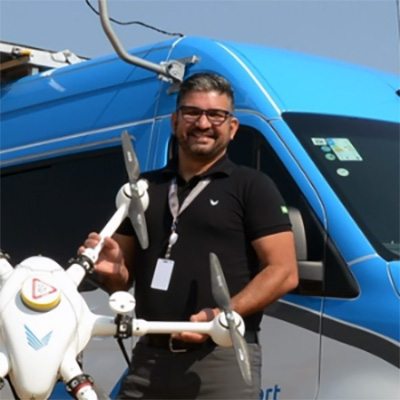
Drone Delivery in Brazil: Manoel Coelho, CEO of Speedbird Aero
How is drone delivery progressing in other countries? Manoel Coelho is CEO of Speedbird Aero, a leader in the development of intelligent uncrewed aircraft systems. The company's advanced drone hardware and software solutions are designed to address a range of logistic challenges, from package delivery to emergency response. Their mission is to enable safer, faster and more efficient logistic operations using autonomous drone technology. By unlocking the potential of the sky for commercial, industrial, and healthcare use cases, the company is positively impacting businesses and people's lives around the world. Manoel is an Entrepreneur and Business Leader with more than 20 years of successful and progressive experience in leading sales and marketing teams with proven ability to implement innovative business solutions that effectively enhance organizational productivity and profitability levels. He excels in developing business cases that showcase value propositions and influence leadership decisions and strategic direction. He has led Speedbird Aero as CEO for the past five years. In this episode of the Drone Radio Show, Manoel talks about Speedbird Aero, the company's drone delivery operations and logistics and how the company is making a positive impact.

Exploring the Future of Digital Twins: Nilson Kufus, CEO & Co-Founder of Nomoko
Are digital twins about to change the way we see the world? Nilson Kufus is CEO and Co-Founder of Zurich-based Nokomo. Nomoko creates digital twins that can be implemented for everything from urban planning to music festival security. The company is on a mission to make the physical world accessible as a digital ecosystem using Digital Twins. With a focus on real estate, Nomoko strives to create virtual copies of individual buildings, larger districts, or even whole municipalities. This helps customers to visualize their projects and to gain informed insights in order to make the right decision at any time. Nilson has a degree in Liberal Arts & Sciences from the University College Maastricht, where he built his curriculum around business, artificial intelligence, and media. He has been a Digital Shaper of Switzerland 2019, a TedX Salon speaker, and Guest lecturer at ETH Zürich & FH HWZ. In this episode of the Drone Radio Show, Nilson talks about Nomoko, the company's quest to build a digital twin of the world and how digital twins will revolutionize the way we see and interact with the world.

Saving Lives and Money with Software-Driven Aerial Robotics: Robert Dahlstrom, CEO & Founder of Apellix
How are precision drones revolutionizing hazardous jobs and saving lives? Robert Dahlstrom is founder and CEO of Apellix, a software-driven aerial robotics company, that creates cutting-edge robotics platforms for precision painting, coating, cleaning, and testing, making hazardous jobs safer by removing the risks of personal harm. Apellix's technology enables pressure cleaning and special coatings to be applied to large infrastructure assets like highway bridges, water towers, oil rigs, and battleships, saving tax dollars and private expenditures while extending the life of assets. Apellix also provides technology for Non-Destructive Testing (NDT) at an unprecedented level. Using Apellix NDT aerial platforms, cruise ship owners, Navy battleship commanders, or state departments of transportation can collect 1,000 readings on a surface where, in the past, only 10 or 20 readings could be taken. Robert has six fully granted U.S. patents and has received numerous engineering, invention, and teaching awards. He has also published over 50 papers and articles, spoken at multiple conferences, events, and podcasts, and is an author of a chapter on Robotic NDE Inspection in "The Handbook of NDE 4.0." Robert is an FAA-certified drone Pilot, a business mentor for "Startup Quest," "Startup Weekend by Google for Entrepreneurs," and a volunteer at startup accelerators. In this episode of the Drone Radio Show, Robert talks about how Apellix's revolutionary drones are making it safer and more efficient to complete hazardous jobs, including coating, pressure cleaning, and non-destructive testing.

IdeaForge: Pioneering Indigenous Drone Development in India and Beyond: Ankit Mehta, CEO & Co-Fouinder
Is India the next hot spot for unmanned business? Ankit Mehta is Co-founder & CEO of ideaForge, India's largest manufacturer of drones for defense, homeland security and industrial applications. IdeaForge was founded in 2007, with a mission to bring cutting-edge unmanned aerial systems to these industries. Over the past decade, the company has emerged as a leader in the Indian drone industry, with a focus on innovation, reliability, and safety. IdeaForge is a pioneer in the UAV industry and has multiple IPs to its credit. One of the key factors that sets Ideaforge apart from its competitors is its focus on indigenous design and development. The company's drones are designed and manufactured entirely in India, which has helped it to establish a strong foothold in the domestic market while also making it an attractive partner for global clients. At ideaForge, Ankit is leading the charge to deliver cutting-edge technology that is Made-in-India and second to none. One of those innovations is the SWITCH UAV, a first of its kind VTOL and fixed wing hybrid Unmanned Aerial Vehicle. SWITCH features advanced flight time, higher safety and simple operation with additional fail-safe redundancies. It is used for long duration operations, long endurance surveillance and security, inspection and photogrammetry. It is so good, the Indian Army selected the Switch above all others to strengthen its unmanned presence. In this edition of the Drone Radio Show, Ankit talks Ideaforge's journey, its approach to innovation and R&D, and its vision for the future of drones in India and beyond. We'll also discuss some of the challenges and opportunities facing the Indian drone industry, and the role that Ideaforge hopes to play in shaping its growth and development.

The Significance of Chapter 135 Certification for Nationwide Drone Delivery: Yariv Bash, CEO and Co-Founder of Flytrex
What is a Chapter 135 certification and how does it relate to drone deliveries? Yariv Bash is CEO and Co-founder of Flytrex, a drone delivery company that partners with retailers and restaurants to offer fast, safe and cost-effective airborne deliveries directly to customers' yards. Flytrex operates the largest backyard drone delivery service in the US, with delivery stations in North Carolina and Texas operating daily, and has signed agreements with several of the world's largest retail and restaurant chains. Yariv has spearheaded Flytrex delivery services for 5 years. Prior to Flytrex, Yariv was Founder and CEO of SpaceIL, a $100M Israeli non-profit organization that launched Beresheet, the first private interplanetary robotic mission to the Moon in 2019. In January, Flytrex announced its longtime partner Causey Aviation Unmanned was granted Standard Part 135 Air Carrier Certification from the FAA allowing Flytrex to operate and complete long-range on-demand commercial drone deliveries in the United States. This milestone comes after years of rigorous training and testing verifying that Flytrex's drone delivery service maintains the highest safety standards. With this part 135 Certification, Flytrex and CAU will further expand their drone delivery service nationwide – eventually offering food, drinks and other goods to the more than 82 million eligible back and front yards across the U.S. This approval has only been granted to a prestigious list of select companies – including Amazon Prime Air, Alphabet's Wing, UPS and Zipline – to date. Since successfully launching the world's first fully autonomous urban drone delivery system in Reykjavik, Iceland, in 2017, Flytrex and Causey have been working closely with regulators to help ensure the highest safety standards in getting drone delivery off the ground. Together, they participated in the FAA's UAS Integration Pilot Program (IPP), which concluded in October 2020, as well as the FAA's subsequent initiative, BEYOND, working with the North Carolina Department of Transportation to help tackle the remaining challenges of UAS integration. In this episode of the Drone Radio Show, Yariv talks about the Chapter 135 certification process, how it differs from a Part 107 certification, and how Flytrex and Causey are now positioned to delivery restaurant orders to homes throughout the country.

Hydrogen Drones Take To the Sky: Ben Levinson, CEO and Co-Founder of HevenDrones
Are Hydrogen Drones Ready To Take Center Stage? Ben Levenson is Co-founder and CEO of HevenDrones, a manufacturer of heavy-lift actionable drones capable of solving a range of commercial, infrastructural, humanitarian and military challenges. From autonomous last-mile delivery to defense missions, emergency response, and infrastructure repair the company's fully-customizable drone solutions deliver cutting-edge performance, patented stability and superior lifting capability. Powered by an expert team with military, engineering, and scientific backgrounds, the company enjoys a strategic partnership with Plug Power and is a partner and supplier of the Israel Ministry of Defense. In February, HevenDrones launched its first hydrogen-powered drone for commercial use, the H2D55. With 5-times greater energy efficiency than traditional lithium battery-powered drones, the H2D55 is capable of flying for 100 minutes with a payload capacity of 7 kilograms. The launch of HevenDrones' hydrogen product line addresses the challenge of flight endurance and payload capacity associated with lithium battery-powered drones as well as the long term environmental impact linked to lithium mining. Without the need to frequently replace batteries, hydrogen fuel cells will also lower long term ownership costs for organizations implementing drone technology at scale. In this episode of the Drone Radio Show, Ben talks about HevenDrones, the company's innovative hydrogen drones and the promise and future hydrogen propulsion systems.

Cities and Autonomous Drones – The Age Has Arrived: Reese Mozer, President of Ondas Holdings and CEO & Co-Founder of American Robotics
Can autonomous drones be deployed in urban areas? Reese Mozer is President of Ondas Holdings and CEO and Co-Founder of American Robotics. Ondas Holdings is a leading provider of private wireless data and commercial drone solutions. The Wireless data solutions are provided via Ondas Networks. The commercial drone solutions are provided through American Robotics and newly acquired Airobotics. Together, American Robotics and Airobotics design, develop, and market autonomous commercial drone solutions worldwide. Their Scout System and Optimus System are highly automated, AI-powered drone systems capable of continuous, remote operation. American Robotics has also led with regulatory successes, becoming the first company approved by the FAA to operate automated drones without humans on site. Right after being acquired by Ondas Holdings, Airobotics announced a $3.5M purchase order and joint venture with SkyGo, a UAE-based company that has a commercial license to provide unmanned aerial transport of goods and services across the city of Abu Dhabi. With this partnership in place, the companies will move forward in launching a first-of-its-kind deployment of Urban Drone Infrastructure throughout Abu Dhabi. The project will serve as the autonomous UAS model for the rest of the world, especially in major cities. Reese is an accomplished entrepreneur, executive, and technologist, with over 12 years of experience in the drone, robotics, and private equity sectors. He also serves as a Board member of the Commercial Drone Alliance. Reese has been featured in the Wall Street Journal, Boston Globe, Business Insider, TechCrunch, Gizmodo, Venture Beat, and CNBC, among other national publications. He holds a Master's in Robotic Systems Development from Carnegie Mellon University and a B.S. in Mechanical Engineering and Entrepreneurship from the University of Southern California. In this episode of the Drone Radio Show, Reese talks about American Robotics & Airobotics autonomous drone solutions, the Urban Drone Infrastructure project for Abu Dhabi and what we can expect to see in the way of global adoption of autonomous drone solutions.

Building The Perfect Public Safety Drone: Blake Resnick, CEO & Founder of BRINC
If you could design a drone specifically for public safety agencies, what would it look like? Blake Resnick is CEO and Founder of BRINC. BRINC designs, manufactures and sells sUAS systems to public safety departments worldwide. The company's flagship product, the LEMUR, employs innovative solutions designed specifically for public safety and emergency situations. Using lidar technology, the drone flies indoors with precision and unprecedented agility, and its two-way communication system allows first responders to hear and see through the drone. But this only scratches the surface of the drone's capabilities. Blake has the innate ability to define a problem, imagine a new approach and create a technology-based solution. He started taking college courses at the age of 14, and then attended Northwestern's McCormick School of Engineering. Before launching BRINC, Blake worked at McLaren Automotive, Tesla Motors, and DJI. He's a member of the Thiel Fellowship's class of 2020. Under Blake's leadership, in just 2 ½ years, BRINC has become a leader of public safety UAS solutions worldwide. He is currently working on an sUAS mesh system designed to respond to gunshot detections and 911 calls within seconds. When not enveloped in product development, he actively engages in recruiting, strategy development, internal communication, and fundraising. In this episode of the Drone Radio Show, Blake talks about BRINC drones, in particular it's revolutionary LEMUR drone and he provides insights into how the company has become successful in supporting the mission of hundreds of public safety organizations around the world.

Are Drone Highways in the Sky Gaining Momentum - Brent Skorup, Mercatus Center
Are Drone Highways Gaining Momentum? Brenk Skorup is Senior Research Fellow at the Mercatus Center. The Mercatus Center is a research center at George Mason University that advances knowledge about how markets solve problems and help us lead happier, healthier, and richer lives. For more than 40 years, research at Mercatus has strived to realize a world where markets operate at their full potential to increase abundance, civility, and well-being. The growing use of unmanned aerial vehicles has spurred a new UAS framework called "highways in the sky." Drone highways in the sky are essentially designated air corridors that are reserved for the exclusive use of unmanned aerial vehicles. The idea is that these corridors would allow drones to fly autonomously, without the need for direct human supervision, while avoiding other aircraft and structures in the national airspace. One of the key benefits of drone highways in the sky is that they could significantly increase the efficiency and safety of drone operations. By providing a clear and well-defined path for drones to follow, drone highways could reduce the risk of collisions and enable drones to fly faster and more efficiently, potentially opening up new opportunities for commercial drone use. But the concept is still in the early stages of development, and there are many different ideas and approaches being explored by researchers, regulators and industry stakeholders. Brent has published several research papers on the topic of drone highways in the sky. His research has covered the economic, regulatory, and legal opportunities and constraints relating to drone highways. In 2019 and 2022, he published a survey that assessed the regulatory environment for drones in all 50 U.S. states and evaluated each state's readiness to support the growth and deve lopment of the drone industry. In this episode of the Drone Radio Show, Brent talks about drone highways in the sky, their benefits and the challenges local, state and federal policy makers may have in advancing the UAS industry while responding to varied stakeholder interests.

Are Spray Drones The New Farm Tool? - Arthur Erickson, CEO and Co-Founder of Hylio
Are Agricultural Drones Coming To A Farm Near You? Arthur Erickson is CEO of Hylio. Hylio develops and offers innovative drone systems that automate precision agriculture treatments. Using Hylio's technology, farmers or producers can apply crop treatments directly to problem areas, targeting pests and deficiencies with more accuracy and efficacy. This allows farms to increase yields. And it has propelled Hylio to one of the top manufactures of precision agriculture drones. Arthur's interest in UAS began when he was studying aerospace engineering at the University of Texas at Austin. While there, he worked with a research team to deploy drones for disaster prediction, response and transportation optimization. Recognizing the enormous potential of UAS technology, Arthur, along with classmates Mike Oda and Nikhil Dixit decided to form Hylio in 2015. While initially a drone delivery company based in Costa Rica in 2017, the team saw greater opportunities in the precision agriculture industry. Today, Arthur leverages his technical and management experience to lead Hylio as it applies it revolutionary drone technology to the global ag-sector. In this episode of the Drone Radio Show, Arthur talks about Hylio, how the company evolved into a leading precision agriculture drone manufacturer and how UAS technology benefits farm organizations of all sizes.

Helping Marginalized Communities Enter The Drone Industry - Sedgrid Lewis, Founder of The Hidden Pilot Project
Does the drone industry offer a career path for individuals from marginalized communities? Sedgrid Lewis of Atlanta, Georgia is Founder of The Hidden Pilot Project. The mission of The Hidden Pilot Project is to teach and train black returning citizens and citizens under the supervision of the criminal justice system how to become licensed drone pilots. Through The Hidden Pilot Project, individuals are provided with hands-on training to enter the unmanned systems industry. Sedgrid Lewis holds an MA in Criminology from the University of West Georgia. He has worked in the criminal justice field for the past 20 years developing evidenced based social programs for juvenile courts and state agencies across the United States. He is also the owner of Blackhawk Aerial LLC. As a part 107 commercial drone pilot, he has flown for several national construction firms providing progression aerial photos. Sedgrid has dedicated himself to helping others experience the benefits of unmanned technology. He provides drone technology workshops for at-risk youth across the state of Georgia. He is also a certified instructor and coach for US Drone Soccer, which is becoming a fast growing sport at the high school and college level. And, as the son of a third generation farmer, Sedgrid partners with black farmers across the south to provide technical training and farm drone technology demonstrations. Sedgrid promotes precision agriculture in order to sustain black farms and increase profit margins. In this episode of the Drone Radio Show, Sedgrid introduces us to The Hidden Pilot Project, drone soccer and how both are helping people from marginalized communities enter the aviation field.

Getting State and Local Lawmakers "Drone Prepared" - Scott Shtofman, AUVSI
How can lawmakers ensure their jurisdictions are ready to reap the benefits of the drone industry? Scott Shtofman is Senior Manager of Grassroots Advocacy & Chapter Engagement for the Association of Uncrewed Vehicles Systems International. AUVSI is the world's largest nonprofit organization dedicated to the advancement of uncrewed systems and robotics. It represents corporations and professionals from more than 60 countries involved in industry, government and academia. AUVSI members work in the defense, civil and commercial markets. In December, AUVSI launched their largest-ever advocacy campaign to educate state and local lawmakers on industry-supported policy solutions to integrate commercial drone operations into the national air space . Called Drone Prepared, the multi-state initiative is designed to help lawmakers ensure that their state or locality is ready for the benefits the future of uncrewed and autonomous flight. Scott is a licensed attorney, certificated Part 107 Remote Pilot and owner and pilot for Quad Axis LLC. He is a well-known policy expert on sUAS, having specialized in policy and operations consulting. Scott's role with Drone Prepared is to manage the advocacy efforts with state and local entities. In this episode of the Drone Radio Show, Scott talks about Drone Prepared, potential legislative opportunities, and how local and state lawmakers can position their states and localities to receive benefits of the growing UAS industry.

Drones And The Mission To Mars: Giuseppe Santangelo, CEO & Co-Founder of Skypersonic
How Will Drones Support NASA's Mission To Mars? Giuseppe Santangelo is CEO and Founder of Skypersonic. Skypersonic is a leader in the use of drones for industrial inspections and first response emergency situations. Their flagship product is the Skycopter: a drone with a tiltable video camera that is designed to work in extreme conditions and ultra-tight spaces. Skypersonic also invented the first-ever worldwide civil real-time remote piloting system that allows piloting in first-person view any drone, not just the Skycopter, located anywhere via the internet. Skypersonic is a subsidiary of Red Cat Holdings, a provider of drone-based products, services, and solutions for the enterprise, military, and consumer markets. Other companies within the Red Cat Holdings include Teal Drones, Fat Shark and Rotor Riot. In 2022, Skypersonic delivered to NASA the hardware and software for a rover and drone system that the crew members of NASA's Simulated Mars Missions will use to remotely explore Martian-like terrain around Earth – all from their 1,700-square-foot simulated Martian habitat at the Johnson Space Center in Houston, Texas. In the Simulated Mars Missions, crew members will spend one year living and working in a habitat at Johnson Space Center that has been designed and built to simulate life on the Red Planet. The Skypersonic drones and rover will be taken to an area on Earth that is similar to Martian terrain – such as a desert or mountainous region – where they will be controlled remotely by crew members in Houston. The exercise is designed to test the ability of astronauts on Mars to remotely explore the planet with drones and rovers. Giuseppe is a mechanical engineer and has spent nearly all of his professional career in the aerospace industry. He is a part-time professor at Wayne State University and collaborates at Lawrence Technology University as adjunct professor for the UAV Artificial Intelligence and Space System Engineering courses. He has been researcher and contract professor at the University of Catania of Italy in the Industrial Engineering Department. Giuseppe has been responsible for the development of projects on behalf of the European Space Agency at Thales Alenia Space in Turin. He participated in the engineering design and development of several equipment for the International Space Station with NASA. In this episode of the Drone Radio Show, Giuseppe talks about Skypersonic, its innovative Skycopter, the Simulated Mars Mission and the role that the company will play in the providing drones that will one day fly on Mars.

Building High Performance UAS Propulsion Systems: Jon Broome, CEO and Co-Founder, Vertiq
What's it take to build the most efficient and reliable UAS propulsion system? Jon Broome is CEO and co-founder of Vertiq, a manufacturer of ultra compact, high performance servo motors for drone propulsion. Combining a unique hardware design and proprietary motor calibration and control software, Vertiq optimizes motor performance and controllability. As a result, Vertiq's products significantly increase the effectiveness of commercial and defense drones. UAS vehicles using Vertiq technology fly 10% longer, maneuver and stabilize 4x faster, experience 75% fewer critical failures, and have access to unique propeller positioning capabilities. Jon started the Vertiq with his co-founder Matt Piccoli in 2017, and since then, they've been working to bring industrial-grade motors and motor controllers to the drone market. Jon graduated with a bachelor's degree in Economics from Middlebury College in 2016. During his time at Middlebury, Jon founded his first company, which made high protein snacks for gym-goers and athletes at the college. Jon wished to continue his entrepreneurial career after graduation, and he quickly found his next venture when he attended his cousin (and future Co-Founder) Matt Piccoli's PhD thesis defense, which focused on building unique aerial vehicles using advanced motor control techniques. Matt wanted to start a propulsion company based on his research and needed a co-founder to handle the non-engineering side of the business. Jon assumed the role of CEO and now, he is responsible for all of Vertiq's business development efforts, investor relations, and company strategy, among many other duties. In this episode of the Drone Radio Show, Jon talks about Vertiq, it's revolutionary propulsion systems and how such systems are changing the drone industry.

Europe's U-Space UTM Regulations - What Does it Mean?: Amit Ganjoo, CEO and Founder, ANRA Technologies
What does Europe's U-Space Protocol for Uncrewed Systems mean for BVLOS Operations? For that question, we head to Washington, DC to speak with Amit Ganjoo, CEO and Founder of ANRA Technologies. ANRA Technologies is Award Winning Drone Operations and UAS Traffic Management Platform provider. The company's SmartSkies™ platform is used by multiple commercial and government entities for running and managing commercial drone operations. Amit has over 20 years of aviation, telecom and wireless experience in both the federal and the commercial space. He is an engineer, a licensed pilot, following a lifelong passion in aviation and builds experimental aircrafts. Amit's engagement with drone programs for the U.S. Department of Defense motivated him to establish ANRA so he could address the growing need for unmanned systems to be safely integrated into existing air systems. ANRA launched their UTM platform in 2015 and has been collaborating and working alongside stakeholders and clients ever since. ANRA was selected as an Airspace Partner for NASA's Advanced Air Mobility National Campaign and is the technology provider for the Future of Flight Initiative in the United Kingdom. As part of his pursuit to efficiently integrate drones into the airspace, Amit is a board member of the Global UTM Association that supports the accelerated and transparent implementation of globally interoperable UTM systems. He is also a member of FAA's Drone Advisory Committee working group for UTM and co-chaired the working group that developed ASTM Standard Specification F3548 for UAS Traffic Management UAS Service Supplier Interoperability. Until December 2016, he acted as the co-chair for FCC's Technical Advisory Council for 5G and IoT, which included ground and airborne autonomous vehicles. He was the Director of Engineering and Principal Architect at Ericsson, providing telecom solutions to commercial customers and Federal Government, where he was the recipient of the Athena Award. He was also the Founder and CEO of a Mobile Marketing company from which he had a successful exit in 2009. Amit is an adjunct professor at George Mason University School of Engineering and volunteers at a local Maker Space in the D.C. area. He holds a master's degree in Computer Science and Civil Engineering from Iowa State University and a Bachelor of Engineering from Punjab Engineering College. On January 26, 2023 Europe will implement a new uncrewed air space regulatopry framework, called the U-Space Framework. U-space is a set of specific services and procedures designed to ensure safe and efficient access to airspace for a large number of drones, and which are based on high levels of digitalization and automation. The purpose of U-space is to achieve automated UAS management and integration, allowing for a large series of operations, many of them even simultaneous, and all of this in harmonious coexistence with the current ATM system. In this episode of the Drone Radio Show, Amit provides an overview of the U-space framework, the impact it will have on BVLOS flights and the potential lessons and applications here in North America.

Protecting Your Valuable UAS Assets - Gene Engelgau, CEO of Fruity Chutes (with Janice and Jayne Engelgau)
What are the current trends in UAS parachute recovery systems? For that question, we head to Monte Sereno, California to speak with Gene Engelgau, CEO and Founder of Fruity Chutes. Fruity Chutes manufactures premium quality parachutes for aerospace, corporate, institutional, university and consumer customers. Since 2007, Fruity Chutes parachutes have established a reputable history for dependable performance in unmanned applications In addition to producing parachute recovery systems, the company provides drone manufacturers with free technical support for full recovery system integration. It also assists manufacturers with obtaining certifications and waivers relating to FAA and ASTM standards as well as other national and international regulations. Since founding Fruity Chutes in 2007, the company has established itself as the leading provider to the UAS industry of a broad range of parachute recovery products optimized for light weight at a high strength capacity. Fruity Chutes is the first UAS recovery company to have a customer using their parachutes obtain an Operations Over People Waiver, an Operations over Moving Vehicles Waiver, and FAA Type Certification. Gene has been part of the Silicon Valley tech industry since the late 70s. He has founded several tech start-ups both in the early Internet e-commerce space as well as the hobby radio control industries. He has experience in electronics hardware design, embedded systems, enterprise software, and web systems design and databases. Gene has always had a passion for aeromodelling. He's flown RC aircraft and rockets for 40 years. In the mid-80s, Gene helped found CSys Labs Inc., a company that designed and manufactured one of the first all computer controlled RC airplane controllers and was sold under the Airtronics/Sanwa brand. Gene has two daughters that hold key roles in the company. Janice Engelgau is the Lead Communications Specialist of Fruity Chutes with nearly a decade of experience working in the UAS industry. Developing methods to better educate the industry on parachute recovery has been the main pillar of her work with Fruity Chutes. Her goal is to help as many UAS professionals as possible understand the profound benefits of parachute recovery and successfully implement recovery into their systems. Jayne Engelgau is the Head of Content and Web Development at Fruity Chutes. She integrates her inquisitive mind for drone applications with her experience in visual design, written media, and web development. She is committed to educating the UAS industry on the vital roles of safety technologies, parachute recovery system implementation, standardization, as well as pre-, post-, and in-flight PRS protocol. Upholding a lifelong belief that educational knowledge should be accessible, she popularizes and enlivens topics of UAS recovery in bright, "fruity" colors across a variety of communicative modes. In Episode 171 recorded in 2018, I interviewed Gene and Jan as they introduced us to Fruity Chutes. In this episode of the Drone Radio Show, Gene, Jan and Jayne discuss about how changes in the drone industry in the past 3 years affect the design and use of parachute recovery systems

UAS Opportunities in Latin America - Juan Plaza, CEO Plaza Aerospace
What's the market like for UAS in Latin America? Juan Plaza is CEO of Plaza Aerospace, a consulting company specializing in crewed and uncrewed aviation, Latin American Business Development and GIS consulting. The company helps organizations reach their goals faster by selecting the right platforms and implementing the best deployment practices. Prior to forming Plaza Aerospace in 2015, Juan spent more than 26 years as a Sales Director for companies such as Autodesk and Trimble Navigation, nearly all time in Latin America where he developed a network of software and hardware distributors willing and eager to represent new products in their respective countries. Juan oversaw the implementation of some of the largest Geographic Information Systems deployments in the world and developed a reputation as a Project Manager with a fierce focus on finishing on time and within budget. Juan received a degree in Geodesy in 1984 and a MBA in International Finance in 2004. He's a commercial pilot flying Citation jets for photogrammetry applications in the Americas, and holds a Part 107 certificate In this episode of the Drone Radio Show, Juan talks about Plaza Aerospace, the market for UAS in Latin America and he provides insights into how companies and entrepreneurs can successfully establish a new business Latin American countries.

Swoop Aero: The Integrated Drone Logistics Company - Eric Peck, Co-Founder and CEO
How does one go about building an integrated drone logistics company? Eric Peck is Co-founder and CEO of Swoop Aero. Swoop Aero is an Australian drone-powered logistics com pany founded in 2017 to transform how the world moves, by making access to the skies seamless. Their mission is to provide the world's leading technology platform for sustainable and scalable drone logistics. The company has extensive experience in this area. It has spearheaded disaster relief and medical supply delivery worldwide, delivering over one million items in over 18,000 flights so far, working with companies including UNICEF, the Gates Foundation, UPS and more. Swoop Aero's platform is built for logistics at scale and integrates all modes of transport. It is the safe and responsive FAA Certification-ready solution that enables two-way deliveries across multiple destinations, organizations, and providers, using their industry-leading BVLOS expertise. At Swoop Aero, Eric leads the overall business strategy and the relationships with the company's global partners. A former Air Force Pilot, Eric led missions in the Middle East as a qualified C130J Hercules Captain. After almost a decade as a pilot, Eric completed an MBA and joined Deloitte to help leading organizations solve their most complex problems. In this episode of the Drone Radio Show, Eric talks about Swoop Aero's drone powered logistics platform and how the company has become the world leader in drone delivery.

The White House Domestic Counter UAS Strategy: Charles Werner, Director DroneResponders
What is the Domestic Counter UAS National Action Plan and how can public safety organizations prepare for it? Charles Werner is Director of DroneResponders, a non-profit organization created to unite aerial first responders, emergency managers, and search and rescue specialists in maximizing drone operations for public safety. The organization is approaching 7,000 members worldwide, most of whom are using drones in a variety of public safety applications. It has become the leading resource for public safety use of drone technology. Charles is the retired Charlottesville fire chief and 46 year public safety veteran. After retirement, Charles worked with the Virginia Department of Emergency Management for 2 years as senior advisor/acting deputy state coordinator. He served in numerous leadership roles at the local, state, national levels on public safety initiatives. He is a FAA certificated Remote Pilot, an author with more than 150 internationally published articles and serves as a contributor to numerous other public safety publications. Charles has received numerous commendations, three Virginia Governor's Awards of Excellence, recognized as the National Career Fire Chief Award in 2008 and Homeland Security Today's Person of the Year in 2018. In this episode of the Drone Radio Show, Charles talks about a new White House initiative on Counter UAS. This initiative will impact all public safety organizations in the US, and he offers suggestions on how to work with and prepare for the National Action Plan. He also provides an update on what DroneResponders is doing to promote public safety use of drones.

Alpine Advanced Materials: Making Drones Lighter, Stronger and More Scalable - Jeremy Smith, Business Development Manager
Is there a way to make drones lighter, stronger and more scalable without sacrificing safety and integrity? Jeremy Smith is the Business Development Manager at Alpine Advanced Materials, a leader in the design and manufacture of custom-engineered parts and products for the world's most demanding aerospace, defense and space applications. The company commercializes high-performance materials originally developed and qualified by top defense contractors, including its flagship HX5® military aviation-grade nanocomposite. Engineered to replace machined aluminum, HX5 is half the weight and has been both tested and proven against the harshest environments in the world. HX5 is currently in use on jet fighters, high-speed helicopters, amphibious transport vehicles, rockets, and satellites. It is highly adaptable without sacrificing strength or performance. Its customization and manufacturability here in the U.S. combined with its high tolerance and dimensional stability make it an ideal alternative to the cost and production challenges associated with aluminum. That makes HX5 ideal for use in the unmanned aerial industry. At Alpine Advanced Materials, Jeremy works in the OEM and UAV markets. Previously, He served as a Sales Engineer for Franklin Products, which specializes in aircraft seating comfort and covers. He spent the past several years focused on aviation ergonomics working with airliners and interior OEMs to optimize customer in-flight comfort. Over his career, Jeremy has specialized in the custom material markets for aviation, holding active roles in the design, sales, production and management of metal parts and their functional systems. He has served aviation, defense, energy and heavy manufacturing industries. In this episode of the Drone Radio show, Jeremy talks about Alpine Advanced Materials, its aviation grade nano-composite and how it can help make stronger, lighter and more scalable drones.

Skyports: Building the World's Advanced Aerial Mobility infrastructure - Damian Kysely, Head of EMEA
Where will future advanced aerial mobility vehicles take off and land? Damian Kysely is Head of EMEA at Skyports. Skyports designs, builds, owns, and operates networks of vertiports. The advent of electric vertical take off and landing aircraft opens the potential of urban air transport. Vertiports are the dedicated ground infrastructure that help realize this future. This is where Skyports excels. The Company is the world's leading vertiport provider and operator, enabling safe and efficient urban air transport in major markets around the globe. At Skyports, Damian is responsible for developing and implementing global infrastructure strategy by working with real estate partners, city authorities, regulators and passenger vehicle manufacturers. Prior to joining Skyports, Damian co-founded and ran Skyscape Technologies, a UK government-backed data analytics start-up identifying disused rooftop potential. He is also a Founding Partner at The Aviary Project, a collaborative platform and community for the Aerial Mobility industry. After his studies, Damian joined a transport technology consultancy in London and managed an early stage start-up accelerator programme in Manchester. In this episode of the Drone Radio Show, Damian talks about Skyports, vertiports, and current vertiports projects in Singapore, Florida and Europe.

Votix: Bringing Harmony To Your Drone Program - Ed Boucas, CEO and Founder
What's the best way to bring harmony to your managed drone program? Ed Boucas is the Founder and CEO of Votix, an American robotics company pioneering an enterprise software platform for orchestration, operation and automation of drones and robots. The platform addresses and solves drone program challenges such as productivity, safety and governance. VOTIX is a powerful and complete cloud-based software-as-a-service solution designed to support all drone manufacturers automating drone-based workflows. The solution is flexible and easy to use, reduces process time, optimizes resources and minimizes risk for a wide range of applications. Ed is a technology entrepreneur and investor, with more than 20 years experience in creating and leading innovative companies. He started his entrepreneurial career as the Founder & CEO of Cipher in 2000, a global leader in the cybersecurity industry with operations in 15 countries. Ed led two rounds of multimillion-dollar private equity investments and as the majority shareholder sold the company to Prosegur, a 5 Billion dollar European publicly traded company and leader in the private security industry. Ed is also the Founder & Chairman of Blockbit, a next-generation cloud and network security technology company with over 3,000 active corporate clients, over 1 million users and with presence in 10 countries. In this edition of the Drone Radio Show, Ed talks about Votix, the concept of drone orchestration and how Votix is helping companies more effortlessy manage, stream and fly their drones.

Draganfly – A Story of Innovation for the Long-Term: Cameron Chell, CEO / President
What's the secret of longevity in the drone industry? Cameron Chell is CEO and President of Draganfly, a leader in the professional drone industry for more than 22 years. The company is the creator of quality, cutting-edge drone solutions, software and AI systems that revolutionize the way organizations can do business and service their stakeholders. Recognized as being at the forefront of technology for the past two decades, Draganfly serves the public safety, agriculture, industrial inspections, security, mapping and surveying markets. The company is driven by passion, ingenuity, and the need to provide efficient solutions and first-class services to its customers around the world with the goal of saving time, money, and lives. Cameron has been a technology entrepreneur for more than 30 years and has spent his career growing a diverse collection of high-potential ideas into revolutionary companies that have changed the way we experience the world. He takes a hands-on leadership role in projects, infusing innovation and adoption with the operational principles of clarity, alignment, and measurement into the culture of every team he works with. I had the pleasure of meeting Cameron at this year's Commercial UAV Expo, where the company unveiled three new cutting-edge North American-made technologies. Following the event, I spoke had a zoom call with Cameron to record this podcast. In this episode of the Drone Radio Show, Cameron talks about Draganfly, the new additions to the Draganfly product line, the company's efforts to support Ukraine in its war effort and he offers several perspectives on the current state and direction of the drone industry and how Draganfly has remained leader in the industry for so long.

Advanced Air Mobility and BVLOS Update ~ Lisa Ellman, Exe. Director Commercial Drone Alliance
What's the Latest Coming Out of the Commercial Drone Industry? Lisa Ellman is Executive Director of the Commercial Drone Alliance, an independent non-profit organization led by key members of the commercial drone industry. The Alliance advocates for the commercial use of drones by reducing barriers to enable the technology. It creates value for commercial enterprise end users to facilitate adoption of drone technology, and educates on the benefits of UAS for various end user communities. Lisa is widely recognized as one of the "world's foremost authorities" on drone policy and law. She was featured in Fortune's "Most Powerful Women" series for her efforts to develop policy governing drone use in the United States. In addition to her role with the Commercial Drone Alliance, Lisa is also a Partner at Hogan Lovells and Chair of the firm's global Unmanned Aircraft Systems (UAS) Practice Group, a "one-stop shop" for all legal and policy issues related to commercial drones. In this episode of the Drone Radio Show, Lisa talks about the Commercial Drone Alliance, a recent White House Summit on Advanced Air Mobility, the status of the FAA BVLOS ARC report and the Commercial UAV Expo, which is going on as we speak in Las Vegas.

Thanks To This Drone, Washing Buildings Just Got Easier: Andre Ashur, CEO & Founder of Lucid Drone Technology
What's Better Than Two Men on A High Scaffold? Andrew Ashur is Founder and CEO of Lucid Drone Technologies, a North Carolina based company that builds industrial spraying drones for labor intensive tasks. The company's goal is simple – provide customers with a safer, faster and smarter alternative to traditional spraying methods while reducing costs and adding top-line revenue. Lucid began in 2018 with the vision of retrofitting existing off-the-shelf drones to handle exterior soft-washing. After a significant investment of time and money, the founders learned that the drone they needed was unavailable in the marketplace. The right product and support required to be successful had to be designed and built from the ground up. That's where Lucid excels. Andrew manages the overall operations of Lucid, including product development, strategic partnerships, and investor relations. He is a prolific learner with a demonstrated track record for extreme productivity. Andrew graduated with a double major from Davidson College in just three years, while founding Lucid. In this episode of the Drone Radio Show, Andrew talks about Lucid Drone Technologies, it's revolutionary C1 Cleaning Drone and how it is disrupting the industrial cleaning industry by providing a solution that is much faster and safer than traditional cleaning methods.

Moving the Earth with a Drone: Richard Hordem-Gibbings, Dir. of Partnerships at Propeller
Can Drones Move Mountains? Well maybe not on their own, but they can make easier for earthwork companies to do their job. Richard Hordern-Gibbings is Director of Partnerships at Propeller. Propeller is a global leader in 3D mapping and data analytics solutions. The Australian company was founded in 2014 by Rory San Miguel & Francis Vierboom and creates tools and software for construction companies, mines, quarries, and landfills to collect, process, and visualize accurate survey data. Some of the world's leading heavy civil and resources operations trust Propeller to answer critical questions about their site's progress, productivity, work quality, and safety. At Propellor, Richard works with a variety of drone partners worldwide. He's been with the company for more than 8 years and has many insights into the use of drones in the heavy construction industry. In this episode of the Drone Radio Show, Richard talks about Propellor, the use of drones in the earthworks industry and how Propellor is leading efforts to help these companies find greater efficiencies and ROI.

The Economic Development Potential of UAS: Tom Swoyer, President Grand Sky Dev. Company
Can Drones Really Foster Economic Development? Tom Swoyer is President of the Grand Sky Development Company. Grand Sky is the first and only fully operational commercial UAS research and development park in the United States. Strategically located on the Grand Forks Air Force Base in North Dakota, Grand Sky is the hub of activities in the nation's leading state for UAS flight testing, training and development. Since 2015, Grand Sky has been the site of continuous UAS industry advancements and milestones. Not only that, the investments in UAS at Grand Sky are now producing dividends in terms of new private development, jobs and tax revenues. In addition to being President of Grand Sky, Tom is also the Founder. He developed the master plan fpr the design, construction, and operation of the infrastructure and facilities for Grand Sky. He has also worked alongside a litany of key stakeholders and partners including the Air Force, the State of North Dakota, Congressional Delegations and Grand Forks County in making Grand Sky a success. In this episode of the Drone Radio Show, Tom talks about Grand Sky, its UAS mission and vision and how the investments that have been made are yielding jobs, development and increasing the tax base. Thus proving UAS can provide community wide benefits.

Adapting to Change - A Drone Service Provider Perspective: Ian Foley, CEO Pacific Triangle
How Do We Lead-the-Ship Through the Fast-Changing UAV Landscape? Ian Foley is CEO of Pacific Triangle, a drone service provider delivering integrated platforms and end-to-end solutions for commercial applications in geospatial, oil and gas, mining and electrical utility industries. Ian has demonstrated the ability to form resilient and high-performing teams and to empower workforce intelligence across many projects. Throughout his UAS career, Ian has worked on projects for 3 major Californian and one Texas utility company, and has performed bridge inspections in Georgia, Oklahoma, and Saskatchewan, Canada. He has completed cell tower inspections in California, staffed helicopter LiDAR, and has upcoming underwater ROV work. Part 107 certified, Ian has worked his way up the ladder in the UAS industry starting as Visual Observer, then Pilot in Command, Team Leader, and Project Manager, before starting his own business with Pacific Triangle in Carlsbad, CA. Ian's experience in the field is an invaluable in directing the efforts of Pacific Triangle. He is a graduate of the Veterans Institute for Procurement START and INTERNATIONAL programs in Potomac, MD arguably the top training programs for C-level executives of Veteran-Owned Small Businesses. In this episode of the Drone Radio Show, Ian talks about Pacific Triangle, the drone service provider industry and the challenges and opportunities of starting and leading a new company. He also provides some insights into his panel presentation at this year's Commercial UAV Expo on September 6-8, where he'll be speaking on how to lead-the-ship through the fast-changing UAV landscape.

See You At The Commercial UAV Expo: Jeremiah Karpowicz, Commercial UAV News
What's on tap for this year's Commercial UAV Expo? Jeremiah Karpowicz, Editorial Director of the Commercial UAV News, a leading source of news, insight and analysis for the commercial drone market. The Commercial UAV News focuses on the use of drone technology in the heavy commercial sectors, such as surveying & mapping, civil infrastructure, power & utilities, mining, construction, emergency response and precision agriculture. At the Commercial UAV News, Jeremiah has spent over a decade cultivating communities of all different types, both in-person and online. He has created articles, videos, newsletters, ebooks and much more for these communities as a contributor and editor. He has also shaped and defined various conference programs. Today, Jeremiah is focused on defining what it means to take the engagement that happens in both the physical and digital worlds to the next level. Each year, the Commercial UAV News presents the Commercial UAV News, a leading international trade show and conference focusing on the integration and operation of commercial UAS. The Expo showcases the world's leading commercial UAS technology from vendors from around the globe. After two years apart, more than 130 exhibitors and 1,955 drone professionals reconvened in person in 2021 to learn, connect, and drive the industry forward. This year's Commercial UAV Expo will be held on September 6-8 at Caesars Forum in Las Vegas. In this episode of the Drone Radio Show, Jeremiah shares details on this year's Commercial UAV Expo and his thoughts on the commercial drone industry.

Using Drones for Long Range Asset Monitoring: Didi Horn, CEO and Founder of SkyX
How are drones used to monitor oil and gas transmission lines? Didi Horn is Founder and CEO of SkyX. SkyX is revolutionizing the way aerial data is accumulated, analyzed and actioned. By integrating Artificial Intelligence with purpose-built aerial systems, SkyX delivers actionable data so enterprise organizations can mitigate risks, assess situations faster and make intelligent and informed decisions. The company's services and technology is redefining long-range asset monitoring. Didi has more than 15 years experience in aviation n, aerospace, and drones. He served with the Air Force for nearly a decade as both a captain and drone pilot. In 2015, Didi established SkyX, which started with three employees with an idea to reshape oil and gas asset management and safety operations. It is estimated that the United States has 3 million miles of operating hazardous liquid, gas distribution, and gathering and transmission pipelines. In 2019, there were 614 reported pipeline incidents in the United States, resulting in about $259 million in damages. Under Didi's leadership, SkyX provides long range aerial asset monitoring that prevents potentially dangerous pipeline issues such leaks, sinkholes, vegetation encroachment, and theft. Thus saving lives and better protecting the environment from spills. In this episode of the Drone Radio Show, Didi talks about SkyX, its long-range asset monitoring service and how its providing value and safety to oil and gas companies.

What's New at the Northern Plains UAS Test Site: Trevor Woods, Executive Director
What's New at the Northern Plains UAS Test Site? Trevor Woods is Executive Director of the Northern Plains UAS Test Site. The Northern Plains UAS Test Site was founded by the North Dakota Department of Commerce in 2013 as one of 7 FAA-designated UAS Test Sites. Its mission is to collaborate with FAA and industry partners to develop equipment, systems, rules, and procedures to safely integrate unmanned aircraft into the National Airspace System without negatively impacting existing general or commercial aviation. Trevor started his career in aviation at the University of North Dakota with a Bachelor of Business Administration in Aviation Management, but he's been flying since he was a teenager, spending his high school years working on obtaining a private pilot's license. He went on to earn a Master of Business Administration degree while working at University of North Dakota, doing flight training, which merged into UAS testing, research, and waiver and regulatory submissions to the FAA. Trevor has been with Northern Plains UAS Test Site since its inception, most recently as director of safety, working extensively with the FAA. He was instrumental to North Dakota being selected as one of ten participants in the UAS Integration Pilot Program, now the BEYOND program. He participates in the FAA's Unmanned Aircraft Safety Team and served as the Lead on the FAA's BVLOS ARC Working Group 2.1. Trevor also played a pivotal role in the inception of Vantis, North Dakota's beyond visual line of sight initiative. In January 2022, Trevor was named Executive Director. He was the natural choice to take over as executive director and lead the test site into the next stage of making the impossible possible. In this episode of the Drone Radio Show, Trevor talks about the Northern Plains UAS Test Site and gives us an update on Vantis and other initiatives where they're leading in UAS operations and integration.

Drones in the Food Delivery Service Industry: James Shea, Founder and Publisher of the Food Delivery News
How Are Drones Affecting The Food Delivery Industry? James Shea is founder and publisher of the Food Delivery News. The Food Delivery News is a multi-media business publication that covers the intersection of food, technology, supply chain and delivery. It covers the changing world of food and how it travels from the farm to the kitchen and finally to a consumer's table. The Food Delivery News is a division of Media Lab Studios, a content studio that works with small and large businesses, helping them tell their stories through a variety of media. James has over 20 years of experience in the media business and writes about the intersection of food and technology. In this edition of the Drone Radio Show, James talks about the Food Delivery News, what restaurants are looking for in food delivery, and how drones are filling that growing need.

Dinner And A Drone (Delivery): Yariv Bash, Co-Founder and CEO Flytrex
When you're craving dinner and in a hurry, who do you call? Yariv Bash is the CEO and Co-founder of Flytrex, an on-demand drone delivery company . Flytrex provides a direct-to-consumer autonomous drone delivery service that lets retailers and quick-service restaurants cater to a wider customer base with faster, safer and more economical on-demand deliveries than ever before. Flytrex is currently working with several restaurant chains and retail giant Walmart to deliver food and goods to customers' front and backyards. Prior to Flytrex, Yariv was Founder and CEO of SpaceIL, a $100M Israeli non-profit organization that launched Beresheet, the first private interplanetary robotic mission to the Moon in 2019. In this edition of the Drone Radio Show, Yariv talks about Flytrex, its innovative hot food drone delivery service and how drones are transforming the home food delivery industry.

Mapping Volcanos to Protect Lives: David Adjiashvili, Co-Founder Drone Harmony
Can a drone prevent the loss of life from volcanos? David Adjiashvili is Co-Founder and Vice President of Products at Drone Harmony. Drone Harmony is a software as a service company that automates mission planning in the most challenging vertical inspection scenarios. Their software enables cost-effective deployment of drone technology in industries where existing technologies are unable to deliver. And it enables pilots with minimal training to collect high quality, reproducible data. As a Swiss company, Drone Harmony understands that the safety of your data is essential and even deploys their system on your premises. The company was founded in 2016 by a team of problem solvers with a passion for drones, software and automation. In addition to being one of those founders and Chief Scientist, he is also senior scientist at the Swiss Federal Institute of Technology. His field of expertise is Algorithm Design and Mathematical Optimization, and he has been responsible for algorithmic development of the Drone Harmony Mission Planner. David received his Bachelors degree in computer science from the Tel Aviv University and his Master's in applied mathematics from the Weizmann Institute of Science. He completed his Ph.D. in mathematics at the ETH Zurich in 2012 specializing on algorithm design for planning and optimization problems. He has since been employed in the Mathematics Department at ETH and worked on various research and industrial projects in the field of optimization. In 2021 Drone Harmony assisted DERYL Group KK and the Kyoto University in generating an up-to-date high-resolution 3D model of Japan's Sakurajima volcano. Sakurajima is one of the world's most active volcanoes. It is located in the south of Japan, with approximately 600,000 people living within 4 kilometers. Scientists are predicting a major eruption within the next 30 years. The project team used Drone Harmony to develop the 3-D model and run various simulations for disaster prevention and response, with the goal of developing evacuation and mitigation plans for all potential disaster scenarios. Mapping a terrain is typically a straightforward process, but the Project Team quickly learned that a large geographic area, much of which is inaccessible, hostile and changing poses several challenges. In this episode of the Drone Radio Show, David talks about Drone Harmony, the company's 3-D mapping services and how that technology can be used to accurately map and model large vertical geographic areas.

AI & Drone Powered Facade Inspections: Jonathan Ehrlich, COO at T2D2
How do you simplify material-failure detection? If you ask today's guest, he would say teach a computer to do it. Jonathan Ehrlich is COO of T2D2, a software-as-a-service company that that uses artificial intelligence to identify and assess damage and deterioration to buildings and structures. T2D2 applies data from more than 50 years of building inspection and forensic investigation work. The data is now available to property and portfolio owners and managers as well as municipalities to identify deterioration early and throughout the life of an asset. T2D2 makes it easier, quicker and less expensive to inspect structures by identifying damage and defects before they become major issues. Their software automatically detects visible damage in concrete, steel and masonry structures. T2D2 was established within Thornton Tomasetti, a global design and engineering firm with more than 50 years experience in structural design. Initially part of the Core Studio incubator, T2D2 was commercialized as a separate entity through the firm's accelerator program. Before becoming COO of T2D2, Jonathan served as the Director of Strategy, Corporate Development and Partnerships at ButterflyMX, a leader in real estate software technology. Prior, he specialized in the financing and development of mega infrastructure and real estate projects. He served as the Director of Budget and Risk Management for the $3.9B Mario M. Cuomo Bridge to replace the Tappan Zee. Prior to that he served as Special Assistant to the Chairman of the New York State Thruway Authority where he was responsible for Board oversight of the $1.5B multi-year capital program and pavement condition rating system. He holds a BA from Tufts University and an MBA from the NYU Stern School of Business. In this episode of the Drone Radio Show, Johnathan talks about T2D2, the company's AI inspection services and how that technology is simplifying the façade and infrastructure inspections.
Is This Drone An Inspection Industry Game-Changer? - Zach Adams, Co-Founder and Chief Engineer, Pitch Aeronautics
Can An Old Technology Make Industrial Drones Safer and More Effective? Zach Adams is Co-Founder and Chief Engineer for Pitch Aeronautics, manufacturer of a unique drone for up-close, touch-based, and robotic tasks. Among the most dangerous jobs in the United States is climbing infrastructure to perform inspections and maintenance as well as performing power line maintenance. While today's drones are good at taking video, they are not well suited to get close or actually interact with the surface of an object. Consequently, technicians are sent up on ropes, ladders, scaffolding, cranes, and sometimes even hanging from helicopters to perform this work. Pitch Aeronautics' Astria Drone is specifically optimized for touch based tasks. It has a unique configuration that can hold a 10 pound payload on a long horizontal arm to keep it away from the rotors and allow it to interact with a building, bridge, tower, wind turbine and powerline. It's flown to the area using a first-person-view camera and goggles. Astria then overlays key flight and job information on the goggles so the operator can conduct the mission. . Astria positions the payload near the target by using a cyclorotor for lateral control. Cyclorotors are unique propellers that can near instantaneously push the drone forward, backward, left, or right. This allows Astria to compensate for wind gusts and fly more precisely. It can create and change thrust 5-10x faster than traditional drones. Cyclorotors have been used on tugboats and ferries for nearly a century for the same reason. Zach is recognized as a leading authority on cyclorotor technology. He is the named inventor on multiple cyclorotor patents and has published extensively on the topic. He holds a BS in Aeronautical Engineering from the U.S. Air Force Academy and a Ph.D. in Mechanical Engineering from Purdue. In this episode of the Drone Radio Show, Zach talks about Pitch Aeronautics, its innovative Astria drone and how the company's patented cyclorotor technology is making dangerous jobs safer.