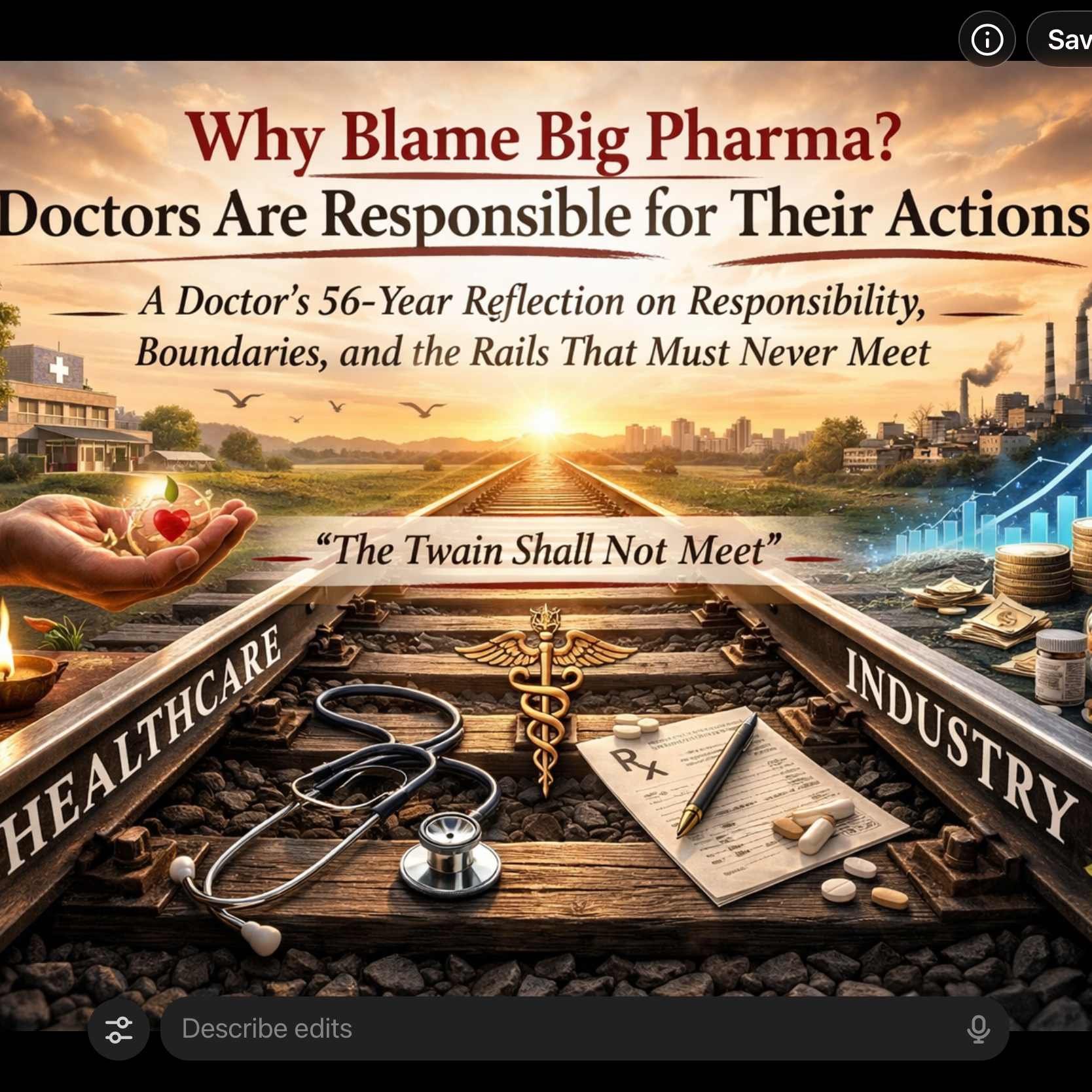
Why Blame Big Pharma alone. Doctors have as much responsibility, if not more
Diabesity Decodified - Is Food the root cause of Type 2 Diabetes Mellitus pandemic? · Pandiyan Natarajan
Audio is streamed directly from the publisher (content.rss.com) as published in their RSS feed. Play Podcasts does not host this file. Rights-holders can request removal through the copyright & takedown page.
Show Notes
In this episode, I reflect on a difficult but necessary question: Why do we place all the blame for healthcare failures on “Big Pharma,” while often overlooking the responsibility of physicians?
After 56 years in medicine, I have witnessed extraordinary scientific progress — much of it made possible through collaboration between clinicians and industry. From life-saving drugs to advanced diagnostic tools, innovation would not move from bench to bedside without corporate infrastructure and support. Industry plays a vital role in modern healthcare.
But the obligations of industry and the obligations of physicians are not the same.
Pharmaceutical and device manufacturers are accountable to their companies and shareholders. Physicians, however, are accountable to their patients. This difference is fundamental. It defines the moral boundary of our profession.
Public discourse frequently portrays doctors as passive participants — overwhelmed by marketing, pressured by systems, or misled by corporate influence. While such pressures are real, physicians are not without agency. We undergo rigorous training. We are taught to evaluate evidence, question claims, and weigh risks against benefits. Most importantly, we take an oath that places patient welfare above all else.
The final clinical decision is made in a consultation room — not in a corporate boardroom.
In this episode, I explore the delicate balance between necessary collaboration and ethical distance. Drawing from the wisdom of the Thirukkural — “Be neither too far nor too near, like one who warms himself by the fire” — I reflect on how physicians must engage with industry: professionally, purposefully, but never intimately.
I also share a simple analogy that has guided my thinking over the decades: healthcare and industry are like the two rails of a railway track. Both are essential. Both must run parallel for progress to occur. But they must never meet. When boundaries blur, patient trust erodes.
This is not an attack on industry. Nor is it a condemnation of the medical profession. It is an appeal for clarity.
Accountability in healthcare cannot be outsourced. It cannot be transferred entirely to corporations, regulators, or systems. With the authority to prescribe comes the responsibility to scrutinize, to question, and to act in the best interest of the patient.
Medicine is not a sales channel. It is a moral covenant.
In an era of increasing commercialization and complexity, the future of our profession depends not only on scientific advancement, but on ethical vigilance.
After more than half a century in practice, I remain convinced of one truth: if we remember that our first and last obligation is to our patients, the rails will remain aligned — and separate.