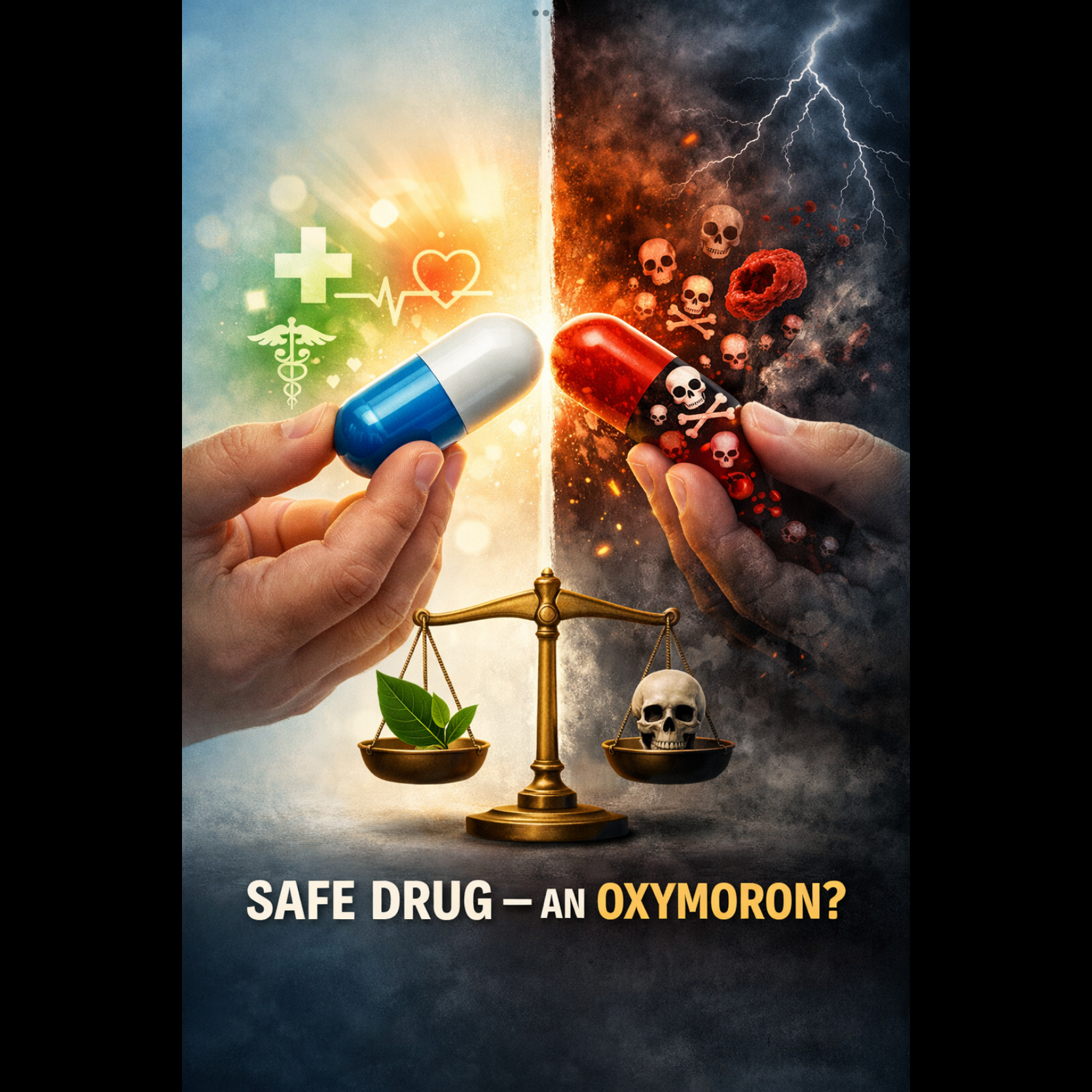
Safe Drug - An Oxymoron
Diabesity Decodified - Is Food the root cause of Type 2 Diabetes Mellitus pandemic? · Pandiyan Natarajan
Audio is streamed directly from the publisher (content.rss.com) as published in their RSS feed. Play Podcasts does not host this file. Rights-holders can request removal through the copyright & takedown page.
Show Notes
Safe Drug – An Oxymoron?
Why fewer medicines may sometimes be the best medicine of all
We often use the phrase “safe drug” casually — to reassure patients, doctors, and even ourselves. But pause and reflect:
Is a safe drug truly possible? Or is the phrase itself an oxymoron?
A drug, by definition, alters physiology. If it did not change normal biological function, it would have no therapeutic value. And if it alters physiology, it cannot be entirely free of consequences.
A drug without side effects is a drug without effects.
Side Effects Are Extensions, Not Accidents
Side effects are often treated as unfortunate mishaps. In reality, they are extensions of the same pharmacological action, expressed in tissues or pathways we did not intend to target.
Lower blood pressure excessively, and organs may suffer.
Suppress inflammation too much, and immunity may weaken.
Alter neurotransmitters, and mood or cognition may change.
The problem is not that drugs have side effects.
The problem is when we forget that they inevitably will.
Even Placebos Are Not Always Harmless
Biology responds not only to molecules, but also to beliefs and expectations.
A placebo can heal.
A nocebo can harm.
Fear, excessive warnings, or negative expectations can produce real symptoms — even in the absence of an active drug. This alone should remind us how powerful any intervention can be.
The Hidden Toll of Adverse Drug Effects
Every year, tens of thousands of people in the United States alone die due to adverse drug reactions — not overdoses, but drugs taken as prescribed. If global data were fully captured, the number would likely run into millions.
This is not an argument against medicine.
It is an argument against complacency.
Less Can Truly Be More
Modern medicine has achieved extraordinary successes. But wisdom lies not in how many drugs we prescribe, but in how few we can safely use.
Do we always need a drug — or do we sometimes need time, lifestyle correction, reassurance, or watchful waiting?
Every prescription should quietly ask:
Is this absolutely necessary, and is this the minimum required?
What Enters Us — and Leaves Us — Matters
Anything that goes into our mouth — food, fluids, supplements, and drugs — can affect us.
Equally important is what comes out of our mouth:
Words, diagnoses, warnings, and written thoughts. These too can heal or harm.
Medicine is not only molecular — it is human.
A Call for Caution, Not Fear
This is not a call to reject drugs, but to respect them — their power, their limits, and their inevitability of unintended effects.
In an age of polypharmacy and pill-for-every-ill thinking, perhaps the most radical act is simple:
Prescribe less.
Take less.
Think more.
Because when it comes to drugs, safe is never absolute — only relative, contextual, and temporary.