
Cybersecurity Today
191 episodes — Page 2 of 4
FortiBleed Emergency: 74,000 Fortinet Logins Exposed
Scam Losses Surge - Cybersecurity Today
Anthropic Models Blocked, FBI Takes Down $1.9B Phishing Network, Critical Splunk Flaw, and more
CyberTitan Champions: Inside Canada's National High School Cybersecurity Competition (and CyberPatriot)
Anthropic Warns AI Risks Are Real, RoguePlanet Zero-Day Drops, Crypto Laundering Takedown
AI Worms, Hacks, and Insurance Shifts
Claude Outage Data Leak, Microsoft GitHub Worm, IBM Hack, M Instagram Takeovers, Canada's Bill C-8
Cybersecurity Today Month in Review: Microsoft Zero-Days, AI Deregulation
New HTTP/2 Bomb Attack, Trump's AI Security Reviews, Android Zero-Day & The Patching Crisis
Carnival Data Breach Exposes Millions as Microsoft Backs Down on Researcher Threats
Microsoft Threatens Security Researcher | Palo Alto VPN Exploited | Google Insider Trading Case
Cybersecurity & Arctic Sovereignty: Protecting Canada's Most Vulnerable Infrastructure Cheryl Biswas
CISA Orders Emergency Drupal Patch | Microsoft Server Bug | Google Fights Canada Surveillance Bill
AI Vulnerability Explosion, Kim Wolf Botnet Arrest, Ghost CMS Hack, Iran Cyber Espionage
Researcher Finds Public GitHub Repo Exposing Sensitive CISA Credentials
GitHub Breach Exposes 3,800 Repos | Microsoft Kills SMS Authentication | Proton Fights Canada Bill
Windows 11 BitLocker Zero-Day, TeamPCP Malware Leak, Iran Gas Station Hacks | Cybersecurity Today
Exchange Zero-Day Under Attack, Ransomware Gets Smarter, Fortinet Critical Flaws
Inside CIRA: How Canada's .ca Registry Became a Global DNS & Cybersecurity Force
How a Google API Key Became an $8,000 AI Bill, Meta Scam Ads Lawsuit, and 73-Second Cyber Attacks
Canvas Breach 'Deal' With ShinyHunters, AI Zero-Day Warning, Checkmarx Hit Again
Canvas Breach Exposes 275M Accounts | AI Targets Water Systems | GM OnStar Settlement
Cybersecurity Today Month in Review: AI Coding Risks, Canvas Breach, QR Phishing Surge
Meta allegedly made billions from scam advertising while online fraud explodes worldwide.
QR Phishing Explodes, Ubuntu Under Attack, CISA Warns Critical Infrastructure Prepare for Isolation
Microsoft Just Broke Trust — And It Might Be the Right Move
Connected Cars Are Rolling Spy Networks — And They Can Be Hacked
WhatsApp Encryption Under Fire After Probe Shut Down
Massive Python Supply Chain Hack, $2.1B Scam Losses, North Korea Targets Crypto Execs
Cyber Weapon in Toronto, Grid Attack, Stuxnet Lie Exposed
Cybersecurity Today Weekend: Deepfakes, the Death of Truth, and Verifying AI in the Enterprise
Inside The Vercel Supply Chain Exploit
Vercel Breach Started With AI Tool
Security Researcher Goes To War Against Microsoft
Cybersecurity Today Month in Review of March/April 2026
Cisco Warns Webex Customers Of Critical SSO Problem
North Korean Spies DM You On Facebook
Banks Panic As Anthropic Mythos Exposes Software Vulnerabilties
Jeff Williams CTO Cofounder of Contrast Security and OWASP co-founder on Mythos and AI Security
Fortinet EMS Zero-Day, Anthropic's AI Finds Thousands of Bugs, Iranian Hackers Target US ICS
North Korea's $285M Crypto Heist, China Breaches FBI System, Delve Faces New Allegations

Electric Vehicles and EV Security - Steve Visconti CEO of Xiid Corporation with David Shipley
EV Charging Infrastructure Security: How Hackers Could Disrupt Chargers, Networks, and the Grid Cybersecurity Today would like to thank Meter for their support in bringing you this podcast. Meter delivers a complete networking stack, wired, wireless and cellular in one integrated solution that's built for performance and scale. You can find them at Meter.com/cst In this holiday weekend edition of Cybersecurity Today, Jim Love introduces David Shipley's interview with Steve Visconti, CEO of Xiid Corporation, about cybersecurity risks in electric vehicle (EV) charging infrastructure. Visconti explains Xiid's software-based security layer for IP networks, aimed at critical infrastructure across enterprise, public sector, and DOD environments, and its growing focus on OT/IoT such as EV charging systems. The discussion highlights how EV chargers connect vehicles, homes, back-office billing/control systems, cloud services, and potentially vehicle-to-grid power flows, creating large-scale attack surfaces that could enable disruption, DDoS activity, or broader grid instability. Visconti argues for "unreachability" architectures that close ports and remove static exposure while allowing only registered users and machine-to-machine access. The interview also touches on concerns about vulnerabilities leading to fires, supply-chain risks, and policy debates such as government-accessible vehicle kill switches. 00:00 Holiday Weekend Intro 01:46 Meet Steve Visconti 04:16 EV Charging Symposium 06:40 Vehicle to Grid Risks 09:16 Fires and Attack Vectors 12:14 Making Chargers Unreachable 14:37 Car as the Threat 19:05 Awareness and DDoS Reality 23:09 Government Kill Switch Debate 24:49 Wrap Up and Sponsor Thanks

Cisco Breached: Source Code Stolen - Cybersecurity Today
Cisco Source Code Stolen in Trivy Fallout, Axios Supply Chain Attack, and Active Exploitation of Fortinet and Citrix Flaws David Shipley reports multiple major security incidents: attackers used credentials stolen in the Trivy supply-chain attack via a malicious GitHub action to breach Cisco's internal development environment, clone 300+ GitHub repos, steal source code (including AI products) and AWS keys, and impact customer-related code; Cisco contained the breach, re-imaged systems, and rotated credentials. A separate supply-chain attack hit the widely used JavaScript library Axios after its maintainer account was compromised, pushing poisoned NPM versions that installed a dropper/RAT via a fake dependency; users are told to downgrade affected versions, remove the dependency, rotate credentials, and review CI/CD logs. Active exploitation is confirmed for a Fortinet FortiClient EMS SQL injection (CVE-2026-21643) and for critical Citrix NetScaler flaws (CVE-2026-3055, possibly alongside CVE-2026-4368). Anthropic accidentally exposed details of a new model, "Code Mythos," described as highly capable in reasoning, coding, and cybersecurity. Finally, TechCrunch reports escalating allegations that compliance startup Delve helped fabricate audit evidence and worked with weak auditors. The episode also marks show episode 1,500. 00:00 Headlines and Sponsor 00:54 Cisco Trivy Breach 02:28 Axios NPM Attack 04:12 Fortinet SQLi Exploited 06:24 Citrix Bleed Returns 08:05 Anthropic Model Leak 10:24 Fake Compliance Scandal 12:30 Episode 1500 Milestone 14:03 Sponsor Closing Message

Russian State Hackers Go After IoS Devices
Mac Malware 'Infinity Stealer,' DarkSword iOS Exploits, China Telecom Espionage & TeamTNT Supply Chain Hits Cybersecurity Today would like to thank Meter for their support in bringing you this podcast. Meter delivers a complete networking stack, wired, wireless and cellular in one integrated solution that's built for performance and scale. You can find them at Meter.com/cst David Shipley reports from Seoul on major threats: Malwarebytes details Infinity Stealer, a new macOS info-stealer delivered via "ClickFix" social engineering and built as a compiled Python payload (Nuitka) that steals browser credentials, Keychain data, crypto wallets, and developer secrets while notifying attackers via Telegram. Proofpoint links Russia-aligned TA446 (Cold River/Star Blizzard) to spear-phishing using the DarkSword iOS exploit kit to deliver GhostBlade, with DarkSword now leaked on GitHub and Apple pushing unusual on-device warnings for vulnerable iOS versions. Rapid7 describes China-linked "Red Menshen" using the kernel-level BPFdoor backdoor to persist in global telecom networks. TeamTNT compromises the Telnyx PyPI package with WAV-steganography payloads that steal secrets and target Kubernetes. Iran-linked activity includes a symbolic FBI director email breach and escalating, deliberate healthcare disruption via attacks on Stryker and a Pay2Key incident. 00:00 Show Intro and Sponsor 00:53 Mac ClickFix Stealer 03:25 Dark Sword iOS Exploits 06:30 China Telecom Backdoor 08:47 TeamTNT PyPI Supply Chain 12:20 Iran Cyber and Healthcare 17:41 Wrap Up and Thanks 18:43 Sponsor Message
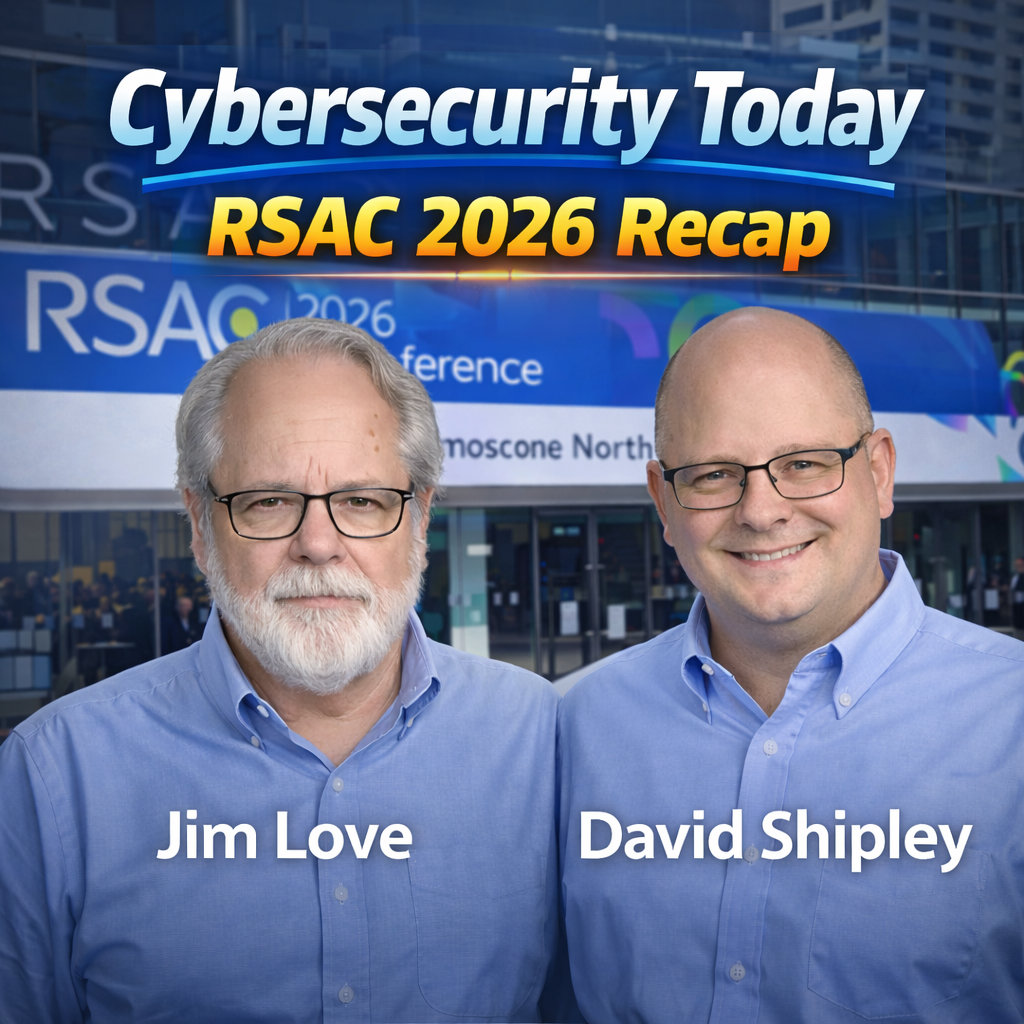
RSAC Recap: Agentic AI and Interview With Commvault CISO Bill O'Connell
RSAC Recap: Agentic AI Takes Over, Security Funding Shifts, and Why CISOs Must Focus on Resilience Cybersecurity Today would like to thank Meter for their support in bringing you this podcast. Meter delivers a complete networking stack, wired, wireless and cellular in one integrated solution that's built for performance and scale. You can find them at Meter.com/cst Jim Love and co-host David Shipley recap the RSA Conference in San Francisco, noting that "zero trust" marketing has faded and "agentic AI" (especially "agentic SOC") dominated vendor messaging. David highlights a major market shift: AI is pressuring cybersecurity company valuations and could reduce funding, accelerate consolidation, and raise security costs due to heavy compute requirements, even as demand increases. They discuss how AI disproportionately benefits attackers, including new phishing-as-a-service capabilities, while organizations cut security hiring in anticipation of AI gains. David's standout booth, MindGuard, used a 1990s metaphor to argue AI security is as immature as cybersecurity was decades ago. He also interviews Commvault CSO Bill O'Connell on the evolving CISO role, communicating risk, the importance of recovery and "ResOps," and celebrating CISOs, including Time magazine's CISO of the year concept. 00:00 Weekend Show Kickoff 00:46 RSAC Recap Setup 01:06 Zero Trust Is Dead 01:48 Agentic SOC Everywhere 03:41 AI Shifts Security Valuations 06:55 Peak Security And Consolidation 07:55 Costs And Layoffs Warning 09:35 Attackers Gain The Edge 11:48 RSAC Booth Spectacle 13:39 MindGuard Nineties Metaphor 15:40 Commvault CISO Interview Begins 17:22 Backup To Cyber Resilience 18:04 Modern CISO Role Evolution 19:55 Translating Risk For Leaders 21:44 Risk Versus FUD 22:22 AI Hype And CISO Relevance 23:29 Defining AI And Controls 24:33 Agentic AI And Backups 25:49 Resilience Over Prevention 27:52 ResOps And Practicing Recovery 31:06 Advice For New CISOs 33:30 Celebrating The CISO Role 35:43 Is The Job Worth It 37:06 Host Wrap And Audience Feedback 39:18 Korea Trip And Show Signoff 40:13 Sponsor Message And Closing

Anonymous Tip System Breach May Expose Tipsters
Anonymous Tip System Breach Exposes Millions of Records, Google Warns Q-Day by 2029, and New AI Documentation Supply-Chain Risks Cybersecurity Today would like to thank Meter for their support in bringing you this podcast. Meter delivers a complete networking stack, wired, wireless and cellular in one integrated solution that's built for performance and scale. You can find them at Meter.com/cst Jim Love reports that a breach at P3 Global Intel, whose tip-submission systems are used by police, government agencies, and schools, allegedly exposed over 8 million submissions including highly sensitive personal data and raised concerns about anonymity due to features that could disclose tipster IP information; the company says it has not confirmed misuse. Google warns "Q Day," when quantum computers could break widely used public-key encryption, may arrive as early as 2029, intensifying urgency around "harvest now, decrypt later" and adoption of post-quantum cryptography standards. The episode also highlights AI-era supply-chain threats where community-generated documentation can be poisoned with indirect prompt injections that influence AI-generated code, and notes upcoming GitHub Copilot policy changes to use prompts and code context from certain users for training unless they opt out, making data governance critical. 00:00 Headlines And Sponsor 00:45 Anonymous Tip Line Breach 03:42 Quantum Q Day Timeline 06:10 Poisoned Documentation Attacks 08:57 Copilot Training Data Changes 10:27 Wrap Up And Meter Thanks

RSAC Presenter Says "Time to Kill One of Cybersecurity's Most Overworked Terms"
RSAC: Retiring "APT," FCC's US-Made Router Ban, Zoom Call Scraping, Iran-Targeting Wiper, and Cyber Terrorism Insurance From RSAC 2026, host David Shipley highlights ESET researcher Robert Lipowsky's argument to retire the overused "advanced persistent threat" label and instead describe actors by motivation and activity, noting blurred lines between nation-state and criminal tooling. He also reports RSAC vendor trends (zero trust fading, "agentic AI" everywhere) and standout booth themes. In Washington, the FCC bans authorization of any new Wi‑Fi router models not made in the United States, citing supply-chain risk and attacks like Volt Flax and Salt Typhoon, impacting an industry largely manufacturing abroad unless exemptions are granted with plans to reshore. The episode details Webinar TV allegedly joining public Zoom links to record calls and publish AI-generated podcast recaps, and a Kubernetes-targeting campaign linked to the Trivy supply-chain attack that deploys an Iran-checking wiper. Finally, Treasury seeks comments on expanding the terrorism risk insurance backstop (TRIP) to cover cyber losses. Cybersecurity Today would like to thank Meter for their support in bringing you this podcast. Meter delivers a complete networking stack, wired, wireless and cellular in one integrated solution that's built for performance and scale. You can find them at Meter.com/cst 00:00 Sponsor Meter Intro 00:18 Headlines Preview 00:58 Retiring The APT Label 02:51 RSAC Floor Trends 05:08 FCC Router Ban 06:43 Zoom Calls Turned Podcasts 09:29 Iran Targeting Wiper 10:57 Cyber Terrorism Insurance Debate 13:15 Wrap Up And Thanks 13:44 Sponsor Meter Outro

Startup Accused Of Helping Fake Privacy and Security Audits
Compliance Startup Audit-Faking Claims, Trivy Supply-Chain Backdoor, Russia Targets Signal/WhatsApp, and Iran-Linked Stryker Disruption Cybersecurity Today would like to thank Meter for their support in bringing you this podcast. Meter delivers a complete networking stack, wired, wireless and cellular in one integrated solution that's built for performance and scale. You can find them at Meter.com/cst This episode covers allegations that Y Combinator-backed compliance startup Delve helped customers fake privacy and security audits by generating fabricated evidence that auditors then rubber-stamped, alongside Delve's denial and a report of sensitive Delve data being externally accessible. It also details a TeamTNT/Team PCP-style supply-chain compromise of Aqua Security's Trivy scanner via GitHub build and tag tampering, briefly distributing a backdoored release that stole cloud credentials, SSH keys, tokens, and more, with guidance to treat affected environments as fully compromised and rotate secrets. The FBI and CISA warn of Russian intelligence-linked phishing targeting Signal and WhatsApp accounts through social engineering and malicious QR codes. Finally, it describes the real-world impact of an Iran-linked Handala cyberattack on Stryker, disrupting custom implant logistics and delaying surgeries. 00:00 Sponsor Message Meter 00:18 Headlines Overview 00:48 Delve Audit Allegations 03:27 Trivy Scanner Backdoor 06:01 Russian Phishing Signals 08:54 Stryker Attack Fallout 11:30 Wrap Up And RSAC 11:48 Sponsor Message Meter

The Fundamental Mistake in Cybersecurity Risk Management
Cybersecurity Isn't Managing Risk—It's Managing Threats... And That's the Problem Host David Shipley speaks with Jeff Gardiner, a former university CISO and now at Morgan Stanley, about Gardiner's doctoral research arguing that cybersecurity has structurally misclassified "risk management" as threat management. Gardiner explains that real risk is an expected loss calculation (impact × likelihood), while many cybersecurity frameworks and training emphasize vulnerabilities, exploitability, and system configuration without likelihood or business impact. He describes examples where teams labeled unlikely issues as "extremely high risk," discusses interviews where leaders universally expect cybersecurity staff to be risk managers, and cites findings that only about 11% of cybersecurity professionals actually perform risk calculations. Gardiner outlines a practical approach using qualitative likelihood and impact scales, prioritization, and clearer business framing, and notes ongoing discussions with NIST to improve the NICE framework. Cybersecurity Today would like to thank Meter for their support in bringing you this podcast. Meter delivers a complete networking stack, wired, wireless and cellular in one integrated solution that's built for performance and scale. You can find them at Meter.com/cst 00:00 Sponsor Message 00:19 Meet Jeff Gardiner 01:51 Career Journey Origins 03:23 TLS Risk Epiphany 05:06 What Is Compute Canada 06:38 Risk Versus Threat 08:35 Why Labels Matter 11:13 Likelihood And Impact 12:26 Teaching Risk Qualitatively 15:29 Why Prioritize Risk 20:36 Training Frameworks Flaw 25:13 Research Frustrations 25:51 Risk Management Wins 26:44 Why CISOs Burn Out 27:43 Speaking Executive Risk 29:22 Teach Risk Broadly 31:36 Biases and Better Judgments 35:17 Sexy Scary vs Real Risk 36:12 Convincing the Room 39:15 Start Simple Frameworks 41:36 Risk Quadrants and Delegation 45:30 Mentorship and NIST V3 47:57 Wrap Up and Sponsor

FBI Seizes Iran-Linked Handala Leak Site After Stryker Intune Wipe Attack: Cybersecurity Today
FBI Seizes Iran-Linked Handala Leak Site After Stryker Intune Wipe Attack; Apple iPhone Exploit Patch; North Korean Fake IT Workers Grow Cybersecurity Today would like to thank Meter for their support in bringing you this podcast. Meter delivers a complete networking stack, wired, wireless and cellular in one integrated solution that's built for performance and scale. You can find them at Meter.com/cst The episode reports that the FBI has seized the data leak site used by the Iran-linked hacktivist group Handala, which has been widely linked to the Stryker attack where attackers compromised admin accounts, stole data, and used Microsoft Intune to remotely wipe and factory reset roughly 80,000 managed devices. CISA and Microsoft warn organizations to harden Intune and identity controls with least privilege, role-based access, MFA, conditional access, and requiring multi-admin approval for sensitive actions like device wipes. Apple urges iPhone users to update after fixing actively exploited flaws used in targeted, sophisticated campaigns, noting risks even for those who think Apple devices aren't targeted. The show also highlights new FLAIR research showing North Korean operatives continue infiltrating Western firms as remote IT workers using stolen or fabricated identities, exploiting weak hiring verification and broad access. LINKS https://flare.io/learn/resources/north-korean-infiltrator-threat 00:00 Sponsor Message Meter 00:19 Headlines And Intro 00:46 FBI Seizes Handala Leak Site 02:31 CISA And Microsoft Intune Guidance 04:37 Apple iPhone Update Warning 06:10 North Korean Fake IT Workers 07:56 Links Sharing And Wrap Up 08:29 Sponsor Thanks And Sign Off