
Show overview
Cultivating Indigenous Voices has been publishing since 2017, and across the 9 years since has built a catalogue of 53 episodes. That works out to roughly 25 hours of audio in total. Releases follow a roughly quarterly cadence.
Episodes typically run twenty to thirty-five minutes — most land between 25 min and 34 min — and the run-time is fairly consistent across the catalogue. None of the episodes are flagged explicit by the publisher. It is catalogued as a EN-US-language Arts show.
The show is actively publishing — the most recent episode landed 2 months ago, with 6 episodes already out so far this year. The busiest year was 2025, with 13 episodes published. Published by KXCI.
From the publisher
Original programming produced in Tucson Arizona for KXCI Community Radio
Latest Episodes
View all 53 episodesEp. 55 Ha:ṣañ Bahidaj (Saguaro Fruit) - A Cultural Story
Ep. 54 Laughter Is Our Medicine with Teresa Choyguha
Ep. 53 Native Broadcast Enterprise with Cisco Benally
Ep. 52 The Níhí Lab Pt. 2 with Dr. Cherie De Vore, Melissa Jacquez, and Gwen Flores
In Part 2 of our conversation with Dr. Cherie De Vore, lead researcher at the Níhí Lab, the spotlight expands to include two more of her students who are carving their own paths in engineering and environmental research. This episode is led by Dr. De Vore herself, as she guides a thoughtful discussion about education, identity, mentorship, and the future of their work. As host, I take more of a back seat, allowing the conversation to unfold naturally between mentor and students. Pictured from left to right is Gwen Flores, Melissa Jaquez, and Dr. Cherie De Vore sitting in recording studio 2B at KXCI Community Radio near downtown Tucson, Arizona. Picture left to right is Melissa (L) and Gwen (R) standing in front of KXCI Community Radio house in Tucson, AZ. Melissa Jaquez (Diné) First, we hear from graduate researcher pursuing a PhD in Environmental Engineering, Melissa Jaquez (Diné) with a minor in American Indian Studies, working under the guidance of Dr. De Vore. She reflects on her academic path, the motivations behind her research, and how integrating environmental engineering with Indigenous knowledge and perspectives informs her work and long-term vision. Pictured is Melissa Jaquez Diné (Navajo) graduate researcher currently working on her PhD in Environmental Engineering and a minor in American Indian Studies. Photo of Melissa J. Melissa (she/her) is a proud Queer Diné (Navajo) graduate researcher currently working on her PhD in Environmental Engineering and a minor in American Indian Studies under the guidance of Dr. De Vore, focusing on innovative techniques for emerging contaminants of concern. She achieved her B.S.E. in environmental engineering from Northern Arizona University and M.S. in Environmental Science from the University of Arizona. Although she grew up in the city, her time with her family in Dzil Na’oodilii, New Mexico, instilled a passion for her community and environment. She continues her education in hopes of working for a tribal college and increasing the representation of Natives in STEM careers. Photo of Melissa and her late father Photo of Melissa and her parents Gwendolyn Flores (Yoeme) We’re also joined by a junior Materials Science and Engineering undergraduate at the University of Arizona, Gwen Flores, who shares her journey into the field—from early curiosity about how materials shape our world to finding a research home in the Níhí Lab. They discuss the challenges and excitement of undergraduate research, the skills they’re building, and how their experiences are shaping their future goals. Gwendolyn Flores is a Pascua Yaqui Tribal member and a junior Materials Science & Engineering undergraduate at the University of Arizona. She is the oldest of five siblings and a mother to her young son, Alex. Gwen transferred from Rio Salado Community College to the university in Fall 2023. Throughout her academic journey, she updated her major four times before finding her path in engineering. Her life started to change when she began earning scholarships which allowed her to leave her eight-year career at State Farm and become a full-time student. In the summer of 2025, Gwen participated in the Environmental Health Science Research for Indigenous Students Engagement (EHS-RISE) program. This initiative aims to increase Native American representation in the STEM workforce while supporting students’ cultural identity. The program pairs students with volunteer faculty mentors for full-time research experiences. Gwen sought a strong female role model in her field, someone who unapologetically embodies what it means to be a Native American woman in STEM. Within the Chemical & Environmental Engineering department, Cherie was the sole Indigenous female mentor. Cherie has played a pivotal role to Gwen’s success, mentoring and guiding her a...
Ep. 51 The Níhí Lab Pt. 1 with Dr. Cherie De Vore, Nieves Vázquez, and Jariah Callado
In this episode, we step inside a one-of-a-kind research lab at the University of Arizona’s Department of Chemical and Environmental Engineering, where cutting-edge process engineering meets deep respect for Indigenous knowledge systems. The Níhí Lab is lead by Dr. Cherie De Vore, PhD, who is the first Native American professor in the history of the University of Arizona’s School of Engineering. Cherie is passionate about mentoring the next generation of community leaders, offering a holistic approach that integrates multiple knowledge systems and praxis. Níhí Lab Research Group Photo The Diné word “Níhí” translates to a plural, collective “ours.” It reflects the spirit and foundation of their research community: to operate as an inclusive collective that brings together students, researchers, non-academic partners, and community members in shared purpose and responsibility. Group photo of students of the Nihi Lab with their Mentor Dr. Cherie De Vore taken at the 2025 American Indian Science & Engineering Society National Conference. Group photo of students of the Nihi Lab with their Mentor Dr. De Vore. From left to right, Nieves, Jariah, Gwen, and Dr. Cherie De Vore Leading the conversation is Dr. De Vore, an Assistant Professor of Chemical and Environmental Engineering Member of the Graduate Faculty at the University of Arizona. Beyond her technical expertise, she is a dedicated mentor recognized for cultivating inclusive environments, fostering scientific identity, and actively guiding the next generation of innovators. Photo of Dr. Cherie De Vore Dr. Cherie De Vore (Diné) Dr. Cherie De Vore (Diné) comes from the beautiful high desert community of Crownpoint, NM in eastern Diné (Navajo) Nation. Her clans are Tł’ááshchi’í (Red Bottom People), Dziłt’áá’ Kinyaa’áání (Atop the Mountain Towering House,) Ashįįhí (Salt People) and Táneeszahníí (Tangle People). She received her Ph.D. in civil & environmental engineering at the University of New Mexico under the mentorship of Professor José Cerrato. She was awarded a National Science Foundation (NSF) Earth Science Postdoctoral Fellowship to conduct research at Stanford University and SLAC National Accelerator Laboratory from 2020 to 2023. Dr. De Vore now leads the Níhí Biogeochemistry Environmental Engineering laboratory group as a new Assistant Professor in the Department of Chemical & Environmental Engineering at UArizona. Her current work investigates biogeochemical mechanisms that affect the mobilization of inorganic contaminants and microbial community changes for the purpose of engineering bioremediation efforts in rural and underserved communities. Cherie is also an associate faculty member of the Indigenous Resilience Center and a co-PI on the Native FEWS Alliance to address food, energy and water solutions in Indigenous communities. Cherie serves as the Vice President of the UA Native Faculty Group and is the co-advisor for the UA AISES Chapter. Outside of research, Cherie enjoys spending time with her family, coffee (campfire to craft), growing food, archery & marksmanship, hunting, martial arts, playing/collecting soul records, and participating in Diné ceremonies. Dr. Cherie De Vore – 2025 American Indian Science & Engineering Society (AISES) Most Promising Scientist. Video by @AISESHQ YouTube channel. I’m also joined by two outstanding research students who are actively involved in projects at the Nihi Lab. These students aren’t just learning science—they’re doing science. They represent the next generation of STEM leaders. In this interview, they’ll share what drew them to research, what it’s like working in a university lab setting, the challenges they’ve faced, and the moments that have inspired them to keep pushing forward.
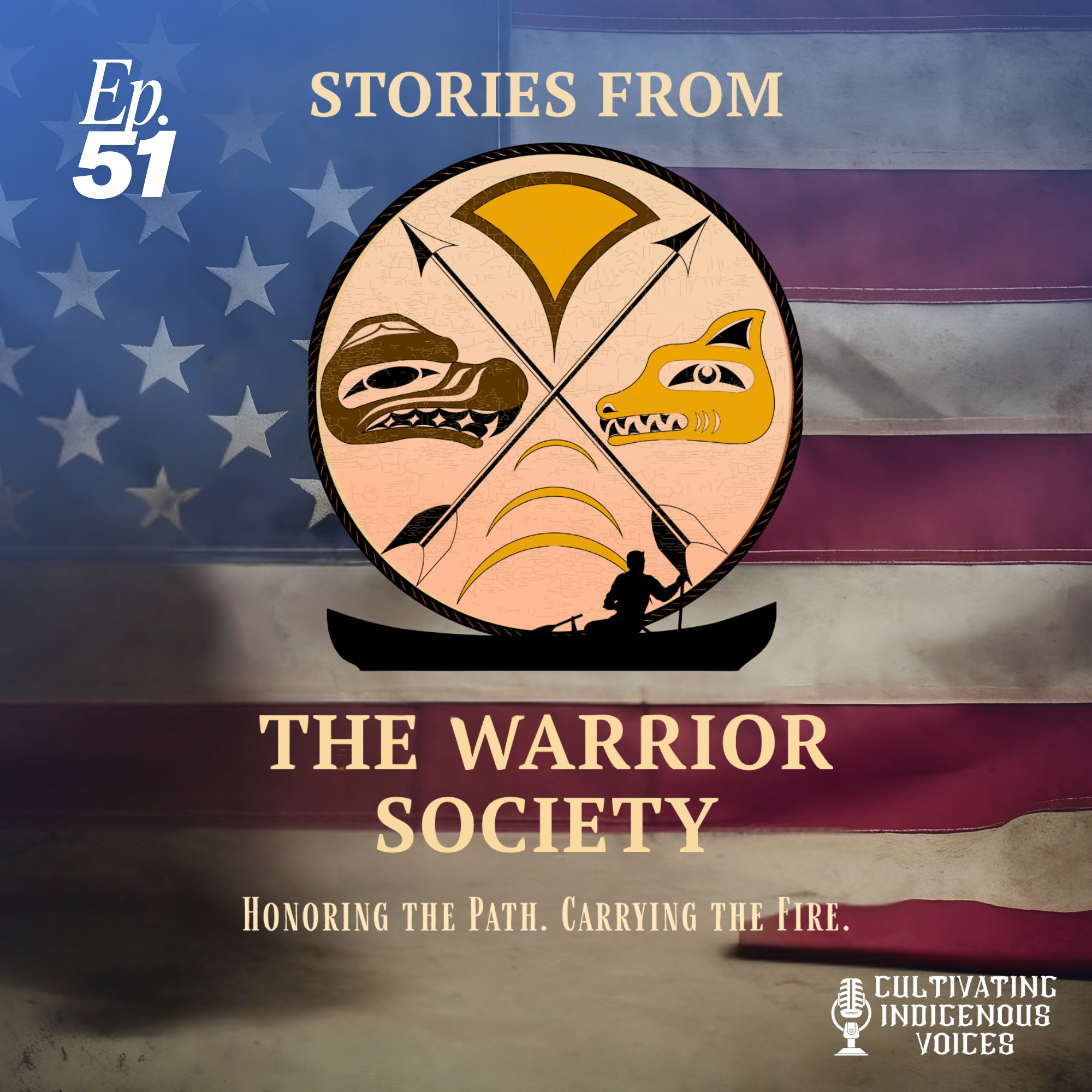
Ep. 50 Warrior Society with Andre Bouchard, Harrison Jim Sr. and Montana Miller
In this episode, I’m joined by three guests Andre Bouchard (Kootenai/Ojibwe/Pend d’Oreille/Flathead Salish), Harrison Jim Sr. (Diné), and Montana Miller (Diné), who are involved in the upcoming live event Stories from the Warrior Society, that explores the evolution of warrior societies in Tribal communities through the lived experiences of Indigenous veterans and active-duty military across three generations. This will be held on Tohono O’odham and Yaqui Tribal territory (Tucson, AZ) and Squaxin Island Tribal territory (Olympia, WA). Each site will feature six Native storytellers who are veterans or active duty— two of whom will be drawn from each site’s local Tribal communities as well as the directors who are Navajo storytellers themselves. This local event will take place at the Fox Theater in downtown Tucson on March 28, 2026 at 2:00 pm, tickets are now available for purchase on the Fox Tucson Theatre website. Logo for the Warrior Society storytelling event Our conversation centers on what it means to be a warrior in Indigenous communities—past and present—and how service, protection, and responsibility have taken many forms over time. Our guests reflect on the power of storytelling as a way to honor ancestors, uplift veterans, and create understanding between generations. They also share what audiences can expect from the live event, where personal stories illuminate history, identity, and the ongoing role of warriors in Tribal life. A photo of Andre and his dog Andre Bouchard (of Kootenai/Ojibwe/Pend d’Oreille/Flathead Salish descent) is an educator, director, producer and consultant who was born and raised on the Flathead Reservation in western Montana. He works to build bridges and reverse the invisibility that serves to marginalize Native people in the US. Andre is the founder and director of Indigenous Performance Productions. He holds a Master’s degree in Arts Management from the Heinz College at Carnegie Mellon University, a BFA in Dance and a BA in Anthropology from the University of Montana. Another storytelling project Andre is involved is called “The Aunties“, which focuses on storytelling from the perspectives by Indigenous women who call the local area their home who have dedicated their lifework in service to their community. A project is shared at sites across Turtle Island with locations that include, Yakima WA, Los Angeles, CA, Salt Lake City, UT, Minneapolis, MN, etc. A photo of Harrison Jim Sr., Diné (Navajo) Co-Director, Harrison Jim, Sr. a Diné (Navajo) Born into Haltsooi, born for Kinyaa aanii, maternal grandfather is Tsi’najiinii, paternal grandfather is Tsi’najiinii. Harrison Jim Sr. is a Navy veteran and Traditional Practitioner at Sage Memorial Hospital, where he developed a program utilizing traditional practices to help western medicine in healing patients. Mr. Jim is a member of the Dine’ Hat’aalii Association as a traditional practitioner (Hat’aalii), traditional counselor, traditional herbalist, and cultural teacher. Mr. Jim is the only full-blooded Native American awarded a Robert Wood Johnson Fellowship for Developing Leadership in Reducing Substance Abuse. Photo of Montana Miller, Diné (Navajo) Photo courtesy of Montana Miller Co-Director: Montana James Miller yinishyé Tabaaha nishti. Áshjjh bashishchiin. Tachii’nii dashicheii. Kinyaa’aanii dashináli. Ákótéego Diné hastiin nishij. Montana Miller (Diné) was born to the Water Edge Clan, Salt People Clan, Red Running into Water Clan, and the Towering House Clan. He is an Infantry Airborne Arm...
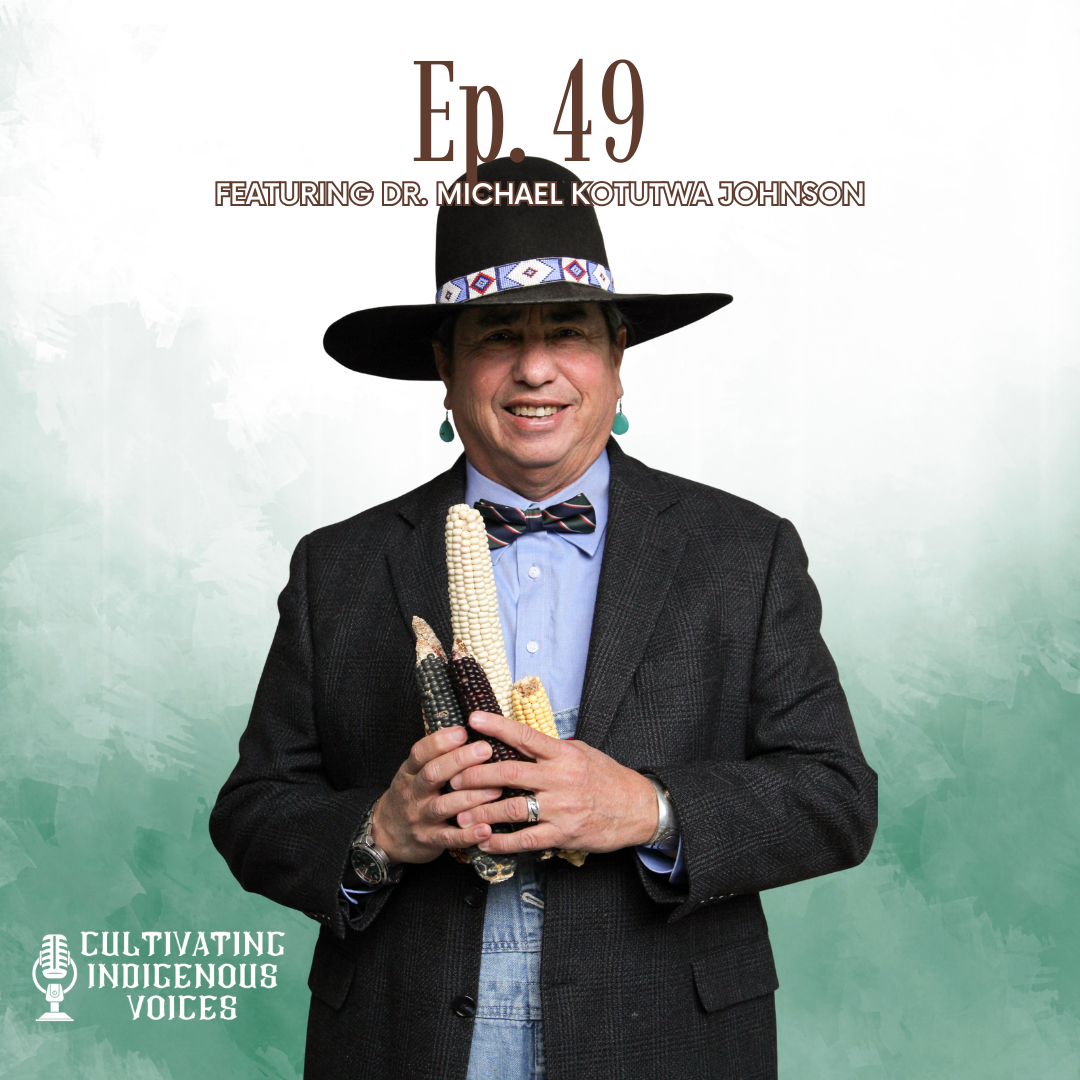
Ep. 49 Dr. Michael Kotutwa Johnson
In this episode I sat down with Dr. Michael Kotutwa Johnson (Hopi), who is an Assistant Professor/Extension Specialist of Indigenous Resilience at the University of Arizona’s School of Natural Resources and the Environment and a core faculty member of the Indigenous Resilience Center. Dr. Johnson is a Hopi tribal member and avid Hopi dryland farmer. He is a 250th-generation Hopi farmer, embodying generational ancestral knowledge learned through cultural practice, observation, and honoring what sustains life. His research focuses on Indigenous Land Use Management while integrating cultural and scientific expertise, such as Indigenous agriculture and the intersections of policy, science, and law. Photo of Dr. Michael Kotutwa Johnson with handful of different corn types. Photo courtesy of Dr. Johnson During our conversation Dr. Johnson not only discusses his work in academia but proudly shares stories of his ancestors, homelands, and planting heritage. As he reflects on his research, mentors, and experiences that shaped his work, he also opens up in a heartfelt way sharing vivid stories of the homelands that nurtured his family and the rich planting traditions he learned from spending time with his grandparents on the Rez during summer breaks as a kid. Together, these stories reveal not only the foundations of his scholarship but the cultural lineage that continues to inspire his life and work today. Photo courtesy of Dr. Johnson The image features a corn field cultivated and cared for by Dr. Michael Kotutwa Johnson. Photo courtesy of Dr. Johnson. Tune in to this powerful conversation with Dr. Michael Kotutwa Johnson, where we explore Indigenous knowledge, food systems, and community-centered futures. Graphic created by T. Andrew Here is a brief version of the interview that offers key highlights and insights from the full conversation. https://kxci.org/wp-content/uploads/2025/12/12-10-25-to-12-24-25-CultivatingIV-Dr-Michael-Kotutwa-Johnson.mp3
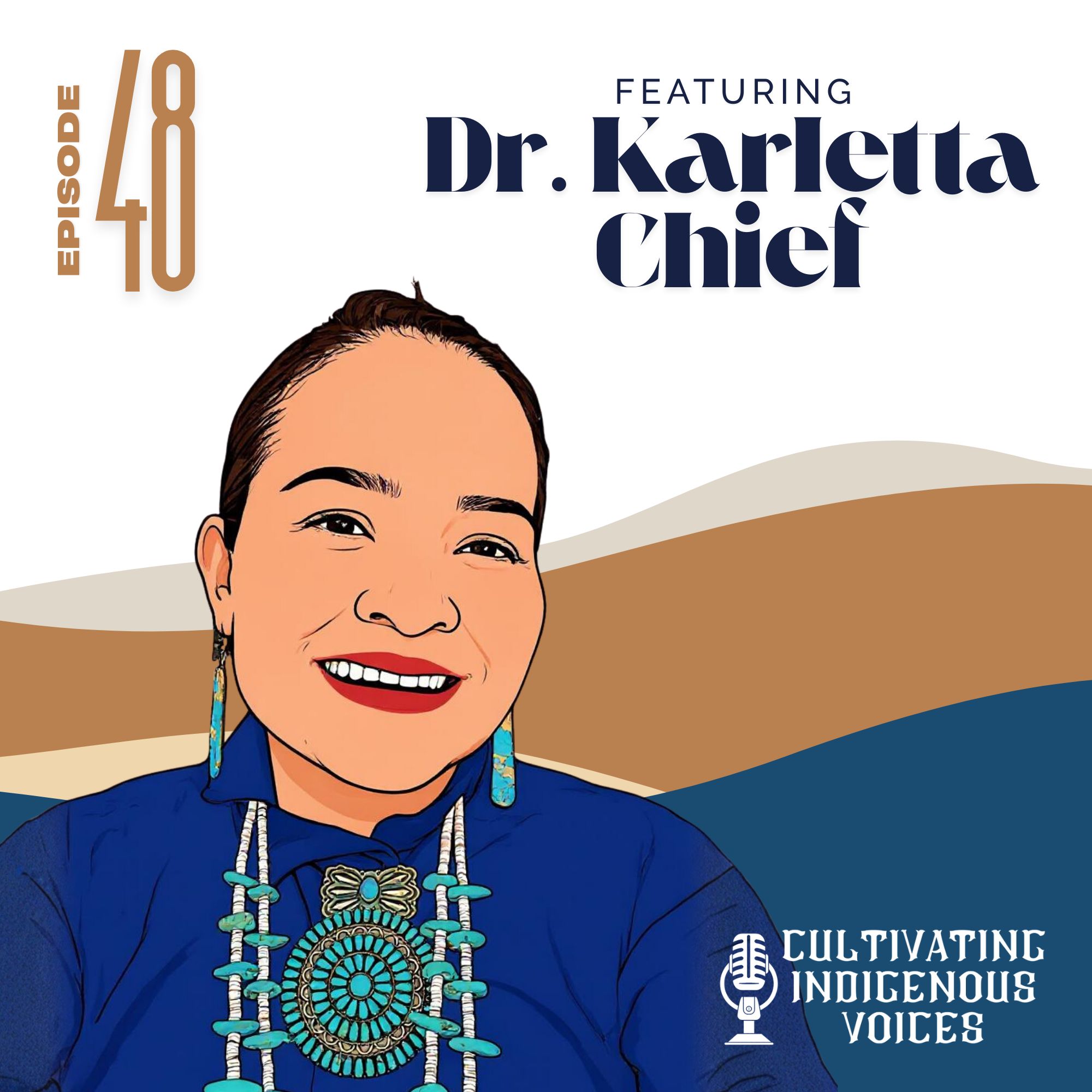
Ep. 48 Dr. Karletta Chief
In this inspiring episode, I sat down with Dr. Karletta Chief (Diné), a distinguished hydrologist, environmental scientist, and proud citizen of the Navajo Nation. She is the Director of the Indigenous Resilience Center, as well as a faculty member and researcher at the University of Arizona. Dr. Chief discusses her expansive work addressing environmental challenges that directly impact Indigenous communities—especially in the areas of water quality, climate resilience, and tribal community engagement. IRes Group Photo Dr. Chief shares how her research bridges cutting-edge science with culturally grounded approaches, ensuring that tribal voices and knowledge systems remain central to environmental decision-making. She also talks about her passion for mentoring the next generation of scientists, describing the programs she leads to support students, by helping build pathways into STEM fields. Dr. Chief breaks down the many projects she’s involved in—from researching water and climate issues that affect Native communities to teaming up with tribal partners on real-world solutions. Throughout the conversation, Dr. Chief shares how her identity and community shape the way she approaches research, teaching, and collaboration. The video titled Breakthrough: Bitter Water, is a great example and visual that depicts part of our conversation in the interview, a film by Science Friday and produced in collaboration with the Howard Hughes Medical Institute. Whether she’s conducting field research, partnering with tribal nations, or empowering students in the classroom, Dr. Chief offers powerful insights on what it means to serve both science and community. Graphic created by T. Andrew If you’d like to learn more about Dr. Chief’s work, here are a few helpful links: Community Tool Kit Off Grid Solar Nanofiltration Unit (SNF) full video Navajo GIS Water Quality Portal Native FEWS Alliance AZPM Connecting indigenous communities with the science of water use Radio Interview
Ep. 47 Indigenous Takeover with Andrew Pedro
In this episode of Cultivating Indigenous Voices, I sat down with Andrew Pedro (Akimel O’odham), promoter and organizer behind the Indigenous Takeover show — an awesome event bringing together metal and hardcore bands from across Turtle Island. We dive deep into the roots of this movement, exploring how heavy music has become a fierce, unapologetic form of cultural expression and resistance. Heavy metal, a genre celebrated for its intense sound and defiant attitude, has fostered a distinctive subculture that reaches far beyond the music itself. One of the most defining elements of this subculture is the sense of community experienced at heavy metal concerts. Fans—often referred to as metalheads—come together through their shared passion for the music, forming a powerful social and cultural movement. Together, we talk about the importance of creating spaces where Indigenous artists can take the stage, be heard, and be celebrated for their talent and message. Indigenous Takeover flyer for the next upcoming show at 191 Toole, Nov. 14th Over time, I’ve gotten to know Andrew and have come to admire the work he does within his community. He’s also an incredible drummer, known for his killer blast beats! Through his DIY shows, Andrew has organized numerous local metal events both on and off tribal lands across Southern Arizona, focusing on showcasing bands that feature tribal members. We talk about what makes this kind of gathering so special — how it’s not just about the heavy riffs and mosh pits (though there’s plenty of that!), but about creating a space where Native people can show up, feel at home, and let loose. It’s about representation, community, and proving that this music — raw, powerful, and full of emotion — deserves to be heard and celebrated by everyone. So, whether you’re deep into the metal scene or just love seeing Indigenous creativity thrive, this episode is all about the energy, passion, and purpose behind the movement. So turn it up, and let’s rock out together! Graphic created by T. Andrew Here is a short version of the interview that offers key highlights and insights from the full conversation. https://kxci.org/wp-content/uploads/2025/11/11-09-25-to-11-16-25-CultivatingIV-IndigenousTakeover.mp3
Ep. 46 A Student's Journey with Daniel Sestiaga and Ben Richmond
In this episode of A Student’s Journey (ASJ), we explore what it really takes for Tribal College students to transition from their community college to a major university. A Student’s Journey (ASJ) is a year-long program that includes a five-week, on-campus summer experience at the University of Arizona. Using an experiential, internship-based approach, ASJ helps students navigate the complex process of transferring to a four-year university while providing mentorship, community, and a sense of belonging. Logo of A Student’s Journey program Daniel Sestiaga Jr. is a member of the Fort Yuma Quechan Indian Tribe of Arizona. He is the son of Daniel Sr. and the late Rosie Sestiaga. His paternal grandparents are Carlotta and the late Julio Sestiaga, and his maternal grandparents are Rosie Montoya, the late Tomas Montoya, and the late Virgil Jack. Daniel currently serves as the Assistant Director of the Indigenous Resilience Center (IRes) at the University of Arizona, where he directs the operations of the Center and provides on-site leadership for faculty, professional staff, and student teams. His leadership has contributed to impactful initiatives such as climate and justice symposiums, environmental health forums, student engagement programs, and culturally grounded research collaborations. Beyond his role at IRes, Daniel is an adjunct instructor at Tohono O’odham Community College, where he teaches courses in Community and Public Health. He earned his Bachelor of Science in Public Management and Policy and his Master of Public Health from the University of Arizona. Photo of Daniel Sestiaga, IRes Center Assistant Director Ben Richmond serves as the Manager of Undergraduate Education Initiatives in the University of Arizona’s Division of Undergraduate Education in the Office of the Provost. He earned his BS in Public Health and MPH from the University of Arizona and is currently pursuing a PhD in Higher Education. Ben’s research interest is in understanding the social and cultural barriers students face in pursuing higher education and developing higher education pathways for students. With this research focus, Ben has developed programs that target students throughout their academic journey and use culturally anchored curriculum to increase students’ knowledge and skills, improve students’ self-efficacy in pursuing higher education, increase sense of belonging on a university campus, and help students navigate campus systems. Photo of Ben Richmond, Manager of Undergraduate Education Initiatives in the University of Arizona’s Division of Undergraduate Education So, what happens after community college for students from rural and tribal communities? In this episode, we explore the powerful transition from a small, close-knit community college to the fast-paced world of a major university. Through this heartfelt conversation with Daniel and Ben Richmond, we uncover the barriers these students face—financial strain, homesickness, cultural shifts, and academic pressures—and the incredible resilience that carries them through. A Student’s Journey is more than just a program; it’s a lifeline. Designed to guide and support students from rural tribal community colleges, it connects them with mentorship, resources, and belonging as they continue their education. Whether you’re a student preparing for your next step, an educator supporting transfer pathways, or a donor passionate about Native student success, this episode shines a light on how programs like ASJ are changing lives and empowering future leaders from Tribal Colleges across the nation. Graphic created by T. Andrew Here is a brief version of the interview that offers key highlights and insights from the full conversation.
Ep. 45 Latinos in Heritage Conservation with Sehila Mota Casper
In this powerful episode, I interview Sehila Mota Casper, Executive Director of Latinos in Heritage Conservation (LHC) to explore the urgent need to preserve Latinx historical sites across the United States. LHC was co-founded in 2014 by an intergenerational group of heritage practitioners, advocates, scholars, and students interested in building a national network to support Latinx preservation efforts across the country. Despite Latinx communities making up nearly 20% of the U.S. population, less than 1% of sites on the National Register of Historic Places reflect Latinx heritage — a sobering statistic that underscores how entire chapters of American history risk being erased before they’re ever acknowledged. Group photo from LHC first National Conference in Tucson, AZ. Photo from the LHC website. Here is a brief version of the interview that offers key highlights and insights from the full conversation. https://kxci.org/wp-content/uploads/2025/09/09-05-25-to-09-19-25-CultivatingIV-Latinos-in-Heritage-Conservation.mp3 Tucson is a big part of the Latino in Heritage Conservation’s origin story and has for many years been a regularly visited place for their team to convene with Tucson folks in regards to the work of heritage, conservation, storytelling, and building community relationships. Through various projects Tucson has become a fixed destination for LHC staff to collaborate with various partners, while continuing to build a network throughout the U.S. Group with partners from Tucson AZ and Latinos in Heritage Conservation. Photo of Sehila with Demion with Preservation Tucson and Betty and Desiree. Sehila highlights LHC’s latest initiative recognizing 13 significant Latinx landmarks across 10 states, which includes Anitas Street Market in Barrio Anita here in Tucson. LHC launched this program called the Endangered Latinx Landmarks as part of the initiative to preserve and educate the public about sites that hold immense cultural, historical, and social significance, and face dangers such as demolition, gentrification, neglect, and the effects of climate change. These range from tortilla shops and LGBTQ+ safe spaces to murals, cemeteries, and adobe churches — all places that serve as anchors of memory, migration, and resilience. Each site carries the weight of everyday stories that collectively shape the American experience, yet many face immediate threats from gentrification, demolition, and climate change. The conversation emphasizes that historic preservation is about more than buildings — it’s about recognition, visibility, and care. It’s a call to ensure that Latinx communities see their stories reflected and preserved in the cultural narrative of the nation. LHC’s work is rooted in preserving the histories of the Latinx heritage, people, and places. Graphic created by T. Andrew Here is a brief version of the interview that offers key highlights and insights from the full conversation. https://kxci.org/wp-content/uploads/2025/09/09-05-25-to-09-19-25-CultivatingIV-Latinos-in-Heritage-Conservation.mp3

Ep. 44 Making Space for Indigenous Creativity with Josie Rios
In this inspiring episode, I sat down with Josie Rios (Akimel O’odham/Gila River Indian Community), a talented artisan jeweler and visionary founder of the Indigenous Market based here in Tucson. I first crossed paths with Josie while we were helping put together a Matriarch Mixer event here in Tucson — but I’d already been familiar with her powerful work in the community. In this episode, we dive into the drive and passion behind Josie’s journey of highlighting the work of the Indigenous community through art, culture, and entrepreneurship. As a Tucsonan, Josie also recollects a few memories from her childhood to her adult life and how it connects her to the work she is involved in today. She also explores what it means to create with intention — and how the Indigenous Market has become a thriving platform for cultural connection and economic empowerment. Photo of Josie holding jewelry and logo of her Beads Over Diamonds business. Indigenous Market past flyers that feature artists work for each market event. Photo from Indigenous Market social media page. Josie shares her story about how she learned and practiced beading at a young age while doing volunteer work at the Tucson Indian Center where they provided a good creative-social environment to do crafts for people of all ages. It was then that she first started doing bead work and was a fast learner, to which she eventually started offering individual attention and constructive feedback to others. Today, she has her own workspace likely equipped with pliers, needles, bead mats, and various types of stringing material, creating handcrafted beaded jewelry for her own business called Beads Over Diamonds. When Josie began to think about the idea of planning a market, she imagined it to be a place where all Native/Indigenous artisans could be welcomed and not singled out because of the sometimes limited, non-compete policy some market organizers put in place along with other obstacles she faced as a vender. She also thought about how she could make the process easier for folks who may not have the necessities to have a booth setup or to cover the financial fee. Josie believes that by focusing on holistic support and cultural protocols makes for a more welcoming place for Native/Indigenous vendors. She also envisioned a place to celebrate diversity and cultivate a safe, inclusive space for Two-spirit/LGBTQ+ artists, makers, and entrepreneurs to join as vendors and share their creativity, culture, and stories. Graphic created by T. Andrew
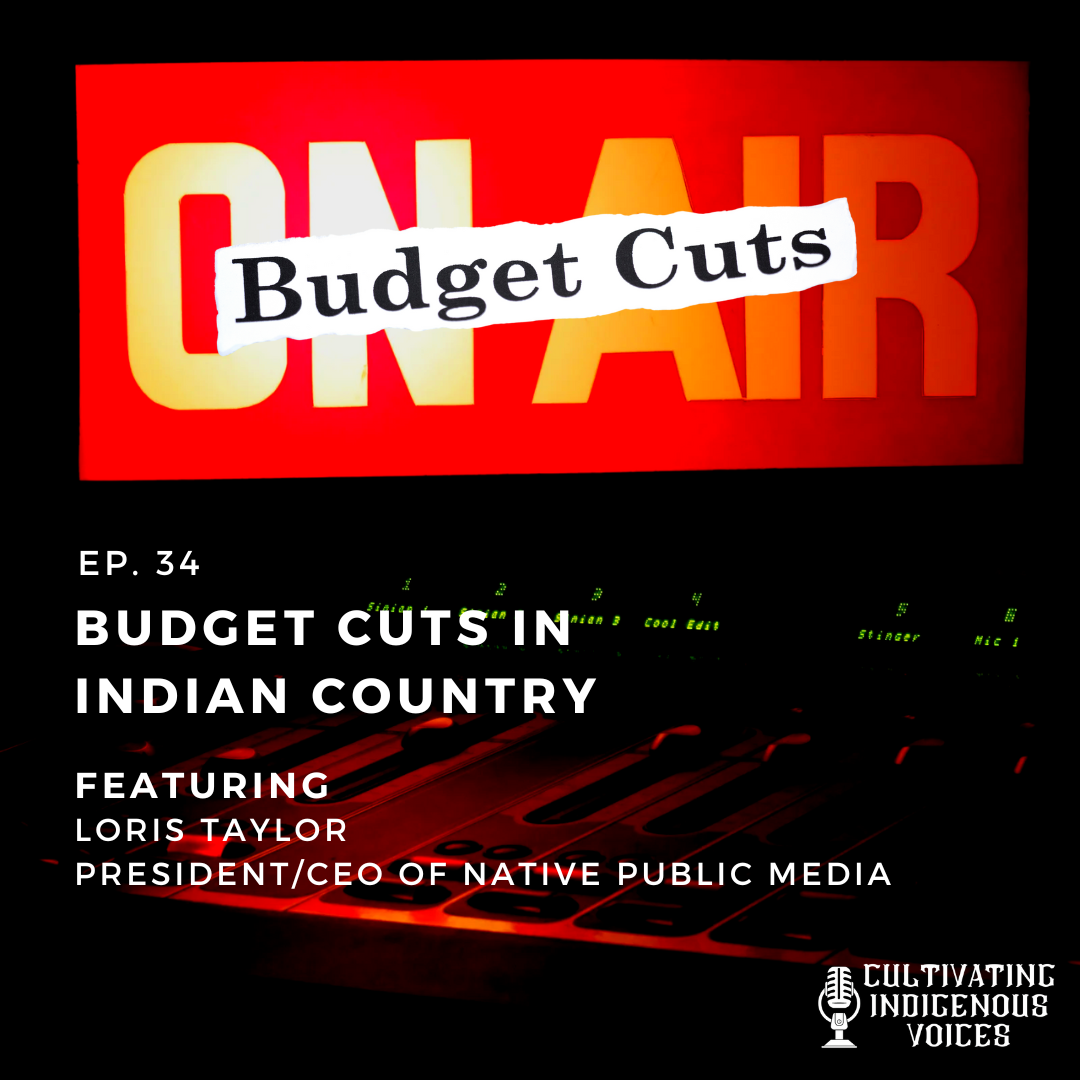
Ep. 43 Budget Cuts in Indian Country with Loris Taylor
Episode 43 features Native Public Media President/CEO Loris Taylor, who has been on the frontlines voicing, and fighting to address the need and importance of radio and public media in Native/Indigenous communities as things unravel at the hands of the current U.S. administration. Currently, Congress has voted to claw back $1.9 billion dollars in federal funding from the Corporation for Public Broadcasting (CPB), which for some tribal radio stations is a tremendous loss in funding. Recently, the rescission package passed the House, and now after that decision all funding from the CPB that was previously approved for radio stations will be cut off starting as soon as October 2025 and the Corporation for Public Broadcasting will shut down. Loris also addresses the negative impacts tribal and non-commercial radio stations could face with the change in funding cuts and the importance public media has in tribal/rural communities who rely on readily available information that relates specifically to their tribal communities as well as Nationwide news on tribal radio stations. Here is a brief version of the interview that offers key highlights and insights from the full conversation. https://kxci.org/wp-content/uploads/2025/07/07-29-25-to-08-12-25-Native-Public-Media-Loris-Taylor-1.mp3 Photo of Loris Taylor speaking at the Native Broadcast Summit, held annually in Phoenix, AZ. Pop up sign of Native Public Media logo at the annual Native Broadcast Summit. Having worked at a tribal radio station as an on-air DJ and board operator at KWAK-LP and KOHN O’odham Hewel Niok Network for a few years, I understand firsthand how important radio is in rural communities. It’s a resource that shares immediate community information about local news, celebrations, memorials, tribal meetings, youth content, cultural and language programs. During my time working for my tribe’s radio station, the local long running newspaper called “The Runner,” had retired, shifting more people to tune in to radio for local tribal content/news. During the COVID-19 pandemic, radio broadcasting and related media services were widely recognized and designated as essential services by various governmental entities in the US and other countries, including tribal communities. It was then I realized that radio is a vital lifeline for communication and information during catastrophic events that impacts local communities within’ tribal lands. As radio broadcasters it’s not always just about the music, it is our duty to be of service to our community, and to be ready to deliver immediate information to the masses in times of celebration and uncertainty. About 92% of public tribal radio stations’ funding comes from the federal government, which puts them in a particularly fragile position. With the Department of Government Efficiency (DOGE), most tribes are already facing dramatic cut back with the loss of federal funding that affects resources such as health programs, educational programs, groups and organizations perceived as promoting diversity, equity, and inclusion etc. Graphic created by T. Andrew, KXCI Production Coordinator
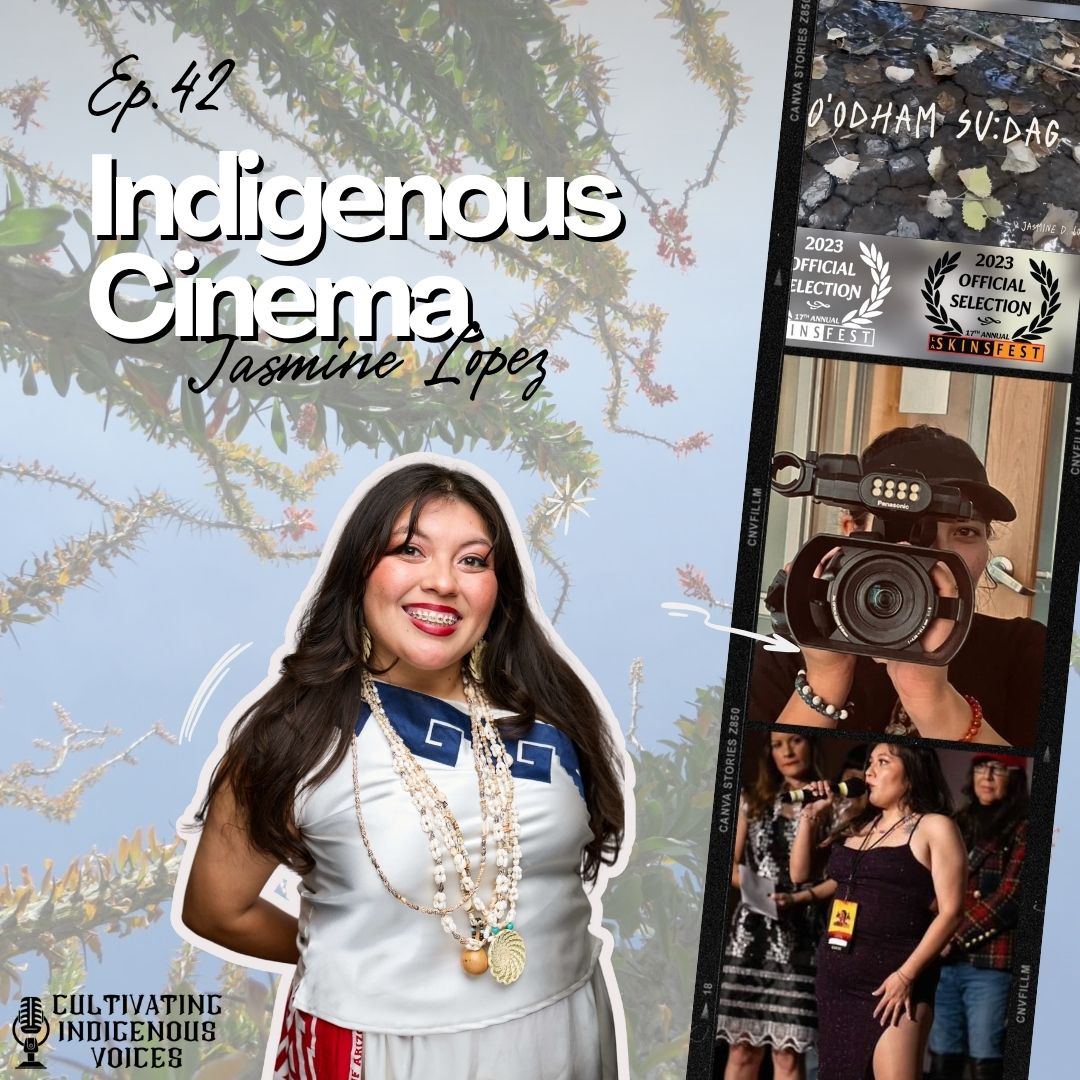
Ep. 42 Indigenous Cinema with Jasmine Lopez
In this episode I feature Jasmine Lopez (Tohono O’odham), who is a young aspiring filmmaker and community advocate. Jasmine was raised on the Southside of Tucson by her Grandmother Roselene, oringinally from the village of Gu-Oidag (Big Fields) on the Tohono O’odham Nation. She is currently a senior at the University of Arizona majoring in Management in Information Systems with a minor in American Indian studies, while working for the program A Students Journey. Photo of Jasmine (right) and Her grandmother , Roselene (Lewis) Smith, (left) at her graduation from Tohono O’odham Community College. I first discovered Jasmine when she held the title as Miss Native American University of Arizona 2024-2025. We recently met in person and it was then I learned more about the work she does as a student and aspiring filmmaker. Her early introductory to recording videos started as a young girl creating short films on her cell phone using the app iMovie. To her the idea of creating videos on the most accessible resource, an app for most digital devices like a cell phone, iPad, computer etc., was fun making playful cinematic shots and stories. Portrait photo of Jasmine in her traditional clothing and regalia. Photo of Jasmine giving a speech during her reign as Miss Native American University of Arizona 2024-2025 In 2023 during her time as an undergraduate student at the Tohono O’odham Community College she was awarded the opportunity to intern with the Student’s Journey program at the UofA, to work on a film project of a topic of her choice. Jasmine’s subject matter was environmental justice where she highlighted the issue of the history of TCE water contamination in South Tucson that was largely caused by and centered around industrial activities and defense-related facilities. Below is the short-film titled, “O’odham Su:dag – The People’s Water – A Tohono O’odham Jewed (Land) Story.” Today, Jasmine is currently working on a grant funded short-film about indigenous love! She was awarded a grant from the American Indian College Fund – Student Professional Development Grant Program. In the interview she goes more in-depth about her plans as her role as the director and pre-production that includes script development, casting, location(s), etc. Aside from being a filmmaker, she is also interested in developing her own business as a managing consulting firm. I hope you enjoy listening to Jasmine’s story and if you wish to support her work she can be reached on Instagram @ripyoungjas and on Linkedin as Jasmine Lopez. Thank you for tuning in! Jasmine filming in a wash standing behind the camera. Ep. 42 Indigenous Cinema. Graphic created by T. Andrew. Here is a brief version of the interview that offers key highlights and insights from the full conversation. https://kxci.org/wp-content/uploads/2025/06/06-19-25-to-07-03-25-CultivatingIV-Jasmine-Lopez-Indigenous-Cinema.mp3
Ep. 41 Finding My Ground with Wynnette Bell
In this episode, I sat down with a Wynnette Bell (Eastern Shoshone/Northern Arapaho), who is a Crew Lead for the Arizona Conservation Corps and originally from Wyoming which is home to the Eastern Shoshone Tribe. She started doing conservation work at the age of 16 and now in her early twenties, she’s found refuge in the work she does. Tune in as she shares her journey of finding purpose, resilience, and identity through hands-on service in the wild landscapes. From early mornings with a shovel in hand to long hikes under the desert sun, Wynnette opens up about adapting to the various landscapes and the challenges of working on public lands — and the unexpected rewards that come with it. We explore what it means to “serve the land” as a young adult, how living and working in remote areas shaped her perspective on the environment, teamwork, and why conservation work is about much more than trail maintenance. Some of the work involves fencing, invasive vegetation removal, environmental education, restoration preservation, tree planting etc. It’s about finding direction, confidence, and connection — even in the dust and sweat of the backcountry. A photo of Wynnette surround by the sonoran desert landscape. Here is a brief version of the interview that offers key highlights and insights from the full conversation. https://kxci.org/wp-content/uploads/2025/05/08-18-25-to-09-01-25-Wynnette-AZCC-RERUN-Edited.mp3
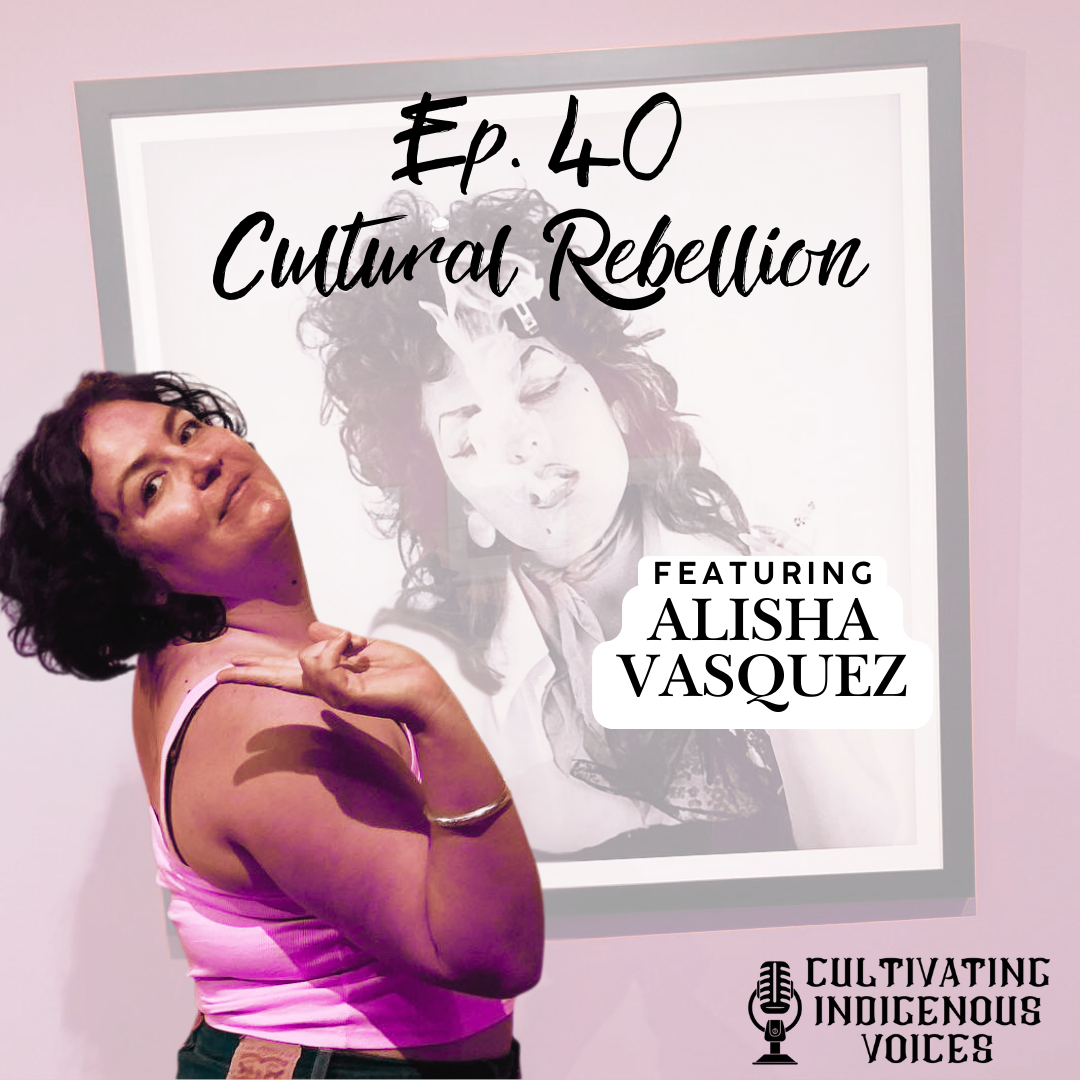
Ep. 40 Cultural Rebellion with Alisha Vasquez
In this episode I feature Alisha Vasquez, who is a 5th generation Tucsonan and is the Co-Director of the Mexican American Heritage and History Museum and the Accessibility and Communications Manager with Southwest Folklife Alliance. She recalls her time spent at Skrappy’s as a teenager stepping into what would become the most transformative space of her teenage years. Skrappy’s was a popular teen hang out, a DIY music venue run by youth for youth, and a place for after school activities that gave young people a chance to create, connect, and lead. Listening to punk rock lyrics opened the door to critical thinking and broadened political awareness for Alisha. From that she built a sense of solidarity as a young person on into her adult life. Photo by Stephanie L. from Skrappy’s tumblr webpage. At an early age Alisha enjoyed listening to family stories told by her grandparents about their memories in Tucson. These stories included important details that Alisha would later discover as a teacher, teaching Chicano Studies at Pima Community College, that history isn’t just in the textbooks—it’s in the barrios, in the stories passed down, and in the fight to be seen and heard. Louis Vasquez and Theodora Petras (Alisha’s yaya and papu) walking hand and hand, down Congress St., early 1950 Alisha in a bucket of water on North Fontana Street, circa 1986 Alisha also goes in depth about a project she and other community organizers are doing called “Survival and Resistance: Southside’s Environmental Justice Movement“, that is telling the story of the trichloroethylene (TCE) contamination in Tucson water from the late 1940s to the 1970s. The contamination occurred on the southside of Tucson where residents were affected by contaminated drinking water. The nearby company Hughes Aircraft Co. used TCE extensively as a degreasing agent in aircraft manufacturing and routinely dumped chemical waste without proper containment. As early as 1957 neighboring tribe officials from the Tohono O’odham Nation wrote a letter to Hughes Aircraft Co.; the letter described alarming signs of livestock dying and natural ecosystems visibly deteriorating. This improper disposal of trichloroethylene (TCE) led to the contamination of the local groundwater supply. Thus, South Tucson residents unknowingly consumed the tainted water for years, and many began experiencing health issues such as liver and kidney damage, immune system dysfunction, and increased rates of certain cancers. Prolonged exposure to TCE, particularly through ingestion and inhalation of vapors in indoor air, raised concerns among public health officials, prompting an environmental investigation and the eventual classification of the area as a hazardous waste site under the EPA’s Superfund program. Louis Vasquez water his backyard, circa 1970s Alisha’s family discovered that their grandfather Louis Vasquez was a part of one of many TCE lawsuits filed by South Tucson residents whose serious health conditions were likely caused due to prolonged exposure to harmful levels of TCE, leading to serious health consequences. For five generations her family has called Tucson home, and over the decades, they’ve watched Tucson transform from a quiet desert town into a vibrant, sprawling city. Each generation witnessing change – some gradual, others abrupt – from the revitalization of downtown to the pressures of gentrification that followed. Tune in to hear more details about Alisha’s personal and community experiences as she continues to explore the layers of history of place, identity, and heritage. Herbert Street House–Vasquez family residence in Barrio Santa Rita. Photo from 2024 Louie Vasquez pointing at the bulldozed site of the house that his father was born in once stood. The city was...
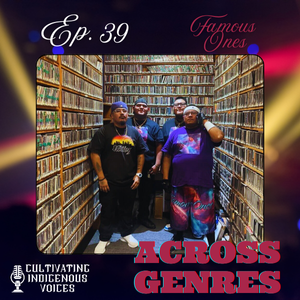
Ep. 39 Across Genres with Famous Ones Band
In this interview Famous Ones talk about their unique blend of sound and style that consists of a trio of brothers Chad, Carl, and AJ Flores and their neighbor friend Jaize Puffer all from the San Lucy community on the Tohono O’odham Nation, which rests on the boundary of the small town of Gila Bend, Arizona. The multi-genre band making it happen not just with playing in a band but also making bold business moves that range from a hot sauce brand to a clothing line and to having their own DJ production company. This interview is a portion of the Locals Only live studio session that happened on March 10th, where Famous Ones played live over the airwaves that included an interview with yours truly Lady T. Here is a brief version of the interview that offers key highlights and insights from the full conversation. https://kxci.org/wp-content/uploads/2025/04/07-11-25-to-07-25-25-CultivatingIV-Famous-Ones-RERUN-Edited.mp3 Pictured from left to right Jaize, Carl, AJ, and Chad Their creative hustle is an inspiring story with 30+ albums already released and many more on the way! Their willingness to push boundaries and experiment is a sign of a band that’s constantly seeking growth, both as artists and as individuals. Beyond their musical talents, Famous Ones is also committed to giving back to the community to which they regularly participate in local community events, and collaborate with youth programs to inspire young artists. Tune in to the conversation to hear more about their creative process, album ideas, and connecting and doing collabs with other artists that adds to their musical growth. This type of networking has opened doors for new opportunities, gigs, and projects. Here is a latest collaboration they did with artist YUNG N8 featuring Famous Ones. Graphic created by T. Andrew
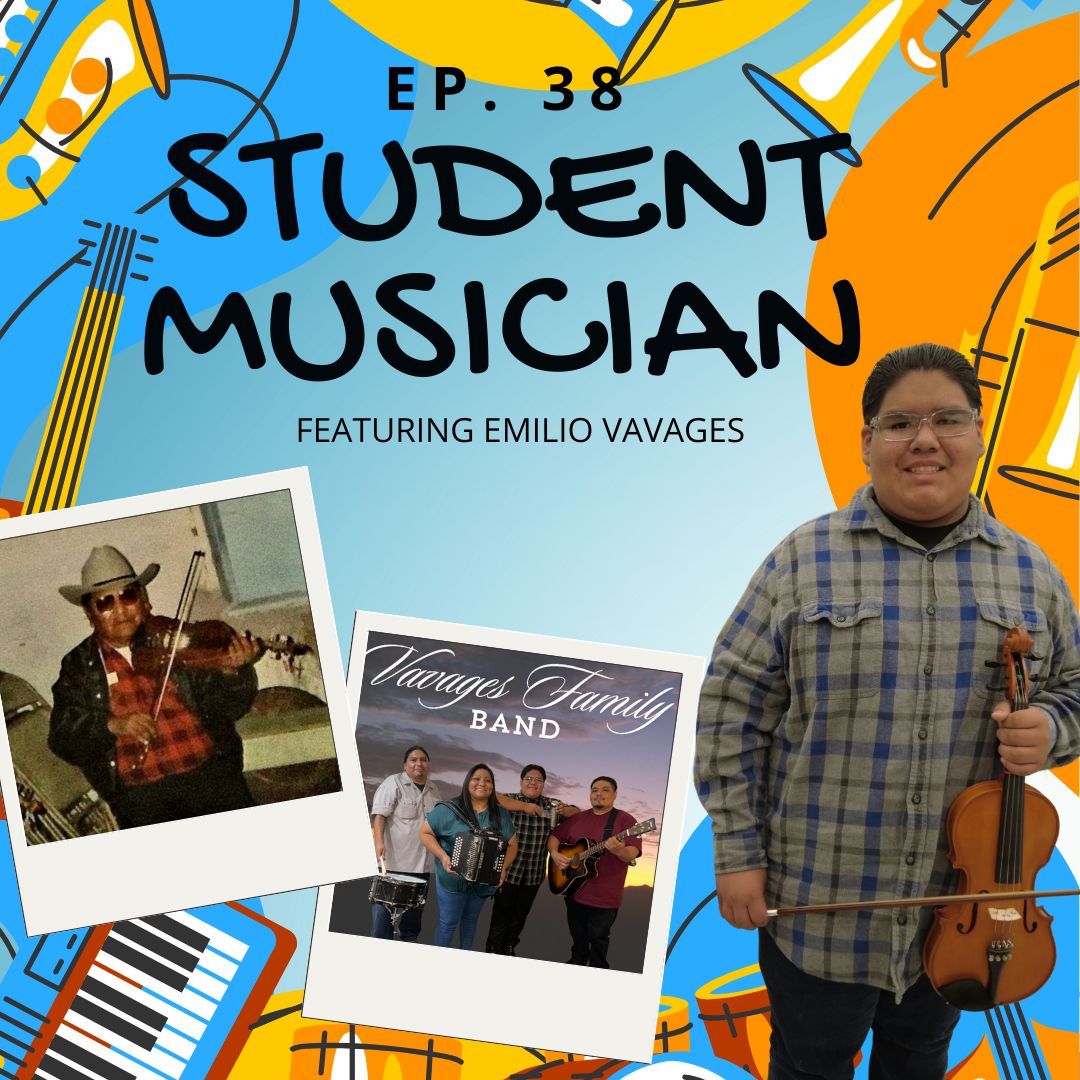
Ep. 38: Student Musician with Emilio Vavages
In this episode I feature student and musician Emilio Vavages (Tohono/Akimel O’odham). I wanted the share the story and experiences of a young person’s perspective about being a student musician, so I decided why not bring in my nephew Emilio. Emilio is thirteen year’s old and a student at Apollo Middle School in the Sunnyside School District. He started taking orchestra in the 4th grade playing the violin and has since then progressed as a musician and is now playing alongside his own father Eligio V. in his family’s band. Emilio also enjoys subjects such as English, Language, and Social Studies, is a participant in a program that teaches students carpentry work, and a part of the Leadership program at his school. With the support of his family Emilio continues to thrive in class getting student of the month in the past several months. Emilio says his musical influence is inspired from his family, but I say it’s naturally in him as it runs in his blood. His great-grandfather Lester V. Vavages played the violin for decades, as well as the guitar, vihuela, bass, etc. He was a member of the Gu-Achi Fiddlers, who’s music is still alive today by many folks in the fiddle world. Lester passed the music down to his boys, who are Emilio’s grandfather’s, and known are as Thee Express waila band from the Tohono O’odham Nation. Sherman Institute, CA yearbook 1952. Emilio’s great-grandfather Lester Vavages is pictured holding the guitar. Picture of Lester V. Vavages, Emilio’s great-grandfather holding his violin while playing. Photo courtesy of T. Vavages-Andrew. During Emilio’s musical journey playing his primary instrument the violin, he is a part of the Sunnyside School District Honors Orchestra Program. He is also a part of his family’s band called the Vavages Family Band playing the violin, percussion, and cowbell and has performed live on-air at KXCI Community Radio during the 2024 Sonic Solstice event. With all his success there is still plenty more things he wants to do in life, one thing being a powerlifter. Tune in to this short interview to hear more details! Photo by Kathleen Dreier Photography Ep. 38 Student Musician graphic created T. Andrew
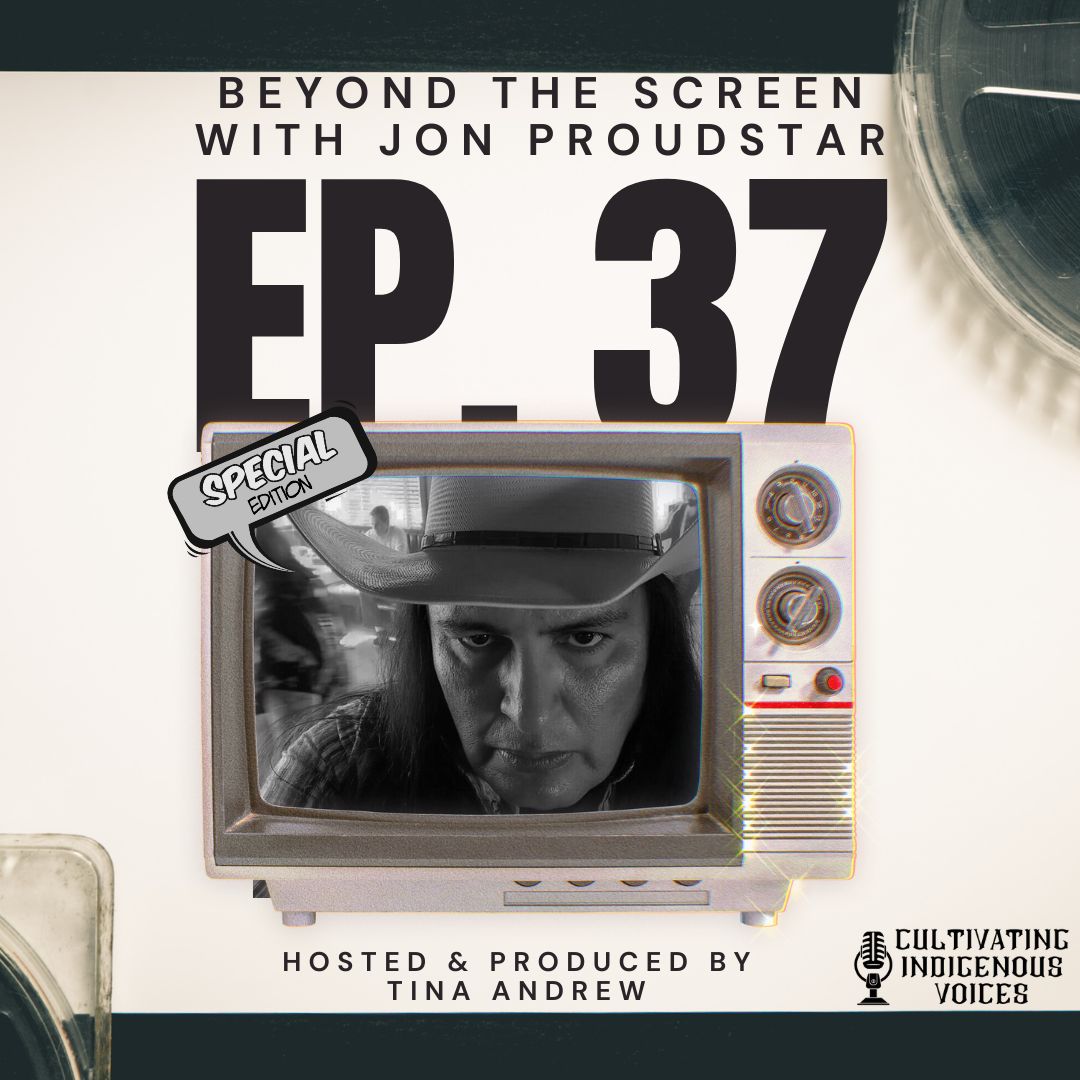
Ep. 37: Beyond the Screen with Jon Proudstar
In this episode I feature Native Tucsonan, Veteran Actor, and Comic Creator Jon Proudstar (Yoeme, Mexican, Jewish). Growing up in Tucson, Jon spent his childhood drawn to television and comic books as a source of entertainment. While in high school he got a small taste of what it feels like to be in the entertainment industry. Jon and a buddy of his both loved a lot of the same things, and one thing they wanted was to be a part of the local radio scene in Tucson. Together they found a way to get their foot in the door of radio, by catching up with a local DJ Cheryl Cruz, host of “The Cruise Control” show, and insisted on helping her with her records during her live shows. From then they would show up on Fridays and Saturdays to help her out and she soon began to teach them and gave them hands on experience working the mics, playing music, and working the board. They eventually were given the opportunity to host a show as Mikey Mike (Mike) aka catdog and Conan (Jon) at just 16 and 17 years old playing mostly slow jams, funk, soul, and some pop. It was how Jon got connected to KXCI those many years ago. KXCI Staff group photo with Jon Proudstar. Taken December 2024. As Jon began expanding his natural abilities to go after what he wanted, he first began taking acting classes in high school and immediately got the attention of the Drama teacher who recognized his talent for acting after he participated in an improvs scene and encouraged him to run with it. Overtime Jon eventually worked toward pursuing a career as an actor. During his early years in acting Jon started as an extra before landing bigger roles in film and TV. One memory Jon tells so well during the interview is the time when the film Young Guns II was in Tucson and he was a stand in photo double for Lou Diamond Phillips. Over his career as an actor Jon has been featured in films and television shows such as Walker, Texas Ranger, Border Warz, Dude Vision, Last Stop in Yuma County, and the Hulu series Reservation Dogs. The series Reservation Dogs was a massive breakthrough for Native film into mainstream media and television. It is a series that connected so many people worldwide and showcased the talents of many Native/Indigenous actors, directors, writers etc. who have been in the film industry for many years as well as exposing the younger generation of Native actors. Beyond the screen Jon wrote and created a one of a kind comic called Tribal Force, published in 1996, which is the first all Native super hero comic in the history of the U.S. The idea of the comic stemmed from his work in tribal communities where he witnessed the struggle that the youth were impacted by. He wanted to create something that the Native community, especially the youth could relate to. Thus, he wrote a comic strip that represent native/indigenous cultures that included characters who were gifted with different abilities that would be helpful in protecting the land, and their people. He worked alongside Ryan Huna Smith (Chemehuevi/Navajo) who was the artist and together they created a unique comic book and that would later get greater recognition and included into the Smithsonian National Museum of the American Indian’s Comic Art Indigène exhibit. Tribal Force comic created/written by Jon Proudstar, artist Ryan Huna Smith The most recent Tribal Force comics was created by Jon with the help from Chris Williams (pencils), Jake Isenburg (inks), Gene (colors and lettering), and Jesse Hernandez (artwork). Since it’s creation many people nationwide have expressed their love and appreciation for these great characters and stories that relate to their own personal experiences in life. Tune in to hear more details about the comics and Jon’s life behind the scenes to his life beyond...
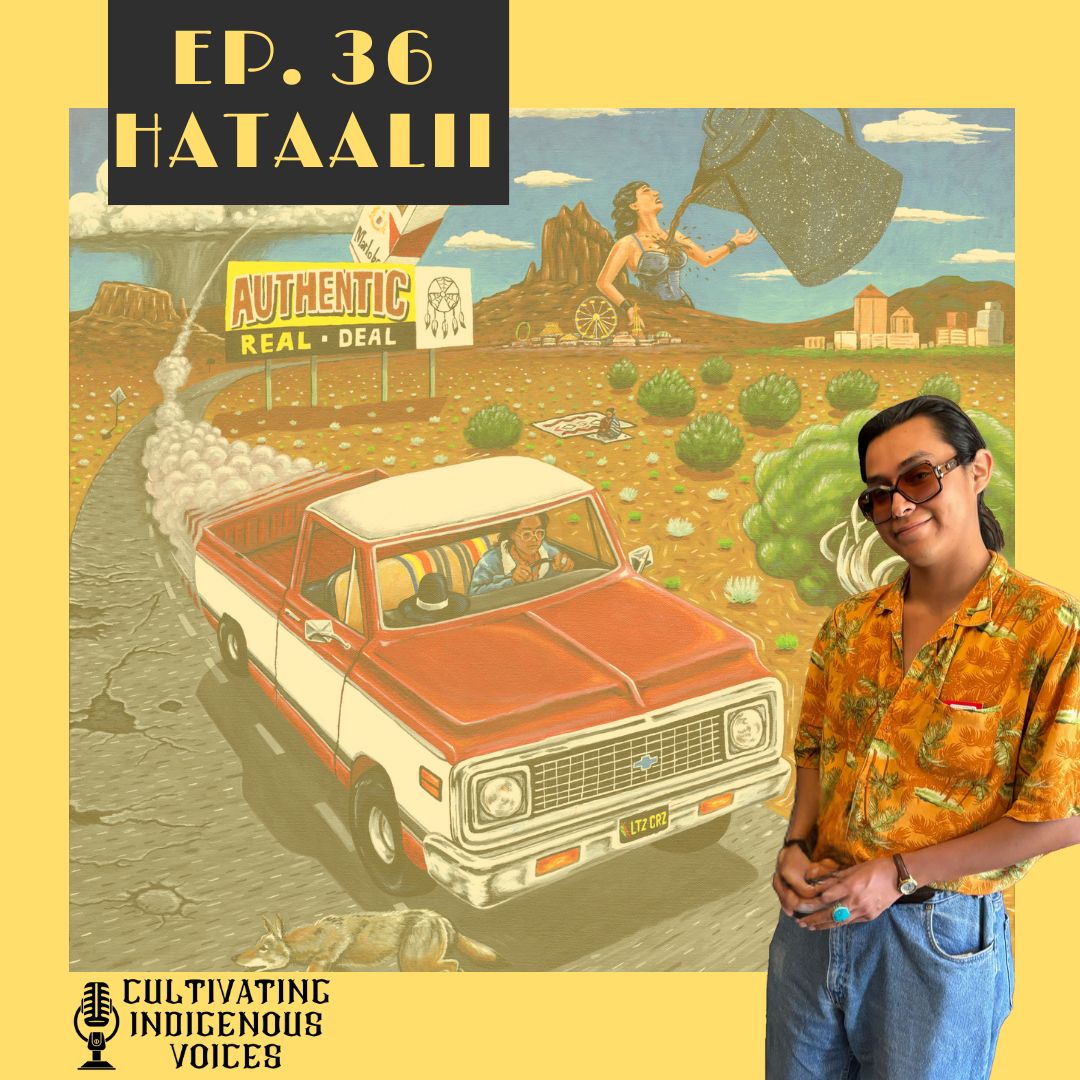
Ep. 36: Hataałii
Diné singer/songwriter Hataałii (pronounced: hah – toth – lee) visited Tucson in October 2024 as the opener for the Katie Pruit show at Club Congress. Born Hataałiinez Wheeler, he grew up on the Navajo Nation in Window Rock, Arizona and began experimenting with music during his teenage years. Now Hataalii is an artist signed to Dangerbird records and just released his second album titled, “Waiting for a Sign.” Since 2019 Hataałii has self-released projects, so technically this would be his sixth album released. During the live in-studio session on The Home Stretch show, we invited Hataałii and band mate Jacob ,who plays the steel guitar, to perform a short set and interview live over the airwaves. The following day he and Jacob arrived to our Armory Park studio for an interview on Cultivating Indigenous Voices. Hataałii shared what his musical journey has been like, and that some of his current work includes lyrics, songs, stories, that he wrote when he was a teenager. As I reflect on our conversation one thing that stood out to me was his enigmatic personality and subtle hints of laughter which you can hear in the interview. Hataalii and band mate Jacob performing a live in-studio session at KXCI’s Congress Studio in down town Tucson, AZ. Photo by T. Andrew. Hataalii standing in the CD vault at KXCI Armory Park Studios in Tucson, AZ. Photo by T. Andrew. Episode graphic created by T. Andrew