
Crazy Wisdom
574 episodes — Page 1 of 12
Episode #575: The Imagination Bottleneck: When Technology Finally Catches Up to Human Creativity
Episode #574: Evals, Ontologies and the Unmappable World of Business
Episode #573: Beyond the Hype: Building Robots for Actual Humans
Episode #572: The Horizontal Truth: Why Everything You Know About Movement is Wrong
Episode #571: The Like Button Killed Connection: Rethinking Social Networks from First Principles
Episode #570: R2-D2 Belongs to You: Building Sovereign AI in the Age of Centralized Power
Episode #569: What the Romans Wrote Over, and What AI Is Erasing Now
Episode #568: AI Is Making Everything More Efficient. What Happens Next?
Episode #567: SEO is Dying and AI is Rewriting Marketing from Scratch
Episode #566: We Killed God, Then We Trained Him: How AI Became Theology
Episode #565: What Is, What Should Be, and the Space Between: A Conversation on Story and Consciousness
Episode #564: The Trojan Horse of Brain Interfaces: What Neuralink's Terms of Service Won't Tell You
Episode #563: Primary Mind vs. Extended Mind: Aaron Neyer on Digital Brains
Episode #562: When the Rule-Based Order Wobbles: Investing in Resilience Over Size
Episode #561: The Internet Was Democratic By Design. AI Was Built to Concentrate Power.
Episode #560: Can AI Build a Better Civilization?
Episode #559: Hug a Tree Before You Upgrade Your Brain: A Conversation on What Makes Us Human
Episode #558: God Mode Off: Sex, Psychedelics, and Staying Human in a Transhuman World
Episode #557: Measuring What Matters: When Breaking Things Apart Loses the Truth
Episode #556: From Meow Wolf to Synthetic Landscapes: Designing Conservation Through Deep Time
Episode #555: Bonds Without Borders: Tokenization, Sovereignty, and the Truth of Markets
Episode #554: When Fluency Lies: The Knowledge Problem at the Heart of AI
Episode #553: The Connection Economy: What Recruiting Teaches Us About Human Value
Episode #552: The Unbanked Advantage: How Nigeria's Financial Chaos Made It Crypto-Ready
Episode #551: From Trash to Tools: The Open Hardware Revolution Powering Solarpunk Science
Episode #550: From Armies to Algorithms: Why the Biggest Player No Longer Wins
Episode #549: From MS-DOS to Vibe Coding: How Non-Technical Founders Build Complex Software
Episode #548: The Pixel Path: From Perception to Action, and the Future of Intelligent Robots with Nizar
Episode #547: Dead Forests and Living Networks: Why the Future of Knowledge Looks Like Fungi, Not Filing Cabinets
Episode #546: Beyond Postgres and Node.js: What Happens When Your Database Runs Your Code
Episode #545: Measuring the Unmeasurable: Agency, IQ, and the Men Who Change History
Episode #544: Privacy Is the New Counterculture
Episode #543: The Year of Agents and the Industries Not Ready for Them
Episode #542: Let the Angels Go: Consciousness, Carbon, and the Coming Renaissance
Episode #541: Where Am I? The Hidden Infrastructure Powering the Robot Revolution
Episode #541: Where Am I? The Hidden Infrastructure Powering the Robot Revolution
S15 Ep 170Episode #540: Own the Software or Go Amish
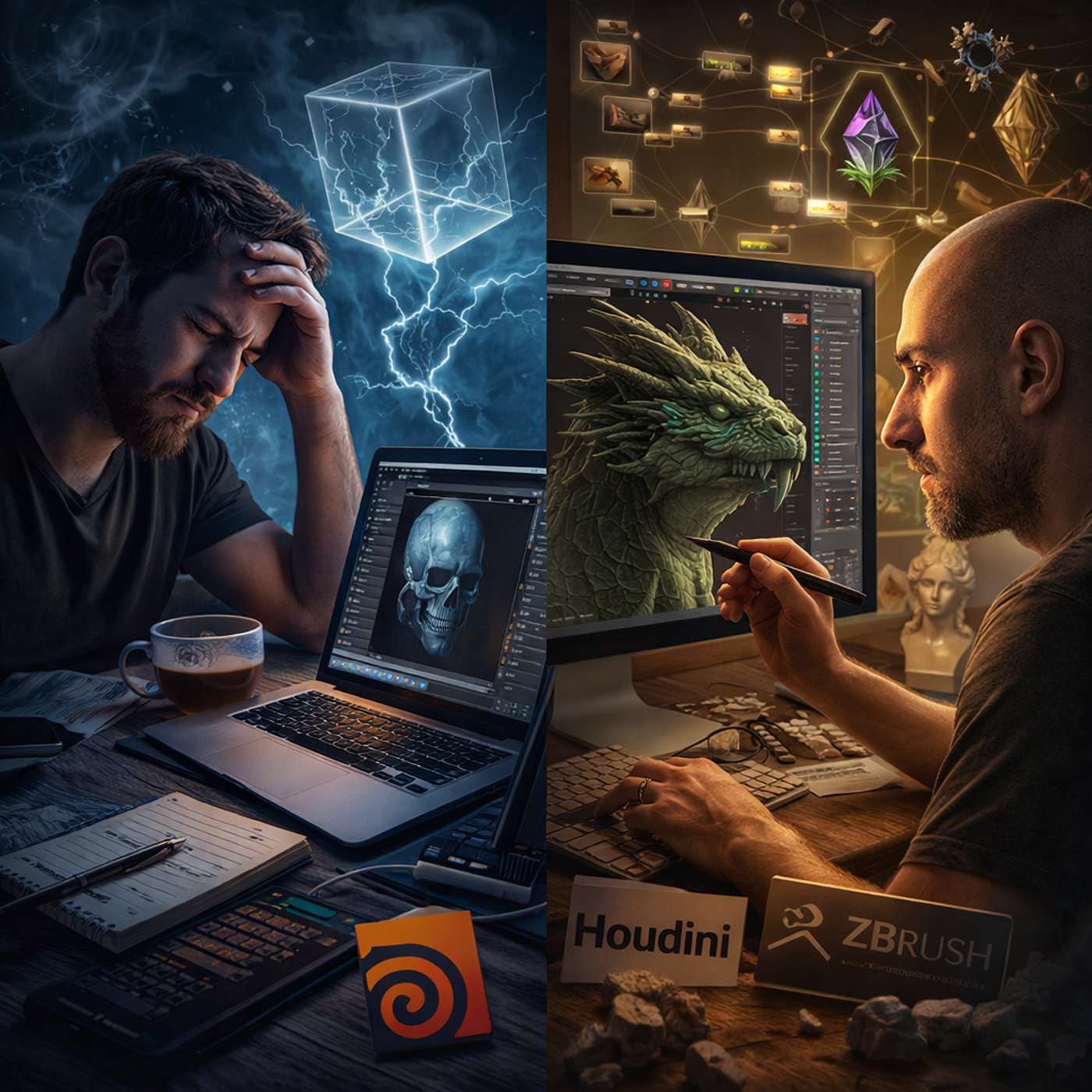
Stewart Alsop sits down with Karol, a 3D generalist and digital artist with 25 years of experience, to talk about the evolving landscape of 3D art — from sculpting in ZBrush to the deep technical rabbit hole of Houdini, and how AI tools like Claude are quietly reshaping creative workflows. The conversation wanders into bigger territory: the singularity, accelerationism, the philosophical roots of Silicon Valley's techno-anxiety (including the Roko's Basilisk thought experiment and the writings of Nick Land), the slow unraveling of Hollywood's cultural monopoly, and what decentralized creative tools mean for independent artists. Stewart also points Karol toward the work of Fei-Fei Li and World Labs as a window into where 3D world modeling is heading next.Timestamps00:00 — Karol's 25-year journey from Photoshop and 2D art into Cinema 4D and the world of 3D.05:00 — Why Houdini blew the ceiling off every other 3D program, and how node-based coding changed Karol's creative process entirely.10:00 — The tension between visual thinking and technical thinking, and how constant digital stimuli has degraded Karol's internal imagination.15:00 — Stewart reflects on Claude Code and how AI is about to dissolve the technical barriers in Houdini the same way it did for programming.20:00 — The Sphere in Las Vegas, projection mapping, drone polo, and Stewart's vision for intimate tech-integrated experiences.25:00 — Roko's Basilisk, fear-driven accelerationism, and why Latin America never caught the Silicon Valley doomsday bug.30:00 — Hollywood's cultural machine, shared Western boogeymen, and how decentralized 3D art is replacing the $100M production monopoly.35:00 — Karol's eclectic client roster: Utah Jazz, Apple, League of Legends, and a Buddhist temple in Los Angeles.40:00 — Gaussian splatting, photogrammetry, point clouds, and where world models are taking 3D next.45:00 — The freelance vs. studio dilemma, brutal VFX industry crunch culture, and Stewart's plan to own his entire podcast stack.50:00 — Poland's economic rise, the hollowing out of the Netherlands, and capitalism as an endless infection with no clear cure.Key InsightsHoudini as creative rebirth. After nearly burning out on conventional 3D software, Karol discovered that Houdini's node-based, code-driven architecture gave him something the other tools never could — a blank canvas with no ceiling. Rather than navigating a boat someone else built, he now builds the boat from scratch every time, which keeps the work perpetually challenging and alive.Visual thinking is under attack. Karol noticed his once-vivid internal imagination quietly degrading over the years, and traces it directly to the overwhelming volume of digital stimuli in modern life. His response has been aggressive minimalism — stripping back inputs, physical and digital, to try to recover the creative mental space he once had naturally.AI as a technical collaborator, not a replacement. Karol uses Claude daily, not to generate imagery, but to work through coding problems inside Houdini. He's clear that image generation is his job — what AI earns its place doing is explaining unfamiliar code and helping him push past technical blockers faster.The freelance paradox. Twenty-five years of independence has meant total creative freedom alongside real financial instability — months of silence followed by weeks of 16-hour days. Karol has never resolved this tension, but holds onto the freedom anyway, and sees it as increasingly important as surveillance and corporate control tighten.Roko's Basilisk explains Silicon Valley. Both Stewart and Karol land on the idea that the feverish, fear-driven energy behind tech accelerationism may trace back to this single thought experiment — the notion that if you don't help build the AI, it will punish you retroactively. Latin America, blissfully unaware of it, seems measurably calmer.Decentralization is ending Hollywood's monopoly. The same forces making software cheaper and AI more powerful are quietly dismantling the $100M barrier to cultural creation. Karol's career — spanning album covers, Apple, the Utah Jazz, and a Buddhist temple — is a living proof of concept for what independent 3D generalism can look like outside the studio machine.Owning your tools is a political act. Whether it's Karol resisting the pigeonhole of VFX studios or Stewart rebuilding his podcast infrastructure from scratch, both see the ability to own and control your own software and hardware as essential preparation for whatever comes next.

S15 Ep 169Episode #539: Zero Trust Everything: Rebuilding the Internet's Money Layer
In this episode of the Crazy Wisdom Podcast, host Stewart Alsop sits down with David Lachmish, co-founder of Ika, to explore the cutting-edge world of decentralized cryptography and its real-world applications. They cover the foundational problem of zero-trust custody and interoperability in crypto, breaking down why most people end up relying on centralized custodians despite crypto's original promise of removing third-party trust, and how Ika's novel 2PC-MPC cryptographic protocol addresses this with decentralized wallets (d-wallets) that require both the user and the Ika network to generate a signature. The conversation also touches on AI agents and the critical need for access control guardrails when agents handle real financial transactions, the philosophical parallels between crypto's growing pains and the early internet, decentralized governance and its potential to reshape how societies make decisions, and a surprising look at how decentralized certificate authorities could dramatically improve everyday internet security. David also gives a first public mention of an upcoming privacy-focused project called Encrypt.Links mentioned:- Ika website: https://ika.xyz- Ika on X: https://x.com/iкаdotxyz- David Lachmish on X: https://x.com/d3h3d_- Encrypt (upcoming project): https://encrypt.xyzTimestamps00:00 - David Lachmish introduces Ika and DWallet Labs, explaining their cybersecurity and cryptography background led them to solve zero trust custody and interoperability.05:00 - The d wallet concept is revealed as a decentralized signing mechanism controlled jointly by user and network, requiring new cryptography breakthroughs.10:00 - Crypto's philosophical parallels to early Internet are drawn, framing scams and misuse as inevitable growing pains of transformative infrastructure.15:00 - Wallet abstraction and agent constraints are explored, comparing future seamless crypto interaction to modern WiFi versus early modem connections.20:00 - Public key cryptography's binary ownership problem is explained, leading into MPC secret shares and Fireblocks' centralized access control tradeoffs.25:00 - 2PC MPC protocol is introduced as Ika's breakthrough, enabling decentralized policy enforcement without trusting any single entity.30:00 - Decentralized governance via token staking and code as law is discussed, contrasting corporate representative governance with crypto's direct decision-making.35:00 - Futarchy prediction markets and decision trees are connected to knowledge graphs, tracing humanity's accelerating governance transition.40:00 - Automation's historical parallels are examined, arguing AI's displacement of lawyers and developers mirrors every prior technological revolution.45:00 - Bitcoin and Ethereum's uncertain futures are assessed alongside Ika's positioning in custody and interoperability infrastructure.50:00 - Zero trust interoperability is explained, revealing how bridges create dangerous honeypots that Ika eliminates through native cryptographic control.55:00 - MetaMask's limitations for agents are detailed, contrasting stored private keys against Ika's policy-enforced guardrails for agentic transactions.60:00 - HumanTech's Wallet as a Protocol is presented as a practical way to give agents spending policies while maintaining user cryptographic control.65:00 - Decentralized certificate authorities emerge as Ika's broader cybersecurity vision, eliminating single points of failure across the entire Internet.Key Insights1. Zero Trust Custody and Interoperability: David and his cofounders at DWallet Labs identified that most cryptocurrency is held by centralized custodians, which contradicts crypto's core purpose of removing third-party trust. They set out to create "zero trust custody and zero trust interoperability" — systems where users maintain cryptographic control without sacrificing usability or relying on any single entity.2. The D-Wallet Primitive: Ika is built around a new cryptographic concept called a "d-wallet" — a decentralized wallet controlled jointly by the user and a decentralized network. A signature cannot be generated without the user's participation, meaning even if all network operators are compromised, they cannot act unilaterally. This required inventing new cryptography called 2PC-MPC.3. Access Control as the Missing Layer: Traditional crypto wallets operate on binary ownership — you either have full control or none. The d-wallet model introduces programmable access control policies enforced by a decentralized network, enabling features like spending limits and whitelisted addresses without trusting a centralized company like Fireblocks.4. Bridges Are Crypto's Biggest Security Vulnerability: Interoperability across blockchains typically requires trusting a bridge, which creates a honeypot for hackers. Ika eliminates this by allowing users to natively control assets on multiple chains simultaneously, maintaining cryptographic guarantees without a trusted intermediary.5. AI Agen

S15 Ep 168Episode #538: Outside the Three Institutions: Network States as the Last Honest Bet
In this episode of the Crazy Wisdom Podcast, host Stewart Alsop sits down with Vahram Ayvazyan, founder of the Armenian Network State, for a wide-ranging conversation touching on AI and the future of work, the cyclical nature of human conflict throughout history, the decay of the nation-state, the concept of a "fourth establishment" of free people operating outside traditional power structures, the role of greed and self-aggrandizement in politics and tech, and how network states could serve as a parallel structure to challenge entrenched global elites. You can find Vahram on LinkedIn, or check the Armenian Network State page at networkstate.io.Timestamps00:00 The Future of AI and Humanity05:57 Human Nature and Greed12:00 The Crisis of Nation-States17:53 Community Resilience and Abundance23:30 The Power of Storytelling in Change29:43 Cultural Connections: Armenia and Africa35:43 Western Dominance and Its Consequences42:17 Creativity in the Age of AI48:07 Creating Parallel StructuresKey Insights1. Humans advance technologically but remain socially and biologically stagnant. Vahram argues that despite extraordinary technological leaps, human nature remains driven by greed and self-aggrandizement. Conflicts today mirror those of thousands of years ago, with only the actors changing while the underlying structure of power struggles stays the same.2. Power corrupts by disconnecting leaders from reality. Using a personal account of a deputy head of state, the guest illustrates how those who gain significant power gradually lose touch with reality, fall into cycles of wanting more, and become trapped in ego-driven decision-making regardless of their original intentions.3. The nation-state is in decay and failing its citizens. Globalization, internet, and migration have eroded the nation-state's ability to deliver basic services. Events like the Valencia flooding exposed how even wealthy European governments mismanage resources despite collecting enormous tax revenues.4. Three institutions currently rule the world, with a fourth emerging. Nation-states, multinational corporations, and religious institutions form today's power structure. The guest envisions a "fourth establishment" — network states — composed of free-thinking individuals connecting across geographies to build parallel, dignity-based communities outside these failing systems.5. Intentions matter more than the tools themselves. Whether discussing AI, nuclear energy, or mathematics, the guest emphasizes that technology is neutral and that what defines civilization is the moral intention behind its use, not the sophistication of the tools developed.6. Western civilization's dominance was built on superior weapons, not superior values. The guest challenges Western narratives by suggesting its historical advantage came primarily from military technology rather than cultural or moral superiority, contrasting this with indigenous and Eastern philosophies that treat land, community, and human relationships as sacred rather than as capital.7. Evolutionary, not revolutionary, change is the path forward. The guest warns that revolutionary movements are easily infiltrated, diverted, or crushed by existing power structures. Meaningful change requires patiently building critical mass through parallel structures, storytelling, and emotional connection until the alternative becomes undeniably powerful.

S15 Ep 167Episode #537: Free From the Grid, Connected to the World
In this episode, Stewart Alsop III sits down with Tom Faye — experimenter, author of The 90 Day Client Acquisition Code, and founder of Carbon Credits Marketplace — to talk about solar energy, off-grid living, and the solarpunk vision of a technology-powered utopia. They cover everything from perovskite solar cells and portable container-based solar systems, to carbon credits, ESG investing, and blockchain verification of clean energy output. The conversation also winds through AI training data, business automation, and the data labeling industry before circling back to some bigger questions about human nature, geopolitics, and what genuine self-reliance looks like in 2025. You can find Tom and his work at Carbon Credits Marketplace on LinkedIn and his energy consumption data visualization is also shared there. His book The 90 Day Client Acquisition Code is available for those looking to explore business automation further.Timestamps00:00 Introduction to Tom Fay and his work01:03 Understanding Solar Punk: Utopian Tech and Culture02:15 Current State of Solar Technology and Storage03:45 Living Off-Grid: Solar, Batteries, and Remote Work06:11 Solar Energy in Africa: Challenges and Opportunities12:21 Powering Communities with Mobile Solar Solutions16:50 The Vision of Solar Punk: Self-Sufficient Communities22:54 Existing Examples: Great Barrier Island and Others26:06 Overfishing, Environmental Challenges, and Technological Solutions28:34 Using Technology to Address Second-Order Environmental Problems36:35 Data, AI, and the Future of Energy Management43:13 Carbon Credits, Blockchain, and ESG Reporting45:27 The Geopolitics of Green Energy and Resource Control46:53 How to Connect with Tom Fay and Future ProjectsKey InsightsSolarpunk represents a genuine near-future possibility, not just an aesthetic. As solar panels and lithium batteries become cheaper and more efficient, the vision of abundant, decentralized clean energy is becoming a practical reality rather than a utopian fantasy.Perovskite solar cells are pushing efficiency roughly 22% beyond conventional panels, and the bigger revolution happening right now is on the storage side — cheaper, higher-capacity batteries are what will truly unlock solar's potential at scale.Africa may leapfrog the West on solar adoption, just as it leapfrogged landlines with mobile phones. People in energy-scarce countries viscerally understand the value of clean power in a way that people in the West, accustomed to reliable grids, simply don't.Portable solar container units — self-contained, deployable systems — already exist and are making off-grid energy viable for farms, mines, remote lodges, and even data centers, with a roughly five-to-one solar-to-load footprint required.Carbon credits generated from verified solar output, tracked via IoT smart meters and stamped on blockchain, represent a long-term business opportunity that survives political shifts because institutional investors and banks operate on independent ESG mandates.AI training data is a present and real economic opportunity, but a shrinking one. The window for humans — especially lawyers, scientists, and specialists — to get paid for their expertise is closing fast as labs pivot toward synthetic data generation.True self-reliance comes down to four things: food, water, power, and transportation. With solar and Starlink, the gap between remote wilderness and connected civilization has essentially collapsed — something unimaginable even a generation ago.

S15 Ep 166Episode #536: From Filament to Agents: The Tools Keep Getting Cheaper and the Judgment Keeps Getting Scarcer
In this episode of Crazy Wisdom, Stewart Alsop sits down with Andre Oliveira, founder of Splash N Color, a bootstrapped 3D printing e-commerce business selling consumer goods on Amazon. The two cover a lot of ground — from how Andre went from running 40 FDM printers out of South Florida to offshoring manufacturing to China, to how he's using Claude Code to automate inventory management and generate supplier RFQs across 200+ SKUs. The conversation stretches into bigger territory too: the San Francisco AI scene, the rise of AI agents and what they mean for the future of the internet, whether local on-device AI will eventually replace cloud-based tools, and why building physical products will stay hard long after software becomes easy. It's a candid, wide-ranging conversation between two self-taught builders figuring things out in real time. Follow Andre on X: @AndreBaach.Timestamps00:00 — Andre introduces Splash N Color, his Amazon-based 3D printing e-commerce business and explains the grind of running 40 FDM machines in South Florida.05:00 — The conversation shifts to Claude Code and how Andre built an inventory automation system to manage sales velocity and RFQs across 200+ SKUs.10:00 — Stewart and Andre compare notes on Opus 4.6, debate Codex vs Claude, and Andre breaks down the new Agent Teams feature in Claude Code.15:00 — Discussion turns to the San Francisco AI scene, the viral OpenClaw launch event that drew 700 people, and what's capturing the city's imagination right now.20:00 — The pair wrestle with data privacy, the illusion of it since 2000, and whether full transparency of personal data might actually serve people better.25:00 — Stewart pitches his vision of local on-device AI replacing cloud tools entirely, and they debate the 10–15 year timeline for mainstream societal adoption.30:00 — Andre traces his origin story: a high school dropout from Brazil who spotted a 3D printing opportunity on Facebook Marketplace and got lucky timing with COVID.35:00 — They explore whether AI-generated 3D models and DfAM will automate physical manufacturing, and why proprietary specs keep the space stubbornly hard.Key InsightsLifestyle businesses deserve more respect. Andre spent months feeling inadequate scrolling through Twitter watching founders announce funding rounds, before realizing his cash-flowing, location-independent business was already the goal. The social media version of entrepreneurial success warped his perception of what he actually had built.Claude Code is becoming an operating system. Stewart describes running Claude Code as having a second OS on top of MacOS — one that makes the underlying machine legible in ways it never was before. Both guests use it not just for coding but as a primary interface for understanding and operating their businesses.Agent Teams changes how work gets done. Andre explains that Claude's new multi-agent feature lets you assign a team lead and specialized roles that communicate with each other in parallel, essentially running an autonomous task force inside your terminal — a meaningful leap beyond single-instance prompting.Physical manufacturing will stay hard. Even as AI-generated 3D models improve, tolerances of 0.5 millimeters can mean the difference between a product working or not. Design for manufacturing is a separate discipline from design itself, and proprietary specs mean open source models rarely hit commercial quality.The internet is heading toward agents. Both guests agree that AI agents will increasingly handle tasks humans currently do manually online — booking services, making payments, coordinating logistics — with the human internet potentially becoming secondary to a machine-to-machine layer.Iteration is the real value of 3D printing. Andre pushes back on 3D printing as a business unto itself, framing it instead as a prototyping tool. The true value is rapid iteration on housing, tolerances, and fit — not the printer, but the speed of the feedback loop it enables.Technology compounds in layers. Andre closes with a tech-tree analogy: each generation normalizes the tools of the previous one and builds the next layer on top. Agentic coding today is what the internet was in the 90s — the foundation for something we can't yet fully see.

S15 Ep 165Episode #535: The Technological Adolescence: Can Humans Keep Up With AI's Puberty?
Stewart Alsop sits down with Ulises Martins on the Crazy Wisdom podcast to explore how artificial intelligence is fundamentally disrupting professional careers, labor markets, and the pace of human adaptation itself. They discuss everything from Dario Amodei's concept of "technological adolescence" to the possibility that we're approaching a point where AI advancement accelerates beyond our ability to keep up, touching on topics ranging from the economics of software development and the future of warfare to generational differences in how people will respond to AI-driven change. Martins emphasizes that while we may not be able to predict exactly what's coming, we need to dramatically increase our efforts to learn and adapt—potentially doubling the time we invest in understanding AI—because this isn't optional change, it's disruption happening at an unprecedented speed. Connect with Ulises on Linkedin to follow his work in AI and generative technology.Timestamps00:00 — Stewart introduces Ulysses Martins, framing the conversation around accelerationism and the future of work.05:00 — Ulises uses the parent-child analogy to argue humans will no longer play the dominant role as AI surpasses us.10:00 — Both agree learning AI is non-negotiable, urging listeners to double their investment in staying current.15:00 — Discussion shifts to software as media, the collapsing cost of building products, and the risk of big players like Anthropic making your idea obsolete overnight.20:00 — Ulises raises ecology vs. cosmic ambition, questioning whether humanity should aim for civilizational-scale goals like the Dyson sphere.25:00 — Stewart's ESP32 hardware project illustrates AI's current blind spots beyond software, while both predict physical-world AI will arrive as a byproduct of bigger industrial goals.30:00 — Tesla's birthplace in Croatia sparks a reflection on human genius as luck versus deliberate investment, invoking the Apollo program as a model.35:00 — The US-China AI race is compared to the Cold War Space Race, with interdependency acting as a brake on outright conflict.40:00 — Drone warfare and AI reframe military power, making troop size irrelevant and potentially reducing total war.45:00 — Agile methodology and generational shifts are linked, asking how Gen Z's values will shape the AI era globally.50:00 — Argentine vs. American Zoomers are contrasted, with millennial expectations versus Gen Z's pragmatism explored.55:00 — Ulises closes urging everyone to enjoy the ride, taking the infinite stream of change one episode at a time.Key Insights1. The Death of Traditional Career Paths: The concept of professional careers as we know them—starting as a junior and progressively advancing—is becoming obsolete due to AI's rapid advancement. This applies far beyond just software and SaaS companies, extending to all industries as robots and AI systems gain capabilities that fundamentally disrupt labor markets. The question isn't whether we'll adapt, but whether humans can adapt fast enough to keep pace with exponential technological change.2. The Acceleration Imperative: People must dramatically increase their investment in learning about AI immediately. Whatever time you were previously dedicating to staying current with technology needs to be doubled or tripled. This isn't optional—it's comparable to the necessity of basic education. Unlike previous technological transitions where you had years to learn new frameworks or tools, the current pace demands immediate, intensive engagement or you risk becoming irrelevant.3. Software as Media and the Collapse of Development Economics: Software has become media—easily reproducible and increasingly commoditized through AI assistance. The fundamental economics of software development are collapsing because if building software requires dramatically fewer development hours, the value and price of that software must necessarily decrease. Entrepreneurs need a new evaluation framework that assesses the risk of their ideas being replicated by AI or absorbed by major players like Anthropic or OpenAI.4. The Parent-Child Analogy for AI Development: Humanity's relationship with AI will inevitably mirror that of parents with increasingly capable children. Initially, we understand and control what AI does, but as it advances, it will surpass human capabilities in most domains. Just as parents cannot control fully grown adult children who exceed their abilities, humans will need to reconcile with creating something superior to ourselves. Attempting to permanently control such systems may be both impossible and potentially pathologic.5. The Kardashev Scale and Civilizational Ambitions: AI represents a civilizational-level technology that should redirect humanity toward grander goals like capturing stellar energy through Dyson spheres and expanding beyond our solar system. The competition between China and the United States over AI mirrors the Apollo program's space race but with higher stakes

S15 Ep 164Episode #534: From COVID's Trust Bonfire to Decentralized Everything
In this episode of the Crazy Wisdom Podcast, host Stewart Alsop sits down with Jake Hamilton, founder of Groundwire and Nockbox, to explore zero-knowledge proofs, Bitcoin identity systems, and the intersection of privacy-preserving cryptography with AI and blockchain technology. They discuss how ZK proofs could offer an alternative to invasive identity verification systems being rolled out by governments worldwide, the potential for continual learning AI models to shift the balance between centralized and open-source development, and why building secure, auditable computing infrastructure on platforms like Urbit matters more than ever as we face an explosion of AI agents and automated systems. Jake also explains Nockchain's approach to creating a global repository of cryptographically verified facts that can power trustless programmable systems, and how these technologies might converge to solve problems around supply chain security, personal data sovereignty, and resistance to censorship.Timestamps00:00 Introduction to Groundwire and Knockbox02:48 Understanding Zero-Knowledge Proofs06:04 Government Adoption of ZK Proofs08:55 The Future of Identity Verification11:52 AI and ZK Proofs: A New Era14:54 The Role of Urbit in Technology18:03 The Impact of COVID on Trust20:51 The Evolution of AI and Data Privacy23:47 The Future of AI Models26:54 The Need for Local AI Solutions29:51 Interoperability of Knockchain and BitcoinKey Insights1. Zero-Knowledge Proofs Enable Privacy-Preserving Verification: Jake explains that ZK proofs allow you to prove computational outcomes without revealing the underlying data. For example, you could prove you're over 18 without exposing your full identity or driver's license information. The proof demonstrates that a specific program ran through certain steps and reached a particular conclusion, and validating this proof is fast and compact. This technology has profound implications for age verification, identity systems, and protecting privacy while maintaining necessary compliance, potentially offering a middle path between surveillance states and complete anonymity.2. Government Adoption of Privacy Technology Remains Uncertain: There are three competing motivations driving government identity verification systems: genuine surveillance desires, bureaucratic efficiency seeking, and legitimate child protection concerns. Jake believes these groups can be separated, with some officials potentially supporting ZK-based solutions if positioned correctly. He notes the EU is exploring ZK identity verification, and UK officials have shown interest. The key is framing privacy-preserving technology as protection against "the swamp" rather than just abstract privacy benefits, which could resonate with certain political constituencies.3. The COVID Era Destroyed Institutional Trust at Unprecedented Scale: The conversation identifies COVID as potentially the largest institutional trust-burning event in human history, with numerous institutions simultaneously losing credibility with large portions of the population. This represents a dramatic shift from the boomer generation's default trust in authority figures and mainstream media. This collapse is compounded by the incoming AI revolution, creating a perfect storm where established bureaucracies cannot adapt quickly enough to manage rapidly evolving technology, leaving society in fundamentally unmanageable territory.4. Centralized AI Models Create Dangerous Dependencies: Both speakers acknowledge growing dependence on centralized AI services like Claude, with some users spending thousands monthly on tokens. This dependency creates vulnerability to price increases and service disruptions. Jake advocates for local AI deployment using models like DeepSeek R1, running on personal hardware to maintain control and privacy. The shift toward continuous learning models will fundamentally change the AI landscape, making personal data harvesting even more valuable and raising urgent questions about compensation and consent for training data contribution.5. High-Quality Training Data Is Becoming the Primary AI Bottleneck: Stewart argues that AI development is now limited more by high-quality training data than by compute power. The industry has exhausted easily accessible internet data and body-shop-style data labeling. Companies are now using specialized boutique services with techniques like head-mounted cameras for live-streaming world model training. This scarcity is subtly driving price increases across AI services and will fundamentally reshape the economics of AI development, with implications for who controls these increasingly powerful systems.6. Urbit Offers a Foundation for Trustworthy Computing: Jake positions Urbit as essential infrastructure for the AI age because its 30,000-line codebase (versus Unix's three million lines) can be understood by individual humans. Its deterministic, purely functional, and strictly typed design aims for eventual oss

S15 Ep 163Episode #533: The Universe Doing Its Thing: AI Evolution Is Already Here
In this episode of the Crazy Wisdom podcast, host Stewart Alsop sits down with Markus Buehler, the McAfee Professor of Engineering at MIT, to explore how seemingly different systems—from proteins and music to knowledge structures and AI reasoning—share underlying patterns through hierarchy, self-organization, and scale-free networks. The conversation ranges from the limits of current AI interpolation versus true discovery (using the fire-to-fusion example), to the emergence of agent swarms and their non-linear effects, to practical questions about ontologies, knowledge graphs, and whether humans will remain necessary in the creative discovery process. Markus discusses his lab's work automating scientific discovery through AI agents that can generate hypotheses, run simulations, and even retrain themselves, while Stewart shares his own experiences building applications with AI coding agents and grapples with questions about intellectual property, material science constraints, and the future of human creativity in an AI-abundant world.Timestamps00:00 - Introduction to Marcus Buehler's work on knowledge graphs, structural grammar across proteins, music, and AI reasoning05:00 - Discussion of AI discovery versus interpolation, using fire and fusion as examples of fundamental versus incremental innovation10:00 - Language models as connective glue between agents, enabling communication despite imperfect outputs and canonical averaging15:00 - Embodiment and agency in AI systems, creating adversarial agents that challenge theories and expand world models20:00 - Emergent properties in materials and AI, comparing dislocations in metals to behaviors in agent swarms25:00 - Human role-playing and phase separation in society, parallels to composite materials and heterogeneity30:00 - Physical world challenges, atom-by-atom manufacturing at MIT.nano, limitations of lithography machines35:00 - Synthetic biology as alternative to nanotechnology, programming microorganisms for materials discovery40:00 - Intellectual property debates, commodification of AI models, control layers more valuable than model architecture45:00 - Automation of ontologies, agent self-testing, daughter's coding success at age 1150:00 - Graph theory for knowledge compression, neurosymbolic approaches combining symbolic and neural methods55:00 - Nonlinear acceleration in AI, emergence from accumulated innovations, restaurant owner embracing AI01:00:00 - Future generations possibly rejecting AI, democratization of knowledge, social media as real-time scientific discourseKey Insights1. Universal Patterns Across Disciplines: Seemingly different systems in nature—proteins, music, social networks, and knowledge itself—share fundamental structural patterns including hierarchy, self-organization, and scale-free networks. This commonality allows creative thinkers to draw insights across disciplines, applying principles from one domain to solve problems in another. As an engineer and materials scientist, Buehler has leveraged these isomorphisms to advance scientific understanding by mapping the "plumbing" of different systems onto each other, revealing hidden relationships that enable extrapolation beyond what's observable in any single domain.2. The Discovery Versus Interpolation Problem: Current AI systems, particularly large language models, excel at interpolation—recombining existing knowledge in new ways—but struggle with genuine discovery that requires fundamental rewiring of world models. Using the example of fire versus fusion, Buehler explains that an AI trained on combustion chemistry would propose bigger fires or new fuels, but couldn't conceive of fusion because that requires stepping back to more fundamental physics. True discovery demands the ability to recognize when existing theories have boundaries and to develop entirely new frameworks, something current AI architectures aren't designed to achieve due to their training objective of predicting the most likely outcome.3. The Role of Ontologies and Knowledge Graphs: While some AI researchers argue that ontologies are unnecessary because models form internal representations, Buehler advocates for explicit knowledge graphs as essential discovery tools. External ontologies provide sharp, analytical, symbolic representations that complement the fuzzy internal representations of neural networks. They enable verification of rare connections—like obscure papers that might hold key insights—which would be averaged away in standard AI training. This neurosymbolic approach combines the generalization capabilities of neural networks with the precision of formal knowledge structures, creating more powerful discovery systems.4. Emergent Properties and Agent Swarms: Just as materials science shows that collections of atoms exhibit properties impossible to predict from individual components, AI agent swarms demonstrate emergent behaviors beyond single models. When agents are incentivized not just to answer questio

S15 Ep 162Episode #532: From Pythagoras to Plugins: Why We Still Need Human Musicians
In this episode of the Crazy Wisdom podcast, host Stewart Alsop interviews John von Seggern, founder of Future Proof Music School, about the intersection of music education, technology, and artificial intelligence. They explore how musicians can develop timeless skills in an era of generative AI, the evolution of music production from classical notation to digital audio workstations like Ableton Live, and how AI is being used on the education side rather than for creation. The conversation covers music theory fundamentals, the development of instruments and recording technology throughout history, complex production techniques like sidechain compression, and the future of creative work in an AI-assisted world. John also discusses his development of Cadence, an AI voice tutor integrated with Ableton Live to help students learn music production. For those interested in learning more about Future Proof Music School or becoming a beta tester for the AI voice tutor, visit futureproofmusicschool.com.Timestamps00:00 Future Proofing Musicians in a Changing Landscape03:07 The Role of AI in Music Education05:36 Generative AI: A Tool for Musicians?08:36 The Evolution of Music Creation and Technology11:30 The Impact of Recording Technology on Music14:31 The Fragmentation of Culture and Music17:19 Exploring Music History and Theory20:13 The Relationship Between Music and Memory23:07 The Future of Music Creation and AI26:17 The Importance of Live Music Experiences28:49 Navigating the New Music Landscape31:47 The Role of AI in Finding New Music34:48 The Creative Process in Music Production37:33 The Future of Music Theory and Composition40:10 The Search for Unique Artistic Voices43:18 The Intersection of Music and Technology46:10 Cultural Shifts in the Music Industry49:09 Finding Quality in a Sea of ContentKey Insights1. Future-proofing musicians means teaching evergreen techniques while adapting to AI realities. John von Seggern founded Future Proof Music School to address both sides of music education in the AI era. Students learn timeless production skills that won't become obsolete as technology evolves, while simultaneously exploring meaningful creative goals in a world where generative AI exists. The school uses AI on the education side to help students learn, but students themselves aren't particularly interested in using generative AI for actual music creation, preferring to maintain their creative fingerprint on their work.2. The 12-note Western music system emerged from mathematical relationships discovered by Pythagoras and enabled collaborative music-making. Pythagoras demonstrated that pitch relates to vibrating string lengths, establishing mathematical ratios for musical intervals. This system allowed Western classical music to flourish because it could be notated and taught consistently, enabling large groups to play together. However, the piano is never perfectly in tune due to necessary compromises in the tuning system. By the 1920s, composers had explored most harmonic possibilities within this framework, leading to new directions in musical innovation.3. Recording technology fundamentally transformed music by making the studio itself the primary instrument. The invention of audio recording in the early-to-mid 20th century shifted music from purely instrumental composition to sound-based creation. This enabled entirely new genres like electronic dance music and hip-hop, which couldn't exist without technologies like synthesizers and samplers. Modern digital audio workstations like Ableton Live allow producers to have unlimited tracks and manipulate sounds in infinite ways, making any imaginable sound possible and moving innovation from hardware to software.4. Generative AI will likely replace generic music production but not visionary artists. John distinguishes between functional music (background music for films, work, or bars) and music where audiences deeply connect with the artist's vision. AI excels at generating functional music cheaply, which will benefit indie filmmakers and similar creators. However, artists with strong creative visions who audiences follow and identify with won't be replaced. The creative fingerprint and personal statement of important artists will remain valuable regardless of the tools they use, just as DJs created art through curation rather than original production.5. Copyright restrictions are limiting generative music AI's quality compared to other AI domains. Unlike books and visual art, recorded music copyrights are concentrated among a few companies that defend them aggressively. This prevents AI music models from training on the best music in each genre, resulting in lower-quality outputs. Some developers claim their private models trained on copyrighted music sound better than commercial offerings, but legal constraints prevent widespread access. This situation differs significantly from other creative domains where training data is more accessible.6. Modern music pr
S15 Ep 160Episode #531: Revenue-Based Lending Meets Crypto: Building Leviathan on Sui
In this episode of the Crazy Wisdom Podcast, host Stewart Alsop sits down with Lars van der Zande, founder and CEO/technical architect of Inkwell Finance, for what Lars describes as his first-ever podcast appearance. The conversation covers a wide range of blockchain infrastructure topics, including Lars's work with Sui and Solana blockchains, the innovative capabilities of Ika's programmatic wallets and blockchain of signatures, and how Inkwell Finance is building revenue-based financing solutions for on-chain entities—from AI agents to protocols. They explore the evolving landscape of crypto regulation, the merging of traditional finance with blockchain technology, the future of decentralized legal systems, and how the user experience barrier is being lowered through technologies that eliminate constant transaction signing. Lars also discusses Inkwell's embedded financing approach and their pre-seed fundraising round.Links mentioned:- Inkwell's website: inkwell.finance- Inkwell on Twitter: @__inkwell- Lars on Twitter: @LMVDZandeTimestamps00:00 Introduction to Inkwell Finance and Technical Architecture02:06 Understanding Sui and Solana: Blockchain Dynamics05:55 The Role of Ika in Inkwell Finance11:51 Leviathan: Revenue Generation and Financing in Crypto17:38 The Future of AI Agents and Programmatic Wallets23:23 Smart Contracts: Legal Implications and Future Directions25:06 The Future of Inqvil Finance25:42 Decentralization and Its Evolution27:32 The Merging of Traditional and Crypto Systems29:33 Global Financial Dynamics and Market Reactions31:48 The Collapse of Traditional Financial Systems32:46 Jurisdictional Shifts in the Crypto World33:59 Legal Systems and Blockchain Integration35:57 On-Chain Credit and Financial Opportunities39:29 The Role of AI in Finance41:30 Learning from Peer-to-Peer Lending History43:14 Disruption in Insurance and Risk Management44:54 On-Chain vs Off-Chain Data46:54 The Evolution of the Internet and Blockchain49:12 Future Subscription Models in BlockchainKey Insights1. Ika's Revolutionary Blockchain Signature Technology: Lars discovered Ika, a blockchain of signatures built on Sui that enables any blockchain transaction to be signed without revealing the underlying message. Using patented 2PC MPC technology, Ika splits key shares across validators and encrypts them in transit, performing complex cryptographic operations that allow smart contracts on Sui to generate signatures for transactions on any other blockchain. This eliminates the need to build separate smart contracts on each blockchain, fundamentally changing how cross-chain interactions work and opening possibilities for truly interoperable decentralized applications.2. Programmatic Wallets vs Traditional Wallets: Traditional wallets like MetaMask require manual user approval for every transaction through a front-end interface, but Ika's D-wallet introduces programmatic wallets with policy-based controls embedded in smart contracts. These wallets can execute transactions based on predetermined conditions checked against on-chain data like Oracle prices, without requiring individual user signatures. For example, a Bitcoin D-wallet can hold native Bitcoin without wrapping or bridging to a custodian, and smart contract policies determine when and how that Bitcoin can be transferred, creating unprecedented security and automation possibilities for decentralized finance.3. Inkwell's Revenue-Based Financing Model: Inkwell Finance is building Leviathan, a revenue-based financing platform for on-chain entities including protocols, AI agents, and individual traders with verifiable track records. Borrowers receive capital based on their on-chain performance metrics like sharp ratio and drawdown, with loan repayment automatically deducted from their revenue stream. The profit split structure allocates approximately 60% to borrowers, 30% to lenders, and 10% split between Inkwell and integrating platforms. This creates a sustainable lending model where flight risk is minimized through D-wallet policy controls that restrict how borrowed capital can be used.4. Wallet-as-a-Protocol and the Future of User Experience: The crypto industry is moving toward embedded wallet solutions that eliminate the friction of traditional wallet management, with Wallet-as-a-Protocol representing the next evolution beyond services like Privy and Dynamic. Unlike current embedded wallets that lock users into specific applications, Wallet-as-a-Protocol enables single sign-on across multiple applications while users maintain control of their keys. Combined with app-sponsored gas fees, this approach allows non-crypto-native users to interact with blockchain applications without knowing they're using crypto, removing the biggest barrier to mainstream adoption and creating web2-like user experiences on web3 infrastructure.5. AI Agents as Financial Entities: AI agents are emerging as revenue-generating entities with on-chain transaction histories that create verif

S15 Ep 161Episode #530: The Hidden Architecture: Why Your Startup Needs an Ontology (Before It's Too Late)
In this episode of the Crazy Wisdom Podcast, host Stewart Alsop sits down with Larry Swanson, a knowledge architect, community builder, and host of the Knowledge Graph Insights podcast. They explore the relationship between knowledge graphs and ontologies, why these technologies matter in the age of AI, and how symbolic AI complements the current wave of large language models. The conversation traces the history of neuro-symbolic AI from its origins at Dartmouth in 1956 through the semantic web vision of Tim Berners-Lee, examining why knowledge architecture remains underappreciated despite being deployed at major enterprises like Netflix, Amazon, and LinkedIn. Swanson explains how RDF (Resource Description Framework) enables both machines and humans to work with structured knowledge in ways that relational databases can't, while Alsop shares his journey from knowledge management director to understanding the practical necessity of ontologies for business operations. They discuss the philosophical roots of the field, the separation between knowledge management practitioners and knowledge engineers, and why startups often overlook these approaches until scale demands them. You can find Larry's podcast at KGI.fm or search for Knowledge Graph Insights on Spotify and YouTube.Timestamps00:00 Introduction to Knowledge Graphs and Ontologies01:09 The Importance of Ontologies in AI04:14 Philosophy's Role in Knowledge Management10:20 Debating the Relevance of RDF15:41 The Distinction Between Knowledge Management and Knowledge Engineering21:07 The Human Element in AI and Knowledge Architecture25:07 Startups vs. Enterprises: The Knowledge Gap29:57 Deterministic vs. Probabilistic AI32:18 The Marketing of AI: A Historical Perspective33:57 The Role of Knowledge Architecture in AI39:00 Understanding RDF and Its Importance44:47 The Intersection of AI and Human Intelligence50:50 Future Visions: AI, Ontologies, and Human BehaviorKey Insights1. Knowledge Graphs Combine Structure and Instances Through Ontological Design. A knowledge graph is built using an ontology that describes a specific domain you want to understand or work with. It includes both an ontological description of the terrain—defining what things exist and how they relate to one another—and instances of those things mapped to real-world data. This combination of abstract structure and concrete examples is what makes knowledge graphs powerful for discovery, question-answering, and enabling agentic AI systems. Not everyone agrees on the precise definition, but this understanding represents the practical approach most knowledge architects use when building these systems.2. Ontology Engineering Has Deep Philosophical Roots That Inform Modern Practice. The field draws heavily from classical philosophy, particularly ontology (the nature of what you know), epistemology (how you know what you know), and logic. These thousands-year-old philosophical frameworks provide the rigorous foundation for modern knowledge representation. Living in Heidelberg surrounded by philosophers, Swanson has discovered how much of knowledge graph work connects upstream to these philosophical roots. This philosophical grounding becomes especially important during times when institutional structures are collapsing, as we need to create new epistemological frameworks for civilization—knowledge management and ontology become critical tools for restructuring how we understand and organize information.3. The Semantic Web Vision Aimed to Transform the Internet Into a Distributed Database. Twenty-five years ago, Tim Berners-Lee, Jim Hendler, and Ora Lassila published a landmark article in Scientific American proposing the semantic web. While Berners-Lee had already connected documents across the web through HTML and HTTP, the semantic web aimed to connect all the data—essentially turning the internet into a giant database. This vision led to the development of RDF (Resource Description Framework), which emerged from DARPA research and provides the technical foundation for building knowledge graphs and ontologies. The origin story involved solving simple but important problems, like disambiguating whether "Cook" referred to a verb, noun, or a person's name at an academic conference.4. Symbolic AI and Neural Networks Represent Complementary Approaches Like Fast and Slow Thinking. Drawing on Kahneman's "thinking fast and slow" framework, LLMs represent the "fast brain"—learning monsters that can process enormous amounts of information and recognize patterns through natural language interfaces. Symbolic AI and knowledge graphs represent the "slow brain"—capturing actual knowledge and facts that can counter hallucinations and provide deterministic, explainable reasoning. This complementarity is driving the re-emergence of neuro-symbolic AI, which combines both approaches. The fundamental distinction is that symbolic AI systems are deterministic and can be fully explained, while LLMs are probabilistic and

S15 Ep 159Episode #529: Semantic Sovereignty: Why Knowledge Graphs Beat $100 Billion Context Graphs
In this episode of the Crazy Wisdom Podcast, host Stewart Alsop explores the complex world of context and knowledge graphs with guest Youssef Tharwat, the founder of NoodlBox who is building dot get for context. Their conversation spans from the philosophical nature of context and its crucial role in AI development, to the technical challenges of creating deterministic tools for software development. Tharwat explains how his product creates portable, versionable knowledge graphs from code repositories, leveraging the semantic relationships already present in programming languages to provide agents with better contextual understanding. They discuss the limitations of large context windows, the advantages of Rust for AI-assisted development, the recent Claude/Bun acquisition, and the broader geopolitical implications of the AI race between big tech companies and open-source alternatives. The conversation also touches on the sustainability of current AI business models and the potential for more efficient, locally-run solutions to challenge the dominance of compute-heavy approaches.For more information about NoodlBox and to join the beta, visit NoodlBox.io.Timestamps00:00 Stewart introduces Youssef Tharwat, founder of NoodlBox, building context management tools for programming05:00 Context as relevant information for reasoning; importance when hitting coding barriers10:00 Knowledge graphs enable semantic traversal through meaning vs keywords/files15:00 Deterministic vs probabilistic systems; why critical applications need 100% reliability20:00 CLI tool makes knowledge graphs portable, versionable artifacts with code repos25:00 Compiler front-ends, syntax trees, and Rust's superior feedback for AI-assisted coding30:00 Claude's Bun acquisition signals potential shift toward runtime compilation and graph-based context35:00 Open source vs proprietary models; user frustration with rate limits and subscription tactics40:00 Singularity path vs distributed sovereignty of developers building alternative architectures45:00 Global economics and why brute force compute isn't sustainable worldwide50:00 Corporate inefficiencies vs independent engineering; changing workplace dynamics55:00 February open beta for NoodlBox.io; vision for new development tool standardsKey Insights1. Context is semantic information that enables proper reasoning, and traditional LLM approaches miss the mark. Youssef defines context as the information you need to reason correctly about something. He argues that larger context windows don't scale because quality degrades with more input, similar to human cognitive limitations. This insight challenges the Silicon Valley approach of throwing more compute at the problem and suggests that semantic separation of information is more optimal than brute force methods.2. Code naturally contains semantic boundaries that can be modeled into knowledge graphs without LLM intervention. Unlike other domains where knowledge graphs require complex labeling, code already has inherent relationships like function calls, imports, and dependencies. Youssef leverages these existing semantic structures to automatically build knowledge graphs, making his approach deterministic rather than probabilistic. This provides the reliability that software development has historically required.3. Knowledge graphs can be made portable, versionable, and shareable as artifacts alongside code repositories. Youssef's vision treats context as a first-class citizen in version control, similar to how Git manages code. Each commit gets a knowledge graph snapshot, allowing developers to see conceptual changes over time and share semantic understanding with collaborators. This transforms context from an ephemeral concept into a concrete, manageable asset.4. The dependency problem in modern development can be solved through pre-indexed knowledge graphs of popular packages. Rather than agents struggling with outdated API documentation, Youssef pre-indexes popular npm packages into knowledge graphs that automatically integrate with developers' projects. This federated approach ensures agents understand exact APIs and current versions, eliminating common frustrations with deprecated methods and unclear documentation.5. Rust provides superior feedback loops for AI-assisted programming due to its explicit compiler constraints. Youssef rebuilt his tool multiple times in different languages, ultimately settling on Rust because its picky compiler provides constant feedback to LLMs about subtle issues. This creates a natural quality control mechanism that helps AI generate more reliable code, making Rust an ideal candidate for AI-assisted development workflows.6. The current AI landscape faces a fundamental tension between expensive centralized models and the need for global accessibility. The conversation reveals growing frustration with rate limiting and subscription costs from major providers like Claude and Google. Youssef believes something must fun

S15 Ep 158Episode #528: Fighting the AI Flood: From Information Overload to Family Sovereignty
In this episode of the Crazy Wisdom Podcast, host Stewart Alsop sits down with Adrian Martinca, founder of the Arc of Dreams and the Open Doors movements, as well as Kids Dreams Matter, to explore how artificial intelligence is fundamentally reshaping human consciousness and family structures. Their conversation spans from the karmic lessons of our technological age to practical frameworks for protecting children from what Martinca calls the "AI flood" - examining how AI functions as an alien intelligence that has become the primary caregiver for children through 10.5 hours of daily screen exposure, and discussing Martinca's vision for inverting our relationship with technology through collective dreams and family-centered data management systems. For those interested in learning more about Martinca's work to reshape humanity's relationship with AI, visit opendoorsmovement.org.Timestamps00:00 Introduction to Adrian Martinca00:17 The Future and Human Choice02:03 Generational Trauma and Its Impact05:19 Understanding Consciousness and Suffering09:11 AI, Social Media, and Emotional Manipulation20:03 The AI Nexus Point and National Security31:13 The Librarian Analogy: Understanding AI's Role39:28 The Arc: A Framework for Future Generations47:57 Empowering Children in an AI-Driven World57:15 Reclaiming Agency in the Age of AIKey Insights1. AI as Alien Intelligence, Not Artificial Intelligence: Martinca reframes AI as fundamentally alien rather than artificial, arguing that because it possesses knowledge no human could have (like knowing "every book in the library"), it should be treated as an immigrant that must be assimilated into society rather than governed. This alien intelligence already controls social media algorithms and is becoming the primary caregiver of children through 10.5 hours of daily screen time.2. The AI Nexus Point as National Security Risk: Modern warfare has shifted to information-based attacks where hostile nations can deploy millions of fake accounts to manipulate AI algorithms, influencing how real citizens are targeted with content. This creates a vulnerability where foreign powers can break apart family units and exhaust populations without traditional military engagement, making people too tired and divided to resist.3. Generational Trauma as the Foundation of Consciousness: Drawing from Kundalini philosophy, Martinca explains that the first layer of consciousness development begins with inherited generational trauma. Children absorb their parents' unresolved suffering unconsciously, creating patterns that shape their worldview. This makes families both the source of early wounds and the pathway to healing, as parents witness their trauma affecting those they love most.4. The Choice Between Fear-Based and Love-Based Futures: Despite appearing chaotic, our current moment represents a critical choice point where humanity can collectively decide to function as a family. The fundamental choice underlying all decisions is alleviating suffering for our children and loved ones, but technology has created reference-based choices driven by doubt and fear rather than genuine human values.5. Social Media's Scientific Method Problem: Current platforms use the scientific method to maximize engagement, but the only reliably measurable emotions through screens are doubt and fear because positive emotions like love and hope lead people to put their devices down and connect in person. This creates systems that systematically promote negative emotional states to maintain user attention and generate revenue.6. The Arc of Dreams as Collective Vision: Martinca proposes a new data management system where families challenge children to envision their ideal future as heroes, collecting these dreams to create a unified vision for humanity. This would shift from bureaucratic fund allocation to child-centered prioritization, using children's visions of reduced suffering to guide AI development and social policy.7. Agency vs. Overwhelm in the Information Age: While some people develop agency through AI exposure and become more capable, many others experience information overload leading to inaction, confusion, depression, and even suicide. The key intervention is reframing dreams from material outcomes to states of being, helping children maintain their sense of self and agency rather than becoming passive consumers of algorithmic content.

S15 Ep 157Episode #527: Breaking the FinTech Echo Chamber: Tommy Yu's Behavioral Finance Operating System
Stewart Alsop interviews Tomas Yu, CEO and founder of Turn-On Financial Technologies, on this episode of the Crazy Wisdom Podcast. They explore how Yu's company is revolutionizing the closed-loop payment ecosystem by creating a universal float system that allows gift card credits to be used across multiple merchants rather than being locked to a single business like Starbucks. The conversation covers the complexities of fintech regulation, the differences between open and closed loop payment systems, and Yu's unique background that combines Korean martial arts discipline with Mexican polo culture. They also dive into Yu's passion for polo, discussing the intimate relationship between rider and horse, the sport's elitist tendencies in different regions, and his efforts to build polo communities from El Paso to New Mexico. Find Tomas on LinkedIn under Tommy (TJ) Alvarez.Timestamps00:00 Introduction to TurnOn Technologies02:45 Understanding Float and Its Implications05:45 Decentralized Gift Card System08:39 Navigating the FinTech Landscape11:19 The Role of Merchants and Consumers14:15 Challenges in the Gift Card Market17:26 The Future of Payment Systems23:12 Understanding Payment Systems: Stripe and POS26:47 Regulatory Landscape: KYC and AML in Payments27:55 The Impact of Economic Conditions on Financial Systems36:39 Transitioning from Industrial to Information Age Finance38:18 Curiosity and Resourcefulness in the Information Age45:09 Social Media and the Dynamics of Attention46:26 From Restaurant to Polo: A Journey of Mentorship49:50 The Thrill of Polo: Learning and Obsession54:53 Building a Team: Breaking Elitism in Polo01:00:29 The Unique Bond: Understanding the Horse-Rider Relationship01:05:21 Polo Horses: Choosing the Right Breed for the GameKey Insights1. Turn-On Technologies is revolutionizing payment systems through behavioral finance by creating a decentralized "float" system. Unlike traditional gift cards that lock customers into single merchants like Starbucks, Turn-On allows universal credit that works across their entire merchant ecosystem. This addresses the massive gift card market where companies like Starbucks hold billions in customer funds that can only be used at their locations.2. The financial industry operates on an exclusionary "closed loop" versus "open loop" system that creates significant friction and fees. Closed loop systems keep money within specific ecosystems without conversion to cash, while open loop systems allow cash withdrawal but trigger heavy regulation. Every transaction through traditional payment processors like Stripe can cost merchants 3-8% in fees, representing a massive burden on businesses.3. Point-of-sale systems function as the financial bloodstream and credit scoring mechanism for businesses. These systems track all card transactions and serve as the primary data source for merchant lending decisions. The gap between POS records and bank deposits reveals cash transactions that businesses may not be reporting, making POS data crucial for assessing business creditworthiness and loan risk.4. Traditional FinTech professionals often miss obvious opportunities due to ego and institutional thinking. Yu encountered resistance from established FinTech experts who initially dismissed his gift card-focused approach, despite the trillion-dollar market size. The financial industry's complexity is sometimes artificially maintained to exclude outsiders rather than serve genuine regulatory purposes.5. The information age is creating a fundamental divide between curious, resourceful individuals and those stuck in credentialist systems. With AI and LLMs amplifying human capability, people who ask the right questions and maintain curiosity will become exponentially more effective. Meanwhile, those relying on traditional credentials without underlying curiosity will fall further behind, creating unprecedented economic and social divergence.6. Polo serves as a powerful business metaphor and relationship-building tool that mirrors modern entrepreneurial challenges. Like mixed martial arts evolved from testing individual disciplines, business success now requires being competent across multiple areas rather than excelling in just one specialty. The sport also creates unique networking opportunities and teaches valuable lessons about partnership between human and animal.7. International financial systems reveal how governments use complexity and capital controls to maintain power over citizens. Yu's observations about Argentina's financial restrictions and the prevalence of cash economies in Latin America illustrate how regulatory complexity often serves political rather than protective purposes, creating opportunities for alternative financial systems that provide genuine value to users.