Constant Wonder
239 episodes — Page 4 of 5
S4 Ep 1Getting Giddy in the Quiet World of Plants
Get to know BBC personality and naturalist Mike Dilger, from his passion for birds and wildlife, to his adventures in the cloud forests of Ecuador. In this podcast episode, we explore Mike's early experiences with birdwatching, his quest to find 1,000 different plant species in a single year, and his heartwarming proposal story, involving a ladder, a ring, and some chickens. Mike Dilger celebrates the natural world with contagious enthusiasm. Guest: Mike Dilger, BBC presenter and author of "One Thousand Shades of Green" Find him online: https://mikedilger.co.uk/
S3 Ep 12The Funky, Fragile World Beneath Your Feet
As a young woman from the East Coast, Sasha Reed had never been camping before when she was introduced to the Arizona desert by her future husband. She fell in love with both, and crouching on the dry ground she noticed and became obsessed with fragile communities of organisms known as "biocrust." This led her into a scientific field, biogeochemistry, that would shape her professional life. With infectious enthusiasm, she's become an evangelist for biocrust communities, finding joy and amusement in their spunky methods of not only surviving, but thriving. Guest: Sasha Reed, biogeochemist with the U.S. Geological Survey, researching biocrust Curious about Sasha's work? Visit USGS's website to learn about her latest publications: https://www.usgs.gov/staff-profiles/sasha-c-reed Photo credit: Canyonlands National Park, Utah. © William Bowman
S3 Ep 11The Dust Within Us
In 1863 on the South Dakota frontier, a Lakota Indian elder and a US army colonel had a tense and deadly encounter. They could not have known that their children would marry each other, and thus create a welded and complex legacy that generations of their descendants would work to reconcile. Guest: Philip J. Deloria, Professor of History at Harvard University
S3 Ep 10Dreams Before Dying
Dying patients often profess to see deceased loved ones around them in the days and weeks before they pass. So often that hospice care doctor Chris Kerr decided to make a scientific study of the phenomenon. He found that while the medical community typically views death as defeat, there is actually a great deal of spiritual growth right there at the end of life. This podcast episode invites you to reconsider these unique dreams before dying. Guest: Christopher Kerr, MD, PhD, CEO & Chief Medical Officer at Hospice & Palliative Care Buffalo, and author of "Death Is But a Dream: Finding Hope and Meaning at Life's End" Find a copy of "Death is But a Dream" here: https://www.penguinrandomhouse.com/books/604704/death-is-but-a-dream-by-christopher-kerr-md-phd-with-carine-mardorossian-phd/
S3 Ep 9A Real-Life Indiana Jones Discovers Shackleton's Lost Ship
The apex of marine archaeologist Mensun Bound's stellar career happened a year ago this week, when the expedition he spearheaded found Ernest Shackleton's "Endurance" at the bottom of an Antarctic sea. This was just the latest find in a career marked by big discoveries, including a 2,500-year-old Etruscan ship and a Roman wreck weighed down by massive stone columns looted from Athens. Bound has a special term for that electric moment when he uncovers a piece of history and feels like he's connecting with the mind of its creator. He calls it "mind touch." Now, the expedition to find Shackleton's ship required a crew of experts, an icebreaker, two helicopters, and cutting edge submersible robots. But the real magic in this story is Bound's palpable connection through time to people whose stories have enriched our world. Guest: Mensun Bound, Director of Exploration on the 2019 and 2022 expeditions to locate Shackleton’s Endurance; previously Triton Fellow in Maritime Archaeology at Oxford University; author of "The Ship Beneath the Ice: The Discovery of Shackleton's Endurance" Learn more about Mensun's adventures on his website: https://www.mensunbound.com/ Photo Credit: National Geographic/The Falklands Maritime Heritage Trust
S3 Ep 8Blue Mind: Finding Emotional Healing in Water
Being in and around water heals us emotionally. Water "evangelist" J Nichols shares his insight and his personal "water stories," when water has inspired him and also when it's healed him from trauma. As part of this episode, we're asking listeners, "What's your water story?" Tune in to Constant Wonder and find out how to share yours! Wallace J Nichols, author of "Blue Mind: The Surprising Science That Shows How Being Near, In, On, or Under Water Can Make You Happier, Healthier, More Connected, and Better at What You Do" and co-author of "Dear Wild Child: You Carry Your Home Inside You" Learn more about J's lifework and mission at his website: https://www.wallacejnichols.org/122/the-blue-mind-movement.html

S10 Ep 4Discovering Extraordinary Awe in Tragedy
After cancer takes his brother's life, Dacher Keltner repeatedly experiences awe in ways that expand the boundaries of what, even for him, is real. Guest: Dacher Keltner, founding director, Greater Good Science Center, UC Berkeley; author, "Awe: The New Science of Everyday Wonder and How It Can Transform Your Life" Visit Dacher's website to explore more of his writing: https://www.dacherkeltner.com/ Originally aired 2/15/23
S3 Ep 7Experiencing Awe in Tragedy
Dacher Keltner has been a leading researcher on the subject of awe for nearly 20 years. It’s hard to improve upon his description of the phenomenon: Awe is an emotion we feel upon encountering something so vast that it upends our sense of what is real. But when cancer took his brother’s life, Keltner personally and repeatedly experienced awe in ways that expanded the boundaries of what, even for him, is real. In this podcast episode, he visits with us about his new openness to experiences of awe that science cannot adequately account for. Guest: Dacher Keltner, Professor of Psychology at UC Berkeley and author of "Awe: The New Science of Everyday Wonder and How It Can Transform Your Life" Visit Dacher's website to explore more of his writing: https://www.dacherkeltner.com/
S3 Ep 6Anxiously Ever After: A Father Faces Mental Illness With Humor
Meet Clint Edwards, a man whose hilarious honesty has brought hope and laughter to his readers in the New York Times, Washington Post, and on his popular blog: No Idea What I’m Doing. Follow his story of growing up at odds with his parents and eventually learning to raise a family of his own, all while managing mental health struggles. On this episode of Constant Wonder, learn about finding wonder in the mundane, the difficult, the hilarious, and the in-between. Guest: Clint Edwards, blogger and author of "Anxiously Ever After: An Honest Memoir on Mental Illness, Strained Relationships, and Embracing the Struggle" Visit Clint Edwards online to see more of his work: Substack blog: https://clintedwards.substack.com/about Instagram: https://www.instagram.com/noideadaddyblog/?hl=en X/Twitter: https://x.com/byclintedwards?lang=en
S3 Ep 5Elephants Hear With Their Feet – Infrasound, Part II
Constant Wonder presents the second of a two-part episode on "infrasound," or sound that lies below the threshold of human hearing. Infrasound can explain seemingly inexplicable animal behavior. In part 2, we meet Hawaiian insects and African elephants that use the same technique to hear sounds not audible to the human ear. They both can hear with their feet! And while we don't hear with our feet, research on these animals may help improve hearing aids in the future—because we do actually hear with our bones. Guest: Caitlin O'Connell-Rodwell, instructor at Harvard Medical School, elephant expert, and co-founder and CEO of Utopia Scientific Learn more about Caitlin at her website: https://www.caitlineoconnell.com/
S3 Ep 4When Volcanoes Whisper – Infrasound, Part I
This is the first of a two-part episode on "infrasound," or sound that lies below the threshold of human hearing. Infrasound can warn of impending danger. In part 1, we go to Hawaii and Chile with an volcanologist who records the voices of volcanos, looking for subtle shifts in their infrasound that could signal a pending eruption. Then we go up the coast to Guatemala, to detect mudslides triggered by a volcano—before they happen, giving people time to get out of the way. Guest: Jeffrey Johnson, Associate Professor of Geoscience at Boise State University Learn more about Jeffrey's volcanologist activities at his website: https://sites.google.com/view/jeffreybjohnson/home
S3 Ep 3Snorkeling Right in Your Own Backyard (Practically)
If snorkeling seems like something you can only do on a tropical vacation, think again. In this podcast episode, we meet a river snorkeling guide who encourages us to stick our heads in the water, right in our local streams and rivers. Keith Williams thinks you'll be amazed at the aquatic life you'll see there. Tune in to Constant Wonder and get hooked with some amazing fish tales. Guest: Keith Williams, author of "Snorkeling Rivers and Streams: An Aquatic Guide to Underwater Discovery and Adventure" and guide at Freshwater Journeys Read more snorkeling stories by Keith at https://blog.nature.org/author/keith-williams/
S10 Ep 13How to Snorkel Right in Your Own Backyard (Practically)
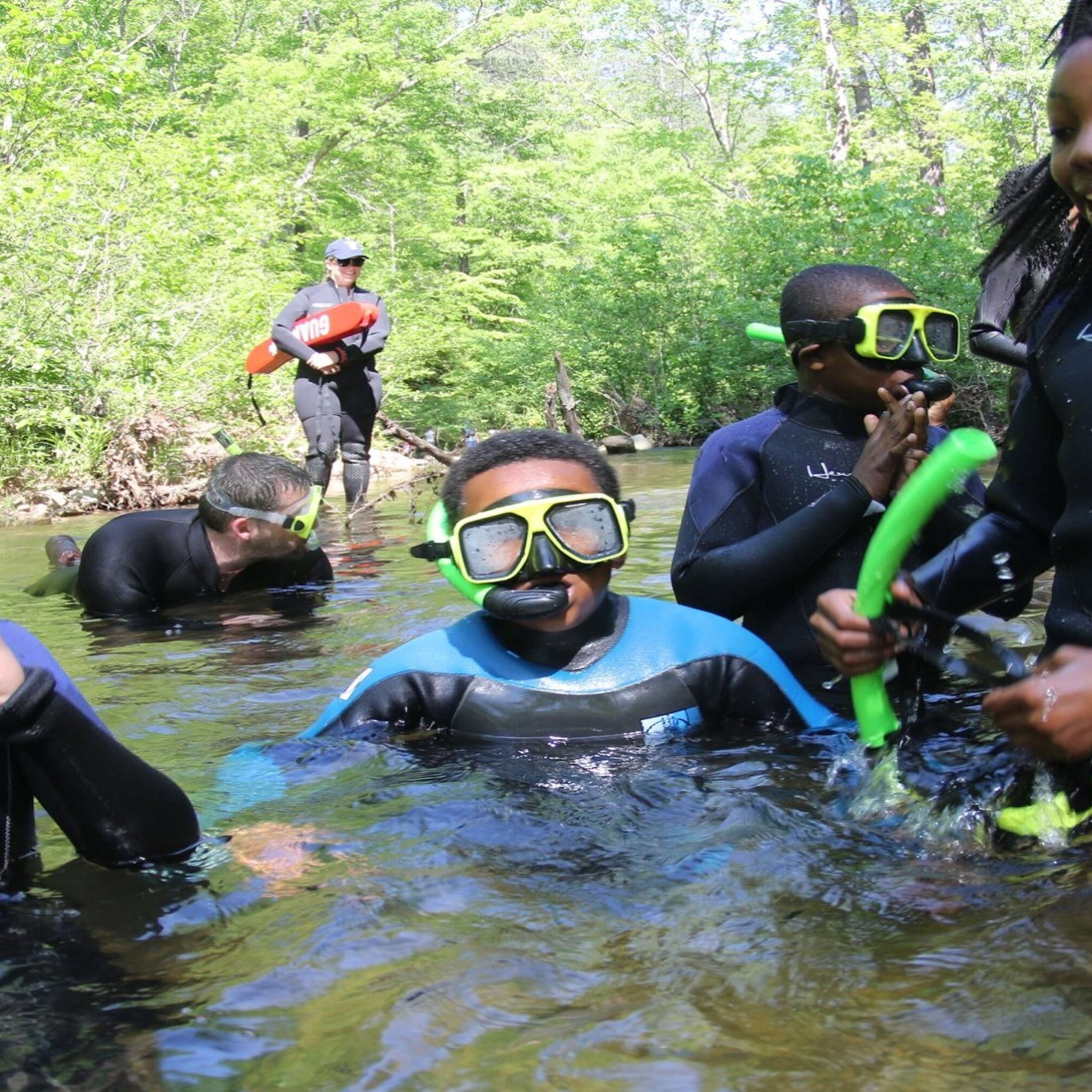
If snorkeling seems like something you can only do on a tropical vacation, think again. In this podcast episode, we meet a river snorkeling guide who encourages us to stick our heads in the water, right in our local streams and rivers. Keith Williams thinks you'll be amazed at the aquatic life you'll see there. Tune in to Constant Wonder and get hooked with some amazing fish tales. Guest: Keith Williams, author of "Snorkeling Rivers and Streams: An Aquatic Guide to Underwater Discovery and Adventure" and guide at Freshwater Journeys Read more snorkeling stories by Keith at https://blog.nature.org/author/keith-williams/ Originally aired on January 25, 2023
S3 Ep 2Storyteller Kevin Kling, A Life of Humor and Humility
Storyteller Kevin Kling has overcome trauma and learned to live with disability, without ever losing sight of the hilarious–even in the horrible. We follow him from his mischievous childhood to his empathetic and inspiring performances around the world. He still laughs often, and so will you, during this episode of the "Constant Wonder" podcast. Guest: Kevin Kling, author, playwright, and storyteller Visit Kevin's website to learn more about his work, speaking events, and performances: https://www.kevinkling.com/
S3 Ep 1Saving Wild Sounds
If you've never stopped by the side of the trail to listen to a beetle larvae chewing on a pine tree, or to the sound of the woodpecker looking for that beetle, we'll give you a chance in this podcast episode. If you've never been puzzled by the high-pitched voice of a male elk bugle, we encourage you to take the time to wonder about nature's oddities. Focusing on underappreciated sounds and sensations opens up an enormous world of insight and beauty. Guest: David George Haskell, author of "Sounds Wild and Broken: Sonic Marvels, Evolution's Creativity, and the Crisis of Sensory Extinction" and Professor of Biology at Sewanee: The University of the South Learn more about David online: Author page: https://dghaskell.com/ Instagram: https://www.instagram.com/davidgeorgehaskell/?hl=en
S2 Ep 39Magic In Neglected Spaces: Reaching People with Bookmobiles, Micro-museums and Street Mosaics
What good is a library or a museum if you can't get to it? In this episode of the podcast, Constant Wonder introduces innovators who bring inspiration to people in the most unexpected ways. We learn about the inventor of the bookmobile, a feisty librarian who allowed neither bureaucrats nor train wrecks to interfere with her mobile library. Then we meet the curator of ATM-sized museums that are popping up in unusual places and opening the world to people who may not otherwise get to visit museums. And, finally, an artist who heads up a street mosaic project staffed by volunteers with mental illness. Their work appears in neglected alleyways and neighborhood parks. Guests: Sharlee Glenn, author of "Library on Wheels: Mary Lemist Titcomb and America's First Bookmobile" Instagram:https://www.instagram.com/sharleeglennwordweaver/ Charles Philipp, cofounder of MICRO, a distributed fleet of micro-museums Website: https://charlesphilipp.com/ Tessa Hunkin, mosaicist Website: https://www.tessahunkin.co.uk/ Instagram: https://www.instagram.com/tessahunkin/?hl=en
S2 Ep 38Can Iceland's Elves Save the Planet?
Meet an Icelandic woman who speaks to (and for) elves. Her efforts led to a famous compromise over a highway construction project in Iceland that would've taken out an elf "church." But more importantly, American researcher Nancy Marie Brown claims, a belief in elves–or in the possibility of elves–could change the way we see, and care for, our environment. Skeptical? That's okay. On this Constant Wonder podcast, we aim to suspend our disbelief to explore ancient ways of thinking, at least for an episode. Guests: Nancy Marie Brown, author of "Looking for the Hidden Folk: How Iceland's Elves Can Save the Earth" Website: https://www.nasw.org/users/nmb/ Ragnhildur Jónsdóttir, elf seer and educator Mara Menzies, Kenyan/Scottish performance storyteller Instagram: https://www.instagram.com/raggajonsdottir/?hl=en
S2 Ep 37Uncovering Archaeology's Hidden Treasures . . . Out of Desert and Ice
In three decades at National Geographic, Ann Williams has been an eyewitness to some of the greatest archaeological treasures of the last century. She was just outside on the dark and stormy night when they loaded King Tut's mummy into a CAT scanner. She examined the fibers of an ancient woven blanket shrouding an Incan teenager, who'd been sacrificed to the gods. She documented the bowls and baskets left behind as an entire Alaskan Yupik village fled an attack. Guest: Ann Williams, General Editor of "Treasures of Egypt: A Legacy in Photographs from the Pyramids to Cleopatra" and "Lost Cities, Ancient Tombs: 100 Discoveries That Changed the World" Listen to Constant Wonder wherever you get your podcasts.
S2 Ep 36Advocating for Sharks and Other "Scary" Creatures
From a young age, Rachel Graham was interested in all kinds of marginalized animals, from snakes to bats. But when she went on a dive trip and experienced a real-life sharknado, it became clear that her future would be inextricably tied to sharks. This marked the beginning of her quest to change people’s mindsets about these fascinating and threatened creatures. Guest: Rachel Graham, Ph.D., Founder and Executive Director of MarAlliance Learn more about MarAlliance's work: https://maralliance.org/ Listen to Constant Wonder wherever you get your podcasts.
ARCHIVE BONUS: Life As an Astronaut
bonusAstronaut Terry Virts experienced a juxtaposition of the sublime and the mundane, sensing God while floating weightless, fixing cables outside his spacecraft. While in orbit, Virts took more than 300,000 photos, which became part of the National Geographic IMAX film "A Beautiful Planet." Podcast Guest: Colonel Terry Virts, fighter pilot, test pilot, NASA astronaut, and author of "How to Astronaut: An Insider's Guide to Leaving Planet Earth." He also directed "One More Orbit,” documenting the fastest circumnavigation of the earth via both poles.
S2 Ep 35Mysterious Tattoo Reunites Korean Adoptee With Birth Family
When Korean adoptee Sara Jones went looking for her birth family, she wondered if a strange tattoo given to her in childhood could unlock any secrets. Jones was adopted into an American family at age three. She found much success here in America, becoming an attorney and CEO. It wasn't until her own kids started asking questions that she decided to search for her birth family. And she started her search with that mysterious tattoo. Hear the story on this week's podcast. Guest: Sara Jones, CEO of InclusionPro, Board Member of The (Utah) State Workforce Development Board, Board of Trustees for Intermountain Salt Lake Valley Hospitals, Co-Founder of Women Tech Council Visit Sara Jones on Instagram to learn more: https://www.instagram.com/saradansiejones/?hl=en
S2 Ep 34A Pediatric Neurosurgeon Shares Stories of Triumph and Resilience
Neurosurgeon Jay Wellons performs the most delicate surgeries on the traumatized brains of children, where every cut and stitch has life-changing consequences. He’s also an enthralling storyteller and a tireless advocate for his patients–a lesson he learned the hard way. Join us as he shares inspiring tales of his patients’ journeys. Guest: Jay Wellons, MD, Cal Turner Chair and Chief of Pediatric Neurosurgery, Vanderbilt University Medical Center; author of "All That Moves Us: A Pediatric Neurosurgeon, His Young Patients, and Their Stories of Grace and Resilience" Read Jay Wellons' book: https://parnassusbooks.net/book/9780593243381 Find him on Instagram: https://www.instagram.com/allthatmovesus_official/?hl=en
S2 Ep 33From the Streets to Symphony Hall: The Improbable Backstory of a World-Class Tuba Player
A story of human triumph: A young child is rescued from life on the streets, fostered, and mentored. He chases a dream to play classical music, and now as a mentor himself, he encourages others to dream big. With humility and humor, Richard Antoine White shares his unique journey. Guest: Richard Antoine White, author of "I'm Possible: A Story of Survival, a Tuba, and the Small Miracle of a Big Dream"; principal tubist for the Santa Fe Symphony and the New Mexico Philharmonic; Associate Professor of Tuba/Euphonium at the University of New Mexico Visit Richard's website to learn more about him and his music: https://rawtuba.com/
ARCHIVE BONUS: The Hidden Life of the Deep Ocean
bonusThe abyss of the deep sea is anything but lifeless!
S2 Ep 32Black Paramedics Find an Ally in a Young White Female Doctor – Freedom House, Part II
Part 2 of our Freedom House story involves the racial politics of saving lives in the late '60s and early '70s, a norm-shattering young White female doctor, and the graceful but determined response of one skilled Black paramedic, who provided unheralded leadership to the people he worked under. Kevin Hazzard, author of "American Sirens: The Incredible Story of the Black Men Who Became America's First Paramedics" John Moon, former paramedic at Freedom House and former Assistant Chief, City of Pittsburgh EMS Photo Credit: Harvard University, Schlesinger Library on the History of Women in America Visit Kevin Hazzard online to learn more about his writing and research: Main website: https://www.kevinhazzard.com/ Instagram: https://www.instagram.com/goes_by_haz... X/Twitter: https://x.com/goes_by_hazzard
S2 Ep 31America's First Paramedics Were Black Pioneers in Pittsburgh – Freedom House, Part I
Paramedics haven't always raced to the scene of an emergency. Before 1966, if you called for help to get to the hospital, you might get a police car, or even a hearse. That year, Pittsburgh's non-profit Freedom House set out to change that for the city's Hill District, which was predominately Black. Staffed by trained Black men and mentored by the inventor of CPR, the ambulance service served as a model for newly emerging paramedic services around the country. Guests: Kevin Hazzard, author of "American Sirens: The Incredible Story of the Black Men Who Became America's First Paramedics" John Moon, paramedic at Freedom House and former Assistant Chief, City of Pittsburgh EMS Photo Credit: Heinz History Center Visit Kevin Hazzard online to learn more about his writing and research: Main website: https://www.kevinhazzard.com/ Instagram: https://www.instagram.com/goes_by_haz... X/Twitter: https://x.com/goes_by_hazzard
S11 Ep 5A Humble Farmer Goes On An Unbelievable World Tour
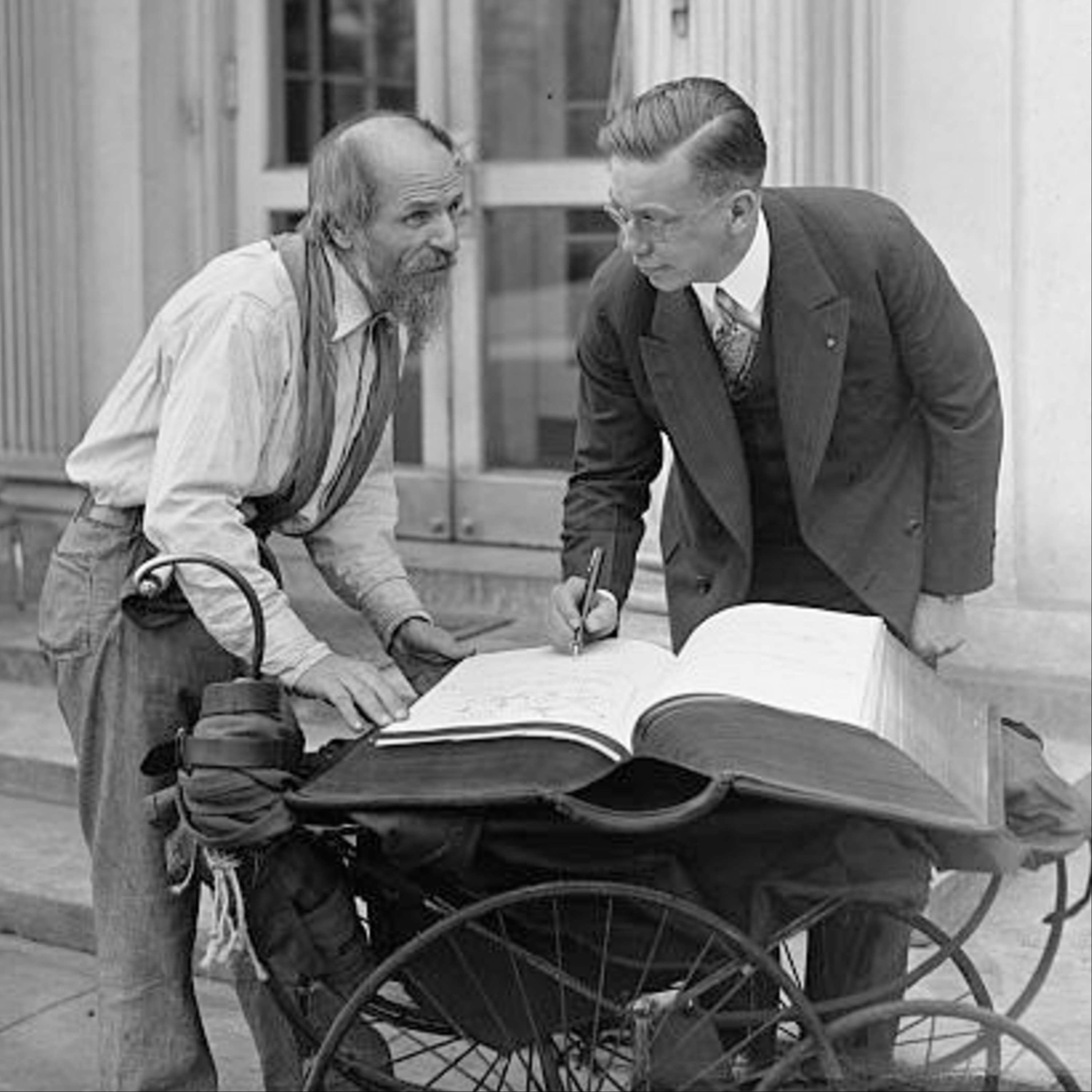
One day in 1901, a young farmer from Croatia set out on a walk. Decades later, he was still walking, had traversed six continents, and had stood face-to-face with the most famous people of the age. His mammoth autograph book, lost to history for nearly a century, has resurfaced to tell the tale of Joseph Mikulec and his eccentric quest. Guests: Rebecca Rego Barry, author of "Rare Books Uncovered: True Stories of Fantastic Finds in Unlikely Places" and editor of Fine Books & Collections magazine. She wrote about Mikulec's odyssey for "Smithsonian Magazine." Nathan Raab, rare book collector, Philadelphia, PA Visit Carolyn Wells online to explore her work: Author page: https://rebeccaregobarry.com/ Instagram: https://www.instagram.com/rebeccaregobarry/ Originally aired September 14, 2022
S2 Ep 30A Humble Farmer Walks the Globe and Meets the World's Elite
One day in 1901, a young farmer from Croatia set out on a walk. Decades later, he was still walking, had traversed six continents, and had stood face-to-face with the most famous people of the age. His mammoth autograph book, lost to history for nearly a century, has resurfaced to tell the tale of Joseph Mikulec and his eccentric quest. Guests: Rebecca Rego Barry, author of "Rare Books Uncovered: True Stories of Fantastic Finds in Unlikely Places" and editor of Fine Books & Collections magazine. She wrote about Mikulec's odyssey for "Smithsonian Magazine." Nathan Raab, rare book collector, Philadelphia, PA Curious about Rebecca's other writing? Visit her website to learn more about her other books: https://rebeccaregobarry.com/
BONUS: Fabric: History Hidden in Plain Sight
bonusThe history of fabric is the history of life and death on this planet.
S2 Ep 29This Party's Dead
In some cultures, the dead are regularly exhumed and carried about in celebration. Why, in the West, are we so much more somber about death and dead bodies? And what can we learn from the carnival atmosphere at many death festivals? Guests: Erica Buist, author of "This Party’s Dead: Grief, Joy and Spilled Rum at the World’s Death Festivals" Website: https://ericabuist.com/ Instagram: https://www.instagram.com/ericabuist/ Victoria Finlay, author of "Fabric: The Hidden History of the Material World" Website: https://victoriafinlay.com/ Instagram: https://www.instagram.com/victoriafinlaywriter/?hl=en
S2 Ep 28How Can You Reforest the Desert Without Planting a Single Tree?
Tony Rinaudo arrived in Africa optimistic that his tree-planting efforts would reverse the damages of deforestation and drought. His efforts failed abysmally, but one day he stumbled on a solution that had been right at his feet the whole time. His new methods have led to the regeneration of more than 200 million trees in Niger alone. Guest: Tony Rinaudo, author of "The Forest Underground: Hope for a Planet in Crisis" and Principal Climate Action Advisor for World Vision International
S2 Ep 27Have You Heard the Buzz? Why We Need Pollinators
Have you heard the buzz about pollinators? Bees, butterflies, wasps, and even some flies live fascinating lives and play critical roles in our ecosystems. Come learn why we should make more room for pollinators in our yards and how to do it. Guests: Rachel Taylor, Founder of Utah Friends of Monarchs Joseph (Joe) Wilson, Associate Professor of Biology, Utah State University; co-author of several books, including "Common Bees of Eastern North America" and "The Bees in Your Backyard: A Guide to North America's Bees" Want to learn more about your pollinators? Visit Bees in Your Backyard's website for more fun facts: https://www.beesinyourbackyard.com/
ARCHIVE BONUS: Pho-nomenal!
bonusAn exploration of delectable foods and the people who make them: Pho is delicious and nutritious, one of the best comfort foods. Learn some tips for making your own pho at home. Every week, 400,000 food lovers wait anxiously for a new video about pasta from their favorite YouTubers: authentic Italian grandmothers. And, St. Vith, Belgium is home to the only sourdough library in the world—they are dedicated to preserving and researching sourdough for current and future generations. Guests: Andrea Nguyen, cooking teacher, editor, consultant, and author of "Vietnamese Food Any Day: Simple Recipes for True, Fresh Flavors" and "The Pho Cookbook: Easy to Adventurous Recipes for Vietnam's Favorite Soup and Noodles” Vicky Bennison, creator of “Pasta Grannies” YouTube channel Karl De Smedt, Sourdough Librarian at Puratos Sourdough Library, St. Vith, Belgium
S2 Ep 26Where Is Hope? Towns Rebuild Their "Lifescapes" After Disaster Strikes
When widespread disaster strikes, survivors lose not just their homes and belongings, they also can lose their "lifescape": their relationships with their neighbors, the places they frequent daily, their support systems. Meet some survivors from around the world who have held on to their lifescapes with creativity and tenacity. From out of the rubble, stories of inspiration and hope. Guests: Lucy Easthope, author of "When the Dust Settles: Stories of Love, Loss and Hope from an Expert in Disaster" Instagram: https://www.instagram.com/whenthedustsettleslucy/?hl=en Marc Mattox, Public Works Director and Town Engineer for the City of Paradise, CA Jeff Marcus, retired principal and former special teams football coach at Paradise High School Rick Printz, retired head football coach from Paradise High School Josh Alvies, former player and current JV football coach at Paradise High School
S2 Ep 25Summer Shorts: Adventure Stories
Travel with us to otherworldly places, both beautiful and strange. You may never get to see these places in person, but we'll take you there: volcanoes in space, the tips of the mighty redwoods, the sunken Titanic. We've mined our archives for breathtaking adventure stories. Guests: Richard Preston, author of "The Wild Trees: A Story of Passion and Daring" Website: https://richard-preston.net/about/ Robin George Andrews, author of "Super Volcanoes: What They Reveal about Earth and the Worlds Beyond" Website: https://robingeorgeandrews.com/ Palani Mohan, author of "Hunting with Eagles in the Realm of the Mongolian Kazakhs" Website: https://www.palanimohan.com/ Kerry McCauley, author of "Ferry Pilot: Nine Lives over the North Atlantic" Website: https://kerrymccauley.com/ Doug Peacock, author of "Was it Worth It? A Wilderness Warrior's Long Trail Home" Website: https://dougpeacock.net/
S2 Ep 24The Sun Can Heal the Planet
Brilliant Planet, founded by an enthusiastic dreamer who has always believed in the power of photosynthesis, borrows a simple process from nature to produce food and sequester carbon. And, an ocean farm that needs no seeds, no fertilizer, no fresh water, no LAND. Through the non-profit GreenWave, its farmer teaches his competitors how do it, too. Guests: Raffael Jovine, Founder and Chief Scientist, Brilliant Planet; author of "How Light Makes Life: The Hidden Wonders and World-Saving Powers of Photosynthesis" Bren Smith, Co-Founder of Greenwave; author of "Eat Like a Fish: My Adventures as a Fisherman Turned Restorative Ocean Farmer" Photo credit: Brilliant Planet Interested in regenerative ocean farming? Visit Greenwave's website to learn more about their work and ways to get involved: https://www.greenwave.org/
What Makes a City Great? Featuring: Top of Mind
bonusConstant Wonder is giving listeners a sneak peak of another BYUradio show, Top of Mind. Millions of Americans move each year in search of a better house, neighborhood, job, or quality of life. Is leaving the only way to live some place better? What would it take for an imperfect place to become your perfect match? Today we crisscross the country and check in with Top of Mind listeners about what makes a city great. Guests: Majora Carter, author of “Reclaiming your Community” Jim and Deb Fallows, co-authors of “Our Town: A Journey into the Heart of America” Melody Warnick, author of “This Is Where You Belong” and “If You Could Live Anywhere” Lynn Kreutz, Hayley Trotter, Reed Wolfley, Erika Layland, Jenny Van Stone, Kim Parati – Top of Mind Listeners
S2 Ep 23Power Struggles in the Peaceable Kingdom, Part II
Adam Nicolson went looking for tranquility and reflection when he built tide pools along Scotland's harsh coastline. He found plenty to reflect on, but things were not so peaceful in the pools. He discovered that to maintain harmony in the wild, species need to be at each others' throats. Guest: Adam Nicolson, author of "Life Between the Tides" Visit Adam online: https://www.instagram.com/adamnicolson1/?hl=en
S2 Ep 22Power Struggles in the Peaceable Kingdom, Part I
There's plenty of warfare in animal kingdom, even within a species: battalions of mongooses square off against each other, hermit crabs evict each other in the quest for the perfect shell, ravens rally their brothers to back them up in a rumble. Sounds almost like West Side Story. But all of this conflict actually leads to more peace and harmony, not less. Guest: Lee Alan Dugatkin, author of "Power in the Wild: The Subtle and Not-So-Subtle Ways Animals Strive for Control over Others" Explore Lee's other writing: https://press.uchicago.edu/ucp/books/author/D/L/au8005058.html Photo courtesy of Harry Marshall/Banded Mongoose Research Project
S2 Ep 21The Unfinished Story of America's Anthem
A true national anthem isn't set by law: it's chosen by the people, often emerges out of conflict, and its meaning shifts over time. All of that and more is true of The Star-Spangled Banner. But still, it was sung by four generations of Americans before it became our official anthem. It's been translated into 40 languages, requires extraordinary athleticism to sing, and has long been both an object of awe and a lightening rod for controversy. Guest: Mark Clague, author of "O Say Can You Hear? A Cultural Biography of The Star-Spangled Banner" and a professor of musicology at the University of Michigan. Visit Mark on Instagram: https://www.instagram.com/usmusicscholar/?hl=en
S2 Ep 20Tomatoes That Leave Earth Behind
This greenhouse in the Utah desert seems to be right out of science fiction, where yummy tomatoes grow without soil and produce for nearly an entire year. The greenhouse gets heat and CO2 from a natural-gas power plant to which it is linked by a sort of umbilical cord. Within this bubble of clean, warm air, bumblebees pollinate the vines, and wasps fend off parasites. Whether you hope to build a colony on Mars or just aim to get a good tomato when there's snow on the ground, this is a good place to start. Guests: Travis Jones, General Manager of Longvine Growing Co. Martin Weijters, Head Grower at Longvine Growing Co.
S2 Ep 19A Passion for the Past
"The past is never dead," wrote William Faulkner. "It's not even past." Ron Coddington was a young boy at a flea market one Saturday, when he stumbled on a book of Civil War-era photos and felt his world shift beneath his feet. The boy's passion deepened as he grew to adulthood, maturing into a deeply felt obligation to uncover these stories. Many photos of the time were preserved on calling cards ("cartes de visite") that people would hand out to others, much like the profile pictures we post on social media today. Guest: Ron Coddington, Editor and Publisher of "Military Images" magazine Want to learn more about Cartes de visite? Visit Ron's website: https://ronaldscoddington.com/ Cartes de visite featuring Daniel Waldo, Martin C. Clark, and Almira Newcomb McNaughton Lockwood Fales from Ron Coddington's personal collection. These images are used with his permission.
S2 Ep 18Body, Soul & Memory: What would you do with a lock of George Washington's hair?
An old friend of Benjamin Franklin always regretted not having asked the founding father if he could taxidermize his body. He thought Franklin might have agreed, and then maybe George Washington might have also followed suit. But (maybe to our collective relief) what we do have, instead, as a tangible reminder of our first president are several collections of cuttings from his hair. In the days before photography, a lock of hair might be the only proof that a person had access to a notable man like Washington. After his death, some pseudoscientists used Washington's hair to "prove" the biological superiority of America's founders. Others used their clippings to prove that they, too, were there at America's founding. Now, in our digital age, are these kinds of physical relics and mementos still important? Guest: Keith Beutler, author of "George Washington's Hair: How Early Americans Remembered the Founders" and professor of history at Missouri Baptist University Visit Keith's website to learn more about the Founding Fathers' hair: https://www.georgewashingtonshair.org/home
S2 Ep 17Downton Shabby
Meet the improbable rescuer of a dilapidated English manor house: Hopwood DePree, a Hollywood producer having a mid-life crisis. He'd heard rumors about his family's ancestral castle, and when he discovers that it really exists–but in a shocking state of disrepair–he goes all in to save it. Guests: Hopwood DePree, author of "Downton Shabby: One American's Ultimate DIY Adventure Restoring His Family's English Castle" Geoff Wellens, historian Bob Wall, caretaker of Hopwood Hall; historical and heritage building specialist Zena Howard, PR & Communications for Hopwood DePree and Hopwood Hall Estate Want to keep up with the renovations? Visit Hopwood DePree's YouTube channel to see updates on the castle's repairs: https://www.youtube.com/channel/UCmP4mhZrjgdfqQRzPQ9mXwA
ARCHIVE BONUS: The Dressmakers of Auschwitz
bonusIn Auschwitz, twenty-five Jewish slaves used their sewing skills to survive the Holocaust. The Upper Tailoring Studio, run by the commandant's wife, Hedwig Höss, and a prisoner, Marta Fuchs, was created to design, cut, and sew popular fashions for the Nazi elite. But it was also the means of saving Jewish women from the gas chambers. Guest: Lucy Adlington, author of "The Dressmakers of Auschwitz: The True Story of the Women Who Sewed to Survive"
S2 Ep 16It's Complicated: Our Fraught Relationships with Animals
Why do some cultures object to dogs the way that we object to rats? And why do we object to rats? Simon Barnes says they're our brothers. We explore who's really domesticating whom in the pet ownership process, why we choose to protect certain wild animals over others, how there's no such thing as the natural world, and many other assumptions about our relationships with animals. Guests: Hal Herzog, psychologist; author of "Some We Love, Some We Hate, Some We Eat: Why It's So Hard to Think Straight about Animals"; blogger at "Animals and Us" blog in Psychology Today Simon Barnes, author of "The History of the World in 100 Animals" Madi Vazquez, veterinary nurse Visit Hal online: https://halherzog.com/ Explore Simon's other writing at his website: https://simonbarnesauthor.co.uk/biog/
S2 Ep 15Superplants vs. Superbugs
After losing a leg as a toddler and struggling with repeated infections, Cassandra Quave became obsessed, even as a young child, with preventing infection. That obsession has led her from Florida's swamps to the Peruvian Amazon in pursuit of plants that can defeat antibiotic-resistant superbugs. Her stories are personal, riveting and inspiring, and they offer hope for a medical future that's quite different from our present. Guest: Cassandra Quave, author of "The Plant Hunter: A Scientist's Quest for Nature's Next Medicines" and Associate Professor of Dermatology and Human Health at Emory School of Medicine Visit Cassandra online to learn more about her work: https://www.cassandraquave.com/
S2 Ep 14Animal Duets
Clarinet duets with laughing thrushes, nightingales, whales and cicadas. Philosopher and ornithologist David Rothenberg poses the question: do birds make music, or do they just make sounds to defend a territory or attract a mate? We also talk to a zoomusicologist in Scotland, and we listen to a trio of two oboes and a dog. Guests: David Rothenberg, musician, composer, author, philosopher-naturalist, and Professor of music and philosophy at the New Jersey Institute of Technology Emily Doolittle, composer, zoomusicologist, and Athenaeum Research Fellow and Lecturer in Composition at the Royal Conservatoire of Scotland Learn more about David's work at his website: https://davidrothenberg.wordpress.com/ Visit Emily online to learn about her compositions: https://emilydoolittle.com/
Roots of Belief Featuring: The Apple Seed
bonusConstant Wonder is giving listeners a sneak peak of another BYUradio show, The Apple Seed. In this episode, a musician and a couple of actors take unlikely approaches to sharing scripture. (4:58) Detroit storyteller and blues guitarist Robert B. Jones talks about how he became an ordained minister (9:51) Rev. Jones tells the story of he built his guitar from the wood from different parts of his childhood home to stay connected to his hometown in the story “Detroit Guitar,” recorded live in the Apple Seed studio (25:32) Host Sam Payne connects with his Greek grandparents by learning to cook Greek food in today’s entry in The Radio Family Journal (34:03) Two New York pals connect to their heritage by performing Torah stories for families as a duo called The Bible Players
BONUS: Our Animal Superpowers (Extended Version)
bonusExtended version of our conversation with Jackie Higgins.