
CDSN Podcast Network
274 episodes — Page 2 of 6

Episode 3.33: NATO Ambassadors and Euro-Atlantic Security
In episode 33 of Battle Rhythm season 3, with co-host Artur Wilczynski, retired DG of Foreign Intelligence Operations Canada and Senior Fellow GPSIA, University of Ottawa; Artur and Steve discuss PM Carney’s new cabinet choices for national security and defence files; David McGuinty as Minister of National Defence, Public Safety Minister Gary Anandasangaree, Foreign Affairs Minister Anita Anand, and the issues they will face delivering on campaign promises including managing the US relationship, arctic defence, and procurement. Todays feature interview is with Margriet Vonno, Ambassador of the Kingdom of the Netherlands in Ottawa and Witold Dzielski, Ambassador of the Republic of Poland to Canada, in advance of our event to discuss NATO and Euro-Atlantic security on May 22nd at Carleton University.

Épisode 51: Romain Le Cour Grandmaison, docteur en science politique de l’Université Paris
Dans ce 51e épisode, Laurent Borzillo et Sarah-Myriam Martin-Brûlé reçoivent Romain Le Cour Grandmaison, docteur en science politique de l’Université Paris 1 Panthéon-Sorbonne et expert senior à la Global Initiative Against Transnational Organized Crime. À la croisée de la recherche, du terrain et de la stratégie, notre invité revient sur son parcours singulier et partage ses réflexions sur la production contemporaine du savoir en matière de sécurité. Il présente également le mandat et les actions de la Global Initiative, tout en proposant une lecture renouvelée de la violence criminelle — non pas comme une rupture de l’ordre, mais comme une forme de gouvernance. L’échange aborde en profondeur la manière dont les rapports entre l’État, l’armée, la police et les groupes armés non étatiques se reconfigurent dans des contextes comme le Mexique ou Haïti. Il explore également le rôle des diasporas, des flux financiers et des dynamiques transnationales dans la consolidation de la violence, et questionne la portée — et les limites — d’une réponse multilatérale ou militaire dans un pays comme Haïti. Plus largement, la discussion s’élargit à l’impact des trafics transnationaux (armes, drogues, personnes) sur les frontières classiques de la défense et de la sécurité. Enfin, l’épisode se conclut sur une réflexion essentielle : comment sortir du prisme exclusivement répressif face à la criminalité organisée, et quelles alternatives politiques ou sociales pourraient être envisagées?

Episode 3.32: Terrorism and Authoritarian Regimes
In episode 32 of season 3 (recorded on voting day), Co-hosts Linna Tam-Seto (Assistant Professor Department of Occupational Science & Occupational Therapy within the Temerty Faculty of Medicine at the University of Toronto) and Steve Saideman discuss Canada’s federal election and Conservative anti-woke messaging along with how the next government can improve CAF recruitment and retention issues through a focus on healthcare, housing and procurement. Today's Feature Interview is with Michael Collins – Executive Director, The Americas, Institute for Economics & Peace (IEP) https://www.economicsandpeace.org/about/ This year will be the 12th edition of the Global Terrorism Index (GTI). The report provides a comprehensive summary of the key global trends and patterns in terrorism over the last decade. The calculation of the GTI score considers not only deaths but also incidents, hostages and injuries from terrorism, weighted over a five-year period. The report is produced using event records on terrorist attacks since 1 January 2007. The current terrorism dataset contains over 66,000 terrorist incidents for the period 2007 until today. The GTI ranks 163 countries based on four indicators weighted over five years. A country’s annual GTI score is based on a unique scoring system to account for the relative impact of incidents in the year.
Épisode 50: Brigadier-général Éric Laforest, Chef J5 au Grand Quartier général des puissances alliées en Europe (SHAPE)
Pour ce 50ième épisode du balado Conseils de sécurité, Laurent Borzillo et Sarah-Myriam Martin-Brûlé reçoivent le Brigadier-général Éric Laforest, officier chevronné en opérations internationales et en planification stratégique, membre des Forces armées canadiennes depuis 1991. Tout au long de sa carrière, le Brigadier-général Laforest a exercé des responsabilités de commandement aux niveaux du peloton, de la compagnie, du bataillon et de la force opérationnelle. Il a notamment dirigé des troupes en Haïti, en Afghanistan et en Lettonie dans le cadre de l’opération REASSURANCE. Fort de plusieurs affectations stratégiques à Ottawa et dans des instances internationales, il occupe depuis juillet 2023 le poste de chef des plans militaires (J5) au SHAPE, siège opérationnel de l'OTAN en Europe. Lors de cette entrevue, il revient sur les enseignements tirés de ses expériences de commandement opérationnel dans des contextes variés. Il partage son analyse des défis rencontrés sur le terrain, notamment pour maintenir la cohésion de forces multinationales. Sarah-Myriam et Laurent évoquent également les priorités stratégiques identifiées depuis sa prise de poste au SHAPE, ainsi que son analyse de l’évolution de la menace russe, à la lumière de son expérience en Europe de l’Est. Cet épisode permet également d’aborder les défis de la coopération militaire au sein de l'OTAN et les contributions spécifiques et notables des Forces armées canadiennes à l'architecture de défense collective.

Resilience Plus Season 5 Episode 2: Gen (Retd) Knud Bartels, Royal Danish Defence College
General (ret) K. Bartels, born in 1952, joined the Danish Army in 1972 as a private. He has attended the Royal Danish Military Academy, the Royal Danish Defence College, l´École Supérieure de Guerre in Paris and the US Army War College in Carlisle. He has commanded company, battalion, brigade and division and has served in higher staff positions nationally and in NATO Headquarters. General (ret) K. Bartels was Chief of Defence Denmark in 2009-2011 and Chairman NATO Military Committee 2012-2015. He retired in 2015 and became Adjunct Professor in military history at the Royal Danish Defence College. General (ret) K. Bartels is married to Mrs. Inge Vansteenkiste and they have their home in Belgium.
Field Report Ep 13 - Reporting from the Montreal Climate Security Summit
In this episode of the Field Report, join Hannah and Amy in Montreal, as they break down the discussions and panels of the 3rd annual Montreal Climate Security Summit, alongside several special guests! Thank you to the NATO Climate Change and Security Centre of Excellence (CCASCOE) and the Conference of Defence Associations Institute (CDAI) for their support in the making of this episode, and to our special guests for joining us: Pauline Baudu, Director of the Climate and Security Programme at CDAI. The Honourable Sherri Goodman, Secretary General of the International Military Council on Climate and Security and author of Threat Multiplier: Climate, Military Leadership and the Fight for Global Security. Dr Will Greaves, Associate Professor of International Relations at the University of Victoria. This episode of the Field Report was presented by: Hannah Christensen, Senior Advisor to the NATO Field School and MA (Security and Defence Policy) student at Carleton University. Amy Topshee, NATO Field School Alumni Coordinator and an alumna of the 2022 NATO Field School. With special thanks to our editor, Solomon Rodgers.
Épisode 49: Giovanna De Maio, chargée de mission au Centre d’analyse, de prévision et de stratégie (CAPS)
Dans cet épisode du balado Conseil de sécurité, nous recevons Giovanna De Maio, spécialiste des relations transatlantiques et de la politique étrangère des grandes puissances. Docteure en relations internationales et aujourd’hui chargée de mission au sein du CAPS du ministère français de l’Europe et des Affaires étrangères, elle produit des analyses stratégiques sur les dynamiques américaines et leur impact sur la France, l’Europe et l’architecture transatlantique. Forte d’un parcours international, entre Rome, Moscou, Paris et Washington, Giovanna De Maio a été chercheuse au German Marshall Fund, à l’IFRI, à la Brookings Institution et à la George Washington University. Ses travaux ont notamment porté sur la désinformation russe, les rapports UE–États-Unis, les dynamiques politiques italiennes, ainsi que les ingérences étrangères dans les processus électoraux. Au cours de cet entretien, elle revient sur sa trajectoire et son rôle actuel au sein du CAPS, à la croisée de la recherche, de la diplomatie et de la prospective. Nous explorons ensuite ses recherches sur les perceptions russes de l’Ukraine depuis 2014, la construction idéologique autour de la négation de l’identité ukrainienne, et les tensions entre récits officiels, opinions publiques et propagande. La discussion se penche également sur les stratégies de désinformation russe et les fragilités narratives occidentales, questionnant la frontière entre propagande extérieure et biais internes à nos sociétés. Pour conclure, l'épisode permet d'aborder l’évolution récente de la politique étrangère américaine et l’ébranlement des fondements de l’architecture sécuritaire transatlantique. Avec notre invitée, nous revenons ainsi sur les tensions croissantes entre les États-Unis et certains alliés — dont le Canada — et les risques associés à une hypothèse de retrait américain de l’OTAN.

Episode 3.31: Challenging Assumptions Through Systems Thinking Approaches
In the 31st episode of Battle Rhythm, Season 3, Steve Saideman and co-host Thomas Hughes, Assistant Professor at Mt. Allison University discuss Trump’s rhetorical shift on the 51st state threat on a phone call with PM Carney, the fallout from #Signalgate including for allies and does Canada need to follow Denmark’s lead on rallying European allies? Thomas and Philippe explore the power of transformative games to empower leaders in defence and security through the work of the Archipelago of Design in Today's feature interview. As Co-President of the Archipelago of Design, a not for profit, and Professor at Canadian Forces College, Philippe Beaulieu-Brossard’s purpose is to empower leaders in shifting mindsets in national security organizations to better set conditions for evolution and address complex situations. Philippe fulfills this purpose especially by mobilizing a crowdsourcing approach to designing transformative games captured as the "hop-on hop off model". This approach proved successful, resulting in the critical and popular appraisal of Breakthrough, a strategic mystery investigation game taking place in the Canadian Arctic in 2040, its sequel, Shadows of Byzantium, taking place in Istanbul Turkey in 2040, and Inner Alliance. Just released in 2025 collaboration with Wero Creative, Inner Alliance set conditions for players to adapt to diverse constituencies in disaster relief operations in support of the WPS agenda. Philippe is currently collaborating with the NATO Climate Change and Security Centre of Excellence (CCASCOE) to co-design a game to empower the centre and its agenda. Philippe lives in Leslieville, Toronto with his wife, daughter, son, and too many games.
Épisode 48: Amélie Zima, chercheuse au Centre des études de sécurité de l’IFRI (Institut français des relations internationales)
Pour ce 48ᵉ épisode, Laurent Borzillo et Sarah-Myriam Martin-Brûlé reçoivent Amélie Zima, chercheuse au Centre des études de sécurité de l’IFRI (Institut français des relations internationales), spécialiste de l'OTAN et de la Pologne. Docteure en science politique, lauréate du premier prix de thèse de l’IHEDN, elle a travaillé au sein de nombreuses institutions académiques et de recherche en France et à l’étranger, dont le CEFRES à Prague, l’Académie polonaise des sciences et l’Université de Varsovie. Avant de rejoindre l’IFRI, elle a exercé à l’IRSEM en tant que chercheuse sur la sécurité européenne. Elle est également l’autrice de plusieurs publications récentes sur l’OTAN et la politique de défense polonaise. Au cours de cette entrevue, nous abordons en détail le cas polonais, à partir de ses travaux sur le réarmement massif engagé par Varsovie, dont les ambitions pourraient faire de la Pologne la première puissance militaire européenne d’ici 2035. L'échange met ainsi en lumière les défis politiques, économiques et organisationnels de cette montée en puissance, ainsi que ses implications pour les équilibres internes de l’OTAN et de l’Union européenne. L’entretien porte de ce fait également sur les tensions politiques internes en Pologne, les risques de politisation de la défense et l’impact des élections présidentielles à venir. La discussion permet en outre d'aborder la question des coopérations bilatérales qu'entretient la Pologne avec les États-Unis (y compris sous les diverses administrations Trump), avec d'autres pays européens tels la France et l'Ukraine, mais aussi avec le Canada.Pour conclure, à travers cette discussion, nous nous interrogeons sur les moyens pour déconstruire les idées reçues sur l’OTAN, notamment en France et au Canada, à travers le regard d’une chercheuse engagée dans la diffusion des savoirs stratégiques auprès des décideurs et du grand public.
Resilience Plus Season 5 Episode 1: Dr. Jill Scott, Principal RMC
Prior to her appointment to the Royal Military College of Canada, Jill Scott served as Provost and Vice-President Academic Affairs, and professor in the Faculty of Arts at the University of Ottawa. In this capacity, Dr. Scott was chief academic officer and chief budget officer from 2019-2024, providing leadership in key areas such as equity, diversity and inclusive excellence, antiracism, Indigenous affairs and reconciliation, and mental health and wellness. From 2013-2019, Dr. Scott served as the inaugural Vice-Provost (Teaching and Learning) at Queen's University, where she oversaw the implementation of a new academic quality assurance process, led research and new practices in assessing higher-order cognitive skills in undergraduate education, and co-chaired the Provost's Task Force on Truth and Reconciliation. Dr. Scott assumed additional responsibilities as Interim Associate Vice-Principal (International) in 2018-2019. During her time as Head of the Department of German Language and Literature, she led major reform to academic programming and departmental structures. At Queen's University, she was professor in the Departments of Languages, Literatures and Cultures, and German Language and Literature, and held cross-appointments to the Department of Gender and Women's Studies and the Graduate Program in Cultural Studies. Dr. Scott has taught and published widely in the fields of German and Austrian literary studies, forgiveness and conflict resolution, and Indigenous studies. Dr. Scott holds a PhD in Comparative Literature from the University of Toronto. She is fluent in English, French and German.
Episode 3.30: Pan-Domain and CIMIC Responses
In the 30th episode of Battle Rhythm, Season 3, with co-host Anessa L. Kimball, Ph.D., Professor at Université Laval. Steve Saideman & Anessa discuss wrapping up the Department of National Defence/Ministère de la défense nationale MINDS Network funded research on setting up Canada’s NATO Climate Change and Security Centre of Excellence (CCASCOE) , the upcoming 16th UNIDEF event CSI Centre sur la sécurité internationale; PM Carney defies convention by choosing Europe for his first international engagement, NATO SG Rutte’s visit to the White House possibly undermining NATO countries to appease Trump, pivoting away from the F35 deal towards diversifying air power, as well as a review of Trump’s reign of terror so far this year including the shutdown of USIP and ignoring court orders including massive deportations and what this means for Canada accepting US refugees. Lcol Philippe-Andre Genest is today's Feature Interview. Holding a Master’s Degree in Technology Management, Philippe-André Genest has more than 20 years of experience as a member, leader, mentor and recruiter, of organizational and specialized teams for national and international projects in civilian, institutional and military contexts. He possesses excellent knowledge of project management, team management and organizational management having been team leader for a consulting-engineering firm and the Ordre des Ingénieurs du Québec as well as a commander and staff-officer in varied military operational context. He has proven leadership as a civilian manager and a military officer. His fields of expertise include liaison and coordination, organizational management, the legal, regulatory and normative framework of the engineer profession, humanitarian aid and international development. Docotral student in Military History at Unviersit. du Québec a Montréal. Member of the Groupe de Recherche en Histoire de la Guerre. Member of Ordre des Ingénieurs du Québec (#128960), he is fluent in French and English and as a basic knowledge of German.
Épisode 47: Natascha Hryckow, conseillère principale pour l'Initiative de la Corne de l'Afrique
Pour ce 47ᵉ épisode, Laurent Borzillo et Sarah-Myriam Martin-Brûlé reçoivent Natascha Hryckow, conseillère principale pour l'Initiative de la Corne de l'Afrique. Cette entrevue nous plonge au cœur du parcours et de l’expertise de Natascha Hryckow, une figure reconnue dans la gestion des conflits, le contreterrorisme et le renforcement des capacités institutionnelles. Forte d’une expérience au sein d’organisations internationales telles que l’OMS, l’OTAN et l’Union européenne, elle a occupé des postes stratégiques dans certaines des régions les plus instables du monde. Son engagement auprès de l’Initiative de la Corne de l’Afrique illustre la complexité des défis liés aux conflits et à la gouvernance. Nous reviendrons sur son parcours professionnel et les responsabilités qu’elle a exercées dans ces divers rôles. Elle partagera ensuite son analyse des défis communs et des particularités des crises en Afghanistan, en Irak, en Libye, en Somalie, en Syrie et au Yémen, à travers son travail au sein de l’OMS. L’entretien abordera également son rôle dans la mission européenne EUCAP Nestor ainsi que son implication au sein du Panel d’experts sur la Somalie, permettant d’évaluer l’évolution des enjeux sécuritaires et institutionnels au fil des années. Forte de son expérience en Afghanistan avec l’OTAN, elle reviendra sur les enseignements essentiels tirés de cette mission. Enfin, nous évoquerons son rôle actuel au sein de l’Initiative de la Corne de l’Afrique, en mettant en lumière l’implication de la Banque mondiale et l’influence du financement britannique sur sa mission. Pour conclure, nous nous interrogerons sur la place qu’un pays comme le Canada peut occuper dans ces contextes de crise et les contributions qu’il pourrait apporter à la stabilité et au développement des régions en difficulté.
Episode 3.29: After Action Report: Ukrainian Foreign Legion
In episode 29 of Battle Rhythm season 3, with co-host Artur Wilczynski, retired DG of Foreign Intelligence Operations Canada and Senior Fellow GPSIA, University of Ottawa; Artur shares his professional opinion on the shocking exchange and fallout between two allies in the Oval Office last week as Steve looks for the silver linings. Steve and Artur also discuss France opening its nuclear umbrella and Canada’s future with the Five Eyes. Today's Feature Interview is with Major Dave Smith (retired) Dave Smith served 15 years in the Canadian Armed Forces as an infantry officer. He resigned in 2023 to join the International Legion for the Defence of Ukraine. He fought against the Russian invasion for eighteen months.
Épisode 46: Colonel Dariusz Niedzielski, chef d’état-major au Centre d’excellence de l’OTAN
Dans ce nouvel épisode, Laurent Borzillo et Sarah-Myriam Martin-Brûlé s'entretiennent avec le Colonel Dariusz Niedzielski, chef d’état-major au Centre d’excellence de l’OTAN pour les communications stratégiques (STRATCOM). Fort d’une vaste expérience dans les opérations d’information et la planification stratégique, il partage son expertise sur l’évolution des communications stratégiques au sein de l’OTAN face à la montée des menaces hybrides et de la désinformation. La discussion met en lumière le rôle du STRATCOM dans l’adaptation de l’OTAN aux défis modernes, notamment à travers le développement de doctrines, l’analyse des menaces informationnelles et l’intégration des technologies émergentes comme l’intelligence artificielle. Le Colonel Niedzielski explique comment le centre contribue à renforcer la résilience des démocraties face aux campagnes de manipulation numérique orchestrées par des acteurs hostiles tels que la Russie et la Chine. L’épisode explore également l’interaction entre STRATCOM et les structures alliées, soulignant comment les analyses du centre influencent les politiques de l’OTAN et de ses États membres. À ce titre, il partage des recommandations pour le Centre canadien sur le changement climatique et la sécurité, récemment créé, en insistant sur l’importance d’une approche ciblée et d’une coopération internationale renforcée. Enfin, la question cruciale des ingérences électorales est abordée, alors que plusieurs pays occidentaux s’apprêtent à organiser des élections. Le Colonel Niedzielski évoque les stratégies de protection des processus démocratiques, insistant sur le rôle fondamental de l’éducation numérique, de la responsabilité médiatique et de la vigilance citoyenne face à la propagation de la désinformatio
Episode 3.28: Canada First, Not Canada Alone
In episode 28 of Battle Rhythm's third season, Steve Saideman and co-host Thomas Hughes, Assistant Professor at Mt. Allison University discuss JD Vance’s speech and subsequent reactions at the Munich Security Conference, NATO on life support, Conservative Party’s plan for a military base in Iqaluit, and a brief intro to the works of author Alistair MacLean. Today's feature interview Steve talks with Dr. Adam Chapnick, Professor of Defence Studies at the Canadian Forces College and the Royal Military College of Canada (RMC). He is the award-winning author of Canada on the United Nations Security Council: A Small Power on a Large Stage, among other titles, and a former editor of International Journal.

Épisode 45: Tjorven Bellmann, ambassadrice d'Allemagne au Canada
Dans ce nouvel épisode, Laurent Borzillo et Sarah-Myriam Martin-Brûlé s'entretiennent avec Tjorven Bellmann, ambassadrice d'Allemagne au Canada. Elle revient sur les moments marquants de son parcours au ministère des Affaires étrangères depuis 2013, en partageant son expérience en matière de politique de sécurité et de coopération internationale. La discussion explore plusieurs enjeux stratégiques, notamment l’Arctique, où les visions canadienne et européenne divergent entre souveraineté territoriale et liberté de navigation, soulevant des questions environnementales et géopolitiques. Le partage du fardeau au sein de l’OTAN est également abordé, en mettant en perspective les critiques adressées à l’Allemagne et au Canada quant à leurs engagements budgétaires et leur contribution à l’Alliance. L'épisode compare ensuite le rôle des centres d’excellence de l’OTAN en Allemagne avec celui du tout nouveau centre canadien sur le changement climatique et la sécurité, mettant en lumière les enseignements pouvant renforcer le rôle du Canada au sein de l’Alliance. Enfin, les invités discutent de la menace croissante de l’ingérence électorale dans les démocraties occidentales et des stratégies de coopération entre Ottawa et Berlin pour mieux faire face à ces risques.
Episode 3.27: Bridging the Gap with Visiting Defence Fellows
In episode 27 of season 3, Co-hosts Linna Tam-Seto (Assistant Professor Department of Occupational Science & Occupational Therapy within the Temerty Faculty of Medicine at the University of Toronto) and Steve discuss Danish defence concerns; the success of PM Trudeau’s trade war speech; the future of NATO and Defence Minister Blair’s goal of reaching 2% by 2027; plus Canadian Armed Forces changes to recruitment criteria. Today's feature interview is a fireside chat on a culture of cooperation with four Visiting Defence Fellows, hosted by producer Melissa Jennings: Col Nick Roby: VDF Carleton, 2024/2025 Gen MC Harvey: VDF Carleton. 2023/2024 Col Cathy Blue: VDF Carleton 2022/2023 Col Mike Babin: VDF Queen’s 2023/2024
Episode 3.26: Stealth, Persistence and Lethality: Naval Force Development
In our twenty-sixth episode of Battle Rhythm season 3, Steve joins Dr. Wendy H. Wong (Professor of Political Science and Principal’s Research Chair at the University of British Columbia) in Kelowna to discuss President Trump’s inauguration, the current media and information landscape, impending Tariffs on Canada, along with thoughts on democratic backsliding. Our Feature interview is with Commodore Jason Armstrong, Director General Naval Force Development. Captain (N) Jason Armstrong joined the Canadian Armed Forces as a Maritime Surface and Subsurface Officer in 1989 and graduated from the Royal Military College of Canada with a Bachelor of Arts Honours History in 1993. Captain (N) Armstrong, upon completion of MARS training has served onboard HMC Ships on both coasts conducting a number of international deployments. He had the honour of commanding three HMC Ships during his command tour and deployed onboard HMCS TORONTO as commanding officer during OP REASSURANCE in 2014-2015. Captain (N) Armstrong has served in staff positions at Maritime Pacific and in Canadian Fleet Atlantic Headquarters. He has served twice in Ottawa, once as the Underwater Warfare requirements officer in the Directorate of Naval Requirements and the second time as the Director of Naval Requirements. Capt(N) Armstrong is a graduate of both the Joint Command and Staff Program and the National Security Program from the Canadian Forces Command and Staff College, and he holds a Master’s degree in Defence Studies. Captain (N) Armstrong and his bride Monica have two outstanding young teenagers, Jack and Sara, who excel in the world of academics and athletics. Captain (N) Armstrong enjoys hockey and golf, both sports he plays poorly, cycling and coaching his children.
Episode 3.25: Canada’s National Quantum Strategy
In episode 25 of Battle Rhythm season 3, with co-host Artur Wilczynski, retired DG of Foreign Intelligence Operations Canada and Senior Fellow GPSIA, University of Ottawa; Artur and Steve Saideman discuss PM Trudeau’s surprise announcement, the looming threat of US- Canada border security and tech billionaires influence on policymaking. For today's feature interview, co-host Wendy Wong interviews a trio of Canada's Quantum experts: Kristen Csenkey, Ph.D., is a Centre for International Governance Innovation (CIGI) Digital Policy Hub fellow. She is the Principal Investigator of multiple Department of National Defence-funded projects. Benjamin T. Johnson, Ph.D., is an Assistant Professor at the University of Groningen, Netherlands, with the Department of International Relations and International Organization (IRIO). He is also a visiting Fulbright scholar at the University of Washington in Seattle, having received a Fulbright-NATO Security Studies Award for fall 2024. Greg Dick is a Co-founder and the Chief Executive Officer of Open Quantum Design. Prior to founding OQD he was a longtime senior executive at Perimeter Institute for Theoretical Physics. He also founded RESILIENT, an agency dedicated to helping organizations purpose build for resilience against unexpected change. https://doi.org/10.1080/11926422.2024.2397970
Episode 3.24: Allied Military Leadership in Conversation
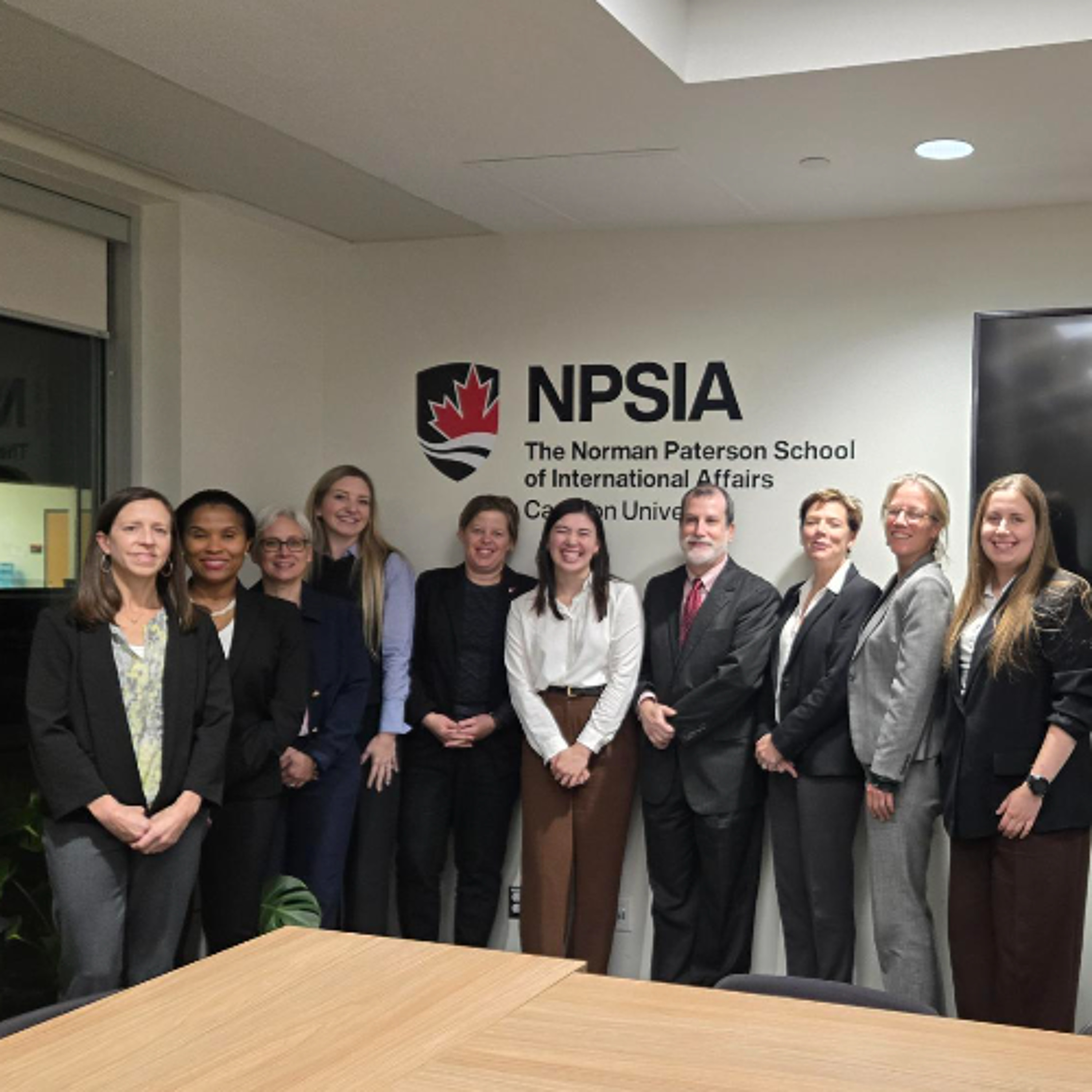
We are ending the year on a positive note with this Battle Rhythm / Notes From the Field crossover episode, co-hosts Steve and Hannah meet up with a few of the incredible leaders that make up this year’s cohort of HFX Peace With Women Fellows when they reached Ottawa on their whirlwind global tour. The Peace With Women Fellowship brings together senior, active-duty, military officers from NATO member and partner countries for a 3-week executive tour of the political, military and technological centers of the United States and Canada. The Peace With Women Fellowship is designed to challenge participants by engaging with senior government, military, corporate, and academic leaders to discuss and better understand the world’s leading security issues. The program endeavors to not only ensure that the Fellows can discuss the problems and ideas they face, but also propose innovative solutions and apply what they learn in their home countries. HFX is proud to lead the security community with this unprecedented Fellowship program advancing women’s leadership in security, while fostering a dynamic network of women military leaders across the world. In order of appearance: [03:45] Gp. Capt. Elizabeth Hutchison (Defence Attaché Chile Royal Air Force, Air Ops United Kingdom) Col. Nanda Kellij (Policy Director for Material, Environment, Real Estate and Sustainability Ministry of Defence, Policy Directorate. Netherlands) Col. Sonja Fischer, MD (Chief of Branch Protocol Executive Staff FMoD Germany) [24:06] Capt. Mette Stab-Johansen (Navy Command - Head of Operations and Planning. Royal Danish Navy) Col. Alison Gonzalez (Director of Staff, United States Space Force) [36:08] Col. Angela Thomas (Director Air Plans. Royal Canadian Air Force) Capt. Carolyn Moberley (National Strike Force Commander, United States Coast Guard) Maj. Anna Novak (Head of Logistics Department (S4) 58th Detached Motorized Brigade Land Forces, Armed Forces of Ukraine)
Episode 3.23: Civil Wars
In episode 23 of Battle Rhythm season 3, with co-host Artur Wilczynski, retired DG of Foreign Intelligence Operations Canada and Senior Fellow GPSIA, University of Ottawa; Artur and Steve discuss the Halifax Security Forum debate about women in combat roles, Trump, Trudeau, Tariffs and US asylum seekers along with martial law in South Korea. Today's feature interview is with Dallaire Centre of Excellence for Peace and Security researcher Dr. Dustin Johnson and Mount Saint Vincent University's Dr. Catherine Baillie Abidi on their recent volume of Civil Wars, Volume 26, Issue 3 (2024): https://www.tandfonline.com/toc/fciv20/26/3 Dr. Catherine Baillie Abidi is a scholarly practitioner in the Department of Child and Youth Study at Mount Saint Vincent University and has specialized in children and armed conflict for over two decades. She has worked in collaboration with dozens of Defence Forces and with international organizations such as the United Nations, Red Cross, and the International Labour Organization. She has over twenty publications in the field of peace and security and was the editor of Allons-y: Journal of Children, Peace and Security for five years. Dr. Baillie Abidi was awarded a Queen Diamond Jubilee Medal from the Governor General of Canada for her work in children, peace and security. At Mount Saint Vincent, she is leading research focused on conflict-related early warning, moral injury, and children and youth as agents of peace. Dr. Baillie Abidi is also the Co-Director of the Children, Peace and Security International Network, an active and collaborative group of international scholars, committed to researching inter-disciplinary, community-based, inclusive, and prevention-oriented approaches for protecting children and preventing their use in violence. Dr. Dustin Johnson is an Assistant Professor in the Department of Defence Studies at the Royal Military College of Canada, and he is based within the Dallaire Centre of Excellence for Peace and Security at the Canadian Defence Academy, where he researches child protection and gender dynamics in armed conflict and peacekeeping with a focus on Ukraine. He holds a PhD in peace and development studies from the School of Global Studies at the University of Gothenburg in Sweden, and has previously published in journals such as International Peacekeeping, Civil Wars, and Global Responsibility to Protect.
Episode 3.22: NATO Diplomacy with SNMG2 Comdr, Cmdre Matthew Coates
In the twenty-second episode of Battle Rhythm, Season 3, with co-host Anessa Kimball, Professor at Université Laval. Steve & Anessa discuss upcoming NATO Parliamentary meetings in Montreal, communications espionage in European waters and Canadian implications for Trump’s cabinet picks. Today's feature interview is with Cmdre Matthew Coates. A native of Halifax Nova Scotia, Cmdre Coates is a Naval Warfare Officer in the Royal Canadian Navy. He graduated from the Royal Military College of Canada Kingston, with a degree in Electrical Engineering in 1998, and from Salve Regina University in 2010 with a Masters in Management. Cmdre Coates has held numerous staff and sea-going appointments, deploying multiple times on operations around the globe. Memorable highlights include a 2011 deployment as Executive Officer in HMCS CHARLOTTETOWN in support of NATO operations off the coast of Libya, and his appointment in 2013 as the Commanding Officer of HMCS IROQUOIS, a Tribal Class Destroyer. After his time in IROQUOIS he assumed command of Sea Training Atlantic where he was responsible for at-sea ship readiness and certification training. He is a two-time graduate of the United States Naval War College in Newport Rhode Island where he attended the Naval Staff College (class of 2010) and Naval Command College (class of 2017). In July 2017, he assumed the post of Director Naval Strategy, providing Force Development guidance in support of the future Navy. During this time Cmdre Coates was selected to participate in the RIMPAC 2018 Executive Steering Committee, responsible for planning major aspects of the multi-national exercise. He then deployed with the Chilean Navy as Deputy to the Combined Force Maritime Component Commander for the exercise. In July 2019, he assumed the post of Director Human Rights and Diversity within Chief Military Personnel, working to ensure the Canadian Armed Forces, along with the Defence Team, are an inclusive, equitable and diverse organization. After two rewarding and educational years in CMP, he returned to Navy lines, moving to Victoria BC to take up the appointment as Commander, Naval Personnel and Training Group. Evolving the Naval Training System to be best positioned to meet the needs of the RCN’s future fleet, Cmdre Coates completed three busy years prior to his appointment as Commander Standing NATO Maritime Group 2, during a ceremony 1 July 2024 in Toulon, France. When not at work, Matthew and his wife Meghan, enjoy time camping with their two boys, and cheering them on at the ball park and hockey arena.

Securityscape Season 3 Episode 1: Introduction
SecurityScape is created by The graduate student organization that represents the interests of the students of the Centre for Military, Security and Strategic Studies, and acts to foster a sense of community in the program.

Episode 3.21: The Cookie Crumbles: US Election and Canadian Security
In our twenty-first episode of Battle Rhythm season 3, Steve Saideman and Dr. Wendy H. Wong (Professor of Political Science and Principal’s Research Chair at the University of British Columbia) trade baking schedules and recipes before diving into US election campaign strategies, Canada’s 2% defence spending prospects, plus the US and China relationship. Today’s feature interview is with co-author Stephane Leman-Langlois of “The Great Right North: Inside Far-Right Activism in Canada” written by Stéphane Leman-Langlois, Aurélie Campana and Samuel Tanner. Stéphane Leman-Langlois is professor of criminology at Laval University, Québec. He holds the Canada Research Chair on Surveillance and the Social Construction of Risk. He is director of the Terrorism and Counterterrorism Research Group and of the Centre on International Security at Laval University. He is also co-director of the Observatoire sur la radicalisation et l’extrémisme violent (OSR). As a co-investigator of the Big Data Surveillance project, funded by the Social Sciences and Humanities Research Council of Canada, Stéphane Leman-Langlois is co-leading (with Valerie Steeves) research Stream Three: Governance. This stream will examine the use of big data for policing and other forms of social control.
Field Report Ep 12 - Spotlight on NATO on the Ballot: US and Latvia
Welcome to a new episode of the Field Report's Spotlight Series, brought to you by the students of the 2024 NATO Field School. The Spotlight Series will shine a light on key issues and threats in the landscape of security and defence through expert analysis and in-depth discussions. How have NATO, security, and defence topics impacted electoral campaigns and voters' decisions? In today's episode, Chloe Duguay, Matt Howell, Adam Ivanovic, and Santiago Palacios are joined by Dr Toms Rostoks and Dr Steve Saideman to discuss how security and defence issues can, and have, impacted electoral campaigns. First, Dr Rostoks gives an overview of the incorporation of security and defence issues in Latvian politics, from NATO membership when Latvia regained its independence from the Soviet Union, up to the 2022 Russian invasion of Ukraine. Then, the team goes to Dr Saideman to discuss what's on all our minds, the upcoming US election. This episode was created during the 2024 NATO Field School by: Chloe Duguay, an international relations honours student at Mount Allison University. She is currently completing research on NATO's role in upholding climate security and is an executive member of the Young Diplomats of Canada. Adam Ivanovic, an International Studies student at Simon Fraser University. Matt Howell, a political science honours student at the Royal Military College. Santiago Palacios, a political studies honours student at Queens University, focussing on NATO, international affairs, and the Canadian Armed Forces. Our special guests are: Dr Toms Rostoks, an Associate Professor at the University of Latvia and the Director of the Centre for Security and Strategic Research at the Latvian National Defence Academy. Dr Steve Saideman, Director the Canadian Defence and Security Network and co-host of the Battle Rhythm Podcast! With special thanks to our Spotlight Series producer, Morgan Cowley.

Resilience Plus Season 3 Episode 4: CWO Lucie Alain
From the archives, an interview with Chief Warrant Officer Lucie Alain. The Resilience podcast provides resources on responding to trauma, empowering individuals to maximize their productivity and effectiveness in pursuing personal and professional goals.
Episode 3.20: Development - Security Nexus
In episode 20 of Battle Rhythm's third season, Steve travels to Pennsylvania, discussion on campaign spending ensues. Co-host Thomas Hughes, Assistant Professor at Mt. Allison University and Steve also discuss New Brunswick's recent election, Canada-India relations, North Korean - Russian military cooperation and the escalation risk of US troops in Israel. Today's feature interview is with Rhonda Gossen, a former diplomat with Global Affairs Canada. The Year Ahead Event: https://www.cdsn-rcds.com/network-events/save-the-date-cdsn-year-ahead-writing-canadas-foreign-policy Rhonda Gossen is a former diplomat with Global Affairs Canada, assigned to Philippines, Pakistan, Afghanistan and Ghana. She is currently a senior consultant with UNDP, working on early recovery, forced displacement and refugee response, resilience, stabilization, development solutions to internal displacement and strategic planning. She worked as development advisor to the humanitarian coordinator for the Rohingya Crisis in Cox’s Bazar, Bangladesh and to UNHCR Lebanon on the Syrian refugee crisis. In addition to UNDP, she has undertaken assignments with the World Bank, UNICEF, UNHCR, in Pakistan, Lebanon, Nepal, Nigeria, South Sudan, Southern Africa, Bangladesh, Azerbaijan Afghanistan, and Iran. She is the author of an upcoming book with McGill-Queens University Press.
Field Report Ep 11 - Reporting from the 2024 NATO Summit: Part 2
In this second part of a two-part series on the 2024 NATO Summit, NATO Field School staff Sasha and Amy take you behind the scenes of Day 2 of the NATO Public Forum, held in Washington, DC in July 2024, alongside the NATO Summit. Join Sasha and Amy as they share their live reactions and insights, recorded in real-time between summit discussions. This episode will immerse you in the event, making you feel like you were right there with them! This is Part 2 of a two-part series. Check out part 1, released on October 1st. The NATO Field School is proud to be the Canadian institutional partner of the NATO Public Forum. Thank you to the NATO Public Diplomacy Division for their continued support. Biographies: Amy Topshee is the NATO Field School Alumni Coordinator and an alumna of the 2022 NATO Field School. She has a BA (Hons) in Political Science with International Relations from the University of British Columbia and recently completed a 6-month internship in the BC Legislature. Sasha Kardos-Machado is the NATO Field School Communications and Outreach Coordinator and an alumna of the 2024 NATO Field School. She is in her final year at Bishop's University, pursuing an BA (Hons) in International Studies with a minor in Political Studies.
Episode 3.19: Conventional War & Means of Control
In episode 19 of Battle Rhythm's third season, Steve has an agreeable discussion with David Pugliese on Canadaland’s Backbench podcast. Co-host Thomas Hughes, Assistant Professor at Mt. Allison University and Steve discuss conventional war readiness, along with analysis of the Military’s domestic propaganda story and potential implications. Today's Feature interview is with Byron Tau. Byron Tau is an investigative and enterprise journalist who specializes in law, courts, and national security. He reports for and teaches at the Allbritton Journalism Institute, a journalism nonprofit launched in 2023 that trains and mentors early-career reporters. He previously worked at The Wall Street Journal and Politico. A native of Holliston, Massachusetts, Tau has degrees from McGill University in Montreal and Georgetown University in Washington, D.C. Links: https://www.canadaland.com/podcast/100-trump-says-canada-doesnt-pull-its-weight-in-nato-hes-right/ https://saideman.blogspot.com/2023/04/who-gets-to-police-defence-and-security.html
Field Report Ep 10 - Reporting from the 2024 NATO Summit: Part 1
For the 10th episode of The Field Report, NATO Field School staff Sasha and Amy take you behind the scenes of the 2024 NATO Summit, held in Washington, D.C., where NATO celebrated its 75th anniversary. Join Sasha and Amy as they share their live reactions and insights, recorded in real-time between summit discussions. This episode will immerse you in the event, making you feel like you were right there with them! The NATO Field School is proud to be the Canadian institutional partner of the NATO Public Forum. Thank you to the NATO Public Diplomacy Division for their continued support. Biographies: Amy Topshee is the NATO Field School Alumni Coordinator and an alumna of the 2022 NATO Field School. She has a BA (Hons) in Political Science with International Relations from the University of British Columbia and recently completed a 6-month internship in the BC Legislature. Sasha Kardos-Machado is the NATO Field School Communications and Outreach Coordinator and an alumna of the 2024 NATO Field School. She is in her final year at Bishop's University, pursuing an BA (Hons) in International Studies with a minor in Political Studies.
Episode 3.18: Military Ethics Education and Application
In episode 18 of Battle Rhythm's third season, Steve testifies at the Parliamentary Defence Committee, discussion ensues. Co-host Thomas Hughes, Assistant Professor at Mt. Allison University and Steve also discuss the submarine procurement announcement, security clearances for provincial and territorial leaders and newly released intelligence priorities from the federal agencies. Today’s feature interview is with David Whetham, Professor of Ethics and the Military Profession in the Defence Studies Department of King’s College London. David Whetham is the Director of the King’s Centre for Military Ethics and delivers or coordinates the military ethics component of courses for between two and three thousand British and international officers a year at the UK’s Joint Services Command and Staff College. Before joining King’s as a permanent member of staff in 2003, David worked as a BBC researcher and with the OSCE in Kosovo, supporting the 2001 and 2002 elections. David supports military ethics education in many different countries and has held Visiting Fellowships at the Stockdale Center for Ethical Leadership, US Naval Academy Annapolis, the Centre for Defence Leadership and Ethics at the Australian Defence College in Canberra and at the University of Glasgow. He was a Mid-Career Fellow at the British Academy in 2017-18 and is currently a Visiting Professorial Fellow at the University of New South Wales. He was appointed as the Jeffrey Grey Distinguished Visiting Fellow at the Australian Defence College in 2023. David is a founding member of the European Chapter of the International Society for Military Ethics (Euro ISME) which holds an annual conference for military practitioners, academics and defence policy-makers.In 2020, David was appointed as an Assistant Inspector General of the Australian Defence Force to contribute to the Afghanistan Inquiry into allegations of war crimes committed by Special Forces personnel. His contribution was published as an annex to the Brereton Report in November 2020, with all of the recommendations being accepted by the Chief of the General Staff and Prime Minister. He currently sits on the UK Defence Medical Services Ethics Committee, the UK MoD AI Ethics Panel, the 77X Ethics Advisory Panel, and the Australian Defence Force's International Standing Panel of Experts in Ethics. David is married with two children, and sits as a Magistrate on the Wiltshire Bench. In his spare time, he plays trombone with the 41º Big Band and enjoys epée fencing.
Episode 3.17: Change Agent, Soldier-Scholar Dr. Alan Okros
In episode 17 of season 3, Co-hosts Linna Tam-Seto (Assistant Professor Department of Occupational Science & Occupational Therapy within the Temerty Faculty of Medicine at the University of Toronto) and Steve Saideman discuss the US Justice Department indictment of Russian funded media in North America (including Tenet Media in Canada), immigration backlash and hate crimes increase along with the UN campaign to provide Polio vaccines to children in Gaza. Today’s feature interview is with Dr. Alan Okros, a full professor at the Royal Military College Department of Defence Studies and has been supporting Chief Professional Conduct and Culture initiatives. He is also a co-director of the CDSN. Dr. Alan Okros holds a PhD in Industrial and Organizational Psychology from the University of Waterloo. He was appointed Associate Professor in the Department of Military Psychology and Leadership at the Royal Military College of Canada in 2004 and appointed as Full Professor to the Department of Defence Studies at CFC in 2008. In 2019, he assumed responsibilities as Deputy Director Research in the Dallaire Centre of Excellence for Peace and Security within the Canadian Defence Academy.

Épisode 44: LT.Col. Chris Labbé, CHEF, BUREAU INTERARMÉES CONTRE AÉRONEF SANS ÉQUIPAGE
Dans ce 44ième épisode, Brigadier-Générale Marie-Christine Harvey et la professeure Sarah-Myriam Martin-Brûlé reçoivent le Lieutenant Colonel Chris Labbé, CHEF, BUREAU INTERARMÉES CONTRE AÉRONEF SANS ÉQUIPAGE - CHEF DE L’INTÉGRATION DES SYSTÈMES DE COMBAT . Ils discutent de son parcours, des principales menaces pour le Canada dans le domaine aérien et spatial , du rôle du bureau interarméees canadien contre-drone, de la lutte anti-drone et de ses défis et enjeux, tant sur le plan technologique, réglementaire et éthique. Il explique la coopération avec les autres entités gouvernementales, les instituts de recherches, les entreprises ainsi que la collaboration internationale pour réguler et contrer l' utilisation des drônes.
Episode 3.16: Pride and Politics
In our sixteenth episode of Battle Rhythm, season 3 Steve and Wendy (Professor of Political Science and Principal’s Research Chair at the University of British Columbia) discuss the National Security Transparency Advisory Group’s recommendations on AI, the controversy over the new Army logo and the US Presidential candidate’s use of pop culture. Today's feature interview is with Ottawa based freelance journalist, Dale Smith. Dale Smith is a freelance journalist in the Canadian Parliamentary Press Gallery, writing about politics full-time since the 2008 federal election. He has written for the Ottawa Citizen, the National Post, Maclean’s, Canadian Business, the Canadian Press, iPolitics.ca, and the Hill Times. Dale lives in Ottawa.
Episode 3.15: Medium Risk, Medium Reward
In episode 15 of Battle Rhythm's third season, Steve and co-host Thomas Hughes, Assistant Professor at Mt. Allison University, discuss the impacts of Russia’s invasion of Ukraine in the arctic, Canadians intercepting Chinese naval ships sailing through Arctic international waters along with far-right riots in the UK and with a final twist, Ukraine’s incursion into Russian territory. Today's feature interview is with our new Visiting Defence Fellow, Col Nick Roby. Colonel Nickolas Roby joined the Canadian Armed Forces Primary Reserves in the rank of Gunner in 1997, and was commissioned into The Royal Regiment of Canadian Artillery in 2002. He has since commanded at the Troop, Battery, Rifle Company, as the Commandant of The Royal Regiment of Canadian Artillery School, and more recently, was the Commander of the Canadian Forces Recruiting Group (2022-2024). Serving in a variety of key staff assignments in Ottawa, Colonel Roby served as the Canadian Army analyst at Chief of Program, Executive Assistant to Commander Canadian Forces Intelligence Command, as the coordinator to Deputy Chief-of-Staff Operations at the Canadian Army Headquarters, and as the Senior Military Assistant to the Minister of National Defence. Colonel Roby was employed as the Director of Army Personnel Management (G1) at the Canadian Army HQ from 2020 to 2022. Operationally, Colonel Roby deployed to Afghanistan with the International Security Assistance Force as the Deputy Commander of Brigade Troops, and Operations Officer of Combined Team Kandahar City Brigade HQ in 2009-10. In support of the United Nations, he deployed twice with the Mission de l'Organisation des Nations Unies pour la Stabilisation en République démocratique du Congo (MONUSCO) in 2013 and 2016. Colonel Roby is a graduate of the Joint Command and Staff Program at the Canadian Armed Forces College, Toronto. He holds a Baccalaureate in Arts from St. Thomas University, and a Master’s Degree in Defence Studies from the Royal Military College of Canada. Colonel Roby is married to Jessica, and they lead an active lifestyle racing from one sporting activity to another with their four young children: Chloé, Maëva, Félix, and Kallee.
Resilience Plus Season 3 Episode 3: Jennifer Eyre
From the archives, an interview with Master Resilience Trainer Mrs Jennifer Eyre. The Resilience podcast provides resources on responding to trauma, empowering individuals to maximize their productivity and effectiveness in pursuing personal and professional goals.
Episode 3.14: Leadership in times of crisis
In episode 14 of Battle Rhythm season 3, with co-host Artur Wilczynski, retired DG of Foreign Intelligence Operations Canada and Senior Fellow GPSIA, University of Ottawa, Steve asks Artur what’s going on with CSIS and the new Interim Director, they discuss sabotage at the Olympics in Paris and Canadian disaster response coordination in the wake of the devastating Jasper fire. This episode’s featured interview is a throwback to Episode 2 of Battle Rhythm from July 10, 2019, Co-Director Stéfanie von Hlatky interviews (then) Brig.-Gen. Jennie Carignan who talks about leadership and affecting change in the military. General Jennie Carignan, Chief of the Defence Staff, has had a distinguished career since commissioning into the Canadian Military Engineers in 1990. She commanded two Combat Engineer Regiments, Royal Military College Saint-Jean, and the 2nd Canadian Division. She participated in multiple international and domestic deployments, led NATO Mission Iraq and most recently held the position of Chief of Professional Conduct and Culture. General Carignan holds two master's degrees and has received several honours, including the Commander of the Order of Military Merit and an honorary doctorate. She was promoted to her current rank in July 2024.
Episode 3.13: the venn diagram of policy, experience and research
In episode 13 of Battle Rhythm season 3, Steve and Wendy (Professor of Political Science and Principal’s Research Chair at the University of British Columbia) discuss Kamala Harris as the new Democratic presidential nominee and the implications for US foreign policy; Chief of Defence Staff Change of Command Ceremony; the CrowdStrike outage as well as Korean laser drones. Today's feature interview is with this year's CDSN postdoc, Manaswini Ramkumar. She is completing her PhD in International Relations at the School of International Service, American University in Washington DC, where she examines civil-military relations in the context of democratic erosion. She also studies postcolonial statebuilding, subnational democracy, and authoritarian resistance. Her work has been funded by American University, The Association for Documentary Editing and the American Political Science Association. She received her MPhil in IR from American University and MSc in Strategic Studies from the S. Rajaratnam School of International Studies at Nanyang Technological University in Singapore where she previously worked as an Associate Research Fellow in the Military Studies program and was a lecturer in Professional Military Education to the Singapore Armed Forces.
Resilience Plus Season 3 Episode 2: CWO MPC Martin Rousseau
Back catalogue of previously unreleased episodes.
Episode 3.12: Authoritarian Military Careers
In episode 12 of Battle Rhythm's third season, Steve and co-host Thomas Hughes, Assistant Professor at Mt. Allison University, discuss Thomas's trip to Nunavut and the civilian - military relationship implications for Canada's newest Chief of Defence Staff (and former Battle Rhythm guest), Lt. Gen Jennie Carignan. In today's feature interview, Steve speaks with Christian Gläßel, a postdoctoral researcher at the Centre for International Security and principal investigator of the research project “The Anatomy of the Authoritarian Security Apparatus” (AASAP), funded by the German Research Foundation DFG. Christian obtained his PhD from the Mannheim Graduate School of Economic and Social Sciences in 2020. His PhD on subversion, repression, and regime stability was awarded the Lorenz von Stein Prize. Before joining the Hertie School, Christian was a lecturer at the University of Mannheim and researcher in the ERC project "Repression and the Escalation of Violence" and the Collaborative Research Center "Political Economy of Reforms". In 2022, he substituted Nils-Christian Bormann as Professor of International Political Studies at Witten/Herdecke University. In his research, Christian investigates fundamental questions of authoritarian politics and touches new grounds on the inner workings of dictatorial regimes. His findings help us understand when autocracies develop, how they cement their rule, and why they break down. Christian’s work on autocratization processes, repressive organizations, information manipulation, and the death toll behind authoritarian soft power and sportswashing strategies has been published in all leading international political science outlets, including in the American Journal of Political Science, American Political Science Review, Journal of Politics, Journal of Conflict Resolution, European Journal of International Relations, and Comparative Political Studies, among others.

Episode 3.11: Interference
In the eleventh episode of Battle Rhythm, Season 3, with co-host Anessa Kimball, Professor at Université Laval. Steve & Anessa discuss the Canadian business community push to reach the NATO 2% target, US security agreement with Ukraine and foreign election interference. For today's feature interview, Thomas Hughes interviews Rob Clark about foreign interference in the UK and what it means to him along with the debate around the practicalities of mandatory military service inclusion in the UK’s upcoming election. Robert Clark is Policy Director at Curia UK, Fellow at Yorktown Institute, Washington DC and director of defence and security at Civitas. Prior to this he served in the British Army for fifteen years, including deployments to Iraq and Afghanistan. Watch out for our next episode on July 10th!
Episode 3.10: Domestic Politics and International Relations
In the tenth episode of Battle Rhythm, season 3 – Steve and Wendy discuss ICC warrants, Canada’s decision to abstain from recognizing Palestine in the UNSC and CSIS’s TikTok spying warning. This week, Wendy interviews Abe Newman about his new co-authored book, Underground Empire: How America Weaponized the World Economy. Professor Newman received his BA in International Relations from Stanford University and his PhD in political science from the University of California, Berkeley. He is a professor in the School of Foreign Service and Government Departments at Georgetown University. His research focuses on the ways in which economic interdependence and globalization have transformed international politics. He is the co-author of Underground Empire: How America Weaponized the World Economy (Holt/Penguin 2023); Of Privacy and Power: the Transatlantic Struggle over Freedom and Security (Princeton University Press 2019), co-author of Voluntary Disruptions: International Soft Law, Finance, and Power (Oxford University Press: 2018), author of Protectors of Privacy: Regulating Personal Data in the Global Economy (Cornell University Press: 2008) and co-editor of How Revolutionary was the Digital Revolution: National Responses, Market Transitions, and Global Technologies (Stanford University Press: 2006). His work has appeared in a range of journals including Comparative Political Studies, International Organization, International Security, Nature, Science, and World Politics.
Resilience Plus: S3E1 General Wayne Eyre, CDS
Back catalogue of previously unreleased episodes.
Episode 3.9: The Hidden Costs of War
In episode 3.9 co-hosts Steve and Artur discuss the Election Interference Commission of Inquiry and legislation along with Gaza protests on university campuses and a call for empathy. This week Steve interviews Dr. Tanisha Fazal about her new book, Military Medicine and the Hidden Costs of War. Tanisha Fazal is a Professor of Political Science at the University of Minnesota. Her scholarship focuses on sovereignty, international law, and armed conflict. Fazal’s current research analyzes the effect of improvements in medical care in conflict zones on the long-term costs of war. She is the author of State Death: The Politics and Geography of Conquest, Occupation, and Annexation (Princeton University Press, 2007), which won the Best Book Award of the American Political Science Association’s Conflict Processes Section, and Wars of Law: Unintended Consequences in the Regulation of Armed Conflict (Cornell University Press), which won the Best Book Award of the International Studies Association's International Law Section and the American Political Science Association's International Collaboration Section. Her work has also appeared in journals such as the British Journal of Political Science, Daedalus, Foreign Affairs, International Organization, International Security, International Studies Review, International Studies Quarterly, and Security Studies. A frequent commentator on international relations and foreign affairs, she has been a fellow at the Center for International Security and Cooperation at Stanford University and at the Olin Institute for Strategic Studies at Harvard University. In 2002 she was awarded the Helen Dwight Reid Award of the American Political Science Association. From 2021-2023, she is an Andrew Carnegie Fellow.
Episode 3.8: Confidence Building Measures & Arms Control
In the 8th episode of our 3rd season, Steve and Thomas discuss NATO perspectives in Artic Security from his recent visit to the NATO Defence College in Rome, Arctic threats in the Defence Policy Update along with procurement investments and timelines PLUS FBI Director Wray’s analysis of Chinese hacker threat on critical infrastructure as well as US aid to Ukraine. In this week's feature interview Thomas speaks with William Alberque; Director of Strategy, Technology and Arms Control at the International Institute for Strategic Studies focusing on preventing the proliferation of nuclear weapons, weapons of mass destruction and related delivery systems, as well as risk reduction and arms control. William previously served as the director of NATO’s Arms Control, Disarmament, and WMD Non-Proliferation Centre (ACDC), with more than 25 years' experience in arms control, disarmament, and non-proliferation.
Ep 9 - Congressional Affairs And Canada - US Relations
In this 9th episode of the Field Report, Amy Topshee and Lauren Mannix take you inside the Canadian Embassy in Washington D.C. for a conversation with Wendy Boudreau and Mandy Sheldrake, members of the Congressional and Intergovernmental Affairs section. Wendy and Mandy shed light on the purpose of their team and how it is unique among the many embassies in D.C., clarify common misunderstandings about the dynamics of Canada-U.S. relations, and emphasize the importance of proactive advocacy to ensure that U.S. lawmakers appreciate the mutual benefits of this bilateral relationship. Wendy Boudreau is a Congressional Liaison Officer at the Canadian Embassy in D.C, on a rotational position as part of the Canadian Foreign Service. Mandy Sheldrake is a Congressional Liaison Officer at the Canadian Embassy in D.C., she is a Locally Engaged employee who has worked at the Embassy for 18 years. Amy Topshee is an alumnus of the 2022 NATO Field School and 2023 NATO Field School Intern, she is currently working as a Legislative Intern in the British Columbia Legislature. Lauren Mannix is a Research Coordinator for the Conference of Defence Associations Institute and an alumnus of the 2022 NATO Field School.
Episode 3.7: Is More Enough?
In the seventh episode of season three, co-hosts Anessa Kimball and Steve Saideman discuss some details from the newly released Defence Policy Update, NATO’s 75th Anniversary, Chief of Defence Staff, Gen Wayne Eyre has turned off commenting on his twitter (X) feed. This week Steve interviews Roger Hilton, Canadian media presenter and research fellow at GLOBSEC in Bratislava. GLOBSEC is a global think-tank with local offices in Bratislava, Brussels, Kyiv, Vienna, and Washington D.C. committed to enhancing security, prosperity and sustainability in Europe and throughout the world. Its mission is to influence the future by generating new ideas and solutions for a better and safer world. GLOBSEC helps to provide a better understanding of global trends and their consequences for society, economy, and security. We generate new ideas and solutions for a more stable, prosperous, and sustainable world, by: Conducting world-class research and political insight into major threats and risks to our society; Driving change by engaging esteemed policy-makers and senior leaders from different sectors in our policy initiatives; Putting together leaders and stakeholders from multiple sectors at the right time in one place.
Field Report Ep 8 - Reflecting on NATO@75 with Dr Ian Hope
This episode of the Field Report was presented by: Hannah Christensen, Program Manager of the NATO Field School, and Sophie Sacilotto, a Masters student in the Centre of European, Russian, and Eurasian Studies at the University of Toronto. With special thanks to our Field Report Production team for their support. Our special guest today is Dr, Col (ret'd) Ian Hope. Dr Hope is a retired military official with 40 years of experience, including the first Gulf War, as well as multiple tours in the Balkans, Africa, and Afghanistan. He commanded the 1st Battalion, Princess Patricia's Canadian Light Infantry Battle Group, Task Force Orion, in combat in Kandahar in 2006, the Canadian battlegroup which experienced the first major land combat operations since the Korean War, earning him the Meritorious Service Cross. Dr Hope holds a PhD from Queen's University in American Military History, and has studied strategic studies and military theory and history from the United States Army War College and the School of Advanced Military Studies. He has also served on the faculty of the US Army War College, the Royal Military College, and the NATO Defense College.
Field Report Ep 7 - NATO@75: Discussing eFP Latvia
As NATO reaches its 75th anniversary, the NATO Field School is taking the opportunity to reflect on one of Canada's largest recent involvements in NATO, leading the Enhanced Forward Presence (eFP) in Latvia. In today's episode, hosts Chris Babcock and Hannah Christensen sit down with Brigadier-General Rutland, the Chief of Staff, Operations, for the Canadian Army, and the first Commanding Officer of the Enhanced Forward Presence in 2017, to discuss the eFP's scaling up from battlegroup to brigade, the unique nature of eFP Latvia is the most multi-national of all the eFPs, and what opportunities and challenges this commitment presents for the Canadian Armed Forces. This episode of the Field Report was presented by: Chris Babcock, a Masters student at Carleton University, and Hannah Christensen, Program Manager of the NATO Field School. With special thanks to our Field Report Production team for their support. Our special guest today BGen Rutland, Chief of Staff, Operations, CAF. BGen Rutland joined the Canadian Armed Forces in 1995 as a primary reservist. In 2017, while commander of First Battalion, Princess Patricia's Canadian Light Infantry, he deployed as the first Commanding Officer of the Enhanced Forward Presence Battle Group. For this deployment, he was named an Officer of the Order of Viesturs, in recognition of his contributions to the promotion of security and defence in Latvia.
Episode 3.6: Bridging the Gap, One Post-Doc at a Time
In episode 6 of BR Season 3, Co-hosts Linna Tam-Seto and Steve Saideman discuss new legislation proposed to address the abuse of power crisis within DND; military to civilian transition issues for veterans transferring to public service and Tik Tok! Steve interviews our Post-Doc, Ryan Atkinson about his research on emerging technologies and NATO Centers of Excellence. Ryan Atkinson is Postdoctoral Fellow at Carleton University where his research focuses on defence policy. He previously worked at NATO and has experience in the private sector as a cybersecurity consultant. Ryan completed a PhD from Western University and an MA from the University of Toronto.