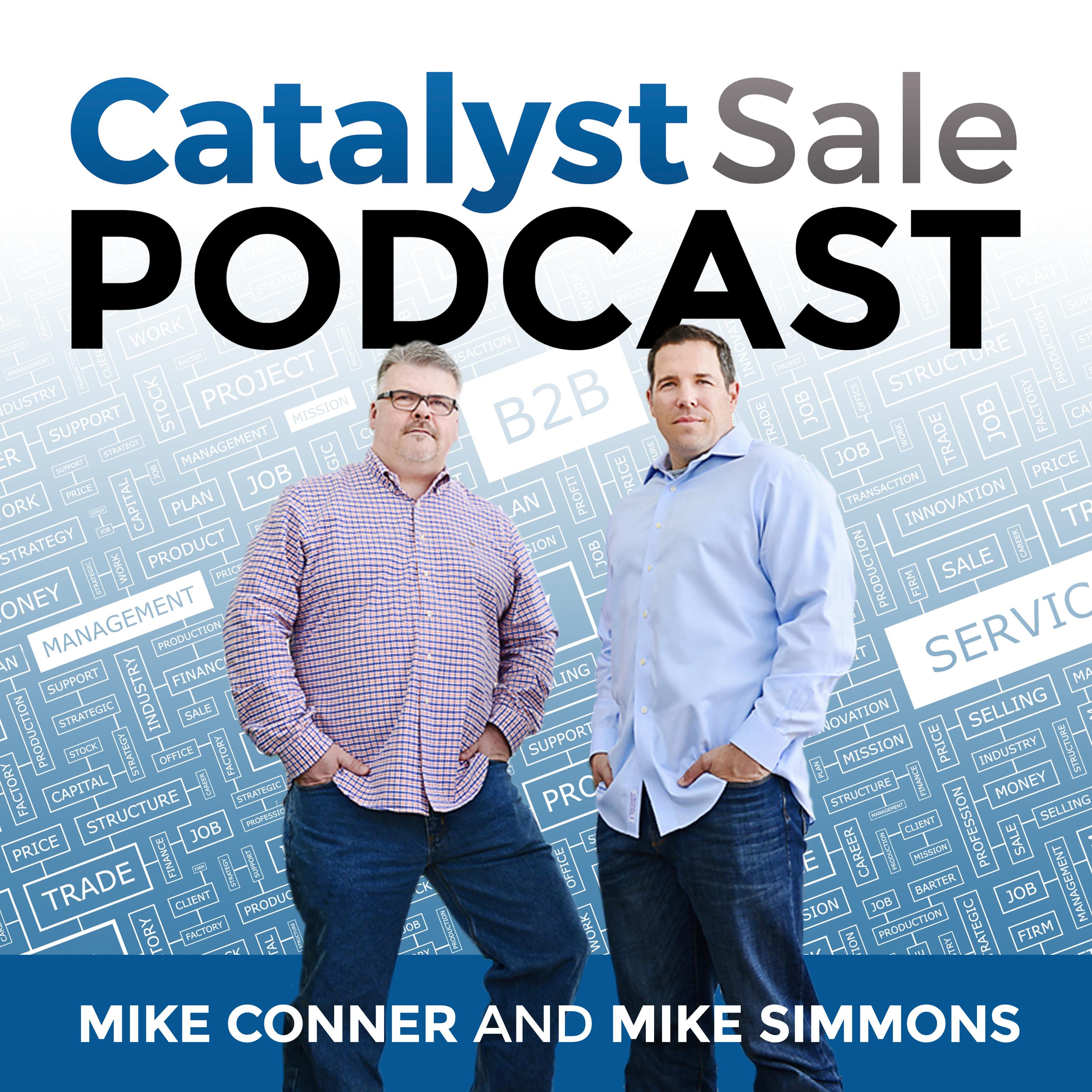
Catalyst Sale Podcast
472 episodes — Page 8 of 10

Ep 122The First Noel with Guest Jeff Noel - 122
The First Noel with Guest Jeff Noel Jeff has spent 30 years building an amazing career at the Walt Disney Company. The last 15 years a speaker with the Disney Institute. I am really excited to have Jeff join us this week, in what I hope is an annual Christmas appearance. This week we discuss Jeff's blogs, which he has published daily since April 1st 2009, goal setting, sales, learning, and execution. I hope you enjoy the conversation as much as I did. Questions Addressed Why The First Noel? How does Jeff achieve balance? Why did Jeff select to focus on mind, body, spirit, health? Do you want to be the best in the category, or do you want to be the category? How can we be better salespeople, and not focused on the pitch? "Don't let your learning lead to knowledge, let your learning lead to action" - what does this mean to Jeff? Is there any guidance Jeff would give folks on going through the process of setting goals for the next year? Key Takeaways Jeff has blogged every day, since April 1st, 2009 Mind Body Spirit Family Health Work Health Everyone struggles to gain the feeling that they are not overwhelmed in one area or another. Jeff could not find a role model that had the balance he was looking for. We tend to use "time" to measure balance. Jeff suggests using "energy". If you wanted to be prepared, if the unthinkable were to happen, what would you do? (Jeff's question) You take your mind, body, spirit to work & home. Work is our contribution to society. Society (work) pays people for our contribution. Your "Get to Do's" should be more than your "Have to Do's" Other questions to consider... How is your health? How is your attitude? How is your spirit? How are you at work? How are you at home? Brand is your reputation. It's the first thing people think about when they hear your name or see your name. Brand yourself for yourself - your inner voice should be encouraging. Not self-defeating. The self-talk, self-branding, has to be a critical part of your movement forward. Walt Disney & Roy Disney were brothers, they worked together for decades. Roy looked at profit as the goal, Walt looked at profit as the reward. The customer can feel this. "The sale should be the reward, not the goal" - Jeff Creativity is the idea part, Innovation is the implementation. All of Jeff's blogs are personal. Can you be a boundary pusher? It's only impossible (your impossible) until you do it for the first time. Do something every day that scares you, eventually, you will do something that inspires you. Some additional thoughts Jeff shared regarding setting goals, documentation, and execution. Everything that happens to you is a gift - Train yourself in finding the good. You think, you move, and you feel. You do have a job, you have a place where you live. Draw five boxes on a piece of paper Create your list Identify those things that are missing Identify those things that you don't need to take with you. Start with the blueprint. Things will work out better than you hope, or worse. Be grateful when it is better, forgive yourself when it is worse. Go through the practice. Reflect. Keep Moving Forward. Think Differently. Show Links Jeff's Blogs Mind Body Spirit Family Health Work Health Jeff's Twitter ThinkingHeads.com Thank You Thank you for rating and reviewing the podcast via iTunes, Google Play, or your favorite podcast platform. Ratings & reviews help others discover the podcast - thank you for helping us get our message out to the community. Please send listener questions and feedback to [email protected] or contact us directly on twitter, facebook or LinkedIn. Catalyst Sale Service Offerings Growth Acceleration - Plateau Breakthrough Product Market Fit ---------------------- Subscribe to the Catalyst Sale Podcast Subscribe via iTunes Subscribe via Google Play Catalyst Sale In every business, in every opportunity, there is someone who can help you navigate the internal challenges and close the deal. There is a Catalyst. We integrate process (Catalyst Sale Process), technology and people, with the purpose of accelerating revenue. Our thoughtful approach minimizes false starts that are common in emerging markets and high-growth environments. We continue to evolve our practice based on customer needs and emerging technology. We care about a thinking process that enables results versus a process that tells people what to do. Sales is a Thinking Process.

Ep 121Prospecting and Outreach - 121
Common Listener Questions - Prospecting & Outreach Prospecting & outreach is another common topic we discuss with folks we coach, clients we work with, and listeners of the podcast. This week we dive deep into the tactical detail of conducting research, beginning outreach, and the importance of context. One assumption we make in this podcast is that you are operating in an organization that has not adopted an inbound approach, and the core of your business comes from direct outreach and prospecting. Questions Addressed If someone asks for help with outreach, where do you start? What action should we take if we are starting from zero when prospecting? What are some common mistakes we make when conducting outreach? Key Takeaways First, assess your current situation, you can start with these questions... How do you define prospecting? How do you define outreach? How do you define your business development process How do you find customers? Be careful about going too broad. There is a difference between crabbing and catching fish - decide what approach is going to work best for your potential client base. Once you have identified the role of the folks that you are interested in speaking with, start your search within LinkedIn or LinkedIn Sales Navigator. Establish your filters based on the desired profile. Determine if the people are within the spectrum of your ideal customer profile. (i.e. organization size between 500 and 2,000 people) Look at the companies, and identify those that you have something in common. You may use their products, know people who work there, own stock in the organization. Begin conducting research into the organization. Take action, be deliberate. With the "casting the net" approach, you hope/anticipate that something is going to come to you. The risk here is that this is a bit more passive, and the fish may find another route. Casting a line requires specific intent. You cast to a target. You focus on quality over quantity. There are multiple approaches that you can take to engage with those who you would like to speak with. Take a personalized approach, do the research, do your homework. The person on the other end should understand why it is worth trading their time to spend time with you. It's your job to identify and convey this. Lee Cockerell - "Don't ask me something that you could have googled" Prospecting is about the customer, it is not about you. You are trying to discover the people who care about the problem that you are trying to address. Ask more questions. Be deliberate. Show Links #77 Initial Outreach - Why you Why You Now - Podcast CISO & Security Vendor Relationships Podcast Send us your Questions Twitter [email protected] Catalyst Sale - Live Chat Catalyst Sale - Podcast List Thank You Thank you for rating and reviewing the podcast via iTunes, Google Play, or your favorite podcast platform. Ratings & reviews help others discover the podcast - thank you for helping us get our message out to the community. Please send listener questions and feedback to [email protected] or contact us directly on twitter, facebook or LinkedIn. Catalyst Sale Service Offerings Growth Acceleration - Plateau Breakthrough Product Market Fit ---------------------- Subscribe to the Catalyst Sale Podcast Subscribe via iTunes Subscribe via Google Play Catalyst Sale In every business, in every opportunity, there is someone who can help you navigate the internal challenges and close the deal. There is a Catalyst. We integrate process (Catalyst Sale Process), technology and people, with the purpose of accelerating revenue. Our thoughtful approach minimizes false starts that are common in emerging markets and high-growth environments. We continue to evolve our practice based on customer needs and emerging technology. We care about a thinking process that enables results versus a process that tells people what to do. Sales is a Thinking Process.

Ep 120Leaders Eat Last a Catalyst Sale Book Review - 120
Leaders Eat Last - Why Some Teams Pull Together and Others Don't - a Catalyst Sale Book Review This week on the Catalyst Sale Podcast we review Simons Sinek's "Leaders Eat Last", the episode is brought to you by our sponsor - getAbstract. Questions Addressed How do we use tools like getAbstract? How do we apply the concepts discussed in Leaders Eat Last? What did August learn from reading the book? What are the differences between the approach taken at Costco vs GE? Why is Trust Important? Call to Action Let us know how you gather feedback. Let us know how you plan to apply the concepts discussed in Leaders Eat Last to your workday? Show Links Leaders Eat Last - Simon Sinek Carol Quinn - Motivation-Based Interviewing Time Management - Lee Cockerell episode getAbstract Catalyst Sale Live Chat Thank You Thank you for rating and reviewing the podcast via iTunes, Google Play, or your favorite podcast platform. Ratings & reviews help others discover the podcast - thank you for helping us get our message out to the community. Please send listener questions and feedback to [email protected] or contact us directly on twitter, facebook or LinkedIn. Catalyst Sale Service Offerings Growth Acceleration - Plateau Breakthrough Product Market Fit ---------------------- Subscribe to the Catalyst Sale Podcast Subscribe via iTunes Subscribe via Google Play Catalyst Sale In every business, in every opportunity, there is someone who can help you navigate the internal challenges and close the deal. There is a Catalyst. We integrate process (Catalyst Sale Process), technology and people, with the purpose of accelerating revenue. Our thoughtful approach minimizes false starts that are common in emerging markets and high-growth environments. We continue to evolve our practice based on customer needs and emerging technology. We care about a thinking process that enables results versus a process that tells people what to do. Sales is a Thinking Process.
Ep 119Pricing - How Should We Approach Pricing? - 119
Common Listener Questions - Pricing Another common set of questions we receive from those who listen to our podcast, as well as potential clients and current clients, revolve around pricing. How should we price our product or service? Also asked as, How should we approach price? These are two of the more common questions around pricing. This week on the Catalyst Sale podcast we discuss pricing, and wrap up the discussion with a brief conversation on addressing the price objection. Questions Addressed What is the difference between value and price? How can we make the price easy to understand? Market Response - using market data to iterate. How do you handle the price objection? Key Takeaways Your pricing should be simple, but that doesn't mean it is easy to do. Your pricing should be easy to understand Should be easy to work with When I buy coffee at Starbucks, I know what it will cost. The price is on the board behind the barista. Is it (your product or service) worth the trade? B2B - the decision is most often on behalf of others Value & Price - Ask these questions when thinking about pricing. What is the value the customer will get? How can I make it easy to understand? What are the variables that influence or impact price? Value is a perception Price is what you pay Value may diminish over time and volume. Ask these questions on behalf of your customer What do they find value in? Why is this valuable? What are the costs of not solving the problem? Your perceived value of the solution may be different than you're the perceived value your customers have. You can make it easier to understand your pricing approach by setting clear expectations. These expectations can be set around costs, impact, volume, etc. Whiteboard out the variables, or use a tool like mindnode to organize thoughts around the variables. Gather data from the market, do this by asking questions. The information will help you iterate and evolve your approach to pricing. Leverage question to understand the perspective of the customer. Don't simply respond to the pricing objection with a discount, or an answer. Consider that the customer may be measured based on some factor that you have not uncovered. Be empathetic, put yourself in the shoes of your customer. Be careful about the assumptions that the customer may make based on their understanding of the pricing. Don't assume. Show Links Sales for non-Sales Professionals event Send us your Questions Twitter [email protected] Catalyst Sale - Live Chat Catalyst Sale - Podcast List Thank You Thank you for rating and reviewing the podcast via iTunes, Google Play, or your favorite podcast platform. Ratings & reviews help others discover the podcast - thank you for helping us get our message out to the community. Please send listener questions and feedback to [email protected] or contact us directly on twitter, facebook or LinkedIn. Catalyst Sale Service Offerings Growth Acceleration - Plateau Breakthrough Product Market Fit ---------------------- Subscribe to the Catalyst Sale Podcast Subscribe via iTunes Subscribe via Google Play Catalyst Sale In every business, in every opportunity, there is someone who can help you navigate the internal challenges and close the deal. There is a Catalyst. We integrate process (Catalyst Sale Process), technology and people, with the purpose of accelerating revenue. Our thoughtful approach minimizes false starts that are common in emerging markets and high-growth environments. We continue to evolve our practice based on customer needs and emerging technology. We care about a thinking process that enables results versus a process that tells people what to do. Sales is a Thinking Process.

Ep 118Listener question - How do you survive as a salesperson in a siloed organization? - 118
How do you survive as a salesperson in a siloed organization? This week on the Catalyst Sale Podcast, we have a listener question. James wonders, how do you survive as a salesperson in a siloed organization? Many of us have dealt with this challenge at one point or another. Lack of access, lack of awareness, lack of engagement across functional areas within an organization. In many organizations, this is by design. In others, it is a function of the culture. Silos create an alignment risk and do not let you leverage the collective intelligence and expertise of the broader team. We discuss this, and a couple of other items, including survival on the podcast this week. Thanks for listening. If you know someone who could benefit from this conversation, please share the episode. Questions Addressed If we have a question for the podcast, where can we send them? How do you survive as a salesperson in an organization, with no marketing systems? What is a 'siloed' organization? Can you control the silo? Can you leave your silo, and reach across the line? Survival skills in the wilderness - what are some of the things you need to keep in mind? How does this apply to us in business? What can you do about silos? Key Takeaways How to Ask Catalyst Sale Questions Twitter Email Website Silos are a result of the walls that exist between functional areas within organizations They can lead to a lack of alignment or disconnect Control what you can control - here are some of the things you can control as a sales professional. The interactions you have with customers Direct outreach The way you go about doing your job The way you engage with others Success breeds success - Bring others into the success equation Invite product or marketing to customer calls Define the call plan Leverage their expertise Empathize with the needs of the product team Identify the person who cares within your team Build your network - don't waste their time. Just because the organization creates the silo, does not mean you have to operate in that manner. Build the relationships, find common ground Networking inside your organization is as important as networking outside of your organization. You can incrementally tear down silos "Things aren't the way they are, they are only the way you let them be" - Lee Cockerell It does not have to be that way. Keep in mind, you may be dealing with cultural issues. The path to change begins with one step. Survival in sales Make your number There are other things you can provide back to the organization that go beyond the number - i.e. providing customer feedback Continue to look at the data that is in front of you. Survival skills in the wilderness - what are some of the things you need to keep in mind? Take stock of what you have Figure out where you are Know where you are going These skills, survival, project management, communication, they apply. Leverage your OODA loop Sales is a thinking process If you are operating in an organization that enables or supports silos and you would like to change this, you can start with the following questions. What are you doing about it? What's the current state? What's the desired state? Where are the gaps? What can you control? Differentiate between what you can control and what you can influence? Show Links Sales for non-Sales Professionals event Send us your Questions Twitter [email protected] OODA Loop with Dave Berke Catalyst Sale - Live Chat Catalyst Sale - Podcast List Thank You Thank you for rating and reviewing the podcast via iTunes, Google Play, or your favorite podcast platform. Ratings & reviews help others discover the podcast - thank you for helping us get our message out to the community. Please send listener questions and feedback to [email protected] or contact us directly on twitter, facebook or LinkedIn. Catalyst Sale Service Offerings Growth Acceleration - Plateau Breakthrough Product Market Fit ---------------------- Subscribe to the Catalyst Sale Podcast Subscribe via iTunes Subscribe via Google Play Catalyst Sale In every business, in every opportunity, there is someone who can help you navigate the internal challenges and close the deal. There is a Catalyst. We integrate process (Catalyst Sale Process), technology and people, with the purpose of accelerating revenue. Our thoughtful approach minimizes false starts that are common in emerging markets and high-growth environments. We continue to evolve our practice based on customer needs and emerging technology. We care about a thinking process that enables results versus a process that tells people what to do. Sales is a Thinking Process.
Ep 117Open to Think with Author Dan Pontefract - 117
Guest - Dan Pontefract, Author - Open to Think Dan is the author of Open to Think, an awesome read on the process of thinking, aspects of thinking, issues that get in the way of thinking, and what you can do about improving your thinking. We hope you enjoy this discussion as much as we did. Thank you for listening to & sharing the Catalyst Sale Podcast. Questions Addressed Why do we struggle with thinking? Why do we like to go to the signal? How do we overcome stress, distraction or both? What are some ways leaders can build empathy? Prioritization - how can we do better at this? What inspired Dan to write the book? What are the three types of thinking? What are some examples of where things have gone bad when we fall to think? Key Takeaways Busyness gets in the way of Thinking We are distracted Our minds wander Think of the dogs in up - "Squirrel" Inability to say no gets in the way of Thinking We forget to subtract We are addicted to the dopamine hit We are good at doing. Plato's warning about the Book. We are distracted In 2016 distracted driving outpaced drunk driving accidents We don't like to say no We need to remove distractions and consciously invoke willpower Executive function is not fully formed until the mid-20s Be mindful - be into the point of why you are where you are Attentiveness to what is going on "in the moment" Block things out Empathize / life is difficult these days Rational empathy - sensing (mind of someone else) Emotional empathy - feeling the pain Sympathetic empathy- observing and reacting Time is our most precious asset/resource Prioritization - When the leader helps the team with management of their time good things tend to happen. Recognize the way the leader prioritizes will be different from the team. This should not be micromanaged. Indirect - Don't accept the default meeting times - Free up time Direct - Coach, guide. The inspiration for Open To Think Maybe there is a lack of purpose because our thinking is not like it was back with the greeks. Cole - How many more mother's days to they have left? Dream, Decide, Do - Repeat Types of Thinking - 31 min type of thinking Open Thinking revolves around three types of thinking. Creative Thinking - Do you Reflect? Critical Thinking - Decide - How are you making that decision? Applied Thinking - commitment to take action on something you have decided. Don't skip critical thinking to get to applied thinking, and don't skip applied thinking to get back to creative - Leverage your loops Hawaii example Rushed and not thought through Listen to the evidence "Beware the barrenness of a busy life" - Socrates Show Links Dan's Twitter Open To Think Purpose Effect Flat Army Catalyst Sale - Live Chat Catalyst Sale - Podcast List Thank You Thank you for rating and reviewing the podcast via iTunes, Google Play, or your favorite podcast platform. Ratings & reviews help others discover the podcast - thank you for helping us get our message out to the community. Please send listener questions and feedback to [email protected] or contact us directly on twitter, facebook or LinkedIn. Catalyst Sale Service Offerings Growth Acceleration - Plateau Breakthrough Product Market Fit ---------------------- Subscribe to the Catalyst Sale Podcast Subscribe via iTunes Subscribe via Google Play Catalyst Sale In every business, in every opportunity, there is someone who can help you navigate the internal challenges and close the deal. There is a Catalyst. We integrate process (Catalyst Sale Process), technology and people, with the purpose of accelerating revenue. Our thoughtful approach minimizes false starts that are common in emerging markets and high-growth environments. We continue to evolve our practice based on customer needs and emerging technology. We care about a thinking process that enables results versus a process that tells people what to do. Sales is a Thinking Process.

Ep 116Reflecting on the Year and Getting Ready for Next Year - 116
Reflecting on the Year and Getting Ready for Next Year Looking back on the year and preparing for the upcoming year is a practice that many of us consider this time of year. Some wait until the beginning of the year, some start around October/November. Reflection is critical, it provides an opportunity to evaluate and enjoy success, consider opportunities for improvement, and determine focus for the following year. This week on the podcast we talk about the importance of reflection, establishing goals, measuring, and iteration. Questions Addressed Why is it important to reflect? How do you set goals & reflect? How have you performed against goals in the past year? When you set yourself up for the year, identify goals, how do you plan for opportunities that you are not aware of? If we are going to fall short of our goals for the year, how do we adjust late in the year? How important is it to focus on things outside of sales? (i.e. fitness, family) What else should we be looking at as we wrap up the year? Key Takeaways This is a great time to ask yourself the question - "Of the goals, I set at the beginning of the year - how many of them have I accomplished?" Establishing and evaluating goals/performance in the context of Mind, Body, Finances, Family. Here are some questions I ask. Did I do what I said I was going to do? What did I add to my list over the course of the year? Where did I fail & where did I succeed most? What patterns can I identify, and how might they apply to the next year? Evaluating the year from a personal perspective. There were some good things, and some not so good things, but I continue to move forward. The importance of building the pipeline is a lesson that was reinforced. One question I like to ask is "What's the worst thing that can happen?" you can also look at the alternative of this - "What's the best thing that can happen? Don't let the jackpot events influence your strategic planning. At some point, you may need to shift the mindset to focus on the future. Mind & Body come into play - if you are not healthy, it is hard to do the work. Your priorities will change with the seasons of your life. This will evolve. Balance is important. Bill Marriott story conveyed by Lee Cockerell - "You know why I do not have any problems at work? It's because I don't have any problems at home." What can we do as we prepare for the next year? Think about your buckets. Identify the KPIs that help you determine if you are making progress in these areas. Continue to evaluate performance & the buckets throughout the year. (Time, Balance, Things you can do to make an impact on success) Be ok with letting go. Sometimes it makes sense to exit. Simplify by taking things away, not by adding. Take Time & Reflect. Show Links Catalyst Sale Live Chat Past Reflection episodes Getting over a Bad Year How to Handle a Sales Slump Dealing with Emotions in Sales Ratings & Reviews on iTunes Thank You Thank you for rating and reviewing the podcast via iTunes, Google Play, or your favorite podcast platform. Ratings & reviews help others discover the podcast - thank you for helping us get our message out to the community. Please send listener questions and feedback to [email protected] or contact us directly on twitter, facebook or LinkedIn. Catalyst Sale Service Offerings Growth Acceleration - Plateau Breakthrough Product Market Fit ---------------------- Subscribe to the Catalyst Sale Podcast Subscribe via iTunes Subscribe via Google Play Catalyst Sale In every business, in every opportunity, there is someone who can help you navigate the internal challenges and close the deal. There is a Catalyst. We integrate process (Catalyst Sale Process), technology and people, with the purpose of accelerating revenue. Our thoughtful approach minimizes false starts that are common in emerging markets and high-growth environments. We continue to evolve our practice based on customer needs and emerging technology. We care about a thinking process that enables results versus a process that tells people what to do. Sales is a Thinking Process.

Ep 115The One Thing - a Catalyst Sale Book Review - 115
The One Thing - a Catalyst Sale Book Review This week on the Catalyst Sale Podcast we review a book that applies to our work, our approach, and sales in general. The One Thing, by Gary Keller - is the book we discuss on this week's episode of the podcast. Please let us know what you think of this format, and if there are any books you would like us to add to our review list. This episode is brought to you by our sponsor - getAbstract. Questions Addressed How do we apply the concepts discussed in The One Thing? How do we use tools like getAbstract? Key Takeaways Superior success comes from the extraordinary focus on your "ONE Thing." Multitasking is a weakness, it is not a good thing Your brain will not allow you to do multiple things at once There are switching costs in moving from one thing to another Multitasking gives you the chance to screw up multiple things This applies to big things and little things Ask the focusing question What is the one thing I can do such that, by doing it, everything else will be easier or unnecessary?" Find your focal point The formula for reaching your goals is "Purpose, Priority, and Productivity" How does your passion align with your focus? Jody shares a Dan Cockerell - Housekeeper story The best housekeepers at Disney found JOY from cleaning Passion matters Ask yourself this question - What can I do today to make a difference? Success is about doing the right thing, not doing everything right. Work on the right things Activity is often unrelated to productivity In the past, multitasking and being busy may have been worn as a badge of honor We all have the same time in a day - what are you doing with your time? Ask yourself - How can I stay more focused? Jody - If you are too busy…you may be doing something wrong Adoption of concepts vs Adaption of concepts. Jody takes an adaptation approach. Both Jody & Mike use notecards to maintain focus on a daily basis. Mike - I write down the three things I need to move forward You know what to Do - focus on those things. Knowing your One Thing can help you say NO to the things that do not align. "Take care of your health with good food, exercise, stress relief, family time and sleep. Show Links The One Thing - Gary Keller Carol Quinn - Motivation-Based Interviewing Dan Cockerell Episode Time Management - Lee Cockerell episode getAbstract Catalyst Sale Live Chat Thank You Thank you for rating and reviewing the podcast via iTunes, Google Play, or your favorite podcast platform. Ratings & reviews help others discover the podcast - thank you for helping us get our message out to the community. Please send listener questions and feedback to [email protected] or contact us directly on twitter, facebook or LinkedIn. Catalyst Sale Service Offerings Growth Acceleration - Plateau Breakthrough Product Market Fit ---------------------- Subscribe to the Catalyst Sale Podcast Subscribe via iTunes Subscribe via Google Play Catalyst Sale In every business, in every opportunity, there is someone who can help you navigate the internal challenges and close the deal. There is a Catalyst. We integrate process (Catalyst Sale Process), technology and people, with the purpose of accelerating revenue. Our thoughtful approach minimizes false starts that are common in emerging markets and high-growth environments. We continue to evolve our practice based on customer needs and emerging technology. We care about a thinking process that enables results versus a process that tells people what to do. Sales is a Thinking Process.

Ep 114Josh Pigford - Founder Baremetrics and Host Founder Chats Podcast - 114
Guest - Josh Pigford, Founder of Baremetrics Josh is the host of the Founder Chats podcast, he is an entrepreneur, maker, and the founder of Baremetrics. Josh shares some great experience, perspective, and background. We discuss startups, his founder journey, learning, sleep, and more. Thank you for listening to & sharing the Catalyst Sale Podcast. Questions Addressed Why is it important to be open/transparent with your numbers? How has transparency impacted the way you have built out the Baremetrics team. What compelled Josh to share his absurd list of products, apps, websites, and business? Where does "Learning by Doing" fit into Josh's process? What did Josh learn from starting a band? Where did Josh learn the importance of delegation? The "Primary job of the CEO is putting things in motion" - How does Josh think about accountability? What are some of the patterns Josh has noticed from the interviews he has had on the Founder Chats Podcast? What is Josh's learning process? Key Takeaways Baremetrics is a Revenue Analytics Platform Built based on a need he had for his organization Authenticity & Transparency was lacking. The news was focused on "good news stories" but not where 99% of us operate. Josh - Transparency I need other people to weigh in on things and provide input, they need context to do this. If they don't have the data, all they are sharing is opinion without context. Our financials are available to the team. Nothing is a surprise. Absurd List of Products/Apps/Websites/Businesses - Recognized Patterns. Forgotten how many, and how crazy some of the ideas were. Opportunity to learn something via a real-world project Josh would identify a trend, and would try to replicate success. (many of these failed) Shifted to a product approach (e-commerce, web-based) really enjoyed building, and refining the process. Importance of Learning by doing Programming Languages Playing the Guitar Taking what someone has done, trying to copy, creates an opportunity to learn. Let people who have certain strengths, make good use of those strengths. Being able to do all the things is important early, but you need to know when to let go. Hire out your weaknesses. When something feels like a significant pain, that is the right time to hire. Hiring too early gets expensive. Crucial to hire with capabilities in mind. Provide the guidelines, but let them work autonomously. Equip them with the tools that they need. Patterns recognized from interviewing founders. Almost all have a pretty lengthy history of doing/trying different things. Almost no one is on their first thing. Chances are this "first thing" is not the thing. Josh's learning process Starts with a goal (iterative) Needs to create a feedback loop Small wins are a requirement Create the next few steps to get to the next thing. Product Market Fit You can't know the path, but you can look for the little things along the way that will nudge you in the right direction. The small little steps along the way are critical. Sleep is critical - lack of sleep makes you a worse founder, sales, rep, etc. Schedule your sleep Make a conscious choice It is important to hear how others have done things, but it is more important to just keep trying things. 90% may not work, but it's ok, keep moving forward. Figure out what works well for you. Show Links Founder Chats Podcast Baremetrics Josh's Twitter Ryan Carson Episode Catalyst Sale - Live Chat Catalyst Sale - Podcast List Thank You Thank you for rating and reviewing the podcast via iTunes, Google Play, or your favorite podcast platform. Ratings & reviews help others discover the podcast - thank you for helping us get our message out to the community. Please send listener questions and feedback to [email protected] or contact us directly on twitter, facebook or LinkedIn. Catalyst Sale Service Offerings Growth Acceleration - Plateau Breakthrough Product Market Fit ---------------------- Subscribe to the Catalyst Sale Podcast Subscribe via iTunes Subscribe via Google Play Catalyst Sale In every business, in every opportunity, there is someone who can help you navigate the internal challenges and close the deal. There is a Catalyst. We integrate process (Catalyst Sale Process), technology and people, with the purpose of accelerating revenue. Our thoughtful approach minimizes false starts that are common in emerging markets and high-growth environments. We continue to evolve our practice based on customer needs and emerging technology. We care about a thinking process that enables results versus a process that tells people what to do. Sales is a Thinking Process.

Ep 113The Prospect or Client Goes Silent - Uh Oh - 113
Common Question - What If The Customer/Prospect goes Quiet - How do I Get Them To Re-engage? This is one of the more common questions we receive from listeners and from participants in our workshops/training sessions. How do I get the client/prospect to re-engage? This week on the Catalyst Sale Podcast we discuss how to avoid this situation, what to do if you are in this situation, and we have a bonus question around sales rep compensation/credit. Thank you for listening to, and sharing the Catalyst Sale Podcast. Questions Discussed How do I get the customer to re-engage? Why is this a common question? Is it important that the content is generated by your organization? What if you are in a rut, how do you get out? Bonus Question - How do I make sure I get credit for the sale? Key takeaways Sometimes the question is driven by sales management and frequent requests for updates. CRM may not be current, account plans may not be current. Sometimes the question is a result of sales rep activity or perception. They could be experiencing be a slump or rut. Avoid the rut by not getting caught in the rut in the first place. Project manage the sales cycle. Establish clear next steps Hold the client/prospect & yourself accountable to these next steps. Create a reason to stay engaged. Account Planning Use your Account Plan. Maintain a list of next steps - what are the 1, 2, or 3 items that I know that the client will need as they go through the buyer journey. Know your gates. Design your next steps based on the journey that you know your customer should go through. i.e. schedule time for the demo, define participants, identify questions, schedule a trial, etc. Manage the buyer journey. Next steps should not be scripted out, but you should understand the guideposts. Always have a list of resources or pieces of information that you can share with the client/prospect that will provide value. Whitepapers, blog posts, podcast, etc Let them know that you have come across the post, and you thought of them. Provide context Have a call to action - this might be an open deliverable that the client is responsible for completing. Take on the role of curator, you are curating information, don't fall into the trap of only sharing content you create. Context is critical. Don't fall into the trap of only working with one point of contact. Expand your network within the organization. Give yourself another option/person to communicate with. Build up a level of trust with others in the organization. What if you are in a rut, or the prospect/client has gone quiet - what do you do? Be patient, don't let your problem become the customer's problem. Evaluate the situation, where did things leave off? Find something, a compelling event, a location, and use it as a reminder to re-engage. It is about them, it is not about you. Maintain a service-oriented approach. Help your client solve problems. Don't make up the story in your head. Stay engaged. Build your network. Bonus Question - A Prospect Re-engages, How Do I Make Sure I get Credit for the Sale? Sometimes a prospect/client will go silent, a couple of months later they may return via the website. They fill out a lead form and get re-directed to someone else in the company. You, as the rep are responsible for documenting your activity. Ask the question - if you have been working with them for over a year, why did they come through the website? Sometimes this is the result of client research. Sometimes they are looking for a competitive quote. Do your job - make sure you are following your internal process. Ask the prospect - how did you find us? Establish clear process & procedures. Set expectations. Sometimes it makes sense to double comp the team - you might identify a gap in your own process. Show Links Catalyst Sale Live Chat Pam Boiros Why You, Why You Now Account Planning Catalyst Sale Planning Templates Thank You Thank you for rating and reviewing the podcast via iTunes, Google Play, or your favorite podcast platform. Ratings & reviews help others discover the podcast - thank you for helping us get our message out to the community. Please send listener questions and feedback to [email protected] or contact us directly on twitter, facebook or LinkedIn. Catalyst Sale Service Offerings Growth Acceleration - Plateau Breakthrough Product Market Fit ---------------------- Subscribe to the Catalyst Sale Podcast Subscribe via iTunes Subscribe via Google Play Catalyst Sale In every business, in every opportunity, there is someone who can help you navigate the internal challenges and close the deal. There is a Catalyst. We integrate process (Catalyst Sale Process), technology and people, with the purpose of accelerating revenue. Our thoughtful approach minimizes false starts that are common in emerging markets and high-growth environments. We continue to evolve our practice based on customer needs and emerging technology. We care about a thinking process that enables results versus a proces

Ep 112Leadership Pipeline and Learning Agility - Guest Mike Sarraille, EF Overwatch - 112
Guest - Mike Sarraille, CEO EF Overwatch Mike is a retired Navy Seal, founder of Vetted, and CEO of EF Overwatch. EF Overwatch connects veterans with companies who are looking to address talent gaps. They are currently focused on placing retired Special Ops & Combat Aviators. We cover a lot of ground in this episode. We discuss leadership, common mistakes leaders make, how to overcome these mistakes, and why you should consider hiring veterans in your workspace. We also discuss the direct correlation between military experience and the private sector. Questions Addressed How does military experience apply to the non-military workspace? What are some common mistakes leaders make? As a leader, how do I check myself to make sure I'm not making these mistakes? What is meant by leading up & down in an organization? Leadership development and learning over time Can you describe the onboarding process when adding new leaders to a team? How can we help veterans make the transition to the private sector? Can you discuss what it means to detach? Key Takeaways It's all about leadership There are three primary categories of mistakes leaders make. #1 - They don't believe in the mission/organization #2 - Ego #3 - Extreme Ownership Extreme Ownership Starts with Humility A common question Mike hears is - How do you overcome a bad boss? #1 - Keep your ego in check #2 - Lead up and down #3 - Work together Steadfast humility - keep your ego in check One of the worst misconceptions about leadership in the military is that we all fall in line. There is a time for just get it done, but that is not the norm. "It is not what you preach, it's what you tolerate" The military does not have a zero-defect mentality. People will make mistakes. Learn from these mistakes an move forward After action processes Great mentor and coaches AAR (After Action Review) this is similar to a post-mortem It is about Learning It is important to make Failures known. Identify the Solution AARs are used in both successful missions & failed missions Answer the question - "How do we get better?" Decentralized Command Everyone Leads It is important that the team knows the "Why". The leader explains the why - desired end state Communicates what the standard is. Think of this in the context of "The Box" Initial the boundaries of the box are tight. Over time, the boundaries expand. The Box gets larger. Why EF Overwatch? Military experience brings - Learning Agility + Mindset There is no quit in these guys. Focused on sourcing talented & humble leaders in organizations. Detachment is important, because... When you try to solve everything at once you solve nothing. You have to have the ability to relax, back away Calm is contagious Mindset can overcome a lack of industry experience Show Links EF Overwatch Jocko Podcast with Mike Sarraille Echelon Front EP 80 OODA Loop with Dave Berke Catalyst Sale - Live Chat Catalyst Sale - Podcast List Extreme Ownership Thank You Thank you for rating and reviewing the podcast via iTunes, Google Play, or your favorite podcast platform. Ratings & reviews help others discover the podcast - thank you for helping us get our message out to the community. Please send listener questions and feedback to [email protected] or contact us directly on twitter, facebook or LinkedIn. Catalyst Sale Service Offerings Growth Acceleration - Plateau Breakthrough Product Market Fit ---------------------- Subscribe to the Catalyst Sale Podcast Subscribe via iTunes Subscribe via Google Play Catalyst Sale In every business, in every opportunity, there is someone who can help you navigate the internal challenges and close the deal. There is a Catalyst. We integrate process (Catalyst Sale Process), technology and people, with the purpose of accelerating revenue. Our thoughtful approach minimizes false starts that are common in emerging markets and high-growth environments. We continue to evolve our practice based on customer needs and emerging technology. We care about a thinking process that enables results versus a process that tells people what to do. Sales is a Thinking Process.

Ep 111Personalize Your Outreach - 111
Take a Personalized Approach to Your Cold Outreach Do you remember playing Mad Libs as a kid? I remember long car rides and crazy stories. This is not an approach you should take with your outreach to prospects, nor should you take this approach when drafting your proposals. It is not personalized, and it is manufactured. This week on the Catalyst Sale Podcast, Jody and I share some stories about guest requests we have received, including some good behavior and some bad ones. We take these stories and connect the dots between this, and your cold outreach to prospects. Let us know how you personalize your outreach to new prospects. Questions Discussed How often do you receive requests to be on the podcast? What if, I don't know you, but I'm a fan, how do I ask to be on the podcast? How do you personalize outreach? How does this relate to sales? Key takeaways The copy paste approach is lazy and is not effective. Typos can be repeated Context is lost Don't play the numbers game Psuedo customized is better than copy paste, but it is still not great. This may seem more personalized, but if you are just replacing nouns and verbs, your prospects will see right through things. Take a personalized approach to your outreach Reminder - being personal does not scale This approach takes thought, and a high-level understanding of who the person is on the other end. Let them know what compelling event led to the request. Include a clear call to action Provide Context - why did you reach out? When conducting outreach to Catalyst Sale about being a guest on the podcast, consider the following.. (this can apply to any outreach, really) What was the compelling event that led to the outreach? Answer this question - How can you help our audience? Demonstrate that you did the work - share what you have observed. Help by connecting the dots between the problem & the solution Suggest a discussion to see if there is the right fit Demonstrate you know what you are talking about Make sure your profile is relevant Build rapport, don't pitch Don't be I/me focused Be transparent Fit is critical Templates don't work - use guidelines or guideposts to frame your approach. DOs Make the communication personal Do the work, do the research Put the outreach in context Help connect the dots for the person on the other end Describe the value they may get or give Context is critical Context matters Show Links Catalyst Sale Live Chat Jennifer McClure Pam Boiros Why You, Why You Now Bo Burlingham EP 80 OODA Loop with Dave Berke Thank You Thank you for rating and reviewing the podcast via iTunes, Google Play, or your favorite podcast platform. Ratings & reviews help others discover the podcast - thank you for helping us get our message out to the community. Please send listener questions and feedback to [email protected] or contact us directly on twitter, facebook or LinkedIn. Catalyst Sale Service Offerings Growth Acceleration - Plateau Breakthrough Product Market Fit ---------------------- Subscribe to the Catalyst Sale Podcast Subscribe via iTunes Subscribe via Google Play Catalyst Sale In every business, in every opportunity, there is someone who can help you navigate the internal challenges and close the deal. There is a Catalyst. We integrate process (Catalyst Sale Process), technology and people, with the purpose of accelerating revenue. Our thoughtful approach minimizes false starts that are common in emerging markets and high-growth environments. We continue to evolve our practice based on customer needs and emerging technology. We care about a thinking process that enables results versus a process that tells people what to do. Sales is a Thinking Process.

Ep 110Guest Donald Kelly - Host of The Sales Evangelist Podcast - 110
Guest - Donald Kelly, Host of The Sales Evangelist Podcast Donald Kelly joins us on the podcast, I think he is the first Miami Dolphins fan we have had on the show. We recorded this episode in August, and date it a bit with talk of 3 quarterbacks & 4-2 Jets records, given that the Jets are currently 1-3. Donald started off as a B2C Sales rep, and made the transition into B2B before starting the TSE Podcast, the Sales Podcast Network, and his coaching & training practice. I hope you enjoy the discussion as much as I did. Thanks for your patience with the Jets vs Dolphins banter. Questions Addressed Who is Donald Kelly? What are some things that happened last year that have led to this year's success? What was the struggle between "I need to bring in others", instead of "doing it myself"? What patterns has Donald Kelly identified while recording 950 episodes? What is Donald's approach to helping people solve problems? Everybody can sell, what does this mean? Dolphins/Jets talk Key Takeaways When Donald first made the transition from B2C to B2B, it was like being smacked in the face This experience reinforced the importance of training. Donald was fortunate to work with an organization who valued training. Donald started sharing his experience on his podcast in 2013. TSE the startup launched in 2015 2018 has been Donald's best year yet - why? Focus Thinking Big - not limiting himself or his team by thinking small. Overcoming Imposter Syndrome was important. Use what you know, and leverage this to build a community. Donald added a BDR in 2018 and a virtual assistant I can do it, does not mean I should When thinking about the transition from B2C to B2B, realize that the sales principles are the same. However, the value you bring changes Get past your beliefs, outside of your echo chamber. There is an advantage to having other eyes on a task Anyone can sell. If they have the desire Process is critical Coaching and guiding people Planning and structure - prioritize and execute If your body is the business, sales is the lifeblood For every problem, there is a solution Identify the problem, then go 5 WHY's deep The first problem is likely not the real issue Don't just prescribe a solution Discover Identify what we have done in the past to fix it Put a plan in place Experiment Know that your client wants to win Everyone can Sell There is a process, follow the process Identify your process Know your buyers Donald knows his team better than I do. Dolphins are 3-1 Jets are 1-3 Show Links TSE Hustler's League Sales Podcast Network Podcast Movement Simmons Episode of TSE 12 Week Year EP 80 OODA Loop with Dave Berke Thank You Thank you for rating and reviewing the podcast via iTunes, Google Play, or your favorite podcast platform. Ratings & reviews help others discover the podcast - thank you for helping us get our message out to the community. Please send listener questions and feedback to [email protected] or contact us directly on twitter, facebook or LinkedIn. Catalyst Sale Service Offerings Growth Acceleration - Plateau Breakthrough Product Market Fit ---------------------- Subscribe to the Catalyst Sale Podcast Subscribe via iTunes Subscribe via Google Play Catalyst Sale In every business, in every opportunity, there is someone who can help you navigate the internal challenges and close the deal. There is a Catalyst. We integrate process (Catalyst Sale Process), technology and people, with the purpose of accelerating revenue. Our thoughtful approach minimizes false starts that are common in emerging markets and high-growth environments. We continue to evolve our practice based on customer needs and emerging technology. We care about a thinking process that enables results versus a process that tells people what to do. Sales is a Thinking Process.

Ep 109The Obstacle is the Way - a Catalyst Sale Book Review - 109
The Obstacle is the Way - a Catalyst Sale Book Review This week on the Catalyst Sale Podcast we are testing a new format. We will review a book that applies to our work, our approach, and sales in general. The Obstacle is the Way - the Timeless Art of Turning Trials into Triumph, by Ryan Holiday - is the book we discuss on this week's episode of the podcast. Please let us know what you think of this format, and if there are any books you would like us to add to our review list. This episode is brought to you by our sponsor - getAbstract. Questions Addressed Why review a book? Why did we choose - The Obstacle is the Way by Ryan Holiday? How much of what you hear is magnified by your own perception? Many of us get stopped in our tracks when faced with obstacles, what aspects of the book resonated with you? How do you use tools like getAbstract? Key Takeaways Stoicism - Perception, Action, and the Will There are things that will happen that are outside of your control. If you allow these things to impact your approach, you become beholden to others. Colin Cowherd - "It's not how you act, it's how you react" "Every obstacle is unique - the responses elicited are the same" - Ryan Holiday Behind the Serenity Prayer is a 2,000-year-old Stoic Phrase - "ta eph'hemin, ta ouk eph'hemin" Mindfulness - challenge yourself to think through - how do I respond in a given situation? Ask yourself the question - Am I reacting, or am I focused on moving things forward? Theodore Rosevelt - "We must either wear out or rust out,...my choice is to wear out" Change will happen - you choose whether to be a part of it or impacted by it. Lee Cockerell - "5 years is going to go by anyway, why not be a doctor at the end of those 5 years" Simmons - I've made the mistake of taking a short-term approach in the past. Today I've shifted to a more long-term perspective, I do not want to look back 2-years from now and say "I did not make any progress, or I'm in the same place" Show Links The Obstacle is the Way - Ryan Holiday Carol Quinn - Motivation-Based Interviewing Edison's story - when the lab burned down Time Management - Lee Cockerell episode getAbstract Catalyst Sale Live Chat Thank You Thank you for rating and reviewing the podcast via iTunes, Google Play, or your favorite podcast platform. Ratings & reviews help others discover the podcast - thank you for helping us get our message out to the community. Please send listener questions and feedback to [email protected] or contact us directly on twitter, facebook or LinkedIn. Catalyst Sale Service Offerings Growth Acceleration - Plateau Breakthrough Product Market Fit ---------------------- Subscribe to the Catalyst Sale Podcast Subscribe via iTunes Subscribe via Google Play Catalyst Sale In every business, in every opportunity, there is someone who can help you navigate the internal challenges and close the deal. There is a Catalyst. We integrate process (Catalyst Sale Process), technology and people, with the purpose of accelerating revenue. Our thoughtful approach minimizes false starts that are common in emerging markets and high-growth environments. We continue to evolve our practice based on customer needs and emerging technology. We care about a thinking process that enables results versus a process that tells people what to do. Sales is a Thinking Process.

Ep 108Finish Big and Small Giants with Author Bo Burlingham - 108
What does it take to Finish Big and what makes a Small Giant Bo Burlingham joins us this week on the Catalyst Sale Podcast to discuss two of his books - Small Giants & Finish Big. We also discuss the importance of knowing what question you intend to answer when conducting research, the importance of understanding this question for your audience, and where community fits. Questions Discussed What inspired you to do the research for Small Giants? What is the Small Giants Community? What compelled Bo to write Finish Big? How do you know if you have asked enough questions to get to the root of the story? Why do founders try to manage the exit on their own? What does research mean to Bo? Key Takeaways Zingerman's - 2003 coolest small company in America Small Giant's have a quality - MOJO - which is the business equivalent of charisma. Most companies lose their mojo as they get larger. Bo started with what do these companies have in common. Run by people & started by people who had a clear idea of who they were, what they wanted, and why. Reflected the community where they started. 1:1 relationship with customers & suppliers. Employees come first. Financial/Business models. Focus on gross margins Healthy balance sheet Need to have a business model that can change with the environment & times Crazy/passionate about what the company does - over the top. Things change when a company grows. It is no longer possible to operate the same way when it was smaller. You have a choice - there is nothing in business that requires that you build a large organization. The reason we tend to adopt quick fixes is that companies are so focused on growing big fast. Go to smallgiants.org to connect with others who are interested in building Small Giants. When researching Finish Big, he found a tremendously high percentage of the people were unhappy about their exit. People were willing to share more than expected. They wanted to help other people. People were willing to let Bo write about mistakes A good exit People could look back on the process, and feel it was a good process. People could look back on what they have done, and feel they created something of value. People could look back and say that the others who joined them on the journey benefited. That the business continues to go on & do better. A bad exit missed one of the above. Entrepreneurs like to feel like they are in control. They forget that do not have the experience in managing the exit. They will make mistakes through the process. Some of the best people to ask to help you with an exit are those who have done it. They understand the mistakes. Find an exit advisor who has been through it. Entrepreneurship is not a construction project. It is a journey that includes building a company, but it also includes leaving the company. An exit is not an event - it is a stage of the business. Stage 1 - The education phase Stage 2 - The strategic phase Stage 3 - The exit Stage 4 - The transition from being an owner to whatever comes next. The business tells you what the next thing is that you have to do - the exit or lack of structure after the exit can be extremely disorienting. Failing at the exit is a tragedy - Don't Fail Alone A book (or research) starts with a question. Once Bo has the question, then he knows how to do the research. The most important thing is to understand what is the question you want to answer for your reader? Peer groups are important - the best advice you will get is from people who have been through the journey. Show Links Small Giants Finish Big Small Giants Community Norm Brodsky - The Offer - INC column Thank You Thank you for rating and reviewing the podcast via iTunes, Google Play, or your favorite podcast platform. Ratings & reviews help others discover the podcast - thank you for helping us get our message out to the community. Please send listener questions and feedback to [email protected] or contact us directly on twitter, facebook or LinkedIn. Catalyst Sale Service Offerings Growth Acceleration - Plateau Breakthrough Product Market Fit ---------------------- Subscribe to the Catalyst Sale Podcast Subscribe via iTunes Subscribe via Google Play Catalyst Sale In every business, in every opportunity, there is someone who can help you navigate the internal challenges and close the deal. There is a Catalyst. We integrate process (Catalyst Sale Process), technology and people, with the purpose of accelerating revenue. Our thoughtful approach minimizes false starts that are common in emerging markets and high-growth environments. We continue to evolve our practice based on customer needs and emerging technology. We care about a thinking process that enables results versus a process that tells people what to do. Sales is a Thinking Process.
Ep 107Proper Prior Planning Prevents Poor Performance - 107
Proper Prior Planning Prevents Poor Performance Lack of planning can put you in a bad place - how do you avoid this? It is important to have the tools in your toolbox, but you actually have to use them, and they need to be ready when you need them. This week on the Catalyst Sale Podcast we discuss checklists, thinking through scenarios, and planning. Thanks for listening, and for sharing with a colleague. Questions Discussed What's the worst that can happen? How is anticipation a part of preparation? How can a SMILE save your day? Key Takeaways Always look left before going through intersections It is not enough to be prepared, you have to execute. It is one thing to have the tools, have the checklist. It is another thing to make sure you are ready to use them when it counts. The fundamentals are critical Asking effective questions is a good step. One you should consider is "What's the worst that can happen?" Always have an out, always have a backup plan. Leverage concepts like the "Crush Workshop" to anticipate competitive threats and better understand your competition. You can use anticipation to prepare for the questions that you may be asked. (i.e. what's the most challenging question they/audience can ask?) You will never be prepared for every situation, but by putting these concepts into practice, you can minimize your risk. Routines are very important. The patterns we repeat set expectations for our customers. Jody shares a story where this had a direct impact on a park ranger. Continue the conversation via [email protected] or via the live chat at https://catalystsale.com "Everybody has a plan until they get punched in the face" - Mike Tyson Links Catalyst Sale Planning Templates Building a Sales Territory Plan Sales for Non-Sales Professionals - version 3 - 9/27/2018 at ASU SkySong Live chat with us on the Catalyst Sale Website Catalyst Sale Workshops & Training Thank You Thank you for rating and reviewing the podcast via iTunes, Google Play, or your favorite podcast platform. Ratings & reviews help others discover the podcast - thank you for helping us get our message out to the community. Please send listener questions and feedback to [email protected] or contact us directly on twitter, facebook or LinkedIn. Catalyst Sale Service Offerings Growth Acceleration - Plateau Breakthrough Product Market Fit ---------------------- Subscribe to the Catalyst Sale Podcast Subscribe via iTunes Subscribe via Google Play Catalyst Sale In every business, in every opportunity, there is someone who can help you navigate the internal challenges and close the deal. There is a Catalyst. We integrate process (Catalyst Sale Process), technology and people, with the purpose of accelerating revenue. Our thoughtful approach minimizes false starts that are common in emerging markets and high-growth environments. We continue to evolve our practice based on customer needs and emerging technology. We care about a thinking process that enables results versus a process that tells people what to do. Sales is a Thinking Process.

Ep 106Your First 90 Days - 106
Your First 90 Days, Some DO's and DON'Ts This week on the Catalyst Sale podcast we talk about your first 90 days in a new role, or with a new organization. Mike & Jody discuss some of their experiences in onboarding, considerations, and some general do's and don'ts. Thank you for listening to the Catalyst Sale Podcast. You can find additional episodes at https://catalystsale.com/podcast Questions Discussed What advice do we have for people who are taking on a new role? What type of information are you trying to gather in the first 90 days? How do you go about "learning" in the first 90 day period? Is there anything that you should NOT do during the transition period? What is one thing that we/I can do tomorrow to help make the first 90 days more successful? Key Takeaways Whether onboarding a new client or moving into a new role in an organization, keep in mind - you don't know what you don't know. 30/60/90/180/365 plans are important. Failing to plan is a plan to fail. Try to remove or limit your preconceived notions. Listen & Learn as much as you can in that first 90 day period. Try to identify both the formal & informal leaders. Get to know your colleagues. Questions you can ask Why do you do the work that you do? What are some of the things the previous person did really well? Where did they struggle? What do you wish you knew in your first 90 days, that you know now? Do the research. Know the organization and the people, look for things that you may have in common. It is likely that one of the first people you will engage with is a member of the HR team. When you are working with HR, take the time to ask some questions. Build Rapport Gather Information Ask Questions Find people who are in a similar role. Be cognizant of their time. Have a plan. Have a conversation with the person who hired you, or brought you into the organization. Work with them to identify and clarify expectations. Be really careful about trying to implement new things, take the first 90 days to listen & learn. Things you can do to improve your success... Take notes Identify patterns Do NOT assume things Find your advocates within the organization. Don't let others control your calendar. Links Blind Spots Making The Transition from Inside to Field Sales @simmons_m on Twitter Sales for Non-Sales Professionals - version 3 - 9/27/2018 at ASU SkySong Catalyst Sale Website Catalyst Sale Workshops & Training Thank You Thank you for rating and reviewing the podcast via iTunes, Google Play, or your favorite podcast platform. Ratings & reviews help others discover the podcast - thank you for helping us get our message out to the community. Please send listener questions and feedback to [email protected] or contact us directly on twitter, facebook or LinkedIn. Catalyst Sale Service Offerings Growth Acceleration - Plateau Breakthrough Product Market Fit ---------------------- Subscribe to the Catalyst Sale Podcast Subscribe via iTunes Subscribe via Google Play Catalyst Sale In every business, in every opportunity, there is someone who can help you navigate the internal challenges and close the deal. There is a Catalyst. We integrate process (Catalyst Sale Process), technology and people, with the purpose of accelerating revenue. Our thoughtful approach minimizes false starts that are common in emerging markets and high-growth environments. We continue to evolve our practice based on customer needs and emerging technology. We care about a thinking process that enables results versus a process that tells people what to do. Sales is a Thinking Process.
Ep 105Applying the StoryBrand Framework with Guest J.J. Peterson - 105
Applying the StoryBrand Framework with J.J. Peterson - Chief of Staff - StoryBrand. This week on the Catalyst Sale Podcast we revisit StoryBrand and the StoryBrand Framework. This is one of my favorite discussions to date, and one that I think many of you will save and listen to multiple times. We even manage to get some "free consulting" out of J.J. on the podcast, and have applied his recommendations to our home page. Thank you J.J. Questions Addressed How has StoryBrand impacted what we are doing at Catalyst Sale? Why do we/Companies want to be the hero? Why do we feel like we have to fall back on feature functionality, rather than the customer story? Does the hero know what success or failure looks like at the beginning? How can we communicate better, and speak more plainly? Have you used the Starbucks test? How can you create magical moments in your customer experience? Key Takeaways StoryBrand - brand scripts at Catalyst Sale - when we consider new products or services, a StoryBrand brandscript is part of the process. Brandscript - how to talk to the customer in a way that illustrates what's important and helps them engage in the discussion. We know the people at parties who only talk about themselves, they annoy us. For some reason, we think we need to do this in sales, and ultimately it comes across as insincere. The Hero does not become the Hero until the end of the story. The Guide does not transform throughout the story. The Hero goes through an up-down-up-down cycle. Think of Mary Poppins - she is the guide, not the hero. The dad is the hero who goes through the hero's journey Features are about us, the benefit is about the customer. StoryBrand BrandScript - 6 things you need to address. # 1 - Identity who your character is (customer) - What do they want, and what do they want to be. # 2 - Identity what is the problem & what do they need to overcome. (position yourself as a brand that solves problems) # 3 - You have to position yourself as the guide. Do this through Empathy & Authority. # 4 - The Plan - "here's the plan" - your customer needs to see that there is a way forward. (don' t land on the feature, always land on the benefit) # 5 - Call to Action - what's the next step, no guessing # 6 - There are stakes - Success or Failure When you are talking about failure, you do not need to pile on. When it comes to success, talk about things in the context of short-term & long-term. People do not have time to think - if you make me think, you are going to lose me. Big words confuse people - think about this question "what is the benefit?" Starbucks test - 3 seconds, 3 questions What do we do? How does it make your life better? How can I get it? Create magical moments for your customers, focus on the details, deliver the experience. The story is not about you as a company - it is about the customer. Show Links storybrand.com 5-minute marketing makeover StoryBrand podcast Donald Miller on the Catalyst Sale Podcast StoryBrand workshops Thank You Thank you for rating and reviewing the podcast via iTunes, Google Play, or your favorite podcast platform. Ratings & reviews help others discover the podcast - thank you for helping us get our message out to the community. Please send listener questions and feedback to [email protected] or contact us directly on twitter, facebook or LinkedIn. Catalyst Sale Service Offerings Growth Acceleration - Plateau Breakthrough Product Market Fit ---------------------- Subscribe to the Catalyst Sale Podcast Subscribe via iTunes Subscribe via Google Play Catalyst Sale In every business, in every opportunity, there is someone who can help you navigate the internal challenges and close the deal. There is a Catalyst. We integrate process (Catalyst Sale Process), technology and people, with the purpose of accelerating revenue. Our thoughtful approach minimizes false starts that are common in emerging markets and high-growth environments. We continue to evolve our practice based on customer needs and emerging technology. We care about a thinking process that enables results versus a process that tells people what to do. Sales is a Thinking Process.

Ep 104Sales for Non Sales Professionals - Part 2 - Lessons Learned - 104
Sales for Non-Sales Professionals Part II - Workshop Feedback and Lessons Learned This week on the Catalyst Sale Podcast we share feedback captured from the "Sales for Non-Sales Professionals" workshops we have facilitated, discuss some general lessons learned, and provide a brief overview of the Catalyst Sale Process. Questions Discussed What did we learn? How did this change the course? What were some of the common questions asked? What was it about the process slide that led to the detailed discussion around process? What is the Catalyst Sale Process? Why were the participants interested in the process? Lessons learned. The expectation was that we would have people who were interested in sales, but not necessarily interested in selling. ~75% of the participants were people who were not in a sales role, but are being asked to sell. We ended up spending over an hour on the sales process. I did not expect this. We thought we would start with definitions, then move into concepts. A significant amount of time was spent on definitions. The discussion around business acumen and knowing your business was very active. Leverage resources like your 10K, About Us pages, and Job Descriptions. "Asking Effective Questions" was also a very popular topic. You can do this well by keeping the questions simple and by conducting your research in advance. Catalyst Sale Process Validation – do I see the potential for a business relationship between both organizations? Qualification – This is where we build out the customer story Fit – Based on what we know about the customer, can we solve their problem? Feasibility – Can the customer implement? Proposal – The solution in the context of the customer, costs, timeline, etc. Closed Won – Contract is executed. Confirmation – Did we do what we said we were going to do? Agenda for the Workshop Definitions Research Asking Effective Questions Evaluating Fit/Feasibility Alignment with the Business Improve Execution The Process Links Sales for Non-Sales Professionals - version 3 - 9/27/2018 at ASU SkySong Catalyst Sale Website Catalyst Sale Workshops & Training Thank You Thank you for rating and reviewing the podcast via iTunes, Google Play, or your favorite podcast platform. Ratings & reviews help others discover the podcast - thank you for helping us get our message out to the community. Please send listener questions and feedback to [email protected] or contact us directly on twitter, facebook or LinkedIn. Catalyst Sale Service Offerings Growth Acceleration - Plateau Breakthrough Product Market Fit ---------------------- Subscribe to the Catalyst Sale Podcast Subscribe via iTunes Subscribe via Google Play Catalyst Sale In every business, in every opportunity, there is someone who can help you navigate the internal challenges and close the deal. There is a Catalyst. We integrate process (Catalyst Sale Process), technology and people, with the purpose of accelerating revenue. Our thoughtful approach minimizes false starts that are common in emerging markets and high-growth environments. We continue to evolve our practice based on customer needs and emerging technology. We care about a thinking process that enables results versus a process that tells people what to do. Sales is a Thinking Process.

Ep 103Communicate with Empathy - 103
Communicate with Empathy - Putting yourself in the shoes of others This week on the Catalyst Sale podcast we chat about communication, specifically communicating with empathy. It takes us a little time to get to the practical application, but we end the discussion on a strong note with some guidance on how you can communicate with empathy. We also add a point of clarification on the front end of the podcast. If you are looking for us online, you can find us at https://catalystsale.com Questions Addressed What does empathy mean? What is the difference between empathy and sympathy? What does it mean to communicate with empathy? What do you think of when you reflect on Lee Cockerell's quote – "Candor is Truth with Empathy" How does Empathy impact Sales? Key Takeaways Empathy - Putting yourself in someone else's shoes. Empathy - Evaluating a situation through their eyes. Being empathetic is doing what you can to put yourself in the shoes of others. Focus on how others may receive the message based on their experiences, where they are at a given point in time. You don't know what is going on in the mind of someone when you are communicating with them at a given point in time. Ask questions to clarify where they are, what their mindset is. Jody's Granny – "When you communicate, you are responsible for what someone hears" The same comment, in different places, at different times, can be received differently. Lee Cockerell quote – "Candor is Truth with Empathy" If you want to communicate, and ensure that your message is heard in the way you intended it, you should be truthful, transparent, and communicate with an understanding that considers the perspective the person on the other end. Put the person you are communicating with first. In the context of sales, whatever challenge you are helping the customer overcome, you need to realize it is their challenge. What can we do today to help us communicate with empathy? Ask this question - Do I really understand what my customer is going through right now? Leverage tools like Crystal Knows (https://crystalknows.com/) Show Links StoryBrand Framework - Don Miller Episode Christie Walters - Transparency Drew D'Agostino - Crystal Knows Rush to Demo Empathy vs Sympathy Catalyst Sale Website Catalyst Sale Workshops & Training Thank you Thank you for rating and reviewing the podcast via iTunes, Google Play, or your favorite podcast platform. Ratings & reviews help others discover the podcast - thank you for helping us get our message out to the community. Please send listener questions and feedback to [email protected] or contact us directly on twitter, facebook or LinkedIn. Catalyst Sale Service Offerings Growth Acceleration - Plateau Breakthrough Product Market Fit ---------------------- Subscribe to the Catalyst Sale Podcast Subscribe via iTunes Subscribe via Google Play Catalyst Sale In every business, in every opportunity, there is someone who can help you navigate the internal challenges and close the deal. There is a Catalyst. We integrate process (Catalyst Sale Process), technology and people, with the purpose of accelerating revenue. Our thoughtful approach minimizes false starts that are common in emerging markets and high-growth environments. We continue to evolve our practice based on customer needs and emerging technology. We care about a thinking process that enables results versus a process that tells people what to do. Sales is a Thinking Process.
Ep 102Common Listener Questions and How we Interpret Them - 102
Common Questions and How we Interpret Them This week on the Catalyst Sale Podcast, we take a different approach. Instead of focusing on one question or topic, we discuss some of the most common questions we receive from listeners. This was a little different, but I think you'll find the journey is pretty interesting. Questions Discussed What are some of the common questions we receive from listeners of the podcast? Common Question #1 - How do I get the right information out of the subject matter experts that I work with? Common Question #2 - How do I communicate better with Marketing? i.e. marketing is calling a lead qualified, but when I speak with the contact - they are not really a qualified lead. Common Question #3 - How can I better communicate customer requirements to the product team? i.e. share customer requirements and use cases with the product. Common Question #4 - How do I know when it is time for me to leave the organization? Common Question #5 - I'm working with a prospect/customer, and they go "quiet". How do I get the customer/prospect to re-engage? What do these 5 questions tell us about the listeners of the show? How do you handle questions, when they have been addressed previously on an episode? How have the questions changed the way we think about and talk about sales? How can listeners connect with Catalyst Sale? Show Links [email protected] Catalyst Sale Website Mike's Twitter Planning Templates Territory Planning that Works Catalyst Sale Workshops & Training Thank you Thank you for rating and reviewing the podcast via iTunes, Google Play, or your favorite podcast platform. Ratings & reviews help others discover the podcast - thank you for helping us get our message out to the community. Please send listener questions and feedback to [email protected] or contact us directly on twitter, facebook or LinkedIn. Catalyst Sale Service Offerings Growth Acceleration - Plateau Breakthrough Product Market Fit ---------------------- Subscribe to the Catalyst Sale Podcast Subscribe via iTunes Subscribe via Google Play Catalyst Sale In every business, in every opportunity, there is someone who can help you navigate the internal challenges and close the deal. There is a Catalyst. We integrate process (Catalyst Sale Process), technology and people, with the purpose of accelerating revenue. Our thoughtful approach minimizes false starts that are common in emerging markets and high-growth environments. We continue to evolve our practice based on customer needs and emerging technology. We care about a thinking process that enables results versus a process that tells people what to do. Sales is a Thinking Process.
Ep 101The Inbound Organization and How Sales is Changing - 101
The Inbound Organization and How Sales is Changing with Guests, Dan Tyre and Todd Hockenberry This week HubSpot's Dan Tyre joins us for his second appearance on the podcast. We are also joined by the co-author of The Inbound Organization, Todd Hockenberry. We discuss a number of topics, including what it means to be an Inbound Organization, how the sales profession continues to change, why the buyer should be your focal point, and the difference between understanding the desired outcomes of your client vs being a "problem solver". Questions Addressed "Everyone wants to grow, no one wants to change" - what does this mean? How do I handle the internal conflict? What is the difference between "Change" and ongoing implementation/adoption of "Tactics"? What are some of the things we can do within our organizations to improve alignment? "To DO Inbound, You have to BE Inbound" - what does this mean to Todd & Dan? What is the inbound ecosystem? How does the inbound organization impact us at an individual rep level? How does this approach translate into other roles within the organization? What does the future look like? Show Links Dan Tyre Todd Hockenberry Rachel Leist Link to MSPOTs article referred to during the podcast InboundOrganization.com Assessment MSPOT Territory Planning that Works Catalyst Sale Workshops & Training Thank you Thank you for rating and reviewing the podcast via iTunes, Google Play, or your favorite podcast platform. Ratings & reviews help others discover the podcast - thank you for helping us get our message out to the community. Please send listener questions and feedback to [email protected] or contact us directly on twitter, facebook or LinkedIn. Catalyst Sale Service Offerings Growth Acceleration - Plateau Breakthrough Product Market Fit ---------------------- Subscribe to the Catalyst Sale Podcast Subscribe via iTunes Subscribe via Google Play Catalyst Sale In every business, in every opportunity, there is someone who can help you navigate the internal challenges and close the deal. There is a Catalyst. We integrate process (Catalyst Sale Process), technology and people, with the purpose of accelerating revenue. Our thoughtful approach minimizes false starts that are common in emerging markets and high-growth environments. We continue to evolve our practice based on customer needs and emerging technology. We care about a thinking process that enables results versus a process that tells people what to do. Sales is a Thinking Process.

Ep 100Catalyst Sale Episode 100
Catalyst Sale Episode 100 This week Mike, Mike, & Jody celebrate the 100th episode of the Catalyst Sale Podcast. We share some of the lessons learned, share feedback we have received from listeners, chat a bit about previous guests, and discuss where we plan to take the show going forward. Show Links Most Popular Podcast - Don Miller First Podcast Guest - Lee Cockerell EP #35 - Dan Peter Coaching Episodes #79 - Training vs Coaching #89 - Coaching, Mentoring, or Training? #98 - Coaching with Christie Walters EP #80 - Dave Berke Catalyst Sale Twitter LinkedIn [email protected] Territory Planning that Works Catalyst Sale Workshops & Training Thank you Thank you for rating and reviewing the podcast via iTunes, Google Play, or your favorite podcast platform. Ratings & reviews help others discover the podcast - thank you for helping us get our message out to the community. Please send listener questions and feedback to [email protected] or contact us directly on twitter, facebook or LinkedIn. Catalyst Sale Service Offerings Growth Acceleration - Plateau Breakthrough Product Market Fit ---------------------- Subscribe to the Catalyst Sale Podcast Subscribe via iTunes Subscribe via Google Play Catalyst Sale In every business, in every opportunity, there is someone who can help you navigate the internal challenges and close the deal. There is a Catalyst. We integrate process (Catalyst Sale Process), technology and people, with the purpose of accelerating revenue. Our thoughtful approach minimizes false starts that are common in emerging markets and high-growth environments. We continue to evolve our practice based on customer needs and emerging technology. We care about a thinking process that enables results versus a process that tells people what to do. Sales is a Thinking Process.

Ep 99Sales for Non Sales Professionals - Part I - 99
Sales for Non-Sales Professionals A segment of the audience who listens to the Catalyst Sale podcast are not practicing sales professionals. This week we discuss some high-level topics related to sales for non-sales professionals. For the sales pros out there, some of this may be a little basic, but you may want to share it with other members of your organization. Questions Discussed Why is sales an interesting topic to those who are not in sales? What comes to mind when thinking about sales for non-sales professionals? How does sales apply in a non-sales role? Key Takeaways Everybody sells We are all trading something, sometimes it is time, sometimes it is insight, sometimes it is information Sales for Non-Sales Professionals is one of the workshops we facilitate at Catalyst Sale. Sales is the activity that leads toward a business transaction Success is often measured by the dollars generated, number of people or number of companies you expose to your product. Sales is about connecting a problem to a solution. A core component of sales is influence. How do you influence others? Communication, Empathy, Listening, these are all skills that are important. We can get better with influence by understanding general sales best practices. Influence requires listening, gathering information, and delivering the solution in the context of what is important to the individual. Vocabulary plays a big role in this discussion as well. Quota - the sales professionals target for a given timeframe (year, quarter, month) Activity metrics - the number of calls, number of proposals, number of demos. These can be leading indicators for an organization. The sales team's ability to meet objectives can have a significant impact on other aspects of the organization, including investment. Take the time to ask people questions about their roles within the organization. Be cognizant of the time period and time of year. i.e. budget planning and award periods, or mid-year/beginning of the year kickoffs. As a sales rep leverage the other members of your team to improve and shift your perspective. Salespeople are people - they are human. Show Links Catalyst Sale Twitter LinkedIn [email protected] Territory Planning that Works Catalyst Sale Workshops & Training Thank you Thank you for rating and reviewing the podcast via iTunes, Google Play, or your favorite podcast platform. Ratings & reviews help others discover the podcast - thank you for helping us get our message out to the community. Please send listener questions and feedback to [email protected] or contact us directly on twitter, facebook or LinkedIn. Catalyst Sale Service Offerings Growth Acceleration - Plateau Breakthrough Product Market Fit ---------------------- Subscribe to the Catalyst Sale Podcast Subscribe via iTunes Subscribe via Google Play Catalyst Sale In every business, in every opportunity, there is someone who can help you navigate the internal challenges and close the deal. There is a Catalyst. We integrate process (Catalyst Sale Process), technology and people, with the purpose of accelerating revenue. Our thoughtful approach minimizes false starts that are common in emerging markets and high-growth environments. We continue to evolve our practice based on customer needs and emerging technology. We care about a thinking process that enables results versus a process that tells people what to do. Sales is a Thinking Process.
Ep 98Coaching with Guest Christie Walters - 98
Christie Walters, co-host The Why & The Buy Podcast, and President iCore Strategy Christie is a speaker, sales & marketing strategist, coach, Gitomer certified advisor, and co-host of the Why and the Buy podcast. This week Christie joins us to share her perspective and experience as a certified coach. We discuss what changed in her approach pre-certification & post-certification, and discuss how coaching can help you and your organization. Questions Addressed What is Coaching? How does coaching differ from mentoring? What prompted Christie to become a certified coach? Can a boss be a coach? What are some questions we can ask ourselves to determine if coaching is something we will benefit from? Why is authenticity important? How does authenticity impact the way that she coaches? Key Takeaways True coaching is about helping you uncover the brilliance within yourself. As a coach you are not the sage on the stage, you are the guide on the side. The Mentoring relationship is two-sided, a coach is a bit different. The relationship between client/coach is all about the client. Designed Alliance - laying the groundwork, this is what you can expect, this is the role I will play. You are rarely just a coach, just a mentor, or just a consultant, you may shift between roles. Coaching - how can you help others think through their process? Coaching is about getting the right questions in front of people. The questions you ask are powerful as a coach. The best coaches are likely not going to be in the organization. Going outside of the organization to find a coach helps to reduce pre-conceived notions. A third party coach will allow you the level of freedom to express what is really happening at a given point in time. Too often we are trying to run someone else's race. Define success based on your expectations, not someone else's. The Why and The Buy Podcast - Jeff & Christie wanted to create a space where sales professionals & sales leaders could look at sales as an act of service. Christie is a recovering perfectionist. The levels of listening & true self-management in the coach/client relationship are two of the biggest changes post-certification vs pre-certification. Nothing beats recording a coaching discussion, and then listening to it with a critical eye. Engage with a coach as a way to determine if coaching is right for you. There are three key elements to a successful organization. Culture Cultivation - to build capability & train Ongoing Coaching - to help minimize drifting Show Links Linkedin chistiewalters.com Why & the Buy Podcast Dear Basketball Authenticity podcast Thank you Thank you for rating and reviewing the podcast via iTunes, Google Play, or your favorite podcast platform. Ratings & reviews help others discover the podcast - thank you for helping us get our message out to the community. Please send listener questions and feedback to [email protected] or contact us directly on twitter, facebook or LinkedIn. Catalyst Sale Service Offerings Growth Acceleration - Plateau Breakthrough Product Market Fit ---------------------- Subscribe to the Catalyst Sale Podcast Subscribe via iTunes Subscribe via Google Play Catalyst Sale In every business, in every opportunity, there is someone who can help you navigate the internal challenges and close the deal. There is a Catalyst. We integrate process (Catalyst Sale Process), technology and people, with the purpose of accelerating revenue. Our thoughtful approach minimizes false starts that are common in emerging markets and high-growth environments. We continue to evolve our practice based on customer needs and emerging technology. We care about a thinking process that enables results versus a process that tells people what to do. Sales is a Thinking Process.

Ep 97Prospecting - Building Pipeline - 97
Prospecting - building your well before you need a drink. We have recently passed the mid-point of the year for most sales organizations. How does your pipeline look for the remainder of this year? What about next year? Q2 has wrapped up, we are moving into what many see as the most financially active period of their sales year. This week on the Catalyst Sale Podcast we discuss the importance of prospecting and building pipeline. We discuss a couple of best practices, tools, and tactics. We also discuss how you may want to approach hunting within the base using methods similar to new customer acquisition. Questions Addressed Where do you start with prospecting? What are some best practices in building pipeline? How do you identify the appropriate vocabulary for a given vertical? What about prospecting within your existing client base? Key Takeaways Pipeline saves lives Start first by defining your "Ideal customer" Size of organization Market/Vertical Link to Territory Planning that Works Identify where the people who will use the product, purchase the product, or influence those who may purchase, hang out. Hunting requires that you go where the customer is. Best Practices Stay engaged with the community that you serve Read analyst reports & research relevant to the given market What are some common problems that your ideal customer profile experience? Use the vocabulary that the community uses Tools Google LinkedIn/Sales Navigator Questions Deliver value to the audiences and communities with whom you engage. Share experience, be genuine about your interest in solving problems within their market. Ask questions with a genuine intention to learn. Think about growing business within your account base as hunting within the base. Use the same process, when hunting within the base. Identify ways to expand your network within your account base. Ask these questions Who else cares about the problems we solve? How are they addressing those problems today? Who is experiencing those problems? Act as an extension of your client/customer's team Take a humble approach, be genuinely interested in solving problems. When you do the right things, good things tend to follow. Focus on the customer Prospecting is hard, but you have to keep doing it, put in the reps, do the work. Set aside specific time to focus on prospecting. Show Links Catalyst Sale Twitter LinkedIn [email protected] Territory Planning that Works Catalyst Sale Workshops & Training Thank you Thank you for rating and reviewing the podcast via iTunes, Google Play, or your favorite podcast platform. Ratings & reviews help others discover the podcast - thank you for helping us get our message out to the community. Please send listener questions and feedback to [email protected] or contact us directly on twitter, facebook or LinkedIn. Catalyst Sale Service Offerings Growth Acceleration - Plateau Breakthrough Product Market Fit ---------------------- Subscribe to the Catalyst Sale Podcast Subscribe via iTunes Subscribe via Google Play Catalyst Sale In every business, in every opportunity, there is someone who can help you navigate the internal challenges and close the deal. There is a Catalyst. We integrate process (Catalyst Sale Process), technology and people, with the purpose of accelerating revenue. Our thoughtful approach minimizes false starts that are common in emerging markets and high-growth environments. We continue to evolve our practice based on customer needs and emerging technology. We care about a thinking process that enables results versus a process that tells people what to do. Sales is a Thinking Process.

Ep 96Motivation Based Interviewing with guest Carol Quinn - 96
Carol Quinn, CEO of Hire Authority and the Founder & Creator of Motivation-Based Interviewing Hiring is one of the most important decisions you will make as a CEO, Founder, Leader, or Manager. Carol Quinn joins us this week to discuss Motivation-Based Interviewing (MBI), the importance of hiring, common mistakes, and important considerations when working through the interview process. Carol Quinn is CEO of Hire Authority and a national speaker with more than 30 years' experience in interviewing and hiring. She has taught thousands how to hire High Performers using motivation-based interviewing. Questions Addressed What are the differences between motivation-based interviewing & behavior-based interviewing? How do you identify/reveal passion? What is the difference between an internal & an external locus of control? What's wrong with "one-upmanship" in the interviewing process What are companies doing when it comes to keeping track of data in their hiring process? How do you bring passion, attitude, and skills into the interview process? Key Takeaways Hypothetical questions create hypothetical answers With Behavior-Based Interviewing, the expectation is that past behavior will be indicative of future behavior. If you can hire somebody great one time, why can't you when using the same process, create consistency in hiring success? This question and the hit/miss hiring results led to the creation of MBI. MBI - designed to identify high performers - someone who will go above and beyond to get the best results High performers have great skills, passion, and attitude. You can hire someone with great skills, and they could be a poor, average, or high performer - It's not just about skills. The interview process has evolved. MBI looks at what all high performers have in common. They have the Skill They have the Passion They have the Attitude (how a person responds to on the job challenges) Passion You cannot assess passion directly Interviewers have to get wiser about the questions they ask, they need to understand how to assess attitude & passion. Passion is usually tied to self-motivation Find out what the candidate likes doing the most - ideally, match this to the role. MBI includes a series of 5 questions that focus in on what the person likes doing the most, the least, etc. Weaknesses tell you about skill deficits and tell you about passion. Passion is not something you can teach. Passion helps you get through the adversity. Attitude The high performer's attitude reflects an internal locus of control, their attitude may be "I don't know how to do it, but, we can figure it out" - This is solution focused & empowering The high performer goes into a problem-solving mode They have an optimistic perspective that keeps them in the game This is a split second decision "I can't" or "I can" The "I can't" is representative of an external locus of control The "I can't" person begins a to build a case for why they cannot be successful. No one is pure "I can" or "I can't" Skill, Knowledge, IQ combined predict the successful hire approximately 7% of the time, while Attitude accounts for the remaining 93%. A hiring mistake can set you back, not only due to the cost of the hire, but the time that is lost. As interviewers, we want to be able to identify the high-performer despite their interviewing skills. CareerBuilder - 68% of employers surveyed struggle with interviewing. Interviewing for a sales role is one of the most interesting of all interviews because you have candidates who are prepared to interview & want the job as a sales professional, while at the same time, the interviewer wants to put someone in the role. This can create significant risk. Many companies look at the cost per hire and average days to fill a role. These metrics can lead to fast/cheap hires. As a result, we miss on the quality of the hire. Quality of hire is the most important factor. It does not take any longer to evaluate the quality of a hire. (See link below) Short-term turnover is tied to the hiring process - MBI reduces short-term turnover by ~50% If you have a "quality of hire" problem, and you end up retaining low performers, you will create a culture problem. Attitude is 80% formed by age 5. The person who has the attitude has to change it, not the employer. The #1 reason for the metrics - to motivate positive change in the hiring process. "Training is not going to fix what the interviewer missed" - Carol Quinn The average interviewer either (A) asks questions off the cuff, or (B) asks canned questions that are ineffective. Show Links Hireauthority.com Hire Authority - free resources tab Phone Number - 561-231-0313 LinkedIn LinkedIn group Twitter Anniversary edition of MBI - Motivation-Based Interviewing - published by SHRM Thank you Thank you for rating and reviewing the podcast via iTunes, Google Play, or your favorite podcast platform. Ratings & reviews help others discover the podcast - thank you for helping us get our message out to t

Ep 95Enabling the Organization - 95
Transitioning from Sales Enablement to Organization Enablement This week on the podcast we discuss sales enablement as a function and the different lenses that an organization may use to inform their approach. We also discuss the idea of organization enablement and wonder if this will be the next evolution within organizations. Questions Asked Has your attitude about Sales Enablement changed? How does Sales Enablement gain a better understanding of the functional areas of the organization? How do we make the transition from where we are today, to Organization Enablement? Key Takeaways Start with considering the lens you are looking at enablement through Learning Operations Marketing Sales Operations Enablement Technologies we use at Catalyst Sale. HubSpot Pardot Funnelwise Slack Google When enabling sales, you should consider multiple functions within an organization. Identify how these teams interact and cross paths with your sales team. Sales enablement created to address a gap - we needed someone/something to bridge the gap between Product & Sales, and Product & Marketing. The enabling function inside an organization can help to create consistency in communication The enablement function should meet with customers - they can connect the dots between what the customer is saying and what product/sales/marketing sees. Organization Enablement as a function - maybe we should consider learning as an enabling role inside an organization. In order to perform at a high level, to be successful, I need everyone in the organization to perform well. Everybody sells, we are all part of the value chain Get others engaged - leverage the expertise of your team - They can ask great questions, many times with better context. Show Links Catalyst Sale Twitter LinkedIn [email protected] Jennifer McClure ep 60 Sales Enablement Society Catalyst Sale Workshops & Training Thank you Thank you for rating and reviewing the podcast via iTunes, Google Play, or your favorite podcast platform. Ratings & reviews help others discover the podcast - thank you for helping us get our message out to the community. Please send listener questions and feedback to [email protected] or contact us directly on twitter, facebook or LinkedIn. Catalyst Sale Service Offerings Growth Acceleration - Plateau Breakthrough Product Market Fit ---------------------- Subscribe to the Catalyst Sale Podcast Subscribe via iTunes Subscribe via Google Play Catalyst Sale In every business, in every opportunity, there is someone who can help you navigate the internal challenges and close the deal. There is a Catalyst. We integrate process (Catalyst Sale Process), technology and people, with the purpose of accelerating revenue. Our thoughtful approach minimizes false starts that are common in emerging markets and high-growth environments. We continue to evolve our practice based on customer needs and emerging technology. We care about a thinking process that enables results versus a process that tells people what to do. Sales is a Thinking Process.

Ep 94Gender Pay Gap, Building Business Acumen, and Networking - 94
Compensation, Building Business Acumen, and Networking Round 2 with Guest - Jennifer McClure - Speaker, Executive Coach, President of Unbridled Talent & CEO of DisruptHR Jennifer McClure, CEO Unbridled Talent & DisruptHR joins us for her second appearance on the Catalyst Sale Podcast. We cover a number of topics this week, including the gender pay gap, building business acumen, and networking both inside and outside of your organization. The gender pay gap discussion was prompted by a twitter chat initiated by a friend of the podcast - Cara North. Thanks for listening to the Catalyst Sale Podcast Questions Addressed How real is the gender pay gap issue? What can we do to fix the issues at an individual level? How can we prepare for the salary/compensation negotiation? How can we build our business acumen, financial acumen, understanding of general business strategy? How can people improve their approach to networking? Key Takeaways The issue is real, it is clearly an issue. Women are typically paid less than men for doing the same job. The smart HR Leader/Business Leader will look at the current pay structure for their team. This may exist today because the leadership is not looking at the data. They may not be looking at the data because they believe this is not an issue they are having at their organization. From an employee standpoint... You have a choice, your goal is to get paid what you are worth. Consider all of the parameters - Salary, Opportunity, etc. Make your choice, own your choice. From a manager's standpoint... If you notice issues in pay equity, you should take measures to fix the issue. Look at the data objectively Create a communication plan This is not part of a merit increase budget It is on you to make the business case. Use the data, work with your HR leadership to help make the business case. Separate this type of adjustment from performance. Make the change once you recognize the error. What would it cost us to replace the person? If they came in today and said they were resigning or leaving for another opportunity, would we counter with a similar "market rate"? Preparing for the negotiation Do the research. Know your worth. Power comes from information. Know the top things that are important to you, before you get seduced by the role or the conversation. Have the data. Own your choice, create your own opportunities. Understanding what the biggest problems are, that the business has to solve. We tend to look at ourselves first, rather than the organization. Talk to the functional leaders within the business. What are your challenges? What obstacles are you facing? There are a number of things you will hear, if you are having the discussions. If you want to work at a strategic level, you have to be solving business problems. Ask questions & listen There are no stupid questions when you are truly seeking ways to help others be successful. (Be Intentional) Any system that takes the human connection out of the process in networking, and allows you to network at scale, is not relationship building. Networking is not Marketing. Add value first, but don't do so "automatically, every two weeks" Relationships & Networking should be intentional. You can share value, people can connect, when they are ready to engage, they will do so. Outbound/Outreach - be intentional, be personal. Whether it is Pay Equity issues, knowing your worth as a candidate, networking with others - be intentional. Do the research on your end to understand how you can add value. The action starts with you. Show Links Unbridled Talent jennifermcclure.net Impact Makers Podcast Twitter Call to Action How do you build business acumen? Let us know via twitter @catalystsale or email us directly. Please share your stories with us @catalystsale on twitter or via [email protected] ---------------------- Thank you Ratings & reviews help others discover the podcast - thank you for helping us get the message out to the community. Please send listener questions and feedback to [email protected] or contact us directly on twitter, facebook or LinkedIn. Catalyst Sale Service Offerings Growth Acceleration - Plateau Breakthrough Product Market Fit Catalyst Sale - Sales Fundamentals Training Program ---------------------- Subscribe to the Catalyst Sale Podcast Subscribe via iTunes Subscribe via Google Play Catalyst Sale In every business, in every opportunity, there is someone who can help you navigate the internal challenges and close the deal. There is a Catalyst. We integrate process (Catalyst Sale Process), technology and people, with the purpose of accelerating revenue. Our thoughtful approach minimizes false starts that are common in emerging markets and high-growth environments. We continue to evolve our practice based on customer needs and emerging technology. We care about a thinking process that enables results versus a process that tells people what to do. Sales is a Thinking Process.

Ep 93Making the Transition from Inside Sales to Field Sales - 93
Listener Question - Tips for Making the Transition to Field Sales This week on the Catalyst Sale Podcast we have a listener question. Chris from Ontario is the process of transitioning from an inside sales role to a field sales role, and he wonders if there are any best practices or tips to keep in mind when making the transition. We discuss the importance of planning, building rapport, being aware of your surroundings, and tips to keep the conversation on track. We wrap up the discussion talking about the transition from a customer success role to an account executive or account manager role. Please continue to send the questions and recommendations. Thank you for engaging with us via LinkedIn, Twitter, and Facebook. Questions Addressed What are some important considerations when making the transition from an inside sales role to a field sales role? What are some considerations around non-verbal communication when meeting with a customer? How do you overcome a reliance on scripts? What are some important considerations when making the transition from Customer Success to Account Executive or Account Manager - how do you make the transition effectively? Key Takeaways Get back to basics, people are people Go in with a plan Anticipate challenges Confirm meetings beforehand Anticipate challenges Take advantage of your time on location, schedule other meetings. Ask Questions Set the Agenda Clarify Expectations Gather intelligence - look around the office, notice books, magazines, company-specific communication in the lobby. Dress the part Work to wrap up the meeting 5 min before the scheduled end time. Use pen & paper to keep notes Customer success to account executive or account manager - how do you make the transition Stay committed to customer success, focus on the customer. Help your customer accomplish the things they are trying to accomplish Account manager - growing accounts renew by default Shift mindset - take a growth mindset Final Thoughts Be yourself If you have a question, ask it. Be aware of your surroundings Establish next steps Execute on next steps Show Links Catalyst Sale Twitter LinkedIn [email protected] Product & Sales Alignment - a Catalyst Sale Workshop Thank you Thank you for rating and reviewing the podcast via iTunes, Google Play, or your favorite podcast platform. Ratings & reviews help others discover the podcast - thank you for helping us get our message out to the community. Please send listener questions and feedback to [email protected] or contact us directly on twitter, facebook or LinkedIn. Catalyst Sale Service Offerings Growth Acceleration - Plateau Breakthrough Product Market Fit ---------------------- Subscribe to the Catalyst Sale Podcast Subscribe via iTunes Subscribe via Google Play Catalyst Sale In every business, in every opportunity, there is someone who can help you navigate the internal challenges and close the deal. There is a Catalyst. We integrate process (Catalyst Sale Process), technology and people, with the purpose of accelerating revenue. Our thoughtful approach minimizes false starts that are common in emerging markets and high-growth environments. We continue to evolve our practice based on customer needs and emerging technology. We care about a thinking process that enables results versus a process that tells people what to do. Sales is a Thinking Process.

Ep 92Leading, Doing the Work, & Communication - Guest Dan Cockerell - 92
Leadership Lessons from Dan Cockerell This week Dan Cockerell joins us on the Catalyst Sale podcast to discuss leadership, experience, doing work, and his next journey. Dan recently retired from the Walt Disney Company, as the Vice President of the Magic Kingdom, and has recently launched his consulting, public speaking, and virtual COO practice. Questions Addressed Did Dan say "Yes" too fast at times? Was it tough to decide to make the move to leave the stability of the Walt Disney Company? How do you get feedback from the frontline when you are leading a large organization? How do you inspire others to engage? Why is hiring important, and how does Dan identify talent? Where does nature vs nurture fit in ideal roles? How can podcasting help with internal communication? How does Dan differentiate between Coaching vs Mentoring vs Training? What's Dan currently working on? What has Dan learned about selling? Key Takeaways Grab the next opportunity, and focus on it like every other job, and make good things happen "I guess you'll have to go out and get a job" if it doesn't work out. "Do Your Best and Forgive Yourself" - Admiral Charles Payne, Naval Academy class of '42 - Have a high expectations for yourself, but know you will fail sometimes. (mind) The Gap - we all have a belief system, there is who we want to be, what we want to do, but sometimes we fall short. Hold yourself accountable to "the gap". What you do, defines who you are. Doing the work is important. Be intentional, but do not look like you are being intentional. Walk the floor, work with customers, interact with others in the operation. Don't go into feedback discussions with an agenda. When you get information, you have to use it correctly. Building a relationship takes care of a lot of things. When Dan facilitates roundtables, he starts with sharing experiences and asking for their thoughts on the scenarios. There is always something between the lines, make sure you are listening. If you are out there, and accessible, you have a better chance of success. Talented people in the right job, with the right skillset, do great things. Find the best person you have worked with, or the person on your team who you really enjoy working with, think of their traits, what makes them the best. Frame your interview questions around those traits & behaviors. Be open & authentic when evaluating data & asking questions, whether in the hiring process, or when bringing on clients. (internal podcast) When launching the internal podcast, Dan was working to address a gap in communication and reach. He wanted the team to hear his voice. He did this by recording on his iPhone & distributing the MP3 to the cast members. Don't stress or over think the tech. This does not need to be overproduced. No one is above coaching. Coaching is an in the moment thing. If it is done right, it is based on improving performance. Training is technical in nature, it is less behavioral, according to Dan. An Advocate is a person who is in a position of authority, they can advocate for the person when they hear about a role. The Mentor is a thought partner.I can meet with them periodically, we can work through scenarios. Mentoring is a partnership - Dan You are the one who can take the action. Leverage the collective intelligence & perspective of your tribe of mentors. Dan's three areas of focus. Consulting/Coaching Keynote Speaking Virtual COO Be a student, ask questions, be humble, but have confidence. Show Links LinkedIn DanCockerell.com The article of the Week Call to Action What do you think about fractional roles? Let us know via twitter @catalystsale or email us directly. Please share your stories with us @catalystsale on twitter or via [email protected] ---------------------- Thank you Ratings & reviews help others discover the podcast - thank you for helping us get the message out to the community. Please send listener questions and feedback to [email protected] or contact us directly on twitter, facebook or LinkedIn. Catalyst Sale Service Offerings Growth Acceleration - Plateau Breakthrough Product Market Fit Catalyst Sale - Sales Fundamentals Training Program ---------------------- Subscribe to the Catalyst Sale Podcast Subscribe via iTunes Subscribe via Google Play Catalyst Sale In every business, in every opportunity, there is someone who can help you navigate the internal challenges and close the deal. There is a Catalyst. We integrate process (Catalyst Sale Process), technology and people, with the purpose of accelerating revenue. Our thoughtful approach minimizes false starts that are common in emerging markets and high-growth environments. We continue to evolve our practice based on customer needs and emerging technology. We care about a thinking process that enables results versus a process that tells people what to do. Sales is a Thinking Process.

Ep 91Setting Expectations, Creating a Plan, and Adapting the Plan - 91
Failing to Plan is a Plan to Fail Part II in our series on common challenges that we see across our customer and prospect base is focused on planning. Specifically developing the plan, adapting the plan, and execution. One of the biggest challenges organizations we work with have relative to planning, is clarity around expectations, which leads to issues with focus & expectations around speed. Setting expectations, establishing a plan, working the plan, and adapting the plan all play a critical role in this process. We hope you enjoy the discussion and look forward to your feedback. Questions Addressed What are some of the challenges organizations face when it comes to planning? Why is adapting the plan the third step? Why is it important as a park ranger to know how to take a punch in the head? How does this apply to us in Sales? Key Takeaways Defining expectations, creating a plan, adapting the plan. One of the biggest challenges organizations face relative to planning, is clarity around expectations. This usually leads to issues with focus. Ryan Carson reinforced this point on a previous podcast, when talking about issues with hiring that first Sales VP. When it comes to planning - begin with the end in mind. Know that perspective may be different depending on role. i.e. VP of Marketing vs VP of Sales vs VP of Operations. Design thinking - once we understand the objective, we design backward. Create a plan that helps you get to that objective. It is important to identify the gates that you will need to get through in order to meet the objective. (Think of a road trip) "Everyone has a plan until they get punched in the mouth" - Mike Tyson Know that you will need to adjust the plan once you start gathering additional information. Maybe the use cases you have identified are not accurate. Your plan is philosophical, it will never be perfect. Apply your OODA loop - Observe, Orient, Decide, Act, and repeat the loop. (link) Communicate the plan, adjust, iterate, optimize. Something is going to happen, that you do not expect One question we should ask ourselves - What are the things you are doing on your end to adjust your loop, so that the competition cannot get inside your loop? The fundamentals. How do you ask the right questions to get to the root problem/challenge? How do you position your solution in the context of the customer need? You don't know until you know As you go through this, you identify patterns, and identify different ways to address the issue. Training helps you prepare and know how you will react to the situation. (Pepper spray discussion/example) Experience should provide clarity. Everyone wants to move fast. The process we follow Set a goal - Buy-in on the objective is important (identify and establish your goals) Establish measurable items that work toward the goal Set a plan to help you execute on the measurables - consider how you might address the objective (i.e. growth within the base, identifying partners, etc.) Evaluate the data to determine success. A weak plan with a solid foundation is better than a solid plan with a weak foundation. Show Links Catalyst Sale Twitter LinkedIn [email protected] Product & Sales Alignment - a Catalyst Sale Workshop Thank you Thank you for rating and reviewing the podcast via iTunes, Google Play, or your favorite podcast platform. Ratings & reviews help others discover the podcast - thank you for helping us get our message out to the community. Please send listener questions and feedback to [email protected] or contact us directly on twitter, facebook or LinkedIn. Catalyst Sale Service Offerings Growth Acceleration - Plateau Breakthrough Product Market Fit ---------------------- Subscribe to the Catalyst Sale Podcast Subscribe via iTunes Subscribe via Google Play Catalyst Sale In every business, in every opportunity, there is someone who can help you navigate the internal challenges and close the deal. There is a Catalyst. We integrate process (Catalyst Sale Process), technology and people, with the purpose of accelerating revenue. Our thoughtful approach minimizes false starts that are common in emerging markets and high-growth environments. We continue to evolve our practice based on customer needs and emerging technology. We care about a thinking process that enables results versus a process that tells people what to do. Sales is a Thinking Process.
Ep 90The Art & The Science of Sales - Leveraging Data to Take Action - 90
The Art & The Science of Sales - Leveraging Data to Take Action. This week Steve Will, Revenue Champion & SaaS Sales Leader, joins us to discuss sales, data, common challenges, dealing with conflict, and what's next. We discuss Steve's background and experience, both as an individual contributor, and leading sales teams. Questions Addressed How does Steve define success in sales? How do you distinguish between the Art & Science of Sales? How can you improve functional product knowledge? What are common mistakes companies make when thinking about data? What are some of the questions you should be asking when looking at data? How can technology be leveraged to help improve Marketing & Sales alignment? What does the sales professional of tomorrow look like? Key Takeaways When Thinking of the Art - three things come to mind for Steve. Sales Skills Product Knowledge Industry Knowledge Talk to your peers - Peer & Customers are a great source of information when it comes to industry knowledge Ask your prospects & customers where they go for information. Separate yourself from the norm in your space, put your product through the use cases, work through the practical application. When Thinking about the Science of Sales - consider the data that is available. The ability to uncover the story that the data is telling is critical. Putting the information into practical use is the next step. There are a lot of Sales Enablement tools that will help support sales cadences. A common mistake, is running using these tools, but not understanding how the cadence should change based on the personas you are working with. The Funnelwise playbook is a good example of where the Art & the Science of Sales come together in a successful partnership. Leveraging the data in context to take action. Crucial Conversations You need to have a good understanding of each others role & responsibilities Give your team member the benefit of the doubt Treat people with respect Be patient Most of the time, conflict occurs when goals do not align. As sales leaders, we are comfortable with being measured by revenue. Jill Rowley - talks about the traits of the modern seller. Leverage Data Seek Collaboration Communicate Effectively Exhibit Business Acumen Share New Ideas Embrace Technology The root of sales evil is poor discovery Show Links LinkedIn Crucial Conversations Jill Rowley Catalyst Sale Twitter Call to Action How do you distinguish between the Art & Science of Sales? Let us know via twitter @catalystsale or email us directly. Please share your stories with us @catalystsale on twitter or via [email protected] ---------------------- Thank you Ratings & reviews help others discover the podcast - thank you for helping us get the message out to the community. Please send listener questions and feedback to [email protected] or contact us directly on twitter, facebook or LinkedIn. Catalyst Sale Service Offerings Growth Acceleration - Plateau Breakthrough Product Market Fit Catalyst Sale - Sales Fundamentals Training Program ---------------------- Subscribe to the Catalyst Sale Podcast Subscribe via iTunes Subscribe via Google Play Catalyst Sale In every business, in every opportunity, there is someone who can help you navigate the internal challenges and close the deal. There is a Catalyst. We integrate process (Catalyst Sale Process), technology and people, with the purpose of accelerating revenue. Our thoughtful approach minimizes false starts that are common in emerging markets and high-growth environments. We continue to evolve our practice based on customer needs and emerging technology. We care about a thinking process that enables results versus a process that tells people what to do. Sales is a Thinking Process.

Ep 89Coaching, Mentoring or Training? - 89
Coaching, Mentoring or Training - What's the Difference? On previous episodes we have discussed Mentoring in Sales (42), we have also discussed Coaching vs Training (79). This week we discuss all three approaches in the context of personal development and improving capabilities. We share our thoughts on the differences between Coaching, Mentoring, and Training, why one approach may be better than another, and when it might make sense to combine methods. Questions Addressed What's the difference between Coaching & Mentoring? How do you know if you need a coach or a mentor? How important is it to be coachable? How do I know if I should work with a coach? How can we connect with Catalyst Sale to discuss coaching? How do you know if Training, Coaching, or Mentoring is a better fit? Key Takeaways Coaching tends to be focused on the current task, or skill. The coach and the person receiving the coaching, are looking at ways to optimize. Mentoring tends to consider the bigger picture. There may be more ambiguity. It is less about the skill, more about the longer term objective. Good mentors should also be able to coach. Coaches, on the other hand, may not be good mentors. When considering skills improvement, coaching may be a better solution. i.e. cooking. When working on improving your skills in the kitchen, a coach can help you by being in the kitchen. The coach should be there, with you, and provide coaching in real time. Coaches look for the subtle changes that can make a significant impact - they look for the details. Mentoring is a bit more philosophical. The relationship between mentee and mentor is critical. Coaching may be a bit more tactical. The relationship between the coach and the player is not critical. Being coachable is crucial if you want to develop your skills. Ask yourself, if you are not coachable, if you have a big ego, how will you grow? It is important to have an open mind when working with a coach. You should have a solid understanding of where your deficiencies are. You may need a coach in an area, but you may be blind to it. This is where a mentor, a manager, a colleague, or others can make a recommendation. One way to overcome your blind spots is to shift your perspective. Fit with a mentor is really important. When it comes to coaching, the fit is not the focus, the results are more important. Skill development should lead to something With a coach, you should see direct skill improvement. With mentoring, am I moving in the right direction? Training tends to be more structured. Most cases 1:many, however a 1:1 approach may make sense in a training environment. If your objective is to "Learn something new" - Training may be a better solution Coaching tends to be task-based or skill based. 1:1 really works well with coaching. If your objective is to "Improve a specific skill" - Coaching may be the best approach Mentoring tends to be more open, less structured, relationship driven, future-focused, and the relationship will evolve. If your objective is to "Improve being/focus" - Finding and working with a mentor may work best As an example, when thinking about swimming - training works well at first, comfort around the pool, coaching might be specific to hand position in a given stroke, mentoring might be more focused on nutrition, pre-race prep, and mindset. Call to Action Ask yourself - Am I coachable? In what scenarios will a coach help me more than a mentor or participating in training? Engage with the community via twitter @catalystsale - how are you applying infinite learning concepts? Show Links Catalyst Sale Podcast Episode 42 - Mentoring in Sales Catalyst Sale Podcast Episode 79 - Training vs Coaching Catalyst Sale Twitter LinkedIn [email protected] Catalyst Sale Workshop - Product & Sales Enablement Thank you Thank you for rating and reviewing the podcast via iTunes, Google Play, or your favorite podcast platform. Ratings & reviews help others discover the podcast - thank you for helping us get our message out to the community. Please send listener questions and feedback to [email protected] or contact us directly on twitter, facebook or LinkedIn. Catalyst Sale Service Offerings Growth Acceleration - Plateau Breakthrough Product Market Fit ---------------------- Subscribe to the Catalyst Sale Podcast Subscribe via iTunes Subscribe via Google Play Catalyst Sale In every business, in every opportunity, there is someone who can help you navigate the internal challenges and close the deal. There is a Catalyst. We integrate process (Catalyst Sale Process), technology and people, with the purpose of accelerating revenue. Our thoughtful approach minimizes false starts that are common in emerging markets and high-growth environments. We continue to evolve our practice based on customer needs and emerging technology. We care about a thinking process that enables results versus a process that tells people what to do. Sales is a Thinking Process.

Ep 88Managing an Exit - The Good, The Bad, The Ugly - 88
Managing an Exit - The Good, The Bad, The Ugly This week on the podcast, Mike & Mike tackle the question of a startup exit or merger from the perspective of the employee within the organization, to the founder/leadership team, to the company who is making the acquisition. Acquisitions & exits are tough, they become more complex as more information is shared, especially if too much of the wrong information is shared or gaps are left in the information. It is a delicate balance and a difficult dance. We hope you enjoy the discussion, and look forward to your feedback on Twitter, LinkedIn, and Facebook. Questions Addressed What are some of the things you should not take for granted during an exit? What about timing, and the way organizations handle setting expectations on the amount of time the acquisition should take. How does managing an exit correlate with a sales process? How do you avoid losing key people? Let's say you are the company who is making the acquisition - how do you determine what to do with the technology? What are some considerations that we should keep in mind from an employee perspective, founder perspective, and acquiring company perspective? Key Takeaways Cultural differences and mindset that is different between an early stage company, and one who may be more established, and is leading the acquisition. Communication & setting expectations are important, from both sides of the equation. Transparency can be dangerous. If you are a small company, managing resources directly, too much information, shared too soon, can put an organization in a psychological holding pattern. Transparency can lead to uncertainty and can be a momentum buster. Anne Wolfe - Some of this information needs to be held as state secrets. If the performance of the company starts to suffer due to uncertainty, it can have a negative impact on customers & the organization. Understand the culture inside the organization, keep this in mind when considering communication. When it comes to timing, figure that it will take longer than initially anticipated. Always remember, you still have a business to run. Consider the worst case scenario - what happens if the acquisition does not take place? Be prepared to adjust, and keep operating the company. When managing pipeline, you usually have multiple opportunities in play to help mitigate risk. When managing an acquisition, as you get further down the process your risk increases if you lose focus, and the deal falls apart. Be careful about over-communication, this can lead to speculation, and you may lose key people as a result of uncertainty. People will make up the story. The transition from you are "on a mission" to you are "in a role" can create significant conflict and risk. Be careful about taking the parts away from the golden goose, you may no longer have a goose. From the enterprise perspective, remember to take a holistic approach to integration. An integration strategy requires multiple perspectives. Do your job, deliver on your role, minimize distractions. Don't forget about your customers & your employees Minimize assumptions, and leverage the collective intelligence of the organization to minimize the impact of blindspots. Call to Action Share your personal experience with acquisitions either from the perspective of being the founder, an employee, or the acquiring company? We are actively increasing our engagement on Twitter, LinkedIn, and Facebook, and look forward to hearing from you. Please share your questions, comments, and recommendations with us via twitter at @catalystsale or @simmons_m Show Links Catalyst Sale Twitter Mike Simmons Twitter LinkedIn Action Requested Help us and others by rating and reviewing the podcast. We would love to hear from your at [email protected] or @catalystsale on twitter - what are some of the topics you would like to hear us address on a future podcast? Thank you Thank you for rating and reviewing the podcast via iTunes, Google Play, or your favorite podcast platform. Ratings & reviews help others discover the podcast - thank you for helping us get our message out to the community. Please send listener questions and feedback to [email protected] or contact us directly on twitter, facebook or LinkedIn. Catalyst Sale Service Offerings Growth Acceleration - Plateau Breakthrough Product Market Fit ---------------------- Subscribe to the Catalyst Sale Podcast Subscribe via iTunes Subscribe via Google Play Catalyst Sale In every business, in every opportunity, there is someone who can help you navigate the internal challenges and close the deal. There is a Catalyst. We integrate process (Catalyst Sale Process), technology and people, with the purpose of accelerating revenue. Our thoughtful approach minimizes false starts that are common in emerging markets and high-growth environments. We continue to evolve our practice based on customer needs and emerging technology. We care about a thinking process that enables results ver

Ep 87Helping People Do Things Better - Learning, Sales, & Doing the Work - 87
Helping People Do Things Better - Learning, Sales, & Doing the Work This week Ryan Carson - Founder & CEO Treehouse joins us to discuss Learning, Sales, and Doing Work. Ryan continues to build and run his third startup, and according to him, you would have to kill him before he stopped working on his mission at Treehouse. He is passionate about helping people do things better. We discuss Ryan's background, why he started Treehouse, his experience with other startups, and what he's learned about sales now that he is leading the sales team. We also discuss hiring for behaviors over skills, and how learning happens. Questions Addressed What's broken in education? Where is the focus on innovation in education? How do you facilitate learning in a way that it makes an impact on the business? What is Ryan's story? How can you create leverage? What has Ryan learned about managing a sales team within Treehouse? When it comes to hiring - what does it mean to hire for behavior vs skills? How do people learn? Key Takeaways Those who are in education are the heroes, the challenges are with the system. Treehouse's focus is on helping those who are trying to get a job. In K-12 they are active in raising funds to support technology in classrooms (i.e. Chromebooks, Google Docs, etc) "What bearing does GPA have on our adult lives? - none" - Ryan We have moved into a world where trade jobs/skills are all of our jobs. Let's decouple success and happiness from the college degree. Do the math on the investment - make sure it is good to you. Start with building the project, and work backward. Entrepreneurs can be split into two categories - those who believe in their business or those who do not, and that makes all the difference. Ryan is driven to help people so that they can be happy - technology can provide this, if you learn how to use it and create with it. When you don't have leverage, you don't have leverage. Ryan's advice - Do not get into that position. You can't win in this scenario. You can't pretend that you have it. There is no hack, there is no shortcut, you have to build the thing. Jocko Willink - There is no shortcut, there is no system, there is no to-do list. The importance of sales enablement. As a founder - be the first sales person - identify the gaps - i.e. differentiating features, marketing collateral, leads, etc. - Do this, and build out the support that will enable your team. If you think you are bad at sales, go deeper. Ask, if you really believe in what you are selling. If you really believe in the problem you are solving. When interviewing start to ask for behavior, and get quiet, listen. Map the Skills. Break these down into Learning Units. Turn these into Courses. Roll the courses up into projects. We do not learn until we take a unit of learning, and rearrange it. Take the information and make it your own. Talent Path (Treehouse Program) - you need to learn to build things. Can you build it? Try to ignore all the hype, the fear of missing out - focus on things that you are passionate about. Show Links LinkedIn Twitter Instagram Treehouse Jocko Willink - There is no Shortcut, there is no system, there's no to-do list. Ryan's Blog Crypto Currency Ryan Blog TalentPath Call to Action If you are a founder, how are you building your sales acumen & experience? Let us know via twitter @catalystsale or email us directly. Please share your stories with us @catalystsale on twitter or via [email protected] ---------------------- Thank you Ratings & reviews help others discover the podcast - thank you for helping us get the message out to the community. Please send listener questions and feedback to [email protected] or contact us directly on twitter, facebook or LinkedIn. Catalyst Sale Service Offerings Growth Acceleration - Plateau Breakthrough Product Market Fit Catalyst Sale - Sales Fundamentals Training Program ---------------------- Subscribe to the Catalyst Sale Podcast Subscribe via iTunes Subscribe via Google Play Catalyst Sale In every business, in every opportunity, there is someone who can help you navigate the internal challenges and close the deal. There is a Catalyst. We integrate process (Catalyst Sale Process), technology and people, with the purpose of accelerating revenue. Our thoughtful approach minimizes false starts that are common in emerging markets and high-growth environments. We continue to evolve our practice based on customer needs and emerging technology. We care about a thinking process that enables results versus a process that tells people what to do. Sales is a Thinking Process.

Ep 86Using Data to Improve Sales Performance, Management, and Leadership - 86
Using Data to Improve Sales Performance, Management, and Leadership Rob Käll is the CEO and Co-Founder of Cein, Inc. Rob is passionate about data, machine learning, natural language processing, and using these technologies to improve organizations. We met Rob through a listener of the Catalyst Sale podcast, and we think you will enjoy getting to know him as well. On this episode, we discuss measuring things that matter, using data to gather insight and improve outcomes, how Machine Learning + Human Intelligence improve performance, and many other topics. Questions Addressed Why is data important to Rob? What does it mean to measure what matters? What is Natural Language Processing? How can AI, Data, NLP, be used for personal development, coaching, and management? What does the future look like when considering AI? How do we differentiate between the signal and the noise when it comes to AI and Machine Learning? What are some of the things Rob knows now that he wishes he would have known 5 years ago? Key Takeaways Replace hunches with facts See beyond KPIs Measure what matters - some numbers go up, some go down, but what do they really mean? Use AI to measure & reduce gaming We know that data is never perfect, it is likely incomplete, inconsistent, delayed, etc. Use data as a signal. Call John, Talk to John, John Reached Out to Me - all may relate, NLP (Natural Language Processing) allows you to connect these things, correlate, and identify patterns. NLP can be used for coaching - coaching in context. You cannot apply your playbook to every situation. Humans are excellent at picking up patterns - but we are also subject to our own biases. The combination of the computer analysis with human intelligence you can very quickly realize a new level of importance. Artificial Intelligence and Data Sciences will fundamentally change how we work within the next 10 years, across all industries. Small improvements can yield significant impact long term. Rob - "we use simple measurements of success. Baseline, and illustrate changes in performance." Improving sales productivity can be the ultimate medicine for your business. You are going to feel like you are failing as you build your business. If you are making progress, and you keep solving problems, you will have success. Continue to deliver something of value. Business partners are important, they can help with focus. You have to say No. Organizations work when you have a solid culture, and everyone is working toward the same goals. Communication is critical Don't forget about the importance of 1:1 communication, throughout the organization - know your people "As a startup founder, it is your obligation to care about every member of your team" Training should be more than an afterthought - as a salesperson, you need to know your industry. Nothing is more expensive than replacing a great salesperson. Show Links LinkedIn Twitter Cien.ai Measure What Matters Everything a Sales Leader Needs to Know About AI Call to Action How are you using AI to improve your craft? Let us know via twitter @catalystsale or email us directly. Please share your stories with us @catalystsale on twitter or via [email protected] ---------------------- Thank you Ratings & reviews help others discover the podcast - thank you for helping us get the message out to the community. Please send listener questions and feedback to [email protected] or contact us directly on twitter, facebook or LinkedIn. Catalyst Sale Service Offerings Growth Acceleration - Plateau Breakthrough Product Market Fit Catalyst Sale - Sales Fundamentals Training Program ---------------------- Subscribe to the Catalyst Sale Podcast Subscribe via iTunes Subscribe via Google Play Catalyst Sale In every business, in every opportunity, there is someone who can help you navigate the internal challenges and close the deal. There is a Catalyst. We integrate process (Catalyst Sale Process), technology and people, with the purpose of accelerating revenue. Our thoughtful approach minimizes false starts that are common in emerging markets and high-growth environments. We continue to evolve our practice based on customer needs and emerging technology. We care about a thinking process that enables results versus a process that tells people what to do. Sales is a Thinking Process.
Ep 85Infinite Learning - 85
Infinite Learning - How Can You Apply It To Your Role? This week on the Catalyst Sale Podcast, we discuss Infinite Learning. Specifically, what is it, how you can apply it to your job, how it applies to sales, and how we apply it within Catalyst Sale. Mike Simmons first heard the phrase Infinite Learning on a recent Masters of Scale podcast with Reid Hoffman and Barry Diller. A link to that episode is included in the notes below. Questions Addressed What is the difference between Continuous Learning & Infinite Learning? Is it just another marketing thing? Some learning builds upon other learning. How do you apply infinite learning in this context? How does Infinite Learning impact sales? What can we do differently? Key Takeaways Concept discussed on Master's of Scale Podcast w/ Barry Diller Continuous Learning - Natural curiosity, desire to keep learning. If I'm not learning, I'm not getting better Infinite Learning - more of a learning loop - the importance of starting with a beginners mind when you move into a new situation If we anticipate the things we expect to see, it clouds our judgment Jody's experience at the law enforcement academy. The people who were already good, sometimes struggled. Learned behavior/knowledge can result in bad habits that need to be broken You have to "unlearn what you have learned" - Yoda Beginning with a blank slate in customer environments, in other words, a blank whiteboard. Preconceived notions can cloud your judgment Force your mind to empty Stick to the simple questions - who is impacted, how are they impacted, why..., where... Let the story unfold There will always be a fit for Successive Approximation - "The concept was first developed and used by B.F Skinner, who is known for his theories that involve learning behaviors through reinforcement. The theory involves reinforcing behavior that are successively closer and closer to the approximations of the desired, or targeted, behavior." There will always be a place for building on previous knowledge. You are going to learn to walk before you run, learn to run before you sprint. Creativity can be stifled by assumptions - A beginners mind can support and reinforce creativity and innovation. It forces a pause, forces a check to see what you are missing, where are your gaps. Remind yourself to go back to the early curiosity that you had as a beginner. Get back to the basics, ask questions. Call to Action Ask yourself - what can I do differently? Engage with the community via twitter @catalystsale - how are you applying infinite learning concepts? Show Links Masters of Scale Podcast w/ Barry Diller Episode 1 Episode 2 Catalyst Sale Twitter LinkedIn [email protected] Catalyst Sale Product - Initial Cohort Thank you Thank you for rating and reviewing the podcast via iTunes, Google Play, or your favorite podcast platform. Ratings & reviews help others discover the podcast - thank you for helping us get our message out to the community. Please send listener questions and feedback to [email protected] or contact us directly on twitter, facebook or LinkedIn. Catalyst Sale Service Offerings Growth Acceleration - Plateau Breakthrough Product Market Fit ---------------------- Subscribe to the Catalyst Sale Podcast Subscribe via iTunes Subscribe via Google Play Catalyst Sale In every business, in every opportunity, there is someone who can help you navigate the internal challenges and close the deal. There is a Catalyst. We integrate process (Catalyst Sale Process), technology and people, with the purpose of accelerating revenue. Our thoughtful approach minimizes false starts that are common in emerging markets and high-growth environments. We continue to evolve our practice based on customer needs and emerging technology. We care about a thinking process that enables results versus a process that tells people what to do. Sales is a Thinking Process.
Ep 84Insights and the Importance of Story - Guest Anne Wolf - 84
Storytelling, Entrepreneurship, and Lessons Learned from Working with Steve Jobs - Guest Anne Wolf Anne is the President & Founder of Wolf Communications. She is a Chief Marketing Officer by trade, she has carried a bag, starting her career in sales. Today, she works with entrepreneurs, many times in a Chief Strategy Officer role. We met Anne through the TLDC18 conference. This week we cover a lot of ground, from the transition between sales and marketing, to Anne's time at Apple, to helping new entrepreneurs. We hope you enjoy the discussion, and look forward to your feedback. Questions Addressed What is the difference between Brand Story & Authentic Story? What are some of the things a sales rep can do when trying to understand their story, or their customers' story? What was it like working with Steve Jobs? What are some common misperceptions among your students about entrepreneurship? What are some common challenges that you see when working with founders? What are some of the things that people do well when it comes to the exit? Where do they fail? Key Takeaways Brand Story - sometimes this is confusing - entrepreneurs tend to focus on feature functionality vs why they are doing this. Authentic story - why they decided to focus on this issue, focus on this challenge. This helps to convey your passion, helps with onboarding, and helps with keeping customers Mistakes happen when you think of the pitch as a focus on feature/functionality. Investors want to hear the "why" behind it Your Authentic Story takes a lot of transparency, some people fear this. Your customers are smart. SHaring the good, the bad, the ugly is better than painting the picture that everything is perfect) Reps tend to focus on presentation of the information, they should focus more on listening. Listen to solve problems. Anne's success in sales was a function of understanding her customer's story Think of brands we admire - you usually can tell a great story - this is what makes them interesting. Start with the Why Go Where they Live? - Why? (pressure, Problems, Location, Put yourself in the customer's shoes) If you can't be on site - you can bridge the gap by using vocabulary, showing empathy, help the client see you as an extension of their team. Be Brutally Honest. When in Doubt, Tell the Truth. Be Trustworthy Changing human behavior is very difficult. Your brand is your promise. When the thing breaks - is the company there, or do you regret the promise? - Follow the customer through the lifecycle In Steve's mind, Apple was breaking their promise, they were not delivering great technology. Working with Steve helped Anne recognize the value in "doing something great." Decisive Leadership - It is just as important to know what you are not going to do, as it is to know what you are going to do. This led to the "Think Different" Campaign The sales team was focused on product, the business was focused on changing behavior, changing mindset. This was about releasing something new, something different, which ultimately was the iMac. As reps, sometimes we have a tendency to color inside the lines, embrace the rebellious spirit, use your own story as a tool. Entrepreneurship - it's not as easy as you think. Know who the customer is. Know why will they buy. Know how will you fund it. One common challenge is when you have a CEO/Founder who is so married to their technology, that they can't see around the product. (i.e. the product does not do xyz). The leadership "DOES NOT SEE THE REALITY" There is such a lack of communication across functions. CEO can be surrounded by people who just tell them what they want to hear. Do you feel awkwardly uncomfortable with what you are communicating? If so, that is a good thing. Over-communication can help with commitment. Staff may feel awkwardly uncomfortable, communication can help overcome this. Great leaders do not create followers, they create other great leaders. Common theme - students, others, executives - you need to build a level of trust, the foundation of trust is based on intention. Exits are taking longer than in the past. ~70% of startups will fail, Crossing the Chasm takes longer than you think it will take, and many organizations will not get there. The ones who exit manage the exit successfully... Don't count their "coin" too early Maintain a maniacal focus Keep the exit as a closely guarded secret When everyone is talking about the IPO, it takes people off task Failure is an accomplishment Leverage mentors Build your personal brand Show Links LinkedIn Twitter Crossing the Chasm Think Different Campaign Call to Action Anne shared her LA County Unified School District story - How can you apply this in your role? We'd like to hear how you can apply "being there" in the context of your customers. Please share your stories with us @catalystsale on twitter or via [email protected] ---------------------- Thank you Ratings & reviews help others discover the podcast - thank you for helping u

Ep 83Be Careful What you Measure - 83
Be Careful What You Measure Mike Simmons started the year attempting a 10k steps a day objective. Four to five days into the test he decided it would only be a 28-day experiment. This week we will discuss how this test applies in business and in life. We discuss the importance of choosing the right things to measure, choosing the right goals, and choosing the right tools to capture the data. We also talk about goal setting, and include a request at the end of the show notes. Questions Addressed Why did you do it? What did you learn? Jody is well over 700 days, over 8M steps - what do you think about someone who has accomplished that - or chosen that goal? How does this apply to business? Key Takeaways 10K steps is not a lot of steps, unless you choose the wrong measurement device Be Careful what you measure & How you measure those things Imagine how many times you get in your own way The tool I was using was not capturing an accurate measurement Be careful on how you decide to measure success Ask questions - i.e. are there other ways to measure success? Don't be so rigid - that you have to measure in a certain way You can hack the tool to get the data you want to, but is this the right thing to do. Be careful about manipulating data. When you make a commitment - execute against that commitment. Quite often, we see what others have accomplished, and compare ourselves to them, this creates challenges including a skewed perspective. Dr. Jordan Peterson - Don't measure yourself against others, measure yourself against how you improve yourself each day. The 28 days forced behavior change, and required making some trades on other things. You have to do the reps up front, do the work early. If you know what your desired outcome is, know you why, it becomes easier to give certain things up. Within our careers - if we have planned what we want, what our values are, why we are doing something - prioritization becomes easier. If we do not, we may be driven by the noise, or things we come across, and lose direction. Give yourself time to determine if it is the right fit, don't fall into the trap of a perpetual pivot. Stay the course for a period of time, but set timelines & evaluate if you are moving in the right direction. If you are not measuring anything today - start measuring something. If you are not measuring - how do you know if you are making progress? Be careful about what you measure Be careful how you measure Adapt, iterate, be ready to make changes as you go along We are actively increasing our engagement on Twitter, LinkedIn, and Facebook, and look forward to hearing from you. Please share your questions, comments, and recommendations with us via twitter at @catalystsale or @simmons_m Show Links Catalyst Sale Twitter Mike Simmons Twitter Jody Maberry - 10K steps Podcast Action Requested Help us and others by rating and reviewing the podcast. At the end of this episode - we ask the audience a question, and look forward to your response. Please share some of the things you measure and challenges you have run into with the tools or methods you have used to measure these things. We would love to hear from you at [email protected] or @catalystsale on twitter Thank you Thank you for rating and reviewing the podcast via iTunes, Google Play, or your favorite podcast platform. Ratings & reviews help others discover the podcast - thank you for helping us get our message out to the community. Please send listener questions and feedback to [email protected] or contact us directly on twitter, facebook or LinkedIn. Catalyst Sale Service Offerings Growth Acceleration - Plateau Breakthrough Product Market Fit ---------------------- Subscribe to the Catalyst Sale Podcast Subscribe via iTunes Subscribe via Google Play Catalyst Sale In every business, in every opportunity, there is someone who can help you navigate the internal challenges and close the deal. There is a Catalyst. We integrate process (Catalyst Sale Process), technology and people, with the purpose of accelerating revenue. Our thoughtful approach minimizes false starts that are common in emerging markets and high-growth environments. We continue to evolve our practice based on customer needs and emerging technology. We care about a thinking process that enables results versus a process that tells people what to do. Sales is a Thinking Process.
Ep 82Blindspots - Do we all have them? - 82
Blindspots - We all Have them This week on the Catalyst Sale Podcast, we have a listener question from Ann in San Diego. Ann asks - What is something you consistently find within organizations you work with? One of the most consistent things we see across all of the organizations we work with, are the blind spots they have created. Many times these blindspots are a function of focus, attention, and passion. The challenge with blindspots, everyone has them, they require help to identify, and they bring risk if not addressed. Questions Addressed Can you provide an example? How can you avoid/overcome blind spots? How can consultants/coaches help with blindspots? How can we find out more about Catalyst Sale? Key Takeaways On a positive side the organizations it is clear, that the organizations we have worked with are committed to their customers. They have identified a need in the market and they are passionate about addressing the need. On the negative side - there are blindspots that many of these organizations "Can't" see. One of the biggest blindspots is missing the perspective of the customer. Be aware of the risks of being caught in your own echo chamber Lean on others, don't fail alone We assume outcomes, and fail to pay attention, many times this approach creates those blindspots. Ask your network for help. Do the work, take the perspective of your customer, work through the use cases. If you are in a room, and everyone is saying yes, find someone who can say "no" Everyone has blindspots - you are not unique. If you think you do not have blindspots - you may have some really big blindspots. Consider creating SWOT teams within your organizations to help you identify and overcome blind spots. Consultants can come in with an unbiased, beginners mind, perspective. A coach, a consultant, can draw attention to things that you may not be paying attention to. The coach/consultant is likely not tied to the political baggage that exists within the organization. Show Links Smokey Bear Episode Basketball Passes Video Don Miller Podcast Episode Catalyst Sale Twitter LinkedIn [email protected] Thank you Thank you for rating and reviewing the podcast via iTunes, Google Play, or your favorite podcast platform. Ratings & reviews help others discover the podcast - thank you for helping us get our message out to the community. Please send listener questions and feedback to [email protected] or contact us directly on twitter, facebook or LinkedIn. Catalyst Sale Service Offerings Growth Acceleration - Plateau Breakthrough Product Market Fit ---------------------- Subscribe to the Catalyst Sale Podcast Subscribe via iTunes Subscribe via Google Play Catalyst Sale In every business, in every opportunity, there is someone who can help you navigate the internal challenges and close the deal. There is a Catalyst. We integrate process (Catalyst Sale Process), technology and people, with the purpose of accelerating revenue. Our thoughtful approach minimizes false starts that are common in emerging markets and high-growth environments. We continue to evolve our practice based on customer needs and emerging technology. We care about a thinking process that enables results versus a process that tells people what to do. Sales is a Thinking Process.

Ep 81Personal Relationships - Do they help in Sales? - 81
Personal Relationships - Do they help in Sales? Is this the first time Mike & Mike are going to have conflicting viewpoints on the podcast? This week on the podcast, Mike & Mike tackle the question of personal relationships in sales. You may be surprised to see who takes which perspective. We hope you enjoy the discussion, and look forward to your feedback on Twitter, LinkedIn, and Facebook. Questions Addressed What is the place of personal relationships in sales? What's the difference between surface level engagements, and true friendships? Have you ever purchased a product even when you do not like the sales rep? Key Takeaways The impact a personal relationship has on an opportunity is different based on the complexity and scope of the problem you are solving. SDR - their job is to get people in the door, the AE - then tasked the discussion deeper into the sales process. The perspective we are seeing - many folks are too focused on "making friends" as a quick way to sell. We are not looking for friends, we are looking to solve problems. If you are not able to build rapport, build a relationship based on a foundation of trust, you are going to have blind spots. Be an extension of the customer's team - where appropriate. In a scenario where the problem is similar, and your product provides the solution, the trust can help accelerate the path to success. In a more transactional relationship, this may not work. Even if those within your network may no longer be the buyer, you can still leverage the relationship. Ask for help. A relationship does not entitle you to do business with someone. Sadly, many folks think that it does. Get back to the fundamentals - what works in sales, how you can hone your skills. Sometimes companies may want to buy the product - they may not want to buy from you. Call to Action How do you leverage relationships in sales or your current role? We are actively increasing our engagement on Twitter, LinkedIn, and Facebook, and look forward to hearing from you. Please share your questions, comments, and recommendations with us via twitter at @catalystsale or @simmons_m Show Links Catalyst Sale Twitter Mike Simmons Twitter LinkedIn Action Requested Help us and others by rating and reviewing the podcast. At the end of this episode - we ask the audience a question, and look forward to your response. We would love to hear from your at [email protected] or @catalystsale on twitter - what are some of the topics you would like to hear us address on a future podcast? Thank you Thank you for rating and reviewing the podcast via iTunes, Google Play, or your favorite podcast platform. Ratings & reviews help others discover the podcast - thank you for helping us get our message out to the community. Please send listener questions and feedback to [email protected] or contact us directly on twitter, facebook or LinkedIn. Catalyst Sale Service Offerings Growth Acceleration - Plateau Breakthrough Product Market Fit ---------------------- Subscribe to the Catalyst Sale Podcast Subscribe via iTunes Subscribe via Google Play Catalyst Sale In every business, in every opportunity, there is someone who can help you navigate the internal challenges and close the deal. There is a Catalyst. We integrate process (Catalyst Sale Process), technology and people, with the purpose of accelerating revenue. Our thoughtful approach minimizes false starts that are common in emerging markets and high-growth environments. We continue to evolve our practice based on customer needs and emerging technology. We care about a thinking process that enables results versus a process that tells people what to do. Sales is a Thinking Process.
Ep 80OODA Loop & Leadership with Guest Dave Berke - 80
Feedback Loops, including the OODA Loop & Leadership Lt Col. Retired, David "Chip" Berke is our guest this week. Dave served 23 years as a Marine, mostly flying airplanes as a fighter pilot. He is currently with Echelon Front as a Leadership Instructor. Dave shares his experience with the OODA loop as a pilot, forward air controller, and in the business environment. We also discuss the science and art of this process, and how this applies in sales, learning, and leadership. Questions Addressed What is the OODA Loop? How do you apply the OODA loop or feedback loops today in business? How do feedback loops apply to leadership? How do questions apply to this process? Key Takeaways John Boyd F-86 pilot - Korean War Boyd figured out that there is a process that we use to make a decision. The capability of your equipment can't be what limits your success. OODA loop translates into every aspect of our lives. There are four phases/stages - Observe, Orient, Decide, & Act - Repeat When it comes to data, there are things we can gather, there are things we are looking for that we miss, and there are things we simply discover. Assumptions get in the way of Observations. Transformation of data to information - this is hard - putting the data into context The more times you do something the easier it is to assess and determine the potential outcomes The more experienced we are - the likelihood that our decisions will be correct. There is a lot of science in data acquisition, however some of the decisions are more art than science. You need to rely on your instincts. Making Decisions is Hard, but not that Hard. People are pretty good at this part. There is a discussion between decision and action Taking action is Hard - Once you take action, you now own the outcome. The action is the thing that matters most. Once you take action, you immediately get feedback, this starts the loop again. The deciding factor for success is how quickly you can act.You are going to be wrong, we are always making mistakes. Act, inform, re-act, reinform, re-act, inform - create efficiency in action EM Diagram - Energy Management - equipment - shows you what you are good at & what you are not good at. You can do this for yourself and competitors and define a plan that helps you avoid your competitors' strengths. DO the reps - take action, this is how you get better. The debrief is part of the process, it is If you want to get good at leading - LEAD, take the feedback, apply to scenarios, gain experience. Apply the information within your feedback loop, and use it to learn, adapt, and act. Two ways to get good at something - Experience & Training "You do not want to be the best salesperson in a company that goes bankrupt" You can give yourself more information to orient on by asking questions. Your intuition, your presumptions, they are not natural, they are based on your experience. The more reps you get, the better you will get. The lessons in "Extreme Ownership" are applicable in every aspect of life Show Links Dave's blog posts Echelon Front Dave's Twitter Jocko Podcast Ep #69 OODA Loop - John Boyd Extreme Ownership - Leif Babin, Jocko Willink Lean Startup - Eric Reis Call to Action Please share your stories with us @catalystsale on twitter or via [email protected] We'd like to hear how you apply the OODA loop or feedback loops into your work. ---------------------- Thank you Ratings & reviews help others discover the podcast - thank you for helping us get the message out to the community. Please send listener questions and feedback to [email protected] or contact us directly on twitter, facebook or LinkedIn. Catalyst Sale Service Offerings Growth Acceleration - Plateau Breakthrough Product Market Fit ---------------------- Subscribe to the Catalyst Sale Podcast Subscribe via iTunes Subscribe via Google Play Catalyst Sale In every business, in every opportunity, there is someone who can help you navigate the internal challenges and close the deal. There is a Catalyst. We integrate process (Catalyst Sale Process), technology and people, with the purpose of accelerating revenue. Our thoughtful approach minimizes false starts that are common in emerging markets and high-growth environments. We continue to evolve our practice based on customer needs and emerging technology. We care about a thinking process that enables results versus a process that tells people what to do. Sales is a Thinking Process.

Ep 79Training vs Coaching - 79
Listener Question - What is the difference between Training & Coaching? Matt's company is implementing a new sales process, some folks believe they need training, others believe coaching is a better fit. He asks "what is the difference between Coaching & Training?" This week on the Catalyst Sale Podcast we discuss the difference between training and coaching, and the scenarios where training may be a better fit. We also discuss why coaching may work better, and why organizations do not take this approach. Questions Addressed What is the difference between Coaching & Training Within an organization how do you tell if the team needs training or that there are some individuals who would benefit from coaching? What are some of the benefits of coaching vs. training? Key Takeaways Training is an event, designed to meet a specific set of objectives. Coaching is personal, it is 1:1, and tailored to the individual need. One of the benefits of a good coach is their ability to see the things that you may not be able to see yourself. Start asking the people who are leading the teams you are supporting. What are they doing well? What would you like to see more of? Establish the edges of the organization. The how starts with the answers to these questions If it is a training issue, you start to identify the core items that the team needs. If it is a coaching issue, look to see how you can improve what individuals are doing well today. Coaching is tough, it may not be scalable. One of the core benefits of coaching is the personalization. Another benefit to coaching is the ability to reveal blind spots. A coach can help you make the minute adjustments that can lead to significant success. Coaching - because it is so personal, you have to be invested in the individual. Coaching is not for everyone, some people are not in the specific mindset that can benefit from coaching. The person seeking out a coach does so with the intention of getting better. Don't fail alone. We are actively increasing our engagement on Twitter, LinkedIn, and Facebook, and look forward to hearing from you. Please share your questions, comments, and recommendations with us via twitter at @catalystsale or @simmons_m Show Links Catalyst Sale Twitter Mike Simmons Twitter Quick Fixes & Shortcuts Mentoring LinkedIn Thank you Thank you for rating and reviewing the podcast via iTunes, Google Play, or your favorite podcast platform. Ratings & reviews help others discover the podcast - thank you for helping us get our message out to the community. Please send listener questions and feedback to [email protected] or contact us directly on twitter, facebook or LinkedIn. Catalyst Sale Service Offerings Growth Acceleration - Plateau Breakthrough Product Market Fit ---------------------- Subscribe to the Catalyst Sale Podcast Subscribe via iTunes Subscribe via Google Play Catalyst Sale In every business, in every opportunity, there is someone who can help you navigate the internal challenges and close the deal. There is a Catalyst. We integrate process (Catalyst Sale Process), technology and people, with the purpose of accelerating revenue. Our thoughtful approach minimizes false starts that are common in emerging markets and high-growth environments. We continue to evolve our practice based on customer needs and emerging technology. We care about a thinking process that enables results versus a process that tells people what to do. Sales is a Thinking Process

Ep 78GDPR & Cyber Security - The Human Element - 78
GDPR & Cyber Security - The Human Element - Guest Oz Alashe MBE - CEO, CybSafe We are excited to have Oz Alashe on the podcast this week. We talk about the forthcoming GDPR regulations, its global impact, as well as the impact of cyber security at both a personal and organizational level. Oz is a former Lieutenant Colonel in the British Army and UK Special Forces. He has a successful track record of developing strategy, driving innovation and leading implementation in both the public and private sectors. His background gives him a unique insight into the socio-technical realities of cyber security and the sensitivities around changing human behavior. Oz was awarded an MBE for personal leadership in the most complex and sensitive of conflict environments Questions Addressed What is GDPR? How does it impact communication with potential prospects? Are others being influenced by the EU approach? How does this impact the sales professional? How do you measure behavior change? What is Social Engineering? What are some of the behavioral things we should be aware of? How do you test in a way that allows people to keep their dignity? What can we do? Key Takeaways GDPR - General Data Protection Regulation, EU regulation, affects business around the globe If you are engaging with Europeans or have European customers or clients you will be impacted by this. There is a convergence of expectations - we are increasingly aware of attacks, at the same time, our reliance on technology is increasing. It is natural that governments are getting engaged. Take care of entrusting organizations with data. Ensure that others are doing what they say they are. Seeing changes in relationships with third parties that are part of the general supply chain. Cybersecurity is an issue today. Reliance, enablement, impact - for all the negative you hear, there are far more positive things. There is an opportunity to lean into security. We are not always as secure as we should be. People, Process, Technology - businesses tend to focus more on the tech & the process, when it comes to people, they may take a tick the box approach. Cybsafe focuses on the human aspect, changing behavior positively. What people know How people think How they behave Social Engineering is the art of manipulating people so that we give up information that we might not provide normally. It is a cornerstone of most cybercrime. They might create a scenario that will make you more vulnerable to share information. i.e. common background, common network Phishing email is one of the most common tactics. They may leverage the expectation that we expect people to request information, and we will share. The SMS version is Smishing - might seem less threatening, but can still have the impact. Criminals are pretty smart. This is a business to them. People will continue to make mistakes. The tests should be positive, they should be evaluated. Many organizations will run campaigns to see if people will fail, rather than educate. Psychologically speaking, linking training with failure is not a good approach. Some action we can take now. Stop being so trusting - we are hardwired to want to trust, but we live in a society where some people will take advantage of this. Not being so trusting will encourage you to make sure people are who they say they are - i.e. hover over a link to see if it is taking you to someplace different. Pay attention to spelling, sites may look like something very real, but they are spelled slightly different, at a glance you might not notice. Check with folks - if the communication is out of the blue - ask them if they meant to send something. Organizational Impact/Risk is a matter of Trust - once you have violated the trust, it can have a significant impact on your reputation in the marketplace. We will gravitate toward those who can protect our data. We will continue to increase our connectivity. Risk will continue to increase. We are getting smarter about how we challenge these threats. Show Links CybSafe - https://www.cybsafe.com/en-gb/ The Human Aspect of Cybersecurity - Webinar Find Oz on LinkedIn Find Oz on Twitter Empathy is a Cybersecurity Necessity GDPR - An Opportunity to Rethink Cybersecurity People are not the Problem - they are Part of the Solution ---------------------- Thank you Ratings & reviews help others discover the podcast - thank you for helping us get the message out to the community. Please send listener questions and feedback to [email protected] or contact us directly on twitter, facebook or LinkedIn. Catalyst Sale Service Offerings Growth Acceleration - Plateau Breakthrough Product Market Fit ---------------------- Subscribe to the Catalyst Sale Podcast Subscribe via iTunes Subscribe via Google Play Catalyst Sale In every business, in every opportunity, there is someone who can help you navigate the internal challenges and close the deal. There is a Catalyst. We integrate process (Catalyst Sale Process), technology and people,

Ep 77Initial Outreach to Prospects - 77
Initial Outreach to Prospects This week on the Catalyst Sale Podcast we discuss an initial outreach approach mentioned during the episode with Pam Boiros, and one that Mike Simmons first learned from Jeff Hoffman when Mike and Pam were at SkillSoft. This initial contact approach is based on a foundation of Why You (the customer), Why You Now. Mike has had significant success over the years using this customer focused and personalized approach. This is a personalized approach that works well for both new prospects, and for re-engaging with previous contacts. We would also love to hear some of the additional topics you would like us to discuss on future episodes. Questions Addressed "Why you, why you now?" How do you apply this today? How can we start? Key Takeaways Why you (the customer, prospect, recipient of the email); Why I'm reaching out to you now. Call to Action - who would you recommend? Provide context, demonstrate that you have done the legwork, focus on the customer. Here is the copy of my initial outreach to Jody. Hi Jody - I've listened to you and Lee for ~9 months now. I was smart enough to follow your advice and Lee's advice, and contacted him last July. He and I met for coffee, and it was one of the catalysts that lead to where I am today. I'd like to talk with you about your experience, your journey, lessons learned, and the possibility of creating a Sales oriented podcast. What's the best way to schedule a discussion? Thank you, Mike The outreach is not cold, context is provided based on what is important to the recipient. Be thoughtful The subject line is critical - you want to provide enough information that will prompt the recipient to open the communication. Jody likes to put the "Ask" - right up front. Practical application today. Search Use keywords Find a Quote Find the Context Do the Work Up Front Use your own language This is NOT mass email Learn your customer's story, and incorporate it into your communication. We are actively increasing our engagement on Twitter, LinkedIn, and Facebook, and look forward to hearing from you. Please share your questions, comments, and recommendations with us via twitter at @catalystsale or @simmons_m Show Links Catalyst Sale Twitter Mike Simmons Twitter LinkedIn Pam Boiros - Episode Jeff Hoffman Action Requested Help us and others by rating and reviewing the podcast. At the end of this episode - we ask the audience a question, and look forward to your response. Please share your initial outreach communication, what's worked, and what you have learned. We would love to hear from you at [email protected] or @catalystsale on twitter Thank you Thank you for rating and reviewing the podcast via iTunes, Google Play, or your favorite podcast platform. Ratings & reviews help others discover the podcast - thank you for helping us get our message out to the community. Please send listener questions and feedback to [email protected] or contact us directly on twitter, facebook or LinkedIn. Catalyst Sale Service Offerings Growth Acceleration - Plateau Breakthrough Product Market Fit ---------------------- Subscribe to the Catalyst Sale Podcast Subscribe via iTunes Subscribe via Google Play Catalyst Sale In every business, in every opportunity, there is someone who can help you navigate the internal challenges and close the deal. There is a Catalyst. We integrate process (Catalyst Sale Process), technology and people, with the purpose of accelerating revenue. Our thoughtful approach minimizes false starts that are common in emerging markets and high-growth environments. We continue to evolve our practice based on customer needs and emerging technology. We care about a thinking process that enables results versus a process that tells people what to do. Sales is a Thinking Process.

Ep 76To Discount or Not To Discount - What's the Risk? - 76
To Discount or Not to Discount - What's the Risk? Discounting is a four-letter word. If you reduce your price, are you going to decrease the value of what you deliver, or decrease the impact that you will have on the customer? Think of some of the organizations you purchase goods or services from, but will never pay full price. Think of any conversation you have had with a customer where price has become the focal point. Mike Conner is back this week, and we briefly discuss what he has been up to, and dive into the details around the risks of discounting. We hope you enjoy the discussion, and look forward to your feedback on Twitter, LinkedIn, and Facebook. Questions Addressed What are some of the things that have popped up on LinkedIn that are interesting? How should you approach discounts? What's the difference between selling value and taking a discounting approach? What advice do you have for a rep who knows their customer is looking for the discount, but your sales manager is saying you should not? What about competitive situations? How does discounting apply? How do you help a client move away from a discounting expectation to something that is more in line with how your other customers purchase your product? What are some other approaches you can take, and different trades you can bring to the discussion? Key Takeaways Lesson learned - early career/mid-career rep - realizes, they may be doing their client a disservice. When the focus changes to discounts, value gets lost in the equation The focus should be on delivering value to people, not creating new buddies. People will not make decisions just because they like you. As a buyer - we will ask for discounts until we feel like we have gotten to the floor. Discounting is a really weak crutch The value you deliver should go far beyond pricing. Look at your ability to validate that the product will work, will solve the customer's problem, will do what you said it would do as part of the value you deliver. Have value attached to everything - make sure the client understands what is involved. As an example, when working with a product that includes setup fees. It is necessary to take a look at what's included, identify the things that are unnecessary, challenge the need, and get fair value for the services delivered. Don't let these things be arbitrary. Our approach - we will give you the most value in the first proposal we will deliver. Sales, unfortunately, drives a lot of the negative behavior. We get trapped in a race to the bottom, the discounting approach. In our experience, the initial discount is a gateway to the discussion for further discounts. Know your competition, understand their value proposition, the value they deliver, and that you deliver. Don't get caught in the trap of chasing them down the discount rabbit hole. Once you have established the behavior it is difficult to reset expectations. Have confidence in your pricing & don't take the bait. We know it is hard, especially at the end of the quarter, end of the year. Sales managers - should not reinforce bad behavior. Call to Action What's your approach to discounting? We are actively increasing our engagement on Twitter, LinkedIn, and Facebook, and look forward to hearing from you. Please share your questions, comments, and recommendations with us via twitter at @catalystsale or @simmons_m Show Links Catalyst Sale Twitter Mike Simmons Twitter LinkedIn Action Requested Help us and others by rating and reviewing the podcast. At the end of this episode - we ask the audience a question, and look forward to your response. We would love to hear from your at [email protected] or @catalystsale on twitter - what are some of the topics you would like to hear us address on a future podcast? Thank you Thank you for rating and reviewing the podcast via iTunes, Google Play, or your favorite podcast platform. Ratings & reviews help others discover the podcast - thank you for helping us get our message out to the community. Please send listener questions and feedback to [email protected] or contact us directly on twitter, facebook or LinkedIn. Catalyst Sale Service Offerings Growth Acceleration - Plateau Breakthrough Product Market Fit ---------------------- Subscribe to the Catalyst Sale Podcast Subscribe via iTunes Subscribe via Google Play Catalyst Sale In every business, in every opportunity, there is someone who can help you navigate the internal challenges and close the deal. There is a Catalyst. We integrate process (Catalyst Sale Process), technology and people, with the purpose of accelerating revenue. Our thoughtful approach minimizes false starts that are common in emerging markets and high-growth environments. We continue to evolve our practice based on customer needs and emerging technology. We care about a thinking process that enables results versus a process that tells people what to do. Sales is a Thinking Process.

Ep 75Anthony Iannarino - Author - The Lost Art of Closing - 75
Guest - Anthony Iannarino - International Speaker, Author, Podcast Host & Consultant This week on the podcast Anthony joins us to discuss key concepts discussed in both of the books he has authored, we also touch briefly on his forthcoming book. We discuss a number of different items, including discipline, doing work, why "price is a shield" - not a sword, and many other topics. We hope you enjoy the discussion as much as we did. Questions Addressed Who is Anthony Iannarino? What is Anthony's writing process? How do you distinguish between signal & noise? How can you build business acumen? How often have you asked others for help, and had the person you asked say no? What is wrong with presenting the solution but not getting the next commitment? How do you distinguish between Objections & Concerns? What does Anthony mean by using price as an advantage? Why do we tend to overcomplicate things? Key Takeaways Book #3 - planned for October 2018 Self-Discipline is a differentiator in sales. Anyone who is successful in any endeavor, they have a set of practice, a set of disciplines. The market is crowded. Anthony does not spend a lot of time-consuming & instead focuses on things that have stood the test of time. (i.e. caring, resourcefulness, discipline - these have not changed much over time) Timeliness principles that have served people for thousands of years. The most dangerous thing is to maintain the status quo. Trusted Advisor - you need to be able to build trust, but you also have to be able to provide advice. The role means - I'm not going to let you get hurt. Build business acumen by working with others, shadowing those who are further down the path that you are on. Read. Build your vocabulary by listening to business people discuss business (CNBC) You need to know how to produce business results for your customers. We are pack animals, we are a part of communities, don't go it alone. Time tends to accelerate & exacerbate concerns The Objection is what you hear, the Concern is the underlying thing between the lines. When price is lower, it means we are taking money out of solution. The best salesperson is the person who can get the client to invest the right amount of money to produce the outcome they need. There are three business strategies. Lowest Price Strategy Best Product Strategy Customer Intimacy Strategy Sometimes your salespeople are outstanding negotiators, however, they are channeling that skill internally. Be somebody worth doing business with. Show Links Only Sales Guide You'll Ever Need The Lost Art of Closing In the Arena Podcast The Sales Blog Anthony's YouTube Channel Jocko Willink- Discipline Equals Freedom - Field Manual Ken Wilber - A Theory of Everything ---------------------- Thank you Thank you for rating and reviewing the podcast via iTunes, Google Play, or your favorite podcast platform. Ratings & reviews help others discover the podcast - thank you for helping us get the message out to the community. Please send listener questions and feedback to [email protected] or contact us directly on twitter, facebook or LinkedIn. Catalyst Sale Service Offerings Growth Acceleration - Plateau Breakthrough Product Market Fit ---------------------- Subscribe to the Catalyst Sale Podcast Subscribe via iTunes Subscribe via Google Play Catalyst Sale In every business, in every opportunity, there is someone who can help you navigate the internal challenges and close the deal. There is a Catalyst. We integrate process (Catalyst Sale Process), technology and people, with the purpose of accelerating revenue. Our thoughtful approach minimizes false starts that are common in emerging markets and high-growth environments. We continue to evolve our practice based on customer needs and emerging technology. We care about a thinking process that enables results versus a process that tells people what to do. Sales is a Thinking Process.
Ep 74Is it better to Curate or Create? - 74
Curation vs Creation This week on the Catalyst Sale Podcast we discuss curation vs creation, the difference between the two, why it is important to your audience to do both, and some general best practices. We would love to hear from the audience regarding Curation vs Creation & how you Create vs Curate. We would also love to hear some of the additional topics you would like us to discuss on future episodes. Questions Addressed Where is the line between creating content and curating content? How does Mike use Twitter? What are some best practices? What are some recommendations that Jody has regarding content creation? Is there a difference between a thought leader, teacher, and practitioner? Key Takeaways Creation of content is more important than curation of content today - Simmons Your perspective is a combination of practical experiences, the things you read, the things you watch, the things you hear, the discussions you have. If you rely completely on curated content - you are not providing your perspective - Jody One of my favorite curation tools is Twitter. You can create a content curation machine that works well for you. LrnChat, GuildChat, ShrmChat, PodcastChat Twitter best practices from Mike's perspective Be careful who you follow Leverage search Follow people that you have found interesting. Search specific hashtags #Sales #Negotiation #Learning Follow conference back channels. Use this as a way to help identify others you would like to engage. Jody users Twitter to curate by creating lists. He uses this to curate without creating noise within his stream. If you are just sharing other peoples stuff, it does not let people know your point of view. Continue to share your previously published content. We are actively increasing our engagement on Twitter, LinkedIn, and Facebook, and look forward to hearing from you. Please share your questions, comments, and recommendations with us via twitter at @catalystsale or @simmons_m Show Links Catalyst Sale Twitter Mike Simmons Twitter LinkedIn Action Requested Help us and others by rating and reviewing the podcast. At the end of this episode - we ask the audience a question, and look forward to your response. We would love to hear from your at [email protected] or @catalystsale on twitter - what are some of the topics you would like to hear us address on a future podcast? Thank you Thank you for rating and reviewing the podcast via iTunes, Google Play, or your favorite podcast platform. Ratings & reviews help others discover the podcast - thank you for helping us get our message out to the community. Please send listener questions and feedback to [email protected] or contact us directly on twitter, facebook or LinkedIn. Catalyst Sale Service Offerings Growth Acceleration - Plateau Breakthrough Product Market Fit ---------------------- Subscribe to the Catalyst Sale Podcast Subscribe via iTunes Subscribe via Google Play Catalyst Sale In every business, in every opportunity, there is someone who can help you navigate the internal challenges and close the deal. There is a Catalyst. We integrate process (Catalyst Sale Process), technology and people, with the purpose of accelerating revenue. Our thoughtful approach minimizes false starts that are common in emerging markets and high-growth environments. We continue to evolve our practice based on customer needs and emerging technology. We care about a thinking process that enables results versus a process that tells people what to do. Sales is a Thinking Process.
Ep 73Making Mistakes and How to Respond - 73
Making Mistakes and How to Respond This week we have a listener question - Jason in NY, says we always talk about success, can you share some of your mistakes? Mistakes happen, but do they just happen? Are all mistakes accidents? A mistake can be an accident, a mistake can be intentional, a mistake can be a result of not knowing your situation. This week on the Catalyst Sale Podcast we talk some of the mistakes Mike has made, how he responded, and what the results were. Questions Addressed What are some of the mistakes you have made, and how have you overcome them? How do you recover? Is there a difference between how customers view mistakes in judgment vs a technical mistake? Key Takeaways Say I'm Sorry Think before you act - be careful about what you say or do. Own up to the mistake, take action, move forward. Sometimes a mistake can help make the relationship stronger. It may be the process or the system in place that enables that mistake to happen. Ask the five whys to find the root of the mistake - maybe it's the process. Mistakes don't just happen. Usually, there is an error in judgment. Figure out why the error occurred. We are actively increasing our engagement on Twitter, LinkedIn, and Facebook, and look forward to hearing from you. Please share your questions, comments, and recommendations with us via twitter at @catalystsale or @simmons_m Show Links Catalyst Sale Twitter Mike Simmons Twitter LinkedIn Action Requested Help us and others by rating and reviewing the podcast. At the end of this episode - we ask the audience a question, and look forward to your response. We would love to hear from your at [email protected] or @catalystsale on twitter - what are some of your biggest mistakes? Thank you Thank you for rating and reviewing the podcast via iTunes, Google Play, or your favorite podcast platform. Ratings & reviews help others discover the podcast - thank you for helping us get our message out to the community. Please send listener questions and feedback to [email protected] or contact us directly on twitter, facebook or LinkedIn. Catalyst Sale Service Offerings Growth Acceleration - Plateau Breakthrough Product Market Fit ---------------------- Subscribe to the Catalyst Sale Podcast Subscribe via iTunes Subscribe via Google Play Catalyst Sale In every business, in every opportunity, there is someone who can help you navigate the internal challenges and close the deal. There is a Catalyst. We integrate process (Catalyst Sale Process), technology and people, with the purpose of accelerating revenue. Our thoughtful approach minimizes false starts that are common in emerging markets and high-growth environments. We continue to evolve our practice based on customer needs and emerging technology. We care about a thinking process that enables results versus a process that tells people what to do. Sales is a Thinking Process.