
CASH KID
56 episodes — Page 1 of 2

S3 Ep 16Wealthy Homeschooler: Family, Faith, and Finances
A lot of people think that when wanting to build wealth, it means that you're greedy. But what if it actually means that you're being wise? Today's episode flips the script with the idea. We're talking with a mom who's built her family's financial future from the ground up, and she's doing it with purpose, faith, and generosity at the core.But before we dive in, be sure to like, follow and subscribe to the Cash Kid Podcast so you don't miss out on more episodes that help you learn how to earn, save, and invest money earlier in life. Alright, let's get started. The Cash Kid podcast is underway. So you've got some cash maybe from an allowance or that money your grandma gave you for your seventh birthday.Here you go, sweetie. Woo hoo. Thanks Grandma. Whatever it is, what are you gonna do with it? Spend it hide of the way or maybe invest it. Let's start learning how to make that money grow. Time to learn how to be a cash.Today's guest is on a mission to equip families, especially homeschool families, with the tools, mindset, and biblical foundation to build lasting wealth and raise kids who are financially confident, generous, and wise. Stephanie is also known as the Wealthy Homeschooler on Instagram is a first generation multimillionaire, a devoted wife and a mom to four kids, and the creator of the Finance Blueprint.It's a parent led opening go system designed to teach kids how to earn, manage, and grow their money through real life applications at home. She shares her real life journey from going to survival mode to strategic wealth building. All while homeschooling her kids and in keeping her faith at the center of it all.Stephanie, welcome to the Cash Kid podcast and first off, tell us a little bit about yourself and your background.Stephanie: Yeah, thank you so much for having me. This is so fun. So my name is Stephanie. I'm a mom of four. I live in the Maryland Baltimore area with my husband Ryan and our four kiddos. They are 10, 8, 6, and four.We do homeschool. It'll be our sixth year coming up this fall, which is wild. But my background is in elementary education. I taught for eight years in second and third grade. Then I moved into real estate. I grew a really successful real estate career. But when COVID hit a lot of things shut down, especially here in Maryland, and it got harder to take my kid with me.On all of my appointments, which I usually did, I incorporated them a lot into my life. And so I switched gears. We decided to stay home and homeschool the kiddos, and I put my real estate license on hold and started building some online businesses and opportunities to supplement that income and started the Wealthy Homeschooler page.Gosh, it'll be two years this upcoming February, just sharing our journey.Cash Kid: That's really amazing in how you took something and allowed it to become part of your life. So you currently have 162,000 followers on your Instagram page. Oh, at Wealthy Homeschooler. So why did you start this page and what was your mission?Stephanie: Yeah, so I started this page really to share our journey with building generational wealth and using multiple streams of income to do really hoping to inspire others and hold ourselves accountable too. It's morphed as it's grown and become far more than just a finance piece. We now look at wealth building throughout our entire lives and really living intentionally within how we parent and how within our marriage and within our finances, our faith, our health.And we share now a variety of different tools for people to use systems within their home that we use here within our home too. To help us build that wealthy life.Cash Kid: And I really love that your tagline let's build a wealthy life. And you describe your family as a first generation multimillionaire, homeschool family.What does that mission look like in a daily life?Stephanie: Yeah, that's a great question. Wealthy life for us looks like living intentionally in all aspects of your life. And so whether that be in how you handle your finances or how you are, building that relationship with your children or your spouse you know what you're, the focus that you're putting into your health and your faith.And so we really, for us, that looks a lot of systems that we're putting in place. We have four kids, so life is crazy. And so it's a lot of trying to navigate this busy life while staying really intentional and on a path of purpose and a really purpose driven life.Cash Kid: So you often share that your wealth built building journey is rooted in biblical principles.Can you explain how your faith has shaped your views on money, work, and stewardship?Stephanie: Yeah, absolutely. Money tends to be taboo to talk about for a lot of people, especially if you're a Christian. But we believe that God owns it all and we are just stewards, right? So we trust him with the process.And that means that we're working hard. We're making sure that we're using our wealth building as a tool not just for oursel

S3 Ep 15TOP 5 Money Lessons Parents Fail to Teach
Episode 55:The Top 5 Money Lessons Parents Fail to Teach Their Kids... Kids, what have your parents taught you about money? And adults, what did your parents not teach you that maybe you wish you’d had a heads up? In today’s episode, we tackle the top five money lessons parents fail to teach their kids. Hey everyone! Welcome back to the Cash Kid Podcast — where we teach kids, teens, and even some adults how to earn, save, and invest money. I’m your host — the Cash Kid — and today, we’re diving into something that’s been on my mind for a while... The Top 5 Money Lessons Parents Fail to Teach Their Kids... (and don’t worry — if you’re a parent listening — this isn’t about making anyone feel bad. It’s about all of us learning how to be better and set up the next generation for success.) So let’s get into it! 🎯 #1: Not Teaching the Value of Money and Hard Work One of the biggest mistakes I see is when parents just give kids money...without connecting it to any effort. It sounds awesome, right? Free money! But the problem is, it teaches kids that money just appears...without work. Now, I’m not referring to money they get for a birthday or holiday. It’s the scenario of them asking for money and you just freely handing it over. It’s like if a teen knocked on your door, said they would mow your lawn for $50 bucks. You pay them and then they just walk away. You just lost money and still need to mow your lawn. How can we fix that? Tie money to chores or responsibilities around the house. Encourage us to earn money through side jobs like mowing lawns, dog-walking, or babysitting. And share stories about your own work! Kids learn a lot by hearing how you make and manage your money. When kids understand that hard work equals rewards...we start respecting money and ourselves a lot more. Plus, we’re less likely to be willing to give up or spend our money on unnecessary items as we know how hard it was to earn that money in the first place. 🎯 #2: Not Talking About Budgeting and Saving You hand a kid twenty bucks...and 10 minutes later it's gone. Sound familiar? That's because budgeting and saving don't come naturally — they have to be taught. Here’s a simple fix: Teach us to split our money into "Save, Spend, and Give" jars. Help us set real savings goals — like saving up for a bike or a cool gadget. And most importantly...explain the difference between "needs" and "wants." We need food. We want the latest new OnCloud shoes or clothes. There’s a big difference! Greenlight is an app I use to set up save, spend, and give categories. It’s all digital and easy to move money from one bucket to the next. Parents and kids both have access to it to monitor it and help reach the goals together. Budgeting isn’t boring when you turn it into a challenge or a goal we’re excited about. 🎯 #3: Avoiding Conversations About Debt and Credit A lot of parents think, "My kid doesn’t need to worry about credit cards yet." But here’s the thing — by the time we do get a credit card, if we don’t understand how debt works, we can get into serious trouble. A better way? Start small. Let your kid "borrow" $5 with the promise to pay it back with a little interest. Talk about how credit scores work and why they matter. And share real stories from your life — like how you bought your house, your car, or even mistakes you made with debt. Money mistakes happen...but learning early can help us avoid some big ones later. One of the tried and true measure is when a teen turns 16 they can be made an authorized user on their parents credit card and have them only use it to buy gas and pay that back every month. It helps to build their credit and experience in how credit works… and that it’s gotta be paid back… or you’re in debt. 🎯 #4: Not Encouraging Entrepreneurship and Investing Saving is good — but growing your money is even better. And guess what? Kids can totally understand investing and entrepreneurship if someone takes the time to explain it. What are some ways you can help: Introduce simple concepts like stocks, bonds, and ETFs. Support our business ideas — like selling bracelets, mowing lawns, or even running a YouTube channel! And point us to real success stories of young entrepreneurs who started early. You never know — the next Elon Musk or Oprah Winfrey might be sitting at your kitchen table! Don’t be the one to discourage them. Find a way to help them expand on their business mindset in a educated way. 🎯 #5: Not Setting a Good Financial Example Parents, we’re watching you — even when you think we’re not! If you’re always swiping credit cards, shopping online, or arguing about money...that’s what we learn. Here’s what helps: Be open about money. Let us see the family budget. Talk about savings goals you're working on. And let us be part of little decisions, like picking cheaper groceries or planning a budget-friendly family outing. The more we see smart money moves in action, the more likely we are to copy them! And be honest with us. If you’v

S3 Ep 14Alternative Investing for Teens: Rich Advice for Teens
Hey Cash Kids! Let me ask you a big question... What if I told you that you could be a millionaire one day just by saving a little bit of money each year starting NOW — even as a teen? In this episode, we’re talking to Adam Bergman, a retirement expert who’s helped over 17,000 people invest using self-directed IRAs — including his own kids! He’s going to break down how YOU can start investing in things like Bitcoin, real estate, and even small businesses... yes, even as a teen. We’ll talk about: ✅ The secret power of Roth IRAs ✅ How compounding returns make your money grow faster ✅ Why starting early gives YOU the biggest advantage So if you're serious about building real wealth and taking control of your financial future — you do NOT want to miss this. Before we dive in — don’t forget to like, subscribe, and leave us a review if you're loving the podcast. Your support helps us reach more future millionaires just like you! Alright, let’s get into it. (intro tease) Cash Kid: Hey Cash kids. Welcome back to the Cash Kid Podcast and today we're doing an interview with none other than the Adam Bergman . He's the founder of IRA Financial Group And IRA Financial Trust, which are the leading providers of self-directed IRA plans and 4 0 1 Ks. He's helped over 17,000 clients make alternative asset investments with their self-directed plans. Adam has published nine books on retirement plans and Taxation is a frequent contributor to Forbes and has been quoted in over 250 major publications. He's passionate about educating Americans of self-directed investment plans and passionate about my generation and learning about these types of investment strategies earlier in life. I'm excited to learn from Adam today. So hey Adam. Welcome to the show, and first off, tell us a little bit about yourself. Adam Bergman: Well thanks so much for having me. Really excited. So I was a tax lawyer and um, for eight years in New York City. Really, um, always wanted to be an entrepreneur. Didn't really know what I wanted to do. And I had the pleasure of being able to help a client who wanted to use his IRA to invest in what's called a hedge fund. Right? It's, a more advanced way to invest. So I was asked to research how he was, able to use his IRA to invest in a hedge fund, and I was totally blown away because. I couldn't imagine myself, always thought of myself as a really, you know, smart guy. I was a tax lawyer of a master's in tax law and I had no idea that you can use your IRA to do alternative assets like real estate or gold or hedge fund. So I quit my job and started IRA Financial about 15 years ago. Cash Kid: you have adults save retirement and really like unique ways. So can you explain just like what a self-directed plan is, but in a way that a kid or teen could understand it? Adam Bergman: Sure, sure. So I'll, let me double click on that and just give a little bit of history and make it easier to understand. So in 1974, IRAs were created Not a lot of Americans got to save for retirement. Right. It was mostly if you worked at big companies like Ford or GE, you had a defined benefit plan, otherwise you just didn't have a chance. So the government created ERISA, which created the IRA and the 401k, which are the two most common ways to save. So what is the foundation? What's an IRA or an individual retirement account? Basically anyone that has some income that works, that has a job, could open an IRA. So you can be a lifeguard, you can be a basketball coach, you can work at the grocery store. You can do chores for a neighbor, as long as it's really not a parent paying you. You can have income and you can put money into an IRA. And what's the advantage? Well, there's two big advantages. One is you get a tax deduction for what you put in. Meaning if you make $20,000 and you get a $5,000 tax deduction, you only pay tax on 15,000, which is good. It's less money goes to the government. And the second is the most important. It's called tax deferral. That means you don't pay tax when your money is invested in an IRA. So here's a simple example. If you take a hundred dollars and buy Bitcoin, okay, or or Tesla stock, and it goes to $200 in an IRA and you sell it, you don't pay any tax. If you did that in a non IRA account, you would pay income tax on that gain. And if you did that for the next 10, 15, 20, 30 years, you're gonna have a lot, lot less money if you saved in a non IRA. Cash Kid: Right. Yeah. And I feel like that's a big factor, and that's part of one of the reasons that we really wanted this interview is so we could teach people the different, like investment strategies or different ways that you could invest through different platforms. And so being able to show like the unique benefits, I think would be really beneficial for us at our age. So thank you. And, uh, third of all, why do you think it's important for people even young people like us to start thinking about money for the future now instead of waiting till w

S3 Ep 13Who Can Be A Millionaire?
Who can be a millionaire? Can I? Can you become one? Hey guys, welcome back to The Cash Kid Podcast! Today, we’re talking about something that most people think is impossible… but actually isn’t. You don’t have to be born rich. You don’t have to be famous. You don’t even need to have a six-figure salary. But what do you need? That’s what we’re going to talk about. My mom and I recently both read Everyday Millionaire by Chris Hogan, and we’re going to break down exactly what makes a millionaire. The best part? Almost anyone can do it—it just takes smart financial choices, patience, and the right mindset. I learned a TON from this book. It actually shocked me how wrong most people are about who millionaires really are. And trust me, after reading this book, I realized that anyone can do this. No lottery tickets, no trust funds—just smart habits, the right mindset, and patience. Remember, the Cash Kid Podcast is here to teach my generation how to earn, save, and invest money earlier in life. We are going to bust some millionaire myths today. Let’s get started. [music interlude] Segment 1: What is a Millionaire? Cash Kid: Alright, so let’s start with the basics. Before we dive into how to become a millionaire, we should probably define what a millionaire actually is. Most people think a millionaire is someone with a million dollars in cash just sitting in a bank account. But that’s not what it means! A millionaire is someone whose net worth is at least $1 million. And net worth is just a fancy way of saying: everything you own, minus everything you owe. Let’s break it down real quick: Say you own a house worth $300,000, but you still owe $200,000 on it. You also own a car worth $75,000, and you’ve paid off $55,000 of it. That means the total value of your assets is $375,000. But when you subtract what you still owe ($255,000), your net worth is $120,000. And to be a millionaire, that number has to be in the millions! Segment 2: Who Actually Becomes a Millionaire? CASH KID: Okay, now that we know what a millionaire is, let’s talk about who actually becomes one. Chris Hogan interviewed over 10,000 millionaires for this book. What surprised me the most was who these millionaires actually are Honestly? I thought most millionaires would be people making six figures or more—big CEOs, athletes, or tech geniuses. But in reality, the majority are regular people! They’re teachers, engineers, small business owners… even people working in everyday jobs. Most of them never made over $100K a year! That blew my mind. The idea that it’s not about how much you make, but how much you keep is huge. So many people think they have to have some crazy high-paying job to build wealth, but it’s really about spending smart, saving consistently, and avoiding debt. There’s a myth about millionaires that Chris Hogan debunks in the book and it’s the thoughts that millionaires always lived flashy lives—you know, fancy cars, designer clothes, huge houses. And for my generation, because of social media nd movies that’s what’s drilled into our heads. We feel and see that’s we have to look and live that way to be rich. But according to the book, most millionaires actually live pretty normal lives. They drive used cars, live in modest homes, and don’t waste money on things they don’t need. Chris Hogan calls it the Millionaire Mindset. They don’t care about looking rich—they care about being rich. Big difference. Most people think that millionaires come from rich families or inherit their money. But that’s so wrong. Did you know that: 🔹 79% of millionaires received no inheritance at all? 🔹 Only 21% inherited anything, and of those, only 16% got more than $100,000. 🔹 And get this—8 out of 10 millionaires came from families that were at or below middle-class income levels. So basically, most millionaires didn’t start rich—they built their wealth from scratch. That’s a HUGE myth-buster! In Chris Hogan’s book he highlights a lot of stats. One of those is that 1 in 3 millionaires never even had a six-figure income in a single year. And only 7% of them made over $200,000 per year. That means you don’t need a fancy job to get there! So what does that tell us? It’s not about how much you make—it’s about how you manage what you make. I think we all are guilty of thinking well those who work lower salary jobs will just never get ahead or be able to reach millionaire status. But he gives examples of teachers, farmers, construction workers all reaching millionaire status. Segment 3: The Millionaire Mindset Okay, let’s talk mindset. One thing that stuck with me from this book is that millionaires believe they’re in control of their own destiny. They don’t sit around waiting for someone to make them rich. They take control, make smart decisions, and stick with them for years. That’s a big deal. If you tell yourself, “I’ll never be rich,” guess what? You probably won’t be. But if you believe you can, and

S3 Ep 12Stuck? These 5 Roadblocks Are Holding You Back From Starting a Business
Have you ever had a GREAT idea to make money—like selling something cool, offering a service, or turning a hobby into cash—but then, something gets in your way? Maybe you don’t have enough money to start, or you feel like no one would buy from you. Maybe you're thinking, "I'm just a kid, how do I even start?"I get it. I’ve been there. And guess what? So has every successful entrepreneur EVER. The difference between them and everyone else? They didn’t let obstacles stop them.So today, I’m going to tell you the 5 biggest roadblocks that stop kids and teens from starting a business—and exactly how to break through them.By the end of this episode, you’re gonna feel PUMPED to take action. No more waiting. No more excuses. Let’s go!Hey, Cash Kids! Welcome back to the Cash Kid Podcast where I’m on a mission to teach my generation (and some adults) how to earn, save, and invest money earlier in life. This season we’re focusing on kid and teen entrepreneurs. If you aren’t already, please subscribe to our show and share with a friend. Leave a comment from wherever you are listening and head to our website to purchase some Cash Kid merch to help fund our show. This is the best way for us to continue to grow and change the financial direction of the next generation.Alright, now let’s get into the top roadblocks we face in starting a business. Let’s break it down starting with number 1.Roadblock 1: Not Knowing Where to StartOkay, let’s be real for a second. Starting a business can be overwhelming. With so many options, it’s tough to know where to begin. You might think, “Should I sell cookies? Or start a tutoring business? Or maybe create a YouTube channel?” It can feel like there’s just too much to choose from.Here’s the thing—I’ve been there, too. I spent weeks thinking about what I should do, and then I realized that the best place to start was with something I already loved. Do you have a hobby or a skill you’re passionate about? It could be anything—from baking, drawing, or even gaming! The key is to build your business around something you already enjoy. Trust me, that passion will make it so much easier to stick with it when things get tough.And listen, don’t overthink it. I know it sounds like a lot, but sometimes the best business ideas come from the things you already do every day. Do people ask you to help with their homework? Maybe you could start tutoring! Do you love animals? Maybe it’s time for a dog-walking business. The key is to solve a problem—whether that’s helping someone with their homework or providing a service people really need.Rockblock 2: Not Having Enough Money to StartNow, let’s talk about something that trips up a lot of young entrepreneurs—money. It’s true that many businesses need some upfront costs, whether it’s supplies, marketing, or tools. But here’s a secret: you don’t need to spend a ton of money to get started.Let’s use the classic lemonade stand business venture. Most kids who set these stands up don’t have much cash or budget. But they figured out they could use things they already had at home: cups, a table, some lemonade mix, and a pitcher. That was it! They didn’t need fancy branding or a high-end website—just a simple idea and a little bit of effort.If you want to start a business that requires almost no money, consider service-based businesses like tutoring, babysitting, or offering to do yard work like raking leaves. These kinds of businesses have zero startup costs, and you can start making money right away. And once you earn some cash, you can reinvest it into your business to make it even better.Also, if you need a little extra cash to kickstart your idea, don’t hesitate to talk to your parents. Maybe they can help with a small loan to get you started—or even help promote your business to family and friends!Roadblock 3: Not Having Enough TimeI know this one all too well. Between school, sports, hanging out with friends, and just trying to enjoy your free time, finding time for a business can seem impossible. Trust me, I’ve had days where I felt like there was no way I could run my business AND do everything else I love.But here’s the trick: treat your business like any other important commitment. That might mean setting aside just one hour a week to work on your project or business. Maybe it’s after school or on the weekends… I mean… we filmed this episode on the weekend. So, use your time wisely and take advantage of time away from school to work on your business. Do whatever works best for you. The important part is making time for it regularly.You can spend one hour a day wasting time sitting in front of a TV or one hour a day focused on a ways to improve your skills in an area. That equates to 30 hours of progress after one month or 30 hours more of well… nothing. Think about it!And don’t feel like you have to go big right away! Start small and build from there. Maybe you only take on one or two clients at first, or you offer just one product. As you get bette

S3 Ep 11Secrets the Rich Know (That We Don’t Learn in School)
Secrets the Rich Know (That We Don’t Learn in School) Ever wonder why some people always seem to have money, while others struggle no matter how hard they work? Is it luck? A family secret? Or something we’re not learning in school?Welcome back to the Cash Kid Podcast. I’m your host, the Cash Kid, where I’m on a mission to teach my generation how to earn, save, and invest money earlier in life.This is episode 51 of the show, and we’ve covered a wide range of topics, but today, we’re tackling a question that I’ve pondered and others have asked me about. This idea stemmed from a famous financial book I read. What is it, and do the rich have secrets we don’t know about?Let’s dive in. The Cash Kid Podcast is underway!Intro tease:So you’ve got some cash. Maybe from an allowance, or that money your grandma gave you for your 7th birthday. Here you go, sweetie. Thanks, Grandma.Whatever it is, what are you going to do with it? Spend it, hide it away… or maybe invest it? Let’s start learning how to make that money grow.Time to learn how to be a cash kid.I want to make it clear that as a 13-year-old, I in no way think money will buy you happiness or fix all your problems. But debt and not knowing enough about your finances can also cause unhappiness and problems. So the mission here on the Cash Kid Podcast is always to educate, inform, and motivate my peers to take healthy action in their financial journey. And the way we do that is through acquiring good information and taking conscientious action with our money.Now, why should a kid or teen my age care? Just ask your parents. Most will tell you they were taught very little about finances when growing up or in school. Why is that?For Christmas, my parents bought me the famous financial book, Rich Dad Poor Dad. Rich Dad Poor Dad opened my eyes. It compares how two dads—one rich, one not—teach their kids about money. One teaches how to grow wealth, the other stays silent, hoping a job and hard work will be enough.This book illustrates the difference between how the rich talk to their kids about financeswhile the Poor Dad doesn’t. But how can we change this?This is what motivated me at the age of 11 to start this podcast. You see, I was in a special class in the 4th grade that got to play the stock market game for ten week period. We were handed $100,000 in fake money to invest for ten weeks. I felt like a mini-investor. I was totally hooked playing the game. But I realized most of my classmates never got this chance, and that bothered me.A year later, after talking to my parents, reading books and talking to my teachers, I realized it wasn’t just kids who weren’t financially literate… it was adults too. I thought, this can’t continue. And if you don’t think we kids see and realize how much debt our nation, many recent graduates, and families are in…well, we’re watching.So, what can we do?I believe we need more financial education in our school systems. As of May 2025, 27 U.S. states require high school students to complete a personal finance course to graduate. This marks a significant increase from just 6 states in 2019, reflecting a growing recognition of the importance of financial literacy in preparing students for real-world challengesJust last month, I had the opportunity to speak to 100 7th graders about ways they could earn, save, and invest money. Then two weeks later, I got to give the same presentation to 75 6th graders. You wouldn’t believe how many questions these kids had. What was even more encouraging was that we learned that numerous students, after our presentation, the students went home, talked to their parents, and opened savings or investment accounts. Then we heard that one math teacher after learning about us and how interested her kids were about investing, is working it into her curriculum. So, how do we do it?We educate. We talk about it. We find ways to inform.That’s our mission and goal. Let’s close that gap.Thanks for listening. Cash Kid, get curious. Ask questions. Read books like Rich Dad Poor Dad. Be sure to like and subscribe and check out our Cash Kid merch at cashkidpocast.comRemember our motto: anyone can be a Cash Kid, you just have to learn how to become one.Cash Kid, out!

S3 Ep 10How I Make Money as a Teen (My Income Streams at 13!)
It’s episode 50 of the Cash Kid Podcast!Yep, we’ve covered 50 topics related to teaching my generation how to earn, save, and invest their money earlier in life. It’s my mission to create generation that’s more informed about their finances, one that asks more questions, smarter money management skills, and less stress.But one things we haven’t discussed is, how does the Cash Kid make money.Now in season 3 of this show we’ve been focused on spotlighting other fellow “Cash Kids” about ways they’ve been making money. And what we’ve learned from talking with this kids and teens is there are so many ways for us to make some extra cash while young. So, I thought I would spotlight some of the ways I’ve been exploring to make some extra cash. Let’s dive in. The Cash Kid Podcast is underway![musical interlude transition]1: My Part-Time JobAlright, I’m not going to lie. I might get a little excited and run down a few rabbit holes when I learn about ways to make money. The most recent was how to create a faceless YouTube channel. This is where you create a bunch of YouTube shorts and post on social to make get a bunch of vanity views and make money on YouTube. There’s a 16-year-old who touts he’s made millions doing this. He had a simple course you could even take to see how he does it. I watched it. I tried it. It’s harder than it looks. I’ve had a few other things like that one as well and honestly, I learn a little from doing research and knowing what’s a vital option or what’s going to really take a lot more time and energy that I have to give to make it work. So this focus on ane of the first ways I make money—and that’s through working at the concessions stands at our local sporting events in my town. I found out about this by seeing kids my age and hearing them talk about working here. I thought I could do it to so I texted the Owner and I got the job.Now, don’t get me wrong, juggling school, a podcast, and a job can be a lot. But working at the concession stand has been a great way for me to generate income. It’s steady, predictable, and gives me the freedom to invest in my other business ventures. Funny fact, one night I was working the concession stand at a high school basket ball game. I had a customer ask if I speak French. Well turns out, I am currently taking French and I was able to take his order in French. He tipped me $5 bucks!(Say something in French)If you’re looking for a steady income, and old enough to work, consider getting a part-time job at places like Publix, your local concession stands, or any other businesses in your area. Even if it’s just a few hours a week, it’s a great way to start making your own money and learning how to manage it. Lesson Learned: What’s a lesson learned from this venture. Keep your eyes and ears open! I learned about this one from a friend discussing it and then researched it myself. There are always opportunities around you to make money—you just have to be ready to take them.2: Buying, Selling, and Trading Sports CardsAnother way I make money is by flipping sports cards. I sell through two platforms: eBay and Whatnot. You’ve probably heard of eBay, and Whatnot is an auction-based site where you can buy and sell cards in real time.Flipping sports cards is easier than most people think. I spend about an hour each week searching for cards at a low price, buying them, and then reselling them at a higher value. Setting up an account on these platforms takes a little time, but once you’re in, it’s super easy to list, sell, and ship. Plus, both sites offer prepaid shipping labels, making the process even smoother. With this I have learned to speak in front of a live audience, how to ship items, how to be prompt and professional, and people skillsIf sports cards aren’t your thing, you can do this with sneakers, vintage clothing, or even collectibles. The key is to buy low and sell high! Lesson Learned: Selling sports cards taught me how to talk to a live audience and present myself well so that customers trust me and want to buy from me. Confidence and communication are key!3: Selling 3D-Printed ItemsAnother way I make money is by selling 3D-printed items. Two Christmases ago, my brother got a 3D printer, but after a couple of months, he lost interest. I saw an opportunity after watching Instagram videos of people selling 3D-printed products, so I put that printer to work!I started making small fidget toys and selling them to my peers and on eBay. Within two days, I had already made $100. The best part? The printer does most of the work! I just load the filament, press a few buttons, and wait for the products to print. The profit margins are high—sometimes 400-500+%! Also, I had the opportunity to sell at a local business at thier Young Entrepreneur week. And made around $150 in like 2 hours!If you have a 3D printer or anything else lying around that you can repurpose to make money, go for it! There’s always a w

S3 Ep 9My Tesla Stock Journey: Why I Need to Talk to Elon Musk!
/* Style Definitions */ table.MsoNormalTable {mso-style-name:"Table Normal"; mso-tstyle-rowband-size:0; mso-tstyle-colband-size:0; mso-style-noshow:yes; mso-style-priority:99; mso-style-parent:""; mso-padding-alt:0in 5.4pt 0in 5.4pt; mso-para-margin-top:0in; mso-para-margin-right:0in; mso-para-margin-bottom:8.0pt; mso-para-margin-left:0in; line-height:115%; mso-pagination:widow-orphan; font-size:12.0pt; font-family:"Aptos",sans-serif; mso-ascii-font-family:Aptos; mso-ascii-theme-font:minor-latin; mso-hansi-font-family:Aptos; mso-hansi-theme-font:minor-latin; mso-font-kerning:1.0pt; mso-ligatures:standardcontextual;} I bought Tesla stock at the age of 10…. And then things tanked. I’ve been ready to hit that sale button so many times on this stock. Did I though? I’d really like to talk to Elon Musk about how my generation could affect his stock and the future of Tesla. Let’s talk Elon. A new episode the Cash Kid Podcast is underway. Welcome back to another episode of the Cash Kid Podcast. I’m your host, the Cash Kid. We took a little break.. as well… I’m 13…I go to school full-time… I kind of really like to make good grades… and I made my school’s tennis team and so my parents wanted me to take a break before recording more episodes. But, I’m back and it’s time to talk about Tesla… and my Tesla stock in particular. If you didn’t know, here on the Cash Kid Podcast our mission is the teach my generation (and some adults) how to earn, save, and invest money earlier in life. The whole premise of this episode and the Cash Kid movement started because in the 4th grade I was allowed to play the stock market game as a class challenge in school. I immediately fell in love with stocks. I was fascinated how the price of a company’s stock could go up and down and how someone like me… a 10-year old at the time… could take the money just sitting in my wallet, invest it and then make more money. But really, this is what set the idea in motion. Within a few months, I discovered an app called Greenlight where I…who was 10 at the time, could purchase fractional shares of a company and I could purchase stock in a company to try and get a gain. Now have you ever put money into something, thought it was going to the moon, and then—BOOM—it crashes? That’s exactly what happened when I bought my first Tesla stock at 10 years old. I was pumped! I had saved my money, did my research, and when Tesla split in 2022, I finally got my chance to buy a full share for around $250. But then, something happened that I did NOT expect… Tesla dropped. Hard. Suddenly, I wasn’t making money—I was losing money. And as a 10-year-old investor, let me tell you, watching your first-ever stock go from a bull market to a bear market is like riding the world’s scariest rollercoaster—except your money is on the line!Alright, let’s take it back to 2022. I had been saving up money, learning about investing, and watching Tesla for a while. But before I could invest, Tesla’s stock price was over $1,000 per share—which was way out of my budget. But then, Tesla announced a stock split. If you don’t know what that means, it’s when a company splits its shares to make them more affordable to investors. So instead of being $1,000 per share, Tesla dropped to around $250 after the split. And I jumped on it right away! I was so excited because I thought, “This is it! Tesla is the future! I’m about to make BANK!” But investing doesn’t always work like that. Not long after I bought my Tesla stock, the market tanked. In late 2022 and early 2023, the stock market was struggling. Inflation was up, interest rates were high, and people weren’t spending as much money. It was what some called a mini-recession—and Tesla was hit hard. My $250 stock? Dropped by over $100. And as a kid investor, let me tell you, that hurt. I started thinking, "Did I just make a huge mistake? Should I sell before I lose even more?" And honestly, part of me wanted to call up Elon Musk and say, "Dude! What is going on? Fix this!" And my Mom says daily I would get in the car after school, open up my Greenlight account and check the price. I was obsessed over how it was performing. But here’s what I learned—the stock market isn’t about quick wins. It’s about patience. One thing I realized is that a company’s stock price isn’t just about numbers—it’s about people’s confidence in that company. And Tesla? It’s tied to Elon Musk like no other company. Whenever Elon does something big—whether it’s launching a new car, buying Twitter (which he did in 2022 now know as X), or making a statement about politics—the stock moves. For example: When Tesla was booming in 2021, people had HUGE confidence in electric cars. More people were buying Teslas, and investors saw the company as a tech powerhouse. Boom—stock price went up. But when Elon started focusing more on Twitter in 2022, investors started pulling back on Tesla. Some people thought he wasn’t as focused on the company anymore. St

S3 Ep 8Building for Cash: From Legos to Business, How Eli Turned His Passion Into Profit!
At just 11 years old, Eli Everts has turned his passion for building into a successful business! In this episode of the Cash Kid Podcast, we dive into Eli's journey as 'The Assembly Man.' Learn how he started assembling furniture, toys, and more to earn his own money. Eli shares his love for Legos, the tools he uses (like his dad’s drill!), and even how he balances schoolwork with his side hustle. If you're a kid or teen dreaming of starting your own business, Eli’s story will inspire you to turn your unique skills into a money-making venture! 💡 From the importance of marketing (shoutout to Eli's mom!) to the joy of helping others, this episode is packed with tips and motivation. Don’t forget to like, comment, and subscribe to the Cash Kid Podcast for more stories about young entrepreneurs turning their passions into profits! 💰✨📌 Follow Eli’s advice: Think about your talents, find problems you can solve, and start building your dream business today!

S3 Ep 717-Year-Old CEO Builds a Successful Car Detailing Business | Teen Entrepreneur Success Story
Cash Kid: [00:00:00] Hey everyone, welcome back to the Cash Kid Podcast. Today, we're highlighting the ultimate teen entrepreneur, a 17 year old who's running his own car detailing business and making serious money while still in high school. Not only is he handling multiple clients, but he's also managing a team of employees, proving that age is no barrier when it comes to entrepreneurship. Cash Kid: With big aspirations to plan to go to a business school. This senior is already on the fast track to success. We're excited to dive into his story, how he grew his business, and what the future holds for him. This is an episode you won't want to miss. So let's meet today's Cash Kid. If you aren't already, be sure to follow us on Instagram, Facebook, and YouTube at Cash Kid Podcast. Cash Kid: Or sign up for our mailing list at cashkidpodcast. com. Stay tuned. The Cash Kid Podcast is underway. Cash Kid: Eli Slaton, welcome to the show. And first off, tell us a little bit about yourself. Eli Slaton: Thank you for having me. My name's Eli Slaton. Um, I'm 17 years old and [00:01:00] I'm a mobile car detailer in Birmingham, Alabama. I love working on cars. And so that's what I do for people. I help clean up their cars and get them how they like them. Cash Kid: How did you come up with the idea to start a car detailing business? Like, how did you get it off the ground? Eli Slaton:I've always loved cars. There's something about bringing a car back to life that's just satisfying. I noticed that many people didn't just want their cars washed, they wanted them detailed, really taken care of, inside and out. That's when I thought, Hey, I can do this as a business. I started small, just detailing cars for friends and family and in my community. I used what I had at first, basic supplies and a lot of hard work. But as I made money, I reinvested it into better tools and equipment, which helped me deliver even better results. Word started to spread and more people wanted my services. That's when I realized this could be something a little bigger than I [00:02:00] thought. I officially started my business, and then from there, it's just been consistent improvement and growth. Yeah, that's really interesting about how you took something that you weren't sure about, and then you ended up turning it into like a full grown business. Cash Kid: So, you've grown your business now from the point to where you're managing employees. What's it like being a teen and running a team? How do you keep everything so organized? Eli Slaton: Yeah, managing employees as a teenager is definitely an interesting experience. Uh, right now I have about 10 part time employees, and each one plays an important role in making sure our clients are happy. At first it was overwhelming, and I think about how to organize everything. Scheduling appointments, assigning tasks, and keeping track of details. It was kind of overwhelming. But, I quickly realized the importance of systems and communicating. I use scheduling apps and tools to stay organized, and I hold regular meetings with my team to make sure that we're on the [00:03:00] same page. I also try and lead by example. If I, if I want my team to go above and beyond for our clients, I need to show them what it looks like. It's not always easy, but it's rewarding to see my team come together and deliver high quality detailing services. Cash Kid: Yeah, I mean, you really have to keep them in line, but then you also have to manage them and get your entire business going. Eli Slaton: So, being a senior in high school while running a successful business might keep you busy. How do you balance school, work, and your personal life? Balancing school, business, and personal life has been one of the biggest challenges for me. Being a senior in high school means I have to focus on my classes, but running a successful business with over 300 clients now and a team of employees means I have a lot of responsibilities outside of school. What helps me most is staying organized. I use a business planner to map out my day and make sure I'm [00:04:00] prioritizing my important tasks. For example, I might use a couple hours in the morning to work on schoolwork, and then focus on detailing in the afternoon, and still make some time to relax and hang out with friends and family. Eli Slaton: It's really a balancing act, but when you care about what you're doing, you'll find a way to make it work. Cash Kid: That's really important because if you can't balance school and do your business, you might be doing too much because school is still very important. So what challenges have you faced as a young entrepreneur, especially when it comes to managing both clients and employees? How did you overcome those challenges? Eli Slaton: Yeah, starting a busi

S3 Ep 6How to Start and Succeed with a Side Hustle as a Teen
Did you know teens like you are cashing in on creative side hustles and making serious money? And no, we’re not talking about boring chores or allowance! Stay tuned to learn how you can turn your skills into cash without waiting to grow up! Hey, Cash Kids! Welcome back to another exciting episode of the Cash Kid Podcast! I’m your host, the Cash Kid, and today we’re going to dive deep into how you, as a teen, can start your very own side hustle and begin making money right now. That’s right! You don’t have to wait until you're an adult to have cash flow coming in—whether it's for a new game, saving for something special, or even just making some extra pocket money. But, the big question is, how do you actually start? Don’t worry—I’m here to break it down step by step. From coming up with your big idea, to setting goals, to selling your product and managing your money like a pro. Now before we go any further, be sure to hit that subscribe or follow button from wherever you are listening to the Cash Kid Podcast to help us continue to grow the most savviest financially generation ever! Alright, let’s get started! Number 1: Create the Idea – Find Your Hustle Alright, first things first: You need an idea. But how do you come up with one? Think about what you enjoy doing. Are you the go-to math whiz in class? Maybe tutoring younger kids is your hustle. Or, are you great at making TikTok videos? You could teach other teens how to create engaging content! Or maybe you’ve got a creative side and love making jewelry, art, or even baking. These are all awesome places to start! Here’s a little secret: You don’t have to invent something brand new to start a side hustle. Sometimes, the best ideas come from things you already enjoy or skills you’ve already got. Ask yourself these questions: What do I love doing in my free time? What am I good at? Is there something that my friends or family always ask me to help them with? The key here is to choose something that excites you because it’s going to take some time and effort, and you’ll want to enjoy the process! For example, just two episodes ago, we spotlighted teen entrepreneur Sadie Norris who runs who own baking business. She loves baking and turned something she already enjoyed doing as a way to make some extra cash as a teen. Number 2: Discover and Learn Skills in Your Chosen Area Ok, so now you’ve got your idea— let’s now become an expert at it! For any side hustle, you need to build your skills so you can do a good job. Yes, people may still pay you if you are a cute kid and they feel sorry for you… but we want to get great at our craft. The good news is that you’re never too young to learn, and there are so many free resources out there! Like YouTube for example which is where I’ve gone to learn a lot about running this podcast. If you’re offering a service, like babysitting or dog walking, you can check out YouTube tutorials, or even ask your parents or friends who have experience. For creative businesses, like making jewelry or crafts, there are hundreds of online courses, guides, and even communities that will help you learn more. Maybe you want to start an online store—well, learning how to take great photos of your products, write catchy descriptions, or marketing yourself on Instagram is key. And guess what? There are tons of free online courses and videos to teach you how to do just that. Never be afraid to ask for help, and don’t rush the learning process. The more you know, the better your hustle will be. Number 3: Start Your Business Plan – Make it Real Now that you have an idea and some skills under your belt, it’s time to create a plan. Don’t worry—this isn’t some boring school assignment. Think of it as your roadmap to success. Here’s a simple business plan for you to follow: Name Your Hustle: What are you calling your new side business? Pick something catchy that reflects what you do. Set a Goal: Do you want to make $50 by the end of the month? Maybe $200 for a special purchase? Setting a goal will keep you focused. Price Your Service or Product: What’s your time worth? How much do you need to charge to make a profit after covering any costs? Do a little research and see what others are charging for similar services or products. Create a Schedule: Are you going to work weekends? After school? I would suggest also running this by your parents so you’re aware of any family commitments as well and don’t cause additional stress down the road with being overbooked. Find the Tools You Need: If you’re selling products, you might need supplies. If you’re offering a service, w

S3 Ep 5How to Start Babysitting as a Teen: Make Money and Build Responsibility
S3E5 How to Start Babysitting as a Teen: Make Money and Build Responsibility. Cash Kid: [00:00:00] Welcome to the Cash Kid Podcast, where we highlight young entrepreneurs who are finding creative ways to earn, save, and invest money early in life. Today we are featuring another awesome teen who's balancing it all, school, babysitting, and even carpool pickups to make some extra money on the side. If you aren't already, be sure to follow us on Instagram, Facebook, and YouTube @ Cash Kid Podcast. Cash Kid: And sign up for a mailing list if you haven't already. Now, this student is proving that you can take on responsibility, help out your community, and learn valuable life skills while still being a student. Whether she's babysitting kids after school, or helping out with carpool runs, she's finding smart ways to bring in cash, while managing her busy schedule. Cash Kid: In this episode, we'll dive into her story, how she got started, and what it takes to balance work and school life. So let's jump in and meet today's Cash Kid. Kennedy Teal, welcome to the show. And first off, Kennedy, tell us a little bit about yourself. Hey Kennedy Teal: Cash Kid, it is so great to be on. [00:01:00] Thanks so much for asking me. Kennedy Teal: Um, so yeah, I'm Kennedy. I'm a junior college student at Sanford University and I come from Johnson City, Tennessee, which I've loved, but I also love Birmingham. It's been an awesome home and yeah, I'm studying interior design and I love babysitting since the very beginning of like my preteen years. So thanks so much for asking all these questions. Cash Kid: Yeah. So, um, what really inspired you to start babysitting and offering, like, carpool pickups? Was it something like you've always wanted to do, or did the opportunity just, like, come up unexpectedly? Kennedy Teal: So, a little bit about myself some more is that I'm an oldest of six kids. So, I've kind of just always been around kids. I've been used to, like, kids. I've been babysitting since I was probably nine for my siblings, so I've just kind of been in that role forever, and I've also loved it, and it's come a little bit naturally to me. So, I think probably when I was around 14 years old, I started just babysitting for my community, and for my church, and for small groups, and [00:02:00] stuff like that. Kennedy Teal: So, like, little jobs. Like, small groups that I didn't have to drive towards, but I was still, like, hanging out with kids and stuff like that. Um, so yeah, it was something that I've always kind of been infused with since I was younger. Um, but yeah, I loved it. Cash Kid: That's amazing and how, like, you kind of, like, was something that you went to and then you turned what skills you have into a way to make money. That's kind of like all that we're talking about on the Cash Kid Podcast. So how do you balance school babysitting and carpool duties? Like what is a typical day or week look like for you? Kennedy Teal: Yeah, good question because it can be a lot. But gladly, my work, my school schedule works very well with me. Um, so my typical week kind of looks like my Monday, Wednesday, Friday. Kennedy Teal: I have class from like 8 to 3:30. So most of those days I am in class all day. Um, occasionally I will do some pickups after those 3:30 classes. So, if like someone needs to go to tennis or horseback riding or something like that. I do pick up a few of those shifts in the later [00:03:00] afternoon. Kennedy Teal: Um, but Tuesdays and Thursdays are my main days that I just go from like probably 8 until 6 or sometimes even 9. Um, so yeah, I've roped off those days so that I can just fully like, Um, not all of those hours are used every week because my weeks kind of look different each week. Um, so sometimes Thursday mornings, I won't babysit, so I'll be able to like go to a coffee shop and do some homework. Kennedy Teal: Um, or like in the evenings, I'm not used as late, so then I can get some homework in as well. So, it's a balance for sure, but just trying to figure out what works well for me. And since I have been doing this for a while, I kind of know my limits and my balance and what works for me. So, yeah. Cash Kid: Yeah, I totally agree with that. It's just like time management, it’s such a big and important factor whenever you're starting a business or a side hustle. So, what has been the most challenging part of juggling all your responsibilities? How do you handle it when things get overwhelming? Kennedy Teal: Yeah, that's a great question because I don't even know if I do handle it very [00:04:00] well. Kennedy Teal: Um, but I think since I'm just used to this, like it's something that just is so second hand. So, it's so natural, um, that I don't even kind of blink twice about it. Like I've been balancing this. Since high s
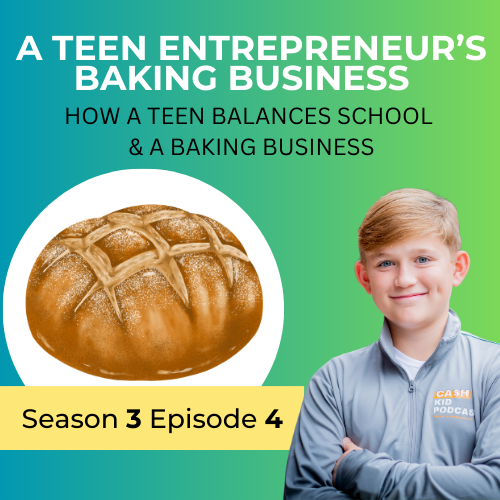
S3 Ep 4A Teen Entrepreneur’s Baking Business: HOW A TEEN BALANCES SCHOOL & A BAKING BUSINESS
A Teen Entrepreneur’s Baking Business: HOW A TEEN BALANCES SCHOOL & A BAKING BUSINESS 00:00:00:00 – Intro Cash Kid: What's up, cash kids? Welcome back to the Cash Kid Podcast! We're in season three, and this season we’re exploring fun and creative ways for kids and teens to learn about money, entrepreneurship, and setting up their own side hustles. Today, we've got an exciting guest—someone who's already turning her passions into profits. Be sure to follow us on Instagram, Facebook, and YouTube @CashKidPodcast or sign up for our mailing list at CashKidPodcast.com. 00:00:27:18 – Introducing the Guest Cash Kid: Today, we’re talking to a high school freshman who’s taking her love for baking and turning it into a business. She’s whipping up more than just sweet treats; she’s making some extra cash on the side! This young entrepreneur is using her skills, creativity, and hustle to run her very own baking business, and we’re thrilled to share her story with you. Stick around to hear how she’s doing it, the challenges she’s faced, and why we consider her a true Cash Kid. 00:01:45:03 – Guest Introduction Cash Kid: Joining us today is Sadie Norris. Sadie is a fellow Cash Kid, using her talents and entrepreneurial mindset to make extra cash. She runs a baking business called "Sadie's Sourdough and Sweets." Just the mention of it is making me hungry! She’s baking up a storm weekly for clients, and we’ve asked her to join us to talk about how she’s using her baking skills to make a profit. 00:01:54:16 – First Question Cash Kid: Welcome to the show, Sadie! First off, tell us a little bit about yourself. 00:02:07:10 – Sadie’s Baking Journey Sadie Norris: I’ve always loved to bake. I make sourdough bread with my mom, strawberry pie by myself, and I use my sister’s chocolate chip cookie recipe. 00:02:18:22 – When Did You Start Baking? Cash Kid: So, when did you start baking and learning how to make these things? 00:02:32:11 – Selling Online Cash Kid: Do you have a website where people can buy your baked goods? 00:02:47:16 – Shipping Cash Kid: How do you ship your items? 00:03:01:20 – Why Start a Baking Business? Cash Kid: What gave you the idea to use your talent and skill to make some extra money? 00:03:23:01 – Other Ways of Making Money Cash Kid: I know baking isn’t your only way to make money because we worked together at the local concession stand this summer. What are some other ways you’ve worked to make money? 00:03:38:14 – Finding Clients Cash Kid: How do you find clients to buy your goods? Do you run ads on Facebook or just post in groups? 00:04:04:23 – Feeling of Earning Your Own Money Cash Kid: How does it feel to make your own money? 00:04:22:07 – Saving vs. Spending Cash Kid: You’re going to be a freshman. Are there any big purchases you’re saving up for, or do you just spend your money as you go? 00:05:08:03 – Advice for Young Entrepreneurs Cash Kid: What advice would you give to kids and teens who are thinking about starting their own side hustle or business as a student? 00:05:21:08 – Balancing School and Business Cash Kid: How do you manage your business while still being a full-time student? 00:05:47:06 – Lessons Learned from Running a Business Cash Kid: What have you learned from running Sadie’s Sourdough and Sweets? 00:06:10:07 – Time Commitment for Sourdough Baking Cash Kid: I’ve heard that sourdough can take a while to make. How long does it take you? And if you get a lot of orders, how do you keep up? 00:06:52:08 – Best-Selling Items Cash Kid: You also sell cookies and pies. What’s your best-selling item? 00:07:05:17 – How to Place an Order Cash Kid: How can people place an order, and how do they get their goods delivered? 00:07:41:01 – Clarifying Pickup and Delivery Cash Kid: Just to clarify, do you do porch pickup, or do you drop off orders? 00:08:04:18 – Pricing Cash Kid: What are your prices for cookies, pies, and sourdough? 00:08:22:22 – Expanding the Business Cash Kid: Do you have plans to expand your business, add more items, or sell online? 00:08:45:05 – Baking Mishaps Cash Kid: Have you ever had a batch of dough go wrong or made a mess in the kitchen? 00:09:19:26 – Friends’ Reactions Cash Kid: What do your friends think about you running this business? 00:09:45:09 – Conclusion Cash Kid: Sadie, we appreciate your time and expertise! Thank you for joining us on the Cash Kid Podcast and boosting the financial knowledge of fellow Cash Kids everywhere. Remember, anyone can be a Cash Kid—you just have to learn how to become one. Cash Kid out! 00:10:04:10 – Disclaimer The information presented represents the views and opinions of the guest. This podcast is for info

S3 Ep 3Balancing Books and Business: A Teen's Tutoring Business Journey
What's up, Cash Kids? Welcome back to the Cash Kid Podcast, where we highlight young entrepreneurs learning how to earn, save, and invest at an early age. We're continuing our special series on kids with a serious entrepreneurial mindset, and today’s guest is a great example of that. **Host:** If you aren't already, be sure to follow us on Instagram, Facebook, and YouTube @cashkidpodcast or sign up for our mailing list at [cashkidpodcast.com](https://www.cashkidpodcast.com). **Host:** Our guest today is a high school sophomore who’s not only super involved in his community but also runs his own tutoring business. Balancing academics, extracurriculars, and a business, this young entrepreneur is making moves to set himself up for financial success. We’re excited to dive into his story and learn how he's managing it all while gaining valuable skills that will serve him for years to come. Stay tuned as we talk about how he’s helping others while building his own path to success, truly embodying the spirit of a “Cash Kid.” **Host:** “So, you've got some cash? Maybe from allowance or that money your grandma gave you for your seventh birthday. Whatever it is, what are you going to do with it? Spend it? Hide it away? Or maybe invest it? Let’s start learning how to make that money grow. Time to learn how to be a Cash Kid.” **Host:** Joining us today is Matthew Farmer, a sophomore in high school who runs his own tutoring business. Welcome to the show, Matthew! First off, tell us a little bit about yourself. **Matthew:** Hi! Yeah, it’s great to be here. My name is Matthew. I am the secretary for Model UN, I have my own tutoring business called Matthew’s Tutoring, and I’m in several other clubs. I do cybersecurity on the side and I’m part of a club called Educators Rising, where we do volunteer work. That’s all about me! **Host:** That’s amazing! So tell us, what are your thoughts on kids using their talents to make money? **Matthew:** I think it’s really important that kids use what they already know to make money. I felt like tutoring was a solid thing for me to do because I knew what was being taught in class and could help kids who were struggling. I thought, why not make a little bit of money off of it? It’s been going really well. I think it’s important for kids to do that because it teaches maturity, responsibility, and how to handle their money better. **Host:** I definitely agree! There’s always someone with a skill who can help others. So, what gave you the idea to start tutoring? **Matthew:** It’s actually a funny story! Someone from the school reached out to me to tutor as a volunteer, and I did it for a couple of months for free. I had a lot of students, and it got to the point where I was spending my own money on notebooks, markers, and supplies. I realized, with all the time and effort I was putting in, I should turn it into my own business because I found out I was really good at it. **Host:** That’s great! So, how do you get clients or find students to tutor? **Matthew:** I mainly advertise on Facebook, and I have a Google business account. If you search for tutoring in my area, I pop up in the search results. Occasionally, I go door to door, but I don’t do that too often. **Host:** How do you manage your time with tutoring and being a full-time student? **Matthew:** I plan everything out using Google Calendar. I set aside time after school for tutoring, and if I’m doing something else, I have people who work for me who can take on students. That way, I can still have time for myself. **Host:** What subjects do you typically tutor? **Matthew:** We tutor in a variety of subjects because we have different tutors who specialize in different areas. I like to focus on math and science, but we also tutor in subjects like Spanish, world history, and area studies. We offer a wide variety of subjects. **Host:** What have you learned from being a tutor, and how has the money you’ve earned helped you? **Matthew:** The money I’ve earned has helped me a lot. I’ve been able to save up to buy a car since I’m 15 and will get my learner’s permit soon. It’s nice to be able to buy things for myself and even buy gifts for my family. I also save and invest my money, which is really important. **Host:** That’s awesome! You mentioned you have employees. How did you get your first one? **Matthew:** I reached out to one of my friends who didn’t have a job or only worked

S3 Ep 2A University that Teaches You How to Become a Millionaire, What!?: Our interview with Millionaire University Podcast
A university that teaches you how to become a millionaire? What?! Our guest on the show will explain, coming up. So, you've got some cash. Maybe from an allowance, or that money your grandma gave you for your 7th birthday. Here you go, sweetie. Woohoo! Thanks, Grandma! Whatever it is, what are you going to do with it? Spend it, hide it away, or maybe invest it? Let's start learning how to make that money grow. Time to learn how to be a cash kid. Welcome back to another episode of the Cash Kid Podcast. I'm so pumped about today's guest on the show. They might have only agreed to come on the show because I'm a kid. And how can you say no to a little kid? But whatever it is, I'll take it. Don't forget, if you aren't already, to follow us on Instagram, YouTube and Facebook. We love interacting with our audience on these platforms. And [00:01:00] be sure to subscribe to our podcast and leave a review from wherever you're listening. Joining me on the show today is Justin and Taro Williams from the Millionaire University Podcast. Their motto is, graduate rich, not broke. I'm hooked just from that. Millionaire University believes that anyone can start and grow a successful business. It's your school for wealth creation and on their show they interview experts from numerous industries to help you start and grow a successful business. Mr. and Mrs. Williams, welcome to the show and first off, tell us a little bit about yourself and your business background. Woohoo! That was horrible, let me do that again. Woohoo! Yeah! That's better. I was like, wow! Man, Cash Kid, we are pumped to be here. I came across your podcast, like Few weeks ago and I couldn't stop listening. I was hooked. I love what you're doing. Uh, yeah, I'm going to have, we're going to have our kids listen to it. So thank you so much for everything that you're sharing with everyone. First of all, we've learned a lot from listening to you. So thank [00:02:00] you. You're welcome. And thanks for having your podcast for me to listen to. So go ahead. Perid, do you want to kick it off and share a little more about, about us and our background? Yeah, I'll give you a little bit of our personal background. So Justin and I, we just celebrated our 20th year anniversary. We got three kids. So we have an 18 year old boy, 16 year old daughter, 14 Uh, we live in California, San Diego area, and we have been running businesses together for about 20 years. 20 years! Can you believe that she's been able to handle me for that long? I'm a lucky lady. I have an awesome husband. Oh, I'm blessing. But yeah, we've had some ups and downs. And if you kind of want to share a little bit more of our business background. Yeah. So I've wanted to have a business my entire life. I just didn't know a whole lot about business, but when I was young, your age, or even younger, I would go to Costco and buy candy and try to sell it. And, um, this is a little, I'm not sure if you're supposed to do this, but my mom would [00:03:00] buy the, like candy bars when we were, you guys today, you just like send out a text and we give you money for your fundraisers at school. But when I was younger, I would sell like candy bars at grocery stores. So my mom would buy the candy bars. As if we were doing like a fundraiser, we'll go sell the candy bars. And, um, we were doing all kinds of stuff. I would raise lovebirds and animals and hand feed them and sell them. So I was always just trying to figure out how I could make money, but I always want to have a business, but they didn't really know a whole lot about business. But my parents were in lots of like multi level marketing things, and they never really made a lot of money in those, but I went to like some events and. Some things that kind of got in my head. Um, when I was in high school, I read a book called Rich Dad, Poor Dad. And that really helped me kind of like change the way I thought about about money and business. So I always knew I wanted to have a business. I always knew I wanted to invest. I always knew I wanted to create wealth and be able to do cool things in my life. [00:04:00] So, um, fast forward, went to college, uh, went to Brigham Young University and had a football scholarship. And that's where I met Tara. And so we met and we ended up getting married and I told her like, I hurt my shoulder and I knew I wasn't going to play football anymore and I knew I wanted to start a business. And at the time I was selling satellite dishes door to door. And after doing research, I was like, Hey, I think we can make like three times as much money if we start our own business doing this instead of doing it for this other company. So I got paired a quitter job as a third grade teacher. And we went for it. And we were pumped. We're going to make a million dollars within a year. And what do you think happened within a y

S3 Ep 1Jobs Kids and Teens Can Do: Kicking Off Season 3 of the Cash Kid Podcast
You don’t have to wait until you’re grown up to start making your own money. Whether you want to save up for something big or just have extra cash for fun, a side hustle could be your answer. But where do you start? Stick around—I’ve got alot the tips you need to become a money-making Cash Kid! Hey, Cash Kids! Welcome back to the Cash Kid Podcast, where we teach you tips and tricks to making, saving, and growing your money as a kid or teen. I’m the Cash Kid, and guess what? We’re kicking off Season 3, and this season is all about…drumroll please… jobs kids can do! That’s right! This season, we’ll explore all sorts of jobs and side hustles you can try to earn some extra cash, even if you’re still in school. From mowing lawns to babysitting, from pet sitting to selling crafts online, we’ve got all the ideas you need to start earning. Whether you want to save up for that new video game, a special pair of shoes, or maybe you’re like me and want to invest in some stocks—this season is for you! ( And we’re definitely gonna talk about stocks here and there… I’m a little angry with Tesla… but yet… I want one.) So, today’s episode is a short one, but I want to give you a sneak peek into what’s coming up in this season: We’ll talk about how to find jobs in your neighborhood—the ones that pay you for your effort and responsibility. We’ll share tips on starting your own mini business—ever thought about setting up a lemonade stand or a dog-walking service? Plus, we’ll even dive into saving, spending, and investing what you earn—because being a Cash Kid isn’t just about making money. It’s about learning how to use it wisely! And don’t worry if you’ve never worked a day in your life—we’ll walk you through it all. We’ll also have some special guests on the show who will share their stories of how they got started and give you tips to help you succeed. Oh, and maybe you could help us out here on the show! If you know a kid or teen who is doing something to make money, we would love to feature them here on the Cash Kid Podcast. Just email us yourself or have a parent reach out to let us know what you’re doing at [email protected]. We want to spotlight as many fellow “Cash Kids” as we can! Next Monday, we’re diving into our interview with another podcast called Millionaire University. It’s going to be our longest episode yet and young and old a like can learn so much from what these two millionaire entrepreneurs have to say about us kids making our own money… and even millions… one day! Alright, Cash Kids, I’ll leave it there for now. So, make sure you subscribe or follow the podcast and follow along so you don’t miss out on any of these great ideas. Also be sure to follow us on Instagram, Facebook or YouTube @cashkidpodcast. Remember, anyone can be a Cash Kid—you just have to learn how to become one. Cash Kid, Out! Disclaimer: The information presented represents the views and opinions of the guests. This show does not intend to provide personal investment advice through this podcast. This content has been made for informational and educational purposes only. To make a full and informed investment decision, we advise you to speak with a financial advisor and for kids, definitely your parents first before investing.

S2 Ep 25It's Over! Reflecting on Financial Lessons and Sneak Peek into Season 3 | Cash Kid Podcast
00:00:00] It's over! Not the podcast, just season two. A talk with the Cash Kid, coming up. So, you've got some cash. Maybe from the allowance, or that money your grandma gave you for your seventh birthday. Here ya go, sweetie! Woohoo! Thanks, Grandma! Whatever it is, what are you gonna do with it? Spend it, hide it away, or maybe invest it? Let's start learning how to make that money grow. Time to learn how to be a cash kid. Welcome back to the Cash Kid Podcast. I'm your host, and today, we're closing out season two with a bang. But don't worry, the podcast isn't over, just the season. We're reflecting on what we've learned. I'll share some personal insights as I continue my financial journey as a Cash Kid. Can you believe it? This is episode 40. We've covered so [00:01:00] much ground this season the last 25 episodes of season 2 our focus was building super financial skills. From understanding a checking and saving account and compound interest to avoiding scams and shopping tips. We've laid the groundwork to set you up for financial success. We live in the information age. All the information is there. It's just taking it and applying it. Which is where we got our motto for the Cash Kid Podcast. Stating how anyone can be a Cash Kid. You just have to learn how to become one. We're all capable of it. I see it already at the age of 12. Our most popular episode, episode 22, Working for Greater Financial Education, featuring Ms. Wanda McAbee from the Alabama Council on Economic Education. She's a true champion for financial literacy. It was inspiring to hear about the strides being made to bring this critical education into our schools. She continues to be a great advocate for what we are doing and help our [00:02:00] mission. So, what have I learned in these last 25 episodes? A lot, actually. Did you know how many adults feel uncomfortable talking about money? Some even graduate from college without a clue on how to manage their finances. I'm 12. That's a bit scary. But, I'm hearing from adults who appreciate our podcast shows and how important financial education is at any age. And let's be real, we don't have excuses anymore. The information is out there, and our mission is to make it accessible for kids and teens, parents, and even grandparents. Together, we're building a healthier mindset around money. And it's crucial, because according to Business Insider, the total household debt in the U. S. hit 17.987 trillion in early 2024. Imagine what this could look like if our generation doesn't get financially smart? What I've learned from my interviews this past [00:03:00] season is how my generation will be one of the ones to not really touch money or have less of an actual emotional attachment to it because we never get the sensation of feeling it. It's all in the cloud, basically. There's also the emerging world of Bitcoin and cryptocurrency. How will that affect my generation? There's just so much to explore. And I'm glad you're here to join me on this Cash Kid journey. I'm actually surprised how many of my friends are starting to invest now as well. I'm getting asked. Weekly about what companies I'm looking at and whether I plan to buy or sell a stock based on the market trends. Now that I think about it, it stresses my parents out some. But, me and my friends are on this journey together, and I love the discussions around stocks at my school. It's definitely a Cash Kid goal to have more kids discussing these topics. And, as we wrap up season two, I'm excited to announce our focus for season three. How kids can start earning money. We're [00:04:00] interviewing young entrepreneurs and exploring various job opportunities for kids and teens. You won't believe the amazing things kids are doing to make money. Whether you're interested in starting your own business, learning about stocks, or just finding a way to make some extra cash. Season 3 will be packed with tips and Information. It's mind blowing to me how many options kids like me really have. So please, if you aren't already, subscribe to our show on whatever platform you're listening from. Follow us on Instagram, Facebook, and YouTube at Cash Kid Podcast. And joining our mailing list can help you keep updated on what's next for the Cash Kid Podcast. You can find all of our handles episodes and our mailing list, also our merch, at our website, cashkidpodcast.com. Also, we would love your support for this show. Podcasts are passion projects, but they come with expenses. So [00:05:00] let's support our mission by grabbing some cash kid merch on our website or by donating through Buy me a Coffee. You don't actually get me an actual coffee. It's just a metaphor to like, donate directly for a cause. The coffee's for my mom, who actually gets up really early to edit th

S2 Ep 24Back to School: Managing Costs and Making Smart Choices/Budgeting Tips for the Smart Student
It’s time to go back to school already. (Sigh) My true feelings about school and the cost of heading back. Coming up! Intro: So, you got some cash, maybe from an allowance? Or, that money your grandma gave you for your seventh birthday. Here ya go, sweetie! Woo hoo! Thanks, Grandma! Whatever it is, what are you gonna do with it? Spend it? Hide it away? Or maybe invest it? Let's start learning how to make that money grow. Time to learn how to be a Cash Kid. Hey, Cash Kids! Welcome back to another episode of the Cash Kid Podcast, where we teach you all the tips and tricks to becoming a money-savvy kid or teen. I’m the Cash Kid and today we’re talking about something that’s on everyone’s mind this time of year—going back to school. But not just any back-to-school talk—we’re diving into how to be mindful of the costs and expenses that come with it. Where I live, we are already in week two of school and the idea for this episode actually came from a story one of my new teachers shared in class. We were having to glue some items into some pages in our binder and he was instructing us how to use the glue…we’re 7th graders so thought it was a little strange but then he shared this story how a boy saw this girl using too much glue on a project, and he asked, “Why do you use so much glue?” And she replied, “Because glue is cheap!” And he said, “It must be nice to live the 3-ply life.” (sound effect after joke) So, whether you can live a 3-ply life or not, you need to listen up to this episode. Whether you’re getting new supplies, new clothes, paying for lunch for yourself – or your friends, or just taking care of school property, there’s a lot to think about. So, let’s jump right in and see how we can be smart with our money as we head back to the classroom. **[Sound Effect: School Bell Rings]** **Segment 1: Back-to-School Shopping** Alright, first up, let’s talk about back-to-school shopping. It’s easy to get carried away with all the cool notebooks, backpacks, and gadgets. But before you start filling up your cart, take a moment to think about what you really need. We’ve addressed these a few times already on the Cash Kid Podcast in understanding the difference between needs and wants. Make a list of the essentials—things like pencils, notebooks, and folders. Then, check to see if you have any supplies left over from last year. Reusing what you already have is a great way to save money. We reused our backpacks, and water bottles from last year for instance. Also, consider setting a budget with your parents. This way, you won’t be tempted to buy things that aren’t necessary. Pro tip: Look for sales and discounts. Many stores offer back-to-school deals, so you can get what you need without breaking the bank. **[Sound Effect: Cash Register Cha-Ching]** **Segment 2: New Clothes and Shoes** Now, let’s talk about something that’s super exciting for a lot of us—new clothes and shoes! I made a deal with my parents if I made straight A’s last year could I have a pair of OnCloud Shoes. I already own 5 shares of their company’s stock too so I wanted a pair. So, maybe you can make a deal like that. Maybe you’ve earned some money over the summer and can asks to share the cost of a pair you really want. Also, it’s always fun to start the school year with a fresh outfit, but it’s also important to be mindful of how much we’re spending. Before you go shopping, take a look at what you already have. Do you really need a whole new wardrobe, or can you mix and match some of your current clothes to create new outfits? Sometimes, just a couple of new pieces can make a big difference. You don’t actually need an entire new wardrobe to go back to school. Well, some my age do as there are kids who grew a lot over the summer. But, that constitutes a need, not a want. When you do go shopping, try to focus on buying quality over quantity. A few well-made items can last you longer and save money in the long run. **[Sound Effect: Clothes Hanger Sliding]** **Segment 3: Lunch Money and Daily Expenses** Next, let’s talk about one of the biggest daily expenses—lunch! I’m not going to lie, when I moved to middle school, the freedom of more choices for lunch was appealing. I started buying a X drink every day at lunch before my Mom got pinged with the need to replenish my lunch money supply within a few weeks and questioned me on what I was buying. Let’s just say… we had to make some cut backs. I also know of lots of other kids who want to be kind an

S2 Ep 23Smart Savings for Big Purchases – Good Money Habits for Kids and Teens
We’re all guilty of it! What am I talking about? Stay tuned! Intro: So, you got some cash, maybe from an allowance? Or, that money your grandma gave you for your seventh birthday. Here ya go, sweetie! Woo hoo! Thanks, Grandma! Whatever it is, what are you gonna do with it? Spend it? Hide it away? Or maybe invest it? Let's start learning how to make that money grow. Time to learn how to be a Cash Kid. Welcome back to the Cash Kid Podcast! I'm your host, the Cash Kid, and today we're diving into a topic that's super important for kids and teens - saving for big purchases. Let’s be honest. We’ve all been guilty of asking our parents for something we want. My six-year-old brother has figured out how to search up toys on Amazon to show my parents to try and convince them to buy him things. My parents then showed him how to add things to a wish list, and that he has to wait until a birthday or has the money to buy it. But, if we don’t want to wait until a birthday or Christmas for the chance we get what we want, how do we learn to save for things we kids and teens want to buy? Whether you're aiming to buy a new gadget, that first car, a new lego set, Lululemon outfit, purse, or even start your own small business, learning how to manage your money wisely is key. So let's get started! First, let's talk about budgeting. Budgeting may sound boring, but it's the foundation of good money habits. A budget helps you keep track of your income and expenses so you can make sure you're saving enough to reach your goal. **[Sound Effect: Cash Register Ding]** Now, let’s say you get $20 a week from your allowance or a part-time job. If you spend all of it on snacks and video games, there won't be anything left for that big purchase you want. Instead, try the 50/30/20 rule. Save 50% of your income, use 30% for needs like school supplies, and spend 20% on fun stuff. Next, let's talk about earning money. Saving is great, but if you want to reach your goal faster, finding ways to earn extra cash is a smart move. Here are some ideas: First, for teens, why not think about getting a part-time job. Many teens work part-time jobs after school or on weekends. It could be at a local store, a fast-food restaurant, or even babysitting. I saw several teens working at a local farmer’s market the other day. I thought that’s a great job for the summer for teens to make money and save for big purchases. Second, what about tutoring? If you're good at a particular subject, consider tutoring younger students. It's a great way to earn money and help others at the same time. There are always parents on Facebook groups looking for tutors to help their kids with a subject they are struggling in, so lots of clients… and money. And then of course for younger kids there’s the good ole lemonade stand and doing household chores. Be mature and ask to talk with your parents to set-up a chore list for you and how you can earn some money around the house or do things for neighbors. You’d be surprised how many are willing to pay kids to do small jobs here and there. We’re actually working on season 3 of the Cash Kid Podcast already where we’re going to be interviewing lots of tweens and teens about ways they are using their skills to make money. We can’t wait to start releasing those episodes later this year! **[Sound Effect: Coins Clinking]** **Host:** Now, let's move on to selling old items. Most of us have toys, clothes, or gadgets that we no longer use. Why not turn those items into cash? We have lots of large lego sets in our house that we’ve put together. My Mom gave us the idea recently to take those apart and resell them used to others. We looked it up, and it’s actually a thing. Also maybe organize a garage sale, or sell old items online through platforms like eBay, Depop, or Facebook Marketplace. Not only will you declutter your space, but you'll also add to your savings goal for that big purchase. Another important habit is setting clear savings goals. It's easier to save when you know exactly what you're saving for. Break down your goal into smaller, manageable milestones. For example, if you want to save $200 for a new bike, aim to save $50 each month for four months. This makes the goal less overwhelming and gives you a sense of achievement as you reach each milestone. I use an app called Greenlight to help with my savings goals. I can always see how much I have in my savings account. When I get paid for a job or chores, I use the 50/30/20 rule we talked about earlier and know before the money even enters my account where it’s going. Seeing your progress can be incredibly motivating and helps you stay on track. &nbs

S2 Ep 22Explaining Inflation: Less Candy Bars for You My Friend!
Understanding Inflation: Why Your Money Buys Less Over Time In this Cash Kid Podcast episode, the concept of inflation is explained in a simple way tailored for kids and teens. The episode covers how inflation affects purchasing power, increases the cost of goods, and impacts daily life and financial goals. Real-world historical examples, such as hyperinflation in 1920s Germany and the Great Inflation in 1970s USA, illustrate the effects of rising prices. Practical tips are provided to help young listeners manage their money, save, and invest wisely to mitigate the impact of inflation on their lives. 00:00 Introduction to Inflation 00:39 Why Inflation Matters 01:39 Historical Examples of Inflation 02:33 Causes of Inflation 03:09 Impact of Inflation on Families and Businesses 04:01 Inflation and Personal Finance for Teens 04:32 Tips to Handle Inflation 05:40 Conclusion and Final Thoughts

S2 Ep 21Are you getting the best deal?: Price Comparison Shopping
My Mom is joining me on the show today? Hello. Welcome back Cash Kid audience! We are so excited every week to see our listener count grow and your involvement in the Cash Kid movement to build the savviest and most educated financial generation ever. I get asked a lot about how people can be a part of the Cash Kid Podcast movement. First, please follow us on one of our social channels at Instagram, Facebook or YouTube. Just search Cash Kid Podcast and start following us. Interact with our content by sharing, liking or commenting. Also, we’ve got merch! Purchasing this merch directly helps us continue to produce this podcast and help market our efforts. And, Join our mailing list. No, we don’t send a lot of emails. Actually, just once a month, but this list is a great way to stay up to date on giveaways and a recap of what we covered on the podcast recently. Alright, let’s jump into today’s discussion. Price comparison shopping. There are always ways parents can be involved in helping their kids learn about finances and I’ve had some instances over the last few months where my parents have stepped in to keep me or my siblings from making a quick purchase to stop and think about it and do some research before buying. One instance is my dad took us fly fishing for the first time back in March. I loved it! And I came home and right away started filling up my cart with brand new fly fishing gear. I wanted to go fly fishing again. My mom, however, was like, “Why are you buying, new gear? Save your money and search trading sites and yard sales for used gear. You’ll be able to spend half the money. You don’t need to buy new, especially at your age.” I knew then I needed to think more about comparing prices and options before I spent my hard-earned money. So, let’s talk about how to get the most bang for your buck! (music interlude) Now, how do you know if you've found the best deal? First, you need to learn the skills of price comparison. This means taking the time to research and compare prices of similar products from different retailers. We can easily do this at home online. Many websites offer price comparison tools that allow you to easily compare prices from different retailers. We use a Chrome extension called “PayPal Honey” that while we shop around online it will bring a pop-up telling us the price comparison difference of this same item across different stories. Then when we go to check-out, it will try out various coupon codes to see if any will work with our purchase. Another is Simplycodes. It’s an app and an extension online to pull up coupon codes and deals. Let’s give a real world example. Let’s say we’re shopping for a new GoTrax Electric Scooter. Let’s first search on Google. You’ll see right away various options from different stores. Our honey and simply codes widgets show up to the side and will tell us what the price difference is between some stores and Honey will actually tell us the price history of this item over time. So, don’t just settle for the first price you see. Another example is this past week my little brother wanted to buy a new snow cone machine. We found one we wanted on Amazon for real cheap. But when we went to check out, the shipping was almost the same price as the item. I then searched around and found…. Cash Kid: Now, I’m going to bring my Mom into this conversation to share a few of her thoughts on price comparison. Welcome to the show, Mom. Mom: Thanks for having me. Cash Kid: What are some skills you were taught or learned around price comparison? Mom: Well, I come from a long line of very frugal women in my life. Until probably my 30s I had what I termed, “Full Price Phobia” which meant I would literally go without something I needed just because I wasn’t willing to pay full price. I’ve grown out of that over the last ten years and we’ll talk more about that later. I can remember though my Mom taking me grocery shopping and it felt like it took forever as we took our time searching through coupons my Mom had clipped to only get those items that were on sale and we had to have a coupon. My grandmother was one of those people who was savvy enough to use coupons and watch sales to go to check out and the store would owe her money. I remember seeing the receipts, it was pretty impressive. Using coupons grocery shopping like that isn’t as big of a thing anymore so it’s been a shift to buying store brand items to save or buying things when it&rsqu

S2 Ep 20Who is Protecting Our Investments?
If we're going to be money-savvy kids, we must know how to watch out for scams and frauds that will cause us to lose our hard-earned money. In this episode of the Cash Kid Podcast, we explore the importance of investment protection and scam prevention with Amanda Senn, the director of the Alabama Securities Commission. Learn about the role of the Securities Commission, real-world examples of its impact on preventing fraud, and how technology affects financial safety. Discover actionable tips on how to safeguard personal information, the significance of financial literacy, and the new financial education requirements for high school students. This informative episode aims to educate kids and adults alike on the essentials of financial protection and literacy. Episode: So, you got some cash, maybe from an allowance? Or, that money your grandma gave you for your seventh birthday. Here ya go, sweetie! Woo hoo! Thanks, Grandma! Whatever it is, what are you gonna do with it? Spend it? Hide it away? Or maybe invest it? Let's start learning how to make that money grow. Time to learn how to be a Cash Kid. Millions of dollars lost to fraudsters. Scams across the states. The elderly and kids are big targets. Who is working to protect our investments? And how can kids my age help stop these scams? Plus, taking a financial course is now a graduation requirement in my state. Yep. We’ve got it all covered in this episode of the Cash Kid Podcast where we went on the road to talk with The Alabama Director of the Securities Commmission, Amanda Senn. I personally, had no idea what this department in our state was doing for us everyday. How there are people behind the scenes working to make sure only legitimate business is being conducted and stop fraudsters so we can protect our hard earned money. If you aren’t already, be sure to follow us on social media @cashkidpodcast. Visit our website at cashkidpodcast.com and join our mailing list. Please, please, leave a review from whatever platform you are listening from and help us spread and grow the Cash Kid mission. Alright, we traveled to Montgomery, Alabama to conduct this interview with Ms. Senn. So let’s jump right into it! Cash Kid: Welcome to the show Ms. Senn. And first off, tell us a little bit about yourself. Amanda Senn: Thank you, Cash Kid. I'm glad to be here. My name is Amanda Senn, and I've been with the Alabama Securities Commission for almost 16 years. Interesting fact, I started as an intern and worked my way up, became general counsel, deputy director enforcement and then last year, succeeded at the long time director,Joe Borg, as the director of this agency. Cash Kid: Yep, that's really interesting. So, what is a securities commission and why do we need it? Amanda Senn: So, a security is more than just a stock, a bond, a debenture. There are a laundry list of things that are covered, but it's essentially anything with a view toward an investment. So, you don't actually have to have a writing. But, our agency enforces laws that, um, directly impact. People who sell securities and Those products that are considered securities. We also serve as a resource to our financial industry in the state. Oftentimes some of the smaller businesses don't always have the tremendous amount of resources that the larger firms have. So we're in a unique position to be able to collect information from across the United States and provide it to our industry folks to let them know what's going on and hopefully keep them apprised of all the trends that are coming out in the financial industry. So can you explain how you advocate for investor protections? Why do, why do we need this protection? Just to be clear, there are two securities regulatory bodies, the Federal Securities Exchange Commission and then the State Securities Commissions. The State Securities Commission, our office here, does have some dual oversight with the federal government, but we are exclusively responsible for certain investment advisor And we retain, um, fraud authority so we can prosecute any cases where we have some crook that comes into our state. Because I'm certain none of our Alabama residents are crooks. They come into our state and, um, and represent, um, That, you know, we have this typically what we'll see. So we have this great investment opportunity and, um, it's going to grow jobs in the state and we need investor capital and I'll put it with my, um, you know, business model and my plan and we'll help grow this industry. What happens in a criminal case is they take the money and they don't do what they told the investor they would do with it. They instead funnel it into personal expenses. Sometimes these crooks buy houses, cars,

S2 Ep 19Overcoming Roadblocks to Teaching Kids Financial Lessons
Overcoming Roadblocks to Teaching Kids Financial Lessons Intro: So, you got some cash, maybe from an allowance? Or, that money your grandma gave you for your seventh birthday. Here ya go, sweetie! Woo hoo! Thanks, Grandma! Whatever it is, what are you gonna do with it? Spend it? Hide it away? Or maybe invest it? Let's start learning how to make that money grow. Time to learn how to be a Cash Kid. What's up Cash Kids and here's a fun fact for y'all. Did you know that 57% of parents have some reluctance to discuss money matters with their kids? And 50% of America's youth will learn less than their parents? That doesn't sound right. So, joining us today is the financial "dadvisor", Anthony Delauney. Mr. Delauney is a certified family financial planner, and a behavioral financial advisor, and the author of the award-winning "Owning the Dash" children's book series. He's joining us today to talk about some of these roadblocks to teaching kids financial lessons today and how a more cashless society can be a challenging way to make money tangible for kids. Plus, we'll discuss his book series and stay tuned to the end for a free giveaway. Welcome to the show, Mr. Delauney, and first off, tell us a little bit about yourself. Anthony Delauney: Thank you so much for having me. Um, so I have been a financial planner for the past 21 years. I started it right out of college, and I discovered pretty early on that I loved helping families. Since I started, I got married, had children, bought my first home, bought another home, went through all those fun stages, and realized that, um, it's hard enough to figure out stuff on your own, but when you've got to figure it out as a family, it gets really crazy. And when it comes to talking to your kids about it, it gets even crazier. Cash Kid: Mr. Delauney, we started to talk about how 57% of parents are reluctant to discuss money matters with their kids. Why do you think this is the case? Anthony Delauney: The simplest answer I can give you is, I have spoken in front of adults, uh, for some time, for 20 plus years, and I am more nervous about this interview speaking to a child than I am speaking to adults. And I think that part of the reason that it's so hard for a lot of kids to learn about these things is because parents don't know what to say or afraid of what to say. And sometimes we're intimidated around even having the conversation. They don't want to mess up for their kids. Cash Kid: That's a great point. Why is it crucial that financial planning be a family affair? Anthony Delauney: It's important because the sooner we start talking about these lessons and kind of getting the real basics of how life works, investing and all that stuff is really important, but really understanding how a budget works, understanding how money works, understanding how to live life on your own, the sooner we can start instilling those lessons and teaching them, just like brushing your teeth. As soon as you start to learn that, it becomes a habit, it becomes a ritual, and you become, it's part of your life. If we don't teach those lessons early enough, it becomes much harder to learn them later in life. And, once kids are on their own, it's, it's, we don't have as much involvement in the lessons that they learn. Cash Kid:: Totally agree with that. And so, what tips do you give parents to start the conversation with their children around money? Anthony Delauney: Sure. So, I think the most important part is, just like this conversation today, You are, you're the cash kid, but you have an intrigue. You have a desire to learn. And most children do have that desire. Even as very young children, kids want to play grownup and want to do the different activities that they mimic their parents, the good and the bad parts of what their parents do. So, um, if we can, when it comes to talking to our children, treat them like many adults, treat, treat them, like respect them. Okay. not judge them. I think that's the biggest part is when it comes to having these discussions, we want to be there for them. Let them know that they can they're in a safe environment where they can talk about things where they can ask questions where they can fail. But if they do fail, parents have to be really mindful of how they react because the kids are not only focusing on the lesson being learned, but how are my friends, my family and others treating me? Based on my response and my questions and my, you know, my mistakes. Cash Kid: I totally agree with that statement. So do you have any financial lessons to teach elementary or teenage children? Anthony Delauney

S2 Ep 18The Cost of a Puppy-Financial Freedom-Financial Mindset
A one-time expense vs an ongoing cost. Do you know the difference? In this financial podcast episode with the Cash Kid, he'll explain why understanding this concept can help us achieve financial freedom and independence earlier in life. This is a way to help the next generation by building wealth instead of debt. Plus, a new segment on the show called "Stock Talk!" Listen in as the Cash Kid helps shape our financial mindset to think before we buy. Want to learn more about the Cash Kid? Visit our website and join our mailing list at: www.cashkidpodcast.com Also, check out our Cash Kid Merch store! Transcript Intro: So, you got some cash, maybe from an allowance? Or, that money your grandma gave you for your seventh birthday. Here ya go, sweetie! Woo hoo! Thanks, Grandma! Whatever it is, what are you gonna do with it? Spend it? Hide it away? Or maybe invest it? Let's start learning how to make that money grow. Time to learn how to be a Cash Kid. Welcome back to season two of the Cash Kid Podcast. Last episode we celebrated our one year anniversary mark and now we are charging forward with more topics and skills to learn and teach. If you aren’t already, please be sure to follow us today on Instagram and Facebook @cashkidpodcast. Also, head to our website and be added to our mailing list. This is a great way to be a part of the Cash Kid movement to empowering the next generation to build super financial skills at a younger age. This week, our episode is “The Cost of a Puppy.” We’re not going to just talk about puppies… even though, that would be cute and fun. Our focus is discussing the difference between a one time purchase and an on-going purchase. Do you know the difference? Many times as kids, because we don’t pay the bills, we might not understand this concept and have to be enlightened by an adult of the difference. But, knowing what’s a one time purchase vs. an on-going purchase is a concept we need to understand, especially before we find ourselves in debt and having to sell back the thing we purchased. Yep, it happens. So, let’s talk about it. What’s considered a one time purchase? A car or a video game? A bike or a cellphone? A puppy or a remote control car? Let’s start with a bike vs. a cellphone. Before I knew better, I used to think you just purchased a phone and that was it. But then my parents talked to be about how a cellphone is not a one time purchase. In fact, just this past week, my nine-year old brother saw this ad where you could purchase an iPhone 14 for just $5.99. He was like, “See Mom, I can afford that?” My Mom then explained to him to look at the fine print. Yeah, it’s that much smaller writing under the large discount price in bold that states it’s $5.99 a month for the next 36 months under a contract with that cellphone carrier . Then Mom explained how you’ll also need a cell plan to go with that which can cost upwards of $30 dollars or more per month. See a cellphone, while to a kid it just seems like an object you buy once and that’s it, is actually an on-going monthly expense… usually for your parents at this age. My brother’s not getting a phone… Now a bike on th other hand, it’s a one-time purchase. Except for the time I wrecked mine and we had to spend a little extra to get it fixed. But asking your parents for a bike is different. There may be some repair costs at times. Like a new tire or brake, but it doesn’t have an ongoing expense like a cellphone. We’re going to talk about that puppy and the debate in our house over having one, coming up. More purchase comparisons on the way. (Music interlude) It’s time for a new segment on the show called “Stock Talk.” If you follow us on social media, you’ll see I like to talk about stocks. Following different companies stock prices, what’s going on in the news about their company, and seeing the prices rise and fall excites me. I’ve found more and more of my peers asking me about the stocks I’m interested in. Why I’m invested in them? And how do I invest? Now, I’m not an advisor, but I’m trying to teach my friends and our audience how you can research companies and stock yourself. So, each episode I’ll hit on a stock either I’m watching or researching and why. This week, since we just finished talking about a cellphone, let’s look at Apple. Apple became a publicly traded company on December 12th, 1980. Their stock price started at $22.

S2 Ep 17One Year of the Cash Kid!
It's our anniversary! We're celebrating our first anniversary of starting this podcast with a talk with the Cash Kid on what he's learned from this experience, a recap of this last year, and what's in store for the future of the Cash Kid Podcast. Plus, a couple of announcements near the end of the episode (and bloopers!) Listen in, the Cash Kid Podcast is underway. Learn more about your ad choices. Visit megaphone.fm/adchoices Transcript Intro: It’s our anniversary. This week we are celebrating the 1-year anniversary of the Cash Kid Podcast. We could not be more excited to have you join us on this financial journey as we work to build super financial skills for the next generation. How did this podcast get started? Where are we headed? And what I have I learned from this experience? Plus, some bloopers to share from recording this last year. And stay tuned to the end for two special announcements as well. We’ll discuss it in this special anniversary episode. Stay tuned. The Cash Kid Podcast is underway! Intro tease: So, you got some cash, maybe from an allowance? Or, that money your grandma gave you for your seventh birthday. Here ya go, sweetie! Woo hoo! Thanks, Grandma! Whatever it is, what are you gonna do with it? Spend it? Hide it away? Or maybe invest it? Let's start learning how to make that money grow. Time to learn how to be a Cash Kid. Welcome back to this special episode of the Cash Kid Podcast. I can’t believe it’s already been one year since we launched this podcast. This podcast started as part of a school project. In the 5th grade, I was asked to create a passion project. And for some reason, starting a podcast came to mind. The first four episodes were really just me talking about what I’m passionate about and scripts I wrote while in class. We may actually go back soon and revise those some as they were written before we had a clear mission statement… or knew we were going to continue the podcast after the school project. We got such great feedback on our first episodes and were told by many we should continue the podcast but we needed a clear mission for our audience. So, after producing 7 episodes for 7 weeks my Mom said, “I think we need to seek some advice and get some help.” And so, we used my summer break to meet with a podcasting expert and get some guidance on what steps we needed to take to grow this podcast. We set-up our website, cashkidpodcast.com, and a YouTube channel to publish our episodes. We started an Instagram page as well. But the main focus, was putting a plan together of where we wanted to take the podcast. The mission was clear to me. I wanted to teach kids and adults the financial literacy skills they need to start saving and investing money early. My goal is to help my generation grow the greatest wealth with a slow and steady approach and be the most financially literate. No get rich schemes here. Since then we completed season 1 with 15 episodes. Then we launched season 2 which was all about building “Super Financial Skills.” This is currently episode 17 of that series. So far, we’ve interviewed 15 different guests on the show that represent a wide range of individuals from a kid running his own car detailing business, to a financial advisor, tax expert, a high school finance teacher, book authors, and CPAs running their own training courses to help others get out of debt and start investing. I have learned so much! And it’s affected how I invest and think about money. What have I learned? I’ve learned that running a podcast is harder than it looks. There are numerous aspects beyond just recording audio. And talking into a microphone takes some training. There may be a few blooper clips added to the end of this episode. My Mom likes to torture me and save them. So stayed tuned to the end. She said I’ve gotta learn to laugh at myself when I make these mistakes. Running a podcast has taught me you must remain persistent and continue to think outside the box. It takes planning and learning new skills. I’ve had to learn how to write more and write faster than others my age. I’ve had to learn how to communicate confidently on-camera, plus interview skills, and editing skills in creating content to post on our social channels. We also went from producing audio only podcasts to now an audio and video format these last two months. Where are we headed now? In future episodes, we’re going to focus on ways kids can make money. We plan to interview what we consider to be fellow Cash Kids who are using their skills and entrepreneurial mindset to make some cash, while still kids. We’ll continue to build super financial skills by

S2 Ep 16Wealthy Kids Investment Club
In this episode, we capture an inspiring interview with Maya Corbic, CPA, who started the "Wealthy Kids Investment Club" to help parents and kids learn how to be smart with money early. Hear her incredible life story and what she's doing to equip parents with the tools to raise money smart kids. Stay tuned, the Cash Kid Podcast is underway! Learn more about your ad choices. Visit megaphone.fm/adchoices Transcript Wealthy Kids Investment Club Teach.Kids.Money It only takes one person to change the generational wealth trajectory of the family. Let that person be you. Welcome to another episode of the Cash Kid Podcast, where we focus on building super financial literacy skills for kids and teens to build a greater financial future at a younger age. If you aren't already, follow us on social media at CashKid Podcast and subscribe to our mailing list at CashKidPodcast. com. We have another special guest on the show today who works to change the generational wealth trajectory of families. Parents, you'll walk away from this episode feeling you have the resources to change your financial journey and that of your children. Stay tuned. The CashKid Podcast is underway. So, you got some cash. Maybe from an allowance, or that money your grandma gave you [00:01:00] for your 7th birthday. Here you go, sweetie! Woohoo! Thanks, Grandma! Whatever it is, what are you going to do with it? Spend it? Hide it away? Or maybe invest it? Let's start learning how to make that money grow. Time to learn how to be a cash kid. Joining us today is Mrs. Maya Corbic. Mrs. Corbic is the founder of Wealthy Kids Club from her Instagram page, teach. kids. money, where she has over 133, 000 followers and growing. She provides some solid advice and steps parents can take to teach their kids about money and investing together. Mrs. Corbic, welcome to the show. Cash Kid: And first off, tell us a little bit about yourself. Maya Corbic: Okay. Well, thank you for that lovely introduction and thank you for having me on the show. So a little bit about me, I am first generation immigrant. [00:02:00] I immigrated from war toward Bosnia when I was almost 15, uh, with both of my parents and my brother, we lost everything in the war and we immigrated with two suitcases and 50 and I lived in government shelters, government housing, and when I was a teenager, I even had two part time jobs. So, um, I learned how to hustle and I worked very hard, um, to, you know, become, you know, in a better financial position. So I became a CPA and, um, when I got married, I had some student loans and so did my husband and we ended up paying off all of our debt, uh, including our mortgage by the time I was 32, because we were very disciplined with money. And at that Point in time, I, um, decided that it was really important to start teaching my own children about money. Uh, but also being a CPA, I learned from some of my clients that they were struggling with money. So I realized that the [00:03:00] root of all that struggle really started in childhood because a lot of the clients that I had were struggling with money because nobody ever taught them about money when they were growing up. Cash Kid: That's really an interesting story, and we definitely agree with you on your point. So, where did you get the idea to start Wealthy Kids Club? Maya Corbic: So, Wealthy Kids Club only, uh, was only started about three years ago. Uh, before that, for the past 11 years, I have been teaching parents about money, by going to schools and doing workshops. But then with pandemic, all that changed because I wasn't able to go into schools anymore. So I started doing more online workshops and still access the parents and classrooms that way. But then, um, I also started my, uh, Instagram account, teach. kids. money. And. When I was actually posting on that account, I realized that a lot of parents were coming [00:04:00] back to me because they were struggling with, uh, investing and how to teach their children to invest. Um, a lot of them were able to teach their kids, you know, the difference between needs and wants and budgeting. But they just did not know how to teach investing. And I realized that this is where a lot of parents needed help. They needed to learn some of the basics themselves so that they could teach those basics to their kids. And that's how Wealthy Kids Investment Club was born. Um, and, um, you know, I started that membership. I tried to make it accessible to everybody, um, regardless of where they are, um, you know, in the globe. Cash Kid: Yeah, tell us about your club and what parents and kids can expect to learn. Maya Corbic: So the club, uh, it's actually currently undergoing a big facelift, uh, but, uh, essentially in the club, you start off as somebody who is intimidated, uh, an intimidated investor, and then you learn some [00:05:00] basics, uh, in terms of what investing really is and you That's not as sc

S2 Ep 15Girls On The Money (And Boys too)!
Live frugally, save abundantly, invest intelligently. Join us as we interview special guest Mabel Nunez, the founder of Girlsonthemoney.com, where she shares her investing success journey and how she's helping others boost their investing knowledge. The Cash Kid Podcast is underway! Learn more about your ad choices. Visit megaphone.fm/adchoices Transcript Live frugally, save abundantly, invest intelligently. That’s our guests’ motto on the show today. Welcome back to another episode of the Cash Kid Podcast where we continue to build super financial skills. If you aren’t, please be sure to follow us on social media. Just search Cash Kid Podcast or on our website at CashKidPodcast.com. Cash Kid’s we’ve got a special guest on the show whose story is inspiring and motivating to learn how to invest. Parents, there’s an investing course for you to learn about as well. Listen up! The Cash Kid Podcast is underway. Cash Kids, we've got a special guest on the show whose story is inspiring and motivating to learn how to invest. Parents, there's an investing course for you to learn about as well. Listen up, the Cash Kid podcast is underway. So, you got some cash, maybe from an allowance? Or, that money your grandma gave you for your seventh birthday. Here ya go, sweetie! Woo hoo! Thanks, Grandma! Whatever it is, what are you gonna do with it? Spend it? Hide it away? Or maybe invest it? Let's start learning how to make that money grow. Time to learn how to be a Cash Kid. Cash Kid: Joining us today is Mrs. Mabel Nunez. Mabel Nunez is the founder and CEO of Girls on the Money, with over 60, 000 on her Instagram page alone, and 10, 000 members on her Facebook She's a blogger and investing educator whose mission is to teach everyday people how they can intelligently invest too. Welcome to the show. And first off, tell us a little bit about yourself and your story. Mabel Nunez: Hi, Cash Kid. I'm very excited to be here inviting me and I guess I can say I can start with the fact that I wasn't born in the United States. I was born in an island in the Caribbean called the Dominican Republic and I moved to the States when I was 9 years old and from a very young age. My parents always taught me. The importance of saving money and, you know, being careful with credit cards, things like that. Um, but it wasn't until I went to college my, my last year of college, my senior year when I discovered the stock market and investing and I. You know, fell in love with it and became obsessed with it. Um, but, you know, it wasn't something that I learned at home. I learned that when I was already in school, but I'm very grateful and blessed that even though I didn't know how to invest from a young age, I still kind of knew the basics of personal finance from my parents. I grew up in a very, um. Um, I guess poor household because we were immigrants. So we had limited resources and things like that. So we had to kind of make do with what we had. And then later on when I, you know, made my own money and started investing, I discovered, you know, this whole new world. So that's kind of how things started off. Cash Kid: That's really interesting. Tell us about Girls on the Money and why you started this site. Mabel Nunez: So I started Girls on the Money because when I started to invest, um, And I became obsessed with it, like I said, I noticed that a lot of my friends, my female friends weren't into investing, or they found investing intimidating, or they were, they thought it was too complicated. And most of the people that I will talk to about stocks and funds will be my male friends, my guy friends. Because they were the ones into it. Um, so I thought, you know, there was a disconnect there. You know, I wondered why weren't more women talking about investing? Why were they so scared of it? So it kind of like, you know, it was like a light bulb moment for me to, okay, I need to create a community or a platform that increases the confidence of women to start investing or, you know, girls. Even though, like I say on my website, I don't discriminate if like, you know, guys want to learn too. Like that's fine. I welcome them. But my, the majority of the people that I target are female. Cash Kid: Yeah. I love how on your site you talk about investing being your passion. That's how I started my podcast as it was part of a passion project. We were assigned that school. Why is investing your passion? Mabel Nunez: So investing is my passion because, um, I guess it first started with my professor, my college professor that I mentioned before my senior year. He, uh, kind of explained to us how anybody with any income can becom

S2 Ep 14Kids Buying Stocks and Investing
Can kids start investing in stocks? Absolutely! The world has changed and kids at a younger age can start investing some of that allowance and birthday cash to start growing their money earlier in life. Learning this financial term as kids can have a huge impact on the financial future of any generation. Tune in to hear how the Cash Kid invests and how to be an informed investor. The Cash Kid Podcast is underway! Learn more about your ad choices. Visit megaphone.fm/adchoices Transcript Alright, today Cash Kids, we are diving into one of my favorite topics: Investing and stocks. What does investing mean? What’s a way a kid can invest and purchase stocks? Keep listening. We’ll answer those questions and more coming up. Let’s learn how to grow your money using these essential financial tools. Stay tuned the Cash Kid podcast is underway! Intro tease: So you’ve got some cash. Maybe from an allowance, or that money your grandma gave you for your 7th birthday. Here you go, sweetie. Thanks, Grandma. Whatever it is, what are you going to do with it? Spend it, hide it away… or maybe invest it? Let’s start learning how to make that money grow. Time to learn how to be a cash kid. Since launching this podcast almost a year ago now, I get asked a lot about investing, what stocks I like, and where do I invest. My mom says there are some odd conversations that happen in our house at times regarding stocks. I don’t know what she’s talking about. [Mom: What do you mean? I’ll be cooking dinner only to turn around and you and your 9-year-old brother are discussing the gains and losses of a company over the last six months and whether not now is the time to buy. I’m sorry, it may be the new norm in our house… but that’s not the norm in other homes. I mean, how do I write that down in a baby book. Kids discussed Apple stock today. Looks like Johnnie is finally ready to buy that first stock. I mean, come on, it’s a little surreal at times in our house.] Well, I’m working to make it more the norm Mom. If you haven’t figured it out by now episode 28, I like stocks and any way to make money grow without doing much. So, let’s start with the basics. What does the term investing even mean? Investing is when you spend money with the expectation of achieving a profit. Lots of our parents like to watch these HGTV home renovation shows. What are these folks mostly working towards when they “invest” in buying one of these fixer upper homes? They are looking for that investment (or money spent into buying the home) to fix it up and then make a profit. In the stock market, when you invest, you are putting money into a company or companies with the expectation you’ll receive a profit in return down the road. I like the way wikipedia describes an investment as a commitment of money to receive more money later. So, one thing to remember as kids, investing is not a short term game. You are putting money in an account to let it sit and grow overtime. My focus on the Cash Kid Podcast is to help get this concept across to my peers that “time” is exactly what’s on our side. Now, how do I invest? I get asked this a lot. I use an app called Greenlight. Greenlight is a debit card and money app for families, that’s managed by parents. It gives parents tools to manage and monitor their kids spending. You can transfer money straight from a checking account to the kids account on Greenlight. You can pay an allowance this way, assign chores, set savings goals, donate to charity… and my personal favorite… buy stocks. Within the app I can research stocks and ETFs, and mutual funds. I can view charts, buy and sell stocks see how much the stocks are gaining or losing money. The accessibility on this app is amazing. Also some shares can cost hundreds to thousands of dollars and some kids just don’t have that kind of money. So on Greenlight, you can buy partial shares so you always can invest even when you don’t have the money to buy a full stock. I do all my buying and selling within the app. Since then, I’ve had sometime already to watch the stock prices go up and down and gotten more patient with what I buy and sell. I’m reading books more and doing more research to save up for stocks I want to be able afford stocks I feel will give me a profit from my investment. My parents for Christmas this past year gifted me a subscription to the Wall Street Journal and Barron’s. I get up some mornings just to read about different stocks and businesses to see what’s happening. Part of being an investor is being informed of what’s going on in the world. Mrs. Wanda McAbee, the Executive Director of the Alabama Council on Economic Education, addressed this in a previous episode in regards to playing the stock market game. Here’
S2 Ep 13Debt Free Millennials
We have another special guest on the Cash Kid Podcast! Justine Nelson is a book author and founder of DebtFreeMillennials.com. She published a book called "Investing for Kids Activity Book" which has 65 activities on how to teach your kids about money and how to start investing it early. The Cash Kid and Justine are two people trying to change the financial path of their peers. Listen in, the Cash Kid Podcast is underway! Learn more about your ad choices. Visit megaphone.fm/adchoices Transcript Cash Kids, we have another special guest on the Cash Kid Podcast today. Just like I’m trying to reach my generation to build a better financial future, she’s dedicated to changing her financial direction of her. She’s someone who self-taught herself to become a financial expert and wrote a book to help us Cash Kids do the same. Stay tuned…The Cash Kid Podcast is underway! Intro tease: So you’ve got some cash. Maybe from an allowance, or that money your grandma gave you for your 7th birthday. Here you go, sweetie. Thanks, Grandma. Whatever it is, what are you going to do with it? Spend it, hide it away… or maybe invest it? Let’s start learning how to make that money grow. Time to learn how to be a cash kid. Joining us today is Mrs. Justine Nelson. Justine is the founder of Debt Free Millennials and YouTube channel aimed at helping millennials improve their financial situation. She is here to tell us about her financial education book for kids, what she's doing today to help fight for more financial education, getting millennials out of debt, and much more! Welcome to the show. And first off, tell us a little bit about yourself. Justine Nelson: Thank you so much for having me. This is so awesome. Glad to be on the show. My name is Justine Nelson. I am the founder of Debt Free Millennials and I help millennials crush debt achieve financial confidence that leads to more fun and fewer payments My journey with personal finance actually started when I was a sophomore in college, I was doing my homework at the time when I got a phone call from my mom. And she told me that she and my dad could no longer support me financially through school because she had been laid off from her job. So, I was really panicked on what to do, and trying to figure out how he's going to afford college tuition. So I did what any other college student did at that time, which was to walk down to the student financial aid office and asked to take out more student loans. By the time that I had graduated, I was $35,000 in student loan debt. And I was just making $10 an hour at my very first job, which wasn't a lot of money to cover my student loan payment, and do all of the things that I wanted to do. After college, I wanted to live in an urban city and a high rise apartment. I wanted to go out for sushi and have lots of fun traveling. And I wasn't sure how I was going to do that, with so much student loan debt. So it was then that I decided that I needed to take financial ownership and pay it off really, really fast. Cash Kid: We purchased your book “Investing for Kids Activity Book” last year and loved it. We even inspired some of our previous episodes based off the boo. Tell us why you chose to write this book. Justine Nelson: I chose to write investing for kids the activity book because when I was 10, 12 years old, I didn't have a really good understanding of money. In fact, I thought money was a little mysterious. I had no idea how to earn it, how to keep it. And the only basic teaching principles that I knew from my school was how to write a physical paper check. I don't know if you remember those. But that was the only teaching that I had from school was learning how to write a physical check, and how to cash that in. And really finances so much more than than writing physical checks. And I'm not sure if a lot of people do that anymore. So money is constantly evolving. And I wanted to write this book as a way to guide individuals and kids on how to access money, invest it and grow it. Cash Kid: So tell us about your website and YouTube channel Debt Free Millennials. Why did you start this initiative? Justine Nelson: Yeah, so going back to my story. I eventually paid off all of my student loan debt in two years, five months on a $37,000 salary. And through that journey, in my experience of being very disciplined with my budget, learning how to invest and really making strides in my career to earn more money, I found more and more of my friends and family were coming to me for financial advice. So, I decided to start a business out of it. And one thing that really attracted me about running my own business was that I could use whatever platform that I wanted, which I love that you're using a podcast. And for me, a YouTube channel was the perfect match for somebody who enjoys being on camera talking about finan

S2 Ep 12Money, Makes Money, Makes Money
Is your money making you more money? If it's not, you are harnessing the power of our next financial term, "compound interest." In this episode, we brought in book author and financial expert Brian Feroldi to explain to us how compound interest works. Not understanding this term could cost us all big bucks down the road. Don't miss out and listen in to find out how money, makes money, makes money in this episode of the Cash Kid Podcast. Learn more about your ad choices. Visit megaphone.fm/adchoices Transcript Welcome back Cash Kids! Alright, I’m going to get serious… listen up. We’ve hit on many financial terms this season already. But today. Today’s term is one that many, many, lose lots of money without even realizing it because they don’t understand how it works. If we Cash Kids can understand the power of “compound interest” early in life… guess what, we’ll have more later in life. And I’ve got a great financial expert and book author here to break it all down for us. Brian Feroldi is the author of the book, “Why Does the Stock Market Go Up?” We loved this book in our house and Brian agreed to come on the show to talk about it. Stay tuned, please… it’s a matter of big bucks down the road. The Cash Kid Podcast is underway! Intro tease: So you’ve got some cash. Maybe from an allowance, or that money your grandma gave you for your 7th birthday. Here you go, sweetie. Thanks, Grandma. Whatever it is, what are you going to do with it? Spend it, hide it away… or maybe invest it? Let’s start learning how to make that money grow. Time to learn how to be a cash kid. So joining us today is Mr. Brian Feroldi. Brian is a financial educator, podcaster, YouTuber, speaker, writer and author. Mr. Brian’s vision is to spread financial wellness, which is exactly what us Cash Kids need. Welcome to the show Brian. And first off, tell us a little bit about yourself. Brian Feroldi: Well, thank you for having me. It is a true honor to be here. I myself graduated from college in 2004 and I really put that down as the mark of the start of my money journey. Prior to that, I was taught absolutely nothing about about money growing up, despite graduating with a degree in business. I was taught next to nothing about personal finances. I was taught next to nothing about the stock market, about compound interest, about the basic principles of spend less than you earn, invest the difference, and grow your wealth. Now, after college, my dad handed me a copy of a very popular book back in 2004 called The Rich Dad Poor Dad, by Robert Kiyosaki. And that book was the first book I ever read that opened my eyes up to the idea that anybody can build wealth. Anybody can become wealthy in one generation. And importantly, rich people think differently about money than middle class people, and poor people do. And that book opened my eyes to the power of compound interest, introduced me to people like Warren Buffett and Peter Lynch. And that really kickstarted a love affair with everything related to money, personal finance and investing that continues to this day. So for the last 20 years since I launched that book, I have been doing everything in my power to educate myself and take that information, to educate other people about how to do better with their money. Cash Kid: All right. That's amazing. So first off, tell us about your book, “Why does the stock market go up?” Brian Feroldi: So I have been voraciously reading books about money and investing for, again, the last 20 years. One question that I always had about investing in the stock market is that lots of books I read essentially said the same thing. The stock market is the greatest wealth creation machine ever. The stock market grows at a compound annual growth rate of about 10% per year. And every time the stock market crashes, don't worry, that's the time to buy. The stock market will always come back. I bought that hook line and sinker. However, I didn't understand a fundamental question despite reading those great books. And that was I could see the long term chart that showed the U.S. stock market going up and to the right continually for decade after decade. But it was never explained to me why that happens. And I was always taught as a kid, what goes up must come down. So every time the stock market crashed, as it did in the year 2000, as it did in the year 2008, as it did in the year 2020, I always thought, Well, that's it. It's crashing. Why on earth would this stock market come back and continue on to a new high? So I wanted to answer that question fundamentally for myself and really get into the crux of why. Why does the stock market go up? So that was the that was the reason that I wrote the b
S2 Ep 11Pay Taxes, What!?!
We gotta pay taxes, what!?! Many kids are shocked to learn just how much is taken out of that first paycheck. In this episode, we break down the basics of what are taxes, why we pay them, and what's with all those "W" forms. Oh, and who is Uncle Sam? Let's talk taxes in this episode of the Cash Kid Podcast. Learn more about your ad choices. Visit megaphone.fm/adchoices Transcript There are only two certains in life…. death and taxes. - Said everyone as I’m told it’s a pretty old joke. What are taxes, who pays them, why are there so many W forms involved, and why do we pay taxes? Oh, and who is Uncle Sam? Well, you’re about to find out in this episode of the Cash Kid Podcast. The Cash Kid Podcast is underway! Intro tease: So you’ve got some cash. Maybe from an allowance, or that money your grandma gave you for your 7th birthday. Here you go, sweetie. Thanks, Grandma. Whatever it is, what are you going to do with it? Spend it, hide it away… or maybe invest it? Let’s start learning how to make that money grow. Time to learn how to be a cash kid. Okay. So let's talk about taxes. I hear this topic causes a lot of anxiety in adults. I'm hoping we can educate my generation about it earlier to have a better understanding of it and maybe develop less anxiety. Joining us today is Joe Proffitt with Dark Horse CPAs. Mr. Proffitt, welcome to the show. Joe Proffitt: Hey, great to be here, Cash Kid. I very much appreciate the time. And I agree if we can start talking about taxes younger, maybe I wouldn't have freaked out about them when I got to be an adult as well. Cash Kid: Yeah. So welcome. And first off, just tell us a little bit about yourself. Joe Proffitt: Sure. I'm a CPA based out of Little Rock, Arkansas. I work with clients all over the country, from small business owners to individuals that don't necessarily own a business but need help with their tax planning and filing. And the main thing for people to do what I do. Basically, the U.S. tax system is complicated and sometimes you need a little bit of help and things get to be more than you can handle on your own. Cash Kid: Yeah. So what does Dark Horse CPAs do for its clients? Joe Proffitt: Great question. So Dark Horse specializes in serving small business owners. Specifically, we provide tax and accounting services ranging from basic bookkeeping to what we refer to as CFO engagements. We essentially help business owners compile their financial information and put it into a format that allows them to know where they're at financially to help them with projections as needed, or on the side of the tax work we do, compliance work with the basic business tax filings or just essentially try to help make sense of the really complicated tax structure we have here in the U.S.. Cash Kid: All right. Let's talk about taxes, Mr. Proffitt. We’ll, start simple. What is the basic reason why we pay taxes? Joe Proffitt: Great question again. So taxes provide money to the government so that they can provide services for we the people. In an ideal world, taxes provide a range of services, whether it be assistance for individuals needing a little bit more help provides money for constructed roadways. Essentially, taxes are the way the government gets money from its citizens so that it can continue to function as the government. Cash Kid: What all do we pay taxes on? Joe Proffitt: Pretty much anything that you're going to spend any time you spend money or receive money, you're probably going to be subject to some sort of tax. So you get sales tax on groceries, cars. You have various tax for major purchases like a home purchase, you pay property taxes, or when you do own various pieces of personal property. So the major categories of taxes across the U.S. are going to be your income tax, your property taxes and your sales are what we refer to as excise taxes. And the sales and excise is based on things that you actually go out to purchase and are based on the usage that way. Cash Kid: In episode one of of season 2, a financial teacher at a local high school stated a lot of his students were shocked when they got their first pay check to see how much they paid in taxes, leaving them with a lot less than what they thought they would take home. Can we break down the different taxes in what we pay for and why we pay them from our paycheck? Joe Proffitt: Absolutely. And I remember it hurt my feelings the first paycheck I got and when I was a kid, seeing how much they hold out. And so when you receive any anyone that goes out and works for an employer and receives a paycheck, they're going to have your federal income tax withholding, state where it actually occurs depending on where you live. And then you're going to have additional taxes that we refer to as FICA. And what FICA is, that’s FICA, is the Social Security and Medicare tax withholdings. Now,

S2 Ep 10What to do with that Christmas Cash.
Got some cash for Christmas and wondering how to spend it. We've got seven ideas on how to stretch that money, make it grow, and set yourself up for a better financial future in this special edition episode of the Cash Kid Podcast. Happy Holidays! Learn more about your ad choices. Visit megaphone.fm/adchoices Transcript Cash Kid Christmas Script What’s up Cash Kids? Maybe where you are it’s snowing outside, or maybe it’s 85 degrees and sunny… But wherever you are, I bet there are holiday decorations nearby and you and your family and friends are getting ready for overeating and celebrations! Here at the Cash Kid Podcast we are wrapping up a great year and getting ready for a well deserved holiday break… After all “it’s the most wonderful time of the year,” right? But I’m here to tell you today why it’s the “Most wonderful time of the year to make some good financial decisions.” Ideas on what to do with that Christmas cash, coming up. INTRO Welcome back to the Cash Kid Podcast special episode edition. This is our first episode that’s also in video format. Listen where you like, but you can catch the full video episode on your YouTube page. Just search Cash Kid Podcast. So, like I said, it’s the most wonderful time of the year to make some good financial decisions. Don’t believe me… Just listen up as we revisit some important topics from other 2023 Cash Kid Podcast episodes. Idea number 1: Treat yourself… but don’t blow it If you get cash for Christmas, take time to consider your options and don’t blow it all right away. Sure, it’s ok to spend some of it - treat yourself. Be sure to go back and listen to episode 7 titled “Needs, Loves, Likes, Wants” for a refresh on spending that cash wisely. Idea number 2: Take advantage of sales There are plenty of deals before Christmas… but after Christmas is a great time to snag the things you've been eyeing on sale. Whether it's a new pair of shoes, a fancy kitchen gadget, or the latest tech toy, there are plenty of deals to be had. One tip for finding the best prices is to search multiple sites. Don't just settle for the first deal you come across. Check out different retailers and compare prices to make sure you're getting the best possible discount. Idea number 3: Coupon Codes Another way to save even more money is to use promo codes. These codes can often be found with a quick Google search. Simply type in the name of the retailer you're shopping with and "promo code" to see if there are any discounts available. Sometimes you'll find a code for free shipping, a percentage off your purchase, or even a free gift with your purchase. It's a small extra step that can make a big difference in your overall savings. Idea number 4: Open a savings account If you haven’t opened a savings account yet, consider now a great time to do it. Some offer up to 5% in interest a month. Let’s listen to a clip from the checking versus savings episode. Cash Kid: At what age can someone open a savings account? Amy Greer: So the good news is parents can open one for you at any age. You can open one at birth and they can start contributing to it and grandparents can start contributing to it for the for a child individually to open one on their own. It actually goes in accordance with state laws and federal laws. That is typically around 18. Cash Kid: What would be a reason to start a savings account as a kid? Amy Greer: Well, there's so many reasons to choose from for that. Like I mentioned earlier, it can help you learn responsibility by setting aside some percentage of all the money that you make. If you just start the habit of moving some of that into your savings every time you get money, whether it's paid for a service you provided or paid for a good you made or an allowance, just set aside some of that in a savings. And there's also many big, big future events that you can start saving for and help your parents out like cars and college and maybe one day weddings. Many things that you can start saving for in the future. It's never too early to start saving. Idea number 5: Invest it! There are several different ways kids today can start investing. I use an app called Greenlight to purchase stocks I want. Take some of that cash and make a commitment to watch it grow this coming year. Here’s an example. A year ago, I purchased a stock in Apple, Amazon, and Tesla. These are companies I spent time researching and felt would bring me a return on my investment. Well, check it out a year later. Amazon is up 81%. These stocks have all grown and so has my money. So check out an app like

S2 Ep 9Investing in Cryptocurrency- Part 2
What's up with cryptocurrency? Do you know enough about this new-age digital currency that never rests? Find out more about why my generation needs to understand this financial concept in part 2 of "What is Cryptocurrency?" on the Cash Kid podcast! Learn more about your ad choices. Visit megaphone.fm/adchoices Transcript “I really wish I would have started investing in the stock market at your age and learning the stock market, because I didn't start learning about it until I was just graduated from college.” Welcome back to episode 9 season 2 of the Cash Kid Podcast. Whether you're listening from Amazon Music, Apple Podcasts, Spotify, the cashkidpodcast website or wherever you like to listen from, we’re glad you are here! Today, we are jumping right back into part 2 of our discussion on Cryptocurrency. If you haven’t already, be sure and listen to part 1 first. There is so much confusion and unknown on this topic, we decided to split it into two episodes. Did you know that cryptocurrency trading is open 24/7 365 days a year? The market never closes! What’s the future of cryptocurrency? What is Bitcoin? And what should my generation know about investing in this new-age currency? Those answers and more coming up. The Cash Kid Podcast is underway! Intro tease: So you’ve got some cash. Maybe from an allowance, or that money your grandma gave you for your 7th birthday. Here you go, sweetie. Thanks, Grandma. Whatever it is, what are you going to do with it? Spend it, hide it away… or maybe invest it? Let’s start learning how to make that money grow. Time to learn how to be a cash kid. Joining us again today is Mr. Grant Newell who is an entrepreneur and a financial professional. He is the co-founder and CEO of Abundant X Inc, Amana X royalties and Abundant X Investments, LLC. As the CEO of AbundantX, Grant Newell has been at the forefront of optimizing accounting efficiencies, devising cutting-edge tax strategies, exploring innovative investing, and promoting financial education. Let’s jump back into our discussion from the previous episode. The Cash Kid Okay, so where do you see cryptocurrency going in the future? Grant Newall So the government has actually already started creating their own digital currency. And so what I think will happen in the future with cryptocurrency, especially because each country has seen how successful Bitcoin and Ethereum have been in the market. And usually how it works is the government's want to get in on the action. They don't want to they don't want to miss out. And so my thoughts on it is that the governments will come in, and each country will have their own cryptocurrency. Kind of like how, you know, each country has their own physical currency, currently, and I think we'll end up venturing into that it'll be a little bit easier to transact with our own currencies. And as a result, I think it will have some downward effect on the larger currencies currently. Unless the government comes in and says, Hey, we're we're going to join with Bitcoin or join with Ethereum in which could happen as well. They can adopt those cryptocurrencies as their main currency for the country. So there's kind of two options, I think the governments have figured out that, that it's not going away that cryptocurrency is going to be a thing moving forward. And it's just going to be about whether they want to create their own or they want to adopt one of the mainstream ones as you know, their form of currency for the country. The Cash Kid So now a lot of people hear the term Bitcoin a lot, but what exactly is Bitcoin? Grant Newall So it is one form of cryptocurrency that, like I kind of explained to earlier, it's decentralized. So it is not regulated by anybody. There is no one authority that rules over it. It is all on the blockchain, which is just kind of a fancy way of if you think of Legos, they stack on top of each other and they get stronger and stronger as If you build on top of them, and once you plug in a Lego on top of another one, it locks it in. And that's what bitcoin does is every time somebody trades, buys a Bitcoin and sells a Bitcoin, it creates a new block. And they just stack on top of each other, since there's no central authority for it. The Cash Kid Are there other cryptos besides Bitcoin? Grant Newall Yes, yeah, so there's lots and lots of cryptocurrencies. You know it for some people, they'll try and find the next Bitcoin or next Ethereum. I try and stay away from that. It's, it's a little bit of a guessing game at that point. So I try and stick to investing in the main two, which is Ethereum and Bitcoin, just because trying to guess the winner is really difficult. And you'll lose more than you win in that game.

S2 Ep 8What is Cryptocurrency - Part 1
What is cryptocurrency? Most are baffled on this topic. But I feel my generation certainly needs to understand this new-age currency and what it means for our investing future. So, join us in this interview with a cryptocurrency expert to break it down in a two-part episode series. The Cash Kid Podcast is underway! Learn more about your ad choices. Visit megaphone.fm/adchoices Transcript SPEAKERS Grant Newall, The Cash Kid Welcome back to episode 8 season 2 of the Cash Kid Podcast. Whether you're listening from Amazon Music, Apple Podcasts, Spotify, the Cash Kid Podcast website, or wherever you like to listen from, we’re glad you are here! Our focus this season continues to be on building super financial literacy skills, and today, we have a special guest who is going to break down a term that… well…I’ve found most people don’t want to discuss because they don’t really know or understand much about it. It’s known as cryptocurrency. Listen up and learn more in today’s episode. The Cash Kid Podcast is underway! Intro tease: So you’ve got some cash. Maybe from an allowance, or that money your grandma gave you for your 7th birthday. Here you go, sweetie. Thanks, Grandma. Whatever it is, what are you going to do with it? Spend it, hide it away… or maybe invest it? Let’s start learning how to make that money grow. Time to learn how to be a cash kid. Joining us today is Mr. Grant Newell who is an entrepreneur and a financial professional. He is the co founder and CEO of Abundant X Inc, Amana X royalties and Abundant X Investments, LLC. First off, we'd like to welcome him to the show. Grant Newall Thank you for having me. I want to, first of all, commend you for your tremendous success and for having this podcast for even teaching kids and helping kids understand the nuances and things of finance because it's definitely needed in this world. The Cash Kid Yeah, definitely. I agree. So, um, first off, how about you tell us a little bit about yourself? Grant Newall Yeah, so I started with finance very young like yourself. I started by bartering at garage sales. And it grew from there. I always wanted to be an entrepreneur, and build businesses. And it started from a young age, I was mowing lawns, and doing construction work for my neighbor's, gosh, probably since the age of like, 10 years old. And so I learned how to advertise. I learned how to work hard. And most of all, I learned how to manage finance. Then from there, I went and played college football at Oklahoma State. And once my football career was over, I had no idea what I was going to do with my life. And so I found myself being a lifeguard at the local pool. And I had tore my shoulder playing football. And when I got done, I had to have it repaired. And in doing so, I couldn't be a lifeguard, I couldn't really save people's lives while I had a, an arm in a sling. So that led me to a company called the Joseph group. And the owner of it was a Harvard MBA, he graduated with honors and was incredible with finances, and he took me under his wings, and taught me the nuances in the finance business. And so from there, it's grown into today having a tax and accounting firm, along with an investment firm that we do trading and investments with. The Cash Kid So um, let's jump right into it. What is the basic definition of cryptocurrency? Grant Newall So cryptocurrency is basically decentralized finance. And what that means is it is finance that's not controlled by one person. And really, the easiest way to understand it is when you look at $1, the $1 Bill $5 Bill, whatever. And you're holding that in your hand. T hat currency there is controlled by the US government and the central bank. With cryptocurrency, there is nobody that rules over the cryptocurrency. It's all in the blockchain. And so it creates a path for people to have finances that aren't regulated that aren't controlled by one single government or authority. The Cash Kid So why did this need arise for cryptocurrency? Grant Newall Well, a lot of it arose when you know, you go to these other countries and for us, we have US dollars. And some of these countries, they wouldn't accept the US dollar , because when they take in that dollar, they then have to go to their bank, and they have to give it to their bank, their bank has to convert it into their currency that they have in their country. And then they can use it. So there's this long process. And so the need arose for there to be a currency that would go across the world, no matter where you're at, no matter where you live, one Bitcoin or one ethereum is worth that. You don't have to convert it into anything else. The Cash Kid So what do you think confuses people most abou
S2 Ep 7Working for Greater Financial Education
Should financial education be a graduation requirement? One organization is working to spread access to greater financial education for all students. Find out what they are doing, what age can kids start learning the stock market, and what opportunities await those who learn to invest early. Those topics and more are in this episode of the Cash Kid Podcast! Learn more about your ad choices. Visit megaphone.fm/adchoices Transcript SPEAKERS The Cash Kid, Wanda McAbee Welcome back to episode 7 season 2 of the Cash Kid Podcast. Whether your listening from Amazon Music, Apple Podcasts, Spotify, the cashkidpodcast website or wherever you like to listen from, we’re glad you are here! Our focus this season continues to be on building super financial literacy skills, and today, we have a special guest who works every day to do that for kids across the entire state of Alabama. There are organizations across the US who are seeking funding and fighting for legislative measures to be taken to make financial education an educational requirement because of the impact it can have on our economy. You don’t want to miss out on what she has to say. The Cash Kid Podcast is underway! Intro tease: So you’ve got some cash. Maybe from an allowance, or that money your grandma gave you for your 7th birthday. Here you go, sweetie. Thanks, Grandma. Whatever it is, what are you going to do with it? Spend it, hide it away… or maybe invest it? Let’s start learning how to make that money grow. Time to learn how to be a cash kid. Who is advocating for us kids to have access to better financial education at a younger age? How can real world events impact our investments and why should we understand that? At what age can kids start learning about the stock market? Joining me today is Mrs. Wanda McAbee who is the Executive Director of the Alabama Council on Economic Education. Mrs. McAbee is a little like me. She was introduced to the stock market game which we discussed in season 1 episode 8. This game ignited her passion to have more financial education provided for not just her students but the entire state of Alabama. And that’s what she works to do now. Advocate for more financial education programs and requirements to set students up for greater financial success. The Cash Kid Welcome. And first off, tell us a little bit about yourself. Wanda McAbee Well, first of all, thank you so much for this invitation. I think I want to start by saying that I love learning, okay? I've loved learning my whole life. I spent over 47 years as a either a classroom teacher or an administrator in public schools in Alabama. And now it is my distinct honor to continue serving the area of education. As Executive Director of the Alabama Council on Economic Education. My journey began in stock market game being used in my classroom. It just sort of ignited a passion in me. So I'm just excited to continue this learning process. The Cash Kid So, what does the Alabama Council on Economic Education do? Wanda McAbee Okay, well, we are a nonprofit organization. And our purpose and mission is to provide economic and financial education in Alabama, by providing professional development and curriculum resources to teachers throughout the state, at no cost to them. And then through this work that we do with teachers, we have the opportunity to impact students. So that's our mission, working with teachers to help them equip their students to have a better financial future and an understanding of the decision-making process to become good informed citizens in our society. The Cash Kid Why was an organization like this formed? And how does it help support schools? Wanda McAbee Okay, so this organization was founded in 1969. And we're very thankful for the group of individuals that saw a need in the state of Alabama to have another way that students and teachers could be impacted. We keep up with our data on a two year timeframe. And so over the past two years, we've impacted over 179,000 students, and we have had an involvement with teachers or students in over 70%, of the school systems in Alabama. So our goal is to make it 100%. We want every school system, public and private involved. The Cash Kid So what impact do you feel these programs have had on school systems in our state? Wanda McAbee We are continuing to offer a variety of programs. I mentioned that we do professional development for teachers. A lot of teachers who are like me, when I first started stock market game, I had no investment background. In fact, if you said the word economics, I probably would roll my eyes and say, Oh, how boring is that? I don't want to do that. But stock market game. As a teacher, I became totally engaged. And I realized that I had missed out on 15 years of compound
S2 Ep 6A Loan Is Free Money, Right?
A loan is free money, right? This week we dive into learning three more financial terms we "Cash Kids" need to learn to further our super financial skills. Loan, debt, and interest. How are they all tied together? How much debt are Americans in? Plus, a Cash Kid blooper to laugh about. That and more coming up in this episode of the Cash Kid Podcast. Learn more about your ad choices. Visit megaphone.fm/adchoices Transcript That’s Warren Buffett during a conference in 2009, stating there’s even a problem with this generation when it comes to financial literacy terms. It’s my goal, that’s not said about my generation! So, welcome back Cash Kid Podcast listeners! You’re listening to episode 6 already of season 2 where we are focused on building super financial literacy skills this season. What about debt and interest rates? And how much debt are Americans in? You’ll find out. Stay tuned. The Cash Kid Podcast is underway. Intro tease: So you’ve got some cash. Maybe from an allowance, or that money your grandma gave you for your 7th birthday. Here you go, sweetie. Thanks, Grandma. Whatever it is, what are you going to do with it? Spend it, hide it away… or maybe invest it? Let’s start learning how to make that money grow. Time to learn how to be a cash kid. Listen, let’s be honest. When kids ask their parents for money and they give it to us…. In the back of our minds, we have no intentions of paying that money back, right? I mean. We used it. And for the majority of our lives up until we start making our own money, this is how it works. But in the real world, when someone loans you money… they definitely, definitely, expect you to pay them back. This brings us to our first term this episode. What is a loan? (ding) A loan is basically an amount of money that a bank or lender has allowed you to borrow for a certain amount of time and pay back with interest. One example is a mortgage. This is the type of loan your parents probably have to pay for your house. Most mortgages are set at a 30 year loan. So say you purchase a house and take out a loan (mortgage) and have 30 years to pay a certain amount each month to pay back the bank that loaned you the money to buy the house. When you take out a loan, you incur what our next financial term is called… debt. Debt is money that you owe to either a person or a business. Here are some stats. American households carry a total of $17.1 trillion in debt as of the second quarter of 2023, and the average household debt is $101,915 as of the end of 2022. Rising debt can mean less economic opportunities, plus slows economic growth. Now, in the mortgage example, your parents owe the bank a certain amount every month for the next 30 years. So let’s say you also need a car. So, you take out an auto loan. Auto loans are usually set around 5 years. It’s the same principle. You now have a new loan and more debt basically. You have more money you owe back to a financial institution over a period of time. Last episode, we talked about your credit score and what things can affect your credit score. The amount of loans you have open and the amount of debt you have, can impact your credit score. Now, if you make your loan payments each month on time, then you are being financially smart and paying down your debt. But if you don’t, you can incur additional fees and your interest rates could go up, thus increasing your debt. I think it’s clear which direction you want to be headed in, right? So, is a loan free money? Nope. Those days of just taking your parents cash and never giving it back were fun, but the real world is knocking… and they want that cash back. (music) Now, how does someone get a loan? Well, you have to show you have good credit which we discussed in previous episodes. You have to show you are responsible financially so the banks will in good faith trust you to pay the money back. How many of you have had a friend or sibling borrow some money, and in the back of your mind… you knew… that money is gone? Lenders will look at your past financial history, your credit record and see if you are eligible to be offered a loan based on your habits and behaviors financially. They won’t think of you as a friend though and just let it go… this is business, they want to feel confident you can repay. Which means they’ll also want to know how much money you make. They want to see that you don’t have five credit cards, two car loans, a mortgage, and now need another loan but don’t make enough to even pay off those other, there’s that word again, debts. So, be aware. Taking out a loan needs to have a purpose in mind… and a game plan to pay it back to eliminate your debt. And let’s just touch on interest here for a minute. With any loan, not only is it not

S2 Ep 5What is a Credit Score?
What’s a credit score? Do you know? When do you get one and how is it calculated? And why does your score even matter? Well, turns out, it does. Find out those answers in more in season 2 episode 5 of the Cash Kid Podcast. Learn more about your ad choices. Visit megaphone.fm/adchoices Transcript What’s a Credit Score? Welcome back to another episode of the Cash Kid Podcast. Whether you're listening from Amazon Music, Apple Podcasts, Spotify, the Cash Kid Podcast website, or wherever you like to listen from, we’re glad you are here! This is episode 5 of season 2 where each week we dive into different financial terms we need to know to become cash kids. This week, what is a credit score? Do you have a credit score? If so, how is it calculated? What’s a good score? And can you just ask people what their score is? Those answers and more coming up. Plus, another book review this week. The Cash Kid Podcast is underway! Intro tease: So you’ve got some cash. Maybe from an allowance, or that money your grandma gave you for your 7th birthday. Here you go, sweetie. Thanks, Grandma. Whatever it is, what are you going to do with it? Spend it, hide it away… or maybe invest it? Let’s start learning how to make that money grow. Time to learn how to be a cash kid. Last week we discussed the difference between debit and credit. We stated that credit is money that’s borrowed from a lender in return that you agree to pay it back, usually with interest. But how well you pay it back, how often, and how much credit you have all can feed into your credit score. Now, for kids my age, we don’t have credit scores yet. But, let’s compare it to an adult’s grade point average or GPA. At my age, we worry about our GPA by the grades we get in school. It’s based on how well we perform in our classes. A credit score is kind of similar. A credit score is a prediction of your credit behavior. Like, how likely are you to actually pay back a loan on time. Let’s say you turn 18 and open a simple credit card with a $5,000 limit. If you spend it all but then forget to pay it back, or at least make the minimum payment each month… guess what… your credit score will take a hit and start to go down. Credit scores range from 300 to 850. I tried figuring out why “these” numbers. I mean why not start at zero? But I haven’t found a clear answer yet. So, just remember the score ranges from 300 to 850. The higher the number the better. A score below 700 is considered “fair” credit… we’ll equate that to getting a “C” average. Anything around 700 to 800 is good,... say an A-B average and over 800 is considered exceptional or A+. In 2022, the average FICO Score in the U.S. reached 714. There are actually several sites where you can check your credit score at any time. But how can you achieve those higher numbers? Many times this is a mystery to most. I’ve learned most adults don’t even know what their score is. And why does it even matter what your score is? We’ll discuss this more coming up, after this book review from my Mom. (music) This week we are spotlighting an activity book. The title is “Investing for Kids Activity Book” by Justine Nelson. It has over 65 activities about savings, investing, and growing your money that kids can easily work through to get a concept of how money works and how they can work to make it. Each workbook activity takes less than 5 minutes. The book can be found on sites like Amazon and Wal-Mart for less than ten dollars. Stocking stuffer for sure that will pay dividends! (music) Thanks Mom! Alright. So, why does your credit score matter? It matters because companies use your credit score to decide on whether to offer you money to borrow to make purchases like a house, or a car. Like our $5,000 dollar credit card example earlier where he forgot to pay it back or make payments on time. Say that same person went to try and buy a car and needs a loan to do it, which would be another line of credit. The car dealership will look at his credit score and say, “Hey, your score isn’t great because you show as being behind in paying back your debt.” So, no car for you! There are actually several factors that impact your credit score. Here are some. Your bill-paying history is one. Like in our example, how well do you pay your bills? Another factor is how much current unpaid debt you have. So how many lines of credit do you have open and how much do you still owe on each of those? Also, the number and type of loan accounts you have. We’ll just say most adults have a car loan and a mortage (your house payment). If you have those two but you pay the balances each month, on time, then this type of practice can increase your score. Another factor is how much of you

S2 Ep 4Debit vs Credit
Debit versus credit. What's the difference? How fast is credit card use growing? How can it get you in trouble, fast? And what are banks doing to prepare for our generation's needs in how we want to handle money or forms of it? Answers to those questions and more coming up in season 2 episode 4 of the Cash Kid Podcast. Learn more about your ad choices. Visit megaphone.fm/adchoices Transcript Debit vs Credit Hey Cash Kids! Ready to test your financial literacy skills even further today? We are in season 2, episode 4 of the Cash Kid Podcast where we are working to build super financial skills. If you haven’t already, go back and listen to past episodes as each one builds on the next. Today, debit vs. credit. Do you really know the difference between them? How fast is credit card use growing? Can it get you in trouble? And what are banks doing to meet our generation's financial needs? Those answers and more are coming up! The Cash Kid Podcast is underway. Intro tease: So you’ve got some cash. Maybe from an allowance, or that money your grandma gave you for your 7th birthday. Here you go, sweetie. Thanks, Grandma. Whatever it is, what are you going to do with it? Spend it, hide it away… or maybe invest it? Let’s start learning how to make that money grow. Time to learn how to be a cash kid. Joining me again today is Mrs. Amy Greer with Cadence Bank. She is the Director of Digital Transformation where she works to make sure customers have a great experience online or in banks apps, including all types of money movement that we will talk about today. Thank you, Mrs. Greer, for joining us on the show again. Let’s get into it. Cash Kid: So what is your definition for debit? Amy Greer: Well, a debit card is actually a tool that's connected to a checking account that allows you to use that at various places, such as stores and any merchants is what they are called that accept card payments, which is pretty much everywhere nowadays. But it is a way to to pay for for goods or services, and it comes directly out of your checking account. So you have to have the funds in the account in order for it to process. It's not money that you're borrowing, and so it's not credit, which I know we'll talk about in a little bit, but it's actually linking to the cash that you have sitting in your checking account. And so it's just a quick and easy way to pay for things. And it also helps guarantee that you have proof of purchase and kind of like a digital receipt. And because then you can go back and look and see what you spent where in the super helpful in that way. Cash Kid: So to clarify, debit is cash you actually have in your checking account. Right. Amy Greer: That's right. It's your money in your account. And debit is just the tool that you use to get to to pull the money out, to pay a person. Cash Kid: How did people pay for things before debit cards from their checking account? Amy Greer: So lots of checks. Lots of lots of recording checks in the check register, like I mentioned. So people would pay with checks and cash was a lot of cash. And there's been a huge decrease in just the amount of cash that the government even makes now, paper cash. Because of because of the digital currency and things that are taking over. Cash Kid: What brought about the need for debit? Amy Greer: The need for debit, I think, really began out as just the fact that cash was getting harder to keep up with. Checks were people were trying to be more environmentally friendly and not write as much paper. And so this concept of the debit system, that electronic money movement kind of was birthed. And it's really again, it's back to it gets money places faster and safer and there's a trail for you to track it. Cash Kid: How do people mostly use debit as a form of payment? Amy Greer: Most people use debit as a form of payment at what we call point of sale, which that means you're at a store or another name you'll you'll learn over the years as a merchant. And so really, as you as you are buying something in the gas station or you're buying something, you know, at a concession stand or at an event, that's the point of sale purchase is when you tap your card or insert your card or swipe your debit card. There's all different options these days. That's where most of the transactions occur. It's not as readily available to use your debit card to pay another individual. That's where some of the digital forms of payment come in, where you can send money digitally to different accounts like Venmo and things that we've talked about. (music transition) Cash Kid: All right. Let's switch to credit. I feel probably, most people hear this term more than debit. What is your definition of credit? Amy Greer: So credit in the simplest sense is really an account that's establishe

S2 Ep 3Checking vs Savings
Checking versus a savings account. Do you really know the difference? How many people are still actually writing checks these days? When should you open these accounts? We answer and discuss these questions and more in season 2 episode 3 of the Cash Kid Podcast. Join us as we dig deeper into building super financial literacy skills in this episode. Learn more about your ad choices. Visit megaphone.fm/adchoices Transcript Checking vs Savings Account What’s up Cash Kids! First, every week we are watching the number of new listeners and we can’t thank you enough for joining us on this journey. Right now, you are listening to season 2 episode 3 of the Cash Kid Podcast where we are focused on learning super financial skills. So, let’s get started! First a riddle for you. I love riddles. What kind of book can make money? The answer,coming up. The Cash Kid Podcast is underway! Intro tease: So you’ve got some cash. Maybe from an allowance, or that money your grandma gave you for your 7th birthday. Here you go, sweetie. Thanks, Grandma. Whatever it is, what are you going to do with it? Spend it, hide it away… or maybe invest it? Let’s start learning how to make that money grow. Time to learn how to be a cash kid. Checking vs a Savings Account. Do you really know the difference? When do you need one, or both? And are writing checks the ancient past. Hahaha! Joining me today to break it all down is Mrs. Amy Greer with Cadence Bank. She is the Director of Digital Transformation where she works to make sure customers have a great experience online or in banking apps, including all types of money movement that we will talk about today. Thank you, Mrs. Greer, for joining us on the show. Amy Greer: You're welcome. I'm so glad to be here. Cash Kid: First off, tell us a little bit about yourself. Amy Greer: So, my name is Amy Greer, and I have been in banking for over 18 years. And I was with Region’s Bank for a while. And now I've just started a new journey with Cadence Bank here in Birmingham and have always been very passionate about financial literacy and in making sure that the banks can provide tools and technology to help users learn how to manage their financial life. Cash Kid: All right. We've brought you on to help educate our audience about the difference between a checking and a savings account. Let's start with checking. Tell us basically what that is. Please. Amy Greer: So a checking account is basically a place for you to store your money at at a bank that can be opened for you by a parent. Really, at any age, they can set it up and they can be joint on your account. But until you're 18. Typically in most states you can't have one on your own. So if you have if you earn money from chores or different projects you worked on or jobs as you get older and you start to get jobs, anything like that that you earn or even money that you get as a gift for Christmas or various birthdays. It can all be deposited here in the bank. And the good thing at any bank and a checking account is that it's safe there and it's guaranteed. You can add on other tools to it, like a debit card that allows you to use money in it, like a mobile app that allows you to have access to the funds that sit to the funds that sit in your checking account. You can then leverage a lot of different ways to send money to people, whether it's through other payment apps like Venmo or PayPal that we all know so much about. Or within the bank account, you can move money out of your checking account for that. You can also use it to buy goods. So there's something that that you need, whether it's food your parents have given you money or you've saved your allowance or something beyond just food it’s something you’ve worked for and you’re ready to purchase it. It’s many different purposes and it’s just a great practice to start learning early on in life. Cash Kid: What would be some reasons for a kid to open a checking account? Amy Greer: Well, I think the main reason would be to really get you introduced to learning how to manage money. Until you can have your own account and really see that money that you got, that you earned or that you got as a gift is sitting right here in this bank in this account and it’s safe. And if I go use some of that money for something fun or something, I need to do something I want to donate. Then you can see what it does to the balance and it triggers it starts in your brain early at an early and important age for you to start realizing what you have left, what you've earned. And the concept of sharing money when needed. And it just helps. It helps develop responsible behaviors. Cash Kid: Are there fees to consider with a checking account? Amy Greer: Yes, there can be fees. Actually, that is a very important thing to look

S2 Ep 2Money, Money, Money
Money. You don’t have to love it, but you do need it. In this episode, we dig into our first super financial literacy term and discuss money. Where did it come from? What can it do for you? And is paper cash, nearing an end!? We’ll discuss this and more in season 2 episode 2 of the Ca$h Kid Podcast! Learn more about your ad choices. Visit megaphone.fm/adchoices Transcript Money, Money, Money Money isn’t the most important thing in life, but it’s reasonably close to oxygen on the “gotta have it” scale. ~Zig Ziglar Welcome back to another episode of the Cash Kid Podcast. Whether you're listening from Amazon Music, Apple Podcasts, Spotify, the cashkidpodcast website, or wherever you like to listen from, we’re glad you are here! In this episode, we start to dive into some financial literacy terms we need to know and understand. And you guessed it, today we’re talking about money. You don’t have to love it… but you do need it. The Cash Kid Podcast is underway! Intro tease: So you’ve got some cash. Maybe from an allowance, or that money your grandma gave you for your 7th birthday. Here you go, sweetie. Thanks, Grandma. Whatever it is, what are you going to do with it? Spend it, hide it away… or maybe invest it? Let’s start learning how to make that money grow. Time to learn how to be a cash kid. Money. Why do we have it? Where did it come from? And are the days of holding paper cash nearing an end? Well, money or forms of it have been around for thousands of years. Money serves to measure the value of an item. Back before coins or cash, people bartered or exchanged, goods and services. For instance, maybe one villager would trade his one goat for five chickens. The value of the one goat was considered worth five chickens. Over time, the methods used to pay for a product or service developed into the use of coins. Precious metals like gold and silver started to be used in trading. Lydians in 600 BC were the first known to make coins from these precious metals. The first paper money known was introduced in China around 800AD. But it wasn’t until the 17th Century that Western civilizations turned to the use of paper money. Today, central banks print banknotes or paper money and use special security features to prevent them from being easily fake. Money now has taken the form of everything from the U.S. dollar to cryptocurrencies like Bitcoin. Thanks to the creation of modern-day money, buying, selling, and trading is easier than it’s ever been. But while here in the US we are familiar with the US Dollar. Different countries have different currencies or forms of money. In the US, we have the US Dollar. But in India, it’s a rupee. And the value of the currency of one US dollar is equivalent to 82 rupees (at the time of this podcast). This is known as an exchange rate. The value of one currency versus another country. This actually changes as it’s tied to the global market. So if the US market were to go up, then the value of the dollar would be even greater. Google has an easy currency converter if you want to try it out and compare your currency to another and see the difference in value. Will paper money one day go away? Well, who knows? But Elon Musk stated so in a podcast interview four years ago stating cryptocurrency is a far better way to transfer value than pieces of paper. Our generation may be the ones to touch those green bills or shiny coins the least ever. Just remember money is a tool. You can make it work for you. Build wealth. Give to others and make a difference. Or cause yourself financial ruin and make a mess of things with it. Having money doesn’t always translate to happiness or bliss either as many might think. Having money means having choices. It gives you independence and freedom. Like Zig Zigler said in our opening quote. It’s not the most important thing in life, but you gotta have it. And learning to manage it well early in life is what this podcast is about. A book review coming up next! We’re introducing a new segment on the show today. My Mom… “Hello”… is going to start giving a quick book review in some shows. Warren Buffet and Mark Cuban are avid readers and have both stated in interviews that everyone has access to the same information they do. It’s just a matter of who takes the time to consume that information. Books are a great tool and there are many financial books to choose from. My Mom is focused on the ones she feels are good starting points for our listeners. Take it away Mom! Mom: Thanks, Cash Kid! Today I’m spotlighting the book “How to Turn $100 into 1,000,000” by James McKenna and Jeannine Glista. I was able to check this out at our local library. It’s a great starter book to break down basic money concepts. It gives creative ways to make money a

S2 Ep 1Super Financial Literacy Skills
This episode launches season 2 of the Ca$h Kid Podcast. We need to build our knowledge to create smart financial habits. That’s what this season of the Cash Kid podcast will be all about. How to build "Super Financial Literacy Skills." What are students lacking? How does always using a debit or credit card affect our financial habits? Find those answers and more from a high school teacher who works to teach financial skills to juniors and seniors. Learn more about your ad choices. Visit megaphone.fm/adchoices Transcript Super Financial Literacy Skills “Mr. Buffet, how can I make 30 billion dollars? Start young.” https://www.youtube.com/watch?v=fErzHbEiQIs That’s Warren Buffet speaking at a conference years ago. Start young he says. Wise advice from a man who bought his first stock at age 11. But to start young, we need to build our knowledge to create smart financial habits. That’s what this season of the Cash Kid podcast will be all about. How to build Super Financial Literacy skills. And today, it starts with an interview with a high school teacher who works every day to do just that. I’m so excited to start this new season and new journey with my fellow cash kids. The Cash Kid podcast is underway. Intro tease: So you’ve got some cash. Maybe from an allowance, or that money your grandma gave you for your 7th birthday. Here you go, sweetie. Thanks, Grandma. Whatever it is, what are you going to do with it? Spend it, hide it away… or maybe invest it? Let’s start learning how to make that money grow. Time to learn how to be a cash kid. Joining me today is Mr. Ryan Halla. He’s a business and personal finance teacher at Vestavia Hills High School in Alabama. Welcome to the show Mr. Halla. Ryan Halla: Thank you. Good to be on! Cash Kid: First, tell us a little bit about yourself. Ryan Halla: I’ve been a teacher for a long time. Graduated from Vestavia Hills in 1992. I played baseball at Auburn after that and then played baseball a little while after Auburn. Got into teaching and coaching when I was about 29 years old. Been doing it ever sense. I’ve got two kids. I've been married for 25 years and. Cash Kid: Okay. So what led you to wanting to teach people personal and business finance to high schoolers? Ryan Halla: Well, it actually kind of chose me. One thing led to another, and I ended up getting into the business curriculu. Which I have found to be very useful and very enjoyable. Because I'll be honest with you, a lot of things in school I necessarily say I use today, but I same thing I tell all my kids as far as personal finance goes that they will definitely, definitely use that at some point in their lifetime. Cash Kid: Do you remember what kind of financial literacy material, if you had any or found or given when you were growing up? Ryan Halla: The only stuff I remember when I was a kid was we counted the paper nickels and the paper pennies and things like that. But as far as true financial literacy, I really don't recall. And I don't want to insult any of my teachers because it was a while ago, but I don't recall ever going over that. Cash Kid: Also, about your thoughts on what type of financial literacy is needed in schools today and when you should it start being taught. Ryan Halla: I think basic financial language, as far as, you know, checking accounts and savings accounts and things of that nature, I think that should begin in middle school. Then I think as you progress and you know, because I have a bunch of I teach a bunch of juniors and seniors, they all have jobs. They get real paychecks. So I think at the end of the day, when they get to be maybe a sophomore, you start talking about actually taxes. And, you know, taxes is not fun to talk about anyway. I'm not trying to insult any CPAs, but they I'm not sure income taxes which I’m talking about as far as what comes out of their paycheck you know the FICA taxes and and the state and federal tax is probably discussion and I think they can all use, you know, savings account discussions and checking account discussions. A lot of my kids don't know the difference when a debit and a credit card. Cash Kid: Yeah, we're going to cover that soon in an upcoming episode. Ryan Halla: Uh, good! Cash Kid: Would you say there's a lack of financial skills taught in schools, and if so, why? Ryan Halla: I'm going to say, no, there's not, because I'm teaching it. I would say that I don't really know other people's curriculum, but I do think that as far as Vestavia goes we do a pretty good job of maybe introducing it to them. I think it's I think it's funny, though, because I think a lot of kids don't really understand and having taught

S1 Ep 15A talk with the CA$H KID.
What's next for the CA$H KID Podcast? Listen in as he wraps up season 1 and talks about where we are headed next. There are lots of topics to cover with this podcast and we want you involved. You'll hear ways you can be engaged and always know what's happening with the CA$H KID Podcast. Learn more about your ad choices. Visit megaphone.fm/adchoices Transcript What’s Next for the Cash Kid Podcast? Hey Cash Kids! First off, I huge thank you for joining this podcast and helping us grow this audience. In just the first season of the Cash Kid Podcast, we’ve watched this audience grow daily. It’s got friends and family I know talking about their finances more and asking questions to make better financial decisions. I’m learning along with you and so glad you are here with us on this journey. This episode will mark the end of the first season of the Cash Kid Podcast… but no worries! A new season will start in just two to three weeks. Where are we headed? That and more of my thoughts on this podcast and it’s future…, coming up. The Cash Kid Podcast is underway. Intro tease: So you’ve got some cash. Maybe from an allowance, or that money your grandma gave you for your 7th birthday (Here you go, sweetie.) Thanks, grandma. Whatever it is, what are you going to do with it? Spend it, hide it away… or maybe invest it? Let’s start learning how to make that money grow. Time to learn how to be a cash kid. (cash register) First, let’s rewind (tape rewinding effect) and talk about how this podcast even got started. I was given an assignment in school to create a passion project. Many of my classmates were doing fundraisers, or creating websites to share knowledge about a non-profit or health issue. But I knew what my passion was… the stock market and investing, so I wanted to create a podcast. My teacher said I would be the first to create a podcast from this project. I came home and told my Mom.. and in full disclosure, I knew I had the materials to create a podcast. You see, my Mom is a full-time voice-over talent and we have a sound studio in our home. When I told her what I wanted to do, she said great… but in her mind, I think she was panicking a little. Mom: I wouldn't say I was panicking. I just saw myself getting a lot less sleep. We set out to create 4 episodes. And if you go back AND review the first four you’ll see I started out talking first about the stock market because well, that’s what I’m passionate about. We got great feedback and my teachers, friends, and family encouraged me to continue it. So, we met with a podcast producer to get some guidance and we’ve been growing the podcast ever since. We have so many plans and topics we feel we can cover. From financial literacy terms, what jobs can kids do to make money, how to get your first job, scholarships, and of course how to start investing early. It’s my goal to help my generation, Gen Alpha, to be the smartest financial generation ever. I mean, why not?! Think of how many problems that could solve. But I’ve also learned from adults talking to me about the podcast, they are finding the information useful as well. I’m grateful for all listeners, young and young at heart. So, if you haven’t yet, please go back and start from episode 1 and listen in. This first season we touched on a little bit of everything from the stock market, budgeting, investment advice, the type of spender or saver you are, and interviewed three other fellow “Cash Kids” on how they're making money. In season two, we plan to start breaking it down and we feel the best way to do that is focus on financial terms… that frankly, many adults don’t even know or understand. As we move into season 2 though, I wanted to communicate ways to be engaged and never miss out. First, if you haven’t already visit us at cashkidpodcast.com. All episodes are posted here. You can even read the transcripts for each episode. Find contact details for our guests. And be sure to sign up for our mailing list for alerts when new episodes are released. Also, creating a podcast isn’t free. If you’d like to support the growth of this podcast, there is an option on my website to buy me a coffee. These funds will help us continue to grow the show and are most appreciated! And most important, you can leave a review or feedback right on our website. Plus, follow the Cash Kid Podcast on Instagram. We post new content weekly to know what’s going on. The same for YouTube. We actually have some teachers already using the YouTube videos of each episode to play for their students. This is so exciting to hear! And most importantly, listen in each week. The Cash Kid Podcast is on all major podcasting platforms like Apple Podcasts, Spotify, Google Podcasts, etc. And whatever platform you choose, please take 3 s

S1 Ep 14A Jewelry Making Cash Kid.
There are lots of ways for kids to make some cash. In episode 14, we interview fellow "Cash Kid" Ella Kate about her bracelet jewelry-making business, Bracelets by EK. Hear how she turned a hobby and turned it into a money-making idea. Learn more about your ad choices. Visit megaphone.fm/adchoices Transcript A Jewelry Making Cash Kid Welcome back to another episode of the Cash Kid Podcast. I love these types of episodes where we get to bring in a guest who is another fellow cash kid. Today, we’re spotlighting a kid making cash from making jewelry. Her story, coming up! The Cash Kid Podcast is underway. Intro tease: So you’ve got some cash. Maybe from an allowance, or that money your grandma gave you for your 7th birthday (Here you go sweetie.) Thanks grandma. Whatever it is, what are you going to do with it? Spend it, hide it away… or maybe invest it? Let’s start learning how to make that money grow. Time to learn how to be a cash kid. (cash register) Joining me today is Ella Kate Miller. Ella Kate is an 8th grader who took an opportunity and turned it into a jewelry making business. That’s why we consider her a fellow “Cash Kid.” Welcome to the show Ella Kate! Cash Kid: First off, tell us a little bit about yourself. Ella Kate: My name is Ella Kate Miller and I’m 13 years old. I go to Pizitz Middle School and I’m in 8th grade. I also play basketball and volleyball. Cash Kid: That’s cool so uh please, tell us about your business. Ella Kate: Yeah, so I make bracelets. They’re similar to a business called Enewton. There’s a wide variety of bracelets that I make. Cash Kid: What gave you the idea to start making these bracelets? Ella Kate: During Covid I made some lanyards and I sold them so you could use them for your mask. And I had some beads left over so it gave me the idea to make bracelets during the summer. Cash Kid: How did you learn to make them? Ella Kate: So from those lanyards they gave me the idea. And they gave me some practice. I also made some little cross bracelets for my grandmother to start off the business so I could get used to using the beads and things like that. Cash Kid: What influenced you to make this type of style bracelets? Ella Kate: Yeah, so a lot of my friends have had these little colorful beads with gold accents and things and so I starting making those at first. And I did pretty good with those. And then I started using like gold beads and crosses and those got really popular so I just kept on doing what people kept on ordering. Cash Kid: Where and how do you sell the bracelets or jewelry you make? Ella Kate: I make them in my house and then I take pictures of them and then I post them on Instagram. My mom does it on Facebook too. At first, I like texted my friends and they would just tell me what they wanted. But you can also find some Mountain Brook Spartan ones at Smith in Mountain Brook Village. My Mom is friends with the owner and she really likes them so she was like if you can make me some. I made her about 18 I think. So you can find them at Smith’s Variety in Mountain Brook Village. Cash Kid: What are you future plans with this business? Would you like to sell them in more stores in the future, or maybe open an Etsy shop? Ella Kate: I think for right now I would like to keep it small because of how busy I am. But, maybe an Etsy shop in the long run would be cool. Cash Kid: How much time do you spend on your business? Ella Kate: Probably around one to two hours a day or more. It doesn’t take me too long to make the bracelets but that helps me a lot for school and sports after school. Cash Kid: How do you advertise your business? Ella Kate: So I have as I said my Mom runs my Instagram. It’s called bracelets by EK. And I just post it on there and my Mom kind of repost it on Facebook. Cash Kid: So is there like a kit you buy or something to give you the materials for the bracelets? Ella Kate: So I usually buy the beads on Amazon. I think most of all of them are from Amazon. And some cross bracelets that I make, the little cross beads are from Etsy. Cash Kid: What have you learned from running a business like this at a young age? Ella Kate: Definitely just stay organized because it’s very hard to know whose bracelets are whose and where things are on my desk. And it’s hard to find what I want when my desk isn’t nice and clean. But I also have like a notes on my phone of who hasn’t paid and who has just so I know and it helps me a lot. Cash Kid: What advice would you give to other kids thinking of starting a little business of their own? Ella Kate: I would say make sure you know what you are going to do and have lots of products so you are prepared. And again, stay organized and be ready cause you might start off strong and have a lot of orders right off the back. Cash Kid: Do you have plans for the money your making? Ella Kate: I&rs

S1 Ep 13Natural Spender vs. Natural Saver
Today, I will be talking about the difference between a natural spender vs. a natural saver. Which one do you think you are? Find out that and more in episode 13 of the Cash Kid Podcast. Learn more about your ad choices. Visit megaphone.fm/adchoices Transcript Saver or Spender? Hey Cash Kids, welcome to the Cash Kid Podcast. We love how this audience is getting so engaged and tuning in each week. I wanted to make sure you knew to check out our new website, cashkidpodcast.com. You can read through transcripts there, listen to episodes, and get helpful links about things we’ve discussed, like the stock market game in episode 8. Alright, a couple of episodes ago we went over the 4 different types of spenders. I said then, we would dive deeper into this topic. If you didn’t catch that episode, be sure to go back and listen to episode 9, “What Kind of Spender are you.” Today, we want to break it down further to find out if you are a “natural spender” or are you a “natural saver.” We actually develop these traits early in life and being either of them is not wrong. But understanding what type you are, can help you to recognize your strengths and weaknesses in finance, and set you up for better financial success. So, let’s get started. The Cash Kid podcast is underway! Intro tease: So you’ve got some cash. Maybe from an allowance, or that money your grandma gave you for your 7th birthday (Here you go sweetie.) Thanks grandma. Whatever it is, what are you going to do with it? Spend it, hide it away… or maybe invest it? Let’s start learning how to make that money grow. Time to learn how to be a cash kid. (cash register) So everyone in life is either considered a natural spender or a natural saver. Now normally a natural spender would be somebody that if they get some money, they'll go out and spend it right away on something they really like. I mean, they like to spend money and get new things. A spender is more carefree with their cash. They like to live in the moment and spenders just get more pleasure from spending. Think of it like this on a kid level. Let’s say you are at the ballpark and your Mom gives you five dollars to go to the concession stand. She didn’t tell you what to get. A spender sees that $5 as all his and ready to spend in this one trip to the concession stand. They’ll walk away with lots of loot… but zero cash left over. They lived in the moment to take advantage of the opportunity to spend. A negative side to being a natural spender is impulse buying… like seeing something you like in a store, not thinking much about the purchase and buying immediately. Sometimes spenders also spend just for the desire to keep up with others. You know the saying, “Keeping up with the Jones.” Well, the Jones may be in debt too…so, just remember that. Spenders also though are usually more giving. They aren’t so wrapped up in their money that they aren’t willing to quickly give to help others. They see a need and like to fulfill that need to help others. They also are usually the ones who seek more fun and see the value in spending the money to make memorable trips to walk away with memorable experiences. (music transition) Then there's a natural saver. This type will normally save up their money until they need something. While spenders get more pleasure from spending their money, savers get more gratitude from saving it. They are usually more patient and responsible. So, back to the example of your Mom giving you five dollars to go to the concession stand. The saver may only spend what they need and keep the rest for later. (Because I’m not giving my Mom back change unless she ask, right kids?!) Savers really think about a purchase. They may ask questions like, “Will I really use this? Is this really the best price? Maybe I should wait until it’s on sale. Will this be a wasted purchase?.” Spending money for them may create fear and sometimes they forego spending on things they actually need. They’ll do without that vacation, or new clothes just for the sake to have more saved away. A saver is also usually not as generous with their money. But savers, usually have the most money saved up for retirement and live below their means. Now, again, it's not wrong to be either of these type types of people, so if you're a parent listen to this and thinking, “Oh no my son's a spender. He'll never have any money in his life because he’s a spender.” Don't worry! You can help guide them to make wiser choices. Recognize the personality trait early can be a really big step in order to achieving financial goals. Learning to be a wise spender can include learning how to save at the same time.

S1 Ep 12Advisor Advice Part 2
Want some advice? You'll find it in this episode where we interview Financial Advisor Jon Cunningham on best practices to teach kids financial skills and tips to start investing early. Don't miss out! This episode is especially great for parents and kids to listen together. This is a two part series so stay tuned! Learn more about your ad choices. Visit megaphone.fm/adchoices Transcript Advisor Advice Part 2 Welcome back to another episode of the Cash Kid Podcast. If you haven’t already, be sure to visit our website at cashkidpodcast.com for more resources and links to past episodes. Follow us on Instagram as well. Today, is part 2 of our “Advisor Advice” interview with financial advisor Mr. Jon Cunningham. If you missed the first part of my interview with him, definitely go back and listen to it first. So much great advice… and he’s got more to share. The Cash Kid Podcast is underway. (music) Intro tease: So you’ve got some cash. Maybe from an allowance, or that money your grandma gave you for your 7th birthday (Here you go sweetie.) Thanks grandma. Whatever it is, what are you going to do with it? Spend it, hide it away… or maybe invest it? Let’s start learning how to make that money grow. Time to learn how to be a cash kid. (cash register) Alright, let’s jump right back into part 2 of our interview with Mr. Jon Cunningham. (music) Cash Kid - So what are some ways that kids can learn about personal finance in the stock market? Jon - Yeah, another great question. You know, I think it's very important someone once told me to always preserve precious capital. And so as you're working as a young person and you're working hard and you're sweating outside maybe mowing grass or doing chores for your parents, the last thing you want to do is earn that money and then lose it. So it's important that you really understand how investments and how the stock market works before you just put money in an account and buy a stock and hope for the best, right? Cash Kid - Definitely. Jon - You know, even when I was in high school, we had a stock market simulation game. And so there are programs out there that will basically give you plain money. So it's not real money. You're not subjecting your own money to risk, but you're buying stocks with this, you know, fake money and not real stocks. But it's a way to simulate how stocks work in the buying and the selling of stocks and researching them without putting money at risk. So that's an easy and safe way for a young person to really understand and learn the market without actually subjecting their money to risk of loss. Cash Kid- Yeah. In our previous episode we've talked about what is the stock market game. And so we talked with one of my teachers that introduced that to me. Jon - Oh cool. Cash Kid - That's how I learned about the stock market. And so that's what our previous episode was about. What are some ways kids can start earning, saving and investing their money? Jon - Yeah, this is going to require a little bit of involvement from from Mom and Dad. But until you reach the age of adulthood, you really can't open an investment account without the involvement of a parent or guardian. So their accounts called up UTMAs Uniformed Transfer of Minors Accounts, and these are accounts that are owned by a guardian or a parent for your benefit. And money can go into these investment accounts and certainly can be invested for your benefit. However, the parent owns this account, so the funds have to be used for you and for your benefit and someday would have to be transferred to you when you became an adult. So this would be a safe way. I'd say safe. This could be a way to open an account with parental oversight that you can invest some of your money in the market that eventually could be for your benefit. Cash Kid - Yeah. Do you think there are any, like, jobs out there that kids could do? Jon - Oh, absolutely. I mean, I have three kids. I love it when they work for me. And I think I think oftentimes kids try to find creative ways of forming a business early, whether it be mowing grass or everything from that to pressure washing, things like that. And oftentimes it's tough to find prospects. It's tough to find customers. It takes time and energy and money and overhead to to make that income. When oftentimes you can find things in your own backyard that you can do for your parents that they would really appreciate and also be willing to pay you some money to do it. And so certainly, I think it's a good thing for kids to have chores and allowances, but then also to work for for that money. So that could be something you talk to your parents about and

S1 Ep 11Advisor Advice Part 1
Want some advice? You'll find it in this episode where we interview Financial Advisor Jon Cunningham on best practices to teach kids financial skills and tips to start investing early. Don't miss out! This episode is especially great for parents and kids to listen together. This is a two part series so stay tuned! Learn more about your ad choices. Visit megaphone.fm/adchoices Transcript Advisor Advice Part 1 Welcome back to another episode of the Cash Kid Podcast. If you haven’t already, be sure to visit our site at cashkidpodcast.com for more resources and links to past episodes. Follow us on Instagram as well. We are so excited to continue to see this audience grow. It’s my belief we can help build a generation of cash kids that’s know how to manage, invest, and grow their money. And our guest today, will give us some tips to help get us there. The Cash Kid Podcast is underway. (music) Intro tease: So you’ve got some cash. Maybe from an allowance, or that money your grandma gave you for your 7th birthday (Here you go sweetie.) Thanks grandma. Whatever it is, what are you going to do with it? Spend it, hide it away… or maybe invest it? Let’s start learning how to make that money grow. Time to learn how to be a cash kid. (cash register) My guest joining me today is Mr. Jon Cunningham with Cunningham Financial Group. Mr. Cunningham, or Mr. Jon, as I like to call him, is a financial advisor and considers his clients, partners in creating financial success. He has also been super helpful in answering some of my questions about the stock market and finances. So we're going to cover a few topics with him about how kids can prepare to invest later and be smart investors. Cash Kid - Mr. Jon, welcome to the show. Jon - Thanks for having me. Cash Kid - First off, tell us a little bit about yourself. Jon - Sure. Well, first, just personally, my name is Jon Cunningham, and I'm married to my wife, Ann. And we have three kids, Wes, Grant, and Charlotte, and actually one on the way that's due sometime in October. Professionally, I'm the managing member of the Cunningham Financial Group. We began in August 1st of 2011 and have grown the practice ever since. We have locations in Birmingham, Alabama, and in Florence, Alabama, and just outside of Nashville and the town Murfreesboro, Tennessee, and presently have about a little over 2000 clients throughout the country. And we're licensed in about 29 different states. So it's a great practice. Cash Kid - That's great. So what led you to having a career as a financial advisor? Jon - Yeah, you know, it's something that I always had an interest in, whether it be everything from just earning money to saving it to investing. And I always had an interest in the stock market. And actually what's interesting, I entered in college hoping to be an accountant and was an accounting major initially and quickly realized that was not the area of finance that I really wanted to focus. You know what's funny? It took a class with a a professor, he’s my favorite professor. His name is Dr. Moron, actually, but a fantastic teacher and and taught me to really love and understand numbers. And so from there I wanted to focus on finance and so quickly took on multiple internships with multiple firms and in different areas of focus and quickly began actually growing the client base as an intern with the company in my junior year of college. Cash Kid - What do you think is the biggest misconception for adults in managing finances? Jon - Yeah, that's a great question. What I kind of find with working with prospective clients and really adults is they look at their 401K as similar to what's called a pension plan. And so people like my parents worked for companies and then their parents worked for companies and they worked at companies like Alabama Power for ten, 20, 30, 40, 50 years. And that generation of client an employee had what's called a pension plan. And what that basically means is if you're going to work for a company for your entire career and when you retire, you have a pool of money and a pension that's going to pay you an income for the rest of your life no matter how long you live. And that gave retirees a lot of peace of mind. Well, those plans aren't necessarily available or not as often available to people that your parents age or even my parents age. And they have what's called a 401k, which is an investment account that's provided by by most employers. And it's just a employer sponsored plan that provides an avenue for an employee to save and invest money for for retirement purposes. And often people look at that and they think, hey, this could be like my pension. I'm going to put money in this plan and I'm going to save money my entire career. And whatever's there is going to last the entirety

S1 Ep 10A "Cash Kid" Dog Sitter.
Want to meet another fellow "Cash Kid?" In today's episode, we'll meet George Cochran and learn how this Cash Kid started his own dog sitting business. Learn more about your ad choices. Visit megaphone.fm/adchoices Transcript A Cash Kid Dog Sitter Hey you guys it’s Cash Kid here. Today, your going to hear from another fellow cash kid who started his own business at just 9-years old! He took a passion and turned it into making cash. An interview with him, coming up. The Cash Kid Podcast is underway. (music) Intro tease: So you’ve got some cash. Maybe from an allowance, or that money your grandma gave you for your 7th birthday (Here you go sweetie.) Thanks grandma. Whatever it is, what are you going to do with it? Spend it, hide it away… or maybe invest it? Let’s start learning how to make that money grow. Time to learn how to be a cash kid. (cash register) Joining me today is another fellow Cash kid, George Cochrane. George runs his own dog sitting business and is having quite the success. We are here to learn more about him and his business. That's why we consider him to be a cash kid. George, thank you for joining us on the show. First off, tell us a little bit about yourself. George - I'm the oldest of four kids . They names are Billy, Johnny and Marianne. I was born in Vestavia, Alabama. And yeah, I've been running George's Pet Business for around three years now. We started around COVID, and we've only gone up from this point. Cash Kid - What type of business are you running? George - You probably got it from the name, but I run a pet sitting business where I only charge $10 a day. This idea helps customers who kind of probably want to save money for their trip and don't want to like, we charge like $100 a day for the vet and stuff like that, you know? Cash Kid - So, what gave you the idea for this business and why did you feel it was a need that others would want? George - I love dogs. I've wanted one for as long as I can remember. But right before COVID, it seemed like my family was not going to get one anytime soon. So I decided to create George’s Pet Business to be able to take care of something that you love and also be able to make a little money off of it. So, we started off charging only $5 a day, but we got so much more popular and so we started making it $10 a day. But still, that's a really big step down from the cost of the vet. Cash Kid- So how did you get your first customers? George - Oh, well, some of my mom's friends, they were going out of town and they had a lot of kids and so they'd probably have to spend a lot of money, meals and stuff and all the stuff you get on vacation and stuff. And they didn't want to waste their budget on going to the vet. And so my mom texted them and told them about George’s Pet Business. Cash Kid - Okay, so how do you advertise your business? George - So sometimes I'll go on like iMovie or Cap Cut and make like thirty second long ads and put them on Instagram. Cash Kid - Yeah. So do you get help running your business? George - Yes. Sometimes my siblings and my parents help play with or walk the dog in the early morning, but usually it's my parents who have to walk the dog at like the middle of the night. So, sometimes I'll give them some of the profit. My siblings don't care. They just love to play with dogs and stuff. Cash Kid - So, um, where would you like to see this business go? George - Oh, I would love to learn to, like, trained dogs and have, like, a training school and be able to charge, like, still, like, $20 a day to teach them how to sit and go to the bathroom outside and all that stuff. Cash Kid - Yeah. So what brings you the greatest joy at running a business as a kid? Like taking care of animals, the money, etc.? George - I love taking care of different breeds of dogs, and that's pretty much it. You know and earning money so I can save up for stuff. Cash Kid - Yeah. What advice would you give other kids about how to start a business like this? George -Yeah, this is important. Do not overprice anything. Trust me. If an adult is coming to you after trying to go to the vet and stuff it means she's burned out from spending so much money charge like $5 to $10 a day like I did. Trust me. Don't overprice it. Cash Kid - Okay. What do you feel you've learned from a young age about running a business? George - I think it's important to, like, know your customers and make them feel comfortable that they're, like, dropping their dog off at your house for, like, a week or so. Yeah. Just make your customer feel comfortable. Cash Kid - How long would you like

S1 Ep 9What kind of Spender are you?
In this episode, I will talk about different types of spenders and what does different types of spiders do. So, you can discover what type of spender are you? Learn more about your ad choices. Visit megaphone.fm/adchoices Transcript What kind of spender are you? Hey cash kids welcome to the Cash Kid Podcast. Today we're going to talk about what kind of spender are you. How can the type of spender you are affect your financial path? We’ll explore this, coming up. The Cash Kid Podcast is underway. (music) Intro tease: So you’ve got some cash. Maybe from an allowance, or that money your grandma gave you for your 7th birthday (Here you go sweetie.) Thanks grandma. Whatever it is, what are you going to do with it? Spend it, hide it away… or maybe invest it? Let’s start learning how to make that money grow. Time to learn how to be a cash kid. (cash register) Now there are many kinds of spenders (payout coins sound effect). There's a natural spender that likes to spend money often but only spend money on things that matter. There's a careful spender that thinks very carefully about whether it was a good option before they buy it. And there's a rare spender and they don't spend money often. They normally save money until they really need it. And then there's the big spender. This person spends money on things that they don't even need but they just do it so they look cool and maybe they just want it. (sound effect - Big spender here….show me the money, yay! -Andrew voice) Haha, first off let's talk about the natural spender. The natural spender may enter a store and immediately tries to find something to buy. But they’ll only spend on something that matters to them. A natural spender is still careful though, on what they spend. Many times natural spenders are generous, thoughtful, and ready to spend to take action on something. These people are normally good income makers. They can provide for their families and they spend money in useful ways. Now we're going to talk about the careful spender. This person really thinks before they buy something and they weigh all the options before spending. They don't mind waiting for a sale to happen on a product that they really want. This person takes time looking through the store for discounts and coupons. When they get a deal they go in and they try to get alot of it before the price rises back up. These people spend money but not very often. (music) Now we're going to talk about the rare spender. These people they don't spend money very often. They would rather save money for when they really need it like if a car breaks down or they have a home repair. These people usually can go to the grocery store and they only pick out things that they really really need sometimes. So, they aren’t the Target shoppers who go in for one item and come out with 20. (sound effect - What just happened? - Mom) A rare spender won't even go out and spend that much money. They normally ask friends if they can borrow something or use it instead of using their own money. Now we have our big spenders. (coins, cash registers - money music) These people they'll go to a shop and they'll just buy a ton of things even though they don't even need half the things they buy. They have luxurious houses. They have the latest iPhones. These people normally make a lot of money and they have a ton of money to spend. But also spending this much money can be a bad thing sometimes if they don't set enough money to save or invest. (music playing under next section) It’s actually not wrong to be any of these types of people. In a later episode, we’ll explore this more on being a natural spender vs. a natural saver. But recognizing the type of spender you are early can help you to set good financial habits in place to control your spending. That’s it for this episode. Be sure to head over to the CashKidPodcast.com for more help resources and past episodes. Follow us on Instagram as well. Cash Kid, out!

S1 Ep 8Playing the Stock Market Game.
Today we're gonna be talking to someone that introduced me to the stock market. Also we're gonna be talking about the Stock Market Game from my former teacher Mrs. Abbott.Link to Stock Market Game Link to state specific resources and links to register. Learn more about your ad choices. Visit megaphone.fm/adchoices Transcript Welcome back to another episode of the Cash Kid Podcast. Today, we’re going to talk about how to buy and sell stocks, but never lose a dime of your own money! That’s right. One of my former teachers is going to tell us how. That and more coming up. The Cash Kid Podcast is underway! (music) Intro tease: So you’ve got some cash. Maybe from an allowance, or that money your grandma gave you for your 7th birthday (Here you go sweetie.) Thanks grandma. Whatever it is, what are you going to do with it? Spend it, hide it away… or maybe invest it? Let’s start learning how to make that money grow. Time to learn how to be a cash kid. (cash register) Kids today love to play online games. (Mario music sound effect). But in this episode, we’re going to talk about how you can use $100,000 to buy and trade stocks with no regrets. That’s right! It’s known as the stock market game. It’s how I first learned about my love of the stock market… and I never lost a penny of my own money. So let me introduce our guest and my former teacher Mrs. Amy Abbott to the show, to explain how it works. Mrs. Abbott was one of my teachers and during the school year we did something called The Stock Market Game. We’ll provide links to the game and more on our website at cashkidpodcast.com. I’m excited to have her join us for this episode to talk about the stock market game. And, I guess you have her to thank for what led to this podcast. Cash Kid - Mrs. Abbott, thank you for joining us today. First off, tell us a little bit about yourself. Mrs. Abbott - Hey Cash Kid, thank you so much for having me on today. Like you said, I am a teacher. I teach 4th and 5th grade gifted students here in Birmingham, AL. I’m a wife and a mom. I have two girls who are ten and five. Cash Kid - When did you learn about the stock market game and why did you feel it would be a good idea for students? Mrs. Abbott - So, I actually learned about the stock market game when I was in fifth grade because I played the stock market game as a student. But back then it was not digital like it is today. So, I had to bring in my dad's Wall Street Journals , the actual physical newspaper, and I'd bring a big stack of them in for the week and we would spread them out around our classroom. And then we had to look through all of those ticker symbols. We couldn't just search for the one we wanted. We had to search through and find our company and see how it had done for the week. So we kind of just check that once a week. It wasn't like a daily thing and I loved it. I still remember that as an adult, and I thought it would be a great fit for my students because it's such a real world simulation. It teaches real life problem solving skills and just so many valuable life lessons for the future. Cash Kid - That's great. So how long have you been presenting this as an option for students? Mrs Abbott - So I think that I first started presenting this as an option probably the first year that I started teaching Gifted, which was in 2006. That was about 17 years ago. It's been around for a long time. Cash Kid - How does the stock market game work? Mrs. Abbott - Okay, so the stock market game is a ten week online trading experience. Students begin with a fictitious hundred thousand dollars that they can use to purchase stock bonds and mutual funds. They can make any number of trades with their funds. And then at the end of the ten weeks, the program sees whose portfolio is the most valuable and the most valuable portfolio at the end of ten weeks wins for their division. It's open for grades four through 12. Cash Kid - What do you feel your students learn from participating in the stock market? Mrs. Abbott - All right Cash Kid I could go on for a long time about this because I think the students learn so much. You know, they're learning a lot of economic and financial principles. They're learning to work with real world variables. So like actual changing prices, they're working with a changing market. They're learning how current events can impact the economy. They're also learning about how companies get started and how a company can go public and grow. They are learning, you know, teamwork, computer skills, critical thinking, problem solving. And another thing that I think is great is they're learning some valuable lessons about how to handle adversity and how to adjust and adapt when things do not

S1 Ep 7Needs, loves, likes, wants
Today I'll explain the needs, loves, likes, and wants budgeting practice. Learn more about your ad choices. Visit megaphone.fm/adchoices Transcript Needs, loves, likes, and wants Hey you guys it’s Cash Kid here. Back again with another cash kid podcast episode. Today, we’ll be talking about your Needs, loves, likes, and wants. This is a concept many use when it comes to spending. It’s like a checks and balances tool. But, more about this coming up. The Cash Kid Podcast is underway! So you’ve got some cash. Maybe from an allowance, or that money your grandma gave you for your 7th birthday. Here you go sweetie. Whoa, Thanks grandma! Whatever it is, what are you going to do with it? Spend it, hide it away… or maybe invest it? Let’s start learning how to make that money grow. Time to learn how to be a cash kid. (cash register) Do you need it? Do you love it? Do you like it? Do you want it? These are four simple questions you can ask yourself before spending any money. It’s a budgeting practice called needs, loves, likes, and wants. This method helps remind you to be more mindful of your spending and help you spend less. (01:53) So, first is “needs” which is pretty simple. That’s my Mom listing our needs, like groceries so we can eat. A "need" is something that will help improve your health like food and water or will provide safety like clothing and shelter. Now when I say clothing I’m not talking about some super cute designer dress or some $100 shorts you’ll use at the gym. This “Need” concept should be the first question you ask yourself. “Do I need this… Will this help improve my health or keep me safe?” These are questions you can ask yourself. (2:32) Next we have our "loves." A love is something that will provide long term enjoyment like 6 months or more. Now a video game console like a switch or Xbox will last you a long time as long as it doesn't break. But a game for it might be a "like." More coming up. (music) (3:09) Ok, that brings us to the question of “Do you like it?” A "like" is something that brings you short-term enjoyment. For instance, we like to go to the movies, or we like to go to the beach every year. Now, recently around the time we released this episode, the new Zelda game came out called The Legend of Zelda: Tears of the Kingdom. This is an example of a like. Likes are simply things that give you joy in the moment. Sometimes we get too wrapped up in our likes and over spend. So, it’s good to stop and ask, “Do I like it?” before buying it. (3:42) And that brings us to our last question, “Do I want it?” Well, let’s be honest, as kids… we “want” a lot of things. We’re always asking our parents for something we want. (Child reading his list of wants.) That’s my little brother last week telling my Mom his new wants list. We’re not even sure if some of those things exist, but it’s a good example. A want provides temporary satisfaction. Like that candy bar you just bought at the concession stand or splurging on a new pair of shoes you saw and thought were cute, when you already have five other similar pairs. Wants basically amount to spending without thinking much about it. Be careful with your wants… they can drain that bank account fast. (music break) So, that’s wraps up our discussion on our needs, loves, likes, and wants. Just learn to recognize how you spend your money and slow down to ask yourself those questions before you spend that hard earned cash to make sure it’s worth it. Thanks for listening. Be sure to subscribe, leave a rating, and come back for more helpful tips and interviews with experts. Cash Kid, out! Disclaimer: The information presented represents the views and opinions of the guests. This show does not intend to provide personal investment advice through this podcast. This content has been made for informational and educational purposes only. To make a full and informed investment decision, we advise you to speak with a financial advisor and for kids, definitely your parents first before investing.