Brain Inspired
162 episodes — Page 3 of 4
BI 148 Gaute Einevoll: Brain Simulations
Check out my free video series about what's missing in AI and Neuroscience Support the show to get full episodes, full archive, and join the Discord community. Gaute Einevoll is a professor at the University of Oslo and Norwegian University of Life Sciences. Use develops detailed models of brain networks to use as simulations, so neuroscientists can test their various theories and hypotheses about how networks implement various functions. Thus, the models are tools. The goal is to create models that are multi-level, to test questions at various levels of biological detail; and multi-modal, to predict that handful of signals neuroscientists measure from real brains (something Gaute calls "measurement physics"). We also discuss Gaute's thoughts on Carina Curto's "beautiful vs ugly models", and his reaction to Noah Hutton's In Silico documentary about the Blue Brain and Human Brain projects (Gaute has been funded by the Human Brain Project since its inception). Gaute's website.Twitter: @GauteEinevoll.Related papers:The Scientific Case for Brain Simulations.Brain signal predictions from multi-scale networks using a linearized framework.Uncovering circuit mechanisms of current sinks and sources with biophysical simulations of primary visual cortexLFPy: a Python module for calculation of extracellular potentials from multicompartment neuron models.Gaute's Sense and Science podcast. 0:00 - Intro 3:25 - Beautiful and messy models 6:34 - In Silico 9:47 - Goals of human brain project 15:50 - Brain simulation approach 21:35 - Degeneracy in parameters 26:24 - Abstract principles from simulations 32:58 - Models as tools 35:34 - Predicting brain signals 41:45 - LFPs closer to average 53:57 - Plasticity in simulations 56:53 - How detailed should we model neurons? 59:09 - Lessons from predicting signals 1:06:07 - Scaling up 1:10:54 - Simulation as a tool 1:12:35 - Oscillations 1:16:24 - Manifolds and simulations 1:20:22 - Modeling cortex like Hodgkin and Huxley
BI 147 Noah Hutton: In Silico
Check out my free video series about what's missing in AI and Neuroscience Support the show to get full episodes, full archive, and join the Discord community. Noah Hutton writes, directs, and scores documentary and narrative films. On this episode, we discuss his documentary In Silico. In 2009, Noah watched a TED talk by Henry Markram, in which Henry claimed it would take 10 years to fully simulate a human brain. This claim inspired Noah to chronicle the project, visiting Henry and his team periodically throughout. The result was In Silico, which tells the science, human, and social story of Henry's massively funded projects - the Blue Brain Project and the Human Brain Project. In Silico website.Rent or buy In Silico.Noah's website.Twitter: @noah_hutton. 0:00 - Intro 3:36 - Release and premier 7:37 - Noah's background 9:52 - Origins of In Silico 19:39 - Recurring visits 22:13 - Including the critics 25:22 - Markram's shifting outlook and salesmanship 35:43 - Promises and delivery 41:28 - Computer and brain terms interchange 49:22 - Progress vs. illusion of progress 52:19 - Close to quitting 58:01 - Salesmanship vs bad at estimating timelines 1:02:12 - Brain simulation science 1:11:19 - AGI 1:14:48 - Brain simulation vs. neuro-AI 1:21:03 - Opinion on TED talks 1:25:16 - Hero worship 1:29:03 - Feedback on In Silico
BI 146 Lauren Ross: Causal and Non-Causal Explanation
Check out my free video series about what's missing in AI and Neuroscience Support the show to get full episodes, full archive, and join the Discord community. Lauren Ross is an Associate Professor at the University of California, Irvine. She studies and writes about causal and non-causal explanations in philosophy of science, including distinctions among causal structures. Throughout her work, Lauren employs Jame's Woodward's interventionist approach to causation, which Jim and I discussed in episode 145. In this episode, we discuss Jim's lasting impact on the philosophy of causation, the current dominance of mechanistic explanation and its relation to causation, and various causal structures of explanation, including pathways, cascades, topology, and constraints. Lauren's website.Twitter: @ProfLaurenRossRelated papersA call for more clarity around causality in neuroscience.The explanatory nature of constraints: Law-based, mathematical, and causal.Causal Concepts in Biology: How Pathways Differ from Mechanisms and Why It Matters.Distinguishing topological and causal explanation.Multiple Realizability from a Causal Perspective.Cascade versus mechanism: The diversity of causal structure in science. 0:00 - Intro 2:46 - Lauren's background 10:14 - Jim Woodward legacy 15:37 - Golden era of causality 18:56 - Mechanistic explanation 28:51 - Pathways 31:41 - Cascades 36:25 - Topology 41:17 - Constraint 50:44 - Hierarchy of explanations 53:18 - Structure and function 57:49 - Brain and mind 1:01:28 - Reductionism 1:07:58 - Constraint again 1:14:38 - Multiple realizability
BI 145 James Woodward: Causation with a Human Face
Check out my free video series about what's missing in AI and Neuroscience Support the show to get full episodes, full archive, and join the Discord community. James Woodward is a recently retired Professor from the Department of History and Philosophy of Science at the University of Pittsburgh. Jim has tremendously influenced the field of causal explanation in the philosophy of science. His account of causation centers around intervention - intervening on a cause should alter its effect. From this minimal notion, Jim has described many facets and varieties of causal structures. In this episode, we discuss topics from his recent book, Causation with a Human Face: Normative Theory and Descriptive Psychology. In the book, Jim advocates that how we should think about causality - the normative - needs to be studied together with how we actually do think about causal relations in the world - the descriptive. We discuss many topics around this central notion, epistemology versus metaphysics, the the nature and varieties of causal structures. Jim's website.Making Things Happen: A Theory of Causal Explanation.Causation with a Human Face: Normative Theory and Descriptive Psychology. 0:00 - Intro 4:14 - Causation with a Human Face & Functionalist approach 6:16 - Interventionist causality; Epistemology and metaphysics 9:35 - Normative and descriptive 14:02 - Rationalist approach 20:24 - Normative vs. descriptive 28:00 - Varying notions of causation 33:18 - Invariance 41:05 - Causality in complex systems 47:09 - Downward causation 51:14 - Natural laws 56:38 - Proportionality 1:01:12 - Intuitions 1:10:59 - Normative and descriptive relation 1:17:33 - Causality across disciplines 1:21:26 - What would help our understanding of causation
BI 144 Emily M. Bender and Ev Fedorenko: Large Language Models
Check out my short video series about what's missing in AI and Neuroscience. Support the show to get full episodes, full archive, and join the Discord community. Large language models, often now called "foundation models", are the model de jour in AI, based on the transformer architecture. In this episode, I bring together Evelina Fedorenko and Emily M. Bender to discuss how language models stack up to our own language processing and generation (models and brains both excel at next-word prediction), whether language evolved in humans for complex thoughts or for communication (communication, says Ev), whether language models grasp the meaning of the text they produce (Emily says no), and much more. Evelina Fedorenko is a cognitive scientist who runs the EvLab at MIT. She studies the neural basis of language. Her lab has amassed a large amount of data suggesting language did not evolve to help us think complex thoughts, as Noam Chomsky has argued, but rather for efficient communication. She has also recently been comparing the activity in language models to activity in our brain's language network, finding commonality in the ability to predict upcoming words. Emily M. Bender is a computational linguist at University of Washington. Recently she has been considering questions about whether language models understand the meaning of the language they produce (no), whether we should be scaling language models as is the current practice (not really), how linguistics can inform language models, and more. EvLab.Emily's website.Twitter: @ev_fedorenko; @emilymbender.Related papersLanguage and thought are not the same thing: Evidence from neuroimaging and neurological patients. (Fedorenko)The neural architecture of language: Integrative modeling converges on predictive processing. (Fedorenko)On the Dangers of Stochastic Parrots: Can Language Models Be Too Big? (Bender)Climbing towards NLU: On Meaning, Form, and Understanding in the Age of Data (Bender) 0:00 - Intro 4:35 - Language and cognition 15:38 - Grasping for meaning 21:32 - Are large language models producing language? 23:09 - Next-word prediction in brains and models 32:09 - Interface between language and thought 35:18 - Studying language in nonhuman animals 41:54 - Do we understand language enough? 45:51 - What do language models need? 51:45 - Are LLMs teaching us about language? 54:56 - Is meaning necessary, and does it matter how we learn language? 1:00:04 - Is our biology important for language? 1:04:59 - Future outlook
BI 143 Rodolphe Sepulchre: Mixed Feedback Control
Check out my free video series about what's missing in AI and Neuroscience Support the show to get full episodes, full archive, and join the Discord community. Rodolphe Sepulchre is a control engineer and theorist at Cambridge University. He focuses on applying feedback control engineering principles to build circuits that model neurons and neuronal circuits. We discuss his work on mixed feedback control - positive and negative - as an underlying principle of the mixed digital and analog brain signals,, the role of neuromodulation as a controller, applying these principles to Eve Marder's lobster/crab neural circuits, building mixed-feedback neuromorphics, some feedback control history, and how "If you wish to contribute original work, be prepared to face loneliness," among other topics. Rodolphe's website.Related papersSpiking Control Systems.Control Across Scales by Positive and Negative Feedback.Neuromorphic control. (arXiv version)Related episodes:BI 130 Eve Marder: Modulation of NetworksBI 119 Henry Yin: The Crisis in Neuroscience 0:00 - Intro 4:38 - Control engineer 9:52 - Control vs. dynamical systems 13:34 - Building vs. understanding 17:38 - Mixed feedback signals 26:00 - Robustness 28:28 - Eve Marder 32:00 - Loneliness 37:35 - Across levels 44:04 - Neuromorphics and neuromodulation 52:15 - Barrier to adopting neuromorphics 54:40 - Deep learning influence 58:04 - Beyond energy efficiency 1:02:02 - Deep learning for neuro 1:14:15 - Role of philosophy 1:16:43 - Doing it right
BI 142 Cameron Buckner: The New DoGMA
Check out my free video series about what's missing in AI and Neuroscience Support the show to get full episodes, full archive, and join the Discord community. Cameron Buckner is a philosopher and cognitive scientist at The University of Houston. He is writing a book about the age-old philosophical debate on how much of our knowledge is innate (nature, rationalism) versus how much is learned (nurture, empiricism). In the book and his other works, Cameron argues that modern AI can help settle the debate. In particular, he suggests we focus on what types of psychological "domain-general faculties" underlie our own intelligence, and how different kinds of deep learning models are revealing how those faculties may be implemented in our brains. The hope is that by building systems that possess the right handful of faculties, and putting those systems together in a way they can cooperate in a general and flexible manner, it will result in cognitive architectures we would call intelligent. Thus, what Cameron calls The New DoGMA: Domain-General Modular Architecture. We also discuss his work on mental representation and how representations get their content - how our thoughts connect to the natural external world. Cameron's Website.Twitter: @cameronjbuckner.Related papersEmpiricism without Magic: Transformational Abstraction in Deep Convolutional Neural Networks.A Forward-Looking Theory of Content.Other sources Cameron mentions:Innateness, AlphaZero, and Artificial Intelligence (Gary Marcus).Radical Empiricism and Machine Learning Research (Judea Pearl).Fodor’s guide to the Humean mind (Tamás Demeter). 0:00 - Intro 4:55 - Interpreting old philosophy 8:26 - AI and philosophy 17:00 - Empiricism vs. rationalism 27:09 - Domain-general faculties 33:10 - Faculty psychology 40:28 - New faculties? 46:11 - Human faculties 51:15 - Cognitive architectures 56:26 - Language 1:01:40 - Beyond dichotomous thinking 1:04:08 - Lower-level faculties 1:10:16 - Animal cognition 1:14:31 - A Forward-Looking Theory of Content
BI 141 Carina Curto: From Structure to Dynamics
Check out my free video series about what's missing in AI and Neuroscience Support the show to get full episodes, full archive, and join the Discord community. Carina Curto is a professor in the Department of Mathematics at The Pennsylvania State University. She uses her background skills in mathematical physics/string theory to study networks of neurons. On this episode, we discuss the world of topology in neuroscience - the study of the geometrical structures mapped out by active populations of neurons. We also discuss her work on "combinatorial linear threshold networks" (CLTNs). Unlike the large deep learning models popular today as models of brain activity, the CLTNs Carina builds are relatively simple, abstracted graphical models. This property is important to Carina, whose goal is to develop mathematically tractable neural network models. Carina has worked out how the structure of many CLTNs allows prediction of the model's allowable dynamics, how motifs of model structure can be embedded in larger models while retaining their dynamical features, and more. The hope is that these elegant models can tell us more about the principles our messy brains employ to generate the robust and beautiful dynamics underlying our cognition. Carina's website.The Mathematical Neuroscience Lab.Related papersA major obstacle impeding progress in brain science is the lack of beautiful models.What can topology tells us about the neural code?Predicting neural network dynamics via graphical analysis 0:00 - Intro 4:25 - Background: Physics and math to study brains 20:45 - Beautiful and ugly models 35:40 - Topology 43:14 - Topology in hippocampal navigation 56:04 - Topology vs. dynamical systems theory 59:10 - Combinatorial linear threshold networks 1:25:26 - How much more math do we need to invent?
BI 140 Jeff Schall: Decisions and Eye Movements
Check out my free video series about what's missing in AI and Neuroscience Support the show to get full episodes, full archive, and join the Discord community. Jeff Schall is the director of the Center for Visual Neurophysiology at York University, where he runs the Schall Lab. His research centers around studying the mechanisms of our decisions, choices, movement control, and attention within the saccadic eye movement brain systems and in mathematical psychology models- in other words, how we decide where and when to look. Jeff was my postdoctoral advisor at Vanderbilt University, and I wanted to revisit a few guiding principles he instills in all his students. Linking Propositions by Davida Teller are a series of logical statements to ensure we rigorously connect the brain activity we record to the psychological functions we want to explain. Strong Inference by John Platt is the scientific method on steroids - a way to make our scientific practice most productive and efficient. We discuss both of these topics in the context of Jeff's eye movement and decision-making science. We also discuss how neurophysiology has changed over the past 30 years, we compare the relatively small models he employs with the huge deep learning models, many of his current projects, and plenty more. If you want to learn more about Jeff's work and approach, I recommend reading in order two of his review papers we discuss as well. One was written 20 years ago (On Building a Bridge Between Brain and Behavior), and the other 2-ish years ago (Accumulators, Neurons, and Response Time). Schall Lab.Twitter: @LabSchall.Related papersLinking Propositions.Strong Inference.On Building a Bridge Between Brain and Behavior.Accumulators, Neurons, and Response Time. 0:00 - Intro 6:51 - Neurophysiology old and new 14:50 - Linking propositions 24:18 - Psychology working with neurophysiology 35:40 - Neuron doctrine, population doctrine 40:28 - Strong Inference and deep learning 46:37 - Model mimicry 51:56 - Scientific fads 57:07 - Current projects 1:06:38 - On leaving academia 1:13:51 - How academia has changed for better and worse
BI 139 Marc Howard: Compressed Time and Memory
Check out my free video series about what's missing in AI and Neuroscience Support the show to get full episodes, full archive, and join the Discord community. Marc Howard runs his Theoretical Cognitive Neuroscience Lab at Boston University, where he develops mathematical models of cognition, constrained by psychological and neural data. In this episode, we discuss the idea that a Laplace transform and its inverse may serve as a unified framework for memory. In short, our memories are compressed on a continuous log-scale: as memories get older, their representations "spread out" in time. It turns out this kind of representation seems ubiquitous in the brain and across cognitive functions, suggesting it is likely a canonical computation our brains use to represent a wide variety of cognitive functions. We also discuss some of the ways Marc is incorporating this mathematical operation in deep learning nets to improve their ability to handle information at different time scales. Theoretical Cognitive Neuroscience Lab. Twitter: @marcwhoward777. Related papers: Memory as perception of the past: Compressed time in mind and brain. Formal models of memory based on temporally-varying representations. Cognitive computation using neural representations of time and space in the Laplace domain. Time as a continuous dimension in natural and artificial networks. DeepSITH: Efficient learning via decomposition of what and when across time scales. 0:00 - Intro 4:57 - Main idea: Laplace transforms 12:00 - Time cells 20:08 - Laplace, compression, and time cells 25:34 - Everywhere in the brain 29:28 - Episodic memory 35:11 - Randy Gallistel's memory idea 40:37 - Adding Laplace to deep nets 48:04 - Reinforcement learning 1:00:52 - Brad Wyble Q: What gets filtered out? 1:05:38 - Replay and complementary learning systems 1:11:52 - Howard Goldowsky Q: Gyorgy Buzsaki 1:15:10 - Obstacles
BI 138 Matthew Larkum: The Dendrite Hypothesis
Check out my free video series about what's missing in AI and Neuroscience Support the show to get full episodes, full archive, and join the Discord community. Matthew Larkum runs his lab at Humboldt University of Berlin, where his group studies how dendrites contribute to computations within and across layers of the neocortex. Since the late 1990s, Matthew has continued to uncover key properties of the way pyramidal neurons stretch across layers of the cortex, their dendrites receiving inputs from those different layers - and thus different brain areas. For example, layer 5 pyramidal neurons have a set of basal dendrites near the cell body that receives feedforward-like input, and a set of apical dendrites all the way up in layer 1 that receives feedback--like input. Depending on which set of dendrites is receiving input, or neither or both, the neuron's output functions in different modes- silent, regular spiking, or burst spiking. Matthew realized the different sets of dendritic inputs could signal different operations, often pairing feedforward sensory--like signals and feedback context-like signals. His research has shown this kind of coincidence detection is important for cognitive functions like perception, memory, learning, and even wakefulness. We discuss many of his ideas and research findings, why dendrites have long been neglected in favor of neuron cell bodies, the possibility of learning about computations by studying implementation-level phenomena, and much more. Larkum Lab.Twitter: @mattlark.Related papersCellular Mechanisms of Conscious Processing.Perirhinal input to neocortical layer 1 controls learning. (bioRxiv link: https://www.biorxiv.org/content/10.1101/713883v1)Are dendrites conceptually useful?Memories off the top of your head.Do Action Potentials Cause Consciousness?Blake Richard's episode discussing back-propagation in the brain (based on Matthew's experiments) 0:00 - Intro 5:31 - Background: Dendrites 23:20 - Cortical neuron bodies vs. branches 25:47 - Theories of cortex 30:49 - Feedforward and feedback hierarchy 37:40 - Dendritic integration hypothesis 44:32 - DIT vs. other consciousness theories 51:30 - Mac Shine Q1 1:04:38 - Are dendrites conceptually useful? 1:09:15 - Insights from implementation level 1:24:44 - How detailed to model? 1:28:15 - Do action potentials cause consciousness? 1:40:33 - Mac Shine Q2
BI 137 Brian Butterworth: Can Fish Count?
Check out my free video series about what's missing in AI and Neuroscience Support the show to get full episodes, full archive, and join the Discord community. Brian Butterworth is Emeritus Professor of Cognitive Neuropsychology at University College London. In his book, Can Fish Count?: What Animals Reveal About Our Uniquely Mathematical Minds, he describes the counting and numerical abilities across many different species, suggesting our ability to count is evolutionarily very old (since many diverse species can count). We discuss many of the examples in his book, the mathematical disability dyscalculia and its relation to dyslexia, how to test counting abilities in various species, how counting may happen in brains, the promise of creating artificial networks that can do math, and many more topics. Brian's website: The Mathematical BrainTwitter: @b_butterworthThe book:Can Fish Count?: What Animals Reveal About Our Uniquely Mathematical Minds 0:00 - Intro 3:19 - Why Counting? 5:31 - Dyscalculia 12:06 - Dyslexia 19:12 - Counting 26:37 - Origins of counting vs. language 34:48 - Counting vs. higher math 46:46 - Counting some things and not others 53:33 - How to test counting 1:03:30 - How does the brain count? 1:13:10 - Are numbers real?
BI 136 Michel Bitbol and Alex Gomez-Marin: Phenomenology
Support the show to get full episodes, full archive, and join the Discord community. Check out my free video series about what's missing in AI and Neuroscience Michel Bitbol is Director of Research at CNRS (Centre National de la Recherche Scientifique). Alex Gomez-Marin is a neuroscientist running his lab, The Behavior of Organisms Laboratory, at the Instituto de Neurociencias in Alicante. We discuss phenomenology as an alternative perspective on our scientific endeavors. Although we like to believe our science is objective and explains the reality of the world we inhabit, we can't escape the fact that all of our scientific knowledge comes through our perceptions and interpretations as conscious living beings. Michel has used phenomenology to resolve many of the paradoxes that quantum mechanics generates when it is understood as a description of reality, and more recently he has applied phenomenology to the philosophy of mind and consciousness. Alex is currently trying to apply the phenomenological approach to his research on brains and behavior. Much of our conversation revolves around how phenomenology and our "normal" scientific explorations can co-exist, including the study of minds, brains, and intelligence- our own and that of other organisms. We also discuss the "blind spot" of science, the history and practice of phenomenology, various kinds of explanation, the language we use to describe things, and more. Michel's websiteAlex's Lab: The Behavior of Organisms Laboratory.Twitter: @behaviOrganisms (Alex)Related papersThe Blind Spot of Neuroscience The Life of BehaviorA Clash of Umwelts Related events:The Future Scientist (a conversation series) 0:00 - Intro 4:32 - The Blind Spot 15:53 - Phenomenology and interpretation 22:51 - Personal stories: appreciating phenomenology 37:42 - Quantum physics example 47:16 - Scientific explanation vs. phenomenological description 59:39 - How can phenomenology and science complement each other? 1:08:22 - Neurophenomenology 1:17:34 - Use of language 1:25:46 - Mutual constraints
BI 135 Elena Galea: The Stars of the Brain
Support the show to get full episodes, full archive, and join the Discord community. Check out my free video series about what's missing in AI and Neuroscience Brains are often conceived as consisting of neurons and "everything else." As Elena discusses, the "everything else," including glial cells and in particular astrocytes, have largely been ignored in neuroscience. That's partly because the fast action potentials of neurons have been assumed to underlie computations in the brain, and because technology only recently afforded closer scrutiny of astrocyte activity. Now that we can record calcium signaling in astrocytes, it's possible to relate how astrocyte signaling with each other and with neurons may complement the cognitive roles once thought the sole domain of neurons. Although the computational role of astrocytes remains unclear, it is clear that astrocytes interact with neurons and neural circuits in dynamic and interesting ways. We talk about the historical story of astrocytes, the emerging modern story, and Elena shares her views on the path forward to understand astrocyte function in cognition, disease, homeostasis, and - Elena's favorite current hypothesis - their integrative role in negative feedback control. Elena's website.Twitter: @elenagalea1Related papersA roadmap to integrate astrocytes into Systems Neuroscience.Elena recommended this paper: Biological feedback control—Respect the loops. 0:00 - Intro 5:23 - The changing story of astrocytes 14:58 - Astrocyte research lags neuroscience 19:45 - Types of astrocytes 23:06 - Astrocytes vs neurons 26:08 - Computational roles of astrocytes 35:45 - Feedback control 43:37 - Energy efficiency 46:25 - Current technology 52:58 - Computational astroscience 1:10:57 - Do names for things matter
BI 134 Mandyam Srinivasan: Bee Flight and Cognition
Support the show to get full episodes, full archive, and join the Discord community. Check out my free video series about what's missing in AI and Neuroscience Srini is Emeritus Professor at Queensland Brain Institute in Australia. In this episode, he shares his wide range of behavioral experiments elucidating the principles of flight and navigation in insects. We discuss how bees use optic flow signals to determine their speed, distance, proximity to objects, and to gracefully land. These abilities are largely governed via control systems, balancing incoming perceptual signals with internal reference signals. We also talk about a few of the aerial robotics projects his research has inspired, many of the other cognitive skills bees can learn, the possibility of their feeling pain , and the nature of their possible subjective conscious experience. Srini's Website.Related papersVision, perception, navigation and 'cognition' in honeybees and applications to aerial robotics. 0:00 - Intro 3:34 - Background 8:20 - Bee experiments 14:30 - Bee flight and navigation 28:05 - Landing 33:06 - Umwelt and perception 37:26 - Bee-inspired aerial robotics 49:10 - Motion camouflage 51:52 - Cognition in bees 1:03:10 - Small vs. big brains 1:06:42 - Pain in bees 1:12:50 - Subjective experience 1:15:25 - Deep learning 1:23:00 - Path forward
BI 133 Ken Paller: Lucid Dreaming, Memory, and Sleep
Support the show to get full episodes, full archive, and join the Discord community. Check out my free video series about what's missing in AI and Neuroscience Ken discusses the recent work in his lab that allows communication with subjects while they experience lucid dreams. This new paradigm opens many avenues to study the neuroscience and psychology of consciousness, sleep, dreams, memory, and learning, and to improve and optimize sleep for cognition. Ken and his team are developing a Lucid Dreaming App which is freely available via his lab. We also discuss much of his work on memory and learning in general and specifically related to sleep, like reactivating specific memories during sleep to improve learning. Ken's Cognitive Neuroscience Laboratory.Twitter: @kap101.The Lucid Dreaming App.Related papersMemory and Sleep: How Sleep Cognition Can Change the Waking Mind for the Better.Does memory reactivation during sleep support generalization at the cost of memory specifics?Real-time dialogue between experimenters and dreamers during REM sleep. 0:00 - Intro 2:48 - Background and types of memory 14:44 -Consciousness and memory 23:32 - Phases and sleep and wakefulness 28:19 - Sleep, memory, and learning 33:50 - Targeted memory reactivation 48:34 - Problem solving during sleep 51:50 - 2-way communication with lucid dreamers 1:01:43 - Confounds to the paradigm 1:04:50 - Limitations and future studies 1:09:35 - Lucid dreaming app 1:13:47 - How sleep can inform AI 1:20:18 - Advice for students
BI 132 Ila Fiete: A Grid Scaffold for Memory
Announcement: I'm releasing my Neuro-AI course April 10-13, after which it will be closed for some time. Learn more here. Support the show to get full episodes, full archive, and join the Discord community. Ila discusses her theoretical neuroscience work suggesting how our memories are formed within the cognitive maps we use to navigate the world and navigate our thoughts. The main idea is that grid cell networks in the entorhinal cortex internally generate a structured scaffold, which gets sent to the hippocampus. Neurons in the hippocampus, like the well-known place cells, receive that scaffolding and also receive external signals from the neocortex- signals about what's happening in the world and in our thoughts. Thus, the place cells act to "pin" what's happening in our neocortex to the scaffold, forming a memory. We also discuss her background as a physicist and her approach as a "neurophysicist", and a review she's publishing all about the many brain areas and cognitive functions being explained as attractor landscapes within a dynamical systems framework. The Fiete Lab.Related papersA structured scaffold underlies activity in the hippocampus.Attractor and integrator networks in the brain. 0:00 - Intro 3:36 - "Neurophysicist" 9:30 - Bottom-up vs. top-down 15:57 - Tool scavenging 18:21 - Cognitive maps and hippocampus 22:40 - Hopfield networks 27:56 - Internal scaffold 38:42 - Place cells 43:44 - Grid cells 54:22 - Grid cells encoding place cells 59:39 - Scaffold model: stacked hopfield networks 1:05:39 - Attractor landscapes 1:09:22 - Landscapes across scales 1:12:27 - Dimensionality of landscapes
BI 131 Sri Ramaswamy and Jie Mei: Neuromodulation-aware DNNs
Support the show to get full episodes, full archive, and join the Discord community. Sri and Mei join me to discuss how including principles of neuromodulation in deep learning networks may improve network performance. It's an ever-present question how much detail to include in models, and we are in the early stages of learning how neuromodulators and their interactions shape biological brain function. But as we continue to learn more, Sri and Mei are interested in building "neuromodulation-aware DNNs". Neural Circuits Laboratory.Twitter: Sri: @srikipedia; Jie: @neuro_Mei.Related papersInforming deep neural networks by multiscale principles of neuromodulatory systems. 0:00 - Intro 3:10 - Background 9:19 - Bottom-up vs. top-down 14:42 - Levels of abstraction 22:46 - Biological neuromodulation 33:18 - Inventing neuromodulators 41:10 - How far along are we? 53:31 - Multiple realizability 1:09:40 -Modeling dendrites 1:15:24 - Across-species neuromodulation
BI 130 Eve Marder: Modulation of Networks
Support the show to get full episodes, full archive, and join the Discord community. Eve discusses many of the lessons she has learned studying a small nervous system, the crustacean stomatogastric nervous system (STG). The STG has only about 30 neurons and its connections and neurophysiology are well-understood. Yet Eve's work has shown it functions under a remarkable diversity of conditions, and does so is a remarkable variety of ways. We discuss her work on the STG specifically, and what her work implies about trying to study much larger nervous systems, like our human brains. The Marder Lab.Twitter: @MarderLab.Related to our conversation:Understanding Brains: Details, Intuition, and Big Data.Emerging principles governing the operation of neural networks (Eve mentions this regarding "building blocks" of neural networks). 0:00 - Intro 3:58 - Background 8:00 - Levels of ambiguity 9:47 - Stomatogastric nervous system 17:13 - Structure vs. function 26:08 - Role of theory 34:56 - Technology vs. understanding 38:25 - Higher cognitive function 44:35 - Adaptability, resilience, evolution 50:23 - Climate change 56:11 - Deep learning 57:12 - Dynamical systems
BI 129 Patryk Laurent: Learning from the Real World
Support the show to get full episodes, full archive, and join the Discord community. Patryk and I discuss his wide-ranging background working in both the neuroscience and AI worlds, and his resultant perspective on what's needed to move forward in AI, including some principles of brain processes that are more and less important. We also discuss his own work using some of those principles to help deep learning generalize to better capture how humans behave in and perceive the world. Patryk's homepage.Twitter: @paklnet.Related papersUnsupervised Learning from Continuous Video in a Scalable Predictive Recurrent Network. 0:00 - Intro 2:22 - Patryk's background 8:37 - Importance of diverse skills 16:14 - What is intelligence? 20:34 - Important brain principles 22:36 - Learning from the real world 35:09 - Language models 42:51 - AI contribution to neuroscience 48:22 - Criteria for "real" AI 53:11 - Neuroscience for AI 1:01:20 - What can we ignore about brains? 1:11:45 - Advice to past self
BI 128 Hakwan Lau: In Consciousness We Trust
Support the show to get full episodes, full archive, and join the Discord community. Hakwan and I discuss many of the topics in his new book, In Consciousness we Trust: The Cognitive Neuroscience of Subjective Experience. Hakwan describes his perceptual reality monitoring theory of consciousness, which suggests consciousness may act as a systems check between our sensory perceptions and higher cognitive functions. We also discuss his latest thoughts on mental quality space and how it relates to perceptual reality monitoring. Among many other topics, we chat about the many confounds and challenges to empirically studying consciousness, a topic featured heavily in the first half of his book. Hakwan was on a previous episode with Steve Fleming, BI 099 Hakwan Lau and Steve Fleming: Neuro-AI Consciousness. Hakwan's lab: Consciousness and Metacognition Lab.Twitter: @hakwanlau.Book:In Consciousness we Trust: The Cognitive Neuroscience of Subjective Experience. 0:00 - Intro 4:37 - In Consciousness We Trust 12:19 - Too many consciousness theories? 19:26 - Philosophy and neuroscience of consciousness 29:00 - Local vs. global theories 31:20 - Perceptual reality monitoring and GANs 42:43 - Functions of consciousness 47:17 - Mental quality space 56:44 - Cognitive maps 1:06:28 - Performance capacity confounds 1:12:28 - Blindsight 1:19:11 - Philosophy vs. empirical work
BI 127 Tomás Ryan: Memory, Instinct, and Forgetting
Support the show to get full episodes, full archive, and join the Discord community. Tomás and I discuss his research and ideas on how memories are encoded (the engram), the role of forgetting, and the overlapping mechanisms of memory and instinct. Tomás uses otpogenetics and other techniques to label and control neurons involved in learning and memory, and has shown that forgotten memories can be restored by stimulating "engram cells" originally associated with the forgotten memory. This line of research has led Tomás to think forgetting might be a learning mechanism itself, a adaption our brains make based on the predictability and affordances of the environment. His work on engrams has also led Tomás to think our instincts (ingrams) may share the same mechanism of our memories (engrams), and that memories may transition to instincts across generations. We begin by addressing Randy Gallistel's engram ideas from the previous episode: BI 126 Randy Gallistel: Where Is the Engram? Ryan Lab.Twitter: @TJRyan_77.Related papersEngram cell connectivity: an evolving substrate for information storage.Forgetting as a form of adaptive engram cell plasticity.Memory and Instinct as a Continuum of Information Storage in The Cognitive Neurosciences.The Bandwagon by Claude Shannon. 0:00 - Intro 4:05 - Response to Randy Gallistel 10:45 - Computation in the brain 14:52 - Instinct and memory 19:37 - Dynamics of memory 21:55 - Wiring vs. connection strength plasticity 24:16 - Changing one's mind 33:09 - Optogenetics and memory experiments 47:24 - Forgetting as learning 1:06:35 - Folk psychological terms 1:08:49 - Memory becoming instinct 1:21:49 - Instinct across the lifetime 1:25:52 - Boundaries of memories 1:28:52 - Subjective experience of memory 1:31:58 - Interdisciplinary research 1:37:32 - Communicating science
BI 126 Randy Gallistel: Where Is the Engram?
Support the show to get full episodes, full archive, and join the Discord community. Randy and I discuss his long-standing interest in how the brain stores information to compute. That is, where is the engram, the physical trace of memory in the brain? Modern neuroscience is dominated by the view that memories are stored among synaptic connections in populations of neurons. Randy believes a more reasonable and reliable way to store abstract symbols, like numbers, is to write them into code within individual neurons. Thus, the spiking code, whatever it is, functions to write and read memories into and out of intracellular substrates, like polynucleotides (DNA, RNA, e.g.). He lays out his case in detail in his book with Adam King, Memory and the Computational Brain: Why Cognitive Science will Transform Neuroscience. We also talk about some research and theoretical work since then that support his views. Randy's Rutger's website.Book:Memory and the Computational Brain: Why Cognitive Science will Transform Neuroscience.Related papers:The theoretical RNA paper Randy mentions: An RNA-based theory of natural universal computation.Evidence for intracellular engram in cerebellum: Memory trace and timing mechanism localized to cerebellar Purkinje cells.The exchange between Randy and John Lisman.The blog post Randy mentions about Universal function approximation:The Truth About the [Not So] Universal Approximation Theorem 0:00 - Intro 6:50 - Cognitive science vs. computational neuroscience 13:23 - Brain as computing device 15:45 - Noam Chomsky's influence 17:58 - Memory must be stored within cells 30:58 - Theoretical support for the idea 34:15 - Cerebellum evidence supporting the idea 40:56 - What is the write mechanism? 51:11 - Thoughts on deep learning 1:00:02 - Multiple memory mechanisms? 1:10:56 - The role of plasticity 1:12:06 - Trying to convince molecular biologists

BI 125 Doris Tsao, Tony Zador, Blake Richards: NAISys
Support the show to get full episodes, full archive, and join the Discord community. Doris, Tony, and Blake are the organizers for this year's NAISys conference, From Neuroscience to Artificially Intelligent Systems (NAISys), at Cold Spring Harbor. We discuss the conference itself, some history of the neuroscience and AI interface, their current research interests, and a handful of topics around evolution, innateness, development, learning, and the current and future prospects for using neuroscience to inspire new ideas in artificial intelligence. From Neuroscience to Artificially Intelligent Systems (NAISys).Doris:@doristsao.Tsao Lab.Unsupervised deep learning identifies semantic disentanglement in single inferotemporal face patch neurons.Tony:@TonyZador.Zador Lab.A Critique of Pure Learning: What Artificial Neural Networks can Learn from Animal Brains.Blake:@tyrell_turing.The Learning in Neural Circuits Lab.The functional specialization of visual cortex emerges from training parallel pathways with self-supervised predictive learning. 0:00 - Intro 4:16 - Tony Zador 5:38 - Doris Tsao 10:44 - Blake Richards 15:46 - Deductive, inductive, abductive inference 16:32 - NAISys 33:09 - Evolution, development, learning 38:23 - Learning: plasticity vs. dynamical structures 54:13 - Different kinds of understanding 1:03:05 - Do we understand evolution well enough? 1:04:03 - Neuro-AI fad? 1:06:26 - Are your problems bigger or smaller now?
BI 124 Peter Robin Hiesinger: The Self-Assembling Brain
Support the show to get full episodes, full archive, and join the Discord community. Robin and I discuss many of the ideas in his book The Self-Assembling Brain: How Neural Networks Grow Smarter. The premise is that our DNA encodes an algorithmic growth process that unfolds information via time and energy, resulting in a connected neural network (our brains!) imbued with vast amounts of information from the "start". This contrasts with modern deep learning networks, which start with minimal initial information in their connectivity, and instead rely almost solely on learning to gain their function. Robin suggests we won't be able to create anything with close to human-like intelligence unless we build in an algorithmic growth process and an evolutionary selection process to create artificial networks. Hiesinger Neurogenetics LaboratoryTwitter: @HiesingerLab.Book: The Self-Assembling Brain: How Neural Networks Grow Smarter 0:00 - Intro 3:01 - The Self-Assembling Brain 21:14 - Including growth in networks 27:52 - Information unfolding and algorithmic growth 31:27 - Cellular automata 40:43 - Learning as a continuum of growth 45:01 - Robustness, autonomous agents 49:11 - Metabolism vs. connectivity 58:00 - Feedback at all levels 1:05:32 - Generality vs. specificity 1:10:36 - Whole brain emulation 1:20:38 - Changing view of intelligence 1:26:34 - Popular and wrong vs. unknown and right
BI 123 Irina Rish: Continual Learning
Support the show to get full episodes, full archive, and join the Discord community. Irina is a faculty member at MILA-Quebec AI Institute and a professor at Université de Montréal. She has worked from both ends of the neuroscience/AI interface, using AI for neuroscience applications, and using neural principles to help improve AI. We discuss her work on biologically-plausible alternatives to back-propagation, using "auxiliary variables" in addition to the normal connection weight updates. We also discuss the world of lifelong learning, which seeks to train networks in an online manner to improve on any tasks as they are introduced. Catastrophic forgetting is an obstacle in modern deep learning, where a network forgets old tasks when it is trained on new tasks. Lifelong learning strategies, like continual learning, transfer learning, and meta-learning seek to overcome catastrophic forgetting, and we talk about some of the inspirations from neuroscience being used to help lifelong learning in networks. Irina's website.Twitter: @irinarishRelated papers:Beyond Backprop: Online Alternating Minimization with Auxiliary Variables.Towards Continual Reinforcement Learning: A Review and Perspectives.Lifelong learning video tutorial: DLRL Summer School 2021 - Lifelong Learning - Irina Rish. 0:00 - Intro 3:26 - AI for Neuro, Neuro for AI 14:59 - Utility of philosophy 20:51 - Artificial general intelligence 24:34 - Back-propagation alternatives 35:10 - Inductive bias vs. scaling generic architectures 45:51 - Continual learning 59:54 - Neuro-inspired continual learning 1:06:57 - Learning trajectories
BI 122 Kohitij Kar: Visual Intelligence
Support the show to get full episodes and join the Discord community. Ko and I discuss a range of topics around his work to understand our visual intelligence. Ko was a postdoc in James Dicarlo's lab, where he helped develop the convolutional neural network models that have become the standard for explaining core object recognition. He is starting his own lab at York University, where he will continue to expand and refine the models, adding important biological details and incorporating models for brain areas outside the ventral visual stream. He will also continue recording neural activity, and performing perturbation studies to better understand the networks involved in our visual cognition. VISUAL INTELLIGENCE AND TECHNOLOGICAL ADVANCES LABTwitter: @KohitijKar.Related papersEvidence that recurrent circuits are critical to the ventral stream’s execution of core object recognition behavior.Neural population control via deep image synthesis.BI 075 Jim DiCarlo: Reverse Engineering Vision 0:00 - Intro 3:49 - Background 13:51 - Where are we in understanding vision? 19:46 - Benchmarks 21:21 - Falsifying models 23:19 - Modeling vs. experiment speed 29:26 - Simple vs complex models 35:34 - Dorsal visual stream and deep learning 44:10 - Modularity and brain area roles 50:58 - Chemogenetic perturbation, DREADDs 57:10 - Future lab vision, clinical applications 1:03:55 - Controlling visual neurons via image synthesis 1:12:14 - Is it enough to study nonhuman animals? 1:18:55 - Neuro/AI intersection 1:26:54 - What is intelligence?
BI 121 Mac Shine: Systems Neurobiology
Support the show to get full episodes, full archive, and join the Discord community. Mac and I discuss his systems level approach to understanding brains, and his theoretical work suggesting important roles for the thalamus, basal ganglia, and cerebellum, shifting the dynamical landscape of brain function within varying behavioral contexts. We also discuss his recent interest in the ascending arousal system and neuromodulators. Mac thinks the neocortex has been the sole focus of too much neuroscience research, and that the subcortical brain regions and circuits have a much larger role underlying our intelligence. Shine LabTwitter: @jmacshineRelated papersThe thalamus integrates the macrosystems of the brain to facilitate complex, adaptive brain network dynamics.Computational models link cellular mechanisms of neuromodulation to large-scale neural dynamics. 0:00 - Intro 6:32 - Background 10:41 - Holistic approach 18:19 - Importance of thalamus 35:19 - Thalamus circuitry 40:30 - Cerebellum 46:15 - Predictive processing 49:32 - Brain as dynamical attractor landscape 56:48 - System 1 and system 2 1:02:38 - How to think about the thalamus 1:06:45 - Causality in complex systems 1:11:09 - Clinical applications 1:15:02 - Ascending arousal system and neuromodulators 1:27:48 - Implications for AI 1:33:40 - Career serendipity 1:35:12 - Advice
BI 120 James Fitzgerald, Andrew Saxe, Weinan Sun: Optimizing Memories
Support the show to get full episodes, full archive, and join the Discord community. James, Andrew, and Weinan discuss their recent theory about how the brain might use complementary learning systems to optimize our memories. The idea is that our hippocampus creates our episodic memories for individual events, full of particular details. And through a complementary process, slowly consolidates those memories within our neocortex through mechanisms like hippocampal replay. The new idea in their work suggests a way for the consolidated cortical memory to become optimized for generalization, something humans are known to be capable of but deep learning has yet to build. We discuss what their theory predicts about how the "correct" process depends on how much noise and variability there is in the learning environment, how their model solves this, and how it relates to our brain and behavior. James' Janelia page.Weinan's Janelia page.Andrew's website.Twitter: Andrew: @SaxeLabWeinan: @sunw37Paper we discuss:Organizing memories for generalization in complementary learning systems.Andrew's previous episode: BI 052 Andrew Saxe: Deep Learning Theory 0:00 - Intro 3:57 - Guest Intros 15:04 - Organizing memories for generalization 26:48 - Teacher, student, and notebook models 30:51 - Shallow linear networks 33:17 - How to optimize generalization 47:05 - Replay as a generalization regulator 54:57 - Whole greater than sum of its parts 1:05:37 - Unpredictability 1:10:41 - Heuristics 1:13:52 - Theoretical neuroscience for AI 1:29:42 - Current personal thinking
BI 119 Henry Yin: The Crisis in Neuroscience
Support the show to get full episodes, full archive, and join the Discord community. Henry and I discuss why he thinks neuroscience is in a crisis (in the Thomas Kuhn sense of scientific paradigms, crises, and revolutions). Henry thinks our current concept of the brain as an input-output device, with cognition in the middle, is mistaken. He points to the failure of neuroscience to successfully explain behavior despite decades of research. Instead, Henry proposes the brain is one big hierarchical set of control loops, trying to control their output with respect to internally generated reference signals. He was inspired by control theory, but points out that most control theory for biology is flawed by not recognizing that the reference signals are internally generated. Instead, most control theory approaches, and neuroscience research in general, assume the reference signals are what gets externally supplied... by the experimenter. Yin lab at Duke.Twitter: @HenryYin19.Related papersThe Crisis in Neuroscience.Restoring Purpose in Behavior.Achieving natural behavior in a robot using neurally inspired hierarchical perceptual control. 0:00 - Intro 5:40 - Kuhnian crises 9:32 - Control theory and cybernetics 17:23 - How much of brain is control system? 20:33 - Higher order control representation 23:18 - Prediction and control theory 27:36 - The way forward 31:52 - Compatibility with mental representation 38:29 - Teleology 45:53 - The right number of subjects 51:30 - Continuous measurement 57:06 - Artificial intelligence and control theory
BI 118 Johannes Jäger: Beyond Networks
Support the show to get full episodes, full archive, and join the Discord community. Johannes (Yogi) is a freelance philosopher, researcher & educator. We discuss many of the topics in his online course, Beyond Networks: The Evolution of Living Systems. The course is focused on the role of agency in evolution, but it covers a vast range of topics: process vs. substance metaphysics, causality, mechanistic dynamic explanation, teleology, the important role of development mediating genotypes, phenotypes, and evolution, what makes biological organisms unique, the history of evolutionary theory, scientific perspectivism, and a view toward the necessity of including agency in evolutionary theory. I highly recommend taking his course. We also discuss the role of agency in artificial intelligence, how neuroscience and evolutionary theory are undergoing parallel re-evaluations, and Yogi answers a guest question from Kevin Mitchell. Yogi's website and blog: Untethered in the Platonic Realm.Twitter: @yoginho.His youtube course: Beyond Networks: The Evolution of Living Systems.Kevin Mitchell's previous episode: BI 111 Kevin Mitchell and Erik Hoel: Agency, Emergence, Consciousness. 0:00 - Intro 4:10 - Yogi's background 11:00 - Beyond Networks - limits of dynamical systems models 16:53 - Kevin Mitchell question 20:12 - Process metaphysics 26:13 - Agency in evolution 40:37 - Agent-environment interaction, open-endedness 45:30 - AI and agency 55:40 - Life and intelligence 59:08 - Deep learning and neuroscience 1:03:21 - Mental autonomy 1:06:10 - William Wimsatt's biopsychological thicket 1:11:23 - Limtiations of mechanistic dynamic explanation 1:18:53 - Synthesis versus multi-perspectivism 1:30:31 - Specialization versus generalization
BI 117 Anil Seth: Being You
Support the show to get full episodes, full archive, and join the Discord community. Anil and I discuss a range of topics from his book, BEING YOU A New Science of Consciousness. Anil lays out his framework for explaining consciousness, which is embedded in what he calls the "real problem" of consciousness. You know the "hard problem", which was David Chalmers term for our eternal difficulties to explain why we have subjective awareness at all instead of being unfeeling, unexperiencing machine-like organisms. Anil's "real problem" aims to explain, predict, and control the phenomenal properties of consciousness, and his hope is that, by doing so, the hard problem of consciousness will dissolve much like the mystery of explaining life dissolved with lots of good science. Anil's account of perceptual consciousness, like seeing red, is that it's rooted in predicting our incoming sensory data. His account of our sense of self, is that it's rooted in predicting our bodily states to control them. We talk about that and a lot of other topics from the book, like consciousness as "controlled hallucinations", free will, psychedelics, complexity and emergence, and the relation between life, intelligence, and consciousness. Plus, Anil answers a handful of questions from Megan Peters and Steve Fleming, both previous brain inspired guests. Anil's website.Twitter: @anilkseth.Anil's book: BEING YOU A New Science of Consciousness.Megan's previous episode:BI 073 Megan Peters: Consciousness and MetacognitionSteve's previous episodesBI 099 Hakwan Lau and Steve Fleming: Neuro-AI ConsciousnessBI 107 Steve Fleming: Know Thyself 0:00 - Intro 6:32 - Megan Peters Q: Communicating Consciousness 15:58 - Human vs. animal consciousness 19:12 - BEING YOU A New Science of Consciousness 20:55 - Megan Peters Q: Will the hard problem go away? 30:55 - Steve Fleming Q: Contents of consciousness 41:01 - Megan Peters Q: Phenomenal character vs. content 43:46 - Megan Peters Q: Lempels of complexity 52:00 - Complex systems and emergence 55:53 - Psychedelics 1:06:04 - Free will 1:19:10 - Consciousness vs. life vs. intelligence
BI 116 Michael W. Cole: Empirical Neural Networks
Support the show to get full episodes, full archive, and join the Discord community. Mike and I discuss his modeling approach to study cognition. Many people I have on the podcast use deep neural networks to study brains, where the idea is to train or optimize the model to perform a task, then compare the model properties with brain properties. Mike's approach is different in at least two ways. One, he builds the architecture of his models using connectivity data from fMRI recordings. Two, he doesn't train his models; instead, he uses functional connectivity data from the fMRI recordings to assign weights between nodes of the network (in deep learning, the weights are learned through lots of training). Mike calls his networks empirically-estimated neural networks (ENNs), and/or network coding models. We walk through his approach, what we can learn from models like ENNs, discuss some of his earlier work on cognitive control and our ability to flexibly adapt to new task rules through instruction, and he fields questions from Kanaka Rajan, Kendrick Kay, and Patryk Laurent. The Cole Neurocognition lab.Twitter: @TheColeLab.Related papersDiscovering the Computational Relevance of Brain Network Organization.Constructing neural network models from brain data reveals representational transformation underlying adaptive behavior.Kendrick Kay's previous episode: BI 026 Kendrick Kay: A Model By Any Other Name.Kanaka Rajan's previous episode: BI 054 Kanaka Rajan: How Do We Switch Behaviors? 0:00 - Intro 4:58 - Cognitive control 7:44 - Rapid Instructed Task Learning and Flexible Hub Theory 15:53 - Patryk Laurent question: free will 26:21 - Kendrick Kay question: fMRI limitations 31:55 - Empirically-estimated neural networks (ENNs) 40:51 - ENNs vs. deep learning 45:30 - Clinical relevance of ENNs 47:32 - Kanaka Rajan question: a proposed collaboration 56:38 - Advantage of modeling multiple regions 1:05:30 - How ENNs work 1:12:48 - How ENNs might benefit artificial intelligence 1:19:04 - The need for causality 1:24:38 - Importance of luck and serendipity
BI 115 Steve Grossberg: Conscious Mind, Resonant Brain
Support the show to get full episodes, full archive, and join the Discord community. Steve and I discuss his book Conscious Mind, Resonant Brain: How Each Brain Makes a Mind. The book is a huge collection of his models and their predictions and explanations for a wide array of cognitive brain functions. Many of the models spring from his Adaptive Resonance Theory (ART) framework, which explains how networks of neurons deal with changing environments while maintaining self-organization and retaining learned knowledge. ART led Steve to the hypothesis that all conscious states are resonant states, which we discuss. There are also guest questions from György Buzsáki, Jay McClelland, and John Krakauer. Steve's BU website.Conscious Mind, Resonant Brain: How Each Brain Makes a MindPrevious Brain Inspired episode:BI 082 Steve Grossberg: Adaptive Resonance Theory 0:00 - Intro 2:38 - Conscious Mind, Resonant Brain 11:49 - Theoretical method 15:54 - ART, learning, and consciousness 22:58 - Conscious vs. unconscious resonance 26:56 - Györy Buzsáki question 30:04 - Remaining mysteries in visual system 35:16 - John Krakauer question 39:12 - Jay McClelland question 51:34 - Any missing principles to explain human cognition? 1:00:16 - Importance of an early good career start 1:06:50 - Has modeling training caught up to experiment training? 1:17:12 - Universal development code
BI 114 Mark Sprevak and Mazviita Chirimuuta: Computation and the Mind
Support the show to get full episodes, full archive, and join the Discord community. Mark and Mazviita discuss the philosophy and science of mind, and how to think about computations with respect to understanding minds. Current approaches to explaining brain function are dominated by computational models and the computer metaphor for brain and mind. But there are alternative ways to think about the relation between computations and brain function, which we explore in the discussion. We also talk about the role of philosophy broadly and with respect to mind sciences, pluralism and perspectival approaches to truth and understanding, the prospects and desirability of naturalizing representations (accounting for how brain representations relate to the natural world), and much more. Mark's website.Mazviita's University of Edinburgh page.Twitter (Mark): @msprevak.Mazviita's previous Brain Inspired episode:BI 072 Mazviita Chirimuuta: Understanding, Prediction, and RealityThe related book we discuss:The Routledge Handbook of the Computational Mind 2018 Mark Sprevak Matteo Colombo (Editors) 0:00 - Intro 5:26 - Philosophy contributing to mind science 15:45 - Trend toward hyperspecialization 21:38 - Practice-focused philosophy of science 30:42 - Computationalism 33:05 - Philosophy of mind: identity theory, functionalism 38:18 - Computations as descriptions 41:27 - Pluralism and perspectivalism 54:18 - How much of brain function is computation? 1:02:11 - AI as computationalism 1:13:28 - Naturalizing representations 1:30:08 - Are you doing it right?
BI 113 David Barack and John Krakauer: Two Views On Cognition
Support the show to get full episodes, full archive, and join the Discord community. David and John discuss some of the concepts from their recent paper Two Views on the Cognitive Brain, in which they argue the recent population-based dynamical systems approach is a promising route to understanding brain activity underpinning higher cognition. We discuss mental representations, the kinds of dynamical objects being used for explanation, and much more, including David's perspectives as a practicing neuroscientist and philosopher. David's webpage.John's Lab.Twitter: David: @DLBarackJohn: @blamlabPaper: Two Views on the Cognitive Brain.John's previous episodes:BI 025 John Krakauer: Understanding CognitionBI 077 David and John Krakauer: Part 1BI 078 David and John Krakauer: Part 2 Timestamps 0:00 - Intro 3:13 - David's philosophy and neuroscience experience 20:01 - Renaissance person 24:36 - John's medical training 31:58 - Two Views on the Cognitive Brain 44:18 - Representation 49:37 - Studying populations of neurons 1:05:17 - What counts as representation 1:18:49 - Does this approach matter for AI?
BI ViDA Panel Discussion: Deep RL and Dopamine
BI 112 Ali Mohebi and Ben Engelhard: The Many Faces of Dopamine
BI 112: Ali Mohebi and Ben Engelhard The Many Faces of Dopamine Announcement: Ben has started his new lab and is recruiting grad students. Check out his lab here and apply! Engelhard Lab Ali and Ben discuss the ever-expanding discoveries about the roles dopamine plays for our cognition. Dopamine is known to play a role in learning – dopamine (DA) neurons fire when our reward expectations aren’t met, and that signal helps adjust our expectation. Roughly, DA corresponds to a reward prediction error. The reward prediction error has helped reinforcement learning in AI develop into a raging success, specially with deep reinforcement learning models trained to out-perform humans in games like chess and Go. But DA likely contributes a lot more to brain function. We discuss many of those possible roles, how to think about computation with respect to neuromodulators like DA, how different time and spatial scales interact, and more. Dopamine: A Simple AND Complex Story by Daphne Cornelisse Guests Ali Mohebi @mohebial Ben Engelhard Timestamps: 0:00 – Intro 5:02 – Virtual Dopamine Conference 9:56 – History of dopamine’s roles 16:47 – Dopamine circuits 21:13 – Multiple roles for dopamine 31:43 – Deep learning panel discussion 50:14 – Computation and neuromodulation
BI NMA 06: Advancing Neuro Deep Learning Panel
BI NMA 05: NLP and Generative Models Panel
BI NMA 05: NLP and Generative Models Panel This is the 5th in a series of panel discussions in collaboration with Neuromatch Academy, the online computational neuroscience summer school. This is the 2nd of 3 in the deep learning series. In this episode, the panelists discuss their experiences “doing more with fewer parameters: Convnets, RNNs, attention & transformers, generative models (VAEs & GANs). Panelists Brad Wyble. @bradpwyble. Kyunghyun Cho. @kchonyc. He He. @hhexiy. João Sedoc. @JoaoSedoc. The other panels: First panel, about model fitting, GLMs/machine learning, dimensionality reduction, and deep learning. Second panel, about linear systems, real neurons, and dynamic networks. Third panel, about stochastic processes, including Bayes, decision-making, optimal control, reinforcement learning, and causality. Fourth panel, about some basics in deep learning, including Linear deep learning, Pytorch, multi-layer-perceptrons, optimization, & regularization. Sixth panel, about advanced topics in deep learning: unsupervised & self-supervised learning, reinforcement learning, continual learning/causality.
BI NMA 04: Deep Learning Basics Panel
BI NMA 04: Deep Learning Basics Panel This is the 4th in a series of panel discussions in collaboration with Neuromatch Academy, the online computational neuroscience summer school. This is the first of 3 in the deep learning series. In this episode, the panelists discuss their experiences with some basics in deep learning, including Linear deep learning, Pytorch, multi-layer-perceptrons, optimization, & regularization. Guests Amita Kapoor Lyle Ungar @LyleUngar Surya Ganguli @SuryaGanguli The other panels: First panel, about model fitting, GLMs/machine learning, dimensionality reduction, and deep learning. Second panel, about linear systems, real neurons, and dynamic networks. Third panel, about stochastic processes, including Bayes, decision-making, optimal control, reinforcement learning, and causality. Fifth panel, about “doing more with fewer parameters: Convnets, RNNs, attention & transformers, generative models (VAEs & GANs). Sixth panel, about advanced topics in deep learning: unsupervised & self-supervised learning, reinforcement learning, continual learning/causality. Timestamps:
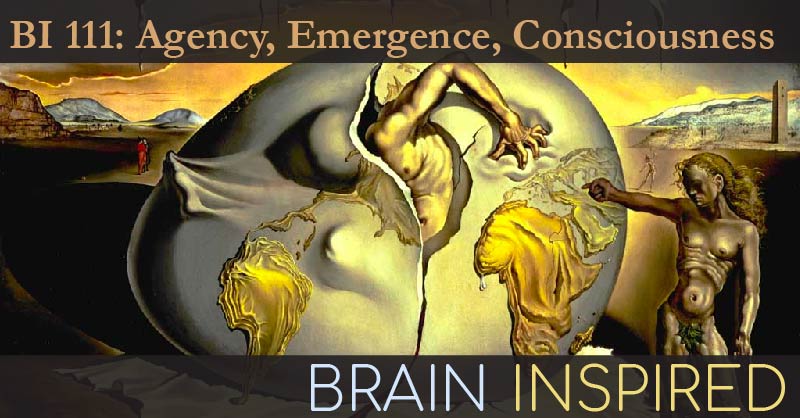
BI 111 Kevin Mitchell and Erik Hoel: Agency, Emergence, Consciousness
Erik, Kevin, and I discuss... well a lot of things. Erik's recent novel The Revelations is a story about a group of neuroscientists trying to develop a good theory of consciousness (with a murder mystery plot). Kevin's book Innate - How the Wiring of Our Brains Shapes Who We Are describes the messy process of getting from DNA, traversing epigenetics and development, to our personalities. We talk about both books, then dive deeper into topics like whether brains evolved for moving our bodies vs. consciousness, how information theory is lending insights to emergent phenomena, and the role of agency with respect to what counts as intelligence. Kevin's website.Eriks' website.Twitter: @WiringtheBrain (Kevin); @erikphoel (Erik)Books:INNATE – How the Wiring of Our Brains Shapes Who We AreThe RevelationsPapersErikFalsification and consciousness.The emergence of informative higher scales in complex networks.Emergence as the conversion of information: A unifying theory. Timestamps 0:00 - Intro 3:28 - The Revelations - Erik's novel 15:15 - Innate - Kevin's book 22:56 - Cycle of progress 29:05 - Brains for movement or consciousness? 46:46 - Freud's influence 59:18 - Theories of consciousness 1:02:02 - Meaning and emergence 1:05:50 - Reduction in neuroscience 1:23:03 - Micro and macro - emergence 1:29:35 - Agency and intelligence
BI NMA 03: Stochastic Processes Panel
Panelists: Yael Niv.@yael_nivKonrad [email protected] BI episodes:BI 027 Ioana Marinescu & Konrad Kording: Causality in Quasi-Experiments.BI 014 Konrad Kording: Regulators, Mount Up!Sam [email protected] BI episodes:BI 095 Chris Summerfield and Sam Gershman: Neuro for AI?BI 028 Sam Gershman: Free Energy Principle & Human Machines.Tim [email protected] BI episodes:BI 035 Tim Behrens: Abstracting & Generalizing Knowledge, & Human Replay.BI 024 Tim Behrens: Cognitive Maps. This is the third in a series of panel discussions in collaboration with Neuromatch Academy, the online computational neuroscience summer school. In this episode, the panelists discuss their experiences with stochastic processes, including Bayes, decision-making, optimal control, reinforcement learning, and causality. The other panels: First panel, about model fitting, GLMs/machine learning, dimensionality reduction, and deep learning.Second panel, about linear systems, real neurons, and dynamic networks.Fourth panel, about basics in deep learning, including Linear deep learning, Pytorch, multi-layer-perceptrons, optimization, & regularization.Fifth panel, about “doing more with fewer parameters: Convnets, RNNs, attention & transformers, generative models (VAEs & GANs).Sixth panel, about advanced topics in deep learning: unsupervised & self-supervised learning, reinforcement learning, continual learning/causality.
BI NMA 02: Dynamical Systems Panel
Panelists: Adrienne [email protected] [email protected] [email protected] 054 Kanaka Rajan: How Do We Switch Behaviors? This is the second in a series of panel discussions in collaboration with Neuromatch Academy, the online computational neuroscience summer school. In this episode, the panelists discuss their experiences with linear systems, real neurons, and dynamic networks. Other panels: First panel, about model fitting, GLMs/machine learning, dimensionality reduction, and deep learning.Third panel, about stochastic processes, including Bayes, decision-making, optimal control, reinforcement learning, and causality.Fourth panel, about basics in deep learning, including Linear deep learning, Pytorch, multi-layer-perceptrons, optimization, & regularization.Fifth panel, about “doing more with fewer parameters: Convnets, RNNs, attention & transformers, generative models (VAEs & GANs).Sixth panel, about advanced topics in deep learning: unsupervised & self-supervised learning, reinforcement learning, continual learning/causality.
BI NMA 01: Machine Learning Panel
Panelists: Athena Akrami: @AthenaAkrami.Demba Ba.Gunnar Blohm: @GunnarBlohm.Kunlin Wei. This is the first in a series of panel discussions in collaboration with Neuromatch Academy, the online computational neuroscience summer school. In this episode, the panelists discuss their experiences with model fitting, GLMs/machine learning, dimensionality reduction, and deep learning. Other panels: Second panel, about linear systems, real neurons, and dynamic networks.Third panel, about stochastic processes, including Bayes, decision-making, optimal control, reinforcement learning, and causality.Fourth panel, about basics in deep learning, including Linear deep learning, Pytorch, multi-layer-perceptrons, optimization, & regularization.Fifth panel, about “doing more with fewer parameters: Convnets, RNNs, attention & transformers, generative models (VAEs & GANs).Sixth panel, about advanced topics in deep learning: unsupervised & self-supervised learning, reinforcement learning, continual learning/causality.
BI 110 Catherine Stinson and Jessica Thompson: Neuro-AI Explanation
Catherine, Jess, and I use some of the ideas from their recent papers to discuss how different types of explanations in neuroscience and AI could be unified into explanations of intelligence, natural or artificial. Catherine has written about how models are related to the target system they are built to explain. She suggests both the model and the target system should be considered as instantiations of a specific kind of phenomenon, and explanation is a product of relating the model and the target system to that specific aspect they both share. Jess has suggested we shift our focus of explanation from objects - like a brain area or a deep learning model - to the shared class of phenomenon performed by those objects. Doing so may help bridge the gap between the different forms of explanation currently used in neuroscience and AI. We also discuss Henk de Regt's conception of scientific understanding and its relation to explanation (they're different!), and plenty more. Catherine's website.Jessica's blog.Twitter: Jess: @tsonj.Related papersFrom Implausible Artificial Neurons to Idealized Cognitive Models: Rebooting Philosophy of Artificial Intelligence - CatherineForms of explanation and understanding for neuroscience and artificial intelligence - JessJess is a postdoc in Chris Summerfield's lab, and Chris and San Gershman were on a recent episode.Understanding Scientific Understanding by Henk de Regt. Timestamps: 0:00 - Intro 11:11 - Background and approaches 27:00 - Understanding distinct from explanation 36:00 - Explanations as programs (early explanation) 40:42 - Explaining classes of phenomena 52:05 - Constitutive (neuro) vs. etiological (AI) explanations 1:04:04 - Do nonphysical objects count for explanation? 1:10:51 - Advice for early philosopher/scientists
BI 109 Mark Bickhard: Interactivism
Mark and I discuss a wide range of topics surrounding his Interactivism framework for explaining cognition. Interactivism stems from Mark's account of representations and how what we represent in our minds is related to the external world - a challenge that has plagued the mind-body problem since the beginning. Basically, representations are anticipated interactions with the world, that can be true (if enacting one helps an organism maintain its thermodynamic relation with the world) or false (if it doesn't). And representations are functional, in that they function to maintain far from equilibrium thermodynamics for the organism for self-maintenance. Over the years, Mark has filled out Interactivism, starting with a process metaphysics foundation and building from there to account for representations, how our brains might implement representations, and why AI is hindered by our modern "encoding" version of representation. We also compare interactivism to other similar frameworks, like enactivism, predictive processing, and the free energy principle. For related discussions on the foundations (and issues of) representations, check out episode 60 with Michael Rescorla, episode 61 with Jörn Diedrichsen and Niko Kriegeskorte, and especially episode 79 with Romain Brette. Mark's website.Related papersInteractivism: A manifesto.Plenty of other papers available via his website.Also mentioned:The First Half Second The Microgenesis and Temporal Dynamics of Unconscious and Conscious Visual Processes. 2006, Haluk Ögmen, Bruno G. BreitmeyerMaiken Nedergaard's work on sleep. Timestamps 0:00 - Intro 5:06 - Previous and upcoming book 9:17 - Origins of Mark's thinking 14:31 - Process vs. substance metaphysics 27:10 - Kinds of emergence 32:16 - Normative emergence to normative function and representation 36:33 - Representation in Interactivism 46:07 - Situation knowledge 54:02 - Interactivism vs. Enactivism 1:09:37 - Interactivism vs Predictive/Bayesian brain 1:17:39 - Interactivism vs. Free energy principle 1:21:56 - Microgenesis 1:33:11 - Implications for neuroscience 1:38:18 - Learning as variation and selection 1:45:07 - Implications for AI 1:55:06 - Everything is a clock 1:58:14 - Is Mark a philosopher?
BI 108 Grace Lindsay: Models of the Mind
Grace's websiteTwitter: @neurograce.Models of the Mind: How Physics, Engineering and Mathematics Have Shaped Our Understanding of the Brain.We talked about Grace's work using convolutional neural networks to study vision and attention way back on episode 11. Grace and I discuss her new book Models of the Mind, about the blossoming and conceptual foundations of the computational approach to study minds and brains. Each chapter of the book focuses on one major topic and provides historical context, the major concepts that connect models to brain functions, and the current landscape of related research endeavors. We cover a handful of those during the episode, including the birth of AI, the difference between math in physics and neuroscience, determining the neural code and how Shannon information theory plays a role, whether it's possible to guess a brain function based on what we know about some brain structure, "grand unified theories" of the brain. We also digress and explore topics beyond the book. Timestamps 0:00 - Intro 4:19 - Cognition beyond vision 12:38 - Models of the Mind - book overview 14:00 - The good and bad of using math 21:33 - I quiz Grace on her own book 25:03 - Birth of AI and computational approach 38:00 - Rediscovering old math for new neuroscience 41:00 - Topology as good math to know now 45:29 - Physics vs. neuroscience math 49:32 - Neural code and information theory 55:03 - Rate code vs. timing code 59:18 - Graph theory - can you deduce function from structure? 1:06:56 - Multiple realizability 1:13:01 - Grand Unified theories of the brain
BI 107 Steve Fleming: Know Thyself
Steve and I discuss many topics from his new book Know Thyself: The Science of Self-Awareness. The book covers the full range of what we know about metacognition and self-awareness, including how brains might underlie metacognitive behavior, computational models to explain mechanisms of metacognition, how and why self-awareness evolved, which animals beyond humans harbor metacognition and how to test it, its role and potential origins in theory of mind and social interaction, how our metacognitive skills develop over our lifetimes, what our metacognitive skill tells us about our other psychological traits, and so on. We also discuss what it might look like when we are able to build metacognitive AI, and whether that's even a good idea. Steve's lab: The MetaLab.Twitter: @smfleming.Steve and Hakwan Lau on episode 99 about consciousness. Papers:Metacognitive training: Domain-General Enhancements of Metacognitive Ability Through Adaptive TrainingThe book:Know Thyself: The Science of Self-Awareness. Timestamps 0:00 - Intro 3:25 - Steve's Career 10:43 - Sub-personal vs. personal metacognition 17:55 - Meditation and metacognition 20:51 - Replay tools for mind-wandering 30:56 - Evolutionary cultural origins of self-awareness 45:02 - Animal metacognition 54:25 - Aging and self-awareness 58:32 - Is more always better? 1:00:41 - Political dogmatism and overconfidence 1:08:56 - Reliance on AI 1:15:15 - Building self-aware AI 1:23:20 - Future evolution of metacognition
BI 106 Jacqueline Gottlieb and Robert Wilson: Deep Curiosity
Jackie and Bob discuss their research and thinking about curiosity. Jackie's background is studying decision making and attention, recording neurons in nonhuman primates during eye movement tasks, and she's broadly interested in how we adapt our ongoing behavior. Curiosity is crucial for this, so she recently has focused on behavioral strategies to exercise curiosity, developing tasks that test exploration, information sampling, uncertainty reduction, and intrinsic motivation. Bob's background is developing computational models of reinforcement learning (including the exploration-exploitation tradeoff) and decision making, and he behavior and neuroimaging data in humans to test the models. He's broadly interested in how and whether we can understand brains and cognition using mathematical models. Recently he's been working on a model for curiosity known as deep exploration, which suggests we make decisions by deeply simulating a handful of scenarios and choosing based on the simulation outcomes. We also discuss how one should go about their career (qua curiosity), how eye movements compare with other windows into cognition, and whether we can and should create curious AI agents (Bob is an emphatic yes, and Jackie is slightly worried that will be the time to worry about AI). Jackie's lab: Jacqueline Gottlieb Laboratory at Columbia University.Bob's lab: Neuroscience of Reinforcement Learning and Decision Making.Twitter: Bob: @NRDLab (Jackie's not on twitter).Related papersCuriosity, information demand and attentional priority.Balancing exploration and exploitation with information and randomization.Deep exploration as a unifying account of explore-exploit behavior.Bob mentions an influential talk by Benjamin Van Roy:Generalization and Exploration via Value Function Randomization.Bob mentions his paper with Anne Collins:Ten simple rules for the computational modeling of behavioral data. Timestamps: 0:00 - Intro 4:15 - Central scientific interests 8:32 - Advent of mathematical models 12:15 - Career exploration vs. exploitation 28:03 - Eye movements and active sensing 35:53 - Status of eye movements in neuroscience 44:16 - Why are we curious? 50:26 - Curiosity vs. Exploration vs. Intrinsic motivation 1:02:35 - Directed vs. random exploration 1:06:16 - Deep exploration 1:12:52 - How to know what to pay attention to 1:19:49 - Does AI need curiosity? 1:26:29 - What trait do you wish you had more of?