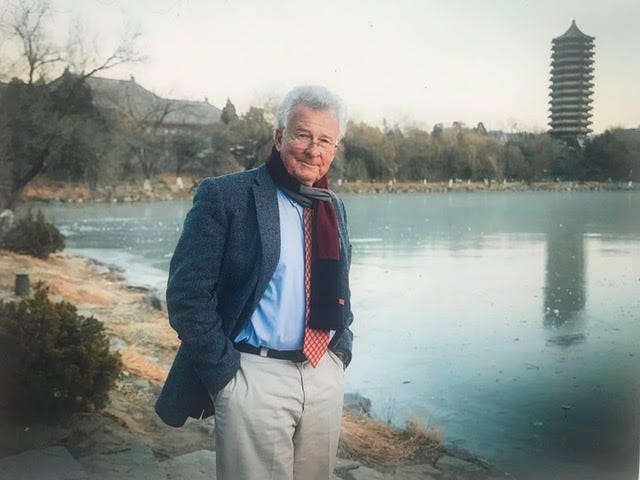
Interview | Roger T. Ames: Bringing Chinese Philosophy Onto The Stage of The Modern World
波士頓書評 Boston Review of Books Podcast · 波士頓書評 Boston Review of Books
Audio is streamed directly from the publisher (api.substack.com) as published in their RSS feed. Play Podcasts does not host this file. Rights-holders can request removal through the copyright & takedown page.
Show Notes
In 2011, Confucian Role Ethics: A Vocabulary was published by the University of Hawai‘i Press and the Chinese University of Hong Kong Press. In this work, “Confucian Role Ethics” was for the first time systematically and comprehensively articulated, presenting Confucian ethics as a distinctive ethical system centred on “relational being” and “role-bearing persons”. This framework distinguishes itself from dominant Western traditions such as deontology, utilitarianism, and virtue ethics in its conventional form.
The concept has received widespread acclaim in the international academic community. It has been praised for its holistic, narrative, and practical character, revitalising Confucianism as a living moral tradition transmitted across generations and endowed with universal philosophical significance. While some scholars, such as Stephen Angle, have raised critical questions, they nonetheless acknowledge its core insights — particularly its relational conception of the person — as both compelling and illuminating. Today, “Confucian Role Ethics” has become a recognized term within contemporary ethical discourse. The author of this work is Roger T. Ames, widely regarded as “one of the most distinguished interpreters of Chinese philosophy in the Western world.”
Roger T. Ames was born in 1947 in Toronto, Canada, and grew up in the United Kingdom and Vancouver. As a young man, he developed a strong interest in poetry and literature. Around 1966, he left Canada to study liberal arts at the University of Redlands in California, later transferring to the University of British Columbia (UBC), where he majored in philosophy and Chinese language and obtained his bachelor’s degree. During this period, he spent a year as an exchange student at the Chinese University of Hong Kong, marking his first deep engagement with Chinese culture. There, he was profoundly influenced by scholars such as Lao Sze-Kwang and Tang Junyi.
After completing his undergraduate studies, Ames pursued a master’s degree at National Taiwan University (1970–1972) under the tutorial supervision of Yang Youwei, earning an MA in philosophy. In 1975, he moved to the United Kingdom to study at the School of Oriental and African Studies (SOAS), University of London, under the renowned sinologist D. C. Lau, and completed his PhD in 1978. His doctoral dissertation, titled The “Chu Shu” chapter of the Huai-Nan-Tzu: The sources and orientation of its political thought, laid a solid foundation for his mastery of classical Chinese and his cross-cultural comparative perspective.
After receiving his PhD in 1978, Ames joined the Department of Philosophy at the University of Hawai‘i at Mānoa as an assistant professor. He remained there for 38 years (1978–2016), later serving as associate professor, full professor, and director of the Center for Chinese Studies. He is an important heir to the University of Hawai‘i’s tradition of comparative philosophy, a tradition that can be traced back to scholars such as Charles A. Moore. After retiring as Professor Emeritus in 2016, Ames relocated to China. He currently serves as Humanities Chair Professor at Peking University and Academic Director to Berggruen Institute China.
Over the years, Ames has consistently reinterpreted classical Chinese thought through the lenses of process philosophy and relationality. He has articulated Confucian ethics as a distinctive ethical system grounded in concrete social roles and dynamic relational practices, offering a compelling East Asian alternative to contemporary global ethical dilemmas. In addition, he has long promoted dialogue between pragmatism and Chinese philosophy, systematically developing a distinctive “vocabulary” for Chinese thought that emphasizes its processual, contextual, and narrative dimensions. His work has had a profound impact on comparative philosophy, the contemporary revival of Confucianism, and cross-cultural ethical studies. It has been hailed as a milestone achievement that enables Confucianism to be taken “on its own terms.”
Ames’s achievements in translation are renowned for their philosophical depth and cross-cultural insight. Rather than being content with literal equivalence, he draws on process philosophy and pragmatism to revitalize classical texts, bringing out the dynamic, relational, and contextual dimensions of Chinese thought. For instance, he renders ren 仁 as “consummate conduct” rather than “benevolence”; dao 道 as “way-making” instead of “way” or “path”; cheng 誠 as “creative resolve” rather than simply integrity or honesty; zhengming 正名 as “using names properly” rather than “rectification of names”; and zhongyong 中庸 as “Focusing the Familiar” instead of Doctrine of the Mean.
Recently, Tokuyu Ko, an independent writer and a former student of Prof Ames, conducted an interview with this great philosopher and translator who first encountered China at the age of eighteen and has since devoted himself to bringing Chinese philosophy onto the stage of the modern world. In the interview, Prof Ames reflects on his academic career, discusses several key concepts in his interpretation of Chinese philosophy, and considers the place of Chinese philosophy in the world today.
“My career has been formed in a very Chinese manner.”
Q: What first sparked your interest in Chinese or Asian culture and philosophy? And what led you onto the path of studying Chinese philosophy in particular?
A: It was when I went to Hong Kong at the age of 18 for the exchange program with the Chinese University of Hong Kong. I lived there for one year, and was much amazed by the people there. It was particularly intriguing to me how Chinese or Hong Kong people behave differently from Western students. For instance, Chinese people tend to form groups and hang out collectively; I can tell that they cherish the bond between classmates, or tongxue (or tunghok) 同學. On the other hand, Western students prefer to act individually and cherish boundaries. Indeed, in the western culture, being independent is often regarded as a sign of maturity. Interestingly, what drove my curiosity is actual people rather than books.
Looking back on my life, I feel that I have always attempted to make sense of the associations behind the behaviors of Chinese or Asian people.
Another factor that has led me through my scholarly career is the special bond between masters and disciples in Chinese culture (so-called shituguanxi 師徒關係). Particularly, I have an indelible memory of Yang Youwei (楊有維) – my advisor during my master’s years; he was a really kind and helpful teacher, and had an astounding command of classical Chinese. I owe a lot to him for my Chinese linguistic skills.
At the University of Hawaiʻi at Mānoa (UHM), where I spent most of my teaching career, I have advised 50 or so PhD students in total. It was not that we formed our own school, but the bond among students and faculty was strong. Since early on UHM became the world centre for comparative philosophy, all students who pursue their PhD there were at a high level. It is a mutual learning through collaborations rather than me teaching them. Many of my later works, including Human Becomings, are the products of my experience during this period.
It was also a great memory that a group of my students collected the essays on my work and published them as a book entitled One Corner of the Square: Essays on the Philosophy of Roger T. Ames. The title derives from a phrase in the Analects – “I do not open the way for students who are not driven with eagerness; I do not supply a vocabulary for students who are not trying desperately to find the language for their ideas. If on showing students one corner they do not come back to me with the other three, I will not repeat myself” (不憤不啟,不悱不發,舉一隅不以三隅反,則不復也) (7.8).
I have spent my scholarly career in a way much characterized by Chinese-style apprenticeship both as a student and as a teacher. It is my greatest delight that I myself could be part of this intergenerational succession of Chinese philosophical scholarship.
Q: You have translated many Chinese classics, including the Analects, Zhongyong (Focusing the Familiar) and Daodejing. How do you choose the topics and texts you work on? Conversely, why have you not chosen to translate certain other classics, such as the Xunzi and neo-Confucian works?
A: My academic career has been formed much through collaborations.
After completing my PhD program in London, my supervisor D. C. Lau (劉殿爵) and I left there in the same year; I left for Hawaii and he went to Hong Kong. But we still met each other regularly in Hong Kong, and read Chinese classics together. In our reading sessions, we usually began from my own translations of many Chinese classics, and they became the foundations of many of my later works. We collaborated on some translated works together, such as Sun Pin: The Art of Warfare and the first chapter of the Huainanzi, “Yuandao.”
David L. Hall, one of my collaborators, was central in the formation of my early career as well. He did not understand the Chinese language at all, but his solid understanding of Western philosophy enabled him hermeneutically to have a paroramic picture of philosophy and where to place Chinese philosophy within it. I had thought one cannot understand Chinese thought without a command of Chinese language, but after collaborating with Hall, I completely changed my view. The synoptic vision he had in his mind helped me philosophize both my understanding and my translations of Chinese classical thought. Many people say David L. Hall is a philosopher, and Roger T. Ames is a sinologist. The sad truth is, however, that people in the philosophy field don’t have much time for sinologists. My collaboration with Hall helped me become a philosopher.
In short, my academic career, including the selection of my translated works, is formed organically and associatively – or, let’s say, in a very Chinese manner.
Regarding Neo-Confucianism, I always use the concept of “root and branch” (benmo 本末) to explain my views. Song-Ming Neo-Confucianism, as a matter of course, has its roots in Confucianism before that, particularly in the pre-Qin era. Without thoroughly understanding Chinese philosophy as it evolved during the Spring and Autumn and Warring States periods or even earlier, one cannot comprehend Neo-Confucianism. For me, understanding pre-Qin Chinese thought itself was an enormous task. Even now, I still regard myself as a hard working novice in the process.
Q: At what point did your studies shift from close studies of individual classics to exploring the broader picture of or patterns in Chinese philosophy?
A: In fact, I did not change my trajectory. The broader picture was always in my mind. As I mentioned earlier, my curiosity about the underlying way of thinking behind the behavior of Chinese people is what drove me into academic explorations of Chinese thought in the first place.
One can find such traces in my early works – including The Art of Rulership, where in the introduction I touched on the question regarding “the common ground” behind the traditions of different Chinese intellectual schools such as Confucianism, Buddhism, and Daoism.
In this sense, the broader picture comes first. Every time I finished the translation of one specific classical work, I always went back to the question of the holistic and organic worldview of Chinese philosophy, and wondered in what way this classic reflects it.
Q: How do you reflect on your days in Beijing since you came here as the Humanities Chair Professor of Peking University in 2016?
A: In Beijing, I have had a most productive time; I completed many works, including Human Becomings, Living Chinese Philosophy, A Sourcebook in Classical Confucian Philosophy and A Conceptual Lexicon of Classical Confucian Philosophy.
My collaborations with the Berggruen Institute were central to my time in China. I helped them set up their China centre as a research fellow in 2016-2018, and have been actively involved in the Berggruen China Center’s activities, including its research projects on Tianxia (天下), Philosophy of Family, and Co-Becoming (gongsheng 共生).
Collaborations and interactions were also an integral part of my years in Beijing. I could visit universities across China, and had great exchanges with many great scholarly minds in China, including Wang Bo (王博), Zheng Kai (鄭開), Zhang Xianglong (張祥龍) Cheng Lesong (程樂松)Peking University, Chen Lai (陳來) at Tsinghua University, Sun Xiangchen (孫向晨) at Fudan University, Chen Yajun (陳亞軍) at Zhejiang University, Wu Genyou (吳根友) at Wuhan University, Wang Qingjie (王慶節) at University of Macau, Zhao Tingyang (趙汀陽) , and many more
.
“Chinese philosophy understands the world in a dynamic, relational way”
Q: You have always emphasized the importance of taking Chinese philosophy “on its own terms”. Indeed, your translations of many Chinese classical notions appear to be quite unique, such as ren 仁 as “consummate conduct”, dao 道 as “way-making”, and zhongyong 中庸 as “Focusing the Familiar”. What do you mean by understanding Chinese philosophy “on its own terms”?
A: By “on its own terms”, I do not mean taking Chinese philosophy in an objective way. Rather, I challenge the clear boundary between subjectivity and objectivity. As many pragmatists and empiricists such as William James have observed, the concept of “objective” knowing itself is dubious. In Chinese (and Japanese), the subjective and objective are respectively expressed as the host’s and the guest’s points of view (zhuguan 主觀and keguan 客觀). These two notions are complementary rather than dualistic and dichotomous.
I often use “mirroring” to describe the way of understanding we might apply to different traditions of thoughts. The idea is inspired by a passage in Huainanzi: “Sages are like mirrors – They neither go out to meet things nor see them off, and they respond to things without storing anything up. Hence in a myriad of transformations they are innocent of harm” (故聖若鏡,不將不迎,應而不藏,故萬化而無傷). “Mirroring” does not mean reflecting reality completely; it is impossible since there is no purely objective standpoint – no “view from nowhere”. We always see from a particular perspective. The salient idea, therefore, is being aware of our own biases and doing our utmost in interpreting the texts without overwriting them with any predetermined assumptions.
Knowing our own biases is crucial. For instance, David L. Hall could not read Chinese, but he developed a profound understanding of Chinese philosophy because he was deeply immersed in the history of Western philosophy that constituted his own biases. This awareness enabled him to situate Chinese thought within a broader philosophical picture and turn obstructions into insights.
I myself am a Westerner, and although I am not a Christian, I am still biased by Christianity. In this sense, my academic career studying Chinese philosophy has also been a gradual process of understanding Western philosophy and the Platonic-come-Christian tradition that has shaped my own intellectual background.
We can see the most obvious examples in early missionary translations, such as those by James Legge. Their translations were heavily biased by Christian ideas; for instance, he translated ren 仁 as “benevolence” and dao 道 as “the Way”. We are always, often unconsciously, biased by our own languages and cultures. In many respects, it is not that we speak language as much as language speaks us. Hence, interpretation must begin with self-understanding and remain attentive to it. For me, studying Chinese philosophy has simultaneously deepened my understanding of Western philosophy.
In short, what I mean by “on its own terms” is to place ourselves in this ceaseless process of engaging in conversations with, or “mirroring”, the texts we elucidate, while at the same time addressing our own biases.
Q: You use “zoetology” to describe the underlying mainstream worldview in Chinese thought, in contrast to that based on the ontology that has characterized mainstream Western thinking. What is a “zoetological” way of seeing the world?
A: Let me begin with “ontology”. Ontological thinking posits that every entity possesses an essence that defines it and distinguishes it from other things.
Taking the term “human being” as an example, there is some self-same, identical characteristic that makes all members of humankind the same; this “essence” is so strong that you cannot stop being human; even if one degrades oneself or behaves like an animal, one still remains a human being.
We can find the traces of Western “ontological” thinking in many Western ideas, including the pathetic fallacy: that is, the human “being,” the chain of being, God, angels, and the idea that the world is created for human salvation.
If we apply this perspective to the world more broadly, everything is essentially what it is; a tree is a tree, and a dog is a dog. In this world, everything is taxonomically classified into certain categories. In this taxonomical, categorical perception of the world, definition and knowing are very closely tied together. If you want to know something, you have to define it; defining means setting its boundaries.
Within ontological thinking, the essence, or categorical definition of the human being is permanent and unchanging, and thus not affected by the world and experience.
We can explain such thinking by the environing factors. In the ancient Greek world—surrounded by the Mediterranean Sea and vast deserts—navigation required fixed reference points. To orient oneself in such an environment, one needed an Archimedean point: something stable and unchanging. In this intellectual environment, philosophy developed in a way that emphasized permanence. As a result, mathematics became the model of knowledge. Statements like “1 plus 1 equals 2” are beautiful. Indeed, many major figures in the history of Western philosophy – from Pythagoras to Descartes, Leibniz and Russell – were also mathematicians.
In the Chinese tradition, however, the world is not primarily perceived as fixed and unchanging. The Chinese world is completely different: it is a monsoon, agrarian world. Managing growth and life is what we call farming. Thus, instead of regarding something as determinant and unchanging as the basic principle, and seeing humans as “human beings,” the underlying idea in Chinese culture has been “life”, and humans are “human becomings”.
Whereas the basic idea in Greek tradition is “ontology”, that in Chinese tradition is “zoetology”; “zoe” means life in ancient Greek. It is evident from the idea of “ceaseless procreation” (shengshengbuxi 生生不息), “ceaseless procreating is what is meant by ‘change’” (生生之謂易) and “the greatest capacity of the cosmos is life itself” (天地之大德曰生). All of these tell us that life is the underlying and greatest principle of the world in Chinese philosophy. In this sense, the Book of Changes (Yijing 易經 ) can also be the Book of Life (Shengjing 生經), comparable to the Bible (Shengjing 聖經) in the Chinese world.
In summary, the ontological way of thinking in ancient Greek and Western philosophy sees the world in a categorical, taxonomical way – everything possesses unchanging, essential characteristics that set clear boundaries with others, and make real definition possible. On the other hand, the “zoetological” way of thinking in Chinese philosophy perceives the world in a dynamical, relational way – everything is constantly changing and interconnected with everything else. This kind of worldview places the experience of life at its centre.
Q: Can some of your other ideas — such as “human becoming” and “the inseparability of the one and the many” (yiduobufenguan 一多不分觀)—also be understood within this zoetological framework?
A: Yes, precisely. Instead of speaking of “human being”, Chinese philosophy sees humankind as “human becomings”. What does it mean to become “human”?
I often use the model of a primitive man I saw in a museum in Liaoning as an example. Compared with us, both the body and brain of this early human were astonishingly small. Yet he is still human. And yet, he is only 75,000 years old.
“Humanity” is therefore an open-ended process. Our species has a relatively short history, yet enormous changes have already taken place. What it means to be human is not fixed or permanent—it continues to evolve. In our times, the speed of change is ever more rapid. I have no idea how artificial intelligence will reshape humanity, but the transformation of human life will certainly continue.
To be human is to inhabit an ever-changing world. Each generation inhabits its own world. If subject and object are inseparable, then each generation of subjects necessarily encounters a different world as objects.
The notion of “the inseparability of the one and the many” (yiduobufenguan 一多不分觀) suggested by Tang Junyi (唐君毅) captures this interconnectedness and dynamism of the world particularly well. As I have articulated in many of my writings, each person is a focus-field, uniquely constituted by their particular relationships with others. In such a view, “one” being defined by its vital relations, is “one” and “many” at the same time.
“The fundamental spirit of Confucianism is to be inclusive and progressive”
Q: “Role ethics” is another key terminology in your elucidation of Chinese philosophy. How is it different from following the stipulated social norms required for each role?
A: My interest in, and understanding of, “roles” as a human culture began in Hong Kong, where I observed the special bond between fellow students (tongxue or tunghok 同學), a special familial category in Chinese culture. The sense of family is fundamental in Chinese culture, and, as a matter of fact, all forms of “life” begin within a family.
What I mean by “role ethics” is not a set of fixed, dogmatized norms attached to roles. Rather, we should pay attention to the changing and flexible nature of the content of roles. When I became a grandfather, for example, I experienced love for grandchildren for the first time. I learned that “love” is not a single, uniform thing. Only in actually assuming a “role” can we learn what it means to live that role and the feelings behind it.
John Dewey stressed the importance of “association”, which corresponds in many ways to guanxi 關係 as it is understood in the Chinese tradition. Every association, or guanxi, is grounded in some form of “role” – whether we encounter someone as a stranger, a foreigner, a friend, a family member, or even a murderer. We see others only through some kind of role, even when we ignore someone. Once you stipulate an association, it becomes normative; and once normativity emerges, standards arise by which we evaluate whether someone is fulfilling their role well. Yet, despite its normative dimension, every role is rather particular than general. I am this grandfather to my particular grandchild. It is similar to how people play the same musical instrument differently.
We need to distinguish normativity from norms. The difference between them can be understood in terms of the distinction in Chinese philosophy between “ritual propriety in roles and relationships” (li 禮) and “laws” (fa 法). Rather than merely following fixed norms, we should devote ourselves to cultivating our particular relationships with the particular others environing us.
Differing from Western thinking which values being liberated from relationships (e.g., family) as achieving independence, Chinese tradition places enormous emphasis on the cultivating of relationships. We cannot escape human associations; we must live with them. Thus cultivating these relationships, and aspiring to achieve co-becoming (gongsheng 共生), is vital.
Q: We may find a relational and dynamic worldview in Chinese philosophy. Historically, however, we cannot deny that Confucianism has sometimes produced rigid social norms and oppression, particularly toward women and minorities. How do you explain the gap between Confucian ideas and historical realities?
A: It is true that in most cultures or traditions – including Islam, Christianity, Judaism and Buddhism – we find the same tendency: cultural norms can become ossified, rigid, oppressive, and authoritarian.
I sometimes say, half-jokingly, that the best Confucianism lies somewhere between Confucianism and Daoism. Daoism has always served as a critical counterpart to Confucianism, warning of the danger that Confucian thought has in tending to become too rigid, dogmatic, moralistic, or catechistic. In karate, which I used to practice, you first have to follow the form (kata 型). But after long practice, you eventually find your own way to move beyond the form while still inheriting it. The stronger the form, the higher the level of refinement that becomes possible. We can find a similar idea in the li 禮or “ritualized roles and relations” in Chinese philosophy that can be understood in terms of “forming and functioning” (tiyong 體用). The notion of tiyong concerns the ongoing refinement that arises through the interaction between established forms and lived experience.
In many respects, Confucianism does deserve the criticism that it has sometimes become rigid and dogmatic. For instance, I have argued with Zhang Xianglong many times over whether same-sex marriage could be justified from a Confucian perspective. In my view, the most important spirit of Confucianism should be “seeking superlative harmony rather than sameness” (heerbutong 和而不同), inclusiveness (barongxing 包容性), “self-so-ingly-so” (ziran 自然) or the “spontaneity” of things and “optimising symbiosis” (gongsheng 共生) among the myriad entities. If some people are born homosexual, we should not only make room for them, but celebrate the differences they bring to the human experience. Otherwise, we would be diminishing Confucianism itself.
It is true that we can find discriminatory passages in Confucian canons. The most well-known example is the statement, “It is only women and petty persons who are difficult to nourish(唯女子與小人難養也)” in the Analects (17.25). Needless to say, this remark is clearly sexist. At the same time, we also cannot find any women in the Analects, and Confucius did not have female disciples. We should note, however, that Confucius was a man of his time. To understand his thought more deeply, we must recognize the limitations imposed by the historical context in which he lived. What is fundamental in Confucianism, I believe, are “harmony not uniformity” (heerbutong 和而不同) and “reviewing the old as a means of realising the new” (wenguerzhixin 溫故而知新). For that reason, Confucianism to be true to its own premises must remain progressive, hybridic, open-ended and evolutionary. We should not cling to outdated norms simply because Confucius once described women in a certain way.
The world is constantly changing and evolving. To take the world as it is, we need to take differences into account, cherish equity and the diversity it brings with it, and exercise our creativity (cheng 誠) in order to optimize our relationships within it.
In my observations, Confucianism also has a strong holistic tendency. Historically it has absorbed many other intellectual traditions, including Buddhism and other forms of Western learning. In most cases, the best Confucian scholars are the best comparative philosophers rather than purely Confucian thinkers. Modern Confucian thinkers, such as Mou Zongsan (牟宗三) and Fang Dongmei (方冬美), are the most recent examples. In this sense, Confucianism can itself be seen as a form of holism that embraces change and remains open to collaboration. It is therefore our responsibility to reshape Confucianism continually while inheriting its core values. I believe this is what Confucius meant by “following the proper way, and not forging new paths” (shuerbuzuo 述而不作) (Analects, 7.1). The proper way itself is always under construction.
“The intellectual resources of the East may help us address numerous challenges today”
Q: How do you see the place of Chinese philosophy today in world philosophy, or academia in general?
A: I do think that Chinese philosophy is becoming more relevant in the academic world today. This can be seen in the increasing number of publications and conferences on Chinese philosophy, both inside and outside China. For me, however, what matters is not publications but the participation of people – especially Chinese scholars – who embody the values of the Chinese tradition.
In many regards, Chinese academia has become highly westernized, and so have Chinese scholars. Many of them still prefer to pursue academic degrees overseas and tend to behave in ways that appear very Western, such as emphasising independence and expressing liberal views. But I believe that, just as Western scholars of Chinese thought retain an appreciation for their own traditions at a deeper level, Chinese scholars, through their deeper understanding of the West, may also develop a stronger appreciation of their own traditions. In the end, people often return to their own cultural roots. Even though Chinese people may appear competitive and self-assertive on the surface, they belong to the tradition of Chinese values at the deeper level – their sense of association and family, as well as embodying ideas such as “consummate conduct” (ren 仁) and “optimal appropriateness” (yi 義).
Q: What do you think of the place of Chinese philosophy in society today? Do you think its ways of thinking – rather than its external symbols – can remain relevant in the face of numerous challenges, such as excessive competition under market capitalism and the isolation of individuals detached from family?
A: I believe that within the lives of the current younger generation, the hegemony or superiority of Western thinking, such as individualism, zero-sum thinking and the notion of justified self-interest, will come to an end. Behind these values lies liberal thinking that valorizes individual autonomy, rationality and calculation. I am optimistic that the growing confidence of Chinese people, supported by China’s economic rise, will lead them to turn to their own traditions again.
In many respects, it is true that Chinese people today appear more westernized than Westerners themselves. Yet we are in a transitory phase. In the past, Chinese people tended to doubt their own roots more critically, as exemplified by the call to embracing “Mr Democracy” (dexiansheng 德先生) and “Mr Science” (saixiansheng 賽先生) during the New Culture Movement, but this situation is gradually changing.
I often use the framework of “flux and continuity” (biantong 變通) to see things. Liberal thinking in its time was liberating, but the persistent, continuous tendency of illiberal liberalism as an ideology has contributed to many contemporary problems. By contrast, certain underlying ideas in the Chinese tradition may offer resources for building a more sustainable world. Ultimately, we need to find a balance between these two ways of thinking, allowing them to become hybridized. I believe that we should turn our attention to those intellectual resources of the East that have been ignored, understand their importance for the modern world, and find a way to synthesize them with whatever we find of value in within the Western narrative.
As I mentioned earlier, many Chinese people today behave in Western ways on the surface, but we can still perceive an underlying sense of association and family — what might be called “family feeling” (qinqin 親親). “Family” is a fact: whether we like it or not, we cannot escape from “family”, or more broadly put, relationality with others. In contemporary Chinese discourse, many people discuss the trauma associated with the “family of origin” (yuanshengjiating 原生家庭). Even if someone cannot find a sense of “family feeling” within their own family, they most likely will still seek to discover it elsewhere. As Mencius reminds us, human goodness is realized through relationships rather than in isolation. I believe this sense of connection is something people must return to.
This sense of association is precisely what we need in order to address many contemporary crises. Take “democracy” as an example. I always distinguish between democracy as a political institution and democracy as an idea. Democracy as an idea does not need to be confined to representative or parliamentary democracy, or more broadly so-called liberal democratic institutions. In The Democracy of the Dead: Dewey, Confucius, and the Hope for Democracy in China, David L. Hall and I discussed how John Dewey’s conception of democracy as a “communicating community” can help us conceive of a Confucian form of democracy. For Dewey, the very idea of community already contains what is essential to democracy. In this sense, I don’t recognize America today as an ideal example of democracy – it is becoming increasingly a form of illiberal liberalism that is given to distaining other cultures before understanding them. The basic, originating principles of democracy are diversity and inclusiveness, enabling everyone to belong and participate. But this no longer seems to be the case. I believe that Chinese philosophy – or Asian thought more broadly – can provide rich intellectual resources that may help us address many of the challenges facing the world today and to rethink what real democracy should be.
Note:
Roger T. Ames’s works: include:Thinking Through Confucius (1987)Anticipating China (1995), Thinking From the Han (1998), and Democracy of the Dead (1999) (all with David L. Hall), Confucian Role Ethics: A Vocabulary (2011), Human Becomings: Theorizing Persons for Confucian Role Ethics (2020), A Sourcebook in Classical Confucian Philosophy (2022) and the companion volume, A Conceptual Lexicon of Classical Confucian Philosophy, and most recently Living Chinese Philosophy: Zoetology as First Philosophy (2024).
He has left many translated works of ancient Chinese classics, including Sun-Tzu: The Art of Warfare (1993); Sun Pin: The Art of Warfare (1996) (with D.C. Lau); The Analects of Confucius: A Philosophical Translation (1998), the Classic of Family Reverence: A Philosophical Translation of the Xiaojing (2009) (both with H. Rosemont), Focusing the Familiar: A Translation and Philosophical Interpretation of the Zhongyong (2001), and Dao De Jing: A Philosophical Translation (with D.L. Hall) (2003).
This is a public episode. If you'd like to discuss this with other subscribers or get access to bonus episodes, visit bostonreviewofbooks.substack.com/subscribe