Interview | Daniel J. Flynn: Frank Meyer’s conservatism helped elect President Reagan
波士頓書評 Boston Review of Books Podcast · 波士頓書評 Boston Review of Books
Audio is streamed directly from the publisher (api.substack.com) as published in their RSS feed. Play Podcasts does not host this file. Rights-holders can request removal through the copyright & takedown page.
Show Notes
In the aftermath of World War II, the role of the US federal government significantly expanded under the impetus of President Franklin D. Roosevelt’s New Deal. Prominent Cold War politicians who are generally classified as “liberal,” such as Truman, Kennedy, and Johnson, championed the welfare state and Keynesian economics. American conservatives, however, felt threatened by what they perceived as the liberals’ collectivism and big government. At the same time, American conservatism saw many internal divisions. Traditionalists, such as Russell Kirk, emphasized moral order, religion, and traditional communities, and opposed unbound laissez-faire individualism. Libertarians, such as Friedrich Hayek, put at the forefront individual liberty, limited government, and the market economy, while opposing all forms of coercion—including moral coercion. The two camps debated fiercely in venues such as National Review (founded in 1955), and often openly expressed disdain for each other. The unity of the conservative movement came to be endangered as a result.
At that juncture, in the year of 1962, a scholar called Frank S. Meyer published In Defense of Freedom. In this book he systematically expounded “fusionism,” arguing that tradition and liberty are complementary, insofar as it is possible to safeguard individual liberty in politics, as advocated by libertarianism, while maintaining traditional virtues in morality, as demanded by traditionalism. In sum, according to Meyer, only through free choice can true virtue be realized. Meyer above all sought to preserve the tradition of “ordered liberty” rooted in the American founding and to shore up resistance against totalitarianism. His doctrine, conceived in response to the Cold War anti-communist agenda, helped to unite the American Right and exerted great influence on Barry Goldwater’s 1964 presidential campaign as well as the conservative movement of the Reagan era.
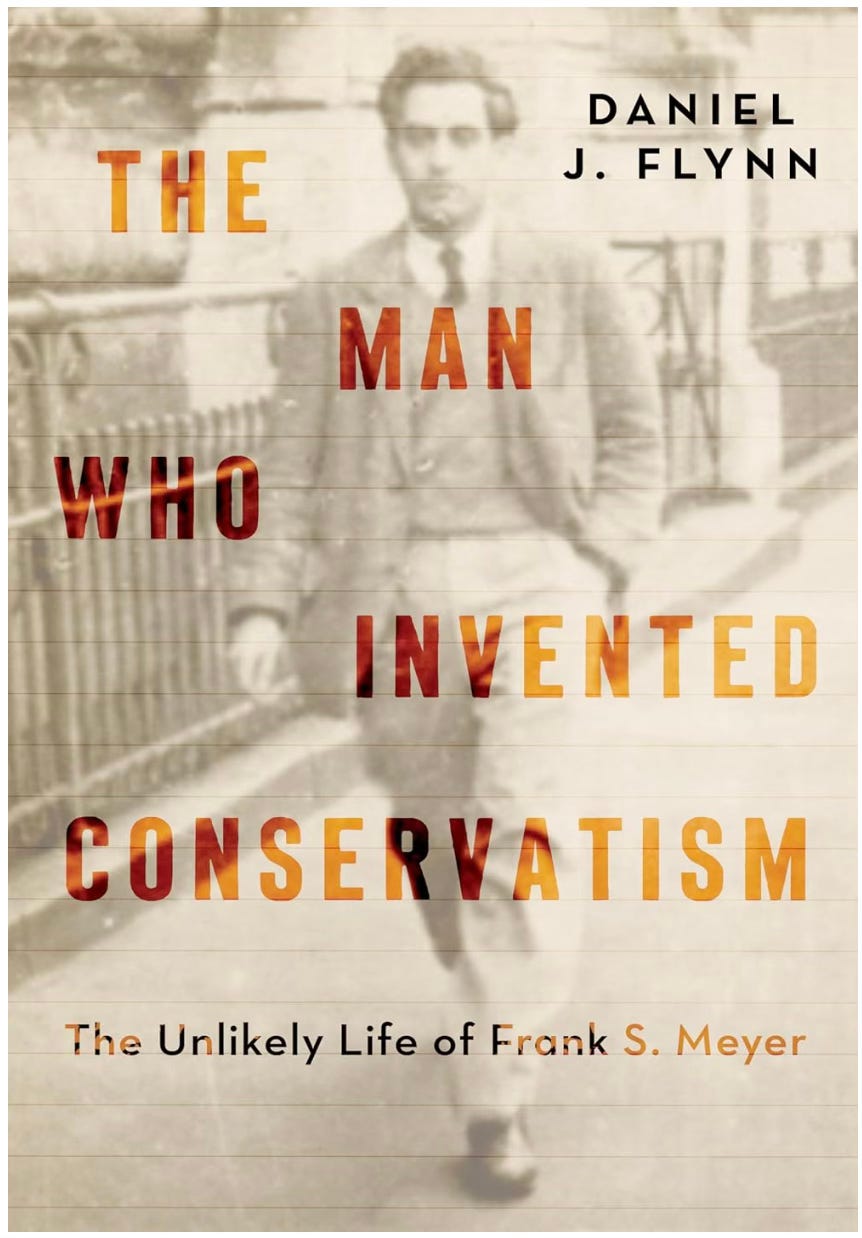
In 1981, Ronald Reagan, speaking at the Conservative Political Action Conference (CPAC), praised Meyer for breaking free from the shackles of communism, and fashioning “a vigorous new synthesis of traditional and libertarian thought—a synthesis that is today recognized by many as modern conservatism.” As a present-day American conservative scholar Daniel J. Flynn puts it, Frank Meyer was “if not the sole architect, then at least an architect of the modern conservative movement.” This is the key thesis of Flynn’s latest biography, published in August 2025, The Man Who Invented Conservatism: The Unlikely Life of Frank S. Meyer.
Frank S. Meyer was born in 1909 into a Jewish family in Brooklyn, New York. Deeply attracted to Marxism in his youth, he became an ardent communist while studying at Oxford University in the late 1920s. In the 1930s, he took part in Communist Party’s activities in Britain and the United States, and even became an early leader of the British communist student movement. During World War II, however, he became skeptical of Stalinism and formally quit the party in 1945. And after reading Friedrich Hayek’s The Road to Serfdom, Meyer consummated his turn to anti-communism.
In the mid-1950s, Meyer joined National Review, founded by William F. Buckley Jr., as a senior editor and became a key figure in conservative circles. His most famous contribution was the formulation of “Fusionism,” which had a formative influence on Barry Goldwater’s 1964 campaign and the Reagan administration in the 1980s. Meyer’s ideas laid the foundation for mainstream modern American conservatism and continue to shape debates among conservatives on the relationship between liberty and tradition.
For a long time, Meyer was seen merely as a coordinator within the National Review circle or as a subordinate to Buckley, rather than as an original thinker. Early biographies such as Principles and Heresies (2002), while acknowledging the importance of Fusionism, were hampered by insufficient archival materials and did not plumb the depth of Meyer’s dramatic transformation from a communist to a conservative.
Flynn’s 2025 book, The Man Who Invented Conservatism: The Unlikely Life of Frank S. Meyer, goes far beyond previous scholarship by uncovering long-lost Meyer archives, which include fifteen boxes of warehouse documents and seventeen letters exchanged with Leo Strauss and other notaries. The book is the first total examination of Meyer’s life: from being a leader in the British communist movement, through his complete break with the party and reconsideration of totalitarianism, and finally to his articulation of Fusionism and key role in launching conservative institutions (such as the American Conservative Union and Young Americans for Freedom). Notably, in the book, the author elevates Meyer to the rank of a founder of modern American conservatism. He highlights how Meyer’s ideas resolved the internal conflicts on the right in the Cold War and laid the groundwork for Reagan-era conservatism. The book abounds with insights for contemporary debates over balancing liberty and tradition. As many scholars and conservative institutions, such as the Independent Institute, Law & Liberty, and the Russell Kirk Center, praise its depth of research and the newly discovered sources it utilizes, it may properly be considered an authoritative work that fills a major gap in Meyer studies.
Earlier, Boston Review of Books obtained Flynn’s authorization to translate and publish one of his important essays, “Rediscovering Meyer and Strauss.” By analyzing a decade(the late 1950s to the mid-1960s) of correspondence between Meyer and Leo Strauss, the article sheds light on their shared anti-communist convictions and profound reflections on totalitarianism. The letters uncovered by Flynn revive intellectual sparks dormant for six decades and afford insight into the preoccupations of the two thinkers amid Cold War crises, and by extension, the origins of American conservatism. On this note, the review has also translated and published Meyer’s well-known political essay “The Meaning of McCarthyism” (1957), which contains Meyer’s critique of American Cold-War liberals who sought appeasement or compromise with communism.
Daniel J. Flynn is an American conservative scholar. He is the author of seven books, a senior editor at The American Spectator, and a columnist for National Review Online. He has also served as a visiting fellow at the Hoover Institution. Recently, Boston Review of Books contributing reporter Yao-ching Lin conducted a special interview with Flynn about his new book, The Man Who Invented Conservatism: The Unlikely Life of Frank S. Meyer, with a view to highlighting Meyer’s contributions to American conservatism and the foundations of his thought. It may be hoped that this interview will help to clarify the changes and perplexities within present-day American conservatism.
Q: How did you first become interested in the study of the history of American conservatism, and what led you specifically to the figure of Frank Meyer?
A: When I wrote about the American left in such books as Intellectual Morons and A Conservative History of the American Left, it struck me that the progressives who dominate academia exhaustively cover obscure events or figures on the left in their scholarly work. Yet, massive figures on the American right lack biographies or academic interest. I felt that I could fill a void created because of the ideological one-sidedness of American academia. In terms of Meyer specifically, I like to write about important figures or events that scholars neglect or overlook. Strangely, when one goes into a bookstore, one can find all sorts of books on Adolf Hitler or Abraham Lincoln or Julius Caesar. I think we know all there is to know about these figures. I would rather write about someone readers should know about but do not. Frank Meyer, given his life as a founder of the student Communist movement in Britain and role in the creation of the postwar American right, strikes as just such a person.
Q: In your view, how large was the role Frank Meyer played in the founding and development of post-war American conservatism?
A: Meyer played a major role as both an organizer and theorist. In terms of the former, he helped found numerous organizations that still thrive, such as the American Conservative Union and Philadelphia Society. In terms of the latter, his big idea—fusionism—both described and animated the thought of such figures as Barry Goldwater, William F. Buckley, and Ronald Reagan. Ironically, Meyer honed his skills as an organizer and began developing his big idea as an active Communist. He found his greatest fame as a writer for National Review magazine and the author of In Defense of Freedom, in which he articulated his philosophy of limited government.
Q: What distinguishes Meyer’s conservative ideas from the ideas of more well-known conservative icons such as Russell Kirk or Friedrich Hayek? It is the case that unlike Meyer, the other two have long been known to Chinese-speaking scholars and generated extensive discussions.
A: Kirk believed that conservatism was the negation of ideology, a tradition that developed organically rather than emanated from some theorist’s imagination. His philosophy feels more like a mindset than a political program. It also feels in some ways more European than American. Hayek famously rejected the label “conservative” because that word had more statist connotations in Europe than in America. He offered a libertarian outlook that applied to politics and economics but not, unlike Kirk’s outlook, to life. Meyer’s fusionism was very much an American conservatism. He believed that the big, obvious tradition for American conservatives to conserve was the American founding, and that the tradition of the founding meant freedom. Meyer told traditionalists and libertarians that their ideas were in cooperation rather than conflict. Freedom rested on thousands of years of tradition. Take away the heritage that undergirds that freedom, and freedom soon collapses. What traditionalists value, he instructed, rested on freedom. Take, for instance, virtue. True virtue cannot exist without freedom. Virtuous acts do not come by government orders but by acts conducted through free will. Choice is a precondition of virtue.
Q: It seems to me that Meyer has been largely forgotten in contemporary American scholarly and public discourse? Are there any public figures or politicians in America that have cited Meyer in recent decades? What might be the reasons for this?
A: Ten days before the assassination attempt on him, Ronald Reagan delivered a speech at the Conservative Political Action Conference (CPAC) in which he paid deference to the intellectual forefathers of the postwar conservative movement that gave rise to his presidency. The president spent more time on Meyer than the other figures, crediting him with having “fashioned a vigorous new synthesis of traditional and libertarian thought—a synthesis that is today recognized by many as modern conservatism.” This tribute seemed fitting. In 1960, Meyer had, in essence, predicted Reagan’s presidency by telling his fellow National Review editors that it may take until 1980 for them to elect one of their own to the White House. Meyer, in the immediate aftermath of Barry Goldwater’s 1964 presidential defeat, became an early booster of Ronald Reagan. He helped sow the intellectual seeds that resulted in Reagan’s presidency. He did not live to see those seeds bear fruit.
Q: Meyer joined the Communist Party in the 1930s. What were the motivations or intellectual springs that led him to embrace communism at that stage of his life?
A: Meyer’s mother involved herself heavily in her Jewish faith and his father involved himself in entrepreneurialism. He rebelled against his mother’s religion and his father’s capitalism in embracing communism. Like so many youngsters who fall for communism, Meyer grew up insulated from the society he sought to reform. He lived in a high-hat hotel, attended private schools, and lived off an allowance provided by his parents. He knew nothing of the working class he sought to save. As an Oxford undergraduate, he started a Marxist organization called the October Club. He quickly affiliated with the Communist Party of Great Britain, which soon placed him on its board and named him director of its student bureau. His antics drew the attention of not only British intelligence but the British prime minister’s daughter. Unsurprisingly, the British deported the upstart American.
Q: What events decisively triggered Meyer’s break with the Communist Party, and how did this break inform his later arguments regarding conservatism?
A: Meyer tried to join the fight against Adolf Hitler after recruiting men to fight and die in the Spanish Civil War. The Communist Party told him they needed him at home. He found it strange that a party that exhorted others to fight against Nazism prevented him from doing so. When he finally joined the military, he finally met the proletariat that so dominated his ideology. It turned out that they were nothing like what Marx described. They were not, for instance, incipient revolutionaries itching to overthrow the government. His injuries during training left him medically discharged. For the first time in more than a decade, he enjoyed time away from the party. He began to question as he convalesced. Questioning and Communism do not go together. He read Friedrich Hayek’s The Road to Serfdom. He questioned more. Then, ostensibly from France but really from the Soviet Union, came the Duclos Letter, which essentially declared the start of a Cold War once the Second World War ended. Meyer regarded another war atop this bloody one as something close to insanity, loudly objected, and then quietly left by the end of 1945.
Q: Meyer frequently referred to Whittaker Chambers and his work Witness in his critique of mid-century liberalism, as one can see in his article The Meaning of McCarthyism. Most Chinese readers, however, are uninformed of Chambers’s Witness. Who was Chambers, and what is the significance of Witness in American history? Is Chambers still well-known in American academia today?
A: Chambers broke with the Communist Party after the Hitler-Stalin Pact. The Kremlin-engineered Duclos Letter catalyzed Meyer’s departure. Whereas Meyer worked in the aboveground party, Chambers worked in espionage. It was in this capacity that he dealt with Alger Hiss, a New Deal bureaucrat who eventually rose to a high position within the State Department. Chambers warned the Franklin Roosevelt administration that Hiss was a Soviet agent. The administration did not listen. After the war, with the Soviets now enemies and not allies of the U.S., the powerful began to listen to Chambers. He authored a beautiful memoir, Witness, that memorably told of how he switched sides from those he imagined as the future winners (the Communists) of the Cold War to those he regarded as the losers (the West). Briefly at National Review, Chambers and Meyer worked together. Chambers, who embraced a mainstream Republican Party outlook, and Meyer, who was a right-wing purist, ultimately did not see the world the same way even though each man shared a history in common with the other more than with any of the others at National Review. Each man regarded the other as maintaining vestiges of a Marxist mentality.
Q: In your recent article, you describe how Frank Meyer and Leo Strauss initiated a correspondence that continued over several decades. In the last few decades, Strauss has been introduced into the Chinese-speaking world by prominent intellectuals such as Liu Xiaofeng. As a result, he has become a controversial name among PRC academic circles, and just like in American academia, self-styled Straussians in China intensely debate over the substance of Strauss’ thought. Notably, Liu Xiaofeng and other people in his circle seldom speak of Strauss’ involvement with American conservatism. How does the Meyer-Strauss correspondence fill a gap in the popular accounts of Strauss?
A: Strauss’s curiosity in Meyer stems, I think, from his remarkable admission in the correspondence that he had never met an actual Communist. Meyer deeply admired Strauss for his stand against relativism, demonstrated in his book Thoughts on Machiavelli. In their correspondence, they both regard Senator Joseph McCarthy positively, regard Boris Pasternak’s Doctor Zhivago with something less than three cheers of approval, and wonder whether Hitler derived his basic idea from Stalin and Lenin (Meyer’s view) or whether Stalin actually borrowed from Hitler (Strauss’s view). In one 1961 letter discovered in a warehouse during this project, Strauss, a Jew who had left Germany shortly before Hitler’s ascent and had taught in Israel, characteristically championed Israel from a critic writing in National Review. His embrace of Joseph McCarthy, contempt for the United Nations, and confession of not knowing any Communists may surprise readers.
Q: You mentioned that you discovered Hu Shih’s papers at the Hoover Institution. Could you describe the content of these materials? Is Hu Hsih a well-known figure within American academia today? To your knowledge, did Hu Shih ever correspond with Meyer, or for that matter any prominent American conservative intellectual?
A: In early November, I had never heard of Hu Shih. I came across, by chance, many of his letters from the 1920s at the Hoover Institution. I was immediately stunned by his brilliance and decided to focus my limited time on him. Later, I looked him up on Wikipedia and realized that I was not alone in regarding him as brilliant. Subsequently, I have brought him up to numerous natives of China living in the United States. Most of them knew something about him. The wisdom of his correspondence takes many forms. What most impressed me was his counsel for China during a time when China did not enjoy the national strength it does now even as the patriotism of the Chinese was still quite high. Jingoism coupled with weakness struck Shih as a dangerous combination. He paradoxically spoke about the strength it took to admit weakness. As a Chinese patriot, he regarded his country in a dangerous position vis-à-vis Japan in between the world wars. He worried that hotheads holding out for justice from Japanese diplomacy would instead receive bombs and bullets. So much of what he foresaw came to pass. I am eager to return to the Hoover Institution to learn more about Hu Shih. He strikes me as someone like Frank Meyer—a person that people should know more about but do not (at least ignorance concerning Hu Shih characterizes most Americans, to include, until very recently, myself).
This is a public episode. If you'd like to discuss this with other subscribers or get access to bonus episodes, visit bostonreviewofbooks.substack.com/subscribe