Donni Wang | The Golden Ratio Economy: Rediscovering Proportion in the World of Extremes
波士頓書評 Boston Review of Books Podcast · 波士頓書評 Boston Review of Books
Audio is streamed directly from the publisher (api.substack.com) as published in their RSS feed. Play Podcasts does not host this file. Rights-holders can request removal through the copyright & takedown page.
Show Notes
The Golden Ratio Economy: Rediscovering Proportion in a World of Extremes
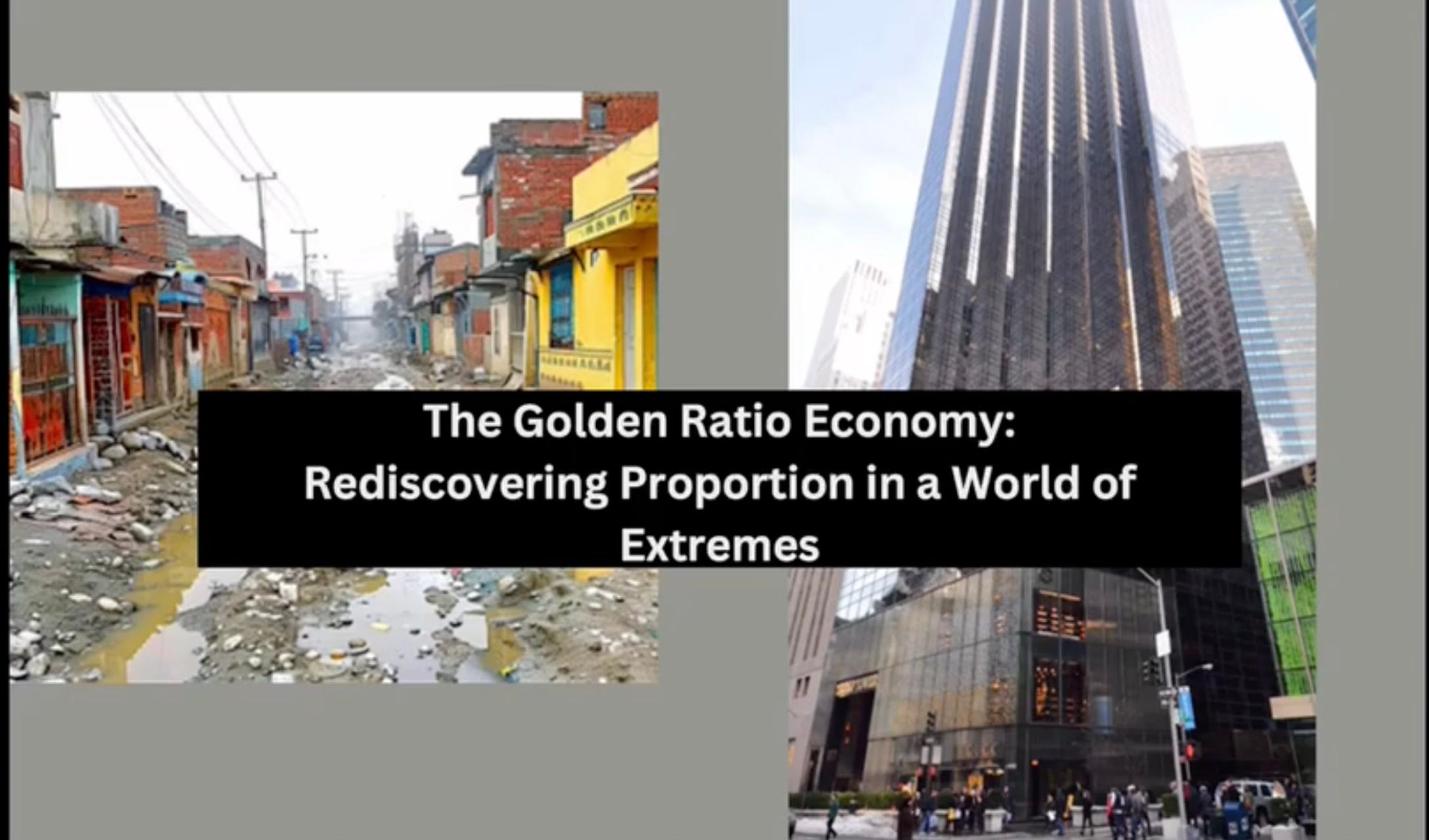
Look around.We live in a world of grotesque asymmetry, where towers of luxury rise beside deserts of deprivation—where high-end buildings stand shoulder to shoulder with impoverished slums. Take the United States as an example. Every year, the American food system produces far more than enough to feed its 330 million inhabitants, and yet over 13 million American children go to bed each night, not sure whether they will have enough to eat from one day to the next. At the very moment when these young lives most need care and protection, the first lesson they learn is poverty and fear.
In major cities, we see people sleeping on the streets—but this is not because there is a shortage of housing. On the contrary, the number of vacant homes outnumber the number of unhoused people by a ratio of 26 to 1. When we walk past those who have been displaced and battered by life, how do we look them in the eye, knowing that their suffering is entirely unnecessary?
Likewise, over the past several decades, workers’ productivity has steadily increased, yet the fruits of that labor are extracted and distributed in an extraordinarily unequal way. Today in the United States, the bottom 50 percent of the population holds just 4 percent of the nation’s wealth, while the top 1 percent commands a staggering 30 percent.
In the dark shadow of this extreme material imbalance, a spiritual crisis is quietly unfolding. Half of Americans report feeling lonely. Nearly 20 percent of young people struggle with mental health issues. Combined with environmental collapse and the rise of political extremism, our world increasingly feels like a dystopian film. More disturbing still, giant technology corporations are pushing artificial intelligence forward with little public oversight or regard for social consequences, leaving us with a deep sense that the future is slipping out of human control.
These problems are not unique to the United States. In the global wave of capital-driven development, both developed and developing countries suffer from severe imbalances—different in form and proportion, but rooted in the same logic.
So the question is unavoidable:Where does this imbalance come from? And how should we respond?
On November 29, 2025, Donni Wang, PhD from Stanford University, delivered a speech entitled “The Golden Ratio Economy: Rediscovering Proportion in the World of Extremes.” at the 2025 Economy of Francesco International Conference held in Castel Gandolfo, Italy, The talk analyzes the root causes of today’s various forms of imbalance and introduces the concept of the Golden Ratio Economy as a guiding idea and normative framework, offering a pathway and a mode of thinking for addressing contemporary challenges.
The following article is adapted from the speech.
Structural Imbalance and the Polycrisis
What we are facing today—a polycrisis spanning the social, ecological, and spiritual realms—is not caused by absolute scarcity of resources, but rather structural imbalance.
We see food waste alongside hunger, vacant housing alongside homelessness, unprecedented wealth accumulation alongside deepening poverty. These disturbing asymmetries can be traced back to a core flaw of the modern economic system: the relentless pursuit of quantified output and unlimited growth. This ultimate goal systematically ignores distributive justice and social sustainability, producing excess and deprivation at the same time.
The phenomenon we witness is not natural, nor is it something that can be fixed simply by adjusting individual policies or replacing decision-makers. It is the inevitable outcome of an economy that measures success primarily through capital accumulation.
In the United States, agricultural production is sufficient to meet domestic demand, yet millions of people experience food insecurity. At the same time, food waste accounts for a significant share of total production, while food safety cannot be taken for granted. This reflects a system in which supply chains and markets prioritize profit maximization rather than ensuring universal access to essential resources.
Housing follows the same pattern. Vacant units vastly outnumber unhoused individuals, as properties are treated as speculative assets rather than places to live. This misallocation is not accidental—it is systemic, rooted in an economic logic where market efficiency consistently outranks human care.
From Economic Inequality to Social and Spiritual Crisis
These structural imbalances also plague income and wealth distribution. Productivity gains over recent decades have overwhelmingly benefited those at the top, while the majority see little improvement. This growing disconnect between contribution and reward undermines not only economic fairness, but social cohesion itself.
Globally, similar patterns emerge. Many developing countries depend on extractive, export-oriented economies that leave local communities eviscerated from environmental destruction and economic exploitation, while multinational corporations and small elites capture the profits. The rise of the gig economy intensifies this instability: platform workers generate immense value for tech giants while lacking social protection, income security, or long-term stability.
These imbalances also manifest as loneliness, anxiety, burnout, and alienation. Nearly one-fifth of young people experience mental health issues. Ecological degradation accelerates. Political extremism feeds on despair. And technological systems—especially AI—advance at breathtaking speed without democratic oversight.
The result is a pervasive feeling that economic and technological systems no longer serve society, but operate above and beyond it. People feel replaceable, managed, and disconnected—mere components in a vast machine.
At the spiritual level, this imbalance appears as a loss of meaning and purpose. Consumer culture offers instant gratification and endless accumulation, while neglecting our need for belonging, creativity, and transcendence. Burnout and depression are not side effects; they are structural outcomes of an economy that treats human beings as inputs optimized for efficiency rather than as relational, dignified, and creative beings.
The Golden Ratio Economy: A Normative Framework for Proportion
In response to these crises, what our economic system most urgently needs is structural reorientation. This is where the Golden Ratio Economy enters the picture.
The Golden Ratio Economy seeks to shift the center of gravity of economic life—from endless growth toward a balanced integration of ecological sustainability, social justice, and human dignity. It offers an alternative to the growth-dominated paradigm and a way for societies to regain balance in an age of excess.
The idea of the golden ratio originates in a mathematical relationship—approximately 1.618—long associated with harmony in nature, art, and architecture. Popularized in Europe through Fibonacci, it also emerged independently in ancient Greek philosophy, Indian mathematics, and Arab geometry. Across cultures, proportion has served as a measure of balance between parts and wholes, means and ends, material foundations and spiritual life.
Modern economies increasingly reduce living human beings to labor, human capital, or consumer units, while excluding ethical and humanistic concerns from the economic sphere. This separation marks a departure from earlier humanist traditions, particularly the ideas of the European Renaissance. Renaissance humanism embraced holisism, emphasizing proportion, harmony, and balance, which were reflected not only in art and architecture but also extended to social life. Works such as Michelangelo’s The Creation of Adam expressed the nobility of human nature and endowed individuals with creative potential. During that era, economic activity was understood as subordinate to broader ethical and cultural goals. For instance, the merchants and bankers of Florence pursued wealth while also patronizing art and education, viewing economic success as a means to humanistic flourishing. In contrast, contemporary economic models have lost this humanistic scale, inverting priorities by placing material growth first, which has led to imbalance becoming the norm. This deviation represents a historical regression, allowing modern rationalism to devolve into a narrow utilitarianism that ignores the multidimensionality of human existence and breeds severe social and spiritual crises.
As the Golden Ratio Economy repositions the economy, it emphasizes cultivating sensory and aesthetic experiences through artisan production, craftsmanship, and meaningful work. These capacities are not luxurious add-ons, but the foundation of human flourishing. In contemporary workplaces, many people face alienation produced by mechanized tasks, whereas the Golden Ratio Economy advocates designing work as a pathway for expressing creative potential.
At the same time, it places civic vitality at the center of economic evaluation, sustaining it through cooperation, democratic participation, and shared responsibility for the common good. In imbalanced societies, civic participation is often marginalized; whereas the new framework calls for the democratization of economic decision-making—for example, through workers’ councils, cooperatives, and community forums that allow stakeholders to directly influence resource allocation. This not only alleviates power asymmetries, but also cultivates collective responsibility, transforming the economy into a tool for democratic cohesion rather than a force of division.
Furthermore, the Golden Ratio Economy regards leisure, non-work, and contemplation as essential elements of intellectual, emotional, and spiritual development. Under growth-dominated paradigms, rest or idleness is often treated as unproductive; the new framework, by contrast, legitimizes it as a key mechanism for restoring balance. By shortening working hours or introducing universal basic income (UBI), it provides individuals with space for reading, resting, playing, or philosophical reflection, thereby counteracting the cognitive fragmentation produced by technological acceleration.
Such leisure is not wasteful, but a purposeful pause that helps individuals reconnect their inner needs with the external world. At the same time, material abundance must submit to ecological limits, ensuring that economic activity supports community well-being while also safeguarding the environment. This places sustainability at the core of the economy, creating a form of abundance that is not limitless expansion, but a moderation of “enough,” and ensuring that future generations inherit a healthy planet rather than a depleted wasteland.
Finally, the Golden Ratio Economy takes fairness and justice as its foundation, demanding the democratic governance of workplaces and economic institutions. Under current conditions of imbalance, injustice often arises from opaque power structures; the Golden Ratio therefore advocates transparency and inclusion. Examples include promoting cooperative rather than privately owned enterprises, securing labor union rights through legal reform, and introducing stakeholder capitalism so that employees and communities have a voice in corporate decision-making.
This form of justice is not an abstract principle, but a concrete balance achieved through proportional adjustment. It mitigates wealth concentration, promotes equal opportunity, and thereby rebuilds societal trust.
Restoring a Sense of “Scale”
Today, we marvel at humanity’s unprecedented material wealth and physical comfort, yet we continue to feel exhausted and disoriented. The paradox we face is no longer scarcity, but the coexistence of excess and deprivation.
Rooted in the humanist tradition, the Golden Ratio Economy restores proportion, balance, and dignity to economic life. It rejects a system built on maximization and infinite growth, offering instead a paradigm of moderation, fairness, and human flourishing.
This is a public episode. If you'd like to discuss this with other subscribers or get access to bonus episodes, visit bostonreviewofbooks.substack.com/subscribe