
Big Brains
228 episodes — Page 1 of 5
Neutrino Hunters: Searching for Ghostly Particles in Antarctic Ice, with Abigail Vieregg
Recreating A Sense of Touch, Using Our Minds, with Nicholas Hatsopoulos
Why The Key to Treating Cancer May Be In Your Gut, with Thomas Gajewski
The Little-Known Secrets To A Good Life, with Shigehiro Oishi
How to Use Nature to Restore Your Focus, with Marc Berman
How to Raise Kids in the Age of AI, with Dana Suskind
What Our Trash Problem Says About Our Culture, with Sarah Newman
How Websites Trick You Using ‘Dark Patterns’
Quantum Technology, Explained: A Big Brains Live Event
Our Untapped Superpower: Connecting With Others, with Nicholas Epley
Why the Fed Matters Now More Than Ever, with Douglas Diamond
Anxious? Avoidant? How to Build More Secure Relationships
Ep 191Could AI Models Forecast Extreme Weather Events? with Pedram Hassanzadeh
What if we could predict the world’s most dangerous weather events—not days, but weeks in advance? Extreme events like heat waves, hurricanes, and floods cause massive loss of life and billions in damage, but they’re also some of the hardest events for traditional weather forecasting to predict. In this episode, Assoc. Prof. Pedram Hassanzadeh of the University of Chicago explains why forecasting extreme weather has long pushed science to its limits—and how a new wave of AI models could transform the field at a time when climate change is making these events more common. By learning directly from decades of atmospheric data, these systems can generate forecasts faster, more cheaply, and in some cases more accurately than traditional models—even to predict freak ‘gray swan’ weather events no one has ever seen. Hosted by Simplecast, an AdsWizz company. See pcm.adswizz.com for information about our collection and use of personal data for advertising.
Ep 190Are Judges Too Powerful? The Rise of Universal Injunctions, with Samuel Bray
In recent years, a judge in one state had gained the power to halt policies across the entire United States. Known as nationwide or universal injunctions, these actions have become one of the sweeping tools in the federal court—affecting cases ranging from student loan forgiveness to environmental policies to birthright citizenship. How did universal injunctions become such a central feature of modern constitutional battles? And should one judge really be able to block a policy for the entire country? In this episode, UChicago legal scholar Samuel Bray explains the history and legal debate behind such actions, including his research which was cited more than a dozen times in the 2025 Supreme Court case Trump v. Casa, which examined how courts use this remedy—and whether injunctions fit within the Constitution’s design. Hosted by Simplecast, an AdsWizz company. See pcm.adswizz.com for information about our collection and use of personal data for advertising.
Ep 189Could Data Centers Break Our Power Grid? with Andrew Chien
Artificial intelligence may live in “the cloud,” but its footprint is firmly on the ground. As AI systems grow more powerful, the data centers that train and run them are consuming massive amounts of land, water and electricity—as well as reshaping regional power grids. What does this surge in demand mean for the environment, energy infrastructure, and the future of innovation? In this episode, we speak with UChicago computer scientist Andrew Chien, an expert in large-scale computing and cloud computing, about why these data centers require so much power, why they’re stirring such controversy—and whether there are sustainable approaches that could keep our energy use in check. Hosted by Simplecast, an AdsWizz company. See pcm.adswizz.com for information about our collection and use of personal data for advertising.
Ep 188Remarkable New Treatments for Spinal Cord Injuries, with Mohamad Bydon
When a two-year-old boy suffered a catastrophic injury that severed the connection between his skull and spine, doctors across Europe told his family there was no hope. His spinal cord was completely severed, and the injury was not considered survivable. But University of Chicago neurosurgeon Mohamad Bydon saw a possibility.In this episode of Big Brains, Dr. Bydon walks us through the extraordinary, multi-stage surgery at UChicago that not only saved the boy’s life but helped him regain the ability to breathe, talk and move his fingers and toes. He examines the future of surgery for spinal cord injury patients—from minimally invasive surgery techniques to robotic surgery and AI to stem cell therapy—is even helping some paralyzed patients regain movement and even walk again after their injuries. Hosted by Simplecast, an AdsWizz company. See pcm.adswizz.com for information about our collection and use of personal data for advertising.
Ep 187Can You Improve Your Working Memory and Attention? with Edward Awh
In today’s world, our brains are overloaded with information, making it hard to focus and remember. But what are the true limits of the human mind—and why do they exist? And why are some people seem so much better than remembering things than others? In this episode, we talk with with Edward Awh, a cognitive neuroscientist and professor of psychology at the University of Chicago. Whose lab studies how the brain controls focus, memory and attention.His research explores the connection between attention and working memory, why our conscious awareness is far more limited than it feels, and what those limits mean for life in an information-saturated world. He explains what we can actually do to improve our memory—including one easy thing we can all do every day—and how using the “remote control of your mind” could help you focus your attention, given the limited space in our brains. Hosted by Simplecast, an AdsWizz company. See pcm.adswizz.com for information about our collection and use of personal data for advertising.
Ep 186Why Knowing Your True Self Is So Difficult, with Eric Oliver
The process of understanding who we are is a lifelong journey for many of us. For two decades, that question has been one that University of Chicago scholar Eric Oliver has asked his students in class—and inspired him to write a new book called "How to Know Your Self: The Art & Science of Discovering Who You Really Are."A renowned political scientist, Oliver draws upon science, philosophy, psychology and his personal experiences to better examine the mysteries of the human experience—and explore what it truly means to be “you.” Hosted by Simplecast, an AdsWizz company. See pcm.adswizz.com for information about our collection and use of personal data for advertising.
Ep 185The Breakthrough Quantum Sensor That Sees Inside Your Cells, with Peter Maurer
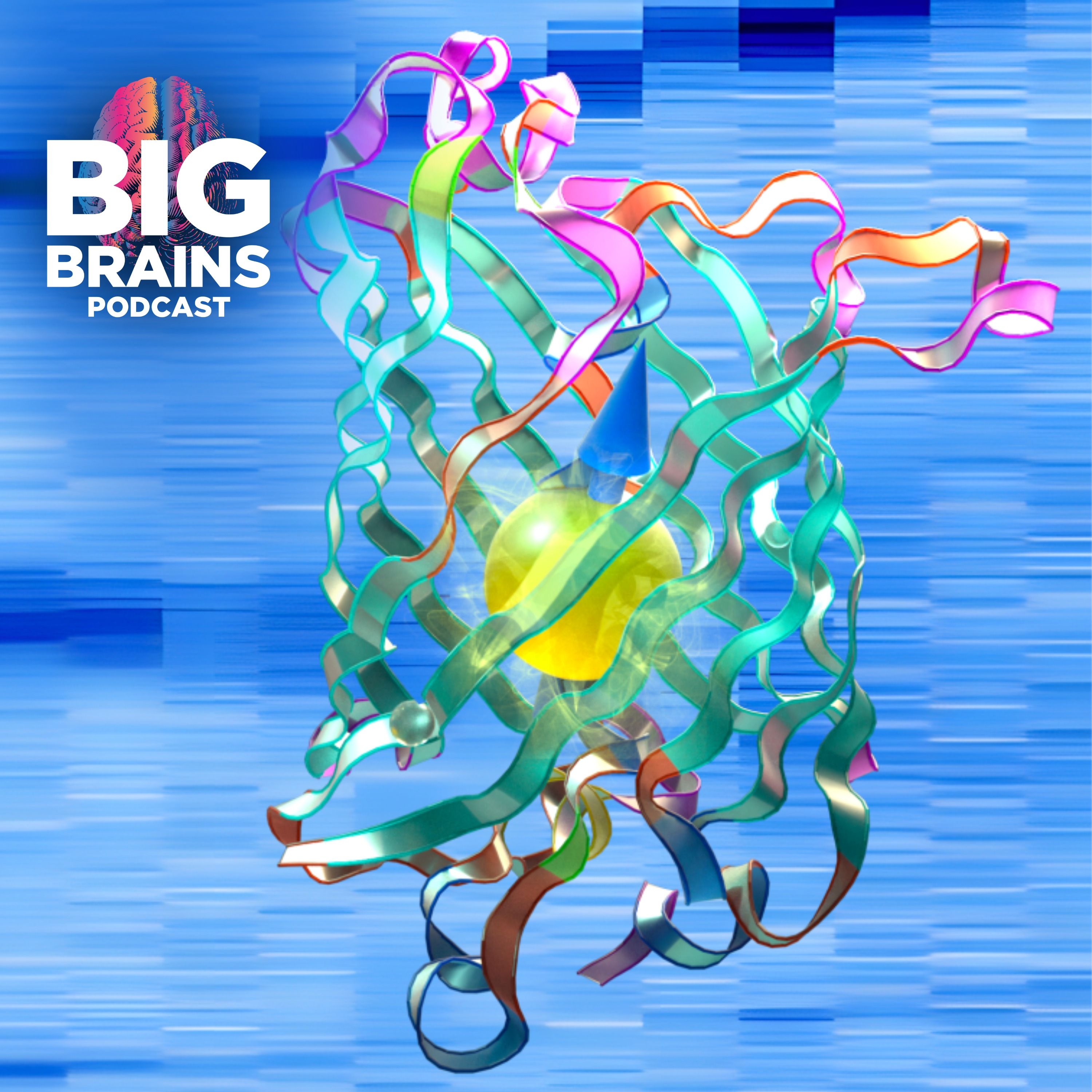
What if we could precisely measure a cell at its most fundamental level? In this episode, we talk with the University of Chicago scientist Peter Maurer about how he and his colleagues made the breakthrough discovery of turning a protein found in living cells into the first biological quantum bit, also known as a qubit.Maurer explains how quantum systems—once thought to be too fragile for real-world use—are becoming some of the most powerful sensors ever built, and what they could teach us about the brain, the body and more. Hosted by Simplecast, an AdsWizz company. See pcm.adswizz.com for information about our collection and use of personal data for advertising.
Ep 184How to Manifest Your Destiny with the Late James Doty
We've all heard the phrase "Manifest Your Destiny" when it comes to wanting a new promotion, figuring out a new career path or just trying to achieve that long-term goal. It turns out that the act of manifestation is not merely pseudoscience—it actually has a body of research in neuroscience to back it up.James Doty was a clinical professor of neurosurgery at Stanford University, and founder and director of the Center for Compassion and Altruism Research and Education. He wrote several books, including Mind Magic: The Neuroscience of Manifestation and How It Changes Everything. Hosted by Simplecast, an AdsWizz company. See pcm.adswizz.com for information about our collection and use of personal data for advertising.
Ep 183What Makes Music Go Viral—From AI to Taylor Swift
The internet and social media have transformed the way in which we hear and understand music today—and online communities and platforms from YouTube to TikTok have changed how music circulates and ultimately goes viral. Why do some pop stars have more success creating hit songs and building online following than others?In this episode, we speak with Paula Clare Harper, a musicologist and assistant professor at the University of Chicago. Harper co-edited the book Taylor Swift: The Star, The Songs, The Fans, which explores the online musical cultures that produced and propelled the image of megastar Taylor Swift. Harper unpacks how gendered narratives around "the fangirl" continue to influence which musical practices we take seriously—and how studying music on the internet helps us understand contemporary cultural power. Hosted by Simplecast, an AdsWizz company. See pcm.adswizz.com for information about our collection and use of personal data for advertising.

Ep 182How Wearable Tech Will Heighten Our Senses and Abilities, with Pedro Lopes
Can you imagine a world in which a wearable device, like a smartwatch, could move your fingers to strum the guitar or play the drums? That kind of technology is part of the innovative research coming out of the Human-Computer Integration Lab at the University of Chicago, led by renowned computer scientist Pedro Lopes. His lab is developing a new generation of gadgets that use haptics (or tactile sensations like the buzz of your smartphone) to move your body, replicate your sense of smell and even make you feel things.In this episode, Lopes explores the potential of wearable devices to transform our future as well as brain-computer interfaces that are being developed by companies like Elon Musk’s Neuralink that directly into the body. Hosted by Simplecast, an AdsWizz company. See pcm.adswizz.com for information about our collection and use of personal data for advertising.
Ep 181Why Are More Women Saying No To Having Kids? With Peggy O'Donnell Heffington
More and more women in the United States are saying no to motherhood. In 2023, the U.S. fertility rate reached the lowest number on record. But the idea of non-motherhood is actually not a new phenomenon, nor did it come out of the modern feminist movement. For centuries, women have made choices about limiting births and whether or not to become mothers at all. This history is documented in a new book, "Without Children: The Long History of Not Being a Mother," by University of Chicago Assistant Instructional Professor Peggy O'Donnell Heffington.Heffington writes about the historic trends of non-motherhood as well as the modern factors that are playing a role in women's choices to not have children today — from lack of structural support in the workplace, to a national law for paid maternity leave, and the sheer lack of affordability. She writes that if these trends continue, American millennials could become the largest childless cohort in history. Hosted by Simplecast, an AdsWizz company. See pcm.adswizz.com for information about our collection and use of personal data for advertising.
Ep 180How Full-Body MRIs Could Predict Your Long-Term Health, with Daniel Sodickson
What does it mean to see beneath the surface — of the human body, the brain, or even the universe itself? In his new book, The Future of Seeing: How Imaging Is Changing Our World, Prof. Daniel Sodickson of NYU explores the future of imaging: How technology is transforming not just medicine, but our very ways of perceiving the world. With the rise of AI-driven “digital vision,” Sodickson, a pioneer of MRI innovation, argues that imaging is no longer just a diagnostic tool — it’s becoming a new language of discovery.In this conversation, Sodickson explores the promises and pitfalls of this promising new technology. Reflecting on the history of scientific discovery, we examine what the next generation of imaging might reveal about life itself. Hosted by Simplecast, an AdsWizz company. See pcm.adswizz.com for information about our collection and use of personal data for advertising.
Ep 179Is There Such A Thing As A Psychopath?
Few ideas have gripped the public imagination quite like the idea of the “psychopath.” From Hollywood thrillers to true-crime podcasts, popular culture has led us to believe that psychopaths are dangerous and biologically distinct from the rest of us. But what if almost everything we think we know about them is wrong?In this episode, we talk with Rasmus Rosenberg Larsen, an Assistant Professor of Forensic Epistemology at the University of Toronto and author of "Psychopathy Unmasked," whose research is challenging the very foundation of psychopathy as a diagnosis. Larsen explains how the term “psychopath” is relatively new, dating to the Ted Bundy trial in the 1970s, and how TVs and movies have skewed our understanding of the “psychopath.” He discusses psychopathy tests, their impact on the criminal justice system—and what the latest science reveals about the minds we’ve long misunderstood. Hosted by Simplecast, an AdsWizz company. See pcm.adswizz.com for information about our collection and use of personal data for advertising.
Ep 178Why We Haven’t Solved Brain Disorders—And How To Fix It, with Nicole Rust
For decades, neuroscience has promised breakthroughs in treating conditions like depression, schizophrenia, and Alzheimer’s. Yet despite powerful technologies and billions invested, progress has been frustratingly slow. Why?On this episode of Big Brains, we talk with Nicole Rust, neuroscientist at the University of Pennsylvania and author of Elusive Cures. Rust argues that the traditional “domino” view of the brain—where one broken piece can simply be fixed—has held us back. Instead, she says we need to embrace the brain’s true nature: a complex, dynamic system more like the weather than a machine.We explore why treatments so often fail, what makes mood such a scientific mystery, and whether a new era of brain research—powered by models, feedback loops, and fresh ways of thinking—can finally deliver the cures that have long eluded us. Hosted by Simplecast, an AdsWizz company. See pcm.adswizz.com for information about our collection and use of personal data for advertising.
Ep 177Life On Mars: Is It Possible For Humans? with Edwin Kite
Billions of years ago, Mars may have looked less like the barren red desert we know today and more like Earth—with a blue sky, flowing rivers, and even seas. What happened to turn a once-habitable world into the frozen, lifeless planet we see now?On this episode of Big Brains, University of Chicago geophysical scientist Edwin Kite takes us on a journey through Mars’ hidden past. From evidence of a lost carbon cycle to theories about ancient climate swings, Kite’s research is rewriting the story of the Red Planet. But it’s not just about the past—his work is also at the forefront of a provocative question: could humanity one day terraform Mars and make it a living world again? Hosted by Simplecast, an AdsWizz company. See pcm.adswizz.com for information about our collection and use of personal data for advertising.

Ep 176How To Use Nature To Restore Your Focus, with Marc Berman
We’re living in an attention economy—and most of us are broke. But what if the secret to restoring your focus, improving your mental health, and even reducing crime rates wasn’t found in an app or a pill, but in a tree?In this episode, we speak with University of Chicago psychologist Marc Berman, whose research on “soft fascination” and nature’s cognitive effects is reshaping how we think about everything from urban planning to depression treatment. From groundbreaking hospital studies to surprising results with plastic plants, Berman’s work uncovers the deep—and often invisible—power that natural environments hold over our minds and bodies.Whether you're a city planner, a parent, or just someone feeling mentally fatigued, this conversation may just change the way you think about a walk in the park. Hosted by Simplecast, an AdsWizz company. See pcm.adswizz.com for information about our collection and use of personal data for advertising.
Ep 175Could Plants Unlock Quantum Medicine’s Potential? with Greg Engel
We’ve long marveled at how efficiently plants convert sunlight into energy—but no one guessed they were using quantum mechanics to do it.In this episode, we speak with Greg Engel, a pioneering biophysicist at the UChicago Pritzker School of Molecular Engineering and the Department of Chemistry who helped launch the field of quantum biology. Engel explains how plants and bacteria evolved to exploit quantum effects for photosynthesis—and how understanding these systems could spark a revolution in quantum sensing, medicine, and neuroscience.Engel’s team has already built quantum sensors inspired by nature’s designs, with the potential to transform how we detect disease, develop drugs, and even read neural signals. The ultimate goal? A new era of quantum medicine, powered by the weird and wonderful physics found in leaves. A new large gift is helping that mission along by establishing The Berggren Center for Quantum Medicine and Biology at The UChicago Pritzker School of Molecular Engineering, partnering with BSD, UC Medicine and others. Hosted by Simplecast, an AdsWizz company. See pcm.adswizz.com for information about our collection and use of personal data for advertising.
Ep 174How Microplastics Are Invading Our Bodies, with Matthew Campen
You’ve heard of plastic polluting oceans. But what if it’s polluting you—your brain, your reproductive system, even your unborn children?In this eye-opening episode, we speak with Prof. Matthew Campen, a scientist at the University of New Mexico, whose latest studies have uncovered evidence of microplastics in placentas, reproductive organs and brains of humans—particularly in the frontal cortex, where decision-making and personality live.We explore how these plastic particles are entering our bodies (hint: it’s not just your water bottle), what they might be doing to us, and why scientists are just beginning to understand the true scope of the issue. From declining sperm counts to potential links with dementia, this episode asks a critical question: Are microplastics the next big public health crisis? Hosted by Simplecast, an AdsWizz company. See pcm.adswizz.com for information about our collection and use of personal data for advertising.
Ep 173Why We Get Stuck—And How to Finally Move Forward
Hello listeners…we're re-releasing one of our favorite Big Brains episodes—an incredibly insightful conversation with psychologist Adam Alter. If you've ever felt stuck in your life or career, this episode offers practical strategies and surprising science to help you move forward. From why your best ideas might come after you feel like giving up, to what Netflix can teach us about breaking through inertia, this episode is packed with revelations. We’ll be back with brand-new episodes starting in August—also, check out our new YouTube page where you can now watch video versions of Big Brains. Hosted by Simplecast, an AdsWizz company. See pcm.adswizz.com for information about our collection and use of personal data for advertising.
Ep 172Inside the AI Debate: Hope, Hype, Or Harm? A Big Brains Panel Weighs In
One of the benefits of producing this podcast at the University of Chicago is that there are often events on campus that bring in not just one Big Brain, but many in order to find answers to the some of the most complex problems of our time. I recently had the pleasure of hosting one such event on artificial intelligence that we want to share with you today. It was part of the Graham School’s Leadership & Society Initiative Symposium, examined how AI could change everything and, more importantly, whether it should.Artificial intelligence is evolving faster than most of us can keep up with—and its impact is already reshaping our lives, from the hospital to the courtroom to the art studio. Is AI moving too fast? Are we focusing on the wrong questions? And what comes after today’s generation of models? It’s a candid, complex, and eye-opening conversation you won’t want to miss. Hosted by Simplecast, an AdsWizz company. See pcm.adswizz.com for information about our collection and use of personal data for advertising.

Ep 171Are Your Medications Safe And Effective?, with Jerry Avorn
For a more than a century, the Food and Drug Administration has worked to protect public health. In his research, Harvard University physician-researcher Jerry Avorn has examined how the FDA’s once-rigorous gold standard approval process has been affected by a powerful shortcut known as the Accelerated Approval Program—originally designed for desperate AIDS and cancer patients. He says that change in the 1990s has allowed more than half of all new drugs onto the market before drug companies have proven they actually help people.In his new book Rethinking Medications: Truth, Power and the Drugs We Take, Avorn cites numerous examples: from a cold medicine that doesn’t de-congest to billion-dollar cancer treatments that only shrink lab results to the controversial Alzheimer’s drug Aduhelm—approved despite no clear cognitive benefits. In this episode, Avorn explores whether some prescriptions in your medicine cabinet are safe, effective and worth the money. Hosted by Simplecast, an AdsWizz company. See pcm.adswizz.com for information about our collection and use of personal data for advertising.

Ep 170Are We Making AI Too Human?, with James Evans
Prof. James Evans, a University of Chicago sociologist and data scientist, believes we’re training AI to think too much like humans—and it’s holding science back.In this episode, Evans shares how our current models risk narrowing scientific exploration rather than expanding it, and explains why he’s pushing for AIs that think differently from us—what he calls “cognitive aliens.” Could these “alien minds” help us unlock hidden breakthroughs? And what would it take to build them? Hosted by Simplecast, an AdsWizz company. See pcm.adswizz.com for information about our collection and use of personal data for advertising.

Ep 169Inside The Disease That Changes Your Personality, with Bruce Miller
When someone we know or love starts to develop psychological issues, we don't often associate it with a form of dementia. However, this trait is one of the most common signs of frontotemporal dementia (FTD) — the most common neurodegenerative disease in people under the age of 65. In his new book, Mysteries of the Social Brain: Understanding Human Behavior Through Science, Dr. Bruce Miller highlights his experiences observing people with FTD and what they have taught him about what he calls the "social brain."Dr. Bruce Miller has been observing people with FTD for decades in the Memory and Aging Center at the University of San Francisco, where he is also Professor of Neurology and the Founding Director of the Global Brain Health Institute. He shares key insights on how to keep our "social brain" healthy and how it can even unlock our creative potential. Hosted by Simplecast, an AdsWizz company. See pcm.adswizz.com for information about our collection and use of personal data for advertising.

Ep 168Meet The ‘Planet Hunter’ Searching For Alien Life, with Jacob Bean
The search for life beyond Earth is no longer science fiction—it takes a lot of data, powerful telescopes and a bit of cosmic detective work. And at the center of this search is University of Chicago astrophysicist Jacob Bean. Bean was part of the team that made history by detecting carbon dioxide in the atmosphere of a distant planet using the James Webb Space Telescope—a major step forward in our ability to study exoplanets.Bean uses cutting-edge tools and discoveries that are reshaping how we think about planet habitability, biosignatures and our place in the universe. From potentially habitable exoplanets like K2-18b to false hopes like Gliese 486b, Bean shares why the atmospheres of these faraway worlds might hold the key to one of humanity’s oldest questions: Are we alone in the universe? Hosted by Simplecast, an AdsWizz company. See pcm.adswizz.com for information about our collection and use of personal data for advertising.

Ep 167How To Stop Gun Violence Before It Starts, with Jens Ludwig
Despite decades of policy ideas, pouring millions of dollars into the problem, and a slow pace of gun control measures, the United States hasn’t made much progress on curbing the epidemic of gun violence in our country.For the past 25 years, Prof. Jens Ludwig of the University of Chicago has examined the questions of: Why does gun violence happen, and is there anything we can do about it? In his new book, Unforgiving Places: The Unexpected Origins of American Gun Violence, Ludwig—who is director of the University of Chicago Crime Lab—discusses why we've been thinking about the gun violence problem in the wrong ways.Drawing upon behavioral economics, he explains that most shootings are not premediated; rather, the result of arguments that escalate into violence. Using data-backed interventions, Ludwig introduces new ideas beyond policy and policing to get at the real root causes of gun violence today. Hosted by Simplecast, an AdsWizz company. See pcm.adswizz.com for information about our collection and use of personal data for advertising.

Ep 166Can Your DNA Predict Your Future?, with Dalton Conley
What if a single number, derived from your DNA, could predict your income, education level or even who you're likely to marry? In his new book “The Social Genome,” Princeton University sociologist Dalton Conley explores the science behind how our genes are shaping our society in ways that are both profound and unsettling.Conley explains how our genes, and the genes of those around us, are influencing our lives in ways we barely understand—from fertility clinics selecting embryos based on genetic traits to the rise of “genetic sorting” in everything from dating to zip codes. He also debunks the idea of nature versus nurture, revealing how deeply intertwined they truly are.Are we heading toward a future of genetically coded inequality? And what policies and conversations are urgently needed to ensure we don’t cross the line from science into dystopia? Hosted by Simplecast, an AdsWizz company. See pcm.adswizz.com for information about our collection and use of personal data for advertising.

Ep 165Can You Really Die of a Broken Heart? The Hidden Dangers of Grief, with Mary Frances O'Connor
When we lose someone, we love, we often say we have a broken heart—but what if that’s not just a metaphor?In her new book “The Grieving Body: How The Stress of Loss Can Be An Opportunity For Healing” University of Arizona Professor of Psychology Mary Frances O’Connor shares groundbreaking insights into the biological and physiological impacts grief has on our bodies. O’Connor reveals how profound loss can lead to serious medical conditions, from heart attacks to immune system breakdowns, and explains why grieving can make us more vulnerable to diseases like cancer, pneumonia, and even autoimmune disorders.Drawing on her personal experiences and extensive research, O’Connor outlines why our medical system—and society at large—needs to rethink how we support grieving individuals. She makes a powerful case for viewing grief not only as an emotional experience but as a medical event deserving careful monitoring and intervention, similar to pregnancy or chronic illness. Hosted by Simplecast, an AdsWizz company. See pcm.adswizz.com for information about our collection and use of personal data for advertising.

Ep 164The Science Behind Raising Successful Kids, with Ariel Kalil
New federal data paints a stark picture: American children are falling behind in reading and test scores, with the gap between advantaged and disadvantaged kids growing wider. But is this really just a problem of money? University of Chicago Developmental psychologist Ariel Kalil has spent her career studying how parents influence childhood development—not just through resources, but through daily habits and interactions.On this episode, we explore the surprising science behind parental engagement, the behavioral biases that shape parenting decisions, and why simple interventions—like 15 minutes of reading a day—can have an outsized impact. Plus, we discuss how AI and behavioral economics might provide new solutions for supporting parents in an era of rising inequality. Hosted by Simplecast, an AdsWizz company. See pcm.adswizz.com for information about our collection and use of personal data for advertising.

Ep 163Do Animals Understand Death?, with Susana Monsó
What does it mean to understand death? For centuries, philosophers have argued that only humans can truly comprehend mortality. But what if they’re wrong?In this episode, we speak with philosopher Susana Monsó, author of Playing Possum: How Animals Understand Death, to explore whether animals can grasp their own mortality. From grieving elephants to corpse-removing ants and possums that play dead, we investigate what animal behavior reveals about their concept of death. Do dogs understand when their owners pass away? Do predators recognize a corpse as different from prey? And what does this mean for how we treat animals? Hosted by Simplecast, an AdsWizz company. See pcm.adswizz.com for information about our collection and use of personal data for advertising.

Ep 162Why Measles Is Resurging—And The Rise Of Vaccine Hesitancy, with Adam Ratner
In 2000, the United States declared that measles had been eliminated. But just 15 years later, the disease made a comeback—and it hasn’t gone away since. In this episode, Dr. Adam Ratner, director of the Division of Pediatric Infectious Diseases at NYU and author of Booster Shots: The Urgent Lessons of Measles and the Uncertain Future of Children's Health, explains why measles outbreaks are occurring again—as vaccine hesitancy and the antivax movement is on the rise—and what this means for the future of children’s health.Ratner describes why measles is the most contagious disease we know of, and why it can be particularly harmful to children. As vaccination rates for children and adults continue to decrease in the U.S., are we at risk of undoing decades of medical progress? And what can we do to stop it? Hosted by Simplecast, an AdsWizz company. See pcm.adswizz.com for information about our collection and use of personal data for advertising.

Ep 161The Little-Known Secrets To A Good Life, with Shigehiro Oishi
What makes a good life? For decades, psychologists have debated whether true fulfillment comes from happiness—a life of comfort and joy—or meaning—a life of purpose and impact. But what if there's a third way?University of Chicago psychology professor Shigehiro Oishi has spent his career studying happiness, meaning, and what truly brings people deep satisfaction. His new research suggests that some of the most fulfilled people don’t prioritize either—they live psychologically rich lives, full of novelty, challenges, and transformative experiences.In this episode, Oishi explains why psychological richness might be the missing piece in our search for fulfillment. Hosted by Simplecast, an AdsWizz company. See pcm.adswizz.com for information about our collection and use of personal data for advertising.

Ep 160How Bioelectronics Could Heal Our Bodies And Minds, with Bozhi Tian
Imagine a future in which Band-Aids talk to your cells, pacemakers are powered by light and your gut microbiome gets a tune-up—all thanks to tiny bioelectric devices. Sounds like sci-fi, right? Think again. Prof. Bozhi Tian of the University of Chicago is on the frontier of bioelectronics, building living machines that can heal, enhance and maybe even transform what it means to be human. In this episode, he explains his research lab’s work and explores the thrilling, strange and sometimes unsettling world in which biology meets technology. Hosted by Simplecast, an AdsWizz company. See pcm.adswizz.com for information about our collection and use of personal data for advertising.

Ep 159Could A Fungal Pandemic Be “The Last of Us?", with Arturo Casadevall
Five years after COVID became a global pandemic, could another health crisis be on our horizon? According to scientists who study diseases, the possibility of a fungal pandemic—the subject of science fiction TV shows like “The Last of Us,” could be more of a reality, thanks to climate change and our warming planet. As fungi are adapting to warmer climates, they are becoming increasingly stronger and more resistant against the drugs we have to fight them.Arturo Casadevall is one of the scientists who is warning against fungi's powerful potential. He's a professor of microbiology and immunology at the Johns Hopkins’ Bloomberg School of Public Health and the author of the new book, What If Fungi Win? He explains why fungi are becoming a growing public health threat, and what tools we have to protect ourselves from a future fungal outbreak. Hosted by Simplecast, an AdsWizz company. See pcm.adswizz.com for information about our collection and use of personal data for advertising.
Ep 158The "Magic Words" That Turn Resolutions Into Reality
As we step into 2025, many of us are thinking about how to turn our New Year's resolutions into lasting changes. But what if the secret to success lies not in willpower but in the words we use every day? To kick off the year, we’re sharing our past episode with Jonah Berger, a professor at The Wharton School and author of Magic Words: What to Say to Get Your Way.In this episode, Berger uncovers the science behind the language we use and how it shapes our habits, decisions, and relationships. From simple word swaps that can help you stay on track with your goals to strategies for using language to connect with others more effectively, this conversation is packed with insights to help you make 2025 a year of transformation. Hosted by Simplecast, an AdsWizz company. See pcm.adswizz.com for information about our collection and use of personal data for advertising.

Ep 157What’s The Truth About Alcohol’s Benefits And Risks? with Tim Stockwell
We have long heard the claims that a glass of red wine is good for your heart, but it turns out that the research that fueled this wisdom was actually skewed. Some studies made it appear like moderate drinkers were healthier than people who didn't drink at all, leading the public to believe that alcohol was healthier than it is. While drinking alcohol occasionally might not have catastrophic effects on your health, the data shows that even moderate drinking will reduce your life expectancy.In this episode, we speak with Tim Stockwell, a scientist at the Canadian Institute for Substance Use Research and a professor of psychology at the University of Victoria. Stockwell has reviewed hundreds of studies that he claims embellished alcohol's effects, and he explains how the new science of drinking is changing the public perception of alcohol. Today, trends like sober-curiosity and “Dry January” are on the rise, and some countries around the world are even implementing new policies around alcohol regulation. Hosted by Simplecast, an AdsWizz company. See pcm.adswizz.com for information about our collection and use of personal data for advertising.

Ep 156What Happens When We Die? with Sam Parnia
For centuries, death has been seen as a final, inescapable line—a moment when the heart stops and the brain ceases to function. But revolutionary research asks: What if everything we thought we knew about death was wrong?Sam Parnia, an associate professor of medicine at NYU Langone, is the author of Lucid Dying: The New Science Revolutionizing How We Understand Life and Death. His groundbreaking work explores how science is pushing the boundaries of life and death, uncovering the potential to resuscitate animals—and maybe one day humans—after they've been declared dead. From recalling experiences of consciousness after death (what some call “near-death experiences”) to using AI and advanced techniques to study the brain in its final moments, he explores the profound implications for medicine, ethics and our understanding of what it means to be alive. Hosted by Simplecast, an AdsWizz company. See pcm.adswizz.com for information about our collection and use of personal data for advertising.
Ep 155The Illusion of Moral Decline
This year’s election might have been the most contentious in modern memory. It's not just that politics have changed, but it seems that people have too. You’ve probably heard this phrase: “People aren’t as kind as they used to be”. Maybe you’ve experienced the feeling that people are acting meaner to each other, year after year. But is it true? Are people really less kind than they used to be?With that question in mind, and as we take some time off for the Thanksgiving holiday, we wanted to reshare our episode with psychologist Adam Mastroianni. Mastroianni wondered if people are really becoming less moral in today's world, so he set out to find an answer, and published his findings in the journal Nature, “The Illusion of Moral Decline.” While the title may be a giveaway for his findings, he asks: If people are becoming less moral, why do we all feel the same way—and what can we do to shake this “illusion?” Hosted by Simplecast, an AdsWizz company. See pcm.adswizz.com for information about our collection and use of personal data for advertising.

Ep 154Can We Predict The Unpredictable? with J. Doyne Farmer
What if we could predict the economy the way we predict the weather? What if governments could run simulations to forecast the effects of new policies—before they happen? And what if the key to all of this lies in the same chaotic systems that explain spinning roulette wheels and rolling dice?J. Doyne Farmer is a University of Oxford professor, complexity scientist, and former physicist who once beat Las Vegas casinos using his scientific-based methods. In his recent book “Making Sense of Chaos: A Better Economics for a Better World” Farmer is using those same principles to build a new branch of economics called complexity economics—one that uses big data to help forecast market crashes, design better policies and find ways to confront climate change.But can we really predict the unpredictable? And how will using chaos theory shake up well-established economic approaches? Hosted by Simplecast, an AdsWizz company. See pcm.adswizz.com for information about our collection and use of personal data for advertising.