
B&H Photography Podcast
459 episodes — Page 3 of 10

A World History of Women Photographers with Luce Lebart and Pauline Vermare
Women photographers take center stage in this week's show, in celebration of International Women's Day and Women's History Month. We reveal the blind spot of photo history in a chat about the book A World History of Women Photographers, with photo historian and co-author Luce Lebart and contributing writer Pauline Vermare. Gracing the pages of this book's 500-page heft are images and stories behind 300 women photographers, spanning both photo history and geographic reach. Listen in to learn about the exhaustive process Lebart and co-author Marie Robert undertook to find this range of talent and then commission essays from 160 women writers and curators. We also discuss how the position of women within photography has changed over time and across cultures. There are fresh discoveries to be made by even the most ardent photography devotees, as illustrated by the many photographer names and related resources we mention during the episode, also listed below in our show notes. Guests: Luce Lebart and Pauline Vermare Top shot © The National Museum of Iceland, Reykjavik Episode Timeline 4:17: Luce Lebart describes the editorial statement behind the book A World History of Women Photographers as a manifesto to complete a history that already exists. 10:14: Back stories about women working as picture editors, art directors, designers, and art buyers in photo industry trenches, with male photographers as hunter gathers in the field. 13:32: The international network behind the research for this book. Which came first—the contributing writers or featured photographers? 21:21: The matter of women photographers who stayed in the shadow of a master or did not receive equal recognition as her spouse. 26:45: Avoiding the pitfall of a western centered approach in the geographical representation of photographers selected for the book 30:56: Additional book projects and databases of women photographers. 33:44: Episode break 34:38: Pauline Vermare describes differences between France and America in their respective approaches to photography. 38:36: Pauline discusses the Japanese women photographers she wrote about for the book. 45:00: American photographer Nancy Burson's stature as a forerunner of current trends for AI generated photographs. 49:40: How A World History of Women Photographers encourages questions of readers, inspiring Pauline to create a forthcoming book on Japanese women photographers. Guest Bios: Luce Lebart is co-author, with Marie Robert, of A World History of Women Photographers. A photography historian and curator currently based in Paris, she is a researcher for the Archive of Modern Conflict, a collection and publishing house based between London and Toronto. Luce served as director of the Canadian Institute of Photography from 2016 to 2018, after spending five years directing the collections of the French Society of Photography in Paris. Pauline Vermare is a French photography curator and historian based in New York. A contributing writer to A World History of Women Photographers, she was formerly the cultural director of Magnum Photos in New York, a curator at the International Center of Photography and the Museum of Modern Art. From 2002 to 2009, she worked at the Henri Cartier-Bresson Foundation, in Paris. Stay Connected: A World History of Women Photographers English language edition: https://www.thamesandhudsonusa.com/books/a-world-history-of-women-photographers-hardcover A World History of Women Photographers French edition: https://www.editionstextuel.com/livre/une-histoire-mondiale-des-femmes-photographes Luce Lebart Website: https://lucelebart.org/ Luce Lebart Facebook: ? Luce Lebart Instagram: https://www.instagram.com/lucelebart Luce Lebart Twitter: https://twitter.com/lucelebart?lang=en Mauvaises Herbes (Weeds) exhibit: https://www.cpif.net/ Photo Europea Photo Festival: https://www.fotografiaeuropea.it/fe2023/en/concept-2023/ Pauline Vermare curated Kunie Sugiura Exhibit at Alison Bradley Projects: https://www.alisonbradleyprojects.com/kunie-sugiura-show/ Recently curated exhibition of Northern Ireland photos by women photographers: https://photomuseumireland.ie/pauline-vermare-protest Co-curated exhibition of 10 contemporary Japanese women photographers: https://matterport.com/discover/space/LQT8wCUrWuE Recent interview on Pauline's Japanese women photographers project: https://www.truthinphotography.org/japanese-women-photographers.html Women Photographers mentioned in the podcast: Anna Atkins - United Kingdom, 1799 - 1871 Amilie Guillot-Saguez -1810, France – 1864, Algeria Constance Talbot - United Kingdom, 1811 - 1880 Julia Margaret Cameron - 1815, India – 1879, Sri Lanka Alice Seeley Harris – United Kingdom, 1870 - 1970 Clara Sipprell - 1885, Canada – 1975, United States Tsuneko Sasamoto – Japan, b. 1914 Tokyo Tokiwa – Japan, b. 1930 Claudia Andujar - Switzerland, b. 1931 Yildiz Moran - Turkey, 1932 - 1995 Sara Facio - Argentina, b. 1932 Hilla Becher - Germany, 1934 - 2015 Abigail Heyma

Building and Maintaining Your Web Presence with Alex Vita and Ben Von Wong
When was the last time you updated your website? Despite the popularity and traction of social media sites, having a stand-alone website to promote your work and build your brand is key to connecting with your given audience. In this week's podcast, we explore the dynamics of building and maintaining a professional caliber website with insights from both sides of the coin. We start by chatting with website designer Alex Vita, who shares pet peeves as well as the best practices he's honed over more than 13 years of work with photo industry clients. All will benefit from Alex's insights on building a client-focused website as a way to build trust. After a break we get the artist's perspective from the illustrious photographer, environmental activist, and creative whirlwind Benjamin Von Wong, who also happens to be one of Alex's clients. Listen in as Ben and Alex discuss his web strategy and take a deep dive into the challenges of staying relevant and getting noticed in an oversaturated creative climate. We also dip into thoughts about how the evolution of AI is likely to change the future of the visual world, to make photographs the starting point for a conversation rather than its final purpose. Guests: Alex Vita and Benjamin Von Wong Top shot © Benjamin Von Wong For more information on our guests and the gear they use, click here. Episode Timeline 3:55: What role do stand-alone photography websites play in a world of viral social media sites? 12:16: Alex's pet peeves in photography websites. Two general categories: poor content and poor user experience. 20:55: Bounce rates, Google analytics reports, and how to determine the success of your website. 26:17: What are the most important considerations for good SEO and how have best practices for SEO changed over time? 31:59: Alex's recommendations for image size and compression for fast performance and readability on a wide range of devices—from mobile to retina screens. 35:55: Episode break 36:56: The varied roles that Ben Von Wong's websites and web presence play in communicating his environmental message. 41:40: How Ben's various microsites and social media presence helps with virality in marketing his work. 47:25: Ben's position as an environmentalist in a world full of advertising and boosted content—Ethics and principals come first. 52:30: How the evolution of AI and integration with Chat GPT is about to change the future of the visual world. 1:02:33: Ben's recommendations for what to look for when seeking to work with a web designer. Guest Bios: Alex Vita is a professional website designer, specialized in crafting sites for photographers and photo agencies. Working from his home base in Bucharest, Romania, Alex's super-power is thinking outside the box to grasp the big picture, helping photographers to structure their web presence by prioritizing maximum impact. Ben Von Wong is a Canadian artist, photographer, social influencer, and activist, best known for his hyper-realistic style, bridging photography and fantasy. His storytelling targets environmental issues such as ocean plastics, fashion pollution, and electronic waste, fueled by an extensive viral component that has generated more than 100 million views to date. Stay Connected: Alex Vita's Website: https://www.foregroundweb.com/ Alex Vita's Facebook: https://www.facebook.com/foregroundweb Alex Vita's Instagram: https://www.instagram.com/foregroundweb/ Alex Vita's Twitter: https://twitter.com/foregroundweb Alex Vita's YouTube: https://www.youtube.com/@foregroundweb Benjamin Von Wong's Website: https://www.vonwong.com Benjamin Von Wong's Blog: https://blog.vonwong.com Benjamin Von Wong's Case Studies: https://unforgettablelabs.com Benjamin Von Wong's Facebook: https://www.facebook.com/thevonwong Benjamin Von Wong's Instagram: https://www.instagram.com/vonwong Benjamin Von Wong's Twitter: https://twitter.com/thevonwong Alex Vita's YouTube: https://www.youtube.com/c/Vonwong%20

Flora Photographica A Potpourri of Pictures with Danae Panchaud and Abe Morell
We're all about flower power on this week's podcast, in celebration of Valentine's Day. Joining us in discussion are photography curator Danae Panchaud, co-author of the recent book Flora Photographica, along with contributing photographer and audience favorite Abelardo Morell. After describing the book's genesis and scope, Danae delves into the extensive research process she and co-author William Ewing employed to sift through many thousands of photographs celebrating this wide-ranging subject. From sumptuous floral still lives to delicate blooms photographed in service of an activist cause to conceptual treatments depicting flowers as imposters of real life and beyond—this magnificent book offers fertile ground for consideration and debate. After a break we continue the conversation with photographer Abelardo Morell, whose featured images from the series Flowers for Lisa evolved from a single photograph created as a gift for his wife to encompass a wide-ranging exploration of and homage to great artists of the past. As an alternative to a floral bouquet, we invite you to consider the enduring value in the gift of a photograph—or better yet an entire book of floral photography—to make a photoholic's heart flutter. Guests: Danae Panchaud and Abelardo Morell Top shot © Abelardo Morell For more information on our guests and the gear they use, see: www.bhphotovideo.com/explora/podcasts Episode Timeline 4:52: Danae Panchaud explains the research process for Flora Photographica and describes the joy in discovering the innovative methods photographers have used to explore this wide-ranging subject. 10:16: Distinctions between the new edition of Flora Photographica and an earlier volume by William Ewing sharing the same title, published in the 1990s. 13:53: The effects of digital tools and technologies on both the images themselves, and the research methods used to source images for the book. 16:31: Insights about Flora Photographica's nine intriguing chapter titles: Roots, In Situ, Enquiry, Arrangement, Essence, Imposters, Hybrids, Fugue, and Reverie. 21:00: Incorporating floral pictures with political themes and conceptual work on floral subjects, and the use of captions to help convey these messages. 23:55: Using the element of surprise in picture selection and sequencing to highlight unexpected images and allow readers to discover new artists. 32:50: Episode break 34:20: Abe Morell's first flower photograph was a double gift: A birthday gift for his wife and a gift for Abe to embark on a new challenge. 38:19: The benefits of working at home in the studio to use as a breeding ground for new ideas. 39:55: The incorporation of painting with photography, and Abe's efforts to reinterpret and transform past works from art history. 42:34: How work on this photo series enhanced Abe's perception of flowers as a common object. Guest Bios: Danae Panchaud is a photography curator, lecturer, and museum professional based in Switzerland. After studying photography at the widely acclaimed Vevey School of the Arts, she turned to curatorial practices at Geneva University of Art and Design. She has since held positions in the fields of contemporary art, design, and science at several Swiss institutions. From 2018 to 2021, she served as director and curator of Photoforum Pasquart in Biel. She was appointed director of the Centre de la Photographie Genève in 2021, where she explores the medium as a tool for constructing knowledge through both contemporary and historical photographs. Danae is actively involved in a number of Swiss associations for photography and the arts, currently serving as president of Spectrum – Photography in Switzerland. Abelardo Morell is a repeat visitor to the podcast, having previously appeared in the show Abelardo Morell: Alchemist of Photography in 2022. Born in Havana, Cuba, Morell immigrated to the United States with his parents at the age of 14. After earning a BFA from Bowdoin College and an MFA from Yale, he had a distinguished career as a photography professor at the Massachusetts College of Art and Design from 1983 to 2010. Morell has received many awards and accolades for his work, including a Guggenheim fellowship in 1994, an ICP Infinity Award in 2011, and a Lucie Award for achievement in fine art in 2017. He is the author of 8 books, including Flowers for Lisa, the subject of today's discussion, and his photographs have been exhibited and collected by galleries, institutions, and museums worldwide. Stay Connected: Flora Photographica book: https://thamesandhudson.com/flora-photographica-the-flower-in-contemporary-photography-9780500024584 Danae Panchaud Website: https://danaepanchaud.net/ Danae Panchaud Facebook: https://www.facebook.com/danae.panchaud/ Danae Panchaud Instagram: https://www.instagram.com/danaepanchaud/ Danae Panchaud Medium: https://medium.com/@danaep Centre de la Photographie Genève Website: https://www.centrephotogeneve.ch/ Abelardo Morell Website: https://www.abelardomor

Visual Narratives for the 21st Century with Mike Davis
"Selecting photos is a different skill than making them," explains renowned picture editor Mike Davis in this week's podcast. This essential understanding forms the core of Davis's new book Creating Visual Narratives Through Photography: A Fresh Approach to Making a Living as a Photographer. Davis approaches this topic with a mix of clarity and candor, to offer deeply engaged yet highly accessible insights about making photos—and making sense of those photos—while also discussing the elusive art of selecting and sequencing pictures and other ways to create visual narratives. Some of the key points covered in our chat include the visual vocabulary Davis assigns to photographs, his ideas about elevating pictures beyond simply informational content, how making multiple passes through a photo edit can help a photographer remove themselves from the experience of making the work, and his three different approaches to image sequencing. Listeners will also gain a fresh understanding of ways in which both the art of creating visual narratives and the photo industry itself have evolved over time, to raise the bar on creative expression. In presenting this book, Davis's goal echoes the response he has received from hundreds of photographers he's helped to tell stories with their pictures, "I never would have thought of things that way, had we not had this engagement." Guests: Mike Davis Photos © Mike Davis Episode Timeline 3:26: Photography as a visual vocabulary, and distinctions between, nouns, verbs, adjectives and adverbs. 6:25: What are informational photographs and how to make photos that rise above this basic level. 9:08: Davis's definition of composition: the full realization of light, and color, and distance in conveying a 3-dimensional space. 18:33: How the photo industry and relationships between photographers and photo editors have changed over time. 30:42: Davis discusses his photos published in the book and shares thoughts about photographing with intention. 39:34: Episode break 44:18: Three approaches to image sequencing and how they work within the full spectrum ofrafting a narrative 46:17: Mike Davis's most visually successful book project and a general timeframe for image sequencing. 48:06: Davis's approach to working with photographers on sequencing a book. 51:46: Davis describes his picture editing process using multiple passes through a set of photographs. 56:40: The primary audience and Davis's ultimate goal in writing Creating Visual Narratives Through Photography: A Fresh Approach to Making a Living as a Photographer. Guest Bio: Mike Davis is a visual consultant, editor, author, photographer, and professor emeritus. He has worked independently with hundreds of photographers as well as in staff positions for organizations as diverse as National Geographic, The White House, and several of America's visually powerful newspapers. Mike was twice named newspaper picture editor of the year, and he received The Sprague Award from The National Press Photographers Association, its highest honor. He has edited more than 40 books as an independent consultant, judged a wide range of photography competitions and grant programs, lectured widely, and served as a member of various workshop and review faculty. Most recently, Mike spent eight years as an endowed faculty member at Syracuse University's Newhouse School, where he taught visual storytelling courses and directed The Alexia Grants. Stay Connected: Mike Davis website: https://www.michaelddavis.com/ Mike Davis Instagram: https://www.instagram.com/mikedavis_mnpls/ Creating Visual Narratives Book: https://www.routledge.com/Creating-Visual-Narratives-Through-Photography-A-Fresh-Approach-to-Making/Davis/p/book/9781032262857

Filling the Access Gap with ASMP's Photography Mentorship Program, The Bridge
Creating and sustaining a successful photo career is no easy feat. To help aspiring young imagemakers acquire the needed creative concepts and business skills, two New York-based organizations—ASMP NY and BKC—have teamed up to offer the innovative mentorship, education, and industry immersion program The Bridge. Open to individuals from 18- to 26-years-old, The Bridge embraces diversity and offers opportunity to underserved communities, regardless of formal photography experience. Best of all, this four-month, real world program is free to accepted students. We first learned about The Bridge during a chat with program co-founder Liam Alexander for the show ASMP-NY and the Future of Photo Trade Organizations in February 2022. Since the program's second year recently wrapped with a gallery exhibition in Brooklyn, and plans are in the works to expand The Bridge to other ASMP chapters in 2023, we wanted to learn more about this valuable initiative in advance of the next application window this spring. For this week's podcast, we're joined by Alexander, who sheds light on The Bridge program's inner workings and educational goals during the first half of the show. After a break, we speak with 2022 Bridge graduate Eli Edwards, who describes what he learned through the program, and the resulting shift in the pictures he makes, as well as in his creative point of view. To discover how to futureproof your career and learn how to apply for this free program, make sure to listen in! Guests: Liam Alexander and Eli Edwards ASMP Bridge Program photo © Saad El Amin For more information on our guests and the gear they use, see: https://www.bhphotovideo.com/explora/podcasts/photography/celebrating-asmp-nys-mentorship-program-the-bridge Episode Timeline 3:50: Application and selection process for The Bridge Mentorship, a program designed to fill the gap in existing educational models. 9:27: Introduction to The Bridge program partner BKC, and program co-founder Justin Lin. 17:13: The Bridge Program coursework: Developing Your Creative Point of View. 20:52: Bridge Mentorship Program Core Supporters: The ASMP Foundation, Sony, and Freelancers Union, and a widening network of additional supporters. 25:17: A five-year vision for the program: Producing the future of the photo industry every summer. 26:50: Episode break 27:24: 2022 Bridge Program participant Eli Edwards and his easy application through Instagram. 32:42: Effects of the program on Eli's pictures and his new confidence in making project-based work. 36:40: Is YouTube University an effective tool for learning the ropes of photography? 40:56: How Eli's shift from social media to photography changed his creative point of view, and some social media tips. 46:38: Ways to support The Bridge program and application window for the 2023 Bridge program mentorship. Guest Bios: Liam Alexander is a fine artist and creative director who seeks to catalyze social change through artistic expression. As the current president of ASMP New York, he co-founded the ASMP NY Bridge program in 2020 with Justin Lin of BKC. He has also been instrumental in building other community focused creative projects designed to educate and inspire, such as IThou at NYU's Kimmel Galleries, The Exchange at Rush Arts, and #StrokeofGenius. Liam's own work has been featured in gallery exhibitions and art fairs throughout the US, and at the second annual Toolkit Festival in Venice, Italy. His work has been published in magazines including Nylon and Rolling Stone, and he creates projects with major brands like Wix.com, Samsung, SAP, Renaissance Hotels, and the city of New York. Eli Edwards is a photographer, videographer, writer, producer, and director. Born in Los Angeles, Eli currently resides in New York City, where he works as a freelance videographer and photographer for brands, events, and musical artists. He was a 2022 participant in the ASMP Bridge program, where he produced the photo series 'A Community of Hoops', which is about the dedicated group that frequents New York's iconic West 4th Street basketball court. Eli is a 2019 graduate of NYU's Steinhart School, receiving a bachelor of arts degree in Media, Culture, and Communication. After college, he worked as a social media editor for Turner Sports in Atlanta as part of the Emmy-Award winning NBA on TNT team, doing content creation work with the NBA. Stay Connected: The Bridge Program: https://www.wearebkc.com/bridge Donate to the Bridge: https://asmpfoundation.betterworld.org/campaigns/bridge-program ASMP National website: https://www.asmp.org/ ASMP New York website: https://www.asmp.org/newyork/ ASMP New York Facebook: https://www.facebook.com/asmpny ASMP New York Instagram: https://www.instagram.com/asmpny/ ASMP New York Twitter: https://twitter.com/asmpny Bridge Program partner BKC website: https://www.wearebkc.com/ BKC Instagram: https://www.instagram.com/wearebkc/ BKC Twitter: https://twitter.com/wearebkc Eli Edwards Website: https://www.eliedwa

Fire & Lights and Wild Nights: Jill Waterman's New Year's Eve Project: The B&H Photography Podcast
In some locales, the period between Christmas and the New Year is known as the Wild Nights, where mischief reigns in the darkest days of the northern hemisphere. We're digging into this theme for our last show of 2022, in a chat with photographer and producer of this very podcast, Jill Waterman, who has been documenting New Year's Eve traditions and exploits around the globe for the past 38 years. We first spoke with Jill about this project in the two-part show Legacy and Commitment in January 2022. Since she's now a full-fledged member of the podcast team, we thought we'd investigate some of her more memorable experiences a bit further. Jill is still shooting this series primarily with film, so our conversation ranges from the whys and wherefores of making that choice, to how the growth of the Internet became an essential research tool in the lead up to the Millennium and beyond. We also shed light on the elusive Austrian Perchten and Bulgarian Kukeri, and discuss parading Philadelphia Mummers, Bahamian Junkanoo figures, and Cape Town, South Africa's legendary Minstrel Parade. To learn about the most rewarding aspect of Jill's project and find out where she'll be ringing in New Year's Eve 2023, pull up a seat, pop some bubbly and listen in! Guest: Jill Waterman Photos © Jill Waterman Episode Timeline 2:35: The beginnings of the New Year's Eve Project 4:28: Evolution of the project and approach over time 5:34: Shooting black and white film instead of monochrome digital captures 8:12: Opportunities of the Millennium 9:04: The growth of the Internet as a research tool and discovering locations for New Year's Eve rituals 10:00: Documenting "Perchtenlaufs" in Austria during the Wild Nights 10:59: Common themes in different cultures: Mummer's Parade in Philadelphia; Junkanoo in Nassau, Bahamas; and the Minstrel Parade in Cape Town, South Africa 14:48: The spread of oral New Year's traditions and rituals: Burning Effigies and New Year's Widows in Quito, Ecuador 16:32: Bulgarian Kukeri and New Year's parade to scare away evil spirits in Razlog 17:28: Advance planning before arrival and proceeding with boots on the ground 18:46: The value of spontaneity and capturing action in the moment 19:58: Working through anxiety, emotional spikes, and physical challenges 21:09: Assessing coverage and reviewing images after the fact 22:12: Underwhelming celebrations, and New Year's Eve during COVID lockdown 25:50: Episode break 26:35: Jill's analog camera kit: Nikon F3 HP, a 35-70 mm f/2.8 zoom and 24 mm f/2.8 prime lenses 27:45: Black and white films used—Ilford HP5, Delta 400, FP4, Delta 100—and diluted development to minimize contrast 29:23: The most rewarding aspect of the New Year's Eve Project 30:41: Working through language differences and being open to communication 32:15: Experiencing the Pied Piper syndrome 32:45: Big crowds and safety issues on New Year's Eve 35:36: This year's destination, recent New York Foundation for the Arts award, and project links Guest Bio: Born and raised in Massachusetts, Jill Waterman has been based in New York since 1985. Her personal work is centered in long-term photo projects, such as the ongoing New Year's Eve Project and other aspects of her focus on night photography. Her photographs have been exhibited internationally and widely featured in press and media. Highlights include a 1997 arts documentary for Deutsche Welle TV in Berlin, Germany; a 2003 Today Show interview with Katie Couric; and a 2015 documentary for the web TV show Culture Connect. Waterman's first book, the technical volume Night and Low Light Photography, was released by Amphoto books in August 2008. Her professional background includes a past career in image licensing, editorial positions in custom publishing, and her current role as creative producer for the B&H Photography Podcast. Stay Connected: New Year's Eve Project Documentary: https://www.youtube.com/watch?v=SLqZ_PIEugA New Year's Project Silvester Stories NFT: https://opensea.io/collection/silvester-stories Instagram: https://www.instagram.com/nightpix/ Facebook: https://www.facebook.com/jill.waterman

2022 Cameras of the Year: The B&H Photography Podcast
For anyone seeking a new camera to gift or to hold this holiday season, we present the eighth annual installment of our Cameras of the Year episode! Featured in our discussion are 16 new cameras from Canon, FUJIFILM, Hasselblad, Leica, Nikon, OM SYSTEM, Panasonic, and Sony—presented in alphabetical order. In addition to a detailed review of each camera on our list, we also discuss trends such as the shift from separate cameras for photo and video to a single camera geared to content creation, recent advances in high resolution EVFs, the benefits to cameras with internal memory, an increasing prevalence of AI technologies, the continued relevance of Micro 4/3rds and APS-C models when full frame cameras are shrinking in size and weight, and much more. Along the way, we even come up with some new terminology—Exit Level Cameras! Tune in for yourself and find out what it means. Guest: Kevin Rickert Episode Timeline 3:30: Canon EOS R6 Mark II Mirrorless Camera 4:29: From separate cameras for photo and video to one camera for content creation 5:30: Canon EOS R7 Mirrorless Camera 6:42: A question about image stabilization 7:58: The increasing use of dual card slots 8:50: Newer Canon cameras have a different hotshoe 11:18: Canon EOS R10 Mirrorless Camera 12:25: The legacy of the Canon Rebel series name 14:25: Canon R5 C Mirrorless Cinema Camera 15:43: What constitutes a Netflix-approved cinema camera 17:08: FUJIFILM X-H2S Mirrorless Camera 18:12: FUJIFILM X-H2 Mirrorless Camera 18:20: FUJIFILM X-T5 Mirrorless Camera 19:43: Recent advances in high resolution EVFs 20:55: New FUJIFILM lenses mean faster full-time autofocus 22:15: Hasselblad X2D 100C Medium Format Mirrorless Camera 2400: The benefits to cameras with internal memory 24:38: Medium format 16-bit color gives you more crayons to play with in the box 26:02: Episode break 27:13: Leica M 11 Rangefinder Camera 30:24: US-B Type C connection allows downloading pictures to a phone 30:59: What is pixel binning and why is it useful? 32:12: Nikon Z 30 Mirrorless Camera 35:44: OM SYSTEM OM-1 Mirrorless Camera 37:08: The continued relevance of Micro 4/3rds and APS-C sensors when full frame cameras are shrinking in size and weight 39:54: OM SYSTEM OM-5 Mirrorless Camera 41:29: Panasonic Lumix GH6 Mirrorless Camera 43:15: The value of dual image stabilization 44:14: Sony ZV-1F Vlogging Camera 46:51: Sony FX30 Digital Cinema Camera 48:42: What is a BSI sensor? 49:08: Sony a7R V Mirrorless Camera 49:52: The higher the resolution, the better your lenses need to be 50:52: The increasing prevalence of AI technologies in the photo world 54:40: Sony a7R V updated screen design and menu tweaks Guest Bio: Kevin Rickert is B&H Photo's Senior Sales Trainer for Cameras and Lighting. It's Kevin's job to collaborate with camera and lens manufacturers to create curriculum for training B&H's world-renowned sales staff. He knows his stuff! Born & raised in New York and self-described as a ball-park journeyman, Kevin has traveled to—and photographed—all* Major League Baseball Stadiums in the United States since 2008. He also recently travelled to South Korea for food, drink, and photography in October. Stay Connected: B&H Photo Video Website: https://www.bhphotovideo.com B&H Photo Video Instagram: https://www.instagram.com/bhphoto B& Photo Video Twitter: https://twitter.com/bhphoto B&H Photo Video YouTube: https://www.youtube.com/@BandH B&H Event Space YouTube: https://bhpho.to/BHEventSpaceYT B&H Photo Video Facebook: https://www.facebook.com/bhphoto B&H Photography Podcast Facebook Group: https://www.facebook.com/groups/1001107823418353

Master Blaster - Charles Daniels Reveals his Unseen 60s Era Photo Archive: The B&H Photography Podcast
In an era brimming with instant gratification, some things are worth the wait. This is an apt takeaway from our chat with photographer Charles Daniels about his long-outdated film from the legendary Boston Tea Party and other 60s-era music venues, rarely processed until recently. Joining Daniels in conversation is his long-time partner Susan Berstler, and Gerald Freyer from Film Rescue International, the unique image processing and digitization specialists entrusted with his mother lode of 4,000 plus rolls. Listen in as Daniels tells of his rise from club denizen to emcee to cultural ambassador, introducing 60s-era British invasion rockers to America, with a Leica, two Nikons and a mic in hand. Berstler describes how the unprocessed rolls stockpiled in their home became a COVID project, which then went viral after the launch of a Go-Fund-Me campaign. After a break, Freyer explains how Film Rescue International's unique processing and scanning technologies can breathe new life into lost and found film, saving untold stories from oblivion. Freyer also recounts his epic drive from Saskatchewan to Somerville (and back!) to safely collect the film for processing, without risking x-rays or other shipping hazards. As Daniels notes during the show, "For years, I never really developed any film, but I was shooting all the time. It was just there, and then at some point I realized that I needed to bring some of this older stuff to light." With a nod to Daniels's 80th birthday on November 30th, the pictures may have been a long time coming—but what a fabulous gift to photographers and music aficionados alike! Guests: Charles Daniels, Susan Berstler, Gerald Freyer Photographs © Charles Daniels For more information on our guests and the gear they use, see: https://www.bhphotovideo.com/explora/podcasts/photography/master-blaster-charles-daniels-reveals-his-unseen-60s-era-photo-archive Guest Bios: Charles Daniels was born in segregated Alabama, where his parents ran a late-night speakeasy after farming cotton all day; maybe that's how outlaw music got into his blood. After moving to Boston's Roxbury neighborhood with his family in the 1950s and teaching himself photography with a camera he found in his parent's closet, Charles began capturing whatever caught his eye on city streets and in the era's legendary music venues. Soon he was serving as emcee for the bands, which provided unique access and strong friendships. This led to Lear Jets and tours with the likes of Rod Stewart, Ron Wood, and the Rolling Stones. Since his start in rock-and-roll, Charles has expanded his photography to embrace a wide range of subjects from music and fashion to dance, performance, and everything in between. Susan Berstler has a long history as a visual artist, curator, and arts producer, deeply immersed in the vibrant arts scene of Somerville, Massachusetts. One of her primary interests is transformative events and media, especially within public art. Her passion for this medium is further enhanced by her work as an Emerging Technology Specialist for Creative Technologies at Harvard University's Cabot Science Library. After a small grant from the Somerville Arts Council allowed her to begin developing Charles's treasure trove of film, the Go-Fund-Me campaign set up by a friend quickly went viral, raising more than $70,000 to date. Susan was referred to the company Film Rescue International, which became an ideal solution for film processing and creating high-resolution archival files from the negatives. At present, she is also in discussions with publishers and university archives to identify a final home for this unique image collection. Gerald Freyer is a technically trained photographer who also studied folklore, monument preservation and cultural history at the University of Bamberg in Germany. After working as a research assistant in museums, he became a consultant for digital imaging pioneer Phase One. Since 2007, Gerald has trained museum and archive staff in the use of high-end digitization systems, completing both archival and 360-degree photography projects for international museums and cultural institutions. In 2021, he joined Film Rescue International to work on digitization projects for its clients. Stay Connected: Charles Daniels Go-Fund-Me Website: https://www.gofundme.com/f/2500-rolls-Charles-Daniels Charles Daniels Facebook page: https://www.facebook.com/profile.php?id=100088252000625 Film Rescue International Website: https://www.filmrescue.com Film Rescue International Facebook: https://www.facebook.com/filmrescueinternational/ Episode Timeline 4:15: Charles Daniels's start as a music emcee and his most productive years for photography: 1967 – 1969 6:36: A friendship with J. Geils Band front man Peter Wolf and coming up with his Woofa Goofa nickname 8:20: Hanging out with the bands during the day provided easy access and authentic pictures 10:07: Daniels's most enjoyable Rock & Roll subject and co-photographer mate: Alvin

Festive Food Photography with Joanie Simon
Food, glorious food—there's no better time than the holiday season for a bountiful exploration of food photography—a fan favorite. For this episode of the podcast, we're delighted to connect with food blogger, educator, and content creator extraordinaire Joanie Simon. Listen in as she discusses the magic behind her aspirational, achievable shooting style. Besides examining the limits to reality when shooting fake food, Simon describes her collaborations with a dedicated crew, offers advice about a photographer's responsibilities when working remotely, and describes her personal evolution through camera brands and models to arrive at the Nikon Z mirrorless system she shoots with today. Discover all these things and much, much more—including a secret recipe for fake ice cream! Guests: Joanie Simon Photograph © Joanie Simon Guest Bio: Instead of an apron, Joanie Simon wears many hats. She's a food photographer, published author, educator, and content queen, and her daily life is a bouillabaisse of camera gear and culinary delights. In just a baker's dozen year—that's 13 for the inexperienced cooks—Simon has built her brand into a powerhouse of creative content and learning. In addition to shooting commercial and editorial assignments, Joanie teaches food photography through her online platform, The Bite Shot. Her food photo adventures on YouTube and Instagram can be found at @thebiteshot and on Tik Tok @joaniesimonsays, and you learn tons more from the many tutorials in her 2021 book, Picture Perfect Food. For more information on our guests and the gear they use, see: https://www.bhphotovideo.com/explora/podcasts/photography/festive-food-photography-with-joanie-simon Stay Connected: Website: https://joaniesimon.com Education Website: https://thebiteshot.com Instagram: https://www.instagram.com/thebiteshot YouTube: https://www.youtube.com/c/joaniesimonmedia TikTok: https://www.tiktok.com/@joaniesimonsays Episode Timeline 3:56: Joanie Simon's favorite holiday and seasonal foods to photograph 4:34: Cultivating aspirational, achievable food content 6:11: Images created with high quality gear requires exact timing 6:58: How far can you push reality and tricks to making food look good. 8:38: Editorial shooting - an opportunity to run wild, get creative, and shoot conceptually 9:48: A secret recipe for fake ice cream. 12:18: The hero of the shot vs the crash test dummy 13:12: The ratio between single shot pictures and food items that need a test run 15:18: How many team members are on set during a food shoot? 17:37: The evolution of Joanie Simon's food photography career 19:16: Discovery of remote work and creating digital content from home 21:26: The need to take responsibility for communications when working remotely 23:10: What's Joanie's preference: mouth-watering stills or toe tapping videos and stop motion content? 27:18: Software for stills, video, and animation content: Capture One, Dragonframe, and Premiere Pro 29:44: The benefits to and workflow behind shooting tethered 31:09: Joanie Simon's art background and her hesitation about studying art in school 33:10: Episode break 33:58: Thoughts on using gear in a controlled environment: 35:38: Joanie's personal evolution through camera brands: from Nikon to Sony mirrorless to Canon and back to Nikon 40:04: The benefits to working in manual mode, and when to use auto focus 42:14: Joanie's go-to lighting tool: the Godox AD 600 Pro strobe 43:52: Advantages to flash over working with continuous light LEDs 45:44: Drag your shutter when shooting with flash to control the ambient light 46:33: Joanie's primary light modelling tool: Westcott 4'x4' Scrim Jim Cineframe 48:36: Lens preferences: Primes or zooms and Joanie's go-to lenses: 24 – 70 f/2.8 for flexibility and 105 macro lens for background compression 51:02: Food photography with a phone: wipe off the lenses and it all comes down to the light 52:30: Key elements to a food photograph: Texture, highlights, and getting close up to the food 53:36: Tips for transitioning from a phone to a more formalized camera: Look to the mirrorless world and get a camera in your hands to test 54:50: When photographing people around a holiday table: Stage the magic and direct your subjects. 56:54: Joanie's free workshop about building a food photography business 57:34: Connect with Joanie at thebiteshot.com for links to TicToc, Instagram, YouTube, and blog
Vintage Cameras and a Fondness for Film: The B&H Photography Podcast
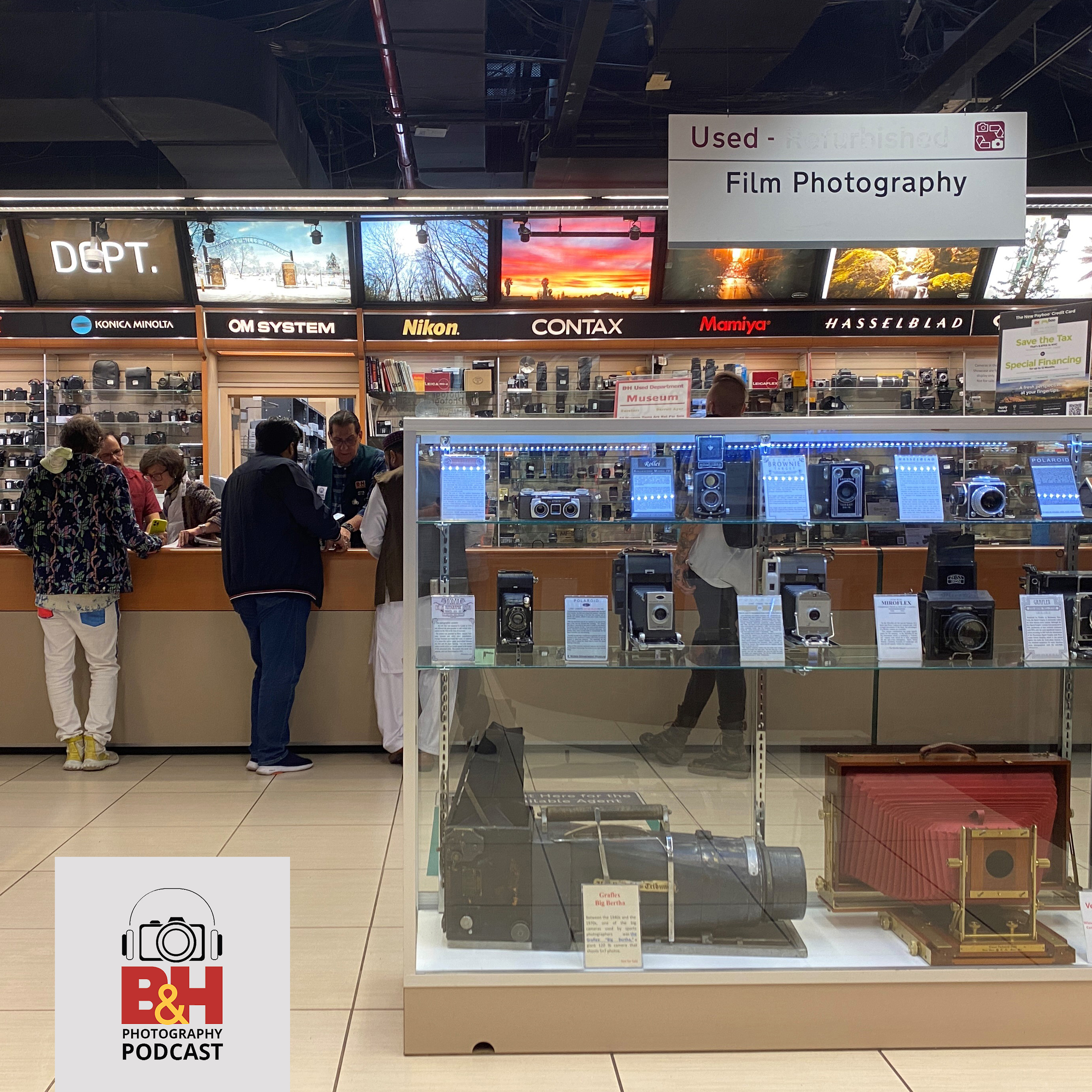
Vintage cameras and analog film have grown to be unprecedented media darlings within our crowded digital landscape. With a superstar status fueled by insatiable demand amid a limited supply, in this week's podcast we investigate both the beauty and quirks of these trending tools. Joining us in conversation are photographer / vintage camera buff Bill Bain, and expert camera technician / repair wizard Shlomo Weinberger from B&H Photo's Used Department. Whether you cut your teeth on old school tech or you're an analog adopter in the digital age, there's a topic of interest for everyone, plus plenty of DYI tips to be had, including our favorite—liquid electrical tape! How many of you dedicated camera buffs knew about that? Guests: Bill Bain and Shlomo Weinberger Top Shot © Jill Waterman For more information on our guests and the gear they use, see: https://www.bhphotovideo.com/explora/podcasts/photography/vintage-cameras-with-bill-bain-and-shlomo-weinberger Guest Bios: Bill Bain has loved photography since his teenage years, when all his earnings went towards buying gear and paying for film and development. During a long career as an engineer, photography was a constant thread—particularly documenting his family and their extensive travels. Now living a post-corporate life in the Canadian Rockies, Bain devotes much of his time to photography. In addition to being fully immersed in digital imaging, he continues to make good use of his extensive collection of vintage cameras, many dating from the early 1900s. Bain's analog and digital fine-art images have been featured in Black & White magazine, and his photos of Olympic-style wrestlers have been published internationally. Shlomo Weinberger is a gifted technician who developed a specialty in repairing vintage cameras and lenses over nearly 25 years at B&H Photo. After learning his trade from an old-world technician steeped in the analog age, Weinberger currently operates a special repair shop within B&H Photo's Used Department, where he patiently inspects, calibrates, lubricates, and otherwise assesses the condition of the cameras and lenses that pass through his hands before they are offered to customers. Stay Connected: Bill Bain's Website: https://www.bainphotos.com/Film-Photography-page Bill Bain's Instagram: https://www.instagram.com/bainphotos/ B&H Photo Used Department: https://www.bhphotovideo.com/c/browse/Used-Equipment/ci/2870/N/4294247188 B&H Photo Vintage Film Equipment: https://www.bhphotovideo.com/c/browse/Cameras-Photo-Gear/ci/2871/N/4294247179 Episode Timeline 2:47: Bill Bain's tips when shopping for a vintage camera 3:30: Inspect the lens for mildew or mold and actuate the shutter 4:45: Making use of vintage lens fungus for creative portraits 6:53: Bain's preferred vintage camera formats: Folding bellows and box cameras 8:05: Bain's new vintage camera—60-year-old Mamiya C330 twin lens reflex 9:08: How many cameras are in Bill Bain's collection? 10:19: Black and white or color film, and various emulsions 12:28: Discontinued film formats and a nod to 2016 podcast—Dick Haviland: Last of the Classic Film Re-Spoolers 13:57: Bain's DYI modification for unavailable film stocks: Plastic wall anchors! 15:34: Different film sizes and determining if a camera will accept a currently available stock 17:42: 120 format film—the most easily adaptable film format 18:18: The difference between 120- and 220-format film 19:12: 127 film and smaller formats 20:20: DYI tip—Use a cigar cutter to trim readily available films to fit smaller formats 22:54: Vintage cameras with interchangeable lenses vs fixed lens cameras 23:14: The Petzval lens—19th-century classic and Lomography's 2015 redesign and release 24:00: Bill Bain's favorite vintage camera—His mother's Kodak Jiffy 620 25:02: The poor man's Leica—the Argus C3 26:42: Read the manual! Plus, finding user manuals for vintage cameras online 28:38: Making minor repairs, and when to pass vintage camera repair off to a skilled technician 29:16: DYI camera repair discovery—Liquid Electrical Tape! 32:06: Episode break 34:00: Shlomo Weinberger's advice when shopping for a vintage camera 34:34: Evaluating lens scratches—front vs rear element, edges vs center of glass 35:05: The most popular vintage cameras in B&H's Used Department 36:50: The most common vintage camera problem / repair—stuck aperture blades 38:11: Weinberger's most respected vintage cameras—Leica M3, Hasselblad system, Rolleiflex 35:32: Leica M3 has the best rangefinder—you can shoot with both eyes open 41:44: Weinberger's weekly workload of vintage cameras and lenses 42:28: Repair quirks to an original Nikon F 43:02: What to look for when repairing a twin lens Rollieflex 44:26: Flash photography with vintage cameras that synchronize at all shutter speeds 44:58: Pro tip for evaluating a twin lens camera—ensure all four sides of the lens board focus straight 46:34: Process for overhauling a vintage camera shutter 48:48: B&H Photo's used department museum displa

Ringside Access: Lori Grinker Captures Mike Tyson's Rise
Mike Tyson has long been a boxing legend, and for this week's podcast we speak with the photographer who was there from the very start. Lori Grinker was just a student with a semester-long assignment when she first met Tyson as a 13-year-old kid under the tutelage of famed boxing trainer Cus D'Amato. Grinker's inside access over the next decade offers an intimate portrait of Tyson that few others have seen, and is now published in the book Mike Tyson. Listen in as Grinker describes how she learned on the job as the only woman ringside, transforming from student to pro in step with Tyson's meteoric rise. She also weighs in about gear choices, making distinctions between photographing with reflex cameras and rangefinders, and sharing thoughts on shooting black and while film vs digital captures in monochrome mode. Listen in to learn how she juggled documentary coverage with celebrity reportage and sports photography in what was truly a wild ride. Guest: Lori Grinker Photographs © Lori Grinker, Courtesy of Contact Press Images This episode is sponsored by Audio Technica For more information on our guests and the gear they use, see: https://www.bhphotovideo.com/explora/podcasts/photography/ringside-access-lori-grinker-captures-mike-tysons-rise Guest Bio: Lori Grinker is an award-winning photographer whose work straddles documentary and fine art. Internationally published and exhibited, her long-term, non-linear projects often mix photography with video, audio recording, text, installation, books, and collage. The recipient of many awards and the author of three books, Grinker is a dedicated educator for both University programs and private workshops. She is a senior member of Contact Press Images and is represented by ClampArt Gallery in New York City. Stay Connected: Personal Website: www.lorigrinker.com Instagram: www.instagram.com/lgrinker Twitter: twitter.com/lgrinker Facebook: www.facebook.com/lorigrinker/ Episode Timeline 2:02: Grinker's photojournalism class assignment, and shifting focus to Mike Tyson 4:40: Tyson's dedicated study under legendary boxing trainer Cus D'Amato 7:26: The trajectory of Grinker's photos—from school project to documenting Tyson's daily life to published news stories 9:04: The learning curve from daily life to photographing ringside 11:55: Enlisting Tyson's help to get paid by Don King 13:02: Robin Givens, her mother the publicist, and control over Grinker's pictures 15:34: Tyson's interest in seeing himself in pictures 17:04: Grinker's embedded access and hurdles of Tyson's rise to fame 20:12: Grinker's experiences in dealing with a no-show photo subject 21:44: Working with photo agencies and joining Contact Press Images 24:36: The benefits to Grinker's agency support: Canon camera gear, exhibitions, and books 24:58: Grinker's advice for photographers seeking agency representation 26:26: The importance of owning the rights to your pictures and registering the copyright 28:10: Episode break 28:42: Lori Grinker's photo gear: From Nikkormat to Leica to Canon and beyond 29:50: Grinker's first experience with digital—embedded on a ship the during Iraqi invasion 30:36: Learning to use flash and shooting with black-and-white film 31:41: Making the switch to color film for photo assignments 32:00: Comparing the shooting style of reflex cameras and rangefinders 34:52: Grinker's thoughts on teaching students depth of field 35:32: Learning by doing and Grinker's earliest teachers 36:52: Grain vs pixels: shooting black-and-white film vs digital in black and white mode 40:50: Film type, Kodak chemistry, and printing with Agfa Portriga paper 42:02: Printing gelatin silver prints for upcoming ClampArt exhibit 44:08: Grinker's Mike Tyson book and the 2014 book contract 45:12: Reconnecting with Tyson for Spike Lee's Broadway production 48:18: Choosing a book designer, going through the pictures, making a huge book, and then cuts 49:44: What does Mike Tyson think of the finished book? 50:32: It's more a photo book than a sports book—a time capsule, a slice of pop culture 52:30: Lori Grinker's upcoming events—book launch and ClampArt exhibit 54:34: Grinker's website and social media contacts

Fall Foliage East and West with Jerry Monkman and G Dan Mitchell
It's leaf peeping time in the northern hemisphere when trees break into riots of color as autumn plows a path from north to south. Two of the best regions for capturing the show here in the US are across New England and along California's magnificent Sierra Nevada. To help get you up to speed when preparing for your own foliage excursions, we speak with landscape photography specialists in each of these regions—Jerry Monkman in New England and G. Dan Mitchell in California's Sierra Nevada. After weighing in with informed opinions about when and where to find the best color this year, Monkman and Mitchell make suggestions about fresh ways to picture the scenery and discuss topographic and geological differences between east and west. We also talk gear—both DSLR and mirrorless—with Monkman opting for the Canon 5D Mark IV or EOS R5, and Mitchell alternating between the Canon 5DS R and FUJIFILM X series mirrorless. For all of the above and much more, please join us for this informative discussion and discover new ways to reap an autumn photography harvest and take your landscape and scenic photography to new heights. Guests: Jerry Monkman & G. Dan Mitchell Photo © Jerry Monkman For further details about our guests, their gear, and a selection of their secenic photographs, find this episode on the B&H Explora blog at: https://www.bhphotovideo.com/explora/podcasts/photography/fall-foliage-east-and-west-with-jerry-monkman-and-g-dan-mitchell-the-bh Guest Bios: Jerry Monkman is a New England-based conservation photographer, filmmaker, and writer, who's been telling adventure- and conservation-themed stories for more than 20 years. Together with his wife Marcy, Monkman runs EcoPhotography, a Portsmouth, New Hampshire-based stock and assignment photo business and video production company. EcoPhotography's award-winning images have been published worldwide, and the Monkman's have received National Outdoor Book Awards for two books: The AMC Guide to Outdoor Digital Photography in 2012, and Outdoor Adventures: Acadia National Park, in 2017. Monkman's first feature-length film, The Power of Place, was an official selection of the 2015 New Hampshire Film Festival. His newest documentary feature, The Merrimack: River at Risk, premiered on New Hampshire PBS in July 2020. In 2022, Monkman launched the film production company Reel Quest Films, LLC with partner Ryan Smith. Stay Connected: Jerry Monkman Personal Website: https://ecophotography.com Film Production Website: https://reelquestfilms.com Instagram: https://www.instagram.com/jerrymonkman/ Twitter: https://twitter.com/jerrymonkman Facebook: https://www.facebook.com/ecophotography G Dan Mitchell is a California-based landscape and nature photographer who focus's his attention on the Pacific coast, the Sierra Nevada, the central California grasslands and deserts, and the American Southwest. Author of the 2015 book California's Fall Color: A Photographer's Guide to Autumn in the Sierra, Mitchell's photographs have been widely exhibited, published, and licensed for commercial use. In 2018, he photographed extensively in Yosemite National Park as a Yosemite Renaissance artist-in-residence. He maintains a prolific online presence, sharing daily images and commentary at his website. Equally active on social media, he founded the 10,000-member "Sierra Nevada: Photographs from the Range of Light" Facebook community. Yet, Mitchell is most at home in the field, where he has scoured the Sierra Nevada backcountry for photographic moments for more than 50 years, and photographed each summer since 2011 with the "First Light" group. Stay Connected: G. Dan Mitchell Personal Website: https://gdanmitchell.com Flickr: https://www.flickr.com/photos/gdanmitchell Instagram: https://www.instagram.com/gdanmitchell Twitter: https://twitter.com/gdanmitchell Facebook: https://www.facebook.com/gdanmitchell

Graham Nash: Ace Photographer, Digital Printing Pioneer, Music Legend
Graham Nash is a true visionary. Whether in the lyrics he writes, the music he plays, the songs he sings, or the photographs he captures, he sees things a little differently and—most important—he sees beauty everywhere. As he describes it during our podcast, "It's just energy. I see my life facing a column of energy every day. Where do I want to plug in today?" Listen in as Nash regales us with how multidisciplinary interests help him avoid writer's block, his fascination for early Daguerreotypes, his historic role as a digital printing pioneer, his deep respect for Epson products, and much more. Stay to the end for Nash's honest assessment of his singing voice, and to learn his secret to staying passionate and making the most of a creative life. Guest: Graham Nash Photos by Graham Nash, excerpted from A Life in Focus: The Photography of Graham Nash, and provided courtesy of Insight Editions. Cover photo © Joel Bernstein For further details about our guest, his gear, and a selection of his historic photographs, find this episode on the B&H Explora blog at: https://www.bhphotovideo.com/explora/podcasts/photography/graham-nash-ace-photographer-digital-printing-pioneer-music-legend-the-bh Guest Bio: English singer-songwriter and musician Graham Nash is known for his light tenor voice and his iconic status as a founding member of the Hollies, Crosby, Stills & Nash, and later Young. A two-time Rock and Roll Hall of Fame inductee and the recipient of four honorary degrees, Nash was appointed an Officer of the Order of the British Empire (OBE) for his services to music and to charity. A lesser-known detail is that Nash's long held passion for images even predates his start in music. An avid photographer since the age of 10, Nash began collecting photographs in the early 1970s. In 1990, he chose to auction off his 2,000-print collection to help fund Nash Editions, the pioneering fine art digital printing company he co-founded, using an IRIS Graphics 3047 printer that is now in the collection of the Smithsonian's National Museum of American History, At the tender age of 80, Nash is still busy creating both pictures and music, while also maintaining a hectic tour schedule. A book of his photographs, A Life in Focus: The Photography of Graham Nash, was recently released by Insight Editions and is widely available in bookstores and online. Stay Connected: Personal Website: https://grahamnash.com/ Instagram: https://www.instagram.com/officialgrahamnash/ Twitter: @TheGrahamNash Facebook: https://www.facebook.com/OfficialGrahamNash/ Episode Timeline 3:10: Graham Nash's photo collection and the objects he collects today 4:10: How and where his musical and photographic paths cross 4:58: Nash's work as a sculptor 6:34: The ability to hear photographs, see music, and talk in colors 8:14: Nash's introduction to photography at 10-years-old 9:50: Nash's first camera: an Agfa with a small bellows 10:10: Being invisible when taking pictures and blending into the woodwork 12:42: Nash's favorite music photographers 13:52: It doesn't matter what camera he uses 14:30: A 1980's digital camera and an early awareness of the digital world 15:32: Both ends of the photographic spectrum—digital to Daguerreotypes 17:45: From a sense of history to modern Daguerreotypists 18:58: A personal phone number for Louis Daguerre 25:20: Episode break 20:44: Nash's pioneering work in digital printing 22:18: Iris printers and the issue of ink longevity 25:04: The transition to Epson printers and ink 26:14: An Iris print fades during an hour lunch 27:56: Nash's preference between black and white and color 28:22: Recommended printers and number of color channels 30:50: Nash's paper choice: Epson Legacy Fiber 31:22: Coordinate paper, coatings, and inks for optimal results 32:42: Nash's new book A Life in Focus, and recording music remotely during the pandemic 33:59: Nash's singing voice and how it's held up over time 35:08: Two things Nash wants his audience to know 36:22: Nash's secret to remaining passionate: Keep your eyes open—360 degrees

Abelardo Morell, Alchemist of Photography
The art of photography offers boundless potential for altering and enhancing human perception—this is the focus of our conversation on this week's podcast. Listen in as we go down the rabbit hole of visual discovery with alchemist of photography Abelardo Morell. From his early desire to enlighten students by transforming his classroom into a camera obscura to his ever-expanding universe of ideas—and the subsequent tools he uses—to record moments in light, Morell is an undisputed master in conjuring magic from a cross section of art and science, time and space. Guest: Abelardo Morell Photographs © Abelardo Morell, Courtesy of Edwynn Houk Gallery For more information on our guests and the gear they use, see: https://www.bhphotovideo.com/explora/podcasts/photography/the-camera-obscura-and-recording-time-and-space-in-images-with-abelardo-morell Episode Timeline 3:30: Abelardo Morell's Street Photography Roots 4:29: The Power of a Visual Language 5:50: Creating a Camera Obscura in the Classroom 7:30: Making Pictures Inside the Camera Obscura 7:58: Reciprocity Failure in Film Captures 9:50: Determining Exposure Times When Polaroid Isn't an Option 11:18: Framing Up Compositions Inside the Camera Obscura 11:56: Shifting from Analog to Digital Cameras 12:22: Phase One Digital Allows the Capture of Moments in Light 14:22: From a Pinhole to Projecting an Image Using Diopters and Lenses 17:47: Morell's Digital Workflow and Working with a Digital Tech 18:55: Juggling Multiple Projects, Genres, and Tools 20:33: Picturing Childhood as a Creative Breakthrough 25:20: Episode break 26:04: Conceptualizing the Tent Camera for Use in the Landscape 30:25: Shooting Tethered in the Field 31:18: Developing the Tent Camera's Prism Periscope Lens 32:22: Shifting the Projected Image from the Wall to the Ground 33:00: Patina of the Ground and a Philosophical Meaning 34:00: Channeling Fox Talbot in Cliché Verres 37:42: Morell's Preference: Black and White or Color? 38:43: Becoming a Painter by Photographing Paint Drying 41:04: Composition and Tension in the Hitchock Series 43:35: Morell's Preference Between Studio or Landscape 46:26: The Value of Experience and a Benefits of a Teaching Career 48:00: The Bravery in a Lifetime of Artistic Work 49:10: An Evolving Vision for Alice in Wonderland 51:06: Abelardo Morell's Upcoming Projects and a Residency in Italy 52: 47: Morell's Upcoming Show at the Montclair Art Museum Stay Connected: Personal Website: https://abelardomorell.net Instagram: https://www.instagram.com/abelardomorell/ Twitter: https://twitter.com/abelardomorell Facebook: https://www.facebook.com/AbelardoMorellPhotography LinkedIn: https://www.linkedin.com/in/abelardo-morell-82848827

On Location and Studio Portraits with Monica Sigmon & Michael Taylor
A well-crafted portrait is a beautiful thing, and this week's podcast takes a deep dive into creating individual, group, and family portraits, both on location and in the studio. Our guests are master portraitists Monica Sigmon and Michael Taylor, co-owners of SigmonTaylor Photography in Williamsburg, Virginia. Please join us for tips on everything from how to arrive at a signature style when working on location to the practicalities and pitfalls of establishing a dedicated portrait studio and turning client's heads in today's competitive marketplace. After listening, if you're still hungry for more portrait photography insights, look no further than Sigmon Taylor's six-part series Portrait Studio Intensive, produced by the B&H Event Space in February 2022. Guests: Monica Sigmon and Michael Taylor Photograph © Sigmon Taylor For more information on our guests and the gear they use, see: www.bhphotovideo.com/explora/podcasts Episode Timeline 2:37: How does one arrive at a signature style when shooting portraits in an infinite variety of different locations? 4:03: Building a visual library and exploring your photographic personality to make your portraits stand out. 5:52: Location portraits are more about the story you are telling than what the background looks like. 6:49: Use of lighting conditions as a common thread in defining your signature portrait style. 8:40: How to establish a high-end portrait niche and deliver the goods from the start. Creating work and an experience the client will love. 11:14: Every portrait is a self-portrait, and the value of stepping back to look inside yourself. 13:24: The skill of cultivating an interest in your subjects. People all have stories to tell. 14:18: Tips for expanding from an individual portrait to a group session, and the importance of scheduling a preliminary design session. 16:20: The smallest children rule the day. Keeping the attention of the adults while keeping the children entertained. 17:26: The portrait photographer as symphony conductor. How to take control of the portrait session and bring everything together in a single moment. 21:52: Valuable advice for new portraitists: Understand your limitations and have joy in what you are doing. 22:26: How to even the playing field when photographing powerful subjects who are hesitant to relinquish control. 27:30: Getting out of your own head and being in service to someone else. 27:58: Compositing elements within a group portrait: Is or isn't it cheating? 30:19: Commanding the set and taking the time to finesse the pose. Anticipating the rhythm and flow of a shoot. 33:33: Number one creativity killer: Feeling rushed for time. Slow down and manage expectations. 34:44: An inside look at the design consultation: Establishing the rules of engagement. 36:10: Making the sale up front: Explaining to the client what their investment will be. 41:12: Working on spec vs invitational portfolio building to create the work you want to shoot next. 43:44: Episode break 44:42: How practical is establishing a dedicated portrait studio today? 46:28: Creating a unique style to turn peoples' heads and make them into clients. 46:44: Can higher prices result in increased sales? 48:22: A fair payday leads to a different attitude and better pictures. 50:12: Finding a feasible studio space to work in: Renting space vs a brick-and-mortar address. 53:18: A creative approach to personalizing your office in a neutral space. 55:18: The creation of Sigmon Taylor's signature look: Black Label portraits. 57:31: The Black Label lighting style: A marriage of classical lighting with a contemporary personality. 1:00:08: Vehicles for Sigmon Taylor portraits: Prints, wall portraits, and coffee table books. 1:01:33: Digital files of client portraits: Selling them vs gifting them. 1:03:15: Sigmon Taylor's approach to printing portraits through relationships with various labs across the country. 1:05:50: Photographers show too many images. Do not put images online. 1:06:24: Considerations for camera gear when establishing a portrait studio. 1:09:34: Effective portrait studio lighting: Profoto and Elinchrom One. 1:11:40: Connect with Sigmon Taylor on social media. Stay Connected: Website: https://www.sigmontaylor.com/ Studio Instagram: https://www.instagram.com/sigmontaylor/ Monica's Instagram: https://www.instagram.com/monicasigmon/ Michael's Instagram: https://www.instagram.com/michaelglentaylor Twitter Feed: https://twitter.com/monicaandmike Facebook: https://www.facebook.com/SigmonTaylorPhotography Sigmon Taylor's six-part Portrait Studio Intensive: https://www.bhphotovideo.com/find/eventDetails.jsp/id/4063
Conservation Storytelling with Jaymi Heimbuch & Anne Readel
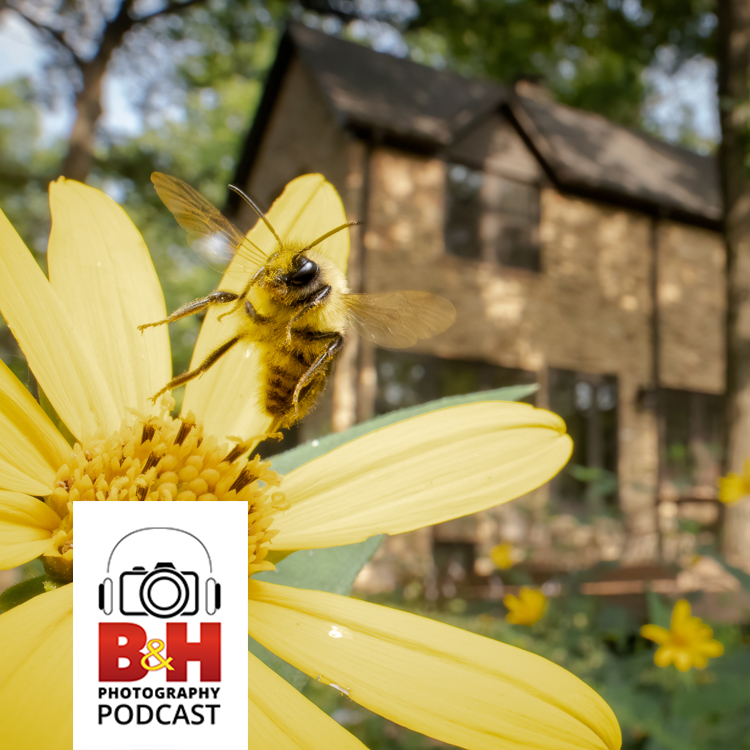
Nature and wildlife photographers seeking to put their images to work for the good of the planet will love this week's podcast. Our first guest, Jaymi Heimbuch, founded the Conservation Visual Storytellers Academy to teach photographers how to connect their pictures to a larger purpose. Listen in as Heimbuch discusses ways to harness the three A's—Action, Audience, and Affect—and successfully target the people you want to reach with your work. After a break, we hear from Heimbuch's star student, Anne Readel, who reveals how the viral spread of her story on No-Mow May enabled her to recast her message with different angles, increasing the story's reach. Stay to the end for Readel's offbeat story about living with your urban turkey neighbors. Please join us for this inspiring discussion about conservation storytelling, and learn how the aforementioned three A's can be used to craft the focus of your nature and wildlife pictures and expand their impact. Guests: Jaymi Heimbuch and Anne Readel Episode Timeline 3:28: What is Conservation Photography? 7:00: The power of a call to action 8:40: Quick synopsis of the Conservation Visual Storytellers Academy 9:37: A look inside the Visual Storytellers Style quiz 12:25: Putting your visual storyteller style to use 14:00: Conservation stories are happening right outside your door 16:22: The effortless impact of No-Mow May 17:12: Pitching conservation stories and photo / text packages 19:08: The importance of the three A's – Action, Audience, Affect 20:15: Tips for reverse engineering a photo story 21:03: Where to pitch photo stories and how to get an editor's attention 23:18: Jaymi Heimbuch's gear tips for cameras and lenses 24:47: Two trends in lens types: wide angle macros for insects and telephoto zooms for birds 27:28: Jaymi's favorite brand of camera bag, plus backpacks vs messenger bags 28:52: Episode break 30:12: Anne Readel's first Sony camera and subsequent upgrades 31:06: Situations where Anne still uses her first crop sensor camera 32:30: Anne's go-to options for lenses 34:10: Anne's discovery of Conservation Storytelling 101 35:00: Getting to the goal line with publishing conservation stories 37:58: Anne's tips for turning scientific data into pictures with impact 38:46: Making pictures to make your point and spur people to action 39:46: More on No-Mow May and Anne's goal for the story 40:42: Recasting a story to appeal to multiple audiences and expand its impact 42:57: Focus on stories that get you excited 44:45: Countering negative media bias with a positive message – giving urban turkeys a different spin 46:12: How to catch up with Jayme and Anne For further details about our guests, their gear, and image galleries of their conservation photography, check out this episode on the B&H Explora blog at: https://www.bhphotovideo.com/explora/podcasts/photography/conservation-storytelling-with-jaymi-heimbuch-anne-readel Photograph © Anne Readel

Grassroots Baseball - America's Favorite Pastime: The B&H Photography Podcast
There's a special feeling to photographing sports action that hooks you from day one. Listen in as we talk sports with Sony Artisan of Imagery Jean Fruth, and longtime Sports Illustrated Director of Photography Steve Fine. In 2019, Fruth co-founded Grassroots Baseball to celebrate the amateur game at the youngest levels. In her latest book Grassroots Baseball: Route 66, Fruth photographs young players in the same heroic manner as the pros. When it comes to equipment, she recommends the best gear to fit your budget, while singing the praises of fast lenses, As Fruth's longtime editor, Fine weighs in on the three pillars of sports photography and the vital importance of cropping. In Fine's view, great pictures are a shared accomplishment between a photographer and an athlete in a moment that cannot be repeated. Please join us for this spirited discussion about Grassroots Baseball and learn how the aforementioned three pillars can be woven into Sports Photography gold. Episode Timeline: 4:30: Jean Fruth's start in sports photography 11:40: Synopsis of Fruth's Grassroots Baseball nonprofit 14:24: Capturing golden hour light and the love of the game 22:08: Steve Fine discusses the three pillars of sports photography 29:22: Neil Leifer's advice to shoot for the double truck 31:34: Sports is messy, hence the importance of cropping 34:29: Rules for retouching and manipulation in sports photography 37:00: Episode break 37:51: Key attributes of a great sports photographer 40:46: What's preferable: trigger happy photographers or more selective shooters? 43:42: What separates football from other sports? 45:00: There are two kinds of hocky pictures: Great and awful 46:40: Sports photography don'ts from the editor's desk—less is more 52:02: Tips for parents when photographing their kids' sporting events 56:08: Gear recommendations for the aspirational sports photographer 1:01:00: Fruth's new project about women in baseball. 1:04:00: Grassroots Baseball: Route 66 book tour and gallery exhibits For further details about our guests, their gear, and for a Grassroots Baseball: Route 66 photo gallery, check out this episode on the B&H Explora blog. Photograph © Jean Fruth

Harvey Stein Shares His Passion for the Street: The B&H Photography Podcast
With a camera in his hand, Harvey Stein owns the streets, having spent the past 50 years capturing quintessential moments and making sensitive portraits of the people he meets there. In this two-part episode, he shares details about his photographic process while also conveying the wisdom he's acquired in publishing 10 books of photographs. We first caught up with Stein at the 2022 B&H OPTIC Conference in June, where he spoke about his newest book Coney Island People: 50 Years. He describes his interactive approach to street photography by traveling near and far in search of the human animal. Although he packs a Canon 5D for foreign locales where vibrant colors can be an important element, Stein is most at home with his Leica M4, a 21 mm lens, and a finder that lets him maintain visual contact with his subjects. We also learn about his Manhattan darkroom, and all the money he's saved by rolling his own film for all these years. In addition to his substantial photography chops, Stein is also an expert in photo book publishing. To leave no stone unturned, we continue our conversation in the studio after a break. Stay to the end for insights about working with publishers, including pitfalls to avoid and tips for turning your own photo project into book form. Guests: Harvey Stein Photograph © Harvey Stein Sponsored by Logitech Blue Yeti Mics

Sapna Reddy and Matt Kloskowski: Creative Vision and Technical Mastery
Sapna Reddy and Matt Kloskowski have more in common than just colorful photos of birds in nature and soothing landscapes. In this week's episode of the B&H Photography Podcast, we investigate how their respective work lives have fueled the technical mastery that allows their creative vision to flourish. We spoke with them both as part of our continuing coverage of B&H's 2022 OPTIC Conference. We begin the show with Dr. Sapna Reddy, who balances a rigorous medical career in radiology with the creative freedom of time spent outdoors, capturing scenic landscapes. Reddy's medical work is limited to a strict analysis of grayscale image data, yet her colorful landscapes provide a healing influence from the world of hospitals. Listen in to learn how she follows the light based on what nature delivers—choosing extreme wide-angle lenses for scenes with powerful foregrounds that draw the viewer's eye and using longer focal length lenses for compositions that isolate elements. Reddy also tells of mastering the technical to allow the aesthetic step in, a process she freely shares with students during awe-inspiring photography workshops in destinations both near and far. After a break, we shift the conversation to Sony Artisan Matt Kloskowski, whose passion for bird photography is central to his motto of "Embrace the Chaos." During our chat, Kloskowski emphasizes how technical knowledge of one's gear can minimize barriers between the eye and the subject. Along with an honest assessment about absorbing failure and challenging success rates, Kloskowski describes how the blazing frame rate of his Sony A1 and its bird eye autofocus help him achieve razor sharp bird pictures. Widely known as an Adobe Photoshop, Lightroom, onOne type guy, Kloskowski also fills us in about the massive collection of online courses, YouTube tutorials, and Lightroom presets that fuels his career as a photo educator, and takes up 99 percent of his time and effort. Please join us for these insightful conversations about photographing birds, wildlife, and scenic landscapes, and balancing the creative with the technical until your process becomes innate. Guests: Sapna Reddy and Matt Kloskowski Photograph © Matt Kloskowski Sapna Reddy and Matt Kloskowski have more in common than just colorful photos of birds in nature and soothing landscapes. In this week's episode of the B&H Photography Podcast, we investigate how their respective work lives have fueled the technical mastery that allows their creative vision to flourish. We spoke with them both as part of our continuing coverage of B&H's 2022 OPTIC Conference. We begin the show with Dr. Sapna Reddy, who balances a rigorous medical career in radiology with the creative freedom of time spent outdoors, capturing scenic landscapes. Reddy's medical work is limited to a strict analysis of grayscale image data, yet her colorful landscapes provide a healing influence from the world of hospitals. Listen in to learn how she follows the light based on what nature delivers—choosing extreme wide-angle lenses for scenes with powerful foregrounds that draw the viewer's eye and using longer focal length lenses for compositions that isolate elements. Reddy also tells of mastering the technical to allow the aesthetic step in, a process she freely shares with students during awe-inspiring photography workshops in destinations both near and far. After a break, we shift the conversation to Sony Artisan Matt Kloskowski, whose passion for bird photography is central to his motto of "Embrace the Chaos." During our chat, Kloskowski emphasizes how technical knowledge of one's gear can minimize barriers between the eye and the subject. Along with an honest assessment about absorbing failure and challenging success rates, Kloskowski describes how the blazing frame rate of his Sony A1 and its bird eye autofocus help him achieve razor sharp bird pictures. Widely known as an Adobe Photoshop, Lightroom, onOne type guy, Kloskowski also fills us in about the massive collection of online courses, YouTube tutorials, and Lightroom presets that fuels his career as a photo educator, and takes up 99 percent of his time and effort. Please join us for these insightful conversations about photographing birds, wildlife, and scenic landscapes, and balancing the creative with the technical until your process becomes innate. Guests: Sapna Reddy and Matt Kloskowski Photograph © Matt Kloskowski

Sally Davies Encore Episode: We Are Our Stuff
This episode of the B&H Photography Podcast was originally published on July 29, 2021. We revisit it today to mark the passing of the podcast torch from creative producer John Harris to Jill Waterman, a creative content writer for the B&H Explora blog, who appears as a guest with Davies. Harris will continue to be an avid listener to the show, and we hope he'll also grace us with his voice on occasion as a future guest. Photographer Sally Davies embodies a remarkable creative spirit, and we think that spirit also resides in the homes of the 72 New Yorkers she photographed for her colorful book of environmental portraits, appropriately titled, New Yorkers. If this spirit does not exist and Davies is not in tune with it, how could she have captured the essence of her subjects and their abodes so efficiently, in some cases in just minutes? We answer that question and many others in this discussion about the making of her book. We are also joined by Jill Waterman who has been photographed by Davies, and has written about her work. Our conversation gets to the heart of Davies' fanciful project, and touches upon its themes of inclusiveness and of gentrification, but also digs into the process of photographing in cramped quarters with little time, and of the surprisingly difficult task of getting people not to smile for a portrait. We talk about Davies' decision to eschew light stands for on-camera flash and to use a Sony mirrorless camera and Zeiss 18mm lens. We also talk about the importance of creative freedom and rejecting preconceived expectations. Davies photographed a wide range of New Yorkers for this series and did not refuse a single person suggested to her, but when it came to organizing a book, edits needed to be made, and we discuss this process, as well. Davies is well-known for her street photography, and we mention her projects on neighborhood storefronts and vintage cars, but this series of interior portraits is as "New York" as it comes. Join us for this engaging conversation. Guests: Sally Davies and Jill Waterman Photograph © Sally Davies For more information on our guests and the gear they use, see: www.bhphotovideo.com/explora/podcasts

Night Photography That Lets Magic Ensue
On this week's episode of the B&H Photography Podcast, we continue our coverage of the 2022 OPTIC Conference with two highly invigorating segments about exploring the world after dark. Our first guest is Susan Magnano, who specializes in luminescent night painted portraits. Our chat is revealing on many levels, from the balance of careful orchestration and randomness inherent in her portraits to a mention of the OM Systems OM1 as Magnano's newest secret weapon. After delving into her playful yet powerful arsenal of lighting tools, we gain insight into her multifaceted career—from beginning at a local newspaper to her currently thriving wedding photography business, and her upcoming schedule of intensive photo workshops. After a break, we welcome Sigma Ambassador Jack Fusco to discuss his unique blend of astrophotography with idyllic nocturnal landscapes. During our conversation, Fusco distinguishes astro work from deep sky photography, weighs the differences between DSLRs, the latest in mirrorless cameras, and even mobile phones such as Google's Pixel 6 Pro, (check out Fusco's Pixel 6 Pro photos here). In addition to elaborating on his favorite Sigma lenses for nocturnal imaging, Fusco provides insights about advanced accessories such as star trackers, all the while offering encouragement to anyone seeking to embark on a new adventure chasing the stars. Please join us for these otherworldly conversations about photography at night. Guests: Susan Magnano and Jack Fusco Photograph © Susan Magnano For more information on our guests and the gear they use, see: www.bhphotovideo.com/explora/podcasts

Macro Photography in Your Backyard and Garden
On this week's episode of the B&H Photography Podcast we return to the 2022 OPTIC Conference for two enjoyable and pragmatic segments about macro photography. While both photographers we speak with are well-rounded professionals, their not-so-secret joy is crawling around in gardens and woods, making beautiful close-up macro photographs of insects, plants, and the tiny wonders of nature. Our first guest is Chris McGinnis, who specializes in spider and insect photography and is an OM System Ambassador. Our chat with McGinnis is incredibly elucidating, not only about OM System lenses and cameras, but also about computational photography and his macro techniques with flash. After a break, we welcome Sigma Ambassador Heather Larkin to discuss her macro work with flowers and to learn a bit about her specialty portrait work. Primarily, we discuss the wealth of macro subjects available in your own backyard and garden, but we also learn of the latest Sigma macro lenses and a few very specific tips for approaching your subjects and maintaining focus. Join us for these insightful conversations on macro photography. Guests: Chris McGinnis and Heather Larkin Photograph © Chris McGinnis https://www.bhphotovideo.com/explora/podcasts

Cinemagraph Portraits and the "Facing Life" Project
On this week's episode of the B&H Photography Podcast, we are pleased to welcome photographer and director Brandon Tauszik and journalist Pendarvis Harshaw to talk about their recently completed project, "Facing Life," an effective blend of form and content, whose principal image format is the cinemagraph and whose content speaks to one of our society's most pressing issues: prison reform. Our discussion takes on both aspects as we learn how cinemagraphs are produced and how Tauszik uses this process to create resonating portraits that blur the line between still and motion photography. We also come to understand the motivation for these two creators to address the changing landscape of the California Department of Corrections and Rehabilitation, and profile the joys and struggles of eight people recently released from life sentences. Our conversation brings together the technical and creative aspects of this imaging process, including Tauszik's thoughts on portraiture and the specific gear and techniques for making these hybrid images, as well as the issues of mass incarceration and "mass integration." We also come to understand the working relationship between Tauszik and Harshaw—who is primarily an audio journalist and author—and how they met their subjects and developed their stories over several years. While this project may ultimately find its way into galleries or print form, it was devised as an online project and we see, in "Facing Life," eight stories that succinctly and compassionately blend form, content, and presentation to tell important contemporary stories. Guests: Brandon Tauszik and Pendarvis Harshaw Photograph © Brandon Tauszik https://www.bhphotovideo.com/explora/podcasts https://www.facing.life/
You Can't Fake Time – Camille Seaman at OPTIC 2022
On this week's episode of the B&H Photography Podcast, we are pleased to present a conversation with photographer Camille Seaman, and pleased to do so from the halls of the OPTIC 2022 Photo Conference, which we have certainly missed over the past two years. Seaman was a keynote speaker at the 2022 OPTIC Outdoor, Wildlife & Travel Photo/Video Conference, which is hosted by B&H and held from June 12-15, 2022, in New York City. Please check the above link to find an archive of the conference's presentations, but settle in now for an enjoyable and inspiring conversation with Seaman that we recorded in person after her keynote address. Seaman's photographs have been published in National Geographic, Italian Geo, TIME, The New York Times Sunday Magazine, Newsweek, Outside, and American Photo, among many others. She frequently leads photographic workshops and is a TED Senior Fellow, Stanford Knight Fellow, and a Cinereach Filmmaker in Residence. It is her work photographing Earth's two poles that first captured our attention and her "portraits" of icebergs, specifically. She has published two books on the subject, including 2014's Melting Away: A Ten-Year Journey through Our Endangered Polar Regions. But her subjects also include extreme weather in the Midwest, the peoples of Tibet, and Native Americans. Our talk was insightful, at times emotional, and her personal story is as inspiring as her photography. Join us for this wonderful chat, and in case you were wondering, the title for this week's podcast is from a quote by Seaman's mentor Steve McCurry, and holds much significance for her—as we discovered in the course of our conversation. Guest: Camille Seaman Photograph © Camille Seaman https://www.bhphotovideo.com/explora/podcasts

2022 OPTIC Conference Preview and Michael Kenna Encore Interview
The 2022 OPTIC Outdoor, Photo/Video, Travel Imaging Conference or just "OPTIC 2022" is live and in-person again and we are excited to welcome the event's director, David Brommer, to the program. Brommer will give us a sense of the updated conference, which after two years online is now a fully hybrid in-person and online event. Of course, we at the B&H Photography Podcast look forward to being back at the live events and talking with the many photographers who speak and present their work. This year's OPTIC Conference runs from June 12–15, 2022, and includes presentations by Chester Higgins, Camille Seaman, Joe McNally, and many others. There are also opportunities to try the latest gear in specialized environments, expert-led panels, portfolio reviews, a sunset cruise, the OPTIC Challenge Print Competition, and OPTIC Signature Photo Walks sponsored by Lindblad Expeditions. Online participants can check the selection of available webinars. After our brief chat with Brommer, we present a very important encore episode—important in the sense that it was our first recording at OPTIC, back in 2016, and because we interviewed three incredible photographers and really began to understand the potential of our podcast. Our guests were Michael Kenna and, in another segment, Paul Caponigro and his son John Paul Caponigro. Each of these photographers offer wonderful insights into their creative processes and to speak with father and son artists is always a treat. Join us for this enjoyable conversation and register for OPTIC 2022 here. Today's episode is sponsored by Audio-Technica. Check out their AT2040 Hypercardioid Dynamic Microphone, ideal for podcasting! Guest: David Brommer Above photograph © Camille Seaman

Drone Photography 2022, with Randy Scott Slavin
It's been a minute since we spoke about drones on the B&H Photography Podcast. The last time we did, it was about drones in news photography and before that, drone work in landscape photography. But today we welcome back to the show one of our earliest guests on the podcast, Randy Scott Slavin. Slavin is an aerial photographer and drone operator, as well as a motion director and still photographer. He started his company Yeah Drones in 2013, at the dawn of drone use in film and commercial work, and his clients include Showtime, Netflix, ESPN, Saturday Night Live, and CNN, among many others. Slavin's work crosses all genres from advertising to film, working with small teams and big crews, and he understands drone use from the photographer's perspective as well as a flyer, racer, and builder of drones. With Slavin, we discuss his recent projects, his workflow, and how he decides which drone is best for each assignment. We also talk about drones and cameras for large professional shoots and those geared more for advanced amateurs. We discuss new technologies and the recent improvements made in navigation, cameras, and batteries and ask which manufacturers are competing with DJI in the drone marketplace. Join us for this informative conversation. This episode is sponsored by Logitech for Creators, and their Blue Yeti USB Microphone. Guest: Randy Scott Slavin Photographs © Randy Scott Slavin
Timeless: The Photography of Moshe and Eddie Brakha
Is artistic creativity passed down through generations of a family? How is style and wisdom garnered? How can a father and son collaborate to grow their work individually and as a team? These are just a few of the questions we posed to Moshe and Eddie Brakha, otherwise known as Brakha x2, during this week's episode of the B&H Photography Podcast. Moshe Brakha likes to say that he was "born in Israel and reborn in Hollywood," and both his early music and celebrity portraiture, as well as his later advertising and editorial work, sure have the vibe of Tinseltown. The elder Brakha built a thriving photography practice that includes not only portrait work but also high-profile advertising campaigns such as those for SKYY Vodka, Martini & Rossi, and Motorola. Eddie Brakha began collaborating with his father after graduating from film school and has expanded their work with new ad campaigns and fine-art series. They have also directed music videos, public service announcements, and "motion" campaigns for Dockers, Sharper Image, and others. The style of the Brakhas' work is very distinctive, but individually and as a team, they continue to experiment and try new methods. As such, we discuss how to evolve creatively when your style is successful. We also learn about their working relationship, which talents each brings to the table, and how clients and subjects react to having them both on set. Finally, we talk about their incredible lighting schemes, Moshe's retrospective at the Grammy Museum, Eddie's film project, and always being prepared before you go on set. Join us for this enjoyable conversation. Guests: Moshe Brakha and Eddie Brakha Above Photograph © Eddie Brakha and Moshe Brakha aka Brakha x2 https://www.bhphotovideo.com/explora/podcasts http://brakhax2.com

Pioneering Photojournalist Catherine Leroy
In 1966, a twenty-one-year-old French woman bought a one-way ticket to Vietnam, where the American military involvement was becoming a full-scale war. The young Catherine Leroy was an admirer of photographer Robert Capa and the "reportage" she grew up seeing in Paris MATCH magazine, but she had little photojournalism experience. Despite that, and despite her particularly small physical frame, Leroy began as a freelance "stringer," photographing the growing conflict in Vietnam. For the two years that she was working there, she was the only female photojournalist covering the war. Our guest on today's B&H Photography Podcast is author Mary Cronk Farrell, who recently published "Close-up on War: The Story of Pioneering Photojournalist Catherine Leroy in Vietnam." The book chronicles Leroy's time covering the Vietnam War and her evolution from an ambitious newbie to a respected conflict photographer with images appearing in LIFE, The New York Times, and her beloved Paris MATCH. With access to Leroy's personal letters, Mary Cronk Farrell not only details Leroy's time in Vietnam, she provides her young readers with an understanding of how the news photography business worked in that era, she mentions the 35mm Leica and Nikon gear Leroy used, and she shares insight into the war itself and the emotional and physical wounds it inflicted on her subject. The late Catherine Leroy's photo career continued after Vietnam and she photographed conflict and news stories throughout the 1970s and 1980s. Her work is preserved and promoted by the non-profit Dotation Catherine Leroy (Catherine Leroy Fund), where interviews with her and many more of her images can be found. https://dotationcatherineleroy.org/en/ We also thank Pelican for its support of this episode, and encourage you to check out Pelican Air Cases and to visit the Pelican product page on the B&H Photo-Video website. Guest: Mary Cronk Farrell Above Photograph © Dotation Catherine Leroy https://www.bhphotovideo.com/explora/podcasts

Polaroid History and Techniques for Creative Instant Film Photography
This is a fun conversation, very informative, and gets the creative chemistries gellin'. Our guest on today's episode of the B&H Photography Podcast is Rhiannon Adam and if there is anyone who knows more about instant film photography, I don't want to meet them. She brings a wealth of researched knowledge about the history of the Polaroid company and also simple but effective techniques to improve your instant film photography practice, whether via FUJIFILM, Mint Camera, or Polaroid. Our conversation generally follows the framework of Adam's 2017 book "Polaroid: The Complete Guide to Experimental Instant Photography," which has been updated and republished in 2022 as a paperback version. The first part of the book (and our conversation) relates the story of the "Polaroid" camera and the inventions of its founder, Edwin H. Land, a.k.a. Dr. Land, which include polarizer sheeting. We learn of the race to market the various instant cameras and films until the SX-70 took the world by storm in the 1970s. We also learn of patent wars between Kodak and Polaroid, the ultimate demise of the Polaroid company and the rebirth of the brand through The Impossible Project, and eventually its return to selling camera and film products. After a break, we talk more specifically about various instant films and cameras, both new and vintage, and we also highlight several of the many techniques detailed in Adam's book and methods to improve your instant photography. From emulsion lifting and manipulation to fingerpainting, scratching, and even microwaving instant film, we discuss creative instant film processes and some noted artists. Guest: Rhiannon Adam Above Photograph © Enrique Freaza https://www.bhphotovideo.com/explora/podcasts

"The Drowning" by Cornell Watson
In September 2017, we dedicated an episode to a conversation about one photograph—an image made by photographer Richard Drew, on September 11, 2001, in New York, which has come to be called "The Falling Man." It was an insightful recollection and analysis of an incredibly painful image, and on today's episode of the B&H Photography Podcast, we will again discuss one photograph to try to understand it better. The photograph is titled, "The Drowning," and it was taken in August of 2020 during another national crisis, albeit a very different one. Photographer Cornell Watson created the series "Behind the Mask," "… for the times we pretend to be strong when we are dying from the weight of racism." Each image in the series is a carefully created and powerful allegory, but "The Drowning," for reasons we will discuss in the episode, has a quiet power that has not waned since we first saw it. To learn more about this photograph, we are fortunate to have Cornell Watson join us, as well as photographer, author, and educator Tara Pixley. With Watson we chat about his motivations, inspiration, and his collaborative process, camera, and lenses, and workflow on the day of the shoot. We consider the reception of the image and discuss the life of the entire series. In addition to her work as a visual journalist, a college professor, and curator, Tara Pixley is also a board member of the National Press Photographers Association, a member of the WPPI Advisory Board, and a co-founder of Authority Collective. Pixley is the ideal voice to provide us with aesthetic insight into the strength and significance of "The Drowning," as well as the cultural and chronological contexts of why this image is an important artistic contribution from 2020 that echoes years of injustice and calls us to be more understanding and compassionate. We'd also like to thank Cara Finnegan and Michael Shaw of "Reading the Pictures" for their contribution to this episode. Guests: Cornell Watson and Tara Pixley Above photograph: © Cornell Watson This conversation has been edited for length and clarity. The views and opinions expressed in this podcast are those of the individual guests and do not necessarily represent the views of B&H Photo.

Shifting Expectations -- Photojournalism after 2020
Our conversation on this week's episode of the B&H Photography Podcast is about the challenges that the practice of photojournalism faced during, and in the wake of, the monumental year, 2020. With the Coronavirus pandemic and the protests following the murder of George Floyd news photographers and editors were faced with situations few had ever experienced. To their credit, the institution as a whole, worked through it, adapted their workflows, and continued to produce honest journalism in the face of many dangers. Our guests to discuss this topic are Lauren Walsh and Danese Kenon. Author, Lauren Walsh is a past guest on our show and her recent book "Through the Lens: The Pandemic and Black Lives Matter" addresses the challenges for photojournalism brought by the Covid pandemic and the protests and politics of 2020. It is a wonderful collection of interviews with noted photojournalists and editors who worked through the events of that unprecedented year. Danese Kenon is the Managing Editor of Visuals at the "Philadelphia Inquirer" and has held many positions as both photojournalist and editor at publications such as "The Indianapolis Star", "The Pittsburgh Post-Gazette" and "Tampa Bay Times". Kenon, who is interviewed in Walsh's new book, lived the events we are considering and brings her first-hand perspective to our conversation. With Walsh and Kenon we first discuss the procedures brought to photojournalism by the coronavirus, how photographers were able to safely cover this story and how editors supported that mission. We then address the new challenges brought by the large-scale Black Lives Matter marches and the dangers, not only of disease, but of clashes between protesters and police and violence directed directly at the media. We talk about simple workflow changes, such as how photographers got access to photography and protective gear, how a living room or even a car became a de facto newsroom, and how editors scheduled and safeguarded their photography staffs. The courage as well as the emotional toll taken on photographers and editors who had never worked in such conditions before is also part of our conversation and we ask about establishing new training and support methods. Finally, we discuss the work that was produced, how shooting styles and relationship with subjects adapted and how photographers and editors collaborated to create honest and nuanced documents of this unprecedented year. Guests: Lauren Walsh and Danese Kenon Above Photograph © Spencer Platt/Getty Images. Courtesy of Lauren Walsh/Routledge Press https://www.bhphotovideo.com/explora/podcasts The views and opinions expressed in this podcast are those of the individual guests and do not necessarily represent the views of B&H Photo.

Earth Day Encore Episode: The Ethics of Landscape Photography
(This episode of the B&H Photography Podcast was originally published on January 20, 2017.) We are living in a Golden Age of landscape photography. Digital cameras and improved software enable the kind of imaging that until recently was only possible via the budgets of large publications and the talents and ambitions of a few select photographers. Ambition and talent remain, and with enhanced dynamic range and color algorithms, higher sensitivity settings, simplified stitching and compositing software, and a network of websites to display work, impressive landscape photography is abundant; however, there are new masters and the skill set of current practitioners includes not only those of the photographer, but also of the savvy digital graphic artist. With the ability to pull details from shadows, augment colors, and combine distinct files into a single image now easier than ever, we must ask—is it acceptable to represent nature without natural characteristics, to merge photos from different focal lengths into one image, or add a blazing sunset to a foreground taken hours or days apart? Can images composed in such a way even be defined as photography and does an ethos, akin to that in photojournalism, apply to nature photography? These are some of the questions we pose to two incredible landscape photographers, Adam Burton and Ryan Dyar. We spoke with them separately, but prepared a similar set of questions, and asked them to walk us through their in-camera workflow and post-process techniques. We spoke about their approach to a scene, their use of "grad-filters" and plug-ins, acceptable degrees of enhancement, and strove to understand if there is indeed an ethics to landscape photography. Guests: Ryan Dyar and Adam Burton Photograph © Ryan Dyar For more information on the photographers and the gear discussed in this episode, please see the B&H Photography Podcast home page.

Somewhere Between Love and Obsession - The Photography of Stanley Greenberg
It has been a hope of ours for some time to speak with photographer Stanley Greenberg and, considering he's made three books in the past three years, there is a lot to talk about. Greenberg is known for his large-scale series on subjects like the New York City reservoir and water systems, on giant particle accelerators, telescopes, and dams. His recent projects, however, are an interesting blend of urban exploration and 19th-Century history. We speak briefly about his 2019 book, CODEX New York, and the typologies he identified walking the whole of Manhattan, but we concentrate our conversation on his work, Springs and Wells - Manhattan and the Bronx, and after a break, we discuss his latest book Olmsted Trees. Greenberg, who started his professional life working in city government, is a Guggenheim fellow and no stranger to prestigious grants and commissions. He's also no stranger to libraries and the research that informs his work. It was during a research visit to the New York Historical Society that he came across a book written and photographed primarily in the 1890s. The Springs and Wells of Manhattan and the Bronx (1938) is a survey made by James Reuel Smith, who located, described, and photographed hundreds of water sources throughout New York City, often traveling by bicycle. Greenberg commented: "My first response was that this had to have been done by a crazy person. [But] five minutes later, I knew I was going to map out all of his sites and photograph what was there now." And this is what he did, often also by bicycle. His 2021 book blends the work of Smith with his own contemporary photos from the same locations. In the second half of the podcast, we discuss the project Olmsted Trees, which Greenberg photographed with a Hasselblad medium format digital camera after using Sony and Leica M cameras for CODEX and Springs and Wells and 4x5 film cameras in previous work. For this series, he photographed the oldest trees of the great public parks designed by Frederick Law Olmsted. These images are a study in black-and-white, in texture and form, almost portraits, that ask you to soak up the power of the trees themselves and consider the genius of the parks' design. Join us for this enjoyable conversation and find more of Greenberg's work here. Guest: Stanley Greenberg Above photograph © James Reuel Smith. Courtesy of Stanley Greenberg https://www.bhphotovideo.com/explora/podcasts

Photography and Loss of Sight, with Pete Eckert
Artist Pete Eckert began to lose his sight at age twenty-seven. That's the time he began to study photography. In a few years, Eckert would be completely blind, but his photography practice continued, and numerous exhibitions and high-profile assignments later, he is still creating unique and personal images―and we are fortunate to welcome him to the B&H Photography Podcast. We start our conversation learning a bit about how Eckert lost his sight and then dive right into discussing the ways he learned photography, the modifications he made to his gear, including his Mamiya medium format camera, and the manner in which he works, whether in studio, streets, or nature. Eckert is clear that his photography is not meant to pass for or mimic photography by a sighted person but to create images that tell his story and communicate his perceptions. One glance at his long-exposure, impressionistic images should make that clear. After a break, we talk with Eckert about his commercial photography assignments, and we learn how he created work for Volkswagen, Swarovski, and Playboy magazine, and how he produces commercial assignments compared to his personal work. We also discuss the value of photography competitions, the groundbreaking "Sight Unseen" photography exhibit, and why Eckert's photography was featured on an episode of the television police drama NCIS. Join us for this fascinating conversation. Guest: Pete Eckert Above photograph © Pete Eckert https://www.bhphotovideo.com/explora/podcasts

Photography Accessories 101: The Basics
Except for the new flagship Olympus OM SYSTEM OM-1 Mirrorless Camera, there haven't been a lot of big camera announcements thus far in 2022, so we thought for this episode of the B&H Photography Podcast we'd start an introductory conversation about photo accessories and the wide range of tools and toys available to improve your photography or just make it easier. Along with our guest, B&H Explora writer and photographer Todd Vorenkamp, we made an outline of the most important accessory categories, and we speak about the photo disciplines for which each are used and what is important to understand when purchasing these items for your specific photography practice. We discuss tripods and camera support, straps, bags, and gear protection, lens filters, lens adapters, remote controls, and more. Because this conversation is primarily concerned with outdoor and natural light photography, we don't get much into accessories for the studio, but we do touch on flash photography and light modifiers. Thanks to the insights of Vorenkamp and our host, Allan Weitz, we also learn ways to avoid unnecessary or inferior accessories and even little hacks to make your accessories perform better. Join us for this informative episode. Guest: Todd Vorenkamp https://www.bhphotovideo.com/explora/podcasts

Memory Cards and Storage for Digital Photography
With much thanks for a listener's suggestion, we invited Pete Isgrigg back to the B&H Photography Podcast for an incredibly informative conversation about memory cards, external hard drives, and other digital image storage solutions. Isgrigg, who previously joined us in 2019, is from the Channel Marketing team at Western Digital (WD), which is the parent company of SanDisk and G-Technology, all very well-recognized names in the digital storage field. Isgrigg brings a wealth of knowledge to the conversation, and we start with simple terminology and the basics of SD cards, but then we discuss the latest memory card formats, capacities and speeds, and card readers, as well as best practices with memory cards in your photography practice. During the second half of the program, we focus on digital image storage and hard drives and we ask Isgrigg to explain SSD and HDD and the various interfaces and ports. We also get very practical advice on which devices are better for long-term storage and which for everyday use, and how best to keep your files secure and available. It's hard to imagine a more helpful conversation so thank you, Pete, and huge thanks to our listeners. Keep the suggestions coming! Guest: Pete Isgrigg www.bhphotovideo.com/c/promotion/15…solutions.html www.bhphotovideo.com/c/promotion/16…es-at-b-h.html www.bhphotovideo.com/c/promotion/15…le-memory.html www.bhphotovideo.com/explora/podcasts

Conversation with Jay Maisel and Stephen Wilkes (Encore Episode)
(This is an encore presentation of an episode first published in November, 2018.) When we finished recording this episode, Jay Maisel asked us which podcast episode was our favorite. It didn't take Allan a second to answer, "This one!" While we now have recorded more than three hundred, there is no doubt that this episode of the B&H Photography Podcast is very memorable. Once we turned the mics on, nobody wanted this conversation to end and, indeed, it runs longer than 80 minutes, but it is worth every minute. When listening to Jay Maisel and Stephen Wilkes talk, time doesn't fly—it soars. The reason we have two such remarkable photographers and long-time associates on together is because Wilkes made a documentary about Maisel, called Jay Myself and with Maisel and Wilkes we discuss the making of the film and their personal and professional relationship that has lasted for 40 years. At the heart of the film is Maisel's former residence and studio, the six-story, 30,000 square-foot Germania Bank building that he bought, in 1967, and sold in 2014 for a tidy profit. This massive space, almost as legendary as Maisel himself, must be emptied before Maisel is to move, and Wilkes was there to capture this undertaking. The movie touches upon themes of mentorship, mortality, visual creativity, and the changing face of New York City, but along with the remarkable space he created, the film focuses on the life, work, and legacy of Maisel himself. It is a loving tribute from one photographer to another, one friend to another. Our conversation is filled with the type of creative insight and humor that these towering figures in contemporary photography can bring. Join us for this fascinating conversation. Guests: Jay Maisel and Stephen Wilkes Photograph © John Harris https://www.bhphotovideo.com/explora/podcasts

Macro Food Photography, with Christina Peters
Our guest on this week's episode of the B&H Photography Podcast is food photographer Christina Peters, and we start with a discussion of Peters' macro food photography. We learn about her work with medium and large format systems, including FUJIFILM cameras. We also explore focus stacking, tilt-shift lenses, and when and why she might choose her Canon full-frame system over larger formats. Peters' work runs the gamut from large commercial jobs with major brands to editorial, portrait, and restaurant work, as well as the unique challenge of photographing pet food. Choice of lighting is also a topic we cover, and Peters offers practical advice for newbies considering a first lighting kit. In the second half of our conversation, we talk about The Food Photography Blog and The Food Photography Club, both founded by Peters and designed to "help foodies and photographers improve their photography and get higher-paying clients." We also acquire some perspective on Peters' professional trajectory and learn why she now prefers to work with smaller, healthy food clients, compared to the fast-food giants. For our listeners, Peters has put together a resource page loaded with practical information and the link to her Recommended Gear Page on the B&H Photo website. We also thank Pelican for its support of this episode, and encourage you to visit the Pelican product page on the B&H Photo-Video website. Guest: Christina Peters Above photograph © Christina Peters https://www.bhphotovideo.com/explora/podcasts https://www.christinapeters.com/index https://www.bhphotovideo.com/c/browse/Pelican/ci/4457/N/4232860887

"Generosity of Persistence", with Amy Touchette and Larry Fink
On this week's episode of the B&H Photography Podcast we talk to an old friend about a new book; two-time past guest Amy Touchette joins us to discuss her book of street portraits. She also brought a friend with her - none other than photographer, Larry Fink. Is it fair to call Fink a photo legend? We think so, and clearly the people at the Center for Creative Photography seem to think so, because they just acquired his complete archive of work including images from the 1950's to the present, from his acclaimed series "The Beats", "Social Graces", "The Vanities" and others. While this is a roundtable conversation, we start with a few questions about Touchette's book "Personal Ties: Bed-Stuy, Brooklyn", which she shot over the course of summer strolls through her New York neighborhood. We learn why she started photography in 2001, about her working process with a Rolleiflex twin lens reflex film camera, and why her personal interaction with her subjects/collaborators is paramount in her photography practice. We also talk about crowdsourcing, editorial collaboration, and why Fink wrote the foreword for Touchette's book. Larry Fink's sixty years of photography work is well-recognized, but his harmonica playing, less so. We hope to remedy that with this episode, but while at it, we learn how he created an extensive archive of vintage prints and "hustled" to find a home for his life's work. We learn of his Mamiya medium format camera with bellows, his preferred photo paper, and mull on the difference between our two guest's aesthetic style. We also talk about an insider vs. outsider perspective, about the nature of portraiture, and the "revelatory excitement that defies the logic of what a frame could be". Join us for this playful yet insightful conversation and have a look at this link for portraiture and WPPI related specials. Guests: Amy Touchette and Larry Fink Photograph © Amy Touchette For more information on our guests or the gear discussed in this show, please visit https://www.bhphotovideo.com/explora/podcasts
ASMP-NY and the Future of Photo Trade Organizations
On today's episode of the B&H Photography Podcast we welcome two members of the New York chapter of the American Society of Media Photographs, otherwise known as the ASMP-NY and we discuss their evolving role as a trade organization for photographers, as well as a recent photography exhibition they sponsored. Our guests are Liam Alexander, President of the New York chapter of ASMP, and Harper Bella, ASMP-NY board member and co-curator of the exhibition "Uncovering the Laws of Perseverance". From Alexander, we learn a bit about the history, structure, and benefits of the organization and discuss his initial reasons for joining. We also talk about the group's mentorship programs, photo law counsel, and recent initiatives to include a new generation of artists, whether that means reaching out to photographers from underrepresented communities or opening the organization's membership criteria to include "new media" makers, who don't necessarily operate within traditional media outlets. In the second half of the show, we speak with Harper Bella about the impressive show she co-curated and how it was born from the anger and up-rise sparked by the George Floyd murder and then nurtured through difficult yet fruitful conversations with other ASMP-NY board members. We also learn about her curatorial process, the disparate photographers involved, and the varied artistic responses to the idea of protest, including healing as a form of resistance. Join us for this interesting conversation and learn how this photography trade organization, founded in 1944, is listening to its community and adapting to the new media and cultural landscape. Guests: Liam Alexander and Harper Bella Photograph © Harper Bella https://www.asmp.org/newyork/ https://www.bhphotovideo.com/explora/podcasts

In the Soup - Photographing Marine Plastic, with Mandy Barker
It's worth the time to see the work of photographer Mandy Barker before listening to this episode. Take a glance at the B&H Photography Podcast homepage or Barker's website to get a sense of the simple but imaginative images she creates; it will certainly enrich the experience of hearing her speak about photographing plastic garbage, which is what she has found to be her calling. Of course, we're being a bit facetious with that comment, but as we discover from our conversation with Barker, it really is the issue of marine plastic—the plastic waste that litters our oceans and beaches—that brought her to photography and continues to push her to create captivating images with the intention of bringing awareness to this increasingly severe problem. The colorful and almost playful images she creates with marine plastic belie the tremendous damage this refuse is doing to ecosystems around the world, and in some cases, in the most remote of islands and coastal lands. And it is this ability to create likeable images that draws people to her work, as seen in National Geographic, The Guardian, and VOGUE, and in her books, including 2019's "Altered Ocean." With Barker we speak about her transition from graphic design to photography, about sketchbooks and process, and about the relatively basic Canon gear she uses. We also learn about the value of working with scientists on intense overseas expeditions and the incredible stories of lost or discarded items that have traveled across the globe. Join us for this fascinating conversation. Guest: Mandy Barker Photograph © Mandy Barker

Football Photography, with Al Bello and Callena Williams
This weekend's football game is bigger and better than most games―you might even say that it's a super game. It certainly is one of the most photographed sporting events of the year, and with that in mind, the B&H Photography Podcast welcomes two photographers who know their way around the sidelines. Our guests are football photographers Al Bello and Callena Williams. Al Bello is a veteran sports and news photographer who has covered countless football games, including previous big bowl games; he is the former Chief Sports Photographer for North America at Getty Images; and his current title is Special Sports Correspondent at Getty. There's not much Bello hasn't photographed, including the Summer and Winter games, underwater photography, and even medium format film portraits of athletes but, if you're a football fan, you'll never forget the incredible photo he made in 2014 of Odell Beckham's fingertip touchdown catch. We ask Bello about getting his first ultra-telephoto lens and playing sports in college, and he offers some very practical and football-specific advice on how he approaches each play, but also talks about taking advantage of good background and light when you have it. After a break, we speak with Callena Williams, the team photographer for the Dallas Cowboys. Williams, who previously worked for the Carolina Panthers, has a different role than a sports photographer like Bello, and we learn about her photo responsibilities that fall outside the field of play, as well as how she works the games. We also talk with Williams about her Canon gear choices and incorporating graphic design duties into her work for the team. Join us for this timely episode. Go team!! Guests: Al Bello and Callena Williams https://www.bhphotovideo.com/explora/podcasts Photograph © Al Bello/Getty Images
Legacy and Long Term Projects - B&H Photography Stories
There are many talented people who work at B&H Photo, and the connections to photography and photo history run deep. We have welcomed many "staffers" to the B&H Photography Podcast over the years, and today we are particularly excited to speak with two members of our team on the B&H Explora blog. We start our conversation with Howard Gotfryd, Senior Copy Editor at Explora, and learn about the incredible photography career of his late father, Bernard Gotfryd. Gotfryd Sr. emigrated to New York after World War II and ultimately found a job as staff photographer at Newsweek Magazine, a job he performed for three decades. We discuss the twists of fate and hard work that got Gotfryd to Newsweek and talk about his most noted assignments, including photographing Robert F. Kennedy, Nina Simone, and The Beatles. We also discuss his camera systems and home darkroom, and come to understand the complexities of keeping an archive of more than 10,000 negatives intact and manageable. In the second half of our program, we speak with writer and photographer Jill Waterman. Waterman writes for the Explora blog and has also created an epic photo series about New Year's Eve. For thirty-seven straight years, she has photographed New Year's celebrations around the world, documenting each with her Nikon FM camera on black-and-white 35mm film. Waterman has traveled to cities and villages in Brazil, Mexico, South Africa, Europe, and throughout the United States, and she describes the various celebrations she has covered and the motivations to keep this personal documentary project alive. Guests: Howard Gotfryd and Jill Waterman Photograph by Bernard Gotfryd https://www.bhphotovideo.com/explora/podcasts

Brooklyn, Back in the Day, with Anders Goldfarb and Larry Racioppo
We try to maintain a global perspective at the B&H Photography Podcast and speak with photographers from around the world, but we are New Yorkers at heart and it's hard to deny the love we have for our city and its history. With that in mind, we are pleased to welcome photographers Anders Goldfarb and Larry Racioppo to the show―two photographers, both born in Brooklyn, who have taken the face of our ever-changing city as their subject. Each photographer has extensive archives of New York neighborhoods, landmarks, and communities, and both have recently published new books of their work. Goldfarb's book, Passed Remains, is a look at the Greenpoint and Williamsburg neighborhoods prior to the gentrification of the 2000s and Racioppo's latest book is titled Coney Island Baby, which chronicles the changes to that storied locale from the 1970s to the present. We learn of Goldfarb's process of bicycling through the quiet corners and industrial cityscapes of his then-neighborhood and photographing with a Rolleiflex twin lens reflex camera. He describes his work as both a "survey and a statement." With Racioppo, we learn of the many visits he made to Coney Island over the years to photograph―covering the demise and demolition of the 1970s through its reincarnation in the 1990s. He also discusses working as a photographer for the New York Department of Housing Preservation and Development and provides a glimpse at the life of a working artist in Brooklyn in the 1970s and '80s. Our wide-ranging conversation includes the challenges of the square format, Nikon rangefinders, texture in a photograph, self-publishing, and the delight of mystery. Guests: Anders Goldfarb and Larry Racioppo Photograph © Larry Racioppo For links and more information : www.bhphotovideo.com/explora/podcasts

Fallout - The War Photography of Peter van Agtmael
Conflict photography of the past twenty years is a subject we have discussed in previous episodes with photographers, psychologists, and scholars, but our very welcomed guest, photographer Peter van Agtmael adds his well-articulated thoughts on the subject, including his own motivations and challenges while covering the wars in Iraq and Afghanistan, as well as the ramifications of those wars here in the United States and elsewhere. On this episode of the B&H Photography Podcast, we reflect on the mindset of a young man wanting to bear witness to history and the evolution of his thoughts after many assignments and embeds. We also learn about aspects of his work, from the intra-personal to the technical and how these have also changed over the course of an almost two-decade career. The work of van Agtmael has been published in The New York Times, The Guardian, and The New Yorker; he is a Guggenheim Fellow; a winner of multiple World Press Awards; and a member of the Magnum Agency. He has also authored several books of his work, which take a deeper narrative and conceptual dive into his images from this same general body of work. He is not alone in this endeavor, but it is this balance, this ability to conceptualize his work within the news sphere and in the nuanced context of a personal photo book that is quite interesting. Quiet images from ten years ago have a tragic power today. His most recent book, Sorry for the War, a subtle and powerful exploration of the disconnect between the United States home front and the actual wars themselves is the main topic during the second half of the show, and we discuss the differences between this and his other books. We talk about the editing process, collaboration, and the formal decisions that go into making a book that is meant to be a historical as well as a personal statement. We also take a minute to talk about gear choices, the aesthetics of technical limits, and about other stories he is working on. Throughout, van Agtmael offers insightful answers to the very complicated questions posed by and of contemporary photojournalism. Please join us, and also check out his work with the Arab Documentary Photography Program. Guest: Peter van Agtmael Photograph © Peter van Agtmael https://www.bhphotovideo.com/explora/podcasts http://www.petervanagtmael.net/ http://arabdocphotography.org/

The Eye is a Hunter -The Photography of Joe McNally
The B&H Photography Podcast is kicking off the new year hot. For our first episode of 2022, we welcome photographer Joe McNally to discuss his career, his working methods, and his exciting new book, The Real Deal: Field Notes from the Life of a Working Photographer. Joe McNally is known to many as a "photographer's photographer," skilled in many genres and able to work across the lines of photojournalism, long-form photo essays, portraiture, sports, dance, and even fashion photography. He has worked for National Geographic, Time, LIFE, and Sports Illustrated, and his commercial clients include FedEx, Adidas, Epson, and many more. He is also a Nikon and Capture One ambassador, a World Press Photo Award winner, and an Alfred Eisenstaedt Award recipient, but as he mentions in our conversation, he started at the New York Daily News as a copyboy, "the wretched dog of the newsroom." Our conversation is easygoing, and we talk with McNally about the beginning of his career and early assignments. We discuss the evolution of photo technology (he shot the first "all-digital" story for National Geographic), and there is much to be gleaned about lighting, gear choices, and custom camera settings. We also talk about self-confidence, research, big budgets, and general thoughts on how to succeed in the ever-changing photo business. McNally also spins a few tales about his more adventurous assignments and the risks and rewards that come from them. In his new book, The Real Deal, McNally candidly shares stories, lessons, and insights he has collected along the way. This is not a dedicated how-to book, nor is it a navel-gazing look back at "the good old days," because those never really existed anyway. This book is as welcomed and as enjoyable as our conversation. Join us. Guest: Joe McNally Photograph © Joe McNally https://www.bhphotovideo.com/explora/podcasts

The 2021 Year in Review and Mick Rock Encore
The B&H Photography Podcast team sends a huge end-of-the-year thank you to our listeners around the world and to the many guests who joined us for our weekly conversations. There's little need to overstate the difficulties of the past year, but we're all still here, still taking pictures, and we're still making this podcast week in, week out. It truly has been a gratifying and unflappable pleasure to produce this show and hopefully it continues to provide some insight, some inspiration, and a few good stories. Despite the adjustments of remote recording, or perhaps because of them, we expanded our circle of photography to include conversations on photomicrography, on the fine art nude, on skate photography, and photo "how-to" books. We spoke with artists and economists about NFTs, discussed protest photography and issues of community and migration. We had episodes on food and wedding photography, bird photography, the freelance business, and, as always, we did our gear episodes, including the seventh annual Cameras of the Year show. I encourage you to take a look back at the wide range of subjects we covered this year and let us know your favorite episodes, as well topics you'd like us to take on in the new year. Finally, and although this episode is not from 2021, we end the year with an encore presentation of our conversation with rock-n-roll photographer Mick Rock. Sadly, we lost Mick in November, but we're solaced by the memory and pleased to present this chat, which was recorded at his home, in Staten Island, and is certainly one of our all-time favorite episodes. Thank you, Mick, and thank you again to our listeners. Happy New Year. Photograph Courtesy of the Collection of Bill Shapiro https://www.bhphotovideo.com/explora/podcasts/photography/the-2021-year-in-review-and-mick-rock-encore
"The United States of Young Photographers" and Photo Books of 2021
We split our time on this episode of the B&H Photography Podcast between one book and many books. In the first half of the show we learn about an inspirational new book, Among Peers: The United States of Young Photographers, which profiles the work of student photographers from several workshop programs in the United States. We conclude the episode with an overview of the many wonderful books from 2021 that were featured on the podcast. To discuss "Among Peers", we welcome the publisher Michelle Dunn Marsh of Minor Matters Books and photography consultant and former director of the Lucie Foundation, Lauren Wendle. As we find out, the book was a creative collaboration between the two, born during the Covid quarantine, and devised to celebrate the work of young photographers and their mentors, who kept the various programs open and operating throughout the difficult past two years. We learn of their process to fund and edit the book and about the photography mentoring programs themselves. Students from the following programs are represented in the book: NYCSalt, First Exposures - San Francisco, Literacy Through Photography - Houston, Las Fotos Project– Los Angeles, YoungArts – Miami, and Youth in Focus – Seattle. Consider supporting these non-profit organizations. After a short break, we run down a list of new photography books we presented on the podcast this year including books as diverse as those by Todd Bigelow, Barbara Mensch, and Mona Kuhn. Join us for this inspiring episode. Guests: Michelle Dunn Marsh and Lauren Wendle Photograph © Jaylen Esparza, Las Fotos Project, Los Angeles

Photographing the James Webb Space Telescope, with Chris Gunn (Encore)
With the launch of the incredible James Webb Space Telescope just hours away, we thought it a good time to republish our conversation with Chris Gunn, the official NASA photographer for this project. The original episode was published almost two years ago when the construction of the telescope was nearing completion. If you are intereted in space research and imaging, also check our episode from 2016 with a chief imaging expert from the Hubble Space Telescope mission. Imagine the privilege of being present at the creation of one of the "wonders of the world," and then imagine being asked to document the magnitude—and the details—of that creation. Our guest on today's episode of the B&H Photography Podcast has just that privilege and that responsibility and, as he puts it, this telescope may "change the way we understand our universe." Chris Gunn has been a NASA contract photographer for almost twenty years but, for the past ten, he has dedicated himself to the James Webb Space Telescope and documenting the construction and eventual launch of this spacecraft, which will replace the Hubble as NASA's most powerful telescope. We speak with Gunn about all aspects of his job and, specifically, about the gorgeous medium format images he creates that are made available to the public. Gunn is responsible for documenting the construction process, which includes portraits of scientists, as well as macro shots of screws, and he relates how he has "taken the extra step" to evolve as a photographer, incorporating medium format photography and detailed setups. Gunn must be prepared to shoot any style of photo and he discusses his daily responsibilities, how his gear has evolved over time, the lighting he chooses, and his interaction with the hundreds and technicians and scientists he works with regularly. We also discuss marketing yourself as a photographer and the specific challenges that make his job like no other, including working in giant "clean rooms," accepting that your work is immediately in the public domain, and incorporating the aesthetics from science-fiction films. Sitting in on this recording is our own member of the B&H Space Force, writer Todd Vorenkamp. Join us for this fascinating episode in which we learn about this incredible spacecraft and the work that goes into documenting its creation and check out our 2016 episode, in which we speak with the imaging scientists from the Hubble Telescope mission. Guest: Chris Gunn Above photograph © Chris Gunn

Cameras of the Year, 2021
We return to our annual Cameras of the Year conversation for today's installment of the B&H Photography Podcast and, as usual, we welcome a member of the B&H staff who knows these cameras as well as anyone. In addition to being a pro photo sales specialist at the B&H SuperStore, Llinelva De Castro is a wedding and portrait photographer and former proprietor of a family photo studio, in Queens, NY. We are pleased to hear her insights on these featured cameras and to get her sense of the public's reaction to this new gear. In the running for "2021 Camera of the Year" are certainly the new flagship mirrorless offerings from Nikon, Canon, and Sony, but there are some surprises when it comes to the cameras we each liked best this year. The Canon EOS R3, Nikon Z 9, and Sony a1 take much of the spotlight of our conversation, but we also discuss new mirrorless, point-and-shoot, and medium format cameras from Panasonic, Sigma, Pentax, Olympus, and several from FUJIFILM. Our conversation also includes mention of new drones and phones, thoughts on the trajectory of the camera industry, and a look back at our favorite cameras from the past five years. Please check out all the photography equipment at the B&H Photo website and in the comment section, let us know your favorite camera from 2021. Guest: Llinelva De Castro