This is NOT One of The Types of Physical Intimacy – Isabelle’s Story
Betrayal Trauma Recovery · Anne Blythe, M.Ed.
Audio is streamed directly from the publisher (media.blubrry.com) as published in their RSS feed. Play Podcasts does not host this file. Rights-holders can request removal through the copyright & takedown page.
Show Notes
Healthy physical intimacy implies just that – intimacy. However this is NOT one of the types of physical intimacy. In fact, even thought it’s common in marriage, it’s classified as domestic abuse.
To know if you’re experiencing any one of the 19 types of emotional abuse that are connected with intimacy, take our free emotional abuse quiz.
And if you relate to any of this episode, check out our Betrayal Trauma Support Group Session Schedule. We’d love to see you in a session today.
Transcript: This is NOT One of The Types of Physical Intimacy
Anne: I have a woman named Isabelle on today’s podcast. She has been walking the path of healing from narcissistic abuse – which is an extreme lack of intimacy. She’s also suffered betrayal trauma for years. In February of 2019, just months after her three year divorce, she experienced a miraculous healing of chronic pelvic floor dysfunction.
She has experienced firsthand the healing power of creativity, and now works as an expressive arts facilitator. She feels called to share her creative talents and the wisdom she has gained from her journey, so that other women can experience hope and healing. Welcome Isabelle.
Isabelle: Thank you, Anne. It’s good to be here.
Anne: So let’s start with your story, Isabelle.
Early Childhood Trauma
Isabelle: The part of my story that led me to where I am today and being on this podcast is when I was six years old. My uncle abused me Christmas Eve at my grandparents’ home. And I’ve been walking through the healing from that, as well as the trauma from marital abuse and my adult life. I have realized that it was that event, that moment in time, that disrupted the healthy development of my mind, body, and spirit.
Also, I realized that I heard the lie in words and actions. That love is pain. That love and pain are synonymous, they go together. And I can see now how believing that set me up for not recognizing abuse in the future.
Anne: I’m so sorry about your experience.
Anne: When you get in a relationship with your husband, did you recognize his behaviors as abusive at first? Or were you still in that mindset that love hurts?
Isabelle: I think that was my, you know, core belief. It was just in there. I didn’t have to think about it. If that makes sense. I didn’t consciously think about it. That was part of it.
Marital Rape Is Difficult To Understand and Identify
Isabelle: My now former husband is a narcissist, so I did not recognize what he was doing as abuse. Because it seemed to me that he was my knight in shining armor. All his promises were to take care of me, that he adored and loved me. He was four years older than me. He would tell me that my innocence and my naivety were so attractive to him, and that he loved that about me. Additionally, he would teach me everything I needed to know.
I bought into all that, didn’t know about love bombing and gaslighting and all those things. I am only 18 and never seriously dated anyone, as a freshman in college.
Anne: When did you recognize his behaviors, perhaps not abusive at first? Or that you had divorced a narcissist. https://www.btr.org/divorcing-a-narcissist/ My guess is when things start happening that are harmful. You’re not thinking immediately this is an abuser. First, every woman goes through this. Maybe he’s stressed when you know that something is wrong.
You don’t know what it is and you may have been blaming yourself. What types of things did you do during that time? I’ll call it not comprehending that you’re in an abusive relationship, to try and establish safety and peace in your home.
Struggles With Birth Control
Isabelle: I am Catholic, and in our marriage birth control was an issue. I learned natural family planning. I learned to know my body to chart my cycles. He said that was the right thing for us to do. But he did not take any responsibility for it that a husband should. It was really on me. So we had four babies in a little over five years.
I was homeschooling the oldest, who would have been in kindergarten at that point. I can actually picture it right now, sitting here. The moment when I knew deep inside of me that something was wrong. It would have been after the fourth baby, I told him, I need a little break before we have another baby. I didn’t say I won’t have another baby.
I just said, not right now. I’m tired and my body is exhausted. I question now how manipulative and coercive. But those words weren’t what I would have used at the time. I probably would have said, wow, he’s persistent. He gets really angry and mean. If I would try to say no this particular night that I remember. He actually, after being persistent, was kind and said no. No, it’s okay. I understand. Sorry. We’ll just go to sleep. We’ll wait until you’re not fertile.
The First Injury
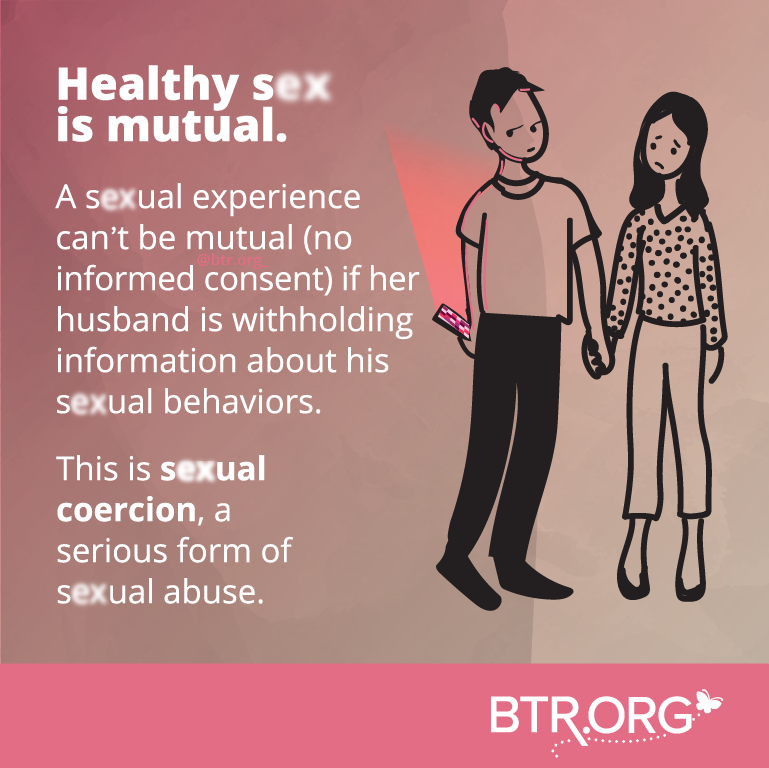
Isabelle: I remember going to sleep thinking wow, he gets it now, this is good and I’m feeling safe. Then I woke in the middle of the night to him forcing himself on me. I begged him to stop. Even when I told him he was hurting me, and that he had promised he wouldn’t, he just became more and more violent.
And I knew, because I knew my cycles, and I knew I was going to end up pregnant. I was. I told him I was pregnant, his response was, how could you let that happen?
Anne: I’m so sorry. Did events like this continue after this event? Then you have five kids after this. Did you try some common marriage advice that we get as Christians, but also just as society in terms of loving or serving or forgiving or any of those things? Talk about your experience with that, how that played out.
Isabelle: For years, I began to see then there was a very unsettling lack of compassion and disregard for me. Then I began to notice that for our children.
This Type of Abuse Is Confusing Sometimes
Anne: As this continued, did you know at the time what it was? Would you have defined it that way?
Isabelle: No, for a long time it was confusing. Because even when I would try to talk to him about it like, that really hurt me or why are you doing this? Now I know I would call that gaslighting and projection all those narcissistic manipulation tactics. But at the time he would tell me I dreamt it. No, that didn’t happen.
I would ask him. Why did you do that again? And he would get angry and tell me, you know, what a horrible wife I was to make up such lies. I must hate him to even think such a thing. I’d lay there thinking, but I know I didn’t dream it.
Isabelle: The other thing that I think is important to know is, because this went on for so long, I ended up after the eighth baby was born with postpartum depression. My OB kept saying, no, you were depressed while you were pregnant. Then it became treatment resistant depression, and then bipolar disorder. I was in and out of the hospital for depression and suicidal ideation.
Anne: Nobody throughout this time, including you, recognized you were an abuse victim?

This Lack of Intimacy Is Domestic Abuse
Isabelle: Eventually, they began to ask me if he was abusing me. Then after a few years in and out of the hospital, the doctors at the hospital started saying, “We know he’s abusing you.” We don’t know exactly how or what, you won’t tell us, but we know he’s abusing you and you do not have to go back home.
I had eight small children and married before I graduated from college. I’d never worked a day in my life. Where are we going to go? By this point, I took medications, I had hospital records, and he just kept telling me, “You won’t tell anyone, no one will believe you”. They know you’re the crazy one. And making threats like, if you tell anyone, I will take the money and find a woman and children who make me happy.
When I see articles now and listen to things about domestic violence, I believe it is true. In an abusive relationship, marital therapy can just further the trauma. Even if I would get up the courage in a session to try to say something that was happening, we would get in the car to leave, and he wouldn’t take me home for hours. The kids would be calling, where are you? Where are you? And he wouldn’t let me answer. He would just rage at me.
One of my psychiatrists used to call me the walking dead and say that I would never ever be better. Because I was catatonic and sick, no one thought I could get free of him. That I’d be able to keep my children, that my children wouldn’t be further harmed. It was very scary.
Narcissistic Abuse, Mental & Physical Pain
Isabelle: I can remember one night telling him, “What you’re doing to me has a name.” For anyone who knows a narcissist, you can imagine that narcissistic stare and smirk, you know, that glare. And he just sat there with his arms folded, glared at me and said, Yeah, what are you going to do about it?
And I thought, nothing. He knows. In that moment, I realized for all his telling me. He wasn’t doing the things I knew he was doing, and he didn’t mean it. Alternatively, I thought, no, he knows. He knows what he’s doing, and he knows I’m powerless to do anything about it. I’m going to die in this marriage.
Anne: Did that moment flip a switch for you?
Isabelle: It flipped a switch. It was at that point that I began insisting on things like separate beds. Part of my story is also that with the depression and what they called bipolar disorder, I had chronic physical pain.
Medication & Abuse
Isabelle: I was on medication after medication after, I mean just handfuls of medication three, four times a day, which did not help the walking dead effect. There would be nights when I would be really unconscious from the medications. In the morning, I woke up and knew he caused the pain raping me during the night.
At that point, I began telling him if he would stop that repeatedly. And then at one point I did tell him that if he had it with me again while I’m unconscious from my meds, I will have to go see an attorney. He didn’t speak to me for several days. And then other abuses became worse.
It did not get better. What ended up happening, I think then, is the more I began challenging him by speaking up, then he became more abusive, even in front of the kids. Then it began to affect my younger children.
Spiritual Abuse
Isabelle: So at this point, we had nine children. After the eighth baby and a few years of in and out of the hospital, I was in the hospital for a full month. They basically said, “We don’t know what else to do, and we know you can’t go home”. And they insisted I live with a relative for a while.
They told us that if I were to get pregnant again, the baby would not survive because of all the medications I was on, and probably die. A few weeks after I was out of the hospital, he visited me at a relative’s. He violated me me again and got me pregnant again. Telling me that he had heard God tell him that another baby would heal me.
Anne: Spiritual abuse.
Isabelle: Oh, there was lots. Yeah.
Anne: Was he a respected man in your church?
Isabelle: Yes.
Anne: Had you told clergy about this at all? What was their response? You may have been experiencing the effects of spiritual abuse.
Isabelle: I did. He insisted that we get marital counseling. Of course, for a while, he would only go to the priest. He was so good. I wasn’t raised Catholic. He was. So he said, well, I taught you faith. I’m the one who knows God. You don’t, you only know God because I told you about him. You can’t tell me that you know what God wants.
Marital Violation & Faith Communities
Anne: Did you convert to Catholicism? Was he part of that conversion process?
Isabelle: I was baptized Catholic and had the sacraments. But my family just went to church on Easter and Christmas, if that. I didn’t go and my parents divorced. He grew up in a home where they daily prayers, the rosary, and mass every week.
I was not raised Catholic in that way. He’s the one who I would say brought me back to the faith. It was when I began homeschooling my children and having children. Then I realized I needed to grow in my faith so I could teach them and pass the faith onto them.
Anne: How do you feel about your faith now from this experience?
Isabelle: I love my faith. It is God who rescued me and my children. I don’t know where I would be. I would be dead if it wasn’t for Jesus, and all the time after time that he saved me. It was my faith that got me through it. Just clinging, clinging to Jesus and the cross. I didn’t know what else to do.
Seeking Safety From This Type of Physical Abuse
Anne: So, talk about when you started really making your way to safety, after attempting the typical love and serve.
Isabelle: Yeah, when we started seeing priests and pastoral counselors, and then marital therapists. Many times the message, bottom line was, you don’t know men and their needs well. You need to learn more about what men need.
Meet your husband’s needs, and you expect too much of him. Things like that. I believed I could change him. That if I loved him more, if I was more self-sacrificing, maybe he would learn to be compassionate and self-sacrificing, which of course only fed into his addiction, narcissism, all of it.
Anne: Yeah, people don’t understand that actually makes it worse, because that’s what they want. They’re abusive on purpose to get what they want, and then you’re giving them what they want. They want more love and respect. You turning the other cheek is basically an abuser getting what he wants.
Isabelle: I said to him, but wait a minute, you said you needed more of this. Or you needed me to change and be more fun. So now I’m being more fun. And then he’d say, well, why would you think that’s what I wanted? That’s not what I meant. This is what I meant. I want you to be like this. And then I’d be like okay, now, wait a minute. So how do I be like that? You know, it was crazy making totally.
Escaping The Fog His Manipulation
Anne: Mine told me he wanted me to stop asking questions. One night I decided I wasn’t going to say anything except for just that. Yes or no, and kind of respond to what he was saying. Then he got mad at me for being cold. So I was like, Oh, great. It’s just a no win situation. Right.
Isabelle: After the ninth baby was born and I survived a suicide attempt, I ended up with anorexia. My therapist, of course, recognized that what I was doing. I was trying to kill myself without actually killing myself, and forced me into treatment. I was then in eating disorder treatment.
Hearing stories from other women, meeting other therapists and other people, telling little bits of my story, and seeing how people reacted, this is not normal. I began to get some education on domestic violence and abuse. And our youngest daughter ended up with anorexia. When she was only eight years old. She stopped eating when she was seven. You know, you asked before if that was the moment when I snapped and woke up.
Anne: I wouldn’t say I woke up. It’s not like you were in denial or anything. It wasn’t your fault. It was just you couldn’t comprehend it for whatever reason. All victims go through that.
Isabelle: For me, the analogy of almost being asleep works in my case because of the depression and the medications. I mean, the medications just had me in a fog.
Anne: Yeah, and I think that’s the perfect word to describe it. The fog of abuse. Right? Even if you’re not on medication, it’s like a fog, and coming out of it is like coming out of a fog.
Trying To Protect The Children
Isabelle: Yeah, you’re right. That is the better word. His abuse towards my youngest became very physical and overt. He was very covert about a lot. And my eating disorder brought a lot more abuse from him. Also right out into the kitchen, because he would, in front of the kids, plate my food. Then tell me I had to be obedient and eat my food, and it got pretty nasty sometimes.
I was not taking it so passively anymore. But when I saw him, I can remember one particular occasion when she tried to run from the table and not eat. He chased her, and she was about 20 pounds underweight at the time, and she was only eight years old.
She was tiny, and he grabbed her by the ankles on the steps and pulled her down the steps onto the hardwood floor. I jumped between them and grabbed her. In that moment, I remember thinking, I have to protect my child. It wasn’t about me. It was about protecting my children. Then I started talking to my therapist about, I think we need to get safe.
I think we need to get out of here. He’s not ever going to change, is he? At some point in there, she then helped me see that the way he treats my child was exactly the way he treats me. It was okay to say, I won’t be treated this way anymore either.
Intersection Of Abuse and Addiction
Anne: Talk about the intersection of abuse and addiction. Did you recognize the abuse first or a addiction first? Can you talk about things like exploitative materials use and other things that you observed?
Isabelle: I did not observe any of that, the addiction I did. Not the exploitative materials. We had therapists say, for years, you know, I think he’s viewing it. I would say, no, he wouldn’t do that. That’s what drove me to start looking at other options and that I needed a divorce.
Anne: Making your way to safety. Actual safety, not the love, serve, forgive, kind of like pseudo safety. But actually starting to make your way to actual safety. What did that look like for you?
Isabelle: First, I tried an in-house separation. Let’s try co parenting, living in the same home, and co parenting, but no intimacy of any kind in separate bedrooms. He could not respect that. Even when I was sleeping in my girl’s room, he would just come in there, so that wasn’t working.
When my youngest was ill with anorexia, I found a priest who listened. He sent me the United States Bishop’s document on domestic violence. It was reading that shifted the way I was seeing and thinking about what was going on in my home and in my marriage.
God Does Not Want You To Endure This Type of Physical Non-Intimacy
Anne: Can you talk about that document? Since I’m not Catholic, I’m not familiar with it. What about it shifted your view? And the reason I ask is because so many of the women who listen to this podcast are religious. They may not necessarily be Catholic, but they feel bound by covenants or promises or their vows. I wonder if what helped you might also help them.
Isabelle: I took my vow and my covenant seriously. The sacramental nature of my marriage was of the utmost importance to me. I mean, I truly believed my vocation was marriage. So I needed to be self-sacrificing for my husband and children. What helped me in that document was that the Bishops talked about how God does not want anyone to be abused.
There’s a difference between making a sacrifice for your husband and when husbands are being abusive. Not only is he harming me, but also because it was also harming my children. Before, he became physically abusive to them, just because their mom was being harmed. That he was also harming himself. My vocation as a wife was that the spouse is what I’m supposed to do and walk the journey to heaven together. Help each other get to heaven, and abuse in a home is not getting anyone to heaven.
The bishops go on to say that a wife has not only the right to do what it takes to get herself and her children safe, but also the responsibility. I began to see what was going on from a different perspective. As much as I wanted a loving, healthy marriage. That’s not what we had.
Marriage Covenants Broken By Abuse
Isabelle: Although marriage is good, the good and the safety and salvation of our souls are greater.
Anne: I try to talk to women about that all the time. I’m a member of the Church of Jesus Christ of Latter-day Saints. We marry in the temple, and we take our temple covenants very seriously, and we want an eternal marriage. I talk a lot about what the bible says about divorce and marriage.
It’s the same thing there. You could say, I’m not going to divorce, because I want an eternal marriage, and I made these covenants. But those covenants are just with God. They’re not just with God, but with the other person. But if the other person is not worthy of those covenants, you don’t have an eternal marriage. So all you’re sacrificing for your eternal marriage is in vain.
Isabelle: Right, and when this priest helped me look at the history, he began to use words like that to me. The fact that, do you understand, he broke the covenant.
There was no more covenant, no more sacredness. There was no more sanctity. What he did was evil and wrong. To see that I was not breaking the covenant, it had already been broken. Abuse breaks the covenant. There was no more covenant to protect. I needed to protect myself and my children.
Because of my personality type, knowing that doing this really hard thing of asking for a divorce was in a sense also for his good, and his protection by removing myself and the children. I needed to teach my children how to set boundaries as well.
Emotional and Psychological Abuse
Anne: What ruined the marriage was the abuse. So you experienced all types of abuse. I just want you to pretend. I know this is impossible, but. Yeah, just for a minute, to pretend that you had only experienced the psychological, the lies, the infidelity, the exploitative materials use, the putting you down, the psychological and emotional abuse.
Now, it is obvious to you that you had to do something. Because your physical self was in danger. If you can imagine now, being away from it, just the psychological and emotional abuse, would you say your soul was in just as much danger? I don’t want to say that, because so many of our listeners, that is what they’re experiencing, and it’s like a horror show.
Like with me, I almost wanted, and he did end up physically hurting me in the end. But I almost wanted him to punch me, because I thought, if he punches me, then I’ll have proof. Then I’ll know that this is what’s happening. But the emotional and psychological abuse was so confusing, and it’s so difficult to track.
I just want to let women know, don’t wait until you’re experiencing ongoing abuse. You’re already severely emotionally and psychologically abused.
Isabelle: I agree with everything you just said, the emotional, psychological, and for me the spiritual abuse also. I mean, it’s soul murder. I believe we are integrated mind, body, and spirit. Abuse of one of those, even if he’s not raping or punching. It’s abusing your person, your personhood.
It’s Not Intimacy It’s Physical Abuse
Isabelle: When I went to a support group. One woman there said it happened to her. So I thought okay, well if she said it, then I guess I can say it too.
I wasn’t going to be the only one in the room to say it, but I still said, but he’s never been physically abusive. I did that for a couple of years. The counselors there would look at me and say rape is physical abuse, but it took me a few years to think of what he was doing to me as physical abuse.
Anne: We get it. You’re in the right place. Everybody listening right now understands what you’re saying. Because we’ve all been through, not that exact scenario, but something similar to that. Where we didn’t know what to call it.
I worry right now about so many victims who want to be positive and save their marriages. Instead of saying the word abuse, they say things like he struggles. Or he has challenges, or he’s doing so well considering he had an abusive upbringing. Instead of saying he’s abusing me, I’m abused.
Especially in addiction circles, so many C-SATs say well, expect relapses, and what they’re asking victims to do is tolerate ongoing abuse rather than get to safety. It’s alarming, which is part of why I started this podcast. But when I started the podcast, God told me to start it. I didn’t understand all these things. Listeners who have listened to me from the beginning can say I didn’t know that. But I know it now, and I now know I don’t know what I don’t know.
Setting Boundaries When Your Husband Refuses True Intimacy
Anne: Can you talk about how that worsened your situation?
Isabelle: Yes. I first went to attorneys for a legal separation. Being Catholic, I thought I couldn’t get a divorce, but kids and I need to get out of here. They said, Oh no, you’re being abused. Your children are being abused. You need a divorce if you’re going to be really safe. And even Catholic attorneys told me that you need a divorce. I didn’t tell anyone, even when I hired my first attorney. The first question I asked him was, Will I ever have to talk about things that went on between me and me to get a divorce?
Will I have to prove anything? He said oh, no, it’s a no fault state. Anybody can get a divorce. You don’t like that he snores, you can get a divorce. Not quite true. Because I told him, I said, no one will believe me. They will believe him. So I filed for the divorce, and I even told my former husband, when I told him I had filed for the divorce, we can just work this out.
Finding Safety From Physical Non-Intimacy
Anne: Was he shocked when you told him?
Isabelle: He said he was. He sure acted like he was, which I had already told him a few months before that I had seen an attorney about a legal separation. He threatened me that if he heard the words separation, divorce or attorneys come out of my mouth again, he was taking everything we owned and leaving me and the kids. And no one could ever make him pay child support or anything.
Anne: So you actually do it amid his threats. And my guess is he was kind of shocked. Well, that would be my guess.
Isabelle: Yeah. I realized that I can be certain that he probably never told me the truth about anything. That everything that even sounded like truth had some sort of distortion. I’d stay in that. That helps me stop trying to figure it out. Because you can make yourself crazy trying to figure them out. I realized I can’t go in his head.
What was funny was that I told him, we don’t have to talk about anything. Nobody has to know the things that went on. And even at that point, I was still willing to work out shared parenting, and I was trying to be very, very cooperative and make it simple.
Living Together & Escalating Abuse
Isabelle: We had to live together for a few weeks after I filed. He wouldn’t move out. It got to the point where it was just scary. It was very, very scary. And he left the divorce papers in the envelope with a crucifix in the middle of the kitchen counter. Every time I moved them into his office, he’d put them back and say, if you didn’t want to look at this, if you didn’t want the kids to see it, you shouldn’t have done it, take it back.
You can still end this. He started following me around the house and trapping me in closets, unlocking the bathroom door and coming in when I was in the shower and not letting me out. It got to the point where I was packing up a bag for myself and my youngest, and leaving the house early in the morning and trying to hide.
Moving around town, library, Starbucks, wherever I had to go to try and hide. So finally, after a night of him trapping me in a laundry room for hours, he started with tears in the eyes saying. You know, our problem is that you just don’t want to admit the ways you’ve hurt me. And if you could just admit you haven’t been the perfect wife and that you’ve hurt me, maybe we could work on getting some change. This is after being trapped for two hours.
An Injury to Intimacy Is Never OK
Isabelle: I said that was not true, that I always admitted I was not a good wife. But that nothing I had failed to do or done could equal the hurt of him raping me. And he looked at me and said, “There you go, bringing that up again. When will you get over it?” And we didn’t know it, but our teenage daughter heard that part of the conversation.
The next day, um, my attorney was able to get him out of the house. He hadn’t hired an attorney yet, and was forced to hire an attorney. The first thing he did was tell his attorney that I was crazy, delusional, and mentally ill, and that I would start saying all these things. He told her all the things I would say, and that they were all lies, and that everyone knew that he was a good Catholic man, husband and father.
And if they listened to me, they would think he was a monster. They all knew that wasn’t true, that I was the crazy one. Then, from the beginning, that’s how I was. And I had that to disprove. Not only did I have to prove what he had done, I don’t care if anybody ever knows, now I had to prove it. I had to disprove that I was a delusional liar.
Marital Laws & Court Challenges
Isabelle: In eight states in our country, this is not a crime. You cannot charge your spouse with a crime if he abuses you in this way. There are spousal exemption laws.
Anne: And you’re living in one of these states at the time?
Isabelle: Yes. I had people within the court system who immediately, when they heard that, I thought he had done this, just my thinking that was evidence that I was a liar. Because I was told it’s impossible. A husband can’t rape his wife. You’re lying.
Anne: My ecclesiastical leader accused me of being abusive. The proof he had was that I said my husband was abusive. A supportive and nurturing wife does not claim her husband is abusive. So I get that. So here you are. What happened next?
Isabelle: My attorney gets off the phone with his attorney, their first meeting, and calls me and says, “We have to meet right now.” You’ll have to tell me the story. He’s gone out there and said you’re going to say A, B, C, D, E, F, and G. Well, you have to tell me what happened. Now he’s made it the issue. What I had said nobody ever needed to know, he turned it into the whole issue.
It took over three years, several attorneys, guardian ad litem, custody evaluator, further trauma. The people appointed within the court, who were supposed to protect the children, further traumatized them. I know exactly what you meant when you said that, you know, you would wish he would hit you.
Anne: I was finally able to free myself from abuse, and everyone can learn how in Betrayal Trauma Workshop.
Coming Out Of The Fog Of This Type of Coercion
Isabelle: No one with the system believed what he had done was abuse or physical abuse. And the courts didn’t seem to care about emotional and psychological abuse. Not of me, not of my children. It didn’t matter, in the course of the divorce, that two children needed hospitalization for suicidal ideation. And Children’s Services were notified several times during his parenting time. None of that mattered.
It wasn’t until near the end, going to trial, and he actually, in front of three older children, bit my youngest child hard enough that there was still a bite mark when she got home to me. I was able to get her to the guardian ad litem so she could see the evidence. And then she had to stop saying that the children and I lied, that we were the liars. We still went to trial.
I can see now, and even at the time, there were moments of almost despair, but there were also moments when I could see that God was at work, and that his timing is perfect, and he knows the whole story. He can see it all. And we have tunnel vision. In the end, it had to take that long and get to that point. Because now my children don’t have to see him unless they want to. The attorneys, everyone said that that is miraculous.
Anne: My kids felt the same way when we went through it. Co-parenting with a narcissist is unbearable.They didn’t want to have to go when they didn’t want to. But they were forced to go and they hated it.
Post-Divorce Reflections
Isabelle: In the end, it all worked out beyond what anyone could imagine. The safety and peace that we have now. Before, I lived in an absolute nightmare. Whether I was awake or asleep, it was just a nightmare. And now there’s days when I walk around and I’m like, wait a minute, am I dreaming? Am I awake? It’s like, is this real?
Anne: Do you feel like, I feel like sometimes. Maybe this is just a terrible thing to say, but when I’m at church, and the other women at church are talking about like the HOA. And how like they charge them an extra $25 at the HOA, just stuff like that, that they’re concerned about. I’m smiling and thinking, oh you poor women who are upset about the HOA.
Oh, who cares about the HOA? I don’t know if that’s how you feel sometimes. Oh, I’m so blessed and life is so good that these little things aren’t a big deal. I’m sure even with the safety that you feel, there are still things happening. Are you completely away from him now?
Isabelle: No, not completely away in a different home now.
Chronic Pelvic Floor Dysfunction & PTSD
Isabelle: So do you know of chronic pelvic floor dysfunction? Do I need to describe what that is?
Anne: Yeah, you should describe it. I don’t know. And then I’m sure some other listeners don’t know. But I’m guessing it has something to do with being repeatedly abused, and having nine kids.
Isabelle: For years, I had debilitating physical pain. Sometimes the pain was all over my entire body. I was diagnosed with fibromyalgia, chronic fatigue, herniated discs, and all kinds of back diagnosis. Tested for Lupus repeatedly, and just thrown on lots and lots of meds to try this and try that. Nothing worked. Years and years of physical therapy.
It wasn’t until he was forced to move out of the marital residence that all of a sudden PTSD symptoms popped up. I guess that’s because when you’re actually still being abused, it’s not considered PTSD.
Anne: No, it’s still trauma, constant trauma. Women living with their abuser may say things like, I got triggered today. I need to know how to deal with the triggers. I’m thinking no, you are triggered because you’re still in abuse.
Isabelle: Yeah, this was like flashbacks and PTSD nightmares, and that all started. The pain I experienced was primarily in my pelvic area, my hips, my back, and it would shoot down my legs. And so it began to trigger, like, memories of the abuse that I didn’t even have a conscious memory of. I would start to see them, feel them, relive them. So now the pain, I’m living in this chronic pain, is triggering all these memories.
Consequences Of These Injuries
Isabelle: There were moments, even driving the car, when I suddenly heard screaming, Get off of me! It became a real problem in the divorce case, because it looked like I was crazy to people who didn’t believe I had been traumatized. Why did I have PTSD now? Why were my kids saying I was crying all the time and not able to sleep?
It was very scary, because they used it to try and threaten to take the kids from me. Well, if you’re not well, you know, the kids shouldn’t be living with you. I ended up seeing a new physical therapist, a young woman who, after only treating me a few times for my back pain, asked me if she could ask me a personal question. She asked me if I’d ever been abused. And of course I said why? Why would you even ask that?
She said that first of all, she could feel fear. She could feel fear when she touched me. And she said those muscles in a woman clench and tighten like that because they’re trying to protect. That’s what they do, is protect that part of your body. And she said what you need is an internal pelvic floor therapist. This isn’t a back problem, it’s your internal muscles, it’s your pelvic floor muscles.
It took me a long time to get up the courage to go see someone, and I went through a few years, doctors who specialized in chronic pelvic floor pain, an internal physical floor therapist, Botox injections where they put me to sleep and did 10 needles into my pelvic floor.
Chronic Pain Due To Domestic Abuse
Isabelle: Nothing worked. It got to the point where they all said, “Look until you’re divorced and you go through years of EMDR (eye movement desensitization and reprocessing) therapy.” And get over the PTSD. We can’t do anything more for the pelvic pain, and one of them was ready to testify at my divorce trial that she’d never work. She’ll never be healed from this. Finally, the divorce gets done.
One of the things that I was using to try and cope with the pain and the flashbacks from the pain was that my therapist had made me Catholic guided visualizations and muscle relaxation recordings. Progressive muscle relaxation takes you through each of the parts of your body and has you relax those muscles.
Anne: Oh, yeah, the meditations have that in every one of the meditations. Yeah, in the Betrayal Trauma Recovery Workshop. That works so well.
Isabelle: And she added to it having Jesus standing there. Touching me, and feeling his warmth and healing power, relaxing my muscles and his tenderness. She would move into him, touching my back, my abdomen, and my pelvic floor muscles, relaxing in the warmth of his healing. On that day, on that night, lying there in my bed, I started sobbing and said, Jesus, I’m so tired. I can’t keep just imagining you touching me and healing me. I can’t do this. I’m so tired.
Miraculous Healing
Isabelle: Immediately this warmth and this comforting, I don’t know, I want to call it a heaviness, but not the heaviness I knew of, sadness and suffocation. This felt like being held tightly, warmth and peace. And I felt those muscles just give, like just relax. And they hadn’t relaxed in 20 some years. I actually fell asleep lying on my back, and I slept through the night.
I woke up and thought, Oh Jesus, you gave me a good night’s sleep. Thank you. I thought that was the miracle. I had slept through the night without any nightmares. He gave me a good night’s sleep. Thank you. I got up and started getting the children ready for school. When I bent down in the kitchen to pick something up, I just stood up, I didn’t have to hold on to the counter.
Oh my gosh, something’s wrong. Where’s my pain? Where’s my pain? It’s never come back.
Life After Healing
Isabelle: After about a month of no pain, I went back to the internal pelvic floor therapist and asked her to please do an exam, and feel those muscles and see where they healed.
She had tears in her eyes, and she said, “I cannot explain it”. She said, “I would expect more dysfunction in your pelvic floor”. Just for being the age you are, having the number of kids you do, never exercising, and they’re healed. She said, they are soft. She told me, they used to feel like hard, dry clay.
And it was so painful, because I would just begin to have flashbacks and I have no pain. And when He healed the physical pain. It healed the PTSD. I no longer take any medications of any kind. There’s no depression. There’s no bipolar. It was all abuse. It was all the effects of abuse.
Anne: That is an amazing story. I’m so grateful that you shared it.
Reflections on Miracles
Anne: I’ve been thinking about miracles a lot lately. Like, big miracles. There are things in my life that I want to see a big miracle for. And it’s interesting to me that you weren’t necessarily looking for a big miracle, you just wanted to relax in that moment. I wrote down all the big miracles that I would like to see.
And I wrote them on a piece of paper and said a prayer. I said, God, I can’t do the loaves and the fishes or bring Lazarus back to life or anything like that. I’ve tried those things, and I’m not spiritual enough or capable. I said, these are the things I would like to see, but I’m gonna leave it up to you.
I put it in a drawer, and I’ve just left it there. But hearing your story gives me hope, not necessarily for the miracles I want, but to surrender my will and my life to God and let him bring to pass the miracles that he sees fit. I’m so grateful to hear your story. That’s the miracle that he bestowed on you, in addition to all the tiny miracles that both of us probably see every day and maybe don’t recognize.
Faith & Miracles
Isabelle: You know, that’s when you talked about here other women and the things they’re worried about and complaining about. I don’t worry anymore. Like that, to me, is a miracle. I have seen what God can do, what He saved us from, little miracle, big miracle. What do I have to worry about? What will He not take care of when I trust Him?
Now I see miracles all the time, everything. I think about how true it is that when you have seen the deepest, blackest darkness, then the light’s so beautiful and brilliant. Sometimes I just say to Him, God, when are the miracles going to stop? You don’t have to give me anymore. You’re overwhelming me. But I think it’s because we’ve seen the darkness that now is what other people miss. Sometimes, I don’t miss it anymore because I know what it’s like on the other side